Introduction
Earthquakes are a devastating natural disaster and they have killed around 1,000,000 people in the past 20 years. 1,2 The location of the head at the top of the body makes it most prone to injuries caused by falling objects and building collapse. Reference Lu-Ping, Rodriguez-Llanes and Qi3 Head injury was the most frequent cause of earthquake-related death and accounting for up to 30% of fatalities. Reference Gu, Zhou and Yang4-Reference Kurt, Küçük, Celik, Demirhan, Gül and Altaca9 Appropriate and timely management is crucial for reducing the mortality and morbidity of patients with head injuries after an earthquake because patients with head injuries that require intervention generally warrant more urgent attention than those with extremity injuries. Reference Lu-Ping, Rodriguez-Llanes and Qi3,Reference Qiu, Liu and Wang10-Reference Aycan, Yener, Aycan, Gönüllü, Dursun and Gönüllü13
Little is known regarding the prevalence, diagnosis, surgery and outcomes of earthquake-related head injuries. Identifying the characteristics of earthquake-related head injuries is important for better disaster preparedness and management. Since no such systematic review has been published to date, we conducted a systematic review of head injuries resulting from earthquakes.
Methods
This systematic review was conducted in accordance with the Preferred Reporting Items for Systematic Reviews and Meta-Analysis (PRISMA) guidelines. A comprehensive search strategy was developed to identify all publications related to earthquakes and head injuries. The following databases were searched: Medline (Northfield, IL), ISI Web of Science (Thomson Reuters, New York, NY), the Cochrane Library (The Cochrane Collaboration, London, United Kingdom), and ICHUSHI (Japan Medical Abstracts Society, Japan), which is a bibliographic database in Japan.
A search was conducted using “earthquakes,” “wounds and injuries,” and “craniocerebral trauma” as medical subject headings. We included publications that were written in English, French, Spanish, Italian, Chinese, and Japanese. The publication period was set from January 1985 to July 2018.
We included the articles which described the proportion of head injury among all injury and earthquake-related head injuries after earthquakes. Among the authors were two who screened the article titles and reviewed the abstracts and full-length articles for inclusion in this review. In case of a disagreement between two authors, the third author made the final decision regarding the inclusion of an article. The authors also performed a hand search to review the references of the included studies. Articles that only described spinal, facial, extremity, or torso injuries were excluded while reviews, commentaries, editorials, and single case reports were excluded.
Results
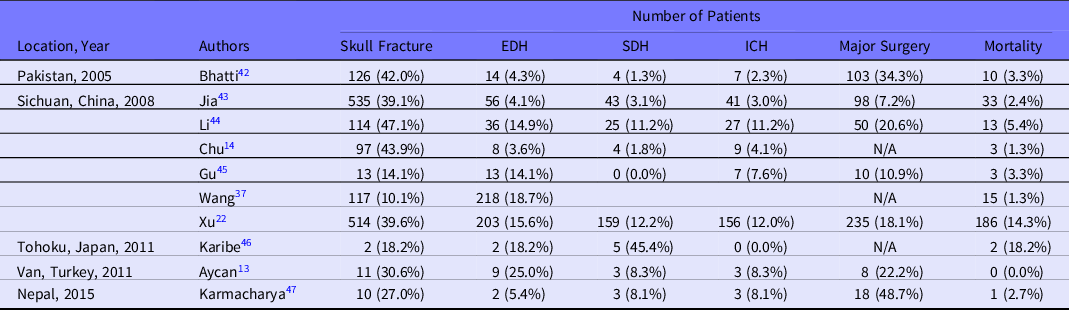
The literature search identified 3,226 articles, 1,765 of which were duplicates and were excluded, leaving 1,461 to be screened. The title and abstract of these articles were screened, and 156 articles were selected for reading. Careful reading of the full-length texts led to identification of 34 articles for inclusion in the analysis (Figure 1). Of these articles, 25 described the proportion of head injury-related trauma among all injury-related trauma patients who were victims of an earthquake (Table 1), and the other 10 articles described earthquake-related head injuries (Table 2).
The flowchart of this systematic review.

Proportion of patients with head and other injuries after a major earthquake

Abbreviations: CDC, centers for disease control and prevention; N/A, not available ; SSR, Soviet Socialist Republic; US, United States.
Diagnosis, major surgery, and mortality of patients with head injury after a major earthquake

Abbreviations: EDH, epidural hematoma; ICH, intracerebral hemorrhage; N/A, not available; SDH, subdural hematoma.
Proportion of Patients With Head Injuries
Head injuries accounted for 1.8 – 25.7% of injuries among trauma patients after an earthquake. The mean prevalence of head injuries was 16.6% from 25 studies. The most common injuries were those to the lower extremities (36.2%) and upper extremities (19.9%), followed by those to the spine (13.1%), chest (11.3%), and abdomen (3.8%).
Median interval of patient registration after earthquakes was 16 days (interquartile range 9 – 41). Limited to the studies within 3 days after earthquakes, head injures accounted for 13.2%.
Neurological Surgery
Studies of inpatients admitted to the department of neurological surgery were found, and 4770 patients were included in the 10 studies (Table 2). The mean age of these patients was 32.6 years. It was found that 59.1% of the patients with head injuries had contusion/laceration; 32.3%, skull fracture; 9.5%, epidural hematoma; 7.0%, intracerebral hematoma; and 6.8%, subdural hematoma. Patients who received major surgery accounted for 15.4%, and the mortality rate was 5.6%.
Median interval of patient registration after earthquakes was 22 days (interquartile range 14 – 53). Of the studies, 3 showed that the largest number of people occurred within 24 hours after an earthquake. Reference Xu, You and Zhou22,Reference Li, Yang, Xu, Chen and You44,Reference Gu, Yang and Cheng45 On the other hand, 2 studies showed that more patients occurred following 48 hours compared with initial 24 hours in Pakistan and Nepal. Reference Bhatti, Ahmed, Qureshi, Akram and Khan42,Reference Karmacharya and Sathian47
Discussion
This review revealed that head injuries were the third most common injuries among patients who were victims of earthquakes. It also revealed that epidural hematoma was the most common earthquake-related intracranial hemorrhage.
Injury Severity
The characteristics of earthquake-related head injury are relatively mild and extra-cranial. Earthquake-related head injuries were more frequently associated with a soft tissue wound (50.7% versus 26.2%, relative risk [RR] = 1.9) and less frequently with intracranial hemorrhage (17.2% vs 50.7%, RR = 0.3) compared with non-earthquake-related head injuries. Reference Chu, Yang, Dong, Chen, Zhu and Shao14 Earthquake-related head injuries are likely to occur at a low velocity following an earthquake compared with traffic accidents. The mean injury severity score (ISS) was 6.6 for hospitalized patients with head injuries. Patients with an ISS of ≤ 16 accounted for 87.0% – 96.3% of all injured earthquake victims. Reference Peek-Asa, Kraus, Bourque, Vimalachandra, Yu and Abrams7,Reference Qiu, Liu and Wang10 After the Sichuan earthquake, patients with an abbreviated head injury scale score ≥ 4 accounted for 1.7% of hospitalized patients. Classification using the Glasgow Coma Scale (GCS) showed that 8.3% of these patients had moderate traumatic brain injury. Reference Aycan, Yener, Aycan, Gönüllü, Dursun and Gönüllü13
Multiple Injuries
Earthquake-related head injuries likely involve multiple injuries. Patients with multiple injuries comprised 26.7% – 56.7% of all individuals injured following an earthquake. Reference Bhatti, Ahmed, Qureshi, Akram and Khan15-Reference Sánchez-Carrillo17 A study determined that 43.3% of the individuals injured after an earthquake had a single injury, whereas the rest had multiple injuries, namely 45.8% had 2 injuries, 9.0% had 3 injuries, 1.7% had 4 injuries, and 0.2% had 5 injuries. Reference Lu-Ping, Rodriguez-Llanes and Qi3 Out of all patients with head injuries, 23.9% – 26.7% had other additional injuries, which were managed by the respective specialists.
Among patients with head injuries who had multiple injuries, the other injuries were found to be as follows: cervical vertebral fracture (8.6%), thoracic vertebral fracture (22.9%), lumbar vertebral fracture (17.1%), rib fracture (28.6%), clavicle fracture (8.6%), and pulmonary contusion (5.7%). Reference Chu, Yang, Dong, Chen, Zhu and Shao14
Diagnosis
According to 10 studies, the most common type of head injury after an earthquake was laceration or contusion, accounting for 59.2% of all cases, followed by skull fracture (32.3%) and intracranial hemorrhage (22.1%).
Skull fractures stemming from earthquake-related head injury were observed in the frontal bone (8.5%), parietal bone (8.5%), temporal bone (12.8%), occipital bone (10.0%), sphenoid bone (2.8%), and mandible (11.3%). The proportion of patients with earthquake-related occipital and mandible bone fractures was significantly higher than the proportion of patients with non-earthquake-related occipital and mandible bone fractures. In contrast, the proportion of patients with earthquake-related maxilla fracture (6.4%) was significantly lower than for that with non-earthquake-related maxilla facture (P < 0.05). Reference Chu, Yang, Dong, Chen, Zhu and Shao14
The most common type of intracranial hemorrhage was epidural hematoma (EDH), which accounted for 9.5% of inpatients with head injury across 9 studies, followed by intracerebral hemorrhage (ICH) (7.0%) and subdural hematoma (SDH) (6.8%). In all except 2 small studies, the proportion of patients who developed EDH was higher than those who developed SDH. In general, EDH was observed in 1% – 4% of traumatic brain injury cases, the incidence of which was lower than that of SDH. Reference Bullock, Chesnut and Ghajar18 Although the exact incidence rate is unknown, EDH is more common than SDH after an earthquake.
Neurological Surgery
The most common type of surgery conducted on patients with earthquake-related head injury was debridement and suture, which accounted for 33.1% – 64.7% of the inpatient cases. Of all patients with cranial wounds, 66.3% had multiple wounds. Reference Qiu, Liu and Wang10,Reference Bhatti, Ahmed, Qureshi, Akram and Khan15
Major surgery was defined as craniotomy, evacuation of hematoma, and cranium repair under general anesthesia. The mean proportion of inpatients with head injury that underwent major surgery was 15.5%. Among patients with altered mental status, focal neurological deficits and skull fracture, 29% were operated under general anesthesia. In contrast, only 5.3% of patients without these symptoms were underwent surgery. Reference Bhatti, Ahmed, Qureshi, Akram and Khan15
EDH was the most common head injury requiring after an earthquake that required surgical treatment. Craniotomy and hematoma evacuation are the standard treatments for symptomatic EDH. Patients with acute EDH who received surgery within 2 hours after onset of coma had a significantly lower mortality rate (17% versus 56%, P < 0.01) and a higher rate of good recovery (67% versus 13%, P < 0.01) as opposed to patients who received surgery at a later stage (> 2 hours). Reference Haselsberger, Pucher and Auer19 Of the patients with EDH, 10 had a GCS score of < 8 at the time of admission and developed new anisocoria after admission. The patients that underwent craniotomy of more than 90 minutes after the onset of anisocoria were 5 in number, and they all died. Of the other patients, 5 underwent craniotomy within 70 minutes after anisocoria onset, and survived with good recovery or moderate disability. Reference Cohen, Montero and Israel20 These findings indicate that patients with symptomatic EDH should undergo immediate surgical intervention. However, it may be difficult for a large number of patients with EDH to undergo craniotomy under general anesthesia immediately after an earthquake. A single series of patients with EDH underwent burr hole evacuation (trephination) after an earthquake. Of the 36 patients having EDH, 1 required craniotomy after trephination, and although no recurrences or complications were observed among them, 1 of the patients died. Single burr hole surgery is safe and has produced good outcomes for a large number of patients with earthquake-related EDH. Reference Aurangzeb, Ahmed and Maqbool21 Burr hole surgery should therefore be considered when a large number of patients with EDH require surgical intervention.
Outcome
According to 9 studies, head injury-associated mortality ranged from 0.0 to 14.3%, with a mean of 5.6% (Table 2). It is difficult to evaluate and compare head injury-associated mortality because the proportion of severe head injuries is unclear and medical standards differ according to geographical locations. However, based on the analysis of factors that influence mortality rate in hospitals subsequent to the occurrence of a disaster, severe traumatic brain injury was found to be the most common (odds ratio (OR) = 253.3, 95% confidence interval (CI) = 8.9 – 7208.6), followed by multiple organ failure (OR = 87.8, 95%CI = 3.9 – 1928.3) and prior major disease and infection (OR = 14.9, CI = 1.9 – 119.0). Reference Xu, You and Zhou22 Moreover, mortality and injury profiles were influenced by the time of injury. Reference Shoaf, Sareen, Nguyen and Bourque23
Surveillance
While multicenter retrospective studies did not often detect severe traumatic brain injury (TBI) in patients with earthquake-related head injuries, 135 patients with severe (32 patients) and moderate (103 patients) TBI were treated of whom 96 patients underwent surgery under general anesthesia in a neurological facility. Reference Bhatti, Ahmed, Qureshi, Akram and Khan15 This finding highlights the importance of obtaining real-time information about the incidence of TBI, injecting relevant medicines at the appropriate site, and transporting patients to hospitals with sufficient capacity. However, until recently, there was no established methodology for achieving these outcomes. In order to meet this demand, the World Health Organization established a technical working group in 2016, which published a final report defining the standard daily reporting items and a daily reporting form for Emergency Medical Teams (EMTs) in 2017. Reference Jafar, Sergeant and Lecky24 A total of 50 items were selected as the Minimum Data Set (MDS) for EMTs. The MDS includes “major head/spine injury,” which is defined as “any major trauma to the scalp, skull, brain and spinal cord requiring hospitalization and/or surgery under general anesthesia.” According to this daily reporting MDS, EMTs are expected to act as sentinels for TBI surveillance during a disaster. An increasing number of EMTs are expected to contribute toward this ad-hoc surveillance system. Previous studies have suggested that with the passage of time, the proportion of patients with disaster-related injuries decreases while that of patients with injures unrelated to disasters increases. The MDS for EMTs also enlists items related to counting of the number of individuals affected by a disaster. Such data will contribute toward identification of the most appropriate medical assistance for individuals affected by a disaster and reflects a paradigm shift in disaster management.
Limitation
This review has several limitations. A few researches were published when earthquakes occurred in the developing countries despite a high death toll. Prevalence and characteristics of earthquake-related head injuries could vary by economic development and population density. Mortality rate also could be affected with medical standards by country. Therefore, it is required to consider the situation in each country.
Conclusion
Head injury was the main cause of mortality and morbidity after an earthquake. Head injuries were the second most common injury among outpatients and the third most common injury among hospitalized victims of earthquakes. Epidural hematoma was the most common earthquake-associated intracranial hemorrhage. This knowledge is important for identifying the demand for neurosurgery and for adequate management of patients following a disaster under resource-limited conditions.