Introduction
Emergency services’ telecommunicators, including call takers and dispatchers, are the frontline of immediate health care response to unscheduled community requests for first aid and medical assistance. In addition to collecting critical health information, prioritizing calls, and rapidly dispatching appropriate medical resources, telecommunicators may provide laypeople with instant telephone pre-arrival instructions (PAI) on first aid, thus contributing to the initiation and continuation of care before professional help reaches the patient’s side. Reference Hewett Brumberg, Douma and Alibertis1
Since the first organized PAI program for cardiac arrest in 1974, Reference Carter, Eisenberg, Hallstrom and Schaeffer2 many Emergency Medical Services (EMS) systems have systematically integrated telecommunicator cardiopulmonary resuscitation (T-CPR) procedures into their daily operations. Reference Gräsner, Wnent and Herlitz3,Reference Lee, Mao and Ng4 Given the proven benefits of T-CPR in increasing bystander intervention rates and improving neurological outcomes after cardiac arrest, Reference Eberhard, Linderoth, Gregers, Lippert and Folke5 major resuscitation societies strongly advocate for T-CPR as a safe, cost-effective, and efficient life-saving strategy. Reference Kurz, Bobrow and Buckingham6–Reference Berg, Cheng and Panchal8 Research on T-CPR continues to expand, Reference Imbriaco and Ramacciati9 driving further innovation and adoption world-wide.
The growing international focus on T-CPR has not been matched by comparable attention to telecommunicator-assisted first aid (TAFA) for emergencies beyond cardiac arrest, such as trauma, acute coronary syndrome, overdose, anaphylaxis, and other time-sensitive conditions. Although practiced in several regions Reference Lee, Mao and Ng4 and recognized by some EMS systems as a standard of care, 10 non-resuscitative TAFA remains largely overlooked in research. A preliminary search of TAFA-related literature conducted in 2022 Reference Birkun11 had found 248 unique publications, of which 96% addressed telephone advice for cardiac arrest, whereas papers related to TAFA for other emergencies were occasional. Limited research productivity in this area may hinder evidence-based advancement and broader implementation of non-resuscitative TAFA, resulting in missed opportunities to improve public health outcomes and to reduce demand on EMS resources.
The present scoping review systematically maps and analyzes the existing body of quantitative research on non-resuscitative TAFA, highlighting current knowledge, evidence gaps, and directions for future study.
Methods
This study is reported in accordance with the Preferred Reporting Items for Systematic Reviews and Meta-Analyses Extension for Scoping Reviews (PRISMA-ScR) guidance. Reference Tricco, Lillie and Zarin12 The completed PRISMA-ScR checklist is available as an online supplement (Appendix A).
For the purpose of this review, TAFA was defined as a telecommunication process involving the provision of PAI on first aid by emergency services’ telecommunicators to laypeople via audio-only calls or video streaming.
Protocol and Registration
A protocol for the review was not registered or published. However, the methodology of the review remained unchanged, and no post-hoc decisions were made concerning the search, selection, or analysis of sources of evidence.
Eligibility Criteria
Studies were included if they reported original quantitative data on simulated, experimental, or real-world applications of TAFA for health emergencies. Studies concerning exclusively cardiac arrest management (CPR or automated external defibrillation; not addressing aspects of first aid for other emergencies); mental health first aid; non-emergency medical counselling (eg, primary care or nursing advice through a medical helpline); telemedicine in special settings (eg, in-flight or maritime environments); those limited to telecommunicator recognition or triage of health emergencies (not involving the provision of first aid advice); reporting qualitative research on telecommunicator or caller perceptions (eg, sociolinguistic or conversation analysis); or not specifying the nature of the provided advice were outside the scope of the current work. The analysis included English-language peer-reviewed journal papers, excepting guideline or consensus documents, study protocols, publications without abstracts (eg, letters, commentaries, editorials, conference proceedings), and reviews. However, relevant reviews were searched, collected, and evaluated to retrieve potentially eligible original studies. No limits were applied to publication dates.
Information Sources and Search
Search strategies were developed based on terminology identified in previously published reviews and original research on T-CPR. The final search strategies are provided in Appendix B. In 2025, PubMed (National Center for Biotechnology Information, National Institutes of Health; Bethesda, Maryland USA), Scopus (Elsevier; Amsterdam, Netherlands), and Google Scholar (Google Inc.; Mountain View, California USA) were searched to identify potentially eligible documents. Additionally, reference lists of eligible papers and relevant reviews were manually scanned to identify the articles of interest.
Selection of Sources of Evidence
The search results were imported into Zotero 7.0.16 (Corporation for Digital Scholarship; Vienna, Virginia USA) reference management program and cleared of duplicates. Titles and abstracts of the remaining unique records were sequentially screened to identify potentially relevant publications. Then, full texts of the selected articles were analyzed to verify their inclusion in the scoping review, and reference lists of the included papers were checked to identify additional eligible publications.
Data Charting Process and Data Items
Data were extracted from the eligible articles using an a priori author-developed data-charting form. Collected data included: author(s) and year of publication, article title, web link, publication type, country of origin (based on first author’s primary affiliation), study aim, addressed health condition(s), study design, methods, study sample, key results, conclusions, and recommendations related to TAFA. The final charting form is available online. Reference Birkun and Douma13 All charted data underwent duplicate verification to ensure accuracy. Literature screening and initial data extraction were conducted by one reviewer (AAB) with subsequent check of study eligibility and accuracy of the extracted data for all included articles by the second reviewer (MJD). Any discrepancies were resolved through discussion.
Critical Appraisal of Individual Sources of Evidence
This scoping review did not involve a critical appraisal of included sources of evidence.
Synthesis of Results
The general characteristics of studies were summarized using descriptive statistics, and a narrative synthesis of the results was undertaken.
Results
Characteristics of Sources of Evidence
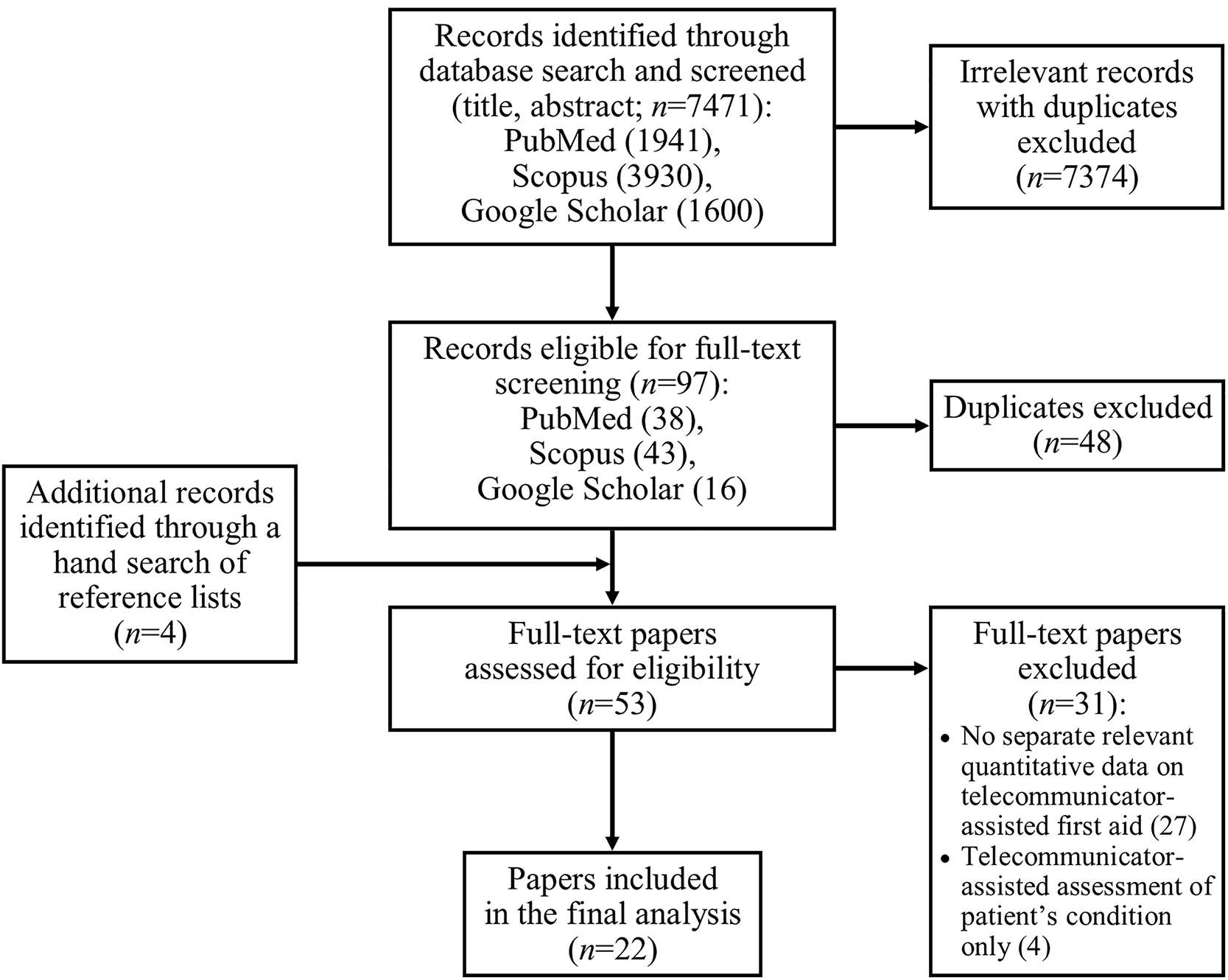
The flow of selection of publications for this review is outlined in Figure 1. Of the 53 full texts evaluated for eligibility, 31 were excluded as they did not report relevant quantitative data on TAFA or dealt exclusively with telecommunicator-guided assessment of the patient’s condition. The remaining 22 articles were included in the analysis. Reference Lee, Mao and Ng4,Reference Billittier, Lerner, Tucker and Lee14–Reference Idland, Kramer-Johansen and Bakke34
Study Selection Diagram.

Key characteristics of particular articles, including authors, years of publication, countries of origin, study aims, addressed health conditions, designs, methods, main findings, conclusions, and recommendations related to TAFA, are available in the online repository. Reference Birkun and Douma13
The articles were published from 2000 through 2024. Based on the first author’s primary affiliation, the reported studies originated from nine high-income countries, including the United States (n = 10; 45.5%), Reference Billittier, Lerner, Tucker and Lee14,Reference Evenson, Brice, Rosamond, Lellis, Christian and Morris18,Reference Beauchamp, Phrampus and Guyette19,Reference Caceres, Adil and Jadhav22,Reference Goldberg, Dworkis and Liao25–Reference Li, Hu and Gregg29,Reference Davidson, Correll and Gottula33 Norway (n = 3; 13.6%), Reference Melbye, Hotvedt and Bolle23,Reference Bakke, Steinvik, Ruud and Wisborg24,Reference Idland, Kramer-Johansen and Bakke34 France (n = 2; 9.1%), Reference Labarère, Torres and Francois16,Reference Fourny, Lucas and Belle20 the United Kingdom (n = 2; 9.1%), Reference O’Cathain, Turner and Nicholl15,Reference Barron, Clawson and Scott21 Australia (n = 1; 4.5%), Reference Lee, Mao and Ng4 Germany (n = 1; 4.5%), Reference Auerbach, Schreyögg and Busse17 Japan (n = 1; 4.5%), Reference Igarashi, Suzuki and Norii32 Spain (n = 1; 4.5%), Reference Aranda-García, Santos-Folgar and Fernández-Méndez30 and Switzerland (n = 1; 4.5%). Reference Dami, Enggist, Comte and Pasquier31
Research designs included experimental randomized controlled (n = 4), Reference Scott, Olola and Gardett28,Reference Aranda-García, Santos-Folgar and Fernández-Méndez30,Reference Igarashi, Suzuki and Norii32,Reference Davidson, Correll and Gottula33 non-randomized controlled (n = 1), Reference Melbye, Hotvedt and Bolle23 and non-controlled (n = 1) Reference Ornato, You and McDiarmid27 descriptive cross-sectional (n = 1), Reference Lee, Mao and Ng4 observational cross-sectional (n = 4), Reference Billittier, Lerner, Tucker and Lee14–Reference Labarère, Torres and Francois16,Reference Evenson, Brice, Rosamond, Lellis, Christian and Morris18 prospective observational (n = 5), Reference Beauchamp, Phrampus and Guyette19,Reference Fourny, Lucas and Belle20,Reference Bakke, Steinvik, Ruud and Wisborg24,Reference Goldberg, Dworkis and Liao25,Reference Idland, Kramer-Johansen and Bakke34 retrospective observational (n = 5), Reference Auerbach, Schreyögg and Busse17,Reference Barron, Clawson and Scott21,Reference Caceres, Adil and Jadhav22,Reference Grisanti, Martorano and Redmond26,Reference Li, Hu and Gregg29 and retrospective descriptive (n = 1) studies. Reference Dami, Enggist, Comte and Pasquier31 Five studies were cohort (two prospective Reference Fourny, Lucas and Belle20,Reference Idland, Kramer-Johansen and Bakke34 and three retrospective Reference Barron, Clawson and Scott21,Reference Caceres, Adil and Jadhav22,Reference Dami, Enggist, Comte and Pasquier31 ) studies.
The studies investigated hypothetical or actual application of TAFA for the following health conditions: anaphylaxis (n = 3), Reference Grisanti, Martorano and Redmond26,Reference Dami, Enggist, Comte and Pasquier31,Reference Davidson, Correll and Gottula33 chest pain or myocardial infarction (n = 3), Reference Evenson, Brice, Rosamond, Lellis, Christian and Morris18,Reference Fourny, Lucas and Belle20,Reference Barron, Clawson and Scott21 stroke (n = 3), Reference Evenson, Brice, Rosamond, Lellis, Christian and Morris18,Reference Caceres, Adil and Jadhav22,Reference Li, Hu and Gregg29 trauma (n = 3), Reference Auerbach, Schreyögg and Busse17,Reference Bakke, Steinvik, Ruud and Wisborg24,Reference Idland, Kramer-Johansen and Bakke34 bleeding (n = 2), Reference Billittier, Lerner, Tucker and Lee14,Reference Scott, Olola and Gardett28 childbirth (n = 2), Reference Billittier, Lerner, Tucker and Lee14,Reference Aranda-García, Santos-Folgar and Fernández-Méndez30 foreign body airway obstruction (n = 2), Reference Billittier, Lerner, Tucker and Lee14,Reference Igarashi, Suzuki and Norii32 opioid overdose (n = 2), Reference Goldberg, Dworkis and Liao25,Reference Ornato, You and McDiarmid27 and respiratory arrest (n = 2). Reference Billittier, Lerner, Tucker and Lee14,Reference Beauchamp, Phrampus and Guyette19 The type of addressed health emergencies was not specified in four publications. Reference Lee, Mao and Ng4,Reference O’Cathain, Turner and Nicholl15,Reference Labarère, Torres and Francois16,Reference Melbye, Hotvedt and Bolle23
Studies of Real-World EMS Call Data
Eight studies (36.4%) Reference Fourny, Lucas and Belle20–Reference Caceres, Adil and Jadhav22,Reference Bakke, Steinvik, Ruud and Wisborg24,Reference Grisanti, Martorano and Redmond26,Reference Li, Hu and Gregg29,Reference Dami, Enggist, Comte and Pasquier31,Reference Idland, Kramer-Johansen and Bakke34 involved analyses of real EMS call data with sample sizes ranging from 113 to 52,282 (median [Q1, Q3]: 374.0 [170.8, 37,377.8]). In particular, Fourny, et al (2011) Reference Fourny, Lucas and Belle20 reported the provision of medical advice for patients with myocardial infarction (instead of immediately dispatching a mobile intensive care unit) as a type of inappropriate initial dispatcher’s decision that, combined with other inappropriate decisions, may result in substantial delays in time to reperfusion therapy. Barron and coauthors (2013) Reference Barron, Clawson and Scott21 determined rates of completion of emergency medical dispatch (EMD) protocol for pre-arrival aspirin administration to treat suspected acute coronary syndrome and revealed a substantial number of cases where the protocol was not used by dispatchers, though the patients met the necessary criteria. A study by Caceres, et al (2013) Reference Caceres, Adil and Jadhav22 showed that recognition of stroke by emergency dispatchers significantly increased the likelihood of the provision of telephone guidance to callers. Further, Li and colleagues (2021), Reference Li, Hu and Gregg29 along with reporting rates of the provision of PAI for suspected stroke events, confirmed that the use of instructions was significantly and negatively (inversely) associated with EMS delay. Bakke and coauthors (2017) Reference Bakke, Steinvik, Ruud and Wisborg24 presented rates of emergency dispatch telephone guidance in trauma, revealed low sensitivity and specificity of dispatchers for correctly identifying trauma patients requiring first-aid measures, and found that dispatcher advice did not significantly influence whether first aid was performed correctly or attempted at all, though in regions with a high spontaneous first aid rate. According to Idland, et al (2024), Reference Idland, Kramer-Johansen and Bakke34 video streaming by dispatchers in calls regarding injured patients, although infrequently used, improved dispatcher recognition of the need for first-aid measures but did not influence the quality of first aid compared with audio-only calls. Grisanti, et al (2019) Reference Grisanti, Martorano and Redmond26 demonstrated suboptimal adherence to EMD protocols for allergies by EMS dispatchers, who infrequently asked about epinephrine availability or instructed callers with suspected anaphylaxis and available epinephrine to use it. Subsequent study of suspected anaphylaxis cases by Dami, et al (2022) Reference Dami, Enggist, Comte and Pasquier31 reported rates of accepted and declined dispatcher advice on using epinephrine autoinjector and identified reasons for refusing the use of the drug. Based on the research results, the authors recommended to further investigate a relationship between TAFA and bystander attempts to provide first aid, Reference Bakke, Steinvik, Ruud and Wisborg24 improve accuracy of telephone triage to enhance dispatcher identification of the need for TAFA, Reference Fourny, Lucas and Belle20,Reference Bakke, Steinvik, Ruud and Wisborg24 conduct studies to understand reasons of why dispatchers are not using an EMD protocol, Reference Barron, Clawson and Scott21 make efforts to increase protocol adherence, Reference Grisanti, Martorano and Redmond26 perform protocol improvement, Reference Grisanti, Martorano and Redmond26 enhance public access to aspirin Reference Barron, Clawson and Scott21 and epinephrine, Reference Dami, Enggist, Comte and Pasquier31 implement related public education campaigns, Reference Barron, Clawson and Scott21 provide training for dispatchers, Reference Caceres, Adil and Jadhav22,Reference Grisanti, Martorano and Redmond26,Reference Li, Hu and Gregg29,Reference Dami, Enggist, Comte and Pasquier31 and carry out TAFA performance oversight. Reference Caceres, Adil and Jadhav22,Reference Grisanti, Martorano and Redmond26
Simulation-Based Experimental Studies
Another eight studies (36.4%) Reference Beauchamp, Phrampus and Guyette19,Reference Melbye, Hotvedt and Bolle23,Reference Goldberg, Dworkis and Liao25,Reference Ornato, You and McDiarmid27,Reference Scott, Olola and Gardett28,Reference Aranda-García, Santos-Folgar and Fernández-Méndez30,Reference Igarashi, Suzuki and Norii32,Reference Davidson, Correll and Gottula33 generated research data in simulated settings. Sample size varied from 12 to 246 (median [Q1, Q3]: 31.5 [21.0, 80.0]). Beauchamp, et al (2009) Reference Beauchamp, Phrampus and Guyette19 demonstrated a high success rate of laypersons in telephone-directed placement of a laryngeal tube during simulated respiratory arrest. Melbye and colleagues (2014) Reference Melbye, Hotvedt and Bolle23 tested mobile phone video conferencing between EMD and bystanders who performed various first-aid tasks according to the provided instructions in different surroundings. The study group concluded that video conferencing can be used during medical emergencies under suboptimal sound and light conditions. According to a study by Goldberg, et al (2018), Reference Goldberg, Dworkis and Liao25 bystanders were able to access pre-stationed intranasal naloxone and administer it in a shorter time than community EMS response times. Later, Ornato and collaborators (2020) Reference Ornato, You and McDiarmid27 showed successful dispatcher-directed bystander administration of naloxone nasal spray delivered by drone to opioid overdose victims. An article by Scott and coauthors (2020) Reference Scott, Olola and Gardett28 reported a randomized controlled study where laypeople provided with telephone instructions from a trained EMD applied a tourniquet and stopped simulated bleeding completely in most cases. A study by Aranda-García, et al (2022) Reference Aranda-García, Santos-Folgar and Fernández-Méndez30 demonstrated the feasibility of remote video assistance to untrained bystanders equipped with smart glasses in a scenario of unplanned out-of-hospital birth. Igarashi, et al (2022) Reference Igarashi, Suzuki and Norii32 confirmed the superior quality of first aid for choking infants with dispatcher advice through video calls compared to voice-only calls. In research by Davidson, et al (2024), Reference Davidson, Correll and Gottula33 bystanders guided by drone-specific or standard EMD instructions successfully interacted with the drone and administered the required interventions for pediatric anaphylaxis, with better adherence to drone safety cues in the group that received the drone-specific guidance. The publications recommended further studies in more realistic scenarios Reference Beauchamp, Phrampus and Guyette19,Reference Davidson, Correll and Gottula33 or clinical settings Reference Goldberg, Dworkis and Liao25,Reference Ornato, You and McDiarmid27 and advised considering relevant ethical aspects of using video communication technologies for TAFA. Reference Aranda-García, Santos-Folgar and Fernández-Méndez30
Surveys
Five studies (22.7%) Reference Lee, Mao and Ng4,Reference Billittier, Lerner, Tucker and Lee14–Reference Labarère, Torres and Francois16,Reference Evenson, Brice, Rosamond, Lellis, Christian and Morris18 collected data through surveys, which encompassed from nine to 652 participants (median [Q1, Q3]: 409.0 [47.0, 588.0]). Billittier and colleagues (2000) Reference Billittier, Lerner, Tucker and Lee14 evaluated the lay public’s (n = 524) expectations of PAI when dialing 9-1-1 and found that most respondents expected to receive the instructions for health emergencies regardless of the current availability of such service. O’Cathain, et al (2002) Reference O’Cathain, Turner and Nicholl15 determined the acceptability of TAFA to ambulance callers before (n = 355) and after (n = 297) the introduction of the Advanced Medical Priority Dispatch System. The study showed the effect of an increase in the amount of first aid advice given to callers and caller satisfaction with the service. Positive public rating of telephone guidance provided by EMS call centers and 61% patient compliance with the self-treatment advice given were reported in an article by Labarère and coauthors (2003). Reference Labarère, Torres and Francois16 A survey of 9-1-1 communication centers carried out by Evenson, et al (2007) Reference Evenson, Brice, Rosamond, Lellis, Christian and Morris18 examined personnel training, certification, and PAI provision rates for stroke and myocardial infarction. As part of a survey of EMD services across Asian countries published by Lee, et al (2020), Reference Lee, Mao and Ng4 seven of nine participating countries confirmed the practice of provision of non-resuscitative PAI. The research-synthesized recommendations included future investigations of callers’ compliance, willingness, and ability to follow PAI, Reference Billittier, Lerner, Tucker and Lee14,Reference Labarère, Torres and Francois16 examination of TAFA economic impact and its actual effects on patient outcomes, Reference Billittier, Lerner, Tucker and Lee14 and organization of training and certification for call center personnel. Reference Labarère, Torres and Francois16,Reference Evenson, Brice, Rosamond, Lellis, Christian and Morris18
Economic Evaluation Research
One study (4.5%) published by Auerbach, et al (2006) Reference Auerbach, Schreyögg and Busse17 represented a cost-effectiveness analysis of two equipment versions of telemedical devices for traffic accident emergency rescue, one of which included a mobile device with a touch-screen display, audio, and video connection for instructing and supporting laypersons in performing first aid. The study found that the application of the telemedical device may considerably reduce the number of traffic-related fatalities, but its application would be associated with a high cost-effectiveness ratio. To facilitate the implementation of the technology, the authors recommended building a coordinated European initiative among European member states.
Discussion
The provision of PAI on first aid to untrained bystanders has a potential for increasing community first response rates and improving outcomes of health emergencies in a safe and cost-effective way. Reference Delbridge, Bailey and Chew35 Such practice is recognized by developed emergency systems as a mandatory function of EMD. 10,Reference Clawson36 The current scoping review showed that, despite the importance of the topic, there remains a paucity of related research evidence. The literature search revealed only 22 quantitative studies on non-resuscitative TAFA, which were highly heterogeneous in terms of design, methods, and data sources, and covered a limited spectrum of emergencies. All studies were led by authors from high-income countries.
The lack of evidence on non-resuscitative TAFA contrasts with the domain of T-CPR, which constitutes a forefront area of modern emergency medicine research, demonstrating a consistently increasing number of peer-reviewed publications, counted in hundreds. Reference Imbriaco and Ramacciati9 The progressive growth of research outputs for T-CPR is not least because of the intensive promotion of the concept by relevant professional bodies, including the International Liaison Committee on Resuscitation (Belgium), Reference Greif, Bray and Djärv37 the American Heart Association (Dallas, Texas USA), Reference Berg, Cheng and Panchal8 and the European Resuscitation Council (Niel, Belgium). Reference Semeraro, Greif and Böttiger7 Besides issuing the evidence-based recommendations, these organizations delineate related knowledge gaps that further increase scholar’s attention to T-CPR and potentiate original research endeavors. That said, non-resuscitative TAFA basically remains out of scope of the current international guidelines and consensuses on first aid.
Notwithstanding the small amount and diversity of research on non-resuscitative TAFA, the particular studies have generated important insights regarding real-life practices of emergency telephone guidance on first aid, demonstrated the feasibility of experimental techniques, including video communication technologies, and identified multiple areas for future investigations and organizational interventions. The evidence suggests that non-resuscitative TAFA is provided by EMS systems in different countries and is generally positively perceived by the public. However, its performance with regard to adherence to EMD protocols can be suboptimal, and implementation of targeted dispatcher training programs is therefore advisable. While several studies demonstrated the potential feasibility of dispatcher guidance in simulated settings, relationships between the real-life application of TAFA and patient outcomes remain unclear and necessitate further research.
Given the important health-protecting and life-saving perspectives of TAFA, significantly more academic attention is needed for this area of emergency medicine. Similar to the Telecommunicator CPR Policy Statement from the American Heart Association, Reference Kurz, Bobrow and Buckingham6 an international call for action could be endorsed by recognized professional entities to provide conceptual justification, operational definitions, and performance measures for TAFA, along with outlining the research agenda to encourage further investigations and developments. The creation of dedicated national and international expert groups, including within the International Liaison Committee on Resuscitation First Aid Task Force, may build a strong foundation for organized and evidence-based advancement of this promising strategic approach for enhancing community first aid.
Limitations
This review has limitations to acknowledge. No study protocol was registered or published prior to the review initiation. The literature was sought in two bibliographic databases and in one language. However, grey literature search through the academic search engine and manual screening of reference lists were additionally employed to ensure better coverage of potentially eligible studies. The review did not consider letters, commentaries, notes, and other papers without an abstract, whereas these publications may occasionally report relevant original data. These limitations may have caused search-related bias. Also, this scoping review focused on peer-reviewed articles that reported quantitative data. All qualitative studies were excluded, although they may synthesize important information on the subject. Finally, the literature screening and initial data extraction were conducted by one reviewer with subsequent check by the second reviewer, which may have introduced selection bias.
Conclusions
This scoping review of quantitative studies showed that non-resuscitative TAFA remains an under-explored area of prehospital medicine. Considering the available limited, heterogeneous, and inconclusive evidence, significantly more research is required to better understand its effects and practical implications. By mapping the current knowledge and outlining the evidence gaps, this review may assist the prehospital medicine community in advancing the development of non-resuscitative TAFA.
Supplementary Material
To view supplementary material for this article, please visit https://doi.org/10.1017/S1049023X26108942
Data Availability Statement
The dataset generated and analyzed during the current study is available in the Mendeley Data repository. Reference Birkun and Douma13
Author Contributions
Alexei A. Birkun: Conceptualization, Methodology, Investigation, Data Curation, Project Administration, Writing - Original Draft Preparation.
Matthew J. Douma: Validation, Formal Analysis, Supervision, Writing - Reviewing and Editing.
Funding Statement
This research did not receive any financial support.
Competing Interests
The authors declare no conflicts of interest.
Use of AI Technology
The authors did not use any artificial intelligence (AI) tools or services to assist with preparation or editing of this work.
Editor’s Note
Editor-in-Chief (EIC) Dr. Jeffrey Franc declares a minor conflict of interest (COI) in reviewing this manuscript. In instances where the EIC has a minor COI, the manuscript follows the standard review process but requires additional approval from an Editorial Board member before acceptance. Final approval for publication of this manuscript was given by Editorial Board member Dr. Joe Cuthbertson.