1. Introduction
Oberdeutscher Präteritumschwund (Upper German Preterite Loss) refers to a change in the verbal system of southern dialects of German, in which the preterite tense was lost and replaced by the present perfect tense. This change took place in Early New High German (ENHG), the stage of the language between 1350 and 1650. According to a study of southern German texts by Lindgren (Reference Lindgren1957), narration tends to be in the preterite tense through the 15th century. Around 1530, Lindren's (Reference Lindgren1957:106–107) texts display a sudden increase in the frequency of the present perfect, with most writers no longer semantically distinguishing it from the preterite. Lindgren (Reference Lindgren1957:111) concludes from this that the preterite of lexical verbs must have completely disappeared in southern dialects around 1500.
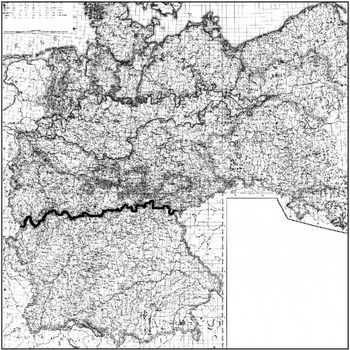
Dialectal studies in the twentieth century have determined that, south of a line running approximately from Trier to Plauen, most verbs do not have a preterite form (Lindgren Reference Lindgren1957:44). This line is roughly equivalent to that in figure 1, which illustrates the southernmost extent of the preterite of kommen ‘come’. A more southerly isogloss runs approximately from Saarbrücken to Cheb (now in the Czech Republic): south of this line, there are no preterite forms for any verb, except for isolated pockets retaining the preterite for sein ‘to be’ (Lindgren Reference Lindgren1957:44). For southern speakers, the preterite tense is now largely limited to written and formal registers (Helbig & Buscha Reference Helbig and Joachim2001:134).
The isogloss kam ‘came’ vs. ist gekommen ‘has come’.Footnote 1

A number of explanations have been offered for the Präteritum-schwund, which will be presented in the next section. This paper evaluates these competing hypotheses using a corpus of ENHG texts, and concludes that the best explanation is quite close to the traditional idea that the loss of the preterite was triggered by the loss of schwa in certain verb forms. However, unlike the traditional hypothesis, which sees apocope in the 3sg. of weak verbs as the primary cause (Reis Reference Reis1891), my study demonstrates that it is syncope in the second person that initiates the decline of the preterite tense.
This paper is organized as follows. Section 2 discusses previous hypotheses for the loss of the preterite. Section 3 introduces the database and analytical method used here. Section 4 presents the analyses that are related to the traditional apocope hypothesis and my syncope hypothesis. In section 5, other hypotheses are considered, of which some are unsupported by this study, and others are shown to be secondary to the effect of syncope. Section 6 concludes the paper.
2. Previous Accounts of the Loss of the Preterite
The traditional hypothesis for the Oberdeutscher Präteritumschwund, going back to Reis Reference Reis1891, sees the loss of the preterite tense as a direct result of southern German apocope. According to this view, repeated in reference works such as Behaghel (Reference Behaghel1924:vi) and König (Reference König1994:163), the apocope of word-final -e in those dialects rendered the 3sg. preterite homophonous with the 3sg. present in weak verbs:
(1)


According to Reis (Reference Reis1910:389), this phonological change made the present perfect necessary for unambiguously marking past tense on weak verbs. From 3sg. weak verbs, the use of the present perfect with the preterite meaning would have spread to other person/number combinations and to the strong verbs (Reis Reference Reis1910:390), where the present and preterite tenses remained distinct even after apocope. Contrary to Reis's hypothesis, however, in Lindgren's Reference Lindgren1957 corpus study of the loss of the preterite, there is no preference for the present perfect with weak verbs or in the singular, leading Lindgren (Reference Lindgren1957:126) to conclude that although apocope may have influenced the loss of the preterite, it could not have been the immediate cause.
Dal (Reference Dal, , Hartmann and Hans1960) dismisses the traditional apocope explanation altogether, pointing out two flaws in Reis's account. First of all, Dal (Reference Dal, , Hartmann and Hans1960:2) argues that weak verbs did not mark the preterite with the suffix -te alone but increasingly made use of Rückumlaut, a stem change differentiating present from preterite in particular weak verbs, as in Modern German nennen ‘to call’ vs. nannte ‘called (3sg.)’. Secondly, she demonstrates that the suffix -te did not disappear from southern dialects of German at all but has become restricted to the subjunctive mood, in which function it may even occur on strong verbs in some contemporary dialects (1960:2). Dal sees the loss of the preterite meaning of -te as a result of its ambiguity in Middle High German, where it marked weak verbs for both the preterite tense indicative and subjunctive. Thus the present perfect was increasingly used instead of the preterite not to disambiguate past from present, as Reis maintained, but to disambiguate past time from the subjunctive (specifically irrealis) mood (Dal Reference Dal, , Hartmann and Hans1960:6). However, Lindgren (Reference Lindgren1963:266) was unable to find textual evidence in ENHG to support Dal's hypothesis.
Dentler (Reference Dentler and John1988) argues that the so-called loss of the preterite should be viewed instead as the expansion of the present perfect. Based on a study of about 2,400 examples of the present perfect in Middle and Early New High German, she demonstrates that the tense gradually shifted from exclusive association with speech time (like the English present perfect) to association with event time, that is, the preterite meaning (1988:137). The preterite use of the present perfect occurred as far back as Middle High German, before the onset of apocope, with 5% of the present perfects in the 13th century having a preterite reading (1988: 138). Although Dentler argues against the traditional explanation as the main cause of the decline of the preterite, she concedes that syntactic or phonological developments may have aided the spread of the present perfect (1988:142).
In a series of publications, Werner Abraham (Abraham & Conradie Reference Abraham and Jac2001, Abraham Reference Abraham1999, Abraham Reference Abraham, and Abraham2004) criticizes the traditional hypo-thesis and proposes that parsing was the primary factor in the rise of the present perfect in German. First, he points out that many neighboring European languages have had a similar loss of the preterite, developments that were obviously independent of southern German apocope (Abraham Reference Abraham, and Abraham2004:258). Lest one conclude that this is an areal phenomenon, Abraham (Reference Abraham, and Abraham2004:259) notes that two languages related to but not bordering on German, Afrikaans and Yiddish, have also lost the preterite tense. Abraham associates the loss of the preterite tense in southern varieties of German with the increasing use of the “full sentence frame” that is characteristic of Modern Standard German. In the full sentence frame construction, the finite verb is in the second position of main clauses (“V2”), any non-finite verb is clause-final, and most other constituents are in the so-called middle field, “framed” by the two verbal positions:
(2)
Abraham (Reference Abraham1999:46) argues that the full-sentence-frame construction is ideal for distinguishing theme from rheme, helping the listener parse the information structure of a sentence. Abraham (Reference Abraham1999:54) maintains that this parsing advantage led to the increasing preference in German for periphrastic verb forms, namely for the present perfect tense over the preterite and for tun ‘do’-periphrasis over the simple present tense. Ac-cording to Abraham (Reference Abraham, and Abraham2004:263), because these periphrastic tense forms aid the listener in parsing, they are characteristic of non-written vernaculars such as southern German, Yiddish, and Afrikaans.
Drinka (Reference Drinka, and Abraham2004:219) raises two areal arguments against Abraham's approach. First, she points out that neighboring European languages have lost the preterite without being full-sentence-frame languages. Conversely, other vernaculars such as Low German exhibit the full sentence frame and yet have not lost the preterite (2004:219). Drinka (Reference Drinka, and Abraham2004:225) argues that the preterital use of the present perfect originated in French and spread throughout much of Europe beginning in the twelfth and thirteenth centuries. Drinka (Reference Drinka, and Abraham2004:227) cites evidence from other studies that Cologne and Strasbourg have high rates of the perfect as early as the thirteenth century, and points out that this is much earlier than the sudden rise of the present perfect in the texts studied by Lindgren, which are mainly Bavarian. For Drinka (Reference Drinka, and Abraham2004:233), this is evidence that the decline of the preterite entered the German-speaking area from French and spread from west to east.
3. Study Design
In order to test these hypotheses against each other, I undertook a study using the Bonner Frühneuhochdeutsch-Korpus (Bonn Early New High German Corpus, hereafter BFnhdK). The BFnhdK consists of forty texts of various genres, representing four periods of time for each of ten dialect areas. From the thirty texts representing the fourteenth, fifteenth, and sixteenth centuries, I selected every finite clause with a past-tense verb or verbal complex, assembling a database of 20,820 clauses. Each text represented in the database is tagged for the rate of apocope on relevant preterite verbs, the rate of syncope in the verbal prefix ge-, the rate of extraposition (Ausklammerung), the rate of tun-periphrasis, dialect, date, and sociolinguistic factors. The clauses are tagged for the tense, inflection class, mood, person, and number of the verb or verbal complex.Footnote 2 Most of the morphological tagging in the database is based on the original tagging in the BFnhdK, but syntactic and sociolinguistic tags were assigned manually. Although the database contains clauses with the pluperfect tense, that tense seems not to play a role in the loss of the preterite and will generally be ignored here.
The analysis was conducted with GoldVarb X (Sankoff et al. 2005), the latest version of the statistics package Varbrul. Although designed for sociolinguistics, GoldVarb lends itself well to diachronic studies if the researcher includes the time period of the text as a variable. An output of GoldVarb that may be unfamiliar to readers is the “factor weight,” which indicates the strength of an independent variable's influence on the dependent variable. The factor weight is expressed as a number between 0 and 1, with 0.5 indicating no effect. In this study, a factor weight above 0.5 indicates a favoring effect on the present perfect tense, and the higher the factor weight, the greater that effect is.
4. Results Related to Apocope and Syncope
4.1 Time
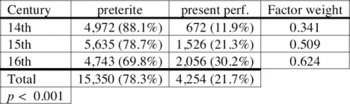
The first factor to be discussed is time, presented in table 1. As expected, the rate of the present perfect increases over time from nearly 12% in the fourteenth century to over 30% in the sixteenth.
Frequency of the present perfect by century.

Recall that Lindgren Reference Lindgren1957 finds a surge in the use of the present perfect around 1530. The data in table 1 show a different result: an increase of 9.4% occurs between my 14th and 15th century texts, that is, before 1450. By the next group of texts in the 16th century, that is, after 1550, the rate of present perfect has steadily risen (8.9%). This confirms Drinka's (Reference Drinka, and Abraham2004:227) criticism of Lindgren Reference Lindgren1957 that the dramatic increase in the present perfect that he finds around 1530 may be a coincidence due to his choice of texts.
4.2. Verb Class
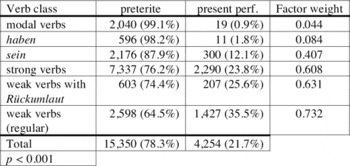
The rate of the present perfect tense in Early New High German varies widely by verb class. As in contemporary spoken German, modal verbs, haben ‘to have’, and sein ‘to be’ are the most likely verbs to appear in the preterite. As shown in table 2, in my database, less than 2% of the past-tense modal verbs and haben are in the present perfect tense, and the past of sein is expressed as the present perfect ist gewesen ‘has been’ only 12.1% of the time.
Frequency of the present perfect by verb class.

The highest rates of the present perfect are found with regular weak verbs: in this study, over 35% of the past-tense weak verbs are in the present perfect tense. This finding may support the traditional apocope explanation, since regular weak verbs show homophony between the 3sg. present and preterite after apocope, as illustrated in 1. However, strong verbs and irregular weak (Rückumlaut) verbs also exhibit higher-than-expected frequencies of the present perfect. At 23.8% and 25.6%, respectively, versus the total rate of 21.7%, this effect is not especially strong, but given the fact that stem-vowel changes quite clearly differentiate the present from the preterite in these verb classes, the traditional hypothesis should predict lower rates of the present perfect.
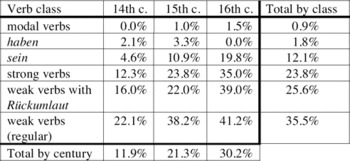
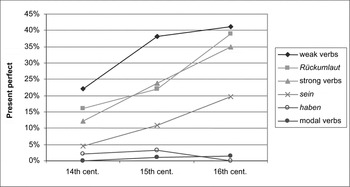
However, when verb class is examined in each of the three centuries, a clearer picture begins to emerge. As can be seen in table 3, in the 14th century, regular weak verbs stand out as being in the present perfect 22.1% of the time, nearly double the expected rate for that century (11.9%). The other classes have close to or much less than the expected rate, except for the irregular weak verbs, which occupy an intermediate position at 16%. The increase in the preterite in the 15th century is led by the weak verbs, with a much higher rate (38.2%) than the total rate. Again, strong verbs and irregular weak verbs lag behind at close to the expected rate of 21.3%. Finally, in the 16th century, the weak verbs have roughly the same frequency of the present perfect as in the previous period. Crucially, however, strong and Rückumlaut verbs have notably higher-than-expected rates of the present perfect, with Rückumlaut verbs approaching the weak verbs at 39% and strong verbs not far behind at 35%. This development is illustrated schematically in figure 2.
Frequency of the present perfect by verb class and century.

Frequency of the present perfect by verb class and century (from table 3).

The conclusion to be drawn from these data is that the loss of the preterite began with the weak verbs and then spread to other verb classes. This spread first affected the verbs most morphologically similar to the regular weak verbs (Rückumlaut verbs), next affecting the other major class (strong verbs), leaving a few irregular lexemes (haben, sein, and modals) relatively untouched in Early New High German. This finding, although not found in Lindgren's (Reference Lindgren1957) data, is predicted by the traditional hypothesis (Reis Reference Reis1910:390), since apocope resulted in homophony between present and preterite only in regular weak verbs, but nearly all verbs are affected by the loss of the preterite in today's southern dialects. However, the spread of the present perfect from the weak verbs is also compatible with Dal's (Reference Dal, , Hartmann and Hans1960) explanation, since that is the only verb class with homophony between the preterite indicative and subjunctive. Therefore, the next section directly examines the effect of apocope.
4.3. Apocope
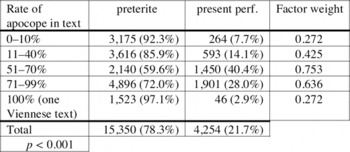
In order to approximate the rate of apocope in each text, 1sg. and 3sg. preterite verbs which end in -te before apocope (weak verbs, modals, and haben) were examined. Each text is tagged according to its rate of apocope in these two verb forms, and the texts are combined into the largest groups possible without undermining the statistical coherence of the group. As shown in table 4, texts with lower rates of apocope also have lower rates of the present perfect: the texts with less than 10% apocope have the lowest rates of the perfect (7.7%), followed by texts with up to 40% apocope (14.1%). Conversely, with the exception of one text from Vienna, texts with more than 50% of apocope have rates of the present perfect (40.4% and 28%) that are higher than the expected 21.7%. This correlation, however, is far from perfect, as the texts with the highest rate of the present perfect are those with 51–70% apocope, rather than those with 71–99%.
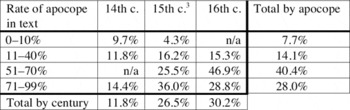
Note that this correlation between apocope and tense holds within all three time periods. As shown in table 5, low rates of apocope correspond to low rates of the present perfect in all three centuries. Likewise, higher rates of apocope are associated with higher rates of the present perfect in each century. Thus the link between apocope and the rise of the present perfect is not reducible to the fact that both are rare in earlier centuries. Therefore, these data appear to confirm the traditional hypothesis for the loss of the preterite.
Frequency of the present perfect by rate of apocope.

Frequency of the present perfect by apocope and century.

However, three other results speak against the traditional apocope hypothesis. First of all, some early texts have an extremely high rate of apocope but also the robust use of the preterite, for example the Viennese text that stands out in table 4. Secondly, as discussed in section 5.5 below, texts from Cologne and Saxony have low rates of apocope (characteristic for Middle German dialects, see Hartweg & Wegera Reference Hartweg and Klaus-Peter1989:109) but robust use of the present perfect. Most importantly, as discussed in the next section, the predicted preference for the present perfect with the 3sg. is not found.
In conclusion, there seems to be a correspondence between the rate of apocope in a text and the rate of the present perfect, which holds in each century studied here. Moreover, as predicted by the traditional apocope hypothesis, the present perfect occurs more often with weak verbs, the context in which apocope rendered the present and preterite homophonous. However, some of the contradictory dialect data (as well as the data presented in the next section) confirm Lindgren's (Reference Lindgren1957:126) statement that the relationship between apocope and the loss of the preterite is not as direct as the traditional hypothesis claims.
4.4. Person/Number
Recall that the traditional hypothesis predicts that the 3sg. of weak verbs was the first preterite context to be affected by apocope, as that is the one context in which the preterite would have become homophonous with the present. In section 4.2, we observed that weak verbs were indeed the first verb class to be affected. In this section, let us test what effect person/number has on the choice of tense.
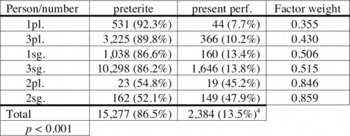
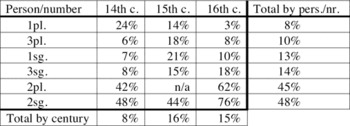
Table 6 shows the results for the effect of person/number on the preterite vs. present perfect tense, ranked by increasing preference for the present perfect. Surprisingly, the two person/number combinations that were subject to apocope in weak verbs, the 1sg. and 3sg., show rates of the present perfect that are nearly identical to the expected rate of 13.5%. The factor weights, just about 0.5, indicate that the 1sg. and 3sg. have only the slightest favoring effect, if any, on the present perfect. Recall that Lindgren (Reference Lindgren1957:126) likewise fails to demonstrate any preference for the present perfect with singular verbs. The second-person verbs, by contrast, very strongly favor the present perfect. Finally, the 1pl. and 3pl. disfavor the present perfect.
Table 7 breaks these data down by century, showing the diachronic development. In the 14th century, the second person verbs already favor the present perfect very strongly, while the other person/number combinations do not. (The 1pl. is an apparent exception, but the raw numbers are quite small.) By the 16th century, the second person verbs overwhel-mingly favor the present perfect, and the 3sg. has begun to somewhat favor the present perfect (18%, compared to the overall rate of 15% for that century).
Frequency of the present perfect by person/number.

Frequency of the present perfect by person/number and century.Footnote 5

This raises a couple of important questions. First, what do the second-person verbs have in common, as opposed to the first and third singular on the one hand and the first and third plural on the other? Secondly, what does the above data have to do with the favoring effect of weak verbs (section 4.2) and apocope (section 4.3)? The answer, I propose, has to do not with apocope (the loss of unstressed /Ə/ word-finally), but rather syncope, that is, the loss of unstressed /Ə/ word-internally. Like apocope, syncope is a productive sound change in Early New High German and is more prevalent in Upper German than in Middle German (Schmidt Reference Schmidt1996:297). By the 20th century, apocope had spread to include Middle German while syncope remains limited to Upper German (König Reference König1994:158).
Let us examine the effect that both apocope and syncope would have had on the preterite of weak verbs, illustrated by lieben ‘to love’:
(3)
The outcome of syncope is clear: it has little effect on the 1pl. and 3pl., since the loss of /Ə/ in the ending can be compensated for by pronouncing the -n as syllabic. Likewise, the 1sg. and 3sg. are phonotactically licit after apocope (although they become homophonous with the 3sg. present). In the second person, however, syncope results in a phonotactically disallowed final consonant cluster (-tt) in the plural and a rather awkward cluster (-tst) in the singular.
There is, in fact, only one clear example in the database of a weak verb with a 2pl. preterite ending: erstörtend ‘destroyed’. Note that this form is not syncopated and displays the Alemannic 2pl. ending -end, instead of the more widespread form -t. There are, however, three unambiguous examples in the database of a modal verb with a syncopated form of the (non-Alemannic) weak 2pl. preterite ending: ir moht, ir möht, and moecht ir ‘you might’. These verbs are clearly the preterite subjunctive (see Modern Standard German möchte), and the adjacent pronouns leave no doubt as to the person/number. Thus the suffix -t represents either the dental preterite suffix (-te), or the 2pl. agreement marker (-t), or both (-tet). That is, these forms are either lacking one of the two morphemes, or, more likely, the spelling <t> represents the reduction of the cluster that resulted from syncope (-tet > -tt). Since a word-final geminate consonant would hardly be perceptible to the listener, it seems natural that it would reduce to a single consonant.Footnote 6 Setting aside the Alemannic variant -end, there are seven instances of strong verbs in the 2pl. preterite (for example, intvinget ‘received’, namit ‘took’, dadit ‘did’, and ward or waret ‘were’) but no weak verbs and only three modals; thus it appears that the present perfect was preferred with the 2pl. in order to avoid the unpronounceable cluster resulting from syncope of the weak 2 pl. preterite -tet.
Turning to the 2sg., the ending -tst is indeed rare on verbs, occurring just three times in the database (soltst ‘you should’ and woltst ‘you wanted’). Since the cluster -tst occurs only after /l/, we may be able to assume that the cluster is only allowed after resonants, as is the case in Modern Standard German.Footnote 7 Thus with weak verbs whose stems end in an obstruent, syncope would have resulted in a phonotactically illicit sequence of four obstruents, as in *liebtst. Dialects with syncope would have had a number of strategies to choose from in order to avoid such clusters: sometimes /Ə/ is preserved as in begertest ‘you desired’, sometimes /Ə/ appears to be replaced by a different vowel as in begertist, or, reminiscent of the 2pl. forms discussed above, occasionally the agreement suffix -st merges with or replaces the preterite suffix -t(e) as in moechst ‘might (2sg.)’.Footnote 8 I propose that an important strategy for avoiding such clusters was to use the present perfect tense in favor of the preterite in the second person.Footnote 9 As seen in table 7, by the 16th century avoiding the second-person preterite forms as much as possible seems to have become the preferred strategy.
In this section, I have argued that the second person singular and plural were the contexts in which the loss of the preterite began. One may object at this point that the second person is too infrequent in Early New High German to be the source of such a major change in the grammar, as there are only 353 verbs in the second person in the database, compared with 15,535 in the third person (see table 6 above). However, this may be largely an effect of written texts (as an anonymous reviewer pointed out); perhaps we can assume that the proportion of second-person forms was greater in spoken Early New High German.
4.5. Syncope
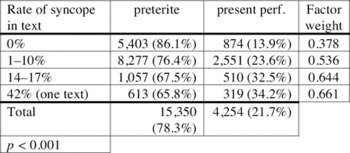
In the previous section, we saw that the preterite was dispreferred in the second person, and I argued that this was due to syncope. Therefore, in this section, I test whether texts with higher rates of syncope favor the present perfect over the preterite. In order to approximate the rate of syncope in each text, I counted the number of occurrences of syncopated and unsyncopated forms of the prefix ge- on past participles.Footnote 10
As shown in table 8, those texts with the lowest rates of syncope (those with no instances of syncope in ge-) have the lowest rates of the present perfect at 13.9%, well below the expected rate. Texts with relatively low rates of syncope (under 10% of ge- syncopated) have close to the expected rate of the perfect. By contrast, the texts with rates of syncope above 14% favor the present perfect.
Frequency of the present perfect by rate of syncope.

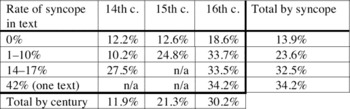
The fact that texts with higher rates of syncope disfavor the preterite supports the hypothesis outlined in the previous section. In fact, although syncope is generally less frequent than apocope, the correlation between the rate of syncope and the present perfect in table 8 is clearer than the correlation between apocope and the present perfect in table 4. The higher the rate of syncope in a group of texts is, the higher its rate of the present perfect. Moreover, recall the Viennese text with 100% apocope but strong preference for the preterite (see table 4); this text has a relatively low rate of syncope (5%), which is in keeping with its robust use of the preterite.
One could object at this point that the correlation between the rate of syncope and the rate of the present perfect in a text is due to the fact that both are less common in earlier texts and more common by the end of Early New High German. However, as shown in table 9 below, this correlation holds in all three time periods and thus cannot be explained by chronology alone. In the 14th century, texts with a low frequency of syncope (less than 10%) have the lowest rates of the present perfect. By the 15th century, only texts with no instances of syncopated ge- still disfavor the perfect. In the final time period, texts with no syncope continue to disfavor the present perfect, while those with any degree of syncope favor that tense.
Frequency of the present perfect by syncope and century.

Based on these data, I propose the following account for the loss of the preterite tense in southern German. Syncope resulted in phonotactically dispreferred consonant clusters in the second person preterite of weak verbs. The preferred strategy to avoid these forms was to use the present perfect instead. The use of the present perfect with a simple past meaning then spread to other contexts. It spread to the 1sg. and 3sg., where it also helped disambiguate the post-apocope forms of these suffixes from the 3sg. present tense suffix. It had the least impact on the 1pl. and 3pl., since neither syncope nor apocope had any real effects on those preterite endings. By the end of the ENHG period, both weak and strong verbs began to favor the present perfect, and by the modern period the present perfect ousted the preterite in all person/number combinations and, in the southernmost dialects, nearly every verb.
5. Results for Other Hypotheses
5.1. Semantics
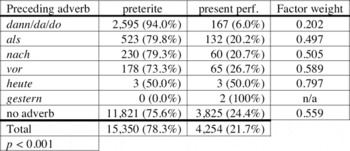
Determining the semantics of tense in such a large database by examining the context of each verb would have been extremely time consuming and error prone. However, the occurrence of temporal adverbs in the clause can give some indication of the meaning of the tense of the verb (Dentler Reference Dentler and John1988:141). In the database, clauses were tagged if one of the following temporal adverbs was present within five words of the verb: dann or da/do ‘then’, als ‘as/when’, nach ‘after’, vor ‘before’, heute ‘today’, and gestern ‘yesterday’.Footnote 11
The results for this factor are presented in table 10. Clauses with the temporal adverb dann strongly favor the preterite tense at 94%, well above the expected rate of 78.3%. This suggests that, as in Modern Standard German, the preterite tense in Early New High German is associated with narration. Conversely, clauses with heute strongly favor the present perfect, as shown by the high factor weight, and both clauses with gestern are in the present perfect. Although there are only a handful of examples with heute and gestern, we may tentatively conclude that, because these two adverbs refer to speech time, the present perfect still retains its original meaning in these clauses: relating an event in the past to speech time in the present.
Frequency of the present perfect by preceding adverb.

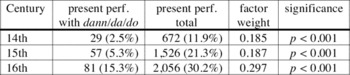
Having established that temporal adverbs can help confirm the meaning of particular tenses, let us evaluate Dentler's (Reference Dentler and John1988) claim that the loss of the preterite was caused by a shift in the meaning of the present perfect. Looking at the effect of preceding adverbs in individual centuries, the clearest results are for dann and da/do. As can be seen in table 11, the acceptability of the present perfect tense with dann rises over the course of the period, being strongly disfavored in the 14th century (2.5% versus the expected rate 11.9%) but less strongly disfavored by the 16th (about 15% versus the expected 30%). The increasing acceptability is confirmed by the rising factor weight.
Frequency of the present perfect with dann/da/do by century.

These data confirm Dentler's (Reference Dentler and John1988) observation that the present perfect gradually takes over the semantic domain of the preterite. However, they do not prove that a semantic shift was the primary cause of the loss of the preterite tense. It is entirely possible that some other factor triggered the loss of the preterite; once in decline, one would naturally expect the present perfect to gradually take over the functions of the preterite. Crucially, the big jump in the use of the present perfect with dann occurs between the 15th and 16th centuries, which is about the same time that the loss of the preterite spreads from the second to the third person and from weak verbs to strong verbs. Therefore, the expanding semantics of the present perfect are likely a result rather than the cause of the Präteritumschwund.
5.2. Mood
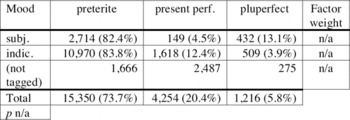
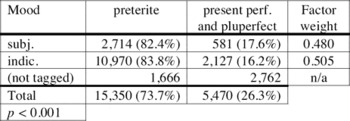
Given Dal's (Reference Dal, , Hartmann and Hans1960) hypothesis that the preterite is lost as a tense because -te develops into a subjunctive marker, one would expect the subjunctive to favor the preterite in Early New High German. At first glance, it appears that this might be the case: as shown in table 12, the subjunctive appears to occur less often with the present perfect than with the preterite. However, this is a result of the morphological tagging in the BFnhdK: the mood for irrealis is historically the preterite subjunctive, and therefore is tagged as [+preterite, +subjunctive]. As a result, in present perfect irrealis contexts, the [+preterite] tagging on the auxiliary means that the verb cluster is construed as a pluperfect in the database; thus present perfect subjunctives are underrepresented in table 12.Footnote 12 If the two perfect tenses are considered together, as in table 13, there is no favoring effect of the subjunctive on the use of the preterite; in fact, the preterite is slightly disfavored.
Frequency of the present perfect by mood.Footnote 13

Frequency of the present perfect by mood.

One of Dal's primary arguments that the weak preterite marker -te came to be used as a subjunctive marker comes from contemporary dialects. For example, in Bavarian, the old weak preterite suffix is now used in the subjunctive both with weak verbs like i sōxat ‘I would say’ and strong verbs like i tsöixat ‘I would pull’ (Dal Reference Dal, , Hartmann and Hans1960:5). In the ENHG database, however, there is not a single case of a strong verb in the sub-junctive with any suffix resembling -te. This confirms Lindgren's (Reference Lindgren1963: 271) conclusion that the development of the dental suffix into a general subjunctive morpheme is a more recent phenomenon.
Given the failure of this study to determine any favoring effect of the subjunctive on the use of the preterite and the lack of preterite/ subjunctive -te on strong verbs in my ENHG data, the following scenario seems most likely. After the preterite declined in favor of the present perfect (likely due to syncope as argued above), in some dialects the suffix -te shifted in meaning to what had previously been its secondary use as a subjunctive marker. Thus the expansion of the subjunctive use of -te was not the cause of the loss of the preterite but rather an effect.
5.3. Syntax
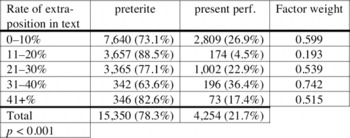
Recall Abraham's (Reference Abraham1999, Reference Abraham, and Abraham2004) contention that the present perfect is increasingly preferred because it builds a full sentence frame. In order to test this, the texts in my database are tagged for the rate of extraposition, that is, violations of the full sentence frame.Footnote 14 If Abraham's hypothesis is correct, one would expect to find a correlation between low rates of extraposition (high rates of the full frame) and high rates of the present perfect tense. As can be seen in table 14, in my database, no such correlation obtains. Although texts with the lowest rates of extraposition (0–10%) do show higher-than-expected rates of the present perfect, the factor weight indicates that this effect is not very strong. Moreover, the highest rates of the present perfect occur in texts with high rates (31–40%) of extraposition.
Frequency of the present perfect by rate of extraposition.

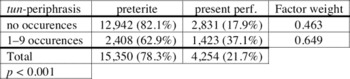
Secondly, Abraham's account would predict that, like the present perfect, tun-periphrasis should become more frequent over the ENHG period, because the use of tun ‘do’ with an infinitive allows the formation of a full sentence frame without altering meaning or tense. However, tun-periphrasis is rare in my database, as in Fischer's (Reference Fischer, Ingrid, Marijke and Arjan1998:124) study of tun in Early New High German, making it difficult to draw any strong conclusions. There is a correlation between tun-periphrasis and the present perfect tense, as shown in table 15, but this may be due to the fact that many of the texts with no tun-periphrasis are from the 14th century, when the present perfect was rare in general. With such a low frequency of the construction, it would be hasty to draw any strong conclusions from this.
Frequency of the present perfect by rate of tun-periphrasis.

In sum, this study does not find evidence to support Abraham's (Reference Abraham, and Abraham2004) hypothesis that the present perfect increases in frequency due to a rising preference for the full sentence frame.
5.4. Sociolinguistics
Previous studies of syntactic change in ENHG, such as Ebert Reference Ebert1980, Reference Ebert1981, find that such changes are strongly influenced by sociolinguistic factors. In order to test whether sociolinguistics also influenced the disappearance of the preterite, texts in the database are tagged for genre as well as the occupation of the author.Footnote 15
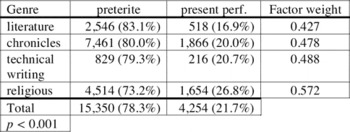
For the Präteritumschwund, where the change may be associated with the spoken language (being triggered by phonology as argued here), one might predict that the least formal texts or those closest to speech show the highest rates of the present perfect tense. This prediction bears out, as shown in table 16. Literature, arguably the genre most removed from speech, has the lowest rate of the present perfect. Literary texts may also favor the preterite tense due to their narrative nature.Footnote 16 Religious texts, including texts that are arguably close to speech, such as sermons and mystical writings, have the highest rates of the present perfect. This effect is independent of time: religious texts have the highest rates of the present perfect in both the 14th and 16th centuries.
Frequency of the present perfect by genre.

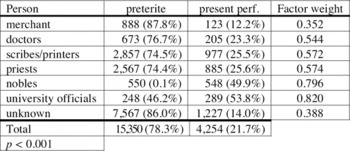
As with the changes examined by Ebert (Reference Ebert1980, Reference Ebert1981), it appears that the most prestigious speakers of Early New High German are at the forefront of this change. In table 17, it can be seen that nobles (the most prestigious group) and university officials (the best educated) show the highest rates of the present perfect.Footnote 17 Note, however, that these two occupations are each represented by just two individuals, so it is not clear whether these effects are due to social or individual variation.
Frequency of the present perfect by occupation.

To sum up this section, the loss of the preterite had the strongest effect on the least formal genres. This differs from the “change from above” scenarios described by Ebert (Reference Ebert1980, Reference Ebert1981), where the development is most advanced in the most formal text types. However, the association between the loss of the preterite and informal texts supports my hypothesis that the present perfect was preferred for phonotactic reasons. Finally, in both this study and Ebert's studies, the changes in question appear to be carried furthest by speakers with the highest levels of prestige and education.
5.5. Dialect
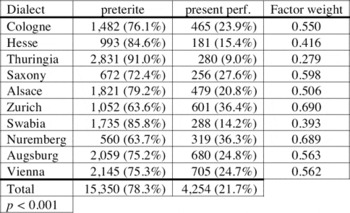
As expected given the dialectal distribution of the preterite tense in Modern Standard German, the use of tenses varies by dialect in Early New High German as well. As can be seen in table 18 below, the Middle German dialects of Hesse and Thuringia have rates of the present perfect less than the total rate of 21.7%. By contrast, Cologne and Saxony, although also Middle German dialects, have somewhat higher than expected frequencies of the perfect tense. The remaining dialects are classified as Upper German, and most of these use the present perfect tense somewhat more frequently than the corpus as a whole. Here the exceptions are Alsace and Swabia, with rates of the present perfect that are close to the expected rate and considerably lower, respectively. These exceptions aside, there appears to be a general tendency in Early New High German to have stronger use of the preterite in Middle German texts than in Upper German. This fact seems to support the link between syncope and the loss of the preterite, since both are characteristic of Upper German.
Frequency of the present perfect by dialect.

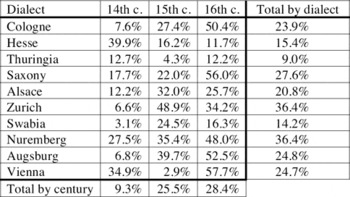
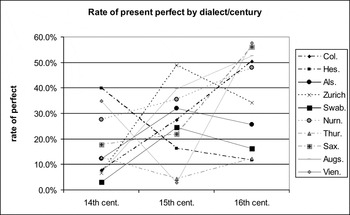
However, once this is examined by century, the picture becomes considerably more complicated. As shown in table 19 (and illustrated as a graph in figure 3), there is much variation across dialects in each century, and the diachronic development within a given dialect is not always the predicted increase in the present perfect. Moreover, it is not entirely clear whether slightly higher rates of the present perfect in a given text indicate that it is being used with a preterite meaning, or whether there are simply more contexts for the present perfect tense in that text. Nevertheless, a number of observations can be made from these data.
Frequency of the present perfect by dialect and century.

First of all, note that although only a few dialects (Cologne, Saxony, Nuremberg, and Augsburg) show a steady increase from the 14th to the 15th to the 16th century, almost every dialect has a higher rate in the 16th than in the 14th century. The exceptions are a negligible decrease in Thuringian and a much more dramatic drop in Hessian, which appears to be the result of an unusually high rate of the present perfect in that dialect's 14th century text.Footnote 18
Frequency of the present perfect by dialect and century (from table 13).

Second, let us consider the state of affairs in the 14th century. Instead of an Upper German vs. Middle German split, we find that Nuremberg and Vienna have much higher-than-expected rates of the present perfect at 27.5% and 34.9%, respectively. Most other dialects (aside from the exceptional Hessian) have rates that are close to or less than the total rate of 9.3%, with Saxony holding an intermediate position at 17.7%. Saxony, Nuremberg, and Vienna are all in the eastern half of the ENHG-speaking area. Since the highest rates at this early stage are in the east rather than the west, these data argue against Drinka's (Reference Drinka, and Abraham2004) hypothesis that Präteritumschwund entered the German-speaking area from the west under influence from French.
Next we turn to the development from the 14th to the 15th century. Here we see a steady rise in the use of the present perfect in Nuremberg and Saxony, while Cologne, Alsace, Zurich, Swabia, and Augsburg show a very sharp increase.Footnote 19 There are two possible explanations for this sudden increase in the latter group of dialects. First, especially in the case of Cologne and Alsace, one could appeal to Drinka's (Reference Drinka, and Abraham2004) areal hypothesis: even if the loss of the preterite in German began in the eastern dialects in the 14th century, the same change in Cologne and Alsace may have been initiated (or at least expedited) by French influence in the 15th. Secondly, one could argue that the loss of the preterite began in the eastern dialects of Early New High German in the 14th century and continued to increase steadily there, and suddenly spread westward to neighboring dialects by the 15th century. The data presented here do not appear to support either one of these explanations over the other.
Finally, by the 16th century, several dialects have the present perfect at rates close to or greater than 50%: Cologne, Saxony, Nuremberg, Augsburg, and Vienna. Such high rates of the present perfect likely indicate that the tense is being used with a preterital meaning in these dialects. With the exception of Cologne, these dialects are in the eastern half of the German-speaking area. The fact that the disappearance of the preterite is most advanced in these dialects supports the suggestion above that this change has its origins in the east. Therefore, we may conclude that the loss of the preterite began in the southeast, probably triggered by syncope, and then moved to other dialects as a language-internal, areal spread.
6. Conclusion
The data presented in this study call for a modification of the traditional apocope explanation for the decline of the southern German preterite. As predicted by the apocope hypothesis, this study has found that the present perfect is favored, and the preterite disfavored, with weak verbs and in texts with high rates of apocope. However, the apocope analysis falsely predicts a preference for the present perfect in the 1sg. and 3sg., and it cannot account for the strong preference for the perfect with second-person verbs.
Instead, I have proposed that syncope, the loss of word-internal unstressed schwa, was the main trigger for the Präteritumschwund. Under this scenario, the loss of the preterite was set in motion as a way to avoid phonotactically disfavored consonant clusters resulting from the syncopated weak preterite suffix -t- and the second-person agreement suffixes -st and -t. This hypothesis is supported by several of this study's findings: the fact that the present perfect is favored with weak verbs and second-person verbs, the rarity of syncopated second-person spellings such as soltst and moeht ir, the rarity of second-person weak preterites, and the correlation between the rate of the present perfect and the rate of syncopated ge- in a given text.
Although the change seems to have begun in the second person of weak verbs, as indicated by the high rates of the present perfect in those contexts in the 14th century, by the end of the ENHG period, the change spreads to other contexts. By the 16th century, it has begun to affect the 3sg. form and strong verbs, and in many modern dialects the preterite is lost completely.
This study confirms some of the findings of previous studies, but these effects are not as strong as that of syncope in the second-person weak verbs. This study confirms that the perfect encroaches on preterite semantics, but it is unclear whether that is a cause (as argued by Dentler Reference Dentler and John1988) or only an effect. Likewise, any shift of the preterite suffix to a subjunctive use (as discussed by Dal Reference Dal, , Hartmann and Hans1960) was likely an effect rather than the cause of the loss of the preterite.
However, this study can not confirm Abraham's (Reference Abraham, and Abraham2004) theory that the present perfect replaces the preterite for parsing reasons, as there is little or no correlation with the full sentence frame. Moreover, no support is found in this study for Drinka's (Reference Drinka, and Abraham2004) hypothesis that preterite decay in German has its roots in contact with the French language, since the change is stronger in the eastern dialects of German in the 14th century and appears to spread westward from there. However, it is entirely possible that the loss of the preterite, once set in motion by syncope in some dialects, was facilitated in its spread to other German dialects by additional factors, such as parsing and contact with neighboring languages like French.
As a final note, this study demonstrates the utility of examining a large corpus of lengthy texts representing several time periods and dialects. Many diachronic developments, like the spread of Präteritum-schwund through the German language area, are influenced by a complex interaction of multiple phonological, grammatical, and sociolinguistic factors, necessitating a statistical analysis. Therefore, in order to facilitate such a study, a corpus needs to be digital and have sufficient morphological tagging, so that numerous factors can be electronically identified and analyzed. With the exception of English, such corpora are largely lacking for the Germanic languages. For the sake of future scholarship, a greater effort should be made to create tagged corpora and make them publicly available, building on the valuable work done in the Bonn Early New High German Corpus.