Background
Researchers generally agree that codeswitching (CS)—or the alternation between two language varieties in a speech episode—is a creative communicative act employed for various pragmatic and sociolinguistic purposes (Blom & Gumperz Reference Blom and Gumperz1972; Valdés 1981; Gumperz Reference Gumperz1982; Bentahila Reference Bentahila1983; Kachru Reference Kachru and Kachru1983; Appel & Muysken Reference Appel and Muysken1987; Heller Reference Heller and Heller1988; Myers-Scotton Reference Myers-Scotton1993; Clyne Reference Clyne2003; Bhatt & Bolonyai Reference Bhatt and Bolonyai2011). For example, codeswitching is used as a mechanism for identity negotiation, situational marking, social-group membership, upward mobility, social solidarity, listener accommodation, face management, discursive salience, and linguistic economy (Bentahila Reference Bentahila1983; Auer Reference Auer and Heller1988; Myer-Scotton 1993; Giles & Powesland Reference Giles and Powesland1997; Gal Reference Gal and Heller1988; Bhatt & Bolonyai Reference Bhatt and Bolonyai2011).
A large number of studies have focused on the social functions of CS in bilingual contexts where typologically distinct languages exist and/or where a foreign and a local language are involved. The local-foreign dichotomy dictates specific social functions for CS based on the social, political, economic, and ideological relationship between the two languages. In most cases, a foreign language accruing power and prestige from a previous asymmetric, often colonial,Footnote 1 relationship is superimposed on a local and low-prestige language. English, for example, assumes the role of the foreign, neutral, and prestige language in the multilingual countries of Africa, often used to avoid the sociopolitical implications of favoring one of the local languages over the others (Appel & Muysken Reference Appel and Muysken1987; Heugh Reference Heugh and Mesthrie2002).
The social relationship that characterizes typologically distinct languages is not typical of bidialectal speech communities, especially diglossic ones. The latter often involves two dialects that not only are historically and somehow structurally related, but also are tied by a distinct social relationship in terms of their value and contextual distribution in the speech community (Ferguson Reference Ferguson and Hymes1959). In the Arabic sociolinguistic context, for example, Standard Arabic (SA)Footnote 2 or Al-FuSħa represents the High variety whose use is normally reserved for formal, semiformal and literary functions, whereas Dialectal Arabic (DA)Footnote 3 or Al-ʕaamiyya represents the Low variety that is used in conversations and other informal communicative exchanges (Ferguson Reference Ferguson and Hymes1959). Although they are structurally connected, DA is viewed as a simplified and corrupt version of SA, the complex and eloquent variety (Ferguson Reference Ferguson and Hymes1959; Versteegh Reference Versteegh2001; Suleiman Reference Suleiman2004).
The designation of SA and DA as High and Low varieties, respectively, and their coexistence as community varieties is nontypical of bilingual speech communities and is therefore predictive of qualitatively different CS patterns. In other words, because bilingual and bidialectal varieties have sociolinguistically different relationships, the functions of CS in each of these contexts are necessarily dissimilar. One can argue that the patterns of CS in a given context may not generalize to other contexts because the social dynamics that govern the use of these varieties are contextually and historically contingent.
The current study seeks to identify the social functions of CS between SA and DA and to examine their wider implications for the study of these two varieties in the Arabic sociolinguistic landscape. Moreover, the study aims to provide a theoretical model within which the patterns of CS between SA and DA can be interpreted in the context in which they occur and re-tested in similar diglossic contexts.
Approaches to CS
The basic sociolinguistically motivated questions of why language alternation occurs, what it is meaning, and how it is socially relevant have been approached from several different perspectives. CS has been analyzed through ethnographic methods (Gumperz Reference Gumperz1958, Reference Gumperz1961, Reference Gumperz1964, Reference Gumperz1982), conversation-analysis techniques (Auer Reference Auer1984, Reference Auer and Heller1988, Reference Auer1998), interpretive and interactional frameworks (Heller Reference Heller and Eastman1992), sociopragmatic principles (Myers-Scotton Reference Myers-Scotton1993), accommodation theories (Giles & Powesland Reference Giles and Powesland1997), rational choice processes (Myers-Scotton & Bolonyai Reference Myers-Scotton and Bolonyai2001), and optimality theory (Bhatt & Bolonyai Reference Bhatt and Bolonyai2011), among others.
These approaches have been adopted as useful frameworks for analyzing data in different bilingual contexts. By contrast, the majority of studies on diglossic CS have drawn largely on Ferguson's seminal work on diglossia (1959). Although he was not particularly concerned with CS per se, Ferguson (Reference Ferguson and Hymes1959) in fact set the stage for what was described later as situational CS (e.g. Blom & Gumperz Reference Blom and Gumperz1972). Ferguson suggested that, in diglossic communities, speakers alternate between the two varieties based on the context of their discourse. In particular, speakers shift to the High variety in formal situations and to the Low variety in informal settings. For example, speakers use the High code in religious sermons, political speeches, news broadcasts, poetry, university lecturers, and personal letters, whereas they use the Low code in conversations with family and friends or with servants, waiters, workmen, and clerks, in radio soap opera, and in folk literature.
Fishman (Reference Fishman1967, 1971) extended Ferguson's model to include two separate languages, where the High language is usually used in official or formal settings and the Low one is used in private or less formal settings. These settings are presented as domains that range from very intimate and private (e.g. home) to very official and formal (office). For Fishman, the most distinctive mark of diglossic communities concerns the availability of “compartmentalized roles [to their speakers] as well as access to these roles” (1971:78). These roles are clearly differentiated “in terms of when, where, and with whom they are felt to be appropriate” (1971:79). The refined criteria correspond to what Fishman describes as occasion, event, and interlocutor. Fishman's contribution here lies not only in expanding the scope of the term diglossia, but also in specifying the principal contextual factors that determine code choice.
Although Ferguson's and Fishman's early delineations of diglossia have been refined in a number of subsequent works (e.g. Hawkins Reference Hawkins1983; Hudson Reference Hudson2002),Footnote 4 this framework has remained a viable base for studying a number of sociolinguistic phenomena in diglossic communities, including CS between SA and DA (e.g. Abdel-Malek Reference Abel-Malek1972; Abu-Melhim Reference Abu-Melhim, Comrie and Eid1991; Holes Reference Holes, Eid and Holes1993; Saeed Reference Saeed1997; Mejdell Reference Mejdell2006; Bassiouney Reference Bassiouney2006, Reference Bassiouney2009; Soliman Reference Soliman2008). A number of studies on CS between SA and DA, while taking insight from Ferguson's model, have gained insights from other theoretical frameworks on bilingual CS. For example, Saeed (Reference Saeed1997) examined the pragmatics of switching from SA to three regional dialects of Arabic (Egyptian, Kuwaiti, and Yemeni) in the formal context of religious discourse. The study showed that the motivations for codeswitching fall into three categories: (i) iconic/rhetorical (e.g. to quote or to simplify), (ii) structural (triggered by linguistic structure), and (iii) other (e.g. due to linguistic incompetence).
Bassiouney (Reference Bassiouney2006) found that language choice was not always related to a particular discourse function. In cases when it did, the speaker was the most important factor in deciding when CS occurs. Speakers often state abstract facts in Modern Standard Arabic and then explain them in more concrete examples using the Egyptian dialect. Moreover, SA is used to lend a tone of seriousness and importance to the topic, whereas DA is used for narration and giving concrete examples.
The current study seeks to complement the existing research on CS between SA and DA, while simultaneously broadening the focus (bidirectional switching), scope (e.g. a number of dialects), and context (multiple domains) of the sociolinguistic analysis of this phenomenon. The study will be theoretically informed by previous work on bilingual and diglossic CS, particularly Ferguson's paradigm of diglossia, as well as by the linguistic, historical, and social peculiarities of the Arab sociolinguistic situation.
The study
This study examines the CS patterns employed by educated speakers of the Egyptian, Gulf, and Levantine dialects of Arabic in the domains of religious discussions/lectures, political debates, and soccer commentaries. Speakers in these domains speak their dialects natively and often command SA to an extent that enables them to use it frequently in their discourse. These three domains occupy different positions on the formal-informal continuum that is characteristic of the Arabic sociolinguistic scene (Ferguson Reference Ferguson and Hymes1959). Thus, whereas religious speeches and soccer commentaries fall somewhere toward the opposite extreme ends of this continuum, political debates lie closest to the middle. The inclusion of these three domains in this study is important to reflect, first, the spectrum of social contexts in which CS may occur and, second, the potential change in CS patterns in different social environments.
The study uses naturalistic data consisting of thirty-five audio and video recordings, which are distributed across the three domains as follows: eleven religious speeches, fourteen political debates/interviews, and ten soccer commentaries. The duration of the recordings ranged between thirty and ninety minutes. The overall duration of the corpus of the recorded data was about twenty-seven hours. The recordings of the political debates/interviews came from three well-known debate shows on the Aljazeera Channel, namely, ʔal-ʔittižaah l-muʕaakes ‘The Opposite Direction,’ ʔakθar min raʔj ‘More Than One Opinion,’ and bilaa ħuduud ‘Without Limits.’ The religious lectures/discussions were delivered to the local audiences in mosques; only one religious discussion was aired on TV. The soccer commentaries were all on recent games played between 2007 and 2010; some are between national teams and some between local soccer teams in Egypt, Saudi Arabia, Jordan, and Syria.
Social functions of CS between DA and SA
In this section, I consider switching from SA to DA and vice versa, focusing on the motivations for switching in each direction. I restrict my account to systematic CS patterns that seem to underlie particular pragmatic and sociolinguistic functions. Hence, unsystematic and individual cases are not reported. Undeniably, some cases of CS may not have special social functions in the discourse. Moreover, the examples provided here are representative, rather than exhaustive, of the patterns observed in the data.
Patterns of switching to SA
The data analysis shows that speakers switch to SA for eight main reasons: (i) to introduce formulaic expressions; (ii) to highlight the importance of a segment of discourse; (iii) to mark emphasis; (iv) to introduce direct quotations; (v) to signal a shift in tone from comic to serious; (vi) to produce rhyming stretches of discourse; (vii) to take a pedantic stand; and (viii) to indicate pan-Arab or Muslim identity. These types of switches occur in all three forms of discourse—namely religious speeches, political debates, and soccer commentaries—which differ considerably in their level of formality. These are explained with reference to the status, function, and usage of SA in the Arabic sociolinguistic arena.
Probably the most visible pattern of switching to SA concerns the use of formulaic expressions. Wray defines a formulaic expression as “a sequence, continuous or discontinuous, of words or other elements, which is, or appears to be, prefabricated: that is, stored and retrieved whole from memory at the time of use” (Reference Wray2002:9). In the Arab culture, expressions like masha'a Llah ‘what God pleased,’ inšaa'a Llah ‘if God willed,’ subħana Llah ‘glory to God,’ alħamdu liLaah ‘praise to God,’ aššukru liLlah ‘thanks to God,’ laa ħawla wala quwwata illa biLlah ‘there is no change nor power/strength except through God,’ la ilaha illa Lllah ‘there is no deity except God,’ Allahu akbar ‘God is the greatest,’ astaʁfiru Llah ‘I seek forgiveness from God,’ and so on are a staple of communicative exchanges. Formulaic expressions are eyed positively in the Arab culture due to their association with piety and God-consciousness. In the current data, these expressions transpired in political debates and soccer commentaries as well as in religious speeches, as examples (1) and (2) show.Footnote 5
(1) ljoom ʔin šaaʔa Llaah l-mubarat badija bi-šakl žamiil.
Today if willed God the match starting in-way beautiful.
‘Today, God willing, the match is starting in a beautiful way.’ (S-C)
(2) xalli ʕinda-k ʔaktar min nijja Salħa w- ʔin šaaʔa Llaah
Keep at-you more than intention good and, if willed God,
bi-taʕaddud n-nawaaja sa-jataʕaddad l-ʔažr S-Saaleħ.
with-multiplicity the-intentions will-multiply the-reward the-good.
‘Keep having more than one good intention. And, God willing, with the multiplicity of intentions, the good reward will multiply.’ (R-S)
Formulaic expressions occurred on their own, as in (1), or at transition points, as in (2). The use of these formulaic expressions seems to serve to draw the listeners' attention to the point under discussion. When used as transition elements, these expressions serve as an introduction to larger stretches of SA discourse. In (2), ʔin šaaʔa Llaah ‘God willing’ prefaces the subsequent SA statement bi-taʕaddud n-nawaaja sa-jataʕaddad l-ʔažr S-Saaleħ ‘with the multiplicity of intentions, the good reward will multiply.’ This is often referred to in bilingual CS literature as triggering, that is, the use of a certain element to introduce a new code and extend it beyond the triggering element (Clyne Reference Clyne1967; Bentahila Reference Bentahila1983).
A second important motivation for a speaker to shift to SA is to give an air of importance to a particular segment of the speech. This explains why soccer commentators, reporters, and preachers typically begin and end their speeches in SA. The use of SA here is meant to present the speeches or the events within which they are contextualized as significant and worthy of attention. This sense of importance is conveyed not only at the discourse level, but sometimes also at the sentence, phrase, and word levels. Examples (3) and (4) illustrate this point.
(3) fii nijja tanja ʕaĐiima giddan ʔan tuʕallima
There intention second great very to teach.2s.m
l-qurʔaan li-ʁair-ik.
the-Qur'an to-other-you.
‘There is a second very great intention [for memorizing the Qur'an]: to teach it to others.’ (R-S)
(4) hajj muħaawali waθbawijji fii waST l-malʕab wa-nTilaaqa sariiʕa
This attempt Wathbaawi in middle the-field and-start fast
xaTiira limaSlaħat l-Waðba.
dangerous for Al-Wathba.
‘This is a Wathbaawi attempt in the middle of the field and a fast dangerous start for Al-Wathba.’ (S-C)
In (3), the speaker presents a religious view on the importance of having good intentions when memorizing the Qur'an. The speaker here comes to the second idea, ʔan tuʕallima l-qurʔaan li-ʁair-ik ‘to teach the Qur'an to others’, whose importance is marked by a shift to SA. Similarly, in (4), the commentator shifts to SA to underlie the importance of a new development in the game, as Al-Wathba team starts ‘a fast dangerous’ counter attack. In both examples, the speakers seem to upgrade their registers to draw attention to the significance of a particular part of an utterance. This practice is not uncommon in the Arabic sociolinguistic context. For example, Versteegh (Reference Versteegh2001) observes that Arab informants often infuse their elicited DA speech tokens with different SA elements due to their perception of the prestige associated with the standard language. Likewise, Saeed (Reference Saeed1997) and Bassiouney (Reference Bassiouney2006) found that shifting to SA in their studies largely depends on whether the speaker seeks to introduce a point to which he attaches importance or value.
A third motivation for switching to SA is for the sake of emphasis. Here, the speaker reiterates a previous idea to clarify or stress its message, as is the case in (5) and (6).
(5) laa haida ʔiddiʕaaʔ. Nəħna miš daabħiin farruuž. niħna bi-ləbnaan.
No this false claim. We neg killing chicken. We in-Lebanon.
naħnu lam naðbaħ farruužan wa lam naksur zužaažan.
We neg kill chicken and neg break glass.
‘No. This is a false claim. We did not kill a chicken. We are in Lebanon. We did not kill a chicken nor broke glass.’ (P-D)
(6) ma-gibši ʔana t-tahwiilaat di. ʔana lastu min anSaar
neg-bring.1s I the-exaggerations these. I neg from supporters
ət-tahwiilaat.
the-exaggerations.
‘I do not bring up these exaggerations. I am not a supporter of exaggerations.’ (R-S)
In (5), the speaker responds to his interviewer's accusation of being involved in bloodshed in Lebanon at one point in his political career. He starts by downplaying his interviewer's accusations by suggesting that he did not take part in the killing of the innocents (Nəħna miš daabħiin farruuž ‘we did not kill a chicken’ ≈ ‘we killed no one, not even a chicken’), and then he realizes the need to emphasize the message, which he renders in SA. The same pattern appears in (6), where the speaker simply states that he does not like exaggerations, ma-gibši ʔana t-tahwiilaat. Then, he reiterates the same idea ʔana lastu min anSaar ət-tahwiilaat ‘I am not a supporter of exaggerations’ to emphasize his rejection of “exaggerations” in the context of religious preaching about death and the afterlife. The speaker rephrases his statement in SA, using more emphasis, elaborating on it, and adding a personal tone to it. This type of switches has been identified in a number of studies on bilingual CS (e.g. Gumperz Reference Gumperz1982; Bentahila Reference Bentahila1983). According to Gumperz, such a repetition “may serve to clarify what is said, but often they amplify or emphasize the message” (1982:78). It was also identified in studies on CS between SA and DA (e.g. Saeed Reference Saeed1997), even though the direction of emphatic switches in these studies was often from SA to DA, a pattern that was not attested in the data. This discrepancy is partly terminological, as Saeed identifies emphatic switches with simplification ones—the latter to be discussed in the next section.
A fourth juncture at which switching to SA systematically occurs is direct quoting. The data shows that quoting occurred both in SA and DA, even though SA was reserved for direct quotations and DA for indirect quotations. This differentiated allocation of functions is dissimilar to the one identified in Saeed's study (1997), where SA is used to quote true examples and DA used for hypothetical examples. Direct quotations are particularly apparent in religious speech, where a speaker may cite a Qur'anic verse or a Prophetic saying to lend authority and credibility to the argument, as a source material for analysis, or for rhetorical purposes. Direct quotations occurred also in political debates and soccer commentaries, but with less frequency. The following are examples of direct quotes, used in two different contexts.
(7) fikrat ət-taxaijjul… bi-taxaijjul l-ʔaaxira di muš wighit-naĐar-i.
Idea the-imagining… in-imagining the-afterlife this neg viewpoint-my.
laa laa laʔ di wighat-naĐar l-qurʔaan… šuufi masalan
No no no this viewpoint the-Qur'an… See.2s.m for example
l-ʔaaja di. jaquulu Llahu tabaraka wa-taʕaala
the-verse this. Say.3s.m God blessed and-exalted
“wa-law taraa ʔið wuqifuu ʕala rabbi-him.”
“and-if only envision.2s.m when stand.3pl.m before Lord-their.”
‘The idea of imagining… in imagining the afterlife is not my viewpoint. No. It is the viewpoint of the Qur'an… See for example this verse. Allah, the High the Exalted, says “And if only you envision when they stand before their Lord.”’ (R-S)Footnote 6
(8) ħa-ʔul-lak kalaam ʔaal-u nušir fii waħdu-ʕišriin…
Will-tell.1s-you speech said.3s.m-it published.pass in one-twenty…
qaal “ʔinna kamp David ʁallat jada miSr…”
Said.3s.m “indeed Camp David shackled hand.dual Egypt…”
‘I will tell you something that he said. It was published in 21… He said: “Camp David shackled the hands of Egypt…”’ (P-D)
In (7), the speaker starts by laying out an argument for preparing oneself for the afterlife and urges his audience to imagine the events of the Day of Judgment. In order to support his argument, he disclaims that the need to imagine the events of the Day of Judgment represents his own viewpoint; rather, it is the viewpoint presented in the Qur'an. By citing the Qur'an, the speaker seeks to lend credibility and authority to his argument. Muslims believe that the Qur'an is the exact and unchanged Word of God. Hence, citing it may allow the speaker to validate his point and make it unquestionable. In (8), the speaker is not in an argument position; instead, the quote is simply introduced for rhetorical effectiveness (i.e. accuracy and conciseness purposes). This may correspond to what Bhatt and Bolonyai (2008) call the economy principle. In other words, the speaker is trying to communicate the idea with the minimum number of words, while at the same time avoiding to put the message awkwardly in his own words.
Switching to SA is also used to signal a shift from a comic or light-hearted to a serious tone. Typically, a speaker would shift back to SA after introducing humor in their SA discourse, as example (9) shows.
(9) qawaaʕid li-ħifĐ əl-qurʔaan əl-kariim. ʔana xaajif inni
Rules for-memorizing the-Qur'an the-noble. I afraid that
baʕDu-kum jikuun faahem in-na ħa-ʕmall-u kida
some-you.2pl be.3s.m understanding that-I will-make-him like
waSfa siħrijja ʔaw ʔaddii-l-u kabsuula biħeis inn huwwa
prescription magic or give-to-him pill so that he
jaxud-haa jiTlaʕ ħaafiĐ l-qurʔaan l-kariim.
takes-it becomes.3s.m memorizer the-Qur'an the-noble.
ʔaʔul- l-u laʔ Tabʕan… əl-ʕamalijja šaaqa.
Say.1s-to-him no of course… The-process hard.
‘Rules for memorizing the noble Qur'an. I am afraid that some of you will understand that I will make for him a magical prescription or give him a pill so that he will take it and become a memorizer of the Noble Qur'an. I will say to him no… The process is hard.’ (R-S)
In (9), the speaker foresees that some of the audience might be listening to the lecture with the expectation of finding an easy way to memorize the Qur'an, and therefore he resorts to humor to suggest that this is not the case. The speaker's shift back to SA underlies a more serious tone and a more serious take on the subject under discussion. Hence, the humor is followed by an earnest proclamation about the difficulty of memorizing the Qur'an. Shifting to SA to denote seriousness has been reported in previous literature on CS between SA and DA (Saeed Reference Saeed1997).
A sixth motivation for switching to SA is when the speakers produce rhyming stretches of discourse, including lines of poetry. This pattern of switching occurred particularly in religious supplications, but also surfaced in political debates and soccer commentaries.
(10) tðakkart baitan ʕallamuu-na-jjaah w-darrasuu-na-jjaah
Remember.1s line (of poetry) taught.3pl-us-it and-taught.3pl-us-it
mina S-Siba “bilaad-i bilaad-i manaaru l-huda
from the-childhood “country-my country-my minaret the-guidance
wa-mahdu l-buTulati ʕabra l-mada.”
and-cradle the-championship through time.”
‘I remember a line of poetry taught to us from childhood: “my country my country is the minaret of guidance and the cradle of championship through time.”’ (S-C)
In (10), the commentator emphasizes his neutrality with respect to the two Arab teams, suggesting that he, as well as the members of the two teams, belong to the larger Arab world. He introduces a famous line of poetry to underscore this point. In Arabic, speakers often produce rhyming stretches of discourse in order to generate greater affective impact on their audience. This is also a sign of eloquence and mastery of the language. This form of switching can only be understood if we consider the common perception of SA as the language of “purity, clarity, eloquence, chastity, and freedom from speech impediments” (Suleiman Reference Suleiman2004:58). Because it is considered the eloquent language, to many Arabs, SA is the only medium suited for rendering eloquent, high style, and linguistically complex structures.
Seventh, speakers switch to SA to take a pedantic stand. Here the speaker addresses his audience assuming the role of an expert or an analyst. Although speakers sometimes assume such a didactic role using DA, the data show that SA is the common code for this purpose, as the following examples demonstrate.
(11) ʕala-fikra raħ nguul šaj li-t-taariix. As-suʕuudijja hija man
By the way will say.1pl thing for-the-history. Saudi Arabia is who
taSnaʕ əl-mudarribiin wa-lajsa l-mudarribiin hum man jaSnaʕuun
produce the-coaches and-neg the-coaches are who produce
ʔinžaazaat əl-kura s-suʕuudijja. wa-ržaʕ
achievements the-ball the-Saudi. And-return.2s.m
li-t-taariix wa-šaahəd.2s.m.
to-the-history and-look.
‘By the way, I will say something for history. It is Saudi Arabia that produces the coaches and not the coaches that create the achievements of the Saudi team. And you can go back to history and see.’ (S-C)
(12) biddi ʔiži ʔana ʔiržaʕ ʔiʕmal dars šuu maʕna
Want.1s come.1s I return do lesson what meaning
d-diimuqraTijja? ʔad-diimuqraTijja tafriD ʕala-l-ʔaqall
the-democracy? The-democracy requires on-the-least
wužuud raʔjjain mutanaqiDain ʔaw mutaʕaakisain…
existence opinions.dual opposing or conflicting…
‘Do I need to come back and give a lesson on what the meaning of democracy is? Democracy requires at least the existence of two opposing or conflicting opinions…’ (P-D)
In (11), the commentator shifts to SA to proclaim that the Saudi Arabian soccer team gives fame to its coaches (i.e. through its achievement) and not the other way around. To confirm his expertise on this topic, he follows his proclamation by posing a rhetorical question in which he asks his audience to consult history for verifying the truth of his claim. Likewise, the politician in (12) uses DA to accuse his interviewer of ignorance, and then shifts to SA to provide “a lesson” on what democracy is. This form of CS may be explained by the fact that SA use in the Arab sociolinguistic context often correlates with education, knowledge, and sophistication.
Lastly, switching to SA is employed to indicate the speaker's pan-Arab or Muslim affiliation. In such a case, speakers seem to emphasize their pan-Arab or Muslim identity to invoke their relationship with other Arabs and Muslims.
(13) balaaš nəlʁi ʕuʔulna w-nigri waraaʔ Kalaam jusiiʔ ʔila
Without nullify.1pl minds-our and-run.1pl after speech harm.3s.m to
šakl d-duwal l-ʕarabijja wa-š-šuʕuub l-ʕarabijja.
shape the-states the-Arab and-the-peoples the-Arab.
‘Let's not nullify our minds and run after a speech that harms the shape of the
Arab states and the Arab peoples.’ (P-D)
(14) haadi l-ħamli š-šaʕwaaʔ leiš? Naħnu muslimuun wa naʕtazz
This the-campaign sever, why? We Muslims and feel proud
bi-ðaalek.
by-that.
‘Why is this severe campaign? We are Muslims and we are proud about that.’ (R-S)
The politician in (13) responds to an accusation made by one of his interlocutors concerning his role as an officer in prison torture. The interlocutor presents a number of pictures showing the forms of torture to which political prisoners in a number of Arab countries are usually exposed. The politician questions the authenticity of the pictures and expresses his astonishment at his interlocutor's attempt to harm the Arab states and peoples. His shift to SA at this point concurs with his attempt to demonstrate his sympathy, as an Arab, with the Arab people and states. In (14), the speaker talks about the recent escalation on Islamic symbols. Then, he shifts to SA to highlight his Muslim affiliation and the pride involved in this affiliation. The data shows SA is the only code employed for activating pan-Arab or Muslim identity. For example, the word Umma ‘nation,’ which often has pan-Arab or pan-Islamic connotations, occurred in five codeswitched sentences, all of which switched to SA. This is not surprising, as SA has historically been associated with the collective Arab or Muslim identity. As a code mutually intelligible throughout the Arab world, SA is one of the few important things that Arab communities share. SA is also a source of unity among Muslims because it is the language of Islamic theology and tradition.
Overall, it seems that the motivational patterns of CS to SA are linked with prestige, importance, eloquence, seriousness, and linguistic complexity. These patterns materialize the very status, role, and functions that SA assumes as the High variety in the Arab diglossic situation. None of these CS patterns seems to be tied to a particular context (religious speeches, political debates, or soccer commentaries), speech event, speaker, or interlocutor, as is often suggested in the bilingual CS literature (Fishman Reference Fishman1971).
Patterns of switching to DA
The foregoing motivational patterns of CS are qualitatively different from those underlying CS to DA. The data indicates that speakers shift to DA for the following nine related reasons: (i) to induce parenthetical phrases and fillers; (ii) to downplay a particular segment of the discourse; (iii) to signal indirect quotes; (iv) to simplify a preceding idea; (v) to exemplify; (vi) to mark a shift in tone from serious to comic; (vii) to discuss taboo or derogatory issues; (viii) to introduce daily-life sayings; and (ix) to scold, insult, or personally attack. As was the case with switching to SA, these patterns appeared in all three forms of discourse discussed above.
One of the most transparent patterns of CS to DA relates to the use of parenthetical phrases and fillers. Parenthetical phrases are implemented to introduce a point that is not completely part of an utterance, but adds to its message. Fillers are sometimes used for interrupting the flow of SA and introducing DA discourse. More often, however, they are used when the speaker seeks to make a rhetorical pause in order to draw attention to the following or preceding point that is typically expressed in SA.
(15) al-muntaxab əl-ʕiraaqi huwa jaʔxuð zimaam l… jaa-salaam laa laa laa
The-team the-Iraqi it takes control the… how sweet no no no
laa ʕažbet-a s-saalfa. Baasim ʕabbas θaani
no please.3s.f-him the-story. Bassim Abbas second
marra jəʕmal-ha b-ʕašr digajeg.
time does-it in-ten minutes.
‘The Iraqi team is taking control [of the game]… how sweet no, no, no, no, he liked the story. Bassim Abbas has done it for the second time within ten minutes.’ (S-C)
(16) ʔiʁtaaluu ruʔuus ħarakat ħamaas…ma bədnaaš nənsa…
Assassinated.3pl.m heads movement Hamas… neg want.1pl forget.1pl…
wa-miθlama ʁtaaluu ruʔasaaʔ əl-žabha l-šaʕbijja.
and-likewise assassinated.3pl.m heads the-Front the-Public.
‘They assassinated the leaders of the Hamas Movement… we don't want to forget… and likewise they assassinated the leaders of the Public Front.’ (P-D)
In (15), the commentator uses the filler jaa salaam ‘how sweet’ as a way to interrupt the flow of the SA speech and simultaneously introduce DA in commenting on a new event in the game. In (16), the speaker injects the parenthetical phrase ma bədnaaš nənsa ‘we do not want to forget’ in order to draw attention to the previous fact about the assassination of Hamas leaders. The designation of fillers and parenthetical phrases to a specific variety in codeswitched utterances has been noticed in a number of studies on both bilingual and bidialectal CS (Gumperz & Hernandez-Chavez Reference Gumperz, Hernandez-Chavez, Hernandez-Chavez, Cohen and Beltramo1975; Bentahila Reference Bentahila1983; Saeed Reference Saeed1997). In most cases, the less dominant or low variety assumes this role.
Less frequent are fillers used after hesitations, where the speaker is at a temporary loss for words, as example (17) shows:
(17) haaða ʔamr… jaʕni… ʁariib.
This matter means… strange.
‘This… I mean… is a strange thing.’ (R-S)
The speaker simply uses jaʕni ‘this means’ for filling up the silence in the utterance. It is similar to you know in American English. The latter type of switching has been identified in a number of studies on CS (Safi Reference Safi and Aleya1992; Saeed Reference Saeed1997).
A second important reason for switching to DA is to deemphasize a particular part of the discourse or reduce its significance. Consider the following examples.
(18) qaal “tilka ʔamaanijju-hum.” di ʔamaani farʁa.
Said.3s.m “These wishes-their.” These wishes silly.
‘He [God] said “these are their wishes.” These are silly wishes.’ (R-S)
(19) naqif ʕinda haaða l-mawqif… wa ħaawalna qadar l-mustaTaaʕ…
Stop.1pl at this the-position… and tried.1pl extent the-possible…
Tabʕan əl-masʔuul əl-maSri lli waÐÐaħ bəTuulat-a fii maa
Of course the-official the-Egyptian that stated heroisms-his in what
qaala fii ʔaÐənti fii muqaabala tilfizjuunijja ʔaw ši ʔana
said.3s.m in think.1s in interview television.adj or thing I
maa raħ rudd ʕalei-ha.
neg will respond on-them.
‘We stop at this position… and we tried to as much as possible… Of course, the Egyptian official who tried to state his heroisms in what he said, I think, in a TV interview, I will not respond to them [his heroisms].’ (P-D)
In (18), the speaker criticizes people who think that they will enter paradise based on their religious affiliation (rather than their true belief and work). After citing the Qur'anic response to them, he shifts to DA to belittle their “wishes.” The shift here is not for explaining the quote, which is self-explanatory, but for downplaying what the speaker sees as misconceptions. In (19), the politician speaks about a Qatari-Egyptian dispute over the location of an emergency meeting for the Arab leaders. He uses SA in a lengthy passage trying to justify the Qatari position in this dispute, and then shifts to DA when he sought to underestimate what the Egyptian side had to say on the tongue of one of its officials. He concludes this part of his speech by suggesting that he does not even care to respond to the Egyptian official's accusations, ʔana maa raħ rudd ʕalei-ha ‘I will not respond to them.’ Saeed (Reference Saeed1997) points to a similar switching pattern to DA in his data that marks a negative attitude of the speaker toward less important or trivial issues.
Another reason for speakers to switch to DA is for indirect quoting. In DA-expressed quotations, the speaker is not interested in citing the exact words of the person, but rather in conveying the message, or in showing what someone may say about the point under discussion. That is why quoting here becomes a form of paraphrasing.
(20) ʔiðaa qadima ʕala Llah, biguul haaði l-kalma. biguul
If returned.3s.m to God, say.3s.m this the-word. Say.3s.m
jaa-rabb-i loo ʔinna-k hadeit-ni
o-Lord-my if that-You guided-me
‘If he returns to God, he will say this word. He will say my Lord if only you had guided me.’ (R-S)
(21) haaðihi š-šuʕuub qaawamat əl-ʔiħtilaal žaaʔ-uu w-qaal-uu
These peoples resisted the-occupation, came.3pl.m and-said.3pl.m
ʔəntuu lli ʕam twarTuu-na.
you who prog implicate-2pl.m-us
‘These people resisted the occupation, so they came and said [to these people] that you are implicating us.’ (P-D)
In (20), the speaker shifts to DA to reproach those who wish, on the Day of Judgment, that God had guided them (because, according to him, God already did so through His prophets and books). The unaffectionate tone in which the speaker said the quote suggests that it is conceived by him as mundane and unworthy of attention. In (21), the speaker satirically quotes governments who cooperate with the occupation and dislike for their own peoples to resist the occupation. He is indirectly referring to some Arab governments that are engaged in this practice. In general, speakers utilize DA in indirect quotations when they are indifferent to the exact wording of the citation or seek to downplay or criticize the content of the quotation itself. This indifference is often reflected in the critical, sarcastic, or unaffectionate tone of the speaker. This pattern of CS partially supports findings from previous studies (e.g. Saeed Reference Saeed1997), where the speaker would use DA for sarcasm or for quoting hypothetical or unlikely situations.
A fourth dominant pattern for switching to DA is for simplification or explanation purposes. Here the speaker may have presented a linguistically or notionally complex idea and assumes that his audience needs further explanation to understand it. In this case, DA is employed because it is supposed to be the easier code.
(22) Qaala n-nabijj “taʕaahadu l-qurʔaan.” jaʕni ʔr-u ktiir.
Said the-Prophet “take care of the-Qur'an.” Means read-it a lot.
‘The Prophet said, “Take care of he Qur'an.” This means read it a lot.’ (R-S)
(23) al-qaaʔəd əð-ðaki huwa man jaʕrəf ʔajna tabdaʔ əl-maʕraka
The-leader the-smart he who knows where starts.3s.f the-battle
wa-ʔajna tantahi. man-na ʔistimrarijji ʕala Tuul.
and-where finishes.3s.f. neg-it continuation on through.
wa-ʔilla ʔiza heik kəl ma btəblaš ħarb məš laazəm
And-otherwise if so whenever start.3s.f war neg necessary
təntihi ʔabadan.
end.3s.f never.
‘The smart leader is the one who knows where the war starts and where it ends. It is not a continuation. Otherwise, whenever a war starts, it will never end.’ (P-D)
In (22), the speaker quotes a prophetic saying that contains the SA verb taʕaahadu ‘take care of,’ which is hardly ever used in everyday speech. He therefore rephrases the idea in DA to simplify a linguistically unusual term. In (23), however, the speaker not only rewords his point on war expertise in DA but also elaborates on it to increase its understandability to the audience. This form of explanation targets a notionally complex idea, namely, war expertise. In both examples, it seems that the speakers resort to DA to avoid the possible vagueness of the point. The fact that the direction of simplification switches is always from SA to DA suggests that Arabic speakers may have mental preconception of DA as the simpler code.
It is also for simplification purposes that speakers often switch to DA to refer to numbers, time, and dates. The use of DA numerals is an attested pattern in a number of studies on SA and DA (e.g. Harrell Reference Harrell and Ferguson1964; Parkinson Reference Parkinson and Aleya1996; Saeed Reference Saeed1997). This might be due to the complexity of the numerical system of SA, particularly in terms of number-noun agreement. Consider example (24).
(24) ladaina muhažžariin mina l-žabal munðu l-ʕaam ʔalf
Have-us immigrants from the-mountain since the-year thousand
w-təsaʕmijji w-talata w-tmaniin liʁaajət əl-ʔaan.
and-nine-hundred and-three and-eighty till now.
‘We had immigrants from the mountain since nineteen eight-three and till now.’ (P-D)
This form of simplification may be both speaker-oriented and audience-oriented, since it is likely to be beneficial to both. For speakers, it means less time and effort in paying attention to the rules of number-noun agreement, and for listeners it is easier to grasp. Parkinson (Reference Parkinson and Aleya1996:92) observed that informants in his study produced numbers in DA to make themselves “accessible” to their listeners. In this sense, shifting to the simpler code becomes a form of communicative accommodation strategy, in which the speaker converges his speech with that of his interlocutor to reduce dissimilarities between them and therefore gain social approval (Giles & Powesland Reference Giles and Powesland1997:233). While ascribing this form of switching to social gains is possible in the religious domain, this interpretation may not always be warranted in the political debates simply because the interlocutors in this domain are highly educated (and so each is probably aware that the others are familiar with the numeric system) or in the soccer commentaries where the commentators address a somewhat vaguely identified audience. Bentahila (Reference Bentahila1983) found that Moroccan speakers switch to French when referring to “a number, date, or time.” He argues that this might be due to the fact that French numbers and the European Julian calendar are used in Moroccan schools. This justification does not hold in the data. Although numbers, time, and dates are taught through the medium of SA in schools, Arab speakers prefer to use DA when referring to them.
Related to simplification switches are exemplification switches, through which the speaker employs DA to instantiate a point through real-life or hypothetical examples. Gumperz (Reference Gumperz1982) refers to this pattern of CS as personification CS, that is, the introduction of a new code when seeking to convey a message with a personal tone. By shifting to DA, the speaker tries to relate to his audience's everyday life. Examples (25) and (26) illustrate this point.
(25) maʕna l-hidaaja ʔaj d-dalaala. jaʕni waaħəd jilgaa-k fi
Meaning the-guidance that is the-indication. Means one meets-you in
T-Tariig lʔaan w-jguul-la-k bə-Llah fein masžəd əl-jaħja
the-street now and-says-to-you by-God where mosque Al-Yahya
fa-tguul-la-h haaða tləf min həna w-təTlaʕ
so-say.2s.m-to-him this turn.2s.m from here and-go.2s.m up
ʕala masžəd əl-jaħja.
on mosque Al-Yahya.
‘The meaning of guidance is indication. This means that one may meet you in the street now and say to you “please where is Al-Yahya Mosque,” so you would tell him to turn from here and go up to Al-Yahya Mosque.’ (R-S)
(26) ʔal-ʔumm əl-ʔawwal. ʔana šaxSSijjan lamma babʔa ʔaaʕid ʔana
The mother the-first. I personally when be.1s sitting I
w-zogt-i… fa-jigi ħad mnə wlaad-i ʕašaan jəbuus
and-wife-my…then-comes.3s.m one of children-my to kiss
ʔiid-i… w-zogt-i ganbi… jəbʔa l-ʔumm l-awwal…
hand-my…and-wife-my beside-me… so the-mother the-first…
‘The mother is to be first. Personally, when I am sitting with my wife… and one of our children comes to kiss my hand… while my wife is beside me… the mother should be the first…’ (R-S)
In (25), the speaker argues that God has provided guidance to everyone through giving instructions on what is right and what is wrong. He then shifts to DA in order to illustrate his point from everyday life—namely, street instructions. Likewise, the speaker in (26) contends that the mother should be prioritized over the father in terms of respect and obedience. He shifts to DA to demonstrate how this priority materializes through an example from his own life. This type of switching is expected because DA is the code used in everyday conversations, and is therefore the appropriate code for narrating daily-life incidents.
The sixth important pattern of switching to DA is to mark a shift in tone from serious to comic. The data shows that this form of switching is often tied with joking, sarcasm, or underhanded criticism.
(27) xaTaʔ li-maSlaħat Waliid ʕabd-rabbuh, w-kəllə-na ʕibaad rabə-na
Foul for-advantage Waleed Abd-Rabbuh, and-all-us servants Lord-our
jaa-walad ʕabd rabb-u.
o-son servant Lord-his.
‘Foul for Waleed Abd-Rabbuh, and all of us are servants for our Lord o son of the servant of his Lord.’ (S-C)
(28) BaʕD ən-naas jataSawwar… maʕna l-hidaaja jaʕni ʔanna Llaaha
Some people imagine… meaning the-guidance means that God
junazzel malak mina l-malaaʔika w-jərbəT fii ragbat-ak ħabl
sends down angel from the-angels and-tie.3s.m in neck-your rope
jsuug-ək li-l-masžəd l-kul Sala.
drive.3s.m-you to-the-mosque for-every prayer.
‘Some people imagine the meaning of “guidance” is that God sends one of the who ties you around the neck and drives you [by force] to the mosque for every prayer.’ (R-S)
In (27) the commentator shifts to DA to make two puns on the name of the player who obtained the foul. The full name of the player literally means “neonate of the servant of his Lord.” First, the commentator puns on the second part of the name by saying w-kəllə-naʕibaad rabə-na ‘and all of us are servants of our Lord.’ Then he modifies the second vowel of the first name Waliid ‘neonate’ to make it walad ‘child,’ so that the modified name becomes walad ʕabd rabb-u ‘child of the servant of his Lord.’ This play on words makes the small modifications sound funny. In (28), switching to DA underlies humor that is mixed with sarcasm and underhanded criticism. Thus, the speaker is critical of a common misconception about the meaning of “guidance.” He presents a sarcastic example of this misconception about “guidance” (where an angel would tie someone around the neck and takes him/her by force to the mosque). The use of humor allows the speaker to create an intimate and relaxing atmosphere with the audience or to lessen the effects of his critical words. Similar findings were reported by Saeed, who reports that humor in his study was often rendered in DA and was meant to “lessen the formality or seriousness of the atmosphere” (1997:166).
Seventh, speakers switch to DA to discuss embarrassing or derogatory topics. The speaker avails the casualness of DA to soften the effect of his utterance or to make his point sound less outlandish. This form of switching may be motivated by the speakers' desire to maintain their positive face or self-image (Brown & Levinson Reference Brown and Levinson1987).
(29) ħaddaθa-ha… ja ħabiib-ti w-ja rooħi ʔila ʔaaxirihi min
Talked.3s.m-her… o-love-my and-o-my soul to end-it of
haaða l-kalaam ər-raaʔəʕ.
this the-talk the-wonderful.
‘He talked to her… my love my soul, etc. of this wonderful talk.’ (R-S)
(30) ʔaxaða-ha li-diini-ha. di bajjaaʕat laban faqiira miskiina ʁair
Took.3s.m-her for-religion-her. This seller milk poor wretched neg
maʕruufa.
known.
‘He took her [in marriage] for her religion. This is a milk seller, poor, wretched and unknown.’ (R-S)
In (29), the speaker addresses an embarrassing issue, namely, how a man should address his wife in a conflict situation. This issue is embarrassing because it is too personal to be discussed in public, particularly in a religious gathering. Therefore, the speaker switches to DA to attenuate the eccentricity of the words that he uses in this context, namely, ja ħabiib-ti w-ja rōħi ‘my love my soul.’ In (30), however, the speaker presents some of the qualities that a man or a woman should seek in their future spouse. Here he expresses his astonishment at how such a prominent figure as the Caliph recommends a woman who is much lower than him in socioeconomic status as a wife for his son. The use of DA to express the condescending sentence di bayyaaʕat laban ‘this is a milk seller’ is meant to moderate the negative effect of the sentence. It is striking that in both of these instances, the switches occur at the point where embarrassing or derogatory topics arise.
Speakers also switch to DA to induce daily-life sayings. The purpose of introducing these sayings is to relate to the audience's everyday life and simultaneously allow them to comprehend concretely the essence of an earlier thought. It is also possible that the use of these sayings dramatizes the point under discussion and adds an affective dimension to it. Consider examples (31).
(31) laa taʕtarəf bi-quwati l-ħaq wa- bi-quwat ʔistiʕaadati
neg acknowledge.2s.m with-power the-right and-with-power regaining
l-ħaq. ʕam tħaawel tətʁaddaa-ni ʔabl maa
the-right. prog try.2s.m eat for lunch.2s.m-me before that
ʔitʕaššaa-k.
eat for dinner.1s-you.
‘You do not acknowledge the power of right and the power of regaining the right. You are trying to eat me for lunch before I eat you for dinner.’ (P-D)
In (31), the speaker accuses his interviewer of using preemptive questions that are based on rumors or mere speculations in order to prevent him from justifying his own point of view. To concretize his idea, he shifts to DA to give a daily-life saying, ʕam tħaawəl tətʁaddaa-ni ʔabəl maa ʔitʕašaa-k ‘You are trying to eat me for lunch before I eat you for dinner.’ By doing so, the speaker not only allows the audience to grasp his point, but also appeals to the listeners' emotions and makes his messages more compelling.
Lastly, switching to DA is implemented by speakers to scold, insult, or personally attack, as examples (32) and (33) show.
(32) haðaa kalaam mawθuuq. ʔinta lli muš faahem ʔeiš biSiir muš
this speech reliable you that neg understanding what happen neg
ʔana lli muš faahem.
I that neg understanding.
‘This speech is reliable. You are the one who does not understand what is going on, not I.’ (P-D)
(33) ʔantum ʔiðaa ʕinda-kum ʕaqlijjat ət-tižaara bi-s-sijaasa l-waTanijja.
you.2pl.m if at-you.2pl.m mentality the-trade with-the-politics the-national.
Haidi bitkuun ðihnijjət əlli ʕam jəTraħuu s-suʔaal ʔaw lli ʕam
This is mentality that prog pose.3pl the-question or that prog
jlaʔnuu s-suʔaal.
dictate.3pl the-question.
‘If you have the mentality of trading with the national politics, then this is the mentality of the one who is posing the question or the one who is dictating the question.’ (P-D)
In (32), the speaker responds to one of the participants in a four-person debate, who accused him of not understanding the current political situation in Israel. The speaker first tries to rationalize his viewpoint (haðaa kalaam mawθuuq ‘this is a reliable speech’), and then shifts to DA to counter-accuse his interlocutor of ‘not understanding’ what is taking place. Likewise, in (33), the speaker responds to his interviewer's accusations that his political decisions are ‘bought’ by those who are funding him. The speaker shifts to DA to criticize his interviewer for his commercial mindset. The deployment of DA (the informal code) to scold, insult, or personally attack may be motivated by the speakers' desire to mitigate the force of their face-threatening acts. According to Brown and Levinson (Reference Brown and Levinson1987), when social actors are forced to threaten an addressee's positive and/or negative face, they often resort to certain politeness strategies to mitigate those acts. One of these strategies is switching the code, register, or style of the speech (see also Goffman Reference Goffman1967).
In general, it seems that DA is brought into the scene in informal, low prestige, accessible, and everyday topics. These topics characteristically reflect the status and functions of DA in the Arab sociolinguistic arena. Again, these concepts do not seem to be tied to a particular context, speaker, audience (all are public), or speech event.
Discussion
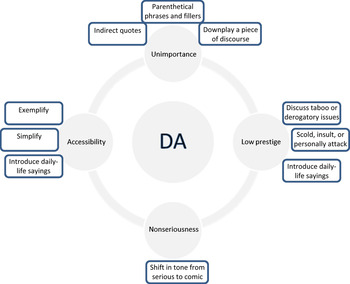
This article has focused on the social functions of CS in Arabic-speaking communities. One of the main findings of this study is that the patterns of CS between SA and DA occur in contexts of varying levels of formality, such as religious speeches, political debates, and soccer commentaries. In fact, one can describe the data examined in all three contexts as a mixture of two codes that is characterized by frequent switching from one variety to another. Despite the apparent mixing of these two varieties at the word, sentence, and discourse levels, the data analysis shows that the patterns of CS from SA to DA are qualitatively different from those from DA to SA. The nine patterns of CS to DA outlined above can be classified under the following constructs: unimportance, low prestige, accessibility, and nonseriousness (Figure 1). These constructs reflect the status and functions of DA as the Low variety in the Arab sociolinguistic arena.
Relationship between patterns of CS to DA and the status of DA.

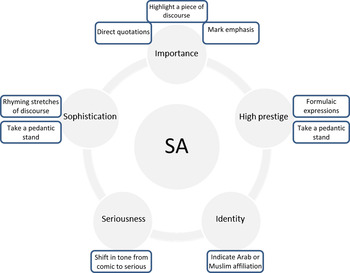
By contrast, the first seven of the patterns of CS to SA can be classified under the following constructs: importance, high prestige, identity, seriousness, and sophistication (Figure 2). These constructs mark the status, role, and functions of SA as the High variety in the Arab diglossic situation. In other words, shifting to the High variety, SA, corresponds to important, high prestige, sophisticated, and serious functions. Interestingly, speakers shift only to SA to appeal to pan-Arab or Muslim affiliation. In other words, only SA is associated with pan-Arab and Muslim identity.
Relationship between patterns of CS to SA and the status of SA.

A cursory examination of the patterns of CS to each of these varieties shows clearly a lack of overlap in their distribution. Thus, CS here serves as a regularization mechanism through which sociolinguistic functions of varying levels of prestige, importance, complexity, and seriousness are encoded and indexed through the use of two codes—a High code dedicated to important, serious, and sophisticated functions, and a Low code assigned to less important, less serious, and accessible issues. At the same time, the respective statuses of the two varieties are preserved within this double-coded mixture, irrespective of the context in which they occur. For example, joking is typically associated with DA whether it occurs in religious speeches, political debates, or soccer commentaries. Through CS, speakers can relate the content of their discourse to one of the codes or the other, based on the above criteria.
Why do speakers assign particular functions to a particular code? Ferguson argues that a person who uses the High variety in an informal setting or the Low variety in a formal setting becomes “an object of ridicule” (1959:328). Implied in Ferguson's argument is that the disjunction between the two codes and the context of their use resembles a violation of an accepted rule of sociolinguistic appropriateness (see also Nader Reference Nader1962). Based on the current findings, however, the unwritten sociolinguistic rules seem to dictate a connection between the codes and their socially prescribed functions. In other words, it is the connection between the codes and those socially accepted functions (rather than contexts) that speakers seem to observe in their alternation between the two codes.
The very process of streamlining different discursive functions in accordance with the status of the code becomes a tool for preserving the value asymmetry between the two varieties. Through this process, speakers reinforce the historically endowed High status of SA and the Low status of DA. When speakers allocate important, serious, and sophisticated functions to SA and less important, less serious, and accessible functions to DA, they simultaneously encode their ideological stance and attitude to SA as an eloquent and superior language and to DA as a simplified and inferior variety. This pinpoints the second function of CS in the data as a marker of the attitude of the speaker toward certain details in the discourse. In his study on CS to DA in religious discourse, Saeed (Reference Saeed1997) argued that shifting to DA often underscores the negative attitude of the speaker to a particular topic under discussion. In the current data, it is evident that the very act of switching, based on High/Low functions, becomes a reflection of a change in the speaker's attitude. However, an independent study is needed to attest this attitudinal function.
A third important function of CS is to index the speaker's pan-Arab or Muslim identity. However, this function is restricted to shifting to SA. This is understandable if we consider the fact that SA has always represented one of the deepest anchors of Arabic unity throughout history (Suleiman Reference Suleiman2004). Moreover, SA has historically been associated with a collective Arab or Muslim identity. Unlike DA, which is linked to eras of Arab division, disunity, and weakness, SA evokes memories of the ages of Arab unity, power, and prosperity. Further, as a code mutually intelligible throughout the Arab world, SA is one of the few shared assets that bring the Arab communities together (Fishman Reference Fishman1971; Suleiman Reference Suleiman2004). SA is also related to Muslim identity because it is the language of Islamic theology, liturgy, and tradition. A number of researchers have pointed to the relationship between the use of a particular language variety spoken by an ethnic group and the expression of ethnic identity (e.g. Heller Reference Heller and Eastman1992; De Fina Reference DeFina2007).Footnote 7 In those contexts, CS is often employed strategically to resist the existing social order and redefine the relationship between two groups. However, while previous studies suggest that the expression of identity is often carried out through the local variety, the current study shows that pan-Arab and Muslim identities are expressed by what has been termed the superposed variety (Ferguson Reference Ferguson and Hymes1959). The link between SA and Arab identity suggests that this variety is viewed, not as a superposed, but a local language that represents the Arabic speaking communities.
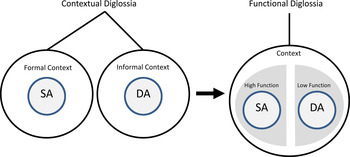
The motivational patterns for the distribution of SA and DA in the data suggest that language choice is not bound only, or mainly, by context. For example, Ferguson argues that “in one set of situations only H is appropriate and in another only L, with the two sets overlapping only very slightly” (1959:328). The data shows that CS does occur with considerable frequency and in contexts of varying levels of formality—a pattern that has been attested in previous studies on CS between SA and DA (e.g. Saeed Reference Saeed1997; Bassiouney Reference Bassiouney2006; Soliman Reference Soliman2008). In other words, the linguistic choices made by the speakers do not depend solely on the formality or informality of the context in which they occur. In fact, the use of one of the varieties or the other depends largely on the function to be performed and its relation to the High or Low code. This means that even in religious discourse, which is the most formal form of discourse, DA may occur if such functions as joking, simplifying, exemplifying, and scolding are invoked. Thus, the construct of diglossia has to be reformulated—not abandoned—based on the functional, rather than the contextual, compartmentalization of SA and DA (Figure 3).
Functional diglossia.

According to the new conceptualization of diglossia, the statuses of SA and DA are materialized and enacted through their unequal functional usage and distribution in social interactions. While SA is associated with topics of importance, seriousness, eloquence, and sophistication, DA is designated to less important, less serious, accessible, and everyday issues. Immediate contextual factors can still be a predictor of language choice, but they are not the sole or even major one. Rather, in the context of the current study, the association between the code status and functions becomes the major factor in determining language choice.
It should be noted that some patterns of CS in this study can be partially explained by the existing models of CS, even though these were mostly based on the experiences of bilingual communities. For example, switching to DA, the simpler code, in religious discourse may occasionally be motivated by the need to accommodate the listeners (Giles & Powesland Reference Giles and Powesland1997), who may find difficulty grasping certain SA structures. Likewise, CS may be seen as a politeness strategy (Brown & Levinson Reference Brown and Levinson1987) employed by speakers who are compelled to threaten an addressee's positive or negative face. This suggests that, although bidialectal CS is motivated by reasons that may be historically, linguistically, and ideologically different from those found in bilingual contexts, they display similarities in certain details. It is reasonable, however, to say that the broad sociolinguistic functions of CS between SA and DA in the data seem to be largely shaped by contextually specific factors, particularly the roles and statuses of the two codes in the Arabic-speaking communities.
Overall, the motivations for CS between SA and DA are mainly code-dependent, rather than dependent on immediate context, interlocutor, event, or speaker. Speakers alternate between the two codes based on their perceptions of the statuses of the codes themselves and the particular sociolinguistic functions associated with them. These functions are preset rather than emergent during the interactional process. In other words, speakers enter the communicative exchange with preconceived notions about the code polarity in terms of statuses and about the role of this polarity in indexing sociolinguistic functions of varying prestige, importance, complexity, and seriousness.
Conclusion
SA and DA have an asymmetric relationship in terms of their statuses and roles in the Arabic-speaking communities. The current study shows that bidialectal speakers observe the status/prestige boundary between SA and DA in contexts of varying levels of formality. CS helps speakers reproduce the division between SA and DA by aligning different functions with one variety or the other based on their importance, prestige, seriousness, and sophistication. In other words, although SA and DA may occur in the same context, the assignment of communicative functions to SA or DA is based on the statuses of the two varieties in the Arabic-speaking communities.
This suggests that SA and DA are distributed functionally rather than contextually. In other words, SA and DA may occur in the same contexts, but their allocation to High or Low functions is maintained. This intracontextual compartmentalization of SA and DA necessitates revisiting the concept of diglossia in its context-based form and concomitant formal-informal dichotomy. The reformation of the notion of diglossia helps us better understand the Arabic sociolinguistic situation and comprehend one of the main functions of CS in the Arabic diglossic context, namely, to maintain the link between the statuses and functions of the two varieties in different situations. The speakers' ability to observe this connection is what makes their utterances socially appropriate.
The fact that SA invokes pan-Arab and Muslim identity is significant. It shows, first, that SA is still an emblem of Arabic unity and Muslim religious affiliation. This link between SA and identity is the result of not merely the interaction of sociohistorical factors (e.g. the relationship between SA and Arab nationalism) and formal and informal institutions (e.g. schools and media), but also the communicative practices of speakers of Arabic. Second, the link between SA and Arab and Muslim identity suggests that SA is viewed as a local language that represents the Arabic-speaking communities. In other words, SA is not a superposed variety in the sense used in most bilingual/bidialectal contexts where a foreign/superposed variety is imposed on the local people due to certain asymmetric power relationships. Due to the multifaceted nature of identity, however, the link between SA and identity should be verified in an independent study.