

The most likely future scenarios suggest that the dairy sector will continue to bear at least part of the cost of global warming where heat stress represents a restriction on farm efficiency. Thus, global community has begun to refocus on a change on livestock production, defending the use of sustainable strategies (Blanco-Penedo et al., Reference Blanco-Penedo, Perea, Cerqueira and Payan-Carreira2013). At present, the best bet might be to identify and quantify the consequences of the extreme situations expected under a changed climate, and then work on identifying the best options for adaptation to these future scenarios.
Today, the dairy sector is the most industrialized livestock sector worldwide. Organic and low-input farming systems emerge as a future more resilient agriculture and as a way to safeguard biodiversity and landscapes, addressing environmental concerns and improving the integration of welfare friendly livestock systems in crop rotations and agroecosystems (Niggli et al., Reference Niggli, Slabe, Schmid and O’Connell2008). Furthermore, animal welfare and milk quality are important added values of the organic production systems. The so-called ‘organic cows’ can better capture farm conditions by the interconnection environment–animal health–food quality. This interconnection involves an ongoing process of coadaptation in which the resilience of the system as a whole plays a crucial role (Fiksel, Reference Fiksel2006). Furthermore, tactical and operational management are much more variable in organic systems compared with conventional, which could also contribute to greater variability in milk productivity and quality. Therefore, it has been shown that in organic dairy system it is expected to find higher intra-farm variability in product quality than the variability found among farms (Sundrum, Reference Sundrum2001).
Animal body temperature stability is based on the exchange of heat with the environment, which, in turn, depends on physiological, behavioural and metabolic mechanisms. Heat stress is a condition generated by a series of symptoms given by persistent situations of low differences between the animal’s temperature and high environmental temperatures, making it more difficult to keep the body’s temperature at normal levels. Under heat stress, reduced food consumption is the main cause of a decrease in milk production (Pennington and Van Devender, Reference Pennington and Van Devender2004). It has been reported that heat stress also reduces the reproductive indices (Villagomez et al., Reference Villagómez, Castillo, Villa-Godoy, Román and Vázquez2000), alters the quality of milk (Bertocchi et al., Reference Bertocchi, Vitali, Lacetera, Nardone, Varisco and Bernabucci2014) and increases the risk of mortality (Vitali et al., Reference Vitali, Segnalini, Bertocchi, Bernabucci, Nardone and Lacetera2009). Studies of heat stress in dairy cows are rare and originated mainly from intensive systems. Hitherto, this is even more relevant in organic and low-input systems, where the access to grassland should be complemented with several management strategies to reduce the detrimental effects of heat stress and simultaneously improve animal welfare and milk quality, both added values of the organic production chain. Heat stress has not been studied in organic and low-input systems, where the access to grasslands should be complemented with several other management strategies to effectively reduce the detrimental effects of heat stress on animal welfare and milk quality. There is still the open question about to what extent are cows in organic farms affected by heat stress and which is the threshold where a reduction in milk productivity and quality is evident.
We tested for the effects of thermic stress on milk productivity (litres, protein and fat content) and its interaction with farm management and cow genetics. To do so, we created a model (eco-DREAMS-S) that builds upon general knowledge on milk productivity models given days in lactation, and accounts for variability and uncertainty at three different hierarchical levels – that is, farm, cow parity and monthly test-day milk records. We use the milk productivity proposed by Wood (Reference Wood1967), as it is the most parsimonious (Koçak and Ekiz, Reference Koçak and Ekiz2008). The model is a Bayesian hierarchical linear regression model stratified at farm level, grouping management variables and climate conditions. The study was conducted in 26 organic farms located in seven autonomous communities of Spain (Galicia, Asturias, Cantabria, Basque Country, Catalonia and Madrid) comprising the green and dry Spain model. Herds were selected in accordance with the IMPRO project (http://www.impro-dairy.eu/) to homogenize the data quality available for each farm. We use information of 15 283 individual cow test-day milk records, corresponding to 2013 cow parities tested between July 2011 and June 2013, retrieved from the Spanish Holstein Friesian National Confederation (CONAFE). Meteorological data was retrieved from Spanish State Meteorological Agency (AEMET) (for the same period) to calculate temperature–humidity index (THI), assumed to be the best indicator of heat stress (Berman, Reference Berman2005).
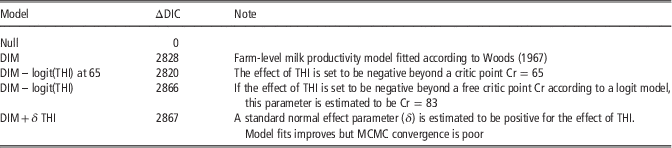
Preliminary results indicate that each farm has unique milk productivity models, with more or less variability around fitted parameters (Figure 1). However, after testing several ways in which THI could influence the milk productivity curve, there is no evidence for a negative effect of heat stress on milk productivity in the tested organic farms. If the effect of THI is conditioned to be negative, the threshold where this effect if found (i.e. where the algorithms find the best solution) is at THI values at the higher end of the observed range (Table 1). Even more, if the threshold is fixed to THI values that have been found to be detrimental to cows in intensive farms (Kadzere et al., Reference Kadzere, Murphy, Silanikove and Maltz2002; Cerqueira et al., Reference Cerqueira, Araújo, Blanco-Penedo, Cantalapiedra, Silvestre and Silva2013), the effect parameter of this variable is found to be positive, but the model fit is poor. This preliminary observation suggests a different scenario of heat stress tolerance by organic cows than previously reported for cows under conventional intensive management. This observation might be a sign that organic cows are less challenged metabolically and can cope better with heat stress. However, the results found should be interpreted with caution, even if they are biologically reasonable. Further analysis and contrasts need to be conducted and verified in larger studies.
Plots of observed milk yields and days in milk for the farms involved in the study. Red dots indicate measurements in days with THI>65. Green lines show the mean (solid line) and 95% confidence interval (green dashed lines) for each farm-level milk productivity model, and for the overall model and its variability (used for predictions).

Model selection procedure values comparing improvement in deviance information criterion (DIC) from the null model (including only intercept parameters)

DIM=days in milk; THI=temperature–humidity index; MCMC=Markov chain Monte Carlo.
The higher the difference in DIC (ΔDIC) the better the model fits the data.
Under an adaptation model, the specific actions could be concretized in farm environment improved tailoring for animal welfare request. Considerations with respect to heat stress should also address farm-specific conditions and good farming practices should regard their need for ongoing adaptation at the farm level. Under a predictive model, the model results will be used to predict potential outcomes under different climate change scenarios, and to optimize organic farming management strategies. It should also take the earliest indicators of health or welfare challenge, as they can precede any clinical signs of heat stress.
Acknowledgements
The authors are very grateful to AEMET (Spanish State Meteorological Agency) and CONAFE (Spanish Holstein Friesian National Confederation) for providing meteorological and milk record data, respectively.
Further information
The LiveM International Livestock Modelling and Research Colloquium was hosted by the Basque Centre for Climate Change (BC3) at the Maritime Museum in Bilbao, Spain between 14 and 16 of October 2014. LiveM is the livestock and grassland modelling theme of the EU knowledge hub Modelling European Agriculture with Climate Change for Food Security (MACSUR). The MACSUR project is a pilot knowledge hub started by FACCE-JPI in 2012. It provides an opportunity to explore the role and potential of multi-disciplinary networking structures to address complex regional and global issues. More information on MACSUR and the LiveM theme can be found at www.macsur.eu, with PDFs of slides from conference presentations available through the conference website (http://www.livem2014bilbao.com/).