INTRODUCTION
The quality of habitat depends on the occurrence of various biotic factors, such as prey, predators and competitors, and intensity of abiotic factors, such as wave action, salinity, temperature and desiccation. The variabilities of biotic and abiotic factors make the quality of each habitat unique. For example, habitats with abundant food resources may have a higher predation risk than those with few foods for some animals (e.g. Lima & Dill, Reference Lima and Dill1990). Mobile animals need to alter their behaviour in relation to the specific variables of the habitat. Habitat selection should therefore play a critical role to determine the fitness of these organisms.
Shell selection by hermit crabs can be viewed as a process of habitat selection. Hermit crabs generally carry gastropod shells because of the lack of calcification of the abdominal exoskeleton. Shell species and size have been found to influence various aspects of the ecological characteristics of the hermit crabs, such as growth rate (Fotheringham, Reference Fotheringham1976a; Bertness, Reference Bertness1981a; Blackstone, Reference Blackstone1985; Wada et al., Reference Wada, Ohmori, Goshima and Nakao1997; Wada Reference Wada2000), clutch size (Childress, Reference Childress1972; Fotheringham, Reference Fotheringham1976b), vulnerability to predators (Vance, Reference Vance1972; Zisper & Vermeij, Reference Zisper and Vermeij1978; Bertness & Cunningham, Reference Bertness and Cunningham1981; Mima et al., Reference Mima, Wada and Goshima2003), and resistance to physical stress (Reese, Reference Reese1968; Bertness, Reference Bertness1982). Shell preferences by hermit crabs have been implied through field observations on shell utilization patterns (Imafuku, Reference Imafuku1983, Reference Imafuku1984; Reddy & Biseswar, Reference Reddy and Biseswar1993; Ohmori et al., Reference Ohmori, Wada, Goshima and Nakao1995; Turra & Leite, Reference Turra and Leite2001; Oba & Goshima, Reference Oba and Goshima2004) and have been clarified by shell choice experiments in the laboratory (Elwood et al., Reference Elwood, McClean and Webb1979; Bertness, Reference Bertness1980, Reference Bertness1982; Imafuku, Reference Imafuku1985, Reference Imafuku1988; Ohmori et al., Reference Ohmori, Wada, Goshima and Nakao1995; Yoshino et al., Reference Yoshino, Goshima and Nakao1999; Oba et al., Reference Oba, Wada and Goshima2008). The preference is also affected by environmental conditions such as the oxygen level (Cote et al., Reference Cote, Reverdy and Cooke1998), water flow (Hahn, Reference Hahn1998), shell abundance (Hazlett, Reference Hazlett1992), and predation pressure (Mima et al., Reference Mima, Wada and Goshima2003). Therefore, it can be expected that the preference for shell species may vary among different regions that have different environmental conditions. However, there have been few studies exploring regional variation of shell species preference within a hermit crab species (Brown, Reference Brown1992).
Pagurus filholi is an intertidal hermit crab that dominantly inhabits rocky shores from southern Hokkaido to Kyushu, Japan. The shell utilization pattern in the field (Imafuku, Reference Imafuku1988; Imazu & Asakura, Reference Imazu and Asakura1994; Ohmori et al., Reference Ohmori, Wada, Goshima and Nakao1995) and shell preference in the laboratory (Imafuku, Reference Imafuku1988; Ohmori et al., Reference Ohmori, Wada, Goshima and Nakao1995) have been studied for each local population of P. filholi. However, there has been no study comparing shell preference among different local populations. We here compared the preference of P. filholi for two shell species Monodonta labio form confusa and Thais clavigera between two populations from Oura Bay, Shimoda, central Japan and from Hakodate Bay, Hakodate, northern Japan, which considerably differ in latitude and in abiotic conditions such as tidal amplitude and temperature. We also measured the desiccation and high temperature tolerance of hermit crabs occupying M. labio form confusa and T. clavigera to discuss the adaptive significance of regional difference in shell preference of P. filholi.
MATERIALS AND METHODS
Shell preference of Pagurus filholi was compared between populations of Oura Bay, Shimoda, central Japan (34°40′N 138°57′E) and Hakodate Bay, Hakodate, northern Japan (41°44′N 140°36′E). Monthly average air temperatures at Irozaki (34°36′N 138°50′E), about 15 km distance from Shimoda are consistently higher than those at Hakodate (41°49′N 140°45′E) (Japan Meteorological Agency, 2009). We also found that temperatures of rock surfaces, where P. filholi can be observed, differed on daytime low tide exposures in summer between two sites (Oura Bay: 5 to 10 August 2006: mean ± SD = 37.4 ± 3.7°C, N = 92; Hakodate Bay: 14 to 31 July 2007: 29.8 ± 4.4°C, N = 112).
Shell preference
Two species of gastropod shells were used: Monodonta labio form confusa and Thais clavigera because these were commonly utilized by P. filholi in both localities (Hasegawa et al., Reference Hasegawa, Wada, Aoki and Wada2009). There are differences in the shell morphological characters between the two gastropods, and T. clavigera shells are harder and heavier than M. labio form confusa shells (Hasegawa, Reference Hasegawa2007). The experiments were conducted during the period 16 August to 7 November, 2005 in Oura Bay, and 13 to 30 June, 2006 in Hakodate Bay.
First, preference for shell size was examined for each shell species of M. labio form confusa and T. clavigera for crabs from both populations. In each test, a hermit crab carrying the shell of either M. labio form confusa or T. clavigera was placed in a plastic tank (Oura Bay: 250 × 150 × 180 mm high, Hakodate Bay: 235 × 155 × 80 mm high) containing seawater to 50 mm depth with empty shells of the same species varying in shell width (10–19 mm in M. labio form confusa, 11–21 mm in T. clavigera). The empty shells were classified into size-classes of 1 mm interval of shell width, and five empty shells in each size-class were provided for the experiment for a total of 50 shells of each species per individual crab. Twelve to 24 hours after placement, the shell occupied by the hermit crab was recorded as the preferred shell, and its shell width was measured with calipers. The hermit crab was measured for its shield (calcified anterior portion of the cephalothorax) length under a stereoscopic microscope with an ocular micrometer. In case the test crab selected a shell of either the maximum or minimum size-class, the data were omitted. The test was conducted for 21–35 male hermit crabs (2.71–6.35 mm in shield length) with each shell species, without using the same hermit crab twice. Water temperature during the experiments ranged from 22.5 to 25.0°C. Each tank was supplied with O2 tablets (Japan Pet Drugs Co Ltd, Tokyo). The preferred shell size for each shell species was obtained by regression against hermit crab size.
Then, shell species preference by P. filholi for M. labio form confusa and T. clavigera was examined. Nine shells of the same gastropod species as the shell carried by the test hermit crab and ten shells of the other gastropod species were placed haphazardly in a plastic tank (Oura Bay: 250 × 150 × 180 mm high, Hakodate Bay: 235 × 155 × 80 mm high) containing seawater to 50 mm depth. To eliminate the effect of shell size preference from this experiment, the sizes of the shells added to the tank were equalized from the size preferred by the hermit crab similar to the test crab in shield length (±7.5% of the test crab size). The preferred size of the shell was determined by applying the regression equation obtained from the shell size preference experiment. A single test crab was placed in the tank, and after 12–24 hours, the shell species occupied by the test crab was recorded as the preferred one. Taking into consideration the possibility that shell species preference is influenced by the shell species carried when initially sampled, two series of the test differing in the gastropod shell species carried by the test crab were conducted. The number of replicates was 20–44 for each combination, without using the same hermit crab repeatedly. Water temperature during the experiments ranged from 18.2 to 24.0°C. Each tank was supplied with O2 tablets.
Results of the tests were analysed with Fisher's exact test to evaluate the difference of preference between the two populations.
Desiccation and high temperature tolerance
To assess the effect of different shell species on hermit crab resistance to high temperature and desiccation, a laboratory experiment was conducted in male P. filholi carrying the shell of M. labio form confusa and T. clavigera. Crab size variation was minimized (3.5–4.0 mm in shield length) to avoid the effect of crab size on thermal and desiccation stress, and crabs carrying the shell of preferred size were used to avoid possible shell size effects. All tests were made at 40°C on crabs exposed to aerial conditions to simulate the air-exposed conditions experienced during summer at both sites. After the test crab chose a shell of preferred size, the shell was towel dried and the crab was allowed to crawl over a dry paper towel surface for one minute to remove some water from the crab and the shell. Then 30 test crabs were placed in a plastic tank (250 × 150 × 180 mm high) that was maintained at a constant temperature of about 40°C in an incubator. The number of dead crabs was recorded hourly until all the test crabs were dead. The test was replicated 6 times for each species.
We calculated the cumulative survival rate of the hermit crabs from the data of 6 replicates combined. Survivorship curve was drawn using the Kaplan–Meier method with statistical software (Hamada, Reference Hamada1999; Ishimura et al., Reference Ishimura, Kubota and Xie2003). Statistical comparison between the two groups of hermit crabs carrying different shell species was made by the log-rank test.
RESULTS
Shell preference
Shell size (shell width) preferred by Pagurus filholi and the size of hermit crab (shield length) was significantly correlated with each other for the two species of gastropod shells (Monodonta labio form confusa and Thais clavigera) in both populations of P. filholi (Oura Bay and Hakodate Bay) (Table 1).
Relationship between hermit crab shield length (SL, mm) and preferred shell width (SW, mm) of two snail species for two populations of Pagurus filholi.

N, number of hermit crabs examined; r, correlation coefficient.
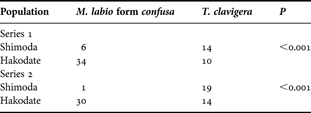
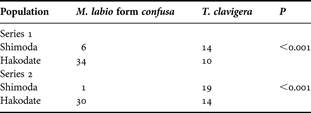
Shell species preference for the two gastropods M. labio form confusa and T. clavigera significantly differed between the populations in Oura Bay and Hakodate Bay (Fisher's exact test, P < 0.001); Pagurus filholi from Hakodate Bay preferred M. labio form confusa to T. clavigera, whereas P. filholi from Oura Bay exhibited the reverse preference (Table 2).
Result of shell-species preference experiments. Frequency of selection for each shell species of Monodonta labio form confusa and Thais clavigera and its comparison between the two populations by Fisher's exact test are shown. Series 1: test crab initially occupying the shell of M. labio form confusa. Series 2: test crab initially occupying the shell of T. clavigera.
Desiccation and high temperature tolerance
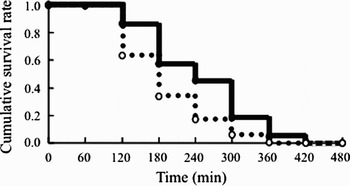
The survival rate of P. filholi at 40°C carrying the shell of T. clavigera was significantly greater than P. filholi carrying the shell of M. labio form confusa (log-rank test, χ2 = 38.25, P < 0.0001) (Figure 1).
Results of thermal tolerance tests run at 40°C on Pagurus filholi carrying the shell of Monodonta labio form confusa (dotted line) and Thais clavigera (solid line). Each point represents the cumulative mortality rate of 180 crabs.

DISCUSSION
Preference for shell species by the hermit crab Pagurus filholi differed between populations from Oura Bay and Hakodate Bay in our experiment. Pagurus filholi from Hakodate Bay preferred shells of M. labio form confusa to those of T. clavigera, whereas crabs from Oura Bay exhibited the contrary preference for shell species. Although some studies have shown that shell preference differs among sympatric hermit crab species because of resource partitioning and different microhabitat distributions (Bertness, Reference Bertness1981b, Reference Bertness1982; Oba et al., Reference Oba, Wada and Goshima2008), there have been few studies showing that shell preference differs between populations from different geographical regions (Brown, Reference Brown1992).
In our experiment, P. filholi from the population in Oura Bay preferred Thais clavigera which was heavier but more effective against desiccation and high temperature stress than Monodonta labio form confusa. By contrast, P. filholi from the population in Hakodate Bay preferred M. labio form confusa which is lighter but less effective against the physical stress than T. clavigera. Aerial conditions of temperature were different between our study sites, and the mean temperature of rock surfaces in the daytime during low tide in summer was higher in Oura Bay than in Hakodate Bay. In Tanabe Bay, Wakayama (33°43′N 135°22′E), P. filholi has been shown to have a shell preference in the order of T. clavigera, Turbo cornatus coreensis or M. labio form confusa and Nerita albicilla (Imafuku, Reference Imafuku1985). Tanabe Bay is relatively near to Oura Bay (34°40′N 138°57′E). Therefore, thermal condition and shell species preference by P. filholi is similar between Oura Bay and Tanabe Bay. These suggest that P. filholi in Oura Bay prefer shells of T. clavigera in order to reduce the thermal and desiccation stress, even though they incur greater energetic costs as they are heavier. Bertness (Reference Bertness1981a) reported that heavy shells affect subsequent growth and reproduction of hermit crabs. In the case that the thermal and desiccation stress is less intense like in Hakodate Bay, it may become more important for hermit crabs to select shell species that have a low energetic cost to carry. Therefore, P. filholi in Hakodate Bay might prefer shells of M. labio form confusa in order to reduce their energetic cost due to shell weight. Higher thermal and desiccation stress in low latitudes may be significant factors in the preference for shell species that have effective resistance to physical stresses.
Intraspecific variation in shell preference can be influenced by differences in many environmental conditions. For example, Mima et al. (Reference Mima, Wada and Goshima2003) have demonstrated that P. filholi in Hakodate Bay change shell preference due to predation risk. Hahn (Reference Hahn1998) also showed that the hermit crab Calcinus seurati collected from a site with a high flow of seawater preferred heavier shells than those collected from a still water site. Hermit crabs in low oxygen environmental conditions prefer lighter and smaller shells than those in normal oxygen conditions (Cote et al., Reference Cote, Reverdy and Cooke1998). When shells are abundant, hermit crabs tend to select smaller shells than hermit crabs that have limited access to surplus shells (Hazlett, Reference Hazlett1992; Wada et al., Reference Wada, Ohmori, Goshima and Nakao1997). Which of these factors strongly influences the shell preference in natural conditions may differ according to the habitat conditions. Further studies will be needed about the cause of intra-specific variation in shell preference of hermit crabs. We suggest that shell quality in terms of resistance to thermal and desiccation stress may be a pervasive cause of latitudinal variation in the shell preference of hermit crabs.
ACKNOWLEDGEMENTS
We express our gratitude to Drs Yoichi Yusa and Hiroaki Sato of Nara Women's University, and two anonymous referees for their valuable advice and suggestions. We would like to thank Takuma Kawaminami, Takashi Oba and other members of the Benthos Research Group, Laboratory of Marine Biology and Diversity, Faculty of Fisheries, Hokkaido University, for their support in our field study. We also thank members of the Laboratory of Animal Ecology, Nara Women's University, and of the Laboratory of Marine Ecology, Shimoda Marine Research Center, University of Tsukuba, for their valuable comments and support.