INTRODUCTION
The plant cell wall, mainly consisting of cellulose, hemicellulose and lignin, is the most important fraction of fibrous feeds. It can be degraded by rumen microorganisms to provide energy and maintain rumen health. Increasing plant cell-wall digestibility is therefore a key strategy for maximizing ruminant performance. However, lignin in the plant cell wall is the primary factor limiting cellulose and hemicellulose degradation (Casler & Jung Reference Casler and Jung1999; Casler Reference Casler2001; Jung & Lamb Reference Jung and Lamb2003); also lignified tissues are difficult for microorganisms to digest compared with non-lignified tissues (Engels & Jung Reference Engels and Jung2005). Jung (Reference Jung2012) reported that lignin accounted for 40–60% of the variation in cell-wall digestion observed in ruminants.
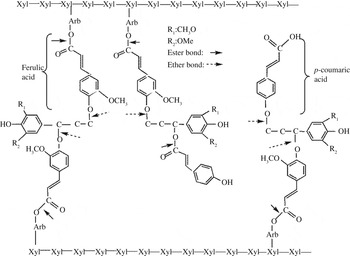
Phenolic acids, such as ferulic acid (FA) and p-coumaric acid (PCA), occur mainly in grasses and are important components of the cell wall. Ferulic acids form ether and ester bonds with lignin and/or other cell-wall polymers, while PCAs are mainly ester-linked to lignin (Fig. 1). The binding of phenolic acids to the cell wall through these covalent bonds can impose additional restriction on cell-wall digestion (Cremin et al. Reference Cremin, Drackley, Grum, Hansen and Fahey1994).
Ferulic and p-coumaric acids linkages in the plant cell wall through ester and ether bonds. Ferulic acids are mainly ester-linked with arabinoxylan and ether-linked with lignin, while p-coumaric acids are ester- and ether-linked with lignin (Grabber et al. Reference Grabber, Quideau and Ralph1996).

Previous studies noted that the presence of ester-linked ferulic acid (FAest) was positively correlated with cell-wall degradation (Jung & Casler Reference Jung and Casler1990; Casler & Jung Reference Casler and Jung2006), whereas ether-linked ferulic acid (FAeth), an indicator of cross-linking between lignin and arabinoxylans, was negatively correlated with cell-wall digestibility (Rodrigues et al. Reference Rodrigues, Guedes, Cone, van Gelder, Ferreira and Sequeira2007; Jung et al. Reference Jung, Mertens and Phillips2011). Ester-linked p-coumaric acid (PCAest), also an indicator of cell-wall lignification (Jung & Bernardo Reference Jung and Bernardo2012), was also found to be negatively correlated with cell-wall degradation (Argillier et al. Reference Argillier, Barrière, Lila, Jeanneteau, Gélinet and Ménanteau1996), whereas no consistent correlations with cell-wall degradation were reported for ether-linked p-coumaric acid (PCAeth) (Casler & Jung Reference Casler and Jung2006; Rodrigues et al. Reference Rodrigues, Guedes, Cone, van Gelder, Ferreira and Sequeira2007). Previous studies have focused mainly on the effects of phenolic acids on ruminal digestibility of cell-wall material in crop straw (Grabber et al. Reference Grabber, Hatfield and Ralph1998), meadow hay (Rodrigues et al. Reference Rodrigues, Guedes, Cone, van Gelder, Ferreira and Sequeira2007) and grasses (Casler & Jung Reference Casler and Jung2006).
Cereal brans are the outer layer fractions of grains, while cereal husks are the hard protective seed coverings. Both are by-products of milling processes and are therefore a potential source of readily available animal feed. Cereal brans are rich in FA and PCA, with the actual contents depending on the grain species (Saulnier & Thibault Reference Saulnier and Thibault1999; Kim et al. Reference Kim, Tsao, Yang and Cui2006; Wang et al. Reference Wang, Sun, Cao, Tian and Li2008). No similar information is available for phenolic acid contents in cereal husks.
Cereal brans (e.g. maize, wheat and rice) are extensively formulated into animal rations due to the presence of highly digestible fibre (Karppinen et al. Reference Karppinen, Liukkonen, Aura, Forssell and Poutanen2000; Ryan Reference Ryan2011). In contrast, millet and rice husks are comparatively inferior fibrous feeds due to the low degradability of their fibre (Beg et al. Reference Beg, Zafar and Shah1986; Vadiveloo et al. Reference Vadiveloo, Nurfariza and Fadel2009). The objectives in the present study were to compare the in situ ruminal degradability of ester-linked phenolic acids, cellulose and hemicellulose in the cereal brans and/or husks, and to explore their associations with original Lignin (sa) and phenolic acid contents in the plant cell wall.
MATERIALS AND METHODS
Collection of cereal brans and husks
Representative samples of maize bran, wheat bran and millet husk were gathered from different local milling plants (37°11′N, 112°10′E, 1200 m a.s.l.) in PingYao city, ShanXi province in China. Rice husk samples were collected from different local milling plants (28°50′N, 112°22′E, 33 m a.s.l.) in YuanJiang city (HuNan, China). Samples were collected in October of 2010 and pooled together in equal proportions according to the grain variety and numbered, resulting in five test samples (1·0 kg) for each cereal bran and/or husk. All samples were dried at 65 °C for 48 h, ground to pass through a 1 mm screen and stored at room temperature for later chemical analysis and in situ rumen incubation.
Animals and feeding
Five healthy Charolais (♂) × Nanyang (♀) yellow cattle crossbred steers, fistulated with ruminal cannulas, weighing c. 650 ± 50 kg (mean ± sd) and aged 1·5 years old, served as experimental animals for in situ rumen incubation. The steers were housed in tie stall barns with free access to water, and they were fed a total mixed ration containing 3·5 kg Chinese wild ryegrass, 2·5 kg alfalfa hay and 8·7 kg commercial concentrate. The concentrate (per kilogram of dry matter (DM)) consisted of 565·5 g maize, 138 g wheat bran, 239·7 g soybean meal, 35·2 g cotton seed meal, 8·1 g salt, 5·4 g calcium carbonate and 8·1 g premix. The ration was offered in two equal portions and fed to the steers at 06·00 and 18·00 h. The study was carried out under the Guidelines of the Beijing Municipal Council on Animal Care.
In situ rumen incubation
Nylon bags (120 × 80 mm, pore size 50 μm) containing 3·0 g tested brans or husks were incubated in the rumens of the steers for 6, 12, 24, 36, 48 and 72 h. The bags were withdrawn at the appropriate time and washed with running cold water to remove any feed particles adhering to the bags until the water ran clear. The washed bags were dried at 65 °C for 48 h to a constant weight. The bags containing samples at 0 h were rinsed separately with the same washing procedure. The residues left in the bags were collected and stored for later chemical analyses of neutral detergent fibre (NDF), acid detergent fibre (ADF), Lignin (sa), FAest and PCAest contents.
Chemical analysis
The methods of the Association of Official Analytical Chemists (AOAC 1999) were used to determine DM (ID 930.5), crude protein (CP; ID 984.13), ether extract (EE; ID 920.30) and ash (ID 942.05) contents in the feed samples. Both NDF and ADF were determined following the detergent procedures of Van Soest et al. (Reference Van Soest, Robertson and Lewis1991) and corrected for residual ash content. Lignin (sa) content was determined by the solubilization of cellulose with 72% sulphuric acid (Robertson & Van Soest Reference Robertson, Van Soest, James and Theander1981).
Feed samples (100 mg) in 5·0 ml 2·0 m sodium hydroxide solution were incubated at 39 °C in the dark for 24 h to extract FAest and PCAest (Jung & Shalita-Jones Reference Jung and Shalita-Jones1990). Total FA and PCA were released by incubating 100 mg feed samples with 5·0 ml 4·0 m sodium hydroxide solution at 170 °C for 2 h (Iiyama et al. Reference Iiyama, Lam and Stone1990). After the incubation, the solutions were acidified to a pH below 2·0 with concentrated phosphoric acid, extracted with ethyl ether which was then evaporated under a nitrogen stream, and resolved with 1·0 ml methanol (Jung & Shalita-Jones Reference Jung and Shalita-Jones1990).
The FA and PCA standards were purchased from Sigma-Aldrich Co. (St. Louis, USA). The contents of FA and PCA released by the alkaline extractions were quantified by high-performance liquid chromatography with a Wufeng analytical instrument (Wufeng Co., Ltd, Shanghai, China) consisting of LC-P100PLUS pump, LC-UV100PULS UV detector and LC-CO100PLUS column heater. The analytical column was a symmetry reversed-phase C18 column (250 × 4·6 mm2, 5 μ m, pH 2–8, Waters, Milford, MA, USA). The method of Wang et al. (Reference Wang, Yang, Yang and Cao2013) was used and set as follows: acetonitrile proportion was increased from 20 to 35% within the first 16 min, kept at 35% for 1 min and then decreased from 35 to 20% for the remaining 0·5 min. The column was operated at 15 °C and the flow rate was 1·0 ml/min. Ferulic acid and PCA were detected at 320 nm. Samples (10 μl) dissolved in methanol were injected into the sampling loop.
Calculations
Cellulose content was calculated as the difference between ADF and Lignin (sa), and hemicellulose content was the difference between NDF and ADF, while FAeth and PCAeth were calculated as the differences between total phenolic acids and ester-linked phenolic acids (Iiyama et al. Reference Iiyama, Lam and Stone1990).
Ruminal degradation of FAest, PCAest, NDF, cellulose and hemicellulose in the cereal brans and/or husks at different incubation times was calculated as: D t = (w 0 − w 1)/w 0, where D t is the disappearance at incubation time t, w 0 is initial analyte (g) and w 1 is the residual analyte (g) at the incubation time t.
To estimate the degradation extent and rate of NDF, cellulose and hemicellulose, in situ degradation kinetics were described by the exponential equation of Ørskov & McDonald (Reference Ørskov and McDonald1979): D t = a + b × (1 − e c×t ), where D t is the disappearance at incubation time t, a is a rapidly soluble fraction, b is an insoluble but potentially degradable fraction and c is the degradation rate of b fraction. Effective degradability (ED) was calculated as: ED = a + [bc/(c + k)] (Sniffen et al. Reference Sniffen, O'Connor, Van Soest, Fox and Russell1992), where k is the ruminal outflow rate and was set arbitrarily at 0·06.
Statistical analysis
Data were subjected to analysis of variance with the General Linear Model procedure of SAS (1999). The model was applied as: Y ijk = μ + Fi + Tj + Ak + e ijk , where Y ijk is the dependent variable, μ is the overall mean, F i is fixed effect of the feed (i = 4), T j is effect of the incubation time (j = 6), A k is random effect of the animal (k = 5) and e ijk is the error term. Least-square means were separated using a multiple comparison test (Tukey). The relationships between ester-linked phenolic acids, cellulose and hemicellulose digestion with original Lignin (sa) and phenolic acid contents in the tested cereal brans and/or husks were analysed with the correlation (CORR) procedure of SAS (1999). Significance was declared at P < 0·05.
RESULTS
Chemical composition
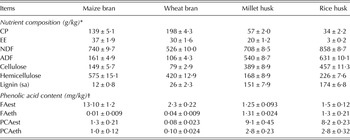
Crude protein, EE and hemicellulose contents were greater in the brans than in the husks (Table 1), but cellulose and Lignin (sa) contents were substantially greater in the husks than in the brans. The total FA content was greater in the brans than in the husks, while total PCA content was markedly greater in the husks than in the brans. The levels of both FAeth and PCAeth were clearly lower than the corresponding ester-linked contents, and the husks had higher levels of FAeth and PCAeth compared with the brans.
Chemical composition of cereal bran/husk feeds on a DM basis

* NDF and ADF represent neutral detergent fibre and acid detergent fibre, respectively, corrected for residual ash content.
† FAest and FAeth represent ester- and ether-linked ferulic acids; PCAest and PCAeth represent ester- and ether-linked p-coumaric acids.
Values are means ± s.e.
In situ rumen disappearance of ester-linked phenolic acids
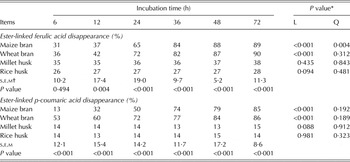
As shown in Table 2, the time-dependent ruminal disappearance of ester-linked phenolic acids occurred in the brans (P < 0·001). No similar effects were observed for the husks. Consequently, FAest disappearance was at least two times greater in the brans than in the husks as the incubation time was extended up to 72 h (P < 0·001). The disappearance of PCAest was at least five times greater in the brans than in the husks (P < 0·001), although no differences were observed between the brans or between the husks.
In situ ruminal disappearances of ester-linked phenolic acids in cereal brans and/or husks at different incubation times

* L and Q represent linear and quadratic effects of incubation time.
† s.e.m., standard error of means.
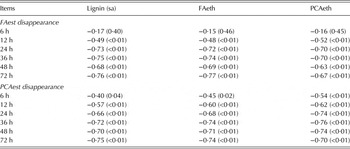
As shown in Table 3, the ruminal disappearances of ester-linked phenolic acids were negatively correlated with the original contents of Lignin (sa) and ether-linked phenolic acids, and these negative correlations became more pronounced with increasing incubation time.
Pearson correlation coefficients (r) between in situ ruminal ester-linked phenolic acid disappearance at different incubation times and original Lignin (sa), ether-linked phenolic acid contents in maize bran, wheat bran, millet husk and rice husk

FAest, FAeth represent ester- and ether-linked ferulic acids; PCAest, PCAeth represent ester- and ether-linked p-coumaric acids.
Values in parentheses are noted for P value.
Degradation kinetics of neutral detergent fibre, cellulose and hemicellulose
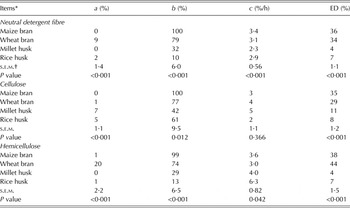
Table 4 shows that the in situ ruminal disappearances of NDF, cellulose and hemicellulose were positively correlated with in situ ruminal disappearances of FAest (r 0·87, P < 0·001) and PCAest (r 0·82, P < 0·001). The degradation kinetics shown in Table 5 indicate that the levels of rapidly soluble fractions (a) of NDF, cellulose and hemicellulose varied among the cereal brans and/or husks (P < 0·001), while the levels of the insoluble but potentially degradable fraction (b) with different degradation rates were consistently greater in the brans than in the husks (P ⩽ 0·012). Consequently, ED values of NDF, cellulose and hemicellulose were markedly greater in the brans than in the husks (P < 0·001).
Pearson correlation coefficients of in situ rumen disappearances between fibre and ester-linked phenolic acids in maize bran, wheat bran, millet husk and rice husk at different incubation times

NDF, neutral detergent fibre corrected for residual ash; FAest, ester-linked ferulic acid; PCAest, ester-linked p-coumaric acid.
Values in parentheses are noted for P value.
Rumen degradation kinetics of neutral detergent fibre, cellulose and hemicellulose in cereal brans and/or husks

* a, Immediately soluble fraction; b, insoluble but potentially degradable fraction; c, rate constant for the degradation of fraction b; ED, effective degradability.
† s.e.m., standard error of means.
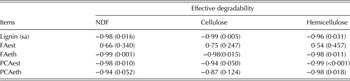
Table 6 shows that the ED values of NDF, cellulose and hemicellulose were negatively correlated with the contents of Lignin (sa) (r £ −0·96, P < 0·05), FAeth (r £ −0·98, P < 0·05) and PCAest (r £ −0·94, P < 0·05) in the cereal brans and/or husks.
Pearson correlation coefficients of rumen effective degradability with original contents of Lignin (sa) and phenolic acids in maize bran, wheat bran, millet husk and rice husk

FAest, FAeth represent ester- and ether-linked ferulic acids; PCAest and PCAeth represent ester- and ether-linked p-coumaric acids; NDF, neutral detergent fibre corrected for residual ash.
Values in parentheses are noted for P value.
DISCUSSION
Phenolic acids profile in cereal brans and/or husks
As the major phenolic acids, FA and PCA are present at 2–20 g/kg in the cell wall of forages (Fahey & Jung Reference Fahey, Jung and Cheeke1989). Assuming that NDF represents the cell-wall fraction, total FA in the NDF fraction in the present study accounted for 1·8, 4·5, 3·6 and 3·2 g/kg in maize bran, wheat bran, millet husk and rice husk, respectively. These values were in accordance with those reported previously (Fahey & Jung Reference Fahey, Jung and Cheeke1989). Compared with ester-linked phenolic acid content in the present study, higher FAest (4·2–6·5 mg/kg DM) and lower PCAest (0·12–0·22 mg/kg DM) contents were reported in de-starched wheat bran (Beaugrand et al. Reference Beaugrand, Crônier, Debeire and Chabbert2004). The FAest content in maize bran in the present study was higher than that reported (0·33 mg/kg DM) in de-starched maize bran by Lapierre et al. (Reference Lapierre, Pollet, Ralet and Saulnier2001). The content of ether-linked phenolic acids has not been reported previously in cereal brans and/or husks. In the present study, a lower ratio of PCA to FA content was found in the cereal brans than in the husks, in agreement with a previous report (Wang et al. Reference Wang, Yang, Yang and Cao2013).
Microbial phenolic acid degradation in the rumen
Previous studies examining in vitro digestion of parenchyma and sclerenchyma cell walls isolated from cocksfoot (Grabber & Jung Reference Grabber and Jung1991) and in situ ruminal degradation of barley (Du & Yu Reference Du and Yu2011) demonstrated that FA was more digestible than PCA. The higher FAest disappearance and lower PCAest disappearance were mainly observed in the cereal husks in the present study. This could be due to differences in specific enzyme activity of FA esterase and PCA esterase in the rumen. O'Neill et al. (Reference O'Neill, Christov, Botes and Prior1996) reported that the enzyme activity of fungal FA esterase was greater than PCA esterase, although the microorganisms in their study were not isolated from the rumen. Another explanation could possibly be that FAest mainly existed in the primary cell walls of cereal brans and were readily accessible by microbial FA esterase in the rumen, whereas PCAest localized mainly in the secondary cell walls of cereal husks was less accessible to enzymes. Phenolic acids are primarily linked to lignin or arabinoxylan through ester bonds that can be disrupted by microbial esterases, but the ether-linked phenolic acids do not appear to be digested (Rodrigues et al. Reference Rodrigues, Guedes, Cone, van Gelder, Ferreira and Sequeira2007). This could explain why the in situ ruminal disappearances of ester-linked phenolic acids were negatively correlated with Lignin (sa) and also with FAeth and PCAeth contents.
Ruminal fibre degradation and its association with original phenolic acid content
Previous studies have reported that the digestible nutrients in rice husks were present at <100 g/kg DM (Juliano Reference Juliano1985), and the in vitro DM digestibility was only 0·16 (Vadiveloo et al. Reference Vadiveloo, Nurfariza and Fadel2009). In contrast, the in situ ruminal DM digestibility of maize bran has been shown to be as high as 0·80 (Tedeschi et al. Reference Tedeschi, Kononoff, Karges and Gibson2009). Ether-linked ferulic acid content was used as a measurement of cross-linking between lignin and arabinoxylans. This cross-linking creates a barrier that protects cell-wall carbohydrates from enzymatic hydrolysis and microbial attack (Casler & Jung Reference Casler and Jung2006), which could explain the much lower effective degradabilities of NDF, cellulose and hemicellulose in the cereal husks than in the brans, and the negative correlation between these degradabilities and the contents of Lignin (sa) and FAeth observed in the present study.
The formation of FAest in the primary cell wall is accompanied by the synthesis of other cell-wall components (Rodrigues et al. Reference Rodrigues, Guedes, Cone, van Gelder, Ferreira and Sequeira2007). Previous studies have indicated that plants with higher FAest contents had higher cell-wall digestibility (Jung & Allen Reference Jung and Allen1995; Mandebvu et al. Reference Mandebvu, West, Hill, Gates, Hatfield, Mullinix, Parks and Caudle1999), reflecting the deposition of FAest accompanies the appearance of other cell-wall components (Rodrigues et al. Reference Rodrigues, Guedes, Cone, van Gelder, Ferreira and Sequeira2007). Rodrigues et al. (Reference Rodrigues, Guedes, Cone, van Gelder, Ferreira and Sequeira2007) speculated that a negative correlation would exist between PCAeth content and cell-wall digestibility, and that the ether bond cannot be broken down under anaerobic conditions by microorganisms. Both PCAest and PCAeth contents, like Lignin (sa) in the present study, were negatively correlated with insoluble but degradable b fractions of NDF, cellulose and hemicellulose, and this resulted in lower ED of the cereal husks compared with the brans. One explanation, based on the previous findings, may be that PCA limited the plant cell-wall degradation in the rumen by indirectly influencing the extent of lignification of the plant cell wall (Argillier et al. Reference Argillier, Barrière, Lila, Jeanneteau, Gélinet and Ménanteau1996; Zhang et al. Reference Zhang, Culhaoglu, Pollet, Melin, Denoue, Barrière, Baumberger and Meéchin2011).
In summary, cereal brans and/or husks exhibited different phenolic acid patterns. Besides Lignin (sa) content, phenolic acids in the ether-linked form, rather than the ester-linked form, were confirmed as major factors that restricted microbial degradation of ester-linked phenolic acids, cellulose and hemicellulose in the rumen. Breeding forage crops with modified phenolic acid profiles could be an alternative strategy for further increasing the fibre digestibility of cereal residues for ruminant animals.
The present study was funded by the National Natural Science Foundation of China (Project no. 31072054), the National Key Basic Research Program (Project no. 2011CB100801) of Ministry of Science and Technology of the People's Republic of China and The Importation and Development of High-Caliber Talents Project of Beijing Municipal Institutions (Project no. CIT&TCD20130324).