Venous oxygen can be measured as an indicator of tissue perfusion.Reference Plotz, van Lingen and Bos 1 – Reference Hirschl, Palmer, Heiss, Hultquist, Fazzalari and Bartlett 7 It is also used for monitoring the response to therapy and for follow-up of infants with patent ductus arteriosus. In neonatal intensive care units, umbilical arterial and venous catheters are used frequently either to monitor blood pressure or to administer medication and parenteral nutrition. Blood gas analyses from the umbilical artery catheter are routinely applied for the management of newborn infants. Catheters placed in the inferior caval vein to allow the measurement of venous oxygenation serve as a proxy for mixed venous oxygenation.Reference Plotz, van Lingen and Bos 1
The mixed venous oxygen saturation (SvO2) reveals the amount of residual oxygen after tissue oxygen extraction and represents the combined sufficiency of the arterial oxygen content, cardiac output, and tissue oxygen consumption.Reference van der Hoeven, Maertzdorf and Blanco 8 – Reference van der Hoeven, Maertzdorf and Blanco 10 Hirschl et al,Reference Hirschl, Palmer, Heiss, Hultquist, Fazzalari and Bartlett 7 demonstrated that right atrial mixed venous oxygen saturation in an animal model is an excellent way of monitoring the effect of airway pressure or hypovolaemia on oxygen delivery, compared with using SaO2 alone.
Pulmonary artery or right atrium catheterisation for true mixed venous blood is an invasive procedure that is not routinely used for newborn infants.Reference Plotz, van Lingen and Bos 1 , Reference MacDonald and Chou 11 However, an umbilical venous catheter is relatively easy to insert and is widely used in neonatal intensive care. It also has the additional advantage of not being affected by intracardiac shunting, which leads to mixing of systemic and pulmonary venous blood.Reference Plotz, van Lingen and Bos 1 , Reference Hart, Vemgal, Cocks-Drew, Harrison and Andersen 3 , Reference Martin and Shekerdemian 12
The monitoring of venous saturations of oxygen has recently been investigated in both children and adults with severe sepsis and septic shock and during the perioperative period of major surgery. Such monitoring reflects major derangements in oxygen balance.Reference Martin and Shekerdemian 12 – Reference Kissoon, Spenceley, Krahn and Milner 15 Tissue oxygenation represents a balance between oxygen delivery (DO2) and oxygen consumption (VO2).
Fractional oxygen extraction represents the balance between oxygen delivery and oxygen consumption and can be calculated as VO2/DO2 =(SaO2 − SvO2)/SaO2. Another parameter is the shunt index, which estimates the venous admixture; it can be calculated as 100 × {(100 − SaO2)/(100 − SvO2)}. Pulmonary venous admixture reflects the degree of mixing of arterial blood and venous blood.Reference van der Hoeven, Maertzdorf and Blanco 10 , Reference Wardle, Yoxall and Weindling 16
Failure of ductus arteriosus closure, called patent ductus arteriosus, is one of the most common complications of very preterm infants. About a third of infants born before 30 weeks of gestation develop clinical signs of a patent ductus arteriosus that require therapy.
The classical physical signs are a murmur, tachycardia, wide pulse pressure presenting as bounding pulses, an overactive precordium, and hepatomegaly. These are mostly distinctive of a large left-to-right shunt; however, their absence does not exclude such a shunt, especially during the first two days.Reference Evans, Malcolm, Osborn and Kluckow 17 , Reference Skinner 18 Accurate diagnosis of patent ductus arteriosus requires echocardiography. Together with Doppler and colour Doppler, echocardiography allows assessment of the potency, ductus arteriosus diameter, and shunt direction. Despite years of extensive research on patent ductus arteriosus in preterm infants, uncertainties remain on the diagnosis and optimal treatment of patent ductus arteriosus.
We observed that the umbilical venous oxygen saturation was similar to the arterial oxygen saturation in some premature infants. We hypothesised that this could be a sign of a severe ductal shunt and could predict patent ductus arteriosus. In this study, on the basis of this clinical observation, we investigated the differences between arterial and inferior caval vein oxygen saturation (DSO2), fractional oxygen extraction, and the shunt index in predicting significant patent ductus arteriosus in premature infants.
Materials and methods
Preterm infants who were admitted to the Baskent University Hospital Neonatal Intensive Care Unit and had umbilical venous and arterial catheters inserted were included in the study. The study was undertaken between June, 2007 and December, 2008. It was approved by the institutional review board and the ethics committee, and written informed consent was obtained from the parents of all study infants.
An umbilical venous catheter was inserted into the inferior caval vein at the level of T6–T10. The catheters’ positions were confirmed by X-rays. If the arterial catheter tip was at the T10–L3 level, it was pulled back to the L3–L4 level. If the venous catheter tip was at the atrium, it was pulled back to the inferior caval vein. Infants in whom the umbilical venous catheter tip was incorrectly placed were excluded from the study. After the catheters were placed in the correct positions and the infant was stabilised, simultaneous umbilical arterial and venous gas analyses were performed for each infant. A Gem Premier 3000 Blood Gas/Electrolyte Analyzer Model 5700 (Bedford, Massachusetts, United States of America) was used for gas analyses. During the process of obtaining blood gases, we prioritised that the premature infants be kept in a quiet environment with an oxygen saturation of above 85%. Blood specimens from all preterm infants who participated in this study were obtained in a standardised manner. The gestational age, birth weight, gender, antenatal steroid use, and surfactant dose of each infant were recorded. In the physical examination, the general condition, peripheral circulation, presence of a murmur, wide pulse pressure (>30 mmHg) or hyperactive precordial pulsation, hypotension, need for an increase in case of a peak inspiratory pressure of >2 cmH2O or FiO2 of more than 0.2, pulmonary congestion or cardiomegaly (cardiothoracic index >60%) on teleradiography, heart rate, and blood pressure of each patient were recorded. If patent ductus arteriosus was confirmed by echocardiography before the 72nd hour for patients who had haemodynamic symptoms, ibuprofen treatment was started. Ibuprofen was administered at a dose of 10 mg/kg/day on the first day of treatment and then continued at a dose of 5 mg/kg/day for the second and third days. Echocardiography was performed on day three for infants without any clinical suspicions of patent ductus arteriosus. In all patients, the left atrial:aortic root ratio and the ductus diameter as mm per birth weight of the baby in kg were recorded.
Fractional oxygen extraction was calculated using the following equation:
 $$\quad\quad\quad\quad\quad{\rm{FOE}}\,{\rm{ = }}\,{\rm{(Sa}}{{{\rm{O}}}_{\rm{2}}}\,{\rm{ - }}\,{\rm{Sv}}{{{\rm{O}}}_{\rm{2}}}{\rm{)/Sa}}{{{\rm{O}}}_{\rm{2}}} $$
The shunt index was calculated using the following equation:
 $$\quad\quad{\rm{SI}}\,{\rm{ = }}\,{\rm{100}}\times {\rm{\{ (100}}\,{\rm{ - }}\,{\rm{Sa}}{{{\rm{O}}}_{\rm{2}}}{\rm{)/(100}}\,{\rm{ - }}\,{\rm{Sv}}{{{\rm{O}}}_{\rm{2}}}{\rm{)\} }} $$
For statistical evaluation, the SPSS for Windows software (Statistical Package for Social Sciences, version 11.0, SPSS Inc., Chicago, Illinois, United States of America) was used. The mean values in patient groups with and without haemodynamically significant patent ductus arteriosus were compared using the Mann–Whitney U-test. The correlation between left atrial:aortic root and the ductus diameter with DSO2, lower body fractional oxygen extraction, and shunt index was assessed using Pearson's correlation analysis. The receiver operating characteristic curve was used to determine the thresholds for the ductus diameter, left atrial:aortic root, and shunt index to predict haemodynamically significant patent ductus arteriosus.
Results
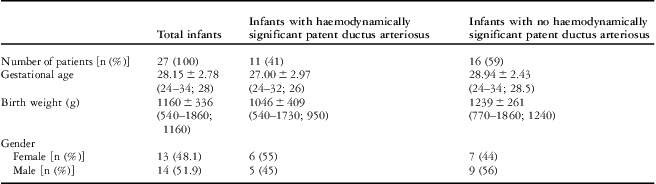
A total of 27 babies were included the study. Table 1 shows the demographic characteristics of the patients.
Demographic parameters of infants.

Of the 27 patients, 11 (41%) had significant patent ductus arteriosus, as proved by echocardiography within the first 72 post-natal hours. Echocardiography was performed on day-of-life one for three (27%), on day-of-life two for three (27%), and on day-of-life three for five (46%) of the 11 babies. Ibuprofen treatment was started within the first 12–24 hours in three (27%), within the first 25–36 hours in one (9%), within the first 37–48 hours in two (18%), and within the first 49–72 hours in five (46%) of the 11 babies with patent ductus arteriosus.
Of the 27 babies, 16 (59%) had no haemodynamically significant patent ductus arteriosus and did not undergo ibuprofen treatment. Echocardiography was performed on day-of-life one for one (6%), on day-of-life two for one (6%), and day-of-life 3 for 14 (88%) of the 16 babies without patent ductus arteriosus.
Haemodynamic symptoms were observed during the first 72 hours in the haemodynamically significant patent ductus arteriosus group – hypotension in 3 of 11, peripheral hypoperfusion in 2 of 11, and pulmonary congestion in 2 of 11 babies.
The mean ductal diameter was reported to be 2.1 ± 0.8 (1.2–3.7) mm/kg in the haemodynamically significant patent ductus arteriosus group and 0.7 ± 0.9 (0–2.9) mm/kg in the group without haemodynamically significant patent ductus arteriosus, with the difference being statistically significant (p = 0.001). The mean left atrial:aortic root ratio was 1.41 ± 0.33 (1.07–1.90) in the haemodynamically significant patent ductus arteriosus group and 1.11 ± 0.19 (0.86–1.51) in the group without haemodynamically significant patent ductus arteriosus, with the difference being statistically significant (p = 0.02).
The mean time of synchronous arterial and venous blood gas analyses was 2 hours and 30 minutes ± and 1 hour and 20 minutes, respectively (30 minutes–6 hours). No statistically significant difference was found with regard to time of measurements.
The differences between arterial and inferior caval vein oxygen saturation and lower body fractional oxygen extraction were significantly lower and the shunt index was significantly higher in the haemodynamically significant patent ductus arteriosus group than in the group without haemodynamically significant patent ductus arteriosus (DSO2: 1.9 ± 13.4 versus 12.6 ± 9.3; p = 0.034; lower body fractional oxygen extraction: 0.01 ± 0.16 versus 0.14 ± 0.10; p = 0.030; shunt index: 126.84 ± 94.95% versus 39.51 ± 32.83%; p = 0.006, respectively) (Table 2).
The differences between the arterial and inferior vena cava oxygen saturation, lower body fractional oxygen extraction, and shunt index values of infants.

FOE = fractional oxygen extraction
DSO2 the value of differences between arterial and inferior vena cava oxygen saturation
*p = 0.034; †p = 0.030; ‡p = 0.006
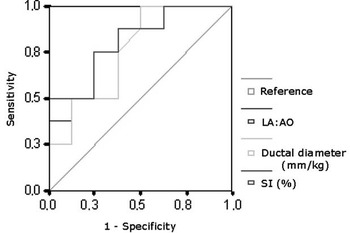
A shunt index of 63% was the optimal cut-off value with a sensitivity of 78% and specificity of 82% in determining patent ductus arteriosus. A ductus diameter ≥1.5 mm/kg had a sensitivity of 75% and specificity of 63% and an left atrial:aortic root ≥1.14 had a sensitivity of 88% and specificity of 63% in predicting patent ductus arteriosus (Fig 1).
Shunt index: AUC 0.81 (p = 0.036); ductal diameter: AUC 0.76 (p = 0.083); LA/AO: AUC 0.77 (p = 0.074).

Discussion
In this study, the shunt index was easily calculated from the values of inferior caval vein oxygen saturation and arterial oxygen saturation. The shunt index was also revealed to predict haemodynamically significant patent ductus arteriosus in preterm infants placed with an umbilical venous catheter in their early post-natal life. In the study of van der Hoeven et al,Reference van der Hoeven, Maertzdorf and Blanco 10 the fractional oxygen extraction was found to be 0.21, and the 5th and 95th percentile values were reported to be 0.15 and 0.29, respectively. In our study, the mean value of fractional oxygen extraction was 0.09, which was lower than that observed by van der Hoeven et al. Our mean measurement of fractional oxygen extraction was 2.5 hours, which was also different from that observed in the study by van der Hoeven et al, in which the earliest measurement was post-natal 18 hours of age. We calculated fractional oxygen extraction using the inferior caval vein oxygen saturation. Thus, we calculated the lower body fractional oxygen extraction.
In the study of van der Hoeven et al,Reference van der Hoeven, Maertzdorf and Blanco 10 the shunt index was 24%, and the 5th and 95th percentiles were reported to be 7% and 24%, respectively. In the study of Schulze et al,Reference Schulze, Whyte, Clifton Way and Sinclair 19 on premature infants with mechanical ventilation and without ductal and arterial shunts, the shunt index ranged from 6% to 49%. In this study, the mean post-natal age of the premature infants was 42 hours (minimum–maximum, 11–96). In our study, the shunt index was measured to be 77.48 ± 7.97 (0.00–300.00; 52.27) at a mean post-natal age of 2.5 hours. This value was higher than those observed in the other studies. In our study, in the group without haemodynamically significant patent ductus arteriosus, only one patient had a 100% shunt index. It was the maximum value recorded in this group, and echocardiographic examination of this patient at 72 hours post-natal revealed a wide (2.9 mm/kg) ductal diameter and a small ventricular septal defect, which do not have haemodynamic effects. This result reveals that the shunt index is an important predictor of wide patent ductus arteriosus, even in patients without prominent symptoms.
The lower fractional oxygen extraction values and the higher shunt index values observed in our study compared with other studies can be explained by the active foetal shunts in the early post-natal life. Fractional oxygen extraction “(SaO2 − SvO2)/SaO2” expresses the difference in oxygen saturation from the arterial to the venous system. In adults without intracardiac shunts, vasoconstriction causes lower fractional oxygen extraction, as the blood cannot reach some capillary beds, and the difference between arterial and venous oxygen saturation diminishes. Fractional oxygen extraction, alone cannot reflect the periferic circulation in the newborn babies whose shunts are still active. The lower values of fractional oxygen extraction observed in our study can be due to intracardiac foetal shunts and peripheral vasoconstriction in the early post-natal period.
On echocardiographic examination, a ductus diameter ≥1.5 mm/kg reflected a haemodynamically significant patent ductus arteriosus with a sensitivity of 75% and specificity of 63% and an left atrial:aortic root ratio ≥1.14 reflected a haemodynamically significant patent ductus arteriosus with a sensitivity of 88% and specificity of 63%.
The shunt index was easily calculated from the values of inferior caval vein oxygen saturation and arterial oxygen saturation. It was also revealed to predict a haemodynamically significant patent ductus arteriosus in preterm infants placed with an umbilical venous catheter in their early post-natal life.
Acknowledgement
The authors gratefully acknowledge all the Neonatal Unit nurses for their cooperation.