INTRODUCTION
Rice (Oryza sativa L.) is the staple food for over half of the world's population and is ranked as the world's number one human food crop (Anuonye et al., Reference Anuonye, Daramola, Chinma and Banso2016). In South Sudan, rice is considered among the first four dominant staple cereals after sorghum, maize and millet in terms of consumption. Results from the 2009 National Baseline Household Survey (NBS) suggested that more than 75% of rural households consume cereals. In the last two decades, South Sudan (formerly Sudan) was a net exporter of agricultural produce to regional markets and the potential of agriculture in stimulating economic growth was emphasized. However, due to civil war-related destruction, poor infrastructure and lack of investment in the agriculture sector, South Sudan is now a net importer of food. It currently imports as much as 50% of its food needs, including 40% of its cereals from neighbouring countries, particularly Uganda and Kenya. Total food imports are estimated to be in the range of US$ 200–300 million a year (AfDB, 2013). The national consumption of rice in South Sudan is approximated at 23,000 mg year−1 and the average per capita consumption is projected as 3 kg year−1.
It is also reported that South Sudan receives all its rice imports through Uganda (Nzomoi and Anderson, Reference Nzomoi and Anderson2013), which acts as an important transit corridor for rice shipment of both locally produced and imported rice. Despite the importance of rice in South Sudan, local production is low. Introduced varieties do not meet the standards of imported rice in physical, cooking and eating qualities and therefore do not offer competitive prices in the market. A major challenge of the rice sector in the country is therefore how to produce sufficient and affordable high quality rice that not only meets the preferences of its fast-growing and increasingly urbanized population, but also competes favourably with imported rice. In addition, consumer preferences may be variable and closely associated with the historical and socio-cultural factors of a given region (Son et al., Reference Son, Do, Kim, Cho, Suwonsichon and Valentin2014), such that quality rice in one region may be considered to be poor in another region. A study by Nzomoi and Anderson (Reference Nzomoi and Anderson2013) on rice markets in East Africa suggested that released rice varieties are not widely adopted because, in most cases, farmers and consumers may not prefer the taste or aroma of the introduced variety. For example, consumers in Uganda prefer aromatic to non-aromatic rice, sticky to non-sticky rice, unbroken to broken, bulging after cooking to rice that does not bulge and white milled rice to brown. Thus, grain quality may be based on certain objective or subjective criteria that are of relative importance to the end-user. In general, the most important grain quality traits that are common to all end-users include appearance, milling quality, cooking, processing quality and nutritional quality (Lou et al., Reference Lou, Chen, Yue, Lou, Mei, Xiong and Luo2009). In light of this, knowledge on end-user tastes and preferences and identifying traits that farmers value in the selection of rice cultivars are important for goal setting in a plant breeding programme (Virk et al., Reference Virk, Singh, Prasad, Gangwar and Witcombe2003).
The development of new high yielding varieties cannot have an appreciable impact unless the selection takes into account end-user qualities. Thus, researchers have become increasingly aware that incorporating end-user preferred qualities in technology development may substantially enhance chances of adoption of the technology (Joshi et al., Reference Joshi, Sthapit, Subedi, Witcombe, Cleveland and Soleri2002; Sié et al., Reference Sié, Sanni, Futakuchi, Manneh, Mande, Vodouhé, Dogbe and Drame2012). Given this strategy, participatory plant breeding (PPB) approaches have been widely embraced in plant breeding programmes to engage farmers in variety selection process and have proven to be successful in eliciting farmers’ preferred varieties and encouraging farmer variety uptake (Asante et al., Reference Asante, Asante, Acheampong, Offei, Gracen, Adu-Dapaah and Danquah2013; Joshi et al., Reference Joshi, Sthapit, Subedi, Witcombe, Cleveland and Soleri2002; Witcombe et al., Reference Witcombe, Joshi, Joshi and Sthapit1996). In addition, participatory rural appraisal (PRA) has been useful in identifying farmers’ crop production constraints and variety preferences during the early phases of a crop improvement programme (Lamo, Reference Lamo2010; Mzengeza, Reference Mzengeza2010; Sibiya, Reference Sibiya2010). This ensures development of rice cultivars tailored for specific adaptation (Joshi et al., Reference Joshi, Sthapit, Subedi, Witcombe, Cleveland and Soleri2002), which encourages competitiveness of locally produced rice and thus provides a mechanism to return more benefits associated with improved quality rice to the farmer. Thus, the aim of this study was to investigate farmers’ perceived rice production and productivity constraints and choice of rice ideotypes across rainfed and irrigated ecologies in South Sudan to guide breeding and policy interventions.
MATERIALS AND METHODS
Study area
In South Sudan, rice is cultivated under two production systems, namely; rainfed upland (in the Greenbelt agro-ecological zone) and irrigated lowland (in the western flood plains Agro-ecological zone), where the latter provides the greatest potential for rice cultivation. This study was conducted in five payams (which are administrative units comparable to townships) of South Sudan that cut across the two common rice ecologies. Thus, Aweil rice scheme payam was selected within the irrigated lowland rice ecology, while Yambio center, Bangasu, Gangura and Lirangu payams were chosen as major rainfed upland rice growing areas.
The Aweil rice scheme in Aweil North County of Northern Bahr el Ghazal State is naturally covered with shrub and sparse trees with open deciduous woodland in the south, and receives a unimodal rainfall pattern with 800 to 1,000 mm annually. The average monthly maximum air temperatures vary slightly from 33.8 °C in March to 36.0 °C in September, and an average monthly minimum air temperature from 17.6 °C in September to 10.5 °C in December. The rice scheme lies within the flood plains agro-ecological zone and provides the greatest potential for lowland rice cultivation in South Sudan. It is located at 08046’48’N and 27024’00’E at 425 m (asl), with an extensive irrigated lowland rice area of about 5000 ha. The soil is classified as black cotton soil and land along the river floods annually, though the floods are of variable volume and duration.
Yambio County is located along the tropical rain-forest belt within the Greenbelt agro-ecological zone of South Sudan at 04033’54’N and 28022’30’E at 650 m asl. The area receives a bimodal rainfall pattern with annual mean total of about 1443 mm and the soils are classified as fertile clay soils (Hoffmann et al., Reference Hoffmann, Blum, Kern, Mewes and Oelmann2013). The highest mean maximum temperatures ranges between 30–32 °C and occur in January just before the rainy season, while mean minimum temperatures ranges between 19–27 °C and occur between February and November during the rainy season (Lukaw et al., Reference Lukaw, Mohammed, Abdelrahman, Jaja and Ochi2016).
Sampling procedure and participants
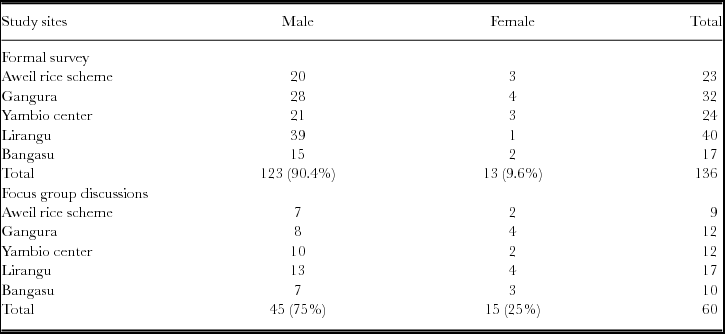
A simple random sampling technique was used to select rice farmers with at least five years of rice farming experience. Farmers were selected in both irrigated (Aweil rice scheme) and rainfed (Yambio County) areas, with the sample size comprised of 136 individual rice farmers (123 male and 13 female) (Table 1). To provide a forum for joint identification of challenges and opportunities in the rice sector, focus group discussions (FGDs) were conducted (one at each payam) and brought together key stakeholders that included farmers, County Agriculture Commissioners, extension officers, traders and millers. The total number of participants in the group discussions was 60 (45 male and 15 female). In general, there were more male respondents than females in both the structured survey and group discussions (Table 1). The research team comprised of two scientists and ten extension officers (two extension officers per site). The enumerators and facilitators were mainly local extension officers working in the study areas and were selected based on their familiarity with the local language, culture and farming activities.
Total number of participants interviewed disaggregated by gender for structured survey and focus group discussions in selected rice growing areas.

Data collection
Primary data for the set objectives were collected through structured and pre-tested questionnaires and participatory learning approaches. PRA tools were used in characterizing the bio-physical and socio-economic status of the rice farming households, including key informant interviews, FGDs and transect walks during farmer field observations to further validate data generated from individual interviews. Additional qualitative and quantitative data were gathered for preferred rice characteristics and cooking and eating qualities required by rice farmers and other stakeholders’. Furthermore, data were collected on a number of variables, including demographic information and socio-economic indicators. Enumerators were guided through the questionnaires and FGDs points by the principal investigator to ensure clarity and to establish a common understanding of the exercise. The questionnaire was pre-tested on a small group of farmers and adjustments were made when necessary.
Group discussions allowed for joint identification and prioritization of challenges and opportunities aimed at enhancing local rice production. In addition, the discussions also focussed on outstanding issues emanating from individual farmer interviews. In one of the group discussions in Gangura payam, a rice cooking and eating quality exercise was conducted with a panel of 12 participants (eight male and four female) to capture stakeholders’ general views on rice cooking and taste qualities and improve discussion. In this exercise, tested materials included imported rice varieties (Basmati, Pakistan and China) and locally cultivated rice cultivars (NERICA 4 and NERICA 1), which were considered as controls. The materials were acquired from the local market where imported rice was observed to be slightly more expensive than the locally produced rice. The test materials were treated equally during the cooking process and were branded with letters to avoid any bias. Thereafter, stakeholders were able to score the cultivars following a linear scale from 1 (most preferred) to 5 (least preferred) for cooking and eating quality, giving reasons for like or dislike.
A participatory approach was used to identify farmers’ needs in a cultivar and to expose stakeholders to new upland and lowland rice cultivars. The most important agro-morphological attributes were revealed and explained to the participants. From the traits chosen, participants gave weighting of the importance of each trait and also the reasons for like or dislike. To assess how participants select traits that they consider in the selection of rice varieties to plant, score cards were used to each trait according to its importance following a linear scale from 1 (most preferred) to 5 (least preferred).
Data analysis
Descriptive statistics using frequency means and percentages were calculated for different variables to explore relationships. Statistical analyses of both quantitative and qualitative data were performed in IBM SPSS Statistics version 21.0 (SPSS, Reference SPSS2012) computer package. Chi-square test for association was used to test for independence between rice growing sites and variables. Data generated from FGDs was tallied, ranked and compared using matrix and pair-wise ranking procedures. Spearman's rank correlation was used to test for consistency of ranking across sites, while Fisher's unprotected least significant difference test was performed for mean comparisons.
RESULTS
Demographic and socio-economic aspects
Significant differences (p < 0.001) were observed for household relationship and number of individuals per household across the rice growing sites, with implications on availability of farm labour. Most of the respondents (52%) were within the age range of 21–40 years (Supplementary Material Table S1). In addition, the bulk of the respondents had attained primary education (58%) with few others achieving Ordinary School Certificate (15%) as the highest level of training (Table S1). Significant differences were also observed for land size allocated for rice production (p < 0.01) and category of popular rice grown (p < 0.001) across sites: a large number of rice farmers cultivated local landraces both in Aweil rice scheme (48%) and Yambio County (81%). Common rice varieties cultivated in Aweil rice scheme were BG400-1 and BR4, while popular rice landraces were Ruanya and Zamburu in Yambio County. The landrace yields ranged between 0.4 and 1.6 mg ha−1 for both upland and lowland cultivars (Table S1).
Farmers’ staple crops and cropping systems
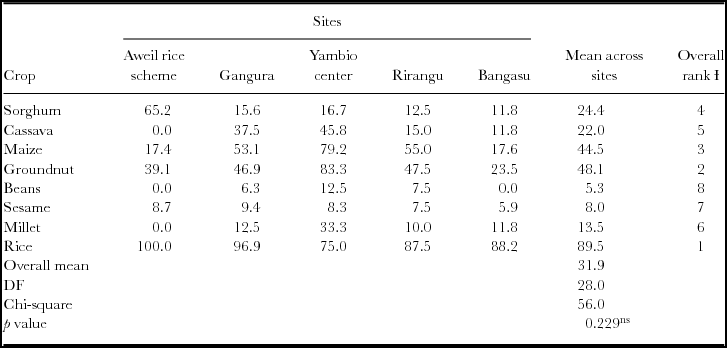
Results of chi-square test for independence revealed that crops grown by farmers did not differ significantly across the rice growing sites (Table 2). Within the lowland rice ecology, rice was grown entirely as a sole crop and was considered an important food and cash crop. After rice, sorghum was most preferred as a food crop followed by groundnut, maize and sesame (Table 2). Commonly cultivated rice and sorghum varieties were late maturing (>6 months). Sorghum was commonly intercropped with sesame, while maize was mainly cultivated in limited areas close to the homesteads and often consumed green. Groundnut – an important contribution to the household diet and also an important cash crop – was mostly cultivated in sandy soils. Upland rice in Yambio County (comprising Gangura, Yambio center, Lirangu and Bangasu payams) was widely grown as an intercrop with maize or cassava. Rice was generally considered an essential food crop and an important socio-cultural crop. Other important crops cultivated in Yambio County were groundnut, maize, cassava and sorghum (Table 2). Similar to Aweil rice scheme, late maturing rice and sorghum varieties were predominant in Yambio County.
Farmers’ preferences (%) for staple crops across lowland and upland rice ecologies in South Sudan.

ƗOverall rank based on percent mean values across sites. Ɨ‘Overall rank 1 = best, to overall rank 8 = worst’, ns = Non-significant (p > 0.05).
Farmers’ desired attributes in rice varieties
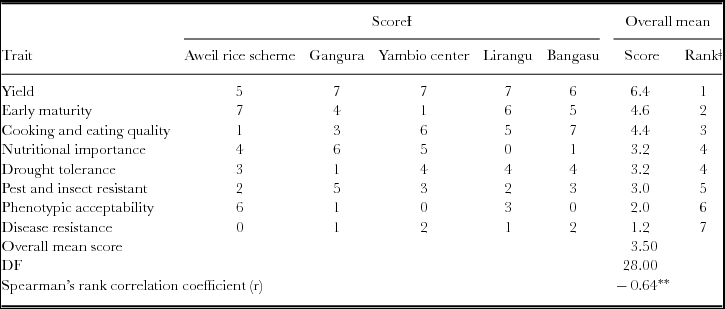
At the lowland rice production site in Aweil rice scheme, farmers identified the four most important desirable variety characteristics as early maturity, phenotypic acceptability, yield and nutritional importance (Table S2). In the upland rice growing sites within Yambio County, farmers in Gangura payam suggested yield, nutritional importance, pest resistance and early maturity as the most desirable cultivar traits. In Yambio center payam, farmers opted for yield, cooking and eating quality, nutritional importance and drought tolerance as the most important traits. In addition, farmers advocated for yield, early maturity, cooking and eating quality and drought tolerance in Lirangu payam. In Bangasu payam, farmers identified improved cooking and eating quality, yield, early maturity and drought tolerance as the most preferred traits (Table S2). Ranking of mean scores across sites in order of importance revealed that yield, early maturity, cooking and eating quality, nutritional importance and drought tolerance were the most desirable cultivar traits preferred by respondents (Table 3). Furthermore, spearman's rank correlation coefficient (r) suggested significant negative correlation (r = −0.64; p < 0.01) in ranking order suggesting inconsistency in ranking of most desirable variety traits preferred by respondents across sites (Table 3).
Pair-wise ranking of most desirable traits of varieties by respondents across lowland and upland rice ecologies in South Sudan.

ƗScores are generated from S2 Table. ǂ‘Rank 1 = most desirable, to rank 7 = least desirable’. **Correlation is significant at the 0.01 level (2-tailed).
Stakeholder preferred rice cooking and eating quality traits
To understand stakeholder perceptions for cooking and eating quality traits, both imported and locally cultivated rice cultivars were subjected to cooking and eating quality tests. The best ranked rice varieties were imported varieties, namely Pakistan, Basmati and China rice (Table S3). Pakistan rice was preferred for its ‘sweet’ taste, swelling capacity, aroma, grain shape and size and non-stickiness. On the other hand, Basmati rice was desired for its grain shape and size, appealing sweet taste, non-stickiness and aroma, while China rice was selected for its appealing golden colour, aroma, sweet taste, non-stickiness and swelling capacity. Among the locally cultivated rice cultivars, NERICA 1 was preferred to NERICA 4 for its aroma, grain colour and less water use during cooking (Table S3). It was also noted that the price of imported rice in the market was slightly higher than the price of locally produced rice.
Desirable rice agro-morphological traits
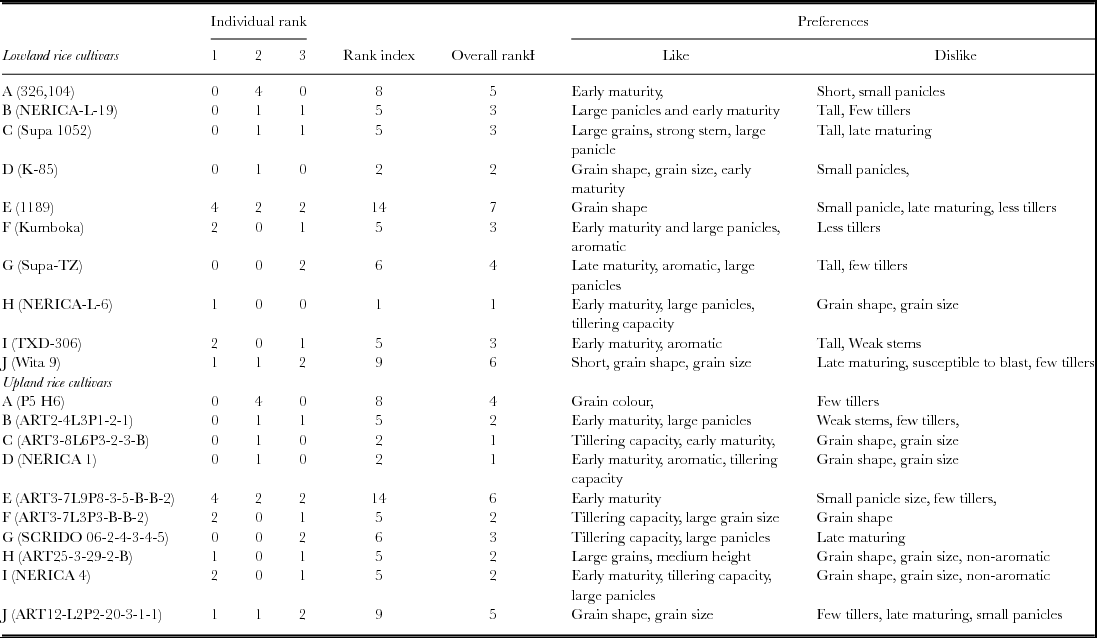
NERICA-L-6 was most preferred for early maturity, large panicles and enhanced tillering capacity, while the least preferred lowland rice cultivar was 1189 due to its small panicles and late maturing cycle (Table 4). The best ranked upland rice cultivars were NERICA 1 and ART3-8L6P3-2-3-B, which were selected for early maturity and enhanced tillering capacity (Table 4). The least preferred upland rice cultivar (ART3-7L9P8-3-5-B-B-2) was disliked for having small panicles and few productive tillers (Table 4).
Matrix ranking of stakeholder preferences for agro-morphological traits in lowland and upland rice cultivars during a focus group discussion.

Ɨ‘Overall rank 1 = best, to overall rank 7 = worst’. In parenthesis are the cultivar lineages or common names.
In general, the most desirable agro-morphological attributes in both lowland and upland rice cultivars were early maturity, large panicles and enhanced tillering capacity. Overall, most locally grown rice cultivars across all rice growing sites were late maturing (>6 months) and had low yields (0.4 to 1.6 mg ha−1), with less potential for market supply. Although rice is an important food and cash crop in South Sudan, its production is unable to meet the growing local demand, competing with imported rice.
Farmers’ perceived constraints to rice production
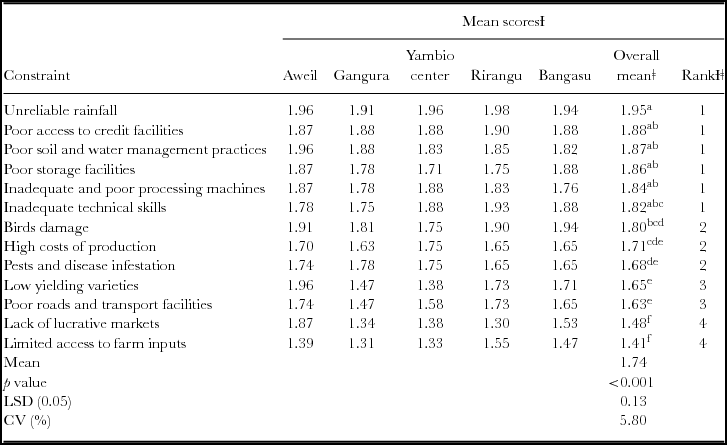
Significant differences (p < 0.001) were observed in the consistency of ranking order of major rice production constraints across lowland and upland rice growing sites (Table 5). The most important constraints across were: unreliable rainfall, poor access to credit facilities, poor soil and water management practices, poor rice storage facilities, inadequate and poor processing machines as well as limited technical skills in rice production (Table 5). Poor soil and water management practices was identified as a major constraint to lowland rice production, while unreliable rainfall was mentioned as a critical factor affecting upland rice production (Table 5).
Ranking of major rice production constraints across lowland and upland rice production sites in South Sudan.
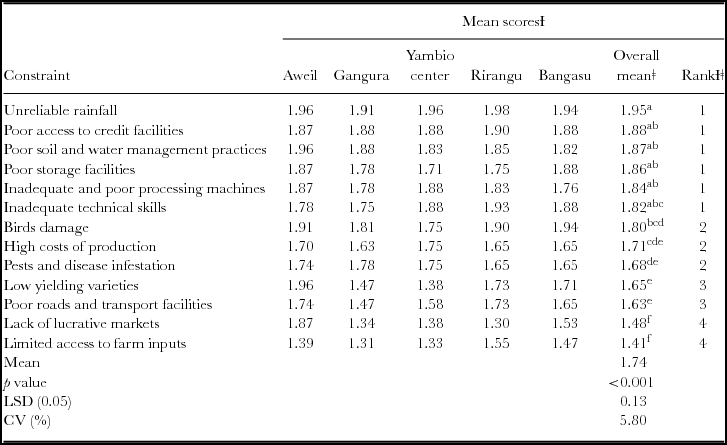
ƗǂRank based on overall mean scores across sites. ‘Rank 1 = most important, to rank 4 = least important’. Means followed by the same letter are not significantly different and therefore the constraints were ranked the same.
DISCUSSION
Women play a prominent role in farming in South Sudan, providing close to 80% of farm labour (AfDB, 2013). However, more males participated than females in this study and this is strongly attributed to the traditional set-up and cultures, where men often as house-hold heads take lead in farm planning and decision making and are custodians of common household wealth. Significant differences were observed for number of individuals per household (Table S1) and the majority of sampled farmers consisted of a youthful age group with the potential for increasing agricultural production. Although some respondents indicated having attended short courses in agricultural training commonly offered by agricultural extension officers and non-governmental organizations, specialized formal training in rice production and management was inadequate. Farming was based on small, hand cultivated units of less than one hectare per household (Table S1). Despite the huge potential for rice cultivation in South Sudan, farmers use traditional and unimproved farming practices and non-improved varieties, limiting potential rice productivity. In both rice ecologies, most farmers used obsolete rice varieties or landraces, which have been recycled over the years. Although landrace is an important component of plant genetic resources (Gyawali et al., Reference Gyawali, Sthapit, Bhandari, Bajracharya, Shrestha, Upadhyay and Jarvis2010), low yield is common among landraces. In spite of efforts to introduce new varieties by development partners and NGOs, most of the introduced varieties did not go through testing for adaptability due to the lack of a functional rice breeding programme and a variety release system in South Sudan. Also, these varieties were not evaluated for their agronomic performance and attributes and hence are rarely adopted by rice farmers. Therefore, this study suggests that adoption of improved rice variety is dependent on farmer's and consumer's desirable traits, which would be taken into account through participatory breeding approaches.
Next to rice, sorghum and groundnut were the most preferred crops at the lowland rice growing site, while maize and groundnut were preferred at the upland rice growing sites (Table 2). The differences may be explained by the suitability of the soils for production of the desired crop and its economic and socio-cultural importance. Furthermore, rice was mainly cultivated as a sole crop in the lowland rice ecology due to its importance as food and cash crop. In the upland ecology, rice is planted as an intercrop and considered an essential food with socio-cultural importance. Across all sites, farmers cultivated local landraces or old crop varieties probably due to inadequate access to new and modern cultivars or the absence of acceptable alternatives to their landraces (Witcombe et al., Reference Witcombe, Joshi, Joshi and Sthapit1996). Although there have been efforts to introduce improved rice varieties by non-governmental organizations, the failure to produce varieties adapted to growing conditions or with traits valued by farmers and consumers may explain the limited adoption in South Sudan (Dalton, Reference Dalton2004; Witcombe et al., Reference Witcombe, Joshi, Gyawali, Devkota and Subedi2004). In both rice growing systems, farmers commonly used their own seed saved from the previous harvest and rarely used fertilizers, pesticides or herbicides.
Variability in farmer variety preferences across sites may be influenced by historical and socio-cultural factors (Son et al., Reference Son, Do, Kim, Cho, Suwonsichon and Valentin2014) as depicted here (Table 3). Consequently, this may provide important considerations for the rice breeding programme in South Sudan to develop varieties that incorporate desired cultivar traits for specific sites. Yield and early maturity were the most desirable attributes across the rice growing sites that offer a clear yield advantage through double cropping. However, this does not always translate into increased revenue as consumer preference is often considered a major driver of widespread adoption of a new variety (Calingacion et al., Reference Calingacion, Fang, Quiatchon-Baeza, Mumm, Riedel, Hall and Fitzgerald2015) as well as grain quality traits such as cooking and eating quality (Oko and Dambaba, Reference Oko and Dambaba2012). Hence, it is important to note that rice producers’ and consumers’ are important drivers of rice production.
Overall, imported rice were highly preferred mainly for the ‘sweet’ and appealing taste, grain shape and size, aroma, swelling capacity and non-stickiness during cooking, while the locally produced rice cultivars were less preferred based on their non-appealing grain shape and size, taste and stickiness during cooking (Table S3). Similar results were reported by Asante et al. (Reference Asante, Asante, Acheampong, Offei, Gracen, Adu-Dapaah and Danquah2013) in West Africa and Kikuchi et al. (Reference Kikuchi, Haneishi, Maruyama, Tokida, Asea and Tsuboi2016) in East Africa. Gender differences were also observed where different rice varieties appealed differently to either men or women. While men generally preferred varieties that are long and slender due to its preference in markets, women selected varieties that are aromatic and swell when cooked.
In this study, the local cultivars recently introduced, farmer preferred and adapted to the upland rice ecology of South Sudan do not match the imported rice in terms of end-user qualities. While imported rice is generally more expensive than the locally produced rice, locally rice does not offer competitive prices in market as they are inferior in processing, cooking and eating qualities as compared to imported ones. A study by Demont and Ndour (Reference Demont and Ndour2015) on upgrading of rice value chains with several African markets concluded that generally urban rice consumers were willing to pay more for rice with superior quality attributes. Furthermore, Demont (Reference Demont2013) suggests that in order to make domestic rice competitive to imported one, African governments will need to invest more resources in rice value-addition. Consequently, this provides a great opportunity for varietal quality improvement in African rice producing countries, reducing rice imports and generating export revenues. Additionally, consumers’ choice of rice varieties are largely determined by the grain cooking and eating qualities (Oko and Dambaba, Reference Oko and Dambaba2012). Although preferences may vary from one group of consumers to another, rice grains with a pleasant fragrance and a soft texture are preferred in markets and have higher prices than non-preferred ones (Yi et al., Reference Yi, Nwe, Vanavichit, Chai-arree and Toojinda2009).
Regarding environmental conditions, Aweil rice scheme lies within the flood plain agro-ecological zone of South Sudan and frequently experiences torrential rains that results in flooding for most part of the rice growing season. Erratic and torrential rains are a major cause of crop failure and therefore viewed as a major challenge in rice production across all rice ecologies in the country. Then, absence or inadequate access to credit facilities was suggested as an important constraint in rice production. Agriculture is generally viewed as a risky business by most financing institutions in South Sudan. While there are very few of these institutions supporting agricultural investments, most of them are located in major towns and are not easily accessible to rice growers. In addition, poor soil is identified a major constraint to rice production and farmers rarely use fertilizers, both contributing to low rice yields found. At Aweil rice scheme, water management is unsatisfactory and limits rice production. Another major setback mentioned by rice growers was grain damage by birds in both lowland and upland rice growing areas. Birds’ damage was more pronounced in rice fields that were sown late, predisposing the crop to damage by migrating birds. Also, inadequate training of rice farmers in various aspects of rice cultivation was identified as a major constraint to rice production in South Sudan. Farmers generally lacked basic skills for improving rice production through management practices, following traditional methods such as broadcasting instead of using dibbling and line planting methods.
CONCLUSIONS
The present study revealed the major determinants for rice production in South Sudan, addressing some important points for breeding programmes and policy interventions. Given the important role of women in agriculture, a clear understanding of gender perspectives in rice farming is of paramount importance. Thus, a more critical assessment of gender roles in rice farming may reveal other factors limiting rice production. Most of rice farmers were relatively young and did not receive specialised training in rice production and management. The study also highlighted that rice farming was largely dominated by traditional rice farming methods, including broadcasting and use of farmer saved seed or recycling of old rice varieties despite efforts to introduce new rice varieties. The low adoption of new rice varieties largely emanates from lack of incorporating farmer's and consumer's preferences in new varieties. The criteria for selecting rice varieties were influenced by local and gender differences and both farmers’ and stakeholders’ would participate in rice breeding. African governments are encouraged to invest more resources in rice value-addition in order to make domestic rice competitive to imported rice and enable African rice farmers to access urban markets. Policy options that encourage increased access to farm inputs through agro-dealer networks and judicious use of fertilizers will help to enhance rice productivity. The study further recognizes the important role of research in generating appropriate rice technologies while advocating for policy measures for improving seed quality, production and distribution.
Acknowledgements
The Alliance for a Green Revolution in Africa (AGRA) is sincerely thanked for funding this work through the African Centre for Crop Improvement (ACCI). The International Foundation for Science (IFS) provided additional funding support. We also appreciate the National Crops Resources Research Institute (NaCRRI, Uganda), Institut d'Economie Rurale (IER-Mali) and the Africa Rice Center (ARC) for providing the germplasm. Rice farmers and stakeholders in the study areas are sincerely acknowledged for making this participatory research possible.
SUPPLEMENTARY MATERIAL
To view supplementary material for this article, please visit https://doi.org/10.1017/S0014479718000017