Introduction
Eurytrematosis is a disease caused by flukes of the genus Eurytrema (Bassani et al., Reference Bassani, Sangioni, Saut, Yamamura and Headley2006). These parasites infect the pancreatic ducts of a wide variety of species, including cattle, sheep and humans (Yeh et al., Reference Yeh, Cheng, Huang, Zhan, Wong and Mitchell2019; Leite et al., Reference Leite, Lopes-Torres, Souza, Neves, Gomes and Machado-Silva2020; De Sousa et al., Reference De Sousa, Barbosa, Wilson, Machado, Oliveira, Duarte and de Castro2021). In South America, there are several records of the presence of this parasite, mainly in Brazil (Brant, Reference Brant1962; Azevedo et al., Reference Azevedo, Mannigel, Agulhon, Borba, Barbiéri, de Oliveira, Headley and Janeiro2004). In Argentina, only one study reported the occurrence of this parasite in Misiones province (Moriena et al., Reference Moriena, Lombardero and Racioppi1996).
Diagnosing eurytrematosis through the analysis of faecal samples can be difficult because most of the available techniques are very laborious and generally considered of low sensitivity (Chinone & Itagaki, Reference Chinone and Itagaki1976; Sakamoto et al., Reference Sakamoto, Kono, Yasuda, Yamamoto and Nakagawa1980; Viana, Reference Viana1985). The Dennis, Stone and Swanson technique was modified by Belém et al. (Reference Belém, Oliveira, Padovani and Luvizotto1992) to increase the probability of detecting animals positive for Eurytrema spp. in faecal samples. According to these authors, the modified technique had a probability of detection of 94.2%. Nevertheless, they observed that the values of eggs per gram (EPG) are generally low. In this regard, some authors propose that the low loads of eggs in faeces, as well as the number of false negatives that occur using the different techniques, may be due to egg laying fluctuations or to a low parasitic load at sampling (Martin, Reference Martin1972; Chinone & Itagaki, Reference Chinone and Itagaki1976; Belém et al. Reference Belém, Oliveira, Padovani and Luvizotto1992).
We proposed a modification of the technique described by Belém et al. (Reference Belém, Oliveira, Padovani and Luvizotto1992), to increase the sensitivity and detection rate of infected animals. The objective of this work was to describe the new technique and to compare it with that provided by Belém et al. (Reference Belém, Oliveira, Padovani and Luvizotto1992).
Materials and methods
Sampling was conducted in Misiones province, Argentina (north-eastern Argentina on the border with Brazil) between March 2021 and November 2021. Faecal samples of 212 clinically healthy animals from 20 farms were collected by the intra-rectal route and stored at 4°C. Subsequently, the samples were transported to the Parasitology Laboratory of the Animal Research Institute of Chaco Semiarid (IIACS) under low-temperature conditions for processing. Of the total samples, 174 were from cattle (calves, heifers, steers and cows) and 38 from sheep (adult females). The farms used for this study were selected based on reports of the presence of Eurytrema spp. in the region and information provided by veterinarians working at abattoirs about the presence of the parasite in the slaughtered animals (Servicio Nacional de Sanidad y Calidad Agroalimentaria (SENASA), pers. comm.). On the other hand, and considering the similarity in the morphology of the eggs of Eurytrema spp. and Dicrocoelium spp., no specimen of Dicrocoelium spp. was found in the slaughter of the animals and the necropsies carried out in several of the establishments, Eurytrema spp. being the only trematode of the family Dicrocoeliidae in the sampled herds. Therefore, it can be assumed that the eggs observed in the coprological studies belong to the genus Eurytrema.
Samples were processed using two sedimentation techniques: The technique described by Belém et al. (Reference Belém, Oliveira, Padovani and Luvizotto1992) the first one (Belém et al. (Reference Belém, Oliveira, Padovani and Luvizotto1992) Sedimentation Technique, BST), and the second one was developed by us, which we named ‘Modification of the technique described by Belém et al. (Reference Belém, Oliveira, Padovani and Luvizotto1992)’ (MBST). BST is one of the most widely applied techniques to diagnose Eurytrema coelomaticum infection in faeces at the regional level (Araújo & Belém, Reference Araújo and Belém1993, Reference Araújo and Belém1994; Belém et al. Reference Belém, Rodrigues de Oliveira and Roberto Padovani1994; Bassani, Reference Bassani2005; Lucca et al., Reference Lucca, Stedille, Schwertz, Henker, Gabriel, Mendes, Pappen and Rosa2015). It is a modification of the technique of Dennis et al. (Reference Dennis, Stone and Swanson1954) and uses a 60-μm sieve, 10 min of sedimentation and 1 g of sample. BST consists of diluting 1 g of faecal matter in a 50 ml 0.5% dishwashing detergent solution (DS) and filtering the contents through a 60-μm sieve into a 50 ml tube; then this solution is allowed to settle for 10 min. Subsequently, the supernatant is removed and only the sediment is left. Finally, using a Pasteur pipette, the sediment is transferred to a slide and observations are made at a magnification of 100 or 400. The result is expressed as EPG of faecal matter (final dilution 1 g/50 ml). According to Belém et al. (Reference Belém, Oliveira, Padovani and Luvizotto1992), this technique has a high probability of detecting infection by Eurytrema spp. (94.2%).
On the other hand, our technique (MBST) combines the sedimentation techniques described by Dennis et al. (Reference Dennis, Stone and Swanson1954), Belém et al. (Reference Belém, Oliveira, Padovani and Luvizotto1992) and Viñabal et al. (Reference Viñabal, Cafrune Wierna, Aguirre, Bassanetti, Bertoni and Suarez2015). MBST consists of homogenization of 5 g of faeces in 250 ml of DS. First, homogenization is carried out in 50 ml of 0.5% DS in a laboratory mortar and then, after filtration with a strainer, the homogenized solution is transferred to a 250-ml graduated conical beaker; then the DS is added until the 250-ml graduated conical beaker is full. This solution is filtered through two sieves (150 μm and 180 μm). The content is poured into another 250-ml graduated conical beaker and then allowed to settle for 10 min. After that, the supernatant is removed, leaving 50 ml of the solution, which is homogenized by shaking, and transferred to another 250-ml conical beaker using a 60-μm sieve. Subsequently, to increase the chances of collecting Eurytrema spp. eggs, DS is added through the 60-μm sieve until the 250-ml graduated conical beaker is full and allowed to settle for 10 min. After 10 min, 200 ml of supernatant are removed, and the remaining 50 ml are homogenized with the pellet by shaking, transferred to a 50-ml Falcon tube and allowed to settle for 10 min. Finally, the supernatant is removed, and the remaining solution (2 ml) is homogenized, collected with a pipette and deposited in the camera described by Viñabal et al. (Reference Viñabal, Cafrune Wierna, Aguirre, Bassanetti, Bertoni and Suarez2015) for its reading in an optical microscope at 100×. The result are expressed as eggs/5 g faecal matter (final dilution 5 g/50 ml).
The results of the techniques were reported as positive/negative because this study intends to compare the ability of both techniques to detect at least one egg in the sample and not the number of EPG as such. The agreement between the techniques was evaluated using the Cohen's kappa coefficient κ.
Results
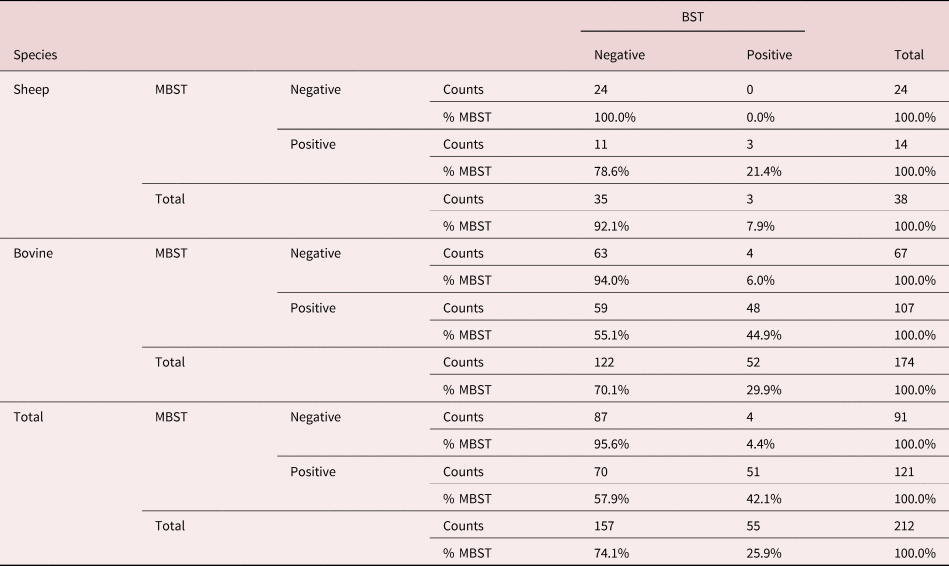
Of the 212 samples tested, 55 were positive for BST (25.9%) and 121 (57.1%) were positive for MBST. The analysis of positive results for each species showed 52 (29.8%) and 107 (61.4%) positive bovine samples by BST and MBST, respectively, and three (7.8%) and 14 (36.8%) positive sheep samples by BST and MBST, respectively. Some samples (11 sheep and 59 bovine samples) were positive by MBST and negative by BST. On the other hand, four bovine samples were positive by BST and negative by MBST, while all the sheep samples positive by BST were positive by MBST (table 1).
Cross-tabulation table for the Modification of the technique described by Belem et al. (Reference Belém, Oliveira, Padovani and Luvizotto1992) (MBST), the technique provided by Belém et al. (Reference Belém, Oliveira, Padovani and Luvizotto1992) (BST) and species. The results of the sample by BST are presented in columns and results by MBST are in rows.

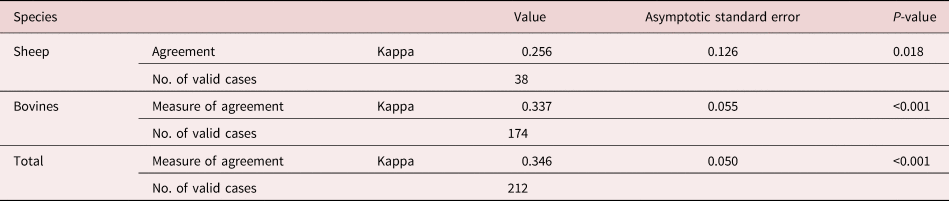
The Kappa coefficient values were 0.223 (P = 0.018) for sheep samples, 0.337 (P < 0.001) for bovine samples and 0.346 (P < 0.001) for all samples (table 2).
Kappa's coefficient by species and total samples.

Discussion
MBST differs from BST in the followings aspects: the sample size is larger (5 g vs. 1 g); it uses an additional wash and passage through two sieves (150 μm and 180 μm) before the passage through a 60-μm sieve; and it uses the camera described by Viñabal et al. (Reference Viñabal, Cafrune Wierna, Aguirre, Bassanetti, Bertoni and Suarez2015) for reading. Our hypothesis was that using a larger sample and modifying some aspects of the technique provided by Belém et al. (Reference Belém, Oliveira, Padovani and Luvizotto1992) would allow us to increase the detection of positive cases. The results suggest that MBST has a higher sensitivity than BST. These differences can be observed mainly in the analysis of bovine samples. Indeed, many of the bovine samples (n = 59) were positive by MBST and negative by BST, suggesting that MBST has a higher negative predictive value than BST. In the case of sheep samples, however, both techniques tended to coincide when the result was negative.
Coprological diagnosis of Eurytrema spp. tends to be difficult and of very low sensitivity (Martin, Reference Martin1972; Belém et al., Reference Belém, Oliveira, Padovani and Luvizotto1992). These difficulties may be related to the parasite load in the animals and fluctuations in the oviposition of Eurytrema spp. (Chinone & Itagaki, Reference Chinone and Itagaki1976). In this regard, Martin (Reference Martin1972) observed an increase in false negatives when loads were below 100 adult specimens in the animal pancreas. Similar difficulties in detecting infected animals with low parasite loads were previously reported (Sakamoto et al., Reference Sakamoto, Kono, Yasuda, Yamamoto and Nakagawa1980; Viana, Reference Viana1985). On the other hand, Belém et al. (Reference Belém, Oliveira, Padovani and Luvizotto1992) describe a 94.2% probability of detection in infected animals. However, the comparison of the results shows that BST has a lower sensitivity to recognize an infected animal than MBST (25.9% for BST and 57.1% for MBST). The studies conducted with BST in Brazil showed positivity of 37.8% (Bassani, Reference Bassani2005) and 68.9% (Lucca et al., Reference Lucca, Stedille, Schwertz, Henker, Gabriel, Mendes, Pappen and Rosa2015), which is higher than the value recorded in this study (25.9%). However, the elimination of eggs through faeces could be related to the parasitic burden of the pancreas and the seasonal fluctuations in the oviposition of Eurytrema spp., which could also influence the results of coproparasitological studies (Bassani et al., Reference Bassani, Sangioni, Saut, Headley and Yamamura2007). These factors may be responsible for the differences observed in the studies from Brazil and Argentina.
Epidemiological characterization studies of eurytrematosis in Argentina are necessary to confirm this assumption. Therefore, MBST is more efficient than BST, and can be a useful tool in the detection of Eurytrema spp. as a complement to the techniques currently available to reduce the presence of false-negative animals. Future studies are needed to validate this technique.
In conclusion, the results observed in this study suggest that MBST may be a more sensitive technique in the detection of Eurytrema spp. eggs in faeces than BST. However, more studies are necessary to validate this technique and better understand epidemiological aspects of eurytrematosis in Argentina.
Financial support
This work was supported by grants from INTA (PEM-E5-I702-001: ‘Caracterización de la Euritremosis en Rumiantes en Misiones’).
Conflicts of interest
None.
Ethical standards
This study was conducted in accordance with animal ethics guidelines and approved protocols described in the requirements of the Argentine Animal Protection Policy (Law 14346) and the European Union Directive 2010/63 on the protection of experimental animals were fulfilled. All information is used for research purposes with the consent of the farm manager.
Author contributions
This work was carried out in collaboration with all authors. L.H.O. and J.F.M.: study conception, design, work supervision, data collection, material preparation, analysis and writing – original draft preparation. A.P.: sample collection, work supervision and writing – review. P.N.V., P.N.C. and A.A.-C.: data collection and processing of faecal samples. M.S.: statistical analysis and writing – original draft preparation. All authors read and approved the final manuscript.