The relative role of bottom-up (resources) and top-down (enemies) mechanisms of population control varies across habitats, and the causes of this variance are poorly recognized (Heath et al. Reference Heath, Speirs and Steele2014, Wilkinson & Sherratt Reference Wilkinson and Sherratt2016, Wollrab et al. Reference Wollrab, Diehl and De Ross2012). Predation is regarded as the primary control agent among insects (Böhm et al. Reference Böhm, Wells and Kalko2011, Roslin et al. Reference Roslin, Hardwick, Novotny, Petry, Andrew, Asmus, Barrio, Basset, Boesing, Bonebrake, Cameron, Dáttilo, Donoso, Drozd, Gray, Hik, Hill, Hopkins, Huang, Koane, Laird-Hopkins, Laukkanen, Lewis, Milne, Mwesige, Nakamura, Nell, Nichols, Prokura, Sam, Schmidt, Slade, Slade, Suchanková, Teder, Van Nouhuys, Vandvik, Weissflog, Zhukovich and Slade2017, Sanz Reference Sanz2001, Williams-Guillén et al. Reference Williams-Guillén, Perfecto and Vandermeer2008), but the importance of this factor for controlling tropical insects is not well studied (Molleman et al. Reference Molleman, Remmel and Sam2015). According to Loiselle & Farji-Brener Reference Loiselle and Farji-Brener(2002), herbivorous insects are generally more frequently attacked by predators in the canopies than in the understorey, and the intensity of predation is expected to vary with the level of disturbance of the forest structure (Posa et al. Reference Posa, Sodhi and Koh2007). If the ongoing mass-logging of tropical forests elicits dramatic changes in the control mechanisms of populations (Barlow et al. Reference Barlow, Lennox, Ferreira, Berenguer, Lees, Mac Nally, Thomson, Ferraz, Louzada, Oliveira, Parry, Solar, Vieira, Aragão, Begotti, Braga, Cardoso, De Oliveira, Souza, Moura, Nunes, Siqueira, Pardini, Silveira, Vaz-De-Mello, Veiga, Venturieri and Gardner2016, Ewers et al. Reference Ewers, Boyle, Gleave, Plowman, Benedick, Bernard, Bishop, Bakhtiar, Chey, Chung, Davies, Edwards, Eggleton, Fayle, Hardwick, Homathevi, Kitching, Khoo, Luke, March, Nilus, Pfeifer, Rao, Sharp, Snaddon, Stork, Struebig, Wearn, Yusah and Turner2015), then we should urgently increase our understanding of how predation intensity might change in the course of the recovery of disturbed forests. For example, the canopy gaps created by logging can attract visually oriented predators such as birds, making foraging herbivores easier to detect in gaps. The improved light conditions in gaps can also attract herbivorous insects due to the abundance of young and sun-exposed leaves (Coley Reference Coley1980). Certainly, foraging predators can locate their herbivorous prey using not only visual but also volatile cues released with leaf damage (Agrawal Reference Agrawal1998). Sam et al. Reference Sam, Koane and Novotny(2015) showed that artificial plant damage increases predation by both insects and birds. Interestingly, caterpillars of some insects, including the family Tortricidae, wrap leaves around their bodies, and although this behaviour is generally believed to provide a refuge against predators (Cappuccino Reference Cappuccino1993), the rolling might also disclose a caterpillar to some specialized predators (Murakami Reference Murakami1999).
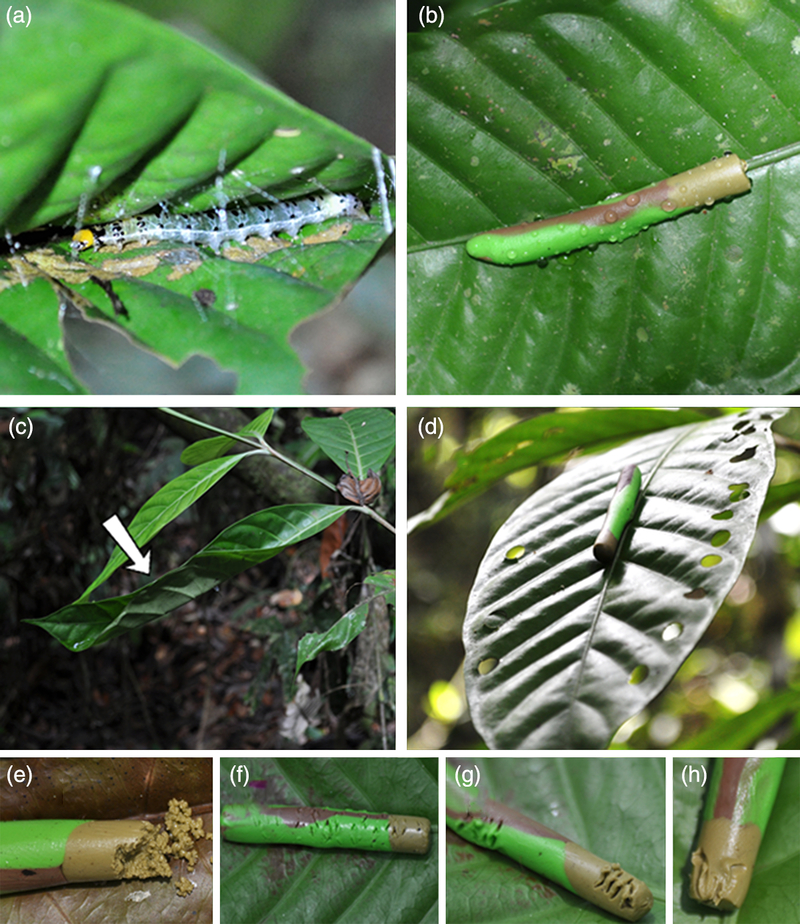
Addressing what shapes predation intensity among caterpillars, we conducted an experiment in the dipterocarp rain forest near Danum Valley Field Station (Sabah, Malaysian Borneo), considering predation pressure of birds and insects on the Tortricidae caterpillars (Figure 1), a common herbivore of the local plant Kopsia pauciflora Hook.f. (Apocynaceae). We predicted that (1) predation attacks become more frequent in canopy gaps, which formed ∼40 y ago due to the selective logging in the area. We also hypothesized that (2) herbivory damage of leaves increases the chance of predatory attacks on caterpillars, but that (3) the leaf-rolling performed by caterpillars would decrease the risk of such attacks.
Photographs of Tortricidae caterpillars and their artificial models in the Bornean tropical rain forest of Danum Valley. The last instar of Tortricidae caterpillar, a common herbivore of Kopsia pauciflora (a). A model of the Tortricidae caterpillar made out of non-toxic and odourless modelling clay; the front part of the caterpillar models was light brown, the rest of the body was bright green with darker brown stripe on the dorsal part (b). An artificially rolled leaf (arrow) over a caterpillar model (c). Artificial herbivore damage of K. pauciflora leaves with a caterpillar model placed along the leaf midrib (d). Photographs of marks left on a model caterpillar by different types of predators: small insects such as ants (e), medium (f) and large (g) insects, presumably bugs and beetles, and birds (h).

The experiment was conducted in July 2016 along two transects in the forest, and involved 53 trees of K. pauciflora and 212 models of Tortricidae caterpillars, which were prepared from non-toxic and odourless modelling clay (Figure 1) and measured 2.5 × 0.5 cm (length × width). To address the effect of canopy cover, each study location was classified either to an open-canopy habitat (seven locations with two to four K. pauciflora trees per location; in total 21 trees in open-canopy habitats) or to a closed-canopy habitat (eight locations with three to four K. pauciflora trees per location; in total 32 trees in closed-canopy habitats). The trees in a given location were at least 5 m away from each other. We placed one caterpillar model on each tree at a time. The caterpillars were mounted with a metal stud and a silicon plug on a randomly chosen leaf within an arm’s reach. Mimicking a common behaviour of Tortricidae caterpillars (pers. obs.), the models were positioned along leaf midribs. Each leaf with a caterpillar was assigned to one of four experimental groups: (1) leaf unrolled and undamaged, (2) leaf rolled and undamaged, (3) leaf unrolled and damaged, (4) leaf rolled and damaged. Trees within one location were assigned to different experimental groups at all times. After 48 h of exposition, caterpillar models were collected to evaluate signs of predatory attacks, which were recognized as effects of predatory birds and insects (Figure 1), and replaced with a new caterpillar which was then assigned to a different experimental group. Leaves previously used in the experiment were removed from a tree before the application of new treatments to the same tree. To perform leaf rolling, we rolled leaves and secured them with a drop of ethyl cyanoacrylate-based, non-toxic and odourless glue (Chemibond Malaysia) (Figure 1c). Mimicking a common pattern of herbivory damage, we used a hole puncher (Figure 1d) to generate 12–15 holes along both leaf edges in a distance of 0.5 cm from each other. We lost three caterpillars during the study and subsequently had to exclude them from the analyses. If a caterpillar was attacked twice (either by two insects or a bird and insect) it was used in the analyses twice as an independent observation.
Statistical analysis was performed with the lme4 and lmerTest packages (Bates et al. Reference Bates, Maechler, Bolker and Walker2015) in R software. We used a generalized linear mixed model (GLMM) with binomial distribution to test whether the occurrence of predatory attacks varied with canopy cover, leaf damage and rolling behaviour. To account for the dependence of our observations collected from the same plants, we treated an individual plant as a random component of the model. Interaction terms were removed from the model in a stepwise procedure, based on their level of significance. To identify a general pattern in the frequency of predatory attacks, we first performed a GLMM on data of bird and insect attacks pooled together. In this analysis each caterpillar was either classified as attacked or not attacked. Next, to identify patterns in the exposure of caterpillars to specific predators, we used two GLMMs to analyse data on bird attacks and insect attacks independently. In these analyses, each caterpillar was either classified as attacked by birds or not attacked by birds, or as attacked by insects or not attacked by insects. If a caterpillar was attacked by both types of predator, it was involved in each analysis in an independent manner.
Out of our 212 caterpillar models, 88 were attacked by predators, which means that an average caterpillar model in our experiment had a 21% chance of being attacked over 24 h. It is envisioned that invertebrates are dominant predators in tropical areas, while the impact of bird predation increases at higher latitudes (Molleman et al. Reference Molleman, Remmel and Sam2015, Remmel et al. Reference Remmel, Davison and Tammaru2011, Tvardikova & Novotny Reference Tvardikova and Novotny2012). In accord with this view, 81.6% of attacks toward our caterpillar models were performed by insects while only 18.4% of attacks could be attributed to birds. We could not confirm taxonomic identity of different types of insect attackers with satisfactory confidence, but, overall, small insects – most likely ants – caused 43.1% of insect attacks, whereas medium and large insects, most likely beetles and bugs, caused 33.3% and 20.8% of insect attacks, respectively. Note that we found only two individual marks of oviposition attempts performed by parasitoid wasps (2.8%). When we analysed all predatory attacks together, we found that their frequency did not depend on the canopy cover (GLMM: Z = 0.038, P = 0.969), nor on the leaf damage (GLMM: Z = 1.41, P = 0.158), but the attacks became less probable if caterpillar models were rolled in a leaf (GLMM: Z = −2.51, P = 0.012). When we analysed insect and bird attacks separately, we found that leaf rolling decreased the frequency of insect attacks (GLMM: Z = −2.31, P = 0.021), but not the frequency of bird attacks (GLMM: Z = −1.06, P = 0.289). Canopy cover and leaf damage did not affect attacks of either insects (GLMM: canopy cover Z = −0.759, P = 0.448; leaf damage Z = 0.588, P = 0.556) or birds (GLMM: canopy cover Z = 0.734, P = 0.463; leaf damage Z = 0.536; P = 0.592).
According to our findings, caterpillars were equally vulnerable to attacks in gaps and under canopies, suggesting that dense vegetation is not a barrier for predators, even for birds. Certainly, the composition of predatory species may vary across microhabitats such that bird species attacking under closed canopies may differ from the species in gaps. We envision that habitat fragmentation attracts new predators, limiting simultaneously the availability of habitats and prey for the naturally occurring predators.
Against Sam et al. Reference Sam, Koane and Novotny(2015), but in agreement with Loiselle & Farji-Brener Reference Loiselle and Farji-Brener(2002), artificial leaf damage did not increase attack rates among our caterpillar models. Certainly, predators might be attracted by plant damage only if it combines with direct cues about the presence of a potential prey (e.g. volatile chemicals released by a foraging herbivore), and such cues were absent in our experiment. We also cannot exclude a possibility that the ‘background’ natural herbivory was high enough to dilute cues generated by our simulated herbivory.
We observed lower attack rates toward caterpillar models that were wrapped in leaves. Importantly, this pattern was mainly explained by the nature of insect predation: insect attacks were more frequent than bird attacks and only insects appeared to be fooled by the rolling strategy. Apparently, birds were able to equally recognize rolled and unrolled caterpillars as a prey. Thus, leaf rolling seems to be an effective strategy against insect predators, which are also recognized as the most common enemy of caterpillars in tropical forests (Molleman et al. Reference Molleman, Remmel and Sam2015, Remmel et al. Reference Remmel, Davison and Tammaru2011, Tvardikova & Novotny Reference Tvardikova and Novotny2012).
Overall, our experimental evidence from a Bornean rain forest suggests that the Tortricidae caterpillars suffer comparable rates of predation in close and open canopies and the effect of their feeding on understorey trees (leaf damage) does not trigger attacks of predators. However, we demonstrated that leaf-rolling behaviour might be an adaptation of caterpillars to cope with the threat of insect predation. If so, future studies should address potential fitness benefits and costs of this intriguing behaviour.
Acknowledgements
This study was performed as part of the Tropical Ecology Field Course of the Jagiellonian University and was supported by the Institute of Environmental Sciences JU (grant: DS/WB/INoŚ/757).