Independent regulatory and executive agencies have become prominent policy actors in the last two decades. Yet although the political insulation of these organizations may enhance policy efficiency and effectiveness, it has also led observers to raise questions of democratic legitimacy and accountability (e.g., Weir Reference Weir1995; Flinders and Smith Reference Flinders and Smith1999; Scott Reference Scott2000; Schmitter and Trechsel Reference Schmitter and Trechsel2004: Section III.3.A). As agencies discharge their tasks at arm's length of central governments, they are exempted from ministerial involvement in their day-to-day activities, and from the accountability mechanisms which are associated with the ministerial hierarchy. The insulation of agencies is further enhanced by their expertise and high level of specialization, as a consequence of which information asymmetries emerge vis-à-vis politicians (Binderkrantz and Christensen Reference Binderkrantz and Christensen2009). Thus, ceteris paribus, agencies face more opportunities to shirk, and to misuse and abuse political power, than do ministerial departments.
However, the absence of the accountability mechanisms inherent in the ministerial hierarchy can be compensated in a variety of ways, and by a variety of actors (Majone Reference Majone1996: 355; Flinders and Smith Reference Flinders and Smith1999; Hogwood et al. Reference Hogwood, Judge and McVicar2000; see also McCubbins and Schwartz Reference McCubbins and Schwartz1984; Bovens Reference Bovens2007). Independent agencies may be accountable to governments and parliaments, audit offices, courts, and entities with less formal authority such as the media, interest groups, and the public at large. Of these forms, accountability to governments and parliaments is most coercive. Agencies are dependent upon politicians for their competences, for the conditions under which they operate, and typically also for their resources. As political accountability links the activities of agencies to democratically elected officials, and thus to the people, it is essential for the functioning of the democratic chain of delegation (see Bergman et al. Reference Bergman, Müller and Strøm2000).
The statutes of agencies may incorporate all kinds of provisions for political accountability. Agencies may, for instance, be subject to obligations to report to politicians upon request and to submit to them their budget and annual report. There may also be provisions enabling politicians to evaluate and sanction the conduct of agencies. Previous research has demonstrated that the degree to which accountability provisions are incorporated into the design of agencies varies considerably from one agency to the other (Bouckaert and Peters Reference Bouckaert and Peters2004: 29–30; Van Thiel Reference Van Thiel2001: Chapter 2). This leaves us with the question of why some independent agencies are subject to more extensive accountability arrangements than others.
Previous studies on related issues such as the formal independence or control of agencies have emphasized the impact of the need for credible commitments, policy complexity, and government capacity (e.g., Gilardi Reference Gilardi2002; Elgie and McMenamin Reference Elgie and McMenamin2005; Bertelli Reference Bertelli2006; Yesilkagit and Christensen Reference Yesilkagit and Christensen2010). A factor which has not been included in systematic analyses yet is political salience. Political salience, or the degree of importance which is attributed to political matters, affects the effort and resources which politicians choose to expend on issues, and therefore plays an important role in the legislative process. As holding agencies to account is quite costly, and as politicians can be assumed to invest more in those issues which they themselves and the public care about, we may expect the political salience of the issue with which an independent agency deals to affect its degree of accountability.
In this study, I will empirically examine the impact of political salience on degrees of formal political accountability using data from 103 so-called autonomous administrative authorities in the Netherlands (zelfstandige bestuursorganen or ZBOs). Since the Netherlands are characterized by a large number of independent agencies covering a wide range of policy areas and set up under very diverse political circumstances, the country offers an appropriate context for a study on the importance of political salience.
The article will proceed as follows. In the next section, I will elaborate upon the importance of political salience in the delegation process, and I will formulate two hypotheses on the impact of salience on the political accountability of independent agencies. The section that follows will discuss three other factors which may account for the variation in political accountability: (i) the need for credible commitments, (ii) government capacity, and (iii) policy complexity. I will then go on to set out how the concept of political accountability is defined and operationalized, and introduce the data on Dutch agencies. Following this I will discuss the operationalization of the explanatory and control variables, and I will present the results of the analysis. In final section, I will reflect upon the findings of the study.
Political Salience and Accountability
Although the concept of political salience is not often defined, it has traditionally been used to denote the importance attributed to policy issues (Wlezien Reference Wlezien2005: 556–557). It has also come to be applied in a wide variety of contexts: scholars have found it to be a determinant of voting behaviour (e.g. Rabinowitz et al. Reference Rabinowitz, Prothro and Jacoby1982; Fournier et al. Reference Fournier, Blais, Nadeau, Gidengil and Nevitte2003), political choices of government and parliament (e.g., Ringquist et al. Reference Ringquist, Worsham and Eisner2003; Sulitzeanu-Kenan Reference Sulitzeanu-Kenan2010), and decisions of federal agencies (e.g., Lee et al. Reference Lee, Rainey and Chun2009). This study will examine the impact of political salience on the institutional design of independent agencies or, more specifically, the degree of accountability which politicians choose to incorporate into the statutes of such organizations. Both the salience of the issue area in which an independent agency operates and the salience of the issue of accountability itself are expected to affect the degree of formal political accountability.
The salience of the issue with which an agency deals might be reflected in the accountability provisions governing it. Such provisions not only impose costs on agencies, they also call for investment on the part of politicians since they must scrutinise the conduct of agencies and, if they wish, sanction or reward their conduct. Politicians with limited time and resources will prioritize the accountability of some independent agencies over that of others in part because of their salience. Whether for electoral reasons or because they genuinely care about them, politicians will be more interested in policy issues which affect the public interest than in issues which are not considered to be of great importance. Applying this logic to independent agencies, politicians should be more interested in the activities of agencies which operate in salient policy areas, and they should be more concerned about potential shirking and misuse and abuse of political power by such agencies and are more likely to seek to hold these agencies accountable.
Previous research has indicated that issue salience indeed has a positive effect on political control. Calvert et al. (Reference Calvert, McCubbins and Weingast1989: 589–590) develop the theoretical expectation that “all else equal, the more important a policy area to politicians, the lower the amount of agency discretion.” Empirical evidence for this argument is produced in various studies. Analyzing the diaries of a former Minister of Transport in the UK, Dudley (Reference Dudley1994) points out that the frequency of ministerial interventions is much higher in issue areas which are more politically salient than in areas which do not attract a lot of political attention. In line with this, 't Hart et al. (Reference 't Hart, Wille, Boin, Dijkstra, Van der Meer, Van Noort and Zannoni2002: 244–245) find, in an interview-based study on Dutch agencies, that the degree to which ministers seek to influence the activities of these organizations is mainly determined by the political sensitivity of the issue area. Furthermore, Ringquist et al. (Reference Ringquist, Worsham and Eisner2003), who use time-series data on regulatory interventions by US Congress, demonstrate that members of Congress are more willing to direct the behavior of regulatory agencies when the salience of a policy area is high. And finally, Egeberg and Trondal (Reference Egeberg and Trondal2009) find that Norwegian ministries and agencies which operate in more salient issue areas are also exposed to more political control. The aforementioned studies have all focused on the impact of political salience on de facto influence or control. Hence we know that politicians tend to put more effort into steering, and keeping an eye on, activities in policy areas which are more salient. Yet we may also expect political salience to affect the institutional design of organizations, and the degree of accountability incorporated into the statutes governing an agency. If the policy area of an independent agency is salient, politicians will anticipate their preference for involvement in the activities of the agency, and will opt for extensive accountability arrangements. If, on the other hand, the policy area is not at all salient, politicians will anticipate their lack of interest in the activities of the agency, and will be less concerned with incorporating accountability provisions. This leads to the following hypothesis:
H1 Independent agencies dealing with issues of higher political salience are subject to higher degrees of formal political accountability.
The political salience of the issues with which agencies deal is not the only form of salience which might affect formal political accountability. There are good reasons to hypothesize that the salience of the issue of accountability matters as well. Accountability as an issue has increased in salience (see Bovens and Schillemans Reference Bovens and Schillemans2009: 9) and in the past two decades in particular the concept has come to feature prominently on the political agenda (see Trechsel Reference Trechsel2010; Van Montfort Reference Van Montfort2010: 8; Van Thiel and Verhoest Reference Van Thiel and Verhoest2004). The number of reports of parliamentary questions in which the term accountability is mentioned, for instance, has increased from around 20 a year between the late 1970s to the early 1990s to 60 in 2006 and over 100 in 2009. In periods in which politicians are more aware of the importance of accountability, they will also pay more attention to the introduction of accountability provisions and we would expect to find more extensive accountability arrangements put in place. In order to assess the effect of the salience of accountability, the following hypothesis will be tested:
H2 Independent agencies whose legislation is written in periods of higher political salience of the issue of accountability are subject to higher degrees of formal political accountability.
Other Potential Explanations
Focusing on the delegation literature, three more explanations can be distinguished which may account for the variation in formal political accountability: the need for credible commitment, government capacity and policy complexity.
Credible Commitments
The most often mentioned determinant of variation in the design of independent agencies is the need for credible commitment (e.g., Kydland and Prescott Reference Kydland and Prescott1977; Majone Reference Majone1996; Gilardi Reference Gilardi2002; Elgie and McMenamin Reference Elgie and McMenamin2005). Politicians seek to enhance the credibility of the long-term political commitments, but they are constrained in these efforts by their relatively short time horizon – that is, the period until the next elections. As a consequence, the long-term commitments may be inconsistent with electorally tempting short-term options, or may be challenged by new parliaments and governments with different preferences. Delegation of policy issues to independent agencies may offer a solution to this problem.
The problem of time inconsistency, or the need for credible commitments, is under some conditions greater than under others. First of all, the need is believed to be higher when the number of veto players is smaller (e.g., Gilardi Reference Gilardi2002; Elgie and McMenamin Reference Elgie and McMenamin2005). Low numbers of veto players – that is, individual or collective actors “whose agreement is required for a policy decision” (Tsebelis Reference Tsebelis1995: 293) – are associated with more policy change and less time consistency of policies. Under those conditions, the need for credible commitment will be higher, and the delegation to independent agencies will be more far-reaching, with less provisions for political control and accountability (see also Tsebelis Reference Tsebelis1995: 323). Empirical support for the association is mainly found in comparisons of political systems. Huber and Shipan (Reference Huber and Shipan2002: Chapter 7) find that under coalition government, more detailed legislation is written, and Gilardi (Reference Gilardi2002) demonstrates that with more veto players less discretion is granted to independent agencies. As both the number of veto players, and the ideological distance between them, vary over time within political systems, these factors may also account for variation in delegation within systems. This leads to the following hypothesis:
H3 The more veto players in the political system, or the greater the ideological distance between them, the higher is the degree of formal political accountability of independent agencies.
The need for credible commitment is also considered to be higher in sectors which have been subject to market opening and privatization. In these sectors, governments have to demonstrate to investors that they are committed to consistent policies, and that the functioning of the market will not be biased towards formerly state-owned companies. In fact, the dramatic rise of regulatory agencies in the past decades is typically ascribed to this tendency. Both Gilardi (Reference Gilardi2002) and Elgie and McMenamin (Reference Elgie and McMenamin2005) find that agencies which operate in sectors which have been subject to market opening and privatization are granted more political independence. As political accountability is associated with lower degrees of independence, I will test the following hypothesis:
H4 Independent agencies dealing with market regulation are subject to lower degrees of formal political accountability.
Credible commitment and political salience
So far, political salience and credible commitments have been ascribed an independent effect on political accountability. However, the impact of the need for credible commitment in the delegation process may be mediated by political salience. Elgie and McMenamin (Reference Elgie and McMenamin2005: 546) argue that politicians are likely to be more concerned with credible commitment when the issue in question is politically salient and directly related to electoral competition. As a consequence, “there may be two different theories of delegation: one for politically salient decisions and one for those which are ‘under the radar’ of electorally-sensitive politicians” (2005: 548). This argument leads to the fifth hypothesis:
H5 The impact of the need for credible commitment on degrees of accountability is higher in policy areas which are more politically salient.
Government capacity
Another system feature which may influence the degree of formal political accountability is government capacity. Huber and Shipan (Reference Huber and Shipan2002: 79) emphasize that politicians have to pay a price for drafting detailed legislation. The legislative process demands lots of time and energy from politicians, which they not only spend on collecting information, but also on defending the draft in parliament, and implementing potential changes. Under circumstances of lower capacity, it is therefore more difficult or even impossible for politicians to draft detailed legislation. Both in their comparison of US states and in their comparison of parliamentary systems, Huber and Shipan (Reference Huber and Shipan2002) find support for the hypothesis that higher legislative capacity – measured in terms of compensation levels of legislators and cabinet turnover – leads to more detailed legislation. However, the hypothesis is disconfirmed by Bertelli (Reference Bertelli2006), who finds that higher levels of government strength lead Dutch ministers to retain more authority over independent agencies. He accounts for this finding by arguing that there is less of a need for ministerial controls over independent agencies in the presence of highly capable governments (2006: 239). As previous studies have not yet settled the direction of the relationship between government capacity and delegated discretion, I will examine two alternative hypotheses:
H6a Agencies whose legislation is written under higher degrees of government capacity are subject to higher degrees of formal political accountability.
H6b Agencies whose legislation is written under higher degrees of government capacity are subject to lower degrees of formal political accountability.
Policy complexity
Policy-making has become more complex in the past decades as a consequence of such factors as the growth of government, the globalization process, and technological change. As it is impossible for politicians to develop expertise in all policy areas, they have to rely on the support of policy experts. However, as Bawn (Reference Bawn1995) demonstrates in her model, there is a trade-off between political control and expertise. By introducing mechanisms of political control into the design of agencies, politicians limit the range of potential policy decisions which agencies can take. Yet the more complex the policy area, the more uncertain the consequences of policy decisions, and the more important it is to let agencies incorporate their knowledge, and the information they gather, into their decisions. Hence the more complex the policy area, the higher the need to loosen control and accountability provisions (a point supported by the work on French agencies of Elgie and McMenamin Reference Elgie and McMenamin2005). This leads to the seventh hypothesis:
H7 Agencies dealing with more complex policies are subject to lower degrees of formal political accountability.
Measuring the Accountability of Dutch Agencies
Although the literature on accountability has expanded dramatically in the last decades, scholars have not yet reached a consensus on the definition of the concept. They largely agree that accountability implies the obligation of an actor to offer information on, and explanation of, his or her conduct, but they still debate the question whether the element of sanctions is part of the concept (see Bovens Reference Bovens2007; Philp Reference Philp2009). As I consider the mere provision of information and explanation to be different from accountability, which implies some possibility of consequences and is therefore less non-committal, I will include in the definition the component of potential sanctions or rewards. To put it in the terms of Koppell (Reference Koppell2005), I will include two dimensions of accountability: transparency and liability. Accordingly, accountability will be defined as the degree to which an actor A is obliged to offer information on, and explanation of, his or her conduct to another actor B, and may be sanctioned or rewarded for this conduct (cf. Mulgan Reference Mulgan2000; Behn Reference Behn2001; Bovens Reference Bovens2007). This definition emphasizes the ordinal nature of the concept: actors can be accountable to various degrees, ranging in principle from not accountable at all to fully accountable.
As this study deals with political accountability of independent agencies, some further specification of the concept is needed. The independent agencies are the “accountability holdees”, to use the words of Behn (Reference Behn2001: 2). Independent agencies are considered to be synonymous with quangos (e.g., Barker Reference Barker1982; Greve et al. Reference Greve, Flinders and Van Thiel1999; Van Thiel Reference Van Thiel2001) and non-majoritarian institutions (e.g. Majone Reference Majone1996, Reference Majone1997; Thatcher and Stone Sweet Reference Thatcher and Stone Sweet2002). Following Thatcher and Stone Sweet (Reference Thatcher and Stone Sweet2002: 2), I will define the organizations as “those governmental entities that (a) possess and exercise some grant of specialized public authority, separate from that of other institutions, but (b) are neither directly elected by the people, nor directly managed by elected officials.”
This study focuses on the accountability of the organizations to politicians, or political accountability. Although independent agencies can, in principle, render account to both ministers and parliamentarians, Dutch independent agencies are only held accountable by ministers. Parliament can subsequently hold these ministers accountable for the way in which the agencies fulfil their public task, but it does not hold independent agencies directly accountable.
This study only takes into consideration the formal accountability of agencies; that is, accountability in terms of the provisions which are incorporated in the legislation, statutes, and other legislative documents which set out the rights and duties of agencies. The reason for looking at formal or de jure accountability rather than de facto accountability is the focus on the process of delegation. In this process, politicians establish the degree of formal accountability. The latter can be expected to affect the degree of de facto accountability, but it does not need to do so (cf. Maggetti Reference Maggetti2007).
Independent agencies are subject to various statutory provisions for political accountability. Whilst some provisions primarily impose information requirements upon them, others offer politicians possibilities to sanction the conduct of agencies. The following twelve provisions for accountability can be found in the statutes of Dutch independent agencies:
1. The obligation of the agency to provide the minister with information on request;
2. The obligation of the agency to submit to the minister an annual plan;
3. The obligation of the agency to submit to the minister an annual budget;
4. The obligation of the agency to submit to the minister an annual activity report;
5. The obligation of the agency to submit to the minister an annual financial report;
6. The obligation of the minister to periodically evaluate the agency's functioning;
7. The possibility for the minister to disapprove the agency's annual plan;
8. The possibility for the minister to disapprove the agency's annual budget;
9. The possibility for the minister to disapprove the agency's annual financial report;
10. The possibility for the minister to take corrective measures vis-à-vis the agency;
11. The possibility for the minister to dismiss the agency's executive head;
12. The possibility for the minister to dismiss the agency's board members.Footnote 2
These twelve provisions are treated as indicators of the degree of formal political accountability of independent agencies. The first six provisions are mainly indicators of the element of information and explanation. The other six provisions are indicators of the element of the possibility to sanction. Let us now turn to the accountability of Dutch independent agencies.
The independent agencies in this study are “autonomous administrative authorities” (zelfstandige bestuursorganen or ZBOs), and are defined by law as bodies which exercise public authority, but which are not hierarchically subordinate to a minister (Kaderwet zelfstandige bestuursorganen, Article 1). Ministerial responsibility for the activities of these agencies is limited to the tasks mentioned in legislation. Although their total number is not known exactly, the number of autonomous administrative authorities established by national legislation has most recently been estimated at 630 (Jongeneel Reference Jongeneel2005). This number includes both organizations with exclusive competences and organizations which share their competences as they are part of a cluster of bodies which discharge the same duty on the basis of a single statute.
In this study, only national-level agencies with exclusive competences will be analyzed. They are selected from the Dutch national budget of the year 2009, which includes for each ministry a list of independent agencies which are linked to the ministry.Footnote 3 For 2009, the budget lists 116 single authorities and 27 clusters of authorities. In 2009, the organizations had at their disposal an amount of public funds of almost 5.4 billion Euro. This study does not focus on the clusters of agencies, and also excludes those agencies which were dissolved in 2009, or stripped of their public authority.Footnote 4
The remaining 103 independent agencies perform a wide range of tasks, such as regulation of the activities of private actors, distribution of benefits or subsidies, provision of educational programs and exams, research on economic trends, and registration of products. They operate in a variety of policy areas, and are linked to most of the thirteen Dutch ministries. A majority of the agencies are established by public law, the others by private law. Furthermore, some 41 percent are fully dependent on public funds, whilst 35 percent get their complete income from the private sector, and another 24 percent dispose of a combination of public and private funds.
To determine the degree of formal political accountability of the agencies, various documents have been used. Using the on-line search engine for Dutch legislation (www.wetten.nl), I have assessed all legislative documents in which the name of an agency was mentioned. On the basis of this, I have determined for each legislative provision on accountability whether an agency is subject to it or not.
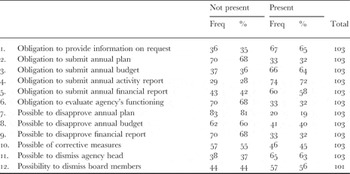
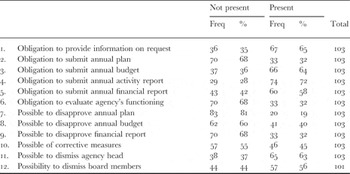
As Table 1 demonstrates, the Dutch independent agencies differ considerably in terms of provisions for political accountability. The most common accountability provisions in the design of the organizations are the obligation to submit an annual activity report (present for 72 percent of the agencies), the obligation to provide the minister with information on request (65 percent), the obligation to submit an annual budget (64 percent), and the possibility for the minister to dismiss the executive head of the agency (63 percent). By far the least common provision is the possibility for the minister to disapprove the annual plan of the agency, which is present in the design of only 19 percent of the agencies.
Political Accountability: Items and Frequencies
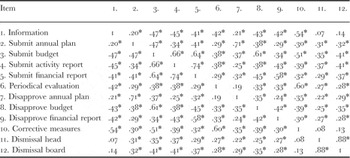
Now the next step is to create an aggregate measure of political accountability. Various techniques have been used to assess whether the twelve items can be considered indicators of one single latent trait. With a value of 0.88, the Cronbach's alpha for the twelve items is rather high. In line with this finding, the items correlate strongly with each other. That is, the phi correlation coefficients are, with only a few exceptions, high and significant (see Table A in the Appendix). To further analyze the scalability of the items, I have used Mokken scale analysis. Mokken scaling is a nonparametric and probabilistic procedure based on the principles of item response theory (IRT) (Mokken Reference Mokken1971; Van Schuur Reference Van Schuur2003). Because of its non-parametric assumptions, it is preferred over factor analysis in the case of dichotomous data. Furthermore, in the case of small numbers of variables – that is, less than twenty – Mokken scaling is preferred over the use of regular IRT models such as the Rasch model (Mokken Reference Mokken1971: 143–4). The most important test statistic in the analysis is the Loevinger coefficient of homogeneity (H), which is calculated for both the individual items and the scale as a whole. For a scale to be reliable, all Loevinger H coefficients have to be higher than 0.3.
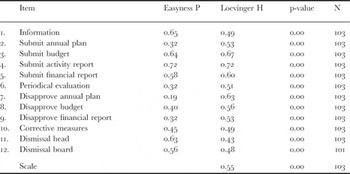
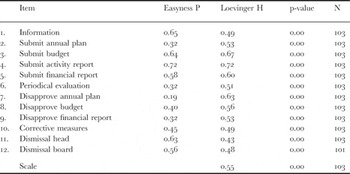
In Table 2, the results of the Mokken scale analysis are presented. As the table demonstrates, the Loevinger H coefficients are all well above 0.3, and significant at the 1 percent level. Hence the twelve items can be considered a homogeneous set of indicators of one single latent trait, and the scale of the items can be regarded as strong. The Easyness P statistic in the table indicates which items are difficult items and which are easy ones. Difficult items are those which are typically only present in the design of agencies which possess a lot of the latent trait; that is, a high degree of formal political accountability. Thus the provision which enables the minister to disapprove the annual plan can usually only be found in the design of agencies with a high degree of formal political accountability. The obligation to submit an annual activity report, on the other hand, is an easy item and hence also present in the design of agencies with low degrees of accountability.
Mokken Scale Results
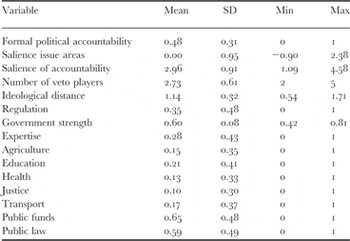
As the twelve items can be considered indicators of formal political accountability, I have taken the average score on the twelve items to create a measure of the concept. The scores of the independent agencies on the composite measure range from zero to one, where the score of zero indicates that the design of an agency does not include any of the provisions for political accountability, and the score of one that the design includes all provisions. The scores of the agencies on the accountability scale vary considerably. The mean score of the agencies is 0.48, with a standard deviation of 0.31. The rather high standard deviation is mainly a consequence of the relatively high number of agencies with one of the extreme scores: ten agencies have a score of zero, and six agencies have a score of one. The other 87 agencies have one of the thirteen scores in between these extremes.
Data and Analysis
Operationalization
Before turning to the analysis, the operationalization of the explanatory variables will be described. First of all, to test the hypothesis on the effect of the political salience of issue areas, two proxy measures have been created which capture the attention devoted to the policy issue of an independent agency – a measure of parliamentary attention and a measure of media attention (cf. Lee et al. Reference Lee, Rainey and Chun2009). The operationalization is based on the assumption that policy issues which are considered to be more important also receive more attention. To measure parliamentary attention, I have counted the annual number of reports of parliamentary questions in which an agency is mentioned. To operationalize media attention, I have looked at four major Dutch newspapers with very different profiles (de Volkskrant, NRC Handelsblad, De Telegraaf, en Het Financieele Dagblad), and I have counted the number of articles per year which refer to an agency.
For both measures, I have focused on the times that an agency is mentioned rather than the times that a policy issue is mentioned. The reason for this is that it offers the most precise way of capturing the salience of the issue with which an agency deals. The disadvantage of this operationalization is that the measure may be biased by incidents related to the organization itself rather than to the importance attached to its activities. To deal with this, the measures are based on the average number of references per year, calculated over a period of the last five years.
Due to extremely high scores of some agencies, the distributions of both measures were positively skewed. I have normalized the measures by taking the logarithm of the scores as the final measure.Footnote 5 Furthermore, as parliamentary and media attention can be expected to influence each other, I have checked the correlation between the measures. These appeared to be strongly correlated (Pearson's r = 0.81, p < 0.001). To avoid multicollinearity, I have constructed a composite measure for issue salience by first standardizing the scores on the two measures, and then taking the average of the standardized scores.
Unfortunately, there are no data available on the importance which citizens attach to independent agencies, or to the issues with which these organizations deal. However, we know from previous research that media attention, political attention and public attention are strongly related (e.g., Soroka Reference Soroka2002; Uscinski Reference Uscinski2009). Hence even though no measure of public attention has been included, we may assume that such a measure would have correlated strongly with the measures of parliamentary and media attention.
The measure of salience of accountability is based on a measure of parliamentary attention, and is calculated in roughly the same way as the measure of parliamentary attention of issue areas. For each parliamentary year, I have counted the number of reports of parliamentary questions in which the Dutch word for accountability (verantwoording) is mentioned. Media salience is not included in this measure of salience for a practical reason: it is not possible to search Dutch newspapers published in the period before 1990, whilst the legislation of quite a number of agencies was written before that year. Nevertheless, there are good reasons to believe that including such a measure would not have made much difference: the correlation between parliamentary and media salience of accountability in the period after 1990 is extremely high (Pearson's r = 0.74, p < 0.001).
To test the first part of the credible commitment thesis – that is, to test the impact of veto players – I have used two measures introduced by Tsebelis (Reference Tsebelis1999). The first is the number of veto players at the time that the statute of an agency was written. As the Netherlands have only one institutional veto player (see Tsebelis Reference Tsebelis1995: 310), the total number of veto players in a certain year is determined by the number of partisan veto players – that is, the number of political parties in the coalition. The second measure is a proxy measure for the ideological distance between veto players. Three experts surveys on party positions have been used to calculate the scores of the political parties on the left-right dimension: the surveys by Castles and Mair (Reference Castles and Mair1984), Huber and Inglehart (Reference Huber and Inglehart1995), and Benoit and Laver (Reference Benoit and Laver2006). To deal with the differences in the scales of the surveys, which range from zero to ten or twenty, the scores for the parties have been standardized. The standardization is based only on the scores in the sixteen countries which are included in all three surveys. The score for an individual party is the average of the standardized scores for that party, or the single standardized score if the party is only included in one survey. I have calculated the ideological distance by taking the absolute value of the distance between the most extreme parties on the left-right scale. The second part of the credible commitment thesis, which focuses on the impact of market opening on the design of agencies, is tested by using a dummy variable for agencies preoccupied with the regulation of markets.Footnote 6
Following Bertelli (Reference Bertelli2006: 238–9), government capacity has been operationalized in terms of government strength. The other measure which has been used to capture government capacity in parliamentary systems – the measure of cabinet turnover developed by Huber and Shipan (Reference Huber and Shipan2002: Chapter 7) – is less suitable for within-system comparisons. The measure for government strength is constructed by taking the number of seats of the political parties which constitute the governing coalition, and dividing this number by the total number of seats. The seat share is calculated for the Dutch lower house (Tweede Kamer) rather than for the upper house (Eerste Kamer) as the former is the key chamber in the Dutch legislative process.
Policy complexity is a difficult concept to capture. To operationalize it, scholars have typically attempted to calculate the percentage of employees in an organization which are hired for their specific expertise. For instance, Lee et al. (Reference Lee, Rainey and Chun2009: 482–483) have constructed a measure of the professional staff ratio in US Federal Agencies, using the Central Personnel Data File (CPDF) established by the US Office of Personnel Management. Unfortunately, such data are not available in most European countries, including the Netherlands. Elgie and McMenamin (Reference Elgie and McMenamin2005: 545–6) have therefore introduced a proxy measure based on the expertise requirements for the members of the executive board of independent agencies. As the statutes of Dutch independent agencies also include provisions for the expertise, competences, or qualifications of executive board members, the same operationalization has been used in this study. The measure of expertise requirements is constructed by calculating the proportion of board seats for which specific expertise or policy-specific qualifications are required.
A few other control variables have been incorporated in the analysis. First, the ministry to which an agency is linked may affect the agency's design. Although government and parliament decide upon the content of the statutes of independent agencies, the draft of these statutes is typically written by bureaucrats within ministries. As a consequence of the high degree of autonomy which Dutch ministries traditionally have, their culture, structure and procedures differ considerably (Andeweg and Irwin Reference Andeweg and Irwin2009: 179–181). These differences may also have an effect on the institutional design of independent agencies. Hence Van Thiel (Reference Van Thiel2006) finds that the styles of agency creation in the Netherlands vary considerably across both ministries and policy areas (for similar findings in the UK, see Gains Reference Gains2004). In order to deal with the nested data structure, I have used dummy variables for the five ministries to which more than ten agencies are linked. These are the Ministry of Agriculture, Nature and Food Quality, the Ministry of Education, Culture and Science, the Ministry of Health, Welfare and Sport, the Ministry of Justice, and the Ministry of Transport, Public Works and Water Management.Footnote 7
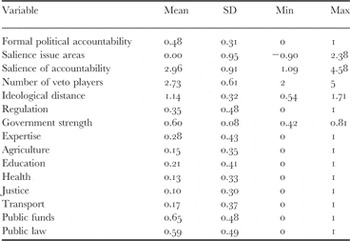
Furthermore, I have included a dummy variable for the use of public funds. Not all independent agencies use public funds; some have their own revenues from, for instance, user fees. Politicians can be expected to care more about agencies which spend taxpayers’ money, and they may therefore make these organizations subject to more provisions for accountability.Footnote 8 Finally, a dummy variable has been included for independent agencies which are established by public law rather than by private law. Politicians use public law to grant independent agencies their competences, but they may delegate either to organizations which are established by public law – often by the same law as the one in which the competences are delegated – or to organizations which have been established by private law, and which are thus not created by politicians. As the articles of association of private law agencies already include provisions for the design of these bodies, politicians may, in the process of delegation to such organizations, not pay much attention to their institutional design, and they may therefore focus less on the inclusion of provisions for the accountability of these organizations. The summary statistics of all variables are included in Table B in the Appendix.
Analysis
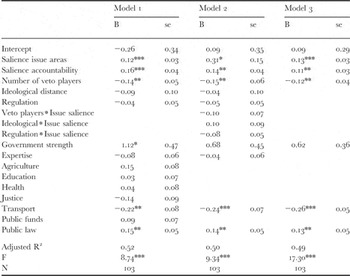
To assess the impact of political salience and the other explanatory factors on the degree of formal political accountability, ordinary least squares (OLS) regression analysis has been used. Table 3 shows three regression models.Footnote 9 In Model 1, all variables are included, except for the interaction terms. Model 2 incorporates the interaction terms, the variables of main interest, and the control variables which appeared to have a significant effect in the first model. As the number of variables in the first two models is rather high for the number of observations, a reduced model – Model 3 – has been estimated to serve as a robustness check. This model only includes the variables which are significant at the 5 percent level in (one of) the first two models.
Regression Results: Formal Political Accountability
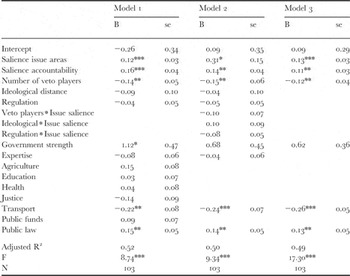
Note: OLS model. *p < .05; **p < .01; ***p < .001.
The adjusted R2 for the models ranges between 0.49 and 0.52. Looking at the coefficients and significance levels, we can see that political salience is indeed an important factor: both the salience of issue areas and the salience of accountability are positively and significantly related to formal political accountability. Other factors which significantly affect degrees of political accountability are the number of veto players, the link to the Ministry of Transport, Public Works and Water Management, and establishment by public law.
The most important result of the analysis is the finding that political salience matters for the degree of formal political accountability. Support for the hypothesis on issue salience is found in all three models. Agencies which deal with issues of higher political salience are also subject to significantly higher degrees of accountability. The hypothesis that independent agencies whose legislation is written in periods of higher political salience of the issue of accountability are subject to higher degrees of formal political accountability is also confirmed in the three models. The salience of the issue of accountability is positively and significantly related to the degree of political accountability which is incorporated into statutes.
No support is found for the credible commitment hypotheses. First, a measure of the number of veto players in the system has been used to test the first part of Hypothesis 3, which stated that the degree of formal political accountability is higher when the number of veto players is higher. Yet whilst the hypothesis suggested a positive relation between the number of veto players and the number of provisions for accountability, the analysis points out that the relation is, in practice, negative. That is, when a larger number of veto players are involved in the development of the statutes of an independent agency, the accountability arrangements in the statutes tend to be less rather than more extensive. The second part of Hypothesis 3 referred to the ideological distance between the veto players in the system. This distance was hypothesized to be positively related to degrees of formal political accountability. No support for this hypothesis was found in the analysis: the ideological distance between veto players does not have an effect on the number of accountability provisions in legislation. Although this does not confirm the hypothesis, it is in line with the results in the study by Yesilkagit and Christensen (Reference Yesilkagit and Christensen2010), who do not find an effect of ideological distance on agency independence in the Netherlands, Denmark and Sweden.
Third, according to Hypothesis 4, independent agencies which deal with market regulation should be subject to less extensive accountability arrangements. No support for this hypothesis was found in the analysis. There is no significant difference between regulatory and executive agencies. Looking at the data, we indeed see that there are quite some regulatory agencies among the organizations with the highest scores on formal political accountability. For instance, the statutes of telecom regulator OPTA, financial market authority AFM, and competition authority NMa all include a high number of provisions for accountability. However, the finding is not in line with the previous study of Elgie and McMenamin (Reference Elgie and McMenamin2005), who demonstrate that the degree of independence of French regulatory agencies is significantly higher than the degree of independence of executive agencies.
No support was found either for Hypothesis 5, which gave expression to the suggestion of Elgie and McMenamin (Reference Elgie and McMenamin2005) that credible commitments may only matter in issue areas which are politically salient. The hypothesis is tested in Model 2, using interaction terms which combine issue salience with the number of veto players, the ideological distance between them, and the regulatory nature of organizations. None of the interaction terms is significantly related to the degree of formal political accountability.Footnote 10 Hence whilst issue salience as such is an important determinant of formal political accountability, there is no evidence that it is also the factor which determines whether the need for credible commitments matters in the delegation process.
As the direction of the relation between government capacity and delegated discretion has not yet been settled in previous studies, two alternative hypotheses were formulated on the impact of government capacity on formal political accountability. No decisive support for one of the two hypotheses is found in the analysis. Nevertheless, the measure of government strength is positively and significantly related to accountability in Model 1, and the p-value in Model 3 is close to the critical value of 0.05 (p < 0.1). Hence although the findings are not robust, there is some indication that the relationship is a positive one. This would support Hypothesis 6a, which states that independent agencies whose legislation is written under higher degrees of government capacity are subject to higher degrees of formal political accountability. It would also be in line with the study of Huber and Shipan (Reference Huber and Shipan2002), who found a positive effect of legislative capacity on the detailedness of legislation.
According to Hypothesis 7, independent agencies dealing with more complex policy issues should be subject to lower degrees of formal political accountability. No support for this hypothesis is found in the analysis. Hence whilst Elgie and McMenamin (Reference Elgie and McMenamin2005) find that French agencies which operate in more complex issue areas indeed have higher degrees of formal independence, no relation between complexity and formal political accountability is found in this study. This may be because the degree of complexity is not as important a factor in the Netherlands as it is in France, but it may also be that the measure of complexity – operationalized in terms of expertise requirements – suits the Dutch context less well.
The analysis also shows some interesting results on the effect of the control variables. First, based on the expectation that ministerial pattern of designing independent agencies may matter, dummy variables have been included for the five ministries to which more than ten independent agencies are linked. Looking at the regression results, such patterns do not appear to play an important role in the explanation of variation in formal political accountability. The only ministry which stands out is the Ministry of Transport, Public Works and Water Management. Agencies linked to this ministry are subject to significantly lower degrees of formal political accountability than agencies linked to other ministries. The question is whether this is because the differences in accountability across ministries are not significant or because the variation in accountability across ministries can be ascribed to other variables which are included in the analysis. Analysis of variance (ANOVA) may offer us more insight into this issue. Looking only at the five ministries to which more than ten agencies are linked, the F-statistic in the analysis is significant (F (4, 72) = 4.99, p < 0.01), which indicates that there are significant differences between the mean accountability scores across ministries.Footnote 11 However, a Bonferroni test, which analyzes which groups differ significantly from each other, indicates that it is only the Ministry of Transport, Public Works and Water Management which differs significantly from other ministries: the independent agencies linked to this ministry have a mean political accountability score which is significantly lower than the mean score of organizations linked to the Ministry of Education, Culture, and Science and the Ministry of Health, Welfare and Sport (see, for details on the analysis, Table C in the Appendix). Hence except for the Ministry of Transport, Public Works and Water Management, there do not appear to be significant differences in degrees of formal political accountability across ministries.
Furthermore, a dummy variable has been included which takes the value of one when an independent agency uses public funds. Yet whilst the expectation was that the use of public funds is positively related to degrees of formal political accountability, no such relation was found in the analysis. Hence independent agencies which spend tax-payers’ money are not subject to more extensive accountability arrangements than are bodies which have their own revenues.
Finally, I have included in the analysis a dummy variable for establishment by public law, based on the expectation that public law organizations are subject to higher degrees of formal political accountability. In all three models, strong evidence is found for such a relation. Independent agencies which are established by public law indeed have significantly higher scores on the formal political accountability scale. This supports the theoretical argument that, due to the fact that the institutional design of private law organizations has already been laid down in the articles of association of these bodies, politicians tend to focus less attention on accountability arrangements when they delegate competences to these organizations. Looking at the original data, we can see that some private law organizations are made subject to fairly extensive accountability arrangements – for instance, the Dutch central bank, the financial market authority AFM, and some government foundations in the cultural sector – but that a majority of the organizations established by private law are largely exempted from accountability provisions. Hence the way in which an independent agency is established clearly matters for the degree of formal political accountability.
Conclusion and Discussion
As independent agencies are insulated from politics and the electoral process, scholars have emphasized the importance of the inclusion of accountability arrangements in the design of these organizations. However, the degree to which such arrangements are, in practice, incorporated into the statutes of the organizations varies considerably. This study has addressed the question why some independent agencies are subject to more provisions for accountability than others. From previous research, we know about the impact of such factors as the need for credible commitments, policy complexity, and government capacity. A factor which has not yet been included in studies on the institutional design of agencies is political salience. Although previous studies have pointed at the importance of political salience for such outcomes as voting behavior, political choices of government and parliament, and de facto control over bureaucracies and independent agencies, we do not know much about its effect on the institutional design of organizations. This study therefore examines the impact of political salience on statutory provisions for political accountability, controlling for other determinants of delegation to independent agencies. To do so, original data have been used on the accountability provisions in the statutes of 103 Dutch independent agencies.
The results of the analysis show that political salience is an important determinant of the degree of formal political accountability. Salience affects accountability in two ways. First of all, independent agencies which operate in more salient issue areas are also subject to more extensive accountability arrangements. This is, to begin with, relevant from a theoretical point of view. Previous research has shown that political salience has an impact on the de facto control which politicians choose to exercise over the activities of agencies. This study demonstrates that salience also affects the institutional design of independent agencies. Hence we know now that independent agencies which deal with salient policy issues are not only subject to more political steering and influencing, but they are also made subject to more statutory provisions for accountability. Looking at the implications for democratic governance, the findings are both reassuring and disturbing. On the one hand, the findings are encouraging as they indicate that politicians are willing to invest more time and resources in keeping an eye on activities which they themselves, and the people they represent, care about. On the other hand, the analysis points out that there is a category of independent agencies which are, in every respect, under the radar. Not only do they operate in policy areas which do not attract a lot of attention, but they are also largely exempted from accountability requirements. This leaves these organizations with a lot of opportunities to shirk, and to misuse or abuse their political power, and it leaves us with the question how eventual misconduct by the organizations can be prevented and detected. This is an implication we should be concerned about.
Political salience affects accountability in still another way. Independent agencies whose statutes are written in a period in which accountability itself is a salient issue are also subject to higher degrees of accountability. Accountability has become a key issue on the Dutch political agenda, and this is reflected in the degree of political accountability incorporated into the design of independent agencies. It should be noted that the generalization of this finding to other political contexts is less straightforward than it is for the finding on issue salience. Whilst there is no reason to expect that issue salience is not important for the institutional design of agencies in other countries, the significance of the issue of accountability, and the change in significance of the issue, may vary across countries. The importance of the salience of the issue of accountability for the institutional design of agencies can be expected to vary accordingly. We may hypothesize that degrees of formal political accountability are lower in countries in which accountability is less of a salient issue, and we may expect to find less of an effect of salience of accountability in countries in which no significant change in the perception of accountability has taken place. Future research could examine whether empirical evidence supports these hypotheses.
The hypotheses which focus on the features of the government in power have not been confirmed in this study. No evidence has been found for the hypothesized effect of the ideological distance between the key decision-making actors on degrees of formal political accountability, and only limited support has been found for the impact of government capacity. These findings do not come as a big surprise as the variation in government characteristics within a political system is always small, and the hypotheses may therefore be more relevant for comparative studies of political systems.
More surprising is the finding on the number of veto players. The number of veto players significantly affects the degree of formal political accountability, but the effect is not in the hypothesized direction. That is, when more veto players are involved in the decision-making process on the statutes of an independent agency, less rather than more provisions for political accountability are included in these statutes. This finding may be explained by looking at the consequences of veto players from another perspective. In the presence of a large number of veto players, it is more difficult for politicians to make decisions and to come to policy compromises. These conditions may lead to more discretion on the part of agencies in two ways. First, and most straightforward, if it is more difficult to make policy decisions, it may also be more difficult to come to decisions on the design of agencies. Following from this, one can expect the lack of compromise on legislative provisions to lead to less detailed legislation, and also to less provisions on accountability. Second, under conditions of lack of compromise, it is more attractive for politicians to depoliticize a policy issue, and to insulate the issue from politics. One way to do this is to delegate the issue to an independent agency or expert committee. As such delegation also implies refraining from political control, one can expect degrees of political accountability to be lower. For the moment, these explanations are only hypotheses. Future studies of qualitative nature could revisit the relation between veto players and legislative detailedness, and could hence contribute to a better understanding of the effect of veto players.
Furthermore, the analysis has not pointed to an effect of the complexity of the policy issue. Whilst previous research in France demonstrated that independent agencies which operate in more complex areas are granted more formal political independence, accountability arrangements of Dutch independent agencies are not affected by the complexity of the issue. As suggested before, this may either be because policy complexity plays less of a role in Dutch processes of delegation, or because the measure which has been used to measure policy complexity does not capture the concept very well in the Netherlands. Future research may be able to improve the operationalization of policy complexity, and may thus be able to offer a more definite answer to the question of the impact of complexity.
Finally, two more findings call for attention. First, although the literature focusing on the delegation process in the Netherlands emphasizes the importance of ministerial patterns, the differences across ministries have not been found to matter much for the degree of formal political accountability. Only independent agencies linked to the Ministry of Transport, Public Works and Water Management are subject to significantly lower degrees of accountability. Further exploration of the variation across ministries has demonstrated that the degrees of accountability do not differ significantly between the ministries, with the exception of the aforementioned Ministry of Transport, Public Works and Water Management. Hence although the styles of delegation vary across ministries, this study finds that, with the exception of one ministry, these differences do not result in significant variation in formal political accountability across ministries. Second, whilst the use of public funds is not a determinant of accountability, the legal basis of agencies has an important effect. Agencies which are established outside politics, and subsequently granted public authority in a delegation process, are subject to significantly less provisions for accountability than agencies established by politicians. The explanation which has been put forward in this study is that since the design of private law agencies is not determined in the legislation upon which politicians decide, but in the articles of association, politicians do not invest much time and effort in thinking about, and elaborating upon, additional provisions on the duties of the organizations. Further research of a qualitative nature could assess whether this mechanism is indeed at work.
Appendix
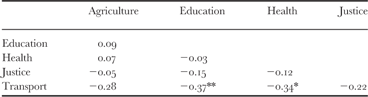
Correlation Matrix of Formal Political Accountability Items

Note. Correlation coefficients are phi coefficients. N = 103, except for item 12, where N = 101. *p < .05.
Summary Statistics
Bonferroni Test
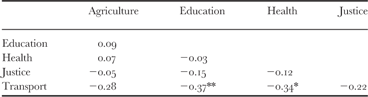
Note. *p < .05; **p < .01.