

Introduction
Gemstones, jawhar (pl. jawāhir) in Arabic, were as precious in the medieval period as they had been in previous times; they were used as ornaments, set in jewellery, seals, amulets, and even as an investment and a status symbol.Footnote 1 A vast literature was written on gemstones by Arab writers and scholars.Footnote 2 Many books are lost, but knowledge from them however, was partly saved by citations in the works of later Arab writers.Footnote 3 A great deal of information regarding gemstones was also found in books written by European scholars,Footnote 4 in fact, both traditions are rooted in Greek and Roman origin.
The identification of the names of the gemstones found in the Arabic sources is not always clear,Footnote 5 since the stones were recognised and identified according to external characteristics, such as colour and comparative hardness, and not by definitive chemical or mineralogical analysis. This resulted in confusion and name-swapping between various stones, for example red stones such as carnelian (cornelian), red garnet, ruby and spinel.
The traditional identification of stones mentioned in Greek literature and its Arabic translation was less stable than the equivalent for medicinal plants. Some names underwent reallocation; for example the Greek Beryllion (beryl) became ballūr Footnote 6 in Arabic, which signifies rock crystal.Footnote 7
Some studies have been done on Arabic nomenclature of gemstones. In our work however, the focus is on examining which gemstones were most commonly used in the medieval Arab world within the various socio-economic strata. Moreover, we seek to ascertain whether there were any significant changes in use as compared to earlier periods.Footnote 8
Gemstones in Arabic Literature
Our research uses written sources; we assume that the Arabic literature dealing with this issue reflects authentic reality and presents the main stones that were actually used in that period. In general, the inventory of Arabic gemstones is smaller (about twenty) than the number of stones that were mentioned in Greek and Roman literature.Footnote 9 Moreover, the number of stones mentioned in works dealing with Arabic trade (such as al-Dimashqī and al-Jāḥiẓ)Footnote 10 is even smaller (not more than ten).
This disparity can be explained by recognising the fact that, whereas the Classical literature is mainly theoretical, the Arabic literature is of a more practical nature and mainly deals with gemstones that were actually used and traded. Moreover in Arabic literature the descriptions are less detailed using mainly collective names that include different kinds of stones.Footnote 11 The literature on gemstones allows us to rate the precious stones according to their importance in the medieval society.Footnote 12
In the first group of the most valued stones we find examples such as corundum (mainly red - yāqūt), emerald (zumurrud, zabarjad), diamond (mās) and pearl (luʾluʾ, marjān, durr). These are mentioned in all the works dealing with precious stones, for example: Pseudo Aristotle (henceforth PA),Footnote 13 al-Jāḥiẓ (henceforth - J),Footnote 14 Ibn Māsawayhi (henceforth - IM),Footnote 15 al-Bīrūnī (henceforth - B),Footnote 16 al- Dimashqī (henceforth - D),Footnote 17 al-Tῑfāshῑ (henceforth - T),Footnote 18 Ibn al-ʾAkfānī (henceforth - IA).Footnote 19 Therefore we claim that they were highly used and appreciated by the higher socio-economic strata, the elite and the rulers.
The second group consists of stones such as turquoise (fayrūzaj) [mentioned by: PA, J, IM, B, D, T, IA], carnelian (ʿaqῑq) [mentioned by: PA, J, IM, B, D, T], garnet (bijādī) [mentioned by: PA, J, IM, B, T, IA], onyx [onyx and sardonyx] (jazʿ) [mentioned by: PA, IM, B, D, T], lazurite (lāzāward) [mentioned by: PA, IM, B, D, T] and malachite (dahnaj) [mentioned by: PA, IM, B, T, A]. In general, these stones were relatively less expensive and, therefore, were more popular and common among the middle classes.
The third group includes cheaper and more common stones such as jasper (yast, yashm, yashb) [mentioned by: IM, B, T, IA], amethyst (jamast) [mentioned by: IM, B, T, IA], and crystal (ballūr) [mentioned by: IM, B, T, IA].
Other stones are: coral (marjān) [mentioned by: IM, B, D, T], bezoar (bādzahr, bāzahr, fādzahr) [mentioned by: PA, B, T, IA], amber (kahrubāʾ,Footnote 20 ʿanbarī) [mentioned by: PA, B], spinel (balkhash) [mentioned by: T, IA], zircon (banafsh) [mentioned by: T], chatoyancy (ʿayn al-hirr) [mentioned by: T], jet (sabaj) [mentioned by: PA, B, T].
The Arabic literature on gemstones actually portrays the interests and needs of the Arabs of higher socio-economic elite, including scholars and physicians, who were, after all, a minority in medieval society. A more solid and realistic picture can be drawn from the actual consumption and trade of gemstones in the medieval period; and this can be obtained only from historical records of trade. However, gemstones are rarely mentioned in commercial records, as evidenced by the fact that among thousands of documents dealing with medieval Arabic trade that were found in the Cairo Genizah (which dates mainly from the eleventh-twelfth century), precious stones such as corundum and diamonds are hardly mentioned. The explanation is that precious stones were not traded in the regular commercial system like other expensive goods and products, but in person by specialists. On the other hand, records of trading with cheaper stones are very common in commercial documents; these give us an opportunity to assemble a more accurate picture of the prevalence and popularity of these stones in the Eastern Mediterranean society. For example, we will submit here a summary of the data Moshe Gil presented in his monumental work, in accordance with the number of documents in which precious stones were mentioned.Footnote 21 In fact, the number of records is higher since each stone is mentioned several times in each document: pearls [luʾluʾ and other names] (71), small pearls and corals [marjān]Footnote 22 (62), carnelian [ʿaqīq] (26), lazurite [lāzaward] (15), crystal [ballūr] (4), red garnet [bijādī]Footnote 23 (1).
There is no doubt that pearls were the most common and popular gemstones in medieval society and make up more than 75% of the trade in precious stones. We based our estimation on the abovementioned information, while we assume that some of the stones mentioned in the sources as marjān are actually small pearls. Furthermore, some of the beads that were recorded in more than 40 documentsFootnote 24 were probably also from various kinds (different shapes, sizes, quality and colours) of pearls. The Arabic literature dealing with gemstones devotes a lion's share to pearls, it gives details regarding many different kinds of pearls; their prices are indicated according to their size and weight, both within necklaces and singularly.Footnote 25 Nonetheless, carnelians were the most common and widespread gems in signet rings. Besides the stones that are referred to in the Genizah, in many cases gemstones were mentioned just according to their colour (e.g. red stones, blue stones), but without specifying their name. These stones were usually kept in small pockets.Footnote 26
Changes in the popularity of gemstones after the Arab conquests
As a result of the Arab conquests and access to new regions, the distribution and use of gemstones by the Arabs underwent substantial changes. Among these we will mention mainly the improvement and expansion of the trade routes (maritime and land alike) and the commercial connections with East Africa, Persian Gulf, and mainly with India, Sri Lanka and China.
Along with an increase in the availability of the gemstones that were already used during the earlier periods brought about by the discovery of new locations to mine, a few changes in style occurred with the appearances of new and unknown gemstones that had not been used before. The pre-eminent ones were the ruby (red corundum) and the eastern topaz, the diamond and the bezoar-stone [Bādzahr]; none of which were mentioned in the Classical medical sources.Footnote 27 As mentioned above, the Arabs developed a whole field of mineral and gemstone science, which included distinguishing between the different stones and their qualities, learning the ways they are formed in nature and locating the places to collect and mine them, as well as improving mining techniques. Moreover, Arab jewellers took an active part in inventing and developing new technologies and tools, mainly in gold-smithery as well as alchemy, heating, melting, pouring and polishing gemstones.Footnote 28
In a study on stones, attributed to Aristotle (ninth century), it is reported that the important gemstones at that time were the large pearl (durr), corundum (yāqūt), and emerald (zabarjad).Footnote 29 There is no doubt that these precious stones were owned by the elites and their function went beyond being accessories to costume they were artefacts which denoted status. According to al-Dimashqī (eleventh century):
“. . . the expensive gemstones attract the kings and rulers to buy them for themselves due to their high value, low weight and the opportunity to show-off and boast; mainly since the common people could not afford them. Precious stones bring the kings happiness, joy, pleasure and bliss”.Footnote 30
This phenomenon was evidently not unique to the medieval Arab society. The wealth of records documenting the ostentation and extravagance of the Arab rulers, in their quest for unique precious stones and their lust for exhibiting them in public, indicates that they were following the example of their predecessors. Moreover, they might were also influenced by the Classical literature, since its occupation with precious gemstones was well known to the medieval Arabs.Footnote 31
In any case, this phenomenon already existed during the time of the first Caliphs and the Umayyad dynasty:Footnote 32 however, it became stronger during the Abbasid period. Traders would travel as far as south and east Asia, i.e. India, Sri Lanka and China, to purchase gemstones to sell at huge profits. Special delegates were sent on behalf of the Caliphs to seek and acquire unique gemstones. It is said that Hārūn al-Rashīd (786-809) was eager to obtain expensive gemstones; he therefore sent a delegate, an expert jeweller named Ṣabāḥ al-Kindī to Sri Lanka to purchase precious stones. al-Kindī was even given a large reward from the king of Sri Lanka.Footnote 33 Similarly, we learn from al-Tῑfāshῑ’s book on gemstones (first half of the thirteenth century) that he had heard from Persian gemstone traders, frequently travelling to China and India, about diamonds possessing special qualities that could be found only in India.Footnote 34 On the other hand, we hear of a tenth century trader named Sulaymān who travelled to India and China and brought emeralds from Egypt to their rulers.Footnote 35 An indication of the importance of gemstones to the Abbasid rulers is the special “safe” that they built (khizānat al-jawhar) in which they safeguarded their precious stones under special supervision. The “safe” supervisor's main responsibility was to take special care of the stones, to protect them and to acquire more stones for the ruler's family; therefore, he would employ several goldsmiths for a monthly wage.Footnote 36 It appears that the rulers invested a large proportion of their wealth in buying precious stones due to their lightness in weight and the ease of transporting them, and more importantly, they relied on the stones as a source of wealth in times of crisis or disaster.Footnote 37
At their courts, the Arab Caliphs surrounded themselves with huge and unique gemstones, as a status symbol of wealth.Footnote 38 Arabic literature is full of descriptions of unique gemstones in the treasuries and caches of the Fatimid rulers. These were exhibited on special occasions such as parades, processions and other festive occasions. Naturally these special stones are also mentioned in accounts of robberies and ransacking of the precious stones from the caches of the Fatimid rulers during the time of anarchy that characterised the end of their regime.Footnote 39 We will present here some examples of such prestigious items in the treasury of Caliph al-Mutawakkil (847-861) there was a prayer necklace consisting of 100 beads; each one weighed one mithqāl (4.68 gram in Egypt) and its value was 1,000 dīnārs.Footnote 40 The most expensive gemstones, renowned for their size and distinctiveness were given special nicknames; one such stone named “the orphan” was a pearl weighing 3 mithqāls, its nickname was explained by the fact that there was no other stone that could compare with its worth.Footnote 41 Alongside this pearl, that had a rich and interesting history, there was a red corundum shaped like a crescent weighing 11 mithqāls that was known as “the horseshoe” (al-ḥāfir). It was in the caches of Fatimid and was transferred later into the hands of Saladin and other rulers.Footnote 42
The most valued stones
The stones most valued by the Arabs in the medieval period belonged to the corundum group,Footnote 43 some of which, such as the blue kind (sapphire), were already known from the late Roman and early Byzantine periods, though on a small scale.Footnote 44 The red ruby was particularly valued. Undoubtedly the reference to the ruby in the Quran (LV 58) enhanced its prestige written sources feature numerous anecdotes about this stone in connection with different rulers, in terms of its stature.Footnote 45 Similarly, the pearl, which was well known in Arabia, was mentioned several times in the Quran (XXII 23; XXXV 33; LV 22).
The third most prestigious stone after the corundum and the pearl was the emerald; this stone was well known and valued during the Roman period.Footnote 46 A superb white (or transparent) diamond Footnote 47 was used by the Indian elite as jewellery; however, it was still rare in the Western world. Therefore, the large stones were expensive, while the smaller raw stones were generally used to process other hard gemstones.Footnote 48 Bezoar-stone [bādzahr] was not used as a gemstone, but as a medication; almost a supernatural cure, to prevent and protect from poisoning, the primary threat to all Arab rulers.
On the other hand, a few gemstones that were considered expensive and precious during the pre-Islamic period were described by Arabic sources as being less valued in comparison to the past. Among these we will note the turquoise, carnelian, and lazurite stones. Sources indicate that kings no longer wore nor prided them, unless they were large, distinctive or special.Footnote 49 During the medieval period the carnelian (ʿaqīq) of Yemenite origin was still considered a precious stone, especially the bright red variety.Footnote 50 An example of this stone, along with a Yemenite onyx table, were included in the gifts that the Caliph al-Maʾmūn (813-833) gave the king of India in return for corundum stones and mother of pearl (durr) which he had received from him.Footnote 51
A few gemstones that were known during the Classical period have no Arabic name, even though they were quite common; for example, different kinds of quartz and agate; these were probably part of the collective noun for carnelian and heliotrope that was probably part of the collective noun for jasper (yashb). The aquamarine stone that was prestigious in the Roman period was probably considered to be part of the collective noun for emerald.Footnote 52
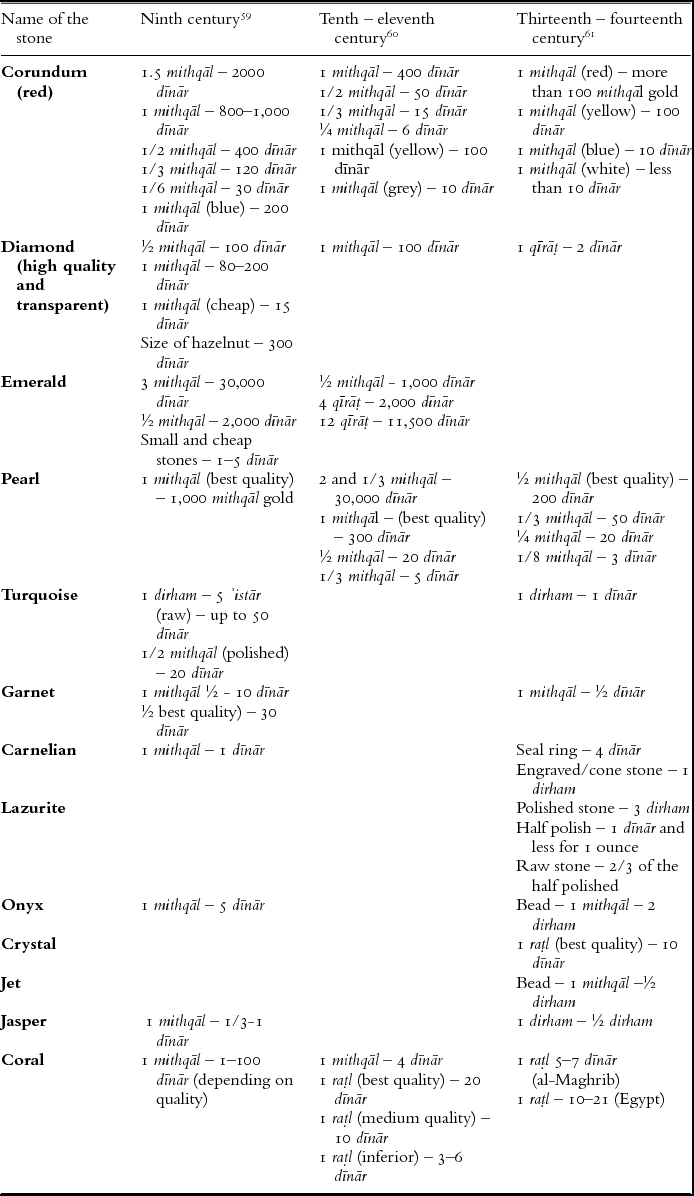
Ratings of gemstones’ value can also be understood by the prices paid for them; these can be sporadically found in the literature (see Table 1). Prices were not fixed but were set according to various parameters such as size, type, quality, supply and demand. al-Tῑfāshῑ (first half of the thirteenth century), for example, evaluates the prices of the stones according to their level of processing: a processed stone, ready to be set was 3 dirhams,Footnote 53 a half- processed stone after washing and cleaning was less than a dīnār for one ʾŪqiyyah Footnote 54 (ounce); and a raw stone was two-thirds the value of a washed stone, since the process of washing reduces its weight. He added that polishing the lazurite was well-paid and well-respected work.Footnote 55 Lazurite, as well as carnelian, was polished with grindstone and water.Footnote 56 Analysing changes in the prices of gemstones, on a long-term scale spanning from the Abbasid to the Mamluk period, can teach us about the supply and availability of gemstones. For example, at the time of al-Maʾmūn, when the market was flooded with gemstones and they were easy to obtain in abundance, the demand and the prices dropped. Brahmin corundum valued at 5,000 dīnārs was sold for 1,000 dīnārs.Footnote 57 However, we can say that in the early periods, in general, the prices of gemstones were high and were only available to the elite. In later periods, as the supply of and trade in stones increased, prices fell and it appears that certain gemstones could be purchased by a wider section of society.
– Rates of prices of gemstones amongst the Arabs in the medieval period.Footnote 58
The practical use of precious stones in medicine
In comparison with the vast information on the medicinal uses of gemstones in the theoretical literature, the information regarding their actual medical use is scant; judging by the dozens of practical prescriptions found in the Cairo Genizah, in which no gemstones were mentioned; with the exception of relatively cheap stones such as agate and lazurite.Footnote 62 More expensive stones such as corundum and emerald appear only in the theoretical medical literature,Footnote 63 and therefore we presume they were not common in practical medical uses. In the Book of the Pharmacists written by the Italian physician Saladino d‘Ascoli (1430) the author gives advice on the required medicinal substances that should be found at a pharmacy; these include metals and gemstones; however, the list almost entirely consists of inexpensive and available stones such as pearl, lazurite, coral, crystal and antimony.Footnote 64
This trend continues in the Ottoman period. In the medical prescriptions found in the Topkapi Palace (Istanbul, Turkey), a few ground gemstones of different kinds appear; however, there is no record certifying that they had actually been bought and made available in the palace storehouse, probably due to their prohibitive price.Footnote 65 This means that whoever needed the gemstones, had to personally pay for them from his own pocket.
Inorganic materials (minerals, metals and types of soil) were used in ancient times, in the medieval Arabic worldFootnote 66 and are still widely used in traditional societies, as was recorded in recent surveys conducted with regard to Middle Eastern markets, including Israel and Jordan (about 10% of the inventory).Footnote 67 However, no gemstone was recorded in the modern traditional markets; their use today is mainly as amulets and supernatural cures. It seems that in the past, like today, buying gemstones was restricted to the elite and was done in the goldsmith's shop and not in the markets of the pharmacists. We should mention though, that certain gemstones such as the bezoar or beaded necklace set with precious stones, were in the possession of the elite and they lent them to others for the treatment of serious diseases.
Gemstones for the treatment of serious diseases were given as presents, as in the example of the stone for the treatment of dropsy sent by Basil the Byzantine emperor to Tāj al-Dawlah governor of Sicily at the end of the tenth century.Footnote 68 The gem stones that were used for healing were hung up or put on the body of the sick person; this way they could be used an unlimited number of times. This phenomenon is known in modern times as well; for example, in twentieth century Yemen a few Jewish families had a beaded necklace set with precious stones and these were lent to other less well-off families when they needed them for medical purposes.Footnote 69
Examples of two popular Arab gemstones
We have chosen to present herein two of the most exotic, expensive, and therefore most interesting gemstones that were introduced by the Arabs in the medieval period: the diamond and the corundum. The information was gathered mainly from primary sources and reinforced by secondary literature.
1.Diamond [ḥajar al-mās].The diamond is a mineral derived from pure crystalised carbon. Diamonds have the greatest hardness of any bulk material (10 on Mohs scale). They are formed in magmatic rock rich in carbon, they are brought close to the Earth's surface through a volcanic eruption, which cools into rocks known as kimberlitic. When the kimberlitic breaks up, the diamonds are washed with river water and create secondary deposits in the alluvium; that is where they were usually collected in the past. The ancient deposits of diamonds were found mainly in India, and only in the modern era were more deposits found in South Africa and America. Up until the Middle Ages, diamonds were rare and expensive; but they were not used as preferred jewellery because the production process was primitive and yielded transparent stones, which were mostly devoid of sparkle and resembled pieces of glass. The main use of diamonds, therefore, was primarily for cutting and polishing other hard gemstones.Footnote 70
The technology of cleaving diamonds and removing deficiencies by polishing them with a special grindstone with water on a surface of black lead (ʾasrab) had already been described in ninth century India.Footnote 71 However, the sophisticated art of polishing diamonds in the modern sense known today was invented only in medieval times. In the thirteenth century Europeans already knew the simple cosmetic process which had been performed in India hundreds of years before. At the beginning of the fourteenth century, the method of splitting a rough diamond into an octahedron structure was learnt, and this process prevented loss of material.
Meanwhile, the technology of polishing diamonds improved. An important milestone of this long process is attributed to Ludwig van Berquem, a Belgian goldsmith who invented the scaif machine in 1476, basing it on older technology while improving it immensely.Footnote 72
The diamond is probably not the Biblical (Hebrew) yahalom;Footnote 73 none of the Bible translations or commentaries mentions diamonds as one of the Hoshen (High Priest's breast plate) stones or even the yahalom. Moreover, there is no historical or archaeological evidence for the existence of diamonds in the Middle East before the Muslim conquests. It appears that the Greeks were first introduced to diamonds only after the conquests of Alexander the Great. Due to its unique hardness and resistance the Greeks named the diamonds ‘adamas’ meaning “unconquerable or unbreakable”.Footnote 74
The diamond is mentioned by Roman authors as being a precious stone from India; however, it was not included in the precious stones that were used in the Classical period. In fact, a specific reference to diamonds exists only from the Roman period and since then very few diamonds, unpolished, were found set in rings.Footnote 75 Marcus Manilius (first century ce) writes: “The diamond, a stone not bigger than a dot, is more expensive than gold”.Footnote 76 Plinius, mentions the ‘adamas’ at the top of the list of the most expensive commodities found in the ground in the Roman Empire.Footnote 77 In a special chapter dedicated to the diamond he adds: “Which for long was known only to kings and to very few of them”.Footnote 78 With regard to its geographical origins he writes that diamonds came from India, Ethiopia, Arabia, and Cyprus, but the hardest came from India. According to Plinius, the diamond is similar in its transparent colour to rock-crystal, as well as in its smooth hexagonal faces. The diamond can be identified by its hardness and resistance to fire; if it is struck with an iron (hammer) on a breech block – the diamond repels the blow; in the meantime the hammer and the breech block might break. Plinius writes that he revealed an innovative way of cracking a diamond – the precious stone should be soaked in hot, fresh buck's blood and after being struck many times it shatters into tiny pieces.Footnote 79 Plinius also writes realistic information together with rumours and even legendary characters; however, it is clear that the information on this specific stone deriving from India refers to the diamond. In the same period we read about the trade with the ‘adamas’ stone and the blue corundum imported from Muziris (a port city in south-western India).Footnote 80 Another option for the identification of the hard ‘adamas’ (besides being a diamond) is the colourless corundum, which was brought from Sri Lanka.Footnote 81 In any case, it is clear that it was a rare and expensive precious stone.
With the expansion of the Arab trade with south-east Asia in the medieval period, the diamond became one of the best known gemstones, and only then did its medicinal virtues start to appear in medical literature. Ibn Jujul (tenth century) insisted that the “ḥajar al-mās” was mentioned neither by Dioscorides nor by Galen,Footnote 82 and he provides us with a description of his own: “. . .an Indian stone, some white and others yellow; it is a stone that destroys and can break other stones, and is used for piercing pearls. Lead breaks and rends it (diamond), and it is a precious stone. If this stone's weight is about a mithqāl its price is 100 golden dīnārs, and the white is better than the yellow; and if drunk it will kill immediately. . .”.Footnote 83 There are many legends about the discovery of the diamond.Footnote 84
In the Book of Precious Stones, attributed to Aristotle, there is a legendary description of the way Alexander the Great found diamonds in a deserted gully in Khurāsān, which was full of poisonous snakes, which could kill by looking into one's eyes. Alexander the Great managed to gain power thanks to a trick he played; he placed mirrors in their lair, and the moment the snakes saw themselves they died. Then, he threw pieces of meat into the gully; the diamonds stuck to the meat and were brought up by eagles that were attracted to the meat.Footnote 85 The diamond was considered amongst the Arabs as the preferred and noblest of all gemstones except for the red corundum (yāqūt) and the pearl, and kings were proud to have it. Wearing this stone or setting it in a ring enhanced one's glory and respect.Footnote 86
However, most of the Arabic writers mention IndiaFootnote 87 and the rivers of Sri Lanka as the source of diamonds, close to the place where the corundum was found.Footnote 88 The diamonds looked like small pebbles and in most cases were about the size of mustard or barley seeds.Footnote 89 al-Kindī (ninth century), in his book on minerals, wrote that he had not seen a diamond bigger than a walnut.Footnote 90 During that period diamonds were not polished, but were rough stones, usually of white or yellowish colour, and rarely was a transparent stone found.
al-Dimashqī was more reserved and asserted that diamonds can be found from the size of a barley seed up to one mithqāl. Diamonds appear in various shapes as well, according to their angles. Their colours are mainly white, similar to the ballūr (crystal); however, in many cases they can be a bit reddish and opaque, similar to glass.Footnote 91 Two kinds of diamonds are described in the literature: the “olive” – a superb stone with white hue leaning towards yellow like olive oil and similar to the (zujāj Firʿawnī). The second kind is the “crystal” white like glass. Ibn Māsawayhi (ninth century) describes the way diamonds were processed: they were broken with the help of corundum stones, polished and cleaned with a special grindstone from India and using intensive rubbing with water.Footnote 92 He added that there are some polished diamonds that disperse rays of light similar to a rainbow on the walls if a glass cup is placed on them; the Indians set such stones in jewellery.Footnote 93 In his book on minerals al-Tῑfāshῑ conveys information he received from some Persian traders dealing with gemstones who were travelling to India and China to import the finest precious stones. According to their report, there is a kind of diamond with intense sparkle and rays of colourful light, similar to a rainbow, which is reflected from it. This kind is highly sought after among the Indian nobility and they wear it as an ornament and do not dispose of it.Footnote 94 It seems that at an early stage, the Indian authorities controlled or supervised the diamond trade: they banned the trade of high quality diamonds and left the rest to be traded.Footnote 95 Another historical source mentions that the Indians preferred the white (transparent) and yellow diamond, while the people and traders of Iraq and Khurāsān did not care about the diamonds' colour since they used them for drilling and polishing and not for jewellery.Footnote 96
The medieval Arab sources describe the diamond as a stone with 8 or more facets.Footnote 97 It is the hardest stone, according to their writings, and they describe various techniques to break it. The diamond was used to polish and make holes in pearls and other hard gems such as corundum and emerald. They ground the diamonds with black lead (ʾasrab) and the powder was set on an iron file with which precious stones were polished; making holes was done by placing a diamond at the head of a reamer and rapidly drilling a hole.Footnote 98 Cutting and polishing corundum stones with diamonds were done in India and Iraq, as was noted by Ibn Māsawayhi.Footnote 99 A tenth century source mentions that the Chinese knew the diamond as a hard stone with which they cut and polished jade.Footnote 100
According to the medieval Jewish commentators the unique hardness of the diamond was the basis for identification of the Biblical “yahalom”.Footnote 101 This identification was first raised in the medieval period among the Spanish Biblical commentators who translated the Hebrew word from the etymological point of view. They found support for their identification (since “halam” in Hebrew is to hit or strike) that hinted, in their opinion, to the hardness of the diamond that enabled it to break other precious stones.
For example, Ibn Ezra wrote: “. . .and a great Spanish scholar said that the diamond, named al-mās in Arabic, breaks all stones and it penetrates crystal. . .”.Footnote 102 This commentary spread far and wide and was accepted by various European commentators. Vastly different Rav Saadia Gaon (882-942) and others identified the al-mās as a stone called “Shamīr”, known for its hardnessFootnote 103 with which, according to the Jewish tradition, Moses engraved the names of the tribes on the Shoham (onyx) and Hoshen (breast plate) stones.Footnote 104
al-Dimashqī notes an extraordinary use of diamonds by rulers. They wore a diamond that was meant to be used to kill them in case they fell into captivity, to avoid being tortured or executed.Footnote 105 The diamond was also mentioned by European scholars. Albertus Magnus (thirteenth century) for example mentions ‘diamant’ in his book on minerals (De Mineralibus), and writes that it was mistakenly identified and exchanged for other stones.Footnote 106 In any case, this is the first time on record that the diamond was mentioned by its modern name.
The value of diamonds rose during the medieval period, and consequently their price became exorbitant. It appears that diamonds were traded extensively among the elites. The size and quality of the stones determined their price, which varied depending on geographical location. Furthermore, over the years, more and more diamonds were available to the sellers of gemstones and therefore their prices dropped relatively. The commercial book of al-Jāḥiẓ, teaches us that the price of transparent crystal-like diamond (al-mās al-ballūrī) weighing half a mithqāl reached as high as 100 dīnārs; the bigger and heavier the diamond is, the higher its price.Footnote 107 al-Tamīmī (tenth century) indicated that a diamond weighing ḥabb, Footnote 108 was sold for 3–4 dīnārs.Footnote 109
Ibn al-ʾAkfānī (thirteenth century), wrote that “in the old days the price of one mithqāl 200 dīnārs and the size of hazelnut between 300–500 dīnārs”. He added a story attributed to Muʿizz al-dawlah ibn Buwayhi al-Daylamī, who gave a three mithqāl diamond as a present to his brother Rukn al-Dawlah (tenth century); “a bigger one was never heard of”.Footnote 110
Likewise, the Emir Nūḥ ibn Manṣūr al-Sāmānī (died 997) had 2 seal rings, each one of which was named baṭṭīkhah; one was a corundum (yāqūt) the size of a grape and the second a diamond (al-mās) similar to the first in size and weight, and it was said that a bigger diamond was never seen.Footnote 111 The Spanish writer Ibn Juljul quoted a price of 100 dīnārs for each mithqāl of diamond.Footnote 112
The Arab sources indicate additional prices of diamonds: Ibn Māsawayhi writes that in Iraq a high quality diamond costs 50 dīnārs, while its processing and polishing can cost 30 dīnārs more.Footnote 113 In the same period al-Kindī mentions that the highest price for a diamond in Baghdad was 80 dīnārs for one mithqāl and the cheapest was 15 dīnārs for one mithqāl. The bigger the stone was, its value could double or increase by up to 5 times, as there was the option of cutting it into more smaller stones. The diamond had medicinal uses in the medieval Arab medical school; it was considered to be a cold, dry drug, which was mainly used to treat stones in the urinary tract. This was done either by drinking a powder of diamonds or by surgery that was considered equally dangerous. An iron wire with a very small diamond glued with pistachio resin to its end was injected through the urethra in an attempt to crumble the stone and open the obstruction.Footnote 114 However, some contemporary physicians warn that the diamond should not be administered internally due to the risk it creates of ripping the internal organs and causing death.Footnote 115 The act of taking powder by mouth was also considered dangerous since it could break teeth.Footnote 116 For external use the diamonds were placed on the stomach and were considered to be beneficial for the treatment of acute stomach ache.Footnote 117
2.Corundum [yāqūt].Yāqūt is a generic name for the group of precious stones; the Greek hyakinthos was translated in Arabic literature into yāqūt and in Persian into yākand. It is crystalline rock-forming minerals made up of aluminium oxide (Al2O3) with traces of other substances such as titanium and iron. The corundum stone is second only to the diamond in hardness (9 on Mohs scale). These minerals are transparently clear when pure, but appear in nature in different colours when impurities are present. Corundum stones are among the most expensive precious stones to the present day.
The modern name corundum is derived from the Sanskrit word kuruvinda meaning ‘ruby’; that is to say, at first it was the name of the red corundum (ruby) and it became the general name for all stones that shared the same characteristics but bore different shades of colour. In the medieval period the ruby was mistakenly attributed by some historical sources to the garnet; anthrax stone (Greek), and carbunculus stone (Latin) that were mentioned in Classical literature.Footnote 118
Four kinds of yāqūt are mentioned in Arabic literature,Footnote 119 distinguishing them by their colour:
-
1. yāqūt ʾaḥmar – red corundum [Al2O3]- the ruby stone of the present day. According to the sources this stone also appears in pink and purple.
-
2. yāqūt ʾazraq or kuḥlī or ʾasmānjūnī – blue corundum – the sapphire stone of the present day.
-
3. yāqūt ʾaṣfar – yellow “corundum” – in fact is topaz, or oriental topaz of the present day [Al2SiO4(F,OH)2]. This is a silicate mineral that consists of aluminium and fluorine. In most cases its colour is yellow; however, it also appears in nature in varieties of orange, brown and even red. Its hardness is 8 on Mohs scale.
-
4. yāqūt ʾabyaḍ or al-mahāwī – white corundum. Two kinds are mentioned: the crystalloid (ballūrī) – similar to crystal in its transparency; and a stone that was called by the inhabitants of India ‘moon stone’, which was harder than the first stoneFootnote 120 (this might have been the moonstone, even though it does not belong to the group of corundum stones).
al-Qazwīnī, while summing up information from other scholarly sources of his time, characterises the yāqūt as: “a dry stone by definition that was formed in nature, according to the ancestors, from drops of water that accumulated in between hard stones for a long time until it was transformed into very hard stone. Yāqūt does not melt in fire due to small amounts of oil contained in it; neither does it disintegrate due to the lack of moisture. . . Its origin is in lands south of the equator and it is unique and very precious”.Footnote 121
Corundum stones were not known or used in the Middle East during the Biblical period; it appears that only after the conquests of Alexander the Great were the conditions and connections created for their import. An analytical examination of a figurine of the Parthian goddess Ishtar dated later than the third century bce (displayed at the Louvre Museum in Paris) showed that the red stones set in its eyes and its umbilicus are ruby stones.Footnote 122 This is a unique and quite exceptional finding which shows that the corundum was known but probably not very common in the Mediterranean region during the Roman period.
The subject of corundum stones in the literature is a typical example of the transformation in identification of precious stones between the Classical and the medieval sources. Plinius mentions iacinthus stones from Ethiopia and its amethyst-like colour.Footnote 123 Apart from that information, it does not appear among the commonly mentioned precious stones in his book and, in fact, its identification is not clear. In the Classical period it was said that the iacinthus stone was imported from Muziris, a port city in south-western India; we assume this was the blue corundum.Footnote 124 Isidore of Seville describes a group of purple and blue precious stones at the beginning of the seventh century, and mentions the amethystus, sapphirus and the iacinthus. The iacinthus is described as a blue stone, very hard to engrave on; however, it is possible to chisel it with a diamond.Footnote 125 It is therefore obvious that the early sources (as early as the seventh century) made a clear distinction between the sapphirus and the iacinthus; the first is clearly identified with lazurite stone (lapis lazuli), a blue stone that has pyrite spots (golden colour spots).Footnote 126 The second is a very hard stone, probably the blue corundum, which first appears as a gemstone embedded in jewellery in the archaeological findings of the Roman period;Footnote 127 for example, blue corundum stones were found in the excavation of the Roman Egyptian city Berenike, a port on the western shore of the Red Sea, and at Shenshef, a city south-east of Berenike.Footnote 128
From that period onwards, the blue corundum was named ‘sapphire’, and it fits the description of a very hard stone in the Midrash (homiletic interpretation of the Bible of the Jewish Sages’ writings) of the Roman-Byzantine period.Footnote 129 The process of separation and transformation between these two stones was completed in the medieval period; the sapphire was identified mainly with the blue corundum and the lazurite stone (lapis lazuli) was designated by a different and separate name – lāzaward.
Ibn Juljul included the corundum in the list of medications that were not mentioned by Dioscorides.Footnote 130 In Arabic literature the yāqūt is not specified as a blue stone, but as a generic name for a variety of stones of different colours that were characterised by their unique hardness. The ninth century Arabic treatise assigned to Pseudo Aristotle mentions red, yellow and blue corundum stones.Footnote 131 Similarly, these kinds of iacinthus are mentioned in medieval European Latin literature dealing with precious stones.Footnote 132
Arabic literature dealing with precious stones describes white corundum, in addition to the red, yellow and blue corundum.Footnote 133 Almost all the Arabic sources point out that the origin of the corundum stones is India,Footnote 134 and mainly Sarandīb (Sri Lanka, Ceylon);Footnote 135 there, the Brahmins were referring to the sacred Rahūn mountain (known today as Adam's Peak, on which, according to many believers, the footprint of the first man is found), as a place in whose vicinity many corundum stones of all colours are found.Footnote 136 The island's inhabitants used to collect corundum stones from the sediments that were washed down from the mountain during the flood. Ibn Māsawayhi describes stones of various colours that were found in and brought from Sarnadib: weak and strong red, similar to black, with red veins.Footnote 137
al-Qalqashandῑ beautifully described a legend explaining the way in which the stones were found: “. . . when they (the inhabitants of Sarandīb – Sri Lanka) did not find precious stones, they used to slaughter animals and scatter their parts at the foot of the mountain. The eagles would swoop down to take these parts and fly back with them to their nests on the mountaintop. Sometimes, pieces of meat dropped and fell onto the ground, and then a corundum stone stuck to it; afterwards, when the eagle came down to retrieve the same piece of meat and glided with it in the sky, the corundum stone would fall back onto the ground and the local people would collect it”.Footnote 138 This legend is very reminiscent of the legend explaining how Alexander the Great had acquired his diamonds from a valley full of poisonous snakes in India.Footnote 139
Another origin of these precious stones mentioned by the Arabic sources is the Badakhshan region (present day Afghanistan), from which red corundum, yāqūt rummānī, was brought, as well as the lāzaward (lapis lazuli).Footnote 140
The corundum, along with the pearl and the emerald, were considered the most important and preferred precious stones in the Arab world.Footnote 141 There is no doubt that the prestige and partiality of the corundum among the Muslims received formal and strong validation by mentioning them in the Quran (LV 58); mainly as a symbol of beauty: “(In beauty) they are like al-yāqūt (rubies) and coral”. This might be evidence that the traders of Ḥijāz were familiar with the corundum from the advent of Islam and perhaps even before that. It was told of the Umayyad Caliph Yazīd I (680-683) that he sent a small bottle made of corundum stone as a gift to the Kaʿbah in Mecca.Footnote 142
Due to the importance of the corundum stones, the medieval Biblical commentators identified them, based on the discoveries of their period, as part of the stones of the Biblical Hoshen (twelve precious stones on the High Priest's breast plate). For example, Rav Saadia Gaon identifies the Biblical Odem (ruby) as yāqūt ʾaḥmar; the Bareqet (topaz) as yāqūt ʾaṣfar; the Sapir (white corundum) as al-mahā; and Tarshish (aquamarine) as yāqūt ʾazraq.Footnote 143
The red corundum was considered the most precious and, therefore, expensive.Footnote 144 In fact, when corundum is mentioned in Arabic sources without any reference to colour, it is probably a red stone rather than the blue corundum that was already known in the Roman-Byzantine period. Though relatively limited, the red corundum did become known and used in the medieval period. According to the Arabic sources, it was resistant to fire and heat which only served to enhance, elucidate and intensify the red colour, thereby increasing its value.Footnote 145 This technique was applied to dark stones in India; the heating removed the blackness and improved the unity of the stone's red colour. As for the other kinds of corundum stone; it was said that they were cut and polished with diamonds in India and Iraq.Footnote 146 Arabic literature distinguishes between certain kinds of red yāqūt the hues of which differ from each other: al-rummānī (looks like pomegranate's seeds), bahramānī (Brahmin; orange colour similar to that of the safflower – Carthamus tinctorius), ʾurjuwānī (magenta red), laḥmī (red meat colour), banafsajī (purple as the flowers of the sweet violet – Viola odorata), jullanārī (yellowish hue), wardī (red mixed with white). Similarly, the yellow and the blue yāqūt stones had various kinds that varied by their hues and names. One of the blue hues was yāqūt ʾakhab (dark grey colour) and the value of a superb one was 10 dirham for one mithqāl. al-Bīrūnī mentions an Indian book in which it is written that the superb kind of al-ʾakhab is the one that “if you look at it in the sunlight its colour tends to look black”.Footnote 147
The value of each stone was determined according to its colour, transparency and smoothness. Top quality stones were shiny corundum stones with a strong colour and no blemishes or defects.Footnote 148 The Arabic sources assert that the corundum is the hardest precious stone, except for the diamond, which was the only stone used for cutting and polishing the corundum.Footnote 149 One of the earliest Arabic sources describes the sizable booty that the Arabs seized from the Sasanians after the Battle of Nahāwand in 642; it included corundum stones and other precious stones that had never been seen before.Footnote 150
At first, the corundum stones were rare and therefore their price was high. The Arabic sources record, by the name of the “ancestors” (probably from the early Arabic period), that the value of one mithqāl of corundum was 3,000 dīnārs. Al-Jāḥiẓ even wrote of one pure red corundum stone, of the Brahmin kind whose value was 5,000 dīnārs.Footnote 151 Over the years the prices dropped, but the corundum stones remained expensive and their value was calculated according to size.Footnote 152
Corundum stones that were not red were valued as well; it was said that one of the soldiers of Muṣʿab ibn al-Zubayr found, in the treasures of one of the Sasanian kings, a golden date tree embedded with gems including yellow corundum and emerald, and brought it to his commander.Footnote 153 Another anecdote is about Abū al-Ḥusayn Bajkam al-Makānī, a commander at the Abbasid army (938-941) who gave his wife as a present a jewellery box full of large pearls and red and blue corundum stones.Footnote 154 After the death of his master, the Abbasid ruler al-Raḍī took over the treasuries of the palace that included jewellery, gems and yellow corundum stones.Footnote 155
Here are some examples of prices of corundum stones during the Abbasid caliphate: top quality corundum stones sold from 30 dīnārs for one sixth mithqāl, 120 dīnārs for one third mithqāl, 400 dīnārs for half a mithqāl, 1,000 dīnārs for one mithqāl and 2,000 dīnārs for 1 mithqāl and a half. At the time of al-Maʾmūn corundum stones were easily attainable and abundant, their tariff was calculated according to their hue; for example, the price of one mithqāl of the Brahmin kind was 800 dīnārs, ʾurjuwānī 500 dīnārs, laḥmī and banafsajī 200 dīnārs and the wardī even less.Footnote 156 In the second half of the eleventh century and in the twelfth century the price of these precious stones dropped dramatically: one mithqāl red corundum of dark hue sold for 400 dīnārs, half a mithqāl for 50 dīnārs, one third mithqāl for 15 dīnārs and one fourth mithqāl for 6 dīnārs.Footnote 157
al-Tῑfāshῑ writes that the corundum's tariff corresponded to the value of the gold; for example, the average value of half a dirham of red corundum in Egypt and Iraq was equivalent to 6 mithqāls of gold. However, a high quality corundum stone (Brahmin kind) was valued at more than 100 mithqāl of gold.Footnote 158
Ibn al-ʾAkfānī indicates that the price of the red corundum stones are the highest, and corundum stones of other colours were much cheaper. For example, one mithqāl of a yellow corundum stone was sold for 100 dīnārs for the best and up to 1 dīnār for the worst,Footnote 159 the blue one for 10 dīnārs and the white one even less.Footnote 160 In any case, these prices are relatively much lower than in the Abbasid period; for example, in the case of the blue corundum stone the prices dropped to the rate of 1:10, since al-Jāḥiẓ quotes a price of 200 dīnārs for one mithqāl stone.Footnote 161
In light of the above, it is clear that corundum stones, mainly the red ones, constituted a commodity consumed only by the rich and the royal. This might be the reason why they were not mentioned in the vast amount of traders’ correspondence and documents found in the Cairo Genizah. The medieval middle class could only afford much cheaper corundum stones. For example, a white corundum stone appears along with less expensive precious stones such as crystal (ballūr), in a list of jewellery in the dowry of a girl; this was written in Fusṭāṭ in 1156.Footnote 162
Arabic literature is sprinkled with many anecdotes regarding the existence of unique corundum stones in the courts of the various Caliphs; their existence was a sign of high and prestigious status: it was said of a man named Ḥamzah ibn Bīḍ who received a gift of a large red corundum stone from Yazīd ibn al-Muhallab, one of the military leaders of the Umayyad Caliphate (about 725). The man sold the stone to a rich Jew in Khurāsān, for 30,000 dirhams, after which the buyer told him that he would have bought it even for 50,000 dirhams.Footnote 163 In another account, Hishām ibn ʿAbd al-Malik (724-743) was given a huge red corundum stone that was so enormous that its two ends stuck out of the hand that held it. This stone was bought for 73,000 dīnārs.Footnote 164 Much evidence comes to light, in particular from the Abbasid Caliphates: Abū Jaʿfar al-Manṣūr (ruled 754–775) had a two-mithqāl corundum stone called al-jabal on his seal ring, valued at 100,000 dīnārs; however, he had bought it for only 40,000 dīnārs.Footnote 165 It was also said that Jibrīl ibn Bakhtīshūʿ, the Nestorian physician of Ibn Yaḥyā al-Barmakī, the vizier of Hārūn al-Rashīd (791-801), came to visit the sick mother of Jaʿfar. Jibrīl had found that her blood pressure was high and he treated her by performing a phlebotomy. In return, the mother gave him a ball and a spoon with which she ate – both made out of yellow corundum stone. Jibrīl sold these gifts and said that this was the origin of his wealth until his last days.Footnote 166
These stories should be seen against the background of the relationship of the Barmakī’s viziers with India; it was their idea to invite scholars as well as physicians to Baghdad and to import medicinal substances and other goods from India.Footnote 167 The Abbasid Caliph al-Muqtadir (908-932) had a corundum stone called myrtle's leaf (waraqat al-ʾās), because of its unusual shape, which he had bought for 60,000 dīnārs. Moreover, the Ghaznavid Emir Yamīn al-Dawlah, Maḥmūd ibn Subuktikīn the Sultan of Ghaznah (971-1030) had a 12 mithqāl corundum stone that was estimated at 20,000 dīnārs.Footnote 168 This should be seen against the background of his conquests in India and the considerable booty he collected. The wife of the vizier Abū al-Qāsim al-Maghrini, al-Ḥusayn ibn ʿAlī (980-1027) brought a small red vessel for mixing fragrances cut from bahramānī and white rummānī yāqūt.Footnote 169
Ibn al-Ṭuwayr mentions in his book on the administration of the Fatimid Caliphate that they had in their possession an 11 mithqāl red corundum stone, shaped like a crescent. The stone known as al-ḥāfir was placed with a pearl on the forehead of the Caliph's horse, between its eyes, whenever he rode his horse on parade.Footnote 170
Ibn Baṭṭūṭah, the famous traveller writes extensively of the abundance of precious stones in Sri Lanka. Once, when visiting the capital city of Sarandīb, Kanker, situated in the valley of Yāqūt, he saw, during a holy day procession, the Sultan riding a white elephant whose forehead was adorned with corundum stones bigger than chicken eggs. When the Sultan saw Ibn Baṭṭūṭah's astonishment at seeing corundum stones the size of the Sultan's hand, he told him that he had even larger stones. Ibn Baṭṭūṭah testified that most of the women of Sarnadīb wore necklaces set with corundum stones. The inhabitants of the island were allowed to keep the stones they found, up to a value of 100 fanam (6 gold dīnārs); however, if they found larger and more valuable stones, they had to hand them over to the rulers and in return they would be paid what they were worth.Footnote 171
The author of a book on precious stones and minerals, al-Tῑfāshῑ, mentions a man, al-Sharīf al-Jawharī [an expert on precious stones] who lived in Cairo around the year 1232. This man had acquired his knowledge in India where he learned that whoever owns a valuable corundum stone, his power, status and prestige would increase.Footnote 172 And indeed, as is the case with all prestigious goods, large corundum stones were sent as presents among the rulers, especially the kings of India and the Muslim rulers.Footnote 173 One example is the female camel that the king of India sent to al-Junayd ibn ʿAbd al-Raḥmān al-Murrī, the ruler of Sind at the time of Hishām ibn ʿAbd al-Malik. Its body was filled with gems; its udder with small pearls and its neck with red corundum stones. The Caliph was overwhelmed when he saw the gift, which was kept in his treasury until being transferred to the possession of the Abbasid Caliphate.Footnote 174 Similar gifts and precious goods from India were also awarded to rulers at the time of al-Maʾmūn.Footnote 175 Ibn Baṭṭūṭah testified that he witnessed with his own eyes gifts that were given to the Sultan of India and Sind, Muḥmmad ibn Tughluq, including a tray full of corundum stones, another tray full of emerald stones and yet another tray full of pearls.Footnote 176
From the medicinal point of view, the nature of the red and yellow corundum stones was considered to be hot and dry; the blue – cold and dry, and the white – cold and humid.Footnote 177 Wearing a corundum stone was considered as beneficial against the evil eye, being hit by lightning and thunder, plagues and epilepsy. Grinding and drinking it was considered beneficial for strengthening the heart, alleviating fear, boosting courage and neutralising poisons.Footnote 178 It was also mentioned that the corundum stone prevents thirst if placed in the mouth or under the tongue, and it prevents bleeding. The yellow kind was used in order to prevent bad dreams and nocturnal emission.Footnote 179 The white kind was administered and spread on the tongue, along with other medicinal substances for the treatment of speech disorders. When it was hung on the thigh of a woman giving birth, the delivery was faster and more comfortable.Footnote 180
Conclusion
In summary, we claim that in the medieval period there was a considerable discrepancy between the value and the commonness of precious gemstones, such as the corundum, and the semi-precious stones such as lazurite and turquoise. The stones in the first group were mainly owned as a status symbol by the elite, though throughout the medieval period they became more common and affordable. The exaggerated references to the diamond and the bezoar stone in Arabic literature could be misleading; they were extremely rare as jewellery but, otherwise, they should be treated more as an insignificant phenomenon than as a substantial factor in the cultural milieu of the medieval period. The diamond was, at first a rare item, but became a preferred jewel during the medieval period. The use of the bezoar stone was also rare and restricted to medical uses.