Religion and politics may not mix well at dinner parties, but they undoubtedly interact in the real world of European governance. Recent examples abound. Early in this decade, religious and secular forces fought a pitched battle over proposals to mention Christianity as a source of values in the new European Constitution. Not long after, the European Parliament forced the withdrawal of devout Catholic Rocco Buttiglione from consideration for a seat on the European Union (EU) Commission because of his conservative stands on abortion and homosexuality. And for a decade Muslim headscarves have cut a swath of political controversy from Paris to Istanbul. The continued intertwining of religion and politics in Europe has not gone unnoticed by scholars (e.g., Jenkins Reference Jenkins2007; Norris and Inglehart Reference Norris and Inglehart2004; Berger, Davie, and Fokas Reference Berger, Davie and Fokas2008). Despite Europe's purported secularization, religion refuses to fade as a political issue.
RELIGION AND EUROPEAN INTEGRATION
Our interest here is in how religion shapes public attitudes toward the greatest political project in recent European history — economic and political integration. There are many historical, ideological, and institutional reasons to suspect that religious factors influence public attitudes toward integration. The creation of the EU's predecessors, the European Coal and Steel Community, and the European Economic Community, was driven and shaped largely, although not exclusively, by Catholic leaders of powerful Christian Democratic parties, particularly in France, Germany, and Italy. The process of integrating Europe received early, crucial support from the Catholic Church, and the European Community/Union customarily relied on popes, bishops, lay Catholics, and church-going politicians to help pass periodic treaty revisions and accession agreements.
This alliance was shaped by the nature of the Catholic Church. Post-war, pre-Vatican II European Catholicism remained a rather closed community bound together by an ideology that still doubted the value of modernity, liberal democracy, and — most importantly — the nation state. It was also united by a church hierarchy that knew its political limits but remained immensely influential in the daily lives of believing and practicing Catholics. Catholic thinkers had long kept alive the idea of a single European political community that gave the Church a prominent role (Chelini-Pont Reference Chelini-Pont2009). When devout Catholic leaders such as Robert Schuman, Konrad Adenauer, Alcide de Gasperi, Paul van Zeeland, and even Jean Monnet (whose general religious indifference contrasted with his family's deep Catholic devotion) faced the political and economic crisis of the late 1940s, they turned to an “absurd” solution — economic and political integration (Venneri and Ferrara Reference Venneri and Ferrara2009). A united Europe did not sound absurd to men who had been mulling over the idea since earlier days in Catholic social organizations and political circles. Moreover, these politicians and the Church had no difficulty convincing Catholics (and some Protestant communities in Germany and the Netherlands) to back integration (Philpott and Shaw Reference Philpott, Shaw, Byrnes and Katzenstein2006).
Protestant resistance, on the other hand, proved just as important to shaping early unity efforts. Politicians in Protestant Britain and the thoroughly Lutheran Nordic countries did find the notion of political integration slightly absurd. Their refusal to participate until the European Community was well underway — and their awkward relationship with their Catholic partners after they joined — was only partly rooted in economic interests (for opposing views see Moravcsik Reference Moravcsik1998; Milward Reference Milward2000). The Reformation era's civil and international unrest had taught Protestants that the sovereign nation state was the best guarantor of their political, social, and cultural autonomy. This lesson permeated Protestant culture so deeply that, as religious fervor waned in Protestant Europe (ahead of Catholic Europe), political integration remained a cultural threat, if not to Protestant worship then to social democratic values. Thus, the values of European religious and political elites shaped profoundly their reaction to the “European project.”
Such elite mobilization did more than structure governmental deliberations; it also influenced public attitudes toward the project. We have shown previously that during the early decades Catholics, especially observant ones, were much stronger supporters of unification than were Protestants, who showed much less enthusiasm (Nelsen, Guth, and Fraser Reference Nelsen, Guth and Fraser2001; Nelsen and Guth Reference Nelsen and Guth2000; Reference Nelsen and Guth2003; Reference Nelsen and Guth2005). Other studies have confirmed the impact of religious variables in less direct ways. McLaren (Reference McLaren2002; Reference McLaren2006), for example, develops a “group conflict” — or clash of civilizations — theory in her exploration of the impact of a “perceived cultural threat” on EU support. Diez Medrano (Reference Diez Medrano2003) includes a “Catholic country” variable in modeling support for European monetary and foreign and security policy. In the same vein, Jasiewicz (Reference Jasiewicz, Rohrschneider and Whitefield2006) argues that religious worldview affects Polish attitudes toward Europe, while Green (Reference Green2007) considers citizenship in a Catholic country when explaining European identity, an important precursor to support for integration.
Confessional culture influenced public attitudes toward integration during the early decades of the European project, but today's much-expanded EU operates in a very different environment, raising important questions about religion's continuing influence. First, given the impact of secularization on confessional cultures, Protestant and Catholic alike, does religion still influence citizens' attitudes toward the EU in the older member states? Second, do similar religious influences appear in the new East European members? And third, do other confessional cultures such as Orthodoxy and Islam, which now have a substantial EU presence, exert a discernible effect on attitudes?
Each question is important to contemporary Europe. The decline in religious belief and traditional observance there is well documented (Jagodzinski and Dobbelaere Reference Jagodzinski, Dobbelaere, van Deth and Scarborough1995; Greeley Reference Greeley2003). Some scholars argue that modernization means that religion's influence will continue to decline in all aspects of European society (e.g., Bruce Reference Bruce2002), but others contend that religious belief and behavior, while changing significantly, may still shape attitudes and behavior in subtle ways (Davie Reference Davie, Berger, Rapids and Eerdmans1999; Reference Davie2000; Greeley Reference Greeley2003). Yet other scholars argue that European religion may undergo a revival, whether as a result of immigration (Jenkins Reference Jenkins2007), differential birth rates (Kaufmann Reference Kaufmann2010), or new religious “competition” (Introvigne and Stark Reference Introvigne and Stark2005). Thus, scholars see potentially different answers to the questions posed above.
This ambivalence is seen even in the most comprehensive review of religion's impact on national societies. Norris and Inglehart (Reference Norris and Inglehart2004) conclude that variations in religious belief and behavior are explained by wealth and its uneven distribution among and within countries. In their view, Europeans are secular because they are rich — and economically secure — a perspective that might suggest further diminution of religious influence over politics. But Norris and Inglehart also argue that religion influences societies even after extensive secularization: “the distinctive worldviews that were originally linked with religious traditions have shaped the cultures of each nation in an enduring fashion; today, these distinctive values are transmitted to the citizens even if they never set foot in a church, temple, or mosque” (Norris and Inglehart Reference Norris and Inglehart2004, 17). Thus, religion may be losing its force as an influence over political attitudes — or, the effects of secularization might be blunted by the continuing grip of religion on European culture.
Still other scholars contend that European religion is alive and well among immigrant populations and will become increasingly important politically as secular Europe copes with burgeoning groups motivated by a religious sense it cannot, or does not wish to, understand (Weigel Reference Weigel2005; Jenkins Reference Jenkins2002; Reference Jenkins2007). And, of course, there is the “influx” of Catholic, Orthodox, and Muslim believers coming in with the new member states, who may be influenced by secularizing forces to varying degrees. We know that religion played a vital role in the democratic transition in Eastern Europe, with Catholic and Protestant churches rallying opponents of the Communist regimes (Swoboda Reference Swoboda1996; Byrnes Reference Byrnes2001). But given the varied religious situations in the East, both before 1989 and after, we should not expect a simple relationship there between confessional culture and attitudes toward the EU. Catholics in Poland, for instance, might follow the strongly pro-EU line taken by the Polish Pope, John Paul II. Yet today Polish Catholic attitudes often seem clouded by leadership and lay perceptions that the EU has rejected its Christian roots by refusing to recognize them in the proposed constitution and, even worse, adopted policies on sexual behavior and bioethics antithetical to Catholic ethics. Indeed, in his last years, John Paul II expressed increasing concerns about such trends and Joseph Cardinal Ratzinger (now Pope Benedict XVI) voiced similar fears (Ratzinger Reference Ratzinger2005).
Other religious groups in the new member states may also differ from their counterparts in the “old” EU. Protestants in the Baltic States and Hungary, unlike their Western brethren, may welcome the religious freedoms of the EU rather than depending for liberty on a national state that so recently devoted itself to eliminating religion, making them more appreciative of the EU. Finally, the religious picture in the East is further complicated by the considerable success of forced secularization pursued by Communist states for 40 years. Perhaps religion there is generally of little consequence — except for Poland, where Catholicism and nationalism became inextricably intertwined.
The addition of the new members, plus several applicant states, including Turkey, to the analysis also requires more consideration of the influence of Orthodoxy (with large populations in Greece, Cyprus, Romania, and Bulgaria) and Islam (Bulgaria, Turkey, and significant pockets in Western Europe). Both Orthodoxy and Islam have strong universalistic impulses that might encourage adherents to favor political, economic, and cultural unity in Europe. On the other hand, Orthodox and Muslim communities have long clashed with Latin Christendom, making it less likely that these confessional cultures would wish to join a “Catholic Club.” The autocephalic tradition in Orthodox countries may well serve to enhance nationalist tendencies and some evidence from Turkey, for example, shows that the most observant Muslims are the least enamored of joining the EU (Çarkoğlu Reference Çarkoğlu, Çarkoğlu and Rubin2003). But utilitarian calculations might overwhelm cultural tensions, as all the populations in question are relatively poor. Complicating the situation for Muslims is the continuing struggle in Turkey between secular Kemalists and traditional Muslims, who may see the EU as a welcome ally in a struggle for greater religious freedom.
Before we can test the influence that religion has over public attitudes toward the EU in this radically new religious environment, however, we must put religious factors in a broader context: religion is only one major determinant of public attitudes toward integration and operates in a political arena where a great variety of other influences are present. Here we review what we know about public attitudes toward European integration and the economic, demographic, and ideological factors that also shape those attitudes.
OTHER EXPLANATIONS
What other factors influence a European's attitude to the EU? Eichenberg and Dalton's (Reference Eichenberg and Dalton1993) seminal piece on public opinion sparked a new wave of research on this question (for older work see Lindberg and Scheingold Reference Lindberg and Scheingold1970; Shepherd Reference Shepard1975; Inglehart Reference Inglehart1977; Reference Inglehart1990; Hewstone Reference Hewstone1986). Fifteen years later we can answer that query with some confidence, although controversies and critical gaps remain.
Without a doubt, economics matters in several ways. Eichenberg and Dalton (Reference Eichenberg and Dalton1993) demonstrated that society-wide factors such as lower inflation and higher intra-EU trade bolster support for the Community in the older member states. Anderson and Kaltenhaler (Reference Anderson and Kaltenhaler1996) and Gabel and Whitten (Reference Gabel and Whitten1997) confirmed the influence of these and other national economic determinants. Studies also found that citizens in countries enjoying a net fiscal benefit from EU membership are more supportive of integration than those in net donor states (Anderson and Reichert Reference Anderson and Reichert1996; Brinegar, Jolly, and Kitschelt Reference Brinegar, Jolly, Kitschelt, Marks and Steenbergen2004; Diez Medrano Reference Diez Medrano2003; Hooghe and Marks Reference Hooghe and Marks2005).
Nevertheless, individual economic assessments are usually more powerful predictors than society-level factors (Gabel and Whitten Reference Gabel and Whitten1997; Hooghe and Marks Reference Hooghe and Marks2005). Citizens optimistic about their personal economic status and that of their country are more positive about the EU than are pessimists. Furthermore, those with the personal resources to exploit opportunities presented by integration (e.g., higher education, greater income, and professional occupation) also demonstrate greater support (Gabel and Palmer Reference Gabel and Palmer1995; Gabel Reference Gabel1998a; McLaren Reference McLaren2002; Reference McLaren2004). In this vein, young people and men are more positive about the EU than older citizens and women, perhaps because they are better positioned to exploit economic openness (Liebert Reference Liebert1999; Nelsen and Guth Reference Nelsen and Guth2000; McLaren Reference McLaren2006).
All these findings are powerful, confirmed by a variety of statistical approaches to different surveys administered over many years. While most studies focus on Western Europe, economic optimism, and socioeconomic status also bolster support for integration in new Eastern member states (Ehin Reference Ehin2001; Nelsen and Guth Reference Nelsen and Guth2005; Elgün and Tillman Reference Elgün and Tillman2007). Thus, most scholars conclude that Europeans use a cost-benefit analysis: if they believe the EU will help them personally and their nation collectively, they support integration. If they think they will be hurt by integration, they offer the EU less backing. This utilitarian model was described first by Gabel and Palmer (Reference Gabel and Palmer1995; see also Gabel Reference Gabel1998b) and elaborated more recently by Hooghe and Marks (Reference Hooghe and Marks2005), who combine individual-level variables with interactive societal-level variables to show that citizens use complex, multi-level cost-benefit analyses in assessing the EU.
Politics matters as well as economics. Scholars debate the precise effect political elites have on public opinion (and vice versa), but party leaders do influence citizen evaluations of the EU (Ray Reference Ray2003; Hooghe and Marks Reference Hooghe and Marks2005; Steenbergen, Edwards, and de Vries Reference Steenbergen, Edwards and de Vries2007; Gabel and Scheve Reference Gabel and Scheve2007; Reference Gabel and Scheve2008). Curiously, perhaps, support for integration grows as backing for the national government increases and faith in national democracy rises (Franklin, der Eijk, and Marsh Reference Franklin, van der Eijk, Marsh and Hayward1995; Ehin Reference Ehin2001; Vetik, Nimmerfeift, and Taru Reference Vetik, Nimmerfelft and Taru2006). Europeans happy with the domestic political scene thus support the integration project that their governments promote. Political ideology and partisanship also have an effect; although stances have varied somewhat by country and era, partisans and ideologues of the left and center have generally tended to back integration, while the right has often opposed it (Hooghe and Marks Reference Hooghe and Marks2005; for Eastern Europe see Marks et al. Reference Marks, Hooghe, Nelson and Edwards2006; Jacobs and Pollack Reference Jacobs, Pollack, Rohrschneider and Whitefield2006). Disentangling the effects of party cues from basic political orientations is, of course, difficult and an area of continued study.
Ronald Inglehart (Reference Inglehart1990) argues that information also matters. He predicted that Europeans who were “cognitively mobilized” — politically aware and informed about integration — would be less threatened by the EU and thus more supportive. Inglehart's evidence confirmed his claim and others have replicated his findings (Gabel Reference Gabel1998a; Nelsen, Guth, and Fraser Reference Nelsen, Guth and Fraser2001; McLaren Reference McLaren2004; Reference McLaren2006).
Finally, several studies explore the impact of national and European identities on attitudes toward the EU (Carey Reference Carey2002; McLaren Reference McLaren2002; Diez Medrano Reference Diez Medrano2003; Hooghe and Marks Reference Hooghe and Marks2005). That relationship is complex because individuals often maintain multiple identities, but those strongly attached to their nations or who see the EU as a threat to national identity demonstrate weaker support for the Union (McLaren Reference McLaren2004; Risse Reference Risse, Wiener and Diez2004; Hooghe and Marks Reference Hooghe and Marks2005). This relationship is not always strong when other variables are added that seem to tap into the same source. But identity remains a key determinant of support — or, more often, an explanation of non-support.Footnote 1
Now we can reexamine the role of religion in forming attitudes toward Europe in a comprehensive analysis that includes variables emphasized in other major theories of public support — those stressing economics, politics, information, and identity. Given newly available comprehensive survey data, we can also look at early member states, where the historic role of religion was clear and newer members, where the situation is cloudier. Finally, we include both Orthodoxy and Islam in the analysis. For the first time, then, we get a complete picture of the role of religion and other factors in determining attitudes toward the EU across all of Europe.
DATA AND METHODS
This analysis uses survey data from Eurobarometer 65.2 (henceforth EB65.2), conducted in the spring of 2006. In addition to basic measures of religious affiliation and commitment, this dataset includes a particularly rich array of variables to test attitudes toward European integration. The survey included respondents from 25 members of the EU in 2006 (Papacostas Reference Papacostas2006) plus the applicant states of Bulgaria, Romania, Turkey, and Croatia, but the absence of some critical items force us to drop Slovenia and Slovakia from the analysis.
Dependent Variable: Support for the EU
We combine several items to create a broad measure of Support for the EU. We first calculated a factor score from four questions asking respondents to rate their image of the EU, whether their country's membership is a good or bad thing, if their country has on balance benefited from membership, and whether or not they trust the EU (θ = 0.83). (In candidate countries identical questions with the prospective phrases “will benefit” and “would be” were substituted for “has benefited” and “is” a good or bad thing.) We also produced a separate factor score from five items assessing trust in the European Parliament, European Commission, Council of the European Union, Court of Justice of the European Communities, and the European Central Bank (θ = 0.92). Preliminary analysis revealed that these two scores behaved very similarly in multivariate tests. As a result, we used a secondary factor analysis of the two scores to produce a broad measure that taps not only approval of membership, but also positive images of the Union and trust in its institutions. Alternative specifications of the dependent variable yielded very similar results in multivariate analysis, giving us confidence that our findings are quite robust.
Economics
Our dataset allows us to test several economic hypotheses. We developed two measures tapping economic perceptions: Positive Current Status is a factor score of five measures of economic status (QC2:1, 3, 5–7), including perceptions of the national economy, employment situation, social welfare situation, personal quality of life, and personal financial situation (θ = 0.84); Economic Optimism is constructed of five-year projections for the same variables, minus “personal situation,” not asked in the prospective battery (QC3:1, 3, 5–6) (θ = 0.86).
We also test the utilitarian hypothesis via demographic variables. We expect individuals in occupations benefiting from integration to support the EU. Thus, four occupational variables are included: Student, Professional (both self- and career-employed), Labor (supervisors or manual workers, skilled, and unskilled), and Unemployed. All other occupational classifications constitute the omitted reference category. The highly educated, men and young people should also show greater support. Education is a three-category variable, with elementary, secondary or university experience. Male is a dummy variable to test again for the documented gender gap in public attitudes towards integration. We also include Age, ranging from 15 to 96.
Politics
We also include several political variables that might influence attitudes about the EU. One measure, Trust National Government, is drawn from the battery in QA10, which also asks about trust in other institutions, such as the EU and the United Nations. Unlike many earlier surveys, EB65.2 did not ask for current party affiliation. We do, however, have two measures of ideology. Neoliberalism is a factor score from a battery asking respondents how favorably they viewed concepts relating to economic liberalism: company, competitive, free trade, reforms, and globalization (θ = 0.71). In addition, EB65.2 includes a measure of left-right ideological self-placement from 1 (extreme left) to 10 (extreme right). Because we expect this variable to have a nonlinear effect, we constructed two separate six-point measures: Left and Right identification, moving from the center (0) to the more extreme positions (5).
Information
We analyze the effect of cognitive mobilization in three ways. First, we tap Knowledge of the EU by QA19, asking respondents to rate, on a scale from one (“nothing”) to 10 (“a great deal”), how much they “know about the EU, its policies, its institutions.” Second, to assess general political information we use Watch TV News (an ordinal scale from “never” to “every day”). Finally, although EB65.2 does not include a good measure of general political interest, it does ask how frequently respondents Discuss Politics with friends (QA1). Higher scores on all three cognitive mobilization variables should increase support for integration.
European Identity
Those identifying as “Europeans” should support the EU. For European Identity, we used QA354 asking how attached respondents felt to “Europe.” Unfortunately, this was a split-half item; using it in the multivariate analysis below reduces the N by 50 percent, but given the size of the Eurobarometer samples, we still have an ample number of respondents for analysis.
Religion: Confession and Commitment
Although EB65.2 lacks the detailed religious questions present in many American surveys, it does include basic questions on religious affiliation and frequency of attendance at religious services. To tap the independent effect of confessional culture on individual attitudes, we use dummies for Catholic, Orthodox, Protestant, and Muslim. Non-religious, agnostic, and atheist respondents, along with the few identifying with some other religion, form the omitted reference category. To identify the effect of religious Commitment by tradition, we created interactive terms for each tradition. Commitment is coded from 1 (“never attend”) to 5 (“at least weekly”).Footnote 2
To provide a thorough test of the theories discussed above, we ran both bivariate and multivariate analyses for six groups of countries: the EU Nine (Belgium, Denmark, France, Germany, Ireland, Italy, Luxembourg, the Netherlands, and the United Kingdom); the Accession six (Greece, Portugal, Spain, Austria, Finland, and Sweden); the Accessions 2004 (Cyprus, the Czech Republic, Estonia, Hungary, Latvia, Lithuania, Malta, and Poland — but, as noted above, not Slovenia or Slovakia); the Candidates 2006 (Croatia, Bulgaria, Romania); Turkey as a separate “group”; and all countries in a single pooled sample. Respondents in each group are weighted by the sample weights provided by EB65.2.
RESULTS AND DISCUSSION
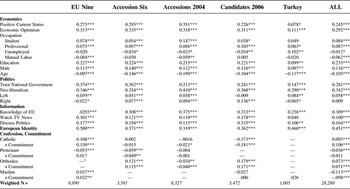
How do the theories explaining support for the EU fare in bivariate analysis? As Table 1 shows, economic variables work much as expected for all the country groups. People confident of their current economic status and those optimistic about the future support the EU. Economic optimism is the stronger of the two everywhere except in the 2004 Accessions, where positive current status bulks larger. The economic measures are weakest in the candidate countries and Turkey, but the evidence in Table 1 suggests that future benefits from EU membership are more important to those not yet in the EU.
Religion and Support for the European Union, 2006 (Pearson's r, bivariate correlations)

Source: Eu Source: Eurobarometer 65.2, March–May 2006.
***p < 0.001, **p < 0.01, *p < 0.05.
aToo few respondents for analysis.
Consistent with our predictions, students, and professionals support the EU, with student backing most noticeable in new member states and professional endorsement in the candidate countries. The unemployed and manual laborers are generally not very enthusiastic about the EU, except in Turkey where, perhaps, the unemployed may expect to find jobs when the country joins the more economically dynamic EU. Other measures that tap ability to take advantage of opportunities provided by economic integration are also revealing. As expected, higher education leads to greater support for integration, as does being a man (especially in the early accessions) and young (especially in the 2004 Accessions). The evidence thus confirms the persistence of the gender and youth gaps in EU support across Europe. In sum, the utilitarian theory so prominent in the literature is once more supported here: people who are economically secure and situated to take advantage of a dynamic economy are more likely to approve integration than those who are, or perceive themselves to be, economically vulnerable.
The political variables also work largely as anticipated. Trust in national government bolsters support for integration across country groups, with the relationship weakest in Turkey. As we argued above, national governments are closely identified with the European project and, as a result, citizens who trust their governments also trust the supranational institutions their leaders support. The weaker result for Turkey may indicate that the religious population supporting the mildly Islamic but pro-EU government is somewhat ambivalent about EU membership. Note, however, that the generally strong relationship here may be partially an artifact of question placement, as respondents are asked to rate their trust in national government just before they are asked about the EU. Thus, the question may involve a degree of response set, as well as tap a general tendency to “trust” authority.
Political ideology also helps shape attitudes. The impact of neoliberalism is quite impressive, especially as the variables included are uncontaminated by any mention of the EU or integration in the battery where they are asked. Neoliberals strongly support the EU everywhere, but especially in newer member states. Bivariate correlations across Europe also show a significant and consistent, though much weaker, relationship between left ideology and EU support. Significant left-wing public backing has been evident in the EU Nine since the early 1990s (Nelsen, Guth, and Fraser Reference Nelsen, Guth and Fraser2001) and may reflect a general shift of the left in a neoliberal direction after the end of the Cold War.
The effects of right-wing ideology prove more contingent: mildly negative in the EU Nine and Turkey, but fairly strong and positive in the two accession groups and the candidates. Thus, the nationalistic right in the EU Nine and Turkey remains opposed to integration, but in new member states the right actually shows low to moderate support for the EU. This pattern makes sense. The anti-communist, often strongly Catholic political right in the new member states often sees the EU as a bastion against leftist economics and Russian aggression. Furthermore, the Scandinavian right has supported membership to fend off economic intervention by social democratic governments. In sum, those who favor economic openness, whether from the left or the right, support the EU.
Other theories also find strong bivariate confirmation. Information — or Inglehart's “cognitive mobilization” — remains a major factor. Those who know a lot about the EU (or think they do), watch TV news (everywhere but Turkey), and discuss politics frequently are most supportive of integration. Of the three indicators, knowledge is most important. But European identity (i.e., strength of attachment to “Europe”) exhibits the strongest bivariate relationship in the Table. The correlations are extremely high in all country groups, but most notably in the EU Nine and Turkey. Not surprisingly, perhaps, those who feel most attached to Europe support the institutional embodiment of “Europe.”
Finally, religion still matters, but the impact varies by country group. In the EU Nine, the historic core of the EU, the bivariate results fall in line with those of our previous studies: Catholics support the EU; committed Catholics are even more approving. Protestants, on the other hand, are less positive as a group, although Protestant commitment does not add to that negativity. At the bivariate level, interestingly, both Muslim identity and practice have a mildly positive relationship with EU support.
Religion works differently in the Accession Six where all three Christian confessional cultures are represented, with Catholics dominating the Iberian Peninsula and Austria, Protestants the Nordic states, and the Orthodox Greece. Here, neither Catholic variable has any significant relationship to attitudes toward the EU, but Protestant identity and Protestant commitment have very solid negative influences. Both Orthodox identity and commitment are associated fairly strongly with support. Thus, in the Accession Six, the religious pattern is quite different from that in the historic home of the EU: Protestants are lukewarm about the enterprise, the Orthodox are more enthusiastic, and Catholics do not differ from the non-religious and minority religious groups.
The picture changes yet again in the 2004 Accessions. Here the Catholic coefficients are quite small, but Catholic religiosity has a significant negative relationship with EU support. Catholics here are concentrated in Poland and the negative result among the devout suggests strongly that conservative Catholics were turning away from a Union increasingly seen as anti-religious (Weigel Reference Weigel2005). Protestant identity and commitment have no impact whatever, and both Orthodox measures have a small but significant negative correlation with EU support. The Orthodox outcome may reflect a re-emergence of the historic nationalistic tendencies of that tradition, or may be the result of factors unique to divided Cyprus: Orthodoxy is closely associated with nationalistic attitudes toward Turkey, and the EU is sometimes viewed as too willing to accommodate Turkish demands.
Yet another pattern appears in the Candidates 2006, which include significant numbers of Catholics in Croatia, Orthodox believers in Romania and Bulgaria, and Muslims in Bulgaria and the Turkish portion of Cyprus. Here Catholics (mostly Croats) strongly oppose the EU, the Orthodox favor it, while Muslims do not differ from the non-religious. The Croatian result seems to reflect again the growing conflict between socially conservative Catholics who wish to bring government policy in line with Church teaching and socially liberal forces in the EU that condemn such efforts (EUbusiness, 2007).
Finally, if one considers the EU and its candidate countries as a single political entity (the final column in Table 1), the findings for the variables examined do not change substantially for most of the theories examined: economic viability and optimism produce positive views of the EU, as do trust in national governments, neoliberalism, and to a lesser extent, leftist commitments. “Cognitive mobilization” and European identity also produce strong correlations. But the melding of confessional cultures and commitments across country groupings produces an “EU-wide” pattern different from that of any of its components: Catholic identity and commitment produce support, as in the EU Nine. For Protestants, only identity is associated with more negative views of the EU, while Orthodoxy has a small net positive impact, and Islam, a slightly more substantial negative one. At the very least, then, the expanded EU is a much more complex religious entity than its predecessors centered in Western Europe.
The bivariate data, then, provide support for many theories advanced to explain public evaluations of the EU. Of course, these theories overlap somewhat conceptually and their empirical indicators are often intercorrelated. For example, those in professional occupations are more optimistic about their economic prospects than manual laborers are; younger citizens are better-educated than their elders; and, Catholics feel more “identified” with “Europe” than Protestants or Muslims do. To sort out these relationships and establish the independent effects of each factor, we ran multivariate analyses (OLS regressions) for each country group and for the EU as a whole.Footnote 3
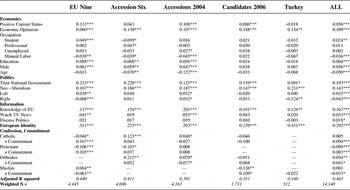
For the most part, multivariate analysis confirms the bivariate findings in Table 1, with some notable modifications. Economic optimism outperforms current economic assessments as a predictor, except for a close match in the 2004 Accessions. Occupational measures are generally weak, with only manual workers consistently more negative about the EU. The latter exert a significant negative drag on attitudes toward integration in every country group but the Candidates 2006 and Turkey. Education is a positive force everywhere, except in the Candidates 2006 and Turkey (the signs are in the right direction but the coefficients are not significant); men and young people are more supportive almost everywhere, even when all other factors are in the equation. On the whole, economic utilitarianism is strongest in the new member states and weakest in the candidate countries. By 2006, new EU citizens may have had enough time to realize just what was needed to exploit the East's integration with the rest of Europe. Citizens in the candidate countries were not yet fully aware of the costs and benefits of EU membership.
The political variables remain important. Trust in national government predicts support for the EU, as do neoliberal views, but trust is more important in the EU Nine and Accession Six, while neoliberalism is more powerful in the 2004 Accessions and Turkey. Leftist ideology has a positive effect everywhere except the Candidates 2006, but one that is not always large enough to be significant. The coefficients for rightist views vary: negative in the EU Nine and Turkey, but slightly positive in the 2004 Accessions and Candidates 2006. Knowledge of the EU remains a powerful positive force everywhere, but watching TV news and discussing politics have very modest and often insignificant effects when other variables are accounted for. Not surprisingly, given the strong bivariate correlations, attachment to “Europe” is arguably the most powerful predictor in each country group model, but above all in Turkey.
What about religion? The pattern of religious variables shifts somewhat under controls, but we still find substantial effects which vary by country grouping. In the EU Nine, Catholic identity reverses to takes a small negative coefficient, but the positive beta for Catholic commitment actually increases from the bivariate correlation, showing that observant Catholics are much more likely to think warmly of the EU, even when all other factors are controlled. Interestingly, Protestant identity takes its expected significant and negative sign, but the impact of Protestant commitment is now positive, reversing its bivariate relationship. In other words, when all else is considered, Protestant religiosity now contributes modestly to support for the EU, at least in the historic heartland of the Union, reflecting perhaps consistent support for the EU from “official” Protestant churches. Finally, although Muslim identity predicts solid support for the EU, Muslim religiosity now works in the other direction: the more frequently Muslims attend services, the less positive their attitudes.
In the Accession Six, the multivariate pattern differs from that in the EU Nine, just as the bivariate findings did. Now Catholic identity produces support for the EU, but the beta for Catholic commitment barely misses significance. As in the EU Nine, Protestant identity works against support, but commitment has a positive effect, although again missing statistical significance. Orthodox identity is a strong positive force, but commitment does not reach significance, although also in a positive direction. In the 2004 Accessions, we see yet another pattern: both Catholic and Orthodox identity have a positive impact on EU attitudes, but commitment works in the other direction, although the Catholic coefficient barely misses significance. In the Candidates 2006, the multivariate results point in the same direction as the bivariate findings, but when everything else is taken into account the coefficients turn out to be significant. Thus, Muslim identity survives as a negative predictor of attitudes toward the EU but Muslim commitment is positive — precisely the reverse of Muslims in the EU Nine. In these minority communities, committed Muslims apparently see the EU as an organization more tolerant of alternative religious expression even if as a whole the community is skeptical of the “Christian club.” Perhaps this result will change as these citizens become better acquainted with the organization of which they are now members. As for Muslim Turkey, no religious variable proves significant, including the mildly negative Muslim commitment coefficient.
When we pool all of the country groups together, we find that our religious factors still produce significant results: Catholic commitment is positive, but not particularly strong. Protestant identity is negative, but Protestant commitment is — when controlling for other factors — significant and positive. Orthodox identity and commitment remain positive, but not strong, while Muslim commitment remains negative.
Nevertheless, despite the continuing significance of religious influences in the model for the entire EU, this examination of religious influences suggests that their effects not only change with country groups, but generally have decreased in each new addition to the EU. A cursory glance at the bottom of Table 2 reveals that the beta coefficients become more modest as we move from the EU Nine to the candidate countries, and reveal fewer significant relationships. Nor do we find in the recent accessions or candidate countries strong independent religious sources of EU support comparable to that provided by Catholics in the EU Nine, both historically and in contemporary politics. (Indeed, in the Candidates 2006 and Turkey all but two of the coefficients are negative.)
Religion and Support for the European Union, 2006 (OLS analysis, standardized regression coefficients)

Source: Eurobarometer 65.2, March–May 2006.
***p < 0.001, **p < 0.01, *p < 0.05.
aToo few respondents for analysis.
In summary, in the 21st century, religion still matters to the formation of attitudes toward the EU, but its impact varies across confessional cultures and in different groups of European countries. Being a Catholic, but most importantly, a committed Catholic still indicates higher support for the EU. Being Protestant still means less support, but as some previous studies (Nelsen, Guth, and Fraser Reference Nelsen, Guth and Fraser2001; Nelsen and Guth Reference Nelsen and Guth2003) found, the most devout Protestants now seem to break from the general skepticism of their confessional culture and join their Catholic brethren in supporting the EU. Being Orthodox also works to increase support for the EU, although somewhat more weakly than being a strong Catholic or Protestant. Being a Muslim tends to make one more skeptical of the EU, especially if one is devout, but the relationship is the weakest among European confessional cultures. And it seems clear that all these effects are influenced by a variety of contextual factors in each country group.
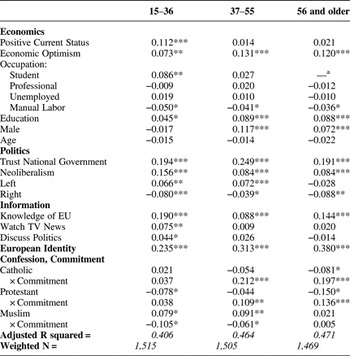
One question remains: is the role of religion in forming attitudes toward the EU changing over time? Previous time series analysis hinted at a declining role for religion (Nelsen, Guth, and Fraser Reference Nelsen, Guth and Fraser2001). Eurobarometer data do not allow us to apply the same comprehensive model used here to older datasets, given the absence of important variables. We thus follow Norris and Inglehart (Reference Norris and Inglehart2004) in using age cohort analysis to approximate time series analysis. Here we focus on the EU Nine, both because of the greater power of the religious variables in explaining support for the EU, and because most respondents in these countries have lived in some version of the EU for all or most of their lives. If religion is losing its ability to influence attitudes toward the EU even in its historic heartland, a full “secularization” of EU politics may be underway. Table 3 displays the results of OLS regression analyses for three age cohorts: 15–36 year olds, 37–55 year olds, and those 56 and older.
Religion and Support for the European Union by Age Cohort, EU Nine (OLS analysis, standardized regression coefficients)

Source: Eurobarometer 65.2, March–May 2006.
***p < 0.001, **p < 0.01, *p < 0.05.
aToo few respondents for analysis.
The economic, political, informational, and identity variables show broadly similar patterns by age group. Younger people do seem to be more influenced by their current economic status while older people respond more to their perceptions of the future. Younger manual laborers are more skeptical of the EU than older workers, but education and gender matters more to older people who have experience of economic change. Of the political factors, trust in the national government means most to middle-aged respondents, while neoliberalism is a stronger predictor of a young person's support for the EU. Information matters most to the young, as do attention to the news and political discussion. And European identity matters most to older respondents and least to the younger ones.
What happens to religion? Table 3 demonstrates that Catholic and Protestant confessional culture matters most to older respondents. Christian young people do not tie their religious traditions or commitments to their views on European integration like their elders do. This is strong evidence that the clash of confessional cultures that characterized the early years of the European Community still influences citizens who lived through that period, but has little hold on the youngest generation. The only exception to this rule might be among young Protestant identifiers who remain marginally skeptical. For Muslims in Western Europe, the reverse is true. Young people, especially the most religiously committed, are more influenced by their confessional culture than their elders. Some of these Muslim young adults see an integrated Europe as a place of freedom and opportunity for minorities, but the most devout young people may see Europe as a cultural threat to the European Muslim community and to Islam in general. The difficult debate in Europe over Turkish membership only reinforces the view among many devout Muslims that they face an inevitable clash of cultures (Jenkins Reference Jenkins2007). If European integration begins to divide Christians and Muslims (perhaps over Turkey), then confessional culture may make a comeback as an important determinant of attitudes toward integration. If a clash of cultures is avoided, however, the evidence points to a continued decline in the importance of confessional culture for public support for the EU.
CONCLUSION
Based on many studies conducted over several decades we know with some confidence what shapes European citizens' opinions of the EU. We know that if they feel good about economic conditions and their own abilities to take advantage of opportunities in a dynamic economy, they will support the Union. Citizens also support the EU if they are ideologically predisposed to favor competition and some degree of risk taking, generally trust government to do the right thing, and support a party that favors integration. We know that if they are familiar with the workings of the EU and stay abreast of current events, they will support integration. And if Europeans feel attached to Europe as a whole, they will support the institutions that look most like a continental government. We also know that European citizens draw on their background cultures, specifically confessional cultures, to form opinions about integration in Europe. In sum, economics, politics, information, identity, and culture make up a complex of factors that contribute to attitude formation across Europe.
Some of these factors are subject to influence by policy-makers. Solid economic performance will keep current citizens happy and potential citizens hopeful. Both groups are more likely to support integration. But utilitarian reasoning among European citizens will also cause policy-makers trouble. The most supportive citizens are those who believe in a neoliberal economy and who are well placed, or believe they are well placed, to benefit from it personally. Maintaining strong public support, therefore, requires that policy-makers spread the benefits of the European market as broadly as possible without dampening economic performance or entrepreneurial activity. Trouble arises when a booming economy produces too many economic losers and not enough winners, or when the European economy enters (as it has) a sustained period of low (or no) growth. Citizens making cost-benefit calculations will reduce their support for an integration project that does not bring them material benefits.
Policy-makers can boost support for integration by informing citizens, especially the young and those in new or potential member states, about how the EU works and what it is doing. Some of this is being done through the public schools in member states, but the challenge is daunting. The EU is a very complex system of institutions and processes that even experts find perplexing. The issues facing decision-makers at the EU level are seldom “newsworthy” — men and women in suits shaking hands over a new agreement on poultry standards rarely attract the TV cameras. To the average European citizen, EU politics is confusing and boring.
Without some emotional attachment to “Europe,” many citizens will abandon support for integration when it fails to deliver tangible benefits. This is bad news for policy-makers who have few resources capable of tying citizens emotionally to the EU. Symbols such as flags and anthems may help — as does a common currency (unless its value falls dramatically). But symbols must attach to something deeper to be of great value for the public legitimacy of the EU. (Will, for instance, Europeans follow the EU flag into battle?) This is why identity and culture matter greatly to sustaining long-term support for the EU. Citizens across the continent who have at least added a European dimension to their individual identities support integration. Policy-makers can encourage Europeans to consider what unites them by supporting student exchanges (as they do) and labor mobility (as they do very unevenly). But their role is limited.
Political leaders have even less influence when it comes to cultural sources of attachment to Europe. Catholics in the older member states have long believed and the most committed still believe, in European integration (for mostly non-material reasons, as controls for economic variables fail to eliminate their distinctiveness). Committed Protestants, while initially skeptical, have also begun to come around to the Catholic position, believing more strongly in the need for unity than in fear of papal power or nationalist aggression. Orthodox believers also support a vision of a united Europe, but may be tugged in another direction by the nationalistic tendencies of their tradition. On the whole, the future of religious sources of support for integration looks rather grim. Confessional culture is not what is driving public attitudes toward the EU in the new member states or candidate countries. In fact, committed Catholics in the East — but also in Western countries such as Ireland — are morally conservative and see the EU as the carrier of decadence to areas less tainted by secularism.
Even in Europe's heartland there is evidence that religion is losing its influence on attitudes toward unity. Young people in the EU Nine look like the citizens of the new member states and candidate countries: religion has very little hold on their attitudes toward the EU. The exceptions are the young Muslim adults who concentrate in pockets of old Europe. They seem even less enamored of the drive for unity than Protestants of an older generation. The presence of devout Muslims in Europe could provoke a cultural (if not religious) response from Christians that inspires a new recognition of Europe's common cultural heritage. That recognition could provide the foundation for a deeper common identity across Europe. Or it could devolve into an ugly clash of cultures that would stall enlargement, especially to Turkey. Perhaps the most likely scenario, at least in the short run, is one in which attitudes about integration become more instrumental. The question asked by the European public of the EU will be more and more: “What have you done for me lately?” And that will be a hard question to answer.