




No CrossRef data available.
Overcoming Obstacles: The Triple Mobilization of the Comisión Científica del Pacífico
Published online by Cambridge University Press: 01 December 2003
Abstract
Argument
This article describes from a constructivist perspective a Natural History expedition put together by the Spanish government and navy to visit territories in the Pacific in the 1860s. Right from the start the expedition ran into problems and barely made it back. However, it managed to compile an admiringly large assortment of specimens: extensive collections of shells, mammals, skulls, and photographs. The expedition was rooted in colonialism. Patrons and organizers of the expedition sought to recreate in Spain discourses and practices then dominant in France, particularly the colonial agenda of the Société Impériale Zoologique d'Acclimatation. The collection assembled by the Comisión Científica del Pacífico had a life of its own. Years after the expedition folded, the collection kept on circulating and inspiring local and foreign scientists to identify new species and draw lessons from anthropology to history. The study of this collection was always discontinuous, a fact that proves the guadianización of science in Spain. The collection has been revived after a number of serendipitous discoveries in various Spanish archives, particularly caches of old photographs. Presently, the website www.pacifico.csic.es is expected to contribute to the circulation of the inscriptions generated by this scientific expedition.
Information
- Type
- Articles
- Information
- Copyright
- © 2003 Cambridge University Press
Introduction
Recent research by Emma Spary has emphasized the process to which “specimens of the natural world”—on which the practice of natural history depends—are subject. These specimens are carried from distant lands to institutions that produce Natural History. Furthermore, they are preserved during their journey in order to be transmuted into “immutable mobiles,” that is, objects that become inscriptions enabling scientists to leave their laboratories and then return with “something” (Latour 1986). As the production of scientific knowledge leans upon communication networks, Natural History is therefore considered a “science of networks” (Spary 2000, 97).
In this paper we would like to contribute to the study of Natural History networks by focusing on the role played by spokesmen. To this end we shall discuss as a case study the Comisión del Pacífico expedition that was put together by the Spanish government in 1862. According to Michel Callon, the laboratory—though certainly a microcosm—can ultimately mobilize a macrocosm based on the activity of a number of spokesmen. In this type of “processionary science” spokesmen circulate in and out of the laboratory in a constant flow (Callon 1988, 23, n. 2). The longer, safer, and more reliable the chain of representatives, the more influence a laboratory can exert all over the world.
The Comisión Científica del Pacífico is considered the most important overseas scientific expedition during the reign of Queen Isabel II.1
It is surprising that this scientific enterprise was not mentioned in the last work on colonial science in nineteenth-century Spain by Elena and Ordóñez (Elena and Ordóñez 2000).
Although this scientific project recreated the colonial program developed by the Parisian Société Impériale Zoologique d'Acclimatation, the collection assembled by the expeditionary group had a life of its own and inspired, as it still does, works on biology, anthropology, and history by a number of savants both in Spain and abroad. The collection, in fact, has been revived after a number of serendipitous discoveries, particularly of photographs and drawings in a number of archives.
We shall consider the activities of the Comisión Científica del Pacífico as an expression of “processionary science” and focus on three major aspects. First, we underline the fundamental contribution of the spokesmen who were active in the networks that were unfolded by the members of this scientific expedition while at the “American laboratory.” Secondly, we attempt to demonstrate that the study of these documentary, scientific, and iconographic collections has a discontinuous character, which corroborates a structural feature of Spanish science: its guadianización (López-Ocón 2003). With this neologism, which refers to a Spanish river—the Guadiana—that flows intermittently, López Piñero intended to emphasize the discontinuous efforts of Spanish scientists,2
This idea is particularly important in López Piñero's work (see López Piñero 1979).
The Scientific Commission and its Two-way Trajectory
As a consequence of Alexander von Humboldt's prestige, the American continent became a favorite destination for European naturalists in the 1850s (López-Ocón 1999). In a few years several collective enterprises for the exploration and study of the natural world and culture of America were organized.
Three such enterprises—organized in Vienna, Madrid, and Paris—are worth mentioning. Von Humboldt (Beck 1959–1961) issued instructions and gave advice to some explorers aboard the Austro-Hungarian frigate Novara, which was to undertake a circumnavigation voyage from 1857 to 1859 under the command of Commodore B. von Wüllerstorf-Urbair (Treffer 1973).3
Information regarding this expedition is available in the virtual exhibition, “The Discovery of the World: The World of Discoveries.” December 2001. Kunthistorisches Museum Wien. 30 July 2003. http://www.khm.at/entdeckungen/frame_einE.html
Thus, politics and science joined in a venture organized in the midst of a pan-Hispanic feeling that pervaded the élite during the late reign of Queen Isabel II (Van Aken 1959; López-Ocón 1987, 60–88). The beginnings of Spanish capitalism resulted in a golden period (Tortella 1995), and a desire to reclaim an international-power status emerged (Durán de la Rúa 1979; Martínez Gallego 2001). As a result of the American Civil War the Spanish government tried to enforce a new policy against North American expansionism in Latin America. The circumnavigation voyage of the frigates Triunfo and Resolución was planned as a result of this strategy. Their objective was to establish a military base on the South American Pacific coast, in an attempt to articulate Spain's fragmentary colonial system in America, Asia, and Oceania. In fact, commissioners were seemingly given instructions to look for a favorable place to set up this military base in the Pacific, an area that had gained economic and strategic importance after California's Gold Rush and the discovery of gold in Australia back in 1848.4
Anthropologist and explorer Manuel Almagro (1984, 77), who wrote an account of the travel that was published in 1866, explained: “Guayaquil is not exactly upon the Pacific but on the Guayaz [sic] river, which connects the city to the Ocean; the island of Puná is located in the river's delta, and has an advantageous geography for a naval station [our emphasis].”
Furthermore, it was believed that Spain's incipient scientific and technological system—still recovering from a crisis—could be used by this colonialist policy. Among other reasons, there were scientists—including some members of the Commission—who had already gained experience in colonial science. In addition, the project was also related to the program of the French Société Impériale Zoologique d'Acclimatation, an important aspect that we shall discuss later.
As a matter of fact, three members of the Commission had been selected for their colonial experience (see fig. 1). Patricio María Paz y Membiela (1808–1874) was a former Navy officer and resident of Cuba. His interest in natural science had been awakened by his acquaintances the naturalist Felipe Poey and shell expert Nicolás Gutierrez.5
For information about the scientific climate of Havanna in the 1850s, see López-Ocón and García-Montón 2000.

Fig. 1. Portrait of the members of the Scientific Commission to the Pacific. From left, Juan Isern, Fernando Amor, Patricio María Paz y Membiela, Marcos Jiménez de la Espada, Francisco de Paula Martínez y Sáez, and Manuel Almagro. Courtesy Biblioteca General de Humanidades-CSIC.
One way or another these naturalists were part of a European trend that considered science to be closely linked to the colonial expansion of a new “conquering bourgeoisie.” The most relevant colonial powers supported important research programs to fulfill “the dream of the eighteenth century”—to bring exotic specimens to European laboratories to gain knowledge and as a result, enable them to domesticate and conquer their natural world (Mackenzie 1990). Such were the objectives of the French zoological society devoted to acclimatizing.
The founding of the Société Zoologique d'Acclimatation—which would become an imperial enterprise with the support of Napoleon III—in 1854 by Isidore Geoffroy Saint-Hilaire (1805–1861) eloquently describes the role of science in European colonial expansion. Although acclimatization—based on the theory of limited variability of types—was conceived as an ancillary science in French colonial policy, particularly in Algeria (Osborne 1994, idem 2000), this new science was transnational in character from the outset.6
In the discipline's foundational work Acclimatation et domestication des animaux utiles (1861), Isidore Geoffroy Saint-Hilaire explained that, according to his theory of limited variability of types: “Acclimater un animal, un végétal, c'est imprimer à son organisation des modifications qui le rendent propre à vivre et à perpetuer son espèce dans des conditions nouvelles d'existence” (cited in Aragón 2002, 81, n. 8; for a broad discussion on the acclimatization's basis as a science in France, see Osborne 1994, 62–97).
According to some recent work by Santiago Aragón (Aragón 2002), there was significant Spanish participation in this Society during the presidency of I. Geoffroy Saint-Hilaire (1854–1861). Considering that the Comisión Científica del Pacífico was organized immediately after that period, this scientific enterprise may well be considered a spokesman of the network unfolded by the Société Zoologique d'Acclimatation. Furthermore, it may also be regarded as an element of the processionary science established by I. Geoffroy Saint-Hilaire. In fact, Mariano de la Paz Graells (1809–1898)—the powerful Director of Madrid's Museo de Ciencias Naturales from 1851 to 1867, sponsor of the Comisión Científica del Pacífico, and one of the Society's first three international delegates—was one of its most active correspondents. The correspondence between Graells, I. Geoffroy Saint-Hilaire, and other members shows that the Spanish scientist actively participated in the Society's activities. Even though he was not a significant naturalist, he believed in the social usefulness of scientific practice, as did many of his colleagues. Furthermore, he believed that science should contribute to the glory of the nation-state. As a nationalist, Graells—like many other members of his generation (López-Ocón 1992, idem 2000)—had a particular interest in the recovery of scientific tradition and thus he advocated that Spaniards play a role in the modern practice of acclimatization (Graells 1855). He succeeded in convincing I. Geoffroy Saint-Hilaire, who consequently became a spokesman for Graells' theories within the Société (Geoffroy Saint-Hilaire 1861, 466–468).
The acclimatization program underlying the Commission's organization may be considered an indicator of Graells' interest in making the Museo Nacional de Ciencias Naturales another center within the “acclimatization-science” network unfolded by I. Geoffroy Saint-Hilaire from the Société Impériale Zoologique d'Acclimatation.
Graells was aware of the sponsorship role played by powers. In fact, he became popular in 1848 due to the discovery of Graellsia isabellae, a butterfly from Sierra de Gredos that he named after Queen Isabel II (Viejo Montesinos 1992). In 1857 he acted as a delegate of the Society in Madrid to reward Queen Isabel II for her support of the acclimatization project in both the metropolis and its colonies. In 1859 he succeeded in giving another important decoration of the Société to the Prince Consort for his introduction of Peruvian llamas and alpacas in Spain (Aragón 2002, 50–51). His role as a court scientist facilitated the Royal sponsorship of a domestication and acclimatization park at Madrid's Jardín Botánico. This short-lived park—active until 1871—was closely linked to the vicissitudes of the Comisión Científica del Pacífico.
Instructions issued to travelers—rather improvised according to their editor—insisted on the mission of these agents at a distance. According to these instructions the explorers had to carefully and meticulously collect both botanic and animal specimens that could contribute to the development of acclimatization. Thus, one of the objectives of the expedition's botanist was: “To take any chance to send seeds, as well as tubers, bulbs, and roots of living plants conveniently, so that they arrive in good condition and may be used in experiments in order to achieve their cultivation among us, understanding that preference must be given to useful plants, but including ornamental species as well as plants of strictly scientific interest.”7
These instructions were approved by a consulting commission of academicians and professors on 7 June 1862. They are reproduced in Puig-Samper 1988, 421–435.
The ambiguity of this request is in contrast with the more specific and detailed instructions issued to zoologists. For example, such instructions listed specimens of mammals suitable for the fur trade. In the case of the Canadian beaver (Castor canadensis) these instructions commented: “[it is] an animal that would become extinct should civilization not hurry to tame it and multiply it.” As for birds, the instructions insisted on giving priority to obtain and then send to the network center—the acclimatization garden at Madrid's Jardín Botánico—animals from distant places such as the ostrich from Senegal (Struthio camelus), rhea from Buenos Aires (Rhea americana), and black swan (Cygnus atratus) from New Holland (Australia). They also recommended the collection of “living specimens of secretary (Sagittarius serpentarius), a bird of prey used for the annihilation of poisonous snakes.” Even considering all classes of the invertebrate group interesting—the catalog of recommendations stated—these travelers had to spare no effort to send “eggs and cocoons of silkworms (Bombyx mori), cochineal insects, and very specially honey bees from different countries. Bee hives and larvae have to be sent well protected, so swarms of queen bees and drones can reproduce.” According to these recommendations the introduction of certain green-honey bees from Madagascar in Europe was deemed convenient.
In order to achieve this rather fanciful acclimatization program—particularly considering that the Commission would not travel to the places where most of these animals had their haunt—right-hand men of the expedition's scientific promoters were chosen: the above-mentioned Mariano Paz Graells and Laureano Pérez Arcas (1824–1894).8
Pérez Arcas authored Elementos de zoología (reprint 1863), the first treaty written in Spanish for the teachings of zoology. He was a member of the Société Impériale Zoologique d'Acclimatation since 1860. When Graells fell from favor, Pérez Arcas succeeded him as director of the said acclimatization park located in Madrid's Jardín Botánico.
A letter written in Cadiz by M. Jimenez de la Espada to M. P. Graells on 30 July 1862 suggests so. The letter is reproduced in Barreiro 1926, 501–508.
It seems that a photographer and draftsman, Rafael Castro y Ordóñez (1830?-1865) was close to Graells. So was the botanist, Juan Isern (1825–1866) who already had a reputation as a hard-working botanist from Catalonia when he was assigned to the Commission. His expertise had drawn the attention of several European savants such as Willkomm, to whom he sent plants from Catalonia in exchange for German specimens. He received the support of Graells from 1851 when he settled in Madrid. Since then he had worked as a collector for the city's Jardín Botánico. Another person close to Graells was the physician Bartolomé Puig y Galup (1826-?), who had worked as assistant taxidermist at Barcelona's Gabinete de Historia Natural. Graells also had close connections with Barcelona's scientific circles due to his earlier position as Head of the Zoology and Taxidermy Department of the city's Academia de Ciencias Naturales between 1835 and 1837.
In the spring of 1862 the Commission organizers decided to include a photographer in the expeditionary group, indicating the élite's interest in innovative technological practice. The eighth Commission member, Rafael Castro y Ordóñez, was a painter. Whether he had any knowledge of photography when he was elected is still unknown. However, he was given instructions on “views” (Puig-Samper 1988, 24) by one of the most important operators of the time: the British photographer Charles Clifford (1819–1863). It is important to note that Clifford's propaganda pictures of public works had been essential in constructing a “soft” image of the reign of Queen Isabel II in the 1850s (Fontanella 1999). And photography was, too, very popular in Madrid.10
See, for example, Benazuza, conde de. 1859 (Noticias sobre la historia de la fotografía. La América 3, 15 [8 October]:14).
The Commission's organizers believed that by including a photographer in the expedition they would be able to see through a “magic eye,” for they regarded photographs as capable of “revealing all the mysteries of the world,” “opening up … landscapes,” and translating “unknown spaces into familiar scenes, opening up distant territory to imperial eyes” (Ryan 1997, 72). The incorporation of this technological instrument also added prestige to the expedition (Badía, Pérez-Montes, and López-Ocón 2000). Similarly to science and technology, photography became a propaganda medium of the new Spanish power as well as an agent for aggressiveness due to the camera's capacity to “facilitate strategic knowledge on the geography of a country which may potentially become a battlefield” (Ryan 1997, 79).
The scientists who organized the expedition knew about the capacity of this new technique to explore nature and to move immutable mobiles through scientific networks. Graells and I. Geoffroy Saint-Hilaire exchanged photographs with their correspondence. In 1858, I. Geoffroy Saint-Hilaire asked for a drawing or photograph of a specimen of Andean Camelidae,11
Lama glama, Lama guanicoe, and Lama vicugna.
The letter from I. Geoffroy Saint-Hilaire to M. P. Graells was written in Paris on 20 January 1858. Graells' reply was dated 18 February (both letters are reproduced in Aragón 2002, Annexe documentaire, letters 22 and 26 respectively). On 9 October 1861, Graells sent I. Geoffroy Saint-Hilaire another photograph of two young emus (Dromaiidae novaehollandiae) born in Madrid's zoological park after the successful acclimatization of their parents (letter 40 of the Anexe docummentaire of Aragón's research work).
Because photographs were capable of producing high-quality immutable mobiles, the expeditionary draftsman was also equipped with a camera. The photographer had to assist his fellow travelers and—according to section 15 of the Commission's regulations—take views of mountains and the vegetation. Furthermore, he had to take portraits of individuals of all races, and pictures of objects that could lose their original color or shape when preserved; as a result, the photographer was also somewhat involved in specimen preservation.13
Regulations and instructions are reproduced in the documentary appendix of Puig-Samper 1988 (see particularly 384–385).
Castro used modern photographic processes and carried with him sophisticated equipment that had been acquired in Paris and London (Puig-Samper 1988, 446–448). During his voyage to America the photographer took more than five hundred wet-collodion plates that were printed on albumen paper (Molina, Pérez-Montes, and López-Ocón 2000). At that time wet collodion and albumen, in use since early in the 1850s, were replacing other photographic processes such as calotypy. Furthermore, the photographer's equipment included a modern Voigtländer lens.
Voitgländer-Petzval brilliant lenses were already known for their contribution to photography's first technological revolution in the 1840s. Interestingly, this equipment was partially purchased by Rafael Fernández de Moratín in Paris. As many Spanish advertisements of the period prove, modern photographic technology, used as part of the advertising strategy launched by many local photographers, was usually acquired in the French city (González 2002, 108, 112). Thus, the acquisition of such material abroad, although conceived as playing a role in a policy of prestige, ultimately reveals Spanish dependence on foreign technology.
Furthermore, Castro acted as a journalist for El Museo Universal, the most significant illustrated periodical in Spain at the time (González Pizarro 1989). Besides the collaboration of several photographers with this magazine, it must be noted that Graells had close connections with it, as advertisements of his acclimatization garden prove.14
In issue number 4, dated 4 May 1862, the magazine published an engraving and the following text: “Modern Madrid. Botanic Garden. Lake and rustic fountain of the Zoological Park.” In issue number 11, 1862, there is another advertisement of the aviaries for useful birds located in that acclimatization park (reproduced in Puig-Samper 1988, 384–385).
This trip may be divided into three parts. The first stage of the Commission's voyage spans from August 10, 1862, the day on which the expeditionary group set sail from Cádiz, to May 1863, when the explorers met in Valparaíso after reaching the Pacific through several routes. Some members crossed the Pampas and the Andes whereas the rest of the group sailed round Cape Horn and through the Strait of Magellan.
In July 1863, during the second part of its voyage, the Commission split up for various reasons. Trouble arose between the explorers and naval officers aboard the frigate Triunfo, which led to Paz's resignation from his post as director of the Commission. Vice-president Fernando Amor, who had become severely ill during his research work in the mines of northern Chile, died in California on October 21, 1863. Furthermore, conflicts between Peru, Chile, and Spain worsened when the Spanish squadron took over the Chincha Islands, well known for their rich guano deposits, on April 14, 1864. As a result, the Commission's naturalists were ordered to return immediately to Spain. Puig decided to remain in Chile, and Castro complied and returned to Spain via New York after a short visit to these islands, where he took some photographs. However, Martínez, Espada, Isern, and Almagro rebelled against the Navy and sought support from the government to set up their own expedition. Once permission was granted, they organized their “grand voyage” from Guayaquil to the Brazilian coast along the 2nd parallel.
During the last year of the trip—from autumn 1864 to October 25, 1865—they crossed the American continent—from the Pacific to Brazil's Atlantic coast—with great difficulty. This was the route previously covered by Francisco de Orellana, the first European explorer across the Amazon, whom they wished to emulate. In September 1865 they came across an American scientific expedition led by the Swiss Louis Agassiz—already working in Harvard—that was undertaking extensive research work in the Amazon. Almagro, as we may read in his memoirs, felt humiliated: “[We were] thoroughly defeated, without clothes or shoes, and with long beards… [Including] the severe jaundice of poor Isern, in all…[we] definitely looked like a bunch of beggars rather than members of a Commission sent by a European government” (Almagro [1866] 1984, 140–141). Agassiz and his wife on board the Brazilian ship Icamiaba mentioned them in their book on their experiences in this South American country. According to their writings, the Spaniards had just accomplished an adventurous journey, having descended the Napo River on a raft that reminded them of Noah's Ark, due to the huge collection of living animals that it carried. The Agassizs also commented that, even though the explorers had lost almost all of their clothing by shipwreck, they had fortunately been able to save their notes and collections (Agassiz and Cabot Agassiz 1895, 208).
Although the Commission was created in 1862 to spread the idea of a “renaissance”—particularly of Spanish natural science—and to participate in the extensive acclimatization program promoted by the Société Impériale Zoologique d'Acclimatation, three years later it had been reduced to four defeated naturalists returning to Spain in awful condition. In fact, the botanist Isern died immediately after his arrival in Madrid. Nevertheless, their journey was not in vain as they succeeded in achieving a huge collection of specimens from the American culture and natural world.
Moreover, the significant contribution of a group of correspondents mobilized by the network created by the Spaniards in America deserves recognition. There were correspondents of all kinds: natives working for European museums, individuals involved in the institutionalization of natural science in Latin America, etc. Some of these contributors were awarded a medal by the Spanish government (Puig-Samper 1988, 337). However, other correspondents were only rescued from oblivion when some expedition members credited their local contribution to the process of knowledge acquisition. Espada, for example, did not hesitate to mention contributions made by his diverse cooperators, for he mentioned the German—naturalized Chilean—naturalist R. A. Philippi, who donated an important herbarium to the Commission (Blanco and Puig-Samper 1995), and also young Fermín, a native American boy who captured a specimen of Thyroptera tricolor—a bat of alleged scientific value that we shall comment on later.
They showed certain friendliness toward American achievements, and discovered the importance of scientific traditions existing in the periphery. In this, they followed a trend already present among a number of European naturalists who shed their ethnocentric prejudices. Alexander von Humboldt and the Spanish zoologist Félix de Azara—whose works were included in the naturalists' baggage—had valued the experience accumulated by Latin Americans during their process of self-identification. Therefore, the botanist was asked to find out about the peculiarities of plants, their use, and the names given to them by natives in the second section of the instructions (Puig-Samper 1988, 421). The activities undertaken at the American laboratory changed the perception that some of these naturalists had of the world. This is particularly true of Marcos Jiménez de la Espada, as will be discussed later.
Despite their difficulties, the naturalists sent more than eighty thousand specimens to Madrid, where a reception commission had been already set up to act as a center for this network. From this center objects were retrieved, ordered, and then prepared for preservation at the city's Museo de Ciencias Naturales (ibid., 333–337). Some of these shipments were easier to transport than others. The first important shipment was sent from Rio de Janeiro in November 1862, and arrived without trouble in Madrid.15
That shipment included 808 mollusks; 3,600 specimens of 538 species of plants from the Canary Islands, Cape Verde, and Brazil; 1,913 geological samples and insects; 103 reptiles; 13 mammals; 1,007 birds, including four nests and several eggs; and an ethnographic collection of weapons and ornamental objects, including a head that had been mummified by Brazilian natives (see Puig-Samper 1988, 334).
See, for example, Bilbao's Irurac bat 15:56 (11 March 1866) p. 3, col. 1.
These collections not only moved through European networks but also within American society, a fact that proves the impact of the work undertaken by these Spaniards in the periphery. So it happened with some of the photographs taken by Castro. Photographs—which, according to Ch. Pierce, have an “indexical” nature, linking the sign with its referent by physical nearness (Dubois 1994, 42)—were considered “the true retina of the scientist,”17
This statement was made by astronomer Janssen, and used in 1896 by Albert Londé in La photographie moderne, Paris: Manson, 546. Quoted in Lemagny and Rouillé 1988, 71.
For the relationship between the Bavarian artist and the Spanish explorers, see Miller 1968, 96–97.

Fig. 2. Photograph of The Guardsmen at the Entrance of the Mammoth Grove by Rafael Castro y Ordóñez. Courtesy Biblioteca General de Humanidades-CSIC.
Early in 1866, when all the surviving explorers were back in Madrid, the Commission's political and scientific patrons wished to exhibit the results. The “Golden Fleece” of these “modern Argonauts” was an impressive display of the biological diversity of America's nature, and the plurality of its culture. Thus, they organized a great exhibition of the objects collected by Commission members along their voyage at the Jardín Botánico (Barreiro 1926, 406–411; Miller 1968, 169–171; Puig-Samper 1988, 339–345). However, little did the organizers, curators, and visitors of the exhibition know that these collections would have a difficult circulation through the scientific network in the next 150 years, as we shall discuss in the following pages.
Ups and Downs in the Scientific Study of a Collection of American Objects
The exhibition was a success. Several media reported on the Commission's work. José Gaspar, editor-in-chief of El Museo Universal, obsessed with his role as educator and mediator between scientists and society, requested authorization to have a staff draftsman copy the objects on display at the exhibit.19
Letter from José Gaspar to M. P. Graells. Comisión Científica del Pacífico Papers. Archivo del Museo Nacional de Ciencias Naturales. In Calatayud 1983. Document 738.
These engravings document the affluence of visitors. Although these visitants are unknown to us, we know that the Basque José María Murga—a Bilbao proprietor who had become a member of the Société Impériale Zoologique d'Acclimatation—visited the display with Espada, who showed him an interesting specimen of the bat Thyroptera tricolor. A woman, shocked by the Peruvian, Bolivian, and Chilean pre-Columbian mummies on display, wrote a romantic poem that was published in a family-oriented magazine.20
Domingo Soler 1866. We would like to thank Curator Carolina Martín, Museo Nacional de Ciencias Naturales, for information about this article.
Despite these favorable conditions this venture marks the end of an era. Five hundred visitors purchased the exhibition catalog, written by the anthropologist Almagro. Thus, the exhibition's success suggests the presence of favorable conditions for the systematic study of these collections. However, it may be considered the last enterprise of science of that time. Although a commission for the study of the collection was created at the time the exhibition was organized, it was ill fated. Politicians were tightfisted and asked Martínez, Espada, and Almagro to complete an ambitious introductory work about new genera and species from the collection in two years! During that period of time a political crisis led to the fall of Queen Isabel II. Spanish science followed a similar pattern. As a result of Graells' loss of power in 1867, his research—based on the work undertaken by the Comisión Científica del Pacífico—and the whole acclimatization program shrank.
Nevertheless the situation improved, at least for a while. In 1868 a coalition of liberal parties came to power. The new government, interested in the promotion of science (López-Ocón 1997), reactivated the Commission's activities. Martínez and González Hidalgo—the most prominent malachologist in Spain at that time, and a regular contributor to the prestigious Journal de Conchyliologie—studied the collection of mollusks, which included 38,755 specimens of 816 species. Several species were described in three research works published during a ten-year period. Martínez focused on aquatic bivalvia. Meanwhile, González Hidalgo published two books on terrestrial and sea gastropoda. The first book, illustrated with eighty-nine figures sketched by the Becquet brothers of Paris, came out in 1872 (see fig. 3) (González Hidalgo and Martínez y Sáez, 1869–79). According to the most recent research work done on malachology, the Commission's explorers collected 324 species of sea gastropoda, and 241 of terrestrial gastropoda. González Hidalgo described 19 new species (Calvo 1994, 283–285).

Fig. 3. Mollusks studied by Gonzalez Hidalgo as sketched by the Becquet brothers of Paris. Courtesy Biblioteca General de Humanidades-CSIC.
There were other contributions to the knowledge of that rich and varied collection. When the former Commission president—Paz—returned to Madrid he sent freshwater bivalvia to Isaac Lea, a member of the Academy of Natural Sciences of Philadelphia. The American scientist immediately described fourteen new species but did not indicate their range.21
See Lea, I. Proceedings of the Academy of Natural Sciences of Philadelphia 1866, vol. 10. Lea improved his studies on those species in Journal of the Academy of Natural Sciences of Philadelphia 1868, vol. 6; and Observations on the Genus Unio, JANSP 1869, vol. 12. Information obtained from Calvo 1994, 286.
The most outstanding scientific work related to this expedition to the Pacific was Espada's. He was the only member of the group who maintained a life-long interest in studying the culture and natural world that he had encountered during his American journey.
At first he focused his research work on the study of those mammals that he had observed and collected during his trip along the biologically rich and varied Amazon area. He traveled to Paris where he contacted colleagues such as Milne-Edwards, both senior and junior, Dumeril, J. Verreaux, Gervais, and Braconnier. Thus, he compared specimens in their collections with the most interesting animals from South America that were kept at Madrid's Gabinete de Historia Natural. Upon his return he used his expertise in comparative anatomy and physiology to describe new species of apes, emphasizing the mechanisms of adaptability to arboreal life developed by some mammals. He studied the Thyroptera tricolor Spix, characterized by its suckers (see figs. 4 and 5). A specimen of this bat had been given to him by a young native-American in Ecuador on May 25, 1865. As Espada wrote in one of his research papers, “a mammal with suckers was… the most extraordinary discovery of our voyage, and a rare finding regarding the anatomy of those vertebrates” (Jiménez de la Espada 1870b, in López-Ocón and Pérez-Montes 2000, 213). This research paper demonstrates an interest in the distribution as well as the behavior of the newly observed species. Once published it was sent to Murga, the above-mentioned visitor to the exhibition at Jardín Botánico, to whom Espada had shown the bat in 1866. Murga replied: “The description of the bat with suckers is extremely strange, something that may be understood by savants and ordinary people all the same.”22
Letter from José María de Murga to M. Jiménez de la Espada. Marcos Jiménez de la Espada Papers, Biblioteca General de Humanidades (CSIC). See www.csic.es/cbic/BGH/espada/pagina.htm.

Fig. 4. Sketch of Tyroptera tricololor Spix, studied by Jiménez de la Espada. Courtesy Biblioteca General de Humanidades-CSIC.

Fig. 5. Illustration of Tyroptera tricololor Spix, studied by Jiménez de la Espada. Courtesy Biblioteca General de Humanidades-CSIC.
Obsessed with the idea of priority, and willing to convince his colleagues of the importance of his scientific findings, Espada focused on the study of a collection of 786 amphibians that he had collected along the trip. He made contact with a network of European and American herpetologists. In his five successive publications, mostly of taxonomic character, Espada discussed the results of his research and, willing to be original, he published his first paper in Latin in the periodical magazine of Lisbon's Academy of Science (Jiménez de la Espada 1870a). The editor of this publication was the Portuguese zoologist José Vicente Barboza du Bocage. This professional connection allowed Espada to contact other European and American colleagues such as Günther, from the British Museum; G. Elliot, from the Zoological Society of London; and E. Cope, secretary of the Philadelphia Academy of Natural Sciences. Barboza du Bocage, who introduced him to E. Cope, acted as the nodal point of a network that interested Espada.23
The following documents belong to the Espada Papers collection, CSIC: 13 letters from Barboza du Bocage written in Lisbon and dated 13 November 1869; 3 and 19 March, 11 and 17 May, 17 July, 1870; 25 May, 3 June, 1871; 16 February, 4 March, 1872; 15 November, 30 December, 1874; and 13 July 1875. He also received two letters from A. Günther, written in London and dated 26 May 1871, and 9 October, 1875. Finally, G. Elliot also sent him four letters from London and Geneva dated 13 June, 21 September, 29 June 1871, and 21 August, 1875 respectively. For a broad analysis of the meaning and characteristics of this correspondence, see López-Ocón 1991, 408–418.

Fig. 6. Herpetological specimens studied by Jimenez de la Espada, as illustrated by Diaz Carreño. Courtesy Biblioteca General de Humanidades-CSIC.
Espada did not devote himself exclusively to taxonomic studies. In 1872 he published a paper on the reproduction of the frog Rhinoderma darwinii in a periodical issued by Sociedad Española de Historia Natural (Jiménez de la Espada 1872, in López-Ocón and Pérez-Montes 2000, 217–224). He was a founding member of this Society and played an important role during its early years. Rhinoderma darwinii belongs to the family Rhinodermatidae, which includes only two species within the restricted range of Chilean and Argentinean temperate forests. Espada made an important discovery, and understood its importance in the field of evolutionary biology immediately (De la Riva 2000, 79). The French—naturalized Chilean—biologist Claude Gay had argued that Darwin's frog was viviparous because he had found well-developed tadpoles inside some specimens that, of course, he had identified as females (Gay 1848). However, Espada observed that males transported larvae in their vocal pouch. Since he had studied dead specimens, he underlined the importance of future research with living animals in order to fully understand the mechanism of such an odd reproduction pattern, still considered most interesting among the evolutionary tendencies of Anura.
Espada found an international audience for his research. Although his monograph was written in Spanish, it stirred up the curiosity of his European colleagues. In 1877 J. W. Spengel became his spokesman by translating into German an excerpt of his work for the readers of Zeitschrift für Wissenschaftliche Zoologie (Spengel 1877), thus introducing his contribution to the field of zoology on an international basis.
Nevertheless, in spite of his success as a zoologist, Espada became a historian. He reached maturity as a man of science, and was soon acknowledged by colleagues such as the aforementioned Spengel, and the Spanish zoology leader Pérez Arcas (Pérez Arcas, 1876). However, he made a decision to change the objective of his research, becoming an expert on American history and culture. This re-orientation toward the past resulted from his desire to enrich his investigations with previous knowledge contained in texts. Thus, he overcame his institutional limitations as a zoologist, and contributed successfully to the recuperation of a History of Natural Science in Colonial Latin America. His romantic nationalism led him to emphasize the continuity between the earliest cronistas de Indias—like Fernández de Oviedo—and the enlightened scientific-explorers of America, such as the Malaspina Expedition members. By doing so he tried to fight the “guadianizing” tendency that characterizes Spanish science, and gave value to a scientific tradition of natural studies in Spanish America of which he considered himself a part.
Furthermore, rescuing previous texts from oblivion was common practice among many nineteenth-century naturalists. Fan Fa-ti has recently demonstrated that members of the North China Branch of the Royal Asiatic Society used Chinese texts (Fan 2000). Similarly, there were naturalists—most of them humboldtian scientists like Espada—who used texts, philological data, and historical documents in their research. This practice led Espada to the study of Americanism. He participated actively in several international conferences—Brussels 1879, Madrid 1881, Torino 1886, Berlin 1888, and Paris 1890—by which this field was being defined (López-Ocón 2002). Furthermore, he developed a singular historiography devoted to the knowledge of the natural world and the ancient cultures of America. Some of Espada's work—published over 25 years—was read decades later, and inspired classic works such as John Murra's historiography on the socioeconomic structure of the Inca Empire (Murra 1980). Furthermore, Espada's work even contributed to the creation of the field of Andean ethno-history.24
Murra commented: “The one important scholar in this field was Marcos Jiménez de la Espada, who was most active a hundred years ago while earning his living as curator of amphibians at Madrid's Museum of Natural History. As a sideline he published the sources Prescott had used in manuscript form and others the New Englander had never seen” (Murra 1984, 61).
In the 1890s, when Espada was completing his work, specimens collected by the anthropologist Manuel Almagro were studied by Luis de Hoyos y Sainz. This scientist—whose research work was published for almost twenty years (Hoyos y Sainz 1910, 1911a, 1911b, 1913, 1923–1924)—defined a typology of cranial deformities, and provided anthropometric data on the inhabitants of the Andean region (Puig-Samper 1988, 367).
Nevertheless, Espada's singular work—a hybrid of natural science and history—acted as a spokesman for the processionary science unfolded by the Comisión del Pacífico expedition in the twentieth century. Later Espada succeeded in passing on his knowledge of the expedition's collection of mammals to his disciple Ángel Cabrera Latorre (1879–1960). From 1900 to 1913, an active period at the Museo de Ciencias Naturales, Cabrera Latorre undertook a series of research that resulted in the discovery of 8 new species and 5 sub-species (Cabrera Latorre 1900, 1901a, 1901b, 1901c, 1904, 1907, 1913, 1917). His research concerning the Comisión del Pacífico collection helped him become familiar with South American fauna, an aspect of the field that would eventually become his area of expertise when he settled in Argentina as a staff member of Museo de la Plata (García Perea and Gisbert 1998).25
For a reference on his contribution to the study of Argentinian fauna, see www.paleonet.com.ar:8080/biografias/acabrera/acabrera.html.
In the 1920s Father Barreiro's body of work attracted new interest in the Commission. Barreiro edited fragments of Espada's diary that had been kept by his descendants (Barreiro 1928) and collected Isern's notes on the botanic aspects of the expedition. He also supported the 1929 Exposición Retrospectiva de Historia Natural, which included objects collected by Spanish expeditions in America and Oceania. Captain Iglesias' project proves the extent of interest that this exhibition aroused. Francisco Iglesias, an Air Force hero, convinced the government of the Second Spanish Republic to organize a new scientific expedition to the upper Amazon. This project was intended to recall the Comisión del Pacífico exploration (Iglesias 1931; López Gómez 2002) and it encouraged the study of other collections. A Catalan botanist Josep Cuatrecasas (1903–1996) studied Isern's herbarium during a stay in Berlin's Botanischer Garten. During his investigation he received help from the German professors Pilger, Diels, and Mattfeld (Cuatrecasas 1935).
However, political difficulties interrupted all studies concerning the collection. On July 1936 General Franco revolted and a bloody civil war broke out. Cuatrecasas was one of those scientists who went into exile. First, he went to Colombia and then to the United States, where he developed an important research program devoted to tropical flora at the Smithsonian Institution.26
For Cuatrecasas' scientific contributions in Colombia, see Pinto-Escobar, P. Cuatrecasas y la flora y la vegetación. In www.banrep.gov.co/blaavirtual/letra~p/pacific1/cap13.htm. The Jose Cuatrecasas Botanical Endowment Fund and the Jose Cuatrecasas Medal for Excellence in Tropical Botany, established at the Smithsonian Institution, point out the significance of his work in the United States.
Finally, two discoveries made in the 1980s and 1990s again attracted interest in the Comisión Científica del Pacífico. These two findings occurred during a new recovery of the Spanish scientific system. Some of Castro's negatives were rediscovered at Madrid's Museo de Ciencias Naturales in the 1980s. Then, a restoration process of these collodion plates was initiated. As a result of this project an exhibition was organized in 1992 (Calatayud and Puig-Samper 1992) and the museum became interested in the collection. A catalog of insects collected by the explorers of the Spanish Commission was published two years later (Santos Mazorra 1994). Also, Madrid's Jardín Botánico showed renewed interest in Isern's herbarium (Blanco and Rodríguez 1996; Blanco 1998), and the discovery of Espada's iconographic collection—known as Espada's “hidden treasure” —was made at CSIC's Biblioteca General de Humanidades in 1995. This collection includes more than five hundred photographs—either taken by Castro or obtained by the explorers along their journey—and more than a hundred drawings and illustrations. These materials helped reveal new aspects of Espada's process of knowledge production, and have encouraged a new and original restoration and preservation project for the scientific heritage kept at CSIC's institutions.
At the moment, immutable mobiles generated by Comisión Científica del Pacífico are being computerized in order to become “visible.” As part of this process, Espada's archive was digitized and put into the institution's system. An appealing CD ROM that resembles a photograph album has been published too. This CD ROM, of valuable assistance for the study of Castro's representation of the natural world and culture of the Americas (Molina, Pérez-Montes, and López-Ocón 2000), was followed by the construction of the website www.pacifico.csic.es. This site offers all kinds of information on CSIC's expedition-related graphic and scientific collections. The expedition's history is presented in an attractive way following the pattern already established by other projects devoted to the creation of digital history (Abbot 2001), which insert the memory of science in “Telepolis.”27
Some of these projects are listed in the introductory text by Dierig, Kantel, and Schmidgen (2000). Two more projects have to be added to this list. First, the website www.burkeandwills.net/expedition, devoted to the Burke and Wills Expedition and developed by the State Library of Victoria (Australia). The reconstruction of an expedition to Congo supported by the American Museum of Natural History from 1909 to 1915, is available at the American Museum Congo Expedition website http://diglib1.amnh.org/.
Even from cyberspace these inscriptions accumulated by the expedition's members almost a hundred and fifty years ago still draw our attention. After many movements over space and time these inscriptions are still circulating among us. Recently, a Brazilian journalist reported that an album including 53 photographs had been found in Rio de Janeiro's Biblioteca Nacional. This album had been given to Emperor Pedro II by the commission in 1862 (Seligman 1999). The publication of another article on the so-called “hidden treasure” by a Spanish journalist in both the press and the Internet made this discovery possible (Aznárez 1999).
Conclusion
When followed over space and time, both the explorers from the Comisión Científica del Pacífico and the samples collected along their journey may help prove two facts concerning the function of the “processionary” scientific activity of this venture: the center's inability to impose its own interpretation, and the essential contribution of spokesmen to the network's operation.
First, inscriptions from the American laboratory, as well as inscriptions and interpretations generated by the explorers, have been progressively acquired and constructed. During this process the central laboratory—in this case Madrid's Museo de Ciencias Naturales—did not impose its own interpretation on the objects being collected by explorers acting at a distance. At first the expedition was thought of as an aid for the acclimatization program. However, some of these collections were studied from various viewpoints. Taxonomical studies were carried on, as in the work of the herpetologist Espada or malachologist González Hidalgo. Furthermore, Espada also undertook physiological analyses when he studied the reproduction of Rhinoderma darwinii. Zoologists Cabrera Latorre and Haas accomplished several bio-geographic studies by researching this collection. Moreover, objects collected at a distance altered the interpretation of the world that was made at the network center. Although the Commission was conceived—particularly considering the imperialist atmosphere from which this enterprise emerged—as a tool for the appropriation of American nature, after his voyage Espada became interested in America and the Americans, and produced a type of “federal science” in alliance with his American colleagues. His initial travel encouraged him to start a working program devoted to the scientific knowledge generated in Pre-Columbian and Early Modern America. His Peruvian readers considered his contribution an illuminating tool for their historical experience.
Secondly, the vicissitudes of the documentary and iconographic collection generated by the Commission may help us to understand the essential role played by the spokesmen of processionary science in their unfolding networks. This is particularly true of this case, since Spanish networks tend to debilitate as a result of discontinuity in scientific efforts, given Spain's semi-peripheral position in the science world. The activities of such spokesmen kept the expedition alive for their audience and for the scientific community despite their ups and downs. During the last quarter of the nineteenth century, Espada's original research program was essential in keeping the Commission's network running. The importance of his work was widely acknowledged, and relevant members of the scientific élite of the time attended a posthumous tribute to him. Homage was paid by the most significant members of the Institución Libre de Enseñanza, a secular association of progressive liberals committed to the educational and scientific modernization of Spain. Many representatives of Lima's Sociedad Geográfica also attended the event. In the first quarter of the twentieth century several research projects contributed to keeping this network functioning. Works like those by Cabrera Latorre, Haas, Hoyos y Sainz, Barreiro, Iglesias, and Cuatrecasas concatenated and acted as spokesmen for the Comisión Científica del Pacífico. Interest in the Commission also aroused interest abroad during the 1960s. During Franco's dictatorship the expedition was mostly forgotten. A major interest in the Commission was manifested in the United States. In 1968 Professor Miller—after reading a text written by Rafael Altamira, a prominent and liberal historian, and an enthusiast of Espada's American studies28
According to Professor Miller, the text by Altamira that encouraged him to study the Comisión Científica del Pacífico was entitled, The Share of Spain in the History of the Pacific Ocean (1917) published in New York.
Finally, we would like to underline the fact that this story demonstrates a “guadianización”—a metaphor for tension between continuity and discontinuity—of scientific activities in Spain. Networks unfolded by the Comisión Científica del Pacífico flowed, disappeared, and emerged again, thus mimicking the river Guadiana. Like this river, which emerges only under favorable conditions, the expedition's networks were only extended within the context of a favorable and stable political environment, an unsurprising fact considering that almost all Spanish scientific practice was—and still is—supported by the State.
Acknowledgements
The authors are grateful to Santiago Aragón, Jesús Bustamante, Fermín del Piro, Antonio Lafuente, Staffan Müller-Wille, Carmen Mª Pérez-Montes, Ineke Phaf-Rheinberger, Juan Pimentel, Agnès Ponsati, Miguel Angel Puig-Samper, and an anonymus referee for their encouragement and valuable comments on this paper. This study was performed within the framework of Research Projects TIC 2000-0168-P4-04 and BS02001-2341, financially supported by the Spanish Ministry of Science and Technology.
References
Agassiz, L. and Cabot Agassiz, E.. 1895. A Journey in Brazil. Boston/New York: Houghton, Mifflin.
Almagro, M. [1866] 1984. La Comisión Científica del Pacífico: Viaje por Sudamérica y recorrido del Amazonas 1862–1866. Barcelona: Laertes.
American Museum Congo Expedition 1909–1915. Ver. 2.0. January 2003. American Museum of Natural History. 20 July 2003 http://diglib1.amnh.org>.
Amor, F. 1856. Estudios que sobre la agricultura en sus varias aplicaciones ha hecho en la Exposición Universal de París el doctor D. Fernando Amor. Córdoba.
Amor, F. 1859. Recuerdos de un viaje a Marruecos. Sevilla.
Aragón, S. 2002. Le rayonnement international de la Société Zoologique d'Acclimatation: participation de l'Espagne entre 1854 et 1861. Mémoire de DEA. Paris: École des Hautes Études en Sciences Sociales.
Aznárez, M. 1999. “El tesoro oculto de JimÉnez de la Espada.” El País Semanal (Sunday 14 March):30–49.Google Scholar
Badía, S., C. Mª. PÉrez-Montes, and L. López-Ocón. 2000. “Una galería iconográfica.” In López-Ocón and PÉrez-Montes 2000, 121–154.
Barras de Aragón, F. 1949. Los últimos escritores de Indias: Bibliografía de españoles del siglo XIX que escribieron sobre países de fuera de Europa o viajaron por ellos. Madrid: Real Sociedad Geográfica.
Barreiro, A. J. 1926. Historia de la Comisión Científica del Pacífico (1862 a 1865). Madrid: Museo Nacional de Ciencias Naturales.
Barreiro, A. J. 1928. Diario de la expedición al Pacífico llevada a cabo por una comisión de naturalistas españoles durante los años 1862–1866, escrito por Marcos JimÉnez de la Espada, miembro que fue de la misma. Publícado por vez primera, adicionado con notas, el P. Agustín Jesús Barreiro, agustino. Madrid: Real Sociedad Geográfica.
Beck, H. 1959–1961. Alexander von Humboldt. Wiesbaden: Franz Steiner Verlag.
Blanco, P. and M. A. Puig-Samper. 1995. “Plantas de R. A. Philippi (1808–1904) en el herbario de la Comisión Científica al Pacífico (1862–1866) del Real Jardín Botánico de Madrid.” Anales Jardín Botánico de Madrid 53():55–99.Google Scholar
Blanco, P. and Rodríguez Veiga, M. D. 1996. “Comisión Científica del Pacífico (1862–1866): Estado actual del herbario Isern en el Real Jardín Botánico de Madrid.” Revista Sociedad Española de Historia Natural ():480–483.Google Scholar
Burke and Wills. Terra Incognita. Ver. July 2003. State Library of Victoria. 30 July 2003. http://www.burkeandwills.net/burkeandwills.html.
Cabrera Latorre, A. 1900. “Estudios sobre una colección de monos americanos” Anales de la Sociedad Española de Historia Natural. Serie Zoología, 65–93, n. 29.
Cabrera Latorre, A. 1901a. “Descripción de tres nuevos mamíferos americanos.” Boletín de la Sociedad Española de Historia Natural 1:367–373Google Scholar
Cabrera Latorre, A. 1901b. “Nota sobre la iconografía del Vespertilio Espadae.” Boletín de la Sociedad Española de Historia Natural 2:131–132Google Scholar
Cabrera Latorre, A. 1902. “Nota sobre el verdadero hábitat del Myotis Thomesi.” Boletín de la Sociedad Española de Historia Natural 2:293.Google Scholar
Cabrera Latorre, A. 1904. “Catálogo descriptivo de los Quirópteros chilenos.” Revista Chilena de Historia Natural 7:278–308.Google Scholar
Cabrera Latorre, A. 1907. “A New South American Bat.” Proceedings of the Biology Society of Washington 22:57–58.Google Scholar
Cabrera Latorre, A. 1913. Dos mamíferos nuevos de la fauna neotropical. Con una lámina. Madrid: Trabajos del Museo de Ciencias Naturales. Serie Zoológica. n° 9. 15 p. + 1 lám.
Cabrera Latorre, A. 1917. Mamíferos del viaje al Pacífico, verificado de 1862 a 1865 por una comisión de naturalistas enviada por el gobierno español. Madrid: Trabajos del Museo Nacional de Ciencias Naturales. Serie Zoológica. n° 31. 62 p.
Calatayud, Mª. A. 1983. Catálogo de las expediciones y viajes científicos españoles en los siglos XVIII y XIX. Madrid: CSIC.
Calatayud, Mª. A. and M. A. Puig-Samper, eds. 1992. Pacífico inÉdito: Exposición fotográfica. Madrid: Lunwerg editores, Museo Nacional de Ciencias Naturales, Madrid Capital Europea de la Cultura, and Sociedad Estatal Quinto Centenario.
Callon, M., dir. 1988. La science et ses rÉseaux. Genèse et circulation des faits scientifiques. Paris: Editions La DÉcouverte, Conseil de l'Europe and Unesco.
Calvo, M. 1994. “Informe sobre el material malacológico recogido durante la expedición al Pacífico (1862–1865).” In Diario de Don Francisco de Paula Martínez y Sáez, miembro de la Comisión Científica del Pacífico, 1862–1865, edited by M. A. Calatayud, 283–287. Madrid: CSIC.
Comisión Científica del Pacífico. Ver. 1.0. December 2000. Consejo Superior de Investigaciones Científicas: Instituto de Historia. Unidad de Coordinación de Bibliotecas. Museo Nacional de Ciencias Naturales. 30 July 2003. http://www.pacifico.csic.es>.
Cuatrecasas, J. 1935. Plantae Iserniae, 1. Anales de la Universidad de Madrid (Ciencias) 4() (June):206–265.
De la Riva, I. 2000. “La obra herpetológica de JimÉnez de la Espada: su relevancia y validez despuÉs de un siglo.” In López-Ocón and PÉrez-Montes 2000, 76–90.
Dierig, S., J. Kantel, and H. Schmidgen. 2000. The Virtual Laboratory for Physiology: A Project in Digitalising the History of Experimentalisation of Nineteenth-Century Life Sciences. Preprint 140. Berlin: Max-Planck-Institut für Wissenschaftsgeschichte.
Discovery of the World: The World of Discoveries. December 2001. Kunthistorisches Museum Wien. 30 July 2003. http://www.khm.at/entdeckungen/frame_einE.html.
Domingo Soler, A. 1866. “Impresiones: En la exposición de objetos del Pacífico.” Álbum de las Familias 36 (29 de mayo):278–279.Google Scholar
Dubois, Ph. 1994. El acto fotogrÁfico: de la representación a la recepción. Barcelona: Paidós.
DurÁn de la Rúa, N. 1979. La Unión Liberal y la modernización de la España isabelina: Una convivencia frustrada, 1854–1868. Madrid: Akal.
Elena, A. and J. Ordóñez. 2000. “Science, Technology and the Spanish Colonial Experience in the Nineteenth Century.” Osiris 15:70–82.Google Scholar
Fan Fa-ti. 2000. “Hybrid Discourse and Textual Practice: Sinology and Natural History in the Nineteenth Century.” History of Science 38:25–56.Google Scholar
Fontanella, L. 1999. Clifford en España: un fotógrafo en la corte de Isabel II. Madrid: El Viso.
García-Perea, R. and J. Gisbert. 1998. “Ángel Cabrera y su contribución a la Mastozoología.” In Fauna IbÉrica: Mamíferos, by A. Cabrera, 17–49. Santiago de Compostela: Xunta de Galicia and Universidade de Santiago de Compostela.
Gay, C. 1848. Historia física y política de Chile según documentos adquiridos en esta república durante doce años de residencia en ella y publicada bajo los auspicios del Supremo Gobierno. Zoología. Vol. 2. Paris: en casa del autor. Santiago de Chile: Museo de Historia Natural de Santiago.
Geoffroy Saint-Hilaire, I. 1861. Acclimatation et domestication des animaux utiles. Paris: La Maison Rustique.
GonzÁlez, R. 2002. El asombro en la mirada: 100 años de fotografía en Castilla y León (1839–1939). Salamanca: Consorcio Salamanca.
GonzÁlez Hildalgo, J. and F. P. Martínez y SÁez. 1869–79. Moluscos del viaje al Pacífico verificado de 1862 a 1865 por una comisión de naturalistas enviada por el gobierno español. Madrid: Imp. de Miguel Ginesta. First part: GonzÁlez Hidalgo, J. 1872. Univalvos terrestres (Terrestrial One-valve Specimens). (Includes 89 figures). Second part: Martínez y Saez, F. P. 1869. Bivalvos marinos : GonzÁlez Hidalgo, J. 1879. Univalvos marinos (Aquatic One-valve Specimens).
Gonzalez Pizarro, J. A. 1989. “Artículos de Rafael Castro y Ordóñez en El Museo Universal (1863–1864). Actividades de la Comisión de Naturalistas Españoles en AmÉrica.” Quipu 6():109–118.Google Scholar
Graells, M. de la P. 1855. “Sur l'acclimatation des animaux en Espagne.” Bulletin de la SociÉtÉ ImpÉriale Zoologique d' Acclimatation 2:109–116.Google Scholar
Graells, M. de la P. 1865, “Sur les travaux d'acclimatation en Espagne en 1864. Lettre adressÉe à M. le PrÉsident de la SociÉtÉ impÉriale d'acclimatation.” Bulletin de la SociÉtÉ ImpÉriale Zoologique d' Acclimatation 11:15–18.Google Scholar
Haas, F. 1916. NÁyades del viaje al Pacífico verificado de 1862 a 1865 por una comisión de naturalistas enviada por el gobierno español. Madrid: Junta para Ampliación de Estudios e Investigaciones Científicas, Instituto Nacional de Ciencias Físico-Naturales. Bilingual edition (German and Spanish).
Hoyos y Sainz, L. de. 1910. “CrÁneos americanos del Museo Antropológico de Madrid.” In Actas del Congreso de Valencia de la Asociación Española para el Progreso de las Ciencias de 1910.
Hoyos y Sainz, L. de. 1911a. “CrÁneo foguino del Museo Antropológico Nacional.” Revista de la Real Academia de Ciencias Exactas, Físicas y Naturales.
Hoyos y Sainz, L. de. 1911b. “CrÁneos araucanos del Museo Antropológico Nacional.” Revista de la Real Academia de Ciencias Exactas, Físicas y Naturales.
Hoyos y Sainz, L. de. 1913. “Crânes fuÉguiens et araucans du MusÉe Anthropologique de Madrid.” Journal de la SociÉtÉ des AmÉricanistes de Paris 10:181–194.CrossRefGoogle Scholar
Hoyos y Sainz, L. de. 1923–1924. “CrÁneos normales y deformados de los Andes: Tres memorias diferentes.” Actas y Memorias de la Sociedad Española de Antropología, Etnografía y Prehistoria 2:151–184; 3:3–37, 185–230.Google Scholar
Iglesias, F. 1931. Anteproyecto de un viaje de exploración por el alto Amazonas estudiado y redactado por el capitÁn Iglesias y sus colaboradores. Madrid: Papelería Sevilla.
JimÉnez de la Espada, M. 1870a. “Faunae tropicalis, species quaedam nondum cognitae.” Jornal de Sciencias Mathematicas, Physicas e Naturaes 3:(June):57–65.Google Scholar
JimÉnez de la Espada, M. 1870b. “Algunos datos nuevos y curiosos de la fauna del alto Amazonas.” Boletín-Revista de la Universidad de Madrid. Reproduced in López-Ocón and PÉrez-Montes 2000, 202–216.
JimÉnez de la Espada, M. 1872. “Sobre la reproducción del Rhinoderma Darwini.” Anales de la Sociedad Española de Historia Natural I:139–151. Reproduced in López-Ocón and PÉrez-Montes 2000, 217–224.
JimÉnez de la Espada, M. 1875 Vertebrados del viaje al Pacífico verificado de 1862 a 1865 por una comisión de naturalistas enviados por el Gobierno español. Batracios. Madrid.
JimÉmez de la Espada, Marcos. Papers. Ver 2.0. November 2002. Consejo Superior de Investigaciones Científicas: Biblioteca General de Humanidades. Instituto de Historia. 30 July 2003. http://www.csic.es/cbic/BGH/espada/pagina.htm.
Latour, B. 1986. “Visualization and Cognition: Thinking with Eyes and Hands.” Knowledge and Society 6:1–40.Google Scholar
Latour, B. and E. Hermant. 1996. “Ces rÉseaux que la raison ignore: laboratoires, bibliothèques, collections.” In Le pouvoir des bibliothèques. La mÉmoire des livres dans la culture occidentale, directed by Ch. Jacob and M. Baratin, 23–46. Paris: Albin Michel.
Lemagny, J-Cl. and A. RouillÉ, eds. 1988. Historia de la fotografía. Barcelona: Ediciones Martínez Roca.
López Gómez, P. 2002. La expedición Iglesias al Amazonas. Madrid: Ministerio de Medio Ambiente, Organismo Autónomo de Parques Nacionales.
Lopez-Ocón, L. 1987. Biografía de “La AmÉrica”: Una crónica hispano-americana del liberalismo democrÁtico español (1857–1886). Madrid: CSIC.
Lopez-Ocón, L. 1991. “De viajero naturalista a historiador: las actividades americanistas del científico español Marcos JimÉnez de la Espada (1831–1898).” Ph.D. diss. Colección Tesis Doctorales. Madrid: Universidad Complutense. 2 vols.
Lopez-Ocón, L. 1992. “Ciencia e historia de la ciencia en el Sexenio democrÁtico: La formación de una tercera vía en la polÉmica de la ciencia española.” Dynamis 12:87–103.Google Scholar
Lopez-Ocón, L. 1995. “La Comisión Científica del Pacífico (1862–1866) y la Commission Scientifique du Mexique (1864–1867): paralelismos y divergencias de dos proyecciones latinoamericanas de la ciencia europea.” In De la ciencia ilustrada a la ciencia romÁntica, edited by Díez Torre, A.R. et al., 459–475. Aranjuez: Doce Calles, and Ateneo de Madrid.
Lopez-Ocón, L. 1997. “El fomento de la educación y de la ciencia en la sociedad española del sexenio democrÁtico.” Boletín Institución Libre de Enseñanza 28–29; 127–148.
Lopez-Ocón, L. 1999. “Un naturalista en el panteón: El culto a Humboldt en el Viejo y el Nuevo Mundo.” Cuadernos Hispanoamericanos 586:21–34.Google Scholar
Lopez-Ocón, L. 2000. “The Circulation of the Work of HernÁndez in Nineteenth-Century Spain.” In Searching for the Secrets of Nature: The Life and Works of Dr. Francisco HernÁndez, edited by S. Varey, R. ChabrÁn, and D. B. Weiner, 183–193. Stanford, CA: Stanford University Press.
Lopez-Ocón, L. 2002. “El papel de los primeros congresos internacionales de americanistas en la construcción de una comunidad científica.” In Elites intelectuales y modelos colectivos Mundo ibÉrico (siglo XVI–XIX), edited by M. Quijada and J. Bustamante, 271–284. Madrid: CSIC.
Lopez-Ocón, L. 2003. Breve historia de la ciencia española. Madrid: Alianza Editorial.
Lopez-Ocón, L. and M. A. Puig-Samper. 1988. “Los condicionamientos políticos de la Comisión Científica del Pacífico: Nacionalismo e Hispanoamericanismo en la España bajoisabelina (1854–1868).” In Estudios sobre historia de la ciencia y de la tÉcnica, coordinated by M. Esteban Piñero et al., Vol. 2, 615–629. Valladolid: Junta de Castilla y León.
Lopez-Ocón, L. and M. I. García-Montón. 2000. “La Habana: un núcleo y portal de ciencia (1857–1867).” In La Habana: Puerto colonial, siglos XVIII-XIX, coordinated by A. Guimerá; and F. Monge, 283–307. Madrid: Fundación Portuaria.
Lopez-Ocón, L. and PÉrez-Montes, C. M. 2000. Marcos JimÉnez de la Espada (1831–1898): Tras la senda de un explorador. Madrid: CSIC.
Lopez Piñero, J. Mª. 1979. Ciencia y tÉcnica en la sociedad española de los siglos XVI y XVII. Barcelona: Editorial Labor.
Mackenzie, J. M., ed. 1990. Imperialism and the Natural World. Manchester and New York: Manchester University Press.
Martínez Gallego, F. A. 2001. Conservar progresando: la Unión Liberal (1856–1868). Valencia: Fundación Instituto de Historia Social.
Miller, R. R. 1968. For Science and National Glory: The Spanish Scientific Expedition to America, 1862–1866. Norman, OK: Oklahoma University Press.
Molina, J., C. Mª. PÉrez-Montes, and L. López-Ocón. 2000. CatÁlogo de fotografías de la Comisión Científica del Pacífico: Colección CSIC. Madrid: CSIC. CD-ROM.
Murra, J. V. 1980. The Economic Organization of the Inca State. Greenwich, CT: JAI Press.
Murra, J. V. 1984. “Andean Societies before 1532.” In Colonial Latin America, edited by L. Bethell, 59–90. The Cambridge History of Latin America. Cambridge, MA: Cambridge University Press.
Net Paleo. Angel Cabrera. Ver August 2001. PaleoNet. Red para la promoción de la Paleontología y Zoología de Vertebrados en SudamÉrica. 30 July 2003 http://www.paleonet.com.ar:8080/biografias/acabrera/acabrera.html.
Novara Expedition in The Discovery of the World. The World of Discoveries. December 2001. Kunthistorisches Museum Wien. 30 July 2003. http://www.khm.at/entdeckungen/frame_einE.html.
Osborne, Michael A. 1994. Nature, the Exotic, and the Science of French Colonialism: Science, Technology and Society. Bloomington IN: Indiana University Press.
Osborne, Michael A. 2000 “Acclimatizing the World: A History of the Paradigmatic Colonial Science.” Osiris 15:135–151.Google Scholar
PÁez Ríos, E. 1952. Indices de El Museo Universal: Madrid (1857–1869). Madrid: CSIC
PÉrez Arcas, L. 1876. “Nota: Actas de la Sociedad Española de Historia Natural.” Anales de la Sociedad Española de Historia Natural (meeting of 1 March) 5:35–39. Reproduced in López-Ocón and PÉrez-Montes 2000, 335–337.Google Scholar
Pinto-Escobar, P. Cuatrecasas y la flora y la vegetación. Ver. October 2000. Banco de la República. Biblioteca Virtual Luis Angel Arango. BogotÁ. D.C. Colombia. 30 July 2003 http://www.banrep.gov.co/blaavirtual/letra-p/pacific1/cap13.htm.
Polanco, X. 1990. “Une science-monde. La mondialisation de la science europÉenne et la crÉation de traditions scientifiques locales.” In Naissance et dÉveloppement de la science-monde. Production et reproduction des communautÉs scientifiques en Europe et en AmÉrique latine, directed by X. Polanco, 10–52. Paris: Editions La DÉcouverte, Conseil de l'Europe and Unesco.
Puig-Samper, M. A. 1986. “La organización de la expedición al Pacífico en 1862: Un proyecto político-científico para articular el sistema colonial español.” Quipu 3 ():335–348.Google Scholar
Puig-Samper, M. A. 1988. Crónica de una expedición romÁntica al Nuevo Mundo. Madrid: CSIC.
Rudisill, R. 1971. “Mirror Image: The Influence of the Daguerrotype on American Society. An Excerpt.” In Photography in Print: Writings from 1816 to the Present, edited by V. Goldberg, 1981, 70–76. New York: Simon and Schuster.
Ryan, J. R. 1997. Picturing Empire: Photography and the Visualization of the British Empire. London: Reaktion Books.
Santos Mazorra, C. M. 1994. CatÁlogo de los insectos recolectados por la Comisión Científica del Pacífico (1862–1865). Madrid. Museo Nacional de Ciencias Naturales, CSIC.
Savage, J. M. 1978. “Marcos JimÉnez de la Espada, Naturalist Explorer of the Andes and Upper Amazon Basin.” Introduction to Vertebrados del viaje al Pacífico: Batracios, by Marcos JimÉnez de la Espada, vii–xvi. Lawrence, KA: Society for the Study of Amphibians and Reptiles.
Seligman, A. 1999. “EpopÉia tropical: A saga dos espanhóis que cruzaram o Brasil hÁ 140 anos e as fotos agora descobertas.” Veja (23 June):62–63.Google Scholar
Soberanis, A. 1998. “La expansión geogrÁfica de la ciencia: Orígenes históricos de la Commission Scientifique du Mexique.” Revista del Seminario de Historia Mexicana 1():9–75.Google Scholar
Sougez, M. L. 1994. Historia de la fotografía. Madrid: CÁtedra.
Spary, E. 2000. Utopia's Garden: French Natural History from Old Regime to Revolution. Chicago and London: Chicago University Press.
Spengel, J. W. 1877. “Die Fortpflanzung des Rhinoderma Darwinii: Nach dem Spanischen des Jimenez de la Espada-Anales de la Sociedad Española de Historia Natural, t. I, p. 139. 1872 – mit einigen einleitenden Bemerkungen.” Zeitschrift für Wissenschaftliche Zoologie 29:495–501.Google Scholar
Tortella, G. 1995. Los orígenes del capitalismo en España: Banca, industria y ferrocarriles en el siglo XIX. Madrid: Tecnos.
Treffer, G., ed. 1973. Die Weltumseglung der “Novara” 1857–1859. [Von] Karl von Scherzer. Wien, München, and Zürich. Molden.
Van Aken, M. J. 1959. Pan-hispanism: Its Origin and Development to 1866. Berkeley, CA: University of California Press.
Viejo Montesinos, J. L. 1992. “Biografía de un naturalista y biología del lepidóptero por Él descrito: Graells y la Graellsia.” Quercus 74:22–29.Google Scholar
Vischer, E. 1864. Sequoia Gigantea, Calaveras Mammoth Tree Grove. San Francisco: E. Vischer.
Vischer, E. 1870. Vischer's Pictorial of California, Landscape, Trees and Forest Scenes: Grand Features of California Scenery, Life, Traffic and Customs: Photographs from the Original Drawings, in Five Series of Twelve Numbers Each, with a Supplement, and Contributions from Reliable Sources. San Francisco, CA: J. Winterburn.
Wagstaff, S. 1983. Introduction to Master of Early Travel Photography, by F. Rainer and H.C. Adam, 6–7. London: Thames and Hudson.
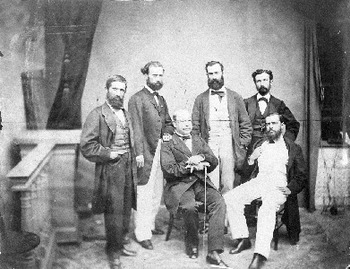
Fig. 1. Portrait of the members of the Scientific Commission to the Pacific. From left, Juan Isern, Fernando Amor, Patricio María Paz y Membiela, Marcos Jiménez de la Espada, Francisco de Paula Martínez y Sáez, and Manuel Almagro. Courtesy Biblioteca General de Humanidades-CSIC.
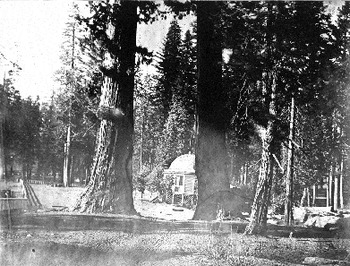
Fig. 2. Photograph of The Guardsmen at the Entrance of the Mammoth Grove by Rafael Castro y Ordóñez. Courtesy Biblioteca General de Humanidades-CSIC.
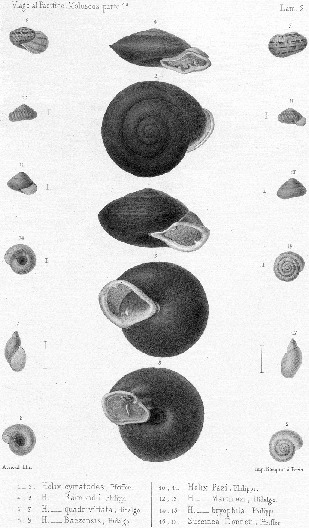
Fig. 3. Mollusks studied by Gonzalez Hidalgo as sketched by the Becquet brothers of Paris. Courtesy Biblioteca General de Humanidades-CSIC.
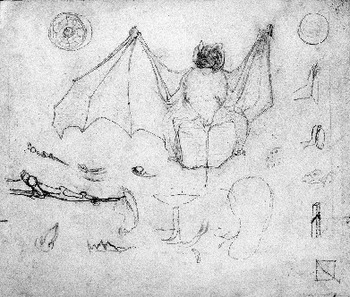
Fig. 4. Sketch of Tyroptera tricololor Spix, studied by Jiménez de la Espada. Courtesy Biblioteca General de Humanidades-CSIC.
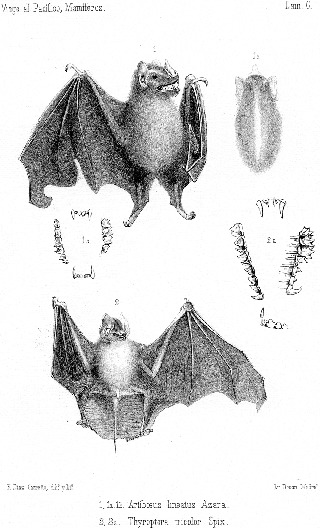
Fig. 5. Illustration of Tyroptera tricololor Spix, studied by Jiménez de la Espada. Courtesy Biblioteca General de Humanidades-CSIC.
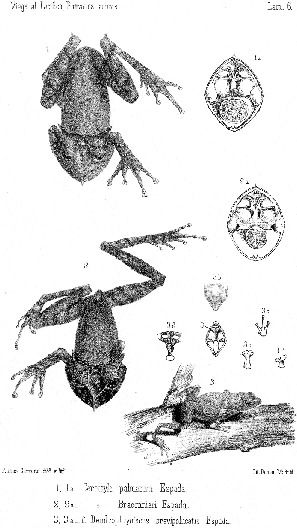
Fig. 6. Herpetological specimens studied by Jimenez de la Espada, as illustrated by Diaz Carreño. Courtesy Biblioteca General de Humanidades-CSIC.
 You have
Access
- 5
- Cited by