Introduction
Since the 1990s, the number of websites has increased extensively, and older adults are one of the fastest growing groups of web users that profit from the wide ranges of internet services to search for information and communicate (Aula Reference Aula2005; Stronge, Rogers and Fisk Reference Stronge, Rogers and Fisk2006; Sum et al. Reference Sum, Mathews, Hughes and Campbell2008). Accessing the Web seems to foster independence and reduce isolation for many older people, to increase communication and wellbeing (e.g. in combating depression), to keep minds active and thereby promote better health (McConatha, McConatha and Dermigny Reference McConatha, McConatha and Dermigny1994) and ability to perform everyday living tasks (Mellor, Firth and Moore Reference Mellor, Firth and Moore2008).
A recent study shows that older people report positive attitudes about the technology devices they use and that in Web activities they are often as enthusiastic as younger people (Zaphiris, Kurniawan and Ghiawadala Reference Zaphiris, Kurniawan and Ghiawadwala2007). This study contradicts the stereotype that older adults are afraid or do not like to use technology (Mitzner et al. Reference Mitzner, Boron, Fausset, Adams, Charness, Czaja, Dijkstra, Fisk, Rogers and Sharit2010). Nevertheless, older adults experience more difficulties than their younger counterparts when using everyday technological devices such as computers (Slegers, Van Boxtel and Jolles Reference Slegers, Van Boxtel and Jolles2009) and learning to use them. Regarding information search tasks, previous studies have shown that older adults are usually less accurate and/or often slower in finding information on the Web than younger adults (e.g. Czaja et al. Reference Czaja, Sharit, Ownby, Roth and Nair2001; Dommes, Chevalier and Lia Reference Dommes, Chevalier and Lia2011; Hanson Reference Hanson2010). More precisely, elderly adult users were shown to have poorer performance when the information search involves visiting numerous hyperlinks and/or web pages before locating the target information (Kubeck, Miller-Albrecht and Murphy Reference Kubeck, Miller-Albrecht and Murphy1999; Mead et al. Reference Mead, Batsakes, Fisk and Mykityshyn1999; Morrell Reference Morrell2005), since they tend to consult fewer links than young adult users (Chin, Fu and Kannampallil Reference Chin, Fu, Kannampallil, Olsen, Arthur, Hinckley, Morris, Hudson and Greenberg2009).
In fact older adults do not always exhibit lower performance than younger people. Chin, Fu and Kannampallil (Reference Chin, Fu, Kannampallil, Olsen, Arthur, Hinckley, Morris, Hudson and Greenberg2009) showed that older adults exhibited poorer search performance than younger adults when search tasks were well-defined (i.e. to locate precise information). In contrast, older adults exhibited better performance than younger adults when they performed ill-defined search tasks (i.e. to gather various information elements to answer a non-precise question). Pak and Price (Reference Pak, Czaja, Sharit, Rogers and Fisk2008) also showed that older adults' performance could be enhanced and age-related differences reduced when they navigated a website in which the relationship between menu and page was many to one, and where information needed was accessible from multiple links, i.e. a website that makes less demand on spatial abilities, but greater demand on vocabulary. But Dommes, Chevalier and Lia (Reference Dommes, Chevalier and Lia2011) recently observed that older adult users experienced difficulties in searching and finding information when search tasks required cognitive flexibility and their high vocabulary did not allow them to overcome declines in flexibility.
Previously published studies therefore concur that age-related differences are particularly exacerbated in search tasks for which fluid cognitive abilities are involved, such as spatial abilities or cognitive flexibility. Older adults are able to adapt their behaviour and decision-making process, but as long as they can because cognitive capacity constrains the repertoire of employable strategies (Mata, Schooler and Rieskamp Reference Mata, Schooler and Rieskamp2007). Amongst fluid abilities, ageing-related declines in working memory have been suggested to influence negatively a large variety of cognitive tasks, such as reading, reasoning and problem-solving (e.g. De Luca et al. Reference De Luca, Wood, Anderson, Buchanan, Proffitt, Mahony and Pantelis2003; Denney, Tozier and Schlotthauer Reference Denney, Tozier and Schlotthauer1992; Zacks, Hasher and Li 2000). Older adults process and store fewer elements in working memory than their younger counterparts (e.g. Chaytor and Schmitter-Edgecombe Reference Chaytor and Schmitter-Edgecombe2004). Beyond this age-related span decline, the way older adults process information in working memory also seems problematic (Hasher and Zachs, Reference Hasher, Zacks and Bower1988). Due to a decline in inhibitory control (for a review, see Hasher, Lustig and Zacks Reference Hasher, Lustig, Zacks, Conway, Jarrold, Kane, Miyake and Towse2007), older adults experience more difficulties in inhibiting irrelevant information elements than younger adults; these irrelevant information elements tend to overload older adults' working memory, and interfere with the task to be performed. More generally, considerable research has shown that age-related variance in performance could be accounted for by a slowing of processing speed (e.g. Myerson et al. Reference Myerson, Hale, Wagstaff, Poon and Smith1990) and impaired executive functioning (Salthouse, Atkinson and Berish Reference Salthouse, Atkinson and Berish2003).
Searching for information can be considered as a complex cognitive activity involving text comprehension, problem-solving and decision-making processes. When searching for information, individuals elaborate a search goal, select a set of information elements and then extract the relevant one(s) (see the models developed for example by Fu and Pirolli Reference Fu and Pirolli2007; Pak and Price Reference Pak, Czaja, Sharit, Rogers and Fisk2008; Sharit et al. Reference Sharit, Hernandez, Czaja and Pirolli2008). The individuals repeat this cycle until they find what they are looking for. During each cycle, individuals have to select the information elements that are the most relevant to their search. If the document found is relevant, individuals deepen their search. If it contains some information elements that are only partially relevant, they need to modify their strategy. If the document is not relevant, individuals have to review their representation of the search goal. To search for and process information, many cognitive resources in working memory are therefore required, mostly when the strategy is unsuccessful or when the website is non-user-friendly. Consequently, the cognitive load may be high, for low performance: the efficiency of performing a task is often directly related to the cognitive resources available.
Previous studies have shown that hypertext information systems (such as internet sites) increase the cognitive load, and so may actually impair learning and/or information search (for a review, see DeStefano and LeFevre Reference DeStefano and LeFevre2007). As the number of nodes in hypertexts is correlated to the decision-making load, the user faced with too many choices may experience difficulties in understanding and retrieving information on the website, especially for older adults who cannot process and remember as many information elements as young adults (Mata and Nunes Reference Mata and Nunes2010).
While individuals visit a website, working memory and long-term memory are actually involved to construct a coherent mental representation of the system, enhancing navigation and performance (Pak et al. Reference Pak, Czaja, Sharit, Rogers and Fisk2008). This construction is facilitated when the architecture of the system is coherent, and fits the users' needs and abilities (Norman Reference Norman1983; Rouse and Morris Reference Rouse and Morris1986; Thuring, Hanneman and Haake Reference Thuring, Hanneman and Haake1995). If the website does not suit the users' abilities, the cognitive load will increase and may cause disorientation in the website navigated, especially for older people suffering from declines in working memory and inhibition processes (which are related to fluid intelligence that declines with ageing, contrary to crystallised intelligence that remains stable or increases with age). Therefore, ageing-related navigation difficulties should be exacerbated when older adults navigate websites composed of many ergonomic violations compared to a website that meets ergonomic guidelines.
For the Web, ergonomics are relevant in both web accessibility and web usability. Web accessibility is the inclusive practice of making websites usable by people of all abilities and disabilities. Web accessibility aims to address visual impairments (e.g. blindness, low visions), motor and dexterity impairments (e.g. difficulty or inability to use hands), auditory impairments (e.g. deafness or hearing impairments) and cognitive abilities (e.g. working memory, attention failures). Some guidelines also concern older people who have specific needs due to their cognitive and motor changes (e.g. guidelines developed by the National Institute on Aging 2001, by Zaphiris, Kurniawan and Ghiawadwala Reference Zaphiris, Kurniawan and Ghiawadwala2007 or by the W3C organisation), but little consensus exists on how to support age-related cognitive declines (Hanson Reference Hanson2010). Web usability is defined by the International Organization for Standardization (ISO 9241-11) as ‘the extent to which a product can be used by specified users to achieve specified goals with effectiveness, efficiency, and satisfaction in a specified context of use’. A system is usable when the end-users can perform tasks and achieve objectives (effectiveness), with a minimum of cognitive resources (efficiency) and when the system is pleasant to use (satisfaction). Usability requires methods for improving ease-of-use during the design process (e.g. Cognitive Walkthrough, heuristic inspection; for more details on usability methods, see Hornbæk Reference Hornbæk2006). Based on these definitions, accessibility is assumed to contribute to website usability. The ergonomic system is often related to friendly systems.
In a study carried out by Hardt and Hollis-Sawyer (Reference Hardt and Hollis-Sawyer2007), older web users were instructed to describe the most important features of a website that promotes continued usage. The participants' comments conveyed the idea that ‘a friendly website was easy to navigate, the information was reliable and up to date, and the text was readable and easy to understand’ (Hardt and Hollis-Sawyer Reference Hardt and Hollis-Sawyer2007: 569). One question we address here was whether these features, underlined by the older web users, also promote performance to find information on a website. More precisely, the present study aimed to examine the impact of age and website ergonomic quality (in terms of usability and accessibility) on information search activity, especially on search performance and quality of the website mental representation built by the participants. This study was complementary to the work of Zaphiris, Kurniawan and Ghiawadwala (Reference Zaphiris, Kurniawan and Ghiawadwala2007) aiming at evaluating the usefulness of web guidelines by older adult users. Zaphiris, Kurniawan and Ghiawadwala (Reference Zaphiris, Kurniawan and Ghiawadwala2007) relied on the subjective points of view of older participants and did not assess the impacts of web guidelines on the actual website use of older adults, as we have done in the research presented in this article.
Based on results from the literature, we hypothesised a poorer performance in older adult users compared to younger adult users, especially finding information on a website that did not fit ergonomic guidelines. In line with the results of Chin, Fu and Kannampallil (Reference Chin, Fu, Kannampallil, Olsen, Arthur, Hinckley, Morris, Hudson and Greenberg2009), older participants should find fewer correct answers than younger participants (Hypothesis 1). Older participants should take longer and make more steps to find information than younger participants (Hypothesis 2). Older participants should involve more cognitive resources to perform the search tasks and so experience a higher cognitive load than younger participants (Hypothesis 3). As a consequence of these navigation difficulties, older participants should be less satisfied, in terms of usability, with the website navigated (Hypothesis 4). Finally, older adults should construct a poorer mental representation of the website visited than younger adults (this should be reflected in the number and the relevance of items recalled by participants) (Hypothesis 5).
This kind of study is essential to (a) replicate and extend previous findings (showing that usability and accessibility errors impede activity of users) in order to identify more precisely the way in which usability and accessibility violations impact on the search activity of older adults compared to younger adults and (b) to determine major usability and accessibility guidelines, such as those developed by the National Institute on Aging (2001) or by Zaphiris, Kurniawan and Ghiawadwala (Reference Zaphiris, Kurniawan and Ghiawadwala2007), for instance, in order to support designers in making websites easier to use, particularly for older adult users. This point is particularly crucial: as indicated by Hanson (Reference Hanson2010: 502), ‘older adults’ views are not the core of design decisions. The result is large numbers of older adults perceiving that current technologies serve no use for them. … As has become apparent, this approach has resulted in a number of older adults being disengaged’.
Method
Participants
Forty participants took part in this study: 20 younger participants (mean=31 years, standard error (SE)=1.8, range 26–34 years) and 20 older participants (mean=64 years, SE=2.3, range 61–67 years). All participants were volunteers, in good health and had normal or corrected-to-normal vision. They had a similar level of education. The younger participants were all working; their jobs were not linked to the internet (e.g. web designers or information seekers). They worked mainly in banking, education, insurance and commerce. The older participants were retired, and like the younger participants, their previous jobs had not been related to the internet; they had worked mainly in banking, insurance and education. All participants were French native speakers. They were not paid. They all signed an informed consent form before participating in the experimental study. All participants were recruited from the social and professional environment of the experimenter.
A questionnaire was used to assess the participants’ internet experience. In line with the study of Stronge, Rogers and Fisk (Reference Stronge, Rogers and Fisk2006), the questionnaire determined the number of years of internet use, the frequency of use, the various activities performed by the participants on the internet (such as checking for e-mails and searching for information; if they used the internet for work, pleasure, studies; how often they used the internet; etc.), and, lastly, their self-assessment of internet use skills.Footnote 1
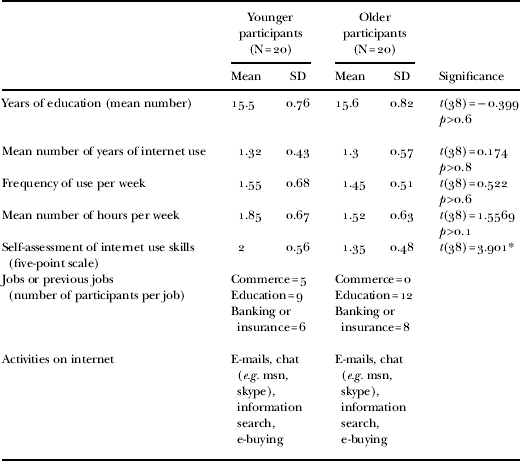
The questionnaire results showed that all participants used the Web occasionally to search for information and check their e-mails, i.e. about once a week, about two hours per week and since about one year ago. Although the younger participants assessed their internet skills higher than the older participants, self-assessment was low in both age groups. Table 1 presents familiarity with the internet and demographic information of the participants.
Socio-demographic information of the participants
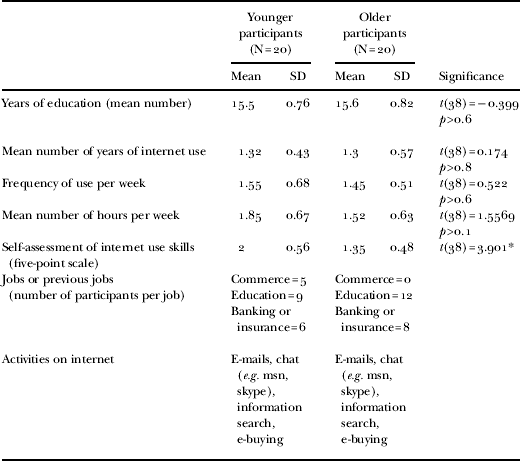
Note: SD: standard deviation.
Significance level:
* p<0.001.
Experimental design
Two versions of the same website were developed, both displaying the same information and presenting an e-shop selling music products.
User-friendly website
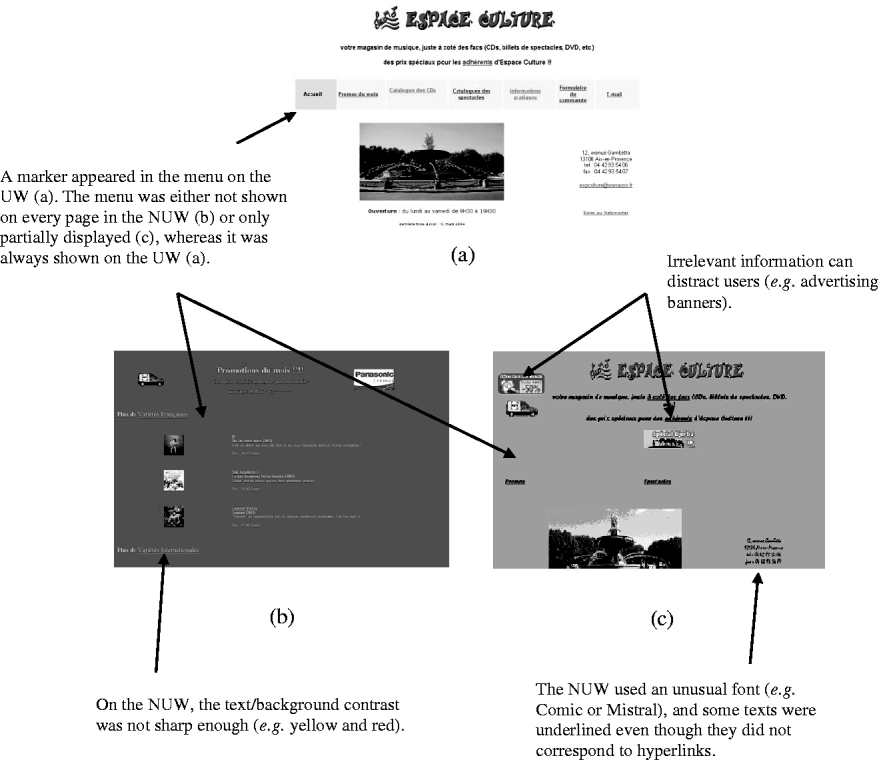
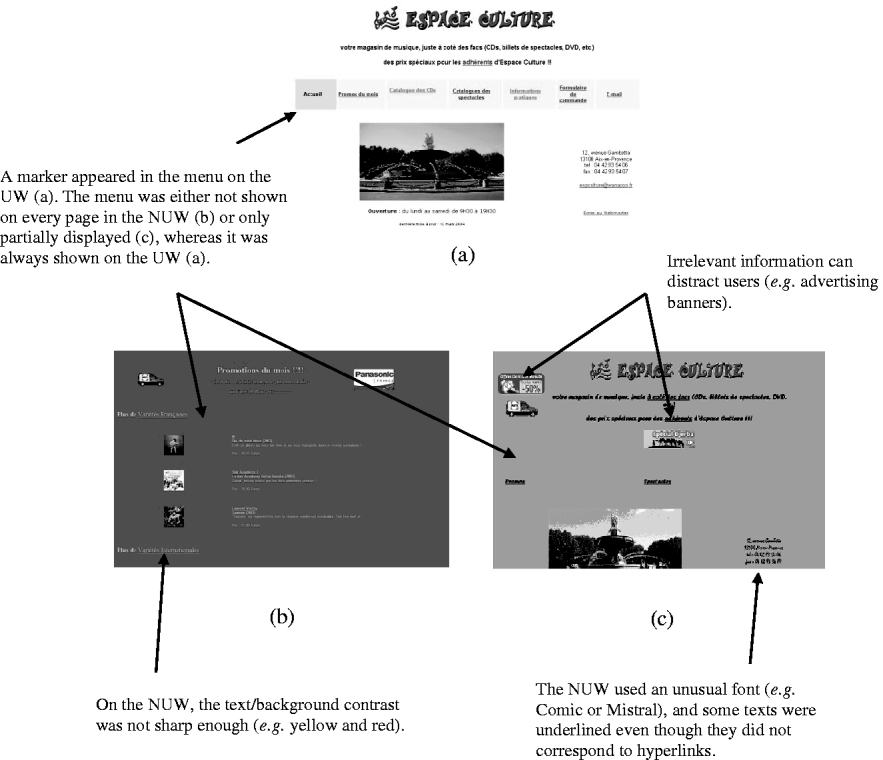
A user-friendly website (referred to as UW; see Figure 1a) was developed that complied with the ergonomic guidelines for web interfaces defined by Bastien, Scapin and Leulier (Reference Bastien, Scapin and Leulier1999) and Nielsen and Loranger (Reference Nielsen and Loranger2006). These guidelines refer to usability and accessibility recommendations. This website was composed of 18 pages, which were hyperlinked so that the participants could navigate the website. To make sure that this website complied with ergonomic guidelines, eight graduate students in cognitive psychology and ergonomics at Paris-Ouest University evaluated it. These students used two techniques. Firstly, the Cognitive Walkthrough and, secondly, an evaluation of its compliance with the ergonomic guidelines. The Cognitive Walkthrough is a usability method, used at the beginning of the design process, which starts with a task analysis that specifies the sequence of steps or actions required by a user to perform a task, and the system responses to those actions (for more details, see Blackmon et al. Reference Blackmon, Polson, Kitajima and Lewis2002). Here, the students used this method to identify possible usability violations in the experimental website. The second method used, the evaluation of compliance with ergonomic guidelines, consists of checking that all pages of the website complied with a grid composed of ergonomic guidelines for the Web (defined by Bastien, Scapin and Leulier Reference Bastien, Scapin and Leulier1999; Nielsen and Loranger Reference Nielsen and Loranger2006). This technique was used after the Cognitive Walkthrough in order to identify precise usability and accessibility violations in the experimental website.
(a) The homepage of the user-friendly website (UW); (b) page dedicated to the catalogue of CDs on the non-user-friendly website (NUW); (c) the homepage of the NUW.
The results obtained from these two techniques for each student were compared and combined to obtain a detailed ergonomic evaluation of the website. This procedure led to a modification of a first version of the website in order to comply with ergonomic guidelines in the user-friendly website.
Non-user-friendly website
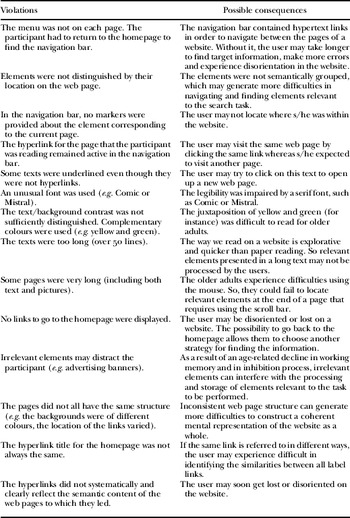
A non-user-friendly website (referred to as NUW, see Figure 1b, c) was developed that included ergonomic violations that designers often introduced in their websites (see Chevalier and Bonnardel Reference Chevalier and Bonnardel2007; Chevalier and Ivory Reference Chevalier and Ivory2003). These violations also countered the recommendation features provided by older users in the study of Hardt and Hollis-Sawyer (Reference Hardt and Hollis-Sawyer2007, see the Introduction). The same eight students evaluated the website in order to identify these violations (from the same grid composed of ergonomic guidelines used for the user-friendly website). This website was also composed of 18 pages, which were hyperlinked so that the participants could navigate the website. Each page included the same number of ergonomic violations, i.e. 14 violations per page (see Table 2 for details on the violations introduced in the NUW, and their possible negative impacts on participants’ activities).
Description of ergonomic (usability and accessibility) violations introduced in the non-user-friendly website and their possible consequences

We chose an e-commerce music website (selling CDs, show tickets, etc.), since these products are bought on-line by many people from younger to older web users, and do not require any specialised or professional knowledge linked to the website content. Our objective was to determine the possible negative impacts of ergonomic violations on the search activity of older and younger web users without manipulating knowledge on the domain of the website, because people often use the internet to look for information for which they have no or very little domain-related knowledge.
Procedure and data collection
The study was divided into two stages.
Stage 1
The participants, using the same computer, were instructed to search for information on the website (UW or NUW) to answer three questions presented in a counterbalanced order. These three questions were well-defined so that precise information had to be found on the website navigated. These questions were the following: (1) ‘What is the main difference between an analogue recording and a digital recording?’; (2) ‘You want to visit the Espace Culture shop. You live near the University of Aix-en-Provence, and you have no car. Which buses do you have to catch?’; (3) ‘Next week is your grandmother's birthday (for younger adult users) / your daughter's birthday (for older adult users). She is particularly fond of classical music. You have decided to buy her a Hector Berlioz CD (featuring Charles Munch and Suzanne Danco Boston). How much do shop members and non-members respectively have to pay for it on the Espace Culture website?’
The participants started each search task from the website homepage. There was only one possible correct answer to each question. The answers to the three questions were provided on three different web pages, and required opening two successive links. To compare the performance on the two websites:
1. The same number of links leading to correct answers were used on both websites, but they were not displayed in the same way since one website complied with the ergonomic guidelines while the other one did not.
2. Two steps were required to find information on each website. The choice of two steps to find the correct answers (that corresponded to the ‘optimal path’), i.e. a priori simple search tasks, aimed to show that a small-size website with ergonomic violations may generate important difficulties.
3. On the non-friendly website, all ergonomic violations were displayed on each web page, so that the participants encountered all ergonomic violations.
The search behaviour of the participants (web pages visited, links opened up, and movements of the mouse) was recorded for analysis by video capture software (River Past Screen Recorder 6.0.5). The dual-task technique was used to measure the cognitive load: while searching for information, the participants were also instructed to react to auditory signals. The experimenter underlined that this task was less important than the information searching. Attention had to be mainly focused on the search questions rather than on the auditory signals.Footnote 2 The idea underlying the dual-task paradigm is that residual capacity (i.e. capacity not being used to perform the main task; here, searching for information) may be used to perform a secondary task. The time taken to answer auditory signals therefore reflects the amount of cognitive resources allocated to the main task. This technique is often used to determine the cognitive load of writers, graphic designers or individuals that search for information (Bonnardel and Piolat Reference Bonnardel and Piolat2003; Chevalier and Kicka Reference Chevalier and Kicka2006; Kellogg Reference Kellogg1987). In the present experiment, the participants were instructed to answer auditory signals generated by the Tholos software (Cegarra and Chevalier Reference Cegarra and Chevalier2008; free software available at http://tholos.psychologie-fr.org) by pressing a pedal with one of their feet (leaving their hands free to search for information). Reaction times (in milliseconds (msec)) to the audible beeps were recorded.Footnote 3 Each participant's baseline reaction time had been measured during a training phase and was subtracted from his/her reaction times recorded during the experimental task (i.e. the information search task). This yielded the calculation of reaction time scores (referred to as RT, in msec). These scores were used as a metric of the participants’ cognitive load: a longer reaction time reflected a higher cognitive load in the main task.Footnote 4
After performing the three information search tasks, participants had to fill in a usability satisfaction questionnaire (inspired by the Web Site Analysis and MeasureMent Inventory (WAMMI) developed by Kirakowski, Claridge and Whitehand Reference Kirakowski, Claridge and Whitehand1998). For each statement, the participants had to indicate the extent to which they agreed with it on a five-point scale, ranging from (1) ‘I completely disagree’ to (5) ‘I completely agree’. Examples of statements are: ‘I was able to control how fast I moved through this website at all times’; ‘The organisation of this website seems to be logical’; ‘These web pages are fun and interesting to explore’; etc. (for more details, see Chevalier and Kicka Reference Chevalier and Kicka2006).
Stage 2
In order to assess the participants’ mental representation of the website they navigated, they performed a free delayed-recall test after answering the three information search questions. However, the participants were not instructed at the beginning of the experiment that their memory would be tested later (the incidental learning paradigm; see Oulasvirta Reference Oulasvirta2004, inspired by Grey Reference Grey1990; Otter and Johnson Reference Otter and Johnson2000). At the end of the information search tasks, the experimenter asked the participants to recall as many of the elements they had seen on the previous web pages as possible, and to write them on a sheet of paper.
Variables and data analysis
Two independent variables were considered as between-subject factors: the age of the participants (younger versus older participants), and the website navigated (user-friendly website UW versus non-user friendly website NUW). Thus, four independent groups were designed: ten older participants navigating the UW; ten older participants navigating the NUW; ten younger participants navigating the UW; and ten younger participants navigating the NUW.
The eight following dependent variables were considered:
1. Number of correct answers. For each participant, a score of three points was computed.
2. Task time. For each search question, the task time was computed from the moment when the participants opened up the homepage to the moment when they found the answer (they said ‘stop’ to the researcher). The mean task time was computed for each participant for the three searches to be performed.
3. The number of steps corresponded to the number of pages visited (or revisited) by a participant to find the information.
4. The cognitive load involved by the participant while searching for information was measured using the dual-task technique and the calculation of a mean reaction time score (RT, in msec).
5. The usability satisfaction of the website visited via a subjective measure from a usability questionnaire. A mean score was computed for each participant for the 17 statements. The more satisfied a participant was, the closer to five the evaluation.
6. The number of elements recalled by the participant in the free and delayed-recall test. The information varied from the title of web pages to background colour.
7. The size of chunks made by the participants. A chunk was identified on the basis of the semantic relationship between the elements recalled together; for instance, the elements successively recalled concerning the contact information (e.g. e-mail, address, opening hours) are all part of the same category, and form one chunk (the ‘contact element’ chunk). The size of the chunks corresponded to the number of elements recalled per chunk.
8. The relevance of the elements recalled: (a) Relevant elements corresponded to information that the participants had to process and understand in order to answer the three search questions. For instance, link labels that allow correct information to be found. (b) Useful elements were linked to the relevant ones; for instance the opening hours of the shop (elements linked to the question about how to get to the shop). (c) Irrelevant elements were elements additional to the necessary ones, such as advertisements or animations, i.e. information unrelated to the search questions.
These dependent variables were submitted to an analysis of variance (ANOVA) with age (younger versus older participants) and website (UW versus NUW) as between-subject factors. Planned comparison analyses were performed to test specific hypotheses. The significance level was set at 0.05 for all statistical analyses. Partial η2 was used as an index of the relative effect size.
The first five variables referred to performance and cognitive effort to answer the three search questions (correct answers, time, step and cognitive load). These variables allowed the usability of the website to be measured. The last three variables measured the quality of the website mental representation elaborated by participants while searching for information; the construction of this mental representation depended, at least partially, on the usability and accessibility of the website navigated.
Results
Information search performance (correct answers, task time, steps and cognitive load)
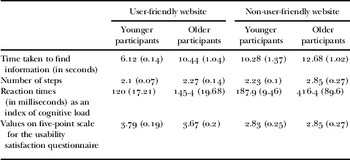
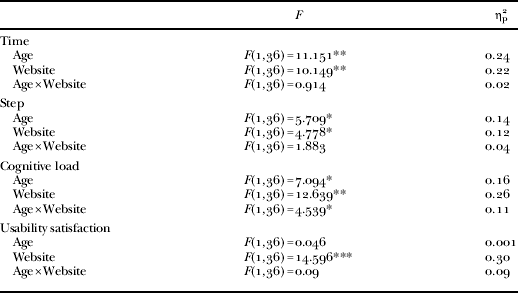
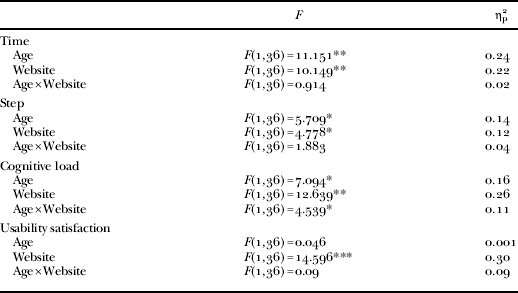
Means, standard errors and results of statistical analyses (except planned comparisons) are presented in Tables 3 and 4. Contrary to hypothesis 1, all participants succeeded in finding the three correct answers and they obtained the maximal score (three points).
Means (and standard errors) of the time taken, number of steps made to find information, cognitive load (per search question) and usability satisfaction according to the age of the participants and the usability of the website

Statistical analyses (analysis of variance) on the effects of Age, Website and Age×Website interaction on the time taken, number of steps made to find information, cognitive load (per search question) and usability satisfaction
Note: ηp2: partial η2.
Significance levels:
* p<0.05,
** p<0.01,
*** p<0.001.
As expected (hypothesis 2), age had a significant effect on the time required: the younger participants took significantly less time to find the target information than the older participants (mean = 8.2 seconds (sec), SE=0.82 and mean=11.56 sec, SE=0.76, respectively). The website visited also had a significant effect: the participants navigating the UW took less time than those navigating the NUW (mean=8.28 sec, SE=0.71 and mean=11.49 sec, SE=0.88, respectively). The Website×Age interaction was not significant. However, and in accordance with our hypothesis, the planned comparison analyses indicated that the younger participants found information more quickly than the older participants when they navigated the UW (F(1,36)=9.226, p<0.005). In contrast, no significant age-related difference appeared when the participants navigated the NUW (F(1,36)=2.839, p>0.1).
As expected (hypothesis 2), the results showed that the younger participants made significantly fewer steps than the older ones: on average, 2.17 (SE=0.06) steps versus 2.56 steps (SE=0.16). Moreover, participants navigating the UW made significantly fewer steps (mean=2.18, SE=0.78) than those navigating the NUW (mean=2.54, SE=0.16). The Website×Age interaction was not significant. However, and as expected, the planned comparison analyses showed that the older participants made significantly more steps than the younger participants when navigating the NUW (F(1,36)=7.073, p<0.05). No significant age-related difference for the UW appeared (F(1,36)<1).
In conformance with hypothesis 3, the RT scores reflecting the cognitive load engaged by the participants while navigating the website increased significantly with ageing: on average, 280.9 msec (SE=55.02) in older participants versus 153.95 msec (SE=12.33) in younger participants. As expected, the UW generated shorter RT scores than the NUW: on average, 132.7 msec (SE=13.05) versus 302.15 msec (SE=51.74). The Website×Age interaction was significant. The planned comparisons showed that the younger participants involved fewer cognitive resources than the older participants when they navigated the NUW (F(1,36)=11.492, p<0.002). No significant age-related difference appeared for the UW (F(1,36)<1).
Usability satisfaction with the two websites
Contrary to hypothesis 4, the effect of age was not significant: on average, 3.31 (SE=0.19) for the younger participants and 3.26 (SE=0.18) for the older participants. The effect of website usability was significant: participants navigating the UW were more satisfied (mean=3.73, SE=0.14) than those navigating the NUW (mean=2.84, SE=0.18). Contrary to hypothesis, the Website ergonomic×Age was not significant (see Tables 3 and 4).
Quality of the website mental representation elaborated by the participants
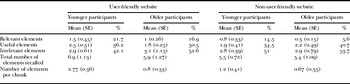
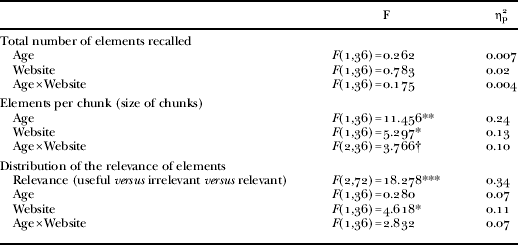
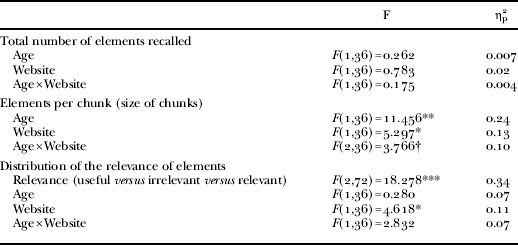
Means, standard errors and statistical analyses (except planned comparisons) are presented in Tables 5 and 6. No significant differences appeared in the total number of elements recalled as a result of the website visited, or the participants’ age. But, as expected (hypothesis 5), age had a significant effect on the organisation of the recalled information elements: the younger participants made larger chunks (mean=1.98, SE=0.32) than the older participants (mean=0.73, SE=0.23). The size of the chunks also differed significantly according to the website: the participants who navigated the UW made larger chunks (mean=1.78, SE=0.33) than those who navigated the NUW (mean=0.93, SE=0.27). The Website×Age interaction fell short of significance. Contrary to our hypothesis, the planned comparisons did not show any significant age-related difference in the NUW (F(1,36)=1.041, p>0.1), whereas a significant age-related difference appeared for the UW (F(1,36)=14.182, p<0.001), with younger participants making larger chunks than the older ones.
The mental representation of the website: relevant, useful and irrelevant elements recalled, total number of elements recalled, and size of the chunks according to the usability of the website and the participants’ age

Note: SE: standard error.
Statistical analyses (analysis of variance) on the effects of Age, Website and Age×Website interaction on the number of elements recalled, the size of chunks and the relevance of elements recalled
Note: ηp2: partial η2.
Significance levels:
† p=0.06,
* p<0.05,
** p<0.01,
*** p<0.001.
The number of elements recalled differed significantly according to their relevance: the participants recalled more useful and irrelevant elements than relevant ones (F(1,36)=32.097, p<0.0001 and F(1,36)=53.805, p<0.0001, respectively). No significant effects of the age of the participants emerged. We observed that the website navigated had a significant effect on this distribution. More precisely, the participants navigating the UW recalled more relevant elements (F(1,36)=7.104, p<0.05) and fewer irrelevant elements (F(1,36)=14.564, p<0.001) than those navigating the NUW. Contrary to hypothesis, no significant differences between the two websites appeared for the useful elements. No significant Age×Website interaction appeared.
Discussion
This study aimed to determine the impact of ageing and ergonomic violations on information search activity. The violations introduced in the website reflected (a) ergonomic violations made by web designers observed in previous studies (Chevalier and Bonnardel Reference Chevalier and Bonnardel2007; Chevalier and Ivory Reference Chevalier and Ivory2003) and (b) important features of favourite websites that older users reported (Hardt and Hollis-Sawyer Reference Hardt and Hollis-Sawyer2007). Overall, the results showed that the non-friendly website (NUW) influenced the search performance as well as the quality of the website mental representation elaborated by the participants; these consequences differed with regard to the participants’ age. The influence of ageing and website ergonomic quality are first discussed with regard to the search performance, and then, to the quality of the mental representation of the website navigated.
Effects of ageing and website ergonomic quality on information search performance
First, contrary to our hypothesis, all older and younger adult participants found the correct answers; no significant differences appeared. But, older and younger participants developed different strategies since the older participants took longer and made more steps (opened up more links) than their younger counterparts to succeed in finding correct answers. The strategy developed by the older participants differed from the one observed by Chin, Fu and Kannampallil (Reference Chin, Fu, Kannampallil, Olsen, Arthur, Hinckley, Morris, Hudson and Greenberg2009). Contrary to the results obtained by Chin, Fu and Kannampallil who observed that older adult users opened up fewer links than their younger counterparts, older participants of our experiment needed to visit and revisit more web pages than the younger participants to succeed in finding the correct information. This discrepancy seems to be due to the search tasks to be performed. In our experiment, all search tasks could be solved in two steps within a precise website, whereas participants in the study of Chin, Fu and Kannampallil (Reference Chin, Fu, Kannampallil, Olsen, Arthur, Hinckley, Morris, Hudson and Greenberg2009) had to search for information in a hierarchical interface where all categories and subcategories were displayed on the interface.
The age-related differences we observed in the present study were in line with the results obtained by Kubeck, Miller-Albrecht and Murphy (Reference Kubeck, Miller-Albrecht and Murphy1999) showing that older and younger users had close performance when the information search task required two or fewer steps. The results also corroborated the age-related difficulties reported in many previous studies (e.g. Aula Reference Aula2005; Czaja et al. Reference Czaja, Sharit, Ownby, Roth and Nair2001; Stronge, Rogers and Fisk Reference Stronge, Rogers and Fisk2006; Wagner, Hassanein and Head Reference Wagner, Hassanein and Head2010). Older adults often took longer to find information on the Web than their younger counterparts whilst obtaining a similar performance as younger adults, i.e. older participants did not make more errors than younger participants (Kurniawan, Ellis and Zapharis Reference Kurniawan, Ellis and Zaphiris2002). Consequently, older adults may have forgotten information, such as web pages they already visited, the elements shown on the web pages they navigated, and ultimately the goal of their information search tasks. Older adults might have had to retrace their steps more often than younger ones, clicked on more links and taken longer to find the correct information. In line with the results of Rouet et al. (Reference Rouet, Ros, Jégou and Metta2004), the navigation activity of the older participants may also reflect difficulties in assessing the relevance of the information presented in the current web page with regard to the goal to be reached, as well as difficulties in managing a set of sub-goals to perform the task. Factual or well-defined search tasks, such as the ones we used in the present study, actually involved analytical search strategies (Kim Reference Kim2009; Navarro-Prieto, Scaife and Rogers Reference Navarro-Prieto, Scaife and Rogers1999), which required important cognitive resources and executive functioning known to be reduced with ageing. As pointed out by Mata and Nunes (Reference Mata and Nunes2010), older adults’ lack of cognitive resources impedes them in processing all the information and therefore forces them to consider fewer elements before making a decision.
Our results also showed that the website ergonomic quality had beneficial effects on performance: the participants navigating the user-friendly website (UW) took less time, made fewer steps and involved fewer cognitive resources than the participants navigating the website incorporating ergonomic violations (the NUW). The poor ergonomics of the website visited had more negative impacts on the search performance obtained by the older participants than their younger counterparts. During the information search activity in the NUW, additional working memory resources were allocated to process irrelevant information elements displayed in the NUW, such as visual characteristics (e.g. colour, form or size) that distracted the participants’ attention (Anderson, Matessa and Lebiere Reference Anderson, Matessa, Lebiere, Anderson and Lebiere1998; Hong, Thong and Tam Reference Hong, Thong and Tam2004; Ling and van Schaik Reference Ling and van Schaik2006; Wickens and Hollands Reference Wickens and Hollands2000). This was particularly exacerbated for older adults. Although the younger participants were not faster than the older ones in performing the search tasks on the NUW, the younger participants found target information more efficiently since they involved fewer cognitive resources, and took fewer steps than the older participants. These findings show that the most important features of favourite websites that older adults reported in the study of Hardt and Hollis-Sawyer (Reference Hardt and Hollis-Sawyer2007), such as navigation easiness, readable and understandable contents, promote their performance while searching for information, reduce age-related differences and benefit older but also younger adult web users.
Beyond these interpretations, at least two other more general explanations can be suggested to account for the difficulties experienced by the older participants navigating the NUW. Firstly, because of a decline in inhibitory processes and more generally in executive functions (Salthouse, Atkinson and Berish Reference Salthouse, Atkinson and Berish2003), older participants might experience more difficulties than younger participants in suppressing irrelevant and distracting elements, and so in focusing attention on the information search task. This finding is in line with studies involving older adults performing visual search tasks (e.g. Plude and Hoyer Reference Plude and Hoyer1981; Scialfa and Joffe Reference Scialfa and Joffe1998; Whiting, Madden and Babcock Reference Whiting, Madden and Babcock2007). Secondly, given that older adults may lack cognitive resources to process all information elements (Mata and Nunes Reference Mata and Nunes2010) and the generalised age-related slowing of mental operations (Myerson et al. Reference Myerson, Hale, Wagstaff, Poon and Smith1990), the processing of the irrelevant elements displayed on the NUW may have overloaded their working memory capacities and required longer time and more steps to find the answer. To test these hypotheses, it would be interesting to carry out a new experiment in which the participants perform cognitive ability tests to measure ageing-related declines in cognitive abilities and their possible relationships with search performance.
The results obtained with the usability satisfaction questionnaire corroborated these results but only concerning website-related differences, since no significant age-related differences appeared. This non-significant age-related difference can be related to the findings obtained by Mitzner et al. (Reference Mitzner, Boron, Fausset, Adams, Charness, Czaja, Dijkstra, Fisk, Rogers and Sharit2010) showing that, contrary to the stereotype about ageing and technology, elderly users have more positive attitudes about technology than negative ones. Moreover, both older and younger adult users can usually navigate non-user-friendly websites and consequently had acquired strategies to adapt their search behaviours. These can, at least partially, also explain why older adults were not more critical about the two websites, especially the non-friendly website, than younger adults.
Effects of website ergonomic quality and ageing on the quality of the website mental representation (via information elements recalled)
If ageing seemed to have no negative impacts on the relevance of elements recalled by the participants, the poor website ergonomic quality had. Regardless of their age, the participants recalled fewer relevant elements after navigating the NUW than the UW, and they also made smaller chunks. This finding can be due to the different strategies developed by the participants while searching for information in the two websites: the participants took longer, made more steps and involved more cognitive resources to find the information in the NUW than in the UW. As the participants navigating the NUW processed and memorised irrelevant information, they recalled fewer relevant elements and in a badly organised way. The website that complied with the ergonomic guidelines seems to allow participants to construct a more complete, accurate and well-organised mental representation of the website navigated.
Concerning the mental representation of the website navigated, ageing affected only the size of the chunks made, with smaller chunks for the older participants than the younger ones. This finding may reflect age-related general declines in memory and cognitive resources. Indeed, Sloutsky (Reference Sloutsky2003) suggested, with regard to cognitive resources, that it is more efficient to incorporate a potentially infinite number of individual objects into a smaller number of categories. And, categorising requires making inferences in order to identify similarities between elements, which require in-depth processing of information elements. This process is indeed affected by ageing (Denney and Lennon, Reference Denney and Lennon1972; Kogan, Reference Kogan1974; and for performance on the Wechsler Similarities Test from the WAIS-III, see Rozencwajg and Bertoux Reference Rozencwajg and Bertoux2008) in such a way that older adults experience difficulties in categorising information elements because additional cognitive resources are needed. For our research, these required resources may have already been involved in performing the information search tasks and in processing superficial and irrelevant information presented in the NUW (such as the colour of the website, the ornamental pictures, etc.). As a consequence, they did not have enough available cognitive resources to process specific and relevant elements for their information search. To deepen this possible explanation, it would be relevant to submit the older adults to cognitive ability tests related to the performance exhibited by the participants as well as the information elements recalled.
Conclusion: implications and future ways of research
The ergonomic violations we used in the experiment countered the favourite recommendation features provided by older users (Hardt and Hollis-Sawyer Reference Hardt and Hollis-Sawyer2007) and corresponded to violations often made by professional web designers. Web designers are usually young people, who build these systems taking into account their own culture and skills (e.g. Hanson Reference Hanson2010), which may differ from those of older people. As far as we are aware, this is the first study based on this approach, which makes it possible to determine the impact of the ergonomic violations that are actually introduced by professional web designers on the information search activity performed by older and younger adult users.
The mental representation of the website navigated is crucial: if users retain very little trace in memory, or if their mental representation of the website navigated is poor and/or inaccurate, they will not revisit this website later (Nielsen Reference Nielsen2002).
Based on our findings, we can recommend that web designers allocate special attention to four points:
1. To display and underline relevant and salient information by using bold characters or specific colours (except blue that generally corresponds to link colour).
2. To guide and support older users in their navigation with devices devoted to help them in choosing relevant elements to be processed and the way to be followed. A major feature to facilitate navigation could be to always display a menu allowing users to select the next page to be visited, i.e. designing websites that place more demand on vocabulary knowledge or more generally on crystallised intelligence than on fluid intelligence (see also Pak and Price Reference Pak and Price2008).
3. To provide markers, in the menu, about the element corresponding to the current page visited.
4. To reduce the number of information elements displayed on the interface, especially superficial ones.
Complying with these four recommendations would reduce the involvement of spatial abilities, working memory, and more generally cognitive resources and executive functions known to decline with ageing. Moreover, these recommendations have been assessed as the major ones by the older adults who participated in the study of Zaphiris, Kurniawan and Ghiawadala (Reference Zaphiris, Kurniawan and Ghiawadwala2007).
Although this study brings interesting results concerning the impact of ergonomic violations on search performance and website mental representation, these results need to be expanded. To this end, it would be interesting to involve groups of younger and older users more advanced in internet use in order to determine the actual impact of ergonomic violations (and their related guidelines) on their search activity. In this way, determining how older individuals can compensate for cognitive losses by relying on knowledge accumulated from years of experience could be studied. It would also be interesting to deepen more precisely ergonomic violations that generate the greatest difficulties for navigating the Web in order to attract web designers' attention to the most relevant ergonomic guidelines so that websites become easier to use for older people.
A better understanding of older adult users is essential in order to make websites easier to use. Indeed, as indicated in the Introduction, using the Web allows, for instance, older people to enhance their ability to perform everyday tasks or to communicate with family, friends and more recently with medical professionals if required for their health. To this end, websites, and more generally interface systems, must meet adult users' needs if they are to be used in an efficient way. Unfortunately, many websites specialised in health information and services for older people are still difficult to navigate because of ergonomic violations (e.g. Becker Reference Becker2005; Zaphiris, Kurniawan and Ghiawadala Reference Zaphiris, Kurniawan and Ghiawadwala2007).