An increasing amount of literature from around the world shows that central line–associated bloodstream infections (CLABSI) are a burden in developed and developing countries alike, increasing length of stay, hospital costs, morbidity, and mortality.Reference Allegranzi, Bagheri Nejad and Combescure 1 – 7 A recent meta-analysis by the World Health Organization estimated the incidence of CLABSI, a leading cause of healthcare-acquired infections among adult intensive care unit (ICU) patients, to be 12.2 infections per 1,000 central line–days. 7 This rate is 2- to 3-fold higher than rates reported among ICUs in Western countries and associated with a crude excess mortality between 14.7% to 23.6%.Reference Rosenthal, Bijie and Maki 6 , Reference Rosenthal, Maki and Jamulitrat 8 Despite growing awareness, many hospitals around the world continue to struggle in their efforts to meaningfully reduce their CLABSI rates in a sustained manner.
Examples of success towards mitigating medical harm are scarce, with most coming from the Western world. Some of the most promising efforts to reduce CLABSIs come from the field of patient safety. One notable example is the Keystone ICU Project, a cohort collaborative improvement project that used a multifaceted intervention involving a checklist of evidence-based practices to prevent CLABSI, a comprehensive safety program to address culture change, and performance feedback.Reference Pronovost, Berenholtz and Goeschel 9 This project demonstrated a 66% reduction in CLABSIs across 103 Michigan ICUs,Reference Pronovost, Needham and Berenholtz 10 sustained results for more than 3 years,Reference Pronovost, Goeschel and Colantuoni 11 and was associated with significant decreases in mortality and costs,Reference Lipitz-Snyderman, Steinwachs, Needham, Colantuoni, Morlock and Pronovost 12 , Reference Waters, Korn and Colantuoni 13 and improvements in safety climate.Reference Sexton, Berenholtz and Goeschel 14
The Keystone Project’s success prompted spread of the multifaceted CLABSI prevention program to more than 1,000 ICUs in 45 states in the United States, and internationally in the United Kingdom and Spain in partnership with the World Health Organization.Reference Berenholtz, Lubomski and Weeks 15 – Reference Palomar, Alvarez-Lerma and Riera 17 Nevertheless, this approach has not been rigorously implemented and evaluated in other international settings, including the Middle East. We sought to determine whether the multifaceted intervention could be implemented in hospitals in the Emirate of Abu Dhabi and significantly reduce the incidence of CLABSIs. This article describes the implementation of this program in ICUs between 2012 and 2014 and the impact on CLABSI rates.
METHODS
Program Organization
This prospective cohort collaborative program was jointly led by 3 entities. The Abu Dhabi Health Services Company (SEHA), which operates the government healthcare system in the Emirate of Abu Dhabi, coordinated and disseminated program content, monitored hospitals during study implementation, and managed the repository of data. The Johns Hopkins Medicine Armstrong Institute for Patient Safety and Quality (Armstrong Institute) provided program content and implementation expertise, and conducted educational sessions. Johns Hopkins Medicine International, the global arm of Johns Hopkins Medicine, provided operational and coordination support between SEHA and the Armstrong Institute. Project coordination calls were held every 2 weeks among the entity leads to facilitate implementation and evaluation of the program.
All ICUs in SEHA hospitals across Abu Dhabi were invited to participate in this study. Hospitals were not compensated for their participation. Participating ICUs were instructed to assemble a unit-based multidisciplinary safety team (called CUSP teams) comprising of local physician and nursing leaders, a senior executive, frontline healthcare providers (physicians, nurses, and ancillary staff), an infection control provider, and hospital quality and safety leaders. Starting in May 2012, the SEHA corporate quality team and newly created ICU CUSP teams jointly attended 14 weekly live webinars to learn about the program, followed by content and coaching webinars every 2 weeks for 24 months. Content calls provided an overview of the CLABSI prevention intervention and patient safety methods and principles. The coaching calls were a venue for ICU CUSP teams to share information about barriers and successes in implementing the work, and to encourage peer-to-peer mentoring between teams at all participating hospitals. All the live webinars were conducted by the Armstrong Institute team and were recorded and posted by SEHA on a local shared drive along with other supporting educational and training materials.
In addition, the Armstrong Institute team of clinicians and patient safety researchers with content and implementation expertise conducted 4 site visits in Abu Dhabi. During the first visit in April 2012, team members visited each ICU to meet the CUSP team and tour the unit to develop an understanding of the local infrastructure and workplace environment. The Armstrong Institute team prepared a baseline assessment report for each unit and SEHA leadership, describing existing strengths that were observed and opportunities to implement best practices. The second site visit in May 2013 included a 3-day Patient Safety Workshop, which involved a 1-day session for SEHA senior leadership, emphasizing the importance of leadership engagement, followed by a 2-day workshop for the CUSP teams, to help consolidate previously taught principles and share teams’ experiences with study implementation. During the third site visit in October 2013, each ICU was visited again to provide additional education and insights specifically related to methods and strategies for developing a culture of safety. The final site visit in January 2014 involved a Patient Safety Workshop that focused on sustaining improvements and celebrating the hard work, dedication, and achievements of the various ICU CUSP teams.
Program Goals and Interventions
The goals of the program were to significantly decrease the CLABSI burden and to achieve a unit-level mean CLABSI rate of less than 1 infection per 1,000 catheter-days. The CUSP teams implemented 3 interventions as part of the program; details of each have been published previously. One was the multifaceted intervention to prevent CLABSI that targeted clinicians’ use of evidence-based infection prevention recommendations from the Centers for Disease Control and Prevention, tools to identify local barriers to these practices, and ideas for implementation to ensure patients received these practices.Reference Pronovost, Needham and Berenholtz 10 , Reference Pronovost, Goeschel and Colantuoni 11 , Reference Berenholtz, Lubomski and Weeks 15 , Reference Mermel 18 – Reference Gurses, Murphy, Martinez, Berenholtz and Pronovost 20 Another intervention was the comprehensive unit-based safety program (CUSP), consisting of a 5-step iterative and validated process intended to improve safety culture and teamwork.Reference Sexton, Berenholtz and Goeschel 14 , 21 The third intervention was the measurement and feedback of monthly CLABSI data to safety teams, senior leaders, and staff in the ICUs.Reference Barron, Krsek, Weber and Cerese 22 , Reference Lubomski, Marsteller, Hsu, Goeschel, Holzmueller and Pronovost 23
Data Collection and Outcome Measure
Existing hospital infection control teams collected data on the number of CLABSI and catheter-days using the Centers for Disease Control and Prevention National Healthcare Safety Network definitions. Data were submitted monthly to the central database maintained by SEHA. No patient-level data were collected. For reporting purposes, monthly CLABSI data were aggregated into 3-month quarters to minimize nonsignificant variability. The quarterly CLABSI rate was reported as the number of infections per 1,000 catheter-days. Each quarterly rate was assigned to either the baseline (up to 12 months before implementation, June 2011 through May 2012) or postimplementation (up to 21 months after starting the multifaceted intervention, June 2012 through Feb 2014) period.
Statistical Analysis
Our analyses are based on data drawn from the SEHA database obtained on May 14, 2014. Our analysis included descriptive statistics for the baseline and postintervention periods, including number of central line infections, number of catheter-days, and weighted average of CLABSI rates per 1,000 catheter-days. To explore the relationship between time since implementation of the multifaceted intervention and CLABSI rates, we used a mixed-effects Poisson regression model for the quarterly number of CLABSIs to report incidence rate ratios. We adjusted for random effects at the hospital and ICU level. Reported confidence intervals for incidence rate ratios were 2-sided. A confidence interval that fell completely below 1 or a P<.05 was considered significant. We used Stata, version 12 (StataCorp), statistical software for all analyses. The Johns Hopkins University School of Medicine Institutional Review Board (IRB NA_00089498) and SEHA Institutional Review Board (IRB No. 14/26 (CRD 322/14) approved this research.
RESULTS
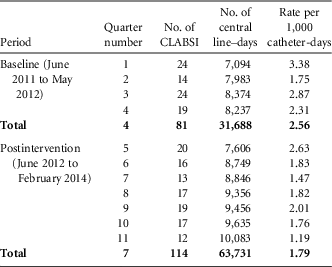
A total of 18 ICUs, representing all 7 secondary and tertiary care hospitals with intensive care facilities under SEHA management, participated in this collaborative study. Coronary care units were considered monitored beds rather than intensive care beds by the local collaborators and therefore did not participate. The participating ICUs included 10 adult, 5 neonatal, and 3 pediatric ICUs accounting for 77% of the adult, 74% of the neonatal, and 100% of the pediatric ICU beds in the Emirate of Abu Dhabi. A breakdown of the ICU bed numbers and types is given in Table 1. Our analysis included 583 ICU-months (205 baseline, 378 postintervention) and 95,419 catheter-days (31,688 baseline, 63,731 postintervention) of data (Table 2). Of the 18 participating ICUs, 15 reported an entire 12 months of baseline data, 1 reported 11 months, 1 reported 9 months, and 1 reported 5 months. All 18 participating ICUs reported 21 months of postintervention data. Overall, 5.1% of data months were missing from the baseline period whereas none were missing from the postimplementation period. The percentage of ICUs that achieved a quarterly CLABSI rate of less than 1 infection per 1,000 catheter-days increased from a low of 44% in the baseline period to a high of 61% in the postintervention period, a relative increase of 39%.
Intensive Care Unit (ICU) Bed Capacity in Emirate of Abu Dhabi

NOTE. SEHA, Abu Dhabi Health Services Company.
Data Related to Central Line–Associated Bloodstream Infection (CLABSI) by Period of Participation

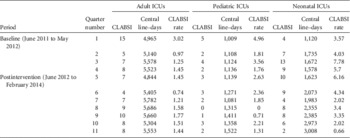
The overall mean crude CLABSI rate for ICUs across the cohort decreased from 2.56 infections per 1,000 catheter-days at baseline to 1.79 per 1,000 catheter-days by the end of the postintervention period (Table 2; Figure 1). This corresponded to a 30% crude reduction in the overall mean crude CLABSI rate across all ICUs in the cohort. By unit type, CLABSI rates decreased by 16% for adult ICUs, 48% for pediatric ICUs, and 47% across all weight categories for neonatal ICUs over the study period (Table 3).
Aggregated central line–associated bloodstream infection rate for all study intensive care units from baseline through 21 months of follow-up. Lines illustrate the mean rate of central line–associated bloodstream infections for 18 intensive care units representing 7 secondary and tertiary care hospitals across the Emirate of Abu Dhabi for June 2011 through February 2014. Dashed vertical line represents the start of the multifaceted intervention.

Data Related to Central Line–Associated Bloodstream Infection (CLABSI) by Intensive Care Unit (ICU) Type and Period

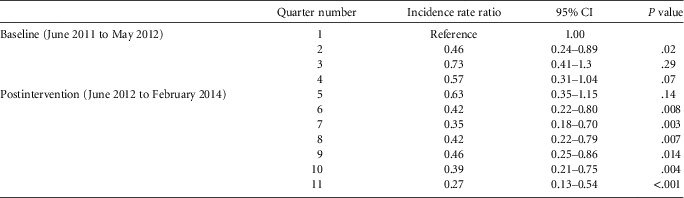
The multilevel Poisson regression model demonstrated a statistically significant decrease in the overall CLABSI rate, with the incidence rate ratio decreasing to 0.62 (95% CI, 0.46–0.83) when comparing the aggregated 21-month postintervention period to the aggregated 12-month baseline period. Compared with the first quarter of the baseline period, incidence rate ratios ranged from 0.73 in the third quarter of the baseline period to 0.27 in the seventh quarter of the postintervention period (Table 4).
Central Line–Associated Bloodstream Infection Rate Incidence Rate Ratios Based on Poisson Regression

NOTE. Multilevel random-effects Poisson regression adjusted at the hospital and intensive care unit levels.
DISCUSSION
This collaborative effort sought to determine whether a multifaceted program proven effective in reducing CLABSI rates in the United States could be implemented across the Abu Dhabi SEHA hospital system and achieve similar results in a variety of ICUs. Eighteen ICUs from 7 SEHA hospitals in Abu Dhabi implemented the program and achieved an overall 38% reduction in their CLABSI rate. The number of units with a quarterly CLABSI rate of less than 1 infection per 1,000 catheter-days increased by almost 40% during the postintervention period.
There is a large body of literature discussing the burden of CLABSI in critically ill patients around the world. In its recent Patient Safety Programme, the World Health Organization World Alliance for Patient Safety listed 13 Action Areas, which included developing and testing measurement tools to understand the nature of patient harm, eliminating CLABSI, and establishing international coordination to ensure delivery of solutions. 24 Such attention to patient safety and quality is making prevention of hospital-acquired infection, including CLABSI, a global priority. Our program was in line with the World Health Organization program and helps answer their call to action. We used a multifaceted intervention focused on evidence-based infection prevention practices, safety culture and teamwork, and measurement and feedback of infection rates, resulting in significantly decreased occurrence of CLABSIs. Moreover, our project extends the principles learned from prior experiences in the United States, Spain, and England and suggests that a similar approach to reduce CLABSI rates can be effective in the Middle East as well.
The baseline CLABSI rate for participating Abu Dhabi ICUs (2.56 infections per 1,000 catheter-days) compares favorably with national project baseline rates reported in the United States (1.96),Reference Berenholtz, Lubomski and Weeks 15 Spain (4.27),Reference Bion, Richardson and Hibbert 16 and England (4.4).Reference Palomar, Alvarez-Lerma and Riera 17 This rate was significantly lower than independently reported rates ranging from 5.2 to 22.7 from other international settings like Lebanon, India, Egypt, and Turkey, and lower than the aggregate rate of 6.8 infections per 1,000 catheter-days reported by the International Nosocomial Infection Control Consortium.Reference Rosenthal, Bijie and Maki 6 , Reference Kanj, Kanafani, Sidani, Alamuddin, Zahreddine and Rosenthal 25 – Reference Leblebicioglu, Ozturk and Rosenthal 28 Nevertheless, Abu Dhabi’s baseline rate was almost 2.5 times higher than the mean US rate of 1.1 infections per 1,000 catheter-days for 2010, as determined by the National Healthcare Safety Network.Reference Dudeck, Horan and Peterson 29 The overall 38% reduction seen in our cohort was smaller than that of the Keystone Project and other US efforts,Reference Berenholtz, Lubomski and Weeks 15 , Reference Pronovost, Needham and Berenholtz 30 but it was significant and likely reflects a lower baseline rate compared with the US studies as well as the relatively short postintervention period.
Hospitals and healthcare systems in Abu Dhabi, and the Middle East in general, have unique barriers to implementing quality improvement programs.Reference Sankaranarayanan, Matarelli, Parkar and Abu Haltem 31 , Reference Sankaranarayanan 32 An initial assessment was performed to identify opportunities to help tailor the intervention to local needs, resources, and existing culture. Our findings were consistent with other published literature, including a multicultural and multilingual environment, staff fearful of punitive repercussions if they “speak up” regarding concerns about patient safety, challenges with staff recruitment and retention, and challenges with throughput due to lack of floor beds, long-term ventilator facilities, or other “out of hospital” support services. Although the project leads were not able to provide additional resources to address the infrastructure or capacity concerns, other barriers were discussed at length during face-to-face meetings with CUSP teams, local leaders, and SEHA leadership. Bringing various stakeholders to the same table allowed everyone to share their concerns and ensure their voices were heard.
In addition, SEHA leadership provided ongoing support in several ways to address local barriers. First, leadership established and shared a commitment to a system level goal of “zero CLABSI.” Second, SEHA updated the requirements for infection preventionists from the existing generic specialist nurses to be in alignment with international standards, empowering existing staff and facilitating recruitment. Third, they convened a new CLABSI taskforce composed of members of the ICU CUSP teams and developed a SEHA CLABSI Prevention Policy across their hospitals, including a standardized insertion and maintenance checklist. Fourth, SEHA provided support to ensure that central line trolleys were created in all units, with appropriate supplies being available (eg, full body drapes, improved transparent dressings). Finally, members of the program team provided quarterly presentations to hospital executives and the SEHA Board regarding progress towards reducing CLABSIs, emphasizing the engagement of senior management.
Given the multifaceted nature of the intervention, it is often not possible to untangle the unique, independent effects of each component.Reference Mauger Rothenberg, Marbella, Pines, Chopra, Black and Aronson 33 Interviews and discussions with participating team members conducted during site visits and throughout the course of implementation suggest several factors likely to have influenced program effectiveness. First, the program differentiated between evidence-based practices and the interventions to implement those practices, standardizing the former and encouraging local modification of the latter. Second, the program combined a conceptual model to translate evidence into practice with a program that focused on improving local culture and educating staff about safety and how to recognize and prevent patient harm, prompted staff to learn from mistakes, and involved senior leaders to support staff directly in local improvement efforts. 21 , Reference Pronovost, Berenholtz and Needham 34 Third, the program was structured as a clinical community of ICUs, creating a common goal of eliminating CLABSIs amongst frontline healthcare providers rather than an external regulatory pressure to change behavior.Reference Dixon-Woods, Bosk, Aveling, Goeschel and Pronovost 35 In several hospitals, it was evident that local improvements were being driven through the emergence of physician and nursing “champions” who demonstrated leadership and strong commitment to the program to ensure engagement of the ICU teams.
Our study has several limitations. First, we did not use a randomized design and did not have a concurrent control group. Consequently, we cannot establish a causal relationship or evaluate the independent impact of the program on CLABSI rate reductions. In addition, 1 hospital had prior experience implementing CUSP for quality improvement initiatives, and several hospitals were already working on their own CLABSI reduction efforts prior to joining the program.Reference Sankaranarayanan, Matarelli, Parkar and Abu Haltem 31 As such, our results may be influenced by temporal changes in CLABSI rates, patient population, or other interventions. Nevertheless, we are not aware of any other regional CLABSI prevention interventions during the same period. Second, we lacked sufficient resources to collect compliance data on CLABSI prevention practices or on contextual factors that may have affected our outcomes. Such evaluations would be informative and likely advance the science of quality improvement and our understanding of why the program worked. Third, we did not have resources to validate CLABSI surveillance data and as a result, social pressure to improve may have biased our results. This risk should have been minimized by use of the preexisting infrastructure where trained hospital-based infection preventionists reported CLABSI data to SEHA.
Despite these limitations, this study has important implications for future work in the Middle East and global reductions in CLABSI rates. In this collaborative, a program that was associated with reductions in CLABSIs in ICUs across the United States, Spain, and England was successfully implemented across 7 Abu Dhabi hospitals in the SEHA hospital system and was associated with significant reductions in these infections. In this diverse cohort of 18 ICUs, the CLABSI rate decreased and the number of ICUs with a quarterly CLABSI rate of less than 1 infection per 1,000 catheter-days increased over time. These results suggest that ICUs in disparate settings across the world could use this program and achieve similar results, significantly reducing the global morbidity, mortality, and excess costs associated with CLABSI. This collaborative could also serve as a model for future efforts to broadly reduce other types of preventable harm in the Middle East.
Acknowledgments
We thank all members of the SEHA hospitals’ ICU CUSP teams for their participation in this project and their ongoing work to eliminate CLABSI.
Financial support. Abu Dhabi Health Services Company (agreement number SEHA/01/2012) through contractual arrangements with Johns Hopkins Medicine International and Johns Hopkins University, for and on behalf of the Armstrong Institute for Patient Safety and Quality.
Potential conflicts of interest. All authors report no conflicts of interest relevant to this article.
Manuscript preparation. We thank Christine Holzmueller for her assistance in editing this article.