Introduction
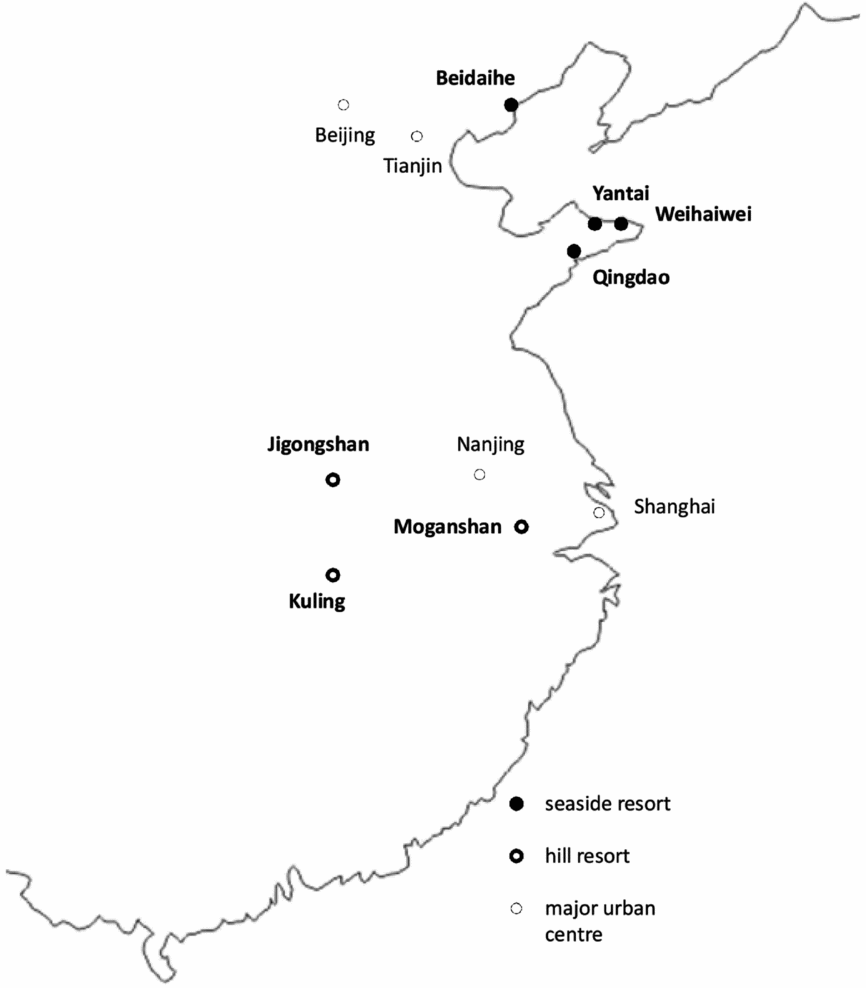
A network of seaside and hill resorts created by foreigners gradually took shape in China during the late Qing and Republican periods. Such places were both a touristic novelty in China and the focal point of a type of tourist experience that was modern in a variety of ways. The establishment of these resorts was closely linked to the different rights that foreigners gained to take up residence from 1842 and to travel around the country from 1860. It was the wish of many who lived in the treaty ports or outside them to journey to destinations at the seaside and on the hills for leisure, and visiting such places was to become a consolidated practice. By 1866, some foreigners were already spending their summer months at the Western Hills near Beijing,Footnote 1 following in the footsteps of local tourists who, for centuries, had made them a leisure destination. The existence of foreign settlements was to facilitate the formation of a new, specialized tourist space. Yantai, opened in 1861 as a treaty port, became an established seaside resort used by foreigners in the 1870s,Footnote 2 and, from the turn of the century, the 1898 concessions of Qingdao and Weihaiwei attracted a steady flow of foreign visitors in quest of the sea. Eventually, foreigners were also to build their own microcosms of leisure in places where they initially lacked a network of foreign support. This was to be the case with Kuling, located on the hill of Lushan, which was already attracting the attention of foreign residents by 1867, and where, after numerous unfruitful attempts to purchase land, they were finally allowed to do so in 1895. This authorization was a volte-face that missionary founder John Archibald (who wrote about the process of the resort's foundation years later) was to explain by the fact that ‘China just then was at the close of her struggle with Japan, and feeling sadly the need of friends’.Footnote 3 Other settlements were to be established by missionaries, again through the private acquisition of property, and become visitor destinations. This was what happened with mountainous Moganshan and Jigongshan, founded in 1896 and 1903 respectively, and with coastal Beidaihe, set up in 1896. While these resorts, not based on treaty, were initially set up by missionaries, they were soon to attract others too. In its early years Beidaihe, for instance, soon became a magnet for foreign merchants,Footnote 4 so much so that a 1910 Thomas Cook handbook described it as having originated in Tianjin, first with the ‘American missionary element and then the local merchants’.Footnote 5 By the 1910s, the practice of travelling to the resorts was already relevant enough to start attracting the attention of the modern burgeoning travel industry, including the Thomas Cook & Son travel company, which catered primarily for a foreign clientele,Footnote 6 and the Chinese Government Railways.Footnote 7 A trend of increasing numbers of foreign visitors was apparent and seems, in general terms, to have continued into the 1930s.Footnote 8 The relative proximity of the resorts to areas where many foreigners resided, including the major urban centres of Beijing and Tianjin in the north and of Shanghai and Nanjing to the south (see Figure 1), was certainly a key contributing factor to this tendency.
Location of the main seaside and hill resorts.

An interest in the resorts created by foreigners was eventually to develop beyond foreign circles. An example of this is found with the female educator and journalist Lü Bicheng, who in the summer of 1910 travelled from Tianjin to Beidaihe, where she stayed at the house of an English lady who taught at her school. As a Chinese national, she may still have been different to the more usual type of visitor, as her own description of the place as a ‘resort for Western residents in Northern China’ plainly shows.Footnote 9 In any case, a process of touristic localization was occurring, so much so that, in 1921 and 1922, guidebooks were published in Chinese on Lushan, Jigongshan, Beidaihe, and Moganshan. Xu Ke, their author, pointed out that the knowledge of places such as Lushan, Moganshan or Beidaihe was still fresh to the Chinese.Footnote 10 He added a note of criticism to this observation: he lamented that foreigners had been the first to discover Lushan, Moganshan, Jigongshan, and Beidaihe, and that the Chinese had only started to praise them after that, a fact which, he claimed, revealed passivity and a lack of awareness on their part.Footnote 11 This statement, with its assumptions of territoriality of touristic knowledge and appreciation (and, ultimately, of mental encroachment), was not surprising in a strongly nationalist environment (particularly post-May Fourth). It was possibly indicative, too, of an anxiety mixed with a wish for a touristic nationalization of these resorts. It might, in this sense, have conveyed added meaning to the quasi-prescription of tourism inherent in a tourist guide text. Be that as it may, the fact is that some nationals were already visiting the resorts.Footnote 12 Xu Ke himself recognized that, Beidaihe being close to Beijing and Tianjin, officials and merchants of both towns were rushing there.Footnote 13
Resort tourist practice among Chinese nationals was to grow demonstrably during the following decade. By 1934, a writer in The Young Companion noted: ‘Before, we only were aware that Qingdao, Beidaihe and other places were summer bathing resorts for foreigners, but now, we Chinese, as the summer comes, are also likely to go to these places.’Footnote 14 A new context had developed, which may be explained by a number of factors. One of them appears to have been the establishment in 1923 of a new participant in the travel industry, the Travel Department of the Shanghai Commercial and Savings Bank, created primarily for a Chinese clientele amid the rhetoric of the need for a national reassertion of rights (in the context of the economic domination of the sector by foreign companies, such as Thomas Cook & Son),Footnote 15 which was succeeded in 1927 by the China Travel Service. Another seems to have been the political nationalization of the resorts that took place during this period. This was a ubiquitous process. It happened not only with the return to Chinese sovereignty of Qingdao in 1922, and of Weihaiwei in 1930, but also at the other resorts, where foreign municipal institutions had been created on the basis of land purchase and custom, rather than treaty, and where the Nationalist government was to enforce Chinese structures of administration in the years after it came to power.Footnote 16 One particular case was that of Moganshan, where the 1928-established Chinese administration prohibited Westerners from purchasing property and determined that any sales be made to Chinese buyers. Such a measure certainly contributed in a significant way to the sharp rise in the number of Chinese-owned houses registered in this period (from 32 in 1926 to 170 in 1937).Footnote 17 Irrespective of such specific rules, however, the political nationalization of the resorts, in itself, may have contributed to attracting some of their Chinese visitors for reasons that may have ranged from familiarity to nationalism. In fact, it ran parallel to their touristic penetration by the political elite, which was especially clear at the resorts closer to Nanjing, in what, ultimately, may have been a mutually influential process. In the two or three years prior to 1935—the year in which a new Chinese administration was set up—Jigongshan had been attracting some ‘high and famous officials’ who had been busy with their summer homes, a visitor observed.Footnote 18 From 1932, Kuling, for its part, became China's de facto political ‘summer capital’, just a few years before its management was handed over to Chinese authority in 1936.
Taking these different elements into consideration, this article examines tourist accounts, tourist guidance material, and other sources in an attempt to understand the major habits, norms, perceptions, and meanings of tourism to the seaside and hill resorts as a new type of tourism in China. The period studied is from the inception of resort tourism to the downfall of the Nationalist government in 1949, a watershed moment for this type of tourism, given how it was modified and disrupted, from a social point of view, under Communist rule.Footnote 19 Not that the year 1937 was not an important landmark as well: the Second Sino-Japanese War thoroughly disturbed resort tourism, even if it may not have brought it to an absolute halt.Footnote 20 The Tianjin branch of the China Travel Service, for instance, reported in September 1937 that many tourists had left Beidaihe beach because of the unsettled situation.Footnote 21 Post-war conditions also seriously hindered the recovery of this phenomenon, to the extent that Chu Yusheng, a writer for the China Traveler, a periodical published by the China Travel Service, noted in September 1948 that it could be said that no one was going to Beidaihe or Qingdao.Footnote 22 There was some level of touristic activity, however, at the resorts in the late 1940s. Chu Yusheng himself noted that things were different in KulingFootnote 23 and Moganshan.Footnote 24 Contrary to what he claimed, there is also testimonial evidence that in 1948 some visitors travelled to Qingdao for leisure and spent time on the beach and that many went there to avoid the turmoil of the civil war (some perhaps being driven by both these motivations).Footnote 25 Given such continuity until the end of the Republican period, therefore, this has been adopted as the end point of this study. In its inquiry, this article explores three aspects that were central to resort tourism: its strong association with an idea of refuge, its identification as an ideal experience, and its important physical component. The article aims to provide an overall analysis of this new element of the tourist culture in China, while also seeking to locate it within the wider contexts of the tourist culture and of the broad motivations and anxieties of this period.
Refuge
The seaside and hill resorts were conceived of, to a large extent, as places of refuge from an environment conducive to physical discomfort or ailment, and were represented and constructed as antithetical in this sense to places of normal residence. Sometimes, this was also the case in Europe and the United States. Cindy Aron has noted how, in the eighteenth and nineteenth centuries, one of the incentives in the United States to travel to the resorts in summer was to avoid the heat and the disease of the plantations and the big cities.Footnote 26 Alain Corbin has signalled, for his part, how in nineteenth-century England many residents of large manufacturing cities flocked to the seaside resorts in summer to escape the urban heat and pollution.Footnote 27 This being so, the experience of travel to the Chinese resorts was, in this respect, a closer equivalent to the periodical flight to the many resorts elsewhere in Asia, which, given their location in the tropics, developed in a more pronounced fashion as territories of escape, both from the hot climatic conditions of the lowlands and from related diseases.Footnote 28
Foreign residents in China largely associated the resorts with getting away from the heat. The name ‘Kuling’ itself derived from the English word ‘cooling’, in view of its ‘destined use’, as ‘the place was hoped to be one for the cooling off of overheated foreigners’ and thus ‘a place of refuge to which the exhausted sufferer might repair’.Footnote 29 E. T. C. Werner, consul in Jiujiang, explained how one was able to enjoy respite there from the stifling and enervating heat of the plains.Footnote 30 Robert Tharp, born to missionary parents, mentioned how every few years his family left their mission compound for Beidaihe to escape the intense summer heat.Footnote 31 A Qingdao guidebook in English also considered its good climate as a reason for its importance as a watering place and summer resort, noting how visitors from all parts of East Asia in search of relief from the heat of summer hastened there.Footnote 32 The heat involved more than just the direct discomfort it caused: in a book for visitors to Kuling, its editors commented on how, together with the great heat of the plains, the nuisance of insects rendered it inadvisable to pass nights on the plains during the months of July and August.Footnote 33
The resorts offered the possibility too of evading health problems not necessarily linked to the heat. Weihaiwei, for instance, was presented as ‘free from malaria and epidemic disease, affording an agreeable contrast to the Treaty Ports’.Footnote 34 The fresh air enjoyed at the resorts, unaffected by the polluting sources present in urban environments, was highlighted. Beidaihe was praised for the fact that ‘from almost every corner the wind comes fresh off the ocean’.Footnote 35 An advertisement by the Queen's Hotel in Weihaiwei exhorted residents in the commercial centres of the ‘Far East’ to visit holiday resorts each year, where they could breathe pure air, away from the congestion of the ‘Asiatic’ cities, which it deemed imperative to the preservation of health.Footnote 36 In fact, resort tourism was largely promoted and justified through a discourse of health and added vitality (which assumed a lack of one or the other at one's place of residence) that was related to climate and air. As early as 1863, a British medical doctor in Shanghai observed that Yantai would prove an excellent resort for those wanting a change or bracing air and that it was almost an antidote to the relaxing, moist climate of Shanghai.Footnote 37 Similar considerations would be common in the twentieth century. Resorts were sanctioned as having a healthy climateFootnote 38 or a vigour-instilling climate and air.Footnote 39 While these were all reasons for travelling to the resorts throughout the year, the summer heat was understood as an aggravating factor of many malaises. Visiting the resorts in the summer was therefore attributed particular medical relevance. This was pointed out in another advertisement from the Queen's Hotel in Weihaiwei, in which, alongside an appeal for resort tourism, it was mentioned that Chinese population centres became inevitably unhealthy in summer.Footnote 40
To Chinese nationals, the resorts—literally, ‘superior places to avoid the heat’—performed a similar function of refuge. Joseph E. Spencer and William L. Thomas wrote a pioneering essay on resorts in Asia, published in 1948, in which they claimed that ‘before the Occidental development of the mountain or beach summer resort no people of the Orient had conceived of such an institution as a means of avoiding the ill effects of climate and related diseases’.Footnote 41 While their proposition may have been correct, travelling to the hills to ‘avoid the heat’ was nevertheless a firmly rooted concept in China. It had been an established imperial practice,Footnote 42 examples of which are found in the Qing emperors’ trips to the Summer Palace of Jehol, which started being built under Kangxi as a hill estate designed to ‘avoid the heat’.Footnote 43 In the essay itself, Spencer and Thomas mentioned the Summer Palace of Jehol.Footnote 44 In truth, villégiature practices in the hills had been far from only an imperial prerogative before the creation of such resorts. Some literati had owned villas in the hills in earlier periods of Chinese history,Footnote 45 and in the late Ming there had been several villas in the suburbs of Beijing near the Western Hills.Footnote 46 Travellers had also visited the Western Hills in the Ming and stayed at temples that served as hostels where they could spend the night.Footnote 47 In this context, the hill resorts created by foreigners surfaced not as a full novelty with respect to the problem of the summer heat but simply as a new formulation that fitted in well with the entrenched concept and practice. This being so, a new type of geographical space—the beach—was also beginning to figure as an option for the purpose of avoiding the heat. It was thus affirmed in 1927 in The Ladies’ Journal that in times of intense heat, most people had a great wish to go to the beach, the mountains or other such places to escape it.Footnote 48 The resorts, for their part, were specifically thought of as places to seek relief from the summer heat,Footnote 49 with Kuling, for instance, being portrayed as the paradise for heat escapers.Footnote 50 Accordingly, resort advertising emphasized the coolness of these places. At Moganshan, the big hotel was presented, first of all, as having pleasantly cool rooms,Footnote 51 and the railroad hotel was promoted as having a pleasantly cool climate.Footnote 52 The local China Travel Service guesthouse was, for its part, described as a place where one rested on the veranda, a glass in hand, with a cool breeze blowing gently, and where the heat disappeared completely.Footnote 53 Interestingly, the connection between climate and health or vitality, although present or likely inferable in some Chinese sources,Footnote 54 does not emerge as clearly there as it does among their foreign counterparts. In such texts, descriptions of the resorts typically began with no more than a reference to their low temperatures. The appeal of a refuge with a healthy climate may have been less marked than among Westerners, who clearly understood the link between climate and health in the tropics, and reproduced it in China, for instance by identifying Kuling as a health resortFootnote 55 or a sanatorium.Footnote 56
The importance of avoiding the heat is reflected in a short story by Beijing writer Xu Xu, written in 1934, in a discussion which takes place in the heat of summer between a man and his wife as to whether to go to the seaside or to the hills. The wife, a proponent of the seaside, starts the argument by asking about the reasonableness of going strolling in the hills at a time of great heat, to which the husband replies that it is quite cool in the hills, but also that, if her purpose is just to soak in water to enjoy the coolness, then she might as well get in a bathtub—why the need to go on holiday?Footnote 57 What this dialogue reveals is an existing perception that avoiding the heat was an integral aspect of visiting the resorts but not a sufficient reason in itself to justify travelling, let alone an imperative. One factor contributing to such a perspective would have been the constraints of travel to such places as they were relatively far away from the major urban centres. There were also other solutions to dispel the summer heat. Even the China Traveler signalled several substitute alternatives to the resorts, like going to the beach at Wusong (near Shanghai), drinking cold drinks with ice, and driving to cool off in the wind.Footnote 58 All the same, avoiding the heat would have been a primary motivating factor behind tourism in the summer. In the short story, the wife states that the activity they are talking about is called travelling in spring, hiking in autumn, and avoiding the heat in summer,Footnote 59 which would seem to confirm just that.
In view of their crucial function as a refuge from the heat (and its negative consequences), the resorts were indeed primarily a summer destination.Footnote 60 There were also visitors during the rest of the year, but their numbers diminished substantially outside the summer season. Hence the need to explain, in a guide on Moganshan, that one did not have to plan the trip within this season: lots of visitors, it said, went there from Shanghai in the solar New Year, Easter, and Christmas.Footnote 61 Business in the resorts was linked to the summer. A journalist observed in the China Traveler that, whereas hotels on the West Lake in Hangzhou only did business in the three months of the spring season, Qingdao was only busy in the three months of the summer season.Footnote 62 Some shops opened especially for the summer in MoganshanFootnote 63 and Beidaihe.Footnote 64 There were also more transportation options by rail,Footnote 65 seaFootnote 66 or air.Footnote 67 Finally, the importance of summer tourism justified the setting up of autonomously run summer offices by the Shanghai Commercial and Savings Bank in Moganshan in 1924 and by the China Travel Service in Kuling in 1930, and then of a joint one for the handling of travel-related services in summer to both these destinations and Qingdao.
To an ideal place
The seaside and hill resorts emerged and developed not only as places of refuge but also as places that embodied several ideals. Identified with the ideal of leisure time and as ideal locations to spend it, they were reshaped furthermore in accordance with ideals of space for pleasure. It was the intention of the first incomers to Kuling, its founder wrote in 1899, to make it a ‘model settlement’.Footnote 68 Tourists to the resorts were clearly drawn by their ideal features, in contrast to tourists in other types of tourism who longed for reality and ‘authenticity’ of experience. The tourist industry knew this and emphasized this aspect of the resorts. Addressing its Western readers, The Far Eastern Traveller's Gazette, edited by Thomas Cook & Son, claimed that Qingdao was, from the tourist's viewpoint, ideal in every respect.Footnote 69 Ultimately, what attracted the tourists to these places was happiness, which they found in their ideal settings, and which clearly was the essence of their journey. Such a feeling was sometimes explicitly mentioned by the tourists themselves, as was the case in an account of an organized China Travel Service tour to Jigongshan which was published in the China Traveler by a Chinese visitor from Hankou.Footnote 70 It was also referred to by others in the same magazine as a fundamental aspect of the resort experience. An account of Weihaiwei summed up life there in the summer as being a really happy one.Footnote 71 Another, from the beach in Qingdao, read: ‘Here, everyone pursues their own happiness.’Footnote 72 All such references in this publication must naturally be dealt with cautiously, as they supported the aim of the China Travel Service to revolutionize the traditional Chinese idea that travel was difficultFootnote 73 and ultimately served its interests. However, it must also be acknowledged that they reflect what was certainly an important aspect and motivation for many tourists. One just needs to think of how the beach itself was quickly becoming a symbol of full satisfaction in China, as exemplified by a caption to a drawing of a gathering at a beach printed in 1934 in Modern Sketch, which described it as ‘summer's frontline of enjoyment’.Footnote 74
To foreign residents the resorts partly represented the ideal of home, reproducing an environment similar to their Western equivalents. This was a characteristic of the Asian resorts. In her study of hill stations across Asia, Barbara Crossette has observed how these acquired the contours of a ‘genteel fantasyland, a retreat from reality’, where the homesick colonial found, among other things, a ‘familiar architecture’ and ‘cosy institutions’.Footnote 75 Life at the metropole served as the model. Dane Kennedy has noted how hill stations in India replicated particular features of the natural, urban, and social environment of Britain.Footnote 76 Similarly, Eric Jennings has examined how the resort of Dalat in Indochina was created to be a piece of France or an island of home in Southeast Asia.Footnote 77 In China, the situation was more complex than elsewhere in Asia, given the multiplicity of foreign powers and residents involved and therefore of homelands that served as reference points. In any case, the focus on home re-enactment was no different, home being reproduced in a variety of ways, including in its human dimension. As elsewhere, tourists came across what amounted to a ‘staged authenticity’, to use Dean MacCannell's expression applied to touristic performance,Footnote 78 in which they themselves were active participants (as representatives of home). Cloning home from an ethnic point of view was particularly effective at the resorts that were founded by missionaries as fully foreign urban structures and which therefore took on the nature, at the beginning, of quasi ethnic enclaves (with only a few Chinese present, mainly servants, porters, and shopkeepers). Robert Bickers has pointed out how the pattern of treaty port segregation was recreated on holidays in places like Kuling and Moganshan.Footnote 79 John Carroll has also compared the experience of residential segregation at the Peak in Hong Kong with that of the hill stations in Asia, including in China.Footnote 80 In fact, while insulation at the resorts created by treaty (Yantai, Qingdao, and Weihaiwei) was carried out in the treaty port model, at the others it was more tightly sealed than either there or at the Peak, given the absence of Chinese settlements in their vicinity. Whatever form isolation took, it was of some relevance. Mrs Archibald Little noted in 1905 how at Beidaihe the few Chinese there did not live very close by and that this was what some were sighing for in Beijing.Footnote 81 In 1910 Reginald Johnston also mentioned how, from the European point of view, the most pleasing feature for summer visitors to Port Edward in Weihaiwei was the absence of any large and congested centres of Chinese population.Footnote 82
Such an alienating function of the resorts may have been one major drive behind the noticeable impulses of segregation that were to occur as the Chinese holiday makers began to arrive. These were unmistakable in Moganshan. Rules put in place by the Moganshan Summer Resort Association, founded by foreigners in 1925, banned the Chinese from accessing all the tennis courts and swimming pools, among other places. Such restrictions would lead to a protest by Li Zhenpu, manager of the recently initiated summer office of the Shanghai Commercial and Savings Bank in Moganshan. His reaction, in turn, would force Westerners to step back and open up all the barred premises.Footnote 83 Other signs of tensions between communities were also present in Kuling. The author of an article published in 1930 in the China Traveler commented on how the Chinese newcomers to Kuling preferred to live outside the ‘concessions’,Footnote 84 in what, to some extent, may have been a reaction against hostility to foreigners,Footnote 85 while another referred in 1931 to a ‘swimming pool of the Chinese’.Footnote 86
Naturally, the resorts appealed to Chinese nationals in a very different way, through the attraction of the new and the exotic, particularly the seaside resorts, built on space that was a touristic novelty from a geographical point of view. They certainly conjured up among them a sharper feeling of ‘being elsewhere’ or of ‘departure’, which has been identified as a typical characteristic of the psychological element of tourism, rather than creating a feeling of home as for their foreign counterparts.Footnote 87 Not that this may always have been the case: one needs only to consider how, through their social and political evolution, the resorts gradually became more like home, too, from a Chinese perspective (which may have countered reservations that some may have had about visiting them).
Moreover, among foreign and Chinese holiday makers and observers alike, the resorts were perceived as ideal places due to a conjunction of factors—including scenery, nature, retreat, modernity, urbanity, recreation, and society—which distinguished them from other locations.
The main visual attraction of the resorts—the scenery—was the object of repeated aesthetic admiration. An advertisement aimed at foreign visitors for a hotel in Moganshan, for example, referred to its location in the land of the bamboo, 1,800 feet above sea level, which would have evoked favourable ideas of nature, climate, and views, and further mentioned the beautiful scenery.Footnote 88 Articles in the China Traveler followed a similar approach and described Moganshan as having very good sceneryFootnote 89 and as being suitable for those seeking both height and vastness.Footnote 90 While scenery was an important element in both foreign and Chinese travel material, there is a more evident emphasis on it in the Chinese sources. Examples of this abound. For instance, a tourist to Kuling pointed out the magnificent views of Lushan as its primary attraction,Footnote 91 while a journalist from the China Traveler wrote that thousands of visitors went to the resort every summer and admired the scenery.Footnote 92 This difference of focus may be explained, in part, by the fact that resort tourism was a new reality in China that materialized in the context of a long tradition of tourist practice connected with scenery. Nature was extolled, particularly in the context of the hills, with their greenery, springs, and waterfalls.Footnote 93 In Xu Xu's story, the husband invokes the existence of nature in the hills to justify his preference for them,Footnote 94 following a narrow understanding of nature that seems to reveal an indifference towards the sea that many Chinese nationals may still have shared in the 1930s just as a seaside culture was taking root. Such an understanding was not universal, however. For instance, Luo Jinming, the author of a book on the sights of Qingdao, published in 1935, praised several beaches for their natural scenery.Footnote 95
Furthermore, the resorts offered a possibility of retreat from a busy environment. Quiet and seclusion were upheld as attributes of the hills. Lushan was summarized as deep and tranquil,Footnote 96 while Jigongshan was declared suitable for those seeking hills and forests for seclusion.Footnote 97 The Moganshan Railroad Hotel was also advertised as a place to rest in a quiet and secluded environment.Footnote 98 These were not exclusive features of the hills, with Qingdao, for instance, being viewed and marketed as a ‘quiet, sheltered resort’ with ‘an atmosphere of peace and rest, far from the noise of ringing telephone bells and business calls’.Footnote 99
In any case, nature and retreat were complemented at the resorts by the advantages of modernity, which were generally expected to be available: a 1917 article in The Far Eastern Traveller's Gazette claimed that in Qingdao ‘all modern improvements, inseparably associated with a seaside holiday resort’, were coming into effect.Footnote 100 Modern amenities were in place at all the resorts, and were typically reported in guidebooks and other tourist information. In reality, both the seaside and hill resorts provided a combination of nature, not only with modernity, but with urbanity as well. This gave them the potential to be viewed as ideal places in comparison with either town or countryside. With its urban characteristics, Qingdao was also suggested to those who wished not for a retreat, but for ‘an extension of city life, with all its features, novelties and pleasures’, with the background of the beach and the sea, making a holiday ‘a beautiful continuity and not a break’.Footnote 101 Qingdao provided in fact a wide range of forms of recreation,Footnote 102 as did, to their scale, the other resorts, such as Kuling, with its cinema, billiards room, and theatre.Footnote 103 In this, the Chinese resorts did not differ from others in Asia where recreational activities had come to supplement health functions.Footnote 104
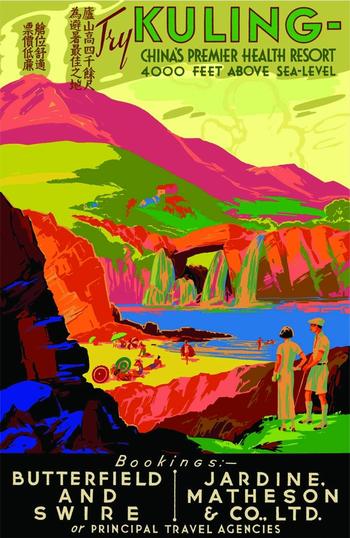
Even if the resorts at the seaside or on the hills were identically ideal in many respects, they were naturally still specific in terms of their characteristics and pleasures, in particular their scenery, nature, and the forms of recreation they offered. In this sense, the conjunction of seaside and hills was perceived as an additional element of idealization. It was thus said that Qingdao's crowning glory was the beautiful union of sea and mountain scenery,Footnote 105 and that its advantage was the fact that it had both hills and sea.Footnote 106 Kuling, for its part, was represented on a promotional poster by a mountainous setting with a fitting description as ‘China's premier health resort 4000 feet above sea-level’, but also by a sand beach and sunshades, the inclusion of which may have been intended to evoke the attractions of the seaside by association.Footnote 107 (See Figure 2.)
‘Try Kuling’. Source: Poster, Butterfield and Swire, Jardine. Matheson & Co., Ltd. (1934–1949).

Moreover, the resorts served as spaces of social contact and, simultaneously, of ideal social interaction among members of the same social groups or strata, like other Asian resorts.Footnote 108 For many missionaries, visiting the resorts was a rare opportunity to meet their colleagues and compatriots. Robert Tharp has recalled how he and his siblings seldom met any other white children, except when they went to Beidaihe every three years or so.Footnote 109 For foreign visitors, in general, the presence at the resorts of other foreigners with both the means to travel to them and higher-level occupations—either foreign residents in China, foreign navy sailors in the region (in the case of the seasideFootnote 110) or other visitors from abroad—turned them into places of social exceptionality, where distinction of place and distinction of society were mutually enhanced. As early as 1876, the Illustrated London News reported how Yantai was visited in autumn by vessels of war, consular officers, and businessmen, and, for a time, acquired all the characteristics of a fashionable watering place.Footnote 111 When Qingdao later became a resort and came to be regarded as fashionable,Footnote 112 it was partly so because of its visitors, with its beach described as a place always patronized by ‘the fashionable crowd in China’.Footnote 113 Such observations are revealing. Travelling to the resorts was not only an activity undertaken by a privileged few, but was emphasized as such.
When Chinese tourists started to visibly pour into the resorts in the 1920s and 1930s, the social exclusiveness of their experience was noted as well. This was only to be expected. Travelling to the seaside and hill resorts was not a common experience, even among the urban population. An article on the summer resorts in China published in 1918 shows that, for most people, travelling to them was not a tangible reality. What was to be done, the writer asked, when one had to endure a scorching sun and oppressive heat and could not go to the pleasantly cool world of the resorts? He proposed that one could still feed on fancies just for consolation, while making clear to his readers that, by telling them about the summer resorts, he aimed to make them travel in their minds.Footnote 114 The inaccessibility of such a destination was the general principle. It was to be so even for the Shanghai urbanites more than a decade later. In 1930 a writer for the China Traveler observed that on hot days the city's wealthy, with no professional fetters, mostly decamped to cool places, and that a few could go to the summer resorts, but that not everyone could enjoy a life of such ease and good fortune.Footnote 115 A fervent critic of the resort tourist practice in China corroborated this impression in the same year by exclaiming that, fortunately, since Western manners had come to the East, only an aristocratized upper class (and not the common people) had been influenced by the fashion of such a summer retreat.Footnote 116 One important factor behind the exclusiveness of such a phenomenon was certainly economic. Beidaihe, The Pei-Yang Pictorial News had pointed out sharply a few years before, was ‘the summer resort for the families of wealth’.Footnote 117 In fact, it was not only wealth that limited travelling to the resorts. In most cases, most people did not have sufficient free time, the fact being that the practice of rest days and holidays in industry and business, while a reality embraced at some working places in the early Republican period, was to remain limited thereafter, with the exception of the most important traditional holidays connected with the lunar calendar.Footnote 118 Such days were likely to be spent on festivities, local amusements, and socializing, which Emily Honig has shown to be the case with mill workers in Shanghai.Footnote 119 While travelling to the resorts was the experience of a small minority, the press contributed to highlighting the singularity of those who congregated at the resorts. The visualization of a socially distinct environment at the resorts was reproduced and, through selection, enhanced in pictorials that showed ‘distinguished’, ‘society’ ladies in Qingdao or BeidaiheFootnote 120 and also featured public personalities travelling to or at the resorts. Chiang Kai-shek was pictured ‘at leisure’, ‘enjoying holidays’ with Song Meiling, on the way to and at Moganshan, and also looking at a map of the resort.Footnote 121 A display of the private life of some ‘great men’ included pictures of them either at the beach or bathing in Moganshan.Footnote 122 Pictures were also shown of other public figures on the beach at Beidaihe or Qingdao, such as Zhang Xueliang,Footnote 123 Mei Lanfang,Footnote 124 and several film starsFootnote 125 or sport icons.Footnote 126 These places, ideal in terms of social distinction, were thus even further detached from the reality of most people.
The resorts also came to be viewed as spaces of escape from conventional habits and, in this sense, as spaces of social freedom. Zhao Junhao, editor of the China Traveler, in 1931 recognized this and depicted the resorts as places for washing away any thoughts about customs and practices, and for getting rid of a multitude of conventions.Footnote 127 Displaying one's body was, exceptionally, sanctioned at the beach or for sportFootnote 128 and was tolerated in the resorts even beyond these spatial or functional confines, at least by the early 1930s, as several references show. In Qingdao, wrote a China Travel Service journalist in 1933, the police are very liberal: whether a man or a woman, you can walk on the street wearing a bathing suit, and will not be charged for offences against decency.Footnote 129 At the beach itself, reported a guidebook in English the following year, there were very few restrictions.Footnote 130 One of these was that, whether a man or a woman, everyone had to wear bathing suits and could not be naked.Footnote 131 In Beidaihe also, reported a Chinese guidebook of around the same period, naked bathing or wearing thin, white bathing suits was forbidden.Footnote 132 If such injunctions suggest the existence of nudist practices in these places, the fact is that young Chinese men indeed fully undressed in beach locations, as published pictures of the time show.Footnote 133 In fact, in Beidaihe, in 1929, topless and nudist practices by a few foreign women were registered too, both at the beach and outside.Footnote 134 In an analysis of holiday practices at the Swedish west coast in the beginning of the twentieth century, Orvar Löfgren has noted how the seaside, as a natural, free environment, developed as a liberating, experimental space where one could question and even transgress the norms, habits, and routines of bourgeois city life.Footnote 135 Such a trait appears to have emerged, more generally, in the different types of resorts. Cindy Aron has observed how the summer resorts in the United States in the late nineteenth century seemed to have allowed and even encouraged more relaxed rules of conduct and how women in particular discovered and helped to create a resort culture that freed them from some traditional middle-class constraints.Footnote 136 In China, liberating practices were also evident in the hills. A journalist for the China Traveler reported in 1948 how at Moganshan young foreign women and girls went to swimming pools and uncovered their bodies, wearing only their bikinis, and went shopping, played or exercised at home, dressed in this way, and how many Chinese girls who came to the mountain to avoid the heat imitated them.Footnote 137 This is a good example of how all resort space was appropriated for leisure, which then prevailed over the social rules applicable in everyday life. Separation from normal life may of course have stimulated these different practices at the seaside and hill resorts in China in much the same way as elsewhere. To foreign visitors, earlier practices or knowledge of such practices at resorts outside China, as well as a further sense in China of their detachment from normal social rules, may also have been particularly inspirational. Cindy Aron has pointed out how in 1900 women walked through the streets of the beach resort of Asbury Park in their bathing costumes.Footnote 138 Such a practice in China may simply have been a case of cultural transplantation. To Chinese women, the possibility of adopting a freer model of engaging with their bodies at the resorts, compared with other places, especially under the conservative pressures of the 1930s,Footnote 139 may have been appealing as well. In reality, for most foreign and Chinese tourists alike, the experiment with liberation may have very much mingled with formulaic prescription where others already had institutionalized these types of unconventional practices. Nevertheless, an ideal of freedom was clearly in the air.
Given these aspects of social distinction and departure from common social rules, the resorts could more easily than usual be conceived of as places of ideal social unity. Jin Ni, a reporter for the China Traveler, commented in an article published in 1933 that, on the Strand beach in Qingdao, the boundaries of race, as well as those between men and women, old and young, and rich and poor, were broken.Footnote 140 Greater class homogeneity and identity of purpose could be found in such a place, in comparison with other locations, and could partly explain this statement. Furthermore, the breaking down of gender and class divisions in the modern seaside holiday resort (noted, for instance, in England and Wales in the 1930sFootnote 141), as a result of its libertarian and unifying character, may also have been felt as a tendency at the Chinese resorts. In particular, the feeling of equalization may have been gradually reinforced by the relative popularization of tourism during this period, which the creation of the Travel Department of the Shanghai Commercial and Savings Bank and of the China Travel Service helped materialize.
Nevertheless, the sand sectorization according to nationality which occurred along the beach coastline in Qingdao ran counter to the idea of total unity. The main beach was said to be ‘a regular League of Nations for Chinese and Japanese join in the fun at the end of the beach and other nationalities spread themselves over the rest of it’.Footnote 142 This segregated distribution seems to have been a pattern, as Japanese and Westerners chose to concentrate at certain other beaches as well.Footnote 143 In addition, there was a hierarchy in beach space, between comfortable bathing boxes, either public or private-owned,Footnote 144 and plain sand. In this context, the claim of social unity appears to have been an idealized one. This idealization was linked to the ideal characteristics of the beach. The reporter proceeded: ‘even if you embrace any kind of pessimism regarding the world, as soon as you reach this place, all troubles are drawn away by the sea waves and you only feel like enjoying the happiness of living’.Footnote 145 With happiness as a criterion, social reality supposedly disappeared. In fact, a consequence of the perception of the beach as an ideal place could precisely be its reconstruction in accordance with ideals that bore either partial or no correspondence to reality. The beach, with its apparent communion of space, partial unclothing, and universal activities, had an equalizing effect and could, in this sense, be seen already as a territory that manifested social ideals. Together with its association with modernity, this rendered it as the perfect locus for idealization according to parameters of a race-, gender-, age-, and classless modernity.
Whatever the case, a space for all classes was not felt to be a common reality, making any apparent examples of it all the more notable. For example, The Young Companion pointed out in 1930 that the Shanghai public swimming pool was a place where ‘people of all classes gather in the same pool’.Footnote 146 This perception, based possibly on the observation that people from a variety of backgrounds used it, was far from accurate, though. The claim inevitably raises questions of social representativeness, given the hard living conditions that many experienced. This being so, the representation of the beach at the faraway resorts as a place for all classes was all the less true. Here, in terms of modern social ideals, it was the one of social exclusivity linked to modernity that prevailed, rather than that of modern social equality, which still remained largely in the domain of the imagination and of rhetoric. There is no indication that Qingdao's clientele might have expanded significantly by the early 1930s to include the ‘poor’ to which Jin Ni alluded. Other references to the tourists at the various resorts seem to unanimously portray them as affluent. In fact, their social composition may not have changed much during the Republican era, even despite the growing role of the travel industry. The latter may have contributed more to attracting a larger number of visitors than to deeply diversifying their social base. Ji Ni's assertion, which fitted in well with the promotional interests of the China Travel Service, may have been wishful thinking, more than anything else.
The body on tour
The seaside and hill resorts were the destinations not only of a receptive body and mind but also of an actively participant body. Tourism to these places provided—through presence, and sight or other senses—physical relief, vigour, and comfort, as well as happiness in mind. But the body was, beyond all that, part of the travelling experience to the resorts by means of its action at and interaction with the travelling environment too—through physical exercise, contact, and display. In this sense, it was, in more dimensions than occurred in many other types of tourism, a ‘body on tour’. At the resorts, body-related practices, an essential aspect of the holidays for the foreigners who first travelled to them, were a key part of the tourist experience of the different groups who visited them. Among the Chinese nationals who came later, to an extent, this was the result of local observation and replication. Much more than that, however, it was an outcome of the broad diffusion in early twentieth-century China of an imagery of sport, swimming, and bodily display, largely encouraged by several factors related to body cultivation. Among them was its growing importance since the late Qing, its association with modernity and a Western lifestyle, its propagation by the press in the 1910s and, increasingly, in the 1920s, and its promotion under the Nationalist government.Footnote 147 In fact, such a reality must be related to a broader development within the tourist culture of this period, which was the growing identification of travel as an activity beneficial to the body.Footnote 148 In the case of the resorts, however, body-related practices assumed a high degree of importance and a variety of expressions, which a combination of specific characteristics of the resorts—geographical, infrastructural, and social—allowed to be drawn out to their full extent.
For purposes of health and pleasure, physical exercise was a significant activity at the resorts in China, much as it was at other resorts in Europe and the United States, where it had been the focus of growing interest from the end of the nineteenth century,Footnote 149 and in colonial Asia, where the pattern from the home country was reproduced.Footnote 150 Kenneth Lo recorded in his autobiography how at the small resort of Guliang, near Fuzhou, life was a constant round of tennis matches, long hikes or swimming.Footnote 151 The ubiquitous existence of sports facilities such as tennis courts and swimming pools at the resorts is in itself revealing of the importance granted to physical activity as part of the resort experience. Given their presence, it is only natural that they should have been frequently referred to in tourist guides. They may actually have been mentioned in these guides not only for information but also for particular promotional purposes, as they may have been perceived as important potential touristic draws. Whether this was the case or not, the fact is that the possibilities for sport were sometimes also given special consideration in guidance material. For example, an article in the China Traveler expressly mentioned that the Empress Hotel in Moganshan had a swimming pool where one could do sport.Footnote 152 A guidebook for Weihaiwei, for its part, affirmed that, for sports enthusiasts, this was really a place to be sought out as it provided opportunities for boating, swimming, fishing, tennis, golf, cricket, mountain climbing, shooting, and so on.Footnote 153
Not that sport was a universal pursuit at the resorts, where many aimed for rest rather than exercise.Footnote 154 In 1931 a strong opponent of the resort practice derided it by pointing out that it was based on a Western culture of laziness, and by questioning the importance of physical exercise at the seaside: if people were really focused on this aspect, then why travel so far and spend one or two months there? Not to mention those who ate only fatty foods, went out only by car, danced all night, and only got up at midday: how might they be in a position to talk about the benefits of physical exercise?Footnote 155 There was certainly another side to the resort experience. What this criticism unintentionally discloses, is how essential physical exercise was at the level of discourse. For some it was also a motivation to travel to the resorts. The testimony of a tourist who went to Kuling for several months to rest and recuperate appears to confirm this. In his report of 1931, he stated: ‘We say, not infrequently, that our aim in residing on the hills is on the one hand to escape the heat and on the other to do physical training.’Footnote 156 From the purpose of such a stay, he then derived the establishment of guidelines for life there, which he considered to be medicalized and disciplinarized, and offered a daily schedule of exercise, reading, and relaxation. He added that, for those wishing to train the body, there were smooth mountain paths, where one could stroll, and swimming pools and baseball fields, where one could do sport.Footnote 157 Sport seemed thus to be a decisive element for travelling to the resorts. In Xu Xu's story, the wife used it as an argument against her husband: ‘at the seaside you have many opportunities for sport, and I can teach you to swim!’ Sport converged with resort tourism in terms of its elitism and modernity, and also as a leisure activity, and was thus a natural element in the resort setting. It rationalized it, moreover, founded, as it was, on health, science, and progress. The wife contrasted the alternative of the sporty seaside to that of the hills where, she told her husband, ‘you will shut yourself indoors and read a book, which is not useful for you—don't you know that your health is not really good?’Footnote 158 The usefulness of sport could ultimately justify a particular choice of resort leisure. Such a utilitarian outlook is not surprising. It might be understood particularly in the light of the utilitarian pressures that increasingly bore down on leisure in the early twentieth century and escalated towards the time when the story was written (1934).Footnote 159 In fact, it may well be that, for some of those who travelled to the resorts, sport as a productive activity may have played out as both a validating and a necessary component of the journey.
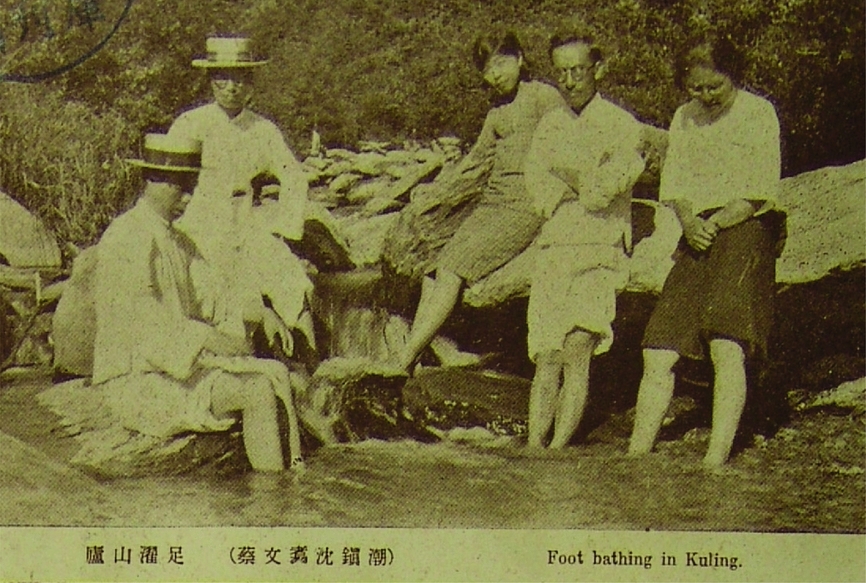
Contact with water, whether it involved physical exercise or not, was another important element of the tourist experience both at the seaside and in the hills (where it occurred either at swimming pools, such as those of Kuling and Moganshan, or elsewhere: see Figure 3). Swimming itself may still have been a challenge for many of the Chinese nationals who visited these places. The author of the foreword to a translated book on swimming techniques published in 1933 observed that swimming was neither widespread nor advanced among the Chinese people: they, he explained, were still young with respect to ways of swimming, either as a technique or for pleasure.Footnote 160 In any case, swimming had become fashionable in elite circles and was in the process of becoming more popular around the country, as a result, for example, of the construction of public swimming pools, which were crowded in the summer.Footnote 161 It was rationally justifiable as well: in the foreword, for instance, it was said that swimming strengthened the body, improved health, and made it possible to save one's own life and that of others.Footnote 162 Rationalization, which could in this case serve a purpose, was part of a more general discourse too. It was thus said in The Young Companion that swimming was not only a very agreeable thing, but also a complete, whole-body exercise and very beneficial to health.Footnote 163 An Ovomaltine advertisement echoed this idea. It identified swimming as the most advantageous sport in the summer.Footnote 164 It is not surprising therefore that Zhu Peide, for instance, should have owned a small swimming pool at his villa in Kuling and taken swimming lessons.Footnote 165
‘Foot bathing in Kuling’. Source: Tuhua shibao, 644 (6 April 1930), p. 1.

Sea bathing and swimming in particular were a fundamental aspect of the appeal of the seaside. They were a common activity of the foreigners who travelled to them. Robert Tharp recalled how he could never get enough of the water at the sea during his holiday at Beidaihe in 1929 and how he swam as often as he could.Footnote 166 Innes Jackson recounted, for her part, how she longed for it during a long journey through China in 1936: ‘My body was thirsty for the sea and I was very sick of sweating.’Footnote 167 In Qingdao, when she finally got to the sea, ‘How good it was, the first swim—ecstatic freedom, delight of the body, longed for through so many weeks!’Footnote 168 The locals noticed this fascination with the sea: Guan Luosheng, the writer of a book on Beidaihe, commented in 1925 that foreigners placed an emphasis on sea bathing.Footnote 169
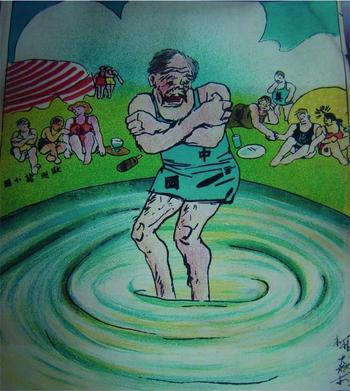
Sea bathing was, in fact, a new phenomenon in China, unlike bathing in other public places.Footnote 170 Innes Jackson remarked, during the same trip, that ‘the Chinese felt it differently. It is only in this generation that they have learnt the pleasures of venturing in water, and bathing remains a feat of endurance for many.’Footnote 171 Given the different approaches towards the sea and sea bathing, just two years before The Pei-Yang Pictorial News commented on the fact that the Chinese seemed to be the most afraid to die—they only dared bathe slightly on the beach in shallow water, a characteristic which was said to come from old times and explained their lack of records for swimming.Footnote 172 It is reasonable, therefore, that in 1934, the image of a distressed Chinese bather at the seaside should have been used in Modern Sketch as a metaphor for China's internationally frail status: Chinese weakness in the context of sea bathing would have been a recognizable or a given fact for many (see Figure 4). The perception that sea bathing was still a new experience continued throughout the Republican period. Even in 1947, Chen Jianheng, author of a book on travel hygiene, remarked on the fact that in Europe and America most summer travellers went to the beach, with the main travel purpose of bathing in seawater or to swim because of the fortifying effect of cold water on the body, whereas ‘we are beginning to apply cold water to the body or to soak the body in cold water or for the first time going into swimming pools or seawater’.Footnote 173
China sea bathing. Source: Shidai manhua, 7 (20 July 1934), n. p.

Yet, sea bathing clearly developed an appeal. The Young Companion appended captions such as ‘lovers of water’Footnote 174 or ‘the call of the sea’Footnote 175 to pictures of Chinese tourists at the beach. A young woman recalled in 1943 how in the 1930s she had enjoyed the beach at Xiamen, where she had watched ‘the tide suddenly surging and splashing all over me’.Footnote 176 It was, understandably, from the start, the activity of a few. In 1926 The Pei-Yang Pictorial News published a story about someone who mentioned having learned that at Beidaihe ‘the most stylish people’ drifted with the current.Footnote 177 A 1933 guidebook on Qingdao noted that every year around 5,000–6,000 Chinese and Western ‘personalities’ went there on holiday for sea bathing.Footnote 178 It was becoming a more widespread phenomenon. A 1934 guide to Guangzhou signalled that, for a few years already, masses of people had been enthusiastically going to bathe in the sea.Footnote 179 That same year, The Young Companion noted similarly that, in the previous two or three years, sea bathing had gradually become more popular.Footnote 180 It had become so, for instance, at Gaoqiao beach, in the vicinity of Shanghai, where the construction of facilities in 1932 was said to have quickly caught the fancy of Shanghai residents.Footnote 181
The insertion of the human element into the sea was, anyway, an innovation. It conflicted with notions of the sea as the exclusive realm of fish and birds, which as a result tended to be used as recognizable comparative tools to this strange new habit. A 1918 text described how at Beidaihe many men and women swam in the sea like wild ducks, fiercely fighting the waves—an extraordinary sight.Footnote 182 In the foreword to the book on swimming techniques, analogous illustrative imagery was employed: ‘in a very hot summer's day, what a pleasure going to the beach, jumping into the water and swimming, with the body floating like a duck or a seagull, following the water and bobbing up and down!’Footnote 183 It must have still seemed unnatural, as even standing on the sea-piercing Qingdao pier may have felt: it was said to be, every summer, full of visitors like ‘crucian carps’.Footnote 184
Many people did not know how to go about sea bathing or swimming. A 1931 article in the China Traveler reported that, although there were many veteran swimmers at the beach in Qingdao, there were also many newcomers and most of these could not swim with ease, and needed the help of gas-bags and safety buoys.Footnote 185 At Strand beach, people would also test if they could swim by trying to reach a diving platform located close to the shore,Footnote 186 and at all beaches swimming platforms were available for people to practise from.Footnote 187 Contact with sea water itself was the object of experiment, with a book on the sights of Qingdao recommending Strand beach as appropriate to practise sea bathing.Footnote 188 A Pei-Yang Pictorial News editorial observed in 1934 that in Qingdao many foreigners went into the water, whereas among the Chinese only a few modern men and women did. This might explain another difference it reported: whereas many foreigners swam for exercise, many Chinese swam to be in the limelight.Footnote 189 Swimming thus served as a means to display skill and modernity.
In a context of the novelty of practice and the lack of personal skills, fear of the sea was still a powerful cultural component.Footnote 190 Innes Jackson was told by a Chinese lady that she had only just cured her fear of the sea—it was so large and open, and the waves sometimes made a great noise.Footnote 191 A writer for the China Traveler also testified that at the beach some women, at the beginning, were even slightly afraid of standing in the water.Footnote 192 The husband in Xu Xu's story played on such fears to shore up his opposition to his wife's choice of the seaside: are you looking for happiness or for death?, he asked.Footnote 193 In fact, fear of drowning at sea was enough of a commonly entrenched angst for advertisements to make use of it.Footnote 194 It was thus an obvious concern in the guidance and promotion of tourism at the seaside resorts. A journalist from the China Traveler reassured his readers by saying they did not need to be afraid of drowning as it was unheard of at the Qingdao bathing beaches—and gave further assurances: with a swimming buoy one did not submerge even in very deep water, standing in the sea at a relative distance from the coast was of no harm even if one could not swim, and having water at chest-height was generally not dangerous.Footnote 195
Such fear was countered and the practice of sea bathing fostered through sets of considerations that gave this practice a rationale. In 1918, an article was published in The Eastern Miscellany which described sea bathing as having started in eighteenth-century Europe for health reasons, and gave details on how cold water stimulated the cutaneous nerves as well as the diaphragm.Footnote 196 In that same year, a book was published on cold water bathing, which explained the benefits of sea bathing: to cure diseases, prolong life, and strengthen the body and even the nation. England, Germany, and the United States all had established large bathing beaches at the seaside and in summer hundreds of thousands of people swam. How could it be that sea bathing was not being promoted to cure the weaknesses and old illnesses of the Chinese?Footnote 197 It thus emerged as a modernizing instrument to treat a range of individual and collective ills, which added motivation for adopting it as an activity. Reference to the benefits of such a practice continued throughout the 1920s and the 1930s. A list of the benefits of and cures for various diseases offered by sea bathing emerged in an outline of Beidaihe published in 1925.Footnote 198 A 1934 article on the resort of Qingdao suggested that sea bathing could improve health and treat skin diseases: those seeking happiness in body and mind could not but experiment with bathing, so it said.Footnote 199 The author of a 1935 guide on the Beidaihe seaside insisted likewise on the benefits of sea bathing and hoped that tourists asking themselves whether to try sea bathing would not lose this good opportunity, because cold water stimulated the skin and could make the blood run faster. Also, iodine, bromine, and other salts contained in seawater could clean the skin and kill bacteria. So, after bathing one felt energetic, fresh, and comfortable, and the appetite increased. Those suffering from depression, skin and gland diseases, anaemia, chronic respiratory diseases, and malnutrition could be treated in this way.Footnote 200 The following year the China Traveler published the testimony of someone, who, trusting the doctors’ advice, had gone to Gaoqiao beach to dip in the seawater, a practice, it seemed, that had some advantage for nervous breakdowns and bad digestion.Footnote 201 The medical advantages of sea bathing were in fact deemed to be numerous, to the extent that a contributor to the magazine, while arguing that swimming was a shortcut to fitness, and that bathing in the sea offered first-class swimming as the seawater was rich in ozone, even alleged that there was hardly any disease that sea bathing could not help fight.Footnote 202 The primacy of sea bathing over other types of bathing for therapeutic purposes was thus promulgated, as it had been in Europe since the seventeenth century.Footnote 203 Health considerations reconstructed the meaning of sea bathing, helping disseminate its popularity among ordinary people in China, much as also happened in Japan.Footnote 204
Sea bathing was further rationalized and medically framed by the limits imposed on it. An article in The Eastern Miscellany declared it inappropriate in the case of vascular and heart diseases.Footnote 205 A review on sea bathing in The Ladies’ Journal in 1927 also warned about its inappropriateness during menstruation, pregnancy, after childbirth, and when suffering from certain diseases, and stressed moreover that all people experiencing nervousness or nervous breakdowns, heart ailments, foot oedema, lung diseases, and dysentery should not bathe in seawater.Footnote 206 The Young Companion, while extolling the virtues of sea bathing, also said that it brought about many diseases, and advised its readers to inform themselves of its effects for health preservation purposes.Footnote 207 Advice was given, in addition, on the appropriate time and duration of bathing in the sea. A guide on Beidaihe emphasized that it was not appropriate to sea bathe after eating, and that after lunch one should avoid the scorching afternoon heat of the beach.Footnote 208 Here, considerations of health and comfort merged. The China Traveler also reminded its readers not to stay in the water for too long, at best for half an hour and for not more than one hour, or else muscles would retract, which it prescribed as being no good.Footnote 209
Bodily contact with the travelling environment of the resorts included exposing the body to sunlight. It was practised at the seaside but also at the hill resorts. At Moganshan, young foreign women and girls were reported to sunbathe at swimming pools and to rest under the sun until their skin became red.Footnote 210 Sunbathing had become widely practised in Europe and America by the 1910s, following the dissemination of the notion of the sun as having healing properties.Footnote 211 In China, while sunlight had historically enjoyed associations with good health and sunbathing had even emerged as being therapeutic,Footnote 212 exposure to the sun had nonetheless been shunned as a result of the traditional ideal of pallid skin being a mark of upper-class status and a standard of beauty.Footnote 213 Thus, for many of those who witnessed the practice of sunbathing at the resorts, it was a novelty. The effects of such exposure to the sun could therefore need clarification. The writer of a 1931 article on Qingdao in the China Traveler noted that many there had brown-red colour skin, and explained that this was the result of natural sunbathing.Footnote 214
The impetus to suntan in China was driven in part by issues of cultural and social identity. Several factors seem to have contributed simultaneously to a reversal of class-related attitudes towards exposure to the sun among the more affluent: a modern, Western model privileging this, the inevitable side effect of tanning resulting from certain, mainly upper class, outdoor activities,Footnote 215 and also a reduced exposure to sunlight by some people from the lower strata of society who lived in crowded urban environments,Footnote 216 which was to be further diminished through factorization and consequent localization of menial work indoors.Footnote 217 At the resorts, the tanned body was a marker and displayer of identity. This idea clearly surfaced in Jin Ni's article, which read: ‘if you have just come to Qingdao, you may think your skin's white complexion is shameful. Because young men and women here, whether Chinese or foreigners, all suntan in such a way that the colour of their skin turns light-brown and even burnt-black. The white skin in your body will confirm that you are an inexperienced swimmer.’Footnote 218 The body was in this sense an important symbolFootnote 219—more than just of physical prowess, but of distinction and modernity as well. A comic strip published in the Ti·ie Ci·ien Pao Miscellany appears to corroborate the importance of tanning. It showed a man being mocked on his first day at the beach because of his white skin and deciding to use a sunlamp at night to catch up (see Figure 5). The significance of suntanning can be recognized in the degree of commitment some were prepared to put in: ‘modern women’ were said to spare no effort to suntan under the intense sun.Footnote 220 It seemed to generate anxiety among them. In a caption to a drawing in The Pei-Yang Pictorial News, one woman who had not yet gone to the seaside but wanted to be in the limelight, asked another: ‘Can other people tell that the black marks on my body are from last summer's tanning?’Footnote 221 Many Chinese women at the beach, however, combined the bathing costume with the umbrella.Footnote 222 Excessive exposure to the sun ran counter to the aim of avoiding the heat and had other unfavourable effects, so, to some extent, this may have been a compromise solution. In fact, the umbrella was designated in The Young Companion as one of the three indispensable accessories of summer time, the others being the fan and the hat.Footnote 223 It served aesthetic purposes as well.Footnote 224 For some it may also have been used for the purpose of minimizing the effects of sun exposure for those still in pursuit of an ideal of paleness (to be followed to the extent that it was possible alongside the bathing costume attractively associated with modernity), whereas, for others, part of its appeal may have derived from its association with having a pale skin, even where the latter was no longer there or, indeed, an objective.
The importance of suntanning. Source: Tuhua chenbao, 16 September 1934, n. p.

The full embracing, or rather, embodying, of sunlight, which occurred at the resorts, was ultimately grounded in the various health considerations related to exposure to sunlight that were growing modern roots in China at the time,Footnote 225 in line with international trends. Travel literature on the resorts specifically mentioned several unrelated strengthening or curative achievements said to result from suntanning. A guide on Beidaihe, for instance, told travellers to suntan for the purpose of strengthening skin texture.Footnote 226 The China Traveler prescribed that at the beach in Qingdao one should sit or lie on the sand and enjoy the benefits of sun bathing, maintaining that, particularly for skin or lung diseases, this type of rest was very beneficial to health.Footnote 227 This echoed the medicalized discourse in the West, which linked sunlight to the cure for such diseases.Footnote 228 Health in fact carried out the functions of both a stimulus and a signifier of cultural practice. An analysis of Australian beach habits in the China Traveler specified that all Australians believed doctors’ claims that being exposed to the sun was an essential factor for strengthening the body, and added that therefore their yellow skin with a texture of dried meat was a ‘symbol of health’.Footnote 229 Whether such information was simply transmitted or the object of cultural interpretation, it is noteworthy for the emphasis placed on the semiotic value of the suntan. That such value may have been relevant in China appears plainly in Jin Ni's article, where he gave the following advice to his readers, either in earnest or jest, but nevertheless definitely concerned with the issue: ‘if you want to show your health, when you come to Qingdao, you had better spread body lotion and ink on your body before you leave your doorstep’.Footnote 230 The social value of displaying health through suntanning was evident here. Elsewhere in the same article, the display of health emerged as a necessity, apparently in association with status and beauty. In Qingdao, one was told, no one wore stockings, even short ones. Women wearing stockings might be suspected of having been bitten by bedbugs or of having a scar.Footnote 231 Here it was not just a question of having tanned legs, which made the wearing of stockings an impediment,Footnote 232 or of displaying the body and one's modernity. The body was to be submitted to an evaluation in terms of health, itself imbued with social meaning.
Sand and wind were other elements of bodily contact. After bathing in the sea, considering that one might feel cold, the China Traveler suggested digging a hole in the sand and burying one's body inside, with only one's head showing.Footnote 233 It explained that one might then feel warm again, and comfortable. The duration for this was laid out: one was to sand bathe in such a way for half an hour and the body would dry off.Footnote 234 The same was proposed for travellers to Beidaihe, for identical reasons: after bathing one was to bury the whole body in sand and gravel (or alternatively sunbathe), as sand contained leftover heat from sunlight, enough to foster bodily warmth.Footnote 235 The point was not recreation but to avoid discomfort and encourage well-being. At Beidaihe beach, wind bathing was also recommended in a similar tone: one should run for exercise, so as to enliven the blood circulation, and, if one could combine sea, sun, and wind bathing on the same occasion, the benefit would be all the greater.Footnote 236
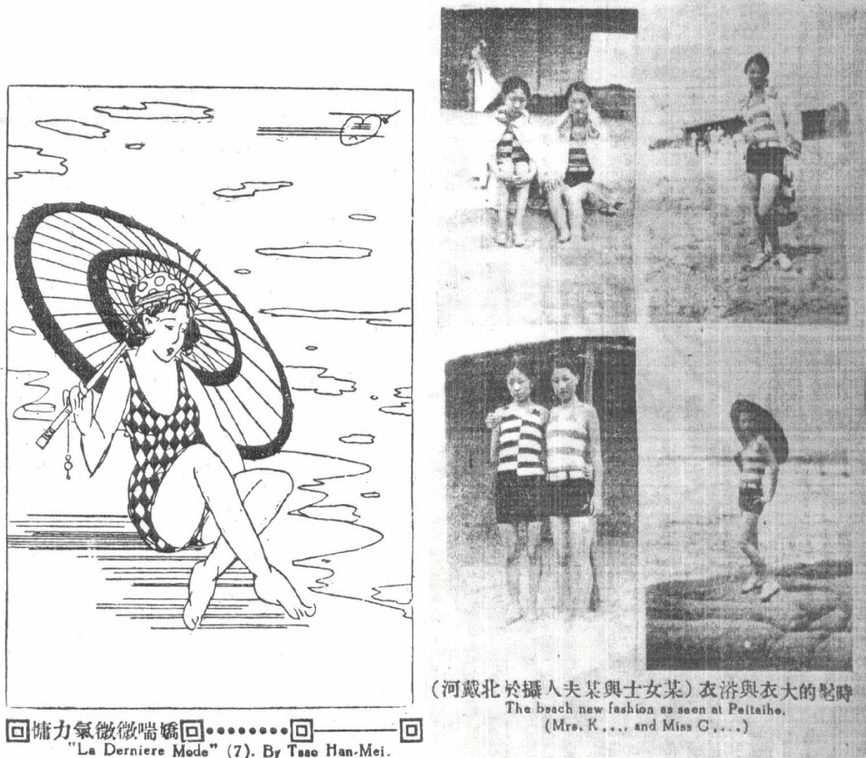
Body and tanned body display as elements of the tourist experience at the resorts were complemented by the display of body dress, also the object of other tourists’ gaze. While avoiding the heat, be sure to wear a Butting Ram bathing costume, ran an advertisement printed in 1939.Footnote 237 Fashion-conscious bathing wear, promoted through advertising,Footnote 238 and relevant, for instance at Gaoqiao beach,Footnote 239 was clearly present at the fashion-aware resorts. The Pei-Yang Pictorial News included images of la dernière mode at Beidaihe, such as of jackets over bathing suits (see Figures 6 and 7). Dress was definitely the object of attention, as was evident in a 1931 summer report on life at the beach and of holidays at the resorts, which included minute visual and textual detail on womenswear at Beidaihe. Dress, like people, appeared to be set free. Innes Jackson noted how in Qingdao ‘people of almost every nationality, Eastern and Western’ were to be seen about ‘in the wildest combination of garments’.Footnote 240 The style and colour of bathing suits at Beidaihe were ever newer and stranger, and many had never been seen before, said the report.Footnote 241 Instructions were given, however, on ways to dress, including the new and unusual back-revealing bathing suit, and the latest fashion: the narrow-sleeve, large-trouser beach sleeping suit or pyjamas (which seem to have been worn at Kuling as well, as witnessed in 1933Footnote 242), using all kinds of combinations of silk in coloured patterns, with bright and different colours, which was sure to draw attention.Footnote 243 Women who wore the beach sleeping suit held umbrellas and rode donkeys, the report also noted, adding, prescriptively, that all of these had to be followed.Footnote 244 The existence of all these standards and insistence on them contrasted not only with the appearance of a possibility to dress more freely but more generally with the break from certain social rules, particularly with regard to the body, at the resorts. It may have had a two-fold origin and been founded on an individual anxiety regarding distinction and modernity and on a collective need to control the ideal of a distinct and modern society at the resorts. For such purposes, rules were socially dictated and supported. It was not a case of social liberation but of social alternative.
‘Pictures from Beidaihe Beach’. Sources: Beiyang huabao, 359 (17 August 1929), p.2; and 360 (29 August 1929), p. 3.

Conclusion
Tourism to the seaside and hill resorts created by foreigners was a new element in China's tourist culture. It was largely defined by the perception of the resorts as places of refuge, ideal life, and physical participation and, importantly, in view not only of its novelty but also of many of its characteristics, it was a modern leisure travel experience. Tourism to the hill resorts had clear antecedents in China. It was, nevertheless, substantially different from earlier practice, given the allocation at these resorts of a space for leisure activities beyond the private sphere which included an infrastructure that had urban, modern characteristics. Shi Mingzheng has noted how, in late imperial times, even though Beijing residents travelled to the Western Hills, use of such space was limited because very few recreational facilities existed.Footnote 245 In this respect these new places were an innovation, allowing for the full pursuit of a hedonistic modern culture, in which comfort, body, and display were major foci.
This modern tourist experience in China was strongly linked to foreigners. Initially shared only by them, it was, nevertheless, to be gradually appropriated by some members of the Chinese upper strata of society and to become the object of attention of many more Chinese nationals, most noticeably from the 1920s. Such an example of cultural acquisition and interest is significant. It challenges, first of all, limited approaches towards the foreign presence based primarily on issues of power and imperialism.Footnote 246 It bears testimony, furthermore, to a curiosity about the outside world and an opening up to it that the historiography focused on this period of Chinese history for a long time largely neglected, concentrated as it was on a scrutiny of problems and deficiencies, and to which it has only more recently begun granting greater recognition.Footnote 247 In this sense, it confirms the argument put forward by Ruth Rogaski in her work on hygiene in treaty-port Tianjin, according to which the Chinese elites were willing to embrace foreign-defined modernity, irrespective of imperialism.Footnote 248 Andrew Field has studied the spread of the ‘dance madness’ of the Jazz Age from Shanghai's Westerners to the Chinese population of the city from the mid-1920s.Footnote 249 Travelling to the resorts was another instance of a foreign-based leisure activity that became a fad among well-to-do Chinese at around the same time. Not that it can be seen as a fully parallel phenomenon. While the ‘dance madness’ was to reach wide sections of the urban population of Shanghai in the early 1930s,Footnote 250 resort tourism was to remain off-limits for most people. However, inclusion in the media of references to the goings-on in the resorts appears to show a greater level of interest than the actual practice would indicate.
Despite the many spotlights on enjoyment and happiness, the resort tourist experience was repeatedly validated through criteria which transcended temporary satisfaction. Avoiding the heat itself presupposed discomfort or ailment, which made travelling to the resorts a necessity more than just a desire. Sport, swimming, and sea, sun, and wind bathing were all rationally justified in terms of health and long-term benefits, rendering travelling to the resorts a useful experience as well. Even the practice of sand bathing was encouraged after sea bathing, not for fun but specifically to offset the chilling effect of cold water on the body. These kinds of considerations can certainly be explained, to some extent, by the development of the resort tradition in the West and in the tropics on the basis of health concerns, as well as by the pervasiveness of a utilitarian agenda around the world during this period. The frequent rationalization of the experience in Chinese sources in particular may, for its part, be the result of a set of realities specific to China, such as the novelty of the resorts and of contact with the sea, and the existence of deep-running motivations and anxieties ultimately traceable to a growing perception, from the late Qing, of a vital need to compete with the modern world under an impending threat to national survival. In fact, utilitarian concerns were one of the characteristics of the tourist culture of this period in China, appearing recurrently in a vast array of tourism-related sources.Footnote 251 These were also present in the wider discourse on leisure and, not unexpectedly, in the discourse on other spaces of leisure as well. The promotion of the public parks in Beijing in the 1910s was carried out through notions of public health and the mental and physical welfare of the city's residents.Footnote 252 A text on the beach, published in 1936 in the China Traveler, followed a similar utilitarian outlook. It advocated going there in the summer, justifying leisure time through non-recreational concerns: ‘in very hot weather, concentrating on your work the whole day is not suitable to preserve your health, and you have to think of a few things for idling away in the summer’.Footnote 253 The resorts were no exception. Like other places of enjoyment, they were described in terms of their usefulness.
If tourism to the resorts was a modern experience in many ways, a strong parallel can be found, however, in gentry travel: in both cases, the tourist experience was an important means of cultural participation. In the travel tradition of the literati, both visual and individual creativity was at the centre of a process of cultural participation. Viewing sights and historical and artistic artefacts with significance in high culture was understood as a form of cultural identification.Footnote 254 Beyond that, gentry travel involved the production of elite culture,Footnote 255 including travel writing and travel painting, and also landscape inscriptions, incorporated into the travelling environment itself,Footnote 256 in a process of participation in tradition. In contrast, in the case of resort tourism, it was the presence of the tourist and the active participation of the body in the travelling environment that constituted the primary aspects in a distinct process of cultural participation. This type of tourist experience was a form of participation in modernity, through environment (and space, at the seaside), recreation, society, and the body. It involved not the production of elite culture but the development of the individual body, which was now a priority, ultimately linked to the strengthening of the national body (as, for instance, the reference to the benefits of sea bathing to the individual body and therefore the nation in the 1918 book on cold water bathing made clear). These were extremely diverse tourist experiences. The importance of cultural participation in both cases might suggest, however, a continuity of social focus and purpose that would challenge the idea of a total break with past tourist culture.Footnote 257