Introduction
A well-established narrative explains the emergence of the early Chinese dynasties and the first states from the Neolithic societies of the Central Plains (Xia Shang Zhou 2000; Liu & Chen Reference Liu and Chen2003). Large sets of cast bronze food and drink containers (Figure 1; IA CASS 1998: 79–103) and symbolic jade weapons are the hallmark artefacts of those dynasties. The state-funded project ‘The Origins of Chinese Civilizations’ (Yuan & Campbell Reference Yuan and Campbell2009) has reviewed the archaeological evidence for contact and continuity between different Neolithic sites that culminated in the creation of the major centre at Erlitou—a site characterised by its large structures, advanced ceramic and turquoise workshops, ritual bronze vessels and jades. These accounts, however, have not yet systematically drawn attention to the major shifts in the geographic distribution of the large Neolithic centres that provided the antecedents for Erlitou and its successors on the Central Plains. Furthermore, these earlier studies did not have access to the information now available on the sources of the metallurgical techniques and raw materials that enabled the workshops at Erlitou to cast the first bronze vessels. This new technology, introduced from the northern borderlands, extended existing socio-political practices for feasting rituals (Underhill Reference Underhill2002: 202–204). These casting achievements also reinforced the contrasts between the metal weapons and personal ornaments valued by the neighbouring inhabitants of Northern Eurasia and the bronze vessels esteemed by peoples of the Central Plains.
Bronze vessel set from M160 of Guojiazhuang, Anyang, Henan, modified after figures from IA CASS (1998) (figure by John Rawson).

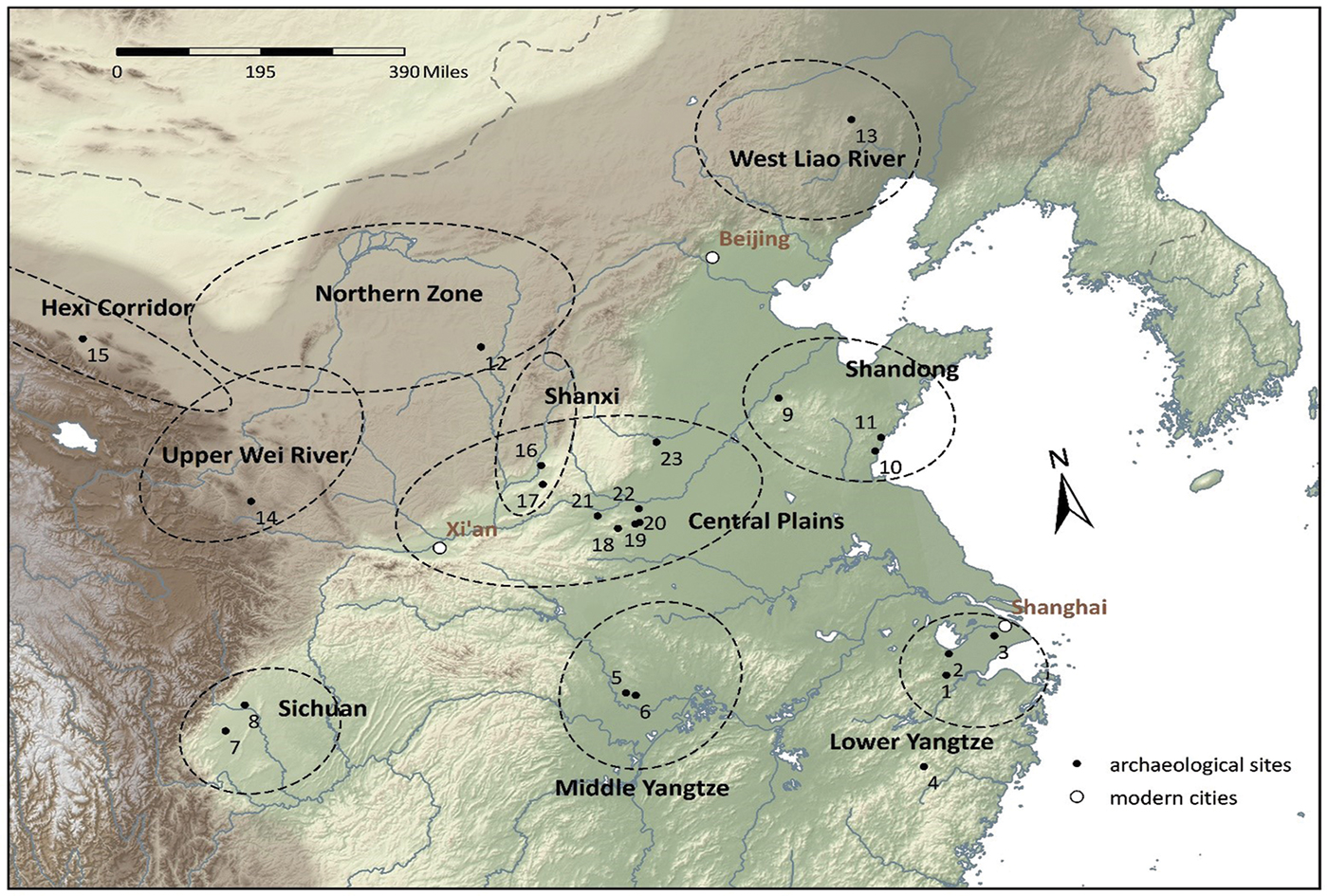
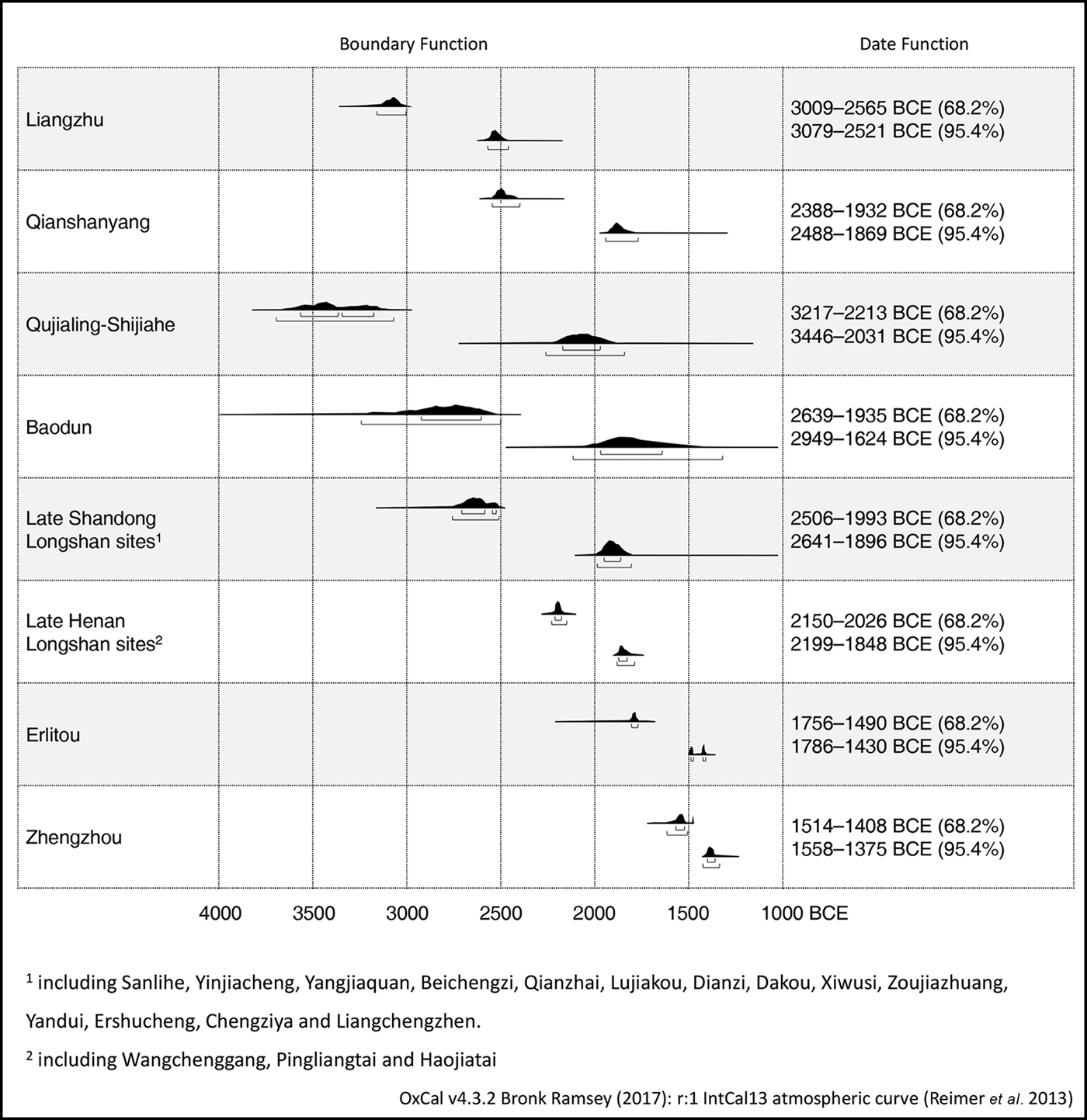
This article provides a new foundation for understanding these major geographic, technological and social discontinuities. A review of the distribution and size of the major Late Neolithic sites (Table S1 in the online supplementary material (OSM)) shows that the largest, Liangzhu, developed in the south-east of China—a long distance from the Central Plains and in a very different topographical and ecological zone (Figure 2 & Table S2). Other large sites along the Yangtze and lower Yellow River Basins were also far beyond the central areas, which were formerly regarded as the essential background to the rise of dynastic powers (Chang Reference Chang, Loewe and Shaughnessy1999: 54–58; Li Reference Li2013: 7–12; Table S1). We present a new comparison of the chronology of the rise and decline of these Late Neolithic and Early Bronze Age sites by plotting their radiocarbon dates in a Bayesian model (Figure 3). This shows a steady sequence of changes, followed by further rise and decline of centres to the north and north-west of the Central Plains. It was via this latter group that metallurgy was introduced to the Central Plains (Linduff & Mei Reference Linduff and Mei2009; Sun et al. Reference Sun, Shao, Liu, Cui, Bonomo, Guo, Wu and Wang2018). Thus, we offer proxies for major geographic shifts in the growth and management of highly organised and probably densely populated societies. While many of these changes have been identified and discussed separately, we here demonstrate that collectively they formed a distinctive pattern in the Late Neolithic development of ancient China that has only recently received attention (Zhang Reference Zhang2017).
Distribution of major regions and sites mentioned, with the Arc shown as the shaded area: 1) Liangzhu; 2) Qianshanyang; 3) Guangfulin; 4) Haochuan; 5) Qujialing; 6) Shijiahe; 7) Baodun; 8) Sanxingdui; 9) Chengziya; 10) Yaowangcheng; 11) Liangchengzhen; 12) Shimao; 13) Yunbaoshan; 14) Xichengyi; 15) Taosi; 16) Zhoujiazhuang; 17) Wangchenggang; 18) Xinzhai; 19) Guchengzhai; 20) Erlitou; 21) Zhengzhou; 22) Anyang (figure by Limin Huan).

A set of modelled boundaries of radiocarbon dates for some Late Neolithic and early bronze-using sites (for data sources, see Table S3 in the OSM) (figure by Ruiliang Liu).

Neolithic sites and societies
Excavations over the last few decades have revealed large Neolithic settlements in many parts of China (Xu Reference Xu2017; Table S1), each with extensive infrastructure and elaborate craft work—notably in the ceramics and jades used in mortuary rituals (Figure 2). The identification of these sites as cities, urban settlements or even as states with rulers is widely debated (e.g. Demattè Reference Demattè1999; Liu & Chen Reference Liu and Chen2003, Reference Liu and Chen2012: 213–52; Yang Reference Yang and Yang2004; L. Li Reference Li2016; M. Li Reference Li2017; Owlett et al. Reference Owlett, Liu and Underhill2018; Xu Reference Xu2018). These issues, however, will not be examined here, as they do not affect our argument concerning the significant shifts in the geographic focus from the south (the Yangtze River Basin) and the east (especially Shandong Province) to the Central Plains. Instead, we use site size and the scale of the infrastructure of walls and moats—outlined in Table S1 (Xu Reference Xu2017)—to identify significant Late Neolithic (3200–1600 BC) settlements, whose sizes and infrastructures indicate managed joint activities and organisation of resources for large-scale communal projects.
Below, we describe some of the jades and ceramics from the most prominent of these sites. These materials were clearly of ritual significance in major burials and indicate high levels (mainly in terms of technology) of craft work. We suggest that these provided the substrate that supported the development of the complex Erlitou and Shang bronzes and other ritual practices, including the prominence of jade (Figures 1 & 4). We also present an OxCal (version 4.3; Reimer et al. Reference Reimer2013; Bronk Ramsey Reference Ramsey2017) plot that brings together the available radiocarbon data to offer the most complete account yet available for the duration of these principal Neolithic cultures (Figure 3). Although it is impossible to model precisely the start and end dates of these occupations (as the dated samples do not explicitly relate to the earliest and latest phases), we use the available dates to calculate the probabilities for each major region, and employ the 68 and 95 per cent limits of these distributions to approximate their duration. As the calibration within OxCal automatically converts the uncalibrated (Libby) dates into the 5730 half-life—as well as correcting for variations in atmospheric radiocarbon production rates—we convert all of our dates, when necessary, to the 5568-year (Libby) half-life. This is the first time that an OxCal presentation of radiocarbon data from a large number of sites across a significant expanse of early China has been attempted.
The most substantial known settlements with complex infrastructures have been identified and explored in the three main basins of the Yangtze River (Figure 2). In the east, Liangzhu featured substantial walls, enclosing a central area, with both water gates and a land gate (Zhejiang Provincial Institute of Cultural Relics and Archaeology 2016; Liu et al. Reference Liu, Wang, Chen, Wu, Mo, Liu, Xu and Zhuang2017). A raised platform at the heart of this large walled enclosure is thought to have supported palace or temple complexes; in the surrounding areas were residential buildings. According to the excavators, draining an area of approximately 100km2 was managed with dams to create a large reservoir and canals, along which goods may have been transported (Zhejiang Provincial Institute of Cultural Relics and Archaeology 2016). Extensive rice cultivation is evidenced by excavated paddy fields at Maoshan (Jin et al. Reference Jin, Mo, Li, Ding, Zong and Zhuang2018).
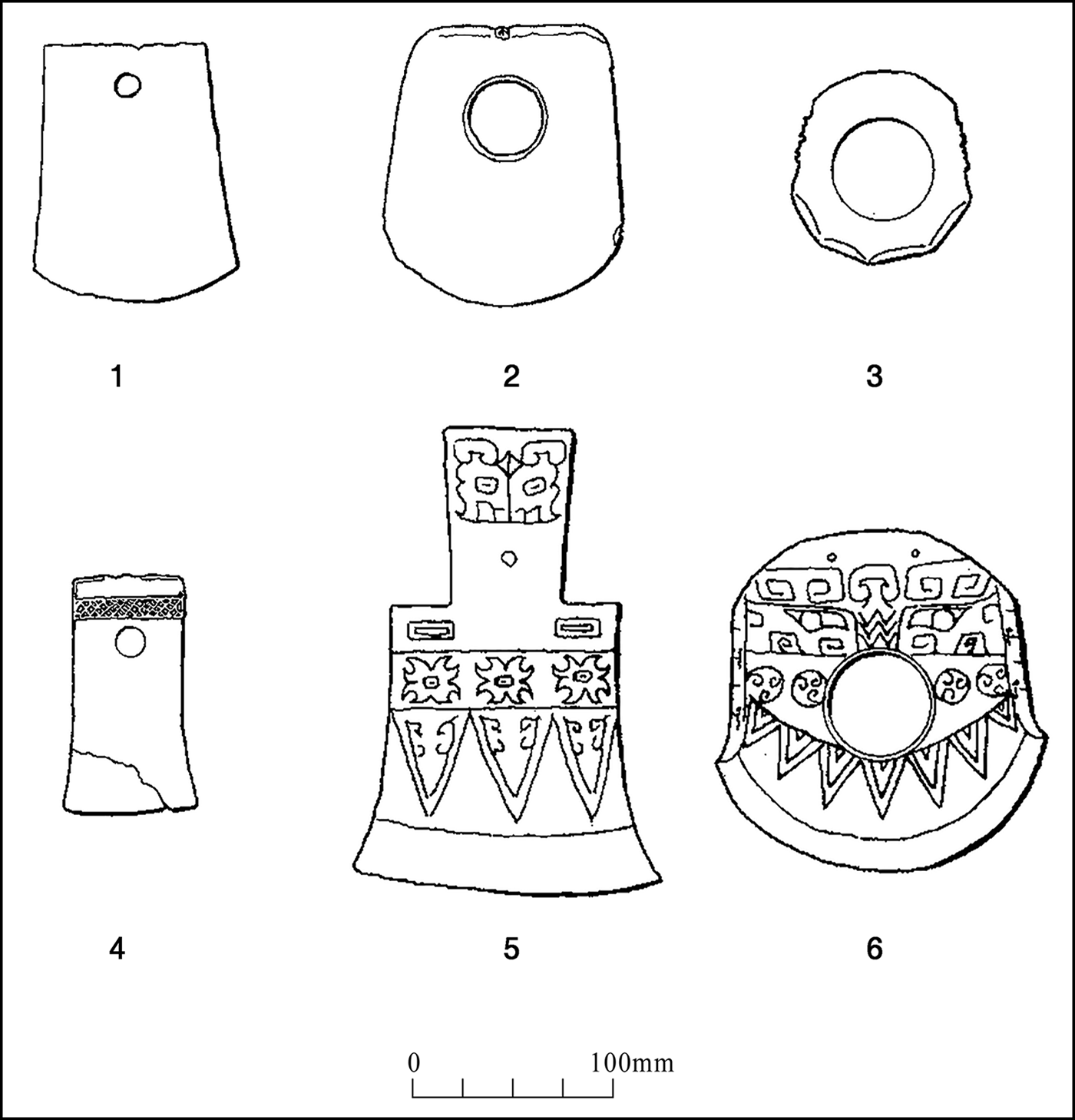
Numerous tombs here have yielded fine ceramics and, more remarkably, jades (Qin Reference Qin, Yanjiusuo and Kaoguxue Yanjiu Zhongxin2015; Renfrew & Liu Reference Renfrew and Liu2018). Clear levels of status or hierarchy are indicated by a wide variety in the numbers of jades associated with buried individuals. Most burials at Yaoshan, for example, contain more than 20 jades (Zhejiangsheng 2003: 203), while burials at other sites, such as Bianjiashan, have fewer than 10 (Zhejiangsheng 2014: 443–44). There are three main categories of jade, all clearly signalling the social status or position of the buried individuals: jade or stone axes with decorative fittings for staffs (Figure 4); personal ornaments, especially for the head and neck; and two major types of ritual jade—the cong (a tube with a square section pierced by a cylindrical hole) and the bi (a disc pierced with a circular hole). Both these latter types required large quantities of jade. Although the source of this material is unknown, small carving tools of flint (Chen et al. Reference Chen, Liu and Wang2017), for incising the face patterns that were shared across many different sites in the Taihu area (Qin Reference Qin, Yanjiusuo and Kaoguxue Yanjiu Zhongxin2015: 32–33), have been recovered.
A comparison of jade and bronze axes: 1) Yaoshan M7 jade axe, from Zhejiangsheng (2003: 80, fig. 95); 2) Yaoshan M7 stone axe from Zhejiangsheng (2003: 105, fig. 128); 3) Erlitou axe jade cut from a bi disc, from Du & Xu (Reference Du and Xu2005: 635, fig. 4:3); 4) Erlitou bronze axe, from Du & Xu (Reference Du and Xu2005: 725, fig. 1); 5) Guaojiazhuang M160 bronze axe, from IA CASS (1998: 106, fig. 82.1); 6) Guojiazhuang M160 jade axe, from IA CASS (1998: 115, fig. 91) (figure by John Rawson).

Our OxCal plot confirms what has long been inferred: that the main Liangzhu centres declined after 2500 BC. As the highly distinctive cong and bi jades have been found at later Liangzhu type sites to the north and south, it seems probable that people moved to establish new settlements or extend existing ones at Qianshanyang (Figure 2), Guangfulin and Haochuan, taking jade-working skills or actual jades with them. These areas were active to the end of the third millennium BC and slightly later, but had disappeared before the rise of Erlitou, c. 1750 BC, and its bronze production in 1600 BC. Notwithstanding the decline of the major Liangzhu centres, the imprint of Liangzhu ritual jades was to be even more profound, with versions of these jade axes, the cong and the bi subsequently used in central China and farther west and north (Zhu Reference Zhu2017). Their widespread impact ensured that jade remained the most highly valued material for ritually important weapons as well as personal ornaments into the Erlitou period (Rawson Reference Rawson1995; Deng Reference Deng2007).
While the large site at Shijiahe (2500–2000 BC) on the middle Yangtze and its predecessors at Qujialing (3400–2500 BC) (IA CASS 1965; Zhang Reference Zhang, Wenbo Xueyuan and Kaoguxue Yanjiu Zhongxin2013) were contemporaneous with Liangzhu, they reveal rather different cultural traits. Their rise and decline were similar to the pattern observed at Liangzhu: the initial growth of a large walled site, supported by rice cultivation, was followed by decline and dispersal c. 2000 BC. At 8km2, Shijiahe shared with Liangzhu the need to manage water with both channels and massive walls. At its zenith in the mid third millennium BC, the central walled area at Shijiahe was 1.2km2 in size. The inhabitants of both Qujialing and Shijiahe made fine ceramics, many of which shared shapes and decoration with those of the late Dawenkou Culture in Shandong (3000–2600 BC), thereby indicating the wide influence of Shandong ceramics (Zhang Reference Zhang and Zhang2015). The presence of very fine and unusual jades, generally later in date than the main occupation of the site, are further evidence of contact with Dawenkou peoples, who also made exceptional jades. Several similarly walled or moated sites located on a range of hills to the north of Shijiahe were also part of the Shijiahe sphere of influence (Meng & Xiang Reference Meng and Xiang2015). By the end of the third millennium BC, however, the majority of these regions and their centres had lost their large-scale populations (Zhang Reference Zhang2003, Reference Zhang, Wenbo Xueyuan and Kaoguxue Yanjiu Zhongxin2013).
Massive walls (Flad Reference Flad2018) also surrounded Baodun Culture sites in the Sichuan Basin. The area is less well understood than those described above. While occupation of the Baodun region ceased in the early second millennium BC (Figure 3), this was later followed by the development of the remarkable Sanxingdui settlement on the upper Yangtze (Figure 2; Flad Reference Flad2018). The massive and sophisticated constructions in all the basins of Yangtze River involved both planning within large areas and population management. Concurrently, the populations of both Liangzhu and Shijiahe—and probably also the Baodun peoples—followed ritual practices (including mortuary deposition) involving exceptionally high-quality crafted materials to maintain their socio-political bonds and ensure the status of their elites (Baines & Yoffee Reference Baines, Yoffee, Feinman and Marcus1998).
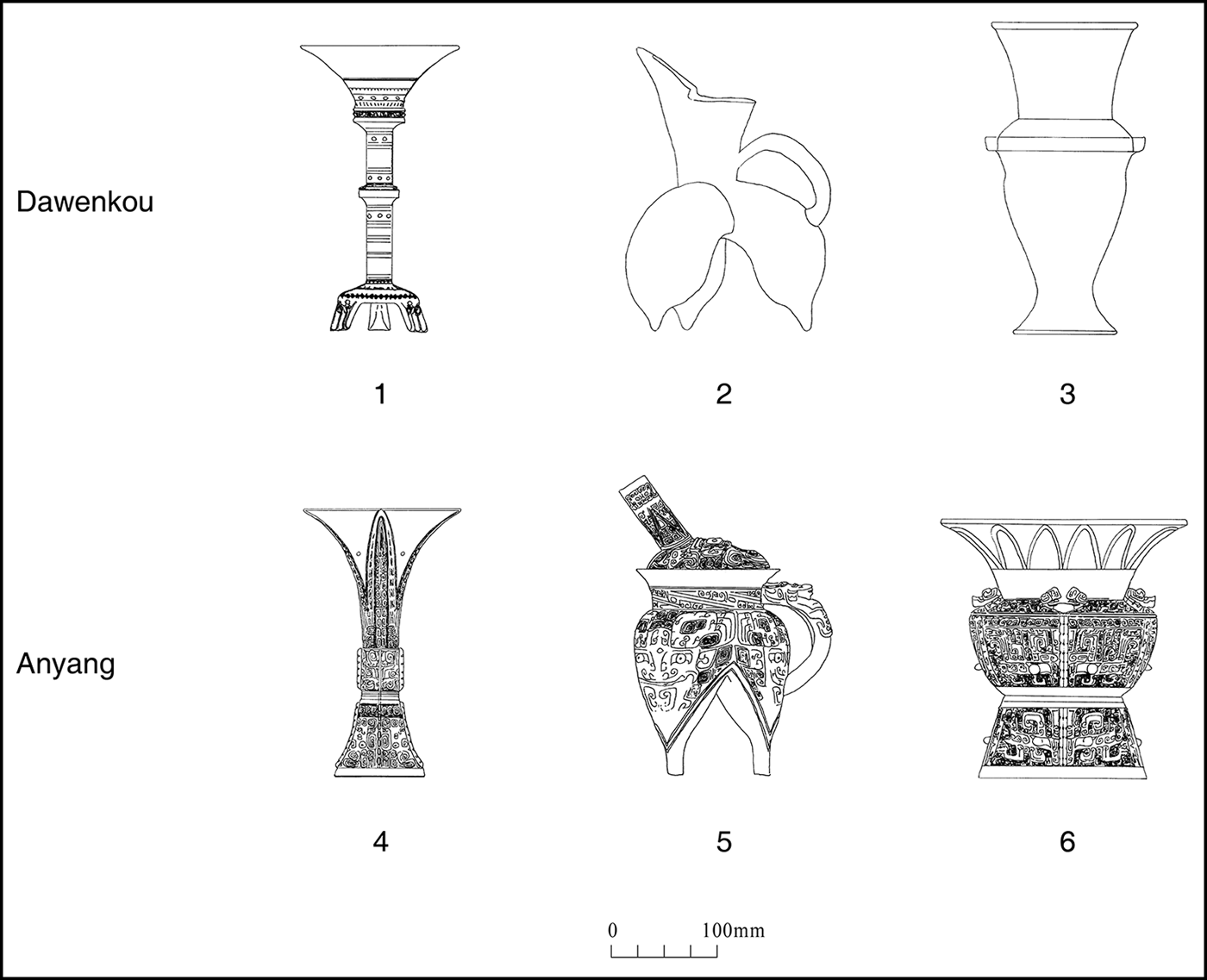
Walled sites in the Shandong peninsula were smaller than those in the Yangtze Basin (Zhang Reference Zhang2017; Table S1). Changes in site number, however, show increased activity, followed again by decline (Figure 3). As in regions farther south, fine jades were significant markers of status. In all the areas mentioned here, complex and intricate ceramics were made on a large scale, with significant division of labour (Vandiver et al. Reference Vandiver, Ruan, Fang, Yu, Cai and Underhill2005). Particularly elaborate ceramics manufactured by Dawenkou and Longshan potters are found in some tombs in Shandong. These reflect feasting rituals at funerals and beliefs concerning suitable provision for the afterlife (Underhill Reference Underhill2002, Reference Underhill2018). Such massive and high-quality pottery production was unmatched elsewhere in Eurasia. One important characteristic form—a lobed vessel, or ewer, for pouring liquids—was an innovation of the Dawenkou groups, and was adopted in many parts of eastern China and the Yangtze Basin (Zhang Reference Zhang and Zhang2015). Figure 5 shows the contribution of this type of ewer, along with other eastern Neolithic vessels for liquids, as models for the later development (c. 1200 BC) of Shang bronzes.
Anyang bronzes (c. 1200 BC) and their Neolithic ceramic prototypes from Dawenkou (c. 4300–2600 BC): 1) tall cup, from Shandongsheng (1997: 155, fig. 114); 2) gui, from Shandongsheng (Reference Guanlichu and Bowuguan1974: 84, fig. 68.8); 3) flask, from Shandongsheng & Jinanshi (Reference Guanlichu and Bowuguan1974: 89, fig. 71.7), Anyang (tomb of Fuhao); 4) gu cup; 5) he vessel; 6) round zun vessel, from IA CASS (1980: pls 50.2, 39.2 & 22.1) (figure by Limin Huan).

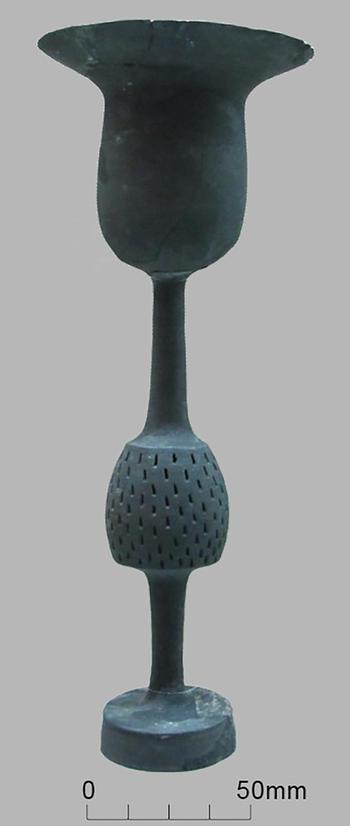
Fine black clay was employed to make egg-shell-thin drinking cups, which were used for ceremonial and ritual purposes. These were made in several distinct sections: a small cup, for example, was joined to a narrow stem, followed by a bulging middle, another slender stem and then, finally, a wide foot (Figure 6). Such attention to construction, which might occasionally involve moulding, was the forerunner of the skills required to create the ceramic moulds used in the complex construction of cast bronzes (Bagley Reference Bagley1987: 24–26; Underhill Reference Underhill2002).
A black egg-shell ceramic cup from Liangchengzhen on the Shandong peninsula, Longshan period, third millennium BC; courtesy of the Shandong Provincial Museum (figure by Xiaojia Tang).

All of the southern and eastern societies mentioned above declined and disappeared. The massive barriers and walls constructed at many sites indicate that the intrusion of water was a problem (Table S1). Marine transgression may have gradually flooded the eastern areas, pushing water-management problems westwards up the Yangtze River (Chen et al. Reference Chen, Zong, Wang, Wang and Chen2008; Wang et al. Reference Wang, Mo, Li, Yu, Xue, Liu, Wang and Shi2017). Only the region around Luoyang—where the Erlitou centre developed—remained relatively unaffected by various events that combined to diminish many of the settlements discussed above (Figure 2) (Shelach-Lavi & Jaffe Reference Shelach-Lavi and Jaffe2014; Zhang Reference Zhang2017; Campbell Reference Campbell2018: 54–55). The loss of these major centres removed the foundational settlements for potential large-scale competitors for the bronze-using groups at Erlitou and its Shang successors (1500–1046 BC) and their later cities (present-day Zhengzhou and Anyang) (Figure 2). The absence of other major bronze-casting groups elsewhere in China was an important factor that contributed to the powerful influence that the first dynasties exerted on the Central Plains.
Metallurgy and the borderlands
We now consider briefly the sources of the metallurgical techniques that facilitated the production of bronze vessels at Erlitou and the huge metallurgical industry of the Shang (Figure 1). The origins of metallurgy in East Asia continue to be debated and are underpinned by the concept of metallurgical provinces across large areas of Eurasia advanced by E.N. Chernykh (Reference Chernykh1992). The very early (7000–5000 BC) use of copper, copper alloys and gold in Western Asia and the Balkans is widely accepted. Movement across the Eurasian Steppe in a generally west–east direction has also been tracked with major local variants recognised in the Seima Turbino phenomenon and among the Okunev people in the Minusinsk Basin in the third millennium BC (Chenrykh Reference Chernykh1992; Linduff & Mei Reference Linduff and Mei2009; Yang Reference Yang2016). The earliest forms of metallurgy within present-day China have been found in the borderlands to the west and north of the Central Plains (Linduff et al. Reference Linduff, Sun, Cao and Liu2017; Jaffe & Flad Reference Jaffe, Flad, Boivin and Frachetti2018), often described as the crescent-shaped region, or the Arc (Figure 2; Rawson Reference Rawson2017). Excavations at Xichengyi (2135–1530 BC; Chen et al. Reference Chen, Li, Qian and Wang2015) in the Hexi corridor (Figure 2) have identified an early copper-mining and -smelting source, radiocarbon dated to 2000–1700 BC (Chen Reference Chen2017)—well before the start of casting at Erlitou c. 1600 BC. Metal items have been found at many sites to the south-east in Gansu Province, belonging to the Qijia Culture (2200–1600 BC; Li Reference Li2006; Chen Reference Chen2017), and recently also farther north-east at the major walled centre of Shimao (Sun et al. Reference Sun, Shao, Liu, Cui, Bonomo, Guo, Wu and Wang2018). All examples follow the widely used Eurasian typology of weapons, tools (especially small knives) and personal ornaments.
The extraordinary Shimao site comprises a massive walled enclosure, with inner and outer sections totalling 4km2 in area, and a massive stone platform (Table S1) (Sun et al. Reference Sun, Shao, Shao, Kang, Qu and Liu2013, Reference Sun, Shao, Di, Kang, Zhao, Shao and Xia2017, Reference Sun, Shao, Liu, Cui, Bonomo, Guo, Wu and Wang2018). Other stone-built enclosures that are generally contemporaneous with Shimao have been discovered in the Northern Zone (Figure 2) in Inner Mongolia and either side of the Yellow River where it runs south (Wang & Ma Reference Wang and Ma2006). Additional large settlements have also been found to the east, in the Chifeng region (Zhang Reference Zhang2017). These imply a significant increase in the numbers of people across the borderlands who were able to provide the labour required for the building of these stone structures (Zhang Reference Zhang2017). In this instance, it appears that environmental and climatic changes took place from the mid third to the early or even mid second millennium BC, which led first to an increase in population and then a major decline (Zhang Reference Zhang2017; Sun et al. Reference Sun, Shao, Liu, Cui, Bonomo, Guo, Wu and Wang2018).
It is not yet known whether metallurgy arrived in the Central Plains from the Qijia Culture to the west, where a large, 2km2 centre has been located at Yunbaoshan (Zhang Reference Zhang2017), or from Shimao and down the Yellow River via the major Late Neolithic site of Taosi (Gao & He Reference Gao and He2014) (Figure 2). At its zenith, Taosi was 4km2 in area. It developed over a long period (c. 2300–1900 BC; IA CASS & Shanxisheng 2015: 1234–40), suffering a break and decline in prosperity and activity, before its final period of ascendency. This break may have been a consequence of events farther north in the area of stone structures, perhaps as the boundary of the Pacific Monsoon (the principal source of moisture in Southeast and East Asia) fluctuated and moved south (Peng et al. Reference Peng, Xiao, Nakamura, Liu and Inouchi2005; Li et al. Reference Li, Liu, Wu, McCloskey, Li and Mao2014). As ceramics and jades at Taosi match Shimao typologies, it has been suggested that migrants from the Shimao region may have moved south (Sun et al. Reference Sun, Shao, Liu, Cui, Bonomo, Guo, Wu and Wang2018). New dates for other sites in the region (Figure 3) confirm that the final stages of the Late Neolithic period flourished here (Liu & Chen Reference Liu and Chen2012: 220–28), but declined before Erlitou expanded in the period associated with bronze casting, c. 1600 BC (Figure 3).
Whatever the route of transmission, all these areas prioritised Northern Eurasian types of metalwork—that is, weapons, tools and personal ornaments—although Taosi has also revealed a small cast bronze bell (IA CASS & Shanxisheng 2015: 666–67). This presents a discontinuity or paradox similar to that mentioned for the Neolithic settlements of the east and the Yangtze Basin. Erlitou's bronzes cannot be regarded as the direct descendants of the metallurgical typologies introduced from the north. We must again consider the impact of the eastern ceramic ritual vessels on the peoples of the Central Plains, as one of Erlitou's major contributions was to act as a magnet for people and materials from several surrounding regions (Han Reference Han2015; Campbell Reference Campbell2018: 54).
The Central Plains and the rise of Erlitou
None of the pre-Erlitou sites on the Central Plains show the scale of development recorded in the Yangtze valley and the basin of the lower Yellow River. This further challenges the traditional narrative focusing on the Central Plains, including its extension into the Yuncheng Basin, to the south of Taosi. This basin witnessed a decline in the overall number of sites, but a growth in the sizes of individual sites; the largest Late Neolithic settlement site, Zhoujiazhuang (2200–1750 BC), for example, reached 4.5km2 (Table S1). In Henan Province, more compact sites at Wangchenggang (2200–1800 BC) and Xinzhai (2050–1900 BC), and nearby Guchengzhai (Xu Reference Xu2017: 108, figs 4.53, 4.57, 110), are often seen as significant forerunners of Erlitou (Han Reference Han2010, Reference Han2015; Xu Reference Xu2018), due to their extensive walls, complex structures and ceramics (IA CASS & Shanxisheng 2015). Traces of a large structure at Guchengzhai are accepted as a predecessor of the larger buildings or even palaces known from Erlitou (Du Reference Du2010). Recently obtained radiocarbon dates from other Late Neolithic sites on the Central Plains suggest that activity probably ceased before bronze casting started at Erlitou (Figure 3).
As Underhill (Reference Underhill2018) has suggested, it was only in this early second-millennium BC period that some of the more complex Longshan ceramics—developed in Shandong—were adopted on the Central Plains. This was a decisive moment, as these provided the models for the ceramics used at Erlitou. Here, people had remained dedicated to existing rituals involving many ceramic vessel types, before creating the first bronze vessels. Erlitou was well established and employed typical Neolithic forms of ritual before its workshops began to cast bronze. This provides a straightforward explanation for why the elite—when the new technology was acquired—turned to bronze vessels, rather than concentrating on the Eurasian metal typology of weapons and personal ornaments.
The concentration on bronze vessels followed Neolithic ritual ceramic practices in four respects:
1) In the use of sets (rather than individual pieces) on any one occasion, such as in a tomb, comprising a large range of different vessel types—although in the early stage, only two or three were made of bronze, with other ceramic forms accompanying them.
2) In an emphasis on vessel shapes that reflected the constructed character of Neolithic ceramics—that is, vessels composed of several visually distinct parts.
3) In the priority given to wine containers.
4) In the burial of the vessels in tombs.
All of these are characteristics of the vessels shown in Figure 1. Jade was another material that Erlitou inherited from its Neolithic predecessors (IA CASS 2014: 1374–427). Many of the jades excavated at Erlitou came from elsewhere; the jade axe illustrated in Figure 4, for example, was probably made by cutting an earlier bi disc into a new shape. Other jades indicate contact with Dawenkou, Shijiahe and even distant Liangzhu. Jade survived well in burial contexts and was readily recovered from them, ensuring that it was always available to later owners in prominent positions to exploit (Rawson Reference Rawson1995: 22–27). This practice probably also inhibited the elites of the Central Plains from adopting bronze for symbolic weaponry and personal ornaments, turning instead to jade. The occupant of tomb 160 at Guojiazhuang, at Anyang, whose bronze vessels are shown in Figure 1 and who was buried with a whole armoury of lesser bronze weapons (in terms of quality), was accompanied by fine bronze axes in the shape of jades and a jade axe cut from an earlier disc (IA CASS 1998: 115) (Figure 4).
The general movement of interest in jade from the east to the centre, west and north—before the arrival of metal—embedded it within the rituals of many different cultural groups (Rawson Reference Rawson1995; Deng Reference Deng2007). Personal display using decorated bronze weapons and ornaments was not generally adopted in central China, where the elite were committed to the strong Neolithic traditions of jade insignia alongside feasting vessels.
Conclusion
We argue that the ascendency of Erlitou, with its location on the Central Plains, was the outcome of a series of major changes in the geographic distribution of large, Late Neolithic centres. These changes have to be included in the narrative of China's pre-dynastic history if we are to account for the paradoxes mentioned at the outset. Long before the rise of Erlitou and its Shang successors, Neolithic settlements were established to the south and east of the Central Plains. A relatively dramatic shift—certainly in geographic focus and probably also in population—took place over the late third and early second millennia BC. This denuded the south and east of major settlements and contributed initially to the expansion of sites along the northern borderlands, and only then to the growing significance of the Central Plains. We have documented these changes through site sizes and infrastructures (Table S1), and in a chronology derived from available radiocarbon dates (Figure 3). The causes and consequences of this transformation are now widely debated in China and beyond. The new discoveries at both Liangzhu in the south-east and at Shimao in the north have led their excavators to claim that the origins and development of Chinese civilization should be reconsidered (Han Reference Han2015).
We have also focused on the genesis of China's major bronze vessel tradition as it had many of its sources in the high-quality, specialised ritual ceramics of the eastern Dawenkou and Longshan Neolithic Cultures (Figure 5). The introduction of bronze metallurgy from the Steppe and the north-western borders of China was an essential ingredient of this stage. A conjunction of two completely different traditions cemented a fundamental contrast in the material culture of Eastern Eurasia. People along the borderlands (Figure 2) shared the bronze production of weapons and body and dress ornaments that formed part of wider Northern Eurasian cultural practices with steppe groups (Yang Reference Yang2016). Conversely, the elites of the Central Plains concentrated on the use of cast bronze vessels for rituals that reinforced not the standing of an individual, but of an individual in a lineage, and represented an essential element in the socio-political network (Campbell Reference Campbell2018: 122–31). They also perpetuated the Neolithic custom of using jade for personal ornaments and symbolic weapons. Hence, the societies on the Central Plains took a very different direction from that of the heroic warriors recognised in Western Eurasia (Kristiansen & Larsson Reference Kristiansen and Larsson2005).
The rise of Erlitou as a major bronze-casting centre foreshadowed the success of the dynasties on the Central Plains, without competition from other regions that had supported major Neolithic societies. This success depended upon four unrelated developments. First, the decline of many large settlements in the Yangtze River and lower Yellow River Basin facilitated the domination of Erlitou and its successors on the Central Plains. Second, the coincidental arrival of metallurgy in the north-west provided a new stimulus and new opportunities. Third, before the arrival of bronze, the practice at Erlitou of preserving Neolithic feasting rituals gave prominence to vessel types inherited from much earlier Neolithic societies in eastern China. Finally, the circulation of jade during the Late Neolithic—elevated to a high level of craftsmanship and social status in the centres on the Yangtze and in Shandong—and its arrival in Gansu, Shimao, Taosi and Erlitou, reinforced its continued use and restrained a move towards the use of bronze for symbolic weapons and personal ornaments. These factors underpinned the later dynastic heritage with its heart on the Central Plains, and entrenched a continuing divergence from the cultural traditions of Northern Eurasia.
Acknowledgements
The paper makes extensive references to, and depends on, studies by many archaeologists working across China. In particular, we owe a large debt to Xu Hong for his fundamental contributions on Erlitou and for his volumes on large walled sites.
Supplementary material
To view supplementary material for this article, please visit https://doi.org/10.15184/aqy.2019.63