

Introduction
Invasive alien species (IAS) present a major threat to global biodiversity (Davis Reference Davis2009, Vilá et al. Reference Vilà, Espinar, Hejda, Hulme, Jarošík, Maron, Pergl, Schaffner, Sun and Pyšek2011). Their influence may be compounded by other human induced factors such as habitat modification, international trade, and climate change (Hellmann et al. Reference Hellmann, Byers, Bierwagen and Dukes2008). Mechanisms of IAS interference with native biodiversity include competition, hybridisation, predation, and disease introduction and transmission (Blackburn et al. Reference Blackburn, Essl, Evans, Hulme, Jeschke, Kühn, Kumschick, Marková, Mrugała, Nentwig and Pergl2014). The biodiversity of isolated islands is particularly at risk from IAS (Rocamora and Henriette Reference Rocamora and Henriette2015); island isolation has facilitated the evolution of endemism and at the same time has protected endemic taxa from generalist predators, competitors, and pathogens that are often widespread on larger land masses. This renders island species with limited distribution particularly vulnerable to incursions of opportunistic predators and competitors. Eradication of IAS and reintroduction of endemic birds are ways of mitigating threats to the survival of endemics (McCormack and Künzle Reference McCormack and Künzle1996, Jones et al. Reference Jones, Holmes, Butchart, Tershy, Kappes, Corkery, Aguirre-Muñoz, Armstrong, Bonnaud, Burbidge, Campbell, Courchamp, Cowan, Cuthbert, Ebbert, Genovesi, Howald, Keitt, Kress, Miskelly, Oppel, Poncet, Rauzon, Rocamora, Russell, Samaniego-Herrera, Seddon, Spatz, Towns and Croll2016, Veitch et al. Reference Veitch, Clout, Martin, Russell and West2019).
While much is now known about the impacts and eradication methodologies for mammalian predators (Holmes et al. Reference Holmes, Spatz, Oppel, Tershy, Croll and Keitt2019), especially rodents, less is known about these aspects of invasive birds (Veitch et al. Reference Veitch, Clout, Martin, Russell and West2019, Avery and Feare Reference Avery, Feare, Downs and Hart2020). One of the bird species considered most invasive and threatening to native taxa is the Common Myna Acridotheres tristis, recognised as one of the world’s 100 most serious invasive species (IUCN 2014). There is now considerable but largely circumstantial evidence that introduced Common Mynas (hereafter “mynas”) negatively impact native bird populations, on continents as well as islands, through competition for resources, especially nest cavities, but also including food and sometimes direct aggression, disturbance, and predation (Komdeur Reference Komdeur1996a, Pell and Tidemann Reference Pell and Tidemann1997, Tindall et al. Reference Tindall, Ralph and Clout2007, Dhami and Nagle Reference Dhami and Nagle2009, Grarock et al. Reference Grarock, Tidemann, Wood and Lindenmayer2012). On small islands that host remnant populations of endemic avifauna, mynas are thought to have especially serious impacts, limiting the endemics’ recovery and threatening attempts to reintroduce endemic species that were formerly present (McCormack and Künzle Reference McCormack and Künzle1996). Mynas have additionally been implicated in disease transmission to endangered fauna (Kannan and James Reference Kannan, James, Poole and Gill2001), in dispersal of invasive plants following consumption of the fruits (Ashmole and Ashmole Reference Ashmole and Ashmole2000) and in agricultural damage, especially to fruits (Feare and Craig Reference Feare and Craig1998). On the other hand, in some circumstances mynas have been claimed to control populations of crop-damaging insects, especially grasshoppers and locusts (Acrididae), but we are not aware of any quantification of such benefits. Nevertheless, this has provided the basis for wide-scale introductions of mynas beyond their native range in the expectation that they exert biological control of insect pests (Feare and Craig Reference Feare and Craig1998, Cheke and Hume Reference Cheke and Hume2008).
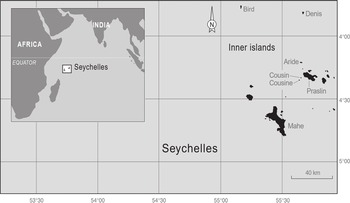
One island ecosystem where mynas have exerted a huge impact on the native environment is Seychelles (Figure 1), an archipelago of c.115 islands in the western Indian Ocean. Most are coralline with little or no human occupation, although some are being developed as tourist destinations. The inner granitic islands and two northern coralline outliers, Bird and Denis Islands (Figure 1), support the main human development but these islands are also the main centres of Seychelles’ floristic and faunistic endemism, including birds. The early years of human colonisation (late 18th and 19th centuries) saw profound vegetational changes, as indigenous species were exploited for construction of houses and boats, and were widely replaced by non-native species, especially fruiting trees, e.g. mango Mangifera indica and breadfruit Artocarpus altilis and spices, e.g. cinnamon Cinnamonum zeylanicum and vanilla Vanilla planifolia. At lower elevations on the granitic islands, and especially on coralline islands, native vegetation was widely replaced by monocultures of coconuts Cocos nucifera (Sauer Reference Sauer1967). Non-native rodents became established and other mammals (e.g. cats Felis catus, tenrec Tenrec ecaudatus), insects (e.g. American cockroach Periplaneta americana), birds (e.g. Madagascar Fody Foudia madagascariensis, Barred Ground Dove Geopelia striata, Barn Owl Tyto alba) were both accidentally and deliberately introduced (Rocamora and Henriette Reference Rocamora and Henriette2015). Acceleration of human development in the 20th and 21st centuries, including greater connectivity between islands and with the wider world, has been accompanied by introductions of many new IAS and arrivals of new species continues (Rocamora and Henriette Reference Rocamora and Henriette2015). On an increasing number of Seychelles’ islands, however, both private and government-owned, rehabilitation programmes aimed at enhancing indigenous flora and fauna have been initiated, where necessary accompanied by the management of introduced species (e.g. Samways et al. Reference Samways, Hitchins, Bourquin and Henwood2010, van Dinther et al. Reference van Dinther, Bunbury and Kaiser-Bunbury2015, Bunbury et al. Reference Bunbury, Haverson, Page, Agricole, Angell, Banville, Constance, Friedlander, Leite, Mahoune, Melton-Durup, Moumou, Raines, van de Crommenacker, Fleischer-Dogley, Veitch, Clout, Martin, Russell and West2019).
Map of central Seychelles, showing the location of Denis Island in the north of the archipelago.

Mynas were introduced to the granitic (inner) Seychelles islands from Mauritius in the late 18th or 19th centuries, ostensibly to control insect pests (Dupont Reference Dupont1930). Since their introduction, mynas have colonised many of the granitic islands, especially those supporting large human populations, and on some mynas live at high densities (Feare et al. Reference Feare, van der Woude, Greenwell, Edwards, Taylor, Larose, Ahlen, West, Chadwick, Pandey, Raines, Garcia, Komdeur and de Groene2016). Here, their frugivory is believed to facilitate the dispersal of invasive plants such as cinnamon and coco-plum Chrysobalanus icaco, both of which have landscape-changing potential, displacing or outcompeting native flora (Sauer Reference Sauer1967).
During early studies of Seychelles’ rare endemic birds, it became increasingly evident that mynas affected not only flora, but also the avian fauna on some islands. Komdeur (Reference Komdeur1996a) first reported adverse effects of mynas on Frégate Island on the then ‘Critically Endangered’ Seychelles Magpie Robin Copsychus sechellarum. Initiation of nesting by mynas in trees already occupied by nesting Seychelles Magpie Robins led to abandonment of the nest by the latter species during construction, and others to appreciably reduce time devoted to incubation, reducing hatching success. Both of these interferences were due simply to the presence of the mynas; there was no direct molestation of the Magpie Robins or their nests. However, mynas are omnivorous and forage on invertebrates, reptiles, and birds, especially eggs and nestlings (Vesey-Fitzgerald Reference Vesey-Fitzgerald1936, Byrd Reference Byrd1979, Feare and Craig Reference Feare and Craig1998, Feare et al. Reference Feare, Lebarbenchon, Dietrich and Larose2015), raising the possibility that predation could have a direct impact on the productivity of susceptible bird species. Concerns over the perceived negative impacts of mynas led to attempts in the early 2000s to eradicate them from several islands, including Denis, but these early attempts failed (Millett et al. Reference Millett, Climo and Shah2004). That eradication of mynas is possible was shown by a successful eradication on Frégate Island (Canning Reference Canning2011), which has contributed to an increase in the Seychelles Magpie Robin population on that island (Burt et al. Reference Burt, Gane, Olivier, Calabrese, de Groene, Liebrick, Marx and Shah2016). Further successful eradications have now been achieved on two more Seychelles islands: Denis and North Islands (Feare et al. Reference Feare, van der Woude, Greenwell, Edwards, Taylor, Larose, Ahlen, West, Chadwick, Pandey, Raines, Garcia, Komdeur and de Groene2016, Reference Feare, Waters, Fenn, Larose, Retief, Havemann, Ahlen, Waters, Little, Atkinson, Searle, Mokhobo, de Groene and Accouche2021).
Here we examine whether mynas directly impacted endemic bird species by monitoring Denis island’s endemic avian populations prior to, during, and following the completion of a recent myna eradication. Prior to the myna eradication, small numbers (see below) of four of the Seychelles threatened endemic bird species were translocated to Denis Island, from islands on which they had survived, in order to establish new breeding populations (Richardson et al. Reference Richardson, Bristol and Shah2006). Three of the species had been reduced to single island populations (Seychelles Magpie Robin on Frégate Island, Seychelles Paradise Flycatcher Terpsiphone corvina on La Digue and Seychelles Warbler Acrocephalus sechellensis on Cousin Island) while the fourth, Seychelles Fody Foudia sechellarum, had survived on three islands in the archipelago (Cousin, Cousine, and Frégate).
In 2009, Denis Island’s mynas were discovered to be impacting the island’s endemic bird populations, following observations of head injuries (bald patches, scars, and eye damage that in one instance was thought to have led to blindness) to eight of 99 mist-netted Seychelles Warblers, “several” Seychelles Fodies and two of 25 Seychelles Paradise Flycatchers (van der Woude and Wolfs Reference van der Woude and Wolfs2009, Bristol and Nourrice Reference Bristol and Nourrice2009). Such injuries have not been seen on endemic birds on myna-free islands. As a result, a new myna eradication attempt was initiated, administered by Green Islands Foundation, and led by WildWings Bird Management. Endemic bird population trends were monitored before, during, and after the eradication, providing valuable data on the effects of myna removal.
This paper provides the first demonstration of the benefits to translocated endemic birds of the removal of mynas from a small tropical island, and thus of the critical role that myna eradication can play in the recovery of endangered island endemic birds. Given the large global environmental impact and high invasion potential of mynas, our results will hopefully demonstrate to other environmentalists that efforts and resources allocated to myna eradication can make a vital contribution to the success of native avian fauna reintroductions.
Methods
Study area: Denis Island
Denis Island (c.140 ha; 3°48′S, 55°40′ E) is a low-lying (<4 m asl) coral sand cay on the northern rim of the shallow (<100 m) Seychelles Bank. When first visited by western mariners in 1773 it was described as partly covered by a woodland of trees of soft wood of no use for construction (most likely Pisonia grandis) and the remainder a grassy plain full of seabirds, with sea turtles, land tortoises and sea lions also present (Stoddart and Fosberg Reference Stoddart and Fosberg1981). The occurrence of phosphatic sandstone over 80% of the island’s surface indicates that it was formerly extensively occupied by seabirds (Baker Reference Baker1963).
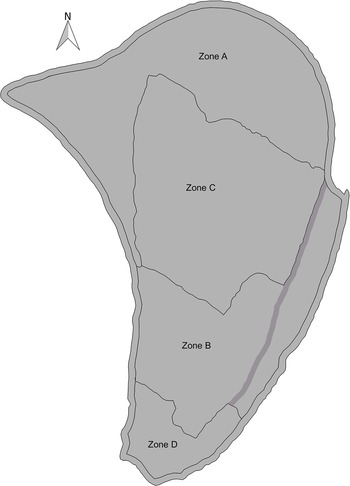
From around 1890 the island was transformed by the planting and cultivation of coconuts Cocos nucifera, but these were removed in order to extract guano from 1929 to 1941, after which coconuts were replanted (Hill et al. Reference Hill, Vel, Holm, Parr and Shah2002). Following transfer of ownership in 1975, the island became a tourist destination, accessed from Mahé by light aeroplane, with more emphasis on woodland development. A further change of ownership in 1998 led the current owners to enhance the tourism enterprise and introduce a substantial farming component to supply the hotel and to export produce to Seychelles’ main islands. These developments were accompanied by a conservation initiative that was formalised in a 5-year Environment Management Plan (EMP) (Nevill Reference Nevill2007): the island was divided into six zones (Figure 2) that were planned to enable different levels and types of primary usage while at the same time maximising the environmental potential of the island (Nevill Reference Nevill2007).
The land use zones proposed for Denis Island (Nevill Reference Nevill2015). Zone A: Primary Production Area: designated for intensive human activity, infrastructure placement and production landscapes (area north of airstrip includes farm and workers’ quarters, area in west contains the hotel and tourism facilities). Zone B: Secondary Production Area: designated primarily for production landscapes and low-density tourism/residential infrastructure. Zone C: Conservation Management Area: designated primarily for management to attain conservation/biodiversity objectives. Zone D: Ecosystem Restoration Area: area designated for restoration to island’s natural state. The coastal strip represents a further zone. The thicker grey line towards the east coast represents a buffer zone of vegetation between the main east coast track and a predominantly grassy area on its eastern side (requested by island management).

The conservation zone (Zone C; Figure 2) was designated for management appropriate to the introductions of the four endemic birds through the replacement of remaining coconut plantation with broad-leaved woodland. In preparation for these introductions, feral cats and black rats were eradicated in 2000 and 2002, respectively (Millet et al. Reference Millett, Climo and Shah2004). An attempted eradication of mynas in 2001 had failed (Millet et al. Reference Millett, Climo and Shah2004), but the introductions of the endemics nevertheless went ahead. With the help of national (Nature Seychelles, Green Islands Foundation) and international (Royal Society for the Protection of Birds, BirdLife International, Darwin Initiative) conservation agencies and specialists, Seychelles Warblers and Seychelles Fodies were introduced in 2004, and Seychelles Magpie Robins and Seychelles Paradise Flycatchers were introduced in 2008 (Wagner Reference Wagner2004a, Richardson et al. Reference Richardson, Bristol and Shah2006, Bristol Reference Bristol2008, Derand Reference Derand2008).
Habitat and endemic bird management
Following the introduction of the endemic birds, improvements to the island’s habitats have continued. Over 40 ha of coconut plantation and seedling coconuts within Zone C were replaced with 14 Seychelles indigenous broadleaved tree species, mostly Terminalia catappa (c.3000 planted), Ochrosia oppositifolia (720) Cordia subcordata (580), Ficus lutea and Pisonia grandis (200), to improve the provision of insect food for the birds (Nevill Reference Nevill2007, Bristol et al. Reference Bristol, Barra and Rose2009). In 2016, island conservation staff began clearing undergrowth of a densely growing native fern Nephrolepis biserrata in small plots within Seychelles Magpie Robin territories within the conservation zone. This was to allow the birds access to the soil surface, where they obtain most of their food (van de Crommenacker and van Dinther Reference van de Crommenacker and van Dinther2016), but ongoing weeding is needed to maintain these cleared areas (R. Bristol pers. obs.).
Once Denis Island’s habitats were deemed suitable to support some of Seychelles’ endemic birds, small numbers of four species were caught on islands where they had survived and transported in cages to Denis Island by fixed-wing aeroplane or helicopter. The main aim of these translocations was to establish insurance populations and improve their global conservation status (Hill et al. Reference Hill, Vel, Holm, Parr and Shah2002). The number of birds released as founder populations were: Seychelles Warbler – 58 (from Cousin Island); Seychelles Fody – 47 (from Frégate); Seychelles Magpie Robin – 20 (16 from Frégate, 4 from Cousin); Seychelles Paradise Flycatcher – 23 (from La Digue). The warbler, fody, and flycatcher were hard released in appropriate habitat on arrival. The Magpie Robins were soft released, initially maintained in large cages within suitable habitat at intended release sites in broadleaved woodland habitat. After a few weeks, free movement from the cages was allowed but supplementary feeding on their territories continued for two years. Further encouragement for Magpie Robins involved the provision within territories of nest boxes, some of which were occupied by mynas but most decayed. Further nest boxes have been erected (Bristol and Gamatis Reference Bristol and Gamatis2017) but monitoring of their use by Magpie Robins has not been reported.
Post-release monitoring of endemic birds
The intensity of monitoring the four endemic species has varied, with Seychelles Fodies subject to only one census, in 2015 (van de Crommenacker and van Dinther Reference van de Crommenacker and van Dinther2015), while the other species have received more frequent monitoring.
Three census techniques have been used to estimate population sizes of the endemic birds: territorial mapping and direct counts of birds in territories (Seychelles Warbler, Seychelles Magpie Robin, Seychelles Paradise Flycatcher) and distance sampling from a grid of fixed points (Seychelles Fody and other land birds on the island).
Territory mapping involved systematic surveys of the island and identification of territory boundaries through observations of the movements of individual birds and their behaviour. During surveys, observers walked slowly along tracks and through forest and located birds by direct observation, listening for song during dawn chorus and calls at other times of day (this included bill-snapping when warblers were foraging), and sometimes seeking responses to playback calls and human imitations.
Where possible, behavioural observations were supported by identification of individually colour-ringed birds. These birds were caught in mist nets, sometimes attracted by broadcast calls or human observer imitations of calls, and given individually identifiable combinations of coloured plastic rings along with a uniquely numbered metal ring (BTO/SAFring). Data collected for each territory included direct counts of birds within the territories and, where possible, their identities and ages (adult, immature, fledgling).
Seychelles Paradise Flycatchers were found to accrete spider web around legs of ringed birds, leading to leg injuries. In consequence, all rings that had been put on birds prior to their release in 2008 were removed from flycatchers on the island in 2009. Thereafter, variations in tail feather lengths and plumage colour have enabled some individuals to be identified individually (Bristol and Nourrice Reference Bristol and Nourrice2009), aiding the counting of birds in territories.
In 2015, the number and distribution of Seychelles Fodies were estimated, for the first time since their introduction, by distance sampling from fixed points. A grid with 58 counting points, separated 150 m from each other, was designed with a GIS package and in the field the points were located using a GPS. At each point, all Seychelles Fodies seen and heard within distance bands 0–10m, 20–30m, 30–50m and 50–100m were counted during a 5-minute period by two observers standing back-to-back, to each cover 180° of the circular area around the census point. In addition to Seychelles Fodies, all other endemic bird species (Seychelles Paradise Flycatcher, Seychelles Warbler, Seychelles Magpie Robin and Seychelles Blue Pigeon Alectroenas pulcherrima [this endemic species colonised Denis Island naturally in the late 20th century from established and expanding populations on the granitic islands to the south, Nevill Reference Nevill2015]) were counted, along with indigenous Common Moorhens Gallinula chloropus, and the three introduced alien birds on the island: Madagascar Fody Foudia madagascariensis, Madagascar Turtle Dove Nesoenas rostratus, and Barred Ground Dove Geopelia striata (van de Crommenacker and van Dinther Reference van de Crommenacker and van Dinther2015).
Mynas on Denis Island
The date and mode of arrival of mynas on Denis Island is uncertain. Denis Island is relatively remote from Seychelles’ granitic islands to the south (Figure 1; c.50 km N of the nearest myna-inhabited large granitic islands, Curieuse and Praslin, c.90 km NNE from archipelago’s main island Mahé, and c.53 km E of Bird Island, the other sand cay with a myna population). By the beginning of the 20th century, Madagascar Fodies and Barred Ground Doves (both introduced to Seychelles) were present on Denis Island but mynas were not (Fryer Reference Fryer1910). The ornithological history of Denis is poorly known (Stoddart and Fosberg Reference Stoddart and Fosberg1981) but by the 1970s mynas were well established. Whether they were deliberately introduced or arrived independently from a source in the granitic islands is unknown.
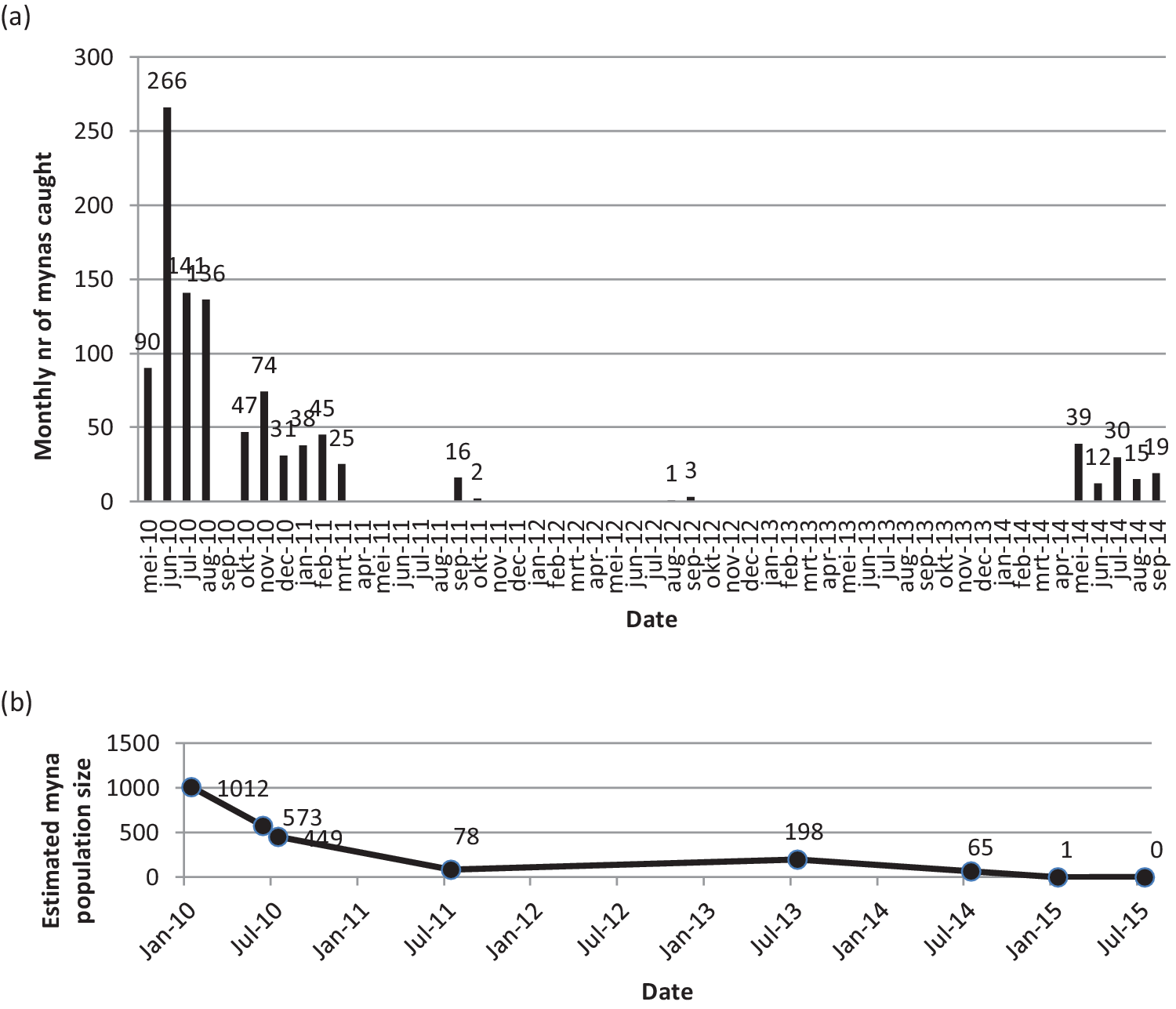
The successful eradication from Denis Island took place in three phases (Figure 3 and Feare et al. Reference Feare, van der Woude, Greenwell, Edwards, Taylor, Larose, Ahlen, West, Chadwick, Pandey, Raines, Garcia, Komdeur and de Groene2016); breaks in the process were due to staff and funding shortages. The trapping of 902 mynas during the first two phases between May 2010 and March 2011 resulted in a >90% fall in the island population censuses (for details see Feare et al. Reference Feare, van der Woude, Greenwell, Edwards, Taylor, Larose, Ahlen, West, Chadwick, Pandey, Raines, Garcia, Komdeur and de Groene2016) between January 2010 and July 2011 to an estimated 78 birds. Thereafter, an approximately 3-year lull in trapping allowed the myna population to increase to c.200, until the final trapping phase and subsequent shooting eradicated the remaining birds, the last being shot in July 2015 (van de Crommenacker and van Dinther Reference van de Crommenacker and van Dinther2015).
(a) The monthly catch rate of mynas on Denis Island from week 1, May 2010 to week 227, September 2014 (excluding the last bird shot on 25 July 2015) and (b) the estimated myna population sizes during the myna censuses before and during the eradication.

In January 2010, before the start of the eradication attempt in May, the density of mynas on Denis Island was estimated to be 644 birds/km2, which was high in comparison with other small island introduced populations in Seychelles (Bird >510, North >373, Frégate 340 birds/km2), and considerably higher than most continental urban and suburban introduced populations in Australia (3–189 birds/km2) and South Africa (59–325) (Feare et al. Reference Feare, van der Woude, Greenwell, Edwards, Taylor, Larose, Ahlen, West, Chadwick, Pandey, Raines, Garcia, Komdeur and de Groene2016). On Denis Island the large expanse of grassland on the airstrip, the farm, open areas and gardens within the hotel and staff village, and the mixed woodland of coconut palms and broadleaved trees, provided a mix of habitats that supported large numbers of mynas. This initial census recorded the highest densities in the farm (within Zone A, with livestock - poultry, cattle, pigs, and goats) and within the secondary production area (Zone B), which supported largely old coconut plantation and open grassy areas, while the lowest density was recorded in the conservation zone, comprising closed canopy broadleaved woodland (van der Woude and Neddermeijer Reference van der Woude and Neddermeijer2010). It was into this area that the endemic birds were introduced. During the myna eradication, the number of mynas was estimated periodically (J. van der Woude pers. obs.) using distance sampling from fixed line transects.
Results
Seychelles Warbler
Fifty-eight Seychelles Warblers (31 males and 27 females) were released in appropriate woodland habitat in Zone C in May–June 2004. Nest-building by some pairs started within three days of release and by September 2004, 20 territories had been located (Richardson et al. Reference Richardson, Bristol and Shah2006). Subsequent censuses have revealed that the number of birds increased 3.4-fold by 2015 (Johnson et al. Reference Johnson, Thomas, Brown, Richardson and Dugdale2018; J. van der Woude studied the development of the population and will fully describe details in her PhD thesis). This increase in numbers and distribution on the island occurred despite the frequency of recorded injuries to Seychelles Warblers inflicted by mynas. The severity of some of the observed injuries suggests that mynas must have created significant disturbance to adult warblers and likely some mortality. However, the initial introduction of warblers into the conservation zone, where the density of mynas was low, doubtless allowed warblers to establish here and in other areas of low myna density before spreading into areas of higher myna density, e.g. hotel and workers’ accommodation areas, prior to the main decrease in myna numbers in 2010.
Territory mapping in 2007 showed that Seychelles Warblers had established territories in the inland conservation zone south of the airstrip and in most coastal areas, but there were voids in south-central parts of the island (van de Crommenacker et al. Reference Van de Crommenacker, Riemerinck and Louter2007). By 2015 there had been more infilling and the voids in the south-central areas were still present but smaller (Doblas et al. Reference Doblas, McClelland, van der Woude and van de Crommenacker2015) and due to localised patches of grassland that did not provide suitable habitat for warblers.
Seychelles Fody
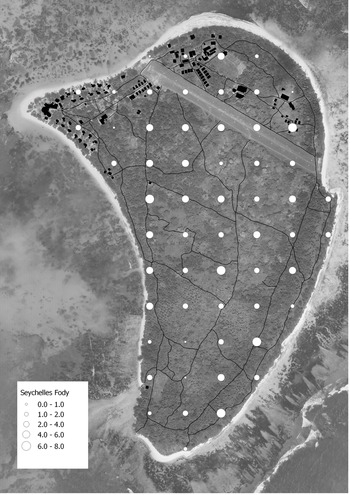
During the two years following the introduction of 47 Seychelles Fodies to Denis Island in 2004, brief surveys reported that birds had survived, breeding had commenced and that birds had spread from the initial site of introduction (Wagner Reference Wagner2004a,Reference Wagnerb, Legge Reference Legge2005, Brouwer and Reimerink Reference Brouwer and Reimerink2006). The only post-release census of Seychelles Fodies was done in 2015, when the population was estimated to be 600–1000 birds (van de Crommenacker and van Dinther Reference van de Crommenacker and van Dinther2015). The grid of point counts showed wide distribution over the island but suggested lower densities of birds in the south-central parts of the island (Figure 4) and also in the two Zone A areas (Figure 2), embracing the farm and staff accommodation north of the airstrip and the hotel in the north-west of the island.
The grid point count densities of Seychelles Fodies as determined during the 2015 census (van de Crommenacker and van Dinther Reference van de Crommenacker and van Dinther2015). The legend indicates the number of Seychelles Fodies detected during 5-minute counts within four distance bands of each census point. The practically featureless belt running WNW-ESE across the north of the island is the airstrip.

The impact of mynas on Seychelles Fodies after release is unknown. However, the detection of some birds with head injuries like those observed on warblers suggests that mynas might have constrained the early establishment of the fody population, especially in the areas of main human occupation where myna densities were highest. During the shooting phase in May 2014, towards the end of the eradication and by which time myna numbers had been considerably reduced (Feare et al. Reference Feare, van der Woude, Greenwell, Edwards, Taylor, Larose, Ahlen, West, Chadwick, Pandey, Raines, Garcia, Komdeur and de Groene2016), CJF considered that Seychelles Fody behaviour had altered. Although not quantified, they appeared visually and vocally much more conspicuous in woodland than earlier. They had also become commensal in the workers’ village, readily entering kitchens in search of food. This behaviour is typical of the species on Cousin and Cousine Islands, where Seychelles Fodies had survived in the absence of mynas, and on Aride Island, a myna-free island where the endemic fodies had been introduced in 2002 (Feare Reference Feare2017, Sands and Skerrett Reference Sands and Skerrett2018), but had not been seen earlier on Denis Island.
Seychelles Magpie Robin
On introduction to Denis Island in June 2008, the 20 Seychelles Magpie Robins were held in cages sited in appropriate habitat within the conservation zone (Zone C, Fig. 2). After c.3 weeks they were allowed to range freely from the cages but could return to them to receive supplementary food presented three times daily. The birds settled quickly and defended territories, and the first egg was recorded in August 2008. By December 2008 there had been 13 nesting attempts, but most were unsuccessful, with mynas implicated in a nest that was destroyed, in the death of a fledgling, and in interference (supplanting by more dominant mynas) at supplementary feeding sites for Seychelles Magpie Robins (Derand Reference Derand2008). Despite the provision of nest boxes, all of the nests were built in natural tree cavities (Derand Reference Derand2008).
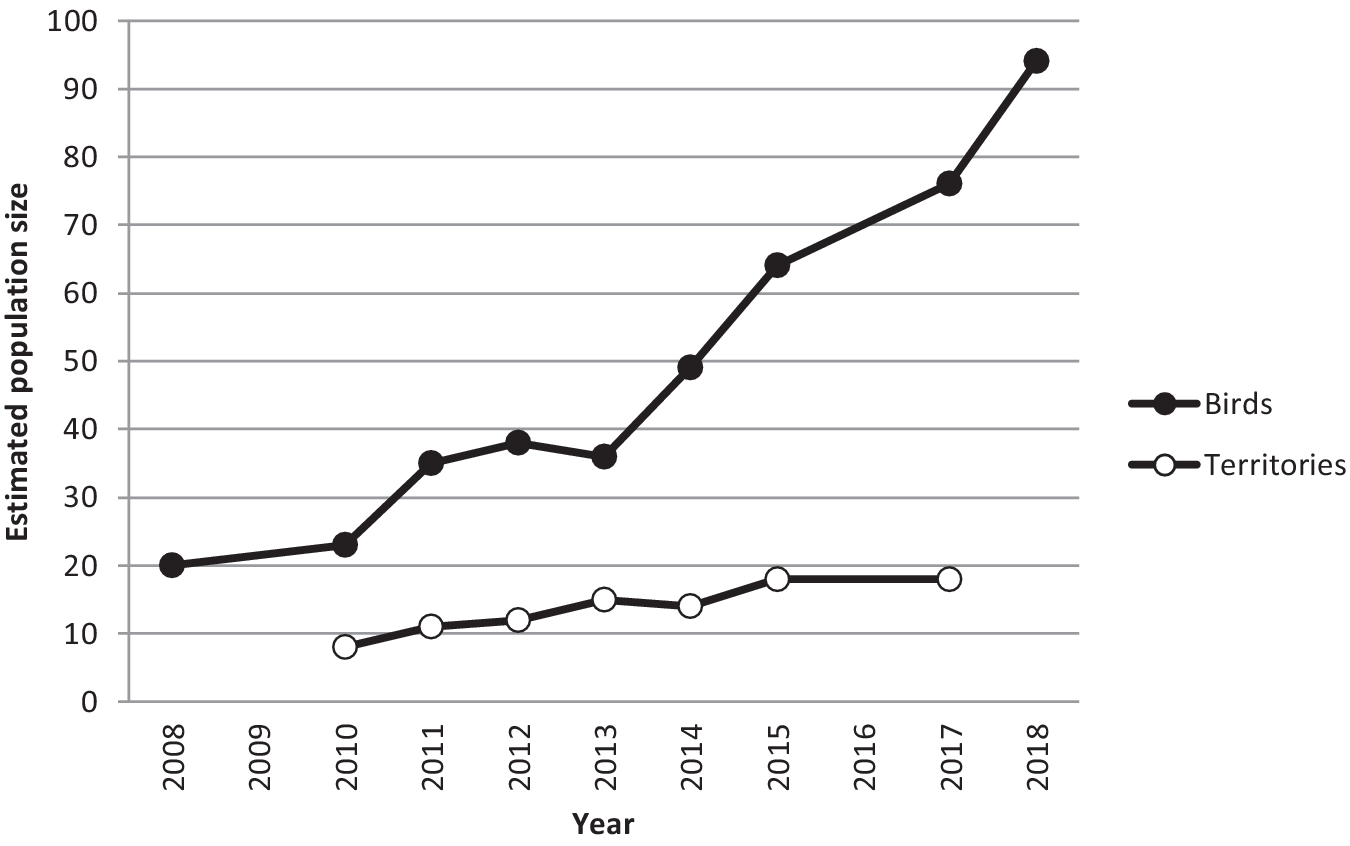
By 2010 the population had slightly increased to 23 individuals but by October 2011, 35 individuals were found and remained at roughly this level through to 2013 (Apperloo et al. Reference Apperloo, van Marrewijk and van der Woude2013). Thereafter, the population increased steadily to 94 in 2018 (Figure 5) (Gane and Olivier Reference Gane and Olivier2014, Lefler et al. Reference Lefler, Crawford and van de Crommenacker2015, Bristol and Gamatis Reference Bristol and Gamatis2017, Bristol and Accouche Reference Bristol and Accouche2019).
Estimated numbers of Seychelles Magie Robins and number of occupied territories on Denis Island since the introduction of 20 birds in 2008 (data from Apperloo et al. Reference Apperloo, van Marrewijk and van der Woude2013, Gane and Olivier Reference Gane and Olivier2014, Lefler et al. Reference Lefler, Crawford and van de Crommenacker2015, Bristol and Gamatis Reference Bristol and Gamatis2017, Bristol and Accouche Reference Bristol and Accouche2019).

The number of territories has increased more slowly (Figure 5), from eight in 2010 to 18 in 2015 and 2017. In the absence of large numbers of birds living outside territories as “floaters”, this implies multiple occupancy of territories, with up to eight individuals recorded within some territories (Lefler et al. Reference Lefler, Crawford and van de Crommenacker2015). However, Bristol and Accouche (Reference Bristol and Accouche2019) recently suspected that some individuals were living outside existing territories and possibly establishing new ones.
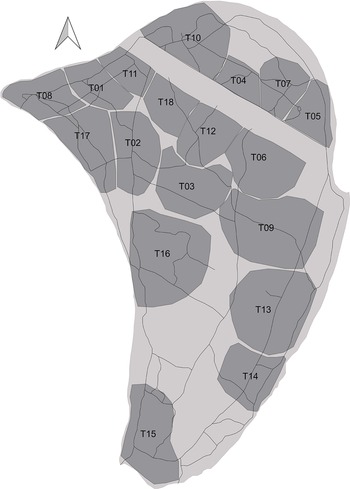
Lefler et al. (Reference Lefler, Crawford and van de Crommenacker2015) and van de Crommenacker and van Dinther (Reference van de Crommenacker and van Dinther2016) showed that Seychelles Magpie Robins had occupied areas beyond the conservation zone and the 18 territories identified extended over all zones, with up to eight individuals per territory. Since then, the number of territories has remained approximately the same, but some boundaries have changed (although accurate boundary maps have not been produced due to time constraints on recent surveys). Notably, the latest surveys have shown that territories in the north, within the hotel and farm complexes (Zone A), are smaller than most territories elsewhere on the island (Figure 6, see Discussion).
Map of the 18 territories of Seychelles Magpie Robins on Denis Island in 2016 (from van de Crommenacker and van Dinther Reference van de Crommenacker and van Dinther2016). Territories in the farm, staff village and hotel in Zone A, which have the greatest human occupation (territories 1, 4, 5, 7, 8, 10, 11) were significantly smaller than those in the remainder of the island, which experiences less human disturbance: Zone A disturbance territories range 1.76–5.46 ha, average 2.97 ± 1.21 (SD), n = 7; elsewhere range 2.71–8.59 ha, average 5.34 ± 1.98, n = 11; t15 = 3.16, P = 0.006.

Seychelles Paradise Flycatcher
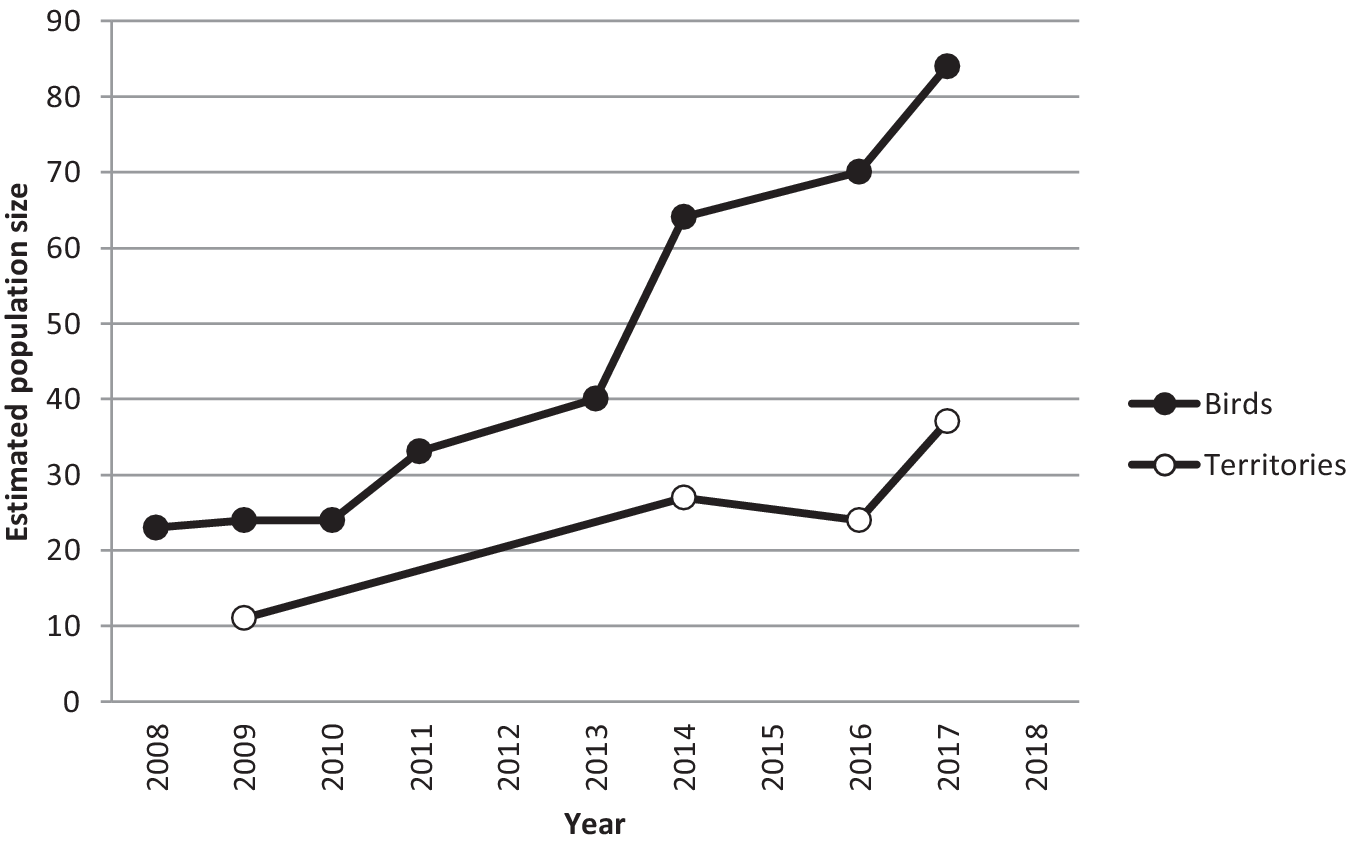
The 23 individuals released in November 2008 established territories and began breeding during their first year on the island. Numbers remained low through 2010 (Bristol Reference Bristol2008, Bristol and Nourrice Reference Bristol and Nourrice2009, French and Bristol Reference French and Bristol2010) but during the first year after introduction, the apparent stability involved the death of four of the translocated birds but the production of five juveniles (Bristol and Nourrice Reference Bristol and Nourrice2009). From 2011 onwards the numbers of birds and territories increased, a trend that appears to be continuing (Figure 7, French and Bristol Reference French and Bristol2010, Henriette and Laboudallon Reference Henriette and Laboudallon2011, Bristol Reference Bristol2013, Reference Bristol2014, Reference Bristol2016, Bristol and Gamatis Reference Bristol and Gamatis2017). During the increase, the sex and age structure of the population has remained more or less the same (Table 1). The censuses are believed to provide minimum estimates of population size as some birds, both males and females, have been recorded singly in apparent territories, and mates and other individuals could have been overlooked during these observations.
Estimates of the number of Seychelles Fycatchers, and the number of occupied territories in some years, following the translocation to Denis Island of 23 birds in 2008 (Data from Bristol and Nourrice Reference Bristol and Nourrice2009, French and Bristol Reference French and Bristol2010, Henriette and Laboudallon Reference Henriette and Laboudallon2011, Bristol Reference Bristol2013, Reference Bristol2014, Reference Bristol2016, Bristol and Gamatis Reference Bristol and Gamatis2017).

The numbers of adult male, adult female and juvenile (dependent and independent young birds) Seychelles Paradise Flycatchers recorded during censuses on Denis Island. (Data from Bristol and Nourrice Reference Bristol and Nourrice2009, Bristol Reference Bristol2014, Reference Bristol2016, Bristol and Gamatis Reference Bristol and Gamatis2017).

In 2009, eight of the first 11 territories were established south of but close to the airstrip, with three additional ones somewhat isolated further south. In the first year post-introduction, 26 breeding attempts, each involving a single egg, were recorded in seven of the territories but only five successfully produced a fledgling. Six nests were abandoned after their eggs failed to hatch, in five nests the eggs were predated, in two nests the chicks were predated, three further nests failed around due hatch date - believed to be due to predation or failed to hatch, one nest was abandoned during nest-building and the outcome of one nest was unknown, and three nests were ongoing. During this monitoring, two adult female flycatchers had bald patches on their crowns like those on Seychelles Warblers that had been attacked by mynas, suggesting that mynas could have been involved in the recorded nest predation and failures (Bristol and Nourrice Reference Bristol and Nourrice2009). Subsequent censuses have been of shorter duration and have not permitted detailed study of breeding success.
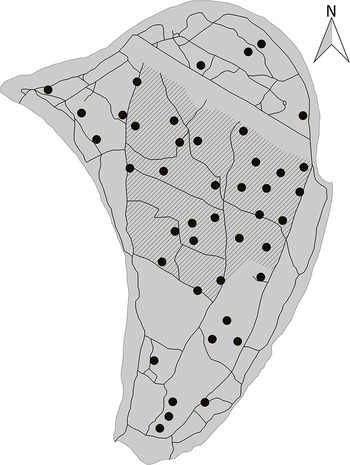
The 2016 territory map (Figure 8, Bristol and Gamatis Reference Bristol and Gamatis2017) reveals the highest density to be in the conservation zone, where translocated birds were released, but also shows that the population has expanded from this area with territories established in all zones, including Zone A despite the potential for human disturbance from tourism and agriculture.
Distribution of Seychelles Flycatcher territories on Denis Island, 2017 (from Bristol and Gamatis Reference Bristol and Gamatis2017). The hatched area is the Conservation Zone (see text).

Discussion
Benefits of the myna eradication
The introductions of the four endemics have all ultimately resulted in well-established breeding populations. The populations of all four species increased as myna numbers fell during the eradication process but other conservation initiatives (Nevill Reference Nevill2007) were in train and would have contributed to the endemic birds’ successes. These involved the removal of semi-derelict coconut plantation and coconut seedling understorey and replacement with indigenous broadleaved trees to provide habitat suitable for endemic birds. Further environmental management in the conservation zone has recently involved removing some of the dense fern Nephrolepis biserrata growth beneath the tree canopy to facilitate access to bare soil for foraging Seychelles Magpie Robins (van de Crommenacker and van Dinther Reference van de Crommenacker and van Dinther2016). Limited access to disturbed bare ground could explain the birds’ larger territories and lower density in the conservation zone, in comparison with the much smaller territories and higher density around the farm and hotel, where ground disturbance by people, vehicles and gardening, including regular sweeping of the soil surface and leaf litter, and the presence of regularly mown short grass areas, may expose potential prey items. In addition, further nest boxes have been constructed to provide more potential nest sites for Magpie Robins and since 2016 some of these have been used (van de Crommenacker and van Dinther Reference van de Crommenacker and van Dinther2016).
After introduction in 2008, the populations of Seychelles Magpie Robins and Seychelles Flycatchers showed little increase until the 2011 censuses (Figures 5 and 7). This increase followed the main reductions in myna numbers after the first two phases of the eradication (Figure 2), suggesting that these species responded quickly to the myna eradication process, through relaxation of myna disturbance and predation of nesting birds.
The population of Seychelles Warblers, on the other hand, increased soon after their release in 2004 and by 2010, the start of the myna eradication, their numbers had already quadrupled. The rate of population increase on Denis Island has been higher than on Cousine and Frégate Islands, which are myna-free, following myna eradication on the latter in 2011 (Canning Reference Canning2011) but is lower than the rate of increase on Aride Island, which is also free of mynas (Johnson et al. Reference Johnson, Thomas, Brown, Richardson and Dugdale2018).
There has been only one post-introduction census of Seychelles Fodies on Denis Island but this revealed an increase from 47 birds translocated to a 2015 population of 600–1,000 individuals. Seychelles Fodies are generalist feeders, eating invertebrates, fruit, and seeds, and are also egg predators. The impact of Seychelles Fody predation on the eggs of the other introduced endemics is unknown. Prior to the initiation of the myna eradication, Seychelles Fodies on Denis Island were largely restricted to woodland and remained very inconspicuous (C. Feare pers. obs.), unlike on Cousin, Cousine and Frégate, where they frequented human habitation and readily entered houses in search of food. In 2014, however, Seychelles Fodies were much more conspicuous than previously in the Denis Island woodland, and much more vocal than on previous visits to the island, and they were entering houses in the staff village in search of food.
All the introduced endemic species have now occupied, to varying extents, habitats outside Zones C and D (Figure 2). This suggests that these species can utilise suboptimal habitats on small coral islands when prime habitat becomes saturated. There is anecdotal evidence for positive outcomes for other bird species. Seychelles Blue Pigeons, which had colonised Denis Island naturally after population increases and geographical expansion in the granitic islands, similarly became much more conspicuous in the woodland and the recent census (van de Crommenacker and van Dinther Reference van de Crommenacker and van Dinther2016) confirms that this endemic has similarly become numerous.
Seabirds might also have benefited from myna removal. Lesser Noddies Anous tenuirostris, which had roosted at night on Denis Island (Hill et al. Reference Hill, Vel, Holm, Parr and Shah2002), bred for the first time in 2014 and nest numbers have subsequently increased. On neighbouring Bird Island, which has a well-established large nesting population, Lesser Noddies are frequently harassed by mynas in order to take their eggs (Feare et al. Reference Feare, Lebarbenchon, Dietrich and Larose2015). Disturbance by the large former myna population on Denis might have been sufficient to prevent breeding,
The myna eradication has clearly benefitted Seychelles Magpie Robins and Seychelles Paradise Flycatchers that were released on Denis Island. The role of myna removal on Seychelles Warblers and Seychelles Fodies is less certain in terms of rate of population increase but these species are no longer reported to sustain the head injuries that were seen prior to myna eradication. This has likely contributed to these species’ increases in numbers and distribution on the island. Upgrading of woodland habitats has most likely also improved the prospects for the geographical and numerical expansion of the four introduced endemics. Monitoring should continue to determine their populations at saturation and preferred habitat occupation to inform future translocation attempts on other suitable islands, both within Seychelles and elsewhere where mynas are believed to compromise the prospects of endemic species. Our results have wider implications for endangered endemic birds whose habitats are invaded by mynas or other invasive birds, where release from predation or other disturbances from the invasives could reduce the threat of further population declines of the endemics.
Transfer of endemic birds to Denis Island
Following the planting of coconuts in the 19th century, their removal to permit guano mining and then replanting of coconuts in the 20th century, Denis Island’s present woodlands, dominated by Terminalia catappa, rather than Pisona grandis that appeared to dominate in the late 18th century (Stoddart and Fosberg Reference Stoddart and Fosberg1981), are largely human creations (habitat “creation” is thus a more appropriate term on Denis Island than habitat “restoration” or “rehabilitation”). Only one of Seychelles’ endemic landbirds had been recorded on the island previously: Fryer (Reference Fryer1910) recorded sunbirds Cinnyrus, most likely the endemic Seychelles Sunbird Nectarinia dussummieri, which is common on the granitic islands. Apart from sporadic records, it is no longer resident on Denis Island.
On this basis, translocation of endemic birds to Denis Island represented an introduction to an environment not previously populated by them, rather than a reintroduction to an area where the birds had become extinct, the preferred option (IUCN 1998). However, Hill et al. (Reference Hill, Vel, Holm, Parr and Shah2002) justified the translocations on the basis that paucity of historic information on bird distribution in Seychelles meant that former presence of endemic species on Denis could not be excluded, and lack of other predator-free islands elsewhere within Seychelles precluded other opportunities for translocations. Some justification for Hill et al.’s earlier conclusion was provided in August 2004 (prior to the translocation of Magpie Robins) by the appearance on Denis Island of a ringed juvenile female Magpie Robin that had formerly been resident on Aride Island, 45 km to the south (IUCN 2017). This demonstrated the capability of this species, albeit exceptionally, to make over-sea journeys. Other Seychelles endemics may also have this capacity: in 1973 Feare (in Diamond and Feare Reference Diamond and Feare1980) recorded a Seychelles Fody on Bird Island, 86 km from the then nearest breeding population on Cousin Island. Within the last 30 years, one endemic, Seychelles Blue Pigeon, has colonised Denis Island, and more recently Bird Island, naturally from expanding populations on the granitic islands to the south (Feare Reference Feare2017). These events suggest that at least some of Seychelles’ endemic birds are capable of inter-island flights within the scale of the granitic islands and coralline satellites. We therefore conclude that translocations among these islands to establish new populations are justifiable to improve the conservation status of endangered endemic birds.
The increased success of the endemic birds on Denis Island following myna eradication has a further conservation benefit, in that the island’s populations now provide a source of individuals available for translocation to other islands within the archipelago once they have been freed from alien predators. Denis Island’s Seychelles Magpie Robins have recently been shown to retain higher genetic diversity than other translocated populations (Cavill Reference Cavill2019), conferring a further benefit of using this island’s birds as a source for future translocations.
Translocations of endangered birds into environments with potential predators
Most of Seychelles’ endemic birds have managed to survive on some islands in the presence of introduced predators: Seychelles Paradise Flycatchers on La Digue in the presence of rats, cats and mynas; and Seychelles Magpie Robins and Seychelles Fodies on Frégate, formerly with cats and mynas, and a short-lived population of rats that was quickly eradicated. Seychelles Fodies also survived on Cousine Island in the presence of cats (Samways et al. Reference Samways, Hitchins, Bourquin and Henwood2010). Seychelles Warblers had only survived on Cousin Island, which rats and cats had never colonised, and mynas rarely visited, but could have bred during the island’s pre-1970 coconut production era; Seychelles Fodies had also survived there.
On Denis Island, the endemic species were introduced into an established and large population of predators, and survival and successful breeding of the endemics’ populations on Denis was not assured. In territories of the cooperatively breeding Seychelles Warbler, helpers aid in defence against predators (Komdeur Reference Komdeur1996b) and lack of helpers in recently released populations might render them particularly vulnerable to predation. Furthermore, the translocated Seychelles Warblers were obtained from predator-free Cousin Island and might have been naïve to the threat posed by mynas (Veen et al. Reference Veen, Richardson, Blaakmeer and Komdeur2000, Behrens et al. Reference Behrens, Ruff, Harms and Dinsmore2019). Equally, Denis Island’s mynas were doubtless accustomed to the wariness of the island’s introduced alien birds (Madagascar Fody, Madagascar Turtle Dove, Barred Ground Dove) that had likely developed tactics to minimise myna predation, and thus could have found the new arrival of naïve Seychelles Warblers easier prey.
The risks of translocations of endangered birds to new environments where potential predators thrive are generally recognised: for example, translocations to islands housing rodents and feral cats are unlikely to be considered. Our data on endemic species survival and reproduction following translocation to an island that supported a high density of mynas, and the endemic populations’ responses to myna eradication, indicates that the threat posed by mynas had been seriously underestimated. In the absence of the myna eradication, the translocations could have resulted in the loss of individuals of species that were at the time ‘Vulnerable’ (Seychelles Warbler), ‘Endangered’ (Seychelles Magpie Robin and Seychelles Fody) or ‘Critically Endangered’ (Seychelles Paradise Flycatcher) according to the IUCN Red List.
In conclusion, mynas should be taken into account, along with mammalian predators, when considering translocation of endemic birds and other taxa to establish new insurance populations. Examples of successful eradication of insular populations of mynas (Canning Reference Canning2011, Feare et al. Reference Feare, van der Woude, Greenwell, Edwards, Taylor, Larose, Ahlen, West, Chadwick, Pandey, Raines, Garcia, Komdeur and de Groene2016, Reference Feare, Waters, Fenn, Larose, Retief, Havemann, Ahlen, Waters, Little, Atkinson, Searle, Mokhobo, de Groene and Accouche2021, G. McCormack pers. comm. for Atiu [2,900 ha, c.27,000 mynas], Cook Islands) demonstrate its feasibility and it should be completed before translocations are undertaken. In addition to facilitating the rapid establishment of the translocated species, pre-translocation myna eradication could allow the use of techniques that would be threatening to endangered endemic birds, e.g. the use of lethal traps or toxins, that might hasten the completion of eradication attempts without unwanted side-effects on native avifauna. Corollaries of our findings are that every effort should be made to prevent mynas from arriving on islands where they do not yet occur, and eradication should be given priority on islands where mynas have become established and threaten the survival of endemic taxa. Furthermore, once eradications have been completed, vigilance for re-invasion and readiness to eradicate new arrivals quickly must be ongoing.
Acknowledgements
The owners of Denis Island, Mickey and Kathy Mason are keen to enhance its conservation value and have given enthusiastic support to the projects described in this paper. Mike Hill and his Nature Seychelles colleagues recognised the potential of Denis Island to make a significant contribution to the survival of some of Seychelles’ endangered endemic birds and John Nevill, who with Mr and Mrs Mason initiated the NGO “Green Islands Foundation”, set out the framework for the island’s contributions in his 2007 and 2015 Environmental Management Plans. Subsequent General Managers of GIF, Michelle Etienne, Arjan de Groene and Wilna Accouche, have secured funding and staff to permit the achievements in endemic bird conservation and invasive bird management highlighted here. Nature Seychelles, under the leadership of Nirmal Jivan Shah, undertook the initial habitat creation on Denis Island, including cat eradication, attempted rat and myna eradications and replacement of coconut trees with native broadleaved trees with financing from the World Bank’s Global Environment Facility (GEF), and introductions of the four species of endemic birds to Denis Island with financial support from others: The Royal Society for the Protection of Birds (RSPB) and BirdLife International initiated the Seychelles Magpie Robin Recovery Programme; the detailed studies of The Seychelles Warbler Group, which undertakes in depth studies of the species on all islands now occupied and of which the data on Denis Island’s birds form a part, are led by Jan Komdeur (University of Groningen, Netherlands) and David Richardson (University of East Anglia, UK); the Darwin Initiative funded further habitat rehabilitation, research, monitoring and the introduction of the Seychelles Flycatcher to Denis Island. In addition to the authors of this paper, many individuals have contributed to the component projects of the species recovery and myna eradication programmes on Denis Island: Jildou van der Woude, Wilna Accouche, Per-Arne Ahlen, Rienk Apperloo, Lyanne Brouwer, Nick Burnham, Will Chadwick, Jodi Crawford, Martijn van Dinther, Leticia Lopera Doblas, Hannah Edwards, Tommy Fieldsend, Georgia French, Indira Gamatis, Julie Gane, Fernando Garcia, Phill Greenwell, Elvina Henriette, Camille Houareau, Andre Labiche, Victorin Laboudallon, Christine Larose, Chelsea Lefler, Harald Legge, Marina Louter, Stephanie McLelland, Marijke van Marrewijk, Vincent Neddermeijer, Mervin Nourrice, Iain Olivier, Smita Pandey, Sanne Ploegaert, Katherine Raines, Jeroen Riemerinck, Jenni Taylor, Luciana Vega, Jack West, Peter Wolfs.