Introduction
Psychological well-being is an integral and essential component of an individual's overall well-being. The term is sometimes used interchangeably with the terms mental well-being, mental health, subjective well-being, and emotional well-being, and is defined as a state where “the individual realizes his or her own abilities, can cope with the normal stresses of life, can work productively and fruitfully, and is able to make a contribution to his or her community” (World Health Organisation [WHO], 2004). Against the background of population aging across many countries, understanding psychological well-being among older people becomes an important area. At the same time, many countries’ populations are becoming culturally diverse. This includes Australia, where the current study was conducted. In 2011, Australia's population consisted of people from over 300 ethnic groups, whereas in 1900, the overwhelming majority were European, mostly from Great Britain (Australian Bureau of Statistics [ABS], 2012). Currently, over a quarter (26%) of the Australian population was born overseas, and a further one-fifth (20%) had at least one overseas-born parent (ABS, 2012).
This study explored psychological well-being among older immigrants, specifically, psychological well-being among older Chinese immigrants, and compared it to that of older Caucasians. It targeted this group because it is one of the biggest and fastest growing groups of older immigrants in many Western countries. The most recent Australian census, conducted in 2011, indicated that there were 31,653 Chinese-born immigrants aged 65 and over living in Australia, making them the fifth-largest older immigrant group (ABS, 2012). This is expected to increase to 50,563 by 2026 making this group the fourth-largest group of older migrants (Gibson et al., Reference Gibson, Braun, Benham and Mason2001). Similarly, older Chinese immigrants were the largest older immigrant group in Canada in 2001 (Turcotte and Schellenberg, Reference Turcotte and Schellenberg2006) and were the fourth-largest older immigrant group in the United States in 2010 (Batalova, Reference Batalova2012).
Psychological well-being can be assessed using various indicators. Some of these, such as depression or anxiety, focus on specific psychological problems, whereas others, such as life satisfaction and quality of life, are more global. To present a more complete picture of older Chinese immigrants’ psychological well-being, both specific and global indicators were used in the current study. The study included three specific indicators, namely, depression, anxiety, and loneliness. Depression and anxiety were selected because they are common psychological problems among older people (e.g. Djernes, Reference Djernes2006). Loneliness was included for its particular relevance to older immigrants, including those who are Chinese, because they are likely to have smaller social networks compared to non-immigrants (Warburton et al., Reference Warburton, Bartlett and Rao2009). Quality of life was used as a global well-being indicator. It measures an individual's subjective perceptions of overall quality of life and includes proxy indicators, such as social and emotional well-being, morale, happiness, and life satisfaction (Bowling, Reference Bowling, Brown, Bowling and Flynn2004).
Psychological well-being among older Chinese immigrants
Kuo et al. (Reference Kuo, Chong and Joseph2008) conducted a review of studies examining depression among older Asian immigrants in North America. Of the 16 reviewed studies with older Chinese immigrants, 15 reported prevalence rates between 18% and 31%. The remaining study, that of Mui and Kang (Reference Mui and Kang2006), reported an exceptionally high prevalence rate of 46%. Kuo et al.’s (Reference Kuo, Chong and Joseph2008) review indicates a minimum 20% to 25% prevalence rate for depression among older Chinese immigrants. This rate is higher than the 10% to 15% prevalence rate among older Caucasians (e.g. Djernes, Reference Djernes2006), suggesting that older Chinese immigrants might be at greater risk for depression.
The study by the Asian American Federation of New York (AAFNY) is the only published one to examine anxiety among older Chinese immigrants (AAFNY, 2003). The report was based on a representative sample of Asian immigrants aged 65 years and over living in New York and included 105 Chinese participants. Of these, 35% identified themselves as “being too anxious” and considered it as a serious problem (AAFNY, 2003). Compared to depression, there is also paucity of research on anxiety among older Caucasians and the prevalence rates vary greatly across studies. For example, a review by Bryant et al. (Reference Bryant, Jackson and Ames2008) found that the prevalence of anxiety ranged from 15% to 52% across the 19 studies included in the review.
Six studies have investigated loneliness among older Chinese immigrants, including those conducted by the AAFNY (2003), Chow (Reference Chow2010), Dong et al. (Reference Dong, Chang, Wong and Simon2012), Ip et al. (Reference Ip, Lui and Chui2007), Mackinnon et al. (Reference Mackinnon, Gien and Durst1996), and Victor et al. (Reference Victor, Burholt and Martin2012). Prevalence rates ranged from 31% to 72% across these studies, with half reporting a rate higher than 50% (Chow, Reference Chow2010; Dong et al., Reference Dong, Chang, Wong and Simon2012; Victor et al., Reference Victor, Burholt and Martin2012). Overall, these studies suggest a prevalence rate of 50% for loneliness among older Chinese immigrants. In comparison, studies with older Caucasian population suggest a 40% prevalence rate among this group (e.g. Sundström et al., Reference Sundström, Fransson, Malmberg and Davey2009). This result suggests that like depression, older Chinese immigrants might also be at greater risk for loneliness than the general Caucasian population.
Only one study has examined quality of life among older Chinese immigrants, namely, that of Bowling and Stenner (Reference Bowling and Stenner2011). Using data from a national survey of older immigrants in Britain which included 45 older Chinese people, they found 58% of the Chinese participants indicated that they have good quality of life. Bowling and Stenner (Reference Bowling and Stenner2011) did not directly compare the quality of life among older Chinese people to that of older Caucasians. However, there is evidence that older Chinese immigrants have poorer quality of life. First, the prevalence of 58% of older Chinese immigrants reporting a good quality of life appears to be lower than that among the general Caucasian population. For example, a British national survey of 999 people aged 65 years and over found that 5% of participants rated their quality of life as “So good it could not be better” and 77% rated it as “Very good” or “Good” (Bowling and Gabriel, Reference Bowling and Gabriel2007). Secondly, Bowling and Stenner (Reference Bowling and Stenner2011) found that, when older people from different non-Western cultures were grouped together, they reported poorer quality of life than the general population. For example, 25% of participants from non-Western cultures had scores in the lowest two categories of the quality of life measures, compared with less than 15% of the general population (Bowling and Stenner, Reference Bowling and Stenner2011).
The current study
Taken together the literature suggests that older Chinese immigrants might be at risk of poorer psychological well-being than older Caucasians if depression, loneliness, and quality of life are used as indicators of this construct. However, there are a number of important limitations in previous research. First, few studies with older Chinese immigrant participants have included a group of Caucasian participants with which prevalence rates can be compared. Thus, there is limited direct evidence about the difference in psychological well-being between these two groups. Second, few studies have explored psychological well-being using multiple indicators and only one study has examined anxiety among older Chinese immigrants. Finally, most of the studies have been conducted in North America. With the increasing number of older Chinese immigrants in countries like Australia and New Zealand, there is a need for data on older Chinese immigrants in these countries. In particular, within the literature discussed above, only one study (i.e. Ip et al., Reference Ip, Lui and Chui2007) was conducted in Australia (the location of this study).
The current study was designed to address these limitations and to provide preliminary data on psychological well-being among older Chinese immigrants living in Australia. It included four indicators, namely, depression, anxiety, loneliness, and quality of life, to present a comprehensive picture of psychological well-being among this group. It also included older Caucasians as participants to enable a direct comparison between these two groups. Based on the results of previous studies, it was hypothesized that older Chinese immigrants would report lower levels of quality of life and higher levels of depression and loneliness. No hypotheses were made regarding anxiety due to limited research examining this construct.
Methods
Participants
Participants were two convenience samples of community-dwelling older people, comprising 59 Chinese immigrants and 60 Australian-born people. Convenience samples were used because there are currently limited Australian data on psychological well-being among older Chinese immigrants and this study was designed to provide preliminary data in this area. The general inclusion criteria for participation in the study was being aged 65 years and over and living in the community. To minimize diversity within each group and enhance comparisons between the two groups, additional group-specific inclusion criteria were included. Specifically, Chinese participants needed to have been born and lived in mainland China before immigrating to Australia. They also needed to have lived in Australia for more than three years to minimize the impact of cultural adjustment. Australian-born participants needed to have both parents born in English-speaking countries, such as Australia, the United States, or the United Kingdom.
Procedure
Ethical approval of the study was granted by the Behavioral Science Research and Ethics Committee, The University of Melbourne (Ethics ID: 1035114). Chinese participants were recruited through an advertisement in a free Chinese newspaper, the distribution of flyers to Chinese senior groups across the Melbourne metropolitan area, and at recruitment talks at some Chinese senior groups. Australian-born participants were recruited through advertisements in a free newspaper targeted at older people, a regional newsletter of the University of Third Age (U3A), and the newsletter of the National Ageing Research Institute (a Melbourne-based research institute that conducts research with older people), as well as a recruitment email to some volunteers of the Council on the Ageing Victoria.
Participants were interviewed using a standardized interview schedule. The interviews were in Mandarin for Chinese participants and in English for Australia-born participants. All interviews were conducted by the first author, who is fluent in both Mandarin and English. The interviews lasted from one to three hours, depending on how much information participants wanted to share with the interviewer. Participants who were couples (n=8, three Australian-born couples and five Chinese ones) had the option of being interviewed separately. All chose to be interviewed with their spouses. Written consent was obtained from all participants.
Measures
The study collected information on participants’ socio-demographic background, including their age, gender, marital status, highest education level, self-perceived financial situation, and self-perceived physical health. For Chinese participants, the study also collected information relevant to their migration history, including how long they had lived in Australia, the main reasons for immigrating to Australia, levels of proficiency with English, and satisfaction with life in Australia.
As noted earlier, four well-being indicators, namely, depression, anxiety, loneliness, and quality of life were used in the current study. Depression was measured using the Geriatric Depression Scale (GDS; Sheikh and Yesavage, Reference Sheikh, Yesavage and Brink1986). It has 15 items and participants are asked to answer “yes” or “no” to these items, based on how they have been feeling over the past week. A sample item is “Have you dropped many of your activities and interests?” The GDS scores range from 0 to 15, with higher ones indicating higher levels of depression. Using conventional cut-off scores, a score under five indicates that the participant is not depressed, a score between five and nine indicates mild symptoms of depression, and a score of 10 and over indicates moderate to severe symptoms (e.g. Mui and Kang, Reference Mui and Kang2006). The GDS showed good reliability in this study, Cronbach's α=0.86.
Anxiety was measured using the anxiety subscale of the Hospital Anxiety and Depression Scale (HADS-A; Zigmond and Snaith, Reference Zigmond and Snaith1983). The HADS-A has seven items and a sample item is “I get a sort of frightened feeling as if something awful is about to happen”. Participants are asked to responded using four categories, ranging from high intensity/frequency (e.g. most of the time) to low intensity/frequency (e.g. not at all). The HAD-A scores range from 0 to 21, with higher ones indicating higher levels of anxiety symptoms. Typically, a score of seven or less indicates that the participant does not have clinically significant anxiety symptoms, a score between 8 and 10 indicates mild to moderate symptoms, and a score of 11 and above indicates severe symptoms (Zigmond and Snaith, Reference Zigmond and Snaith1983). The scale had good reliability in the study, Cronbach's α=0.88.
Loneliness was measured using the de Jong Gierveld Loneliness Scale (de Jong Gierveld and van Tilburg, Reference De Jong Gierveld and Van Tilburg2006). The scale has six items and a sample item is “I experience a general sense of emptiness. Participants were asked to indicate the extent to which each item applies to them using the response categories of “no,” “more or less,” and “yes”. The final score ranges from 0 to 6 with higher ones indicating higher levels of loneliness. As suggested by the scale's authors, a score of 0 or 1 indicates that the participant is not lonely, whereas a score of 2 and above indicates that the participant is lonely (de Jong Gierveld et al., Reference De Jong Gierveld, Dykstra and Schenk2012). The scale reported acceptable reliability in this study, Cronbach's α=0.67.
Finally, quality of life was measured using the abbreviated version of the WHO Quality of Life questionnaire (WHOQOL-BREF, WHO, 1998). It comprises 26 items and participants are asked to respond to each item on a 5-point Likert scale, ranging from 1 to 5, with higher ones indicating better quality of life. A sample item is “How satisfied are you with your health?” range from “Very dissatisfied,” “Dissatisfied,” “Neither satisfied nor dissatisfied,” “Satisfied,” to “Very satisfied”. The mean across all items was used in the current study. The scale had good reliability in this study, Cronbach's α=0.76.
Statistical analyses
The Mann–Whitney and the χ 2 tests were used to investigate differences in the four well-being indicators between Chinese and Australian-born participants. To further explore these differences remained when the impact of socio-demographic factors was controlled for, linear regression analyses were conducted. Each well-being indicator was the dependent variable in these analyses, and country of birth (Australia =1, China=−1), and six other socio-demographic variables, namely age, education, financial situation, gender (Male=1, female=−1), marital status, and physical health, were independent variables. As many of these variables were skewed, they were transformed using optimal scaling before being entered into the model. Optimal scaling is a statistical process undertaken to maximize the relationship between the variables (see Gifi, Reference Gifi1990, for more information about optimal scaling). In this process, the original values of the variables are transformed with optimal values to maximize the relationship between the variables within the restrictions imposed by the optimal scaling model. SPSS 21.0 was used in all analyses.
Results
Socio-demographic characteristics
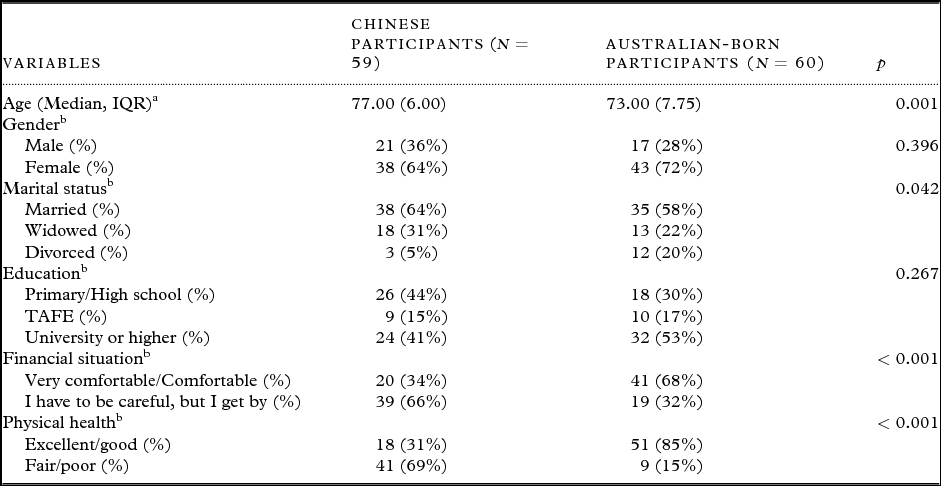
Chinese participants ranged in age from 65 to 82 years (see Table 1). The majority of them were female and married and considered their financial situation to be best captured by the statement “I have to be careful, but I get by.” With regard to physical health, over two thirds rated their physical health to be “fair” or “poor.” Chinese participants had been in Australia for between 3 and 21 years, with a median of 15 years (IQR=3). The most common reasons for immigrating to Australia were to reunite with family (n=35, 59%) and to help look after a grandchild or grandchildren (n=27, 46%). Most Chinese participants either did not speak English well (n=34, 58%) or not at all (n=24, 41%). However, the majority (n=44, 75%) indicated that they were satisfied with their lives in Australia.
Socio-demographic characteristics and mental well-being among Chinese and Australian-born participants

a Mann–Whitney test.
b χ 2 test.
Australian participants ranged in age from 66 to 82 years. Most of them were female and married. More than two thirds of them considered their financial situation to be “very comfortable” or “comfortable” and 85% rated their physical health to be “excellent” or “good.”
There were no differences between Chinese and Australian-born participants in gender distribution and education (see Table 1). However, there were differences in age, Mann–Whitney U=2407.50, p<0.05, and marital status, χ2 (2)=6.32, p<0.05, with Chinese participants being older and more likely to be married. There were also differences in self-reported physical health (hereafter, referred to as physical health), χ2 (1)=36.26, p<0.001, and self-reported financial situation (hereafter, referred to as financial situation), χ2 (1)=14.12, p<0.001, with Chinese participants reporting poorer physical health and financial situation.
Psychological welling among Chinese and Australian participants
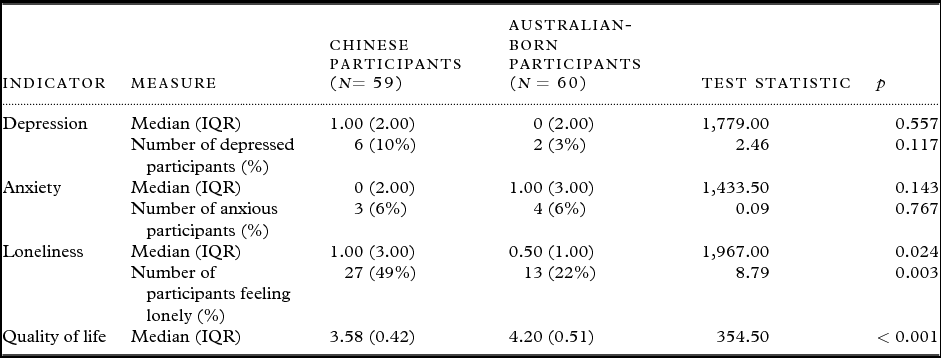
Chinese participants’ depression scores ranged from 0 to 14, with a median of 1.00 (IQR=2.00). Six (10%) participants were classified as exhibiting significant symptoms of depression, including three (5%) having mild symptoms and three (5%) having moderate to severe ones. Their anxiety scores ranged from 0 to 15 (median=0, IQR=2.00) with three (6%) participants reporting clinically significant symptoms, including one (2%) having mild symptoms and two (4%) having moderate to severe ones. Their loneliness scores ranged from 0 to 6 (median=1.00, IQR=3.00) and half (n=27, 49%) were classified as feeling lonely. Finally, their quality of life scores ranged from 2.81 to 4.20, with a median of 3.58 (IQR=0.42). A Wilcoxon signed-rank test found that the median was higher than the scale mid-point (3), z=6.39, p<0.001, indicating that the Chinese participants reported relatively high levels of quality of life.
Depression scores for Australian participants ranged from 0 to 8 (median=0, IQR=2.00) and two (3%) exhibited mild symptoms of depression. Their anxiety scores ranged from 0 to 11 (median=1.00, IQR=3.00) and four (6%) exhibiting anxiety symptoms, including two (3%) having mild symptoms and another two (3%) having moderate ones. Loneliness scores ranged from 0 to 4 (median=0.50, IQR=1.00) and 13 (22%) were classified as feeling lonely. Finally, their quality of life scores ranged from 2.80 to 5.92. A Wilcoxon signed-rank test found that the median was higher than the scale mid-point (3), z=6.71, p<0.001, indicating that the Australian participants reported relatively high levels of quality of life.
Differences in well-being indicators between Chinese and Australian-born participants
As there were a small percentage of couples included in this study, there was the possibility that their responses towards psychological well-being might be affected by the presence of their partners. Separate analyses were conducted to explore the differences in the four psychological well-being indicators with these participants (n=16, 8 couples) removed from the dataset. The results were the same as those using the full dataset. Therefore, only the results obtained using the full sample are reported in this paper.
There were no difference in the median depression or anxiety scores between Chinese and Australian-born participants (see Table 2). There were also no differences in the frequencies of participants being classified as depressed or anxious. There were, however, differences in the median loneliness and quality of life scores, with Chinese participants reporting higher levels of loneliness and lower levels of quality of life. Furthermore, Chinese participants were more likely than Australian participants to be classified as feeling lonely.
Differences in psychological well-being between Chinese and Australian-born participants

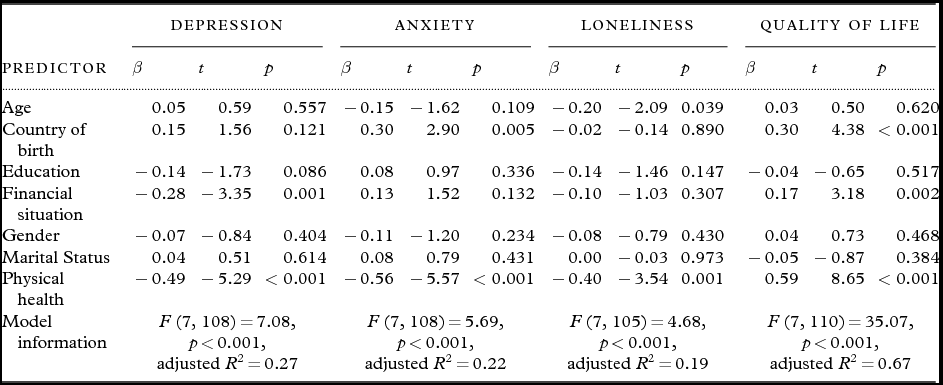
As noted earlier, linear regression analyses in conjunction with optimal scaling were conducted to explore group differences in well-being indicators when the impact of six socio-demographic factors (i.e. age, education, financial situation, gender, marital status, and physical health) was controlled for. As can be seen in Table 3, country of birth was a predictor of anxiety and quality of life, with Chinese participants reporting lower levels of anxiety and quality of life. However, it was not a predictor of depression or loneliness. Of the six socio-demographic factors, physical health was a predictor of all indicators, with those with poorer physical health reporting high levels of depression, anxiety, and loneliness and poorer quality of life. Financial situation was a predictor of depression and quality of life. Specifically, poor financial situation was associated with higher levels of depression and poorer quality of life. Finally, age was a predictor of loneliness, with those who were younger reporting higher levels of loneliness.
Results of linear regression analyses examining socio-demographic variables as predictors of well-being indicators

Discussion
This study was the first to use multiple indicators to explore psychological well-being among older Chinese immigrants living in Australia. In particular, it was the first to provide data on depression, anxiety, and quality of life among this group. The prevalence of depression in this convenience sample of 59 older Chinese immigrants was 10%, with 5% reporting mild symptoms and 5% reporting moderate to severe ones. This rate is lower than those reported in earlier studies with older Chinese immigrants, which range from 20% to 25% (Kuo et al., Reference Kuo, Chong and Joseph2008). It is, however, similar to those reported in studies with older Caucasians (ranging between 10% and 15%). As a result, it is not surprising that these were no differences in either the median scores or frequencies of depression between Australian and Chinese participants.
One possible reason for the relatively lower rate of depression among the Chinese participants in this study is that they were recruited from community groups and that engagement in social activities has been found to be protective against depression (Fiske et al., Reference Fiske, Wetherell and Gatz2009). This might also explain the even lower rate of depression (3%) among Australian participants. Another possible reason is that higher education is also protective against depression (Fiske et al., Reference Fiske, Wetherell and Gatz2009) and that 40% of the Chinese participants and half of the Australian participants had university or higher education qualifications. These percentages are much higher than that reported for the general older Australian population, with only 10% of older Australians having a bachelor degree or higher (ABS, 2012). Consistent with this explanation, there was a trend towards significance for the effect of education in the regression analysis.
Six percent of the Chinese participants reported clinically significant symptoms of anxiety, with 2% reporting mild symptoms and 4% moderate to severe symptoms. This rate is much lower than the 35% rate reported in AAFNY (2003), which is the only previous published study of anxiety among older Chinese immigrants. While the difference might be that the current study was based on a convenience sample, it might also be attributable to the differences in anxiety measures. The AAFNY (2003) used a single question, that is, “Do you feel being too anxious is a serious problem?,” to measure anxiety. In contrast, the current study used the well-validated HADS-A (HADS-A; Zigmond and Snaith, Reference Zigmond and Snaith1983), which included six items.
Interestingly, although country of birth was not associated with anxiety, Chinese participants reported lower levels of anxiety when socio-demographic factors were controlled for. This result was not expected and suggests that socio-demographic variables act as suppressors in the associations between anxiety and country of birth. Of those socio-demographic factors, there is evidence that good physical health is protective against anxiety (e.g. Wolitzky-Taylor et al., Reference Wolitzky-Taylor, Castriotta, Lenze, Stanley and Craske2010). Consistent with these studies’ results, physical health was a negative predictor of anxiety in the regression model. As Australian-born participants reported better physical health, it is possible that the inclusion of this variable suppressed the associations between anxiety and country of birth. These results suggest that future studies need to consider the impact of socio-demographic factors when investigating anxiety among older people.
Approximately, half of the Chinese participants reported feeling lonely. Unlike the results concerning depression and anxiety, this figure is consistent with those reported in previous studies (e.g. Chow, Reference Chow2010; Dong et al., Reference Dong, Chang, Wong and Simon2012). This suggests that loneliness is a prevalent problem among older Chinese immigrants even among those who are socially active and highlight the need for public awareness of this problem and for future studies to determine what might comprise an effective intervention for loneliness among this group.
The study further found that Chinese participants were more likely to report feeling lonely than Australian participants. One possible reason for the high level of loneliness among Chinese participants in this study is their more disadvantaged socio-demographic situation compared to their Australian counterparts, such as poorer physical health and financial situation. This explanation is consistent with the result that the difference in loneliness did not persist when the impact of socio-demographic factors was considered and suggests that these factors should be considered in intervention programs for loneliness among older Chinese immigrants.
Finally, Chinese participants reported relatively high levels of quality of life, with the median score being higher than the scale mid-point. However, their quality of life was lower than that of Australian-born participants. Importantly, this difference remained when socio-demographic factors were controlled for, suggesting that the difference was robust. One possible reason for these results is that quality of life is a global indicator of well-being (Walker and Mollenkopf, Reference Walker, Mollenkopf, Mollenkopf and Walker2007). Therefore, poorer quality of life among older Chinese immigrants might reflect cumulative effects of higher levels of loneliness among this group, as well their more disadvantaged socio-demographic backgrounds, such as poorer physical health and financial situation.
Strengths and limitations of the present study
The study has a number of strengths which could be considered in future studies. First, multiple indicators of psychological well-being were used. The indicators comprised both a global one (i.e. quality of life) and those focusing on specific aspects of psychological well-being (i.e. depression, anxiety, and loneliness). The inclusion of these different indicators allowed a broader consideration of older people's psychological well-being than that considered in previous research. Secondly, the study included both Chinese immigrants and Australian-born individuals. As most previous studies with older Chinese immigrants have included only this group of participants, the inclusion of Caucasian participants enabled a direct comparison between these two groups.
However, a number of limitations of the present study require acknowledgement. First, the study was based on a relatively small convenience sample, which might affect the generalizability of its results. Secondly, due to the nature of well-being measures, these variables were not normally distributed, which is often the case, and optimal scaling was used to reduce skewness. As these transformations might inflate associations between variables, caution needs to be exercised when interpreting results using this transformation method (Grambsch and O'Brien, Reference Grambsch and O'brien1991). Finally, the present study is descriptive in nature and does not seek to explain the observed difference in psychological well-being between the two groups. Future studies should consider incorporating concepts, such as acculturation, to understand the factors that might underlie the differences in psychological well-being.
Conclusion
Using a convenience sample of older Chinese immigrants, the study was the first to provide preliminary data on psychological well-being among older Chinese immigrants living in Australia. Although the participants reported relatively high levels of quality of life, 10% exhibited symptoms of depression, 6% had symptoms of anxiety, and half felt lonely. Compared to Australian participants, Chinese participants reported poorer quality of life and higher levels of loneliness. Importantly, the difference in quality of life remained when the impact of socio-demographic factors was controlled for.
These results have important implications for psychological and community health service provision among older Chinese immigrants. For example, the study suggests that loneliness is a prevalent psychological problem among older Chinese immigrants, even among those who are socially active. These results highlight the need for public awareness of this issue. It also suggests that the government and service providers need to explore the most effective intervention that would reduce loneliness and increase social networks and companionship for this group of older adults.
Conflict of interest declaration
None.
Description of authors’ roles
X Lin designed the study, collected the data, conducted data analyses, and drafted the paper. C Bryant and B Dow contributed to the study design, supervised the study, and gave critical comments on the paper. J Boldero contributed to interpretation of data and gave critical comments on the paper.
Acknowledgments
This study was conducted as part of Xiaoping Lin's PhD. She received the Australian Postgraduate Award during her PhD study.