
Introduction
Magnetic cooling devices based on magnetocaloric effects (MCE) are considered as potential next generation energy efficient and environmentally friendly technology.[ Reference Gschneidner, Pecharsky and Tsokol 1 ] Due to the sharp change in magnetization (ΔM) at their respective phase transitions, some magnetic materials (e.g., intermetallic compounds including rear earth and transition metals) that undergo first order transitions (FOT) exhibit large MCEs and magnetization-dependent properties such as giant magnetoresistance, giant Hall effects, and exchange bias.[ Reference Pecharsky, Gschneidner and Pecharsky 2 – Reference Krenke, Duman, Acet, Wassermann, Moya, Mañosa, Planes, Suard and Ouladdiaf 6 ] The Ni–Mn–Sn Heusler alloys provide an excellent opportunity to vary transition temperatures and magnetic state of the austenitic phase (AP) and martensitic phase (MP) by changing chemical composition or doping with different elements, which strongly influence the magnetic, magnetocaloric, and magnetoelastic properties. The parameters of magnetostructural transition (MST), such as ΔM, transition temperature, etc., in these compounds are highly sensitive to any changes in pressure, applied magnetic field, sequence of measurements and cycling, annealing temperature, heating and cooling rates, chemical composition, and the type of crystal structures. Because of the delicate balance between ionic, vibrational, magnetic, and electronic energies at an MST, large MCEs and other properties can be produced for these compounds by tuning the parameters of the MSTs, which lead toward new potential applications in magnetic refrigeration, spintronics, and magnetoresistive devices.
External pressure can significantly affect the magnetic properties by modifying the electronic structure of the alloys, which alters the magnetocaloric properties.[ Reference Arumugam, Ghosh, Ghosh, Devarajan, Kannan, Govindaraj and Mandal 7 ] Several reports have been published regarding pressure effects on the MCE magnitude and temperature regime in Ni-Mn-based alloys.[ Reference Sharma, Chattopadhyay and Roy 8 – Reference Samanta, Lepkowski, Us Saleheen, Shankar, Prestigiacomo, Dubenko, Quetz, Oswald, McCandless, Chan, Adams, Young, Ali and Stadler 11 ] Previous studies indicate that the application of pressure affects the magnetic exchange by modifying the distance between the Mn atoms for Mn-based Heusler alloys, and also influences the crystal phase stability.[ Reference Manosa, Moya and Planes 12 ] It has been reported that, for Ni–Co-Mn–Sn[ Reference Arumugam, Ghosh, Ghosh, Devarajan, Kannan, Govindaraj and Mandal 7 ] and other Mn-based Heusler alloys,[ Reference Samanta, Lepkowski, Us Saleheen, Shankar, Prestigiacomo, Dubenko, Quetz, Oswald, McCandless, Chan, Adams, Young, Ali and Stadler 10 ] the peak value of ΔS M decreases with pressure while ΔS M of some Ni-Mn-based systems[ Reference Sharma, Chattopadhyay and Roy 8 ] was found to increase with pressure. Since the magnitude and temperature regime of MCE of Ni-Mn-based alloys are related to hydrostatic pressure, a systematic study of the effects of pressure is important from basic science and applications point of view.
In the present work, we have employed indirect methods to determine the adiabatic temperature change through heat capacity measurements, and investigated the effects of pressure on the phase transition, and the magnetic and magnetocaloric properties of Ni45Mn43CoSn11.
Experimental techniques
A polycrystalline ingot of Ni45Mn43CoSn11 was prepared by arc-melting in a high-purity argon atmosphere. The ingot was re-melted four times, subsequently annealed at 1123 K for 24 h under vacuum, and then slowly cooled to room temperature. The magnetic properties were measured at temperatures ranging from 5 to 400 K in magnetic fields up to 5 T using a Quantum Design superconducting quantum interference device magnetometer (SQUID). Differential scanning calorimetry (DSC) measurements were carried out employing a Perkin-Elmer DSC 8000 instrument in the temperature range 123–473 K. The latent heat (L) was estimated from the endothermic peak of the heat flow curve from the DSC measurements. During the hydrostatic pressure measurements, the value of the applied pressure was calibrated by measuring the shift of the superconducting transition temperature of Pb used as reference manometer (T C ≈ 7.2 K at ambient pressure).[ Reference Eiling and Schilling 13 ] Heat capacity measurements were done in fields up to 5.0 T using a Physical Properties Measurement System (PPMS) by Quantum Design. Samples were affixed using a thin layer of grease to the sample platform, which was mounted on a vertical adapter to conduct the measurements in non-zero magnetic fields.
Results and discussion
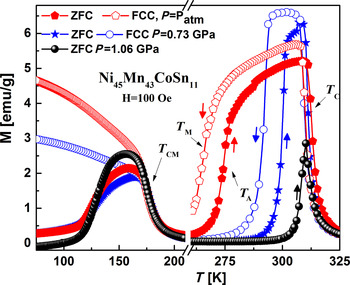
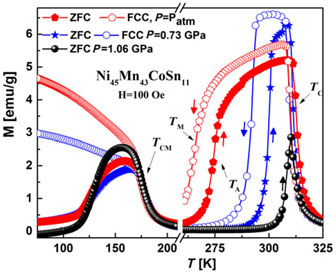
The magnetization data M(T) for Ni45Mn43CoSn11 measured in 0.01 T applied magnetic fields obtained at different applied hydrostatic pressures are shown in Fig. 1. The sharp changes in magnetization in the M(T) curves above 200 K are associated with a MST from a low-magnetization MP to a high-magnetization ferromagnetic AP. The first-order transition temperature (T M) was highly sensitive to pressure, with shift of about +40 K for a pressure P = 1.06 GPa (or about +4 K/Kbar). The applied pressure shifts the MST temperature close to room temperature (T M = 298 K at P = 0.73 GPa). With the increase in pressure, the temperature of martensitic transition is also found to linearly increase.
The magnetization versus temperature M(T) curves of Ni45Mn43CoSn11 measured at different applied hydrostatic pressures (P) in applied magnetic field of H = 0.01 T.

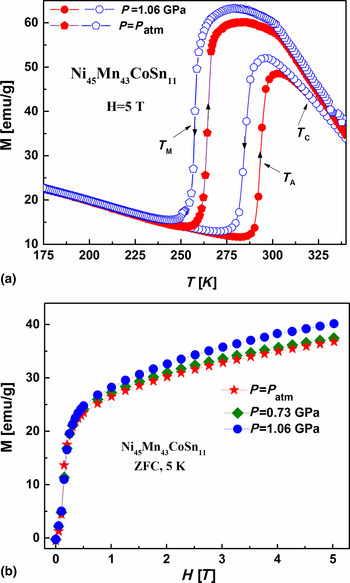
The MST occurred at a lower temperature with the application of higher field as shown in Fig. 2(a). External magnetic field found to act opposite of pressure direction and shift MST to low temperature region. A shift in T M by about 15 K has been detected with H = 5 T [see Fig. 2(a)]. Therefore, the magnetic field and applied hydrostatic pressure provide shifts T M in opposite directions, as the applied pressure stabilizing the martensite phase at higher temperature and the applied magnetic field attempts to stabilize the cubic austenite phase. Figure 2(b) shows the M(H) curves at low temperature (5 K) obtained under applied pressures up to 1.06 GPa. These M(H) data indicates that the ground state in the MP are characterized by a magnetization of 33–35 emu/g, which is much lower than of the austenitic phase. Increasing pressure results in an increase in magnetization. Hence, the application of pressure changes the magnetic ground state and increases the temperature stability of the MP. These results are consistent with those obtained for Ni-Co-Mn-Sb, where the application of external pressure kept T C constant and resulted in a significant increase in the martensitic transformation temperature.[ Reference Nayak, Suresh, Nigam, Coelho and Gama 14 ]
(a) M(T) curves of Ni45Mn43CoSn11 measured at atmospheric pressure and applied pressure P = 1.06 GPa in applied magnetic field of H = 5 T. (b) The M(H) curves at T = 5 K obtained at different applied pressures.

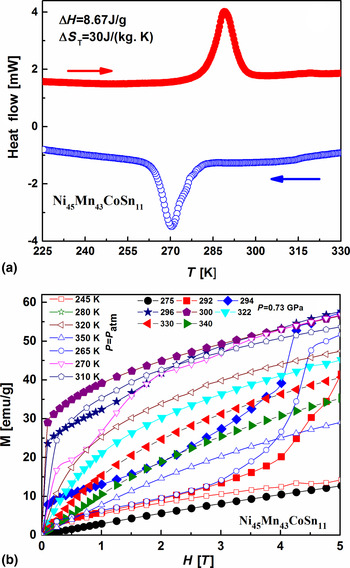
The first order nature of the phase transitions was also detected in the DSC measurements [see Fig. 3(a)]. The well-defined peaks during heating and cooling cycles are related to the latent heat of the first-order MST. The thermal hysteresis between heating and cooling cycles verifies the first order nature of the martensitic transition. The latent heat of the MST and corresponding total entropy changes estimated from the DSC curves were 8.7 J/g and 30 J/(kgK), respectively. These values are similar to those observed in Ni-Mn-In based Heusler alloys.[ Reference Pandey, Aryal, Quetz, Samanta, Dubenko, Stadler and Ali 15 ] Also, the total entropy changes calculated from the DSC data are in good agreement with the “universal” temperature dependence of entropy changes.[ Reference Gottschall, Skokov, Benke, Gruner and Gutfleisch 16 ]
(a) DSC heat flow curves as a function of temperature for Ni45Mn43CoSn11 obtained for cooling (open symbols) and heating (closed symbols) cycles. (b) Magnetization curves in the vicinity of T M and T C of Ni45Mn43CoSn11 measured with increasing temperature for atmospheric pressure (open symbols) and applied pressure P = 0.73 GPa (closed symbols).

Isothermal magnetization curves M(H) curves of Ni45Mn43CoSn11 at atmospheric pressure (P atm) and applied pressure P = 0.73 GPa are shown in Fig. 3(b). The magnetization isotherms were found to be metamagnetic-like at temperatures near the MST and show behavior typical for ferromagnetic-paramagnetic transitions near T C. The critical field of the direct metamagnetic transition increases under pressure. The initial susceptibility (dM/dH) in the low magnetic field region decreases with pressure. Such behavior can be related to an increase in the antiferromagnetic interaction due to a decrease in interatomic distance.
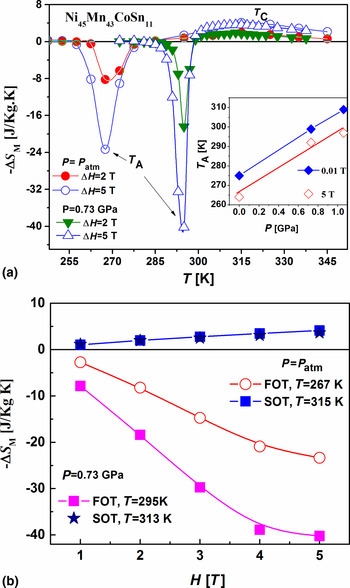
Figure 4(a) shows the thermal variation of the magnetic entropy change (∆S M) for magnetic field changes ∆H = 2 T, 5 T and at pressures P = P atm and 0.73 GPa. From the M(H) curves shown in Fig. 3(b), the ∆S M values were estimated by using an integrated Maxwell relation.[ Reference Tishin and Spichkin 17 ] The sample exhibits inverse and direct MCEs at MST (T M) and Curie temperature (T C), respectively. Since the applied pressure affects the interatomic separation, and therefore the magnetic interactions, the magnetocaloric properties are expected to change with pressure. We found for Ni45Mn43CoSn11 that the peak value of ΔS M at the martensitic transition significantly increases under applied hydrostatic pressure. Positive magnetic entropy changes (i.e., inverse MCE) of 24 and 42 J/kg K were observed at martensitic transition for P = P atm and 0.73 GPa, respectively for ∆H = 5 T. Ni45Mn43CoSn11 alloy shows a larger magnetic entropy change with pressure (2.5 J/kgK/Kbar) in comparison with other reported Ni21.5Mn0.85Ga,[ Reference Albertini, Kamarad, Arnold, Pareti, Villa and Right 18 ] Ni50Mn34In16,[ Reference Sharma, Chattopadhyay and Roy 8 ] Ni-Mn-Sn[ Reference Muthu, Kanagaraj, Singh, Sastry, Ravikumar, Rao, Raja and Arumugam 19 ] Heusler alloys. As it can be seen from Fig. 2(a), the magnetization of the AP at MST temperature increases with pressure. The reason for such behavior may be due to the decrease in crystal cell volume of the alloy under pressure. The change in the volume results in an increased stability of the MP with respect to temperature while the Curie temperature of martensitic (T CM) and AP (T C) remain almost unchanged [see Figs. 1 and 2(a)]. The applied pressure shifts the martensitic transition temperature to higher temperature with a paramagnetic or low magnetization MP, and the MST from the paramagnetic MP to the ferromagnetic AP occurs [see Fig. 2(a)]. The changes in the magnetic entropy produced by the transitions from the paramagnetic MP to the ferromagnetic AP were found to be larger than those from the ferromagnetic martensitic to the ferromagnetic AP. The inset of Fig. 4(a) shows that the inverse martensitic transition found to increase nearly linearly with increasing of pressure for field change of 0.1 and 5 T. The ΔS M values were found to increase monotonically at FOT with external magnetic field for P = P atm and 0.73 GPa [see Fig. 4(b)].
(a) Magnetic entropy changes (∆S M) as a function of temperature for Ni45Mn43CoSn11 for a magnetic field changes of 2 T and 5 T at atmospheric pressure and applied pressure P = 0.73 GPa. The inset shows the inverse martensitic transition at different applied pressure for field change of 0.1 and 5 T. (b) Magnetic entropy changes as a function of applied magnetic field at the FOT and second order transition (SOT) for P = P atm and 0.73 GPa.

The refrigeration capacity (RC) is one useful parameter used to quantify MCE properties. The maximum RC at a magnetic field 5 T at atmospheric pressure was found to be 240 and 130 J/kg at T C and T M, respectively. At P = 0.73 GPa, the RC values were found to be 260 and 180 J/kg at T C and T M, respectively. The refrigerant capacity increases under the effect of hydrostatic pressure.
For Mn-based alloys, the magnetic entropy changes calculated by the Clausis–Clapeyron and the Maxwell relations are observed to be similar.[ Reference Zhang, Zhang, Yu, Liu, Xu, Liu, Chen, Cao and Wu 20 ] The total entropy change using the Clausius–Clapeyron ratio is
 $$\displaystyle{{\Delta T} \over {\mu _0 \Delta H}} = - \displaystyle{{\Delta {\rm M}} \over {\Delta S_{\rm M}}} $$
where ∆T/μ o∆H is the derivative of the temperature to the magnetic field, and ΔM is the change in the magnetization. Using the Clausius–Clapeyron equation, the maximum values of ΔS M obtained were found to be 19.4 and 33 J/(kg K) for P = P atm and 0.73 GPa, respectively. The MCE values obtained at MST are similar to those obtained from the DSC curves at ambient pressure.
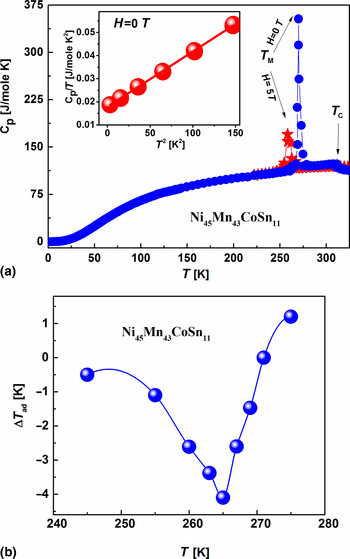
The temperature dependent heat capacity (C p) data of Ni45Mn43CoSn11 at a magnetic field of 0 and 5 T are shown in Fig. 5(a). The heat capacities are characterized by λ-type anomalies typical for FOT at T = 270 K and 258 K at H = 0 and 5 T, respectively. Applied magnetic field suppresses the peak of the λ-type anomaly and shifted it to the lower temperature. The temperature of the MST obtained from the heat capacity and magnetization measurements are in good agreement. Because of the diffusionless character of the martensitic transition, configurational contributions to the specific heat are absent,[ Reference Khovailo, Oikawa, Abe and Takagi 21 ] thus the specific heat can be written as:
 $$C_{\rm P} = C_{{\rm el}} + C_{{\rm vib\;}} + C_{{\rm mag}} $$
where C el, C vib, C mag represents the electronic, vibrational, and magnetic contributions, respectively. The electronic contribution based on the linear-T term[ Reference Mizutani 22 ] is
 $$C_{{\rm el}} = \displaystyle{\pi \over 3}^2 N_{\rm A} k_{\rm B}^{\rm 2} D(E_{\rm F} )T = \gamma T$$
where D(E F) is the density of states at Fermi energy. The vibrational effect can be described using the Debye model[ Reference Mizutani 22 ] as,
 $$C_{{\rm vib\;}} = 9R(\theta _{\rm D} {\rm \vert} T)^3 \int_0^{\theta _{\rm D} /T} {\displaystyle{{x^4 e^x} \over {(e^x - 1)^2}} dx} \; $$
where θ D is the Debye temperature and R is the ideal gas constant. Since the magnetic contribution is found to be very small at low temperature,[ Reference Chernenko, Fujita, Besseghini and Perez-Landazabal 23 ] we plotted C p/T versus T 2 at low temperature [see the inset of Fig. 5(a)] and fitted the data using the equation C p(T) = γT + βT 2, where γ and β are the electronic and vibrational coefficients, respectively. For zero external magnetic field, γ and β were found to be 0.0178 J/mol K2 and 0.000232 J/mol K4, respectively. The obtained value of γ is similar to those observed in Ni48Co2Mn35In15 [ Reference Pathak, Dubenko, Xiong, Adams, Stadler and Ali 24 ] and Ni50Mn36In14.[ Reference Chen, Bruno, Karaman, Huang, Li and Ross 25 ] From the fitted values of γ and β, and using Eqs. (3) and (4), values of 7.5 states/eV/f. u. and 310 K were found for the density of electronic states and the Debye temperature, respectively.
(a) Heat capacity (C p) of Ni45Mn43CoSn11 as a function of temperature at H = 0 and 5 T. The inset shows the low temperature C p/T versus T 2 linear fit data for H = 0 T. (b) The adiabatic temperature change as a function of temperature obtained from heat capacity data.

The adiabatic temperature change (∆T ad) at ambient pressure was estimated from the temperature-dependent heat capacity measurements. The magnetic entropy changes were obtained from the heat capacity using
 $$S(T)_{0,H} = \int_0^H {\displaystyle{{C_{\rm p} (T,H) - C_{\rm P} (T,0)} \over T}\; dT} $$
where C p(T, 0) and C p(T, H) represent the heat capacity in a field zero and H, respectively. Note that this relation comes from the fundamental thermodynamics without using Maxwell or Clausius–Clapeyron relations. Hence, it is valid whether the transition is first or second order. From S(T)0,H , ∆T ad can be obtained by taking the difference of T (S, H) at different fields at constant entropy.[ Reference Gschneidner, Pecharsky and Tsokol 1 ] Figure 5(b) shows the estimated ΔT ad from heat capacity measurements for a field change of 5 T. An inverse ΔT ad with a value of 4 K was calculated at T M. This value of ΔT ad is consistent with the large adiabatic temperature changes (about 1.2 K/T) obtained from direct measurements of ∆T ad for the Ni-Mn-In-B system.[ Reference Pandey, Quetz, Aryal, Dubenko, Blinov, Rodionov, Prudniko, Mazumdar, Granovsky, Stadler and Ali 26 ]
Conclusion
In summary, hydrostatic pressure acts as a parameter to tune the temperature closer to room temperature and increase the parameter of the MCE for Ni45Mn43CoSn11. The magnetic entropy changes and RC values significantly increase by the application of hydrostatic pressure. The density of states, Debye temperature, and inverse ΔTad estimated from the heat capacity measurements were observed to be 7.5 states/eV/f.u., 310 K, and 4 K, respectively. Due to the observed values of ∆S M and ΔT AD of about 42 J/kg K and 4 K, respectively, near room temperature, Ni45Mn43CoSn11 can be considered as a promising multifunctional material and contribute to the progress of ongoing research in this area.
Acknowledgments
This work was supported by the Office of Basic Energy Sciences, Material Science Division of the U.S. Department of Energy, DOE Grant No. DE-FG02-06ER46291 (SIU) and DE-FG02-13ER46946 (LSU).