Maternal depressive symptoms in the perinatal period are a frequent phenomenon, with an estimated prevalence between 6% and 39 % depending on country and severity of symptoms (Field, Reference Field2011). Depressive symptoms in pregnancy are regarded as risk factor for child development, manifesting in preterm delivery, delayed cognitive development, or emotional and behavioral problems (Gentile, Reference Gentile2015). Furthermore, dysfunctions in the hypothalamic–pituitary–adrenal (HPA) axis have been observed in children exposed to prenatal depression (e.g., Diego et al., Reference Diego, Field, Hernandez-Reif, Cullen, Schanberg and Kuhn2004; Laurent et al., Reference Laurent, Leve, Neiderhiser, Natsuaki, Shaw, Harold and Reiss2013; O'Donnell et al., Reference O'Donnell, Glover, Jenkins, Browne, Ben-Shlomo, Golding and O'Connor2013). Based on results from animal and human studies, effects of prenatal stress, depression, or anxiety on offspring psychopathology and HPA axis regulation are found to be sex specific (Glover & Hill, Reference Glover and Hill2012). According to the developmental origins of health and disease hypothesis (Wadhwa, Buss, Entringer, & Swanson, Reference Wadhwa, Buss, Entringer and Swanson2009), environmental stimuli, especially in the pre- and postnatal periods, can have long-lasting effects on the offspring's development and health. It is hypothesized that fetal physiological processes adapt to the in utero environment as preparation for the anticipated postnatal environment. Prenatal exposure to depression or associated high cortisol levels in pregnancy might be interpreted as a signal for an anticipated stressful life, resulting in altered metabolism and hormone sensitivity throughout the lifetime. However, the underlying mechanisms for both the long-lasting effects of prenatal depression and the sex-specific differences are not yet clarified.
As a promising biological mechanism to explain the association of prenatal maternal mental health with later child mental health, epigenetic processes are discussed, especially modifications in DNA methylation of cytosine–guanine dinucleotides (CpGs) because of its role in regulating gene expression (Szyf & Bick, Reference Szyf and Bick2013; Wadhwa et al., Reference Wadhwa, Buss, Entringer and Swanson2009). Thereby, studies regarding prenatal depression effects on child development focused particularly on epigenetic programming of the HPA axis. Genes which encode HPA-relevant receptors, as glucocorticoid (GR), mineralocorticoid (MR), and corticotropin-releasing hormone receptor (e.g., CRHR 1), or genes coding for proteins that influence HPA axis functionality, as FK506 binding protein 51 (FKBP5), brain-derived neurotrophic factor (BDNF), or serotonin transporter (SLC6A4) were investigated.
As explanatory model for the sex-specific influence of prenatal stress on the offspring, varieties in placental DNA methylation are discussed that may lead to differences in placental functioning for male and female fetuses (Bale, Reference Bale2011; Glover & Hill, Reference Glover and Hill2012). Furthermore, studies identified sex-specific alterations of infant DNA methylation (Braithwaite, Kundakovic, Ramchandani, Murphy, & Champagne, Reference Braithwaite, Kundakovic, Ramchandani, Murphy and Champagne2015; Ostlund et al., Reference Ostlund, Conradt, Crowell, Tyrka, Marsit and Lester2016), which might result in diverging gene expression patterns in response to the in utero environment. Thus, sex-dependent DNA methylation might contribute to the understanding of sex-specific differences in both HPA axis development (Panagiotakopoulos & Neigh, Reference Panagiotakopoulos and Neigh2014; van der Voorn, Hollanders, Ket, Rotteveel, & Finken, Reference van der Voorn, Hollanders, Ket, Rotteveel and Finken2017), as, for example, lower salivary cortisol in boys (Shirtcliff et al., Reference Shirtcliff, Allison, Armstrong, Slattery, Kalin and Essex2012), and developmental psychopathology (Zahn-Waxler, Shirtcliff, & Marceau, Reference Zahn-Waxler, Shirtcliff and Marceau2008).
Epigenetic modifications related to prenatal depressive symptoms are present throughout development, with studies often differing in child age and in tissue used to extract DNA (Stonawski et al., Reference Stonawski, Frey, Golub, Moll, Heinrich and Eichler2017). Most findings for methylation changes refer to the GR encoding gene NR3C1, with more maternal depressive symptoms during pregnancy being mainly associated with higher NR3C1 DNA methylation (Braithwaite et al., Reference Braithwaite, Kundakovic, Ramchandani, Murphy and Champagne2015; Mansell et al., Reference Mansell, Vuillermin, Ponsonby, Collier, Saffery and Ryan2016; Murgatroyd, Quinn, Sharp, Pickles, & Hill, Reference Murgatroyd, Quinn, Sharp, Pickles and Hill2015; Oberlander et al., Reference Oberlander, Weinberg, Papsdorf, Grunau, Misri and Devlin2008). However, results for NR3C1 methylation changes are not fully consistent and indicate sex-specific differences (Braithwaite et al., Reference Braithwaite, Kundakovic, Ramchandani, Murphy and Champagne2015) and a possible interaction with later maternal depression (Murgatroyd et al., Reference Murgatroyd, Quinn, Sharp, Pickles and Hill2015). Regarding the serotonin transporter encoding gene SLC6A4, more depressive symptoms were associated with lower promoter methylation in newborns’ cord blood (Devlin, Brain, Austin, & Oberlander, Reference Devlin, Brain, Austin and Oberlander2010). For the BDNF-coding gene, higher prenatal depression scores were associated with reduced DNA methylation in DNA extracted from buccal cells in infants (Braithwaite et al., Reference Braithwaite, Kundakovic, Ramchandani, Murphy and Champagne2015), but no differences were found in newborns’ cord blood (Devlin et al., Reference Devlin, Brain, Austin and Oberlander2010). Non, Binder, Kubzansky, and Michels (Reference Non, Binder, Kubzansky and Michels2014) reported a relation between prenatal depression and hypermethylation of FKBP5 as well as hypomethylation of CRHR1 in newborns.
In addition, MRs are an important regulator of basal HPA axis activity via negative feedback (Berardelli et al., Reference Berardelli, Karamouzis, D'Angelo, Zichi, Fussotto, Giordano and Arvat2013; Buckley, Mullen, & Schatzberg, Reference Buckley, Mullen and Schatzberg2007; Heuser et al., Reference Heuser, Deuschle, Weber, Kniest, Ziegler, Weber and Colla2000) and altered expression of the MR-coding gene NR3C2 was found to be associated with alterations in cortisol secretion in psychiatric disorders (Medina et al., Reference Medina, Seasholtz, Sharma, Burke, Bunney, Myers and Watson2013; ter Heegde, De Rijk, & Vinkers, Reference ter Heegde, De Rijk and Vinkers2015); however, studies investigating the effects of prenatal depression on NR3C2 methylation in children are still missing. In one study, regarding the effects of a prenatal traumatic event, Perroud et al. (Reference Perroud, Rutembesa, Paoloni-Giacobino, Mutabaruka, Mutesa, Stenz and Karege2014) found higher MR mRNA levels accompanied by lower, yet nonsignificant, NR3C2 methylation in exposed children. Furthermore, placental MR mRNA levels were found to be elevated in dependence of maternal depressive symptoms in pregnancy (Reynolds et al., Reference Reynolds, Pesonen, O'Reilly, Tuovinen, Lahti, Kajantie and Räikkönen2015), suggesting NR3C2 as a potential target for prenatal depression effects.
In order to explain the underlying mechanisms, studying the functional consequences of DNA methylation changes that are related to prenatal depression is essential. Initial studies have reported associations of NR3C1 and SLC6A4 DNA methylation with internalizing and externalizing behavioral problems in children (e.g., Parade et al., Reference Parade, Ridout, Seifer, Armstrong, Marsit, McWilliams and Tyrka2016; Park et al., Reference Park, Lee, Kim, Cho, Yun, Han and Kim2015). Other studies have looked at the association of child DNA methylation and HPA activity, with findings for increased DNA methylation of NR3C1 and FKBP5 being related to higher morning cortisol levels and an altered cortisol recovery (van der Knaap, Oldehinkel, Verhulst, van Oort, & Riese, Reference van der Knaap, Oldehinkel, Verhulst, van Oort and Riese2015; Weder et al., Reference Weder, Zhang, Jensen, Yang, Simen, Jackowski and Kaufman2014). For the first time, Oberlander et al. (Reference Oberlander, Weinberg, Papsdorf, Grunau, Misri and Devlin2008) investigated the link of prenatal depression, DNA methylation, and the functional outcome in terms of cortisol reactivity. They found higher NR3C1 methylation in cord blood, associated with prenatal depressive symptoms, predicting infants’ cortisol reactivity at 3 months of age.
The present study aimed to examine DNA methylation as a possible underlying mechanism for the association of prenatal depressive symptoms and basal HPA activity in primary school-aged children. The longitudinal design enables investigating associations with prenatal depressive symptoms, while controlling for postpartum and current maternal depression. Furthermore, the sample size allows comparing sex differences. The following hypotheses were tested in the current study: (a) children exposed to prenatal depressive symptoms show altered basal cortisol levels; (b) exposure to prenatal depressive symptoms is associated with DNA modifications in HPA-related genes; (c) DNA modifications that are related to prenatal depressive symptoms are also associated with altered basal cortisol levels; and (d) DNA modifications mediate the association of prenatal depressive symptoms and basal cortisol levels.
Material and Method
Study design
Data were collected within the prospective, longitudinal Franconian Maternal Health Evaluation Studies (Time 1 [T1]; FRAMES; Reulbach et al., Reference Reulbach, Bleich, Knorr, Burger, Fasching, Kornhuber and Goecke2009) and the follow-up Franconian Cognition and Emotion Studies (Time 2 [T2]; FRANCES; Eichler et al., Reference Eichler, Grunitz, Grimm, Walz, Raabe, Goecke and Kornhuber2016). From 2005 to 2007, pregnant women older than 18 years of age were asked during the third trimester of pregnancy to participate in FRAMES investigating perinatal maternal health. From 2012 to 2015, families were contacted again for participation in FRANCES in order to explore the effects of prenatal risk factors on child development in primary school age. Besides measuring the cognitive, language, and motor development, cortisol samples as marker for the basal HPA activity and DNA samples for epigenetic analyses were collected at T2. Based on the aim of FRANCES, families with an existing prenatal risk, in terms of prenatal depressive symptoms, alcohol consumption, or smoking noted in FRAMES, were contacted more actively: in addition to an invitation letter, which was sent to all families, families with a prenatal risk who did not respond to the first invitation were contacted by phone. This recruiting process of FRANCES resulted in a risk oversampling in order to reach a sufficient risk-sample size (i.e., higher prevalence of depressive symptoms in FRANCES [31.7% in total and 29.9% in analyzed sample] than FRAMES [17.4%]) and in a slightly older group of exposed children due to longer recruitment time. The study was approved by the Local Ethics Committee of the Medical Faculty and conducted in accordance with the Declaration of Helsinki. All participants gave informed consent.
Participants
From the FRANCES cohort, 180 mother–child dyads with complete maternal depression data and child DNA samples were included. All children were from single pregnancies, enabling similar prenatal conditions, and had a Caucasian ethnicity in order to provide genetic homogeneity. In order to rule out possible medication effects, dyads were excluded when mothers reported antidepressant medication intake during pregnancy (n = 3). After quality control of DNA methylation data, additional children had to be excluded (n = 10), resulting in 167 mother–child dyads for the analyses.
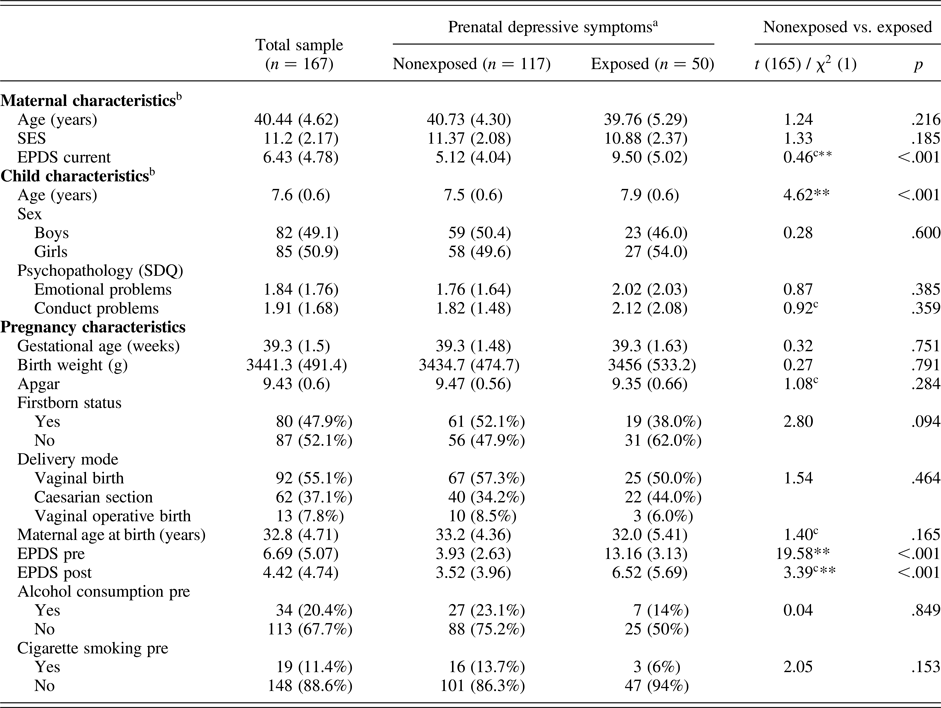
At T2, children (82 boys, 85 girls) were between 6 and 9 years old (M = 7.6, SD = 0.6). The mothers were between 28 and 51 years old, with a mean age of 40.4 years (SD = 4.6). They were well educated, with 53.9% having completed university entrance qualifications, and most lived in a two-parent household, either with the child's father (86.2%) or a new partner (3.6%). Table 1 shows the sample characteristics.
Demographic and pregnancy characteristics of the sample

Note: Continuous variables are expressed as mean (SD) and tested with independent t tests; categorial variables are expressed as n (%) and tested with chi-squared tests. All t scores are displayed as absolute values. EPDS, Edinburgh Postnatal Depression Scale (Cox et al., Reference Cox, Holden and Sagovsky1987). SES, socioeconomic family status, additive combination of parental education level and the family income, theoretical range 3 to 16. SDQ, Strength and Difficulties Questionnaire (Goodman, Reference Goodman2001). Pre, prenatal; post, postpartum. Prenatal alcohol consumption assessed by the ethanol metabolite ethyl glucuronide (EtG) in the newborn's meconium: yes = EtG level above the detection limit (≥10 ng/g). Prenatal cigarette smoking: yes = smoking ≥1 cigarette per day. aPrenatal EPDS score <10 interpreted as nonexposed, ≥10 as exposed. bAt time of cortisol and DNA sampling. cdf adjusted for unequal variances based on Levene. *p < .05, **p < .01.
Measures
Maternal depressive symptoms
Maternal depressive symptoms were assessed with the Edinburgh Postnatal Depression Scale (EPDS; Cox, Holden, & Sagovsky, Reference Cox, Holden and Sagovsky1987) during the third trimester (“prenatal” depressive symptoms), 2 days postpartum (“postpartum”), and at T2 when the child was in primary school (“current”). The EPDS is a 10-item self-rating scale, assessing the severity and frequency of depressive symptoms on a 4-point Likert scale. The scale is validated for the prenatal and postnatal period. Raw-sum scores were calculated (range: 0–30), with a threshold for ≥10 interpreted as exposure to prenatal depressive symptoms in accordance with other studies in this research field (e.g., Braithwaite et al., Reference Braithwaite, Kundakovic, Ramchandani, Murphy and Champagne2015; Mansell et al., Reference Mansell, Vuillermin, Ponsonby, Collier, Saffery and Ryan2016).
Further child and family characteristics
Pregnancy characteristics (i.e. gestational age, birth weight, Apgar scores, delivery mode, firstborn status, and maternal age at birth), were registered immediately after delivery. Apgar scores represent the newborn's physical condition at 1, 5, and 10 min after birth. They range from 1 to 10, with higher values representing a better adaption. The mean Apgar score (mean of the three time points) was used for analyses. Cigarette smoking and alcohol consumption during pregnancy were regarded as further prenatal risk factors. Prenatal cigarette smoking was assessed in self-report at T1. Smoking ≥1 cigarette per day was interpreted as exposed to prenatal smoking. Maternal alcohol consumption in pregnancy was assessed by the ethanol metabolite ethyl glucuronide in the newborn's meconium, described in Eichler et al. (Reference Eichler, Grunitz, Grimm, Walz, Raabe, Goecke and Kornhuber2016). An ethanol metabolite ethyl glucuronide level above the detection limit (≥10 ng/g) was interpreted as prenatal exposure to alcohol. The families’ socioeconomic status (SES) was calculated from maternal and paternal educational level and family income per month referring to Geißler (Reference Geißler1994). The score ranged between 3 and 14, with higher values indicating higher SES. At T2, mothers completed the Strength and Difficulties Questionnaire (Goodman, Reference Goodman2001). The emotional problems and conduct problems subscales were used as index for child's psychopathology.
Salivary cortisol
Mothers were instructed to collect five saliva samples at home using Salivette sampling devices (Sarstedt, Nümbrecht, Germany). The collection device and a daily protocol were given to each family to complete at home. In a single day, five samples (at awakening, 30 min after awakening, at 12 a.m., at 5 p.m., and at bedtime) were collected. Mothers were asked to document the child's awakening time and sampling times as well as characteristics regarding the day of sampling: school day (yes/no), medication intake, diseases, and special events. Mothers were instructed to postpone saliva sampling in acute illness. The child should not have consumed anything by mouth apart from water and should not brush the teeth before the first two samples or directly before the last sample. They were informed not to consume food or drink other than water 30 min before each following sample (Stalder et al., Reference Stalder, Kirschbaum, Kudielka, Adam, Pruessner, Wüst and Clow2016). Saliva samples were stored at –20 °C. Cortisol levels were analyzed with a photometric immunoassay (ELISA; IBL International, RE56211, Hamburg, Germany). Photometric measurements were conducted with the Multiskan™ GO microplate spectrophotometer (Thermo Fisher Scientific, Vantaa, Finland).
To represent the individual diurnal cortisol profile, five parameters were calculated out of the raw values. The first and last sample were used as waking cortisol and bedtime cortisol, respectively. The cortisol awakening response (CAR), indicating the typical cortisol increase during 30 to 45 min after awakening, was calculated as area under the curve with respect to increase from first to second sample (Pruessner, Kirschbaum, Meinlschmid, & Hellhammer, Reference Pruessner, Kirschbaum, Meinlschmid and Hellhammer2003). The diurnal cortisol slope represents the rate of cortisol decline from awakening to bedtime, calculated as a slope over all samples except the second sample. The total cortisol release throughout the day was computed as area under the curve with respect to ground including all samples (Pruessner et al., Reference Pruessner, Kirschbaum, Meinlschmid and Hellhammer2003).
For 6 children, salivary cortisol samples were missing, indicating a response rate for cortisol samples of 96.4%. Children who were administered corticosteroids (n = 7) or ketoconazole (n = 1) or reported Henoch–Schönlein purpura (n = 2) were excluded from cortisol analyses. One child was excluded because samples were collected on different days. Time frames were set for the first two samples in order to assess the sensitive cortisol reaction in the morning accurately and to avoid time effects (Stalder et al., Reference Stalder, Kirschbaum, Kudielka, Adam, Pruessner, Wüst and Clow2016). For the first assessment point, samples that were collected more than 15 min after awakening (n = 31) were excluded from analyses of waking cortisol, CAR, and diurnal slope. If the second sample was collected less than 15 min or more than 45 min after awakening (n = 51), it was excluded from CAR calculation. Because of missing values for awakening time, resulting in unknown time frames for the morning, 17 children were further excluded from waking cortisol, CAR, and diurnal slope analyses. Dyads with missing awakening times did not differ from other dyads in SES, or child or maternal psychopathology. According to the daily protocol, single samples that were associated with special day events (e.g., conflict about sample collection) were excluded in order to assess the basal stress activity, not stress reactivity. Outliers defined as values more than 3 SD from group mean were removed. Due to the typical positive skew of cortisol data, natural logarithm transformation was employed to improve normal distribution of raw values. Sample size for each analysis varied depending on the parameter of interest: waking cortisol, n = 99; bedtime cortisol, n = 145; CAR, n = 81; diurnal slope, n = 99; total release, n = 145. Online-only Supplemental Table S.1 represents sample size and descriptive statistics of raw cortisol values, sampling times, and cortisol parameters. Diurnal cortisol profiles are illustrated in online-only Figure S.1, separated into prenatal exposure to depressive symptoms and sex.
DNA methylation
DNA samples were obtained from buccal cells with OmniSwab (Whatman®, Maidstone, UK). The OmniSwab pad was rubbed on the children's inner cheek for 30 s, placed in a collection tube (Eppendorf Tubes®, Hamburg, Germany), and stored at +4 °C. DNA was extracted with the QIAamp DNA Mini Kit (Qiagen, Hilden, Germany) according to manufacturer's protocol. A total of 500 ng of DNA for each sample was sent to the Helmholtz–Zentrum München (Germany), where genome-wide DNA methylation was analyzed with the Infinium Human Methylation 450K BeadChip (Illumina, San Diego, CA, USA) as described elsewhere (Zeilinger et al., Reference Zeilinger, Kühnel, Klopp, Baurecht, Kleinschmidt, Gieger and Illig2013).
Epigenetic analyses
Quality control and preprocessing of the methylation data were performed with R (version 3.2.2) and the R package minfi (Aryee et al., Reference Aryee, Jaffe, Corrada-Bravo, Ladd-Acosta, Feinberg, Hansen and Irizarry2014), mostly according to the pipeline of Lehne et al. (Reference Lehne, Drong, Loh, Zhang, Scott, Tan and Chambers2015). Illumina Background correction was applied to the raw intensity values. Raw intensity values were then normalized using Quantile (implemented in minfi) and subsequently converted to β values, as the proportion of DNA methylated at a single CpG site. Samples with a call rate less than 97% were excluded (n = 10). Probes overlapping with single nucleotide polymorphisms or located on sex chromosomes were removed as well as probes with a detection p-value >.001, reflecting a low signal-detection rate from the background. Probes with a mean β less than 0.01 or above 0.99, SD less than 0.01, or defined as outliers with more than 4 SD from mean were removed. Control probe adjustment (Lehne et al., Reference Lehne, Drong, Loh, Zhang, Scott, Tan and Chambers2015) was carried out to the normalized β values in order to adjust for technical bias. In addition to 23 control probe factors, which explained 95% of the β value variance and represent technical biases as shown in online-only Supplemental Figure S.2, children's age at DNA sampling and birth parameters (gestational age, birth weight, maternal age at birth, and mean Apgar score) were added to the regression model. To account for further biological variance, a principle components analysis on the resulting regression residuals were performed and the first two factors were included as predictors in a final regression model. As presented in online-only Supplemental Figure S.3, these factors were not associated with relevant psychosocial variables. The resulting residuals were then used as adjusted methylation values. Due to the different number of CpGs per gene on the BeadChip and the filtering procedure, the number of CpGs investigated varied dependent on gene (BDNF: 39 CpGs; CRHR1: 15 CpGs; FKBP5: 26 CpGs; NR3C1: 21 CpGs; NR3C2: 15 CpGs; and SLC6A4: 10 CpGs).
Statistical analyses
After preprocessing of the methylation data, adjusted methylation values were exported to SPSS (version 21, SPSS, Chicago, USA), where analyses were performed. The effect of prenatal depressive symptoms on child cortisol parameters and DNA methylation was tested with univariate analyses of covariance (ANCOVAs). Exposure to prenatal depressive symptoms (EPDSpre) and sex were entered as independent variables in each model, in order to check possible sex-specific or interaction effects. The cortisol parameters and the adjusted methylation values of each CpG were included as dependent variables, respectively. Possible interaction effects were tested post hoc with exposure-group specific ANCOVAs. To examine the functional relevance of differentially methylated CpGs for child cortisol, multiple regression models were applied. Adjusted methylation values were entered as predictor and cortisol parameters as outcome in independent models. Therefore, only CpGs and cortisol parameters, which were associated with EPDSpre in previous analyses, were considered. Regression analyses were conducted for all children and split by sex to investigate possible sex-specific effects.
For significant associations, the mediation hypothesis was tested with the PROCESS macro for SPSS (version 2.16; Hayes, Reference Hayes2013). In independent models, EPDSpre was added as regressor, adjusted methylation values as mediator and cortisol parameters as outcome variable. Bootstrapped 95% confidence intervals based on 10,000 samples were used to interpret the indirect effects, with confidence intervals not containing zero being interpreted as mediation effect (Field, Reference Field2013).
For all analyses, significance level was set to p < .05, and effect sizes were interpreted. Because of the exploratory nature of the study, Bonferroni adjustment was not applied. Effect sizes for ANCOVA results were computed as partial η2 (ηp2), with values ηp2 < 0.06 interpreted as small, 0.06 ≤ ηp2 < 0.14 as medium, and ηp2 ≥ 0.14 as large effects (Cohen, Reference Cohen1988). In order to detect specific prenatal effects, postpartum and current maternal depressive symptoms were added as covariates in all analyses that included prenatal depressive symptoms. Further covariates were added, if they were significantly associated with the dependent variable tested using Pearson correlation (r) or significantly different between the children nonexposed versus exposed to prenatal depressive symptoms (independent t test).
Results
Covariates
Children exposed to maternal depressive symptoms during pregnancy were older than nonexposed children at T2 (p < .001), which must be attributed to the FRANCES risk-recruiting strategy. Regarding maternal characteristics, depressive symptoms differed between groups not only during pregnancy (p < .001) but also for the postpartum (p < .001) and current periods (p < .001). Postpartum and current depressive symptoms were statistically controlled in all analyses that included prenatal depressive symptoms. No other group differences in child, mother, or pregnancy characteristics appeared, as shown in Table 1.
Regarding the cortisol analyses, significant associations between potential covariates and child cortisol differed between parameters, and were therefore specifically controlled in the analyses. Children's antibiotic intake in the last 6 months before sample collection was significantly associated with waking cortisol (p = .032) as well as mean Apgar score with bedtime cortisol (p = .013) and the diurnal slope (p = .006). Child total cortisol release was higher on school days than on the weekend or during a school holiday (p < .001). Results are presented in online-only Supplemental Table S.2. In addition, parameter-relevant time frames were considered as covariates in order to control for time effects. Time between awakening and first sample was added as a covariate for analyses with waking cortisol and CAR, time between first and last sample as a covariate for analyses with bedtime cortisol, diurnal slope, and total release.
Prenatal depressive symptoms and child cortisol
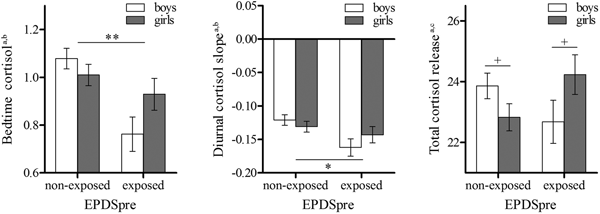
Analyses for bedtime cortisol revealed a significant main effect for EPDSpre (p = .003, ηp2 = 0.07), as well as a significant interaction effect with child sex (p = .039, ηp2 = 0.03). Children who were exposed to depressive symptoms during pregnancy showed lower cortisol levels at bedtime. While boys and girls did not differ in the unexposed group, exposed boys tended to exhibit less cortisol than exposed girls at bedtime. A significant main effect of EPDSpre was also detected for the diurnal slope, with children of prenatal depressed mothers showing a steeper cortisol decline throughout the day (p = .023, ηp2 = 0.06). In addition, a significant interaction effect of EPDSpre and sex for the total cortisol release was found (p = .019, ηp2 = 0.04). Girls tended to release less cortisol throughout the day than boys within the nonexposed group, but more cortisol than boys within the exposed group. All analyses were controlled for postpartum and current depressive symptoms. No significant main effect of sex was found in either model, as well as no effects for waking cortisol and CAR. Significant effects are illustrated in Figure 1. Results of the ANCOVAs and post hoc analyses for interaction effects are presented in online-only Supplemental Table S.3 and Table S.4, respectively.
Effects of exposure to prenatal depressive symptoms and sex on diurnal cortisol parameters. Parameters were calculated based on ln-transformed raw values. Means are adjusted for maternal postnatal and current depressive symptoms as well as specific covariates for the cortisol parameters (atime between first and last sample; bmean Apgar score; cschool day: yes/no). Error bars represent standard mean error. EPDS, Edinburgh Postnatal Depression Scale (Cox et al., 1987). EPDSpre, exposure to prenatal depressive symptoms (EPDS score ≥10) or no exposure (<10). Interaction effects were tested post hoc with analyses of covariance comparing boys versus girls in the nonexposed and exposed group separately. +p < .10, *p < .05, **p < .01.

Prenatal depressive symptoms and DNA methylation of HPA-related genes
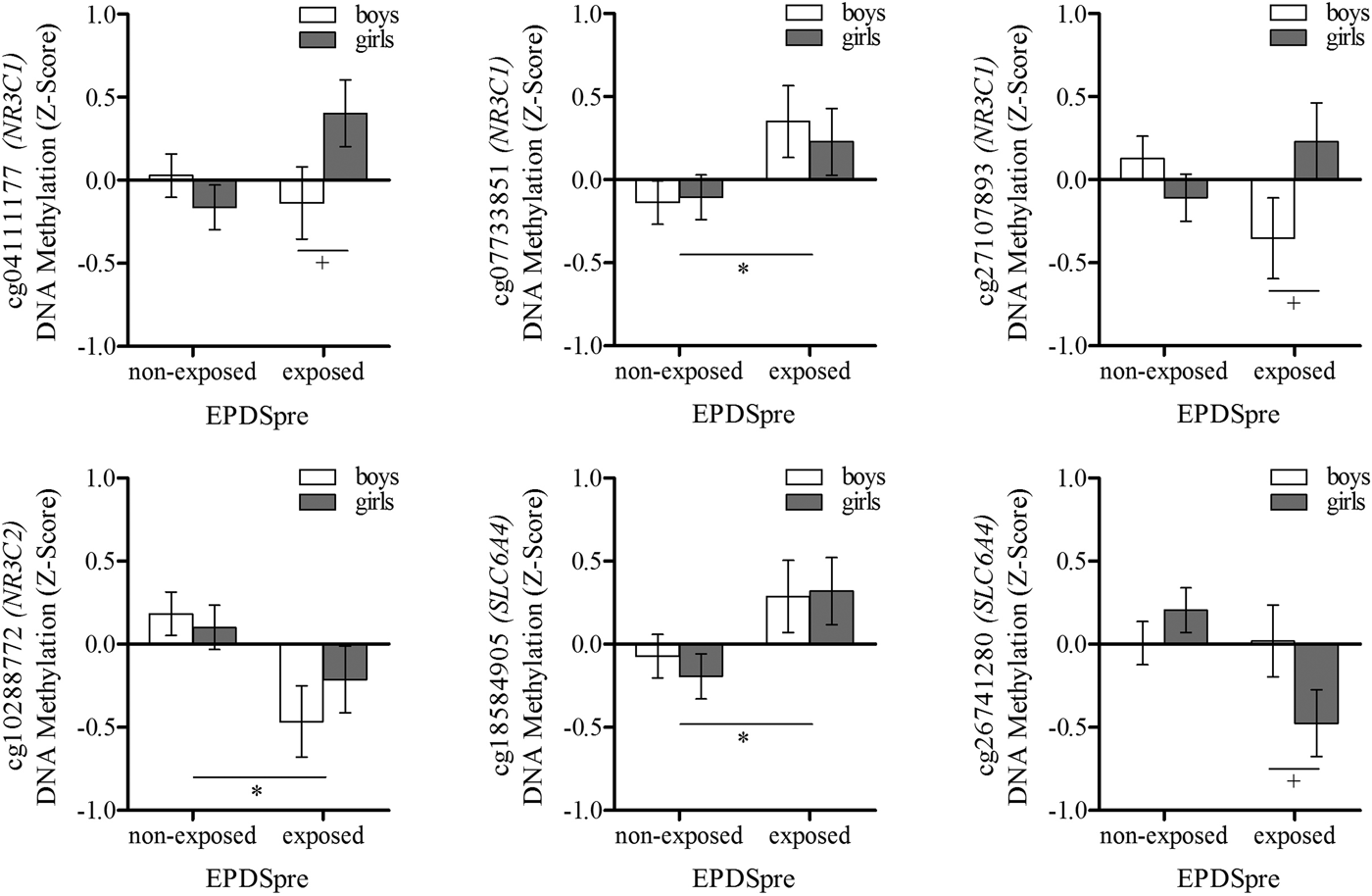
For one CpG (cg07733851) of NR3C1, analysis revealed a significant main effect of EPDSpre (p = .032, ηp2 = 0.03). Children exposed to depressive symptoms in pregnancy showed higher methylation values. Interaction effects between EPDSpre and sex were observed for two further NR3C1 CpGs (cg04111177: p = .031, ηp2 = 0.03; cg27107893: p = .031, ηp2 = 0.03). At both CpGs, no sex differences were observed in the nonexposed group, whereas boys exhibited higher methylation values than girls in the exposed group with medium effect sizes. Exposure to depressive symptoms in pregnancy was furthermore associated with lower methylation at one CpG (cg10288772) of NR3C2 (p = .012, ηp2 = 0.04). For SLC6A4, modifications in DNA methylation at two CpGs were apparent. Exposed children showed higher methylation at cg18584905 (p = .024, ηp2 = 0.03). For cg26741280, an interaction effect for EPDSpre and sex was identified (p = .040, ηp2 = 0.03). Girls exposed to prenatal depressive symptoms tended to exhibit less DNA methylation than boys, whereas no sex differences were observed in the nonexposed group. Significant main and interaction effects for NR3C1, NR3C2, and SLC6A4 reached small effect sizes (ηp2 = 0.03–0.04) and are displayed in Figure 2. No depression or sex effect on DNA methylation was found for BDNF, CRHR1, or FKBP5. Complete results of analyses testing modifications in DNA methylation at all CpGs of the candidate genes under control of postpartum and current depressive symptoms are shown in online-only Supplemental Table S.5. Results of the post hoc analyses for significant interaction effects are displayed in Table S.4.
Effects of exposure to prenatal depressive symptoms and sex on DNA methylation at CpGs of NR3C1, NR3C2, and SLC6A4. DNA methylation is displayed as z-standardized adjusted methylation value. Error bars represent standard mean errors. EPDS, Edinburgh Postnatal Depression Scale (Cox et al., 1987). EPDSpre, exposure to prenatal depressive symptoms (EPDS score ≥10) or no exposure (<10). Interaction effects were tested post hoc with analyses of covariance comparing boys versus girls in the nonexposed and exposed group separately. +p < .10, *p < .05, not Bonferroni-adjusted.

DNA methylation of HPA-related genes and child cortisol
Investigating the functional relevance of altered DNA methylation for basal HPA activity, multiple regression models were only calculated for those cortisol parameters and CpGs that were associated with EPDSpre in the preceding analyses. Only in boys, DNA methylation of one NR3C2 CpG (cg10288772) significantly predicted bedtime cortisol (β = 0.30, p = .010), with higher methylation values resulting in higher bedtime values. Regarding all children and girls separately, DNA methylation of the HPA-related genes did not predict bedtime cortisol, diurnal slope, or total cortisol release. Complete results are presented in online-only Supplemental Table S.6.
Prenatal depressive symptoms, DNA methylation of HPA-related genes and basal cortisol in boys.
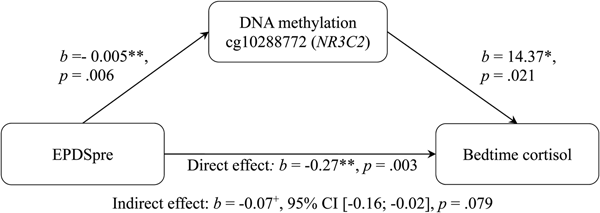
Previous analyses indicated a specific association of prenatal depressive symptoms, DNA methylation in NR3C2, and bedtime cortisol in boys. The hypothesis of DNA methylation as mediator between EPDSpre and cortisol was tested. Prenatal depressive symptoms significantly predicted boys’ bedtime cortisol. The bootstrapped confidence interval for the mediation effect did not include zero, indicating an existing mediation effect of NR3C2 methylation. Paths including bedtime cortisol were adjusted for postpartum and current depressive symptoms, time from first to last cortisol sample, and mean Apgar score. The mediation model is presented in Figure 3.
Model of exposure to prenatal depressive symptoms as predictor of bedtime cortisol in boys, mediated by NR3C2 DNA methylation (n = 70). Results of testing the mediation hypothesis by PROCESS (Hayes, Reference Hayes2013), with exposure to prenatal depression as independent variable, boys’ bedtime cortisol as outcome variable, and cg10288772 (NR3C2) DNA methylation as mediator. EPDS = Edinburgh Postnatal Depression Scale (Cox et al., Reference Cox, Holden and Sagovsky1987). EPDSpre = exposure to prenatal depressive symptoms (EPDS score ≥10) or not (<10). Postpartum and current depressive symptoms, time between first and last sample and mean Apgar score were included as covariates for paths including bedtime cortisol. +p < .10, *p < .05, **p < .01.

Discussion
Investigating the association of prenatal depressive symptoms with child DNA methylation and basal HPA axis activity revealed mainly small effects. Results suggest that there is a sex-specific mediation effect of DNA methylation that explains, at least partially, basal HPA activity in primary school-aged children.
Children exposed to prenatal depressive symptoms showed altered basal cortisol levels. Whereas Laurent et al. (Reference Laurent, Leve, Neiderhiser, Natsuaki, Shaw, Harold and Reiss2013) reported decreased cortisol both at awakening and bedtime, the present study only found a downregulation of bedtime cortisol in exposed children. This might explain the additional finding for the diurnal cortisol slope, with exposed children displaying a steeper cortisol decline than nonexposed children. Exposed boys were more susceptible to the effects, exhibiting lower bedtime cortisol levels than exposed girls. In addition, boys released more cortisol throughout the day than girls in the unexposed group, while the opposite was observed within the exposed group.
Other studies investigating the influence of peripartum maternal depression mainly reported higher basal cortisol levels (as found here in girls) or flattened cortisol slopes in exposed children, without reporting sex effects (e.g., Diego et al., Reference Diego, Field, Hernandez-Reif, Cullen, Schanberg and Kuhn2004; O'Donnell et al., Reference O'Donnell, Glover, Jenkins, Browne, Ben-Shlomo, Golding and O'Connor2013). The diverging results might be explained by differences in the type and duration of maternal depressive symptoms as well as the different child age ranges that were examined. As a consequence of different early life stress exposures, including maternal and paternal depression in the first year of life, Essex et al. (Reference Essex, Shirtcliff, Burk, Ruttle, Klein, Slattery and Armstrong2011) reported profiles of hypo- and hypercortisolism as well as varying developmental profiles from 9 to 15 years of age. Age-dependent effects were also reported in studies investigating effects of maltreatment and abuse on cortisol release in children and adolescents (Trickett, Noll, Susman, Shenk, & Putnam, Reference Trickett, Noll, Susman, Shenk and Putnam2010; White et al., Reference White, Ising, von Klitzing, Sierau, Michel, Klein and Stalder2017). In addition, Shirtcliff et al. (Reference Shirtcliff, Allison, Armstrong, Slattery, Kalin and Essex2012) detected developmental trajectories from prepubertal age to adolescence and found sex-specific effects (e.g., girls exhibiting more cortisol and steeper slopes than boys). Hence, it must be stated that HPA axis development and functionality during childhood and adolescence is not fully understood, making a comparison of its function in studies performed at different developmental stages difficult. The current study regarding primary school-aged children only investigated a single developmental time frame, which do not allow statements to be made concerning age-dependent effects on HPA axis functioning.
Hypocortisolism is typically found in children and adults with a history of maltreatment or stress-related disorders with stressors initially activating HPA axis and enhancing cortisol release, but chronically leading to an exhausted and downregulated HPA axis with reduced cortisol output (Fries, Hesse, Hellhammer, & Hellhammer, Reference Fries, Hesse, Hellhammer and Hellhammer2005; Miller, Chen, & Zhou, Reference Miller, Chen and Zhou2007). However, stressors occurring during pregnancy are assumed to program the set point of the fetal HPA axis. According to the developmental origins of health and disease hypothesis, alterations in the HPA axis represent an adaption to the prenatal environment, with differences in severity and duration of depressive symptoms predicting a more or less stressful postnatal context, which results in varying strong HPA axis adjustment of the fetus. The downregulated bedtime cortisol levels in exposed children, found in the present study, might be interpreted as an overcompensation of the HPA axis to early stressful life circumstances. In expectation of a similar postnatal environment, the regulatory mechanisms of the HPA axis seemed to be increased, resulting in lower cortisol levels. In addition, adjustment might be adaptive for the interaction with the social environment as prenatal maternal depression is a risk factor for postpartum depression (Gaillard, Le Strat, Mandelbrot, Keita, & Dubertret, Reference Gaillard, Le Strat, Mandelbrot, Keita and Dubertret2014). It might be speculated that the child would be prepared for the interaction with a depressed mother characterized by, for example, less maternal sensitivity and responsivity resulting in a poorer mother–infant relationship, which is already seen in subclinically depressed mothers (Behrendt et al., Reference Behrendt, Konrad, Goecke, Fakhrabadi, Herpertz-Dahlmann and Firk2016). Therefore, as proposed by Fisher (Reference Fisher2017) in the context of neglect, hypocortisolism might be protective for a child in response to an insufficient dyadic affect regulation from the mother.
It is speculated that the intrauterine overcompensation might result in a general blunted HPA axis and exhausted cortisol system, serving as a risk factor for mental health problems. Studies regarding the behavioral consequences of prenatal depression support this risk hypothesis of decreased cortisol levels, especially seen in boys. Prenatal depression was associated with more externalizing behavior and violence in children and adolescents, and with a lower social–emotional competence in boys (e.g., Eichler et al., Reference Eichler, Walz, Grunitz, Grimm, Van Doren, Raabe and Moll2017; Korhonen, Luoma, Salmelin, & Tamminen, Reference Korhonen, Luoma, Salmelin and Tamminen2012). Low basal cortisol levels in turn predicted persistence and early onset of aggressive behaviors in boys (McBurnett, Lahey, Rathouz, & Loeber, Reference McBurnett, Lahey, Rathouz and Loeber2000). Furthermore, in studies of early adversity, hypocortisolism was found to mediate between adverse early care or maltreatment and externalizing symptoms in children (Koss, Mliner, Donzella, & Gunnar, Reference Koss, Mliner, Donzella and Gunnar2016; White et al., Reference White, Ising, von Klitzing, Sierau, Michel, Klein and Stalder2017). Thus, both the lower bedtime value and the total cortisol release, especially in exposed boys, might be interpreted as an underlying risk factor for these behavior problems in the long term. Despite nonsignificance, a slightly higher level of conduct problems, with small effect size (d = 0.18), could already be seen descriptively in the present nonclinical sample. This has to be investigated and confirmed in future research. The increased total cortisol release found in exposed girls might be similarly interpreted as a risk factor for later internalizing problems, which have already been associated with prenatal depression, especially in girls (e.g., El Marroun et al., Reference El Marroun, White, van der Knaap, Homberg, Fernandez, Schoemaker and Tiemeier2014; Quarini et al., Reference Quarini, Pearson, Stein, Ramchandani, Lewis and Evans2016).
For DNA methylation, small modifications associated with prenatal depressive symptoms were found for NR3C1, NR3C2, and SLC6A4. With three CpGs, the GR-coding gene NR3C1 was the most frequently influenced gene, corresponding to its central role in the previous methylation studies of early adversity. Whereas one CpG (cg07733851) was hypermethylated in exposed boys and girls, the others (cg04111177 and cg27107893) were modified for each sex differently. Girls showed higher methylation values than boys after prenatal exposure, indicating sex-specific effects on DNA methylation. In Weder et al. (Reference Weder, Zhang, Jensen, Yang, Simen, Jackowski and Kaufman2014), methylation of cg04111177 has already been associated with both early childhood maltreatment and morning cortisol in adolescents, but without investigating sex differences. Indications for an impact of prenatal depressive symptoms on the serotonergic system are given through methylation differences of two CpGs of the serotonin transporter coding gene SLC6A4. For one of these CpGs (cg18584905), exposed children showed consistently higher methylation, and for the other (cg26741280) sex-specific modifications in the exposed group are apparent, with girls’ methylation being influenced stronger in form of a hypomethylation.
Methylation modifications at NR3C1 and SLC6A4 have already been associated with pre- and postnatal adversity, childhood trauma, and risk for psychopathology, and are therefore discussed as biomarkers for prenatal and early childhood adversity (Provenzi, Giorda, Beri, & Montirosso, Reference Provenzi, Giorda, Beri and Montirosso2016; Tyrka, Ridout, & Parade, Reference Tyrka, Ridout and Parade2016). Results presented here support this hypothesis, but with small effect sizes that would not withstand correction for multiple testing. Furthermore, the differentially methylated CpGs of both genes are not located in a promotor region, lowering the potential functional relevance for gene expression. This in turn is bolstered by the missing associations between the found altered CpGs at NR3C1 and SLC6A4 and child HPA activity.
For the MR-coding gene NR3C2, one CpG (cg10288772) was differentially methylated, with decreased methylation in exposed children. The modified CpG is located in the NR3C2 promotor allowing the hypothesis that this CpG likely impacts gene expression. In further analyses, NR3C2 methylation was found to be related to bedtime cortisol in boys and could be identified as a sex-specific mediator of this association, suggesting a functional relevance of NR3C2 for basal cortisol. While low affinity GRs regulate predominantly HPA reactivity, high affinity MRs are important regulators of both basal and stress-induced activity of the HPA axis (Berardelli et al., Reference Berardelli, Karamouzis, D'Angelo, Zichi, Fussotto, Giordano and Arvat2013; ter Heegde et al., Reference ter Heegde, De Rijk and Vinkers2015). MR binding of corticosteroids is thereby associated with an increased inhibition mechanism and, in turn, lower basal cortisol levels, as demonstrated in pharmacological studies (e.g., Buckley et al., Reference Buckley, Mullen and Schatzberg2007; Otte et al., Reference Otte, Jahn, Yassouridis, Arlt, Stober, Maass and Kellner2003). The corticosteroid receptor balance hypothesis assumes that a balance of MR and GR in the brain is important for adequate HPA axis regulation, with an imbalance in MR:GR-mediated processes resulting in a dysregulated HPA axis and increasing the vulnerability for mental disorders (de Kloet, Reference de Kloet and Fink2016). For instance, depression is characterized by a loss of MR resulting in a decreased MR:GR ratio (de Kloet et al., Reference de Kloet, Otte, Kumsta, Kok, Hillegers, Hasselmann and Joels2016; ter Heegde et al., Reference ter Heegde, De Rijk and Vinkers2015), whereas an excess of MR over GR was proposed to be related to aggression-driven disorders and anxiety (de Kloet, Reference de Kloet and Fink2016).
The positive association of NR3C2 methylation and bedtime cortisol levels, found in the present study, fits the typical expectation of DNA methylation associated with a downregulation of gene expression. In the case of NR3C2, lower methylation would result in an increased MR expression and a stronger feedback inhibition process with lower cortisol values as observed. This is in accordance with Fries et al. (Reference Fries, Hesse, Hellhammer and Hellhammer2005), who proposed reduced biosynthesis of relevant hormones and increased negative feedback sensitivity to glucocorticoids as possible mechanisms of HPA axis adjustment in terms of hypocortisolism. Current findings might provide an indication for the underlying molecular mechanisms. The present study identified less NR3C2 DNA methylation and a decreased bedtime cortisol level in boys prenatally exposed to depressive symptoms. Investigating the effects of a prenatal traumatic event on DNA methylation and gene expression, Perroud et al. (Reference Perroud, Rutembesa, Paoloni-Giacobino, Mutabaruka, Mutesa, Stenz and Karege2014) reported higher MR mRNA levels in exposed children, which can be interpreted as analogous finding in terms of the proposed mechanism. Correspondingly to the current findings, they also observed a lower NR3C2 methylation status in exposed children; however, it did not reach significance. More studies reporting modifications in NR3C2 methylation or expression after exposure to early adversity in children are currently missing.
Summarizing the literature to MR, ter Heegde et al. (Reference ter Heegde, De Rijk and Vinkers2015) interpreted increased MR expression or functionality as enhanced stress resilience. Thus, prenatal depressive symptoms, accompanied by increased MR functionality and resulting in decreased cortisol release, would represent stress resilience and not, as discussed more often, a risk factor for HPA dysregulation and psychiatric disorders. Alternatively, supporting the risk hypothesis, de Kloet (Reference de Kloet and Fink2016) suggested a heightened risk for aggressive disorders in case of an increased MR:GR ratio. Considering the fact that the association of prenatal depressive symptoms, NR3C2 DNA methylation, and basal cortisol was found only in boys, it might be possible to integrate current findings into the risk hypothesis. As discussed previously, lower basal cortisol levels are considered to be a risk factor for externalizing behavior problems, which in turn are associated with prenatal depression in boys. Therefore, it is speculated that altered NR3C2 methylation following prenatal depressive symptoms might represent one explanatory model for the higher risk for externalizing behavior in boys. However, more studies are needed in order to validate this proposed mechanism.
The identified sex-specific relations of prenatal depressive symptoms to both HPA axis activity and DNA methylation support the hypothesis of sex-specific intrauterine programming mechanisms (Bale, Reference Bale2011; Glover & Hill, Reference Glover and Hill2012). The differences between boys and girls were predominantly seen in the exposed group, with medium effect sizes. It is speculated that the diverging alterations of DNA methylation between boys and girls in response to prenatal depressive symptoms might be one explanatory factor for sex-specific HPA development and, probably over time, also sex differences in developmental psychopathology (Glover & Hill, Reference Glover and Hill2012; Zahn-Waxler et al., Reference Zahn-Waxler, Shirtcliff and Marceau2008). In the current study, the pathway from prenatal depressive symptoms, DNA methylation, and basal cortisol was only seen in boys. Accordingly, Schore (Reference Schore2017) proposed an increased sensitivity to pre- and postnatal environmental stressors, associated with a slower maturing HPA axis, in boys as a mechanism leading to a heightened vulnerability for affect dysregulation disorders in males. In response to prenatal stressors Carpenter, Grecian, and Reynolds (Reference Carpenter, Grecian and Reynolds2017) also found some evidence for an increased vulnerability to alterations in diurnal cortisol release in males, as observed here.
Sex-specific function of the placenta is discussed as a possible mechanism underlying sex differences of in utero programming of the HPA axis (Bale, Reference Bale2011): sex differences were found in placental methylation and gene expression, which alter placental permeability and thus fetal glucocorticoid exposure (Carpenter et al., Reference Carpenter, Grecian and Reynolds2017; Clifton, Reference Clifton2010; Mueller & Bale, Reference Mueller and Bale2008), potentially affecting fetal neurodevelopment and HPA axis function in boys and girls differentially. Furthermore, interactions of the HPA and the hypothalamic–pituitary–gonadal axis, particularly the sex hormone testosterone, are discussed regarding sex-dependent programming of HPA axis activity and psychopathology during pregnancy. Higher exposure to prenatal testosterone in boys is related to slower maturation of the brain and HPA axis than in females, elevating male vulnerability to prenatal stress and later risk for externalizing symptoms (Martel, Reference Martel2013; Schore, Reference Schore2017; Zahn-Waxler et al., Reference Zahn-Waxler, Shirtcliff and Marceau2008). As proposed in the current study, sex-dependent DNA methylation of child HPA axis genes in response to prenatal adversity might be one further mechanism for sex differences in intrauterine programming.
Limitations
The identified associations were mainly small and, regarding the analyses of DNA methylation modifications, would not withstand correction for multiple testing. Due to this, results should be interpreted cautiously and must be validated in larger cohorts. The mediation analysis, however, proposed a potential functional impact of even small modifications of DNA methylation on HPA axis function. Knowing that methylation changes, especially in the gene promotor, are expected to influence gene expression, it must be recognized that no CpG within the promoter region of BDNF or SLC6A4 was included on the 450k BeadChip. Therefore, investigating the impact of quite important sites for gene regulation was not possible for these genes. Analyzing the association of differently methylated CpGs with variables such as the cortisol system offers an opportunity for identifying their potential functional relevance. Nevertheless, gene expression data, which are necessary for validating this on the molecular level, were not available in the present study. Furthermore, DNA was extracted from buccal cells in the study. Because of the tissue specificity of DNA methylation, conclusions from peripheral tissues upon brain processes and functioning should be drawn consciously. Until now, stability of methylation modifications has not been investigated sufficiently. Longitudinal studies examining the occurrence and maintenance of DNA methylation after birth are needed to validate findings of modifications in children exposed to prenatal risks.
An EPDS score of 10 or higher in the third trimester was interpreted as exposure to prenatal depressive symptoms. This score is used in several studies but indicates only a potential minor clinical depression. Besides the self-rating questionnaire, no other objective assessment was used. Furthermore, depressive symptoms were assessed just once in pregnancy; analysis regarding the diverging influences on child development dependent on the three trimesters was therefore not possible.
Cortisol samples were only collected on a single day, limiting the reliability of cortisol measurements, with cortisol levels potentially being more influenced by day-specific state than trait factors. Sample size had to be reduced because of noncompliance for default sampling time in several cases, especially for the first two samples. Furthermore, sampling times were only ascertained in self-rating, and no objective method for verification of awakening and sampling times was used.
Children exposed to prenatal depressive symptoms were older than nonexposed children, which can be attributed to the more active contacting process of those families with a noted prenatal risk at T1. This recruiting strategy enabled the investigation of a larger risk sample, but due to a longer recruiting procedure resulted in an age difference between groups. This is unfavorable, due to a possible impact of age on HPA activity and DNA methylation. Child age was statistically controlled in the preprocessing of DNA methylation and was tested as a potential covariate for cortisol analyses; however, an impact of age cannot be definitively ruled out.
The current sample had a moderate to high SES limiting generalizability of current results. However, it is assumed that in a sample with lower SES, the effects on child epigenome and HPA axis might be more pronounced, because low income and education characterizing low SES are risk factors for prenatal depressive symptoms (Field, Reference Field2017; Hein et al., Reference Hein, Rauh, Engel, Haberle, Dammer, Voigt and Goecke2013).
Last but not least, effects of prenatal depressive symptoms on the HPA axis may be mediated by later parental mood disorders, maltreatment, or life events in childhood. For example, prenatal depression is associated with a higher risk of child maltreatment (Plant, Pariante, Sharp, & Pawlby, Reference Plant, Pariante, Sharp and Pawlby2015), which in turn is related to HPA axis alterations (White et al., Reference White, Ising, von Klitzing, Sierau, Michel, Klein and Stalder2017). While controlling for maternal psychopathology, the current study did not consider other postnatal factors that should be included in future longitudinal studies. Accordingly, while discussing mechanisms underlying sex differences in fetal HPA axis programming, postnatal factors should be kept in mind that influence the HPA axis beyond prenatal factors. Thereby, sex differences in HPA axis receptors (Bangasser, Reference Bangasser2013), interactions of the HPA and hypothalamic–pituitary–gonadal axes (Panagiotakopoulos & Neigh, Reference Panagiotakopoulos and Neigh2014; Zahn-Waxler et al., Reference Zahn-Waxler, Shirtcliff and Marceau2008), or psychosocial issues such as sex-role traits and stereotypes (Zahn-Waxler et al., Reference Zahn-Waxler, Shirtcliff and Marceau2008) are discussed.
Conclusions and future directions
To the authors’ knowledge, this is the first study conducted in primary school-aged children investigating the association between prenatal depressive symptoms and basal child HPA activity and testing the mediation hypothesis of DNA methylation as an underlying mechanism. Presented results give rise to DNA methylation, here found especially in NR3C2, as one underlying mechanism and point to sex-specific processes. Despite the known role of MR on HPA axis regulation, the current literature has mostly ignored DNA methylation and gene expression of NR3C2 as a marker of prenatal and early childhood adversity in comparison to NR3C1, SLC6A4, or BDNF. Future studies should regard NR3C2 as a further relevant part of HPA axis regulation for validating the presented results. Looking at the sample sizes in several previous studies published on this topic, it is recommended to investigate effects in larger samples enabling the exploration of discussed sex differences. In addition, expression data as a parameter of functional analyses of DNA methylation are necessary in order to validate the functional consequences of modifications in reported CpGs and to integrate former studies, which examined DNA methylation and gene expression mainly separately. Understanding the mechanisms of prenatal depression effects on child HPA axis and psychopathology remains an important research field with many open questions, specifically concerning sex-specific differences. However, this study demonstrates that DNA methylation may be a potential mediating mechanism of prenatal depression on child outcomes and provides a promising direction for future research.
Supplementary Material
To view the supplementary material for this article, please visit https://doi.org/10.1017/S0954579418000056.