INTRODUCTION
Subjective cognitive complaints (SCC) based on self- and informant reports may be sensitive to early cognitive changes that arise years before onset of Mild Cognitive Impairment (MCI) or dementia due to Alzheimer’s disease (AD) (Howieson et al., Reference Howieson, Carlson, Moore, Wasserman, Abendroth, Payne-Murphy and Kaye2008; Rajan, Wilson, Weuve, Barnes, & Evans, Reference Rajan, Wilson, Weuve, Barnes and Evans2015). Studies have shown that SCC are associated with an increased risk of clinical conversion to MCI and AD (Caselli et al., Reference Caselli, Chen, Locke, Lee, Roontiva, Bandy and Reiman2014; Gifford et al., Reference Gifford, Liu, Lu, Tripodis, Cantwell, Palmisano and Jefferson2014; Hsu, Huang, Tu, & Hua, Reference Hsu, Huang, Tu and Hua2014; Mitchell, Beaumont, Ferguson, Yadegarfar, & Stubbs, Reference Mitchell, Beaumont, Ferguson, Yadegarfar and Stubbs2014), supporting the possible clinical utility of SCC as a diagnostic marker. If this is the case, SCC should correlate with objective measures of cognitive performance (OM) before diagnostic conversion.
Longitudinal studies using multiple time points and controlling for known confounding factors (e.g., depressive symptoms), have generally found a modest relationship between SCC and OM (Crumley, Stetler, & Horhota, Reference Crumley, Stetler and Horhota2014; Hulur, Hertzog, Pearman, & Gerstorf, Reference Hulur, Hertzog, Pearman and Gerstorf2015; Mascherek & Zimprich, Reference Mascherek and Zimprich2011; Parisi et al., Reference Parisi, Gross, Rebok, Saczynski, Crowe, Cook and Unverzagt2011) although some have not (Pearman, Hertzog, & Gerstorf, Reference Pearman, Hertzog and Gerstorf2014). Differences in methodology and sample characteristics may in part account for these discrepancies.
Within the preclinical timeframe, when neuropathological and cognitive changes are only beginning to emerge (Jessen et al., Reference Jessen, Amariglio, van Boxtel, Breteler, Ceccaldi and Chetelat2014; Morris, Reference Morris2005); measuring the association between SCC and OM may assist in characterizing the initial clinical course of at-risk individuals. The current study uses data from the Wisconsin Registry for Alzheimer’s disease Prevention (WRAP), a longitudinal cohort enriched for AD risk factors of family history (FH) and apolipoprotein epsilon 4 (APOE4) carrier status (Sager, Hermann, & La Rue, Reference Sager, Hermann and La Rue2005), to determine if SCC (self- and informant-based) change over time, and if baseline SCC predict OM that are sensitive to possible early preclinical changes.
Based on previous research, and because our sample consists of cognitively healthy, late middle-aged adults whom would at most be exhibiting subtle cognitive changes, we expected to observe a modest association between SCC and OM. In addition, given that FH and APOE4 status have each been associated with SCC and change in OM (Dik et al., Reference Dik, Jonker, Comijs, Bouter, Twisk, van Kamp and Deeg2001; La Rue et al., Reference La Rue, Small, McPherson, Komo, Matsuyama and Jarvik1996; McPherson, La Rue, Fitz, Matsuyama, & Jarvik, Reference McPherson, La Rue, Fitz, Matsuyama and Jarvik1995); and that knowledge of one’s status may be a source of bias when evaluating one’s cognitive status (Lineweaver, Bondi, Galasko, & Salmon, Reference Lineweaver, Bondi, Galasko and Salmon2014), we also explored the association between these risk factors and SCC.
METHODS
Sample
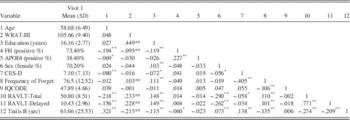
Data for this study came from the WRAP, a longitudinal registry of 1545 cognitively normal, adult participants (mean age at study entry=53.6 years; SD=6.6; range=40.6–73.8 years), of which 72.4% have a parental family history of AD (Sager et al., Reference Sager, Hermann and La Rue2005) (see Table 1). All WRAP participants completed questionnaires about their familial, socio-demographic, and health status and underwent a comprehensive clinical and neuropsychological assessment at WRAP study entry (i.e., WRAP baseline), a second visit 4 years later (Visit1) and subsequent visits approximately every 2 years thereafter (Visits 2 & 3).
Demographic data and correlations

Notes. Data is based on the total WRAP sample at Visit 1 (n=1261). Values in parentheses are standard deviations. Note correlations are two-tailed, * p<0.05 and ** p<0.001. Lower scores on Frequency of Forgetting and scores greater than 3 on the IQCODE equate to more subjective complaints. Higher scores on the CES-D indicate more depressive symptoms. FH=Family History; APOE4=apolipoprotein E4; CES-D=Center for Epidemiologic Studies Depression Scale; IQCODE=Informant Questionnaire on Cognitive Decline in the Elderly; RAVLT=Rey Auditory Verbal Learning Test, WRAT-III=Wide Range Achievement Test-III standard score (Wilkinson, Reference Wilkinson1993).
The current study included three assessments, each 2 years apart, over a 4-year time period (Visits 1–3). Visit 1 was used as the initial assessment for these analyses because collection of informant-SCC did not begin at WRAP study entry, but rather at Visit 1. Participants who were neurologically healthy and cognitively normal at WRAP study entry and who had completed at least Visit 1 and one follow-up (Visit 2 and/or Visit 3) were included in the analysis. Based on this criteria, samples sizes varied for each analysis depending on the combination of predictor and outcome variables (n-size range=1148–1261). The University of Wisconsin Institutional Review Board approved all study procedures and each participant signed informed consent before participation.
Assessment
SCC were assessed using the Memory Functioning Questionnaire (Gilewski, Zelinski, & Schaie, Reference Gilewski, Zelinski and Schaie1990; Zelinski, Gilewski, & Anthony-Bergstone, Reference Zelinski, Gilewski and Anthony-Bergstone1990) for self-SCC and the short version of the Informant Questionnaire on Cognitive Decline in Elderly (IQCODE) (Jorm & Jacomb, Reference Jorm and Jacomb1989) for informant-SCC. The MFQ is a well-validated, 64-item self-report measure with four subscales identified by factor analysis (Gilewski et al., Reference Gilewski, Zelinski and Schaie1990). For this study, we used the 18-item Frequency of Forgetting (FF) scale of the MFQ as our self-SCC measure since it has been shown to correspond to memory performance (Zelinski et al., Reference Zelinski, Gilewski and Anthony-Bergstone1990). For this subscale, participants are asked to rate “How often do the following aspects of memory present a problem for you…” on a 7-point Likert scale (scored 1–7; 1=“Always”, 7=“Never”) for 18 different aspects of memory (e.g., memory for names, faces, appointments, etc.).
For the current study, two items from the FF scale were removed from the analysis due to missing data (“Losing the thread of thought in public speaking” and “Taking a test”). Therefore, ratings were summed across the 16 items to get a total FF score (range, 16–112), with lower FF scores corresponding to a greater frequency of complaints. While the FF/MFQ was initiated at WRAP study entry, only FF data obtained at the same time as IQCODE data (Visits 1–3) are used in these analyses. Test–retest reliability correlations between Visit 1 and Visit2 indicated high stability for FF in this sample (r=0.728; p<.001).
The IQCODE is a well-validated (Jorm, Reference Jorm2004), 16-tem self-report measure asking the informant to rate the study participant on a 5-point Likert-scale (scored 1–5) ranging from “Much Improved” to “Much Worse” about the participant’s memory and other domains of cognitive function across everyday situations. A score greater than 48 indicates more informant reported cognitive difficulties. The informant was a spouse, family member, or close acquaintance. The IQCODE was initiated at Visit 1 and asked the informant to compare the participant’s cognitive functioning to approximately 10 years ago. At Visits 2 and 3, informants were asked to make comparisons to the last visit approximately 2–3 years ago. Test–retest reliability correlations between Visit 2 and Visit 3 (Visit 1 includes a different reference point) indicated low stability for the IQCODE in this sample (r=0.310; p<.001).
Depressive symptomatology was assessed using the Center for Epidemiologic Studies Depression Scale (CES-D)(Radloff, Reference Radloff1977). The scale consists of 20 Likert-scale questions (scored 0–3) ranging from “Rarely/None of the Time” to “Most/All of the Time” about the frequency of depressive symptoms over the past week. A score of 16 or higher indicates clinically significant mild depression.
OM were collected from the larger WRAP neuropsychological battery (Sager et al., Reference Sager, Hermann and La Rue2005) conducted at each visit. Based on the literature indicating that measures of episodic memory and executive functioning are sensitive to early preclinical changes (Albert, Moss, Tanzi, & Jones, Reference Albert, Moss, Tanzi and Jones2001), the following cognitive measures were selected from the neuropsychological battery: Rey-Auditory Verbal Learning- Total (RAVLT; Rey, Reference Rey1964) (sum of trials 1–5; possible range of 0 to 75) and Delayed Recall (possible range of 0 to 15); and Trail Making Test B (Reitan, Reference Reitan1958).
Family History and APOE4 Status
To verify the diagnosis of AD in the parent, parental medical records, autopsy reports, or results of the dementia questionnaire (Kawas, Segal, Stewart, Corrada, & Thal, Reference Kawas, Segal, Stewart, Corrada and Thal1994) were obtained and reviewed by a multidisciplinary diagnostic consensus conference (Jonaitis et al., Reference Jonaitis, La Rue, Mueller, Koscik, Hermann and Sager2013; Koscik et al., Reference Koscik, La Rue, Jonaitis, Okonkwo, Johnson, Bendlin and Sager2014; Sager et al., Reference Sager, Hermann and La Rue2005). Absence of FH of AD was verified through detailed medical history surveys and phone interview with the participants. Genotyping for APOE4 status was done previously in WRAP and described elsewhere (Johnson et al., Reference Johnson, La Rue, Hermann, Xu, Koscik, Jonaitis and Sager2011). Participants were unaware of their APOE4 status.
Statistical Analyses
Linear mixed models (Laird & Ware, Reference Laird and Ware1982) were used to determine if the rates of change of self- and informant-SCC were associated with demographic (age, sex, and education) variables, depressive symptoms, FH, and APOE4 status. The same modeling approach was used to examine the effect of Visit 1 SCC on cognitive change after controlling for the same variables. A key advantage of linear mixed models is that if missing data are missing at random, the estimation process makes full use of all available data from each subject. Age centered at the Visit 1 mean was the metric of time in each model, and occurred in 2-year intervals between each visit (biennial units). The distribution of the outcome measures was approximately normal.
Model building proceeded in several steps. First, we estimated the unconditional means model using time and estimated intra-cluster correlations using family as the clustering variable. We tested models using a random intercept and slope. A model with uncorrelated intercept and slope was examined first and a model that allowed the correlation between intercept and slope was examined second. A fully parameterized (unstructured) covariance matrix seemed appropriate for the tested models. Since intra-class correlations ranged from 0.06 to 0.17, all models included family-cluster as a random effect, which varied in family size (1–9 participants) and number of families (780–926).
The second modeling step incorporated all predictors and interactions of interest. All interactions were retained in the model regardless of significance. To facilitate model interpretation, continuous predictors were mean centered. All models were estimated using restricted maximum likelihood. Random effects were assessed by likelihood-ratio (χ2) tests. A t-value of >1.96 was used as the measure of statistical significance for fixed effects. Model diagnostics included examining collinearity using variance inflation factor and plotting model residuals against normal quantiles to examine departure from normality. Simple slopes were plotted to represent significant SCC by time interactions. Analyses were conducted using the lme4 package in R (R Core Team).
RESULTS
Demographics
Demographic characteristics and correlations are based on the total WRAP sample at Visit 1 (n=1261) and were similar to the analytical samples which varied in n-size depending on the combination of predictor and outcome variables (n-size range=1148–1261) (see Table 1). SCC and OM means were also based on the total WRAP sample at Visit 1 and were similar to analytic samples (see Table 1). Results pertaining to associations with SCC from our linear mixed effects analyses are reported below.
Relationship Between Demographic Variables and Visit 1 and Longitudinal SCC
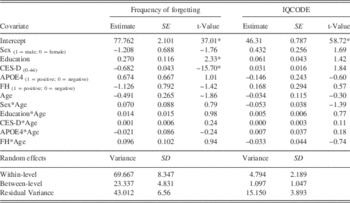
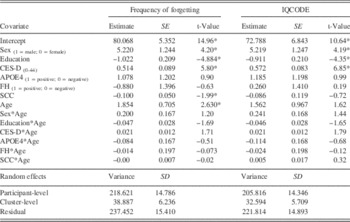
For Visit 1 self-SCC, more complaints (lower scores on FF) were moderately associated with less education (β=0.270; SE=0.116; t=2.33) and highly associated with more depressive symptoms (higher scores on the CES-D) (β=−0.682; SE=0.043; t=−15.70) at Visit 1. Visit 1 informant-SCC as well as longitudinal self- and informant-SCC were not associated with any other variables. FH and APOE4 status were not associated with Visit 1 or longitudinal SCC (see Table 2).
Predictors of Longitudinal SCC

Notes. Time=Age centered at Visit 1 mean. Visits 1-3 occur at two-year intervals. Lower scores on Frequency of Forgetting and scores greater than 48 on the IQCODE equate to more subjective complaints. Higher scores on the CES-D indicate more depressive symptoms. SCC=Subjective cognitive complaints as measured by Frequency of Forgetting and the IQCODE; IQCODE=Informant Questionnaire on Cognitive Decline in the Elderly; FH=Family History; APOE4=apolipoprotein E4; CES-D=Center for Epidemiologic Studies Depression Scale.*t-value>1.96=p < 0.05.
Relationship of Visit 1 SCC and Longitudinal Cognitive Performance
RAVLT-Total
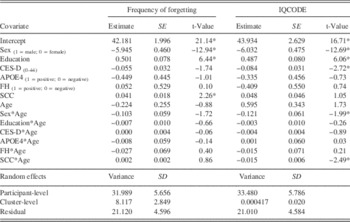
For Visit 1 self-SCC, more complaints (lower scores on FF) were modestly associated with lower Visit 1 RAVLT-Total scores (β=0.041; SE=0.018; t=2.26), but not longitudinal rate of change. Visit 1 informant-SCC were not associated with Visit 1 RAVLT-Total scores. In contrast, Visit 1 informant-SCC were associated with a faster rate of longitudinal decline of RAVLT-Total scores (β=−0.015; SE=0.006; t=−2.49) such that more complaints (higher scores on the IQCODE) predicted, on average, a −0.015 point biennial decrease in RAVLT-Total scores (see Table 3; data were collected every 2 years). Decomposing this interaction into simple slopes revealed that informant-SCC scores +1 SD above the mean (indicating more complaints) showed a steeper rate of decline while scores –1 SD below the mean showed a slower rate of decline (Figure 1).
Simple slopes representing the IQCODE predicting biennial rate of change on the RAVLT-Total for participants scoring +1 SD above (dashed line) and -1 SD below (dotted line) mean (solid line) IQCODE scores (higher scores equate to more informant complaints). X-axis=age as the time metric; y-axis=predicted RAVLT-Total scores. RAVLT=Rey Auditory Verbal Learning Test; SD=standard deviation.

Visit 1 SCC predicting RAVLT-Total scores

Notes. Time=Age centered at Visit 1 mean. Visits 1–3 occur at two-year intervals. Lower scores on Frequency of Forgetting and scores greater than 48 on the IQCODE equate to more subjective complaints. Higher scores on the CES-D indicate more depressive symptoms. SCC=Subjective cognitive complaints as measured by Frequency of Forgetting and the IQCODE; IQCODE=Informant Questionnaire on Cognitive Decline in the Elderly; FH=Family History; APOE4=apolipoprotein E4; CES-D=Center for Epidemiologic Studies Depression Scale.*t-value>1.96=p<0.05.
RAVLT-Delayed
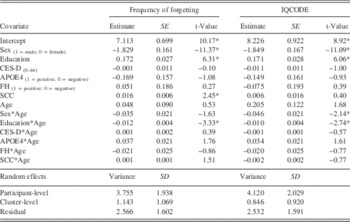
For Visit 1 self-SCC, more complaints (lower scores on FF) were modestly associated with lower Visit 1 RAVLT-Delayed scores (β=0.016; SE=0.006; t=2.45), but not longitudinal scores. No other association was observed between self- or informant-SCC and RAVLT-Delayed scores (see Table 4).
Visit 1 SCC predicting RAVLT-Delayed Recall scores

Notes. Time=Age centered at Visit 1 mean. Lower scores on Frequency of Forgetting and scores greater than 48 on the IQCODE equate to more subjective complaints. Higher scores on the CES-D indicate more depressive symptoms. SCC=Subjective cognitive complaints as measured by Frequency of Forgetting and the IQCODE; IQCODE=Informant Questionnaire on Cognitive Decline in the Elderly; FH=Family History; APOE4=apolipoprotein E4; CES-D=Center for Epidemiologic Studies Depression Scale.*t-value>1.96=p<0.05.
Trails B
For Visit 1 self-SCC, more complaints (lower scores on FF) were modestly associated with a slower time on Trails B at Visit 1(β=−0.100; SE=0.006; t=−1.99). No other association was observed between self- or informant-SCC and Trails B time (see Table 5).
Visit 1 SCC predicting Trails B time

Notes. Time=Age centered at Visit 1 mean. Lower scores on Frequency of Forgetting and scores greater than 48 on the IQCODE equate to more subjective complaints. Higher scores on the CES-D indicate more depressive symptoms. SCC=Subjective cognitive complaints as measured by Frequency of Forgetting and the IQCODE; IQCODE=Informant Questionnaire on Cognitive Decline in the Elderly; FH=Family History; APOE4=apolipoprotein E4; CES-D=Center for Epidemiologic Studies Depression Scale.*t-value>1.96=p<0.05.
Exploratory
Post hoc analyses investigating TMT B:A ratio (Golden, Osmon, Moses, & Berg Reference Golden, Osmon, Moses and Berg1981) as a more specific measure of executive functioning and RAVLT learning over trials (LOT; Ivnik et al., Reference Ivnik, Malec, Tangalos, Petersen, Kokmen and Kurland1992) as a measure of possible improvement in learning across the five learning trials were not associated with self- or informant-SCC.
DISCUSSION
We investigated longitudinal models of self- and informant-SCC in a cohort of healthy late middle-aged adults with familial and genetic risks factors for AD. Separate linear-mixed effects modeling revealed that self- and informant-SCC did not exhibit biennial change over time, and only Visit 1 self-SCC was associated with years of education and Visit 1 symptoms of depression. When Visit 1 self- and informant-SCC were used as predictors of OM, more self-SCC were associated with poorer Visit 1 scores on all three OM cognitive functioning, while informant-SCC were associated with a faster rate of biennial longitudinal decline in RAVLT-Total scores. Below we focus our discussion on associations with SCC.
Visit 1 and Longitudinal SCC
Self- and informant-SCC did not change over a relatively short longitudinal timeframe, and only education level and Visit 1 depressive symptoms were associated with Visit 1 self-SCC. The association of more Visit 1 self-SCC and fewer years of education, may align with the well-known protective effects (e.g., cognitive reserve; use of compensation strategies) of education on cognitive decline and rate of conversion to dementia (Karp et al., Reference Karp, Kareholt, Qiu, Bellander, Winblad and Fratiglioni2004; Letenneur et al., Reference Letenneur, Launer, Andersen, Dewey, Ott, Copeland and Brayne2000; Qiu, Bäckman, Winblad, Agüero-Torres, & Fratiglioni, Reference Qiu, Bäckman, Winblad, Agüero-Torres and Fratiglioni2001; Stern et al., Reference Stern, Gurland, Tatemichi, Tang, Wilder and Mayeux1994; van Oijen, de Jong, Hofman, Koudstaal, & Breteler, Reference van Oijen, de Jong, Hofman, Koudstaal and Breteler2007). However, studies have observed steeper rates of decline in self-SCC (more complaints) in more highly educated individuals (Hulur, Hertzog, Pearman, Ram, & Gerstorf, Reference Hulur, Hertzog, Pearman, Ram and Gerstorf2014; Hulur et al., Reference Hulur, Hertzog, Pearman and Gerstorf2015; Zelinski, Burnight, & Lane, Reference Zelinski, Burnight and Lane2001); and when self-SCC complaints are present, appear to be more predictive of cognitive decline and AD risk compared to that in less educated individuals (Chary et al., Reference Chary, Amieva, Pérès, Orgogozo, Dartigues and Jacqmin-Gadda2013; van Oijen et al., Reference van Oijen, de Jong, Hofman, Koudstaal and Breteler2007. Thus, there may be a period of delay of self-reported cognitive changes in at-risk individuals who are highly educated, and then eventually convert at a faster rate later in time after accumulation of neurodegenerative processes (Stern, Albert, Tang, & Tsai, Reference Stern, Albert, Tang and Tsai1999). Given the relatively high education status (mean=16 years) and younger age of our sample (Visit 1 mean=58 years) within this preclinical timeframe, continued longitudinal evaluation will help determine if this purported pattern is consistent with their longitudinal trajectory.
A greater frequency of depressive symptoms were associated with more Visit 1 self-SCC, but did not predict longitudinal self-SCC, which some have reported (Hulur et al., Reference Hulur, Hertzog, Pearman and Gerstorf2015; Snitz et al., Reference Snitz, Small, Wang, Chang, Hughes and Ganguli2015). Depressive symptoms are often associated with SCC (Brigola et al., Reference Brigola, Manzini, Oliveira, Ottaviani, Sako and Vale2015; Chin, Oh, Seo, & Na, Reference Chin, Oh, Seo and Na2014; La Rue et al., Reference La Rue, Small, McPherson, Komo, Matsuyama and Jarvik1996; Lehrner et al., Reference Lehrner, Moser, Klug, Gleiß, Auff, Dal-Bianco and Pusswald2014) and may represent an inaccurate and/or a negatively biased self-appraisal (Crane, Bogner, Brown, & Gallo, Reference Crane, Bogner, Brown and Gallo2007) characteristically found in depressed patients (Beck, Rush, Shaw, & Emery, Reference Beck, Rush, Shaw and Emery1979), thus warranting their inclusion as a covariate when investigating the unique relationship between self-SCC on objective cognitive performance.
However, a recent longitudinal population-based study (Hulur et al., Reference Hulur, Hertzog, Pearman and Gerstorf2015) showed that correlated changes in self-SCC and memory performance were reliably stronger in individuals endorsing more depressive symptoms. Thus, this may actually reflect an accurate appraisal (i.e., depressive realism) of changes in cognitive function (Pearman et al., Reference Pearman, Hertzog and Gerstorf2014) and in effect highlight the potential clinical value of the association between depressive symptoms and SCC.
SCC and OM
Visit 1 self- and informant-SCC diverged with regards to their association with OM, in that self-SCC were associated with all Visit 1 OM (RAVLT-Total & Delayed, Trails B), and informant-SCC only predicted, albeit modestly, a faster rate of biennial decline in episodic memory (RAVLT-Total). Our findings of an association between self-SCC and OM, such that more complaints corresponded to poorer performance on OM, is consistent with previous research (Snitz, Morrow, Rodriguez, Huber, & Saxton, Reference Snitz, Morrow, Rodriguez, Huber and Saxton2008; Zelinski et al., Reference Zelinski, Gilewski and Anthony-Bergstone1990), and may highlight the possibility that questions about memory complaints on the FF scale may generalize and/or be interpreted to involve other cognitive domains such as executive functioning, given the significant association with Trails B in addition to the RAVLT tests (Jessen et al., Reference Jessen, Amariglio, van Boxtel, Breteler, Ceccaldi and Chetelat2014).
Informant-SCCs were associated with a decline in longitudinal episodic memory (RAVLT-Total) which is consistent with longitudinal studies showing the utility of informant reports as indicators of cognitive changes (Gifford et al., Reference Gifford, Liu, Carmona, Lu, Romano, Tripodis and Jefferson2015; Jorm et al., Reference Jorm, Christensen, Henderson, Jacomb, Korten and Mackinnon1996). Simple slopes revealed that informant-SCC scores + 1 SD (M=52.48; more complaints) above the mean (M=47.89; minor-to-no complaints) showed a relatively steeper rate of decline than scores around or below the mean. While a mean score of 52.48 (~3.28) is still below the recommended clinical cut-off of 3.44 (Jorm, Reference Jorm2004), it would be interesting to explore in future follow-up analyses to determine the clinical relevance in our sample.
A recent longitudinal study found that informant-only and mutual complaints (self- and informant) were predictors of decline in global cognition and processing-speed, but not episodic memory (e.g., RAVLT-Total) in healthy older individuals (approximate mean age=72 years) (Gifford et al., Reference Gifford, Liu, Carmona, Lu, Romano, Tripodis and Jefferson2015). Informant-SCC may be more sensitive to global changes (Jorm et al., Reference Jorm, Christensen, Henderson, Jacomb, Korten and Mackinnon1996); therefore, while the RAVLT-Total measures initial auditory episodic learning of unstructured verbal information, it could also represent the participant’s general ability to learn new information, which, over time, could manifest as subtle yet observable deficits in daily functioning (Cargin, Collie, Masters, & Maruff, Reference Cargin, Collie, Masters and Maruff2008; Gross, Rebok, Unverzagt, Willis, & Brandt, Reference Gross, Rebok, Unverzagt, Willis and Brandt2011).
While speculative, this interpretation may be consistent with the fact that the IQCODE in our study requires informants to evaluate the participant across a variety of cognitive functions, in effect possibly allowing for broader measurement of observable cognitive and/or functional changes than memory performance as assessed by the FF scale. Nevertheless, we chose not to investigate the correlation between self- and informant SCC due to these important differences.
Family History and APOE4 Status
Given that our sample is enriched with AD FH and APOE4 positive adults; and the observed association between these familial/genetic factors and increased SCC (Dik et al., Reference Dik, Jonker, Comijs, Bouter, Twisk, van Kamp and Deeg2001; Kryscio et al., Reference Kryscio, Abner, Cooper, Fardo, Jicha, Nelson and Schmitt2014; La Rue et al., Reference La Rue, Small, McPherson, Komo, Matsuyama and Jarvik1996; Risacher et al., Reference Risacher, Kim, Nho, Foroud, Shen, Petersen and Koeppe2015; Samieri et al., Reference Samieri, Proust-Lima, Glymour, Okereke, Amariglio, Sperling and Grodstein2014; Small et al., Reference Small, Chen, Komo, Ercoli, Miller, Siddarth and Bookheimer2001; Tsai, Green, Benke, Silliman, & Farrer, Reference Tsai, Green, Benke, Silliman and Farrer2006), we investigated the association between SCC and FH and APOE4 status. Our analyses revealed that neither FH nor APOE4 status was associated with Visit 1 or longitudinal self- and informant-SCC. Unlike our participants who were unaware of their APOE4 status, a recent study found that individuals aware of their APOE4 status had more cognitive complaints and performed worse on testing compared to their unknowledgeable counterparts (Lineweaver et al., Reference Lineweaver, Bondi, Galasko and Salmon2014).
More complaints were also observed in younger individuals with an early-onset FH compared to individuals with a late-onset FH (La Rue et al., Reference La Rue, Small, McPherson, Komo, Matsuyama and Jarvik1996; McPherson et al., Reference McPherson, La Rue, Fitz, Matsuyama and Jarvik1995). These participants were comparable in age to our sample, thus the individuals with late-onset FH who had fewer complaints were likely over a decade younger than the onset of their relative’s symptoms and, therefore, possibly less inclined to feel vulnerable to cognitive changes than participants with an early-onset FH. Future analyses in which we distinguish between early and late-onset in our sample may assist in clarifying if characteristics of FH are associated with self- or informant SCC.
LIMITATIONS AND CONCLUSION
In summary, self- and informant-SCC did not significantly change longitudinally, and with exception of Visit 1 informant-SCC predicting longitudinal RAVLT-Total scores, no other model or post hoc analysis with Visit 1 self- or informant-SCC predicted longitudinal changes in cognitive performance. While this is consistent with some studies (Cargin et al., Reference Cargin, Collie, Masters and Maruff2008; Pearman et al., Reference Pearman, Hertzog and Gerstorf2014), several studies, after controlling for depressive symptoms, found correlated longitudinal changes between self-SCC and OM. (Hulur et al., Reference Hulur, Hertzog, Pearman and Gerstorf2015; Parisi et al., Reference Parisi, Gross, Rebok, Saczynski, Crowe, Cook and Unverzagt2011; Snitz et al., Reference Snitz, Small, Wang, Chang, Hughes and Ganguli2015; Zimprich & Kurtz, Reference Zimprich and Kurtz2015). Methodological differences may partially account for some of this inconsistency in that our study included a brief total longitudinal time-frame (mean interval across 3 visits=4 years), with a relatively healthy and younger cohort (Visit 1 mean=58 years) that may be exhibiting stable performance on OM compared to older individuals.
Previous longitudinal studies modeling FF as a random effect have demonstrated that age predicts individual declines in FF possibly due to the expectation that memory will decline with age (Lane & Zelinski, Reference Lane and Zelinski2003); however, participants in the current study may still be too young to apply this heuristic to their own memory function. Moreover, a recent study with a similarly aged cohort and longitudinal timeframe (Hulur et al., Reference Hulur, Hertzog, Pearman and Gerstorf2015) did observe a correlation between memory complaints and OM, though this study had a considerably larger sample size (>15,000) and, therefore, possibly increased power to detect generally modest effects (Hertzog & Pearman, Reference Hertzog and Pearman2013).
Additional limitations include our separate linear mixed effects models approach, as several studies reporting covariation between SCC and OM used latent growth curve modeling (Hulur et al., Reference Hulur, Hertzog, Pearman and Gerstorf2015; Mascherek & Zimprich, Reference Mascherek and Zimprich2011; Parisi et al., Reference Parisi, Gross, Rebok, Saczynski, Crowe, Cook and Unverzagt2011; Snitz et al., Reference Snitz, Small, Wang, Chang, Hughes and Ganguli2015; Zimprich & Kurtz, Reference Zimprich and Kurtz2015); which could be particularly useful as our sample ages and likelihood of variability in cognitive function increases. Also, the low test–retest reliability of the IQCODE is inconsistent with previous reliability measurements (Jorm & Jacomb, Reference Jorm and Jacomb1989; Jorm, Scott, Cullen, & MacKinnon, Reference Jorm, Scott, Cullen and MacKinnon1991; Jorm, Reference Jorm2004) and again may be partially due to the relatively healthy status and younger age of our sample.
Possible informant contamination effects related to informant anxiety, mood, and burden have also been associated with the IQCODE, but were not collected in this study. In addition, the FF of the MFQ and IQCODE measure different constructs (memory performance vs. cognitive/functional changes, respectively) and vary with regards to including a reference point when assessing cognitive function (no reference point for FF vs. “10 years ago” and “2–3 years ago” for IQCODE), thus restricting direct comparisons between the two measures. Lastly, the unique characteristics of our sample may limit our comparison to other studies as the majority of our participants were enrolled based on having a positive FH of AD and are highly educated compared to studies using community/population-based samples (Hertzog & Pearman, Reference Hertzog and Pearman2013).
The current study found that self- and informant-SCC in healthy late middle-aged adults did not show measurable longitudinal change, but were predictors of OM at baseline and longitudinal timeframes, respectively. Methodological and demographic characteristics of our study, particularly the relatively short longitudinal time-frame and younger mean age of our sample, may have contributed to our limited longitudinal findings as well as lack of an association between familial and genetic risk factors and SCC. Additional longitudinal follow-up will likely assist in further clarifying these relationships as our sample ages and more pronounced clinically relevant cognitive changes eventually emerge.
ACKNOWLEDGMENTS
The authors gratefully acknowledge the assistance of Janet Rowley, Amy Hawley, Allen Wenzel, Shawn Bolin, Lisa Bluder, Diane Wilkinson, Emily Groth, Susan Schroeder, Laura Hegge, Chuck Illingworth, and Jen Oh. Most importantly, we thank our dedicated participants of the WRAP for their continued support and participation in this research.Funding: This work was supported by the Clinical Translational Science Award (CTSA) program, through the National Institutes of Health National Center for Advancing Translational Sciences (NCATS) UL1TR00427. Funding support was also provided by the National Institutes of Health (NIH) [R01 AG027161 to SCJ, R01 AG021155 to SCJ, ADRC P50 to SA] and the by a Veterans Administration Geriatrics Research and Clinical Center (GRECC) Fellowship in Advanced Geriatrics and Aging at the William S. Middleton Memorial Veterans Hospital, Madison, WI (CRN). The content is solely the responsibility of the authors and does not represent the official views of NIH or VA. The authors deny any conflicts of interest related to this project.