Introduction
People with severe mental illness are associated with a significant cardiometabolic risk, such as central obesity, glucose dysregulation, dyslipidaemia, and do have a reduced life expectancy (Angst et al., Reference Angst, Stassen, Clayton and Angst2002; McCreadie, Reference McCreadie2003; Sukanta et al., Reference Sukanta, Chant and McGrath2007). These types of problems have indeed been rising in the last decade. For example, the standardized mortality ratio for death within 1 year of psychiatric in-patient care for people with schizophrenia has increased from 1.6 in 1999 to 2.2 in 2006, and for people with bipolar illness from 1.3 in 1999 to 1.9 in 2006 (Hoang et al., Reference Hoang, Stewart and Goldacre2011).
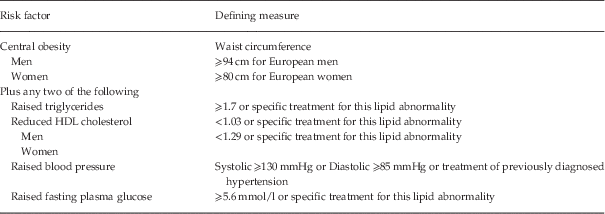
Metabolic syndrome includes a combination of physical and metabolic abnormalities which can be identified by abnormal values for: central obesity, hypertension, high-density lipoprotein (HDL) cholesterol, triglycerides, and fasting plasma glucose [Alberti et al., Reference Alberti, Zimmet and Shaw2005, Reference Alberti, Zimmet and Shaw2006; International Diabetes Federation (IDF)]. While the pathogenesis of the syndrome and each of its components is complex and not well understood, central obesity and insulin resistance are acknowledged as important causative factors (Anderson et al., Reference Anderson, Critchley, Chan, Cockram, Lee, Thomas and Tomlinson2001; Nesto, Reference Nesto2003). According to the IDF, for a person to be defined as having metabolic syndrome they must have central obesity plus any two of the following: raised triglycerides, reduced HDL cholesterol, raised blood pressure and/or raised fasting plasma glucose (www.idf.com/metabolic_syndrome). For a detail description of normal and abnormal values please see Table 1.
Diagnostic criteria for metabolic syndrome used in the study
Interestingly, there is evidence for increased intra-abdominal fat and glucose dysregulation in people with first-episode psychosis even before treatment commences (Ryan et al., Reference Ryan, Collins and Thakore2003) but an outstanding change is noticed after commencement of antipsychotic medication (Correll et al., Reference Correll, Manu, Olshanskiy, Napolitano, Kane and Malhotra2009; Bushe et al., Reference Bushe, Slooff, Haddad and Karagianis2013). Weight gain and obesity are of particular concern because of their potential for cardiometabolic risk. However, it is also important to note that diabetes and dyslipidaemia can occasionally appear even in the absence of weight gain, underlying the importance of being clinically aware of the possibility of serious metabolic disturbance occurring in those on antipsychotic medication who have not gained weight (McIntyre et al., Reference McIntyre, McCann and Kennedy2001).
Cardiovascular disease can also be expected to become a significant problem and cause of death in people with intellectual disabilities (ID), because of increasing longevity, high prevalence of obesity (De Winter et al., Reference De Winter, Bastiaanse, Hilgenkamp, Evenhuis and Echteld2011; Gazizova et al., Reference Gazizova, Puri, Singh and Dhaliwal2012) and sedentary lifestyles (Hilgenkamp et al., Reference Hilgenkamp, Reis, van Wijck and Evenhuis2011). Mental illness has a much higher prevalence in people with ID than in the general population; for instance the prevalence of psychosis in the people with ID is about 3% compared with 1% in the general population (Cooper et al., Reference Cooper, Smiley, Morrison, Allan, Williamson, Finlayson, Jackson and Mantry2007). Moreover, cardiovascular disease in the people with ID is also associated with certain genetic syndromes such as Prader–Willi syndrome (Sinnema et al., Reference Sinnema, Maaskant, van Schrojenstein Lantman-de Valk and van Nieuwpoort2011), sex chromosomal abnormalities, Werner’s syndrome, mitochondrial defects and congenital rubella syndrome (Wallace, Reference Wallace2004), and with the use of antipsychotic medication (McKee et al., Reference McKee, Bodfish, Mahorney, Heeth and Ball2005).
The need for screening and monitoring cardiovascular risk factors in people with psychiatric illness is well documented. However, to our knowledge this is one of the very few studies/audits to evaluate metabolic syndrome in people with ID and comorbid mental illness, and taking antipsychotics. St. Michael’s House is a specialist community based urban service that provides medical and psychiatric care for people with ID. Before this clinical audit, a specific assessment protocol for screening and monitoring of metabolic syndrome in patients attending the service and taking antipsychotic medication, had not been developed. This study was designed to stimulate evidence for the need to develop such a protocol. We first aimed at identifying the level of required information on clinical files to assess the presence of metabolic syndrome. The study was also carried out to assess clinical and demographic correlates that could be associated with developing metabolic syndrome such as age, gender, level of ID, diagnosis and others.
Method
Research design
As part of a clinical audit, a retrospective cross-sectional analysis was performed for a sample of 76 adults with ID and comorbid mental illness attending the service; and for whom treatment with antipsychotic medication was established. Individuals included in our sample had been formally diagnosed through a professional assessment of IQ and adaptive functioning. There are three criteria that must be met for a diagnosis of ID: an IQ below 70, significant limitations in two or more areas of adaptive behaviour, and evidence that the limitations became apparent before the age of 18 (American Psychiatric Association, 2000). Diagnoses of mental illness were made in accordance with DC-LD diagnostic criteria (Royal College of Psychiatrists, 2001) and the IDF definition of metabolic syndrome (gold standard) was used as described in Table 1 (Alberti et al., Reference Alberti, Zimmet and Shaw2005).
Chart review procedure
The medical records of individuals meeting the above criteria were examined for evidence of measurement of fasting glucose, triglyceride, HDL cholesterol, blood pressure, and waist circumference measurement in the previous 12 months. Clinical and demographic details included age, gender, height, weight, level of ID, alcohol and smoking history, and family history of cardiovascular disease.
Study sample
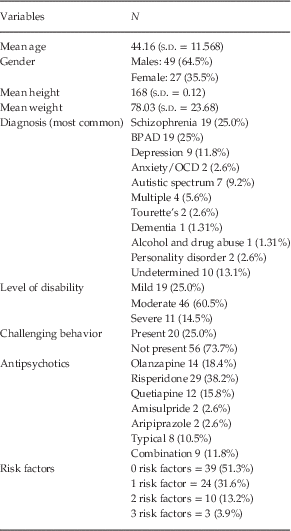
Our sample included a large random cohort of adults attending the mental health service, and taking antipsychotic medication. The sample was generated using an electronic mental health database that cross-sectionally gathers diagnostic (DC-LC) and treatment information on each individual attending mental health clinics of the service. Seventy-six patient files were examined and included in the study. The mean age of participants was 44.16 (s.d.=11.568) and 64.5% (n=49) of the study sample were males. We also looked at the level of ID in our sample and found out that 25% (n=19) had a diagnosis of mild ID, 60.5% (n=46) of moderate ID and 14.5% (n=11) of severe/profound ID.
The mean height of the sample was 168 cm (s.d.=0.12) and the mean weight was 78.03 kg (s.d.=23.68). Most patients had a diagnosis of schizophrenia (25%) or bipolar affective disorder (25%), followed by major depression (11.8%) and autistic spectrum disorder (9.2%). Other less common diagnoses were anxiety disorder/obsessive compulsive disorder (2.6%), Tourette’s syndrome (2.6%), personality disorders (2.6%), dementia (1.3%) and alcohol and drug abuse (1.3%). Four patients (5.6%) had multiple diagnosis and 10 (13.1%) patients had no psychiatric illness identified and recorded in their files. Of note, 5.6% of the patients had multiple diagnoses (more than one) and for 1.3% diagnosis was not determined at the time of inclusion in the study. ‘Problem behaviours’ were documented in 25% of the files reviewed making a total number of 20 patients with comorbid behavioural difficulties.
Data analysis procedures
Statistical analysis was performed using the Statistical Package for Social Sciences (SPSS) 16.0 for Windows. Descriptive statistics were used to document frequency of selected criteria in clinical charts. For group comparisons Student’s t-tests were used for parametric data and the χ 2-test was used for non-parametrical data. All statistical tests were two-tailed and the α-level for statistical significance was 0.05.
Ethical approval
The local Ethics Committee at St. Michael’s House gave ethical approval to carry out the project.
Results
Antipsychotic medication use
With regards to antipsychotic medication, the most commonly used antipsychotic among the sample was risperidone, in a total number of 29 patients (38.2%), followed by olanzapine in 14 patients (18.4%) and quetiapine in 12 patients (15.8%). Two patients (2.6%) were on amisulpride and another two on aripiprazole. In total, 77.6% (n=59) of our patients were on monotherapy with an atypical antipsychotic. Monotherapy with typical antipsychotic medication was received by eight patients (10.5%) in the following manner: seven received haloperidol and one clopixol. A combination of typical and atypical antipsychotics was received by 9 (11.8%) patients as follows: one received haloperidol, risperidone and clopixol, one was on risperidone and aripiprazole, one on quetiapine and haloperidol, one on olanzapine and chlorpromazine, two were on clopixol and risperidone, one received haloperidol and olanzapine, one modecate IM and risperidone, and another patient received olanzapine and haloperidol.
The mode of administration of medication was largely oral mode (96.1%). Only three patients were prescribed intramuscular antipsychotic preparations. For a detailed description of the demographic aspects of our sample, please see Table 2.
Demographic variables of the study sample

BPAD, bipolar affective disorder; OCD, obsessive–compulsive disorder.
Presence of key criteria in records
One of the main issues we encountered when collecting data was that the variable for waist circumference measurement was not available for any patient included in the study; highlighting the fact that regular monitoring check-ups need to be put in place in the service to collect this variable in the future, as waist circumference measure is a very relevant factor to consider for the diagnosis of metabolic syndrome (Table 1). In addition, a total number of 19 patients (25.0%) had two variables missing from their file, 4 (5.3%) patients had three variables missing in total, 30 patients (39.5%) had four variables missing, 10 patients (13.2%) had five variables not recorded, one patient had six variables missing and finally, a total of 12 patients (15.8%) had none of the variables recorded.
Levels of risk evident
Taking into account the variables that were present in our patients files, we can conclude that 39 patients (51.3%) in our sample had no risk factors or features for metabolic syndrome (remembering that all patients had waist circumference missing), 24 of them (31.6%) had one risk factor recorded, 10 patients (13.2%) had two risk factors and three of them (3.6%) had three risk factors for metabolic syndrome.
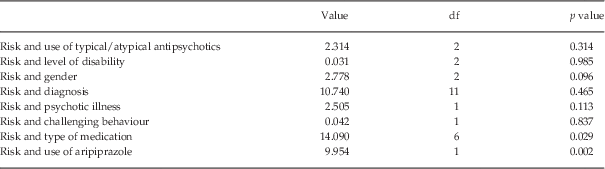
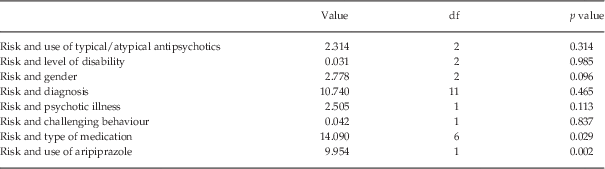
When we looked at the level of risk using again χ 2-test for the patients included in the study, we found that there was no significant interaction between the level of risk and the use of typical or atypical medication (χ 2=2.314, df=2, p=0.314), no significant interaction between the level of risk and the level of ID (χ 2=0.031, df=2, p=0.985), gender (χ 2=2.778, df=1, p=0.096), diagnoses (χ 2=10.740, df=11, p=0.465), presence of psychotic disorder diagnosis specifically (χ 2=2.505, df=1, p=0.113) or presence of ‘problem behaviour’ (χ 2=0.042, df=1, p=0.837).
However, there was a significant interaction between the level of risk and the type of antipsychotic used (χ 2=14.090, df=6, p=0.029). In particular, based on the standardized residuals (>2 suggesting a significant cell) we found that with aripiprazole there were fewer than expected patients on the high-risk category. Studying aripiprazole on its own, we found again a significant difference compared with other antipsychotic medication (χ 2=9.954, df=1, p=0.002).
Discussion
Our study is representative of a first part of a clinical audit cycle with a cohort of individuals with ID who also are on antipsychotic medication for enduring mental illness. The pattern of metabolic syndrome across psychiatric disorders has been well documented in previous studies (Mackin et al., Reference Mackin, Bishop, Watkinson, Gallagher and Ferrier2007; Daumit et al., Reference Daumit, Goff, Meyer, Davis, Nasrallah and McEvoy2008; Vinberg et al., Reference Vinberg, Madsen, Breum, Kessing and Fink-Jensen2012). This study provides further evidence that the use of antipsychotic medication for chronic mental illness in people with ID should be considered a risk factor for developing metabolic syndrome.
We should be careful when interpreting our results as due to the design of the study, it is not possible to accurately determine the prevalence of metabolic syndrome in our sample due to the fact that some variables such as waist circumference were not available on chart review. However, this study serves to highlight the importance of regular and consistent screening and monitoring for metabolic syndrome in psychiatric patients with an ID, in a similar fashion to the general psychiatric populations (NICE guidelines, Maudsley guideliness). Metabolic syndrome, as with other health problems, is at increased risk of being underdiagnosed in the ID population simply due to the fact that self-awareness of increasing weight or unhealthy life styles may be lacking. This study illustrates why Intellectual Disability Services should try to maintain gold standards with regards to screening for metabolic syndrome developing a systematic and consistent protocol to record the relevant diagnostic variables for metabolic syndrome in the ID population at risk for the syndrome, namely those who have mental illness and in particular, if they are on regular antipsychotic medication. The research literature in this area is almost non-existent (McKee et al., Reference McKee, Bodfish, Mahorney, Heeth and Ball2005).
One of the interesting findings of the study is that we did not find a significant result in terms of metabolic syndrome and the use of typical or atypical antipsychotic medications; apart for the finding that there were fewer patients in the high-risk category among those who were taken aripiprazole. Aripiprazole has been consistently reported to be associated in the general population with less metabolic risk than other antipsychotics and with causing less weight gain and having lower risk for increased waist circumference over long-term use (De Hert et al., Reference De Hert, Hanssens, Van Winkel, Wampers, Van Eyck, Scheen and Peuskens2007; Rummel-Kluge et al., Reference Rummel-Kluge, Komossa, Schwarz, Hunger, Schmid, Asenjo Lobos, Kissling, Davis and Leucht2010). However, the generalisability of the result is limited due to the small number of patients on this particular medication but nevertheless interesting and encouraging for further research action.
The limitations of this study include the cross-sectional design and the lack of non-medicated control group or longitudinal follow up. The study does not assess severity of metabolic syndrome, which could also be relevant from a clinical point of view. Other factors that could be treated as confounders and may act as independent risk factor for metabolic syndrome have not been taken into account in the study. Among them is level of physical exercise or a poor diet, for instance. Also, such patients with chronic enduring mental health needs are likely to have a limited or inconsistent approach to medical care. However, one of the strengths of the study is the ability to sample from across the entire organization, and the use of existing data to highlight the gaps in assessment among this ‘at risk’ group (Table 3).
Chi-square test results for the interaction between level of risk and other factors
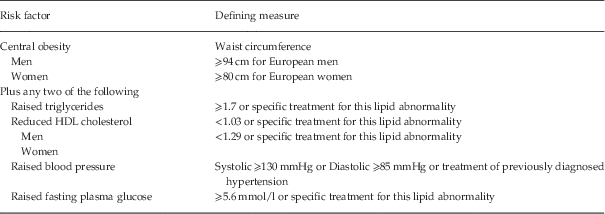
Overall, the high prevalence of metabolic syndrome in those with enduring mental illness indicates that this particular population is at risk. Interestingly, the ID population who have mental illness and receiving antipsychotics seems to be a particularly at threat population due to several risk factors such as poor mobility, reduced physical activity, poor diet and others. Routine and careful screening in clinical settings should be introduced to reduce morbidity and mortality. It is particularly important for that to happen to increase collaboration between primary and secondary levels of care and to develop screening protocols, pharmacological and non-pharmacological strategies to prevent and manage those symptoms. As a rule of thumb, patients on antipsychotic medication should be screened accordingly to current guidelines (De Hert et al., Reference De Hert, Vancampfort, Correl, Mercken, Peuskens and Sweers2011). As part of the cycle of a clinical audit we presented the findings to the department suggesting best practice and the gaps in the various variables that should be regularly monitored for metabolic syndrome, in the hope that the study can be replicated as a follow up audit to assess for the level of metabolic syndrome in the sample with best practice in place. International guidelines recommends monitoring at baseline, 3 months and 12 months for BMI, waist circumference and lipid profile; baseline and frequently during titration of the antipsychotic for blood pressure and baseline, 4–6 months and 12 months fasting/random glucose as described in Table 4. We have also set a new metabolic clinic in conjunction with nursing staff in the service for screening and monitoring of the syndrome. The psychiatrists would refer patients from residential or family home settings (through specific referral form) to the nurse running the metabolic clinic. The nurse would monitor blood pressure, waist circumference and bloods and send the results to the psychiatrist who then makes the decision of involving the primary care giver if necessary. This would be a cost effective measure as involves staff currently working in the organization, not employing new staff; and at the same time could tremendously benefit our patients and increase the links with the general practitioners in the local area.
Metabolic syndrome monitoring recommendations

BMI, body mass index.
A systematic review has demonstrated the importance of physical health advice on physical health awareness and physical health behaviours in people with mental illness (Tosch et al., Reference Tosch, Clifton and Bachner2011). A recent 6-month randomized controlled trial has also highlighted the importance of long-term lifestyle strategies for weight gain management in the people with schizophrenia (Attux et al., Reference Attux, Martini, Elkis, Tamai and Freirias2013). The general consensus at the moment is that physical activity has a mild to moderate favourable effect on many metabolic and cardiovascular risk factors that constitute or are related to metabolic syndrome (De Hert et al., Reference De Hert, Schreurs, Vancampfort and Van Winkel2009). Physical health programmes and diet educational programmes are excellent interventions for weight gain prevention and treatment, and to manage also other metabolic abnormalities (Holt et al., Reference Holt, Abdelrahman, Hirsch, Dhesi, George and Blincoe2010; Luo et al., Reference Luo, Yang, Nieman, Zhang, Wang, Wang and Chen2013). Unfortunately there is no data available looking at these type of interventions in the ID population. We hypothesized that these types of interventions can be adaptable to people’s abilities and could easy be used in the ID population. Some of the limitations that a dietary/exercise programmes could have in the ID population are that success would depend on the level of insight of the individual and the level of physical ability and comorbid illnesses.
Conflicts of Interest
None.