The Canadian Longitudinal Study on Aging (CLSA) is a major strategic initiative of the Canadian Institutes for Health Research (CIHR) that has been on the national research agenda since 2001. Launched in 2010, this landmark study of 50,000 Canadian residents provides a unique resource with vast potential to advance our understanding of adult development and aging. As a study, the CLSA was developed with three key objectives: (1) to examine aging as a dynamic life course process; (2) to investigate the inter-relationship among intrinsic and extrinsic factors from mid-life to older age; and (3) to capture the transitions, trajectories, and profiles of aging-related processes. As a platform, the CLSA was designed with the objective to provide the infrastructure and build capacity for state-of-the-art, interdisciplinary, population-based research and for evidence-based decision making needed to support the nation as it transitions into several decades of rapid population aging.
Over the next 20 years and beyond, the CLSA will generate a wealth of information that will contribute to the advancement of science and the development of programs and policy. Some of the CLSA research findings will be derived in the longer term; however, many others will be available in the short term. Indeed, we expect a steady flow of both basic and applied knowledge to be generated from the CLSA over the coming decades, creating the opportunity for continual productivity and the potential to make significant contributions to the study of aging in local, national, and international spheres.
With the first set of baseline data becoming available on the CLSA Tracking participants (i.e., those study participants being followed by telephone interview), we analysed selected characteristics of these participants at study entry, and in this article, we highlight the potential applications of these data as a platform for multilayered programs of research.
CLSA Study Design
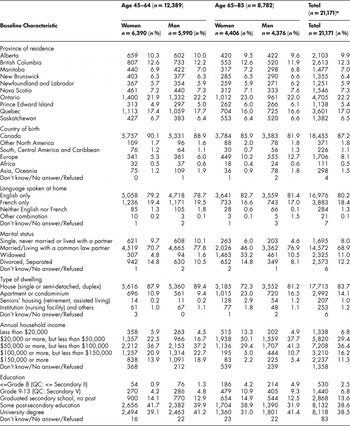
The CLSA study design has been previously described in detail (Raina et al., Reference Raina, Wolfson, Kirkland, Griffith, Oremus and Patterson2009). Briefly, the CLSA will follow approximately 50,000 Canadian women and men, every three years, for at least 20 years. The study has two categories of participants: 21,241 Tracking participants (being followed by telephone interview only) were randomly selected within age/sex strata in each province, and the remainder (Comprehensive participants being followed via in-depth interviews and on-site data collection) were randomly selected within age/sex strata from within 25 km (and, in locales with lower population density, within 50 km) of 11 sites across the country (Victoria, Vancouver, Surrey, Calgary, Winnipeg, Ottawa, Hamilton, Montreal, Sherbrooke, Halifax, and St. John’s). The Tracking cohort (our focus here) was portioned among the provinces to allow reasonably precise estimates of various parameters or associations to be made. The minimum target sample in any province was 1,100 (PEI), and the maximum was 4,388 (Ontario). Eight strata were formed within each province, based on age groups (45–54, 55–64, 65–74, 75–85) and sex. Table 1 shows the actual numbers of participants recruited in each stratum.
Socio-demographic characteristics of CLSA Tracking participants, by age and sex, at baseline years 2010–2013 (n = 21,241)

Note: All percentages are calculated only within those participants who answered the given question, and exclude those who did not know or refused to answer, or those to whom the question is not applicable.
a 70 participants age < 45 or > 85 at interview are excluded from the CLSA sample (met age eligibility at recruitment).
For CLSA Tracking participants, recruitment was accomplished in three ways: we recruited 3,923 participants via the Canadian Community Health Survey (CCHS) on Healthy Aging (CCHS Cycle 4.2); 3,810 participants, through mail-outs from provincial health ministries; and 13,508 participants by means of random-digit dialing. Tracking participants provided signed consent to participate in the study via an interviewer-administered computer-assisted telephone interview, and were given the option to provide their health card number for linkage to administrative health databases.
Details of the measures collected have been reported (Raina, Wolfson, Kirkland et al., Reference Raina, Wolfson, Kirkland, Griffith, Oremus and Patterson2009) and are available on the CLSA website (www.clsa-elcv.ca). Briefly, the CLSA Tracking questionnaire includes modules on (a) socio-demographic characteristics; (b) lifestyle and health behaviours; (c) health status and chronic conditions; (d) function and activities of daily living; (e) social networks, social support, and social participation; (f) care giving and receiving; and (g) labour force participation and retirement.
The baseline data for 21,241 CLSA Tracking participants became available for use by the research community in mid-2014. The final number of Tracking participants exceeded our initial estimate due to the need to approximate the Canadian population as closely as possible. As is characteristic of many population-based studies, CLSA respondents were of higher socioeconomic status than the general population. Therefore, as we approached the end of the recruitment period we chose to selectively target additional recruitment from participants living in postal codes identified as representing areas of low education by Statistics Canada (Statistics Canada, 2012).
Baseline Characteristics of CLSA Tracking Participants
Baseline characteristics of CLSA Tracking participants are presented in Table 1. Most participants were born in Canada (87.2%) and speak English as their primary language at home (80.2%). Although it was an eligibility requirement of the CLSA that participants were able to conduct the interview in either English or French, a small proportion of participants spoke neither English nor French at home (1.3%). The majority of participants lived in a detached or semi-detached house (83.7%) or apartment (14.1%), and more than 70 per cent of individuals in each age/sex group were married or living with a common-law partner, the exception being older women (46.0%). With respect to socioeconomic status, 2.5 per cent of participants had a Grade 8 education or lower; 13.6 per cent had completed secondary school or equivalent; 38.6 per cent had completed some post-secondary education including a technical diploma, college, or some university; and 38.5 per cent had completed a university degree. The greatest proportion of participants fell in the $50,000–$100,000 annual household income bracket (36.4%); 6.8 per cent of participants fell in the lowest income bracket of less than $20,000, and 11.3 per cent were in the highest reported income bracket of greater than $150,000. Notably, women in the older age category occupied significantly higher proportions in the lower income categories than either older men or younger men and women, although similar differences in education were not seen.
In the following discussion, we expand on participant characteristics at baseline to provide a snapshot of the CLSA Tracking data available and to illustrate the ways in which CLSA data can be used to further the research agenda on health and aging in Canada.
Health, Chronic Diseases, and Function in the CLSA
It is well documented that the prevalence of chronic diseases increases with age (Broemeling, Watson, Prebtani, & Health Outcomes Steering Committee of Health Council of Canada, Reference Broemeling, Watson and Prebtani2008; Elmslie, Reference Elmslie2012; Ramage-Morin, Shields, & Martel, Reference Ramage-Morin, Shields and Martel2010) and that many older adults have multiple chronic diseases (Marengoni et al., Reference Marengoni, Angleman, Melis, Mangialasche, Karp and Garmen2011). Moreover, functionality – involving, for instance, loss of vision, hearing, or mobility – that affects the ability to engage in activities of daily living typically declines with age. Preventing or delaying the onset of chronic diseases, reducing the impacts of disease and disability, and slowing functional decline to maintain independence for as long as possible are, therefore, important research foci and avenues for further work. With the increasing population of older adults, these issues have also come to the forefront for policy makers. While it has been clearly demonstrated that higher utilization, not the elderly population per se, is driving health care spending (Denton & Spencer, Reference Denton and Spencer2010; Evidence Network of Canadian Health Policy, 2011), the need for effective and efficient provision of services and an appropriate system of care tailored to the needs of older adults remain pressing policy issues (Hollander, Chappell, Prince, & Shapiro, Reference Hollander, Chappell, Prince and Shapiro2007).
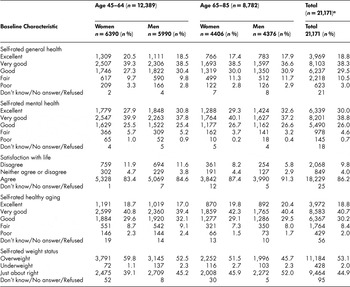
The ability to examine health and functional transitions is a key aspect of the CLSA. Numerous questionnaire-based, clinical, and physiological measures are included in the CLSA to allow for the assessment of various aspects of health, disability, and function. For example, self-report measures of general health, mental health, and successful aging are included in the interviewer-administered questionnaire, as are self-reported chronic conditions. A measure of self-rated general health whereby participants are asked to rate their health on a scale ranging from poor to excellent is commonly used in research and has been shown to be highly predictive of a range of outcomes, such as mortality (Idler & Benyamini, Reference Idler and Benyamini1997). Among the 21,241 CLSA Tracking participants, over half rated their health as very good or excellent (57.1%) and 29.5 per cent as good, with only 13.5 per cent indicating that they perceived their health as fair or poor (see Table 2). These proportions were remarkably consistent across age and sex groups.
Self-reported health characteristics of CLSA Tracking participants, by age and sex, at baseline years 2010–2013 (n = 21,241)

Note: all percentages are calculated only within those participants who answered the given question, and exclude those who did not know or refused to answer, or those to whom the question is not applicable.
a 70 participants age <45 or >85 at interview are excluded from the CLSA sample (met age eligibility at recruitment).
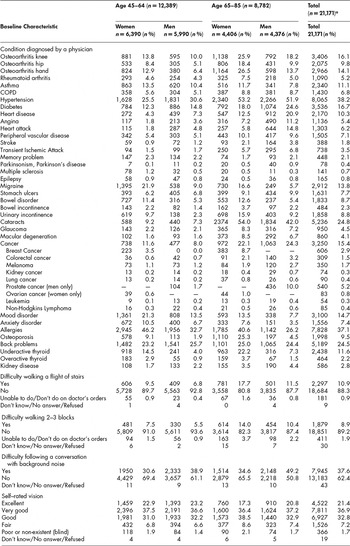
Similar patterns were seen for self-rated mental health, satisfaction with life, and self-rated healthy aging. Subjective, positive ratings of health, however, do not necessarily reflect an absence of health problems. When asked whether they had any long-term health conditions that had been diagnosed by a health professional, CLSA participants most frequently reported the following chronic conditions: hypertension (38.2%), allergies (37.1%), cataracts (24.8%), back problems (24.5%), diabetes (16.7%), osteoarthritis in the knee (16.1%), and mood disorder (14.7%) (see Table 3). Many health conditions were substantially higher in a specific age and/or sex category, such as heart-related conditions in older men, migraine in women, and cataracts in older age groups. An understanding of the relationship between subjective and more objective measures of health, of how these measures change over time and age, as well as of the factors that precipitate change are important to the aging process.
Chronic disease and functional status of CLSA Tracking participants, by age and sex, at baseline years 2010–2013 (n = 21,241)

Note: all percentages are calculated only within those participants who answered the given question, and exclude those who did not know or refused to answer, or those to whom the question is not applicable.
a 70 participants age < 45 or > 85 at interview are excluded from the CLSA sample (met age eligibility at recruitment).
Function can be examined from a variety of perspectives, such as in terms of mobility and sensory function. Among the CLSA Tracking participants, 10.9 per cent indicated that they had difficulty walking alone up and down a flight of stairs; and 8.9 per cent reported having difficulty walking two to three neighbourhood blocks (see Table 3). In terms of hearing function, over a third of participants (37.6%) indicated that they found it difficult to follow a conversation if there is background noise, such as TV, radio, or children playing, even if using a hearing aid as usual. As for vision, although the vast majority of participants rated their vision as good, very good, or excellent, 8.9 per cent rated it as fair, poor, or non-existent.
When examined together with socio-demographic characteristics, lifestyle factors, social engagement and social supports, and other factors, the CLSA provides a rich source of data to address a wide range of clinically and policy-relevant questions, such as: What factors (e.g., in the social or physical environment) predict functional decline? How do major life events (e.g., the onset of disease, loss of a spouse) impact health and functional trajectories? What factors (e.g., medical, social) protect against functional decline or the onset of specific chronic conditions, and how does this vary across different subpopulations (e.g., different income levels, gender, ethnic groups)? How do health and functional trajectories impact engagement and participation, such as social participation and labour force participation?
Work, Aging, Retirement, and Health in the CLSA
In Canada, the employment rate for individuals age 55 and older has increased significantly in recent years. Between 1997 and 2010, the rate increased by 9 per cent for men and 13 per cent for women (Carrière & Galarneau, Reference Carrière and Galarneau2011). In fact, in 2012 it was estimated that one in four persons aged 65 to 70 was still working, compared to about 11 per cent a decade before (MacEwen, Reference MacEwen2012). The increased participation of older aged groups and the relative decrease in younger workers are two factors contributing to the aging workforce. In 2010, more than one in six workers was age 55 or older (Carrière & Galarneau, Reference Carrière and Galarneau2011).
The nature of the older workforce is also changing. Many older workers who leave long-term jobs do not fully retire. Over half of workers aged 55 to 64 who left long-term jobs between 1994 and 2000 were re-employed within a decade (Bonikowska & Schellenberg, Reference Bonikowska and Schellenberg2014). Many of these new jobs are part-time, such that the proportion of part-time workers who are 55 and older has nearly doubled since the mid-1990s to 20 per cent.
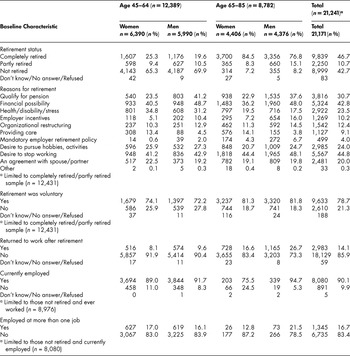
Using data from the CLSA, we can study how these changes in work life and retirement, interacting with other factors, such as social support and caregiving expectations, affect healthy aging. Of the 21,241 Tracking participants, 9,839 (46.7%) reported that they were completely retired, the majority of these being in the 55 and older age group. A further 2,250 (10.7%) reported that they were partly retired (see Table 4). Of those retired, the majority indicated that their retirement was voluntary, but nearly one quarter reported that health, disability, or stress contributed to their decision to retire (over 30% of those aged 45–64 and almost 20% of those aged 65–85). Of those aged 65–85, 26.7 per cent of men and 16.6 per cent of women who were retired reported returning to work. Of those not retired, about 90 per cent of both men and women aged 45–64 reported that they were currently working, and about one in six indicated that they had more than one paid job. Among participants aged 65–85, 94.7 per cent of men and 75.5 per cent of women who were not retired reported currently working, and 21.5 per cent of men and 12.8 per cent of women reported having more than one paid job.
Work and retirement characteristics of CLSA Tracking participants, by age and sex, at baseline years 2010–2013 (n = 21,241)

Note: all percentages are calculated only within those participants who answered the given question, and exclude those who did not know or refused to answer, or those to whom the question is not applicable.
a 70 participants age < 45 or > 85 at interview are excluded from the CLSA sample (met age eligibility at recruitment).
The CLSA has an extensive retirement module which includes the age of retirement, spouse’s retirement status, reasons for retirement, preparation for retirement, return to work after retirement, reasons for return to work, and type of work. For all participants, the labour force module includes characteristics of the current or most recent job (for those retired) and characteristics of the longest held job. For those not retired, information is also collected on current working status and, if applicable, the reason for not working (if currently not working or if never worked). The CLSA also contains a retirement planning module administered to those not yet retired.
The CLSA offers rich data on socio-demographic and psychological characteristics, social environment, physical health and physical functioning, and injuries. Within this context, researchers will be able to examine areas such as disability in retirees and occupational history, correlates of health-related job loss, cognitive function in retirement in relation to occupational history, health status and return to work after retirement, and information caregiving and work, among many other concerns.
Social Isolation and Aging in the CLSA
Social isolation has been identified as a widespread phenomenon that is increasingly affecting the lives of older adults in Canada (Hall, Reference Hall2004; MacCourt, Reference MacCourt2007). It is a multifaceted concept that is commonly defined as a low quantity and quality of contact with others, and one that considers the number and types of social network contacts, feelings of belonging, a sense of engagement with others, and related attributes (National Seniors Council, 2014a; Nicholson, Reference Nicholson2008). Social isolation overlaps with other concepts such as loneliness and social engagement. It has been estimated that approximately 24 per cent of older Canadians aged 65 and older desire more informal contact, and at least 10 per cent report being directly affected by a sense of loneliness (Kobus et al., Reference Kobus-Matthews, Barr, Jackson, Ziegenspeck and Jiwani2010; National Seniors Council, 2014b).
Research to date has only begun to disentangle the risk and protective factors associated with social isolation and related concepts such as loneliness, as well as the underlying processes and trajectories. Some of the ascribed characteristics and risk factors (both mutable and immutable) include (a) advanced age; (b) widowhood; (c) living alone; (d) low income; (e) childlessness; (f) episodic or lifelong health problems (mental and/or physical), or late onset or age-related conditions such as incontinence, and especially multi-morbidity; (g) lacking access to transportation, community services, and programs; (h) fear, stigma, or ageist attitudes; (i) lack of affordable housing and care options; (j) loss of sense of community; and (k) challenges relating to technology (costs, literacy, comfort) including telephone systems, computers, and social media (Hall, Reference Hall2004; MacCourt, Reference MacCourt2007; Nicholson, Reference Nicholson2008).
Research has also identified several important target groups who are particularly susceptible to social isolation and loneliness, including older adults with physical and mental health issues (including seniors with Alzheimer’s disease or other related dementias, or multiple chronic illnesses); ethnic older adults – Aboriginal elders or immigrant groups (language proficiency issues, separation from family, financial dependence, discrimination); lesbian, gay, bisexual, or transgendered seniors; low-income older adults; and caregivers. However, numerous research gaps remain that CLSA data will assist in filling in order that researchers better understand the ways in which social isolation shapes health and social processes of aging, and how we can mitigate these problems when they occur.
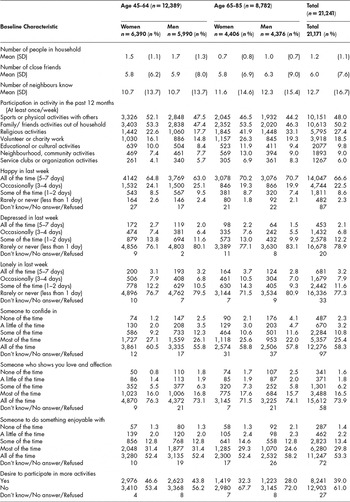
Table 5 provides selective descriptive data pertaining to several key dimensions of social network and support characteristics derived from the baseline CLSA Tracking participants. These data include useful indicators of social isolation and social contact, such as (a) household composition; (b) number of confidents; (c) community participation; (d) perceived happiness, depression, loneliness, and love and affection; (e) someone with whom one can do enjoyable things; and (f) desire to do more activities. Overall, CLSA Tracking participants reported being in relatively strong and rewarding support networks with relatively high levels of social engagement and low levels of social isolation and loneliness, although there were some variations across age and sex groups. For instance, the average number of additional people in the household declined with age and was lower for older women than for their male counterparts – 1.5 and 1.7 for women and men aged 45–64, respectively, compared to 0.7 and 1.0 for women and men aged 65–85, respectively.
Social network and social support characteristics of CLSA Tracking participants, by age and sex, at baseline years 2010–2013 (n = 21,241)

Note: all percentages are calculated only within those participants who answered the given question, and exclude those who did not know or refused to answer, or those to whom the question is not applicable.
a 70 participants age < 45 or > 85 at interview are excluded from the CLSA sample (met age eligibility at recruitment).
Additionally, while most participants in the sample reported being happy and content with relationship quality, and reported low levels of loneliness and depression, there appear to be unmet needs pertaining to social participation, especially among the pre-seniors. Table 5 shows that 46.6 per cent of females aged 45–64 and 43.8 per cent of males in that age category reported that they desired to participate in more activities; whereas 32.3 per cent of women aged 65–85, and 28 per cent of men aged 65–85, reported unmet social participation needs. However, having others with whom to engage in enjoyable activities indicates a reversal in this age-related pattern. Indeed, 16.1 per cent of women and men aged 45–64, compared to 18.3 per cent of women aged 65–85 and 17.2 per cent of men aged 65–85, reported having someone with whom to do something enjoyable only some of the time, a little of the time, or never. While the presentation of these CLSA data only scratch the surface of social isolation and loneliness and their connections to health trajectories, they are indicative of tremendous research potential.
One way to conceptualize the causes and consequences of social isolation (including loneliness) is to position these within a resilience framework. Resilience can be broadly defined as a dynamic adaptive process through which individual traits, characteristics of an individual’s environment, and an individual’s internal and external resources are utilized in the face of adversity (Ungar, Reference Ungar2011). In this sense, social isolation among older adults needs to be understood as a multilevel, life course process that is experienced by individuals but embedded within communities, neighbourhoods, and households.
Several potential research questions that can advance our understanding of social isolation can be addressed using the CLSA Tracking baseline data, including these: What are the risk factors/correlates of social isolation among older adults (e.g., mental/physical health, care giving, and isolation)? What are the primary risk/protective factors for the most isolated seniors (i.e., most vulnerable groups)? What are the most mutable risk/protective factors to social isolation? and, What are the structural dynamics of a social isolation-loneliness model?
At the longitudinal level, CLSA data can be used to answer several additional questions, including the following: What are the pathways into and out of a socially isolated state? What are the reciprocal (cyclical) associations between mental/physical health, other roles/transitions (i.e., care giving, widowhood), and social isolation/loneliness? How does resilience protect against social isolation? and, What are the most important mutable factors in reducing the likelihood of social isolation/loneliness and maintaining social engagement?
Conclusions
As the age of the population continues to increase in the majority of countries worldwide, attention is now turning to understanding the aging process, and how individuals and populations can age successfully. Canada is undergoing rapid population aging due to the position of the large baby boom cohorts in the upper levels of the age structure, coupled with increasing life expectancy. Concurrently, the older population is becoming increasingly diverse in terms of immigration status, ethno-cultural composition, family history, economic security, support networks, sexual orientation and gender identity, and other important determinants of health. In order to advance our understanding of the causal pathways leading to adverse events or favourable outcomes and meet the needs of the older population of today and tomorrow, there is an urgent need for high-quality, longitudinal, population-based information. The Canadian Longitudinal Study on Aging is a rich resource that allows us to move beyond merely describing change over time to actually studying the dynamic determinants of change within and between individuals over time. The CLSA will become increasingly valuable to scientists and policy makers alike as the baseline data from the CLSA Comprehensive study participants (which includes physical assessment data and biological samples) becomes available to the research community in the near future, and as repeated, longitudinal data from both Tracking and Comprehensive study participants become available over the coming decades.