


Black androids fill the Victorian era. They perform in London galleries and Parisian arcades. They populate German catalogs, Broadway window displays, and the parlors of Manhattan saloons. They haunt the corners of drawing rooms in wealthy Philadelphia manor houses. Newspapers loved them. At scientific conferences, they were harbingers of the future. Even the lesser of them staked their claims in plantation vitrines and upscale collectors’ catalogs. In their day, these were objects of desire and amusement: People wanted them, wanted to own them, would pay for the pleasure of watching them perform their mimicries. To this day they are trafficked in the thousands across the Internet, in online auction houses and niche Facebook groups. Yet for all their ubiquity, all their durability as resonant cultural artifacts, our histories of science and technology have made these Victorian Black androids mostly invisible.1 Why?
Take one example from postbellum Victorian America: On March 24, 1868, the United States Patent Office issued patent 75,874 – “Improvement in Steam Carriage” – arguably the earliest android patent in US history (Figure 2.1). The document describes a larger-than-life automaton (the eventual prototype was almost eight feet tall), designed as a replacement for draft horses. Its torso enclosed a steam engine powering “a system of levers, which, in imitation of the action of the legs of a man … are made to walk over the ground, and draw a vehicle attached thereto.”2 The steam engine itself, the authors conceded, was nothing new. The real and novel basis for the patent was the ambulatory mechanism at its core.3 But the figure’s most striking feature, the one that draws our non-Victorian eyes immediately and holds them there, is the head – wearing a top hat, framed by a starched collar, smoking a crude pipe, and caricaturing a Black man.
US Patent 75,874, “Improvement in Steam Carriage,” March 24, 1868
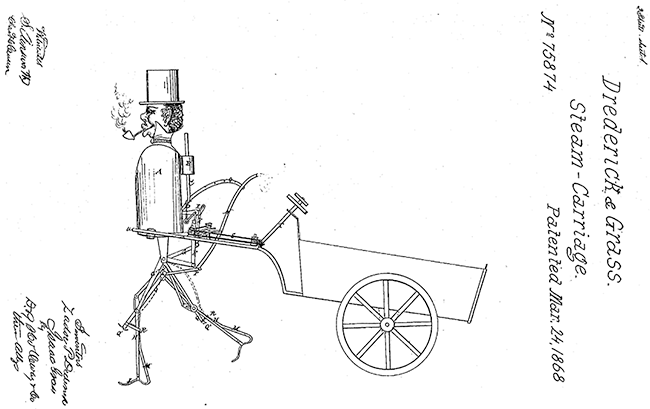
How do we explain this? What is a caricature of Black male gentility and dandyism doing in a patent for an “improved steam carriage” not even three years after the end of the US Civil War? Two bodies of scholarship present possible answers.
The first speculative explanation comes from the history of science. In one of the few engagements of historians of science with Black androids, Norton Wise has suggested that automata in the Victorian period became women, along with a host of “uncanny or exotic figures: talented children, blacks, acrobats, monkeys, magicians, and others,” because of the links between the perceived inferiority of these subjects and the mechanisms at their core.4 Victorian scientists, Wise speculates, saw the repetitive mimesis of mechanisms – the term most closely linked with automata during this period – as inferior to the dynamic, productive energies of engines and motive power.5 Enforced through political economy, Darwinian evolutionary theory, and brain physiology, Wise argues, this association of mechanism with inferiority deepened between 1811 and 1898, linking it first and most importantly with femininity, but soon shaping characterizations of Blackness and animality. “With such deep roots in some of the most successful sciences of the century, the gender stereotype acquired something like the status of an unquestionable fact of nature, a solid rock of truth rather than a malleable ideology. If this interpretation is correct,” Wise ventures, “it helps to explain why so many android automata of the nineteenth century were either gendered female or represented blacks, acrobats, magicians, and other uncanny characters.”6 Add the Steam Man to that list. Case closed.
Or is it? Another explanation from literary and cultural studies points in the opposite direction – one that seems better suited to the laboring machine of the patent than to the objects adorning Victorian drawing rooms. Instead of stemming from the prejudices of Victorian scientific theory, this scholarship traces the Black androids to popular anxieties around white mastery, Black servitude, and the connections between race and machines in Reconstruction-era America. Here, the Steam Man communicated a widespread hope for continued white domination; one that equated idealized slaves with machines before the Civil War, and quelled white fears of reverse enslavement afterwards.7 Taylor Evans, building on these insights and drawing from Saidiya Hartman’s discussion of the “afterlives of slavery,” has suggested that the Civil War did not abolish white mastery but rather transformed it, shifting the norms of mastery from Black bodies to industrial machines.8 The Steam Man patent signaled this new projection. The genre of dime-store novels it inspired – The Steam Man of the Prairies and others – carried that projection through the American science fiction that followed.9 Together, patent and novels formed an “urtext” for “racial, scientific, and technological discourses in the United States following the Civil War,” shaping US modernity and technoculture to this day.10
Both these explanations for Black androids privilege a specific vision of historical reconstruction that involves recovering the historical “truths” of the dominant culture – its scientific theories, its literary genres, its cultural perceptions – in order to reconstruct the white supremacist logics that produced the machines. As a result, these are essentially accounts about whiteness. Wise’s account, for instance, takes the whiteness of Victorian women androids for granted, treating issues of Blackness as derivative – as if central questions about Black androids can be answered by focusing on white female automata; as if gender is the answer to questions about race.11 Evans’s approach slips back and forth between patent, artifact, and literary genre to illuminate imperiled and renewed visions of white mastery, but goes no further. In chasing after those specific historical “truths” of these racist objects, these histories reproduce the “sovereign gaze of the regimes” they study, not as an accident, but as a scholarly goal.12 As Marisa Fuentes suggests in another context, this reproduces both the historical silences embodied in the artifacts, as well as “the lived inequities of our subjects and the discourses that served to distort them.”13 And it sets aside, as either irrelevant or as someone else’s problem, the specific and contemporary histories of the people these objects were designed to (mis)represent.14 Why remain here, then, among the dime-store novelists, natural philosophers, tinkerers, and engineers, rehearsing their narratives of Black inferiority? How else might we understand Victorian automata “as a reservoir of embodied meanings”?15 And what might that mean for our histories of these objects?
In this chapter, we argue that a counterhistory of the Black androids requires us to look elsewhere for our explanations, to read differently, and to imagine other possibilities for the worlds that the Victorian Black androids represent. We start from the premise that, precisely because they were deeply racist objects, Black androids were designed to distract, mislead, and conceal. The function of their racism – like all racism – was to obscure other, arguably more important, historical truths.16 Using the technologies of the period – steam, clockwork, electricity – the machines’ surface appearances portrayed Black people in pastoral, leisurely, and nontechnological roles, supporting the myth that technology is opposed to Blackness.17 Beneath the androids’ surface, however, those same technologies played central roles in Black life, work, and self-understanding during the period.18 Like the histories of blackface minstrelsy of which they were a part, “they are a distorted mirror, reflecting displacements, and condensations and discontinuities.”19 Precisely because of what they labored to hide, we cannot dismiss these androids as sideshows to the real spectacles of gender and mechanical philosophy or renewed white mastery. Investigating them means treating the automata themselves as actors and agents in a form of distraction that sought to mask another reality: the assertion of a Black technological self in nineteenth-century America, one that threatened the projects of American chattel slavery, Southern secession, and Reconstruction-era segregation. In what follows, then, we progressively turn the Steam Man inside out, starting with an account of the context of its creation and eventually turning to what it labored to hide – a portal into the counterhistories of Victorian-era Black America.
The Vanishing History of the Black Androids
Developing new historical techniques that critically engage the space of the archive has been the work of many recent scholars.20 The histories of Black androids are a rich site for grappling with these methodologies. In many cases we lack sources where the people represented by these machines speak in their own voices. Working with such archives, we face the necessity of relying on a constellation of secondary sources, often sources that themselves constitute the very vehicles through which racist institutions and people attempted to impose the terms of Black subjectivity – patents, police reports, prison records, or newspaper articles. But Black androids have been subject to another kind of historiographical silencing, one in which the very constitution of racialized automata as objects of historical research has precluded the possibility of conceiving the kinds of histories we explore here. A brief excursus will illustrate what we mean.
In her pathbreaking essay “Hegel and Haiti,” Susan Buck-Morss offers a critique of one canonical work of early modern Dutch history, Simon Schama’s The Embarrassment of Riches. She points out that, despite the central role that the trafficking in enslaved Africans played in the generation of those same titular riches, Schama includes no discussion of slaves or slavery in his 600-page text.21 This omission exists despite the regular appearance of Black people in the principal works of Dutch “Golden Age” painting, many of which appear in Schama’s book.
Writing the history of early modern Dutch society without taking notice of the Black people whose unique histories were instrumental in shaping it, constitutes, for Buck-Morss, a “partial blindness among seas of perspicacity.”22 It involves making the history of Black people, enslaved or free, in Africa or the Caribbean or Europe or the Americas, incidental to our historical understanding, and therefore marginal within history itself. These people, as Marisa Fuentes makes clear in another context, lived “lives that were just as important as those of more visible and literate people in this period, who most consistently left an abundance of documentary material.”23 It also involves seeing their appearance in Dutch art as mere historical accidents, departures, or deviations from the history that is “really” of interest. It is a failure to recognize the complex questions around Black historical agency and its involvement in the trajectory of Dutch culture, and of Western modernity more generally. It is not enough to say that Hals painted a Black child in his Portrait of a Dutch Family simply because the child was there.24 To learn anything significant at all about Dutch culture, we must ask: Why was the child there to be painted?
We reproduce exactly this partial blindness when we read Black androids as if they have nothing to do with either real Black Victorians or their rich participations in the history of technology. To collapse Black automata into the descriptor “female or otherwise exotic” is to remain unsighted to the absolute centrality of those specifically Black lives and experiences that helped create the conditions under which racialized machines of this kind were able to arise. This, too, is an insight shared with Buck-Morss, who identifies the universalist project of the Black “Jacobins” in postrevolutionary Haiti as a realization of Enlightenment principles more complete than those accomplished in the major centers of “enlightened” European thought. “If we have become accustomed to different narratives, ones that place colonial events on the margins of European history, we have been seriously misled,” she writes.25
What accounts for this failure to see, for these misleading gaps in the historical imagination? For Buck-Morss, academic scholarship itself imposes limits on the kinds of histories that can be conceived; specialization, enculturation, and the construction of disciplinary boundaries make certain kinds of historical or theoretical conjunctions unthinkable.26 Her project, in uncovering the link between the Haitian Revolution and Hegelian philosophy, was to reimagine what the “and” might mean in the phrase “Hegel and Haiti,” to reconstitute a transnational history of philosophy in which Haitian history and the history of African slavery constitute formative forces. An important part of our own project is to remind historians that there is a meaningful, intractable, and, in the phrase “Blackness and technology,” a connector that is signified by racialized automata even despite, and perhaps even because of the fact that such automata were constructed to deny it.27 We argue for the blurring if not outright dismantling of the disciplinary bounds that subordinate Black androids to the periphery of a more mainstream history of automata, or that use them only to explain the views of a dominant culture, and that therefore keep Black history and the history of technology firmly segregated. If we have become accustomed to narratives in which Black androids are merely marginal or anecdotal in a larger history of automata centered around white inventors, scientific racism, machinists, and Europeanized mechanism, we also have been very seriously misled.
The Black Androids
Our research indicates that, throughout the modern period, the appearance of Black androids followed an important trend – their production spiked at moments of Black liberation: slave revolts, abolitionist movements, emancipation.28 The spikes in the production of Black androids mirror the rise in scientific racism and the ossifying categories of race during the Victorian period.29 The actions that Black androids were designed to perform are largely frivolous. They are fruit sellers, magicians, idle smokers, singers, fortune tellers, and musicians.30 Rather than signaling a link between the inferiority of mechanism and the inferiority of Black peoples, these machines were complex expressions of anxiety, control, envy, desire, and denigration during perceived moments of Black autonomy – instances of African-diasporic peoples asserting themselves historically and inserting themselves even more fully into the consciousness of the West. An automaton clock in the figure of Toussaint Louverture – created in France and now displayed in Australia – for instance, mocked the leader of the Haitian Revolution at a time when the young nation expressed a double independence.31 The patent for the Steam Man, like the famous fiction stories it would inspire, was issued in early 1868, at the height of Reconstruction.32 Congress had only recently abolished the Black Codes in the South – a set of laws attempting to control Black labor and mobility after emancipation, restricting their occupations to farmers or servants. As one judge in Mobile, Alabama, would put it, they sought to “confine the negro to the soil.”33 In this context, the Steam Man is an image of harnessed Black labor and restricted Black mobility after the Civil War. But it is also much more than that.
The Steam Man sits oddly within the larger collection of Victorian Black androids – a laboring Black android rather than a decorative object; a Black automaton with a steam engine at its heart, but a mechanism at its core; and the product of an enterprising amateur American imagination in an age of cranks and hucksters, hustlers and frauds. Its inventors seem like obscure and novice charlatans with no obvious connections to Darwinian theory, brain physiology, or political economy.34 The device was originally conceived by Zadoc P. Dederick, a local patternmaker in Newark, New Jersey. Newspapers of the time and his death certificate list him as twenty-two years old.35 Apparently, the idea of an automaton was already old for the young Dederick. Six years earlier (he would have been sixteen), Dederick had reportedly “conceived the novel idea of constructing a man that should receive its vitality from a perpetual motion machine.”36 His co-inventor, Isaac Grass, was even younger: Likely born in 1852 in Bavaria, he probably arrived from Georgia in the 1860s, where his two sisters were born, and, in 1868, was probably living on Washington Street, the site of his family’s dry goods business, Grass & Rosenbaum.37 Grass disappears from the story almost immediately. We have no other record of him. Dederick soon leaves (or flees) New Jersey after the failed demonstrations of his prototype – constructed (in secret) with another friend and made “white” for its debut – and lives out his life in Texas.38
Although the Steam Man patent may seem like an obscure curiosity, it expressed central preoccupations of Reconstruction-era America. Zadoc Pratt Dederick was named after Zadock Pratt, the founder of Prattsville, NY, local patrician, and staunch advocate of patent reform. In April 1844, Dederick’s namesake would propose publishing all “important” US patents – a total of 13,523 – and distributing them “to every town in the country,” so that inventors would know the state of the art.39 Dederick, then, from his earliest childhood was immersed in a culture in which patents and patent illustrations were regarded as integral components of the dissemination of technological progress and not merely as pro forma documents marking intellectual property. In other words, for Dederick, the patent was a communicative and promotional document and not simply a record.40 The caricature that features in the Steam Man patent was Dederick’s active projection of a technological future in which Reconstruction-era racial ideologies and machinism converged.41
The patent took a particularly prominent path to filing. The Newark City Directory from 1868 lists a solicitor of patents, one Reverend Horace Harris, at 288 Broad Street, mere blocks from Dederick’s home and work.42 It also lists at least three patent attorneys operating in nearby New York City, including Munn & Co., editors of Scientific American, which would soon feature stories on android steam men.43 Dederick and Grass used none of these. Rather than passing through the hands of an obscure Newark agent, or a prominent New York firm, the patent received the official sanction and support of the most prominent patent attorneys in the country at the time. A close analysis of the text in the lower right-hand side of the image indicates that Dederick and Grass enlisted the services of the firm of “D.P. Holloway & Co., their attys [attorneys].” David Pierson Holloway had been appointed Commissioner of the US Patent Office under Lincoln at the start of the Civil War. After concluding his duties, he started his own firm in Washington DC. One of the services Holloway’s offices would have offered was help in drafting the accompanying patent drawings, including the figure of the Black android.
Ultimately, though, explaining the Steam Man requires us to look beyond the narrow world of patents to the history of the Reconstruction era. Mid-nineteenth-century New Jersey was particularly reactionary among the Northern states. Although the tangled pathways of the Underground Railroad threaded their way through Bordentown, Princeton, and New Brunswick, the state’s commercial interests allied it with the South, particularly through the leather trades in which Dederick worked as a patternmaker in the saddle and harness shop of E. S. Osborne & Co. at 105 River Street.44 New Jersey was the last Northern state to abolish slavery.45 Partly stoked by white fear that emancipated slaves would compete for Northern jobs, the state was one of the few jurisdictions in the North to sanction the 1850 Fugitive Slave Act, making the mobility of free Blacks suspect and the operation of the Underground Railroad especially dangerous. It was quick to contribute regiments during the Civil War, but it was also the only Northern state that Lincoln did not carry in the 1860 election (he would lose there again in 1864). Pro-Southern sentiment, support for Southern secession, and opposition to emancipation ran strong throughout the war and afterwards. New Jersey initially refused to ratify the 13th amendment in March 1865, ensuring that the amendment entered the US Constitution without the state’s support.46 The rising resistance to the Reconstruction Amendments and the freedoms they granted Black Americans would crest in 1868, when Republicans lost control of the state legislature and the incoming Democrats rescinded the 14th amendment and opposed the ratification of the 15th.47
Rather than providing a material expression for abstract notions of mechanism and initially gendered inferiority, the Steam Man patent was part of a theater of race and technology in Victorian New Jersey. Most histories of the Steam Man ignore the intensely local history of the patent, as well as the immediate social context of Newark.48 Although few slaves lived in antebellum Newark, the city had been built partly from slaveholding fortunes. Following emancipation and in the early years of Reconstruction, it saw increasing involvement of nominally free Black labor alongside increasing mechanical labor.49 Prospects and assertions of Black freedom often met with violent opposition. In the late 1830s, Newark’s first two mayors, supported by the state legislature, worked with the Newark Colonization Society to expel or deport the city’s Black citizens to Africa, Haiti, or Latin America.50 In the New York City Draft Riots, which spread to Newark in July 1863, white workers targeted Black residents as scapegoats for conscription.51 After the war, Black workers began challenging white European immigrants arriving in Newark for work in skilled trades. The Steam Man patent was created in one of these immigrant communities – the large German community that had begun settling there in the eighteenth century, and that included three generations of the Dederick family, but also the groups that had fled the 1848 revolutions, including the family of Isaac Grass.52 The subsequent history of the Steam Man suggested that its associations with German heritage were still a liability in 1868. The Newark Daily sarcastically cast Dederick’s android as a product of the
astuteness of a German machinist, who has doubtlessly infused into the brain of his gentleman some of the sublimest ideas of his transcendental Fatherland, which will thus be promulgated through the land at the rate of sixty miles an hour, defying all our religious instructions, superseding our clergy and forcing them to shut up their churches for mere lack of vital force to contend with this monster. Something must be done to strangle this creature at the outset, before he leaves Crump’s Garden.53
As Kara Swanson has noted, patents formed instruments of belonging, asserting citizenship through utility and usefulness.54 As Black workers in the 1860s fought their way into labor unions, or formed their own, and as white immigrant labor looked to limit Black prospects to unskilled work, or domestic and service trades, the patent was a way to reassert the white Americanness of its authors and the Blackness of the common threat.55 At a moment of increasing Black industrial involvement and prospects of nominally free labor, the Steam Man – a Black android harnessed to a cart, performing the work of a horse, and controlled by its white passengers – represented a vision about the “proper,” preindustrial role of Black labor in the United States.56
But the specifics of the depiction can only be understood through another phenomenon that gripped Newark and the Northeast in this moment – the wild popularity of blackface minstrelsy.57 As Eric Lott notes in his classic study Love and Theft, the functions of blackface minstrelsy were complex. It embodied “a nearly insupportable fascination and a self-protective derision with respect to black people and their cultural practices.” That conjunction made blackface, “less a sign of absolute white power and control than of panic, anxiety, terror, and pleasure.”58 The android patent drew, in particular, on one of blackface’s two main characters – the Black Northern dandy. Although often caricaturing Southern plantation life, blackface had originated in the Northeast three decades earlier, where its popularity was closely tied to the declining position of junior artisans like Dederick. The genre’s other central figure – Jim Crow – made his first appearance in the Bowery Theatre, in the Lower East Side of Manhattan, in November 1832.59 Through these two principal caricatures – the dandy and the rag-clad simpleton – blackface expressed a white vision of Black authenticity. Jim Crow stood for “the authentic, free African American of the North, a character uncorrupted by manners, affectation, education, or any type of self- control.”60 Its inventor, Thomas Rice, was a failed carpenter turned theater performer, who “came out of two cultures: that of the declining mass of junior artisans and that of the urban theater.”61 The counterpart to Rice’s invention was created by George Washington Dixon, who had even closer ties to New York’s artisan class. Dixon was the editor of a small pro-worker newspaper who, in the early 1830s, began performing blackface as the character Zip Coon. Whereas Jim Crow represented “authenticity,” dressing in rags, Dixon’s character dressed in top hat, starched collar, and frills, put on airs, sounded educated, and represented the hated figure of the fop or dandy. Working-class audiences loved the character because of the rage they felt for it.62 Race aside, the dandy represented the educated young men who arrived in Northern cities looking to profit from the same industrialization that degraded former artisans. As Brian Roberts notes, Zip Coon provided a “racial cover” for this rage. By 1834, the character rivaled Jim Crow “as blackface’s most representative and well-known character.” Together, the two figures argued for “authentic” Blackness as preindustrial, uneducated, and unrefined. They also represented an unrestrained, preindustrial, authentic self that white audiences could both mourn and deride.63
Seeing the patent through the popular culture of blackface recasts the connections between its surface appearance and its mechanics. Drawing on the work of Sylvia Wynter and C. L. R. James, Louis Chude-Sokei sees the plantation system as the place that first forged a relationship between Blacks and machines through the figure of the slave as mindless automaton, a figure whom he believes would provide the birth of blackface minstrelsy.64 Rather than a straightforward sympathy, though, the patent reveals the complex tensions and anxieties that surrounded race and machines in Reconstruction-era America. Blackface minstrelsy both embodied and intervened in Jacksonian racial politics: “Underwritten by envy as well as repulsion, sympathetic identification as well as fear, the minstrel show continually transgressed the color line even as it made possible the formation of a self-consciously white working class.”65 Under the guise of mockery and low humor, minstrelsy masked the significance of the Black culture it refracted and distorted. The Steam Man, in drawing on its conventions, also masked and distorted the intersections of Blackness and technology proliferating around the time of the Civil War.
Read as part of an archive for a counterhistory of Blackness and technology rather than simply an embodiment of prejudice, the patent drawing points to a contemporary fugitive technology of Black steam. In her study of antebellum American science, Britt Rusert charts the history of Black American fugitive science: “a dynamic and diverse archive of engagements with, critiques of, and responses to racial science.”66 Carried out by a wide array of actors – professional and nonprofessional scientists, amateurs, dabblers, and eccentrics, across an array of fields – fugitive science extended far beyond the scientific practices of former slaves or of fugitives in the act of escape. The term points to “a history of science on the move in the antebellum period, a furtive, subterranean history of experiments and practices that both linked racial science to abolitionism across the Atlantic and mobilized popular science in more fleeting acts of resistance.”67
Intersecting with and beyond Black science, technologies formed a critical locus for a set of practices, experiences, and understandings of Black selfhood in this period – a constellation gestured to, but obscured in, official records like the Steam Man patent. Paralleling Tiago Saraiva’s invocation of Black science, the focus on Black fugitive technologies is not an attempt to recover consoling narratives of Black invention or traditional critical accounts of technology and racism. It is instead a way of foregrounding specific forms of knowledge and practice that historically enacted Black subjectivities.68 The legal structures of mid-nineteenth-century America created conditions that excluded this equation of technology and Blackness from professional and official forms of recognition, including patents.69 But precisely because of their efforts to deny these deep associations, and because of the anxiety those associations created for white Americans, the documents attest to the technological practices that surrounded and supported Black selfhood in this period – an interiority to which the Steam Man, as metaphor, inadvertently points.
In the years surrounding the Civil War, steam was integral to Black mobility and a circumscribed freedom that operated within, helped create, and worked to exploit the “rival geographies” beyond the surveillance of the plantation.70 As Thomas Buchanan has noted, the steamship and the river economy it supported “was a breach in the South’s carefully constructed system of racial control,” offering possibilities of independence and escape.71 It made possible the emergence of a class of Black rivermen, free and enslaved – embodied in the figure of the “rascal” – who lived by their wits, combining toughness and strength with an adaptability and a flamboyance that often invoked the dandy.72 The abolitionist, novelist, playwright, and historian William Wells Brown, for instance, escaped slavery in 1834 while working on a steamboat on the Ohio River.73 The practice of slaves escaping from steamships became so common that slave owners increasingly sued steamboat companies to recover their “losses.”74 The tightening of steamboat passenger identification and changes in the geographic definition of “runaway” slaves paralleled an increase in steamboat escapes on the Mississippi river.75 Frederick Douglass’s celebrated flight from Maryland in 1838 involved a succession of steam technologies and a spectacular evasion of their surveillance regimes: a steam train from Baltimore with forged papers (borrowed from a free Black sailor), a steam ferry to cross the Susquehanna River, another steam train through Delaware to Wilmington, and a steamship to Philadelphia, before an overland journey to the safe house of the New York abolitionist David Ruggles. In mid-1852, just over five years before the Newark patent appeared, the steamship pilot Robert Smalls and a crew of six fellow slaves further elevated these practices. Not far from Fort Sumter, they commandeered their ship – the Confederate sidewheel steamer, the Planter – rendezvoused with a group of ten more enslaved men, women, and children, evaded recognition by the Confederate night watch on the wharves, and delivered the ship to the Union fleet anchored outside Charleston Harbor.76 The official records – “runaway” slave notices, arrest warrants, court transcripts, and legal judgments – passed over the symbolic place of these technologies in acts of self-liberation, and the technical knowledge they often demanded. But these records everywhere implicated steam technology as a site linking machines with practices of Black freedom and mobility – links that the Steam Man would both mock and attest to – as well as the growing white anxiety around those technologies’ roles as instruments of that freedom.
These instances and practices point to a broader and deeper history of the Black technological self in Victorian America, one that steam technologies built upon, one that threatened the project of American chattel slavery, and one that the Steam Man would again unintentionally signal. As early as 1831, slaves in Petersburg, Virginia, for instance, had developed a practice of exploiting their limited freedom to circulate in the spaces beyond their plantations, negotiating work as “mechanics” – blacksmiths, wheelwrights, wagonmakers, brickmasons, carpenters, plasterers, painters, and shoemakers – while paying their masters a portion of their earnings.77 The practice was widespread enough that white mechanics petitioned for a law prohibiting slaves from working as mechanics at all, “unless under the immediate control and superintendence of some white man.” Their rationale – that white mechanics felt “degraded” in laboring alongside slaves; that even the prospect repelled whites from the trades; and that this was the “true” reason that Southern manufactures languished – was significant for what it admitted: the growing centrality of Black technical labor to Southern industry and the anxiety about an emerging Black technological selfhood, independent of white oversight.78
Steam technologies amplified the possibilities and opportunities of these practices, as well as the attempts to hem them in. Around 1846, at the age of sixteen, Benjamin Boardley improvised a working model of a steam engine using scattered materials, including a gun barrel, pewter, and a section of round steel. Keeping a portion of his earnings, Boardley soon became a helper at the US Naval Academy’s Department of Natural and Experimental Philosophy in Annapolis, Maryland, preparing chemical demonstrations. His status as a slave meant he was unable to patent his own steam engine, so he sold it to a midshipman, used the proceeds to build an engine large enough to drive the first steam-powered sloop of war, and raised funds to pay for his own freedom.79 Against those activities and the ones to follow, protests and petitions to outlaw Black mechanics would continue through the rest of the nineteenth century.
On the eve of the Civil War, over the course of two days in June 1858, this history of Black fugitive technology merged tellingly with the history of American patents. An article in The Republican Banner on June 12 claimed that the rise of Black mechanics in the South held “ruinous consequences to the institution of slavery,” threatening the very project of Southern secession.80 At the center of the article’s multiple and tortured assertions about the inferiority of the Black mechanical arts was an admission that Black mechanics represented a sphere of Black “ascendancy,” and that the practice of training them endangered the category of (white) “mechanical genius.” Two days earlier, on June 10, the United States Attorney General, Jeremiah S. Black, had issued an opinion entitled Invention of a Slave. The case involved a Black mechanic, Ned, who, as a blacksmith in Pike County, Mississippi, had invented a novel machine – a double-plow and cotton scraper. A local slave owner and lawyer had sought to patent the device himself, claiming the “fruits of the mind” of the Black mechanic, and threatening Ned if he contacted the Patent Office directly.81 As Kara Swanson has shown, the case embodied a conundrum: “Acknowledging Ned’s abilities through the grant of a patent to his invention, even if the patent were granted to [the slave owner], would undermine the fragile construct of white supremacy by recognizing that Ned had conceived and created a novel machine that no white man had previously devised.”82 In three sentences, the Attorney General concurred with the opinion of the Commissioner of Patents on the case, finding that all inventions by African Americans, enslaved or free, were unpatentable – a decision that relied on the infamous Dred Scott decision.83 The postwar Reconstruction Amendments would render Invention of a Slave obsolete; but not until 1866, when Dederick was already busy elaborating his vision of the Steam Man. Dederick’s illustration, with its minstrel-based mockery and its artisan-infused anxieties, was of a piece with the protests and petitions to outlaw Black mechanics that would continue through the remainder of the nineteenth century. And yet, just barely beneath the surface, through its prejudices and contradictions, the patent also testified that a history of Black fugitive technologies might, after all, appear in the official documents of the US Patent Office and its first automaton.
Conclusion
This chapter has been an attempt to suggest why the Black androids have only rarely figured in histories of Victorian automata. And it has aimed to demonstrate the value of reading the artifacts of racialized automata in a way that produces counterhistories of the objects – accounts that run against their surface mythologies. Saidiya Hartman, quoting Nella Larsen, calls on scholars to focus on the “disturbing factor,” the one that unsettles the usual discourses and histories, and that gestures toward something different, if only one could follow it.84 The Steam Man patent is one of those disturbing factors: a caricature of Black male gentility and dandyism inserted, not even three years after the US Civil War, where we would never expect it. Rather than dismiss that appearance as an anomaly – a side act to the main event of white automata, their white inventors, and the white technological cultures in which they were trafficked – we have argued for turning the image inside out, to explore what it suggests about Black Victorian America.
That method is critical for histories of the Black androids more generally, because of the way, as Tina Campt has explained in a different context, it “ruptures the sovereign gaze of the regimes that created them by refusing the very terms of … subjection they were engineered to produce.”85 That act of rupture should be at the heart of our accounts of these objects. It is not enough to treat Black androids as mute embodiments of the scientific racism at work in Victorian natural philosophy. As with that racism itself, our scholarship needs to focus on the histories that these objects labored to obscure and erase.
The Steam Man’s links between Blackness and steam technology, fugitivity, and the self suggest much larger questions than ones we can broach in this chapter. We find Black androids across five centuries and six continents. In the Victorian era, they appear not only in the United States, but also in France in the hundreds, the source of great fortune for French machinists such as Gustave Vichy, Jean Roulet, and Henry Phalibois. They appear in Germany, where they are built by figures such as Adolph Mueller, and in the Netherlands, by Cornelis Jacobus van Oeckelen. And they crop up in London: at an exhibition in Covent Garden. It is one thing to observe that this period was also one of renegotiation and transformation of race relations: in France, in the wake of the 1845 Mackau Laws and subsequent abolition of the slave trade in 1848; in Germany, in light of the rush to colonize portions of Africa; in the Netherlands, as the emancipation of enslaved Black people in Suriname, the Antilles, and the Dutch East Indies proceeded with inconsistency and contestation; and in the United Kingdom with the rise of scientific racism and racial social Darwinism.86 One could read these automata as expressions of white anxieties over different encounters with Black subjectivity. But to read these automata this way is to regard them as telling truth – a truth about whiteness. What if, however, we read them as telling lies – lies about Black people, their creativity, and their close relationships with the very technics that these automata relied upon? What other histories of Black technological life might be written through these objects? And how much richer, and more complete, would our android histories be if we took them on their own terms?

 Open access