
I. INTRODUCTION
Studies over the last 25 years have yielded significant progress in the development of methods of severe plastic deformation (SPD), allowing to obtain bulk ultrafine-grained (UFG) and nanostructured metallic materials (NM), with a specific microstructure, attractive properties and great prospects of application in industry, transport, aviation, medicine, etc. Reference Valiev and Alexandrov1
A feature of the SPD methods applied to obtain NM is the possibility of achieving high strains due to the implementation of the scheme of simple shear under conditions of high applied pressures without changing the shape of the original billet. Reference Valiev and Alexandrov1 Among the methods of SPD, the method of torsion under high pressure (HPT) Reference Zehetbauer, Stüwe, Vorhauer, Schafler and Kohout2 and the method of equal-channel-angular pressing (ECAP) are most widespread. Reference Valiev and Alexandrov1
The specificity of the microstructure of NM, obtained by SPD techniques, is the extremely small grain size, the preferably high angular grain boundaries (GBs), high density of intrinsic grain-boundary dislocations, and so on. Reference Valiev and Alexandrov1
These features of the microstructure of NM lead to the formation of a state characterized by high-strength and sufficient ductility, Reference Valiev and Alexandrov1 high fatigue strength, Reference Valiev and Alexandrov3 high-strain rate, and low-temperature superplasticity, Reference Valiev, Islamgaliev and Alexandrov4 etc. The paradox of SPD (simultaneous demonstration of high strength and ductility) has been revealed in NM, Reference Alexandrov and Chembarisova5 as well as novel functional properties. Reference Valiev and Alexandrov3 The range of metal materials in which bulk NS state and attractive properties are formed is constantly expanding, and now includes pure metals, Cu and Al alloys, etc. Reference Valiev and Alexandrov1
Of particular interest are the results of researches carried out on alloys of the same system with different content of components, which are characterized by different values of stacking fault energy (SFE). As a result, the deformation processes in the alloys of the same system of chemical elements but with different contents of the second component are accompanied by activation of different deformation mechanisms; hence the microstructures formed differ appreciably.
The authors Reference Rohatgi, Vecchio and Cray6 have systematically studied the role of SFE in the deformation behavior of Cu and several Cu–Al alloys under quasistatic and dynamic compression. It was found that solid solution hardening contributes to the strength of the annealed Cu–0.2 at.% Al and Cu–2 at.% Al alloys under quasistatic deformation. At the same time the deformation twins make a further contribution to the strength of the annealed Cu–4 at.% Al and Cu–6 at.% Al alloys at strains more than 0.10. The rate of deformation hardening of Cu–Al alloys with low values of SFE does not depend on strain rate, and the rate of strain hardening of Cu and Cu–Al alloys with high values of SFE (with a low content of Al) increases with increasing strain rate. The difference in the character of the dependence of the strain hardening against the strain rate was explained by the difference in the possibility of cross slip and, therefore, dynamic recovery in Cu and Cu–Al alloys. Strain rate sensitivity of deformation hardening is attributed to slow dynamic recovery at high strain rates in materials with high values of SFE. Since the dynamic recovery is hampered at low values of SFE, the increase in strain rate does not lead to significant influence on the beginning of a dynamic recovery.
The effect of SFE on the evolution of microstructure in the process of drawing the wire of pure Al, pure Cu and Cu–2.2 at.% Al and Cu–4.5 at.% Al alloys at room temperature (RT) was studied. Reference Varma, Caballero, Ponce, De La Cruz and Salas7 It was found that deformation mechanisms change depending on the value of SFE. In materials with high values of SFE, cells were formed the size of which decreased with the strain rate. In materials with low values of SFE deformation bands and deformation twins were formed. At low true strains the Cu–2.2 at.% Al alloy was deformed with the formation of deformation bands, while the deformation twins within the deformation bands controlled deformation mechanisms at higher true strains. The Cu–4.5 at.% Al alloy with the lowest value of SFE could be deformed only by means of deformation twinning even at low true strains. The presence of overlapping and intersecting deformation twins was the predominant feature at higher stages of deformations of the rods by drawing. The Cu–4.5 at.% Al alloy with the lowest value of SFE was deformed only by the deformation twinning even at low true strains. At higher true strains overlaps and intersections of deformation twins was the dominant feature of the deformed microstructure.
The results of the study of the effect of grain size on the strength of Cu–15 at.% Al alloy with a low value of SFE are presented. Reference Tian, Zhao, Chen, Shibata, Zhang and Tsuji8 Instead of the anticipated contribution of twinning a significant contribution of stacking faults defects, regardless of the grain size even at the initial stage of the tensile deformation was identified. At the same time twinning is more sensitive to grain size. With increasing grain size the beginning of the twinning was delayed to higher strains. In Cu–15 at.% Al alloy with the average grain size of 47 µm a stage of increasing the rate of strain hardening with increasing strain was detected, which was associated mainly with stacking fault defects, but not with the twinning. Thus, in parallel with the effect of twinning induced plasticity, stacking fault defects also make a significant contribution to the plasticity of FCC alloys with low values of SFE.
In Reference Velasco, Polyakov and Hodge9 using the sputtering deposition method, the microstructure with different twin spacing was formed in Cu–Al alloys. It was revealed that in alloys with a lower SFE twin spacing was less than in the alloys with higher SFE.
The same conditions of dynamic plastic deformation lead to the thickness of twins, which monotonically decreases with the decreasing SFE in Cu–Al alloys. For the same alloy, the thickness of twins becomes less in case of high strain rates and lower deformation temperatures. Reference Zhang, Tao and Lu10
Friction stir processing with additional rapid cooling allowed to form a microstructure with many annealing twins boundaries in ultrafine-grained grains, which led to increasing strength and plasticity of Cu–15 at.% Al alloy. Reference Xue, Xiao and Ma11 The equiaxed recrystallized grains with relatively low dislocation density and a high proportion (96%) of high angular grain boundaries were revealed in the alloy. The yield strength was 700 MPa, the uniform elongation was of 13%.
The increase in the content of alloying elements leads to the formation, as a result of SPD, of the bulk nanostructured (NS) states characterized by a smaller grain size and improved mechanical properties in comparison with the corresponding coarse-grained counterparts. Reference An, Lin, Wu, Zhang, Figueiredo, Gao and Langdon12
The authors of Ref. Reference An, Wu, Zhang, Figueiredo, Gao and Langdon13 investigated the effect of SFE on the strength and ductility of nanostructured Cu and Cu–Al alloys subjected to high pressure torsion and isochronous annealing. All metallic materials showed a similar trend, as strength decreased and ductility increased along with the increase of annealing temperature, and a noticeable increase in ductility was achieved only when the volume fraction of recrystallized grains exceeds 80%. The simultaneous manifestation of strength and ductility were found with decreasing of SFE.
However, it was demonstrated that there exists an optimal value of SFE that corresponds to both high strength and ductility. Reference An, Lin, Wu, Zhang, Figueiredo, Gao and Langdon12,Reference Wei, Wang, Wei, Alexandrov, Du and Hu14 For example, in Cu–Al alloys with different SFE values that have been subjected to ECAP and rolling (ECAP + R) at cryogenic temperature Reference Wei, Wang, Wei, Alexandrov, Du and Hu14 the maximum tensile strength of 871 MPa and uniform elongation of 4.3% were achieved simultaneously in Cu–7 at.% Al alloy. With a decrease in SFE shear bands, which cut the multiple deformation twins in the process of low-temperature ECAP, were revealed. Effective grain size decreased and the dislocation density increased. Subsequent rolling at cryogenic temperature led to a further reduction of grain size and twins thickness. Tensile strength increased with the decrease in SFE. The strength increase in Cu–Al alloys was attributed to the grain size/thickness of twins and higher dislocation density.
According to Refs. Reference An, Lin, Qu, Yang, Wu and Zhang15 and Reference An, Lin, Wu, Zhang, Figueiredo, Gao and Langdon16 the effects of SFE on the deformation mechanisms and microstructures in Cu and Cu–Al alloys during SPD processes, the methods to prepare bulk NS materials, were also systematically characterized. Moreover, in Ref. Reference An, Qu, Wu and Zhang17 the effect of SFE on the strength and ductility of nanostructured Cu and Cu–Al alloys subjected to ECAP and isochronous annealing was also investigated. In Refs. Reference An, Wu, Wang and Zhang18 and Reference An, Lin, Wu and Zhang19 the effect of SFE on the deformation mechanisms, strength and ductility of Cu–Al alloys subjected to cyclic strain was discussed.
It is known that alloying leads to a decrease in the SFE, the increased activity of deformation twinning and the decreased activity of dislocation slip. Reference Stremel20 The authors of Ref. Reference An, Lin, Wu, Zhang, Figueiredo, Gao and Langdon12 carried out an experimental study of the SFE effect on the mechanical properties of NS Cu–Al alloys obtained by HPT. The alloys with Al content of 0, 2.3, 5, 8, and 16 at.% were studied. It is shown that the decrease in SFE leads to a monotonous growth of the strength characteristics (yield stress, ultimate tensile strength). While uniform elongation first increases and then begins to decrease after exceeding 8 at.% Al in alloys.
Nonmonotonic change of uniform elongation with decreasing of SFE in NS Cu–Al alloys processed by HPT is contrary to the trend of monotonic growth of uniform elongation with decreasing of SFE in NS Cu and alloys of the same system obtained by ECAP. Reference An, Lin, Wu, Zhang, Figueiredo, Gao and Langdon12,Reference An, Han, Huang, Zhang, Yang, Wu and Zhang21,Reference Qu, An, Yang, Huang, Yang, Zang, Wang, Wu and Zhang22 At the same time, it is similar to the trends found in the case of NS Cu and Cu–Zn alloys obtained by the HPT with the subsequent cold rolling. Reference Zhao, Liao, Horita, Langdon and Zhu23
Computer modeling is one of the effective tools used to analyze the activity of different deformation mechanisms that determine the strength and ductility of bulk NM. Reference Estrin, Tóth, Molinari and Bréchet24–Reference Malygin26 In particular, the use of computer modeling has allowed to establish that the simultaneous increasing of strength and ductility of Cu obtained by ECAP at room temperature (RT), followed by cryoextrusion and cryorolling, is due to the presence of grains with twins. While the grains without twins in which the state of saturation of the dislocation density is reached faster are responsible for the ductility of the samples. Reference Alexandrov and Chembarisova5 Annihilation processes in a large number of the formed GBs when the degree of accumulated strain ε > 2.8 during ECAP prevents further grain refinement. Reference Chembarisova and Alexandrov27 Modeling the process of dynamic loading of Cu has allowed to establish that the experimentally observed increase in the dislocation density is due to the lack of annihilation of dislocations by their nonconservative motion and reducing of the coefficient of annihilation of dislocations during their double-cross slip as well as activity of the mechanisms of accumulation and multiplication of dislocations. The causes of the blurring of GBs and small misorientation angles between them were revealed. Reference Chembarisova28 Modeling of hardening of UFG alloys, resulting from HPT, showed that ultra-high-strength states in Al and Ti alloys are explained by the pinning of dislocations by impurity atoms and by the need of higher stresses to overcome by dislocations the segregations of impurity atoms. Reference Chembarisova and Alexandrov29
The aim of this work was to analyze by means of computer modeling the influence of SFE on the strength and ductility of NS Cu and Cu–Al alloys obtained by HPT, and experimentally investigated by the authors of Ref. Reference An, Lin, Wu, Zhang, Figueiredo, Gao and Langdon12.
II. MATERIALS AND MODEL DESCRIPTION
Modeling of deformation curves prior to reaching the tensile strength was carried out using experimental data Reference An, Lin, Wu, Zhang, Figueiredo, Gao and Langdon12 on the microstructure and deformation behavior of pure Cu and Cu–5 at.% Al and Cu–16 at.% Al alloys. NS states were formed as a result of HPT with 5 turns under a pressure of 6 GPa at RT. The values of SFE of studied materials were respectively equal to ∼78, ∼28, ∼6 MJ/m2. The average grain size in pure Cu was ∼120 nm, and ∼65 nm and ∼30 nm in Cu–5 at.% Al and Cu–16 at.% Al alloys, respectively.
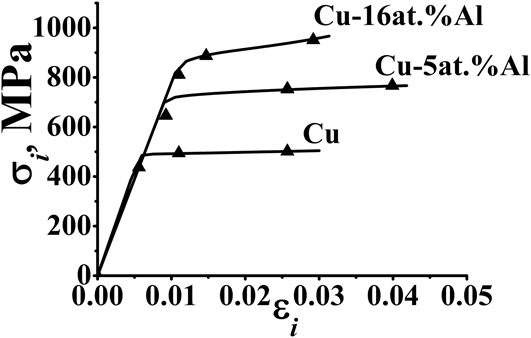
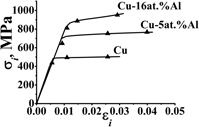
Experimental data obtained during tension of samples at RT with a strain rate of 5 × 10⁻⁴ s−1, are shown in Fig. 1. On the basis of tensile engineering stress–strain curves of NS samples the values of true yield stress and the ultimate tensile stress σu were calculated by the formula σi = σ(1 − ε), where σ is the conditional stress, ε—strain. The corresponding values of the true strains εi (Fig. 1) were calculated by means of the equation εi = ln(1 + ε).
The true stress – true strain curves for NS pure Cu and Cu–5 at.% Al and Cu–16 at.% Al alloys. ▲ experimental points. The solid lines represent the model dependences.

The yield strength was presented in the form
 $${\sigma _{\rm{i}}} = {\sigma _{\rm{P}}} + {\sigma _{\rm{c}}} + M\alpha Gb\sqrt {{\rho _{{\rm{tot}}}}} + {\sigma _{\rm{t}}}\quad ,$$
where σP—Peierls stress, σс—solid solution hardening,
 $M\alpha Gb\sqrt {{\rho _{{\rm{tot}}}}}$
—dislocation hardening, M—the Taylor factor, α—coefficient, G—shear modulus, b—modulus of the Burgers vector, ρtot—the total volume dislocation density, σt—the back pressure created by the twin boundaries.
The Peierls stress σP was calculated according to the formulas
 $${\sigma _{\rm{P}}} = M{\tau _{\rm{P}}},\quad {\tau _{\rm{P}}} = {{2G} \over {1 - \nu }}{{\rm{e}}^{ - {{2\pi h} \over {\left( {1 - \nu } \right)a}}}}\quad ,$$
where h is the distance between adjacent planes in which slip occurs, a—the distance between the atoms in the slip direction, ν—Poisson ratio.
Basing on Ref. Reference Alexeyev30, it was considered that solid solution hardening σc in the considered Cu alloys is determined by the resistance to the movement of screw dislocations, which is probably connected with the fact that the microscopic flow is due to the significant growth of mobile dislocations. Since screw dislocations are able to be reproduced by cross slip they play a significant role in this case. In the event of dissolution of the elements, causing gradual hardening, increment of strength is proportional to their concentrations c or c 1/2. In the event of dissolution of Al in Cu Reference Malygin26 :
 $${\sigma _{\rm{c}}} = M{\tau _{\rm{c}}},\quad {\tau _{\rm{c}}} \approx {{G\varepsilon _{\rm{s}}^{{3 \mathord{\left/ {\vphantom {3 2}} \right. \kern-\nulldelimiterspace} 2}}{c^{{1 \mathord{\left/ {\vphantom {1 2}} \right. \kern-\nulldelimiterspace} 2}}}} \over {{\rm{760}}}}\quad ,$$
 $${\varepsilon _{\rm{s}}} = {\varepsilon '_{\rm{G}}} + 3{\varepsilon _{\rm{b}}},\quad {\varepsilon _{\rm{b}}} = {1 \over b}{{{\rm{d}}b} \over {{\rm{d}}c}},\quad {\varepsilon '_{\rm{G}}} = {{{\varepsilon _{\rm{G}}}} \over {1 + {{\left| {{\varepsilon _{\rm{G}}}} \right|} \over 2}}}\quad ,$$
where εb—the rate of expansion of the lattice when the change in the concentration, which is a measure of mismatch of atomic sizes of the main and alloying elements. The rate of change of the shear modulus εG when the change in the concentration c is determined by
 $${\varepsilon _{\rm{G}}} = {1 \over G}{{{\rm{d}}G} \over {{\rm{d}}c}}\quad .$$
For Cu alloys, εs ≈ 0.8 with respect to screw dislocations. Reference Alexeyev30
It was assumed that the slip dislocations are blocked by the twin boundaries, causing the excessive stress Reference Remy31
 $${\sigma _{\rm{t}}} = {K_{\rm{t}}}{x^{ - 1}}\quad ,$$
where K t = MGNb/2.
The number N of blocked twin boundary dislocations is calculated according to the formula Reference Alexandrov and Chembarisova5
 $$N = g{\rho _{\rm{c}}}{d^2}{(1 - f)^{2/3}}\quad ,$$
where g—the proportion of dislocations in the inner areas of grains accumulated at the twin boundary of the total number of dislocations equal to
 ${\rho _{\rm{c}}}{d^2}{(1 - f)^{2/3}}$
, d—average grain size, f is the volume fraction of GBs.
The distance between neighboring twins x was calculated by the formula Reference Remy31
 $${1 \over x} = {1 \over {2t}}{{{f_{\rm{t}}}} \over {\left( {1 - {f_{\rm{t}}}} \right)}}\quad ,$$
where t—thickness of twins, f t––their volume fraction, which is in accordance with Ref. Reference Ahn, Kim and Estrin32 determined by the formula
 $${f_{\rm{t}}} = {f_{{\rm{t}}0}} + \left( {{f_{\inf }} - {f_{{\rm{t}}0}}} \right)\left[ {1 - \exp \left( { - {{{\varepsilon _{{\rm{zz}}}} - {\varepsilon _{{\rm{onset}}}}} \over {\bar \varepsilon }}} \right)} \right]\quad .$$
Here f
t0 and f
inf—values of the volume fraction of twins after HPT of the alloy and the limit of the saturation volume fraction of twins in the tension of the alloy, εonset—the degree of deformation corresponding to the beginning of the twinning,
 $\bar \varepsilon$
—defined in the modeling process, parameter, εzz—the true degree of deformation.
Model equations of the deformation behavior of elastic–plastic environment, taking into account the evolution of the microstructure are presented in Ref. Reference Chembarisova28. The velocity of slip dislocations in this case was calculated by the method described in Refs. Reference Gilman33 and Reference Friedel34.
 $$V = {V_ * }\exp \left( { - {{{\tau _ * }} \over \tau }} \right)\quad .$$
The parameter
 ${\tau _ * }$
was determined from the analysis of experimental data.
 ${V_ * }$
—transverse speed of sound in the material:
 ${V_ * } = {{\rm{(G/}}\rho {\rm{)}}^{{\rm{1/2}}}}$
, ρ—the medium density.
The double cross slip of dislocations, as well as nonconservative slip of dislocations were considered as possible mechanisms of the annihilation of dislocations in the simulation. Reference Zehetbauer25
The coefficient of annihilation of sections of screw dislocations during their double cross slip (DCS), characterizing the intensity of the annihilation process of dislocations during DCS, was determined using the formula Reference Remy31 :
 $${k_a} = {k_{a0}}{\left( {{{{{\dot \gamma }_0}} \over {{{\dot \gamma }^{\rm{p}}}}}} \right)^{{1 \over A}}},\quad {\dot \gamma _0} = {b^2}{\rho _{\rm{m}}}{\nu _{\rm{D}}},\quad {\dot \gamma ^{\rm{p}}} = b{\rho _{\rm{m}}}V\quad ,$$
where
 $A = 0.352G{b^3}\left( {1 + 180{\gamma _{{\rm{SF}}}}/Gb} \right){\rm{/}}{k_{\rm{B}}}T$
, k
a0—the coefficient of annihilation at T = 0 K, k
B—the Boltzmann’s constant,
 ${\dot \gamma ^{\rm{p}}}$
—the speed of plastic deformation in the slip plane of the dislocations,
 ${\dot \gamma _0}$
—the calculated parameter. According to Ref. Reference Gilman33 it has been assumed that the density of mobile dislocations ρm depends on the total dislocation density ρtot:
 $${\rho _{\rm{m}}} = {\rho _{{\rm{tot}}}}\exp \left( { - {{{\rho _{{\rm{tot}}}}} \over {{\rho ^ * }}}} \right)\quad .$$
The parameter
 ${\rho ^{_*}}$
was determined through the analysis of experimental data from the condition of best approximation of simulated data to experimental data.
According to Ref. Reference Friedel34, it has been assumed that the Debye frequency is equal to νD = k
BΘD/2πħ, where
 $\hbar$
—Planck’s constant,
 ${\Theta _{\rm{D}}}$
—the Debye temperature.
The annihilation coefficient k b, which characterizes the intensity of the annihilation in the result of nonconservative motion of dislocations, were calculated using equations presented in Ref. Reference Chembarisova28,
 $${k_{\rm{b}}} = {{2B'\rho _{\rm{f}}^2} \over {{{\dot \gamma }^{\rm{p}}}}}\quad ,$$
where ρf—the density of forest dislocations in the GBs. The value of the parameter B′ was calculated as in Refs. Reference Zehetbauer25 and Reference Chembarisova28. Numerical values and approximate parameters are given in Table I.
The values of the specified and approximate model parameters.

III. RESULTS AND DISCUSSION
Based on the model of elastoplastic medium an unambiguous, sustainable and reliable solution to the problem was obtained.
In the case of pure Cu the results of modeling of the elastic region of the deformation curve based on the model of elastoplastic medium Reference Chembarisova28,Reference Krasnikov, Kuksin, Mayer and Yanilkin35 led to the value of the shear modulus G ≈ 32 GPa. Peierls stress, according to the estimates made using the formula (2), amounted to τP ≈ 40.06 MPa.
Solid solution hardening does not contribute to the yield strength and the flow stress of pure Cu, and its contribution was considered equal to zero. According to Eq. (1), only active dislocation mechanisms contribute to strain hardening and yield stress of pure Cu.
From the expression (1), which sets the value of the yield strength, taking into account the calculated values of the Peierls stress, the initial total dislocation density ρtot0, proved equal to 6.27 × 10¹⁴ m−2, was determined and the total dislocation density at a stress equal to the tensile strength of the sample σu, ρtotu ≈ 9.14 × 10¹⁴ m−2 was also determined. On the basis of Ref. Reference Holt36 it was believed that the size of the grains in the tensile strain can change the law
 $d = {K_{\rm{d}}}/\sqrt {{\rho _{{\rm{tot}}}}}$
. At the same time, as shown by calculations, the value of K
d ≈ 3.01 corresponds to the experimental data, while the grain size changes from 120 nm in the initial state to ∼100 nm when reaching the tensile strength.
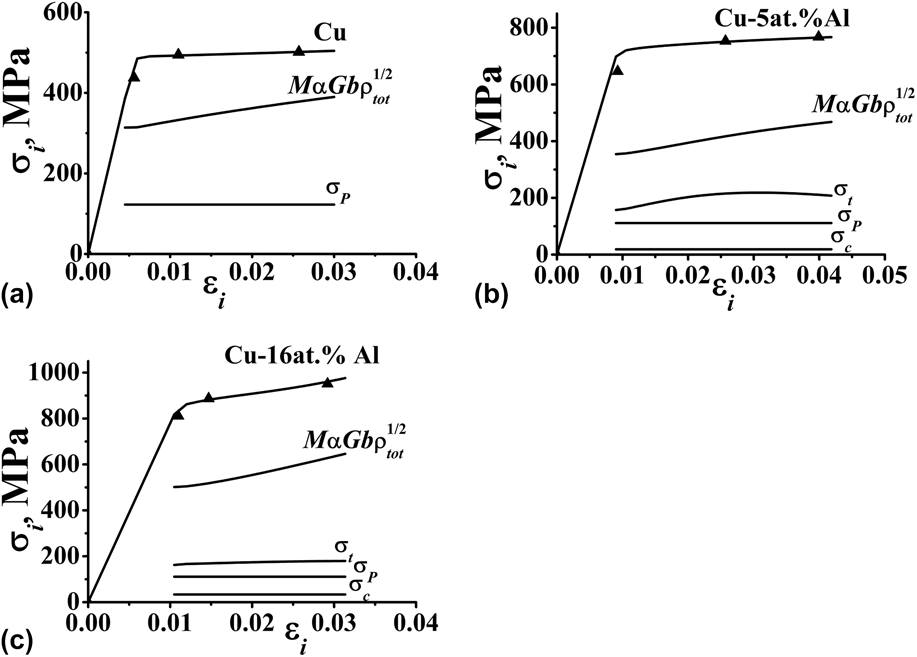
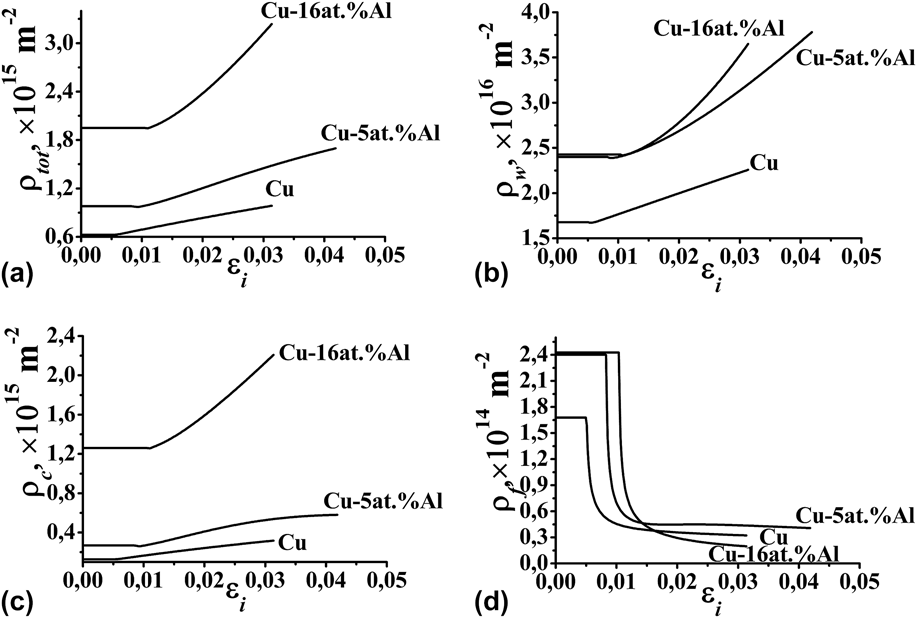
The strength of samples of pure Cu is defined by strain hardening (Fig. 2) in the result of the accumulation and multiplication of dislocations, leading to an increase in the total density of dislocations (Fig. 3).
The contribution of different factors in hardening into the flow stress of NS pure Cu (a) and alloys Cu–5 at.% Al (b) and Cu–16 at.% Al (c).

The total dislocation density ρtot (a), the dislocation density in the GBs ρw (b), the dislocation density in the body of grains ρc (c), the forest dislocation density ρf in GBs (d) against the true deformation for NS pure Cu and Cu–5 at.% Al and Cu–16 at.% Al alloys.

The saturation of the dislocation density ρtot = fρw + (1 − f)ρc, where the 1st term in the right side of the equation corresponds to the contribution of GBs, and the second term is related to the contribution of the body of grains, f—the volume fraction of GBs, ρw and ρc—the density of dislocations in the GBs and in their body, is realized as a result of the balance between the processes of reproduction of dislocations and the activity of the mechanisms of annihilation of dislocations.
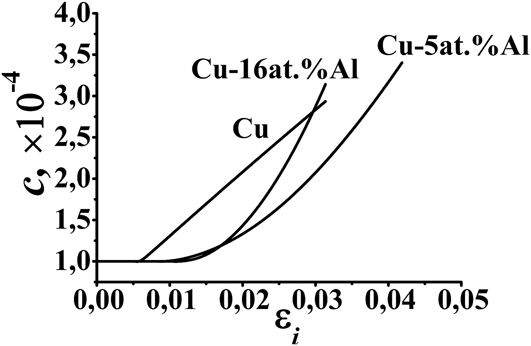
The activity of the annihilation of dislocations at the GBs as a result of their nonconservative motion is confirmed by the reduction of the forest dislocation density in them. Vacancies are spent on the annihilation of forest dislocations, which translates into a corresponding increase of the speed in the growth of the concentration of deformation vacancies (Fig. 4). Thus, according to known experimental data, the concentration of deformation vacancies reaches ∼10−4. Reference Schafler, Dubravina, Kovacs, Zhu, Langdon, Mishra, Semiatin, Saran and Lowe37
The concentration of deformation vacancies against the degree of true strain for NS pure Сu and Cu–5 at.% Al and Cu–16 at.% Al alloys.

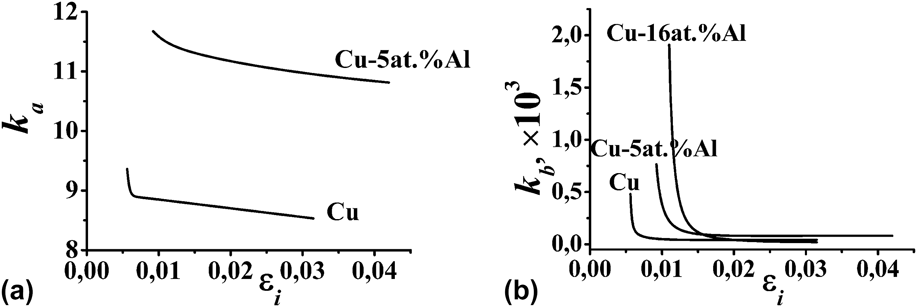
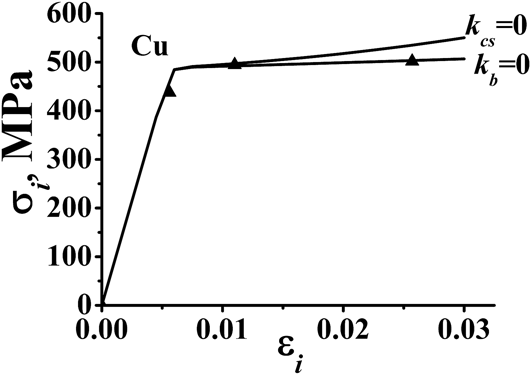
With the decreasing density of forest dislocations decreases the probability of annihilation, resulting in the decrease of the coefficient of annihilation k b (Fig. 5). The achievement of saturation limits the ductility of the sample. However, as shown by the modeling results, annihilation involving vacancies at the GBs does not make a significant contribution to the recovery of the microstructure in the sample. The ductility of the sample is limited by the annihilation of dislocations during their double cross slip (Fig. 6).
The coefficients of the annihilation of dislocations during their double cross slip (a) and the result of their nonconservative motion (b) depending on the degree of true deformation.

The true stress–true strain curves for NS pure Cu in the absence of annihilation in the nonconservative dislocation slip (k b = 0) and dislocation double cross slip (k cs = 0).

Twins were not observed in the microstructure of pure Cu after HPT. Reference An, Lin, Wu, Zhang, Figueiredo, Gao and Langdon12 In this regard, the contribution of twins in the yield strength and flow stress was also considered equal to zero.
In the case of the Cu–5 at.% Al alloy the calculation of the deformation curve in the elastic region leads to the value of the shear modulus G ≈ 29 GPa. The values of the Peierls stress and solid-solution hardening, according to the formulas (2) and (3), respectively, were equal to ≈111.0 MPa and 27.3c
1/2 ≈ 18.7 MPa. In the samples of Cu–5 at.% Al and Cu–16 at.% Al alloys numerous twins were found.
Reference An, Lin, Wu, Zhang, Figueiredo, Gao and Langdon12
Assuming that at the twin boundaries one dislocation is blocked, which is consistent with the estimate obtained according to the formula (1), taking into account the known literature and experimental data, in particular data on the total dislocation density after HPT,
Reference Stremel20
dislocation density in the inner regions of the grains of the alloy Cu–5 at.% Al was evaluated. It was equal to ρc ≈ 2.68 × 10¹⁴ m−2 for given values of the parameters g and f. It was assumed that in the inner regions of the grains almost all dislocations are concentrated at the twin boundaries. Therefore the value g was made equal to g ≈ 0.9. The value of f ≈ 0.03 was chosen according to the known literature data.
Reference Zehetbauer25,Reference Zehetbauer, Stüwe, Vorhauer, Schafler and Kohout2
The dislocation density in GBs was considered to be much greater than ρc and was estimated to be equal ρw ≈ 2.40 × 10¹⁶ m−2.
Reference Valiev and Alexandrov1
Accordingly, the average dislocation density was equal to ρtot ≈ 9.80 × 10¹⁴ m−2. It was assumed that the size of the grains in the tensile strain can be changed according to the law
 $d = {K_{\rm{d}}}/\sqrt {{\rho _{{\rm{tot}}}}}$
, K
d ≈ 2.030.
Evaluation of the coefficient K t yields the value K t ≈ 11.36. From the expression for yield stress (1), it follows that σt0 ≈ 160.6 MPa. If you take the twin thickness t approximately equal to 3.3 nm, according to the microstructure data presented in Ref. Reference Rohatgi, Vecchio and Cray6, the value of the volume fraction of twins in Cu–5 at.% Al alloy after HPT can be determined basing on formulas (5)–(7): f t0 ≈ 8.44 × 10⁻². Assuming that the dislocation density in the inner regions of the grains and their boundaries increased by about 1.7 times when the degree of strain corresponds to ultimate strength σu of the alloy, which is consistent with the value obtained from experimental data for pure Cu, it is possible to obtain the value of the total dislocation density ρtot ≈ 1.69 × 10¹⁵ m−2. Basing on the formula (2) values σtu ≈ 170.5 MPa, the volume fraction of twins f t was calculated: f t ≈ 8.91 × 10⁻², which was adopted by the close equal to the marginal value of f inf corresponding to the saturation during the tensile deformation of this alloy. The obtained values for f t0 and f inf were used in the modeling of microstructure evolution and deformation behavior of the investigated alloy.
Twin hardening and the Peierls stress in addition to the strain hardening caused by the increase in total dislocation density contribute in the strength of the Cu–5 at.% Al alloy (Fig. 2, Table II). The contribution of solid-solution hardening in the strength of the alloy in this case is small. The presence of the twin boundaries contributes to the accumulation of dislocations in the inner regions of the grains, thereby increasing the strain hardening [Figs. 1 and 2(b)]. The accumulation of dislocations at GBs also promotes strain hardening, delaying the moment of reaching the ultimate strength. The saturation of the dislocation density, limiting the ductility of the alloy, is achieved due to the activity of the annihilation processes and no further increase in the number of dislocations in the body of the grains. Higher density of forest dislocations in GBs, and dislocations in the inner regions of the grains compared with that in NS pure Cu, leads to the increase of probability of annihilation processes, which is reflected in the values of the annihilation coefficients (Fig. 5). They are in this case higher. The concentration of deformation vacancies changes accordingly. At the initial stage of plastic deformation it has lower values compared to pure Cu.
The parameters resulting from the modeling.

In the modeling of tensile deformation of the Cu–16 at.% Al alloy according to the results of calculations the shear modulus has also been taken equal to G ≈ 29 GPa. Estimates of the Peierls stress and of solid-solution hardening by the formulas (2) and (3) resulted in values of 111.0 MPa and 27.3 × c
1/2 ≈ 33.4 MPa, respectively. If one accepts that one dislocation is blocked at the twin boundaries, then from the formula (6) it follows that ρc ≈ 1.26 × 10¹⁵ m−2 with known values of parameters g ≈ 0.9, f ≈ 0.03. The dislocation density in the NS materials is very high. It was assumed that ρw ≈ 2.42 × 10¹⁶ m−2, which is approximately the same as in the case of the Cu–5 at.% Al alloy. Accordingly, the total dislocation density has amounted to ρtot ≈ 1.95 × 10¹⁵ m−2. The value of the coefficient K
t as in the previous case, is equal to ≈11.36. From the expression for yield stress (2) it follows that σt0 ≈ 165.4 MPa. Then, the above-described method can be used to determine the value of the volume fraction of twins f
t0 after HPT of the Cu–16 at.% Al alloy. It was equal to f
t0 ≈ 8.67 × 10⁻². Assuming that the dislocation density in the inner regions of the grains and their boundaries has increased, according to the above established regularities, about 1.6 times when the degree of strain corresponds to ultimate strength σu of the alloy material, it is possible to obtain the value of the total dislocation density ρtot ≈ 3.10 × 10¹⁵ m−2 and to estimate the volume fraction of deformation twins in samples when ultimate tensile strength is reached. The resulting value f
t ≈ 9.09 × 10⁻² was taken approximately equal to the limiting saturation value f
inf at tensile deformation of this alloy. It was considered that the size of the grains in the tensile strain can change according to the law
 $d = {K_{\rm{d}}}/\sqrt {{\rho _{{\rm{tot}}}}}$
, K
d ≈ 1.325. Because SFE in this case has a very low value, the possibility of cross slip of dislocations is excluded. Accordingly, annihilation of dislocations during their double cross slip is absent. The result is a significant increase of the dislocation density in the inner regions of the grains and their boundaries, which restricts the possibility of accumulation of dislocations in grains of such a small size. The annihilation of dislocations in the GBs due to their non-conservative motion does not play a significant role in the recovery [Fig. 3(b)]. The limitation of the role of the annihilation of dislocations during their nonconservative motion leads to a significant increase in the concentration of deformation vacancies in GBs (Fig. 4) that contributes to the destruction of the sample. High strength of Cu–16 at.% Al alloy was due to the higher strain hardening (Figs. 1 and 2, Table II) and higher dislocation density after HPT (Fig. 3, Table II). The Peierls stress and the backpressure created by the twin boundaries also make the contribution to the strength of the samples. The contribution of solid-solution hardening is less pronounced.
As a result of computer modeling performed basing on the model of elastoplastic medium taking into account the evolution of the microstructure during deformation, the assumption is confirmed that the grain size affects the value of εu, defining the specific deformation mechanisms and the emerging microstructure of the NS sample. According to the modeling results twin boundaries that appear in the process of HPT enhance strength of Cu–5 at.% Al and Cu–16 at.% Al alloys. At the same time, the increase in strain hardening of the Cu–5 at.% Al alloy is implemented as a result of accumulation of dislocations in the inner regions of the grains at twin boundaries, the volume fraction of which increases with increasing concentration of Al. Activity of annihilation processes creates conditions for the further accumulation of dislocations. As a result, the value of the degree of deformation εu, which corresponds to the ultimate strength of the material of the sample is higher than in pure Cu. Lowering the value εu in Cu–16 at.% Al alloy is a consequence of the absence of annihilation of dislocations during their double cross slip in NS materials. Annihilation of forest dislocations during their nonconservative motion in the GBs does not play a significant role in the recovery process. As a result, the dislocation activity is restricted, the possibility of accumulation of dislocations inside small grains is limited as well. Limiting of the role of nonconservative motion of dislocations leads to a significant increase in the concentration of deformation vacancies in GBs, which in turn initiate earlier fracture of the material.
Nonmonotonic dependence of εu on the concentration of Al in the Cu–Al alloys is determined by the values of the dislocation density and annihilation coefficients. In the Cu–5 at.% Al alloy the dislocation density is greater than in pure Cu, at the same time the annihilation coefficients have higher values. In the Cu–16 at.% Al alloy the dislocation density is the highest, however, the annihilation coefficient at double cross slip is equal to 0. Nonmonotonic change of εu is evidenced by the nature of the change of the parameter
 ${\rho ^{\rm{*}}}$
. If the dislocation density is less than the specified parameter, the density of mobile dislocations increases. Otherwise, it decreases. In pure Cu, the dislocation density with deformation degree corresponding to the achievement of the ultimate strength of the sample, is ∼3.4 times greater than the parameter
 ${\rho ^ * }$
. In the Cu–5 at.% Al and Cu–16 at.% Al alloys, respectively, this parameter is ∼2.4 and ∼5.4 times higher. Thus, most of the mobile dislocations are found in the Cu–5 at.% Al alloy. In the Cu–16 at.% Al alloy their amount is less. At the same time, the value of the degree of uniform elongation in this case is 2.96%, in the pure Cu - 2.60% due to the presence of numerous deformation twins and GBs that contribute to the accumulation of dislocations, leading to an increase in strain hardening and slightly delaying the approach of strain localization.
According to the known experimental data and the results of molecular dynamics simulation, Reference Han, Zhao, Jiang and Lian38,Reference Szlufarska, Nakano and Vashishta39 the NS materials are characterized by localized deformation activity in the GBs in the form of atom shuffling, GB sliding and GB rotation. In Refs. Reference An, Wu, Wang and Zhang18 and Reference An, Lin, Wu and Zhang19 it have been shown experimentally that the high GB activity in NS Cu–Al alloys with decreasing SFE can lead to the formation of partially or completely amorphous structure or nanopores and nanocracks in the vicinity of GBs.
According to the results of the conducted modeling SFE increases the average density of dislocations in the GBs, ρw, while the density of forest dislocations ρf is reduced. Accordingly, misorientation angles between neighboring grains that may be evaluated from
 $\Theta = bd\left( {{\rho _{\rm{w}}} - {\rho _{\rm{f}}}} \right) \cdot 180/\pi$
are increased. Consequently, with decreasing SFE GB rotation is activated.
The increase in the concentration of deformation vacancies in this case favors the formation of nanopores in GBs, leading to the destruction of the material, which is consistent with the results of experimental investigations. Reference An, Wu, Wang and Zhang18 A significant increase in the concentration of deformation vacancies with decreasing SFE is achieved as a result of the limited annihilation of dislocations at their nonconservative movement in the GBs.
IV. CONCLUSION
As a result of the analysis carried out by computer simulation within the model of elastoplastic medium taking into consideration the experimental data, the contribution of various active mechanisms in the strength and ductility of bulk nanostructured Cu and Cu–Al alloys with the different SFE has been estimated.
It is shown that strain hardening contributes the most to the hardening of all the investigated materials. The contribution of strain hardening increases with increasing tensile strain compared to the contribution of the Peierls stress.
In the case of the NS Cu–5 at.% Al and Cu–16 at.% Al alloys strain hardening as in the case of NS Cu is the main mechanism of hardening in tension. The second largest is the twin hardening, the third – the Peierls stress and only the fourth – the solid solution hardening. However, the highest total dislocation density of all the reviewed materials in the Cu–16 at.% Al alloy leads to maximum values of strength characteristics.
Nonmonotonic changes of the ductility of the considered materials due to the fact that in the Cu–5 at.% Al alloy strain hardening increases due to accumulation of dislocations in the inner regions of the grains at the twin boundaries. Annihilation processes contribute to the maintenance of further accumulation of dislocations, delaying the moment of reaching the ultimate strength. At the same time, the increase of Al concentration up to 16 at.% restricts the annihilation processes. The result is the limited possibility of further accumulation of dislocations inside the small grains, which leads to the decrease of the degree of homogeneous deformation of the alloy. The significantly increased concentration of deformation vacancies contributes to the destruction of the sample. Thus, the modeling results are consistent with experimental data on nonmonotonic nature of the change of ductility of the described materials.
ACKNOWLEDGMENTS
The authors are grateful for the support to Natural Science Foundation of Jiangsu Province, P. R. China under grant BK20131144, the Science Project of Changzhou, P. R. China under grant CZ20130021, the Project Funded by the Priority Academic Program Development of Jiangsu Higher Education Institutions (PAPD) under grant no. [2014] 9, and to the Ministry of Education and Science of the Russian Federation within the Framework of the Basic and Design Part of the State Task No. 11.2540.2014/K Educational Organization of Higher Education.