Introduction
The incidence of vestibular schwannoma, also termed acoustic neuroma, is estimated to be 13 to 20 annual cases per million population.Reference Tos, Stangerup, Cayé-Thomasen, Tos and Thomsen1, Reference Stangerup, Cayé-Thomasen, Tos and Thomsen2 Magnetic resonance imaging (MRI) is increasingly accepted as the diagnostic procedure of choice once suspicion has arisen.Reference Dawes and Jeannon3–Reference Moffat, Baguley, Beynon and Da Cruz5
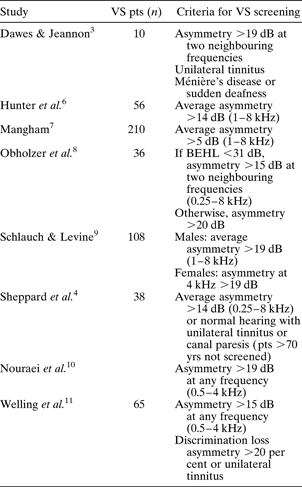
Vestibular schwannoma typically presents with asymmetrical sensorineural hearing loss. However, since it is neither possible nor desirable to refer all cases of asymmetrical hearing loss for MRI, several protocolsReference Dawes and Jeannon3, Reference Sheppard, Milford and Anslow4, Reference Hunter, Ries, Schlauch, Levine and Ward6–Reference Welling, Glasscock, Woods and Jackson11 have been developed to select patients who should be screened (Table I). Naturally, screening criteria must be based on parameters available from standard examination of the patient, which will include data obtained from the clinical history, pure tone audiometry, speech discrimination scores and stapedial reflex thresholds. As auditory brainstem response testing (ABR) is not carried out in all patients, the decision to screen for vestibular schwannoma is not based on ABR results; however, some centres use ABR for screening instead of MRI. Accordingly, MRI is not the primary screening tool in all protocols.
Published vestibular schwannoma screening protocols and their criteria
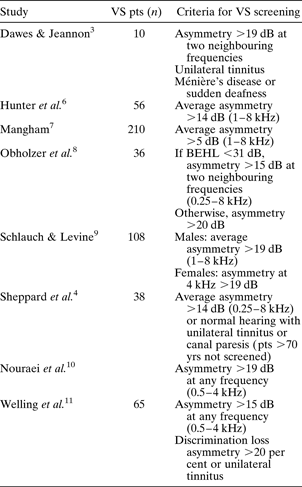
VS pts = number of vestibular schwannoma patients in each study; BEHL = better ear hearing level (0.5–4 kHz average).
In the study catchment area of roughly 360 000, there had been no clearly defined vestibular schwannoma screening policy. This study was initiated in 2004 to determine suitable criteria for such a policy.
Materials and methods
The study included all unilateral vestibular schwannoma patients diagnosed in the catchment area between 1973 and August 2008. A control group was also compiled, comprising patients who had undergone MRI on suspicion of vestibular schwannoma but with a negative result. The two groups' audiological parameters were compared, and were used to evaluate the protocols listed in Table I.
Two hundred and nine vestibular schwannoma cases were identified. Six records were missing, so the vestibular schwannoma study group comprised 203 patients, 109 with right-sided and 94 with left-sided tumours (p > 0.05). Audiograms taken at the time of diagnosis were available in 199 cases, and tumour size was known in 197 cases. Fifty-eight (29 per cent) tumours were intrameatal and 139 (71 per cent) extrameatal. Using the classification of Kanzaki et al.,Reference Kanzaki, Tos, Sanna and Moffat12 the extrameatal tumours comprised 47 small (i.e. <11 mm), 43 medium-sized (11–20 mm), 24 moderately large (21–30 mm), 16 large (31–40 mm) and nine giant (>40 mm) tumours. In this study, we termed intrameatal and small tumours (i.e. <11 mm) ‘minor tumours’ and the remainder ‘major tumours’. Thus, there were 105 minor and 92 major tumours.
The control group comprised 225 patients.
In the vestibular schwannoma group, there was a fairly equal sex distribution (109 males and 100 females), while the non-tumour group had a male preponderance (142 (63 per cent) males and 83 (37 per cent) females; p < 0.05). The mean age at diagnostic scan was the same in both groups (55 years).
The ear in which a vestibular schwannoma was confirmed or suspected was termed the ‘suspect ear’, and the contralateral ear was termed the ‘non-suspect ear’. When a hearing threshold could not be reached at audiometry, the tested frequency was assigned a threshold of 120 dB HL (this being the output limit of the audiometer). In males, the mean hearing threshold in the non-suspect ear was 16 dB poorer at 4 kHz and 9 dB poorer at 8 kHz, compared with females (p < 0.01). The hearing thresholds of the non-suspect ear did not differ, comparing vestibular schwannoma and non-tumour patients, in either sex.
The audiogram configuration of the suspect ear was characterised as either sloping (i.e. high tone loss), flat, trough, reverse slope or peak. This classification was based on comparision of the 0.25–0.5, 1.0–2.0 and 4.0–8.0 Hz frequency segments with 10 dB as criterion for a difference. Hearing in the non-suspect ear was quantified as the 0.5–4 kHz pure tone average, and was termed the better ear hearing level.
Speech discrimination loss was quantified by monosyllabic words, using standardised Dantale speech material.Reference Elberling, Ludvigsen and Lyregaard13
The stapedial reflex was recorded by contralateral stimulation at 0.5, 1 and 2 kHz. It was considered absent if it could not be elicited at 100 dB HL at two of the three test frequencies, if the stimulus ear had a threshold of ≤55 dB HL. The reflex threshold was considered elevated if stimulation in the suspect ear needed to be more than 10 dB louder than in the non-suspect ear at two frequencies.
Statistical analyses were conducted using the Epi Info version 3.5.1 software package. Categorical data were compared using the chi-square test, while continuous data were compared using analysis of variance or the Kruskall–Wallis test. A significance level of 5 per cent was chosen.
Results
Comparison of vestibular schwannoma patients and controls
Presenting symptoms
In the 203 vestibular schwannoma patients, the tumour had been suspected in 174 of those with known histories (86 per cent), but had been an incidental finding in 24 (12 per cent). Asymmetrical hearing loss had been the presenting symptom in 151 (74 per cent) and sudden deafness in 21 (10 per cent). Disequilibrium, unilateral tinnitus, cranial nerve symptoms or Ménière's-type symptoms accounted fairly evenly for the remaining 31 cases (15 per cent). Patients with minor and major tumours did not differ with regard to presenting symptoms.
Audiogram types
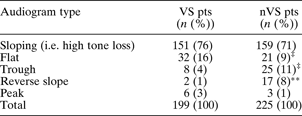
Table II shows that the sloping or high tone loss audiogram configuration was the most common type in both vestibular schwannoma and non-tumour patients. The second most common audiogram pattern was the flat type in vestibular schwannoma patients and the trough type in non-tumour patients. The flat type was seen marginally more often in vestibular schwannoma patients than in non-tumour patients. Trough and reverse slope (including low frequency loss) audiograms were significantly more common in non-tumour patients than in vestibular schwannoma patients.
Audiogram types of vestibular schwannoma* and non-tumour† patients
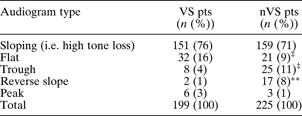
* n = 199 patients in whom audiogram from time of diagnosis was available; †n = 225. ‡p < 0.05, versus vestibular schwannoma (VS) group. **p < 0.01, versus VS group. Pts = patients; nVS = non-tumour
Asymmetry
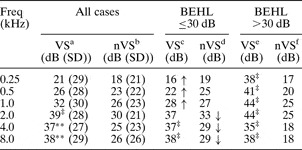
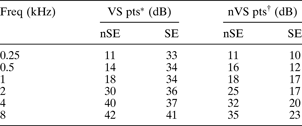
Table III compares the mean pure tone audiometric asymmetry in vestibular schwannoma patients and non-tumour patients at each test frequency from 0.25 to 8 kHz. When the two groups were compared, the vestibular schwannoma group had significantly greater asymmetry at 2, 4 and 8 kHz. In patients with a BEHL of ≤30 dB HL, vestibular schwannoma cases had greater asymmetry at 4 and 8 kHz, but in patients with a BEHL of >30 dB HL, vestibular schwannoma cases had greater asymmetry at all frequencies, compared with non-tumour patients. When the BEHL shifted from less than to more than 30 dB HL, the incidence of asymmetry at 0.25–1 kHz almost doubled in vestibular schwannoma patients. In contrast, in non-tumour patients the same BEHL shift reduced the incidence of asymmetry at 2–8 kHz. The threshold elevations that brought about these changes are shown in Table IV; the elevations in the non-suspect ear were fairly similar in vestibular schwannoma and non-tumour patients. In the suspect ear, on the other hand, elevations were much bigger in vestibular schwannoma patients than in non-tumour patients.
Mean audiometric asymmetry of vestibular schwannoma* and non-tumour† patients

Data represent mean audiometric asymmetry in dB unless stated otherwise. *n = 199 patients in whom audiogram from time of diagnosis was available; †n = 225. an = 199; bn = 225; cn = 153; dn = 152; en = 46; fn = 73. ‡p < 0.01, **p < 0.001, for vestibular schwannoma (VS) versus non-tumour (nVS) patients. Freq = frequency; BEHL = better ear hearing level (0.5–4 kHz average); SD = standard deviation; ↑= asymmetry increases as BEHL shifts from ≤30 to >30 dB HL; ↓= asymmetry decreases as BEHL shifts from ≤30 to >30 dB HL
Mean threshold increase at each frequency as BEHL shifts from ≤30 to >30 dB HL, in non-suspect and suspect ears of VS and non-tumour patients
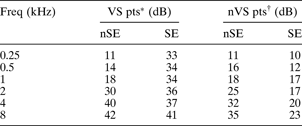
* n = 199 patients in whom audiogram from time of diagnosis was available; †n = 225. BEHL = better ear hearing level (at 0.5–4 kHz average); freq = frequency; VS = vestibular schwannoma; nVS = non-tumour; pts = patients; nSE = non-suspect ear; SE = suspect ear
When the BEHL was ≤30 dB HL, the average audiograms (both ears) of vestibular schwannoma and non-tumour patients were nearly identical, so that the two groups could not be distinguished from each other. When the BEHL was >30 dB HL, the two groups still had similar BEHL but the suspect ear threshold was much poorer in vestibular schwannoma patients than in non-tumour patients, so that the average audiograms were clearly different.
On average, ears with minor tumours had 14 dB better hearing at all frequencies from 0.25 to 8 kHz, compared with ears with major tumours (p < 0.01), and the average asymmetry was 15 dB less in minor tumours than in major tumours (p < 0.001).
Speech discrimination loss
The mean speech discrimination loss for suspect ears was 39 per cent in vestibular schwannoma ears and 23 per cent in non-tumour ears (p < 0.01); however, 38 per cent of the vestibular schwannoma ears had a discrimination loss of ≤10 per cent. The mean interaural discrimination loss difference also differed between the two groups, being 35 per cent in vestibular schwannoma patients and 19 per cent in non-tumour patients (p < 0.0001). The suggested criterion of a 20 per cent interaural discrimination loss differenceReference Welling, Glasscock, Woods and Jackson11 had a sensitivity of 50 per cent and a specificity of 57 per cent. The mean discrimination loss was 31 per cent for minor tumours and 47 per cent for major tumours (p < 0.05).
Stapedial reflexes
The pure tone thresholds permitted stapedial reflex testing of the suspect ear in 223 patients (52 per cent), of whom 102 were vestibular schwannoma patients. Sixty-one of these 102 patients had pathological reflexes (sensitivity = 60 per cent).
Tinnitus
The presence of tinnitus exclusively or predominantly in the suspect ear occurred equally often in vestibular schwannoma and non-tumour patients (i.e. in 117 (60 per cent) and 143 (64 per cent), respectively). Tinnitus prevalence did not differ in patients with minor versus major tumours.
Comparison of protocols
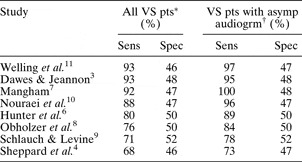
When the protocols listed in Table I were applied to all 199 vestibular schwannoma patients, their sensitivities varied from 68 to 93 per cent (Table V). However, when tested only on the 178 vestibular schwannoma cases with asymmetrical hearing, the sensitivity of the four most successful protocols rose to 95–100 per cent. In all instances, the specificity was around 50 per cent.
Sensitivity and specificity of published VS screening protocols, for VS patients of present study

* n = 199; †n = 178. All VS pts = vestibular schwannoma patients with symmetrical or asymmetrical audiogram; VS pts with asymp audiogrm = VS pts with ≥7 dB audiometric asymmetry (0.250–8 kHz); sens = sensitivity; spec = specificity
Discussion
In Denmark, the management of vestibular schwannoma cases is supervised by the ENT department of Gentofte University Hospital. Accordingly, the cases presented in this paper have been included in publications from that centre, including Tos et al. Reference Tos, Stangerup, Cayé-Thomasen, Tos and Thomsen1 and Stangerup et al. Reference Stangerup, Cayé-Thomasen, Tos and Thomsen2
The design of the present study was considered valid as it was based on an authentic clinical patient population – the vestibular schwannoma and non-tumour patients were recruited on identical terms. These two groups were comparable in all respects apart from gender distribution; however, this was of no importance, since vestibular schwannoma occurs equally often in the two sexes (as demonstrated by this study and others).Reference Moffat, Baguley, Beynon and Da Cruz5, Reference Schlauch and Levine9 The male dominance in the non-tumour group was a result of poorer male hearing at 4 and 8 kHz in the catchment population, leading to more males than females contacting the audiological services.
In the seven-year period (2002 to 2008) during which vestibular schwannoma detection (in the study catchment area) had been based on MRI, 82 cases were diagnosed, corresponding to an annual incidence of about 30 per million. This is almost twice the estimated incidence,Reference Tos, Stangerup, Cayé-Thomasen, Tos and Thomsen1, Reference Stangerup, Cayé-Thomasen, Tos and Thomsen2 and reflects a high index of suspicion among all the professionals involved. As mentioned in “Materials and methods” males and females were affected equally often, as were the right and left ears. The latter finding is confirmed by two other studiesReference Moffat, Baguley, Beynon and Da Cruz5, Reference Neary, Newton, Laoide-Kemp, Ramsden, Hillier and Kan14 but refuted by Lönn et al.,Reference Lönn, Ahlbom, Hall and Feychting15 who found a right-sided preponderance. The laterality issue is of interest since vestibular schwannoma has been claimed to be associated with mobile telephone use.Reference Thomsen, Terkildsen and Tos16 With that in mind, a survey of mobile telephone use was carried out among employees of Vejle Hospital; of 394 responders, 54 per cent held their mobile telephone to their right ear, 36 per cent to their left ear and 10 per cent to both. These figures are identical to those cited by Lönn et al. Reference Lönn, Ahlbom, Hall and Feychting15 and may, therefore, be generally valid. It follows that if mobile telephone use were a vestibular schwannoma risk factor, it would eventually result in a right-sided vestibular schwannoma preponderance.
In keeping with other studies,Reference Thomsen, Terkildsen and Tos16 the commonest presenting symptom of this study's patients was asymmetrical sensorineural hearing loss (accounting for 74 per cent of cases); however, sudden deafness was the presenting complaint in 10 per cent, and 12 per cent of patients' tumours presented as incidental findings. The limit for audiometric symmetry was set at an average of 7 dB across 0.25–8 kHz; this criterion was derived from calculations on audiograms which were perceived on visual inspection to be either symmetrical or slightly asymmetrical.
Comparison of vestibular schwannoma and non-tumour patients
Audiogram types
Three-quarters of the vestibular schwannoma cases had audiographic hearing loss of the sloping or high tone loss type, while a flat audiogram pattern was the second most common type; 92 per cent of the vestibular schwannoma patients had an audiogram of one or other of these two types (Table II). Interestingly, the distribution of audiogram types differed between the patient groups, with trough and reverse slope audiograms being more common in the non-tumour group, presumably because this group included hereditary and Ménière's disease cases.
Asymmetry
Since asymmetrical sensorineural hearing loss is the typical presenting symptom of vestibular schwannoma, the crucial problem is to determine the magnitude and configuration of asymmetry which should raise suspicion of this tumour. Tables II and III show that vestibular schwannoma asymmetry was expressed predominantly in the high frequencies, and several investigatorsReference Mangham7–Reference Schlauch and Levine9 have reported 2 kHz to be the frequency most closely associated with vestibular schwannoma. However, as mentioned in the Results section, a more complex picture emerged when BEHL was taken into consideration, namely that the asymmetry increased in vestibular schwannoma cases and decreased in non-tumour cases as the BEHL shifted from ≤30 dB HL to >30 dB HL.
The decision to use 30 dB HL as a cut-off criterion was based on its use by Obholzer et al.,Reference Obholzer, Rea and Harcourt8 but also on the fact that 30 db HL was the median of the better ear 2–4–8 kHz average on which the initial calculations were based. The association between BEHL and asymmetry suggests the influence of what might appropriately be termed a ‘contralateral ear factor’, which conceivably might be attributed to the fact that the aetiology of the suspect ear hearing loss differed in vestibular schwannoma and non-tumour ears. In non-tumour cases with bilateral asymmetrical hearing loss, the aetiology will often be the same in both ears, and any asymmetry will reflect merely asynchronous progression. Accordingly, the asymmetry will decrease if the better ear gains on the poorer, or if progression in the poorer ear slows down or stops. The theory that this asymmetry reduction was an artefact, caused by the 120 dB audiogram limit preventing the poorer ear from progressing beyond that value, was ruled out.
On the other hand, in unilateral vestibular schwannoma cases a hereditary, noise-induced or age-related hearing loss in the non-suspect ear will also involve the tumour ear and add to the tumour-induced hearing loss in that ear. Therefore, as the underlying bilateral hearing loss progresses, the two thresholds will remain separated by the magnitude of the tumour-induced loss, provided that the underlying bilateral pathology does not affect the non-suspect ear more than the tumour ear. Furthermore, the tumour-induced hearing loss may increase spontaneously, or if the vestibular schwannoma grows. These mechanisms would explain a finding of greater asymmetry in vestibular schwannoma patients compared with non-tumour patients.
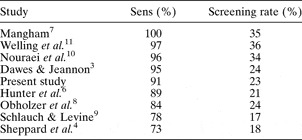
Based on these findings, it could be argued that screening protocols should use differentiated criteria for BEHL above and below 30 dB HL, as proposed by Obholzer et al. Reference Obholzer, Rea and Harcourt8 However, the attempts of the present study on this topic failed. Instead, the use of an approach based on the fact that vestibular schwannoma and non-tumour cases differed at 2–4–8 kHz (Table III) revealed that using an asymmetry of ≥15 dB at two of these frequencies as a screening criterion would detect 91 per cent of tumours in patients with asymmetrical audiograms (Table VI).
Results of published VS screening protocols for patients of present study: sensitivity (for VS patients with audiometric asymmetry*) and screening rate (for consecutive patients undergoing audiology†)

* n = 178; †n = 210. Sens = vestibular schwannoma (VS) detected in VS patients with audiometric asymmetry; screening rate = proportion of consecutive patients undergoing audiology which each protocol would screen
It is widely held that audiometric parameters do not reflect tumour size. Neary et al. Reference Neary, Newton, Laoide-Kemp, Ramsden, Hillier and Kan14 found no relationship between tumour size and hearing loss in the tumour ear. However, Schlauch and LevineReference Schlauch and Levine9 reported a trend, albeit statistically insignificant, linking asymmetry and tumour size. In the present study, non-parametric distinction between minor and major tumours resulted in major tumours being associated with greater asymmetry, poorer thresholds and greater discrimination loss, compared with minor tumours; the use of a parametric approach with linear regression resulted in a clear relationship between tumour size and asymmetry at each frequency (correlation coefficients 0.33–0.37, p<0.01). The reason that such results were not obtained by the aforementioned authors could be that their studies included fewer minor tumours, compared with the 52 per cent included in the present study. For example, in Neary and colleagues' studyReference Neary, Newton, Laoide-Kemp, Ramsden, Hillier and Kan14 minor tumours comprised only 15 per cent of patients with vestibular schwannoma. In addition, the total number of tumour cases included in a study will affect its statistical calculations, and it may therefore be significant that that the present study included 197 patients with an available audiogramme and known tumour size, while those of Neary et al. Reference Neary, Newton, Laoide-Kemp, Ramsden, Hillier and Kan14 and of Schlauch and LevineReference Schlauch and Levine9 included 93 and 108, respectively.
The distinction between minor and major tumours has clinical implications, since minor tumours are often managed by observation. On the other hand, most major tumours are treated, as an extrameatal size of 15 mm serves as a criterion for intervention.Reference Stangerup, Cayé-Thomasen, Tos and Thomsen2 In fact, 72 of the current study's 92 major tumours (78 per cent) fulfilled this criterion.
Furthermore, since the minor and major tumours in the current study performed differently as groups, it might be possible to develop a simple audiological protocol that could exclude major tumours with acceptable certainty. If so, it would be possible to abstain from further diagnostic tests in selected patients in whom it would be permissible to leave a vestibular schwannoma undetected (as it would not be treated anyway). Interestingly, at the time of diagnosis, patients with minor tumours had an average age of 57 years, compared with 53 years in patients with major tumours (p < 0.05). Presumably, the latter patients' more pronounced hearing problems had caused them to contact medical services at an earlier stage.
Speech discrimination loss, stapedial reflexes and tinnitus
Although speech discrimination loss differed between vestibular schwannoma and non-tumour patients, a proposed screening criterion of a 20 per cent interaural discrimination loss differenceReference Welling, Glasscock, Woods and Jackson11 had a sensitivity of only 50 per cent. Furthermore, 95–100 per cent of the vestibular schwannoma patients fulfilling this criterion would already have been detected by the four best performing protocols listed in Table I. Finally, this 20 per cent interaural discrimination loss difference criterion would not have identified any vestibular schwannoma cases without audiometric asymmetry.
Hunter et al. Reference Hunter, Ries, Schlauch, Levine and Ward6 discarded stapedial reflex testing as a means of vestibular schwannoma detection, since only 46 per cent of their cases could be tested in this way, and in these cases this test's sensitivity was only 68 per cent. Allowing for differences in methodology, these authors' findings agree well with the present study, in which 52 per cent could be assessed with stapedial reflex testing, with a sensitivity of 60 per cent. However, again, 92–95 per cent of these tumours would have been found in any case, because of their audiometric asymmetry.
The presence of tinnitus exclusively or predominantly in the suspect ear occurred equally often in vestibular schwannoma and non-tumour patients (60 and 64 per cent, respectively), and 94–100 per cent of these vestibular schwannoma cases would have been detected in any case due to audiometric asymmetry.
Therefore, assessment of speech discrimination loss, stapedius reflex and tinnitus complaints are not suitable screening tools in themselves, but should be seen as supplements to criteria based on pure tone asymmetry.
Comparison of screening protocols
Four of the protocols listed in Table VReference Dawes and Jeannon3, Reference Mangham7, Reference Nouraei, Huys, Chatrath, Powles and Harcourt10, Reference Welling, Glasscock, Woods and Jackson11 had sensitivities of 95–100 per cent when applied to cases with audiometric asymmetry, which would be their clinical application. The 73 per cent sensitivity of another protocolReference Sheppard, Milford and Anslow4 stems from the fact that it excluded persons aged over 70 years; had this protocol been used on our patients, six minor and 17 major tumours, of our 178 asymmetrical cases (i.e. 13 per cent), would not have been screened. It appears that the remaining protocolsReference Hunter, Ries, Schlauch, Levine and Ward6, Reference Obholzer, Rea and Harcourt8, Reference Schlauch and Levine9 were developed in patients with many major tumours, for whom they would have performed better (in fact, one protocolReference Hunter, Ries, Schlauch, Levine and Ward6 was based on surgically confirmed tumours). Six of the protocols listed in Table V (Dawes and Jeannon,Reference Dawes and Jeannon3 Sheppard et al.,Reference Sheppard, Milford and Anslow4 Mangham,Reference Mangham7 Obholzer et al.,Reference Obholzer, Rea and Harcourt8 UK Dept. of Health,Reference Nouraei, Huys, Chatrath, Powles and Harcourt10 Welling et al. Reference Welling, Glasscock, Woods and Jackson11) were tested by Nouraei et al. Reference Nouraei, Huys, Chatrath, Powles and Harcourt10 on 129 patients, yielding sensitivities fairly similar to those generated by the current study for asymmetrical cases, suggesting that Nouraei and colleagues' patients had asymmetrical audiograms.
All the protocols listed in Table I addressed the problem of specificity in order to minimise screening. TwoReference Hunter, Ries, Schlauch, Levine and Ward6, Reference Schlauch and Levine9 appeared to report specificities of 68–85 per cent, while Obholzer et al. Reference Obholzer, Rea and Harcourt8 reported a specificity of 49 per cent. However, when applied to the current study's patients, all these protocols yielded specificities around 50 per cent (Table V). Conceivably, the previously reported high specificity rates may have been attained in patients with poor hearing in the non-suspect ear since, as shown in the present study, the average audiograms of vestibular schwannoma and non-tumour patients were indistinguishable using a BEHL of ≤30 dB HL, thus precluding any specificity.
However, in clinical work it is important to consider another aspect of specificity, namely the proportion of patients that each protocol will allocate to screening.
To assess this, a prospective study was conducted in which the protocols listed in Table I were applied to 210 consecutive adult audiological patients. As would be expected, parallelism was observed between sensitivity and screening rates (Table VI). The three most successful protocolsReference Mangham7, Reference Nouraei, Huys, Chatrath, Powles and Harcourt10, Reference Welling, Glasscock, Woods and Jackson11 had detection rates of 96–100 per cent, but at the expense of 34–36 per cent of the patient population requiring screening. If a sensitivity of at least 90 per cent were required, then the protocols suggested by Dawes and JeannonReference Dawes and Jeannon3 and by the present author (i.e. ≥15 dB asymmetry at two frequencies between 2 and 8 kHz ) should be considered, since these protocols had sensitivities of 91–95 per cent and screening rates of only 23–24 per cent. As some patients will already have been screened whilst undergoing audiological testing, the real screening rates will be less than those stated in Table VI; however, this Table suggests the magnitude of the problem and permits comparison of protocols.
Although the protocols discussed in the present study were found to have specificities of approximately 50 per cent, this figure compares favourably with actual reported specificities. Thus, the number of MRI scans carried out for each vestibular schwannoma detected has been reported as 23 in Oxford,Reference Sheppard, Milford and Anslow4 42 in CambridgeReference Moffat, Baguley, Beynon and Da Cruz5 and 33 in the current study's catchment area. (The Oxford figure may be ascribed to a policy of not screening individuals aged over 70 years.) Therefore, it would appear that a formalised vestibular schwannoma screening policy, in the shape of a suitable protocol, would enable the avoidance of a considerable number of negative MRI scans. Furthermore, such a formal screening policy could facilitate clinical work and enhance patient safety, if an automatic alert was generated whenever the asymmetry of an audiogram met the criteria of the chosen protocol. Indeed, the manufacturer of the computer-based handling system used in all public audiological clinics in Denmark, and in 450 centres in the UK,17 has indicated that it would be possible to install such a feature in future versions.
• The typical presenting symptom of vestibular schwannoma is an asymmetrical sensorineural hearing loss
• Since it is neither possible nor desirable to refer all cases of such asymmetry for magnetic resonance imaging, several protocols have been developed to select patients who should be screened
• In the current study, although 10 per cent of cases presented with sudden deafness, the typical clinical presentation was insidious, asymmetrical, high tone, sensorineural hearing loss with greatest asymmetry in the 2–8 kHz region
• The best compromise between sensitivity and screening rate would be offered either by (1) a protocolReference Dawes and Jeannon3 based on ≥20 dB asymmetry at two neighbouring frequencies, or unilateral tinnitus, or (2) ≥15 dB asymmetry at two frequencies between 2 and 8 kHz
Despite clinicians' best efforts to detect all vestibular schwannomas in their patients, some will nevertheless be missedReference Mangham7 because, firstly, screening protocols are not infallible, secondly, some vestibular schwannomas are asymptomatic and, thirdly, some present with non-otological symptoms.Reference Moffat, Baguley, Beynon and Da Cruz5 Accordingly, clinicians cannot rely entirely on any one strategy, but must also continue to be guided by their clinical intuition.Reference Moffat, Baguley, Beynon and Da Cruz5
Conclusion
Although 10 per cent of current study patients presented with sudden deafness, the typical clinical presentation of vestibular schwannoma was an insidious, asymmetrical, high tone, sensorineural hearing loss, with greatest asymmetry in the 2–8 kHz region.
When the BEHL was ≤30 dB HL, the asymmetry in vestibular schwannoma and non-tumour cases was identical; however, with greater BEHL, the asymmetry increased in vestibular schwannoma cases and decreased in non-tumour cases. Patients with intrameatal tumours or extrameatal tumours smaller than 11 mm had audiograms with 15 dB better hearing and 15 dB less asymmetry, compared with patients with larger tumours.
Vestibular schwannoma screening using an average asymmetry of 5 dB at 1–8 kHz detected all vestibular schwannoma cases with asymmetrical audiograms, but required that 35 per cent of patients be screened. An alternative criterion would be either (1) a ≥ 20 dB at two neighbouring frequencies, or unilateral tinnitus, or (2) an asymmetry ≥15 dB at two frequencies between 2 and 8 kHz; using either of these criteria, the sensitivity would be more than 90 per cent and the screening rate 24 per cent.