The purpose of this research was to investigate the role of theory of mind (ToM) in recognizing and repairing a communicative failure, an important phenomenon in the pragmatic domain albeit somewhat ignored by the recent literature. Pragmatics refers to the use of language to perform social functions, that is, to communicate with other people (see, e.g., Habermas & Cook, Reference Habermas and Cooke2000). A communicative failure occurs when a person does not succeed in modifying another person's mental state in the desired way. Recognition of a communicative failure occurs when a speaker realizes such a failure has occurred and the repair of a communicative failure is another attempt by the speaker (following the failed attempt) to convince the partner to adhere to his communicative purpose. The recognition and the recovery of communicative failures require pragmatic communicative competence, because they imply the use of language for social purposes. ToM is the ability to attribute mental states to other people and to oneself, and to use such knowledge to interpret and predict other people's and one's own behavior (Premack & Woodruff, Reference Premack and Woodruff1978).
In order to test ToM ability, we used first-order (Baron-Cohen, Leslie, & Frith, Reference Baron-Cohen, Leslie and Frith1985; Perner, Leekam, & Wimmer, Reference Perner, Leekam and Wimmer1987) and second-order classical false belief tasks (Sullivan, Winner, & Hopfield, Reference Sullivan, Winner and Hopfield1995), in addition to the picture sequencing task (Langdon & Coltheart, Reference Langdon and Coltheart1999), a nonverbal test investigating the comprehension of false belief and social interaction. A false belief task involves a specific case of use of ToM and consists of the ability to attribute mental states to other people and to use such knowledge to interpret and predict other people's behavior, when one's own knowledge of the world differs from another person's. The false belief paradigm has been classically used to investigate ToM in the developmental domain (Perner & Wimmer, Reference Perner and Wimmer1985; Sullivan, Winner, & Hopfield, Reference Sullivan, Winner and Hopfield1995; Wimmer & Perner, Reference Wimmer and Perner1983; see Wellman & Liu, Reference Wellman and Liu2004).
Some authors have highlighted the role of communicative failure, as in the case of misunderstanding, during a communicative interaction, considering it not so much a breakdown but an integral part of the comprehension process (see Bazzanella & Damiano, Reference Bazzanella and Damiano1999; Blum-Kulka & Weizman, Reference Blum-Kulka and Weizman1988; Bosco, Angeleri, Sacco, & Bara, Reference Bosco, Angeleri, Sacco and Bara2015; Dascal, Reference Dascal and Dascal1985; Weigand, Reference Weigand1999). Weigand (Reference Weigand1999), for example, contends that in instances of nonunderstanding during a communicative interaction, the hearer signals the problem and starts the clarification process, whereas in cases of misunderstanding, the process of clarification is usually initiated by the speaker. Bazzanella and Damiano (Reference Bazzanella and Damiano1999) proposed five levels at which misunderstanding can arise in everyday conversation: phonetic, syntactic, lexical, semantic, and pragmatic, all of which involve a discrepancy between the speaker's intent and the hearer's interpretation. The level of discrepancy may vary, depending on the extent to which the hearer accepts or refuses the speaker's meaning, and it is this that determines the degree to which an utterance is understood.
In the developmental domain, the main empirical studies concerned with children's ability to manage communicative failures were conducted in the 1970s (Peterson, Danner, & Flavell, Reference Peterson, Danner and Flavell1972; Robinson & Robinsion, Reference Robinson and Robinson1977), and Reference Wilcox and Webster1980s (Beal & Flavell, Reference Beal and Flavell1982) and 1990s (Marcos, Reference Marcos1991; Marcos & Kornhaber-le Chanu, Reference Marcos and Kornhaber-le Chanu1992). An analysis of some of these studies revealed that children are able to adopt different kinds of repair strategies depending on what kind of failure occurs, and that as they grow up, they use different forms of repair. For example, one of the first repair strategies used by toddlers in case of communicative failure is repetition (Golinkoff, Reference Golinkoff1986), a strategy that children tend to use less as they grow up (Garvey, Reference Garvey1984). Furthermore, Anselmi, Tomasello, and Acunzo (Reference Anselmi, Tomasello and Acunzo1986) pointed out that when a communicative failure occurs during an interaction, children aged between 1 year, 8 months [1;8] and 3;8 tend to repeat the whole sentence when their mother responds with a neutral query (“What?”), whereas when their mother asks a specific question (“Where's the dog?”), they accordingly provide a more specific answer. Along the same lines, Wilcox and Webster (Reference Wilcox and Webster1980) pointed out that between 1;6 and 2, children are able to use two different repair strategies: repetition and modification. In particular, they are able to modify their requests simply by repeating the same question, when the adult answers with a neutral query (“What?”), whereas they reformulate their request when the adult answers with a simple declarative comment (“Yes, I see it”). Marcos (Reference Marcos1991), too, showed that children of this age are able to reformulate a request, as a function of their mothers’ response. Moreover, by the time they are 18 months old, children seem to adopt the correct repair strategy according to the kind of failure that occurred; when the mother misunderstands, instead of refusing to accomplish the request, children use increased vocalization in order to clarify their request rather than simply insisting by repeating it, an ability that is not present in children aged 14 months (Marcos & Kornhaber-le Chanu, Reference Marcos and Kornhaber-le Chanu1992). On the basis of an original study by Shwe and Markman (Reference Shwe and Markman1997), Grosse, Behne, Carpenter, and Tomasello (Reference Grosse, Behne, Carpenter and Tomasello2010) recently showed that, starting from the age of 1;6, children repair their request differently according to the failure that has occurred, for example, misunderstanding the referent versus the communicative intention.
In order to allow for the existence of different kinds of communicative failures, Bosco, Bucciarelli, and Bara (Reference Bosco, Bucciarelli and Bara2006) proposed and empirically investigated an original taxonomy of different kinds of failures that may occur in a communicative interaction in children ranging in age from 3 to 8 years. In particular, the authors reported a trend of increasing difficulty in children's ability to recognize and repair (a) failure of the expression act,Footnote 1 that is, failure of the literal meaning, such as hearing “sheep” instead of “ship”; (b) failure of the speaker's meaning,Footnote 2 that is, failure of the speakers’ intended meaning, such as Polyphemus crying out: “Nobody is trying to kill me” referring to Ulysses, who was trying to kill him saying his name was “Nobody”; and (c) failure of the communicative effect, that is, the unsuccessful attempt to convince someone to do something. The authors explained their results in light of the cognitive pragmatics theory (Airenti, Bara, & Colombetti, Reference Airenti, Bara and Colombetti1993a, Reference Airenti, Bara and Colombetti1993b; for the most recent developments, see Bara, Reference Bara2010, Reference Bara2011), a theory on human communication (see next section).
Several authors have highlighted the role of ToM in human pragmatic communication; a capacity to attribute mental states and to behave accordingly needs to have been developed in order to comprehend a partner's communicative intention (Bosco, Colle, & Tirassa, Reference Bosco, Colle and Tirassa2009; Happé & Loth, Reference Happé and Loth2002; Sperber & Wilson, Reference Sperber and Wilson2002; Tirassa & Bosco, Reference Tirassa and Bosco2008; Tirassa, Bosco, & Colle, Reference Tirassa, Bosco and Colle2006a, Reference Tirassa, Bosco and Colle2006b). The first authors to point to a link between ToM and the ability to repair communicative failure were, to the best of our knowledge, Feldman and Kalmar (Reference Feldman, Kalmar and Bazzanella1996). They reported that a person in a conversation tends to repair a communication breakdown by adjusting his or her strategy to take the partner's mental states into account and trying to figure out why the communicative intention was not recognized or a request was not accepted.
In keeping with this assumption, in the field of clinical pragmatics (Cummings, Reference Cummings2009, Reference Cummings and Cummings2014), it has been observed that communicative failures (see Keen, Reference Keen2003) and communicative errors (Loukusa et al., Reference Loukusa, Leinonen, Jussila, Mattila, Ryder and Ebeling2007) occur more frequently in children with autism, Asperger syndrome, or high-functioning autism, all of which have been found to be associated with a deficit in ToM (Baron-Cohen et al., Reference Baron-Cohen, Leslie and Frith1985), than among their typically developing peers. Volden (Reference Volden2004) observed that children with autism spectrum disorder were similar to control group children in their ability to use increasingly flexible and complex repair strategies in response to neutral requests, requests for clarification, or semistructured prompts (“Tell me another way”). However, the author also reported that children with autism spectrum disorder were more likely to give an inappropriate response than those in the control group. Taken as a whole, these findings suggest that a deficit in ToM affects children's ability to repair communicative failures.
We proposed that ToM plays a role in children's ability both to repair and to recognize communicative failures. In recognizing a failure, a person must realize that he or she has failed to modify the partner's mental state, in terms of knowledge, desire, belief, and so on, in the desired way. In repairing a communicative failure, a person makes another attempt to change the partner's mental state in the desired way, bearing in mind the strategy that failed. We thus predicted the following:
-
Hypothesis 1: Children's performance on ToM tasks is correlated with their accuracy in both recognizing and repairing a communicative failure.
Moreover, in line with the relevant literature (Bosco et al., Reference Bosco, Bucciarelli and Bara2006; Wellman & Liu, Reference Wellman and Liu2004) we expected the following:
-
Hypothesis 2: Children's ability to solve ToM tasks and recognize and repair communicative failures will increase with their age.
Furthermore, in the present paper, we wished to replicate the finding that children exhibit a trend of increasing difficulty in recognizing and repairing a communicative failure as reported by Bosco et al. (Reference Bosco, Bucciarelli and Bara2006). In particular, we investigated whether the trend of increasing difficulty in recognizing and repairing different kinds of communicative failures, that is, failure of expressive act, failure of communicative meaning, and failure of communicative effect, could be explained by children's performance on ToM tasks, in addition to their age.
Finally, for exploratory purposes, we also examined the role of the family's socioeconomic status (SES) on children's pragmatic development, in order to verify whether this variable could affect the ability to recognize and repair communicative failures.
THE COGNITIVE PRAGMATICS THEORY
The cognitive pragmatics theory (Airenti et al., Reference Airenti, Bara and Colombetti1993a, Reference Airenti, Bara and Colombetti1993b) explains the cognitive processes underlying human communication; it has been found to be effective for explaining the increasing accuracy with which children and young adults comprehend and produce several pragmatic phenomena such as direct and indirect communication acts, irony and deceit (Angeleri, Bosco, Gabbatore, Bara, & Sacco, Reference Angeleri, Bosco, Gabbatore, Bara and Sacco2012; Bosco, Angeleri, Colle, Sacco, & Bara, Reference Bosco, Angeleri, Colle, Sacco and Bara2013; Bosco & Bucciarelli, Reference Bosco and Bucciarelli2008), and figurative language (Bosco, Vallana, & Bucciarelli, Reference Bosco, Vallana and Bucciarelli2009, Reference Bosco, Vallana and Bucciarelli2012). We will now summarize the main theoretical assumptions of the theory (for a more detailed description, please see Bara, Reference Bara2010, Reference Bara2011).
Grice (Reference Grice, Cole and Morgan1975) identified cooperation as the fundamental element of communicative interaction. According to the cognitive pragmatics theory, for cooperation to be concrete, both of the interlocutors must be familiar with the plan of action they are carrying out. Airenti et al. (Reference Airenti, Bara and Colombetti1993a) called the scheme of an action plan known to both A and B a behavioral game. A behavioral game is a shared conventional pattern of interaction in which participants in a dialogue interpret the interlocutor's communication. The speaker's communicative intention is understood on the basis of the beliefs that people share in a communicative exchange, that is, on the basis of the shared behavioral game. The notion of behavioral game is useful to understand how it is possible to attribute different communicative meanings to the same communicative act (verbal or nonverbal).
Let us consider the following example taken from Bara (Reference Bara2010): imagine a situation in which two people are engaged in a conversation and then one of them looks at his watch. If the person who looks at his watch is of superior status, the other person will interpret the gesture as meaning it is time the conversation ended. If, however, the person of lower status looks at his watch, the other person will interpret the gesture as a request for permission to leave. If the speakers are unable to identify a shared behavioral game in which they consider the communication act as a move, they will not be able to understand it. Now consider another example, again taken from Bara (Reference Bara2010): a clerk is working in his office when a complete stranger comes in and says:
-
(1) It's snowing outside.
Although the clerk would have no difficulty in understanding the literal meaning of the utterance, he would be very puzzled. He would only be able to make the necessary inferences and thus give an appropriate answer if he were to interpret (1) as an invitation to stay indoors, a request to close the window, a reminder to take his umbrella, and so on. The pure and simple literal aspect of the utterance, without a game to refer it to, has no communicative significance. Although the literal meaning is an important starting point, on its own it is not enough to enable us to answer the questions we ask ourselves when another person is speaking to us: “Why is she saying that to me? What does she want me to do?”
Consider the following communicative exchange:
-
(2) Anita: Oh, I'm really late!
Ben: Ok, I'll drive you to the office.
Here, the speaker's communicative intention must be understood in order to recognize the behavioral game she is proposing. In (2) Anita and Ben must share the knowledge of the behavioral game [GIVE-LIFT] in order to understand the communicative meaning of the utterance proffered.
-
• A asks B to give her a lift;
-
• B may accept, refuse, propose an alternative solution, and so on.
According to the cognitive pragmatics theory (see Bara, Reference Bara2010, Reference Bara2011), the actions actually performed by a person determine the moves of the behavioral game being played. The meaning of a communicative act (which may be linguistic, i.e., a speech act, or nonverbal, i.e., a communicative gesture, or, more often, a combination of the two) is only fully understood when the move of the relative behavioral game is clear. A speaker may use various moves to propose a behavioral game to the partner. Consider the [GIVE-LIFT] game once again.
Ann might ask her brother Brian to lend her his car by saying (possible moves) the following:
-
(3) Please give me a lift.
-
(4) Would you give me a lift?
-
(5) My car is at the body shop; I can't go to work tomorrow.
-
(6) I'm sad because I haven't got a car for Saturday. . .
In line with the theory, the same move could have several literal formulations. Consider Example (4):
-
(4a) Would you mind giving me a lift?
-
(4b) Please give me a lift.
-
(4c) Would you very kindly give me a lift?
The same move might even be part of more than one behavioral game at the same time. For instance, Example (6) fits both the [LEND-CAR] game and the [GIVE A LIFT] game.
Behavioral games are structures that coordinate interpersonal actions, and are used during communication to choose the actual meaning of an utterance from the various possibilities that are available. Behavioral games exhibit different degrees of applicability; some are universal, others are specific to certain cultures or social groups, and some are only known by two people.
The cognitive pragmatics theory also describes a sequence of processes that are necessary in order to understand and produce a (standard)Footnote 3 communication act:
-
Expression act: the partner recognizes the literal meaning of the speaker's utterance.
-
Speaker's meaning: the partner understands and reconstructs the meaning intended by the speaker.
-
Communicative effect: the partner acquires or modifies his/her mental states in line with, and as a consequence of, the communicative intentions expressed by the speaker.
-
Reaction and response: the partner produces a response.
RECOGNITION OF FAILURE OF A COMMUNICATION ACT: A TAXONOMY
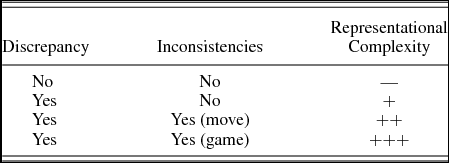
Bosco et al. (Reference Bosco, Bucciarelli and Bara2006) proposed, and empirically investigated, a taxonomy of the different sorts of failures that may occur during the comprehension/generation processes described above. The taxonomy takes into account the speaker's perspective and the complexity of the mental representations involved in their recognition. The label “complexity of mental representations” refers to the presence of discrepancies and inconsistencies between the expression act, the speaker's meaning and the communicative effect (see Table 1). In line with Bazzanella and Damiano (Reference Bazzanella and Damiano1999), we hypotesized that such discrepancy may vary in degree considering the different kind of failure analyzed, and in line with Bosco et al. (Reference Bosco, Bucciarelli and Bara2006), we assumed that children would experience more difficulties in managing failures involving mental representations of increasing complexity.
Recognition of communicative failure: Inconsistencies

Note: The relative degree of representational complexity of failure recognition is indicated by plus signs (+; Bosco, Bono, & Bara, Reference Angeleri, Bosco, Gabbatore, Bara and Sacco2012; Bosco, Bucciarelli, & Bara, Reference Bosco, Bucciarelli and Bara2006).
In order to recognize that a failure has occurred, and try to repair it, the person must recognize that there is a discrepancy between what the speaker wanted to obtain in proffering the communicative act (e.g., to induce the partner to do to something, to believe something, or simply to share something) and the effect he or she actually obtained. By contrast, in successful communication, the partner recognizes the speaker's goal and there is no discrepancy. In our experimental protocol, successful communication represented the control condition. We thus predicted:
-
Hypothesis 3: Recognizing a communicative failure is more difficult than recognizing a successful (standard) communication act.
In addition, a communicative failure may also involve the presence of inconsistencies. According to Bucciarelli, Colle, and Bara (Reference Bucciarelli, Colle and Bara2003), the presence of inconsistencies between the speaker's and the partner's mental representations of the move/game played during the communicative interaction is one specific factor that may hamper the comprehension of a communication act.
Failure of the expression act occurs in the first phase of the comprehension process, when the speaker realizes that the partner has failed to understand the expressive value of the utterance. There is an inconsistency between the move proposed by the speaker and the move attributed to her or him. A breakdown at this stage brings the comprehension process to a halt, because the expression act is the first step that allows the partner to understand the speaker's communicative intention.
Failure of the speaker's meaning occurs in the second phase of the comprehension process, when the speaker realizes that the partner has failed to understand the behavioral game at play. The partner understands the expression act through which the communication act is performed, but fails to associate the move with the behavior game bid by the speaker. To fully understand a communication act, the partner must recognize the game of which it constitutes a move. The same utterance can give rise to different communicative intentions, and the partner can only understand the speaker's communicative intention if he or she also recognizes the behavioral game bid by the speaker. This type of failure is caused by an inconsistency between the game to which the partner's move refers and the game suggested by the speaker's move. Unlike with failure of the expression act, this difference has more to do with the game implied by the move than with the direct move made by the speaker. To recognize failure of the speaker's meaning, the partner must detect this inconsistency in the representations of the game being played. Failure of the speaker's meaning is therefore more difficult to detect than failure of the expression act.
Failure of the communicative effect occurs in the last stage of the comprehension process and does not involve the detection of an inconsistency. The partner comprehends the expression act and the speaker's meaning, but does not adhere to the speaker's goal. This constitutes an explicit and overt refusal by the partner to join in the game proposed by the speaker. Failure of the communicative effect is therefore the simplest type of failure to be detected. In the pragmatic domain, communicative ability is defined as an agent's intentional act proffered with the aim to modify (a part of) the partner's knowledge (Grice, Reference Grice1989). In particular, successful communication is referred to as the partner's recognition of a speaker's specific intention, which includes the achievement of a specific (communicative) effect on the partner (Grice, Reference Grice1989). Recognizing that the speaker has not achieved this is thus part of an individual's pragmatic ability.
-
Hypothesis 4: In recognizing a communicative failure, children will exhibit the following trend of difficulty, from the simplest to the most complex: failure of the communicative effect, failure of the expression act, and failure of the speaker's meaning.
REPAIRING A COMMUNICATIVE FAILURE
When the speaker repairs a communicative failure, he or she makes another attempt to convince the partner to adhere to his communicative purpose (which previously failed; Bosco et al., Reference Bosco, Bucciarelli and Bara2006). The speaker may choose from a variety of repair strategies; the repair strategy adopted by the speaker depends on the kind of failure that has occurred, and thus takes into account the inconsistency and the kind of discrepancy that characterized the failure. Simply adopting a strategy is obviously not enough to guarantee success; it is up to the partner to accept or reject the speaker's proposal. According to Bosco et al. (Reference Bosco, Bucciarelli and Bara2006), there is a trend of difficulty in repairing different communicative failures.
Repairing failure of the expression act: the simplest repair strategy consists of repeating the failed move in exactly the same way. Consider the following example:
-
(7) Billy is sitting on the beach reading the newspaper. His girlfriend Amy arrives and says:
-
Amy: “How about going for a walk along the promenade?”
-
A motorboat passes close to the shore, making a lot of noise.
-
Billy: “What did you say?”
In this case, Amy may repeat her request, “How about going for a walk along the promenade?” This would involve repeating the same move and proposing the same behavioral game. This is the simplest repair strategy, in which nothing has to be changed with respect to the failed communication act. For this strategy to be effective, the problem (in this case the noise) must be eliminated. For example, in (7) Amy will either have to wait for the noise to stop or, if it continues, speak louder.
Repairing the failure of the speaker's meaning: the simplest strategy consists of reformulating the failed move using a different utterance. As already mentioned, different linguistic formulations may be used to express the same move. Consider the following example, in which the speaker's meaning is misunderstood:
-
(8) Billy meets his sister Ann in the street; she wants to ask him to invite her for dinner.
-
Ann: “Billy, I'm really hungry.”
-
Billy: “You can go to a very nice bistro nearby.”
In this case, the simplest way of repairing the failure is to rephrase the utterance in order to make the communicative intention clearer. This is a more complex case of repair with respect to the previous one because it involves changing the formulation of the move in order to at least make it effective. For example, Ann could say: “Come on, Billy, invite me to dinner.”
Repairing the failure of communicative effect: the simplest strategy consists of choosing an alternative, more appropriate move. This could be done by opting for a more acceptable or attractive move, for instance, or even proposing an alternative game. This case of repair is more complex than the previous one because simply reformulating the move is not sufficient in order to repair the previous failure, and it involves at least changing the move proposed. In our example Ann could suggest some sort of a deal with Billy, for instance:
-
(9) Ann: “If you invite me to dinner, I'll make your breakfast tomorrow morning!”
To summarize, failure of the expression act is the simplest case bcecause it can be repaired by repeating the move, without reformulating the utterance. Failure of the speaker's meaning is more complex because it can be repaired by using an alternative communication act to perform the move. Failure of the communicative effect is even more complex to repair, because the speaker must take into account the partner's private motivations. In this case, although the partner has understood the move bid by the speaker, he or she refuses to play the game. In line with Bosco et al. (Reference Bosco, Bucciarelli and Bara2006), we predicted the following:
-
Hypothesis 5: Children will exhibit a trend of increasing difficulty in repairing a communicative failure, from the simplest to the most complex: expression act, speaker's meaning, and communicative effect.
Finally, we explored whether ToM offers an alternative explanation (with respect the one provided above) for the trend of increasing difficulty experienced by children in recognizing and repairing a communicative failure.
SES AND PRAGMATIC DEVELOPMENT
Family SES is a predictor of many aspects of child development, particularly language development (e.g., Hoff-Ginsberg, Reference Hoff-Ginsberg1998; Row, Reference Row2008). SES differences have been shown to be associated with differences within the normal range of performance across a number of cognitive abilities, and to be related to children's language and executive control abilities. For this reason, SES should be taken into account when investigating the development of such cognitive abilities (Noble, Norman, & Farah, Reference Noble, Norman and Farah2005). In a recent study Bosco et al. (Reference Bosco, Angeleri, Colle, Sacco and Bara2013) showed that SES has a moderate overall effect on children's pragmatic performance during the schooling period.
For explorative purposes, we thus examined the relationship between SES and children's ability to recognize and repair a communicative failure in order to identify some possible influences. We explored the influence of SES on children's performance on recognition and repair of communicative failure tasks.
METHOD
Participants
The sample consisted of 120 children. Because we wished to replicate evidence related to the increasing trend of difficulty in recognizing and repairing different kinds of communicative failures as previously shown by Bosco et al. (Reference Bosco, Bucciarelli and Bara2006), we studied the performance of children within the same age groups: 3;6 to 4 (mean age=3;9), 5 to 5;6 (mean age=5;3), 6;6 to 7 (mean age=6;8), and 8 to 8;6 (mean age=8;3). The children were randomly recruited from among pupils at four different preschools and schools in Genoa, Pavia, and Turin, Italy. The 30 participants in each age group were balanced for gender. No bilingual participants were included in the study.
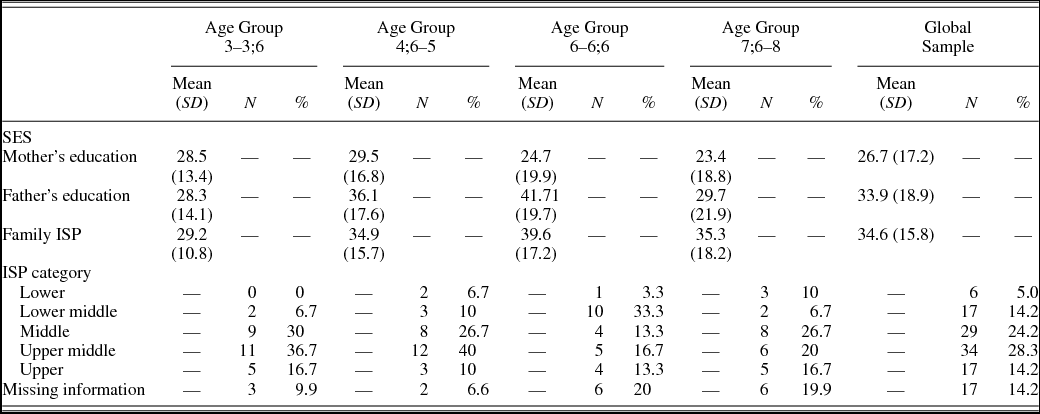
The children's SES was measured using a questionnaire filled out by their parents with information about family composition, parental educational level, and occupation. We derived the SES index from the Four Factor Index of Social Status (Hollingshead, Reference Hollingshead1975). Starting from the Hollingshead procedure and according to the current Italian social context, we updated the employment categories. We calculated the SES scores of the children's families by multiplying the scale values of both parents for occupation (range=1–7) and for education (range=1–7) by factor weights of 7 and 4, respectively. We then obtained the sum of these two products. If both parents were employed, we calculated the mean of their indexes; if just one of them was employed, we used that parent's index. Possible scores on this index ranged from 77 (lowest SES) to 11 (highest SES). The majority of the children were from upper middle class (28.3%) and middle class (24.2%) families, but some were also distributed across the other social classes (upper: 14.2%; lower middle: 14.2%; and lower: 5%; see Table 2). The parents gave their informed consent for their children to participate in our study.
Family composition and socioeconomic details of childrens’ sample

Note: Ages are in years;months. ISP, Index of Social Position.
Materials and procedure
We used the same experimental protocol concerning communicative failures administered in Bosco, Bono, et al. (Reference Bosco, Bono and Bara2012) and Bosco et al. (Reference Bosco, Bucciarelli and Bara2006) on a new experimental group of children. In addition (with respect to Bosco et al., Reference Bosco, Bucciarelli and Bara2006), in the present study we administered a set of ToM tasks. The protocol on communicative failure was composed of videotaped stories showing a communicative interaction. Each video (in Italian) lasted approximately 10–15 s. Twelve stories involved a failure (4 involved failure of the speaker's meaning, 4 involved failure of the expression act, and 4 involved failure of the communicative effect), and 4 stories involved successful communication (the control tasks).
The experimenter visited the schools before the study commenced, in order to become familiar to the children, and subsequently administered the experimental protocols to the children individually in a single session. Each session lasted about 40 min and was audiorecorded. The tasks concerning communicative failures were presented in two different random orders, A and B; each protocol contained identical items, but these were administered in a different sequence in order to rule out the possibility of the order of presentation affecting the children's performance. The participants in each group were balanced for age and gender and were assigned to order A or B of the protocol in a balanced way.
The experimenter showed each child the videotaped stories, one at a time, using a portable computer. At the end of each story, the experimenter asked the child the specific questions concerning the communicative interaction he had just observed. See Appendix A for a translation in English of part of the protocol and details about the recognition and repair tasks.
For each recognition and repair task, the children obtained a score of “0” when the answer was considered incorrect and “1” when the answer was considered correct (see Appendix B for examples of correct and incorrect answers). The interrater agreement between judges was evaluated on 30 randomly selected participants (20% of the total sample). Interrater agreement was very high (Cohen κ = 0.88; p<.001).
In addition, the following ToM tests were administered to the children: the Sally and Anne task, the modified Smarties task, the John and Mary and Maxi stories, and the picturing sequencing task. These tests were also balanced: they were presented to half of the participants before the presentation of the communicative failure protocol and to half of the participants after the presentation of the communicative failure tasks. Moreover, within this balanced administration of the items, the ToM tasks were presented in two different orders, that is, first-order ToM tasks followed by second-order ToM tasks in half of the cases and vice versa in the second half of the sample.
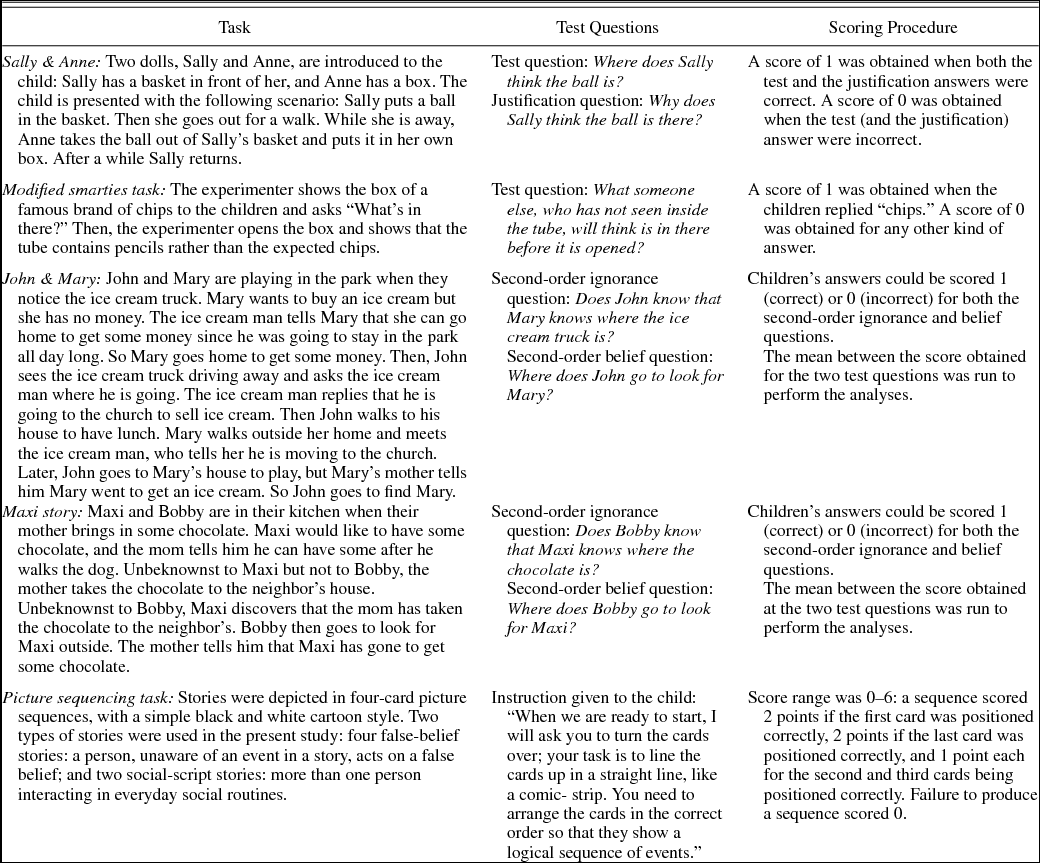
We included both first- and second-order false belief tasks in our experimental material because in the literature these are usually considered as classical tests for evaluating ToM ability (see Wellman & Liu, Reference Wellman and Liu2004). First- and second-order tasks are characterized by different levels of complexity and require different abilities, which follow children's cognitive development with age (see Perner et al., Reference Perner, Leekam and Wimmer1987; Perner & Winner, Reference Perner and Wimmer1985). Considering the age of our sample, we considered these tasks to be appropriate for investigating the development of ToM ability in the aforesaid age ranges. A detailed description of the structure of each task is provided in Table 3.
Description of the structure of each theory of mind task

Sally and Anne task
In this task (Baron-Cohen et al., Reference Baron-Cohen, Leslie and Frith1985), the children were asked to watch a scene acted with puppets and then answer a test question (“Where does Sally think the ball is?”) and a justification question (“Why does Sally think the ball is there?”). A score of 1 was obtained when both the test and the justification were correct.
Modified smarties task
This is a modified version of the original smarties task (Perner et al., Reference Perner, Leekam and Wimmer1987). We had to change the object of the task because we realized that many children do not know what smarties are anymore. In this version of the task, the experimenter shows the packet of a famous brand of potato chips.
John and Mary and Maxi stories
These stories (Sullivan et al., Reference Sullivan, Winner and Hopfield1995) are a modified version of those used in Perner and Wimmer (Reference Perner and Wimmer1985) and Wimmer and Perner (Reference Wimmer and Perner1983), respectively. They have an identical structure. Scenarios of the two stories are provided in Table 3. The test questions used were the “second-order ignorance question” (e.g., “Does Bobby know that Maxi knows where the chocolate is?”) and the “second-order belief question” (e.g., “Where does Bobby go to look for Maxi?”). Following Sullivan et al.’s procedure, during the administration of the two stories, the children were also asked “fact questions” (e.g., “What did the ice cream man tell Mary?”) and “first-order questions” (e.g., “Does Mary know where the ice-cream truck is now?”). These questions, together with the use of a background and stand-up cardboard character props, were used to help the children follow the story and to reduce the memory load needed. However, these questions were not taken into consideration in the scoring procedure. The children's answers could be scored 1 (correct) or 0 (incorrect) for both second-order ignorance and belief questions. The average value of the scores obtained on those questions, for each story, was then taken into account.
Picture sequencing task
We administered part of the original task (Langdon & Coltheart, Reference Langdon and Coltheart1999) consisting of six stories, including two social script and four false-belief sequences. The stories were depicted in sequences of four black-and-white cartoon picture cards; the sequences were presented after two practice runs, which were not considered in the scoring procedure but were used to familiarize the children with the procedure. The children were asked to arrange the cards in the correct order and tell the story. According to Langdon and Coltheart's instructions, the score range was 0–6; a sequence scored 2 points if the first card was in the correct position, 2 points if the last card was in the correct position, and 1 point each for the second and third cards being in the correct position. Failure to produce a sequence scored 0 (see Table 3).
In the analyses, we considered first-order and second-order ToM separately. Specifically, the first-order ToM value was obtained by calculating the mean of the scores on the Sally and Ann, smarties, and picture sequencing tasks. Likewise, the second-order ToM value was obtained by combining the mean of the scores obtained on the John and Mary and Maxi stories.
RESULTS
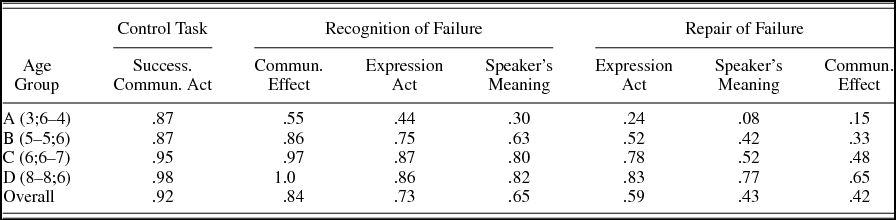
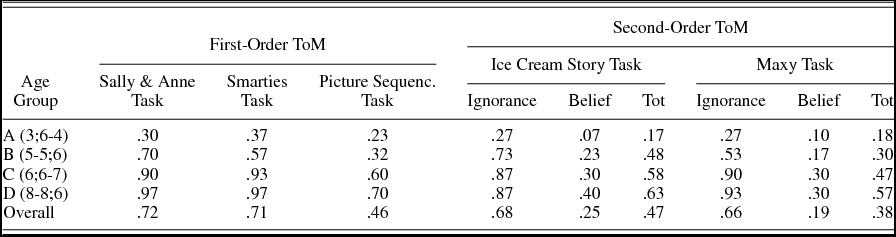
The scores obtained by each age group on the communicative failure recognition and repair tasks are summarized in Table 4 and those obtained on ToM tasks in Table 5.
Performance of each age group on the recognition and repair of communicative failures

Note: Ages are in years;months.
Performance of each age group on the theory of mind (ToM) tasks

Note: Ages are in years;months.
The distributions of the scores in the age groups were not normal according to the Kolmogorov–Smirnov (recognition overall: .001<p<.023; repair overall: p < .001) and Shapiro–Wilk tests (recognition overall: .001<p<.004; repair overall: p<.001). We thus conducted an arcsine transformation on the children's answers to each ToM task and each failure recognition/repair task (failure of expression act, failure of the speaker's meaning, and failure of the communicative effect). We were thus able to perform parametric analyses while satisfying the required assumptions.
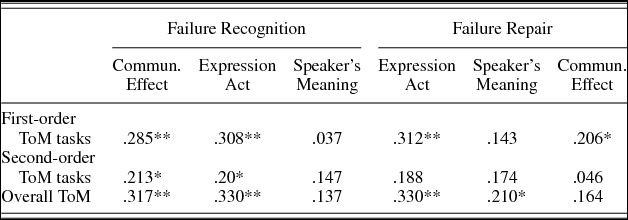
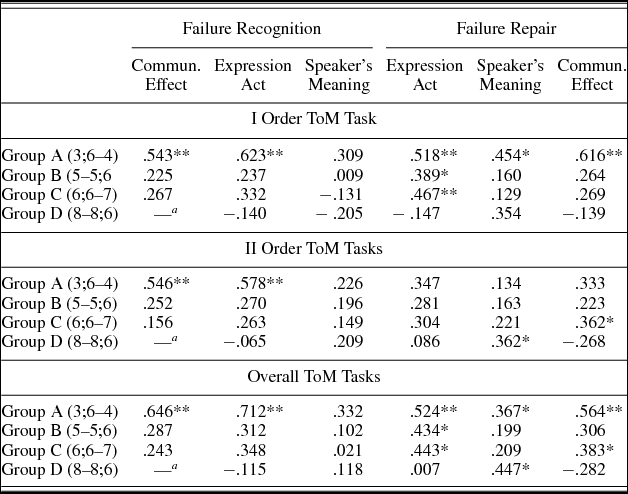
In order to investigate the existence of a correlation between performance on ToM tasks and failure recognition and repair tasks, we calculated partial correlation in the overall sample, controlling for age and SES index, between the ability to recognize and repair different kinds of communicative failures and ToM abilities, using the Pearson r correlation coefficient (see Table 6). Moreover, we calculated the correlation between failure and ToM tasks for each age group (see Table 7).
Partial correlation (Pearson r, controlling for age and socioeconomic status index) between theory of mind (ToM) tasks (first and second order) and recognition and repair of communicative failures in the overall group

*p<.05. **p<.01.
Correlation analysis (Pearson r) between theory of mind (ToM) tasks (first and second order) and recognition and repair of communicative failures in each age group

Note: Ages are in years;months.
a The analysis cannot be performed because of a ceiling effect.
*p<.05. **p<.01.
To investigate the children's performance in understanding successful communication acts and recognizing communicative failures, we conducted an analysis of variance (ANOVA) with one between-subject factor (type of age group, with four levels: Group A 3;6–4, Group B 5–5;6, Group C 6;6–7, and Group D 8–8;6) and one within-subject factor (type of communication task, with four levels: comprehension of successful acts, failure of communicative effect, failure of expression act, and failure of the speaker's meaning). In particular, we investigated whether recognizing a successful communication act is simpler than recognizing any kind of failure and whether children's ability to recognize communication acts increases with age. This analysis revealed an effect of the type of communication task, F (3, 348)=38.52, p<.001, η2=0.25. In addition, the analysis revealed an effect of the age group, F (1, 116)=29.59, p<.001, η2=0.43. We introduced a simple contrast, to compare the scores obtained on each type of communication act, revealing that successful communication acts are simpler than failure of communicative effect (F = 5.65, p = .019), as well as failure of expression act (F=33.85, p < .001) and failure of the speaker's meaning (F = 64.46, p < .001). A post hoc pairwise comparison revealed a significant difference in performance by the different age groups (.001<p<.04) with the exception of Group C (6;6–7) versus Group D (8–8;6), which achieved similar levels of performance (Bonferroni p=1). We found an interaction between age and type of task, F (3, 348)=3.75, p<.001, η2=0.088.
We performed separate ANOVA analyses to investigate the effect of the recognition of communicative failure task within each age group (type of recognition task, with three levels: failure of communicative effect, failure of expression act, and failure of the speaker's meaning). In all the age groups, an effect of the type of communicative failure was detected: Group A, F (3, 87)=9.84, p<.001, η2 = 0.25; Group B, F (3, 87)=9.33, p=.001, η2=0.24; Group C, F (3, 87) = 11.105, p < .001, η2=0.28; and Group D, F (3, 87)=13.91, p < .001, η2=0.32. We introduced linear contrasts for each analysis, which detected a linear trend in scores depending on the type of communicative failure in each age group: Group A (F=14.81, p = .001, η2=0.34), Group B (F=16.21, p<.001, η2=0.36), Group C (F=27.59, p < .001, η2=0.49), and Group D (F=21.08, p < .001, η2 = 0.42). According to our hypothesis, our data revealed the following trend, from the simplest to the most complex: recognition of failure of communicative effect, expression act, and speaker's meaning.
To investigate the increasing trend of difficulty exhibited by children in repairing failures of expression act, speaker's meaning, and communicative effect, and whether their ability to repair a communicative failure increases with age, we conducted an ANOVA with one between-subject factor (type of age group, with four levels: Group A 3;6–4, Group B 5–5;6, Group C 6;6–7, and Group D 8–8;6) and one within-subject factor (type of repair of failure, with three levels: repair of the expression act, repair of the speaker's meaning, and repair of the communicative effect). This analysis revealed a main effect of the type of repair of failure, F (2, 232)=20.24, p<.001, η2=0.15. In addition, the analysis revealed an effect of the age group, F (1, 116)=30.9, p<.001, η2=0.44. We introduced a linear contrast, which revealed a linear trend in scores depending on the type of repair task, F (1, 116)=29.16, p<.001, η2=0.20. In line with our hypothesis, there was an increasing trend of difficulty in repairing failures of expression act, which was the simplest, failure of speaker's meaning, and failure of communicative effect, which was the most complex. A post hoc pairwise comparison revealed that the groups performed significantly differently (.001<p<.037) with the exception of Group C versus Group D, which only approached significance (p=.06). We found no interaction between the two variables (age group and type of task), F (2, 232)=1.98, p=.07, η2=0.05.
In this case, we also performed separate ANOVA analyses to investigate the effect of the communicative failure task within each age group (type of repair task, with three levels: failure of expression act, failure of the speaker’s meaning, and failure of the communicative effect). In all the age groups, an effect of the type of communicative failure was detected: Group A, F (2, 58)=4.67, p=.013, η2=0.14; Group B, F (2, 58) = 7.13, p=.002, η2=0.20; Group C, F (2, 58)=11.12, p < .001, η2=0.28; and Group D, F (2, 58)=2.99, p = .05, η2=0.09. We introduced linear contrasts for each analysis, revealing a linear trend in scores depending on the type of communicative failure in the age groups: Group B (F=6.62, p = .01, η 2 =0.19), Group C (F=19.65, p < .001, η2=0.40), and Group D (F=7.96, p < .009, η2=0.21); the only exception was found for Group A (3;6–4; F=2.87, p=.10, η2=0.09).
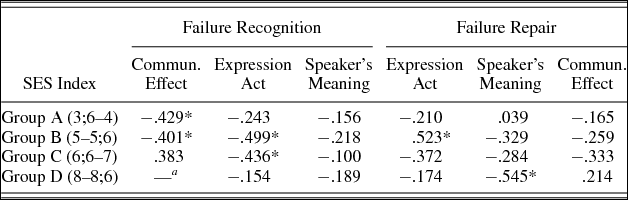
We also explored the influence of SES on all the abilities investigated, expecting it to have a moderate overall effect on children's performance. We used the Index of Social Position as the indicator of the children's family SES (see Table 8).
Correlation analysis (Pearson r) between socioeconomic status (SES) index and recognition and repair of communicative failures for each age group

Note: Ages are in years;months.
a The analysis cannot be performed because of a ceiling effect.
*p<.05.
Our results showed that SES was only partially related to the ability to recognize and repair communicative failures. In particular, SES correlated only with the ability to recognize a failure of the communicative effect in Groups A (3;6–4) and B (5–5;6) and with the ability to recognize a failure of the expression act in Groups B (5–5;6) and C (6;6–7). As regards the ability to repair communicative failures, SES only significantly correlated with the ability to repair a failure of the expression act in Group B (5–5;6) and with the ability to repair a failure of the speaker's meaning in Group D (8–8;6).
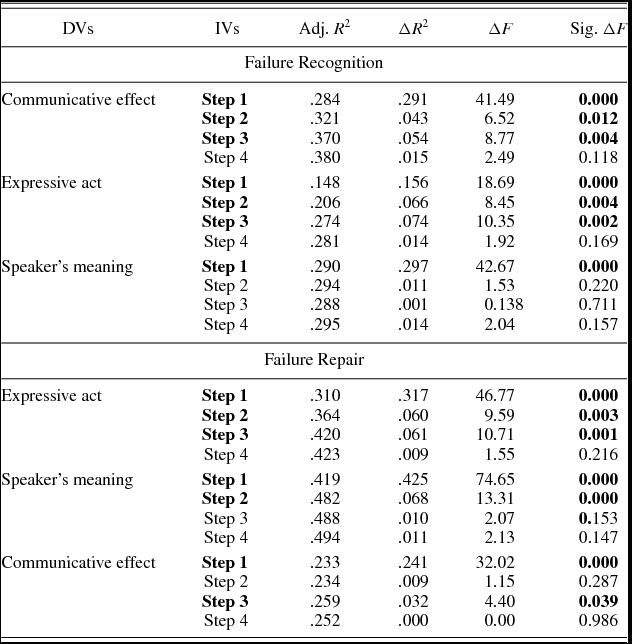
Finally, in order to investigate whether age, SES, or ToM were factors that might be able to explain the increasing trend of difficulty shown by children in recognizing and repairing a communicative failure, we conducted a series of regression analyses, using as the dependent variable the children's performance on each type of failure task and using as predictors age, SES, and ToM performance (see Table 9). In particular, we created a hierarchical model of multiple regression analysis, including as predictor variables age=Step 1, SES=Step 2, first-order ToM ability=Step 3, and second-order ToM ability=Step 4. Table 9 displays the adjusted regression coefficients (Adj. R 2) for each predictor variable, the change in R 2 after the addition of SES and first- and second-order ToM (ΔR 2), the change in F (ΔF), and its significance value (Sig. ΔF).
Regression analysis: Recognition and repair of communicative failures

Note: Step 1: age; Step 2: age and Index of Social Position (ISP) family; Step 3: age, ISP family, and theory of mind (ToM) first order; Step 4: age, ISP family, ToM first order, and ToM second order. DVs, Dependent variables; IVs, independent variables.
The regression analysis revealed that age (Step 1) was able to explain the results obtained by the children on the failure tasks, both for recognition and repair. We then, introduced Step 2 with another predictor, that is, SES index. The analysis showed that, in the majority of cases, with the exception of the most difficult tasks, that is, recognition of speaker's meaning and repair of communicative effect, SES significantly improved the prediction.
Similarly, adding children's performance on first-order ToM tasks as a regressor (Step 3) was able to significantly improve the prediction for recognition of the communicative effect and recognition of the expressive act, but not for the most difficult task to solve, that is, recognition of the speaker's meaning. Step 3 was able to improve the prediction for the repair of the expressive act and repair of the communicative effect, but not for the repair of the speaker's meaning. Finally, adding second-order ToM tasks (Step 4) was not able to improve the prediction for any of the failure tasks, considering both recognition and repair tasks.
The analyses revealed that within both the model comprehending first-order ToM (Step 3) and the model comprehending second-order ToM (Step 4), the R 2 did not increase in line with the trend of increasing difficulty exhibited by children in solving the tasks, both in recognizing and in repairing a communicative failure. The R 2 value indicates how much variance is explained by a certain variable. If ToM (both first and second order) was the factor that best explained the difference in difficulty between the tasks, we would expect the R 2 value to follow the trend of difficulty in the recognition and repair of communicative failures. However, this was not seen. A similar explanation also holds for age (Step 1) and SES (Step 2): the R 2 did not increase in line with the trend of increasing difficulty exhibited by children in solving the tasks, both in recognizing and in repairing a communicative failure.
DISCUSSION
This study empirically investigated the role that ToM, age, and SES play in the ability to recognize and repair a communicative failure. We predicted that ToM would be correlated with children's ability to recognize and repair communicative failures. We also proposed that the increasing complexity of the mental representations (i.e., the existence and the number of discrepancies and inconsistencies involved in a communicative failure), explains the increasing difficulty that children had in recognizing and repairing the different sorts of communicative failures we investigated (i.e., failure of the expression act, failure of the speaker's meaning, and failure of the communicative effect). Finally, we investigated whether ToM, age, or SES were able to explain the increasing trend of difficulty we detected.
We replicated the overall results of Bosco et al. (Reference Bosco, Bucciarelli and Bara2006), confirming that a successful act, involving neither discrepancies nor inconsistencies, is always easier to understand than each kind of failure recognition task. Focusing on the ability to both recognize and repair communicative failures, we found that, in line with our expectations, there was an effect of age on the children's performance such that their scores improved with age. However, we only detected an improvement in performance on all tasks up to 6;6. For the recognition of failure of communicative effect, the easiest recognition task to solve, we detected a “ceiling effect” in the oldest group (8 years). For the other tasks, a possible explanation for such lack of improvement is that during this developmental period, the gap between the two age groups is too small, and it is possible that testing older children, for example, aged 9–10 years, would reveal an improvement in performance.
Focusing on each age group, separate analyses confirmed our prediction of an increasing trend of difficulty in the recognition of a communicative failure; children in all the age groups found it easier to recognize failure of communicative effect, followed by failure of expression act and then failure of speaker's meaning.
Similarly, focusing separately on the performance of the different age groups in terms of their ability to repair the failure of a communication act, we observed, in line with our prediction, that children found it easier to repair the failure of the expression act than the failure of the speaker's meaning, followed by the repair of the communicative effect. This applied for all the age groups, with the exception of the youngest group of children (aged 3;6–4). In this case, their performance approached a “floor effect.” One possible explanation is that repairing a communicative failure is too difficult for children aged 3;6–4.
Focusing on the relation between ToM and the ability to recognize and repair each kind of failure and in order to have a “pure” measure, we conducted a correlation analysis controlling for the role of age and SES. This showed that, considered overall, ToM tasks correlated with recognition of communicative effect and expression act, but not with the recognition of the speaker's meaning, the most difficult task for children to recognize. Similarly, regarding repair abilities, ToM performance correlated with the repair of expression act and of the speaker's meaning but not with the repair of the communicative effect, again the most difficult task for children to solve. These data suggest that ToM could have only a partial role in explaining the increasing trend of difficulty we detected in recognizing and repairing a communicative failure, because it does not correlate with the tasks that the children found most difficult to recognize and repair. A correlation analysis revealed that first-order ToM correlated with a larger number of communicative failure tasks (i.e., with recognition of failure of communicative effect, failure of expression act, repair of failure of expression act, and repair of failure of communicative effect) than second-order ToM, which only correlated with the recognition of failure of the communicative effect and failure of the expression act.
In order to study the issue in more depth, we also investigated the correlation between these variables that is, first- and second-order ToM and the ability to recognize and repair each kind of failure, in each age group. Our data revealed that the correlations were only statistically significant in some cases. In particular, we found that first-order ToM correlated with the performance of the youngest group of children (3-year-olds) on all the recognition and repair tasks, with the exception of the recognition of failure of the speaker's meaning. By contrast, in the other age groups, the only significant results concerned the correlation between first-order ToM tasks and repair of failure of the expression act in the groups of 5- and 6-year-old children. For second-order ToM tasks, our results revealed a significant correlation with recognition of communicative effects and recognition of expression act in the youngest group of 3-year-old children. For the other age groups, significant correlations were only found between second-order ToM and repair of the communicative effect in the group of 6-year-old children and with the repair of the speaker's meaning in 8-year-old children. Taken as a whole, these data suggest that first-order ToM plays a role in explaining the development of children's ability to recognize and repair a communicative failure mainly in the 3;6–4 group, the developmental period in which children usually start to pass the first-order false belief task, which constituted our principal task for measuring ToM ability. Furthermore, no part of such pattern of correlations between ToM and pragmatic tasks explains the predicted trend of difficulty we detected. For example, first-order ToM does not systematically correlate with the easiest task to solve, and second-order ToM does not systematically correlate with the more difficult ones.
We also investigated the relationship between children's ability to recognize and repair communicative failures and their SES for each age group. The analysis revealed no significant correlation, with the exception of a few cases indicating that recognition and repair of a communicative failure are only partially affected by the SES indicator.
Finally, we performed a regression analysis in order to determine if the trends of difficulty in recognizing and repairing the different kinds of communicative failures could better be attributed to the children's ToM abilities, age, or SES than (as we proposed) to the complexity of the mental representations involved. In particular, we created a hierarchical model of multiple regression analysis, including as predictor variables age, SES, first-order ToM abilities, and second-order ToM abilities. The results revealed that age was a signficant predictor. After controlling for age, SES explained addition variance for performance on simple tasks, for both recognition and repair abilities, but not for the recognition of the speaker's meaning and the repair of the communicative effect. The addition of first-order ToM results explained additional variance for failure tasks, though not in all cases. First-order ToM was found to explain additional variance in children's performance on recognition of the communicative effect and the expressive act, but not for the most difficult task, that is, the recognition of the speaker's meaning. Similarly, including first-order ToM improved the model for repairing the expressive act and the communicative effect but not in repairing the speaker's meaning. Finally, the introduction of second-order ToM performance did not improve the predictive abilities of the model on any failure tasks, including both recognition and repair.
We futher examined the changes in the amount of variance explained for each failure task. If ToM were the principal factor in explaining the children's increasing difficulty in recognizing the different tasks we analyzed, when first- and second-order ToM were introduced (i.e., Steps 3 and 4), we would expect to see an increase in the amount of variance explained (i.e., R 2) that corresponded to the difficulty of the task. However, when first-order and second-order ToM results were added, the amount of variance explained did not increase in line with the trend of increasing difficulty experienced by the children in recognizing communicative failures. In both instances, the higher R 2 value corresponded to the relationship between ToM and recognition of the failure of the communicative effect, which is the simplest kind of task to solve, whereas the lower R 2 value corresponded to the relationship between ToM and recognition of the failure of the expression act, which is not the most difficult type of failure to recognize. A similar explanation also holds for age and SES; when these variables were entered, the R 2 did not increase in line with the trend of increasing difficulty exhibited by children in recognizing a communicative failure.
We found a similar pattern of results for the repair of a communicative failure. If ToM were the main factor in explaining the children's increasing difficulty in repairing the different tasks, when first-order (Step 3) and second-order (Step 4) ToM scores were entered, we would expect to see an increase in the R 2 value, in line with the observed trend. However, the higher R 2 value corresponded to the relationship between both first- and second-order ToM and the repair of the failure of the speaker's meaning, which is not the most difficult kind of repair task, whereas the lower R 2 value corresponded to the relation between both first- and second-order ToM and the repair of the failure of the communicative effect, which is the most difficult repair task. Again, a similar explanation also holds for age (Step 1) and SES (Step 2): the R 2 did not increase in line with the trend of increasing difficulty exhibited by children in repairing a communicative failure. Considered as a whole, these results suggest that age, ToM (first and second order), and SES do not appear to be the best predictors of the trend of difficulty in recognizing and repairing a communicative failure that we observed.
The results of the present study are in line with those reported previously in the literature showing that children's ability to manage communicative failures increases with age (e.g., Garvey, Reference Garvey1984; Marcos, Reference Marcos1991). The results of the present study are also partially in line with previous research (Bosco, Bono, et al., Reference Bosco, Bono and Bara2012) using the same experimental protocol concerning communicative failures that we administered in this study. The earlier study showed that in patients with schizophrenia, there is a correlation between (a deficit in) ToM, as measured by false belief tasks (Baron-Cohen et al., Reference Baron-Cohen, Leslie and Frith1985) and strange stories tasks (Happè, Reference Happé1994), and the difficulty in recognition and repair of a communicative failure. However, in the aforesaid study by Bosco, Bono, et al. (Reference Bosco, Bono and Bara2012), ToM was not able to explain the increasing trend of difficulty in recognizing and repairing a communicative failure experienced by the patients. The convergence of the results of these two studies supports the validity of our theoretical model for explaining both the development and the effect of an impairment, schizophrenia, on the ability to handle a communicative failure.
It could be suggested that our results contrast with those of a study of Bernard and Deleau (Reference Bernard and Deleau2007), showing that, in children of 3 and 4 years of age, conversational perspective taking ability predicts the performance on false belief attribution tasks. However, the studies have different objectives and, as a consequence, employ different experimental tasks. The experimental task used by Bernard and Deleau requires the child to understand who, among several possible speakers in a picture story, is saying a specific utterance. By contrast, our experimental tasks require the child to understand (or produce) the (pragmatic) communicative meaning of a communicative act (i.e., the child sees a person spoiling something and another person commenting “Well done,” and has to understand that the communicative intent of the utterance is to be ironic/to say something funny). The experiment of Bernard and Deleau (Reference Bernard and Deleau2007) investigated conversational perspective taking, while our study investigated communicative pragmatic ability. Thus, the results of the two studies are not directly comparable.
A number of limitations of this study should be acknowledged. The present investigation focuses on a specific measure of ToM: the false belief task. Future research could consider other aspects of ToM, such as the comprehension of intention. In addition, it would be interesting to investigate younger children in order to examine the simplest ToM components, such as perspective taking, in responding to communicative failures. Finally, further studies should include measures of language ability in order to control for this factor as well.
To summarize, notwithstanding its limitations, the novelty of the present study lies in the fact that it empirically investigates the role of ToM in children's ability to recognize and repair a communicative failure, showing that children's ToM plays a partial role in such ability. In particular, after controlling for age and SES, ToM correlated with the ability to recognize and repair failures in the easier tasks. In addition, analyses showed that ToM only has a significant role in explaining the ability to recognize and repair different kinds of communicative failures in the youngest group of children, aged 3;6–4. Furthermore, we found no empirical evidence to suggest that ToM, SES, or age are the factors that explain the trend of increasing difficulty shown by children in recognizing and repairing the different communicative failures investigated. By contrast, the increasing complexity of the mental representations involved provides a more convincing theoretical explanation for their different performance on the various failure tasks investigated (see also Bosco et al., Reference Bosco, Bucciarelli and Bara2006). This explanation is in line with previous studies investigating pragmatic ability in children (Bara, Bosco, & Bucciarelli, Reference Bara, Bosco and Bucciarelli1999; Bosco & Bucciarelli, Reference Bosco and Bucciarelli2008; Bosco, Bucciarelli, & Bara, Reference Bosco, Bucciarelli and Bara2004; Bosco, Vallana, et al., Reference Bosco, Vallana and Bucciarelli2009, Reference Bosco, Vallana and Bucciarelli2012; Bosco et al., Reference Bosco, Angeleri, Colle, Sacco and Bara2013), showing that the complexity of the mental representations necessary to solve a communicative pragmatic task is an important cognitive factor in accounting for children's communicative performance.
APPENDIX A
EXPERIMENTAL PROTOCOL
Here we provide an example of each kind of failure investigated, an example of a control task, and the questions that the experimenter posed to the subjects.
COMMUNICATIVE FAILURES
Failure of the expression act
-
1. Anna is close to Barbara and says:
Anna: “I'm so hungry. . .”
Anna turns round and washes her hands. While Anna is washing her hands, Barbara opens a cupboard, takes out a sandwich, and offers it to her friend, saying,
Barbara: “Anna, do you want a sandwich?”
Anna has her back turned to Barbara, the water is making a lot of noise, and Anna has not heard what Barbara said. Anna finishes washing her hands and as she turns off the faucet, she says:
Anna: “Did you say something?”
Failure of the speaker's meaning
-
2. There are a lot of books on the floor along with an empty bookcase. Luciano is putting the books in the bookcase and says:
Luciano: “Mario is coming, I'll ask him to help me put the books in the bookcase.”
Mario comes in.
Luciano: “Hi Mario, are you busy at the moment?”
Mario: “No, I'm free, we could go have an ice cream!”
Failure of the communicative effect
-
3. Mother and daughter.
Daughter: “Mom, please, will you buy me a doll?”
Mother: “No, you have lots of dolls.”
Daughter: “Mom, I promise this will be the last time I ask you for one.”
Mother: “I said no, there's no point in asking me again!”
Questions
At the end of each videotaped interaction, the experimenter asks the child:
C1: “In your opinion, has [name of partner] understood/doneFootnote 4 what [name of speaker] asked (for/to do) or not?”
If the child recognizes the failure, the experimenter asks:
RI: “What might [name of speaker] say or do now to obtain what she/he wants?”
If the subject DOES NOT RECOGNIZE the communicative failure the experimenter asks:
R2:“What might [name of speaker] say or do now?”
SUCCESSFUL COMMUNICATION
Control tasks
-
4. Elisa and Giovanni are in a room and the window is open:
Elisa: “It's very cold in here, please do something about it!”
Giovanni: “Yes, Elisa, I'll close the window”
Giovanni closes the window.
Control questions
C1: “In your opinion, has [name of partner] understood what [name of speaker] asked (for) or not?”
If the subject answers yes, the experimenter asks:
RI: “What might [name of speaker] say or do now?”
If the subject answers no, the experimenter asks:
R2: “Why didn't [name of partner] understand what [name of speaker] asked (for)?”
APPENDIX B
EXAMPLES OF CORRECT AND INCORRECT ANSWERS
Recognition
Answer to question C1 for all failure tasks:
Correct answer: No
Incorrect answer: Yes
Repair
Answer to question R1 and R2.
Failure of the expression act
Correct answers: “She can say it again” or “She could repeat it louder”
Incorrect answers: “She can offer something else, maybe a glass of water,” “I don't know,” or “Say please.”
Failure of the speaker's meaning
Correct answers: “He should say he needs help” or “He can say, ‘Maybe later but now, please, help me.’”
Incorrect answers: “He should go closer” or “I don't know”
Failure of the communicative effect
Correct answers: “She can promise her mom that she will help her with some chores in return.”
Incorrect answers: “She can repeat what she said,” “She can say please,” or “I don't know.”
Control tasks
Correct answers: “Yes, he was kind and he closed the window.”
Incorrect answers: “No, he didn't understand.”
ACKNOWLEDGMENTS
The project was founded by the University of Turin ex-60% project, ”La riabilitazione delle abilità comunicativo pragmatiche in soggetti con trauma cranico.”