UUID: http://zoobank.org/e7fbba20-ee49-46de-b99a-6d8ee8cbc5b1
1. Introduction
The Ediacaran biota traditionally was interpreted as macroscopic soft-bodied organisms preserved as moulds and casts in sedimentary rock (Waggoner, Reference Waggoner2003; Fedonkin et al. Reference Fedonkin, Gehling, Grey, Narbonne and Vickers-Rich2007; Grazhdankin, Reference Grazhdankin2014). Despite the fact that some representatives of this biota may have had various relatively ‘hard’ and elastic bodies, there was no strong evidence for the presence of skeletal macroscopic organisms in Ediacaran time. Nevertheless, it is recognized that doubtless tubular eumetazoans with biologically controlled mineralization appeared for the first time at the end of the Ediacaran Period prior to the ‘Cambrian explosion’ of biodiversity (Zhuravlev & Riding, Reference Zhuravlev and Riding2000; Zhuravlev & Wood 2008). Furthermore, it has recently been demonstrated that the Ediacaran group Palaeopascichnida had an agglutinated skeleton (Kolesnikov et al. Reference Kolesnikov, Rogov, Bykova, Danelian, Clausen, Maslov and Grazhdankin2018 a, b).
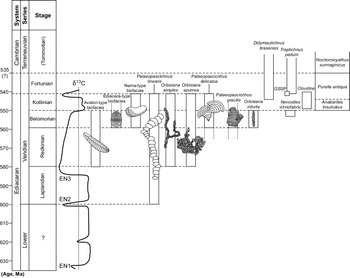
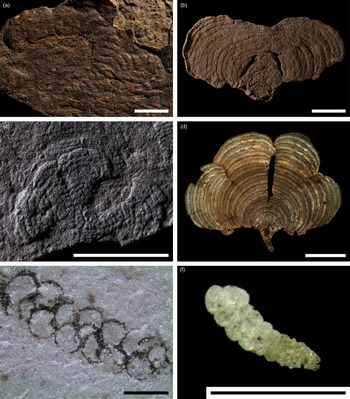
Palaeopascichnida represents a problematic group of macroscopic fossils, which are globally distributed and can be numerically abundant in Ediacaran sequences (Fig. 1). They occur across the entire East European Platform (Finnmark, SE slope of the Baltic Shield, SE White Sea area, Moscow and Mezen basins, Central and South Urals, Podolia), as well as in South China, Avalonia (Newfoundland; Wales), Australia (Adelaide Rift Complex) and Siberia (Olenek Uplift, Uchur-Maya region) (Glaessner, Reference Glaessner1969; Palij, Reference Palij, Keller and Rozanov1976; Fedonkin, Reference Fedonkin1981, Reference Fedonkin, Sokolov and Iwanowski1985; Cope, Reference Cope1982; Narbonne et al. Reference Narbonne, Myrow, Landing and Anderson1987; Becker & Kishka, Reference Becker, Kishka, Bogdanova and Khozatsky1989; Haines, Reference Haines2000; Grazhdankin et al. Reference Grazhdankin, Balthasar, Nagovitsin and Kochnev2008; Becker, Reference Becker2010, Reference Becker2013; Yuan et al. Reference Yuan, Chen, Xiao, Zhou and Hua2011; Högström et al. Reference Högström, Jensen, Palacios and Ebbestad2013; Grazhdankin, Reference Grazhdankin2014; Kolesnikov et al. Reference Kolesnikov, Marusin, Nagovitsin, Maslov and Grazhdankin2015; Nagovitsin et al. Reference Nagovitsin, Rogov, Marusin, Karlova, Kolesnikov, Bykova and Grazhdankin2015; McIlroy & Brasier, Reference McIlroy, Brasier, Brasier, McIlroy and McLoughlin2016; Ivantsov, Reference Ivantsov2017, Reference Ivantsov2018; Jensen et al. Reference Jensen, Högström, Høyberget, Meinhold, McIlroy, Ebbestad, Taylor, Agic and Palacios2018; Kolesnikov et al. Reference Kolesnikov, Rogov, Bykova, Danelian, Clausen, Maslov and Grazhdankin2018 a, b; Hawco et al. Reference Hawco, Kenchigton and McIlroy2019; Kolesnikov, Reference Kolesnikov2019; Desiatkin et al. 2021). The term ‘Palaeopascichnida’ comes from the genus name Palaeopascichnus Palij, which initially was described from the Ediacaran deposits cropping out in Podolia, Ukraine (Palij, Reference Palij, Keller and Rozanov1976). This taxon has previously been interpreted as trace fossils (Glaessner, Reference Glaessner1969; Palij, Reference Palij, Keller and Rozanov1976; Palij et al. Reference Palij, Posti, Fedonkin, Keller and Rozanov1979; Fedonkin, Reference Fedonkin1981; Becker, Reference Becker2010, Reference Becker2013; Parcha & Pandey, Reference Parcha and Pandey2011), macrophytes (Haines, Reference Haines2000), stratiform stromatolites (Runnegar, Reference Runnegar1995) or rhizarians of foraminiferal affinity (Seilacher et al. Reference Seilacher, Grazhdankin and Legouta2003, Reference Seilacher, Buatois and Mangano2005; Antcliffe et al. Reference Antcliffe, Gooday and Brasier2011; Seilacher & Mrinjek, Reference Seilacher and Mrinjek2011). Indeed, if we look at the exterior shape of fossils, a vague similarity can be seen between palaeopascichnids (Fig. 2a, c, e) and recent xenophyophore Stannophyllum zonarium (Fig. 2b), macrophyte Padina pavonica (Fig. 2d) and foraminifera Morulaeplecta bulbosa (Fig. 2f). Gehling & Droser (Reference Gehling and Droser2009) proposed an alternative interpretation and regarded Palaeopascichnida as encrusting benthic organisms, comparing it to other so-called ‘textured organic surfaces’. Recently, it has been demonstrated that Palaeopascichnus linearis represents the oldest known macroscopic organism with an agglutinated test, which has close affinity with modern xenophyophore organisms such as Aschemonella monile or Psammina zonaria (Kolesnikov et al. Reference Kolesnikov, Rogov, Bykova, Danelian, Clausen, Maslov and Grazhdankin2018 a). Crucially, the understanding of palaeopascichnid morphology has advanced significantly since Hawco et al. (Reference Hawco, Kenchigton and McIlroy2019) proposed the combination of a morphometric and multivariate statistical approach using principal component analysis (PCA), which made it possible to recognize natural groups within the dataset of well-preserved fossil material from Newfoundland. For the moment, Palaeopascichnida includes several taxa and morphotypes, such as Palaeopascichnus delicatus, P. linearis, P. gracilis (new combination for Yelovichnus gracilis Fedonkin), Orbisiana simplex and foam- and spiral-like orbisianamorph multichambered structures (Kolesnikov, Reference Kolesnikov2019), that are in need of revision and systematic description.
Chronostratigraphic distribution of palaeopascichnids in the Ediacaran and the room for the ‘Vendian Series’ in the Standard Global Chronostratigraphic Chart (modified after Grazhdankin & Maslov, Reference Grazhdankin and Maslov2015).

Exterior similarity between fossil palaeopascichnids and recent organisms: (a) Palaeopascichnus delicatus, specimen M246/7014 (UGM, Yekaterinburg), Basa Formation, Asha Group, South Urals, Russia; (b) multichambered xenophyophore Stannophyllum zonarium (NHM, Copenhagen), from seamount in the central West Pacific; (c) P. delicatus, specimen 4716/9110 (PIN RAS, Moscow), Verkhovka Formation, Valdai Group, Onega Peninsula, White Sea area, Russia; (d) brown algae Padina pavonica, littoral zone in the central East Pacific; (e) Orbisiana simplex, Shotkusa-1 borehole (IPGG, St Petersburg), depth 225.7–218.5 m, Staraya Russa Formation, Redkino Group, Ladoga Basin, Russia; (f) benthic foraminifera Morulaeplecta bulbosa, North Sea area, midway between Denmark, Norway and Sweden (from Alve & Goldstein, Reference Alve and Goldstein2010). Scale bars = 1 mm (black) and 10 mm (white).

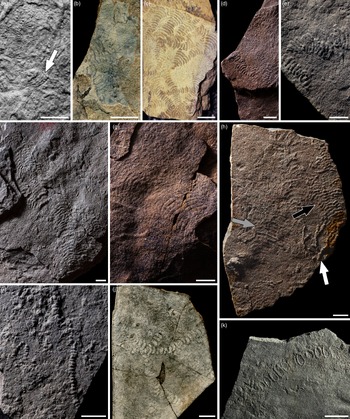
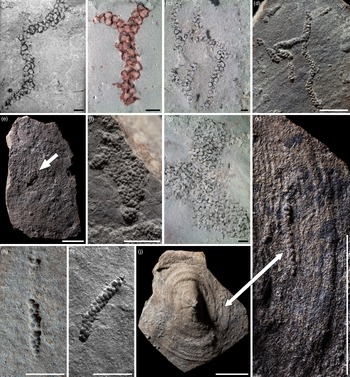
In this study we present a quantitative morphometric analysis of palaeopascichnid fossils from all known localities worldwide following the PCA method proposed by Hawco et al. (Reference Hawco, Kenchigton and McIlroy2019). On the one hand, we have simplified the parameter set (see Section 2); on the other hand the dataset has been expanded to comprise more than 1200 specimens of Palaeopascichnida, and sedimentary environments data have been added. The morphometric parameters and the fossil distribution are then tested with multivariate statistical approaches that allow us to discriminate species in genus Palaeopascichnus, and demonstrate palaeoenvironmental distribution and taxonomic diversification of both genera Palaeopascichnus (Fig. 3) and Orbisiana (Fig. 4). We also provide a revision of Palaeopascichnus and Orbisiana with description of new species.
Examples of morphological diversity in Palaeopascichnus: (a) P. delicatus, holotype (white arrow), specimen 1907/07 (NMNH NASU, Kiev), Komarovo beds, Kanilovka Group, Middle Dniester area, Ukraine (from Ivantsov et al. Reference Ivantsov, Gritsenko, Paliy, Velikanov, Konstantinenko, Menasova, Fedonkin, Zakrevskaya and Serezhnikova2015); (b) P. delicatus (IPGG SB RAS, Novosibirsk), Pilipovo beds, Kanilovka Group, Middle Dniester area, Ukraine; (c) P. delicatus, specimen P36855 (SAM, Adelaide), Wonoka Formation, Adelaide Basin, South Australia; (d) P. delicatus, specimen CU20/1-24 (GIN RAS, Moscow), Chernyi Kamen Formation, Sylvitsa Group, Kosva River area, Central Urals, Russia; (e) P. delicatus, Khatyspyt Formation, Khorbusuonka Group, Olenek Uplift of Northeast Siberia, Russia; (f) P. gracilis comb. nov., holotype, specimen 3993/1309 (PIN RAS, Moscow), Verkhovka Formation, Valdai Group, Winter Coast of the White Sea area, Russia; (g) P. gracilis comb. nov., specimen CU20/2-4 (GIN RAS, Moscow), occurrence as in (d); (h) P. delicatus (grey arrow), P. gracilis (black arrow) and P. linearis (white arrow) preserved on the same bedding plane, as in (f); (i) P. linearis, specimen 3392/3153 (PIN RAS, Moscow), Verkhovka Formation, Valdai Group, Syuzma River, Onega Peninsula, White Sea area; (j) P. linearis, occurrence as in (e); (k) P. linearis, specimen CSGM WC/2018-3 (IPGG SB RAS, Novosibirsk), occurrence as in (f). Scale bars = 10 mm.

Fossils of genus Orbisiana: (a) O. simplex, holotype, specimen CSGM 2076-001 (IPGG SB RAS, Novosibirsk), Soligalich-7 borehole, depth 2060–2025 m, Nelidovo beds, Gavrilov Yam Formation, Redkino Group, Moscow Basin, Russia; (b, c) O. simplex, Shotkusa-1 borehole (IPGG RAS, St Petersburg), depth 225.7–218.5 m, Staraya Russa Formation, Redkino Group, Ladoga Basin, Russia; (d) O. simplex, specimen CSGM 2079-80 (IPGG SB RAS, Novosibirsk), Verkhovka Formation, Valdai Group, Syuzma River, Onega Peninsula, White Sea area; (e) O. spumea sp. nov. (white arrow), specimen 4853/1586 (PIN RAS, Moscow), and scratch marks of Kimberella sp. on the same bedding plane, Verkhovka Formation, Valdai Group, Winter Coast of the White Sea area, Russia; (f) O. spumea sp. nov., holotype, specimen CSGM 2079-80 (IPGG SB RAS, Novosibirsk), occurrence as in (d); (g) pyritized O. spumea sp. nov., occurrence as in (b); (h) O. intorta sp. nov., holotype, specimen CSGM 2079-29 (IPGG SB RAS, Novosibirsk), occurrence as in (d); (i) O. intorta sp. nov., occurrence as in (e); (j, k) O. intorta, sp. nov. (white arrow) preserved on erosional surface of concentric scratch circles (swing marks), occurrence as in (D). Scale bars = 1 mm (black) and 10 mm (white).

2. Material and methods
This study is based on our examination of fossil material from the East European and Siberian platforms (881 specimens) and published photographic documentation from other areas (340 specimens), resulting in a dataset of 1221 specimens of Palaeopascichnida worldwide. Personally observed specimens of palaeopascichnid fossils were collected from outcrops and closely localized float of the Khatyspyt Formation in the Olenek Uplift of NE Siberia, Studenitsa and Mogilev formations of the Transdniester Podolia of Ukraine, Verkhovka and Lyamtsa formations of the SE White Sea area, Perevalok and Chernyi Kamen formations of the Central Urals and Basa Formation of the South Urals. An additional material of 84 specimens of Palaeopascichnida comes from the drill-hole cores of the Shotkusa-1, Dorogobuzh, Kepina-775, Soligalich-7 and Kotlas boreholes from northwest, north and northeast areas of the East European Platform. Other specimens of palaeopascichnid-like fossils were incorporated into our dataset using published photographs from Newfoundland (Narbonne et al. Reference Narbonne, Myrow, Landing and Anderson1987; Gehling et al. Reference Gehling, Narbonne and Anderson2000; Liu & McIlroy Reference Liu, McIlroy and McIlroy2015; Hawco et al. Reference Hawco, Kenchigton and McIlroy2019), Wales (Cope, Reference Cope1982; Liu & McIlroy, Reference Liu, McIlroy and McIlroy2015), Norway (McIlroy & Brasier, Reference McIlroy, Brasier, Brasier, McIlroy and McLoughlin2016; Jensen et al. Reference Jensen, Högström, Høyberget, Meinhold, McIlroy, Ebbestad, Taylor, Agic and Palacios2018), the Transdniester Podolia of Ukraine (Palij, Reference Palij, Keller and Rozanov1976; Palij et al. Reference Palij, Posti, Fedonkin, Keller and Rozanov1979; Fedonkin, Reference Fedonkin, Velikanov, Aseeva and Fedonkin1983, Reference Fedonkin, Sokolov and Iwanowski1985, Reference Fedonkin, Sokolov and Iwanowski1990; Martyshin, Reference Martyshin2012), the Arkhangelsk region of Russia (Chistyakov et al. Reference Chistyakov, Kalmykova, Nesov and Suslov1984), the Uchur-Maya Basin of Eastern Siberia (Ivantsov, Reference Ivantsov2017), Australia (Glaessner, Reference Glaessner1969; Jenkins, Reference Jenkins1995; Haines, Reference Haines2000; Gehling et al. Reference Gehling, Droser, Jensen, Runnegar and Briggs2005; Gehling & Droser, Reference Gehling and Droser2009), South China (Wan et al. Reference Wan, Xiao, Yuan, Chen, Pang and Tang2014) and India (Parcha & Pandey, Reference Parcha and Pandey2011).
The studied specimens are well preserved, with clear edges in various sedimentary rocks as epi- and hypo-relief fossils. The specimens are characterized by differences in shape and size of chambers and in the degree of growth, elongation and expansion along the series or aggregate clusters. In order to develop the quantitative and statistical discrimination of morphospecies within the genus Palaeopascichnus we follow the PCA method that has recently been tested on similar fossil material from Newfoundland (Hawco et al. Reference Hawco, Kenchigton and McIlroy2019). Compared to that study, measures are limited to chamber width and minimum and maximum chamber length (Fig. 5). On the one hand, this allowed us to simplify and speed up the measuring process, but on the other hand, we have expanded statistical analysis to all known fossil localities. From the direct measurements other morphological parameters were calculated, such as minimum/maximum length to minimum/maximum width ratios. These parametric ratios were chosen because they focus on chamber shape and its morphological variability within the Palaeopascichnus. Assuming that branched Palaeopascichnus was probably a single, continuous structure (Hawco et al. Reference Hawco, Kenchigton and McIlroy2019), we also consider branching specimens as single organisms. Orbisiana is generally a palaeopascichnid organism, but differs dramatically in the number of chambers, and the constant globular shape of chambers, forming multiserial regular or biserial spiral-like structures and foam-like irregular aggregates (Kolesnikov et al. Reference Kolesnikov, Liu, Danelian and Grazhdankin2018 b; Kolesnikov, Reference Kolesnikov2019). For the multivariate statistical analysis we have included Palaeopascichnus-like organisms only, which are characterized by a single, occasionally branching, series of chambers. In the interest of a pilot study abundance, density, similarity and difference in ecological and taxonomic diversification of both genera, the dataset has been expanded by adding sedimentary environments data from personal observations and publications. Thus, the dataset includes information on 1034 specimens of Palaeopascichnus and 187 of Orbisiana.
Schematic representations of Palaeopascichnus: (a) organism has chambers arranged in series, with narrow width of chambers and shape being little variable; (b) specimen showing chambers arranged in series, with chamber shape being highly variable from globular to highly elongated throughout the series; (c) organism has chambers arranged in series, with highly elongated chambers, but chamber shape showing little variation.

The studied material (Figs 2–4) was imaged using a Canon EOS 6D Mark II digital single-lens reflex camera with a Canon EF 100 mm f/2.8 Macro IS USM lens mounted on a Canon Extension Tube (EF 25 II); Fujifilm GFX 50r digital mirrorless medium format camera with a Fujinon GF 120 mm f/4.0 R LM OIS Macro lens mounted on a Fujifilm Macro Extension Tube (MCEX-45G WR); and Epson Perfection V600 Photo digital scanner. All analyses were run using the programming language R, version 4.0.3 (R Core Team 2020), and integrated development environment RStudio, version 1.4.1103 (RStudio, PBC 2021). PCA is used in this study on morphological parameters, with the goal of reducing dimensionality in a multivariate dataset. The principal components are linear combinations of the variables, and which compose for the predominance of variation in the specimens (Dillon & Goldstein, Reference Dillon and Goldstein1984). For the purpose of identifying which of the parameters control the coordinates of the PCA space, here we used the ‘FactoMineR’ package for the RStudio (F Husson et al., unpub. technical report, 2010) that allowed us to explore the degree to which each parameter has contributed to the construction of each numerical dimension (by using the dimdesc output). Hawco et al. (Reference Hawco, Kenchigton and McIlroy2019) carried out the PCA on various iterations for two parameter sets used singularly and together (i.e. shape parameters only; size parameters only; and both shape and size). As a result, they have demonstrated that the studied Palaeopascichnus specimens split into three statistically identified clusters and represent different morphotypes independently on chosen parametric iterations. In our study, several iterations were carried out for the two parameter sets used singularly and combined (such as width ratio only; chamber elongation ratio; and both width and chamber elongation ratios). This allowed us to better understand which of the measured morphological features has the most impact on the clustering of specimens in the dataset.
To determine natural groups (morphotypes or morphospecies) within the dataset of 1034 specimens of Palaeopascichnus we performed hierarchical clustering on principal components (HCPC) on the PCA results. This is recognized to be one of the best and easiest methods for determining natural groupings (Dillon & Goldstein, Reference Dillon and Goldstein1984). The number of clusters in our dataset is defined through inertia gain analysis being a variation measure of the within-group variance plotted as a histogram of variance versus number of clusters (Fig. 6). The biggest jumps in inertia gain are taken as nodes at which it is possible to divide the obtained dendrogram into clusters (F Husson et al., unpub. technical report, 2010 Hawco et al. Reference Hawco, Kenchigton and McIlroy2019). This results in an updated dataset as separate clusters containing all previously measured morphological parameters and sedimentary environments data.
Results of principal component analysis (PCA) and hierarchical clustering on principal components (HCPC) tests on the global dataset of Palaeopascichnus specimens (a), including all individuals for which shape and length/width parameters could be determined (number of specimens = 1034); (b) specimens from the Upper Vendian Khatyspyt Formation, Khorbusuonka Group, Olenek Uplift of Siberia (number of specimens = 356); (c), specimens from the Upper Vendian Chernyi Kamen Formation, Sylvitsa Group, Central Urals, Russia, observed on one bedding plane, c. 1.5 m2 (number of specimens = 96); and (d) specimens from the Ediacaran Fermeuse Formation, St John’s Group, Newfoundland (number of specimens = 108). All PCA plots display three separate clusters as different morphotaxa. Inertia gain supports division into three clusters. HCPC plot shows hierarchical separation of the measured specimens into three clusters.

As the only characters we used in PCA are parametric ratios, it can be surmised that these are susceptible to overprinting by tectonic strain. While specimens from a locality with minimal tectonic overprint and deformation can be assumed to have been very little altered from their original shapes, it is clear that the same cannot be assumed when comparing specimens of palaeopascichnids from terranes with very different diagenetic and metamorphic history and, in most cases, it may not be possible to retrodeform specimens studied only from published photographs. However, in this study most specimens of Palaeopascichnus were examined from original fossil material, where the large majority of palaeopascichnid specimens are preserved in fine-grained sedimentary rock without any visible tectonic deformation or metamorphic changes. In order to check this, we have done PCA tests for the entire dataset and separately for different fossil localities in the Central Urals, the Olenek Uplift of Siberia and Newfoundland.
An important statistical tool in modern ecology is the regression analysis provided by generalized linear models (GLMs) and generalized additive models (GAMs) (Guisan et al. Reference Guisan, Edwards and Hastie2002). In defining the ecological diversification of extinct Palaeopascichnida, statistical models are no exception and are one of the essential tools in the field of Ediacaran palaeoecology. GLMs are a mathematical extension of linear models that do not force numeric data into an unnatural scale, and thus allow for non-linearity and non-constant variance structure in the dataset, whereas GAMs are a semi-parametric extension of GLMs, where the mathematical functions are additive and the components are smooth (Hastie & Tibshirani, Reference Hastie and Tibshirani1986). In addition, both linear and nonlinear models may be constructed by the sum of smooth functions of predictor variables (parameters), in which it is common to use polynomial intervals also known as ‘splines’ (Wood, Reference Wood2006). These have often been used to explore the relationship and interactions between environmental variables (i.e. sedimentary environments or depositional settings) and the presence of a species given isolated or worldwide localities (Murase et al. Reference Murase, Nagashima, Yonezaki, Matsukura and Kitakado2009). Thus, using both GAMs and GLMs enables the best representation of the dataset to be identified and selected.
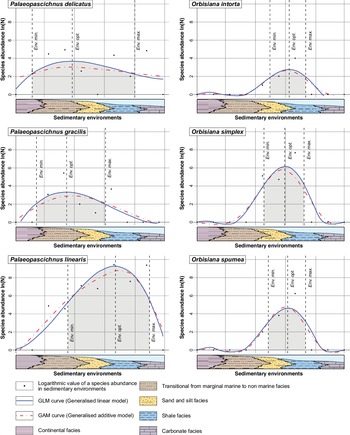
In this study, the effectiveness of linear and nonlinear generalized models to identify the effect of sedimentary environment variables on the abundance of the six species of the Palaeopascichnida (1221 specimens) from different fossil localities worldwide was examined (Fig. 7). Sedimentary environment data were involved in our dataset as the numeric values of definite depositional settings of the fossil material, based on personal observations on the East European and Siberian platforms and respective publications (see Table S1 in the Supplementary Material available online at https://doi.org/10.1017/S0016756822000437). Relying on the experience and knowledge of previous scholars, we did not provide quality control on the data used from published materials and interpretations of depositional settings palaeopascichnid-hosted sedimentary rocks. Based on depositional environment, ten values ranging from extremely shallow continental (value 1) to relatively deep carbonate facies (value 10) were defined. We treated these values as nominal, which allowed us to simplify the dataset and use numeric values for statistical analysis. GLMs are included in standard R and RStudio packages. Available models are linear, exponential and cubic (polynom degrees are 1, 2 and 3 respectively), as higher-degree polynomial models would result in more than the unimodal shape of the plotted curve. Selection of the model was done both manually and automatically, based on the AIC test criterion, allowing us to select the model with the lowest deviance of analysed data. GAMs are included in the R and RStudio packages. The models with a fixed degree of freedom (polynom degrees are 3, 4 and 5 respectively) are available and automatic selection was done based on the AIC test criterion. The palaeoenvironmental optimum is simply the value of the parametrical gradient, in which the Palaeopascichnus and Orbisiana species have the highest probability of occurrence in depositional settings based on the particular model. In the context of identifying which of the parameters define the environmental optimum, we used the ‘vegan’ and ‘mgcv’ packages for the RStudio (Oksaken et al. Reference Oksaken, Blanchet, Friendly, Kindt, Legendre, McGlinn, Minchin, O’Hara, Simpson, Solymons, Stevens, Szoecs and Wagner2020). The optimum of Palaeopascichnida is identical with the highest value of the species abundance gradient, if the response curve shows more-or-less monotone Gaussian-like distribution; the tolerance range is determined as part of the gradient, where the predicted probability of species abundance is higher than 80 % of the maximum value for predicted probability (Mastitsky & Shitikov, Reference Mastitsky and Shitikov2015). From this the palaeoenvironmental distribution of the Ediacaran genera Palaeopascichnus and Orbisiana can be calculated (Fig. 7). However, bearing in mind their global distribution and unpublished/missing data, our database of 1221 specimens is obviously incomplete.
Results of study of palaeoenvironmental distribution of Palaeopascichnus and Orbisiana on the dataset of specimens worldwide (number of specimens = 1034). Generalized linear (GLM) and additive (GAM) model curves almost coincide. Palaeopascichnus demonstrates variable palaeoenvironmental distribution; Orbisiana shows essentially identical distribution of the three species and narrower diversity range.

3. Results
Orbisiana is composed of globular chambers that are organized into multiserial chain- or grape-like aggregates (Fig. 4a–d), irregular foam-like clusters (Fig. 4e–g) and regular biserial spiral- or fusiform structures (Fig. 4h–k). The chamber varies between 0.25 mm and 2 mm in diameter. The shape of the chambers is globular and relatively consistent within an aggregate or irregular cluster. Although it shares the chambered construction with Palaeopascichnus, the Orbisiana differs markedly and has multiserial or irregular arrangement of the chambers, and for that reason they were not included into the dataset for PCA test. For the moment, Orbisiana simplex (Fig. 4a–d) was the only valid and described taxon within the genus (Kolesnikov et al. Reference Kolesnikov, Liu, Danelian and Grazhdankin2018 b). Drawing on the difference in the chamber arrangement and the absence of observed transitional morphotypes, the introduction of two new species is suggested: Orbisiana spumea, an irregular foam-like multichambered structure (Fig. 4e–g), and Orbisiana intorta, with a biserial fusiform multichambered test (Fig. 4h–k).
Palaeopascichnus is composed of chambers that are organized into single chain-like series, elongated and occasionally branching structures (Fig. 3). The series consist of globular or allantoid chambers 1–40 mm in width. Chambers are relatively consistent in size within a series (e.g. Fig. 3f, i) or significantly increase in width successively (Fig. 3a–e). Comparison of the three iterations (such as width ratio only, chamber elongation ratio only, and both ratios) demonstrates similarity in the clustering plots of the PCA tests, where these variables are correlated to both axes. Results of the four PCA tests for all known fossils of Palaeopascichnus (Fig. 6a), 356 specimens from the Khatyspyt Formation in the Olenek Uplift of Siberia (Fig. 6b), 96 specimens from the Chernyi Kamen Formation in the Central Urals (Fig. 6c), and for the 108 specimens from the Fermeuse Formation, Newfoundland (Fig. 6d), are displayed separately. These were calculated and plotted on the third iteration (width ratio W last/W first and chamber elongation ratio W last/L last). For all parameters in that iteration the first dimension (Dim1) accounts for c. 57–63 % of the total variance, and the second dimension (Dim2) c. 33–40 %. The inertia gain supports a division into three clusters for the global Palaeopascichnus dataset (Fig. 6a), Olenek Uplift (Fig. 6b), Central Urals (Fig. 6c), and for Newfoundland separately (Fig. 6b). These three clusters show a partial overlap but also occupy distinct distribution areas in the PCA space.
In the entire dataset (Fig. 6a), cluster 1 consists of 957 specimens that are characterized by a relatively consistent size and shape of chambers throughout the series. The width ratio (W last/W first) is relatively constant at 1.25–1.5. The chamber elongation ratio (W last/L last) does not exceed 2.5–2.6 and mainly ranges between 1 and 1.5. Previously redescribed Palaeopascichnus linearis (Kolesnikov et al. Reference Kolesnikov, Rogov, Bykova, Danelian, Clausen, Maslov and Grazhdankin2018 a) fits the main area of this cluster in the PCA space. Cluster 2 consists of 58 specimens that are typified by a progressively increasing chamber width, and the last chamber can be several (up to 10–20) times wider than the initial one. Assuming palaeopascichnida are protozoan organisms (Seilacher et al. Reference Seilacher, Grazhdankin and Legouta2003; Kolesnikov et al. Reference Kolesnikov, Rogov, Bykova, Danelian, Clausen, Maslov and Grazhdankin2018 a, b; Hawco et al. Reference Hawco, Kenchigton and McIlroy2019), growth can be simplified as the increase in cytoplasm and organelles of a cell through time. Thus, chamber shape varies from smaller globular in the initial chamber to bigger allantoid or extremely elongated sausage- and arc-like in the last one. The type species Palaeopascichnus delicatus (Palij, Reference Palij, Keller and Rozanov1976) fits the gross area of cluster 2 in the PCA space. Cluster 3 consists of 19 specimens distinguished by significantly wider chambers than the overall total mean. The width ratio is relatively constant as in cluster 1, but the shape is extremely elongated throughout the series. Also worth noting is that the chamber width can insignificantly both increase and decrease along the series. The species Palaeopascichnus gracilis, which was initially described as Yelovichnus gracilis (Fedonkin, Reference Fedonkin, Sokolov and Iwanowski1985) from the White Sea area, fits the main part of the cluster 3 area. Thus, the 1034 specimens of Palaeopascichnus fossils processed in this study show a sufficient range of chamber shapes (width or elongation ratios) to consider three separate morphometric clusters as different species.
The carbonate-hosted palaeopascichnids from the Olenek Uplift of Siberia are preserved in intervals of finely laminated limestones of the Khatyspyt Formation which was not affected by tectonic strain. In the Olenek Uplift (Fig. 6b), cluster 1 consists of 232 specimens that are also characterized by relatively consistent size and shape of chambers throughout the series. The width ratio is c. 1.75–2.0. The chamber elongation ratio does not exceed 1.75–2.0. P. linearis fits the area of this cluster in the PCA space. Cluster 2 consists of 53 specimens that are typified by a progressively increasing chamber width, and the last chamber can be up to six times wider than the initial one. The chamber shape varies from globular in the initial chamber to allantoid or crescent-like in the last one. P. delicatus fits the main area of cluster 2 in the PCA space. Cluster 3 consists of 71 specimens distinguished by wider chambers than in clusters 1 and 2. P. gracilis fits the main part of the cluster 3 area, and P. linearis fits some part in it. Despite all three clusters showing an insignificant overlap, they occupy clearly distinct areas in the PCA space.
The siliciclastic-hosted palaeopascichnids from the Central Urals are preserved in intervals of thinly laminated fine-grained silt- and sandstones of the Chernyi Kamen Formation which was affected by tectonic strain, being a part of the Urals Fold Belt. In the Central Urals (Fig. 6c), cluster 1 consists of 60 specimens characterized by relative consistency in the size and shape of chambers. The width ratio ranges from 1.0 to 1.5; the chamber elongation ratio does not exceed 1.75. P. linearis fits the area of this cluster in the PCA space. Cluster 2 consists of eight specimens that are typified by constantly increasing width of chambers (chamber elongation ratio reaches 5.5); the chamber shape changes from almost globular at the beginning to elongated and arched at the end of the series. P. delicatus fits the main area of cluster 2 in the PCA space. Cluster 3 consists of 28 specimens that are characterized by relatively constant size of chambers, but their shape is significantly elongated. P. gracilis fits the major part of the cluster 3 area. Clusters occupy distinct areas in the PCA space.
The palaeopascichnids from Newfoundland are preserved in fine-grained silt- and sandstones of the Fermeuse Formation which might be affected by tectonic strain. Measurements in 90 specimens were taken from Hawco et al. (Reference Hawco, Kenchigton and McIlroy2019); 28 specimens were collected personally by A. Kolesnikov during field work in 2015. In Newfoundland (Fig. 6d), cluster 1 consists of 90 specimens that are characterized by a relatively consistent size and shape of chambers throughout the series. The width ratio varies in the range 1.1–2.1. The chamber elongation ratio mainly ranges between 1.5 and 2.5. P. linearis fits the main area of cluster 1 in the PCA spaces, although it partially overlaps with cluster 2. Cluster 2 consists of 13 specimens typified by a progressively increasing chamber width, and the last chamber can be up to five times wider than the initial one; the chamber shape varies from slightly elongated in the initial chamber to allantoid in the last one. P. delicatus fits the main area of cluster 2 in the PCA space. Cluster 3 consists of five specimens characterized by relatively constant size of chambers (width ratio is 1.17–2.14) and significantly elongated shape (chamber elongation is 7.5–9.0). P. gracilis fits the entire part of the cluster 3 area. As in the global dataset, the Central Urals and the Olenek Uplift, the clusters in Newfoundland occupy distinct areas in the PCA space. Therefore, taphonomy and preservation styles have not significantly affected discrimination of morphotaxa within the genus Palaeopascichnus.
The results of the palaeoenvironmental distribution analysis display a good linear relationship (GLM) between the abundance of orbisianids and the sedimentary environments predictor value (Fig. 7). The orbisianid diversity variance explained by the linear models was 74.6 % for Orbisiana intorta, 77.9 % for Orbisiana simplex and 82.7 % for Orbisiana spumea, closely matching the percentages explained by the GAMs. When referring to statistical significance, a value of 90 % confidence (i.e. p < 0.1) and remarkably lower square mean error value in both models were used throughout. As a result, both GLM and GAM demonstrate a relatively narrow palaeoenvironmental tolerance ranging in between sand/silt and shale facies, with an optimum in shale for all Orbisiana species (Fig. 7). All Orbisiana species demonstrate an identical palaeoenvironmental optimum in shale facies and a relatively narrow tolerance range, unlike the situation within Palaeopascichnus species.
The Palaeopascichnus distribution also shows a good linear relationship between the fossil abundance and the environmental predictor (Fig. 7). The Palaeopascichnus diversity variance explained by the linear models was 45.9 % for Palaeopascichnus delicatus, 48.8 % for Palaeopascichnus gracilis and 82.5 % for Palaeopascichnus linearis, which are similar to the percentages explained by the GAMs (a value of 83 % confidence, i.e. p < 0.17). The GLM and GAM display palaeoenvironmental optimum and tolerance range in the sedimentary environments (Fig. 7). Palaeopascichnus delicatus has the widest tolerance range, from continental facies of extremely shallow sedimentary environment (Bobkov et al. Reference Bobkov, Kolesnikov, Maslov and Grazhdankin2019; Sozonov et al. Reference Sozonov, Bobkov, Mitchell, Kolesnikov and Grazhdankin2019; Desiatkin et al. 2021) to carbonate facies of deeper depositional settings (Grazhdankin et al. Reference Grazhdankin, Balthasar, Nagovitsin and Kochnev2008; Nagovitsin et al. Reference Nagovitsin, Rogov, Marusin, Karlova, Kolesnikov, Bykova and Grazhdankin2015; Mitchell et al. Reference Mitchell, Bobkov, Bykova, Dhungana, Kolesnikov, Hogarth, Liu, Mustill, Sozonov, Rogov, Xiao and Grazhdankin2020), with a palaeoenvironmental optimum in between non-marine and marine facies. Palaeopascichnus gracilis shares its palaeoenvironmental optimum with P. delicatus, except for a shift to shallower settings and environmental maximum limited to shale facies. Palaeopascichnus linearis shows a palaeoenvironmental optimum in the relatively deeper shale facies, and its tolerance range is limited in between shallow marine and carbonate facies.
In summary, we have a sufficient number of different characters, including morphological features and statistical data, to allow us to discriminate not only between Palaeopascichnus and Orbisiana but also the species within them. This allows us to advance our understanding of the systematic palaeontology and revision of the group Palaeopascichnida worldwide (Table S1 in the Supplementary Material available online at https://doi.org/10.1017/S0016756822000437).
4. Systematic palaeontology
Genus Orbisiana Sokolov, Reference Sokolov1976
1976 Orbisiana Sokolov, p. 138, text-fig.
2018 Orbisiana Kolesnikov et al. pp. 202–3.
Type species. Orbisiana simplex Sokolov, Reference Sokolov1976
Emended diagnosis. Compact elongate fusiform structures or grape-like clusters and irregular aggregates of globular chambers (0.25–2 mm in diameter). Chamber size tends to be uniform within each cluster or aggregate but varies among individuals.
Species composition. Orbisiana simplex, O. intorta and O. spumea.
Remarks. Kolesnikov et al. (Reference Kolesnikov, Liu, Danelian and Grazhdankin2018 b) reassessed the type material of Orbisiana simplex Sokolov from the Moscow Basin and coeval material from the White Sea area. It was shown that the species Orbisiana simplex has multichambered construction in the shape of elongate grape-like clusters. However, Seilacher et al. (Reference Seilacher, Grazhdankin and Legouta2003) reported that globular chambers may be arranged into spiral and foam-like structures. A new abundant fossil material from the White Sea area, the South Urals and numerous drill-cores from the East European Platform confirms this. It was therefore suggested that the diagnosis of Orbisiana be revised taking into consideration the new data on its morphology.
Orbisiana simplex Sokolov (Reference Sokolov1976) (Figs 2e, 4a–d)
For earlier synonymy see Kolesnikov et al. (Reference Kolesnikov, Liu, Danelian and Grazhdankin2018 b).
2018 Orbisiana simplex Kolesnikov et al. pp. 199–201, figs 2a–j, 3a, 4a–c.
2018 ‘orbisianid development’ Jensen et al. (Reference Jensen, Högström, Høyberget, Meinhold, McIlroy, Ebbestad, Taylor, Agic and Palacios2018), p. 5, fig. 3c (partim).
2019 Orbisiana simplex Kolesnikov, p. 3, fig. 1d.
Holotype. Specimen No. CSGM 2076-001 (Fig. 4a) stored in the Center of Palaeontological, Micropalaeontological and Palynological Collections ‘GEOKHRON’ of the Trofimuk Institute of Petroleum Geology and Geophysics, Novosibirsk, Russia.
Type locality. Soligalich-7 borehole (depths 2153–2114 m) drilled c. 10–15 km from the town of Soligalich, Kostroma region, Russia; middle part of the Lower Member of the Gavrilov Yam Formation (c. 580–560 Ma).
Description. Globular chambers arranged in compact grape-like clusters and constituting sinuous linear aggregates, the longest measured at 70 mm and comprising over 150 chambers. The width of the aggregates varies between 0.5 and 5.0 mm. Aggregates can branch, with no appreciable change in chamber sizes or shape, into two branches that are similar in appearance.
Occurrence. (1) Soligalich-7 borehole (depths 2153–2114 m), Kostroma region, Russia; Lower Member, Gavrilov Yam Formation, Redkino Group, Upper Vendian, Ediacaran (Kolesnikov et al. Reference Kolesnikov, Liu, Danelian and Grazhdankin2018 b). (2) Shotkusa-1 borehole (depths 225.7–218.5 m), Leningrad region, Russia; Staraya Russa Formation, Redkino Group, Upper Vendian, Ediacaran (Kushim et al. Reference Kushim, Golubkova and Plotkina2016; Golubkova et al. Reference Golubkova, Kushim, Kuznetsov, Yanovskii, Maslov, Shvedov and Plotkina2018). (3) Kunevichi-4 borehole (depth 557–558 m), Leningrad region, Russia; Staraya Russa Formation, Redkino Group, Upper Vendian, Ediacaran (Jensen, Reference Jensen2003). (4) Kepina-775 borehole, Arkhangelsk region, Russia; Lyamtsa Formation, Valdai Group, Upper Vendian, Ediacaran (pers. obs.). (5) Onega Peninsula, Lyamtsa River, Arkhangelsk region, Russia; Lyamtsa and Verkhovka formations, Valdai Group, Upper Vendian, Ediacaran (pers. obs.). (6) Onega Peninsula, Solza River, Arkhangelsk region, Russia; Verkhovka Formation, Valdai Group, Upper Vendian, Ediacaran (pers. obs.). (7) Onega Peninsula, Syuzma River, Arkhangelsk region, Russia; Verkhovka Formation, Valdai Group, Upper Vendian, Ediacaran (pers. obs.). (8) South Urals, Tramshak River, Republic of Bashkortostan, Russia; Basa Formation, Asha Group, Upper Vendian, Ediacaran (pers. obs.). (9) Transndniester Podolia, Khmelnitskyi region, Ukraine; Mogilev Formation, Mogilev–Podolsky Group, Upper Vendian, Ediacaran (sensu Fedonkin, Reference Fedonkin, Velikanov, Aseeva and Fedonkin1983). (10) South Urals, Inzer River, Republic of Bashkortostan, Russia; Basa Formation, Asha Group, Upper Vendian, Ediacaran (Kolesnikov, Reference Kolesnikov2019).
Material. 132 specimens.
Orbisiana intorta sp. nov. (Fig. 4h–k)
2019 ‘spiral-like orbisianamorph structure’ Kolesnikov, p. 3, fig. 1f.
Etymology. From Latin ‘intortus’ fusiformed, in reference to the spindle-like strombuliform structure.
Holotype. Specimen No. CSGM 2079-29 (Fig. 4h) stored in the Center of Palaeontological, Micropalaeontological and Palynological Collections ‘GEOKHRON’ of the Trofimuk Institute of Petroleum Geology and Geophysics, Novosibirsk, Russia.
Type locality. Approximately 5.7 km upstream of the mouth of Suzma River, Onega Peninsula, SE White Sea area, c. 80 km west of Arkhangelsk, NW Russia.
Diagnosis. Recumbent macroscopic organism consisting of globular, submillimetre- to millimetre-sized chambers, which are arranged into biserial linear or slightly curved non-branched fusiform- or spindle-like agglutinated test.
Occurrence. White Sea area, Onega Peninsula, Syuzma River, Arkhangelsk region, Russia; Verkhovka Formation, Valdai Group, Upper Vendian, Ediacaran (pers. obs.).
Material. Eight specimens.
Remarks. Orbisiana intorta is a new taxon represented by spindle-like strombuliform structures found in the Verkhovka Formation on the White Sea area only. This species demonstrates the absence of diverging. The type collection is represented by sinistrally coiled spindle-like structures, but dextrally coiled spindles from the same area are also known (Anton Legouta’s unpublished data). The type collection is stored in the Trofimuk Institute of Petroleum Geology and Geophysics, Novosibirsk, Russia.
Orbisiana spumea sp. nov. (Fig. 4e–g)
1981 Neonereites Fedonkin, p. 78, pl. XIV, figs 3, 4 (partim).
1985 Orbisiana Gnilovskaya, p. 193, pl. XXXIII, fig. 7.
1990 Orbisiana Gnilovskaya, p. 279, pl. 33, fig. 7.
2018 Neonereites multiserialis Ivantsov et al. p. 185, pl. IX, fig. 1a, b.
2019 ‘foam-like orbisianamorph structure’ Kolesnikov, p. 3, fig. 1e.
Etymology. From Latin ‘spuma’ spumy, in reference to the flattened foam-like (or spumy-like) structure.
Holotype. Specimen No. CSGM 2079-48 (Fig. 4f) stored in the Center of Palaeontological, Micropalaeontological and Palynological Collections ‘GEOKHRON’ of the Trofimuk Institute of Petroleum Geology and Geophysics, Novosibirsk, Russia.
Type locality. Approximately 5.7 km upstream of the mouth of Suzma River, Onega Peninsula, SE White Sea area, c. 80 km west of Arkhangelsk, NW Russia.
Diagnosis. Recumbent macroscopic organism consisting of numerous globular submillimetre- to millimetre-sized chambers in a foam-like clustered array.
Occurrence. (1) Soligalich-7 borehole (depths 2153–2114 m), Kostroma region, Russia; Lower Member, Gavrilov Yam Formation, Redkino Group, Upper Vendian, Ediacaran (Kolesnikov et al. Reference Kolesnikov, Liu, Danelian and Grazhdankin2018 b). (2) Shotkusa-1 borehole (depths 225.7–218.5 m), Leningrad region, Russia; Staraya Russa Formation, Redkino Group, Upper Vendian, Ediacaran (Kushim et al. Reference Kushim, Golubkova and Plotkina2016; Golubkova et al. Reference Golubkova, Kushim, Kuznetsov, Yanovskii, Maslov, Shvedov and Plotkina2018). (3) Kunevichi-4 borehole (depth 557–558 m), Leningrad region, Russia; Staraya Russa Formation, Redkino Group, Upper Vendian, Ediacaran (Jensen, Reference Jensen2003). (4) Kepina-775 borehole, Arkhangelsk region, Russia; Lyamtsa Formation, Valdai Group, Upper Vendian, Ediacaran (pers. obs.). (5) Onega Peninsula, Lyamtsa River, Arkhangelsk region, Russia; Lyamtsa and Verkhovka formations, Valdai Group, Upper Vendian, Ediacaran (pers. obs.). (6) Onega Peninsula, Solza River, Arkhangelsk region, Russia; Verkhovka Formation, Valdai Group, Upper Vendian, Ediacaran (pers. obs.). (7) Onega Peninsula, Syuzma River, Arkhangelsk region, Russia; Verkhovka Formation, Valdai Group, Upper Vendian, Ediacaran (pers. obs.). (8) South Urals, Tramshak River, Republic of Bashkortostan, Russia; Basa Formation, Asha Group, Upper Vendian, Ediacaran (pers. obs.). (9) Transndniester Podolia, Khmelnitskyi region, Ukraine; Mogilev Formation, Mogilev–Podolsky Group, Upper Vendian, Ediacaran (sensu Fedonkin, Reference Fedonkin, Velikanov, Aseeva and Fedonkin1983). (10) South Urals, Inzer River, Republic of Bashkortostan, Russia; Basa Formation, Asha Group, Upper Vendian, Ediacaran (pers. obs.). (11) Dorogobuzh borehole (depths 881–873 m), Smolensk region, Russia; Nelidovo Formation, Redkino Group, Upper Vendian, Ediacaran (Gnilovskaya, Reference Gnilovskaya, Sokolov and Iwanowski1985, Reference Gnilovskaya, Sokolov and Iwanowski1990).
Material. 47 specimens.
Remarks. Orbisiana spumea is a new taxon represented by a foam-like aggregation of globular chambers, with a wide chronostratigraphic distribution within the East European Platform. It has previously been described under a variety of informal names, such as: ‘assemblage of coprolites’ (in Fedonkin, Reference Fedonkin, Velikanov, Aseeva and Fedonkin1983, p. 161, pl. XXXIV, fig. 5), ‘mass of coprolites’ (in Chistyakov et al. Reference Chistyakov, Kalmykova, Nesov and Suslov1984, p. 13, fig. 2m), ‘assemblage of small globular coprolites’ (in Fedonkin, Reference Fedonkin, Sokolov and Iwanowski1985, p. 206, pl. XXII, fig. 3), ‘accumulations of fine round coprolites’ (in Fedonkin, Reference Fedonkin, Sokolov and Iwanowski1990, p. 268, pl. 22, fig. 3), ‘Neonereites, strings of fecal pellets’ (in Fedonkin et al. Reference Fedonkin, Gehling, Grey, Narbonne and Vickers-Rich2007, p. 208, fig. 402) and unnamed form (in Fedonkin et al. Reference Fedonkin, Gehling, Grey, Narbonne and Vickers-Rich2007, p. 210, fig. 405). All mentioned occurrences satisfy the specific diagnosis of Orbisiana spumea in terms of morphology.
Genus Palaeopascichnus Palij, Reference Palij, Keller and Rozanov1976
1976 Palaeopascichnus Palij, p. 74.
1980 Intrites Fedonkin, p. 44.
1985 Yelovichnus Fedonkin, p. 207.
1989 Catellichnus Becker & Kishka, pp. 118–19.
2013 Catellichnus Becker, p. 62.
2013 Iterichnus Becker, pp. 60–1.
2013 Palaeopascichnus Becker, p. 71.
2013 Pseudobergaueria Becker. p. 74.
Type species. Palaeopascichnus delicatus Palij, Reference Palij, Keller and Rozanov1976
Species composition. Palaeopascichnus delicatus, P. linearis and P. gracilis.
Original description. A system of trace fossils represented by densely spaced parallel fine grooves (in negative epirelief). The grooves are split to the edge, their terminations are obscure or blunt. The positive hyporelief is formed by narrow densely spaced parallel rolls (translated here, after the Russian diagnosis provided in Palij, Reference Palij, Keller and Rozanov1976).
Revised diagnosis. Recumbent colonial agglutinated chambered organisms. Chambers are globular or elongated; they are organized in series that branch repeatedly. Width and/or length of chambers can be consistent with each specimen, but in most cases it is gradually increasing at various rates.
Remarks. Initially, V.M. Palij diagnosed genus Palaeopascichnus as ancient trace fossils (Palij, Reference Palij, Keller and Rozanov1976). Over several decades, these forms were interpreted as traces of movement or accumulation of coprolites. The diagnosis of Palaeopascichnus delicatus was emended by Shen et al. (Reference Shen, Xiao, Dong, Zhou and Liu2007), who improperly applied the diagnosis of species Palaeopascichnus delicatus instead of that for the genus Palaeopascichnus (Palij, Reference Palij, Keller and Rozanov1976); in addition, they referred to Palij et al. (Reference Palij, Posti, Fedonkin, Keller and Rozanov1979), which was published later than the original work of Palij (Reference Palij, Keller and Rozanov1976). Shen et al. (Reference Shen, Xiao, Dong, Zhou and Liu2007) described the new species Palaeopascichnus minimum and P. meniscatus, which however differ significantly from classic palaeopascichnid fossils. These fossils, together with Palaeopascichnus wangjiawanensis Yin and P. jiumenensis Dong, bear a striking resemblance to representatives of the ichnogenus Nenoxites Fedonkin (Rogov et al. Reference Rogov, Marusin, Bykova, Goy, Nagovitsin, Kochnev, Karlova and Grazhdankin2012, Reference Rogov, Marusin, Bykova, Goy, Nagovitsin, Kochnev, Karlova and Grazhdankin2013 a, b; Luo & Miao, Reference Luo and Miao2020). It is suggested here that these ichnofossils be eliminated from the genus Palaeopascichnus and species composition be restricted to Palaeopascichnus delicatus, P. gracilis and P. linearis. Genera Catellichnus, Intrites and Yelovichnus were revised by Jensen et al. (Reference Jensen, Droser, Gehling, Xiao and Kaufman2006) and reinterpreted as palaeopascichnid-like fossils, but without any systematic description. The same informal revision was performed by Kolesnikov et al. (Reference Kolesnikov, Marusin, Nagovitsin, Maslov and Grazhdankin2015) for the genera Catellichnus, Iterichnus, Palaeopascichnus and Pseudobergaueria, where such fossils were interpreted as agglutinated macroscopic organisms of unknown affinity but without any systematic palaeontology. It is worth noting a recently described ‘modular fossil’ Curviacus ediacaranus Shen, which is considered as a palaeopascichnid-like fossil (Shen et al. Reference Shen, Xiao, Zhou, Dong, Chang and Chen2017), but in some degree it is similar to the ichnofossil Nenoxites (in thin-section it displays menisc-like texture), and the palaeopascichnid affinity of this problematic fossil is controversial (Kolesnikov et al. Reference Kolesnikov, Rogov, Bykova, Danelian, Clausen, Maslov and Grazhdankin2018 a, b; Liu & Tindal, Reference Liu and Tindal2020; Peng et al. Reference Peng, Dong, Ma, Wang, Lang, Peng, Qin, Liu and Shen2020; Wan et al. Reference Wan, Chen, Yuan, Pang, Tang, Guan, Wang, Pandey, Droser and Xiao2020). In particular, it has significantly wide and curved units and some of them have conical projections (Shen et al. Reference Shen, Xiao, Zhou, Dong, Chang and Chen2017; Jensen et al. Reference Jensen, Högström, Høyberget, Meinhold, McIlroy, Ebbestad, Taylor, Agic and Palacios2018). Thus, it is not considered by us to represent a palaeopascichnid organism.
Palaeopascichnus delicatus Palij (Reference Palij, Keller and Rozanov1976) (Figs 2a, c, 3a–e, h)
1976 Palaeopascichnus delicatus Palij, p. 192, pl. XXIV, fig. 2.
1985 Palaeopascichnus delicatus Fedonkin, p. 206, pl. XXII, fig. 1.
1990 Palaeopascichnus delicatus Fedonkin, p. 340, pl. 22, fig. 1.
1995 Palaeohelminthoida sp. Jenkins, p. 57, pl. 2., fig. i (partim).
2009 Palaeopascichnus Gehling & Droser, p. 204, fig. 7a, c.
2010 Nereites irregularis Becker, p. 28, pl. II, fig. 1.
2010 Flexorhaphe crassa Becker, p. 28, pl. II, fig. 2.
2010 ‘palaeopascichnids’ Grazhdankin et al. p. 43, fig. 24d.
2013 Diplichnites Becker, p. 58, pl. I, fig. 11 (partim).
2013 Helminthorhaphe miocenica Becker, p. 58, pl. I, fig. 16 (partim).
2013 Nereites irregularis Becker, p. 72, pl. III, fig. 2 (partim).
2013 Pseudobergaueria bashkirikus Becker, p. 72, pl. III, fig. 10.
2013 Steinfjordichnus brutoni Becker, p. 72, pl. III, fig. 12.
2014 Palaeopascichnus delicatus Grazhdankin, p. 270, fig. 1-1.
2015 Palaeopascichnus delicatus Ivantsov et al. p. 135, pl. VI, fig. 7.
2015 ‘palaeopascichnids’ Kolesnikov et al. p. 72, fig. 9G, H.
2018 Palaeopascichnus delicatus Jensen et al. p. 5, fig. 3A (partim).
2018 Punctorhaphe parallela Ivantsov et al. p. 184, pl. VIII, fig. 7.
2018 Pseudobergaueria bashkirikus Ivantsov et al. p. 187, pl. X, fig. 1.
2018 Helminthorhaphe miocenica Ivantsov et al. p. 187, pl. X, fig. 5.
2019 Palaeopascichnus delicatus Kolesnikov, p. 3, fig. 1A.
2021 Palaeopascichnus delicatus Desiatkin et al. p. 644, fig. 1d–f.
Holotype. Specimen No. 1907/7 (Fig. 3a) stored in the National Museum of Natural History (NMNH NASU), Kiev, Ukraine (Ivantsov et al. Reference Ivantsov, Gritsenko, Paliy, Velikanov, Konstantinenko, Menasova, Fedonkin, Zakrevskaya and Serezhnikova2015, p. 135, pl. VI, fig. 7).
Type locality. Middle Dniester area, right bank of Dniester River, Molodovo village, Ediacaran Kanilovka Group, Komarovo Beds, Khmelnitsky region, Ukraine.
Original description. Negative epirelief represents the series of parallel, in most cases arcuate, small furrows that are closely abutted to each other, with corresponding low ridges in positive hyporelief. The surface shape of ridges is arcuate in cross-section, their endings are indistinct, gradually passing into rock surface or rounded. In some cases, transverse segmentation of ridges by constrictions is observed. The number of furrows in one series ranges from four to ten and more (translated here, after the Russian diagnosis provided in Palij, Reference Palij, Keller and Rozanov1976).
Emended diagnosis. Test agglutinated, elongated, curved or rectilinear, branched occasionally, consisting of a single series of variously elongated ellipsoidal chambers. Width and/or length increases successively within each individual chamber. Chamber shape varies from smaller globular in the initial chamber and larger allantoid or extremely elongated crescent- and arc-like in the last one.
Occurrence. (1) Digermulen Peninsula, Finnmark, Norway; Manndraperelva Member of the Stahpogieddi Formation, Ediacaran (McIlroy & Brasier, Reference McIlroy, Brasier, Brasier, McIlroy and McLoughlin2016; Jensen et al. Reference Jensen, Högström, Høyberget, Meinhold, McIlroy, Ebbestad, Taylor, Agic and Palacios2018). (2) Onega Peninsula and Winter Coast, White Sea area, Arkhangelsk region, Russia; Verkhovka and Lyamtsa formations, Valdai Group, Upper Vendian, Ediacaran (Fedonkin, Reference Fedonkin, Sokolov and Iwanowski1985, Reference Fedonkin, Sokolov and Iwanowski1990). (3) Sylvitsa River and Lake Shirokovskoye, Central Urals, Sverdlovsk and Perm regions, Russia; Siniy Kamen Member, Chernyi Kamen Formation, Perevalok Formation, Sylvitsa Group, Upper Vendian, Ediacaran (Grazhdankin et al. Reference Grazhdankin, Maslov, Krupenin and Ronkin2010; Desiatkin et al. 2021). (4) Flinders Ranges, East Kimberley, Australia; Wonoka Formation, Ediacaran (Gehling et al. Reference Gehling, Narbonne and Anderson2000). (5) Malyi Ryauzyak River, South Urals, Republic of Bashkortostan, Russia; Basa Formation, Asha Group, Upper Vendian, Ediacaran (Becker, Reference Becker2013; Kolesnikov et al. Reference Kolesnikov, Marusin, Nagovitsin, Maslov and Grazhdankin2015). (6) Avalon Peninsula, Newfoundland, Canada; Fermeuse and Trepassey formations, Ediacaran (Hawco et al. Reference Hawco, Kenchigton and McIlroy2019). (7) Tuchkino-1000 borehole, Arkhangelsk region, Russia; Lyamtsa Formation, Valdai Group, Upper Vendian, Ediacaran (pers. obs.). (8) Olenek Uplift, NE Siberia, Russia; Khatyspyt Formation, Khorbusuonka Group, Upper Vendian, Ediacaran (Nagovitsin et al. Reference Nagovitsin, Rogov, Marusin, Karlova, Kolesnikov, Bykova and Grazhdankin2015; Kolesnikov et al. Reference Kolesnikov, Rogov, Bykova, Danelian, Clausen, Maslov and Grazhdankin2018 a).
Material. 58 specimens.
Remarks. Palaeopascichnus delicatus Palij was described from the Ediacaran deposits in Podolia (Ukraine); however, similar objects had been discovered earlier in Australia, but without formal description (Glaessner, Reference Glaessner1969). It also is on the list of ichnofossils from the Lublin region of Poland; however, displayed photographically it resembles a Nenoxites-like meniscate structure (Paczesna, Reference Paczesna1986).
Palaeopascichnus gracilis comb. nov. (Fig. 3f–h)
1985 Yelovichnus gracilis Fedonkin, p. 207, pl. XXVII, fig. 2.
1990 Yelovichnus gracilis Fedonkin, p. 340, pl. 27, fig. 2.
2000 Yelovichnus gracilis Gehling et al. p. 445, pl. 1, fig. 1.
2013 Punctorhaphe parallela Becker, p. 72, pl. III, fig. 11 (partim).
2013 Flexorhaphe crassa Becker, p. 58, pl. I, fig. 14 (partim).
2018 ‘Yelovichnus-type forms’ Jensen et al. p. 5, figs 3A, 4C (partim).
2018 Flexorhaphe crassa Ivantsov et al. p. 187, pl. X, fig. 2.
2019 Yelovichnus gracilis Kolesnikov, p. 3, fig. 1C (partim).
2021 Yelovichnus gracilis Desiatkin et al. p. 644, fig. 1g–i.
Holotype. Specimen No. 3993/1309 (Fig. 3f) stored in the Borissyak Palaeontological Institute of the Russian Academy of Sciences (PIN RAS) in Moscow, Russia (Fedonkin, Reference Fedonkin, Sokolov and Iwanowski1985, p. 207, pl. XXVII, fig. 2).
Type locality. Near the mouth of Yelovyi Creek, Winter Coast of the White Sea, Arkhangelsk region, NW Russia.
Original description. Narrow trace (positive hyporelief) represented by wide curve-like meanders; each transversal track within the series has an irregular wave-like trajectory; nevertheless, due to the regular bearing of the transversal tracks within a feeding direction, there is no empty space between the tracks (translated here, after the Russian diagnosis provided in Fedonkin, Reference Fedonkin, Sokolov and Iwanowski1985, p. 207).
Emended diagnosis. Test agglutinated, elongated, curved or rectilinear, branched occasionally, consisting of a single series of significantly elongated sausage-shaped chambers. Width and/or length are relatively consistent within each individual chamber, but occasionally they are gradually increasing or decreasing.
Occurrence. (1) Digermulen Peninsula, Finnmark, Norway; Indreelva Member of the Stahpogieddi Formation, Ediacaran (McIlroy & Brasier, Reference McIlroy, Brasier, Brasier, McIlroy and McLoughlin2016; Jensen et al. Reference Jensen, Högström, Høyberget, Meinhold, McIlroy, Ebbestad, Taylor, Agic and Palacios2018). (2) Winter Coast, White Sea area, Arkhangelsk region, Russia; Verkhovka and Lyamtsa formations, Valdai Group, Upper Vendian, Ediacaran (Fedonkin, Reference Fedonkin, Sokolov and Iwanowski1985, Reference Fedonkin, Sokolov and Iwanowski1990). (3) Sylvitsa River and Shirokovskoye Lake, Central Urals, Sverdlovsk and Perm regions, Russia; Siniy Kamen Member, Chernyi Kamen Formation, Sylvitsa Group, Upper Vendian, Ediacaran (Grazhdankin et al. Reference Grazhdankin, Maslov, Krupenin and Ronkin2010; Desiatkin et al. 2021). (4) Flinders Ranges, East Kimberley, Australia; Wonoka Formation, Ediacaran (Gehling et al. Reference Gehling, Narbonne and Anderson2000). (5) Malyi Ryauzyak River, South Urals, Republic of Bashkortostan, Russia; Basa Formation, Asha Group, Upper Vendian, Ediacaran (Becker, Reference Becker2013; Kolesnikov, Reference Kolesnikov2019). (6) Avalon Peninsula, Newfoundland, Canada; Trepassey and Fermeuse formations, St John’s Group, Ediacaran (Hawco et al. Reference Hawco, Kenchigton and McIlroy2019).
Material. 33 specimens.
Remarks. Yelovichnus gracilis was initially described as a meandering trace fossil; however, it displays a strong resemblance to the palaeopascichnid fossils (Jensen, Reference Jensen2003; Jensen et al. Reference Jensen, Droser, Gehling, Xiao and Kaufman2006; McIlroy & Brasier, Reference McIlroy, Brasier, Brasier, McIlroy and McLoughlin2016; Hawco et al. Reference Hawco, Kenchigton and McIlroy2019). It was also suggested recently from the study of a new fossil material from the Digermulen Peninsula, Norway (Jensen et al. Reference Jensen, Högström, Høyberget, Meinhold, McIlroy, Ebbestad, Taylor, Agic and Palacios2018). Thus we consider it as Palaeopascichnus gracilis comb. nov. It is interesting to note a superficial similarity to some representatives of Yangtziramulus zhangi from the lower Shibantan Member in the Yangtse Gorges area, China, (Xiao et al. Reference Xiao, Chen, Pang, Zhou and Yuan2020) with taxon Palaeopascichnus gracilis. However, Xiao et al. (Reference Xiao, Chen, Pang, Zhou and Yuan2020) described several completely preserved specimens of Yangtziramulus zhangi which show branch- and tree-like structures instead of the typical chain-like chambered bodies in palaeopascichnid fossils.
Palaeopascichnus linearis Fedonkin, Reference Fedonkin1976 (text-pl., figs 2, 3)
For earlier synonymy see Kolesnikov et al. (Reference Kolesnikov, Rogov, Bykova, Danelian, Clausen, Maslov and Grazhdankin2018 a).
2017 Palaeopascichnus sp. Ivantsov, p. 145, fig. 2c.
2018 Palaeopascichnus renarius Ivantsov, p. 1338, pl. 1, figs 8–9.
2018 Neonereites uniserialis Ivantsov et al. p. 183, pl. VIII, fig. 7.
2018 Palaeopascichnus delicatus Ivantsov et al. p. 185, pl. IX, fig. 3.
2018 Iterichnus ternarius Ivantsov et al. p. 185, pl. IX, figs 2, 4.
2018 Chondrites targionii Ivantsov et al. p. 185, pl. IX, fig. 5.
2018 Tuapseichnium radialis Ivantsov et al. p. 185, pl. IX, fig. 6.
2018 Neonereites renarius Ivantsov et al. p. 187, pl. X, fig. 3.
2018 Diplichnites sp. Ivantsov et al. p. 187, pl. X, fig. 4.
2018 Steinsfjordichnus turbidis Ivantsov et al. p. 187, pl. X, fig. 6.
2018 Steinsfjordichnus brutoni Ivantsov et al. p. 187, pl. X, fig. 7.
2018 Helminthorhaphe miocenica Ivantsov et al. p. 187, pl. X, fig. 6.
2018 Palaeopascichnus delicatus Jensen et al. p. 5, fig. 3B, C, D.
2018 Palaeopascichnus delicatus Jensen et al. p. 5, fig. 4A, B.
2018 Palaeopascichnus linearis Kolesnikov et al. pp. 26–33, figs 2A–C, 3A, D, 4A, 5A–B, 9A–E, 10A, 11A.
2019 Palaeopascichnus Hawco et al. pp. 4–5, figs 4A–C, 5A–D.
2019 Palaeopascichnus linearis Kolesnikov, p. 3, fig. 1B.
2019 Palaeopascichnus linearis Kolesnikov, p. 3, fig. 1C (partim).
2021 Palaeopascichnus linearis Desiatkin et al. p. 644, fig. 1j–l.
Holotype. Specimen No. GIN 4310/8-5 stored in the Borissyak Palaeontological Institute of the Russian Academy of Sciences in Moscow (PIN RAS), Russia (Fedonkin, Reference Fedonkin1976, text-figs 2, 3).
Type locality. Approximately 5.7 km upstream of the mouth of Syuzma River, Onega Peninsula, SE White Sea area, c. 80 km west of Arkhangelsk, NW Russia.
Diagnosis. Test agglutinated, elongated, curved or rectilinear, occasionally branching, consists of a single series of globular or ellipsoidal chambers 1–15 mm in width. The series occasionally diverge dichotomously. Chambers are relatively consistent in size within a series or gradually increase in width before diverging, but the length-to-width ratio of the chambers is relatively constant along the series. The wall thickness does not exceed 1 mm. Number of chambers in a series ranges between 3–5 and several dozens. The diagnosis is taken from Kolesnikov et al. (Reference Kolesnikov, Rogov, Bykova, Danelian, Clausen, Maslov and Grazhdankin2018 a).
Occurrence. (1) Xiuning and Yixian counties, Anhui Province, South China; Member 2 of the Lantian Formation, Ediacaran (Yuan et al. Reference Yuan, Chen, Xiao, Zhou and Hua2011; Wan et al. Reference Wan, Xiao, Yuan, Chen, Pang and Tang2014). (2) Tuchkino-1000 borehole, Arkhangelsk region, Russia; Lyamtsa Formation, Valdai Group, Upper Vendian, Ediacaran (Golubkova et al. Reference Golubkova, Kushim, Kuznetsov, Yanovskii, Maslov, Shvedov and Plotkina2018). (3) Ferryland, Avalon Peninsula, Newfoundland, Canada; Trepassey and Fermeuse formations, St John’s Group, Ediacaran (Hawco et al. Reference Hawco, Kenchigton and McIlroy2019). (4) Olenek Uplift, NE Siberia, Russia; Khatyspyt Formation, Khorbusuonka Group, Upper Vendian, Ediacaran (Nagovitsin et al. Reference Nagovitsin, Rogov, Marusin, Karlova, Kolesnikov, Bykova and Grazhdankin2015; Kolesnikov et al. Reference Kolesnikov, Rogov, Bykova, Danelian, Clausen, Maslov and Grazhdankin2018 a). (5) SE White Sea area, Arkhangelsk region, Russia; Lyamtsa, Verkhovka, Zimnie Gory and Erga formations, Valdai Group, Upper Vendian, Ediacaran (Fedonkin, Reference Fedonkin1976, Reference Fedonkin, Sokolov and Iwanowski1985; Fedonkin et al. Reference Fedonkin, Gehling, Grey, Narbonne and Vickers-Rich2007; Kolesnikov et al. Reference Kolesnikov, Rogov, Bykova, Danelian, Clausen, Maslov and Grazhdankin2018 a). (6) Digermulen Peninsula, Finnmark, Norway; Manndraperelva Member, Stahpogieddi Formation, Ediacaran (McIlroy & Brasier, Reference McIlroy, Brasier, Brasier, McIlroy and McLoughlin2016; Jensen et al. Reference Jensen, Högström, Høyberget, Meinhold, McIlroy, Ebbestad, Taylor, Agic and Palacios2018). (7) Sylvitsa River and Shirokovskoye Lake, Central Urals, Sverdlovsk and Perm regions, Russia; Perevalok and Chernyi Kamen formations, Sylvitsa Group, Upper Vendian, Ediacaran (Grazhdankin et al. Reference Grazhdankin, Maslov, Krupenin and Ronkin2010; Desiatkin et al. 2021). (8) Transdniester Podolia, SW Ukraine; Mohyliv and Studenitsa formations, Mohyliv–Podilskyi Group, Upper Vendian, Ediacaran (Fedonkin, Reference Fedonkin, Sokolov and Iwanowski1985, Reference Fedonkin, Sokolov and Iwanowski1990). (9) South Wales, United Kingdom; Coomb Volcanic Formation, Ediacaran (Cope, Reference Cope1982). (10) Yudoma River, Uchur-Maya Basin, border between Khabarovsk region and Republic of Sakha (Yakutia), Russia; Ust-Yudoma Formation, Upper Vendian, Ediacaran (Ivantsov, Reference Ivantsov2017). (11) Flinders Ranges, South Australia; Ediacara Member, Rawnsley Quartzite, Pound Subgroup and Wonoka Formation, Ediacaran (Haines, Reference Haines2000; Gehling & Droser, Reference Gehling and Droser2009). (12) Burin Peninsula, Newfoundland, Canada; Chapel Island Formation, St John’s Group, Ediacaran (Narbonne et al. Reference Narbonne, Myrow, Landing and Anderson1987). (13) South Urals, Republic of Bashkortostan and Chelyabinsk region, Russia; Basa and Zigan formations, Asha Group, Upper Vendian, Ediacaran (Becker, Reference Becker2010, Reference Becker2013; Kolesnikov et al. Reference Kolesnikov, Marusin, Nagovitsin, Maslov and Grazhdankin2015, Reference Kolesnikov, Rogov, Bykova, Danelian, Clausen, Maslov and Grazhdankin2018 a; Kolesnikov, Reference Kolesnikov2019). (14) Tethys Himalaya, India; Debsakhat Member, Kuzum La Formation, Ediacaran (Parcha & Pandey, Reference Parcha and Pandey2011).
Material. 943 specimens.
Remarks. The interpretation and research history of Palaeopascichnus linearis was discussed in detail in Kolesnikov et al. (Reference Kolesnikov, Rogov, Bykova, Danelian, Clausen, Maslov and Grazhdankin2018 a). The report Palaeopascichnus linearis from India of Ediacaran age is unclear because it is accompanied by a number of Cambrian trace fossils (Parcha & Pandey, Reference Parcha and Pandey2011). The other possibility is that the incompletely preserved specimen is not Palaeopascichnus linearis. Also, there is one specimen of Palaeopascichnus from India only.
5. Discussion
That palaeopascichnid fossils are in need of a revision has long been thought (Jensen, Reference Jensen2003; Seilacher et al. Reference Seilacher, Grazhdankin and Legouta2003; Antcliffe et al. Reference Antcliffe, Gooday and Brasier2011; Grazhdankin, Reference Grazhdankin2014; Jensen et al. Reference Jensen, Högström, Høyberget, Meinhold, McIlroy, Ebbestad, Taylor, Agic and Palacios2018; Kolesnikov et al. Reference Kolesnikov, Rogov, Bykova, Danelian, Clausen, Maslov and Grazhdankin2018 a, b; Hawco et al. Reference Hawco, Kenchigton and McIlroy2019; Kolesnikov, Reference Kolesnikov2019), but the global abundance and complicated interpretations have made it difficult to differentiate species. In the present study we have integrated morphometric data, stratigraphic distribution and depositional settings of more than 1200 specimens of Palaeopascichnida worldwide. On the one hand, the PCA test of chamber shape within Palaeopascichnus displays a wide variability (Fig. 6) and also supports the idea of separation of measured specimens into three clusters. On the other hand, it contradicts the developing rules proposed by Antcliffe et al. (Reference Antcliffe, Gooday and Brasier2011), who reported that chamber width was always greater than length. We interpret the three statistically supported clusters as different morphotypes, representing separate species in the genus: Palaeopascichnus gracilis, P. delicatus and P. linearis. All of them demonstrate a marked difference in palaeoenvironmental optimum and tolerance range in the sedimentary environments (Fig. 7). P. delicatus and P. gracilis show almost the same environmental optimum in transitional shallow water and marine facies, although the former has a wider tolerance range limited by continental (tidal flat) and carbonate (shallow open marine) facies. It is also worthy of note that these species are not as abundant as the taxon P. linearis, the environmental optimum of which is shifted to relatively deeper depositional settings. We do not know yet if this pattern is real, or if it can be explained by selective sampling of fossil material, taphonomic window effect or absence of additional data. However, if these organisms had an agglutinated skeleton and the widest palaeogeographical distribution among the Ediacaran macroscopic biota (Seilacher et al. Reference Seilacher, Grazhdankin and Legouta2003; Antcliffe et al. Reference Antcliffe, Gooday and Brasier2011; Grazhdankin, Reference Grazhdankin2014; Kolesnikov et al. Reference Kolesnikov, Rogov, Bykova, Danelian, Clausen, Maslov and Grazhdankin2018 a, b; Hawco et al. Reference Hawco, Kenchigton and McIlroy2019), the first results of study of palaeoenvironmental distribution are to some extent reliable.
The recent discoveries of agglutinated skeleton in Palaeopascichnus and Orbisiana also place emphasis on this group of extinct organisms in terms of biostratigraphic significance for the Ediacaran and terminal Ediacaran–Cambrian sequences (Kolesnikov, Reference Kolesnikov2019). An example of the potential use of palaeopascichnids in stratigraphical and geological correlation is found in the proposal of Grazhdankin & Maslov (Reference Grazhdankin and Maslov2015) for the ‘Vendian Series’ as a candidate upper series of the Ediacaran System. Grazhdankin & Maslov (Reference Grazhdankin and Maslov2015) suggested that the ‘Vendian Series’ can be subdivided into Laplandian, Redkinian, Belomorian and Kotlinian stages which are typified by regional stratigraphic units of the Vendian sedimentary sequences of the East European Platform. Palaeopascichnus linearis is probably the only species meeting the criterion of a ‘Vendian Series’ index-taxon whose stratigraphic range spans almost the entire series (Fig. 1). The oldest representatives of this species are found in Member 2 of the Lantian Formation in South China (Yuan et al. Reference Yuan, Chen, Xiao, Zhou and Hua2011), the minimum age of which constrained to 602 ± 7 Ma (Yang et al. Reference Yang, Li, Selby, Wan, Guan, Zhou and Li2022), and the youngest taxa occur in the uppermost part of the Ediacaran Zigan Formation in the South Urals, Russia (Kolesnikov, Reference Kolesnikov2019; Kolesnikov & Bobkov, Reference Kolesnikov and Bobkov2019), which also correlates to a similar level of the Cambrian Global Boundary Stratotype Section and Point (GSSP) in Newfoundland (Narbonne et al. Reference Narbonne, Myrow, Landing and Anderson1987; Kolesnikov et al. Reference Kolesnikov, Marusin, Nagovitsin, Maslov and Grazhdankin2015). The species P. delicatus and P. gracilis demonstrate a narrower stratigraphic range (Fig. 1), and they distributed mainly in ‘Belomorian’ and ‘Kotlinian’ stages (Grazhdankin, Reference Grazhdankin2014; Kolesnikov, Reference Kolesnikov2019; Desiatkin et al. 2021).
Orbisiana is known from the East European Platform only, and the three species demonstrate similar palaeoenvironmental optimum and tolerance range in sedimentary environments (Fig. 7). The oldest representatives of Orbisiana simplex and Orbisiana spumea are found in the lower parts of the Staraya Russa and Gavrilov Yam formations of the Redkino Group of the Ladoga and Moscow basins respectively (Golubkova et al. Reference Golubkova, Kushim, Kuznetsov, Yanovskii, Maslov, Shvedov and Plotkina2018; Kolesnikov et al. Reference Kolesnikov, Liu, Danelian and Grazhdankin2018 b; Kolesnikov, Reference Kolesnikov2019), which are attributed to the Redkinian regional stage of the Upper Vendian of the East European Platform (Grazhdankin & Maslov, Reference Grazhdankin and Maslov2015). The youngest specimens occur in the uppermost part of the Asha Group of the South Urals together with trace fossils of the ichnogenus Didymaulichnus, suggesting a correlation with Ediacaran–Cambrian boundary strata (Kolesnikov et al. Reference Kolesnikov, Marusin, Nagovitsin, Maslov and Grazhdankin2015; Kolesnikov & Bobkov, Reference Kolesnikov and Bobkov2019) and Kotlinian regional stage (Fig. 1). Orbisiana intorta is described from the Verkhovka Formation of the Valdai Group of the White Sea area (Onega Peninsula). At the present time this species is known from one fossil locality only, belonging to the Belomorian regional stage of the East European Platform. Orbisiana shows a relatively narrow bioprovinciality in the Ediacaran: a total of 187 specimens of Orbisiana are distributed within the East European Platform and most of them were found in boreholes. Taking into account that a borehole is a tiny spot in the huge platform, this suggests that Orbisiana occurred in high density in these shales. The stratigraphic potential of Orbisiana species is unclear, and at present it may be a working option for regional stratigraphic correlation of the Neoproterozoic within the East European Platform only.
Future research is obviously required to define and model the phylogenetic relationships between Ediacaran problematic modular and chain-like macrofossils: for example, comparison of the taxa Palaeopascichnus and Orbisiana to Funisia dorothea (Droser & Gehling, Reference Droser and Gehling2008) and Harlaniella podolica (Jensen, Reference Jensen2003), which consist of somewhat similar modules that might be series of chambers, and are found in association with Palaeopascichnida in Ediacaran sedimentary sequences. Also, particular attention should be given to the other problematic Ediacaran fossils: Shaanxilithes ningqiangensis from the Schwarzrand subgroup of Namibia (MacDonald et al. Reference MacDonald, Pruss and Strauss2014; Darroch et al. Reference Darroch, Boag, Racicot, Tweedt, Mason, Erwin and Laflamme2016, Reference Darroch, Cribb, Buatois, Germs, Kenchington, Smith, Mocke, O’Neil, Schiffbauer, Maloney, Racicot, Turk, Gibson, Almond, Koester, Boag, Tweedt and Laflamme2021), consisting of a single, occasionally diverged and net-like series of modules, and ‘Palaeopascichnus’ from the Itajaí Basin of Brazil (Becker-Kerber et al. Reference Becker-Kerber, Paim, Junior, Girelli, Zucatti da Rosa, El Albani, Oses, Prado, Figueiredo, Simoes and Pacheco2020), which are both morphologically similar to Harlaniella podolica from Podolia, Ukraine.
6. Conclusions
Step by step the systematic classification of the Ediacaran biota is becoming clearer. The group Palaeopascichnida has been problematic for many years. An integrated morphological, statistical and palaeoecological approach provides a clear discrimination into species within the group: Orbisiana intorta, O. simplex, O. spumea, Palaeopascichnus delicatus, P. gracilis and P. linearis. They are some of the most abundant macroscopic Ediacaran skeletal fossils, and perhaps the only Ediacaran group of fossils that is potentially useful in the geological correlation and stratigraphic subdivision of the Ediacaran System. The new insights into the palaeoenvironmental distribution and taxonomy of Palaeopascichnus and Orbisiana provided herein are central to the identification of possible homologies between these genera, and should provide a robust framework for future classification of other Ediacaran chambered organisms and reconstruction of their phylogenies.
Supplementary material
To view supplementary material for this article, please visit https://doi.org/10.1017/S0016756822000437
Acknowledgements
The core of the study was funded by the Russian Science Foundation (grant No. 21-77-10106). Large image processing and interpretation of photographs of the palaeopascichnids was supported by the Ministry of Education and Science of Russia (megagrant No. 075-15-2019-1883). The study was carried out on the state assignment of the Geological Institute RAS. Dima Grazhdankin (Novosibirsk), Elena Golubkova (St Petersburg) and Alex Liu (Cambridge, UK) generously shared their knowledge and photographs of palaeopascichnids from the East European Platform and Australia. We thank our two reviewers, Andrey Zhuravlev and Charlotte Kenchington, whose comments and remarks greatly improved the paper. We also thank Sören Jensen for his helpful comments and suggestions on the earlier and final drafts of this paper.
Conflict of interest
The authors declare that there is no conflict of interest.