Introduction
To a significant extent, welfare states have been adjusted to new economic and social demands. Moreover, they seem to have adopted, albeit with considerable variation, a new policy orthodoxy, summarised as the ‘social investment strategy’. This strategy can best be characterised as one
that aims at simultaneously promoting competitiveness and growth, employment and quality of jobs. It is essentially about resolving the trade-off between efficiency and equality. Achieving this goal is depend[e]nt on how credible policies can be formulated and delivered. Different examples of best practices can be identified that help to simultaneously widen the tax-base, increase fertility, fight poverty and inequality, or improve the financial sustainability of certain key programmes such as pension schemes. (Morel et al., Reference Morel, Palier and Palme2009: 10)
How and to what extent has the social investment perspective been adopted in different welfare states? Our thesis is that the key conviction that the European welfare states have to be transformed from passive benefit machines into social investment states stands out as a powerful policy paradigm supported, intriguingly, by governments of various ideological persuasions.
The extent to which the idea of social investment and the need to foster human capital has become the core of policy paradigms virtually everywhere in Europe can perhaps already be read from the prominent place these concerns have had since the European Union Lisbon Summit in 2000. Certainly, the targets of the Lisbon strategy have not been met. But the conviction that the social investment strategy is the best possible route for welfare state adjustment and the expectation that in the longer run this will pay off in terms of economic and social achievements, is still, by and large and in spite of the financial and economic crisis, intact. Having said this, one can indicate instantly two major dangers for the social investment strategy: the expected aftershocks of the economic crisis (Hemerijck et al., Reference Hemerijck, Knapen and van Doorne2009) and the political vulnerability of a strategy of which the benefits are expected to transpire in the longer run.
However, our analysis of welfare state trajectories reveals that the European welfare states have been following a social investment logic in their reform agendas. This social investment approach is geared towards ensuring that the returns to social expenditures are maximised, in the form of active employment and social participation − especially in the labour market − social cohesion and stability. From a social investment perspective, welfare states are expected to help non-working people back into employment, to complement income from employment for the working poor, to enable parents reconcile career and family life, to promote gender equality, to support child development and to provide social services for an ageing society (Jenson, Reference Jenson, Giddens, Diamond and Liddle2006). ‘The announced goals of the social investment perspective’, Jenson (Reference Jenson, Morel, Palier and Palme2009: 27) argues:
are to increase social inclusion and minimise the intergenerational transfer of poverty as well as to ensure that the population is well prepared for the likely employment conditions (demand for higher educational qualifications; less job security; more precarious forms of employment) of contemporary economies. Doing so will allow individuals and families to maintain responsibility for their well-being via market incomes and intra-family exchanges, as well as lessening the threats to social protection regimes coming from ageing societies and high dependency ratios . . . In policy terms this implies increased attention to and investment in children, human capital and making work pay.
We trace the origins and major developments of the social investment strategy, describe its main features and variations and show how and to what extent it has inspired an important transformation of social policies and helped build a new welfare state edifice. In the conclusion, we discuss whether the new policy paradigm and the accompanying retrenchment in certain social policy fields have been established at the expense of more traditional income protection policies, with unfavorable effects on poverty relief and income equality.
A bird's eye view of welfare state reform and innovation
Judging by a host of studies on welfare state reform in the last decade (Hemerijck and Schludi, Reference Hemerijck, Schludi, Scharpf and Schmidt2000; Huber and Stephens, Reference Huber and Stephens2001; Hemerijck, Reference Hemerijck, Esping-Andersen, Gallie, Hemerijck and Myles2002; Clasen, Reference Clasen2005; Armingeon and Bonoli, Reference Armingeon and Bonoli2006; Ellison, Reference Ellison2006; Bonoli and Palier, Reference Bonoli and Palier2007; Leibfried and Mau, Reference Leibfried and Mau2008; Starke, Reference Starke2008; Stiller, Reference Stiller2010; Palier, Reference Palier2010; Vis, Reference Vis2010), the idea that the welfare state – and especially the continental, Bismarckian type of welfare state – is a massive and expensive construction that is impossible to modify has been abandoned. Such studies document that the static representation of a ‘frozen’ welfare state landscape has not done justice to the striking intensity and the comprehensive character of permanent reform. In fact, these studies show that the literature of the 1990s has greatly exaggerated the extent to which institutional sclerosis and welfare state resilience characterised the various worlds of welfare.
The European welfare states have never been the ‘static’ models that the institutionalist literature of the 1990s portrayed them to be. Surely, change over time has been slow and path dependent to a large extent, as a result of a political and institutional constellation that favoured the status quo (Pierson, Reference Pierson2001). But comparative assessments need to be made in a diachronic and dynamic way and need to take into account that the effects of the welfare state reforms of the 1980s and 1990s frequently were not noticeable until after a decade or more. In fact, many such reforms were actually intended to produce delayed effects. Politically, many reforms, for example old-age and disability pension reforms, aimed to spare existing core constituencies and to transfer the costs to new groups. Institutionally, far-reaching reforms are almost always time-intensive processes that have long incubation periods before they start to pay off, for instance in terms of job creation and efforts to increase labour market participation. The mistake was that ‘slowness’ and piecemeal change were interpreted as signs for the absence of change.
Interpreting the welfare state as covering more than social protection, we observe a broad, permanent and cumulatively transformative process of policy change across a number of intimately related policy areas over the last three decades (Scharpf and Schmidt, Reference Scharpf and Schmidt2000; Hemerijck and Schludi, Reference Hemerijck, Schludi, Scharpf and Schmidt2000; Ferrera and Hemerijck, Reference Ferrera, Hemerijck, Zeitlin and Trubek2003). These changes are noticeable in all European welfare states, albeit with significant variations.
In macroeconomic policy, up to the late 1970s, Keynesian macroeconomic policy priorities, geared toward full employment as a principal goal of economic management, prevailed. In the face of stagflation – that is, the combination of high inflation and rising unemployment – the Keynesian order gave way to a stricter macroeconomic policy framework centred on economic stability, hard currencies, low inflation, sound budgets and debt reduction, culminating in the introduction of Economic and Monetary Union (EMU). The introduction of the single currency turned monetary policy into a fixed parameter for policy reform in other fields, excluding, for instance, meddling with exchange rates and forcing participating governments to seek opportunities for welfare state adjustment elsewhere.
The financial crisis, however, has induced governments to intervene massively in the banking system; sound budgeting has been put into place to bail out the banks and to prevent the economy from getting caught in a downward spiral. The political struggles revolve around the question whether to opt for Keynesian inspired policy options to compensate for the impact of the likely aftershocks (rising unemployment, declining value of pension assets) or to return to the strict macroeconomic framework that stresses retrenchment policies necessary to balance the public budgets that before the outbreak of the financial crisis were already under strain (Starke, Reference Starke2008; Hemerijck et al., Reference Hemerijck, Knapen and van Doorne2009; Vis and van Kersbergen, Reference Vis and van Kersbergen2011).
In the field of wage policy, a reorientation took place from the 1980s onwards in favour of market-based wage restraint in the face of intensified economic internationalisation. In the Netherlands, Ireland and Denmark, for instance, the rediscovery of a jobs-intensive growth path was built on social pacts. Likewise, in the 1990s, the EMU entrance exam played a critical role in the resurgence of national social pacts for the hard-currency latecomers Italy, Portugal, and Greece (Fajertag and Pochet, Reference Fajertag and Pochet2000; Ferrera and Gualmini, Reference Ferrera, Gualmini, Scharpf and Schmidt2000). The financial crisis, however, is putting such societal pacts under strain, because the need for fiscal consolidation either leads to painful cuts in the welfare state or to an increase in taxes and contributions, and therefore to an increased popular demand to make up, at least partly, for the resulting loss of income and social protection.
In the area of labour market policy, in the 1990s the new objective became maximising employment rather than trying to ease stress on the labour market by inducing (early) exit, and this implied new links between employment policy and social security. The greater the number of people participating in the labour market, the greater the contribution they make to the affordability of adequate levels of social protection. The novelty of the new approach lies in the combination of investment in human capital and stronger work incentives (Bonoli, Reference Bonoli, Morel, Palier and Palme2009: 56–7). In all countries (except Italy), we see an increase in active labour market policies, although some countries stress human capital investment (the Nordic countries and France), while others emphasise facilitating labour market re-entry (The Netherlands, Germany, the United Kingdom). There is, however, some convergence in that most countries adjust their operational policies (Van Berkel, Reference Van Berkel2010) and focus on either training or removing obstacles to participation, in addition to providing strong work incentives. Bonoli (Reference Bonoli, Morel, Palier and Palme2009: 64) expects that the current economic crisis, with longer spells of unemployment, implies the ineffectiveness of work incentives, reinforcing the need for human capital policies (avoiding human capital depletion; upskilling) and job creation.
With respect to labour market regulation, empirical evidence from Denmark and the Netherlands suggest that ‘flexicure’ systems, which are based on minimal job protection but also offer decent standards of social protection for the unemployed, are best able to bridge the gap between insiders and outsiders. However, to the extent that such policies are predominantly aimed at deregulating labour markets at the margins (e.g. temporary work), there is the risk that they will reinforce the divide between insiders and outsiders (Palier, Reference Palier2010; Emmenegger et al., Reference Emmenegger, Häusermann, Palier and Seeleib-Kaiser2012). At the same time, however, it is doubtful whether the flexicurity model enjoys sufficient support in society (especially among rank-and-file union members) to guarantee its continuation in the context of growing budget deficits and continuing problems of the financial sector (Gazier, Reference Gazier2008, Reference Gazier, Morel, Palier and Palme2009). Especially in Denmark, the flexicurity model has come under strain as a result of the comparatively low growth rates, the cumulative negative growth rate over 2008 and 2009 of 6.4 per cent and the steady rise of unemployment. At the time of writing (May, 2011), the standardised unemployment rate (March 2011) amounted to 7.9 per cent, compared to 6.3 per cent in Germany and 4.2 per cent in the Netherlands (figures are taken from Eurostat: http://epp.eurostat.ec.europa.eu/portal/page/portal/eurostat/home/, accessed 18 May 2011). Also, the financial crisis and its economic aftermath have made stricter employment protection and subsidised internal flexibility more popular (Auer, Reference Auer2010).
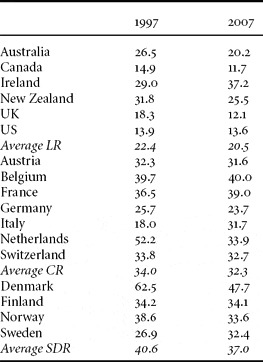
Within the sphere of social insurance, the changes in macroeconomic management, wage policy and labour market conditions have resulted in a shift from passive policy priorities aimed at income maintenance towards a greater emphasis on reintegration, also captured by the shift from out-of-work benefits to in-work benefits. At the same time, policy makers in many countries have turned towards strengthening the minimum income protection function of the welfare state, coupled with activation and reintegration measures to ensure minimum standards of self-reliance. Retrenchment has also been high on the policy agenda and has been moving up the priority list now that governments have started to try to balance their budgets again. There have been reductions in benefit levels and benefit duration, the eligibility criteria of social provisions have been tightened and the coverage of benefits have been limited. Taking average net (after taxes) replacement rates for unemployment insurance and sick pay as our indicator for retrenchment, we observe that all welfare states retrench (Starke, Reference Starke2008; Vis, Reference Vis2010: 54). However, the extent of retrenchment should not be exaggerated, because some countries lower their replacement rates, but keep them at a high level, while others increase benefits. If we look at the gross unemployment benefits as a percentage of previous earnings in Table 1, we observe that all types of welfare states (‘regimes’) retrench in the period 1997–2007. One representative of the liberal type, the United Kingdom, retrenches quite plainly its already low rate. Yet, in the same period Ireland raises its unemployment benefit. In the social democratic countries, we see a similarly diverse trajectory, with Sweden raising replacement rates and Denmark lowering them. The conservative regime also is stable, although the Dutch hybrid case stands out, with a reduction of the unemployment benefit replacement rate from 52.2 to 33.9 per cent.
Unemployment benefits, 1997 and 2007 (gross replacement rates as a percentage of previous gross earnings)

Note: LR = liberal regime; CR = conservative regime; SDR = social democratic regime
Source: OECD 2010,
Late entry into the labour market of young people, early exit of older workers, together with higher life expectancy and low fertility confronts many welfare systems with a looming pension financing deficit. In the area of old-age pensions, retrenchment is high on the agenda. But retrenchment is just one side of the story of what is a genuine restructuring and adaptation to demographic, economic and social structural change of pension systems (Häusermann, Reference Häusermann2010). Some important trends concern the growth of (compulsory) occupational and private pensions and the development of multi-pillar systems, combining pay-as-you-go and fully funded methods, with relatively tight (actuarial) links between the pension benefits and contributions (Clark and Whiteside, Reference Clark and Whiteside2003; Immergut et al., Reference Immergut, Anderson and Schulze2007). In addition, measures to combine work and retirement, with tax allowances and partial pension benefits, have been introduced in countries such as Denmark and Finland.
Social services have experienced a strong comeback. Spending (as a percentage of Gross Domestic Product, GDP) on childcare, education, health, and elderly care, next to training and employment services, have increased practically everywhere in the European Union over the past decade. As the future of welfare states depends on how well the dilemmas associated with women's new career preferences are solved (Esping-Andersen, Reference Esping-Andersen2009), it is impossible to imagine a positive equilibrium without an effective reconciliation of family functions (Hakim, Reference Hakim2003; Orloff, Reference Orloff and Levy2006). Leave arrangements are being expanded, in terms of both time and scope of coverage, also to include care for the frail elderly. In addition, under conditions of the availability of good-quality child care, female employment is the key to resolving child poverty (Esping-Andersen, Reference Esping-Andersen2009: 124), which is on the rise in most European countries.
In terms of the financial architecture of the welfare state, we observe an increase in user financing in the areas of child care, old-age care and medical care. With respect to taxation, as a result of intensified competition across the European Union, many EU Member States started to pursue a combination strategy of lower statutory tax rates and a broadening of the tax base.
As regards macroeconomic performance, we observe a remarkable convergence in terms of price stability and fiscal consolidation. There is a similar cross-national convergence in unit labour costs. Expenditure levels on social protection (as a percentage of GDP) have remained relatively stable. With respect to employment, there has been a large measure of convergence since the 1990s, with practically all welfare regimes scoring somewhere between 65 per cent and 75 per cent activity. This convergent trend is even stronger for the ‘prime age’ (25–54) group of adult workers. There has also been a general increase in activity rates among older workers in some continental welfare states, most notably the Netherlands, followed by France and Belgium. For younger cohorts, female employment in Southern and continental Europe is catching up rapidly to Northern European averages. Today high-skilled groups surpass the Lisbon benchmark of 70 per cent by about 15 percentage points, independently of welfare regime characteristics. In comparison to this group, it is the low skilled whose labour market opportunities are seriously weakened.
National and regime specifics
Against the background of these general trends, it is important to highlight significant national distinctions and trajectories.
The Nordic welfare states offer generous income guarantees, a wide range of public social services and active labour market policies aimed at maximising employment for men and women. We focus on Denmark as an example. The liberal welfare states rely on relatively modest, often means-tested benefits for unemployment, sickness and old-age, with strict rules for social assistance. Here we specifically look at the United Kingdom. The continental welfare states rely on relatively high income replacement benefits, linked to the claimant's employment history and family situation. Germany is our example, but we also pay attention to the hybrid but important reform case of the Netherlands.
Nordic ‘dual-earner’ post-industrialism and the case of Denmark
The most conspicuous characteristic of the Nordic regime has been its combination of generous income maintenance benefits, well-developed public social services and active labour market policies, which sustain high participation rates for both men and women. Social services not only provide large-scale and often flexible employment opportunities in the public sector, but also decent jobs for modestly skilled workers. Publicly funded higher education and vocational training foster innovation and increased productivity in the high-tech sector, which in turn provide employment opportunities in private sector skilled work. The cost, of course, is a very high tax rate. In addition, the Nordic model is under constant pressure to keep balanced budgets, especially in the wake of European monetary integration.
Still, the performance of the Nordic regime, in spite of all difficulties and political criticisms, is remarkable. Not only were the Nordic countries capable of recovering from monetary and economic crises, they also managed to restore balanced budgets and economic dynamism, while maintaining high employment levels and low poverty rates (cf. Ryner, Reference Ryner2007: 66). One important reason for this is that the Nordic welfare states were already well prepared for the ‘new social risks’ of post-industrial society (Bonoli, Reference Bonoli2007), socialising the risks associated with aging societies, changing household structures and the transition to the knowledge economy. In line with its normative foundation in a productivist work ethic, the social investment strategy comes clearly to the fore as the Nordic regime is moving even further away from passively compensating unemployment to actively promoting employability.
The presence of basic income guarantees is a safeguard not only against poverty and exclusion, but also against the penalties deriving from spells out of work and broken or composite careers. The availability of a wide array of services allows Nordic welfare states to respond more effectively to the care needs of families and to socialise their costs, including the cost of children. Moreover, high rates of labour-market participation alleviate the financial strains on pension systems. Furthermore, the Nordic countries invest heavily in labour market training (a crucial policy for knowledge-intensive economies) and their education expenditure ratios are the highest in Europe. Investment in training and labour market activation has increased so as to balance out a move to a more individualised, less-redistributive pension system. Sweden, Denmark and Finland spent between 0.3 and 0.5 per cent of GDP on labour market training and 0.2–0.3 per cent of GDP on re-entry facilitation (Bonoli, Reference Bonoli, Morel, Palier and Palme2009: 61).
The Danes have gone furthest in the social investment strategy, particularly with respect to activation policies. A series of labour market reforms in the 1990s gradually implemented a right and a duty to activation. This included the introduction of mandatory, individual action plans that activate the unemployed within three to five months and the abolishment of a system that passively accorded generous benefits (Albrechtsen, Reference Albrechtsen and Pascual2004: 224). The repertoire of active labour market policies was expanded and jobseekers received earlier and better access to publicly subsidised employment opportunities, education and training measures, rehabilitation courses, as well as sheltered employment for persons with permanently reduced working capacities. In addition to these supply-side measures, a number of leave schemes were temporarily used to reduce artificially the demand for work during the 1990s. It was the introduction of these ‘active’ elements into the Danish labour market that gave rise to the flexicurity model. This model triangulates ‘flexible labour markets, generous unemployment benefits, and active labour market policies – all coordinated to reduce unemployment and improve the quality and supply of workers to the labour market’ (Campbell and Hall, Reference Campbell, Hall, Campbell and Hall2006: 30; see also Madsen, Reference Madsen, Campbell, Hall and Pedersen2006). The 1990s also witnessed the expansion of services for children and the elderly, the expansion of parental leave opportunities and the introduction of specific activation instruments for mothers returning to work. These policies were targeted at improving the working opportunities for women and were coupled to the creation of 50,000 public sector jobs between 1995 and 2001 (Dingeldey, Reference Dingeldey2005).
Alongside the introduction of these enabling activation measures, the eligibility criteria for social assistance were tightened. In 1990, the government introduced Denmark's first compulsory activation measure, requiring eighteen- and nineteen-year-old social assistance claimants to participate in a youth allowance scheme in return for social assistance payments. Subsequently, compulsory activation measures were gradually expanded to reach all social assistance recipients, timetables were tightened and participants in municipal activation schemes no longer (re-)qualified for unemployment benefits. The duration of unemployment benefits was gradually reduced. However, with the exception of young people with no qualifying education, generosity did not decline. In addition, the so-called ‘passive period’ without the right and duty to activation was reduced sequentially from four years in 1990 to six months for under-thirty jobseekers and nine months for adult jobseekers in 2007 (Kvist et al., Reference Kvist, Pedersen, Köhler, Eichhorst, Kaufmann and Konle-Seidl2008: 227). In this way, Denmark adopted a ‘work first’ approach, emphasising benefit control, availability tests and job guidance.
The liberal way and the British case
The UK has been taking a new tack roughly in line with the social investment paradigm, albeit it with clear liberal traits. Still, activation policies have been widely expanded to strengthen the market economy, while trying not to increase poverty. The activation policy moves away from passive, means-tested schemes towards in-work benefits.
Since 1997, successive British governments have departed from the strictly liberal path by developing a liberal version of the idea of social investment, the so-called ‘enabling’ welfare state (Gilbert, Reference Gilbert2004) that makes most of its provisions contingent upon paid employment (see Clasen, Reference Clasen2005; Hills et al., Reference Hills, Sefton and Stewart2009) and balances rights and responsibilities. The flagship example has been the introduction of the New Deal in 1998. The New Deal partly built on the requirement that the unemployed actively seek work in exchange for benefits. The New Deal envisioned a new labour market policy that would offer the unemployed efficient job centres, more personalised support services and core skills training such as literacy, numeracy and self-presentation (Weishaupt, Reference Weishaupt2010).
For this purpose, the government sought to offer training or jobs to 250,000 young people, spending more than £3 billion on young people alone (http://archive.treasury.gov.uk/pub/html/budget97/hmt2.html). Accordingly, by far the largest New Deal program has been the New Deal for Young People. It offers four options to the unemployed: subsidised employment in the private sector; subsidised and temporary work in the voluntary or environmental sectors; full-time education; or training. There is, however, no ‘fifth option’ of passively living on benefits, and failure to comply with the rules can lead to a loss of benefits and eventual suspension. The scheme has been extended to unemployed adults and additional target groups, such as lone parents, chronically disabled persons and older workers.
Another pillar of the ‘make work pay’ strategy concerned a relatively generous Working Families Tax Credit in October 1999. Rewarding those in work through an almost ten-fold increase in tax credits, it sky-rocketed from £1.4 billion in 1999 to £11.5 billion in 2004 (Nachtwey and Heise, Reference Nachtwey and Heise2006: 6). It has subsequently been extended to adults without children and, if applicable, also covers parts of childcare costs. Taken together, the tax credits and minimum wage have had the result that anyone working at least thirty hours a week received an income above the poverty line (Brücker and Konle-Seidl, Reference Brücker and Konle-Seidl2006: 5). Moreover, a variety of legislation was initiated to promote the reconciliation of work and family life (more childcare places, paid maternity leave, a leave entitlement for fathers and an extension of flexible working time (Clasen, Reference Clasen2005)).
Tackling Britain's occupational skills deficit also became part of the social investment agenda. An essential part of Britain's skills strategy has been the introduction of instruments intended to improve the qualifications of less-skilled workers. The ‘Train to Gain’ scheme offers less-skilled workers fully paid access to training and offered employers subsidies to compensate for the loss in working time (Page and Hillage, Reference Page and Hillage2006). In 2006, a legal right for adults to obtain a certain level of qualifications free of tuition was introduced (Weishaupt, Reference Weishaupt2010). As part of an overhaul of the apprentice system, age limits for publicly funded places were removed, a new program for fourteen- to sixteen-year-olds still at school introduced, pre-apprenticeships made available, and access to apprenticeships for older workers significantly expanded.
Reversing the continental syndrome of ‘welfare without work’ and the German and Dutch cases
The continental welfare state has been described as a ‘welfare without work’ system (Esping-Andersen, Reference Esping-Andersen1996). Historically, the prevalence of Christian ‘familialism’ encouraged women to stay home rather than to participate in the labour market and induced a high family wage for male breadwinners (Van Kersbergen, Reference Van Kersbergen1995). High wages, in turn, reduced employment creation, especially in the area of low-productivity and low-skill services. Aggravating matters, industrial restructuring in the 1970s and 1980s was accommodated through a major expansion of early retirement schemes, catalysing those labour-shedding inclinations already connected with globalisation and deindustrialisation. The resulting self-reinforcing negative spiral has had a heavy impact on less-skilled workers, the young and women. Budgetary pressures for retrenching popular and generous income replacement schemes contrast sharply with new demands for social protection, resulting from both the decline of traditional family structures and failure to expand public and private service sectors.
This continental syndrome has generated a complex reform agenda: containing social spending by trimming ‘passive’ benefits, introducing ‘active’ incentives in other cash benefits, expanding childcare and parental leave, increasing means-tested benefits and reducing payroll charges. However, the continental welfare states, because they were very much disconnected from the idea of social investment, probably have undergone the most dramatic and path-breaking reforms in their adoption of the social investment paradigm.
Expanding employment levels among women, low-skill groups and older workers was seen as a sine qua non for the long-term sustainability of the welfare state. As a result, most continental welfare states have been increasing spending on active labour market policy. Higher pressures on the unemployed to accept suitable job offers or participate in education have strengthened activation programs. Since the early 1990s, steps have been taken to reduce early exit via tightened eligibility criteria, benefit reductions, stricter controls and, in the early 2000s, the abolishment of early retirement schemes altogether.
De facto the continental welfare states are saying farewell to the traditional family ideal and opting for reforms that enable women to participate in the labour market. Parental leave schemes were expanded and care for the frail elderly and sick children was introduced. Childcare has expanded since the late 1990s in particular (Morgan, Reference Morgan, Morel, Palier and Palme2009: 47). Governments have increased spending and pushed for more flexible childcare facility opening hours in order to enlarge the number of available and affordable childcare places, although this has not gone so far as to indicate a commitment to a ‘service state’ (Morgan, Reference Morgan, Morel, Palier and Palme2009: 52).
Still, also on the Continent, activation programs based on individual guidance and training opportunities, primarily targeting ‘outsiders’ like the young, female or low-skilled workers, have gained momentum over the past two decades. These reforms have begun shifting privileges away from insiders (male breadwinners and their dependents) by opening insurance benefits to outsiders, introducing paid maternity leave and improving social rights for part-time workers and minimum income protection.
Until the mid-1990s, the German welfare state was infamous for its disinclination to radical reform (Bönker and Wollmann, 2001; Obinger and Starke, Reference Obinger, Starke, Holzinger, Jörgens and Knill2007; Stiller, Reference Stiller2010). Since then, however, it has made a dramatic turn towards activation. In 2001, for instance, the Job-AQTIV Act expanded public employment and opened up broad, early access to training programs. In 2004 and 2005, the influential Hartz reforms expanded the low-wage sector through new tax and contribution exemptions and reductions. While most measures were related to active labour market policies, the most controversial elements brought major changes to unemployment policy. These changes involved drastically shortening benefits durations for all unemployed, most recently also including the long-term unemployed with disabilities (Rauch and Dornette, Reference Rauch and Dornette2010), hiking the early retirement age for elderly unemployed from sixty to sixty-three, tightening requirements to accept suitable jobs, simplifying insurance regulations, and merging unemployment assistance with social assistance. The latter implies that only those unemployed who fulfil certain qualifying conditions are entitled indefinitely.
Whereas such reforms addressed the changing skill requirements of the German labour market, a second strand of reforms tackled the post-industrial social risks associated with the massive entry of women into paid employment. To help reconcile work and family life, childcare and parental leave arrangements were expanded. Leave schemes came to include part-time workers and to offer two ‘daddy months’ for working fathers and quadrupled the maximum working benefits of the late 1990s. In addition, all-day childcare facilities for children under the age of three have been expanded (Morgan, Reference Morgan, Morel, Palier and Palme2009).
In contrast to Germany, the Dutch welfare state of the 1990s was widely praised for its recovery from a severe inactivity crisis in the 1980s and for managing to do so without suspending minimum income protection. This development was based on a long-term strategy of organised wage restraint, restriction of access to (and curtailing heavy misuse of), disability pensions and sickness insurance and promotion of part-time work (Visser and Hemerijck, Reference Visser and Hemerijck1997). In 1995, agreements between the social partners struck a winning balance between flexible employment afforded by safeguarding social security and the legal position of part-time and temporary workers, in exchange for a slight loosening of employee dismissal legislation (flexicurity). The 2000 Working Hours Act now gives part-timers an explicit right to equal treatment in all areas negotiated by the social partners (Hemerijck, Reference Hemerijck2003).
Between 2003 and 2006, the Netherlands took major steps to bolster activity rates, and, as in Germany, policy makers opted for both carrots and sticks. As of 2004, older unemployed people are required to look for work and employers are no longer obliged to pay premiums for disabled employees aged over fifty-five. In 2005, the government significantly reduced disability benefits for partially disabled individuals who do not work, but also expanded training opportunities and created wage subsidies for partially disabled workers and their employers. Also, tax benefits for pre-pension schemes were replaced by a life course scheme that stimulates employees to accrue 210 per cent of their annual salary by saving a yearly maximum of 12 per cent of their annual income. This enables employees to receive 70 per cent of their annual salary while away on leave (parental, educational, sabbatical or early retirement) for three years. In order to further reconcile work and family life, those using the life course scheme during periods of parental leave are granted an additional payment worth 50 per cent of the minimum wage. Furthermore, since 2005 additional child care facilities were created at schools and were subsidised. Still, in terms of participation in formal childcare (2008), especially of children not yet three years old, the Netherlands remains a laggard (www.oecd.org/els/social/family/database).
In sum, the continental welfare states have transformed more considerably than have their Nordic and liberal counterparts. The adoption of the idea of social investment required the adjustment of the two core policy values of the continental welfare state: status maintenance in social policy and support for the traditional family. In their stead came the promotion of equal opportunities via labour market participation and poverty reduction. We observe a development towards an activating welfare state that enhances the social rights and employability of women and low-skill groups in particular.
Conclusion and discussion
In many respects, everywhere in Europe, the social investment strategy has informed the reform of the welfare state. Although to a large extent many of the adjustments have depended on the varied starting points of the different regimes, there have also been quite radical, path-breaking reforms towards the activating welfare state, especially in the continental welfare cluster, that perhaps challenge the standard classification of welfare states according to regime types. Without much exaggeration, we can conclude that the idea of social investment has established itself as the foundation of a new policy paradigm and that its translation into new social policies has been quite successful. Surely, as we indicated, social policy retrenchment is part of the story of two decades of social policy change, but it is only that: part of the story. The other part is the surprisingly widespread and startlingly successful adoption of the social investment agenda in most if not all European welfare states.
If we look at employment patterns and trajectories, the impact of the activation side of the new social investment logic clearly comes to the fore. To give one telling example: in 1985, the female employment rate in the Netherlands was still a low 40 per cent, while the German figure was below 50 per cent. By 2009, however, the Netherlands with 71.5 per cent not only had caught up with many other countries, but also had surpassed Germany (66.2 per cent) and Sweden (70.2) (Eurostat, 2011a). Surely, in the Netherlands part-time employment (both for men and women) is relatively high, but this, in a sense, is the specific way in which the activation side of the social investment strategy has played out in that country. One other telling indicator, especially for the continental regime, is that the average exit age from the labour force has been increasing since the late 1990s (Eurostat, 2011b).
The question we need to raise at this point, however, is whether and to what extent the successful adoption of the social investment paradigm has led to a relative neglect of social policies that are designed for social risks that are difficult to cover with activation type policies. In particular, could it be that there has been a trade-off between social investment strategies that stimulate job growth and redistributive policies that mitigate inequality?
We have witnessed a U-turn in the development of income inequality: declining in the post-war period until roughly the late 1970s, then suddenly increasing. Inequality has continued to increase since then, while the risk of poverty has hardly declined, if at all (OECD, 2008). The critical question is whether rising inequality has been directly caused by the transformation of the welfare state according to the social investment logic. The answer is probably no, if only because inequality started growing long before major welfare reforms were carried out. Moreover, there are other dynamics at work in the complex field of incomes distribution, of which the globalisation- and technology-driven increasing demand for (highly) skilled workers and the ensuing growing wage dispersion between unskilled and skilled workers is but one example. Still, increasing wage differentials and the decreasing redistributive capacity of taxes and benefits are held co-responsible for increasing inequality (Brandolini and Smeeding, Reference Brandolini, Smeeding, Salverda, Nolan and Smeeding2009).
Also, we should not overestimate the impact that the welfare state has had on inequality in the first place. To a large extent, the dramatic increase in equality in the first decades after the Second World War was the result of growing productivity of low-skilled labour that made incomes grow faster at the bottom than at the top. The increase in income inequality, as the OECD (2008) has highlighted, is mainly due to the top of the income distribution faring much better than the middle and the bottom.
At the same time, however, we should not underestimate the welfare state's impact on inequality either. It is difficult to estimate precisely the impact of the welfare state on inequality. The reason is that we need to have information about the world, say the primary income distribution, before it is affected by welfare state intervention, so as to be able to estimate the outcome after intervention. The problem is that the welfare state is always already directly implicated in the primary income distribution (Esping-Andersen and Myles, Reference Esping-Andersen, Myles, Salverda, Nolan and Smeeding2009: 639).
We conclude that activation and the emergence of the social investment state have been relatively successful in terms of stimulating labour market participation, but also that social inequality has been on the rise. Moreover, the risk of poverty in the EU-15 countries (the percentage of people living below the poverty line of 60 per cent of the median income) varied between 15 and 17 per cent in the period 2000–2010. It is unclear what the impact of the social investment strategy has been or is likely to have on income distribution and poverty. Flexible labour markets tend to increase wage differentials and activation policy is designed for the employable or to raise employability. In a word, the logic of social investment is focused on maximising the chances of earning an income on the labour market, and the market tends to generate inequalities and risks.
If the social investment strategy remains coupled with minimum wages, education, training and skills upgrading, one could envision an increase in equality of opportunity and a decrease in income inequality. The crucial issue, however, is whether the financial crisis and its economic aftershocks have been undermining conditions to such an extent that it has become precarious whether social investment policies keep the ability to perform satisfactorily. For instance, will flexicurity policies continue to offer the kind of positive-sum solutions even if temporary and other atypical jobs are disappearing, unemployment is rising and public budgets are hard to control? Whether the social investment strategy will survive the aftershocks of the financial crisis, including potentially long-term low economic growth rates, remains an open question.