It is relatively well documented that electoral system design is an important factor influencing female representation (Norris Reference Norris2006). Many countries have modified electoral rules in order to alter the historical male dominance in politics, usually by introducing legislative gender quotas (Dahlerup Reference Dahlerup2006, Reference Dahlerup2007; Krook Reference Krook2010; Praud Reference Praud2012). Dahlerup (Reference Dahlerup2007) estimates that during the last two decades, almost 100 countries have introduced gender quotas for political assemblies.
Legislative quota regulations are most frequently used in proportional representation systems. According to the Gender Quotas Database, legislative gender quotas are used in single/lower chamber elections in 54 countries.Footnote 1 The existing evidence confirms that quotas are relatively efficient in increasing the share of female candidates, but such a “mechanical effect” does not always increase the share of female legislators (Paxton and Hughes Reference Paxton and Hughes2015; Schwindt-Bayer Reference Schwindt-Bayer2009). In this article, we seek to explain this gap between women's presence on the ballot and in the legislative assembly. We examine how the introduction of gender quotas affected female representation in the open-list proportional representation (OLPR) system used in Poland. Despite the introduction of legislative gender quotas in 2011 and an almost twofold increase in the share of female candidates, the share of female legislators increased only marginally, from 20% in 2007 to 24% in 2011 and to 27% in 2015. In this article, we examine the extent to which the effect of quotas can be mitigated by the unequal distribution of previous political experience, ballot ranking patterns, and preference voting—three factors possibly counteracting the mechanical increase in the supply of female candidates after the introduction of quotas.
In the empirical analyses, we try to combine two approaches used to investigate female electoral representation and the efficiency of gender quotas: the perspective of individual candidate's chances and the perspective of aggregate electoral outcomes, expressed by the shares of women among candidates and legislators. We attempt to ascribe the disparity between the shares of female candidates and female legislators to three main factors: unequal distribution of electoral experience, bias of party elites, and bias of voters.
Elections for the lower chamber of the Polish parliament, the Sejm, are held under an OLPR system, sometimes also classified as a “flexible list” system (Crisp et al. Reference Crisp, Olivella, Malecki and Sher2013). This electoral system is considered to be a critical case for the assessment of quota functioning. Because of the degree of its personalization, the OLPR system allows us to study the interplay between parties’ and voters’ strategies and their joint impact on the election of female candidates (Kunovich Reference Kunovich2012, 174). The former are visible in candidate ranking patterns (nominations for viable ballot positions), while the latter are visible in the ultimate distribution of seats, which depends on the distribution of preference votes (sometimes disturbing the party ballot ranking). The Polish case is particularly useful in this respect, as it is impossible to vote without indicating a preference for a particular candidate; the preferential vote is mandatory, and its impact on the ultimate distribution of seats is far from marginal (Gendźwiłł and Raciborski Reference Gendźwiłł and Raciborski2014).
Apart from adding new empirical evidence to the existing studies of female legislative representation and functioning of quotas in Poland (Flis Reference Flis2014; Fuszara Reference Fuszara2013; Górecki and Kukołowicz Reference Górecki and Kukołowicz2014; Gwiazda Reference Gwiazda2015, Reference Gwiazda2017; Jankowski and Marcinkiewicz Reference Jankowski and Marcinkiewicz2017; Kunovich Reference Kunovich2012; Millard Reference Millard2014; Siemieńska Reference Siemieńska2005), we develop in this article a model for studying female representation under OLPR, discussing several methodological issues related to the measurement of quotas’ impact on individual electoral chances and the proportion of females in legislatures.
In the following section, we summarize the literature on female representation and gender quotas, pointing out the main factors influencing the electoral chances of women, with a particular focus on OLPR systems. Based on this review, we formulate a set of hypotheses concerning women's electoral chances and the outcomes of legislative gender quotas. These hypotheses are subsequently tested on the Polish case. Before we proceed to the presentation of empirical results, we describe our data and method. We end with conclusions that demonstrate the significance of our results and formulate several problems requiring further investigation.
FEMALE REPRESENTATION IN OLPR
There is strong evidence that proportional representation systems are more beneficial for the election of women than plurality/majority systems (Kittelson and Schwindt-Bayer Reference Kittelson and Schwindt-Bayer2012; Matland Reference Matland1998), particularly in the long term (Thames Reference Thames2017). However, it is still being discussed whether OLPR systems prevail over closed-list systems in this respect (Schmidt Reference Schmidt2008). Thames and Williams (Reference Thames and Williams2010) argue that the ability of voters to change ranks might undermine women's representation, since female candidates usually do not perform well in systems with personal vote incentives.
Candidate selection under OLPR systems is more complex than under closed-list proportional representation or first-past-the-post systems. According to the well-known Carey and Shugart (Reference Carey and Shugart1995) classification, OLPR systems generate more incentives for candidates to cultivate a personal vote. Under OLPR, these incentives are stronger with increasing district magnitude, as the number of copartisans against whom each candidate is competing increases (Shugart, Valdini, and Suominen Reference Shugart, Valdini and Suominen2005). These personal features of candidates are thus taken into account by party leaders nominating candidates in order to maximize the party electoral result. In many OLPR settings, including Poland, party leaders also determine the ballot order of candidates, which affects candidates’ electoral chances because of the existence of strong ballot position effects (e.g., Blom-Hansen et al. Reference Blom-Hansen, Elklit, Serritzlew and Villadsen2016; Marcinkiewicz Reference Marcinkiewicz2014; Miller and Krosnick Reference Miller and Krosnick1998).
Nonetheless, the institution of an “open list” allows voters to modify the ranking proposed by parties with the use of preference votes. Their distribution is used to determine which candidates receive the seat won by a given list. The research on intraparty competition demonstrates that preference votes matter, particularly if they are mandatory and party magnitudes are high (Gendźwiłł and Raciborski Reference Gendźwiłł and Raciborski2014; Gendźwiłł and Marcinkiewicz Reference Gendźwiłł and Marcinkiewicz2017). Therefore, studies of elections held under OLPR rules usually deal with two stages of electoral choice: party choice and voter choice. They are represented by ballot ranking and preference votes distribution.
Ranking the candidates can be considered a final step in the selection process, which is dependent on the supply of candidates willing to stand for office and the demand of party gatekeepers (Lovenduski Reference Lovenduski2016; Norris and Lovenduski Reference Norris and Lovenduski1995). Kenny and Verge (Reference Kenny and Verge2016) argue that both candidate supply and demand are structured by the wider social and political framework and produce gendered outcomes: the underrepresentation of women as aspirants, candidates, and elected politicians. The existing research demonstrates that party elites, who are predominantly male, tend to exclude women from the distribution of rewards because of stereotypes and as a result of the out-group effect (Niven Reference Niven1998). Informal selection criteria usually favor men over women (Verge Reference Verge2015); even highly qualified women are less likely to be recruited to run for office (Fox and Lawless Reference Fox and Lawless2010). Even if women are selected, parties tend to place them in unwinnable positions on party lists (Luhiste Reference Luhiste2015).
The findings concerning the effect of gender on preference voting patterns are mixed. While there is evidence that gender-based voting negatively affects women (Giger et al. Reference Giger, Holli, Lefkofridi and Wass2014; Holli and Wass Reference Holli and Wass2010; Kukołowicz Reference Kukołowicz2013), once the analyses take into account candidate political resources and ballot placement, the dominant conclusion is that voters tend to marginally favor female candidates (Black and Erickson Reference Black and Erickson2003; Kunovich Reference Kunovich2012; Siemieńska Reference Siemieńska2005; Stegmaier, Tosun, and Vlachová Reference Stegmaier, Tosun and Vlachová2014). More precisely, the models controlling for ballot placement do not verify whether voters generally prefer women over men but whether the potential imbalance in their preferences systematically corrects the parties’ bias, already inscribed in the ballot placement pattern. Matland (Reference Matland, Ballington and Karam2005, 105) even argues that “women do better with voters than they do with the party committees putting together party lists, that is, the preferential vote leads to a greater representation of women.” Several analyses demonstrate that there is, on average, no significant gender bias in voters’ choices (Jankowski and Marcinkiewicz Reference Jankowski and Marcinkiewicz2017; McElroy and Marsh Reference McElroy and Marsh2010). It is clear, however, that voters’ choices under OLPR most frequently follow the pattern of ballot ranking provided by the parties; voters to a large extent prefer the same candidates as party elites.
THE EFFECTS OF LEGISLATIVE GENDER QUOTAS IN OLPR SYSTEMS
There is evidence that gender quotas are more efficient in closed-list systems than in open-list systems (Jones and Navia Reference Jones and Navia1999), particularly if the “zipper rule” (i.e., alternating men and women candidates at the top of the list) is applied (Millard Reference Millard2014). The existing literature demonstrates that the outcomes of gender quotas depend on the quota size, additional placement rules concerning top ballot positions, and sanctions for noncompliance (Paxton and Hughes Reference Paxton and Hughes2015; Schwindt-Bayer Reference Schwindt-Bayer2009). There is also evidence that left-wing parties are more likely to implement quotas (Caul Reference Caul1999; Millard Reference Millard2004).
As the quota threshold is usually set at a level higher than the average share of female candidates in previous elections, the most immediate, direct effect of quotas is an increase in the proportion of female candidates on the lists. However, the share of women among elected representatives usually increases much slower, as it is an outcome of a nonrandom selection.
It is obvious that the significant change in proportion between men and women directly affects women's chances of being elected: the increasing share of female candidates in comparison with pre-quota elections should proportionally increase their electoral chances if no other factors influence the selection process. Nonetheless, as this inflow of female candidates is a result of an intervention, not a gradually progressing political empowerment of female candidates, it may be expected that the average “electoral capital” of female candidates will decrease after the introduction of quotas, while simultaneously the average electoral capital of male candidates will increase. Researchers frequently approximate this electoral capital, a favorable combination of personal vote-earning attributes, by incumbency and previous electoral experience in national or subnational elections, the factors that are taken into account by party leaders (Htun and Jones Reference Htun, Jones, Craske and Molyneux2002; Shugart, Valdini, and Suominen Reference Shugart, Valdini and Suominen2005).
Numerous studies demonstrate that the general pattern of incumbency advantage may in fact be a disadvantage to the election of women (Schwindt-Bayer Reference Schwindt-Bayer2005). In OLPR systems, incumbents, who are predominantly male, are more likely to receive more promising ballot positions and, consequently, more preference votes (Matland Reference Matland, Ballington and Karam2005). Party leaders usually argue that it is rational to put experienced and well-recognized candidates on the top of the ballot. Sineau (Reference Sineau, Ballington and Karam2005) discusses the case of 2002 French legislative elections, in which large parties preferred to pay the fines prescribed by the quota law rather than have more women candidates and “sacrifice” incumbents.
Several authors mention that quota regulations may create a stereotype that “quota women” are underqualified (Franceschet and Piscopo Reference Franceschet and Piscopo2008; Nanivadekar Reference Nanivadekar2006). Nonetheless, the decreasing average electoral capital of female candidates immediately after the introduction of quotas does not imply that there are fewer experienced female candidates in absolute terms. It usually means that this group simply becomes a smaller part of the significantly enlarged group of all female candidates. Analogously, a significant number of male candidates with lower electoral capital simply are not placed on the ballot.
It seems obvious that ballot ranking may be used to support or counteract quota regulations. The pattern in which fewer women are placed in favorable rather than distant positions can be explained—at least to a certain extent—by differences in the distribution of electoral capital between men and women. But the question remains open whether candidate ranking patterns are additionally biased against women. Party elites, dominated by men, may be interested in preserving the pre-quota status quo, or at least mitigating the immediate impact of the quota regulations.
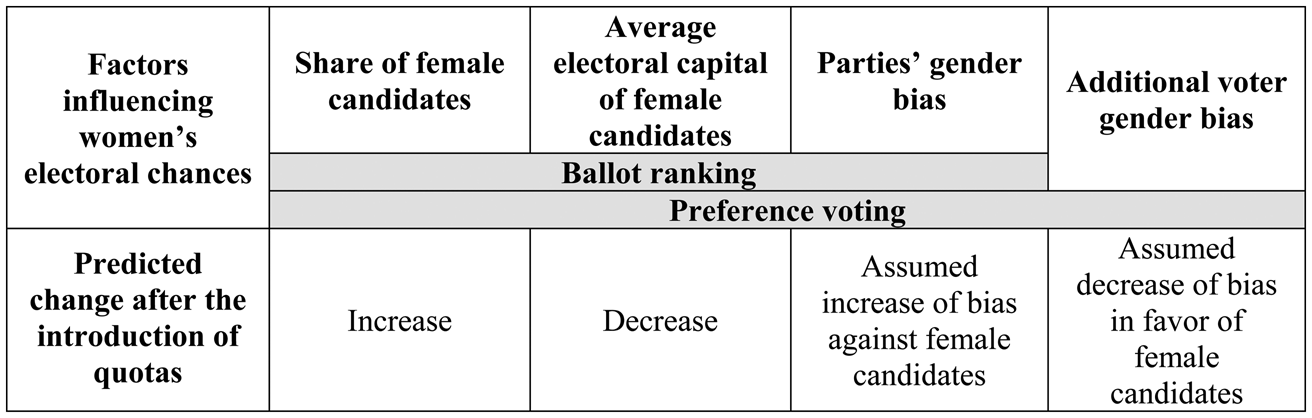
To sum up, in our model assessing the consequences of the introduction of quotas, several interrelated factors should be taken into account (Figure 1).
Factors influencing female representation in an OLPR system and assumed changes after the introduction of legislative gender quotas.

We assume that the individual electoral chances of female candidates under an OLPR system—that is, the chances of both obtaining a viable ballot position and ultimately being elected—are conditioned mechanically by the share of female candidates on lists. However, along with the change in the share of female candidates, we can observe simultaneous changes (1) in the distribution of electoral capital among candidates of each gender; (2) in the parties’ gender bias, that is, systematic differences in ballot placement of women and men that are not explained by differences in their electoral capital or cannot be attributed to the parties’ residual preference for incumbents; and (3) in voters’ additional gender bias, that is, systematic preferences for candidates of a particular gender expressed in preference voting yet explained neither by their ballot placement nor by their level of electoral capital.
MAIN HYPOTHESES
In our analyses, we examine how parties (through a change in ballot ranking patterns) and voters (through a change in preference voting patterns) reacted to the introduction of quotas.Footnote 2 We define the gender bias in ballot ranking as a significant effect of a candidate's gender on his or her individual chance of being placed in favorable ballot position. Analogously, the bias in preference voting relates to the impact of a candidate's gender on his or her individual chance of winning a seat. We ask whether a negative bias exists and, more importantly, whether it changed in the post-quota period.
We do not observe equal chances of women being nominated for viable positions, even if the main personal vote-earning attributes describing the electoral capital of candidates are controlled; we attribute this effect to gender bias in ballot ranking patterns (Dahlerup Reference Dahlerup2007, 84–85). Analysis of the literature leads us to the first hypothesis concerning the pre-quota and post-quota periods:
H 1:
The gender bias in ballot ranking patterns is unfavorable to women, even if the level of electoral capital is controlled.
In fact, if such a formulation implies a control for incumbency, it becomes a very conservative estimation of gender bias in ballot ranking. We assume that gender bias, which is attributed to party leadership, is to a certain extent captured by incumbency status and previous electoral experience, which are not “pure” control variables but outcomes of previous electoral selection processes. In other words, if previous nominations have been already biased in favor of male candidates, they will probably affect subsequent nominations through incumbency status.
As we already discussed, the increased share of female candidates on the list should proportionally increase the share of women occupying viable list positions, once candidates of both genders have equal levels of electoral capital. However, after the introduction of quotas, politically valuable resources are still prevailingly at male candidates’ disposal. Once women become more numerous and men become less numerous among candidates, the introduction of quotas should decrease the individual chances of female candidates being placed high on party lists.
Nonetheless, we assume that ballot ranking patterns could be additionally influenced by bias against female candidates, if political parties counteract the quota regulations. If this is true, women's electoral chances will decrease after the introduction of quotas, not only because of the decrease in their average electoral capital but also because of the additional bias expressed in the ballot ranking.
H 2:
After the introduction of quotas, the individual chances of female candidates being placed in a viable ballot position decrease, even if the level of electoral capital is controlled.
We acknowledge that preference voting to a large extent resembles the pattern of ballot ranking, determined by party elites. For that reason, in the models explaining individual probabilities of receiving a seat, we control for ballot position effects. We also take into account electoral capital, as it can be important not only for the party establishment but also for the electorate. Once these factors are controlled, the remaining effect of a candidate's gender on his or her chance of receiving a seat can be attributed to the additional gender bias in preference voting patterns. Taking into account the dominant (yet not univocal) tone of existing studies, we assume that voters are positively discriminating in favor of women against men, hypothetically acting against the bias already expressed in the ballot rankings.
H 3:
The additional gender bias in preference voting is positive for female candidates, even if the candidates’ features and ballot position effects are controlled.
Once we attempt to assess the change after the introduction of legislative quotas, we seek to confirm the results presented by Górecki and Kukołowicz (Reference Górecki and Kukołowicz2014), which provide evidence in favor of a “paradoxical effect” of quotas on preference voting. This effect means, in brief, that once quota regulations introduce more women on lists, the preference votes of voters who clearly prefer female candidates are less numerous and more dispersed, which decreases women's chances of ultimately being elected:
H 4:
After the introduction of quotas, the additional gender bias in preference voting, favorable for female candidates, decreases.
We test these hypotheses empirically in the subsequent sections of the article. Additionally, we reflect on how the results estimated in the metrics of individual electoral chances could be expressed in the metrics of electoral outcomes.
GENDER QUOTAS IN POLISH SEJM ELECTIONS
In this study, we use the results of Sejm elections held in Poland under the OLPR system between 2005 and 2015, including two elections before and two elections after the introduction of gender quota regulations.
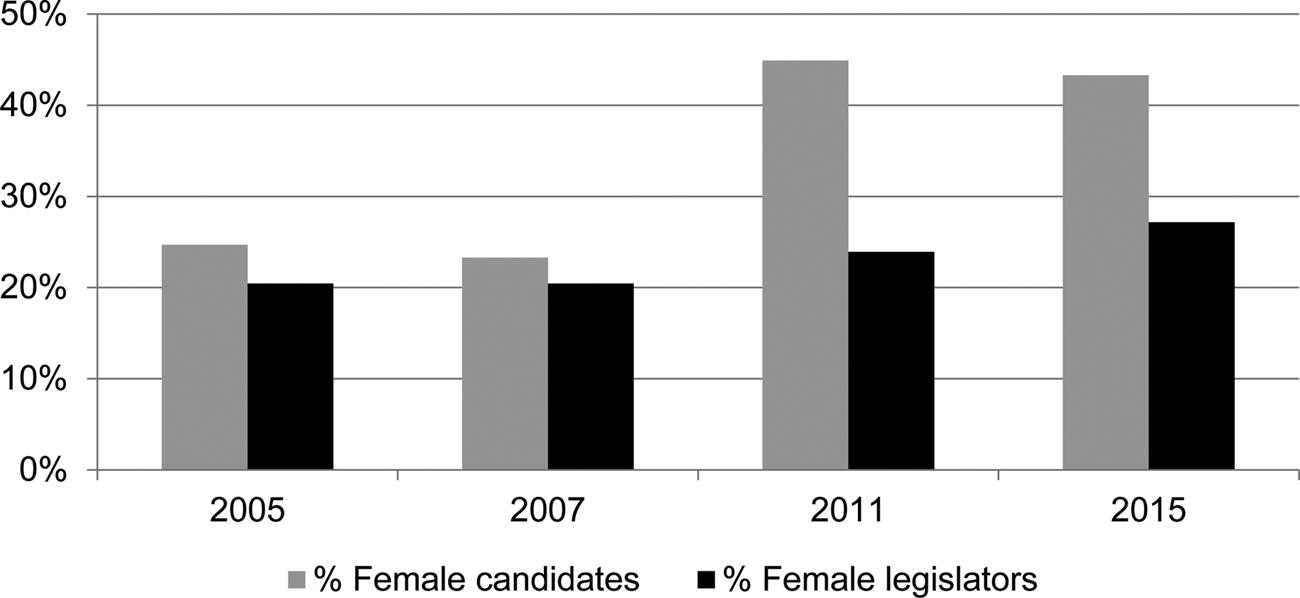
The presence of women in the Polish parliament slowly but systematically increased after the transformation. While in the first democratically elected Sejm (1991–93), there were only 9.6% women representatives, in the eighth term (2015–19), this share increased to 27%. Poland adopted a 35% legislative gender quota in January 2011, before the parliamentary elections held in autumn, yet voluntary party quotas were used before: in the 2001 elections, three parties (the Freedom Union, the Labour Union, and the Democratic Left Alliance) used 30% quotas for the first time (Dubrow Reference Dubrow2011; Fuszara Reference Fuszara2013; Gwiazda Reference Gwiazda2017). The first outcomes of quota regulation seemed disappointing: the difference between the shares of female legislators elected in 2007 and 2011 was rather small (an increase from 20% to 24%), yet one can notice a visible change in the share of female candidates (Figure 2).
Shares of female candidates and legislators in the Sejm, 2005–15. Source: National Electoral Commission, own calculations.

The first look at the candidate data reveals that the electoral capital at the disposal of female candidates was, on average, smaller than in case of their male counterparts (Table 1), which is in accordance with our initial expectations. Górecki and Kukołowicz (Reference Górecki and Kukołowicz2014) also argued that female candidates after the introduction of quotas in Poland were not only more numerous but also—on average—“lower-quality” candidates in comparison with their male counterparts. One can find substantial differences between parties in the candidates’ electoral capital, resulting mainly from the volatility of the party system and the emergence of new parties. However, more important for our reasoning are the intraparty differences between male and female candidates in this respect.
Average electoral capital of male and female candidates in Polish Sejm elections, 2005–15

Source: National Electoral Commission, own calculations.
It is worth mentioning that the candidates’ electoral capital is not necessarily related to their professional competences—for example, Kunovich (Reference Kunovich2003), who examined party lists in Poland between 1989 and 1997, found that equally qualified women were placed lower than their male colleagues on most of the party lists.
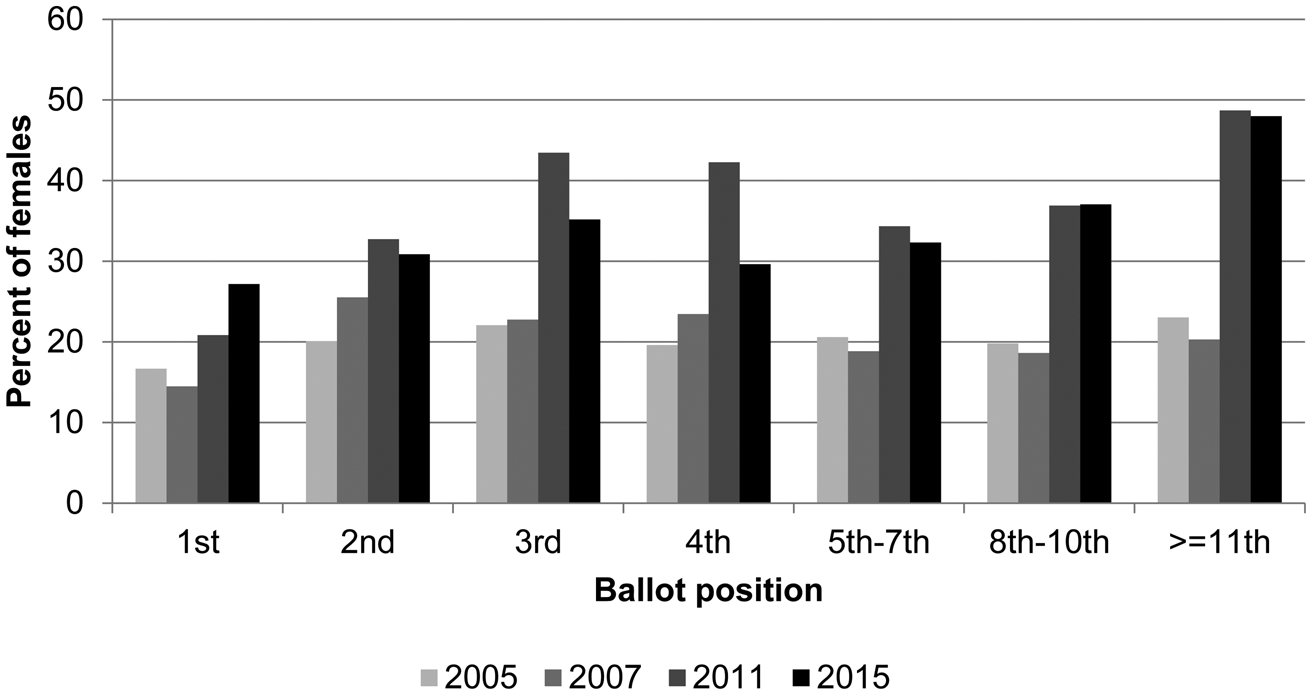
The pooled data from Polish Sejm elections also demonstrate that the visible increase in women's share on the party lists after the introduction of quotas was not evenly distributed among the ballot positions—fewer women were placed in favorable than distant positions (Figure 3). (Fuszara Reference Fuszara2013; Jankowski and Marcinkiewicz Reference Jankowski and Marcinkiewicz2017; Kunovich Reference Kunovich2012). More precise analyses (e.g., Gwiazda Reference Gwiazda2017; Millard Reference Millard2014) reveal differences between parties in the placement of male and female candidates; the authors attribute these differences mainly to internal regulations. However, it can be assumed that other factors (such as party size, ideology, its newness and the dynamics of electoral support) may serve as alternative explanations. In fact, it is difficult to draw systematic conclusions about differences between parties based on single-country studies with low numbers of electoral cycles.
Shares of female candidates placed at different ballot positions, 2005–15. Source: National Electoral Commission, own calculations.

DATA AND METHOD
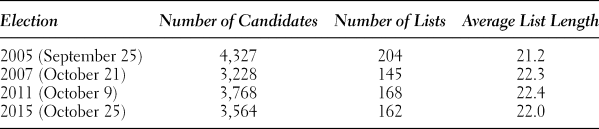
In our empirical analyses, we use the official electoral data obtained from the National Electoral Commission. The original data set contains information on 14,887 candidates, nested in lists, electoral districts, and years; in this study, we include only the lists that received at least one seat in a district (Table 2). The number of electoral districts was constant (41) across the period analyzed, as was the total number of seats (460). The average number of candidates per seat varied between 13.45 in 2007 and 23.17 in 2005. The district magnitudes in Sejm elections ranged from 7 to 20, with average value of 11.2.Footnote 3
Sejm elections included in the empirical analysis

Source: National Electoral Commission, own calculations.
In order to analyze the candidates’ individual electoral chances, we employ binary logistic regression using two different dependent variables. In order to capture the gender bias in ballot ranking, we estimate the probabilities of being nominated for a viable position at the top of the list. In order to capture the gender bias in preference voting patterns, we estimate the probabilities of being elected.
The operationalization of a “viable position” in the Polish version of the OLPR system is not obvious. For example, Kunovich (Reference Kunovich2012) considered the top three positions as a simple definition of a prominent ballot placement, relating her approach to the 35% threshold of the candidate gender quota. On the other hand, Górecki and Kukołowicz (Reference Górecki and Kukołowicz2014, 71), followed by Jankowski and Marcinkiewicz (Reference Jankowski and Marcinkiewicz2017), related the definition of a viable position to party magnitude. They defined “viable” or “promising” positions as top-N positions on each list, where for parties winning seats in a given district, N equals twice the party magnitude. For parties not winning seats in a district, they proposed to consider the top two positions as viable.
We modify the latter approach and use a more restrictive definition of “viable position.” For the lists winning seats in a given district, the viable ballot positions are {1, … m}, where m is the party magnitude.Footnote 4 More importantly, too broad definition of a viable position can actually obscure the real placement strategies, which are unfavorable for female candidates, and thus could lead us to underestimate negative ballot ranking bias and, possibly, overestimate the positive influence of quotas on female candidates’ chances.
The main explanatory variable in our analyses is, obviously, the candidate's gender. In order to test the hypotheses concerning change after the introduction of quotas, we include three dummy variables coding the year when the election was held. It allows us to verify the hypotheses regarding the general effect of introducing quotas (i.e., conducting tests on linear combinations of respective model parameters). The interaction between post-quota year (2011, 2015) and female variables should demonstrate the indirect effects of gender quotas—the changes in either party nomination strategies or voters’ preferences.
In order to account for differences in the levels of electoral capital, we control for the features of candidates that, in light of previous studies, affect their electoral chances: age (and age squared, in order to allow for a nonlinear relationship), incumbency status, and previous electoral experience (status of a candidate, regardless of the ultimate result). We differentiate incumbency and candidate statuses in national (parliamentary) or subnational (municipal, county, regional) elections. We assume that these variables capture well the political experience and popular recognition of the candidate (Crisp et al. Reference Crisp, Olivella, Malecki and Sher2013); we may assume that they also approximate the candidate's status within the local party organization.Footnote 5 In light of the “career politician” model (Kunovich Reference Kunovich2003; Shabad and Slomczynski Reference Shabad and Slomczynski2002), these traits are important to understand “candidate value,” which affects parties’ ballot ranking decisions, as well as candidate recognition, which can additionally boost his or her popularity among voters.
Additionally, in the models estimating the chances of receiving a seat, we control for the well-known ballot position effects. Based on the results presented by Marcinkiewicz (Reference Marcinkiewicz2014), we distinguish the first- and last-position ballot order effects. In order to control for ballot order effect, we use standardized ballot position—by transforming the original ballot positions to the <0,1 > range, we account for differences in list lengths. In order to control for first- and last-position effects, we include relevant dummy variables.
All models include a control for party magnitude (the number of seats received by a party list in a district). Based on the previous studies, we assume that the size of a local party delegation, expressed by party magnitude in a given district, can serve as an important concurrent explanation of gender bias in ballot ranking strategies and voters’ choices (Matland Reference Matland1993).
Continuous variables (age, standardized ballot position, and party magnitude) are centered around their grand means. Because of the nested structure of the data (candidates nested in lists), robust standard errors and significance levels are reported with correction for clustering at the list level.
ELECTORAL CHANCES VERSUS ELECTORAL OUTCOMES: COMBINING TWO ANALYTICAL PERSPECTIVES
The first step of our empirical analysis clearly refers to the metrics of individual chances of receiving a viable ballot position or a seat. The models estimating average individual chances of female candidates being elected or nominated for a viable position allow us to control for personal vote-earning attributes. Yet such an approach poses analytical challenges once applied to study the effects of gender quotas, as candidate chances are heavily dependent on the supply of candidates (Jankowski and Marcinkiewicz Reference Jankowski and Marcinkiewicz2017). The latter is obviously affected by the quota regulation.
Many studies of legislative gender quotas analyzing candidate-level data use the metrics of preference vote counts or shares. The conventional approach in the literature is to use the candidate's list vote share (e.g., Jankowski and Marcinkiewicz Reference Jankowski and Marcinkiewicz2017) or the absolute number of preferential votes cast for a candidate (a count-dependent variable often requiring negative binomial regression; e.g., Górecki and Kukołowicz Reference Górecki and Kukołowicz2014). However, both variables are mechanically dependent on the list length.
One could argue that the ultimate goal of any quota legislation is expressed not in terms of individual electoral chances but in terms of electoral outcomes measured at the aggregate level. Quotas are introduced to increase the share of females in legislative assemblies, not the average electoral chances among particular groups of candidates.
In order to combine the analytical perspective focused on individual chances with the one focused on the share of candidates, we propose to recalculate counterfactually the estimates of individual chances and aggregate them in order to present the predictions concerning the share of female candidates on the lists and in assemblies. Our reasoning can be summarized in the following steps, which follow the estimation of individual chances of being placed in a viable list position and being elected:
1. First, we use the parameters of a model describing the election preceding the introduction of quotas (2007) to compute the individual chances of candidates being nominated for a viable position and their chances of being elected.
2. Given these predicted probabilities, we can compute the expected number of male and female candidates placed at viable positions (or winning a seat) by summing the predicted probabilities for each gender. Computing the predicted proportion of females is straightforward: the predicted number of females is divided by the sum of the predicted number of females and the predicted number of males. Such a computation applied to the same election described by the initial model used to estimate probabilities matches exactly the observed numbers of candidates nominated for viable positions (or winning a seat), irrespective of the set of predictors used in a model.
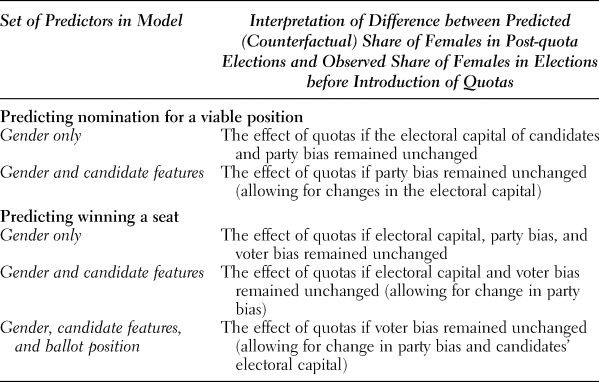
3. We use the model referring to the pre-quota elections to compute the predicted probabilities of being nominated for a viable list position (or winning a seat) by candidates running in the post-quota election. Subsequently, we can determine the expected number of male and female candidates nominated for a viable position (or elected) if the mechanisms of selection (described by the model) have changed since the reference pre-quota election. Knowing these parameters, it is easy to compute respective female shares. However, the set of candidates for whom probabilities are recalculated differs from pre-quota election both in terms of candidates’ numbers and their electoral capital. For that reason, including different sets of predictors in the models makes a difference in terms of the counterfactual interpretation of the results (Table 3).
4. Consequently, the differences between the effects computed using models with different sets of predictors can be used to estimate the importance in shaping the overall (net) effect of quotas of different factors: (1) change in number of female and male candidates, (2) change in average candidate electoral capital, (3) change in party bias, and (4) change in voters’ additional bias.
Counterfactual interpretations of the recalculation from “individual chances” to “electoral outcomes” metrics

RESULTS
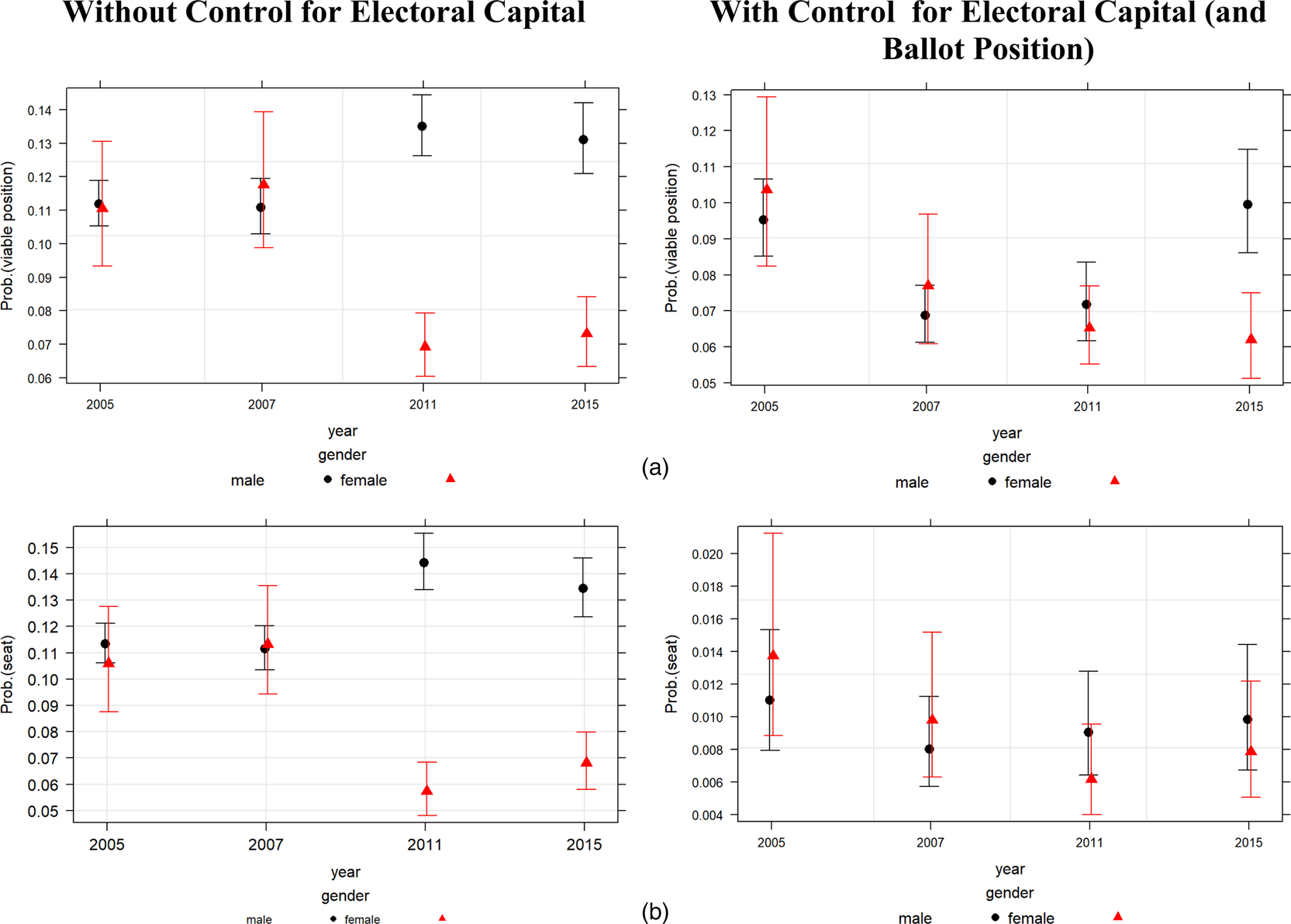
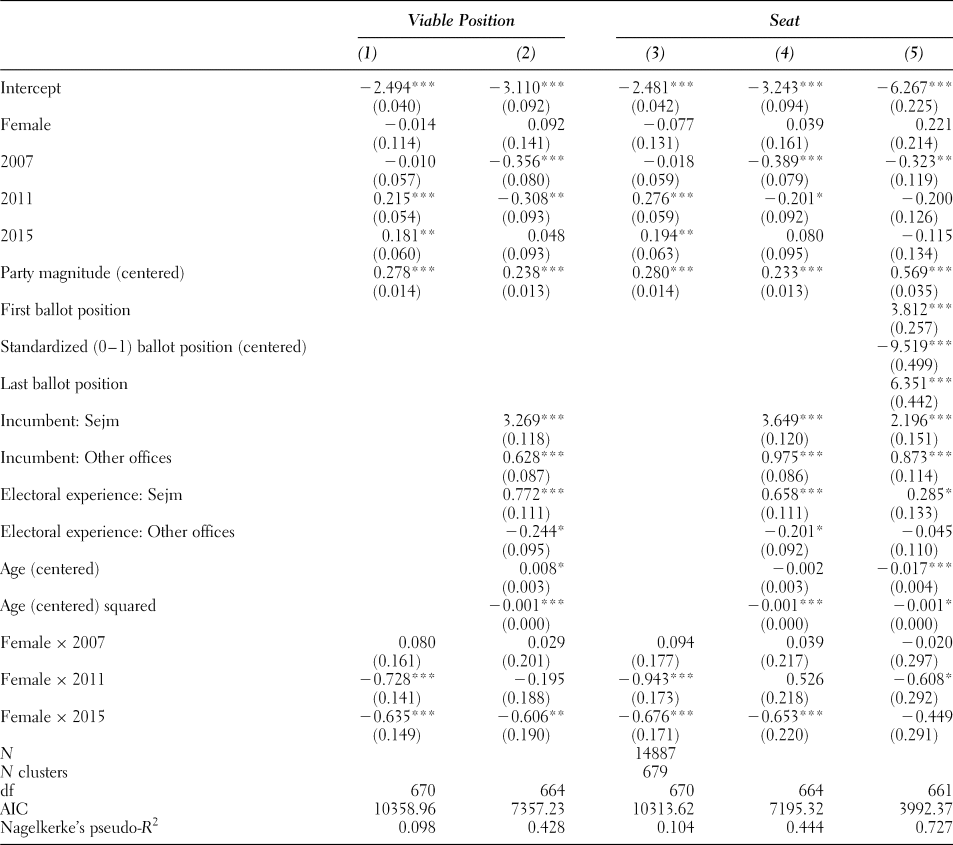
The results of the binary logistic regression analysis are displayed in Table 4. Models (1) and (2) explain the chances of being placed at a viable position, and models (3), (4), and (5) refer to the chances of receiving a seat. The models differ in terms of the included explanatory variables: models (1) and (3) do not account for the candidates’ electoral capital, and models (3) and (4) do not include the set of variables describing ballot positioning. In order to simplify the interpretation of the models with numerous interactions, we plotted the marginal effects (marginal effect at the meanFootnote 6) of candidate's gender in four consecutive elections—they are expressed as probabilities computed on the basis of the models with the full sets of predictors (Figure 4).
Marginal effects of gender on (a) being placed at a viable position, (b) winning a seat. Source: National Electoral Commission, own calculations.

Impact of legislative gender quotas on ballot ranking and preference voting: Results of binary logistic regression

*p<0.05, **p<0.01, ***p<0.00.
Source: National Electoral Commission, own calculations.
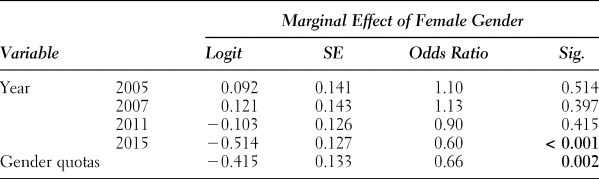
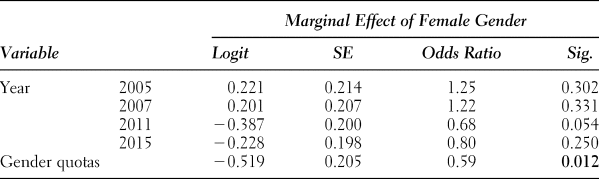
The regression analysis of electoral chances confirms some of the hypotheses. Once the candidates’ electoral capital is not controlled, the probabilities of female candidates being nominated at favorable ballot positions were significantly lower than in the case of male candidates in the 2011 and 2015 elections—that is, after the introduction of legislative gender quotas. The control for incumbency and political experience in the full models helps explain this gap; for the 2011 election, it even becomes statistically insignificant (Figure 4 and Table 5).
Estimates of gender bias in ballot ranking patterns: Viable position

Source: National Electoral Commission, own calculations.
These findings generally confirm that the additional bias in ballot ranking occurred along with the introduction of legislative gender quotas, which supports H 2. In case of the 2015 election, even if the main individual features of candidates were controlled, it was less likely that a female candidate was placed at a favorable position. H 1, regarding the ballot ranking bias unfavorable to women, is empirically supported only for the 2015 elections—it means that directly before the introduction of quotas, the less numerous female candidates were not systematically placed in worse ballot positions. In the first post-quota election, unfavorable bias was not statistically significant. We interpret these findings as evidence that parties (on average) counteracted quotas.
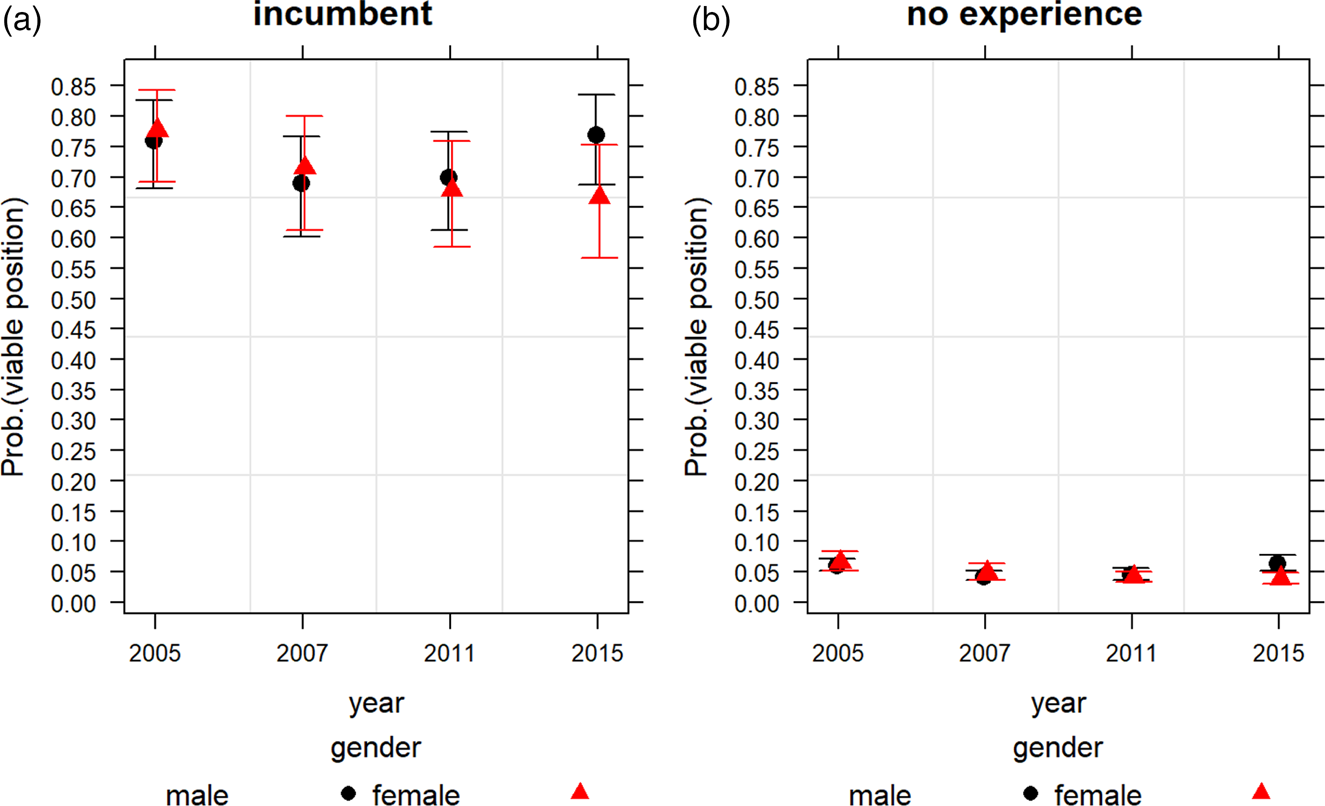
As Figure 5 demonstrates, the gender disparities in the chances of being placed in a viable list position occurred both among incumbents and candidates with the lowest electoral capital. However, the gender effects are of much lower magnitude than the effects of previous political experience. For example, in 2015, a male incumbent had on average a 76.9% chance of being placed in a viable position, while a female incumbent had a 71.7% chance on average. These probabilities estimated for inexperienced candidates equal 6.9% and 3.1%, respectively.
Marginal effects of gender on being placed at a viable position for (a) incumbents, (b) candidates with no previous political experience. The model specification assumes no interaction between the political experience (and other previous electoral experience) and gender or election year. As a result, for a given election, the effects are the same on each panel in the odds ratio metrics. Source: National Electoral Commission, own calculations.

Our analyses report the average effects for all parliamentary parties. The additional analyses demonstrate that these effects are generally consistent across parties.Footnote 7 The differences between parties are more pronounced once the observed shares of female candidates and their average placement are compared, but they are less visible once we account for the disparities in the distribution of electoral capital. In other words, we argue that parties differ more once we look at who is recruited for candidacy but less once we look how parties place comparable male and female candidates on their lists.
This can be illustrated with examples from the 2015 Sejm elections. If we look at the relatively favorable placement of women on the ballot lists of the Modern party (Nowoczesna) (42.9% of viable positions occupied by women, 42.9% women elected), this can be explained not only by internal party regulations in this respect but also by the fact that the differences between male and female candidates in terms of their electoral capital were much less pronounced in the Modern party than in other parties (in fact, an overwhelming majority of candidates of this party had no previous electoral experience). In case of the Civic Platform, in which female candidates were also placed relatively well, the shares of incumbents were similar among male and female candidates (16.8% and 15.3%, respectively). On the other side of the spectrum, the agrarian Polish Peasant Party in 2015 placed only 18.8% women on viable positions, yet the disproportion in electoral capital between male and female candidates was much more pronounced in this party (4.3% of male candidates were incumbents and only 0.5% of female candidates). The heterogeneity of the gender effects across parties certainly requires further analyses, particularly with the focus on the bias occurring at the candidate recruitment stage.
It seems that the introduction of legislative gender quotas in Poland did not bring a very clear shift in the distribution of voters’ personal preferences. We found no empirical evidence that the distribution of preference votes additionally positively discriminated in favor of women against men; thus we reject H 3. However, we found a small negative effect of the introduction of quotas, supporting H 4 and previous findings on the “paradoxical effect” of gender quotas in Poland. Even if we control for the political capital of candidates and ballot position effects (related to the ranking determined by party leaders), there is a significant difference in the probabilities of receiving a seat (Figure 4 and Table 6) between the pre-quota and post-quota periods. It is an open question whether this difference was just incidental and will fade out in the following years.
Estimates of gender bias in ballot ranking patterns: Seat

Source: National Electoral Commission, own calculations.
Studies of the distribution of preference votes, such as the previous study of Górecki and Kukołowicz (Reference Górecki and Kukołowicz2014), using vote counts data, are possibly more sensitive to the changes in the electoral behavior, yet our analyses demonstrate that small shifts in the distribution of preference votes do not automatically translate into differences in candidates’ chances of ultimately receive a seat.
These results, presented in the metrics of individual chances, can be also displayed—with the use of a counterfactual framework—in the metrics of seat shares, as we described earlier. The shares of female candidates placed at a viable positions and elected female legislators, predicted on the basis of the counterfactual reasoning, are presented in Figure 6 and Figure 7.
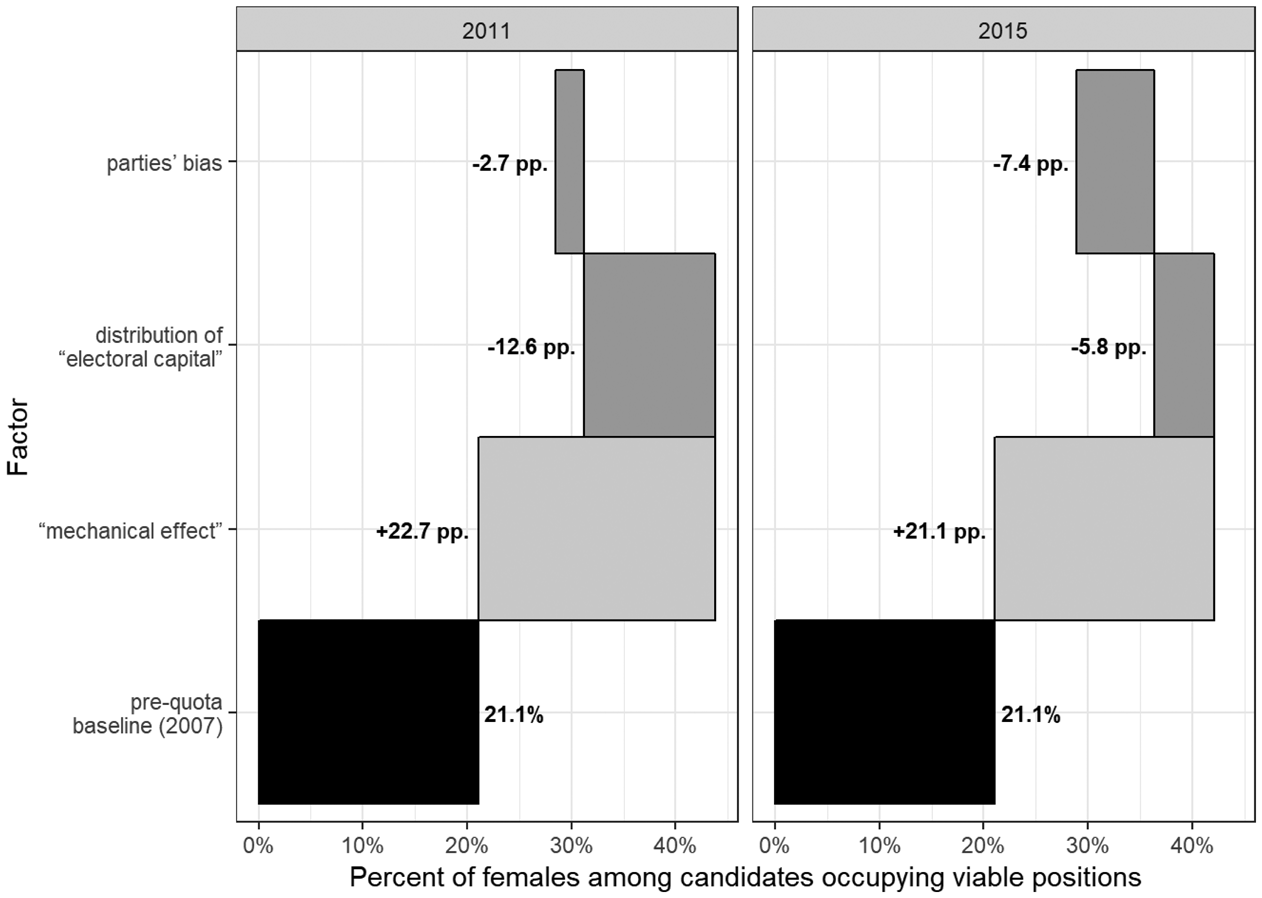
Predicted (counterfactual) shares of females among candidates occupying viable positions – significance of the factors influencing female representation. Source: National Electoral Commission, own calculations.

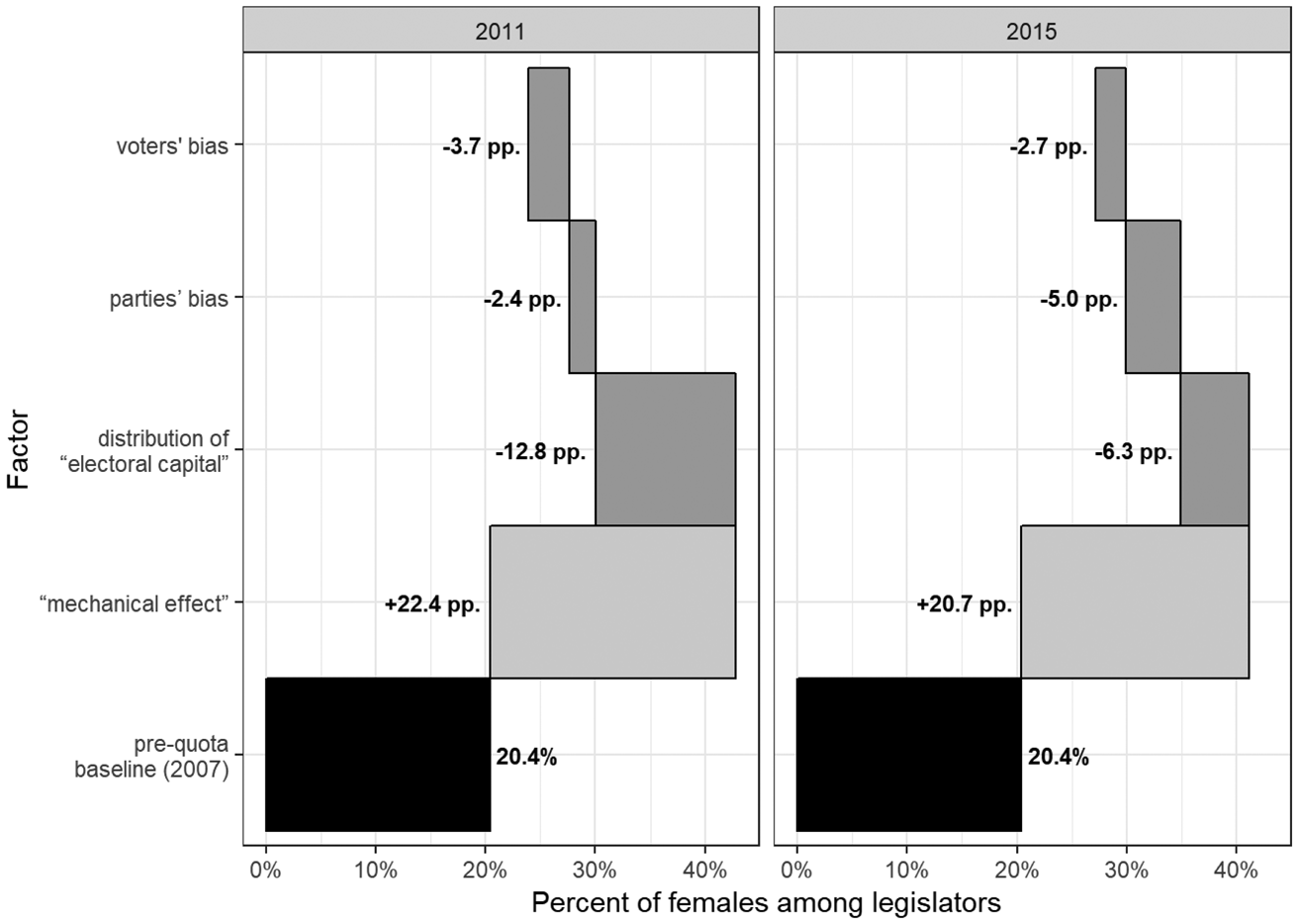
Predicted (counterfactual) shares of females among legislators – significance of the factors influencing female representation. Source: National Electoral Commission, own calculations.

These results allow us to break down the gap between the share of actually elected female legislators and the share of females predicted assuming a constant success rate of female candidates—that is, to determine which factors were the most important in diminishing the effect of the quota on female representation. Following our previous considerations, we are able to attribute the gap between the share of female candidates and the share of elected legislators to the main explanations: differences in the level of electoral capital, gender bias in party nominations (ballot ranking strategies), and gender bias in preference voting.
First we assume that if the gender bias expressed in preference voting (slightly favorable for women) had remained unchanged after the introduction of quotas, the share of female legislators would have been higher (Figure 7). According to our estimations, the elections would have resulted in 27.6% female legislators in 2011 (thus, 3.7 percentage points more than in reality) and 29.9% in 2015 (thus 2.7 percentage points more than in reality).
If, additionally, the gender bias expressed in ballot ranking had remained unchanged at the 2007 level, the share of female legislators would have been even higher: 30.0% in 2011 and 34.9% in 2015, that is, +6.1 percentage points and + 7.7 percentage points in comparison with the actual results, respectively. The same pattern refers to the share of women placed at a viable ballot position (Figure 6). According to our counterfactual model, if parties had not changed the ballot ranking patterns after the introduction of quotas, the shares of women placed on the top of the lists would have been 2.7 percentage points higher in 2011 and 7.4 percentage points higher in 2015.
However, these effects are rather small in comparison with the effect of electoral capital. If, in addition to party bias and voter bias, the main features of candidates had remained, on average, unchanged, the shares of women among legislators and among candidates placed high on the ballot would have been considerably higher than in reality. Shares of women among legislators would have been much closer to the parity: 18.9 percentage points higher than in reality (i.e., 42.8%) in 2011 and 14.0 percentage points higher than in reality (i.e., 41.2%) in 2015. Analogously, shares of women among top-ranked candidates would have been 15.3 percentage points higher in 2011 (estimated 43.8%) and 13.2 percentage points higher in 2015 (estimated 42.1%).
In the first electoral cycle after the introduction of quotas, the key factor diminishing the share of female legislators was the unequal distribution of political experience among candidates. Its impact was to a large extent mediated by ballot ranking patterns. Later, in the second elections after the introduction of quotas, the less favorable ballot positioning of women was still the most important factor reducing the impact of legislative gender quotas on the distribution of seats among candidates, yet a slightly different combination of factors affected candidates’ ranking. Once the share of female candidates with political experience (either incumbents or second-time runners) visibly increased, the role of negative party bias in ballot ranking became more visible.
Our analyses support the hypothesis that after the introduction of quotas, parties in general tended to adopt ballot ranking strategies that were less supportive of women. We identified the change, which deepened the systematic bias against women in ballot ranking, even when the changing vote-earning attributes were controlled. Finally, we found support for the assumption that the change in voters’ bias negatively influenced the shares of elected female candidates. It is likely that after the introduction of quotas, voters’ heuristics changed to slightly less supportive of women than in the pre-quota elections.
CONCLUSIONS
This article contributes to the empirical studies on gender quotas by capturing the impact of quotas on the multistage process of candidate selection in an OLPR system.
The analyses demonstrate that after the introduction of quotas, more women were placed on the lists and more were placed at relatively high positions in comparison to the pre-quota period (Jankowski and Marcinkiewicz Reference Jankowski and Marcinkiewicz2017). Our analyses contribute to the explanation of the discrepancy between the rise in the proportion of women among candidates and the rather small increase in the proportion of women elected. We conclude that the mechanical effect (increased number of women among all candidates) positively influenced the situation of women. However, changes in other factors examined—the distribution of electoral capital, party bias in ballot ranking, and additional voter bias in preference voting—counteracted the mechanical effect of quotas, visibly decreasing their ultimate net effect.
Our analyses demonstrate that differences in the electoral capital (previous political experience) at disposal of the candidates constitute a powerful explanation for the disparities between male and female candidates after the introduction of quotas. Yet it is obvious that this difference is largely dependent on previous nomination strategies and preexisting gender disparities in the political sphere. Nonetheless, we demonstrated that the quota regulations provide more women with the electoral experience (even if it is not a successful start). There is strong empirical evidence that this experience is a valuable resource in future elections—useful both to obtain a viable position on a list and to win a seat. These micro-level findings support the macro-level evidence that the quota regulations have a delayed impact on female representation (Thames Reference Thames2017).
Regardless of the observed differences in the share of female candidates between parties, our findings also demonstrate that party elites actively counteracted quota regulations with the use of ballot ranking strategies, as the systematic disproportions in candidates’ placement are difficult to explain solely by differences in political experience between male and female candidates. In the second electoral cycle after the introduction of quotas, the average party bias in ballot ranking patterns even increased, while the disproportions between male and female candidates in terms of electoral capital became less pronounced. It is likely that in the first election after the introduction of quotas, the low ballot positions of female candidates could be justified by their much lower political experience. In 2015, this factor had visibly lower discriminatory power.
However, the attribution of this additional bias to the strategies of particular parties requires further analysis, as the gaps of electoral capital between female and male candidates vary substantially between parties. They may depend on the internal regulations concerning list composition and the differences in the recruitment base of various parties.
The impact of preference votes on the distribution of seats among male and female candidates remains marginal. It is more likely that after the introduction of legislative gender quotas, voters preferred women relatively less than before—particularly in the 2011 election, where we observed a “paradoxical effect of quotas,” which corroborates the analyses of Górecki and Kukołowicz (Reference Górecki and Kukołowicz2014). Overall, once ballot positioning and vote-earning attributes are controlled, the remaining voter bias has a very small magnitude—if existent, this factor is definitely too small to balance the party bias and differences in candidates’ electoral capital.
Our contribution is not only of substantial but also of a methodological nature. We proposed how to relate two different metrics in which the effects of quotas can be expressed: of electoral chances (individual probabilities of being elected or placed at a viable position) and of aggregate electoral outcomes (share of female candidates or legislators). We addressed this problem with the use of counterfactual reasoning that allowed us to decompose the representation gap occurring in the electoral process and attribute its parts to the main explanations relevant in OLPR systems: candidates’ traits, bias in ballot ranking, and bias in preference voting.
Our results call for further research on the mechanisms of female representation after the implementation of legislative gender quotas. It would be valuable to adopt a counterfactual approach to studies of other electoral reforms aimed at increasing female representation under OLPR systems, for example, in Brazil (Wylie and Santos Reference Wylie and Santos2016) or Chile (Jones and Navia Reference Jones and Navia1999). Our models can be also further developed with a more refined set of candidate- and list-level indicators.
Adam Gendźwiłł is Assistant Professor at the University of Warsaw: a.gendzwill@uw.edu.pl; Tomasz Żółtak is a Researcher at the Educational Research Institute, Warsaw: t.zoltak@ibe.edu.pl