


Introduction
Suicide is one of the most significant public health problems worldwide, with certain populations, such as adolescents, being particularly vulnerable. Globally, it is the third leading cause of death among young people aged 15 to 29 years [1]. In Spain, nearly 4,000 people died by suicide in 2023, according to the National Statistics Report [2]. The situation for youth in Spain is even more alarming than globally, where suicide has become the leading non-accidental cause of death in children and adolescents [3].
Recognizing risk factors is a priority. It is well established that individuals who have previously attempted suicide are at significantly increased risk of subsequent attempts or death by suicide, particularly within the first year following the episode [Reference Alvarez-Subiela, Castellano-Tejedor, Verge-Muñoz, Esnaola-Letemendia, Palao-Vidal and Villar-Cabeza4]. In adolescents, previous research indicates that approximately 25% of those who have attempted suicide will reattempt within a year, making it the strongest known risk factor [Reference Hultén, Jiang, Wasserman, Hawton, Hjelmeland and De Leo5]. Therefore, identifying factors associated specifically with suicide reattempts is essential for informing preventive and clinical strategies for this high-risk subgroup.
There are additional challenges to studying suicide reattempts. One major difficulty lies in the definition of reattempt, which is neither simple nor standardized. Several literature reviews [Reference Mehanović, Rosso, Cuomo, Diecidue, Maina and Costa6,Reference Ezquerra, Alacreu-Crespo, Peñuelas-Calvo, Abascal-Peiró, Jiménez-Muñoz and Nicholls7] indicate that the concept of reattempt lacks clarity and consistency across studies. Most studies recruited patients in emergency rooms after what healthcare workers considered an index suicide attempt. In some studies, this index attempt served as the baseline to count future attempts. Thus, reattempters were defined as people who made an attempt after the recorded index attempt. In other cases, researchers defined reattempters using the number of lifetime attempts as reported by patients or clinical records. This inconsistency makes it difficult to compare existing evidence. Another important aspect is the timing of reattempts. Some studies use short timeframes, while others use longer-term follow-ups. In either case, the results are inconsistent – over time, the likelihood of a second attempt does not always decrease.
Another major issue in studying suicidal behavior is the inherent complexity of the phenomenon itself, as its causal mechanisms are not fully defined or clearly understood. This complexity makes the design of studies aimed at identifying specific risk factors particularly challenging. Traditional studies on suicidal behavior have generally relied on linear predictive models, such as regression-based approaches, which examine the independent contribution of individual risk factors to a specific outcome. While these methods have been valuable for identifying relevant predictors, they may oversimplify the multifactorial nature of suicidal behavior by assuming largely independent relationships between variables. However, suicidal behavior is increasingly conceptualized as the result of complex interactions among multiple psychological, social, and clinical variables rather than the consequence of isolated predictors. In this context, new approaches such as network analysis provide a useful framework to model these interactions by representing variables as interconnected nodes within a system. In the context of suicidal behavior, this perspective may help to better capture the multivariate and interconnected mechanisms that contribute to suicide risk, particularly in adolescent populations where multiple psychosocial and developmental factors often co-occur.
Taking this into account, we aim to identify modulating factors for suicide reattempt in clinical population of adolescents after an index suicide attempt. To this end, we conducted a network analysis that includes different elements, such as mental health problems, substance use variables, or social factors. This approach can highlight which variables are most central within the network, meaning those with the greatest influence on the probability of reattempt. Identifying these central factors would be useful for developing interventions that target the most important risk mechanisms and for improving suicide prevention strategies. From a clinical perspective, this approach may contribute to a more precise characterization of adolescents at high risk of suicide reattempt by highlighting the psychological and environmental variables that occupy a central position within the system of interactions. Focusing on these central nodes may help clinicians prioritize assessment and intervention strategies in emergency and follow-up settings, particularly by identifying adolescents who may benefit from early psychological support and targeted therapeutic approaches.
Therefore, the primary objective of this study was to identify modulating factors associated with suicide reattempts in a clinical population of adolescents following an index suicide attempt using network analysis.
The secondary objectives were:
-
1. To examine the structure of associations between sociodemographic, clinical, and psychosocial variables.
-
2. To identify the most central variables within the network structure.
-
3. To explore the potential role of a brief psychological intervention (SAM) in relation to reattempt outcomes.
Based on previous literature, we hypothesized that depressive symptoms, childhood trauma, and impulsivity would emerge as central nodes within the network.
Methods
Study design and settings
This longitudinal study conducted from January 2021 to March 2024, is part of the SURVIVE project (The Suicide Prevention and Intervention Study: Study Protocol for a Multisite Cohort Study with Nested Randomized-Controlled Trials) [Reference Pérez, Elices, Toll, Bobes, López-Solà and Díaz-Marsá8]. SURVIVE is the largest nationwide project in Spain, conducted by nine research centers: Hospital Clinic (Barcelona), Corporació Sanitaria Parc Taulí (Barcelona), Hospital Universitario La Paz (Madrid), Hospital Clínico (Madrid), Hospital Santiago de Áraba (Vitoria), Hospital Río Hortega (Valladolid), Hospital de Valdecilla (Cantabria), Hospital Virgen del Rocío (Sevilla), and Hospital Central Universitario (Asturias). Recruitment was conducted between January 1, 2021, and March 31, 2023. Given that the recruitment took place during the COVID-19 pandemic, temporal effects may have influenced clinical presentation; however, no specific variable capturing pandemic-related exposure was included in the network model, and therefore it could not be formally controlled for in the analyses.
Data collection and ethical considerations
We recruited patients seen in the emergency department for attempted suicide (DSM-5-TR criteria) [9] if they fulfilled the following inclusion criteria: adolescents aged between 12 and 17 years who had attempted suicide within the 15 days prior to recruitment and were receiving medical attention. Exclusion criteria included inability to sign the informed consent due to the clinical condition at the time of assessment, lack of verbal fluency in Spanish, and participating in other clinical trials when, in the opinion of the investigator, involvement in another study could interfere with the objectives, procedures, or outcomes of the SURVIVE study.
Trained psychologists and psychiatrists assessed participants in the 15 days following their admission to the emergency department due to a suicide attempt. The timing and setting of the baseline assessment varied depending on whether the participant was hospitalized. For nonhospitalized individuals, the baseline assessment was conducted at their mental health center within 15 days of the attempt. Hospitalized participants were assessed during hospitalization (if psychiatrically stable) or shortly post discharge, based on their condition and preferences. Assessments were conducted at two points in time: baseline and 12 months, and the same trained professionals conducted both assessments. We informed both the patient and the legal guardian.
Individuals who agreed to participate received an information sheet (adapted for minors) and an informed consent form that both the adolescent and the legal representative must sign. Participation was voluntary and could be withdrawn at any time. During the initial assessment, only the patient and a trained evaluator were present. We collected data through a semi-structured interview and participants completed self-report questionnaires during the interview.
The project underwent ethical review by the Ethics Committee at each participating center and also the project has been evaluated at the Clinical Research Ethical Committee of the Parc de Salut Mar (EC-Parc de Salut Mar). The current proposal complies with the national code of ethics of the national board of medicine and international (Declaration of Helsinki, Fortaleza, Brasil, Octubre 2013) guidelines, and with the national regulations: Ley 14/2007, 3rd of July of Investigación Biomédica, and Ley Orgánica 3/2018, 5th of December, regarding Protección de Datos Personales y Garantía de Derechos Digitales. Data protection is assured following EU regulations (General Data Protection Regulation 2016/679 and the Council of 27 April 2016). In compliance with Spanish and European Union regulations, the project received approval from the Juvenile Prosecution Service. All participants, along with their parents or legal guardians, provided written informed consent prior to enrolment.
Assessment
The baseline interview was face-to face, and we also conducted the 12-month interview in person whenever possible. When in-person assessment was not feasible (e.g., geographical distance, scheduling constraints, or public health restrictions during the COVID-19 pandemic), interviews were conducted by telephone and supplemented with a review of electronic clinical records to verify information, including details of the suicide attempt such as the dates and methods.
The baseline assessment consisted of an ad-hoc questionnaire to gather socio-demographic information, including age, sex, religion, migration status, current academic year, and course repetition [Reference Pérez, Elices, Toll, Bobes, López-Solà and Díaz-Marsá8].
Clinical data were collected using the Spanish versions of the following psychometric scales: The Columbia Suicide Severity Rating Scale (C-SSRS) [Reference Posner, Brown, Stanley, Brent, Yershova and Oquendo10,Reference Al-Halabí, Sáiz, Burón, Garrido, Benabarre and Jiménez11] is a clinician-administered rating scale to assess the severity and risk of suicidal thoughts and behaviors. Variables included in the study were: (i) the total number of suicide attempts defined as self-inflicted acts with at least some intent to die. We distinguish between one attempt (current) or more than one if previous attempts are reported; (ii) we assessed lethality of suicide attempts on a 6-point ordinal Likert scale from 0 (minor physical damage) to 5 (death) and (iii) severity of suicidal ideation, from 1 to 5, with 1 being the least severe and 5 being the most severe.
In addition, we have included three main variables related to reattempt: (i) Suicide reattempt, defined as a suicide attempt made after the baseline that prompted the patient’s recruitment. This is documented through patient or family reports or clinical records and is collected at the one-year follow-up. The main reattempt-related variables included are: (i) the presence or absence of a reattempt; (ii) the total number of reattempts after the baseline during the one-year follow-up, and (iii) the number of days from the initial evaluation to the reattempt.
Also, we included a variable for drug consumption during the baseline attempt defined as the use of substances within the 2 hours prior to the suicide attempt. The evaluators recorded it during the initial assessment. This variable was operationalized as three separate binary indicators (alcohol, cannabis, and other drugs), each coded as 0 (absence) or 1 (presence), and included as independent nodes in the network analysis.
The Mini International Neuropsychiatric Interview for Children and Adolescents (MINI-KID),
version 7.0.2 [Reference Sheehan, Sheehan, Shytle, Janavs, Bannon and Rogers12], is a structured clinical interview designed to assess psychiatric disorders in children and adolescents. It includes a series of standardized questions based on criteria of the Diagnostic and Statistical Manual of Mental Disorders, 4th Edition (DSM-IV). Psychiatric diagnoses were grouped into the following categories: (1) Affective disorders (including major depressive episode, dysthymic disorder, and mood dysregulation disorder); (2) Anxiety disorders (including panic disorder, agoraphobia, social anxiety disorder, obsessive-compulsive disorder, post-traumatic stress disorder, and generalized anxiety disorder); (3) Alcohol-related disorders (alcohol abuse and dependence); (4) Substance-related disorders (drug abuse and dependence); (5) Attention-deficit/hyperactivity disorder (ADHD); (6) Disruptive behavior disorders (conduct disorder and oppositional defiant disorder); (7) Psychotic disorders; (8) Eating disorders (anorexia nervosa and bulimia nervosa); and (9) Adjustment disorders.
The Patient Health Questionnaire-9 (PHQ-9) [Reference Kroenke, Spitzer and Williams13,Reference Diez-Quevedo, Rangil, Sanchez-Planell, Kroenke and Spitzer14] is a self-report screening instrument to assess the severity of depressive symptoms over the past 2 weeks. The total severity score ranges from 0 to 27, with higher scores indicating greater clinical severity of depressive symptoms.
The Barratt Impulsiveness Scale (BIS-11) [Reference Patton, Stanford and Barratt15,Reference Martínez-Loredo, Fernández-Hermida, Fernández-Artamendi, Carballo and García-Rodríguez16] is a self-report scale used to assess trait impulsivity. It consists of 30 items grouped into three subscales: attentional, motor, and non-planning impulsivity. We also calculated a total score.
The Childhood Trauma Questionnaire-Short Form (CTQ-SF) [Reference Hernandez, Gallardo-Pujol, Pereda, Arntz, Bernstein, Gaviria, Labad, Valero and Gutiérrez-Zotes17,Reference Bernstein and Fink18] is a retrospective self-report inventory that screens for maltreatment across five domains (emotional abuse, physical abuse, sexual abuse, emotional neglect, and physical neglect), yielding subscale scores and a total maltreatment score. Higher values indicate greater trauma exposure.
The Strengths and Difficulties Questionnaire (SDQ) [Reference Goodman19,Reference Ortuño-Sierra, Sebastián-Enesco, Pérez-Albéniz, Lucas-Molina and Fonseca-Pedrero20] is a self-report scale used to evaluate behavioral and emotional difficulties, as well as assess strengths in children and adolescents. It consists of 25 items divided evenly into five subscales: emotional problems, conduct problems, hyperactivity/inattention, peer relationship problems, and prosocial behavior. Higher scores indicate more problems. A license from copyright holder was obtained previous to use.
Clinical intervention: In addition to considering socio-demographic and clinical variables as potential modulators of suicidal behavior, the study included a variable related to a clinical intervention that may have a positive influence. We performed a clinical intervention called the Self-Awareness of Mental Health (SAM) as part of the study. We developed it specifically for this study based on interventions used in previous research [Reference Pérez, Elices, Toll, Bobes, López-Solà and Díaz-Marsá8]. It consists of a manual, individual psychotherapeutic approach aimed at adolescents aged 12 to 17. Its objective is to enhance awareness of mental health and improve the skills necessary to cope with adverse life events, stress, and suicidal behaviors. To study the utility of SAM, we included two arms: one arm combines SAM with Treatment as Usual (TAU) and the other consists of TAU alone. Participants were assigned to one of two treatment groups according to a 1:1 algorithm [Reference Pérez, Elices, Toll, Bobes, López-Solà and Díaz-Marsá8,Reference García-Fernández, Couce-Sánchez, Andreo-Jover, Ayad-Ahmed, Bobes Bascarán and Boti21].
Power analysis
A priori power analysis was conducted within the broader SURVIVE project to estimate the required sample size for a two-arm parallel-group randomized controlled trial with a 12-month follow up, analyzed using repeated-measures Analysis of Covariance (ANCOVA) adjusted for baseline scores [Reference Borm, Fransen and Lemmens22]. Calculations assumed a two-sided alpha level of 0.05, statistical power of 80% (β = 0.20), an expected standardized effect size (Cohen’s d) of 0.375, and a between-wave correlation (ρ) of 0.30. Under these assumptions, the estimated sample size required to detect a statistically significant between-group difference was 94–95 participants per group. To account for an anticipated 30% attrition rate, we targeted a final sample size of 135 participants per group, yielding a total sample of 270 participants [Reference García-Fernández, Couce-Sánchez, Andreo-Jover, Ayad-Ahmed, Bobes Bascarán and Boti21].
Data analysis
Initially, for the descriptive analysis of sociodemographic and clinical variables, we used means and frequencies.
Due to the presence of missing data across several variables, we implemented a multivariable imputation approach to preserve the structural integrity of the dataset prior to conducting network analyses. The k-Nearest Neighbors (KNN) algorithm was employed – an instance-based, non-parametric imputation method that estimates missing values based on the values of the k most similar observations. This approach is suitable for datasets with both continuous and categorical variables and leverages local data structure to minimize imputation bias. We set k = 5, following prior empirical recommendations that balance the trade-off between overfitting and generalization in KNN-based imputations [Reference Troyanskaya, Cantor, Sherlock, Brown, Hastie and Tibshirani23] The imputation was performed in R using the VIM package, and the completed dataset was subsequently used in all statistical analyses. Subsequently, we examined the relationships between the various variables using Spearman correlations, which served as the basis for constructing the graph model.
We visualize our network analyses as figures composed of nodes and edges, where the nodes correspond to the variables of interest and the edges represent the Spearman correlations between those variables. To facilitate interpretation, we excluded correlations with absolute values below 0.2 from the graphical representation of the network. This threshold was selected because a Spearman correlation coefficient of approximately 0.2 is commonly interpreted as indicating a weak association in behavioral and clinical research [Reference Akoglu24]. Applying this threshold reduces visual noise and prevents the network graph from becoming overly dense, thereby improving interpretability. It is important to note that this threshold was applied only for the purpose of visualization and does not alter the underlying correlation estimates used in the analysis.
To visualize the relationships, we used the Fruchterman–Reingold algorithm [Reference Fruchterman and Reingold25]. This is a force-directed graph drawing algorithm designed to display networks in an aesthetically pleasing and intuitive manner, where the distance between nodes reflects the strength of the correlation: the farther apart two nodes are, the weaker their association. Additionally, the algorithm places more influential variables toward the center of the graph, and less influential ones in more peripheral positions. As a result, closely related variables tend to cluster together, and the most central ones occupy more prominent locations in the network.
In network analysis, beyond graphical representation, there are key metrics that provide insight into the role of each node within the network structure – these are known as centrality measures, which quantify the influence of a node in the overall configuration. The centrality measures used in this study are:
-
• Strength centrality is a local measure that reflects the total direct connectivity of a node. In weighted networks, the strength of a node is calculated as the sum of the absolute weights of all edges connected to it. A node with high strength centrality is one that is strongly and directly connected to many others, indicating a high potential for direct influence or vulnerability to influence from other variables.
-
• Closeness centrality measures how close a node is to all other nodes in the network. If a node is disconnected from some or all others (i.e., no edge exists because the correlation is less than |0.2|), it cannot reach the rest of the network. As a result, closeness centrality is undefined for these isolated nodes, reflecting their lack of integration within the network structure. This indicates that, under the applied threshold, these variables do not exhibit sufficiently strong associations with others to be meaningfully positioned within the overall pattern of connectivity.
-
• Betweenness centrality is another global metric that captures the extent to which a node acts as a bridge along the shortest paths between other pairs of nodes. Betweenness centrality is particularly useful for identifying nodes that play a crucial mediating role in the transmission of information or influence, especially between otherwise weakly connected parts of the network.
To evaluate the robustness of both edge weights and centrality indices, we used the bootnet package in R, applying a non-parametric bootstrap approach. This involved generating 1,000 bootstrap samples by randomly resampling rows with replacement to estimate the variability of edge weights. To assess the stability of centrality metrics, we employed the Correlation Stability coefficient (CS-coefficient), focusing on maintaining correlations of r ≥ 0.5r between the original centrality values and those derived from the bootstrapped samples. The CS-coefficient reflects the maximum proportion of the sample that can be omitted while preserving correlations of at least r = 0.5r with 95% confidence.
All centrality measures mentioned above, along with the Fruchterman–Reingold algorithm, were calculated using the R programming language, employing the qgraph package (version 1.9.5) for both network plotting and model estimation.
Results
Sociodemographic and clinical characteristics
Out of the total of 287 patients included in the sample, 250 (87.1%) were girls and 37 (12.9%) were boys, with a mean age of 14.99 years (SD = 1.51). The main sociodemographic variables included a predominance of adolescents born in Spain (81.1%), non-religious (61.7%), enrolled in compulsory secondary school (71.9%), and not repeating a grade (73.3%).
The suicide-related characteristics of the sample included a mean number of suicide attempts per patient of 2.44 (SD = 2.34), with a single suicide attempt the most frequent value. In terms of ideation intensity, 34.2% (N = 97) experienced their most severe suicidal ideation before the attempt. Concerning lethality of the actual suicide attempt, 30.8% (N = 82) did not sustain any type of injury, 33.8% (N = 90) sustained minor injuries, 24.8% (N = 66) sustained moderate injuries, 8.6% (N = 23) sustained moderate injuries requiring hospitalization, and 1.9% (N = 5) sustained severe injuries. Only 6.3% (N = 18) of adolescents consumed alcohol prior to the attempt, 4.2% (N = 12) used cannabis, and 0.4% (N = 1) used other drugs.
From the total of the sample, 68 adolescents reattempted suicide, conforming 24.8% (25.94% of the girls and 17.14% of the boys). The mean number of days until reattempt was 176.88 days (SD = 109.10).
In terms of clinical characteristics, the most common issues were affective problems, followed by anxiety problems according to the MINI-KID. Based on PHQ-9 total scores, 97.5% of the patients present clinical depression. The mean score of the sample was 17.93 (SD = 5.60), indicating moderately severe depression.
Tables 1 and 2 provide more information on the clinical and sociodemographic characteristics of the sample.
Sociodemographic characteristics of the sample

Table 1. Long description
The table is divided into two main sections.
Section 1: Continuous Variable
- Age: N = 287, Mean = 14.99, S D = 1.51.
Section 2: Categorical Variables (Variable, Category, N, Frequency percentage)
- Sex: Female (250, 87.1 percent), Male (37, 12.9 percent).
- Home country: Spain (231, 81.1 percent), Europe (2, 0.7 percent), South America (25, 8.8 percent), Asia (1, 0.3 percent), Other (26, 9.1 percent).
- Religion: Practicing (101, 35.8 percent), Non-practicing (174, 61.7 percent), Others (7, 2.5 percent).
- Current academic year: Primary education (3, 1.0 percent), Compulsory secondary school (205, 71.9 percent), Baccalaureate degree (55, 19.3 percent), Vocational training (18, 6.3 percent), Has drop school (4, 1.4 percent).
- Grade repeaters: No (209, 73.3 percent), Yes (76, 26.7 percent).
Clinical characteristic of the sample
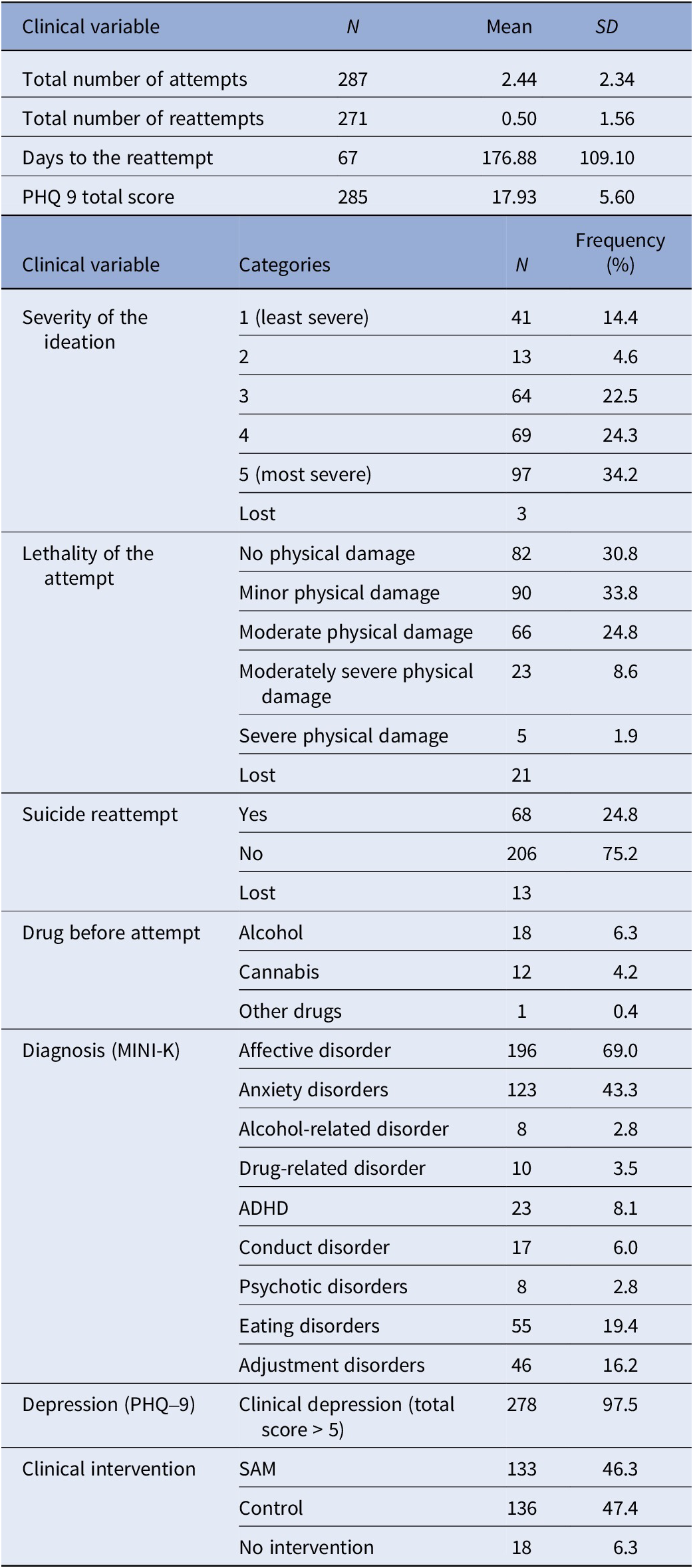
Table 2. Long description
The table is divided into two main sections.
Section 1: Continuous Variables (N, Mean, S D)
* Total number of attempts: N 287, Mean 2.44, S D 2.34.
* Total number of reattempts: N 271, Mean 0.50, S D 1.56.
* Days to the reattempt: N 67, Mean 176.88, S D 109.10.
* P H Q 9 total score: N 285, Mean 17.93, S D 5.60.
Section 2: Categorical Variables (N, Frequency percentage)
* Severity of ideation: Ranges from 1 (least severe) at 14.4 percent to 5 (most severe) at 34.2 percent.
* Lethality of attempt: No physical damage (30.8 percent), Minor (33.8 percent), Moderate (24.8 percent), Moderately severe (8.6 percent), and Severe (1.9 percent).
* Suicide reattempt: Yes (24.8 percent), No (75.2 percent).
* Drug before attempt: Alcohol (6.3 percent), Cannabis (4.2 percent), Other drugs (0.4 percent).
* Diagnosis (M I N I K): Affective disorder (69.0 percent), Anxiety disorders (43.3 percent), Eating disorders (19.4 percent), Adjustment disorders (16.2 percent), A D H D (8.1 percent), Conduct disorder (6.0 percent), Drug-related (3.5 percent), Alcohol-related (2.8 percent), and Psychotic disorders (2.8 percent).
* Depression (P H Q 9): Clinical depression (total score greater than 5) at 97.5 percent.
* Clinical intervention: S A M (46.3 percent), Control (47.4 percent), No intervention (6.3 percent).
Abbreviations: ADHD, Attention Deficit Hyperactivity Disorder; MINI-K, Mini International Neuropsychiatric Interview for Children and Adolescents; PHQ-9, Patient Health Questionnaire; SAM, Self-Awareness of Mental Health.
Table 3 displays the scores obtained from the BIS-11, SDQ, and CTQ-SF assessments, including subscale scores analyzed in the network. Participants reported moderate levels of impulsivity on the BIS-11, with a total mean score of 60.00 (SD = 14.05). Among the subscales, non-planning impulsivity showed the highest average (M = 21.50, SD = 7.15). On the SDQ, the total difficulties score averaged 20.64 (SD = 5.18), indicating elevated emotional and behavioral challenges, particularly in emotional symptoms (M = 7.07, SD = 1.90). Regarding CTQ-SF, the highest scores were emotional abuse (M = 3.05, SD = 1.12) and emotional neglect (M = 2.70, SD = 1.06), suggesting a greater prevalence of emotional over physical or sexual adversity.
Assessment outcomes on emotional, behavioral, and trauma-related measures
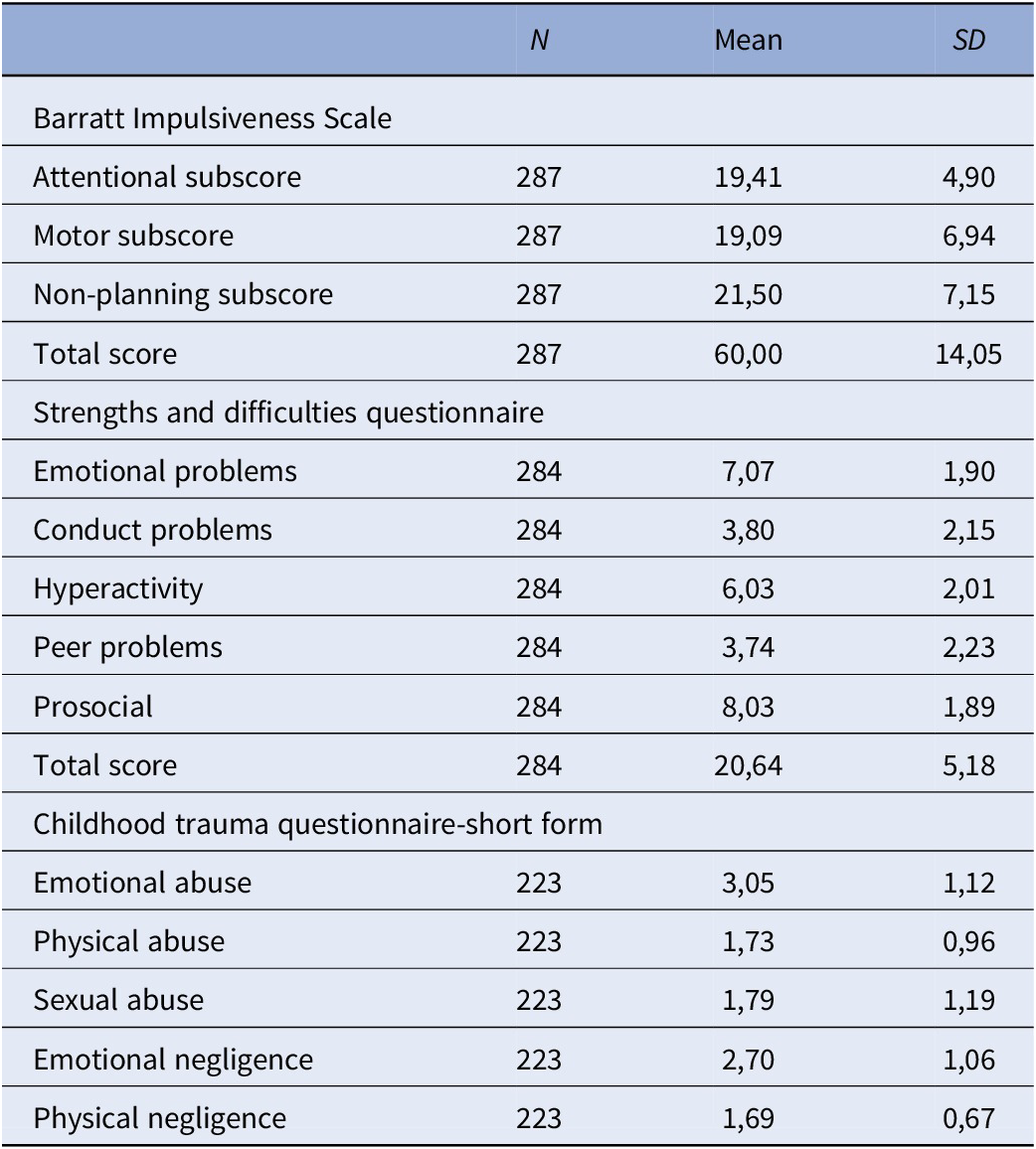
Table 3. Long description
The table contains four columns: Measure, N, Mean, and S D. It is divided into three sections.
1. Barratt Impulsiveness Scale (N = 287 for all):
- Attentional subscore: Mean 19,41, S D 4,90.
- Motor subscore: Mean 19,09, S D 6,94.
- Non-planning subscore: Mean 21,50, S D 7,15.
- Total score: Mean 60,00, S D 14,05.
2. Strengths and difficulties questionnaire (N = 284 for all):
- Emotional problems: Mean 7,07, S D 1,90.
- Conduct problems: Mean 3,80, S D 2,15.
- Hyperactivity: Mean 6,03, S D 2,01.
- Peer problems: Mean 3,74, S D 2,23.
- Prosocial: Mean 8,03, S D 1,89.
- Total score: Mean 20,64, S D 5,18.
3. Childhood trauma questionnaire-short form (N = 223 for all):
- Emotional abuse: Mean 3,05, S D 1,12.
- Physical abuse: Mean 1,73, S D 0,96.
- Sexual abuse: Mean 1,79, S D 1,19.
- Emotional negligence: Mean 2,70, S D 1,06.
- Physical negligence: Mean 1,69, S D 0,67.
Centrality measures
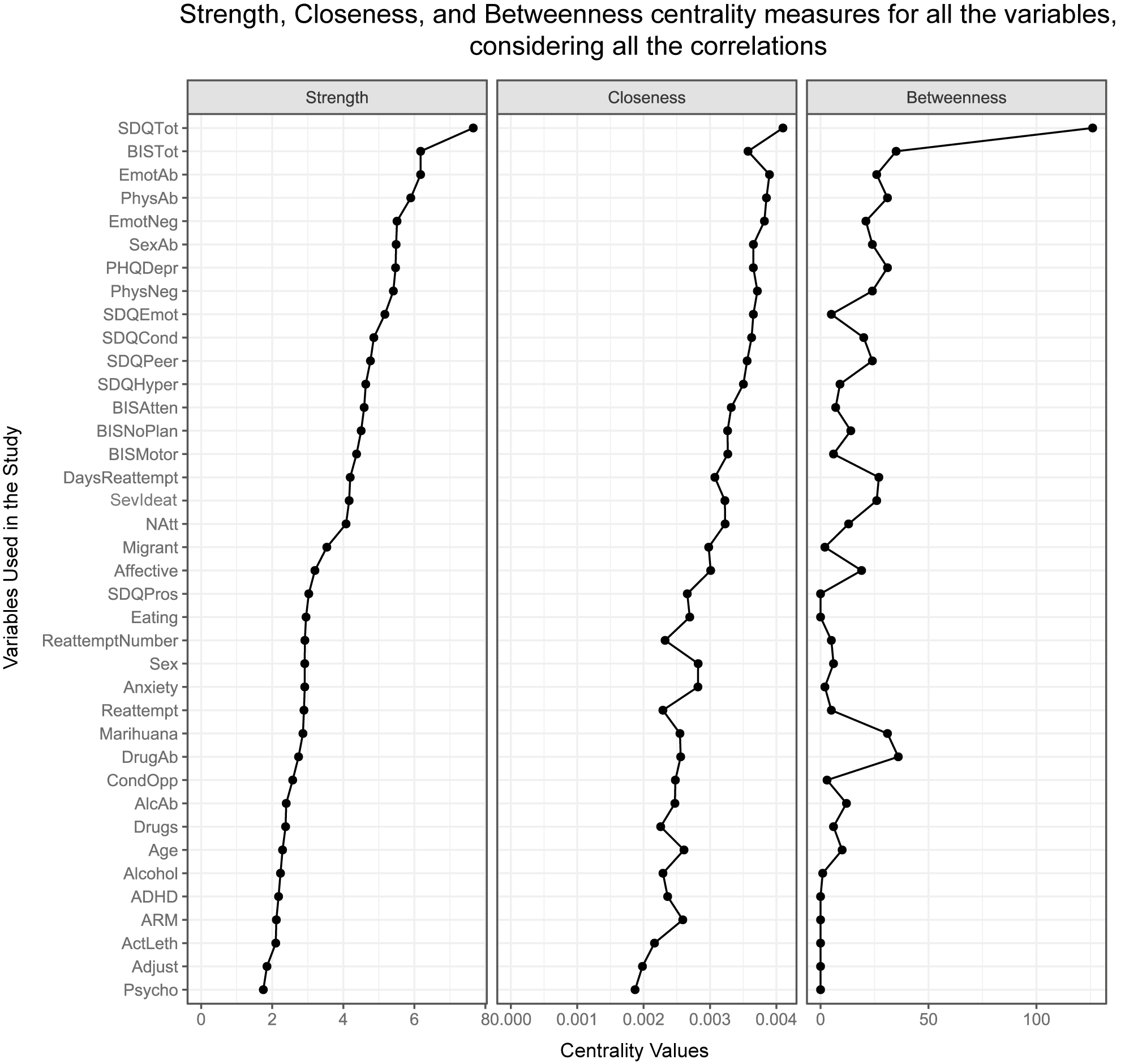
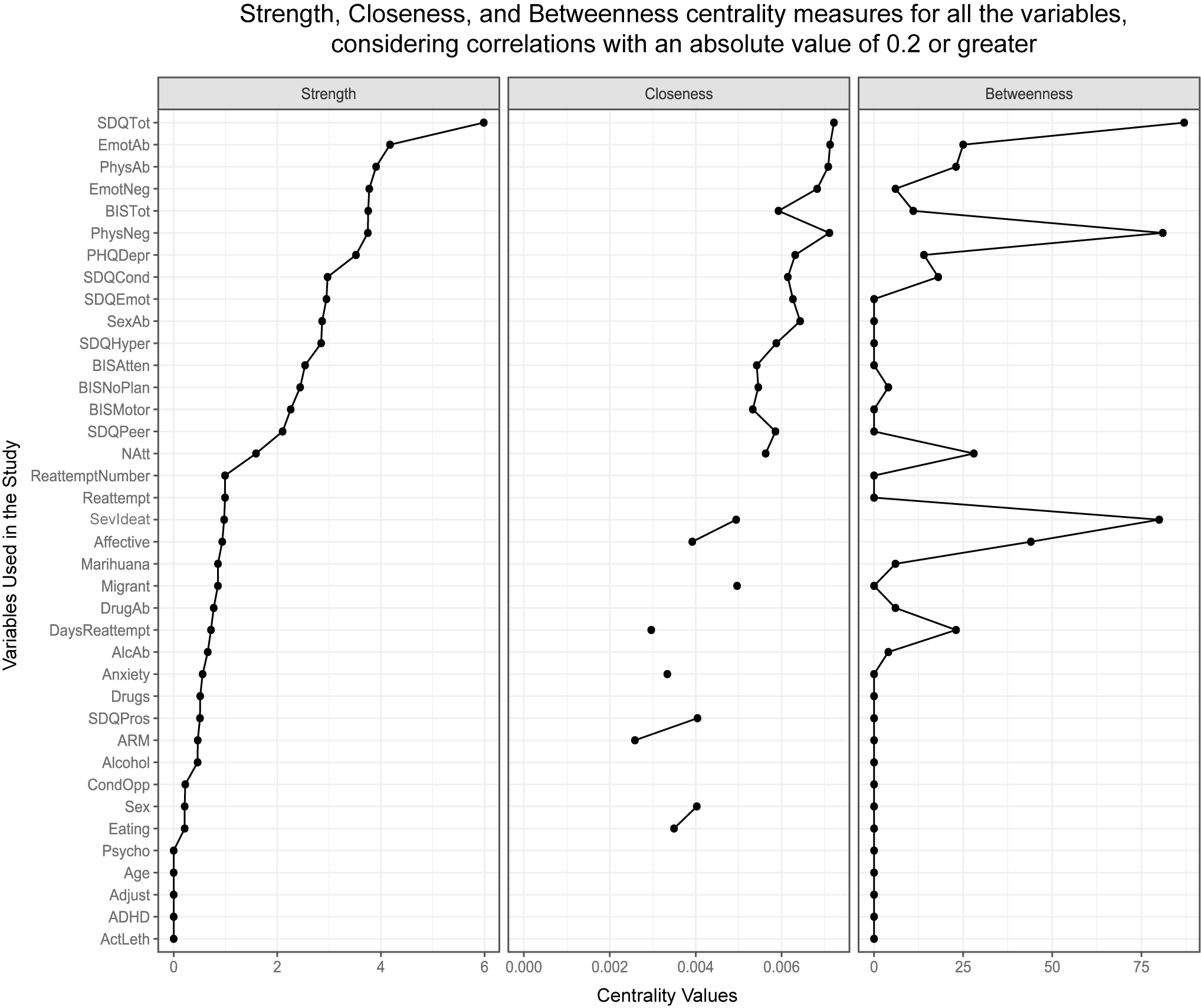
Centrality measures are in Figures 1 and 2, with Figure 2 displaying the measures using a correlation threshold of 0.2. In all cases, the total score on the SDQ scale is the variable with the greatest effect on the others. Other important variables are those related to emotional abuse, which are the second most influential. Contrary to expectations, age, sex, adjustment disorders, and lethality of the attempt have less prominent positions, appearing at the tail end of the graphs in all three centrality measures.
Strength, Closeness, and Betweenness centrality measures for all variables, considering all correlations.

Figure 1. Long description
A multi-panel figure with three vertical panels titled Strength, Closeness, and Betweenness. The Y-axis lists 38 variables used in the study, including S D Q Tot, B I S Tot, Emot Ab, Phys Ab, P H Q Depr, Anxiety, and Psycho. The X-axis represents Centrality Values with different scales for each panel.
* Strength Panel: Shows a relatively linear decrease in centrality from top to bottom. S D Q Tot has the highest value near 8, while Psycho has the lowest near 2.
* Closeness Panel: Displays values concentrated between 0.002 and 0.004. The trend is generally stable with minor fluctuations, peaking at S D Q Tot and dipping at Psycho.
* Betweenness Panel: Shows high variability. S D Q Tot has the highest centrality value near 125. Most other variables, such as S D Q Pros, Eating, and Psycho, cluster near 0, with notable secondary peaks for Drug Ab and Marihuana.
Across all three panels, S D Q Tot consistently ranks as the most central variable, while variables at the bottom of the list like Adjust and Psycho consistently show the lowest centrality measures.
Strength, Closeness, and Betweenness centrality measures for all variables, considering correlations with an absolute value of 0.2 or greater.
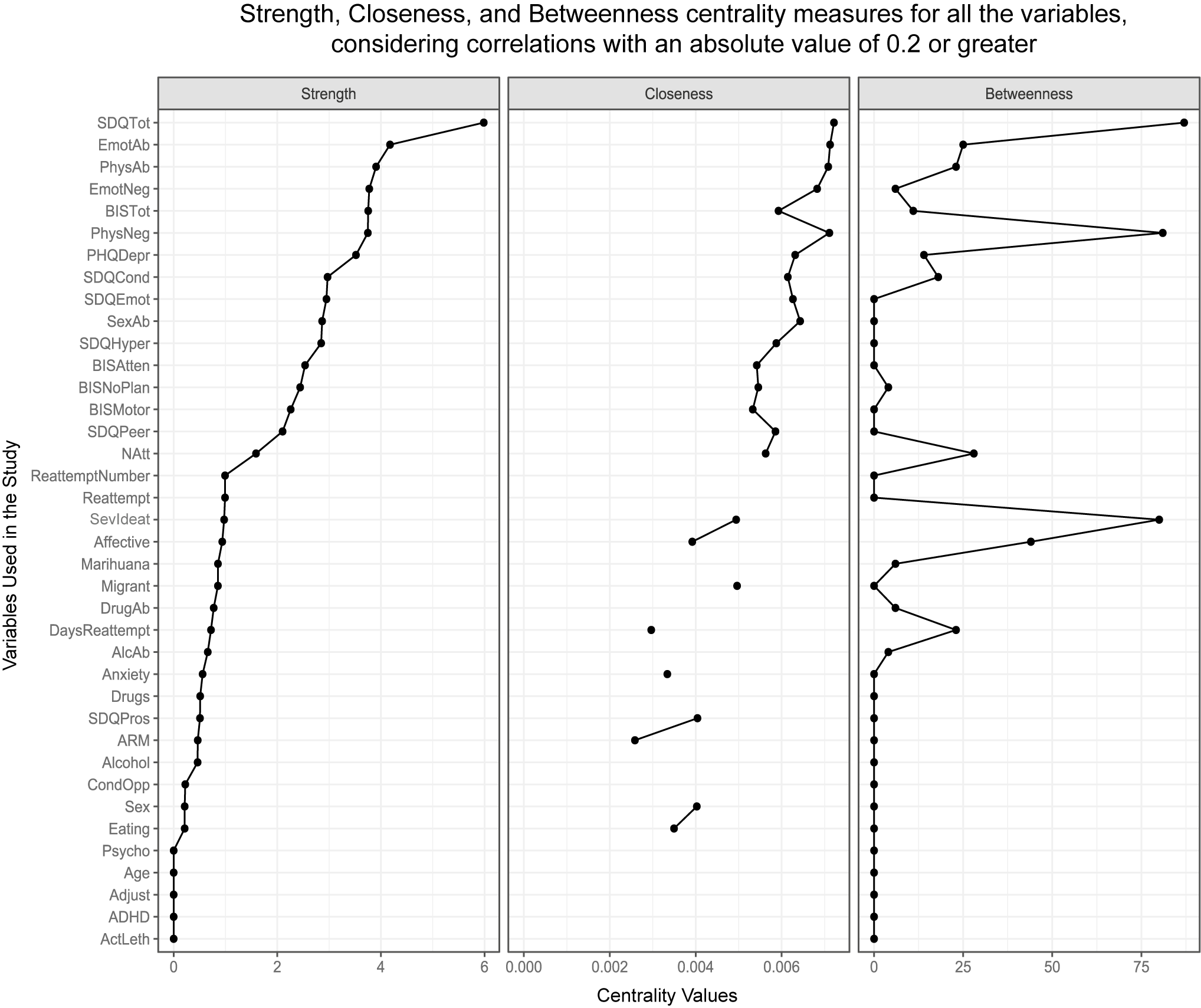
Figure 2. Long description
The figure consists of three vertical panels sharing a common Y-axis labeled Variables Used in the Study. The Y-axis lists 40 variables from top to bottom, starting with S D Q Tot and ending with Act Leth. The X-axis for all panels is labeled Centrality Values.
* The first panel, Strength, has an X-axis from 0 to 6. The data shows a generally linear decrease in strength values as it moves down the list of variables. S D Q Tot has the highest value near 6, while the bottom variables like A D H D and Act Leth are near 0.
* The second panel, Closeness, has an X-axis from 0.000 to 0.006. The data points are concentrated between 0.003 and 0.007 for the top half of the variables, with several gaps and disconnected segments in the lower half of the list.
* The third panel, Betweenness, has an X-axis from 0 to 75. The data shows high volatility with several sharp peaks. Notable peaks occur at Phys Neg (near 75), Sev Ideat (near 75), and N Att (near 25). Most variables in the bottom third of the list have betweenness values at or near 0.
Correlation between variables
Supplementary Table 1 details the Spearman correlations between all the key variables included in the study. Figures 3 and 4 show two different visualizations of graphs (networks). To facilitate interpretation, we present two complementary network visualizations: the complete network including all correlations and a simplified network including only correlations with |r| ≥ 0.2. The latter allows clearer visual identification of the strongest relationships among variables.
Fruchterman-Reingold graph representation of the Spearman correlations.

Figure 3. Long description
A network diagram with circular nodes of various colors connected by blue and red lines of varying thickness.
* Top-Left Quadrant: Contains nodes for Psycho (pink), ActLeth (orange), Reattempt Number (orange), Reattempt (orange), Days Reattempt (orange), and A R M (white).
* Top-Right Quadrant: Includes Adjust (pink), Affective (pink), Eating (pink), Anxiety (pink), AlcAb (pink), DrugAb (pink), Sex (red), Age (red), and A D H D (pink).
* Bottom-Left Quadrant: Features PhysNeg (light green), EmotAB (light green), EmotNeg (light green), PhysAb (light green), SexAb (light green), Migrant (red), S D Q Pros (dark green), and S D Q Cond (dark green).
* Bottom-Right Quadrant: Contains P H Q Depr (purple), S D Q Peer (dark green), S D Q Emot (dark green), S D Q Tot (dark green), S D Q Hyper (dark green), CondOpp (pink), Marihuana (blue), Alcohol (blue), Drugs (blue), B I S Atten (light blue), B I S Tot (light blue), B I S Motor (light blue), and B I S NoPlan (light blue).
Thick blue lines indicate strong positive correlations, notably between S D Q Tot and S D Q Cond, and between B I S Tot and its subscales.
A legend on the right identifies the color coding:
* Light blue: B I S-11
* Dark blue: Substance Pre-Attempt
* Light green: C T Q-S F
* Dark green: S D Q
* Pink: M I N I-K I D
* Red: Age/Sex/Migrant
* Light orange: Suicide Related Variables
* Dark orange: Attempt Repetition
* Purple: P H Q-9
Graph (network) representation of the Spearman correlations, placing all the nodes in a circle.

Figure 4. Long description
A circular network diagram with 42 nodes arranged in a ring. Starting from the top and moving clockwise, the nodes are color-coded by category:
* Red: Sex, Age.
* Purple: P H Q Depr.
* Light Blue: B I S Atten, B I S Motor, B I S No Plan, B I S Tot.
* Yellow: N Att, Act Leth, Sev Ideat.
* Dark Blue: Alcohol, Marihuana, Drugs.
* Pink: Affective, Anxiety, Alc Ab, Drug Ab, A D H D, Cond Opp, Psycho, Eating, Adjust.
* Light Green: Emot Ab, Phys Ab, Sex Ab, Emot Neg, Phys Neg.
* Dark Green: S D Q Tot, S D Q Emot, S D Q Cond, S D Q Hyper, S D Q Peer, S D Q Pros.
* Red: Migrant.
* Orange: Reattempt, Reattempt Number, Days Reattemp.
* White: A R M.
The interior of the circle is filled with a dense web of connecting lines. Blue lines represent positive correlations, while red lines represent negative correlations. The thickness of the lines indicates the strength of the Spearman correlation. Notably thick blue lines connect B I S Tot to other B I S nodes and S D Q Tot to other S D Q nodes.
A legend on the right maps colors to categories:
* Light Blue: B I S - 11
* Dark Blue: Substance Pre-Attempt
* Light Green: C T Q - S F
* Dark Green: S D Q
* Pink: M I N I - K I D
* Red: Age / Sex / Migrant
* Yellow: Suicide Related Variables
* Orange: Attempt Repetition
* Purple: P H Q - 9
Nodes (vertices) represent each variable and their color denotes their class (e.g. BIS-11, CTQ-SF, and SDQ). Edge (link) widths are proportional to the correlation between variables, where positive correlation (direct relationship) is represented in blue, while negative correlation is represented in orange. The graph in Figure 3 was drawn with the Fruchterman–Reingold algorithm [Reference Fruchterman and Reingold25]. Figure 5 shows another graph drawn with the Fruchterman–Reingold algorithm, but including only those with at least a weak correlation (those whose absolute values were greater than or equal to 0.2) [Reference Akoglu24]. Likewise, Figure 6 follows the same visualization method as Figure 4, with a correlation threshold of 0.2.
Fruchterman-Reingold graph representation of the Spearman correlations with an absolute value of 0.2 or greater.

Figure 5. Long description
The network consists of circular nodes connected by edges. Blue edges represent positive correlations and red edges represent negative correlations.
At the center is a dense cluster of interconnected nodes including:
* Light green nodes: Phys Neg, Phys Ab, Emot Ab, Emot Neg, and Sex Ab.
* Dark green nodes: S D Q Peer, S D Q Emot, S D Q Tot, S D Q Cond, and S D Q Hyper.
* Light blue nodes: B I S No Plan, B I S Tot, B I S Atten, and B I S Motor.
* A purple node labeled P H Q Depr is situated between the light green and dark green clusters.
To the left of the central cluster are several loosely connected or isolated nodes:
* Orange nodes: N Att, Sev Ideat, and Days Reattemp.
* Pink nodes: Eating, Anxiety, and Affective.
* A dark blue cluster at the bottom left includes Marihuana, Alcohol, and Drugs.
* Red nodes: Age, Sex, and Migrant are located at the top and left periphery.
* Isolated nodes at the top left include Psycho, Act Leth, Reattempt Number, and Reattempt.
* A single white node labeled A R M is at the bottom.
A legend on the right identifies the color coding:
* Light blue: B I S 11
* Dark blue: Substance Pre Attempt
* Light green: C T Q S F
* Dark green: S D Q
* Pink: M I N I K I D
* Red: Age or Sex or Migrant
* Light orange: Suicide Related Variables
* Dark orange: Attempt Repetition
* Purple: P H Q 9
Graph (network) representation of the Spearman correlations with an absolute value of 0.2 or greater, placing all the nodes in a circle.

Figure 6. Long description
A network diagram with 36 circular nodes arranged in a large ring. Nodes are color-coded by category and connected by blue and red lines of varying thickness representing correlation strength.
Clockwise from the top center, the nodes are:
* White: A R M.
* Red: Sex, Age.
* Purple: P H Q Depr.
* Light Blue: B I S Atten, B I S Motor, B I S No Plan, B I S Tot.
* Yellow: N Att, Act Leth, Sev Ideat.
* Dark Blue: Alcohol, Marihuana, Drugs.
* Pink: Affective, Anxiety, Alc Ab, Drug Ab, A D H D, Cond Opp, Psycho, Eating, Adjust.
* Light Green: Emot Ab, Phys Ab, Sex Ab, Emot Neg, Phys Neg.
* Dark Green: S D Q Tot, S D Q Emot, S D Q Cond, S D Q Hyper, S D Q Peer, S D Q Pros.
* Red: Migrant.
* Orange: Reattempt, Reattemp Number, Days Reattempt.
Internal connections: Thick blue lines indicate strong positive correlations, concentrated heavily between the light blue B I S nodes and the dark green S D Q nodes. Thinner red lines indicate negative correlations.
A legend on the right identifies the color categories:
* Light Blue: B I S 11.
* Dark Blue: Substance Pre-Attempt.
* Light Green: C T Q S F.
* Dark Green: S D Q.
* Pink: M I N I K I D.
* Red: Age or Sex or Migrant.
* Yellow: Suicide Related Variables.
* Orange: Attempt Repetition.
* Purple: P H Q 9.
Discussion
The present study aims to examine the factors that modulate suicidal behavior in adolescents and how these factors are related to various suicide-associated variables, with a particular focus on suicide reattempt as the primary outcome.
Contrary to expectations, our findings were less conclusive with regard to suicide-related variables. Suicide reattempt and number of attempts appeared highly peripheral and largely disconnected from the rest of the variables in the network. Although this may initially seem discouraging, the network analysis offers valuable insight into how these factors interact, showing that their relationships are often complex and not necessarily direct.
Age and sex
The principal sociodemographic variables, sex and age, exhibited few connections within the network. Both variables were peripheral, with only sex showing a direct association with emotional abuse in girls. Also, they are at the bottom of the list of centrality measures, showing a lack of influence and connections with the rest of variables.
We found no relationship between female sex and a higher number of suicide attempts, reattempts, or greater intensity of suicidal ideation. Similarly, male sex was not associated with increased lethality in suicide attempts. With respect to age, we found no direct or inverse correlation with any of the suicide-related variables.
Although youth and female sex are considered relevant factors in suicidal behavior in the literature [Reference Alvarez-Subiela, Castellano-Tejedor, Verge-Muñoz, Esnaola-Letemendia, Palao-Vidal and Villar-Cabeza4], the data presented here do not support that. Several studies have reported no significant association between age and the likelihood of suicide reattempt [Reference Liu, Walsh, Sheehan, Cheek and Sanzari26] nor between female sex and increased suicidal behavior [Reference Pengpid and Peltzer27]. More specific meta-analysis which compares adolescent first-time attempters versus reattempters does not show differences in any of the variables [Reference Ezquerra, Alacreu-Crespo, Peñuelas-Calvo, Abascal-Peiró, Jiménez-Muñoz and Nicholls7].
Recent research and reviews indicate that the impact of sex on suicidal behavior in adolescents varies depending on age [Reference Epskamp, Borsboom and Fried28]. Although sex differences are noticeable during early adolescence, they generally decrease over time and tend to equalize by around age 19 [Reference Miranda-Mendizabal, Castellví, Parés-Badell, Alayo, Almenara and Alonso29]. Multiple studies involving college students have failed to find significant differences related to sex [Reference Epskamp, Borsboom and Fried28]. Such findings are consistent with the results of this study, where sex differences play a less prominent role in the model.
Migrant status
Over time, the percentage of the migrant population has increased to such an extent that it is becoming an increasingly relevant sociodemographic factor. In Spain in 2022, an estimated 10.2% of the population aged 12 to 17 was born outside the country [30].
In our sample, migratory status is not directly associated with any of the suicide-related variables and is peripheral within the network. However, it is connected to several trauma-related variables and thus might have an indirect influence on suicide. This is consistent with previous research indicating that traumatic events experienced prior to migration may impact the mental well-being of individuals [Reference Fazel, Wheeler and Danesh31].
Although existing studies suggest that migration may be a relevant factor in the modulation of suicidal behavior, it remains understudied [Reference Basu, Boland, Witt and Robinson32]. The specific research linking migration and suicide in adolescents is limited, and virtually nonexistent when it comes to suicide reattempts.
It is also noteworthy that the percentage of adolescents with a foreign background in our sample is twice as high as the national average [30]. This overrepresentation may suggest that the relationship between migration and suicide is significant enough to justify further in-depth analysis.
Clinical variables
SDQ
In the network analysis, both the SDQ total score and its subscales emerged as highly central nodes, indicating strong connectivity and influence within the overall structure of the network. Despite this central role, these variables did not exhibit direct associations with suicide-related outcomes. This pattern suggests that these psychosocial difficulties, although not directly linked to suicidal behavior, may exert an indirect influence through its interactions with other clinically relevant variables – such as depression symptoms, trauma-related symptoms, and impulsivity.
One possible explanation is that this questionnaire captures underlying psychosocial vulnerabilities such as difficulties in emotional regulation, peer relationships, or behavioral control that, while not directly predictive of suicidal behavior, may increase the likelihood of other proximal risk factors. In this way, the SDQ might function as a trans-diagnostic indicator of general mental health burden, which could facilitate the emergence of suicidal ideation or behavior through more immediate pathways, such as depression, hopelessness, or social isolation. The centrality of the SDQ variables within the network reinforces their potential importance as upstream contributors to psychological distress and highlights the need to consider indirect mechanisms when evaluating suicide risk in adolescents.
Despite the limited research on the SDQ as a useful tool for assessing suicide risk in adolescents, the findings to date are promising. Statistically significant associations have been reported between SDQ scores and suicidal behavior in adolescents [Reference Balazs, Miklosi, Halasz, Horváth, Szentiványi and Vida33–Reference Carli, Hoven, Wasserman, Chiesa, Guffanti and Sarchiapone35], particularly among older age groups, using both self-reported and teacher-reported measures [Reference Lee, Kim, Hong and Bhang36]. These findings are consistent with our results and underscore the importance of further exploring validated assessment instruments in adolescents, as they may contribute meaningfully to suicide risk assessment.
Psychiatric disorders
In our findings, none of the clinical diagnoses emerged as direct risk factors for suicide reattempt, whether in terms of increased likelihood, number of reattempts, or shorter time to recurrence. In fact, paradoxically, the presence of a mood disorder diagnosis according to the MINI-KID appeared to be associated with a longer time until the next attempt, suggesting a potential connection.
One possible explanation is that first suicide attempts in adolescents with mood disorders often occur during acute episodes, which may be followed by a period of remission, thereby delaying the risk of reattempt. Additionally, adolescents with an affective disorder diagnosis are more likely to be identified by clinicians and referred for follow-up interventions such as psychotherapy, psychiatric care, or pharmacological treatment. This early detection and engagement with mental health services may act as a protective buffer, temporarily stabilizing symptoms even if the underlying vulnerability persists.
Given the central role that depressive symptoms play in modulating suicidal behavior, this study assessed depression using two complementary approaches: a clinical diagnosis based on DSM criteria via the MINI-KID and symptom severity as measured with the PHQ-9. Notably, although both instruments are validated for assessing depressive disorders, we found no correlation between the two variables in this sample; an unexpected result, as they would be anticipated to be positively related and closely positioned within the network. In a literature search, we found no articles that compare or relate the PHQ questionnaire and the MINI-KID in assessing suicide risk or depressive symptoms in adolescents.
The discrepancy between the MINI-KID affective diagnoses and PHQ-9 scores may be partly explained by the different nature of these assessments. While the MINI-KID provides a categorical diagnosis based on structured clinical criteria, requiring a defined number, duration, and impact of symptoms, the PHQ-9 captures self-reported depressive symptoms over the past 2 weeks, and may therefore be more sensitive to acute, situational distress. In the context of a high-risk clinical sample presenting after a suicide attempt, PHQ-9 scores may predominantly reflect transient emotional states and immediate distress, rather than more stable diagnostic conditions. This distinction between a dimensional, momentary symptom reporting and categorical, clinically defined disorders could contribute to the observed lack of correlation between both measures.
The total PHQ-9 score, which reflects the severity of depressive symptomatology, was strongly and directly associated with variables related to trauma, impulsivity, and emotional difficulties. Although not directly linked to suicide-related variables, the PHQ-9 appears to play a relevant indirect role in the network structure.
Focusing more broadly on suicidal behavior, we observed a direct association between eating disorders and the total number of previous suicide attempts. In addition, the severity of suicidal ideation was significantly higher among adolescents diagnosed with depressive or anxiety disorders. These two diagnostic categories were close together in the network, and both were situated near the node representing suicidal ideation severity.
It is also noteworthy that, contrary to expectations, adjustment disorders and psychotic disorders showed no associations with any other variables in the network and were positioned in isolated, peripheral areas of the graph.
Impulsivity
Within the network graph, both the total score and the three subscales of the impulsivity measure occupy highly central positions, close to other influential variables, such as those from the SDQ scale, trauma-related variables, and the PHQ. This suggests that impulsivity holds a relevant position within the network, with the potential to exert influence on surrounding variables.
Thus, although there is no direct association with suicidal behavior, impulsivity may have an indirect effect. This pattern is also reflected in the centrality metrics, where the total BIS score ranks fifth overall.
In the reviewed literature, impulsivity does not appear to be a significant factor in recent studies focusing on adolescent suicide reattempters. Studies that do include impulsivity – whether as a personality trait or clinical diagnosis – have failed to demonstrate a clear influence [Reference Alvarez-Subiela, Castellano-Tejedor, Verge-Muñoz, Esnaola-Letemendia, Palao-Vidal and Villar-Cabeza4,Reference Mirkovic, Cohen, Garny de la Rivière, Pellerin, Guilé and Consoli37]. Importantly, a recent systematic review and meta-analysis [Reference Pemau, Marin-Martin, Diaz-Marsa, de la Torre-Luque, Ayad-Ahmed and Gonzalez-Pinto38] found that impulsivity, although it plays a significant role in initial suicide attempts, may have less influence on subsequent reattempts across all age groups. While we observed no direct correlation with suicide, we suspect an indirect association.
Substance use
As illustrated in the graph, none of the clinical variables related to substance use show a direct association with any of the suicide-related variables. Similarly, substance use prior to the suicide attempt is not linked to increased suicidal ideation, greater lethality of the attempt, or a higher number of attempts.
In contrast, and as expected, all variables related to substance use are closely clustered and directly associated with one another. Notably, alcohol abuse is linked to the abuse of other substances, and also to a diagnosis of oppositional disorder. Furthermore, a diagnosis of drug abuse is connected to substance use prior to the suicide attempt.
Although this may seem contradictory, our findings are consistent with several recent studies in which no significant association was found between substance use and suicide reattempt [Reference Alvarez-Subiela, Castellano-Tejedor, Verge-Muñoz, Esnaola-Letemendia, Palao-Vidal and Villar-Cabeza4,Reference Mehanović, Rosso, Cuomo, Diecidue, Maina and Costa6]. However, a recent meta-analysis did report that adolescent suicide reattempters were more likely to have diagnoses of alcohol and substance abuse. In larger cohort studies, alcohol use has been associated with suicide in young adults, but not in adolescents, while the use of other substances does not appear to be associated with suicide risk at any age [Reference Ong, Lakoma, Gees Bhosrekar, Hickok, McLean and Murphy39].
Childhood trauma
The variables related to traumatic childhood events included in the study emerged as some of the most influential in the network. They occupy central positions, connected to other key variables such as the SDQ (total and subscales) and PHQ total scores, and show direct associations with suicide-related variables (intensity of ideation and number of attempts). Centrality measures also place them among the most prominent nodes, with emotional abuse ranking as the most influential variable overall.
Our analysis indicates that childhood trauma is significantly associated with the total number of suicide attempts in adolescence, although we observed no direct link with the likelihood of making a subsequent reattempt during the 1-year follow-up. This could be contradictory but aligns with several findings in the literature.
A meta-analysis examining longitudinal cohorts concluded that physical, emotional, and sexual abuse, as well as neglect, were associated with elevated risk of lifetime suicide attempts, but did not specifically predict short-term re-attempts [Reference Zatti, Rosa, Barros, Valdivia, Calegaro and Freitas40]. Moreover, while sexual abuse has consistently shown a strong direct effect on risk and early onset of suicide attempts, it did not predict repeat attempts beyond the initial one [Reference Hoertel, Franco, Wall, Oquendo, Wang and Limosin41]. Specifically in adolescent population, no statistical significant relationship was found between abuse and reattempt [Reference Alvarez-Subiela, Castellano-Tejedor, Verge-Muñoz, Esnaola-Letemendia, Palao-Vidal and Villar-Cabeza4,Reference Mehanović, Rosso, Cuomo, Diecidue, Maina and Costa6,Reference Ezquerra, Alacreu-Crespo, Peñuelas-Calvo, Abascal-Peiró, Jiménez-Muñoz and Nicholls7,Reference Mirkovic, Cohen, Garny de la Rivière, Pellerin, Guilé and Consoli37].
Consistent with these findings, one large-scale study found that multiple adverse childhood experiences significantly increased the likelihood of having ever attempted suicide but did not independently predict reattempts. Another investigation highlighted that trauma contributed to early onset and single attempts, but repetition was more strongly influenced by other factors such as self-harm behaviors and impulsivity [Reference Mandelli, Carli, Roy, Serretti and Sarchiapone42].
These results suggest a possible hypothesis: childhood trauma functions as a catalyst to suicidal behavior (i.e., contributing to the first attempt), but later reattempts may depend on different or additional vulnerabilities – such as psychiatric co-morbidities, impaired coping mechanisms, or habitual self-injury – rather than on the trauma itself.
It is also worth noting the proximity and association between abuse-related variables and migration, as previously discussed.
SAM intervention
The SAM intervention, considered the main variable included as a potential protective factor, yielded limited but promising results. First, it does not show a direct association with the number of suicide attempts, attempt lethality, suicidal ideation intensity, or reattempts. Additionally, it appears isolated within the network, with no connections to any other sociodemographic or clinical variables. These findings align with a recent study conducted on the same patient sample, where no statistically significant differences were found regarding the repetition of suicide attempts compared to TAU [Reference García-Fernández, Couce-Sánchez, Andreo-Jover, Ayad-Ahmed, Bobes Bascarán and Boti21].
However, SAM is directly and positively associated with the number of days until reattempt, which could reflect a possible implication in delaying the likelihood of relapse. Several groups have studied psychological interventions in adolescents with suicidal behaviors, with dialectical behavior therapy emerging as the most used and the only approach with consistent evidence of effectiveness for high-risk cases. In contrast, findings regarding other treatments, particularly those targeting self-harm, remain inconclusive [Reference García-Fernández, Bobes-Bascarán, Martínez-Cao, González-Blanco, Fernández-Fernández and Zurrón-Madera43].
It is important to note that the SAM variable originates from a randomized intervention embedded within the broader SURVIVE project. However, the network model used in the present study is based on correlational associations and was designed as an exploratory approach to examine how multiple clinical and psychosocial variables relate to one another within a broader system. Consequently, the observed association between SAM and the number of days until reattempt should not be interpreted as a causal effect of the intervention. Rather, it reflects a statistical relationship within the network structure, which may also arise through indirect pathways mediated by other variables not explicitly modeled in this framework. Future analyses using designs specifically intended for causal inference would be necessary to evaluate the intervention’s effect more formally.
Limitations and strengths
This study has several limitations. First, we drew the sample from a clinical population, so recruitment capacity was inherently limited. From a statistical standpoint, a larger sample size would have been preferable to increase the power and generalizability of the analyses. In addition, missing data in several variables required statistical adjustments, which may affect the robustness of some findings.
An important limitation is the unbalanced sex distribution, with a predominance of female participants. Although this pattern is consistent with the epidemiology of suicidal behavior in adolescence [Reference Margarit Soler, Martínez Sanchez, Martínez Monseny, Trenchs Sainz de la Maza, Picouto González and Villar Cabeza44], where suicide attempts are more frequently reported among females in clinical settings, it may nonetheless limit the generalizability of the findings to the broader adolescent population. Therefore, the results should be interpreted with caution when extrapolating to male adolescents or to community-based samples. Furthermore, the recruitment period coincided entirely with the COVID-19 pandemic, a major contextual factor known to impact adolescent mental health and suicidal behavior. As no specific variables capturing pandemic-related exposure or temporal effects were included in the analyses, we were unable to statistically control for this potential confounder. Therefore, the observed associations may partially reflect pandemic-related influences.
Also, the network in this study was constructed using bivariate Spearman correlations. While this approach allows an exploratory examination of associations among variables, it does not account for potential confounding or conditional dependencies between them and therefore should not be interpreted as representing causal relationships. Consequently, the edges in the network reflect statistical associations that may arise through indirect pathways or shared relationships with other variables not explicitly modeled. For this reason, the network should be interpreted primarily as an exploratory representation of the pattern of relationships within the dataset.
Other methodological consideration concerns the use of a correlation threshold (|r| ≥ 0.2) to simplify the graphical representation of the network. Although this approach improves interpretability by filtering out very weak associations, the choice of threshold may influence the apparent structure of the network and the visual position of certain variables. In particular, variables with generally weak associations with the rest of the network (such as those related to suicide reattempts) may appear more peripheral when such thresholds are applied. Therefore, the graphical position of nodes should be interpreted cautiously and primarily as an exploratory representation of the pattern of associations.
An additional methodological limitation is the use of a version of the MINI-KID based on outdated diagnostic criteria, which may compromise comparability with future studies using updated versions of the instrument. At the time the study was designed, and data collection was initiated, a validated Spanish version based on DSM-5 criteria was not yet available. Therefore, the use of the DSM-IV–based MINI-KID, which has been widely validated and extensively used in child and adolescent psychiatric research, was considered the most methodologically robust option for the purposes of the present study.
Another limitation concerns the lack of a specific assessment of emotional dysregulation or borderline-related traits. These constructs are considered highly relevant in adolescents presenting with suicidal behavior and have been consistently associated with repeated suicide attempts. In the present study, some emotional and behavioral aspects related to dysregulation were partially captured through the SDQ. However, the study did not include a dedicated instrument specifically designed to assess emotional dysregulation or borderline traits. As a result, our ability to more precisely characterize these clinically relevant dimensions in relation to suicidal behavior may have been limited.
Another limitation relates to the data collection at follow-up. Although baseline interviews were conducted face-to-face, some of the 12-month follow-up assessments were conducted by telephone when in-person interviews were not feasible. While telephone-based assessments may introduce potential biases, particularly when exploring sensitive topics such as suicidal behavior, structured interviews administered by trained clinicians have been shown to provide reliable information comparable to face-to-face assessments [Reference García-Fernández, Bobes-Bascarán, Martínez-Cao, González-Blanco, Fernández-Fernández and Zurrón-Madera43,Reference Margarit Soler, Martínez Sanchez, Martínez Monseny, Trenchs Sainz de la Maza, Picouto González and Villar Cabeza44]. Additionally, telephone interviews were used to minimize potential loss of sample size during the follow-up period. Nevertheless, this methodological aspect should be considered when interpreting the results.
Finally, the study assessed only one potentially protective variable, which limits the exploration of protective factors that may buffer against suicidal behavior.
Despite these limitations, the study has important strengths. It focuses on an adolescent clinical population – a group that is often underrepresented in suicide research – applying a novel perspective to established suicide risk factors. Moreover, although the population under study is highly specific, the relatively large sample size stands out as a strength. This was possible thanks to the collaboration of multiple clinics across Spain, which not only helped recruitment but also enhanced the sample’s geographic and clinical diversity.
Another strength lies in the comprehensive assessment protocol. Experienced professionals conducted the data collection using a combination of validated instruments, including both self-report and clinician-administered measures. We designed the evaluation setting to ensure privacy and foster a sense of trust, which is especially critical with adolescent patients. These methodological elements contribute to the reliability and ecological validity of the data.
Lastly, it is worth highlighting the study’s proactive approach, such as minimizing losses to follow-up by retrieving missing information from electronic databases.
Future research directions
Future research should aim to address several limitations of the present study and further clarify the mechanisms underlying suicidal behavior in adolescents.
In particular, future studies would benefit from incorporating specific measures of emotional dysregulation and borderline-related traits in adolescents presenting with suicidal behavior. Such assessments could provide a more nuanced understanding of the role that difficulties in emotion regulation play in the onset and recurrence of suicidal behavior during adolescence. Including dedicated instruments targeting these constructs may contribute to a more comprehensive clinical characterization of high-risk adolescents and help clarify their potential role within the complex network of factors associated with suicide reattempts.
Also, emerging evidence suggests that several underexplored factors mediated by the web may play a significant role in the risk of suicidal behaviors among adolescents and young adults. In particular related content on social media, problematic social media use (PSMU), and fear of missing out (FoMO) have been associated with increased non-suicidal self-injury (NSSI) behaviors, highlighting the potential impact of online environments on self-harm and suicide risk [Reference Longo, Cavallo, Orsolini and Volpe45,Reference Orsolini, Reina, Longo and Volpe46]. Future studies should aim to examine these variables in longitudinal designs, exploring both the direct and indirect mechanisms linking social media engagement, cognitive-emotional factors, and suicidal behaviors. Such research could inform targeted preventive strategies and early interventions for adolescents at risk.
It would be also interesting to consider incorporating additional potential protective factors to better understand the balance between risk and resilience in adolescents with suicidal behavior.
Conclusion
This study applied network analysis to examine modulatory factors of suicidal behavior in adolescents, with a specific focus on suicide reattempt as the primary outcome. Although the main outcome variables (reattempt presence and frequency) appeared peripheral and isolated within the network, the analysis provided valuable insights into how indirect and interconnected risk pathways may operate in this clinical population.
The most central and influential variables within the network were those associated with psychosocial factors (using the SDQ questionnaire). Additionally, the presence of childhood trauma, impulsivity, and depressive symptoms (assessed by the PHQ-9) showed secondary influence on suicidal behavior. Furthermore, the data suggest that post-attempt intervention (SAM) and affective disorders present direct and positive connections with the time until reattempt.
In conclusion, while direct predictors of suicide reattempts remain difficult to identify, the network model underscores the relevance of indirect relationships and complex interactions among psychosocial, clinical, and behavioral variables. When assessing the risk of reattempt in suicidal adolescents, it may be valuable to incorporate standardized questionnaires and particularly self-report tools to complement clinical evaluation.
Supplementary material
The supplementary material for this article can be found at http://doi.org/10.1192/j.eurpsy.2026.12213.
Data availability statement
The data that support the findings of this study are not publicly available due to privacy and ethical restrictions involving patient data. Data are available from the corresponding author upon reasonable request and with permission of the relevant ethics committee.
Acknowledgments
A.G.F. thanks Instituto de Salud Carlos III for its PFIS grant (FI20/00318). A.G.-P. thanks the support of the Spanish Ministry of Science, Innovation and Universities, integrated into the Plan Nacional de I+D+ I and cofinanced by the ISCIII-Subdirección General de Evaluación and the Fondo Europeo de Desarrollo Regional (FEDER (PI18/01055; PI21/00713) CIBERSAM, the Basque Government 2022111054, and the University of the Basque Country IT1631-22. I.G. has received support from the Spanish Ministry of Science and Innovation (MCIN) (PI23/00822) integrated into the Plan Nacional de I+D+I and cofinanced by the ISCIII-Subdirección General de Evaluación and European Union (FEDER, FSE, Next Generation EU/Plan de Recuperación Transformación y Resiliencia_PRTR); the Instituto de Salud Carlos III; the CIBER of Mental Health (CIBERSAM); and the Secretaria d’Universitats i Recerca del Departament d’Economia i Coneixement (2021 SGR 01358), CERCA Programme/Generalitat de Catalunya as well as the Fundació Clínic per la Recerca Biomèdica (Pons Bartran 2022-FRCB_PB1_2022).
Financial support
This study was partly supported by the Spanish Ministry of Science and Innovation, Instituto de Salud Carlos III-FIS (PI19/00236, PI19/00569, PI19/00685, PI19/00941, PI19/00954, PI19/01027, PI19/01256, PI19/01484, PI20/00229, PI23/00085, PI23/00707, PI23/01469, PI23/01367, and PI23/01277), and co-funded by the European Union, the Government of the Principality of Asturias ref. IDE/2024/774, “la Caixa” Foundation (Ref. HR23–00421 CaixaResearch Health 2023), the Fundación para la Investigación e Innovación Biosanitaria del Principado de Asturias (FINBA), and CIBERSAM, Centro de Investigación Biomédica en Red de Salud Mental (CB/07/09/0020 Group). The funders had no role in the study design, data collection and analysis, decision to publish, or preparation of the manuscript.
Competing interests
P.A.S. has been a consultant to and/or has received honoraria or grants from Adamed, Alter Medica, Angelini Pharma, “la Caixa Foundation,” CIBERSAM, Ethypharm Digital Therapy, European Commission, Government of the Principality of Asturias, Instituto de Salud Carlos III, Johnson & Johnson, Lundbeck, Otsuka, Pfizer, Plan Nacional Sobre Drogas, Rovi, Servier, and Viatris España outside the submitted work.
A.G.P. has received grants and served as a consultant, advisor, or CME speaker for the following entities: Janssen-Cilag, Lundbeck, Otsuka, Alter, Angelini, Novartis, Rovi, Takeda, the Spanish Ministry of Science and Innovation (CIBERSAM), the Ministry of Science (Carlos III Institute), the Basque Government, and the European Framework Programme of Research.
I.Z. has received grants and served as a consultant, advisor, or CME speaker for the following entities: Janssen-Cilag, Lundbeck, Angelini, Rovi, and Casen.
I.G. has received grants and has served as a consultant, advisor, or CME speaker for the following entities: ADAMED, Angelini, Casen Recordati, Esteve, Ferrer, Gedeon Richter, Janssen Cilag, Lundbeck, Lundbeck-Otsuka, Luye, SEI Healthcare, and Viatris outside the submitted work. She also receives royalties from Oxford University Press, Elsevier, and Editorial Médica Panamericana.
L.J.-T. has been a consultant to and/or has received honoraria or grants from Adamed, Alter Medica, Angelini Pharma, Exeltis, Instituto de Salud Carlos III, Johnson & Johnson, Lundbeck, Otsuka, Pfizer, Plan Nacional Sobre Drogas, Servier, and outside the submitted work.
J.F.F. has been a consultant to and/or has received honoraria or grants from Otsuka.




 Open access


Comments
No Comments have been published for this article.