Introduction
Scientific study of those who lived in war circumstances during childhood years and by now have reached old age is increasing. This is important considering that worldwide millions of children grow up in unsafe environments (e.g. Fazel et al., Reference Fazel, Reed, Panter-Brick and Stein2012) and the need to improve care for the growing elderly population. Similar to adults, children experience hardships such as hunger, terror, and brutality during a war. Moreover, children are more vulnerable due to separation from their parents by death, internment, or hiding.
Because of little attention in the past, it has remained largely unknown whether there are long-term consequences of growing up in war in later life. Much can be learned from World War II generations that are elderly people now. Research has been conducted on the participant of child survivors of the Holocaust (see the review by Lis-Turlesjka et al., Reference Lis-Turlesjka, Luszczysnka, Plichta and Benight2008; Barel et al., Reference Barel, Van IJzendoorn, Sagi-Schwartz and Bakermans-Kranenburg2010); on former child soldiers in Germany during World War II (Forstmeier et al., Reference Forstmeier, Kuwert, Spitzer, Freyberger and Maercker2009), on former German children (Kuwert et al., Reference Kuwert, Spitzer, Träder, Freyberger and Ermann2007), and Austrian children and youngsters during this war (Glück et al., Reference Glück, Tran and Lueger-Schuster2012). Overall, findings support strong resiliency in child survivors as point prevalences reveal the occurrence of post-traumatic stress disorder (PTSD) and comorbid psychopathology in only a minority. Nevertheless, epidemiological studies among diverse groups of World War II survivors (Bramsen and Van der Ploeg, Reference Bramsen and Van der Ploeg1999; Kuwert et al., Reference Kuwert, Brahler, Glaesmer, Freyberger and Decker2009; Glaesmer et al., Reference Glaesmer, Gunzelmann, Braehler, Forstmeier and Maercker2010; Glück et al., Reference Glück, Tran and Lueger-Schuster2012) have revealed varying rates of PTSD between 3% and 45%. Even in late life, child survivors report more health problems (both physically and psychologically) than their counterparts without these experiences.
The late occurrence of mental health problems related to traumatic experiences early in life may be attributed to several causes, namely (a) cognitive difficulties, (b) stressful family dynamics, little support and subsequent stress and affect regulation problems, and (c) neuropsychological changes.
(a) Consequences may exist because of hampered cognitive efforts to cope with intrusive memories. Due to changed circumstances and reduced social support, children run the risk of developing post-traumatic stress responses when intrusion, avoidance, and physiological arousal hold on (Kleber and Brom, Reference Kleber and Brom2003). Especially at an early age, children may have difficulties to cognitively cope with intrusive experiences and be dependent upon their caregivers for adequate meaning and reassurance. In late life, suppression or distracting mechanisms serve them less well due to reduction of activities and diminishing social networks (Aarts and Op den Velde, Reference Aarts, Op den Velde, van der Kolk, McFarlane and Weisaeth1996).
(b) Furthermore, family dynamics, characterized by a frequently cited “atmosphere of silence” (Danieli, Reference Danieli1998), may have contributed to insufficient self-regulating competencies that harness against later life stressors (Slone et al., Reference Slone, Shechner and Oula Khoury2011; Van Ee et al., Reference Van Ee, Kleber and Mooren2012; Vaskeliene, Reference Vaskeliene2012).
Survivors of prolonged circumstances of, in particular, interpersonal violence have been found to exhibit lasting changes with respect to their development of affect regulation capacities (Schore, Reference Schore2003a; Reference Schore2003b). Separate diagnoses such as “complex PTSD” or “developmental trauma disorder” (DTD) have been suggested (Van der Kolk et al., Reference Van der Kolk, Roth, Pelcovitz, Sunday and Spinazzola2005). Symptoms of complex PTSD are generally more complicated, more diverse, and more sustained. Long-term somatization, dissociative complaints, permanent emotional changes (depression), changes with regard to the perception of oneself as well as of relations with others (the loss of trust; Mooren and Kleber, Reference Mooren and Kleber2001) have been reported (Mazor et al., Reference Mazor, Gampel, Enright and Orenstein1990). The younger the child survivors were during World War II, the more frequent these dissociative symptoms would occur. These developmental trajectories may have caused extra vulnerability for later stressors in life. And indeed, children of war not only are subjected to violence but experience displacement and migration as well (e.g. Keilson, Reference Keilson1979, used the term “sequential traumatization” to describe the hardships that Jewish children encountered immediately after the war). In a recent retrospective study, forced displacement was considered to be one of the most traumatic events by the German war children (Kuwert et al., Reference Kuwert, Spitzer, Träder, Freyberger and Ermann2007).
(c) Lastly, developmental changes in stress regulation, as assessed by the hypothalamic-pituitary-adrenal axis (HPA) functioning, may index covert long-term effects of trauma. The reactivity of the HPA axis may be impacted by early life trauma and disregulation in Holocaust survivors has been observed by deviated cortisol levels. Cortisol reactivity promotes survival in the face of acute danger; if activated chronically, however, the HPA axis may exert detrimental effects on an individual's health (Yehuda et al., Reference Yehuda2005).
In this paper, results of a study among representative groups of child survivors of World War II in the Far East are described. An answer is being sought to the question of long-term consequences of serious experiences of war, migration, and acculturation in those who were children more than half a century ago.
Many of the samples of survivors of World War II studied so far have consisted of clinical cases. Different publications refer to the importance of random sampling when conducting a study among survivors (e.g. Van IJzendoorn et al., Reference Van IJzendoorn, Bakermans-Kranenburg and Sagi-Schwartz2003; Barel et al., Reference Barel, Van IJzendoorn, Sagi-Schwartz and Bakermans-Kranenburg2010). Random samples (e.g. acquiring participants through societies, advertising, and mental health services) have the disadvantage of limited generalizability of findings to the general population. Participating in a study may be felt as acknowledgment of the theme at heart and therefore attract those with a special interest. It was therefore considered important to obtain samples through community registers.
So far, the scientific study of (child) survivors has focused on those who were subjected to persecution in Europe and who were of adolescent or adult age during that period (Shmotkin and Lomranz, Reference Shmotkin and Lomranz1998). Scant attention has been paid to other groups that were persecuted and harassed, such as American Japanese, Roma and Sinti, or people from the Dutch East Indies (DEI; Doreleijers and Donovan, Reference Doreleijers and Donovan1990; Potts, Reference Potts1994). Clinical observations indicate that many World War II child survivors, who are now in their seventies, still suffer from late sequences of the war (Krell, Reference Krell1990). They suffer from intrusive memories, loss or discontinuation of sleep, impoverished social relationships, and a bleak outlook on trust and intimacy (Kestenberg and Brenner, Reference Kestenberg and Brenner1996).
In the past decades, a substantial number of World War II child survivors in the Netherlands who were exposed to the Japanese occupation and the subsequent revolution period (also known as Bersiap) in the former DEI (nowadays Indonesia) have applied for either (im)material help (e.g. allowances) or psychotherapeutic help. In the last two decades, they formed the majority of both applicants for allowances and pensions, and clients of psychotherapy in the special Dutch institutes for World War II survivors.
These child survivors may help to unravel the strengths and weaknesses after war and migration in a life-span perspective. Because they also migrated to a different country, their insights might be especially worthwhile in the light of the number of refugee children arriving in Western countries daily.
World War II and the Dutch East Indies
In 1942, the Japanese invasion put an abrupt end to the long period of Dutch colonial life in Indonesia. Almost all European inhabitants of the former Dutch Indies were confronted with bombardments, internment, shootings, maltreatment, humiliation, and mutilated and dead bodies. There were about 40,000 prisoners of war and around 100,000 civilians were interned in camps, while 160,000 people with a European background experienced persecution outside the camps. During the years of occupation, life in the Japanese internment camps deteriorated drastically. More and more people were forced to live in very cramped conditions. There was a huge lack of proper food and problems with hygiene and illnesses, such as dysentery and “beri-beri,” were prevalent. Nearly all camp-children were held separately from one or both parents. Besides, among the post-war migrants to the Netherlands were many Indo-European children (children with a mixed background), who had remained outside the Japanese camps. They had to endure the Japanese occupation as well as the suspicion of the Indonesian population (who also suffered tremendously during World War II).
Directly after World War II a new war emerged: the struggle for independence of the DEI (1945–1949) that ended with the acknowledgment of the Republic of Indonesia and the end of 300 years of Dutch colonial rule. This period confronted the Dutch with various violent activities, and with a dramatic collapse of colonial attitudes and privileges. Most inhabitants of Caucasian and mixed racial background migrated to the Netherlands. Approximately 300,000 persons from the former Dutch Indies arrived in the Netherlands in the years after the Japanese occupation (1942–1945). They arrived in a country that was preoccupied with recovery from the German occupation (1940–1945). Little attention was given to the new immigrants, who were looked upon as colonials who had spent an agreeable time under the sun.
Only recently, scientific publications have unraveled the long-term consequences of detrimental circumstances of, for instance, hunger, poverty, chronic stress, and violence for the development of infants and children. Children born in the Netherlands who requested help at specialized institutes either belong to the group of Jewish survivors (who often had been hiding during the Holocaust) or children that had lived in severely stricken cities during World War II. Rotterdam and Arnhem for instance have been confronted with more bombardments and violent attacks than other Dutch cities, while children in Amsterdam suffered from a dramatic lack of food in the winter of 1944–1945 (e.g. Ginty et al., Reference Ginty, Phillips, Roseboom, Carroll and Derooij2012).
In this study, the following hypotheses are tested. (1) Child survivors from the DEIs differ from their comparisons (living in the Netherlands during World War II) in war-related stress responses and general health outcomes. (2) Among child survivors from the DEIs, random samples report higher outcomes on stress-related responses and general health outcomes. (3) Lastly, the extent to which a child was traumatized during World War II will contribute significantly to differentiation among groups of child survivors. In other words, when obtaining a typology of each group, the number and kind of war experiences will be associated with a quantification of health symptoms.
Methods
To study the association between World War II experiences and current mental health in child survivors, a cross-sectional design was pursued. As there are simply no people in all European countries (born before 1945) who have not been exposed to World War II, we included comparison groups. In this study, two random community samples, a clinical sample and a sample of persons who applied for “material” help and war pensions, were included. Three samples consisted of people born in the (former) DEI who experienced World War II as a child there. In order to assess the relative contribution of the war under Japanese occupation and the subsequent migration to the Netherlands, a reference group (also a random community sample from the Dutch population) was established consisting of persons of similar age and living area in the Netherlands.
Samples
Two community-based samples were recruited with the cooperation of six Dutch municipalities (with an average population of approximately 150,000 inhabitants), geographically spread throughout the Netherlands. One sample consisted of persons born in the former DEI (“random DEI group”; N = 600) in the years 1929–1945, while a second sample was drawn of persons with similar age born in the Netherlands (“reference group”; N = 1,200). This sample was chosen to be twice as large since a larger non-response rate was expected. Besides these community samples, two other groups were involved through the cooperation with the two national institutes for the material (e.g. war pensions) and psychosocial help for World War II survivors. One sample was chosen at random from the population of persons who had previously applied for a war pension or compensation (“applicants”; N = 600); a second one of people who were receiving therapeutic help in a nation-wide clinic specialized in treating mental health problems of World War II survivors (“patients”; N = 99). Persons born between 1929 and 1945 were included.
Participants
A total number of 939 respondents returned the questionnaire (reference group N = 349, random Dutch Indies N = 255, applicants N = 272, and patients N = 63). Slightly more men (51.5%) than women (48.5%) participated. The distribution of men and women did not vary in the four research groups. As expected, both an Indo-European background and a European background were well represented (48.1% and 46.3%, respectively). Only 1.9% of the participants had a 100% Indonesian background. Very few Chinese persons were included. The three groups of participants born in the DEI were different with regard to their ethnical composition (χ2(4) = 18.23, p < 0.01). Furthermore, respondents differed with regard to the representation of age groups. Of the participants, 46.2% were born between 1929 and 1934, 28.8% between 1935 and 1939, and 24.9% between 1940 and 1945 (χ2(6) = 39.10, p < 0.000). In particular, in two of the DEI samples (the random DEI and the applicants), participation was high among older child survivors.
Response rates varied across groups. The highest response rate was obtained in the most specific sample of East Indian child survivors, those who receive therapeutic help (75%), followed by the group of applicants for allowances (55%). Both community samples differed in response rate: 47% of the Dutch Indies group returned the questionnaire while 34% of the Dutch-born child survivors responded. People who chose not to participate stated various reasons: for instance, the study came too late, they were too busy at the time of study, and answering questions would unravel old pain. No differences were found between participants and non-participants with regard to gender or age. On the basis of these data, we may conclude that a representative group of World War II child survivors was included in this study.
Procedures
In this study, analyses were conducted on a data set collected 50 years after World War II. Six municipalities facilitated contacting a random selection of inhabitants born between 1929 and 1945 either in the Netherlands or in the DEI. The selected persons were sent a questionnaire, accompanied by an extensive letter describing the intention and procedures of the study. After two weeks, those persons who had not replied were sent a reminder.
In the groups of those child survivors who had applied for (im)material or psychotherapeutic help, a slightly different procedure was followed. Randomly selected applicants were sent an information letter and invitation to participate by the institute. In these groups, questionnaires were completely anonymous. Reminders were sent to all potential participants by the organization involved.
Instruments
Participants received an extensive set of self-report questionnaires in which information was collected with regard to the relevant variables.
Demographics
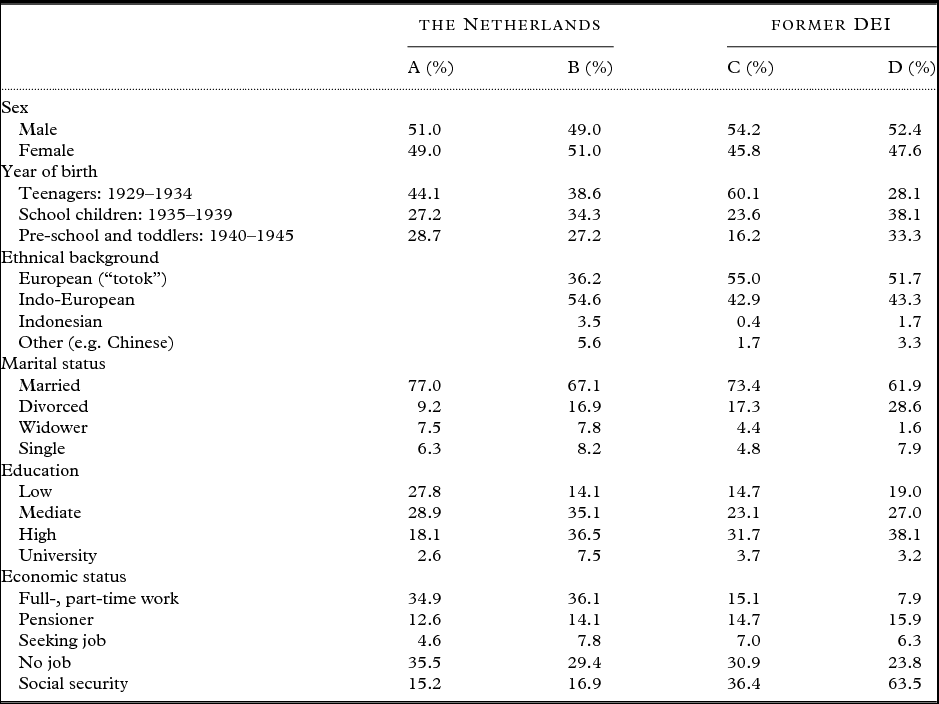
Date of birth, sex, education, income, social and marital status as well as ethnic background (Caucasian, Indo-European, Indonesian, Chinese, or otherwise) were requested (Table 1).
Demographic data on respondents (N = 939) in the four groups: (A) reference group (N = 349), (B) child survivors from the former DEI (N = 255), (C) child survivors from the former DEI who applied for “material” help (N = 272), and (D) child survivors from the former DEI who received psychotherapy (N = 63)

DEI = Dutch East Indies.
War experiences
An extensive list of possible war stressors was presented. This instrument was based on earlier studies with war survivors (Bramsen and Van der Ploeg, Reference Bramsen and Van der Ploeg1999) as well as on literature research (using historical and autobiographical documents). The inventory consisted of two parts: (1) a list of events and circumstances (e.g. bombardments or shootings, evacuation, or internment) and (2) items reflecting direct harm, e.g. loss of family members, being wounded, maltreated, or abused.
Stressful post-war events
A list of major life events was presented developed in research on health and stress (Ros et al., Reference Ros, Winnubst, Defares, Joppen and Van Leeuwen1985). Examples are loss of a spouse, a serious disease, a traffic accident, divorce, and violent acts of crime. Both occurrence and perceived impact (on a Likert scale) of reported events were assessed.
Current health symptoms
The validated Dutch version of the Symptom Checklist (SCL-90-R; Arrindell and Ettema, Reference Arrindell and Ettema1986) was used to obtain an indication of subjective current mental health. Sub-scales (8) assessed feelings of agoraphobia (7 items), anxiety (10 items), depression (16 items), the presence of sleeping problems (3 items), somatic complaints (12 items), insufficiency of thinking and acting (9 items), feelings of hostility (18 items), and distrust (6 items). A total score reflected general psychosocial malfunctioning.
The use of professional help
This inventory assessed current as well as past contacts with professionals in healthcare (e.g. general practitioner and medical specialist) and mental healthcare (e.g. psychologist, psychotherapist, psychiatrist, and social worker). The types and number of contacts, the extent to which World War II had been discussed, as well as the (dis)satisfaction with the help provided were assessed.
Denial and intrusion
The Dutch-validated adaptation of the Impact of Event Scale (IES-15; Horowitz et al., Reference Horowitz, Wilner and Alvarez1979) was included. This inventory assesses manifestations of intrusion and avoidance. Participants were instructed to indicate how frequently during the past seven days they experienced symptoms as a result of their own World War II experiences (1942–1949). Intrusive recollections were operationalized by seven items (e.g. “I thought of the war years when I did not mean to”), while eight items assessed the tendency to avoid thinking of the stressful sequence of events (e.g. “I stayed away from reminders of it”). Items were endorsed as “not at all,” ‘rarely,” “sometimes,” and “often” (assigned with 0–1–3–5 quantifications). An indication of the impact of war memories is provided by summing all 15 items. A strong association has been found for the IES with indices of PTSD (Van der Ploeg et al., Reference Van der Ploeg, Mooren, Kleber, Van der Velden and Brom2004).
Dissociation
Symptoms of dissociation were assessed by including the Dissociation Experience Scale (DES-28, Dutch translation; Bernstein and Putnam, Reference Bernstein and Putnam1986). The DES has been used mostly in clinical samples. A valid cut-off score of four was found to be indicative for dissociative disorders. Cronbach's αs of all instruments in this study were satisfying (ranging from 0.82 to 0.99).
Analyses
First of all, analyses were directed at testing differences between both samples of child survivors of the World War II based on the community registers. Second, we tested whether dependent variables differed among the three samples of child survivors from the DEI, using one-way analyses of variance. Subsequently, discriminant analysis was applied to describe the major differences among the four groups of child survivors (Stevens, Reference Stevens1996). Using discriminant analysis, the significance of different variables (predictors) in distinguishing among groups could be determined. The dependent and independent variables in these analyses were determined after exploring covariations among the variables. Skewness and kurtosis and differences among variances were within acceptable limits (Stevens, Reference Stevens1996; Tabachnick and Fidell, Reference Tabachnick and Fidell2001). The Statistical Package for the Social Sciences (SPSS Windows 18.0) was used.
Missing data
A number of cases (N = 142) had one or more missing values on the dependent variables (IES, SCL, or DES). As it was expected that the missing values were not distributed completely at random, we decided to impute values by prediction based on other variables in the analyses, for each group separately (Tabachnick and Fidell, Reference Tabachnick and Fidell2001), using Norm software (Schafer, Reference Schafer1997). The presented outcomes are based on averages of resulted coefficients. Furthermore, to account for slight skewness in some of the dependent variables, we used logit transformation in a set of analyses. As there were no differences between the data with transformed or non-transformed variables, the outcomes of analyses using the non-transformed data are described.
Results
Number and kind of war experiences
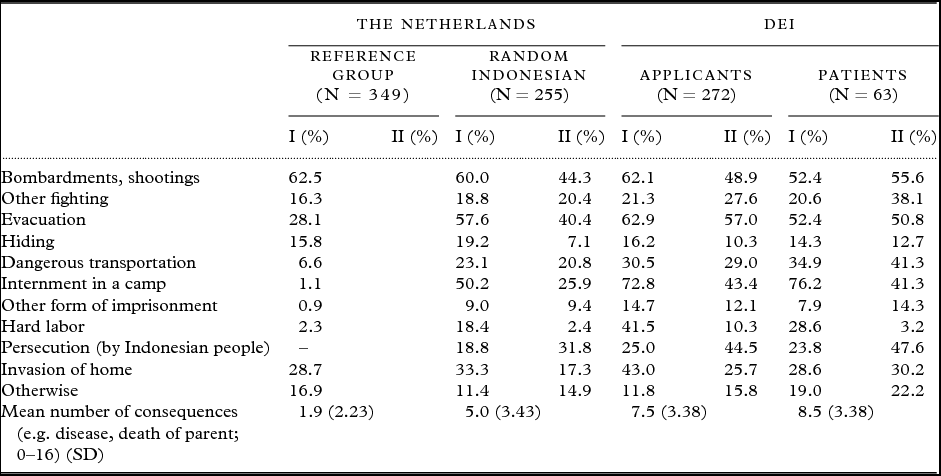
The child survivors from the former DEI in the community sample reported a significantly larger number of war situations (such as having been wounded or seriously ill) than the child survivors in the reference group (F(3) = 206.7, p < 0.001). The reference group had experienced an average number of 1.9 war situations per person; for the DEI group, the mean number was more than five. For the group of applicants and clients in therapy, these rates were even higher, seven and eight in average, respectively.
The type of war situations varied between the DEI child survivors group and the reference group (Table 2). The distinction between the kinds of war fought on opposite sides of the globe is manifested in the types of violence the survivors remembered. Although bombardments, shootings, and having to hide were common to most of the participants, the DEI child survivors more frequently experienced evacuation, dangerous transportation, internment in camps, other forms of imprisonment, and forced hard labor. In particular, the applicants and clients were often in internment camps.
War experiences during the Japanese and German occupation and Indonesian independence war (N = 939)
I = Japanese/German occupation; II = Indonesian independence war; DEI = Dutch East Indies.
The older participants (teenagers during war) have more recollections of war events than the younger respondents (children of school, and pre-school age), both for the period of Japanese occupation as well as for the following revolutionary period (F(2) = 54.46, p < 0.001; F(2) = 16.18, p < 0.001, respectively).
Stressful events in the post-war period
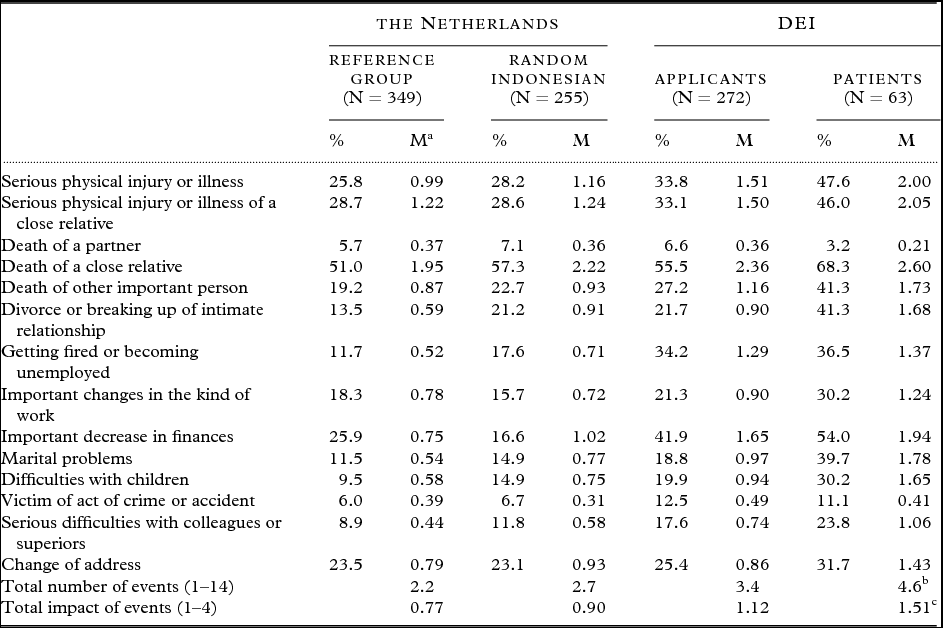
Not only did groups differ in the number of war-related events, they also differed with respect to the life events in the post-war period (since 1950). From Table 3, it can be observed that the child survivors belonging to the DEI groups reported more life events than their peers born in the Netherlands. Furthermore, except for the loss of a partner, the highest percentages of reported life events were found for the clinical group. Besides these group differences in the number of events (F(3, 935) = 22.92, p < 0.001), different means in perceived impact were found among groups (F(3, 935) = 29.60, p < 0.001).
Post-war life events (1950–1995): their nature and perceived impact (N = 939)
aMeans for the reported impact (1–4: 1, not at all; 2, a little; 3, rather much; 4, much) of different events are given. Groups differ with respect to all listed events (p < 0.001) except for the perceived impact of death of a partner, important change in work, or act of crime or accident.
bGroups of child survivors are different for the average number of post-war life events F(3, 935) = 22.92; p < 0.001).
cGroups of child survivors differ with respect to the average reported impact of life events as well F(3, 935) = 29.60; p < 0.001).
DEI = Dutch East Indies.
Current mental health
The groups differed significantly in their total scores on the SCL-90 as well as on sub-scales scores (p < 0.001), the reference group scoring lowest and the patient group scoring highest (Scheffé, p < 0.05). The mean total score on the SCL-90 of 150.4 for the community Dutch Indies group can be considered as moderately elevated. A large representative sample of the Dutch population was found to have a mean score of 123.1; the average score was 205.9 in a clinical population (Arrindell and Ettema, Reference Arrindell and Ettema1986). No significant differences on the mean SCL-90 scores between groups of several age or ethnic background were found.
Comparing the two community samples, the DEI group currently makes more use of professional help (e.g. general practitioner, medical specialist, psychiatrist, and social worker) than participants in the reference group and did so in the past too. Highest percentages for all sources of professional help consulted were found among the applicants and patients (F(3, 935) = 19.77, p < 0.001 and F(3, 935) = 49.10, p < 0.001 for current and past use of psychosocial services, respectively). For instance, while 5.2% of the reference group had consulted a psychiatrist in the past, this holds true for 11.4% of the random DEI group, 21.3% of the DEI applicants, and 38.1% of the clinical group (χ2(3) = 67.63, p < 0.001).
War and related circumstances were not often the subject of discussion during consults. For 24.1% of all child survivors, the war was discussed specifically and in-depth. For 36.9%, the war was mentioned only briefly, while in 39% of the meetings with professional helpers the period of war was not mentioned in any way. About half of all participants (41.5%) were not or only a little satisfied about the consults; the other half felt it had helped them reasonably or very well.
Impact of war
Comparable results were found for the outcomes on the IES. First of all, the average scores, indicating more intrusive and avoidance symptoms, were higher for the Dutch Indies child survivors than for their peers born in the Netherlands. Second, within the group of child survivors from the former Dutch colony, the patients scored highest, followed by the group of applicants. Again, differences were found between mean IES scores between camp internees and those who stayed outside the camps during Japanese occupation (t (743.2) = −11.10, p < 0.001).
Generally, a total score of 26 and higher on the Dutch version of the IES is regarded as an indication of serious disturbances in adjustment to traumatic stress, in particular PTSD (Van der Ploeg et al., Reference Van der Ploeg, Mooren, Kleber, Van der Velden and Brom2004). Within the DEI war survivors groups there were considerably more persons with scores that meet this cut-off point (municipal sample of DEI origin: 25.9%, DEI applicants: 64.7%, patients: 73.1%) than in the reference group (6.0%).
When divided into three different age categories, the oldest participants had the highest sum scores on the IES while the youngest respondents had the lowest scores (F(2) = 27.3, p < 0.001). After having controlled for year of birth, differences among groups remained significant (F(3) = 162.21, p < 0.001).
Dissociative responses
On the DES, one out of four child survivors from the clinical group (25.8%) scored above 4.0, which is considered a cut-off score for dissociative disturbances. Dissociative features were more prevalent in the clinical and allowance group than in the community samples. The group of child survivors in psychosocial treatment showed the highest scores (F(3) = 53.94, p < 0.001). According to expectation, significant differences between the three age groups were found (F(2) = 3.45, p < 0.05). The oldest child survivors distinguished themselves through their relatively low average score on the DES. When divided among two age groups, this difference became clearer (t (936.6 = −2.65, p < 0.01). The child survivors born shortly before or even during the war (1935–1945) showed more dissociative symptoms than the participants born earlier (1929–1934).
Differences among groups of child survivors
Using discriminant analysis, three linear functions were found that together best described the differences among the four groups (Wilks’ λ, χ2f1(24) = 913.92, χ2f2(14) = 149.08, and χ2f3(6) = 33.95 (p < 0.001). Included variables were those that assessed the circumstances experienced during the war, weighted life events that occurred after the war (after 1949), the total scores on the IES, the total scores on the SCL-90, and the total number of physical or mental health professionals consulted in the past. Demographic data (year of birth and sex) were simultaneously included in the analyses.
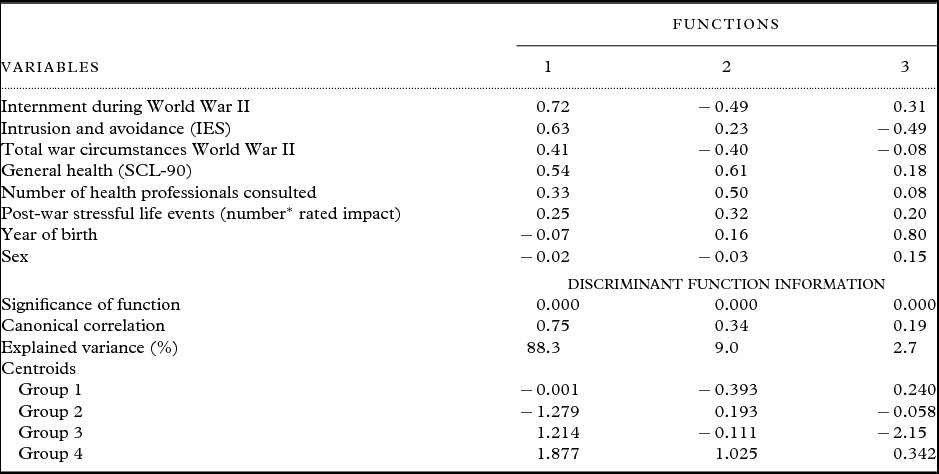
The first discriminant function accounted for most (88.3%) of the variability between groups. In Table 4, the group correlations between variables and discriminant functions are shown. From this table, it can be derived that having been interned in a World War II camp, the IES outcomes, and the number of experienced war circumstances were highly predictive of group classification. In particular, having been interned in a camp added substantially to the division among groups. All correlation coefficients were in the same direction, that is both more war experiences and higher IES outcomes were related to higher scores on this dimension.
The pooled-within-groups correlations between discriminating variables and standardized canonical discriminant functions: distinguishing four groups of child survivors (N = 939)
SCL-90 = Symptom Checklist; IES = Impact of Event Scale.
The second and third discriminant functions were constituted by the other variables. They accounted for only 9% and 2.7% of the variance, respectively. The distinction among the four groups by the first discriminate function becomes further clear from the group centroids, which have distinct values (Table 4). Examining the centroid distance, groups 3 and 4 were most close to each other, while most distance lied between groups 2 and 4.
The three linear discriminant functions successfully predicted 63% of the cases belonging to one of the four groups. This can be considered satisfying, when it is taken in mind that the chance based on coincidence of being allocated to one group was 25%. Misclassifications were most likely to occur for child survivors from group 1 to end up in group 2 and for child survivors from group 4 to be allocated to group 3.
Discussion
Results were presented of a comprehensive study conducted decades after World War II. A large community-based sample of war survivors was studied and compared with a reference group as well as with clinical groups. The attention was focused on the group of people who experienced the war as a child, more than half a century later.
It is striking that after more than half of a lifetime, a considerable group of survivors still suffered from difficulties related to this war. World War II child survivors from the former DEI now living in the Netherlands showed more health disturbances and more problems related to war experiences than people of similar age who lived during the German occupation in the Netherlands. In about a quarter of a community sample of these child survivors from the former DEI, serious adjustment problems were present. The findings are in line with results from other studies (see for an overview Yehuda et al., Reference Yehuda2005; Barel et al., Reference Barel, Van IJzendoorn, Sagi-Schwartz and Bakermans-Kranenburg2010). The current study is relevant because of its focus on random population-based samples of child survivors of World War II. The long-term significance of war experiences and migration in both those who sought professional help and who did not was demonstrated.
Children who lived through the Japanese occupation and the Indonesian struggle for independence in the 1940s have – as a group – known more adverse and detrimental circumstances than children (of the general population) who experienced World War II in the Netherlands. This dose–response relationship of the number of war experiences with problematic health has been reported repeatedly (Barel et al., Reference Barel, Van IJzendoorn, Sagi-Schwartz and Bakermans-Kranenburg2010). This study supports the notion that, also in children asked many decades later, drastic images of war have a long-lasting impact on individual functioning. Theories of trauma that emphasize the need for integration of extreme experiences (Kleber and Brom, Reference Kleber and Brom2003) explain these outcomes.
The war-related variables, such as the number of experienced consequences and the post-traumatic responses (as assessed by the IES), turned out to determine the prediction of group classification most significantly. In particular, the children who were in an internment camp during World War II were more prone to negative health outcomes half a century later than those who remained outside the camps. The long-term character of the symptoms as well as their diversity and the presence of dissociative complaints indicate the value of concepts such as Type II trauma and complex PTSD (Van der Kolk et al., Reference Van der Kolk, Roth, Pelcovitz, Sunday and Spinazzola2005).
The significance of early camp experiences may be attributed to various characteristics of the endured circumstances. Children were separated from fathers and older brothers; they lived in deteriorating circumstances and were exposed to humiliation and violence directed at their mothers by first the Japanese guards and later Indonesian forces. Furthermore, their reception in the Netherlands did not provide them with the support needed. Although peers who remained outside of the camps were often not much better off during the war years, the child survivors of the Japanese camps probably have been less able to incorporate a trustful and confident view of life.
The different levels of health and coping disturbances as well as the more frequent utilization of professional help among child survivors point to a larger vulnerability among those who were severely struck by the war. As a consequence, these child survivors are handicapped by their capacity to deal with difficult circumstances in life (Yehuda et al., Reference Yehuda2005). This is supported by the differences found between groups with regard to the number of dramatic events reported for the post-war period. These life events were perceived as more serious by the child survivors in the clinical group while their impact was reported lowest in the respondents born in the Netherlands. It may well be that this increased vulnerability or the hampered ability to cope with difficult situations has come to its full-blown impact now that child survivors are aging.
Social resources for support may be dissolving in later life or may never have been adequate. In contrast to other types of life events, which were more prevalent, loss of husbands, wives, or partners were experienced least in the clinical group. One obvious explanation may be that there were simply no husbands or wives present. Child survivors in this group indeed went more frequently through divorce than their peers in the other groups. The larger number of war experiences in this group may have led to a decreased ability to relate to others. The absence of social support possibly contributed to an increased use of professional help.
Publications have been ambiguous about the prevalence of age differences with regard to the aftereffects of trauma in children (Keilson, Reference Keilson1979; Maercker et al., Reference Maercker, Schützwohl and Solomon1999). The age of the child at the time of war trauma may be related to the health situation in later life. The assumption is that an infant lacks major cognitive capacities to understand and verbalize the events happening and is most vulnerable to separation from his or her parents; the older child in the age of 6–12 years is better able to assign meaning but is very vulnerable to incongruent messages and events (e.g. learning that the world is an unsafe place). For instance, somatization problems were particularly expected in the first group while more interpersonal problems are more likely to occur in the latter. However, the current study did not support these findings. The oldest child survivors had most memories of events happened to them; they had the most negative scores with regard to the chronic impact of traumatic events. The youngest child survivors, born just before or during the war, were the healthiest of all. Nevertheless, the significant associations between age and dissociation are remarkable. They confirm the hypothesis (Van der Kolk et al., Reference Van der Kolk, Roth, Pelcovitz, Sunday and Spinazzola2005) that psychological traces of the war among very young survivors will be manifested in complaints, such as feelings of de-realization, confusion, and depersonalization, as the memories of the war are rather vague and blurred.
Clinical and non-clinical populations
This study included a group of applicants for war pensions as well as a clinical group. These groups were significantly distinguished from the two community samples not only by more problems with regard to health, coping, and dissociation, but also by a greater number of war-related experiences. Unfortunately, many studies on World War II survivors have focused on patients, creating an inadequate impression of the intensity of post-war responses in the general population. Moreover, in spite of the reported disturbances, the majority of child survivors were found to deal with their war experiences adequately. Their current health and adjustment did not appear to be seriously handicapped by memories of the war period. Although a substantial number of World War II survivors still may develop problems in the near future, these findings indicate a strong resiliency among the majority of war survivors.
The position of the sample of DEI applicants of war pensions or other forms of allowances is worth noting. As a group, they experienced more violent and dramatic events during as well as after the war, they were less healthy as indicated by the assessments and had used professional services more often than their peers acquired through community registers. In many ways they impressed as a clinical group.
Methodological issues
The retrospective character of our study poses several methodological hazards. First of all, due to the cross-sectional and retrospective nature of this study, no conclusive statements can be made about causality. The finding that older participants reveal more distress could be interpreted as a sign of vulnerability of older children during camp internment. It could also reflect the increase of symptoms with growing age. Second, it remains impossible to shed light on the duration of symptoms reported. No answer can be given to the question whether people showed symptoms all their lives or whether there have been periods when there were no complaints. If no life-lasting vulnerability existed, as suggested above, it could be that this generation of war survivors is currently particularly prone to war-related problems because of the particular life-cycle phase. Children have left home and started their own families, people are retiring from their jobs, and social surroundings are narrowing (Aarts and Op den Velde, Reference Aarts, Op den Velde, van der Kolk, McFarlane and Weisaeth1996). They are faced with the developmental task of integrating their life experiences, and thus with the painful war experiences of early life (Kestenberg and Brenner, Reference Kestenberg and Brenner1996). Third, poorer socio-demographic background may have impaired psychological development and adaptation to the severe stressors. Poverty or limited opportunities for education have been found to negatively influence recovery. However, our data did not incorporate information on the context of growing up in the post-war years.
There is a growing societal attention for what had happened in the East during World War II (due to commemorations of more than 60 years free of war, and the historical debate on activities of the Dutch military in wartime). Without doubt, this has influenced the individual interpretation of war memories. For a long time, Dutch society showed no interest at all in the fate of the newcomers from the former colony of Indonesia. Moreover, the clinical and scientific acknowledgment of war-related psychosocial difficulties was not widespread in post-war years. Possibly, the current widespread use of the concepts of trauma and PTSD, together with this societal awareness of war events in the East, contributed to a growing linking of disturbances to the war they experienced.
This “mindset” may have influenced participation in the study. As shown by Shmotkin and Lomranz (Reference Shmotkin and Lomranz1998), it mattered if the invitation to participate in a study was blind to war cues or not. In the current study, it was clear from the beginning that the focus was on post-war adaptation. This may have contributed to a non-response among child survivors not thinking of the war at all. The burden to answer a large number of questions may have outweighed the expected relevance in those who chose not to participate. Perhaps, our sample concerns a selective proportion of people with more severe problems. However, the opposite may also be true: Those with more problems were more reluctant to participate.
Conclusion
Despite these problems, we may conclude that the samples involved in the current study were large enough to guarantee representation and generalizability of our results. Several decades after the end of the Japanese occupation in the Far East, many Dutch citizens still suffer from the ordeals they experienced then. This finding is of importance not only to the population that was born in the DEI, but also to those who nowadays seek refuge in an attempt to escape war and violence. As it remains impossible to prevent the infliction of violence and loss upon children, attention for children who experience war is warranted since we have learned that a substantial portion of them will be haunted by painful memories in later life.
Conflict of interest
None.
Description of authors’ roles
The first author, T. T. M. Mooren, carried out the study and analyzed, and reported the data. R. J. Kleber supervised the entire process and co-authored the manuscript. Both authors designed the study.
Acknowledgments
The authors acknowledge the PUR (the Dutch Council for Pensions and Allowances), the ABP (the Dutch State Employees Pensions Scheme) as well as Foundation Centrum '45 for their constructive and helpful cooperation in the project. The methodological suggestions of Dr. H. Hoijtink have been much appreciated. The project was funded by the Dutch Ministry of Health, Welfare and Sports.