Introduction
Stroke survivors experience a range of impairments, activity limitations and participation restrictions. Impairment of cognitive abilities, particularly executive functions and metacognition, can negatively influence activity and participation outcomes including effective and efficient performance of activities of daily living (ADL) and instrumental activities of daily living (IADL) (Al Banna et al., Reference Al Banna, Abdulla Redha, Abdulla, Nair and Donellan2015). In addition, the impact of cognitive impairment on an individual’s ability to engage in rehabilitation may have implications for rehabilitation referral practices and acceptance into limited rehabilitation spaces (Australian Stroke Coalition, 2012). The median length of stay in Australian hospitals for an acute stroke episode is 5 days (Cadilhac et al., Reference Cadilhac, Lannin, Kim, Anderson, Andrew and Kilkenny2017) and early assessment of cognition is considered an important component of the initial evaluation.
The Montreal Cognitive Assessment (MoCA) is a cognitive screening tool commonly used in acute stroke care with demonstrated feasibility for people with both mild and moderate stroke (Chan et al., Reference Chan, Khan, Oliver, Gill, Werring and Cipolotti2014; Horstmann et al., Reference Horstmann, Rizos, Rauch, Arden and Vetkamp2014; Pasi et al., Reference Pasi, Salvadori, Poggesi, Inzitari and Pantoni2013). This preferred clinical tool is quick to administer in the acute stroke unit and has consistently demonstrated greater sensitivity for detecting stroke-related cognitive deficits over other screening tools, including the Mini Mental State Examination (MMSE) (Bocti et al., Reference Bocti, Legault, Leblanc, Berger, Nasreddine, Beaulieu-Boire and Boulanger2013; Sivakumar et al., Reference Sivakumar, Kate, Jeerakathil, Camicioli, Buck and Butcher2014). The MoCA’s sensitivity is largely due to inclusion of additional cognitive domains such as executive function and visuospatial skills (Nys et al., Reference Nys, van Zandvoort, de Kort, Jansen, Kappelle and de Haan2005). Although more sensitive than other cognitive screening tools, it is only a screening tool and has been shown to underestimate cognitive impairment when compared with comprehensive neuropsychological testing (Chan et al., Reference Chan, Khan, Oliver, Gill, Werring and Cipolotti2014).
Previous longitudinal studies have suggested that the MoCA score within the first 2 weeks contributes to the prediction of the modified Rankin Scale (mRS) at 3 and 6 months for participants with severe stroke (Dong et al., Reference Dong, Slavin, Chan, Venketasubramanian, Sharma, Crawford and Chen2013). A score of 23 or less within the first week demonstrates equal sensitivity and specificity for predicting mRS score at 3 months (Abzhandadze et al., Reference Abzhandadze, Rafsten, Nilsson, Palstam and Sunnerhagen2019) while a score of less than 26 within the first week has also been associated with increased odds of a functional impairment (score > 2 on mRS) (Zietemann et al., Reference Zietemann, Georgakis, Dondaine, Müller, Mendyk, Kopczak and Dichgans2018). One study has explored the association with the Functional Independence Measure (FIM), finding that MoCA score at admission to inpatient rehabilitation was moderately associated with the motor domain of the FIM at discharge from rehabilitation (r = 0.4; P = 0.01) (Toglia et al., Reference Toglia, Fitzgerald, O’Dell, Mastrogiovanni and Lin2011). Additional cross-sectional studies have demonstrated significant relationships between the MoCA and various self-care outcomes in the acute phase of stroke and at 3 months post-stroke (Bocti et al., Reference Bocti, Legault, Leblanc, Berger, Nasreddine, Beaulieu-Boire and Boulanger2013; van Der Wijst et al., Reference van Der Wijst, Wright and Steultjens2014). Notably, only one study explored the relationship between the MoCA administered within the first week after stroke and the mRS, with the remaining studies including MoCA scores at admission to rehabilitation or at a follow-up data point. There is an opportunity to further explore the association between early cognitive screening using MoCA during the first week post-stroke and longitudinal self-care outcomes.
Three studies have explored the association between the MoCA and IADL. A cross-sectional study reported a significant correlation between scores on the MoCA and the Chinese Lawton IADL Scale at 3 months post-aneurysmal subarachnoid haemorrhage (Kendall’s tau b coefficient = 0.493; P < 0.001) (Wong et al., Reference Wong, Lam, Ngai, Wong, Mok and Poon2012). A retrospective cohort study found that greater cognitive impairment on the MoCA at admission to inpatient rehabilitation was associated with more assistance on the Executive Function Performance Test (EFPT) bill paying task (ρ = −0.63; P < 0.01) and the Activity Measure for Post Acute Care (AM-PAC) Applied Cognition scale (ρ = −0.43; P < 0.01) at discharge (Toglia et al., Reference Toglia, Askin, Gerber, Taub, Mastrogiovanni and O’Dell2017). Finally, a score of less than 26 on the MoCA within the first week was associated with increased odds of a lower score as measured using the Lawton IADL scale (Zietemann et al., Reference Zietemann, Georgakis, Dondaine, Müller, Mendyk, Kopczak and Dichgans2018). Consistent with the studies related to self-care, the explorations of IADL outcomes have used the MoCA scores at 3 months or on admission to inpatient rehabilitation. Only one study reported the association of the MoCA score within the first week after stroke and functional outcomes, qualifying a need for further exploration.
Previous research found significant relationships between the MoCA scores and different ADL and IADL outcome measures when the MoCA was performed later in the recovery trajectory. There is limited information on the relationship between acute care cognitive screening using the MoCA with longitudinal ADL and IADL outcomes. Therefore, this study contributes to previous literature by examining performance on the MoCA when used in early cognitive screening, within the first week post-stroke, and its association with ADL and IADL outcomes at 1 month and 3 months post-stroke. It was hypothesised that the MoCA would have a significant relationship with the ADL and IADL outcomes.
Methods
Design
A prospective observational cohort design was approved by Human Research Ethics Committees of The Prince Charles Hospital (HREC/17/QPCH/163), the University of Queensland (#2017001149) and the University of the Sunshine Coast (S/17/1091). Data were collected from January to September 2018 to map the trajectory of cognitive performance and recovery across the first week and until 3 months after stroke using serial computerised cognitive assessment. This paper reports the findings of one research question from the larger study.
Participants
Participants in the larger study included people aged 18 and over with a confirmed diagnosis of stroke, consecutively recruited from the Acute Stroke Unit at the Sunshine Coast University Hospital within 48 h of stroke onset. Exclusion criteria included: a) pre-stroke diagnosis of dementia or blindness; b) cortical blindness post-stroke; c) if primary treatment intent was palliative and d) discharge beyond the boundaries of the Sunshine Coast regional area. Additional criteria for this study were MoCA data at baseline, score above 25 on the pre-Lawton’s score and complete data collection at 1- or 3-month follow-up.
Data collection
Demographic information
Demographic information included age, gender and number of years of formal education, type of stroke (ischaemic or haemorrhagic), hemisphere, location and severity. Stroke location was categorised by the Oxfordshire Community Stroke Project (OCSP) classification system (Anderson et al., Reference Anderson, Taylor, Hankey, Stewart-Wynne and Jamrozik1994). The OCSP has demonstrated good inter-rater reliability and validity with stroke populations (Al-Buhairi et al., Reference Al-Buhairi, Phillips, Llewellyn and Jan1998; Mead et al., Reference Mead, Wardlaw, Dennis, Lewis and Warlow2000; Wardlaw et al., Reference Wardlaw, Dennis, Lindley, Sellar and Warlow1996). Stroke severity was measured by the National Institutes of Health Stroke Scale (NIHSS), which evaluates neurologic outcome and degree of recovery using a 15-item impairment scale (Brott et al., Reference Brott, Adams, Olinger, Marler, Barsan, Biller and Walker1989). The NIHSS has established psychometrics in clinical research and predictive validity for long-term stroke outcomes (Adams et al., Reference Adams, Davis, Leira, Chang, Bendixen, Clarke and Hansen1999; Brott et al., Reference Brott, Adams, Olinger, Marler, Barsan, Biller and Walker1989; Lyden et al., Reference Lyden, Brott, Tilley, Welch, Mascha, Levine and Marler1994). A NIHSS score of less than 8 is indicative of mild stroke, 9–15 of moderate stroke, and 16 and above of severe stroke (Lyden et al., Reference Lyden, Brott, Tilley, Welch, Mascha, Levine and Marler1994).
Montreal cognitive assessment
The MoCA is a brief standardised screening tool administrable in approximately 10 min, originally designed to detect mild cognitive impairment in older adults (Nasreddine et al., Reference Nasreddine, Phillips, Bédirian, Charbonneau, Whiteheard, Collin and Chertkow2005). The highest attainable score on the MoCA is 30 and scores less than 26 have traditionally been considered indicative of cognitive impairment (Nasreddine et al., Reference Nasreddine, Phillips, Bédirian, Charbonneau, Whiteheard, Collin and Chertkow2005). A recent meta-analysis has suggested that a score of 23 should be the cut-off score for mild cognitive impairment (Carson, Leach, & Murphy, Reference Carson, Leach and Murphy2018). The MoCA has demonstrated excellent sensitivity and specificity for mild cognitive impairment and has a high test–retest reliability and internal consistency (Nasreddine et al., Reference Nasreddine, Phillips, Bédirian, Charbonneau, Whiteheard, Collin and Chertkow2005).
Functional independence measure
The FIM assesses ADL performance and higher scores indicate greater independence in ADL, with a maximum score of 126 overall, 91 for the motor domain and 35 for the cognitive domain (Linacre et al., Reference Linacre, Heinemann, Wright, Granger and Hamilton1994). The FIM has excellent test–retest reliability (Ottenbacher et al., Reference Ottenbacher, Hsu, Granger and Fiedler1996), inter-rater reliability for people with stroke (Segal & Schall, Reference Segal and Schall1994) and sensitivity in detecting changes (Dromerick et al., Reference Dromerick, Edwards and Diringer2003).
Australian modified lawton’s instrumental activities of daily living scale
The Lawton’s is a self-report tool that assesses independent living skills including using the telephone, shopping, food preparation, housekeeping, laundry, mode of transport, responsibility for own medications and handling finances (Lawton & Brody, Reference Lawton and Brody1969). Higher scores indicate greater ability to perform IADL independently, with a maximum score of 30. It is reported to have good inter-rater reliability and validity and is widely used in Home and Community Care services in Australia (Green et al., Reference Green, Eagar, Owen, Gordon and Quinsey2006). Harper and colleagues (Reference Harper, Riley, Jacques, MacDonald and Spendier2019) report that a Lawton’s score less than 25 is predictive of cognitive decline in older adults with and without mild cognitive impairment or dementia.
Procedure
Eligible patients in the Acute Stroke Unit received information about the study, including the nature of their participation and potential risks. A substitute decision maker was approached for all patients considered to lack the capacity to provide informed consent by the treating physician. Informed consent was obtained from participants or their substitute decision maker. Demographic data were collected at the time of recruitment, including a rating of Lawton’s score prior to the stroke. The NIHSS, OCSP and MoCA scores were obtained from medical charts. The NIHSS and OCSP were completed by the stroke unit medical team, trained in scoring the NIHSS and determining OCSP. The MoCA, version 7.1, was performed by senior occupational therapy staff, experienced in administration of this routine cognitive screen, at admission to the acute stroke unit as per usual practice. Scores were checked by the formally trained principal investigator on transcribing results into data spreadsheets. The FIM and Lawton’s were collected by the credentialed principal investigator at 1 month and 3 months post-stroke.
Statistical analysis
Seventy-four people were recruited in the larger study and data cleaning for the current analysis excluded three participants who did not complete any baseline measures due to changes in medical status, eight participants who were unable to complete the MoCA at baseline due to delirium (n = 6), aphasia (n = 1) or death (n = 1), five participants who had neither 1- or 3-month data due to study withdrawal or death, and eight participants who scored less than 25 on the Lawton’s prior to their stroke. The change in scores between 1 month and 3 months was explored using paired t-test. Correlational analysis explored associations to inform entry into the regression. Multiple regression was completed with the total scores of the FIM and Lawton’s at 1 month and then 3 months. Assumptions were checked and extreme outliers were removed prior to each analysis. After the analysis, all residuals were plotted and a final check for outliers was conducted. Effect sizes (Cohens f 2) were calculated and ranged from 0.29 to 0.40 indicative of a medium-large to large effect size for the analyses. A P-value less than 0.05 was considered to be statistically significant. All statistical analyses were conducted using IBM SPSS Statistics version 25.
Results
Participants
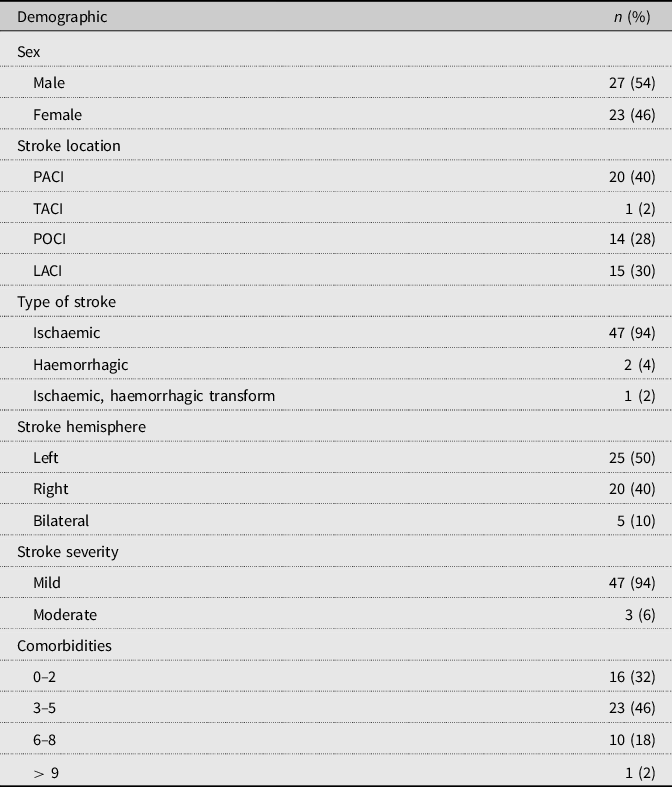
The final sample included 50 participants with a mean age of 69.8 (SD 12.3) and an average of 12 years (SD 4.4 years) of formal education. Participants’ demographic characteristics are listed in Table 1. The mean NIHSS score at admission was 4.8 (SD 3.5) and 13 (26%) participants received thrombolysis. The MoCA was completed an average of 3.4 days (SD + 1.8) post-stroke, with a mean score of 23.1 (SD 4.4). Eighteen (36%) participants scored below the MoCA cut-off point of 23, and 35 (70%) scored below the MoCA cut-off of 26, suggesting that many participants demonstrated issues with cognitive performance the first week post-stroke. Table 2 presents the mean scores for the FIM and Lawton’s according to each MoCA category. Two participants did not complete the 3-month follow-up (n = 48).
Demographic characteristics of sample (n = 50)

PACI, partial anterior circulation infarcts; TACI: total anterior circulation infarcts; POCI: posterior circulation infarcts; LACI: lacunar infarcts
Mean FIM and Lawton’s scores according to MoCA categories

Participants were referred for rehabilitation services as determined appropriate by the multidisciplinary team, with 22 inpatient, 19 outpatient (10 centre-based and 9 home-based) and 9 with mild stroke declined any rehabilitation follow-up on discharge from acute care (6 were referred for rehabilitation but they declined services when contacted). Six participants remained in inpatient rehabilitation at 1 month post-stroke.
Preliminary analysis
Preliminary correlational analysis indicated that NIHSS, OCSP, stroke type and hemisphere were not associated with the two outcome measures and they were not entered into further analysis. The number of comorbidities was inversely associated with the FIM at 1 month (r s = −0.31, P = 0.03) and 3 months (r s = −0.37, P = 0.009), and the Lawton’s at 3 months (r s = −0.43, P = 0.002). Age was significantly associated with both outcome measures at both time points (r s −0.45 to −.62, P = 0.001) and with the comorbidities (r s = −0.37, P = 0.009). The decision was made to enter age, and not comorbidities, into all final analyses to avoid issues with collinearity.
Functional Independence Measure
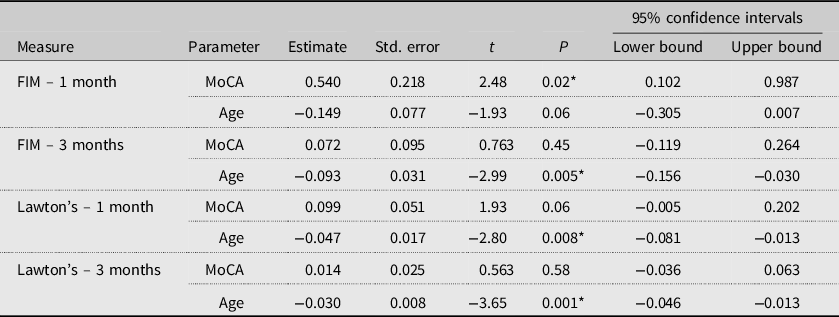
The mean FIM score increased from 118.2 (10.4) at 1 month to 122.2 (4.8) at 3 months (P = 0.005). One participant was an extreme outlier (> 3 SD) and was removed from analysis at 1 month (n = 49). The multiple regression model indicated significant association between early MoCA score and FIM at 1 month (F(2, 46) = 7.46, P = 0.002, adj. R 2 = 0.21). Two participants were extreme outliers at 3 months (> 3 SD) and were removed from analysis (n = 46). Early MoCA score was not significantly associated with FIM at 3 months, but was significantly associated with age (F(2, 42) = 5.98, P = 0.005, adj. R 2 = 0.19). Table 3 reports the regression coefficients.
Multiple regression models of relationship between FIM and Lawton’s total scores with MoCA and age

* Significant at the 0.05 level.
Lawton’s
The mean Lawton’s score increased from 28.1 (3.4) at 1 month to 28.8 (2.7) at 3 months (P = 0.005). Five participants were extreme outliers (> 3 SD) and were removed from analysis at 1 month (n = 45). The multiple regression model indicated significant association with Lawton’s at 1 month and age (F(2,42) = 8.34, P = 0.001, adj. R 2 = 0.25). Six participants were extreme outliers (> 3 SD) and were removed from analysis at 3 months (n = 42). The Lawton’s at 3 months was significantly associated with age (F(2, 40) = 8.00, P = 0.001, adj. R 2 = 0.25). Table 3 reports the regression coefficients.
Discussion
The MoCA is widely used as a cognitive screening tool after stroke and helps to inform the interprofessional teams’ decision-making regarding referral to rehabilitation. This is the first study to examine the relationship between MoCA screening score performed in acute care and the FIM and Lawton’s at 1 month and 3 months after stroke. All but three participants in this study experienced a mild stroke, a trend in keeping with the current population of Acute Stroke Units due to better imaging techniques, the transfer of people with severe strokes who are eligible for endovascular clot retrieval to another hospital and the provision of thrombolysis treatment (Nezu et al., Reference Nezu, Hosomi, Lip, Aoki, Shimomura, Maruyama and Kobayashi2016; Rodríguez-Castro et al., Reference Rodríguez-Castro, López-Dequit, Santamaría-Cadavid, Arias-Rivas, Rodríguez-Yáñez, Pumar and Iglesias-Rey2018). The findings of this study, from a tertiary teaching hospital that provides services for a large regional area, are considered representative of the patient group across similar services. These results highlight the increasing number of people with mild stroke for whom subtle cognitive changes have potential to impact functional recovery.
The preliminary analyses identified that age was inversely and significantly associated with the outcome measures and this association was confirmed with the regression analysis for all outcomes except the FIM score at 1 month. Older participants were more likely to demonstrate lower scores on the outcome measures, regardless of their early cognitive screening score. After controlling for age, early MoCA scores were only significantly associated with ADL outcomes at 1 month. Therefore, we cannot confidently consider that cognitive ability measured by the MoCA early after stroke is a clinical indicator of ADL outcomes at 3 months or IADL outcomes at 1 month and 3 months. We note that these participants were well-supported in their functional recovery with 41 out of the 50 accessing rehabilitation services. This is clinically relevant as it implies that a low MoCA score in the first week following stroke should be an indicator for short-term support during the recovery and rehabilitation phase.
The results are inconsistent with previously reported significant associations with outcome measures at 3 months (Dong et al., Reference Dong, Slavin, Chan, Venketasubramanian, Sharma, Crawford and Chen2013; Wong et al., Reference Wong, Lam, Ngai, Wong, Mok and Poon2012). However, the differences in stroke type and severity, and the collection of data only at the 3-month follow-up point account for the different findings by Wong et al. (Reference Wong, Lam, Ngai, Wong, Mok and Poon2012). The study by Dong and colleagues included 400 participants with predominantly mild stroke (79.8%) who were allocated into severe (> 2) and less severe stroke (2 or less) groups based on their baseline NIHSS score. Hierarchical regression analysis found that the MoCA and the MMSE improved the predictive value of the baseline NIHSS for mRS outcomes of people with more severe stroke only. Neither the NIHSS, MoCA or MMSE was predictive of functional outcomes for people with less severe stroke (2 or less on NIHSS). We did not have adequate numbers to conduct a regression analysis; however, our findings are consistent with this second finding from Wong and colleagues (Reference Wong, Lam, Ngai, Wong, Mok and Poon2012).
It is important to consider alternative explanations for the non-significant relationship between the MoCA and the outcomes. First, the mean scores were high for the FIM and Lawton’s at 1 month and allowed little residual variance for correlation with the MoCA. While a number of studies suggest that the FIM has no to minimal ceiling effect for people with acute stroke (Dromerick et al., Reference Dromerick, Edwards and Diringer2003; Hsueh et al., Reference Hsueh, Lin, Jeng and Hsieh2002), one study has detected a ceiling effect for the Lawton’s with people with dementia (Sikkes et al., Reference Sikkes, de Lange-de Klerk, Pijnenburg, Scheltens and Uitdehaag2009). Our findings suggest that more specific and sensitive outcome tools may be required to accurately assess ADL and IADL outcomes longitudinally for people with mild stroke, incorporating more community-based occupations, productive occupations and complex occupations such as driving. Second, the MoCA is a screening tool regularly used in clinical practice that does not provide a comprehensive measurement of the executive function or meta-cognition that has been associated with functional outcomes. Third, acute temporary cognitive impairment that rapidly improves across the first week and gradually improves across the first 3 months is common after mild stroke (Toglia et al., Reference Toglia, Fitzgerald, O’Dell, Mastrogiovanni and Lin2011; Toglia et al., Reference Toglia, Askin, Gerber, Taub, Mastrogiovanni and O’Dell2017; van Der Wijst et al., Reference van Der Wijst, Wright and Steultjens2014) with subsequently reducing influence on outcomes at 3 months. Finally, additional factors such as fatigue, mobility and mental health status may have changed between 1 month and 3 months and more greatly influenced ADL and IADL outcomes.
Although changes between 1 month and 3 months for both the FIM and Lawton’s scores were statistically significant, the changes in the FIM scores do not appear to be clinically significant. The minimal clinically important difference (MCID) for the FIM post-stroke has been suggested to be 17 in a long-term acute care hospital setting (FIM administered at admission and discharge) (Beninato et al., Reference Beninato, Gill-Body, Salles, Stark, Black-Schaffer and Stein2006) and 11 within a community or chronic care setting (FIM administered at 1 month and 3 months post-stroke) (Wallace et al., Reference Wallace, Duncan and Lai2002). In comparison, the participants in our study experienced a lesser change of four points in FIM scores between 1 month and 3 months, which may suggest participants’ recovery had stabilised at 1 month. In contrast, the MCID for older people with one or more disabilities living in the community was around half a point for the Lawton’s (Suijker et al., Reference Suijker, Van Rijn, Ter Riet, Van Charante, De Rooij and Buurman2017) and in our study there was a mean increase of 0.7 on the Lawton’s between 1 and 3 months suggesting that the change was clinically significant.
The descriptive results of MoCA suggest that people who score below 23 may experience lower outcomes for ADL and IADL performance than the groups who score 23–26, or above 26. Clinical practice has routinely applied 26 as the cut-off for suggested cognitive impairment and recent studies have found that using a MoCA cut-off score of 23 lowers the false positive rate, increases diagnostic accuracy and has greater sensitivity and specificity for predicting poorer outcomes (Abzhandadze et al., Reference Abzhandadze, Rafsten, Nilsson, Palstam and Sunnerhagen2019; Carson et al., Reference Carson, Leach and Murphy2018). Although this study has not identified a link between the score on a cognitive screen soon after stroke with ADL and IADL outcomes, it has identified that changes to clinical practice could include the introduction of a MoCA cut-off score of 23 as more clinically relevant for people with mild stroke.
This study had a number of limitations. First, we were unable to explore the relationship between the cognition of people with moderate and severe strokes and their functional outcomes. Second, other than age, our study did not control for confounding factors, which may have impacted on cognitive and functional outcomes such as fatigue and mobility. Third, the participants’ retrospective scoring of their pre-stroke ability using the Lawton’s may have been impacted by difficulties with memory and insight.
This study raised many interesting questions regarding the appropriateness of the outcome measures commonly used in clinical practice for people with mild stroke. Exploration of the relationship between the MoCA early after stroke and ADL and IADL outcomes using a larger sample size that includes all stroke severities and a more sensitive IADL tool is warranted. In addition, it is important to include a comprehensive cognitive assessment for comparison. Further, despite being a mild stroke cohort, these participants were well-supported with rehabilitation services which could account for improved functional outcomes in those participants with lower MoCA scores and would be worth further investigation.
Conclusion
The MoCA is commonly completed early after stroke as a means of measuring cognitive impact and assisting decision-making regarding discharge and rehabilitation. Findings of this study suggest that MoCA scores are likely to be associated with ADL performance at 1 month but not at 3 months or with IADL scores at 1 month and 3 months. In addition, a score of 23 and below may be an indicative cut-off for lower levels of recovery. Regardless, people with low MoCA scores at 1 week who received rehabilitation support demonstrated recovery of ADL and IADL performance at 3 months, suggesting that cognitive impairment early after stroke should be a marker for rehabilitation referral rather than for poor prognosis of recovery.
Financial support
This work was supported by the Sunshine Coast Hospital and Health Service Transition and Transformation Strategic Research Funding.
Conflicts of interest
The authors have no conflicts of interest to declare.
Ethical standards
The authors assert that all procedures contributing to this work comply with the ethical standards of the relevant national and institutional committees on human experimentation and with the Helsinki Declaration of 1975, as revised in 2008.
Statement of authorship
AC, LG, RG, MS and HG were involved in the larger research project. All authors contributed to research design and questions for this paper. LG, HG and SB managed all aspects of data analysis and development of the manuscript. AC, RG and MS assisted with interpretation of the analysis and development of the manuscript.