Introduction
When the banking crisis of 2008 morphed into a full-fledged economic recession, causing a labour demand collapse not seen in a generation, social safety nets in most European countries were not in the best of shape. Minimum income provisions had by and large deteriorated during the two decades preceding the crisis as social policy in many EU countries had come to rest on the idea that work offered the best way out of poverty. Confronted with soaring unemployment levels, be it to varying degree, the relevance of adequate protection arrangements acquired a new level of significance. This article looks at what, if anything, twenty-four European countries did in the area of minimum income protection for able-bodied persons at working age, during the first years of what Jenkins et al. (Reference Jenkins, Brandolini, Micklewright and Nolan2013) label the ‘Great Recession’. The focus is on final safety net provisions, which in most countries come under the form of social assistance schemes.
Just before the crisis hit, labour market conditions in Europe were as good as they had been in decades. Just prior to the crisis, unemployment rates in some countries had dropped to the lowest levels in a generation and employment rates had increased even more dramatically, especially in the historically lagging countries (Van Rie and Marx, Reference Van Rie and Marx2012). This had not come about by accident. A marked policy shift had taken place towards boosting labour market participation levels and reducing long-term benefit dependency. The increased emphasis on what was called ‘activation’ had taken a drastic turn in some countries, also involving social protection reforms in some cases (Bonoli and Natali, Reference Bonoli, Natali, Bonoli and Natali2012). In many other countries, policy shifts had occurred less visibly and perhaps also less purposefully. Yet studies showed that final safety net provisions had eroded considerably and had become less adequate in offering protection against poverty (Nelson, Reference Nelson2013). In all but two EU countries, minimum income benefit packages were below the EU's at-risk-of-poverty line (Van Mechelen and Marchal, Reference Van Mechelen, Marchal, Marx and Nelson2013).
The belief that labour markets could be relied upon to provide a life free from poverty for people capable and willing to work had incontestably spread in the years preceding the crisis. This notion quickly became untenable after 2008. Few had deemed a global financial crisis of such a magnitude and sweeping impact possible. It thus seems plausible to hypothesise that the crisis and the surge in unemployment levels that ensued, especially among young people, triggered a change in the perceived relevance and necessity of adequate social safety nets. In that context, it is worthwhile to focus on policy responses in the area of minimum income provision during the first crisis years. This is clearly of major interest in itself; adequate protection against severe financial hardship is arguably the first duty of any welfare state worthy of its name.
From a theoretical viewpoint, the recent crisis is also of interest in that it presents a rare, major and rather unexpected shock to the socio-economic system. There has long been an interest in the role such major shocks play in shaping and re-shaping policies, possibly pulling long-standing (path-dependent or even path-trapped) policy trajectories off course. Research on social policy change in European welfare states during the crisis period is growing but remains also mostly descriptive (OECD, 2012; European Commission, Reference European Commission2009) or, if more analytical, limited to country case studies (Dukelow, Reference Dukelow2011; Yerkes and van der Veen, Reference Yerkes and van der Veen2011). An important exception is the edited volume of Farnsworth and Irving (Reference Farnsworth and Irving2011), with detailed country case studies covering a dozen countries as diverse as Iceland, China and the US, thereby offering a truly global assessment of the varying impact of the crisis on social policies at large. International organisations have also produced extensive reports on the crisis (see for instance International Monetary Fund, Reference International Monetary Fund2010; European Commission, Reference European Commission2008; Spilimbergo et al., Reference Spilimbergo, Symansky, Blanchard and Cottarelli2008).
This article looks at first round crisis responses in the area of minimum income provision. The added value of this article is that it extends the sample of countries usually included in contemporary analyses to twenty-four EU countries, thereby allowing for a more systematic comparison of policy responses in Europe. Whereas limiting the analysis to developments in (a particular type of) minimum income schemes may seem too narrow a focus, a systematic analysis of twenty-four countries requires such delineation. We build on purpose-collected policy data, capturing in a systematic way and in significant detail policy changes in the area of minimum income protection as these affect generosity, accessibility and obligations.
The focus here is on the first phase of the crisis, from 2008 until mid-2010. The first signs of the financial crisis emerged in late summer 2007 in the United Kingdom and the United States. It gradually developed throughout 2008 to come to a head in September/October 2008. Generally, significant policy responses in Europe only started by Autumn 2008 (Sawyer, Reference Sawyer2012; Hamburg et al., Reference Hamburg, Momigliano, Manzke and Siviero2010). We do not include measures taken after mid-2010, as the focus of this paper is specifically on the initial crisis measures. Moreover, from mid-2010 on, the role of the EU became more prominent, especially in the countries that were about to receive bailout packages, profoundly shifting the environment in which measures were enacted.
In the next section, we provide a brief overview of the existing literature on crisis measures and social policy change. The third section presents the analytical framework used. In the fourth section, we present the data on which this paper is based. We proceed by presenting the measures taken in the countries of our sample, and assessing these measures in a cross-temporal and cross-sectional light. Finally, we conclude.
Crises and social policy change
The nature of crisis-triggered policy change: incremental or pathbreaking?
An important strand of the welfare state change literature holds that pathbreaking change in social policy is hard to achieve (Hacker, Reference Hacker2002; Pierson, Reference Pierson2000). Two main perspectives on welfare state change each lay a different emphasis. One strand in the literature combines the notion of path dependence with a critical juncture approach. From this perspective, change is more likely to happen in time periods that are destabilised by large (exogenous) shocks, as these shocks open up a window of opportunity for non-incremental social policy change (for a discussion, see Starke et al., Reference Starke, Kaasch and Van Hooren2013; Vis et al., Reference Vis, van Kersbergen and Hylands2011; Kuipers, Reference Kuipers2006). An alternative view emphasises the importance of incremental change, possibly accumulating into what amounts to transformative change in the longer term. This view refers less explicitly to the notion of exogenous shocks, although shocks may act as a catalyst in processes of incremental change (Yerkes and van der Veen, Reference Yerkes and van der Veen2011; Streeck and Thelen, Reference Streeck, Thelen, Streeck and Thelen2005; Thelen, Reference Thelen2004).
It is worth noting that immediate crisis responses may have a specific character because they are usually taken with limited preparation time and under acute external pressure (Chung and Thewissen, Reference Chung and Thewissen2011). Nevertheless, pathbreaking changes that can only be enacted through legislative reform will usually still require considerable political bargaining efforts, including with interest groups. Even though this may be less the case for minimum income schemes, where those affected are generally less organised and less powerful than the beneficiaries of the main social insurance schemes, we do not expect first crisis responses to constitute large departures.
Direction of change: expansion or retrenchment?
Social protection plays a key role in preventing severe financial hardship when markets fail (Immervoll and Llena-Nozal, Reference Immervoll and Llena-Nozal2011; Matsaganis, Reference Matsaganis2011). The declined generosity of unemployment insurance arrangements (Clasen and Clegg, Reference Clasen and Clegg2011) and the surge in non-standard work may have increased the potential significance of minimum income schemes (Immervoll, Reference Immervoll, Besharov and Couch2012). The crisis abruptly and sharply changed the context which allowed policy makers to either neglect or ‘activate’ minimum income schemes over the preceding decades. The crisis critically undermined the notion that markets could be relied upon to provide adequate incomes for all those capable and willing to work. The crisis, and the surge in unemployment levels in particular, may have prompted policy makers to reassess the importance of ‘passive’ protection. It is also relevant to note that there is some evidence that public opinion is more favourable towards income support schemes for the unemployed in times of economic crises (Jeene et al., forthcoming; Pfeifer, Reference Pfeifer2009).
In addition, a number of countries turned towards Keynesian measures in the immediate aftermath of the crisis. Even the European Commission and the IMF advocated fiscal stimuli and explicitly mentioned income support as a valid crisis strategy, as increases in transfers to the poor are deemed more likely to feed through in aggregate demand (European Commission, Reference European Commission2008; Spilimbergo et al., Reference Spilimbergo, Symansky, Blanchard and Cottarelli2008).
Uniformly across countries?
The challenges posed by the crisis varied across Europe. The crisis morphed from a financial crisis into a recession and a fiscal crisis between 2007 and 2010, culminating afterwards in a Eurozone crisis (Hemerijck, Reference Hemerijck, Bonoli and Natali2012) and, for some states, a crisis of the welfare state (Gough, Reference Gough, Farnsworth and Irving2011). Hay and Wincott (Reference Hay and Wincott2012) disentangle the varying origins of the current crisis over countries. They distinguish a group of ‘first wave’ countries, to which the crisis initially came as an endogenously created shock. To this group belong countries as diverse as the United States, the UK, Ireland and the Baltic, Eastern and Southern European countries. These are the countries where the crisis made a head start, pushing economies into recession from the beginning of 2008 onwards. The ‘second wave’ countries only experienced a recession from the third quarter of 2008 on, through contagion of their financial sectors. Also for the ‘third wave’ countries, who slid into a recession in the last quarter of 2008 due to declining world trade, the crisis was an exogenous shock. Hay and Wincott (Reference Hay and Wincott2012) argue that to the extent these different origins reflect the intensity of challenges as well as the scope for returning to previous growth models, these different causes of the economic downfall will reflect in diverging welfare levels. Also Farnsworth and Irving (Reference Farnsworth and Irving2011) stress the need to take account of the varying types of crisis in the different countries in order to understand and predict social policy changes. Moreover, they argue that welfare regime, institutions and policy actors will codetermine effects. In a review of labour market policy responses in six countries, Clasen et al. (Reference Clasen, Clegg and Kvist2012) stress that reactions were enacted in two phases. Initially, labour market policy was used to cushion the effects of the crisis on labour markets and workers, albeit with varying intensity. Then, generally from 2010 onwards, fiscal concerns came to the fore, although to a varying extent in the six countries of their analysis. It is worth noting, however, that governments were faced with multiple challenges from the start, competing to some extent for attention and financial resources. Cost containment concerns must have played an important role even during these first years, although there was not yet the pressure from financial markets that took centre-stage after mid-2010.
In sum, we expect that against the background of a period of relative neglect and activation, governments initially directed additional support towards low income families through increases in minimum income benefits and additional allowances. We also expect a weakening of the earlier activation trend in the shape of increased behavioural obligations. However, we do not expect to see fundamental reforms in the limited time frame under consideration here. Finally, we expect the varying impact of the crisis across Europe to have had an impact on the intensity of the national policy response.
Analytical framework: assessing policy change in the area of minimum income protection
To gauge the nature and direction of the first round crisis measures in the domain of minimum income protection, we follow Yerkes and Van der Veen (Reference Yerkes and van der Veen2011) in approaching this question from a social citizenship perspective. This perspective allows for a more nuanced assessment of policy changes as compared to assessing change in a dichotomous expansion vs. retrenchment setting.
More particularly, we focus on social citizenship guaranteed by minimum income schemes catering for able-bodied persons of working age who are not covered by social insurance schemes. Minimum income provisions are of paramount importance in the whole welfare state edifice because they effectively define what social citizenship minimally entails (Bahle et al., Reference Bahle, Hubl and Pfeifer2011; Leibfried, Reference Leibfried, Ferge and Kolberg1992). The specific focus on able-bodied persons of working age is warranted as they were a prime target group of activation policies during the pre-crisis years. Moreover, the rise in unemployment directly affected this population group, translating into stark increases in the caseloads of the schemes that cater for this group (Marchal et al., Reference Marchal, Marx and Van Mechelen2011). The exact impact of the crisis on minimum income schemes’ caseloads depends on the role these schemes play in the total welfare state set up. There is considerable variation here, ranging from constituting the near-equivalent to unemployment insurance in the United Kingdom, Ireland and Germany to a more patchy safety net of last resort in some of the Southern and Eastern European countries (see Bahle et al., Reference Bahle, Hubl and Pfeifer2011: 200–5).
It is not our goal here to assess differences in social citizenship guaranteed by minimum income schemes, but to gauge policy changes in response to the crisis. Social citizenship is constituted by social rights and obligations (Kvist, Reference Kvist, Clasen and Siegel2007; Marshall, Reference Marshall1950). According to Kvist (Reference Kvist, Clasen and Siegel2007), social rights are manifested through different configurations of benefit characteristics, i.e., generosity of benefits and eligibility criteria. Most studies have focused on these dimensions of social rights, though benefit generosity has been more often employed, given its straightforward interpretation, quantitative nature and availability (Bradshaw, Reference Bradshaw, Kamerman, Phipps and Ben-Arieh2010; Nelson, Reference Nelson2010). However, the shift of social policy measures towards activation has by now been extensively documented (Weishaupt, Reference Weishaupt, Marx and Nelson2013; Aurich, Reference Aurich2011; Immervoll, Reference Immervoll, Besharov and Couch2012; Kenworthy, Reference Kenworthy, Castles, Leibfried, Lewis, Obinger and Pierson2010; Eichhorst and Konle-Seidl, Reference Eichhorst and Konle-Seidl2008). Obligations and behavioural requirements have been strengthened and made more explicit and should therefore be taken into account when assessing changes in social citizenship.
In line with earlier studies, we recognise the prime importance of benefit levels that allow a life free from financial poverty. This requires that we look at gross benefit levels. Yet from the perspective of the rights guaranteed to minimum income recipients, the impact of measures on net disposable incomes is equally important. Consequently, we also include changes in additional support measures benefiting minimum income recipients such as housing and heating allowances, as well as child benefits. Minimum income recipients may also benefit from additional in-kind benefits and (free) access to services. However, quantifying such measures is fraught with difficulties. First, provision is often only guaranteed at the local level, leading to large intra-national differences in presence and level. Second, their face value depends heavily on actual use, which is determined by the specific characteristics of each beneficiary unit. Third, some of these measures are only discretionarily awarded, therefore not matching with a rights-based perspective.
Access to minimum income benefits, as well as to some of the other benefits for which minimum income recipients are eligible, depends on conditions as diverse as having children and their ages, the financial situation of the household or the age of the claimant (Frazer and Marlier, Reference Frazer and Marlier2009; Eardley et al., Reference Eardley, Bradshaw, Ditch, Gough and Whiteford1996). Harsher access conditions have a negative impact on the social rights guaranteed by minimum income schemes. A mere focus on benefit levels neglects this important aspect of social rights.
The past few decades have seen an increase in conditions regulating benefit receipt. This is relatively well documented for unemployment insurance benefits (Weishaupt, Reference Weishaupt, Marx and Nelson2013). This is less so the case for minimum income benefits, although here too there are indications of a shift to more stringent activity requirements, reasonable job definitions and sanctions tied to non-compliance with the behavioural conditions (Aurich, Reference Aurich2011; Eichhorst and Konle-Seidl, Reference Eichhorst and Konle-Seidl2008). A problem that is especially relevant for these types of measures is how to treat possible (and probable) discrepancies between implementation and regulation (Clasen and Clegg, Reference Clasen, Clegg, Clasen and Siegel2007). Here, the focus is on statutory rights and obligations.
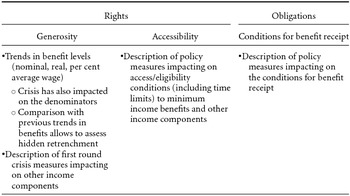
Table 1 summarises these dimensions and presents the indicators we will use to assess crisis-induced changes in the period 2008 to mid-2010.
Operationalisation of the dimensions of social citizenship

Data
This paper builds on the CSB-MIPI dataset, an expert-sourced dataset that covers in detail the institutional arrangements relating to different minimum income protection schemes. The present paper draws on the information regarding the minimum income scheme catering for the able-bodied unemployed falling outside the scope of the insurance scheme. Information is available for twenty-four EU countriesFootnote 1 for the period 1992–2010. The data set includes annual time series on gross benefits. The core of the dataset consists of detailed model family simulations that grasp the interplay of various schemes and measures in providing a minimum income package to various types of households. Information is also gathered on activity requirements for able-bodied minimum income recipients of working age. Most importantly for our present purposes, the 2010 wave included a special crisis module, gathering information on the crisis measures taken in the period 2008–10. The data are provided by national experts on the basis of detailed questionnaires and instructions. Many have participated in earlier studies on social benefit packages (Bradshaw and Finch, Reference Bradshaw and Finch2002; Eardley et al., Reference Eardley, Bradshaw, Ditch, Gough and Whiteford1996), or currently participate in EUROMOD. More information on the methodology and content of CSB-MIPI, as well as a list of the national experts contributing to this data set, can be found in Van Mechelen et al. (Reference Van Mechelen, Marchal, Goedemé, Marx and Cantillon2011).
By first defining the group at risk (here the working-aged able-bodied who fall outside the social insurance scheme and are without a job), equivalent schemes are compared across countries, instead of schemes that merely have a similar name. In most European countries, this target group is catered for by the general final safety net, i.e., the minimum income schemes that provide support to all those who have passed the means-test. Yet in a number of European countries, this target group receives support under a categorical income support scheme, i.e., a safety net explicitly targeting the able-bodied who are not (or no longer) entitled to contributory insurance benefits. This is the case in the United Kingdom, Ireland, Germany, Finland and HungaryFootnote 2 (see Bahle et al., Reference Bahle, Hubl and Pfeifer2011).
Another important difference relates to the government level responsible for regulating the minimum income scheme (Kazepov, Reference Kazepov2010). In Austria (until September 2010), Italy and Spain, the minimum income scheme is a subnational responsibility. CSB-MIPI contains information for the localities Vienna, Milan and Catalonia respectively. For Sweden, where municipalities have a large degree of autonomy, CSB-MIPI provides information for Stockholm. This paper covers measures impacting on the net disposable income of persons receiving support under these schemes, i.e., it includes changes in additional support if minimum income beneficiaries are entitled, even when this additional support is provided through a different scheme.
CSB-MIPI includes policy changes that impacted on the net disposable income of minimum income recipients, as well as conditions tied to minimum income receipt in the period under consideration, i.e., implemented in the period 2008–mid-2010. As the focus of this paper is on crisis measures, tables and figures do not include measures that were clearly prepared before the period under consideration and that were implemented in the first crisis years without further modification or reference to the crisis. This includes changes to indexation or uprating mechanisms. This distinction draws on assessments by national respondents, and additional sources where available. As the information on changes in gross benefit levels is based on the CSB-MIPI time series, instead of on the qualitative information mentioned in the crisis questionnaire, here countries are reported when real year-on-year increases in gross benefit levels for a couple exceed the average year-on-year increase in the four years preceding the crisis.
What should we look for in our data? An important consideration is that expansionary measures may be more visible and explicitly legislated than retrenchment measures. Indeed, various authors have forcefully argued that retrenchment measures are more likely to occur through less visible administrative or technical adaptations, or even through non-intervention, in order to provoke less resistance (Pierson, Reference Pierson1996). In the context of minimum income protection, this may occur through non-interventions, such as skipping indexation, or small, technical changes, such as tinkering with eligibility parameters.
As regards the generosity of minimum income benefits, where non-intervention may be particularly relevant, our time series of gross minimum income benefits allow us to gauge nominal increases or standstills. We also compare trends in gross benefits to more substantively relevant denominators, such as prices and average wages. These, however, are influenced by factors other than policy alone.
Changing access and behavioural conditions generally require explicit legal changes, although these are often of a rather technical nature. The data employed in this paper allow such changes to be captured in principle. Also in this field, creeping retrenchment is possible by not adjusting nominal eligibility thresholds. This kind of retrenchment is harder to gauge, and the data employed in this article may fail to fully take account of this. When there is a link between the benefit levels on the one hand, and the eligibility thresholds on the other, creeping retrenchment in benefit levels may also point towards a tightening of access.
Crisis responses
Benefit generosity
Gross minimum income benefit level
We start with considering what happened to benefit levels. In the pre-crisis period, nominal increases were rather common, generally because most countries (either or not automatically) adjust gross benefits levels for price rises at regular intervals (Van Mechelen and Marchal, Reference Van Mechelen, Marchal, Marx and Nelson2013). Indeed, in just six countries there is no statutory adjustment mechanism for social assistance benefits; the development entirely depends on ad hoc decisions (Ireland, Bulgaria, Estonia, Latvia, Lithuania and the Slovak Republic). In a limited number of other countries, such as Poland and Romania, the law defines the parameters the government should take into account for uprating benefits (e.g., consumer prices and periods), although actual indexation is not enforced. However, in most of these countries, governments did in fact issue periodic increases in the years before the crisis. This is especially so in Ireland, where a strengthening of the safety net was part of an anti-poverty strategy. Significant decreases of gross benefit rates were rare and occurred only in the Czech and Slovak Republics. Both were part of far-reaching reforms of the social safety net. Also, in both cases, effects on net disposable income were not quite so pronounced, given the impact of housing allowances (CZ) or conditional top-ups (SK).
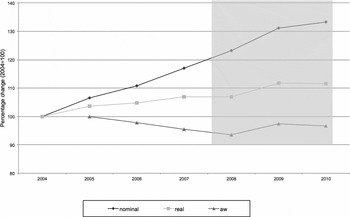
During the first crisis years, nominal growth rates did not slow down (see Figure 1).Footnote 3 In 2008–09 (coinciding with fiscal stimulus programmes), benefit levels in fact increased, exceeding in over half of the countries of our sample the average increases during the pre-crisis period. Exceptions are the Czech Republic, Estonia and Poland, where nominal benefits did not increase at all. Although Estonia had issued some substantial increases in the two years prior to the crisis, this was discontinued. The Czech Republic maintained its indexation rule that requires a surge in consumption prices of over 5 per cent (MISSOC, Reference MISSOC2009). In Poland, the government decided to skip the indexation that should have taken place in 2009. Growth rates decelerated and even halted later on in the crisis. An exceptional development occurred in Ireland, where minimum income benefits were actually cut by around 4 per cent.
Trends in gross social assistance benefits for a couple, EU 24, 2004–10 (2004 = 100) Note: excl. HU, BG. For average wage: 2005 = 100. Source: CSB-MIPI (Van Mechelen et al., Reference Van Mechelen, Marchal, Goedemé, Marx and Cantillon2011), HICP from Eurostat (2012), average wages from OECD (2011a).

Earlier research shows that in the 1990s the purchasing power guaranteed by gross minimum income benefits decreased in a large number of Western European countries (Nelson, Reference Nelson2013; Cantillon et al., Reference Cantillon, Van Mechelen, Marx and Van den Bosch2004). Yet in the years preceding the crisis most countries succeeded in keeping minimum income benefits in line with trends in consumer prices (Van Mechelen and Marchal, Reference Van Mechelen, Marchal, Marx and Nelson2013). It is important to see whether this development was maintained during the crisis. Did the nominal increases succeed in safeguarding the purchasing power of social assistance benefits?
Figure 1 shows that during the years prior to the crisis, gross benefits on average maintained their purchasing power. In more than a few countries, benefit levels even increased (somewhat) more than consumer prices. Nevertheless, there are some important exceptions, mainly in those countries where no automatic indexation procedure exists (e.g., Bulgaria and Latvia). However, discretionary indexation did not necessarily lead to erosion. Benefit levels increased faster than consumer prices in, for instance, Ireland, Lithuania and Estonia, due to substantial hikes enacted by the government (see also Van Mechelen and Marchal, Reference Van Mechelen, Marchal, Marx and Nelson2013).
Following the onset of the crisis, we see substantial real hikes in most of the countries. This is partially due to the lagged reaction of indexation mechanisms to in some cases quite substantial pre-crisis increases in consumer prices. However, these automatic increases were reinforced by discretionary increases of gross benefits in a substantial number of countries, leading to real increases above trends in pre-crisis years. Later on, the deceleration in nominal growth seen for 2009–10 led in some countries to a small loss in purchasing power. However, bar a few exceptions (most importantly Ireland), this decrease does not appear exceptional when compared to pre-crisis trends.
Also relative to average wages, there are no indications for an erosion of benefit levels during the first crisis years, rather the reverse is true. Whereas benefit levels eroded relative to average wages in more than halfFootnote 4 of the countries in our sample in the years before the crisis, a further erosion of benefits remained very limited in 2008–09. Moreover, as average wages decreased in some (mainly Eastern European) countries, the relative value of benefit levels even improved. In line with the deceleration of nominal growth levels, relative benefits did decrease in the majority of countries in 2009–10, but this erosion remained in line with pre-crisis annual changes.
All in all, trends in gross social assistance benefit levels prior and during the crisis provide no indications of a retrenchment round immediately after the onset of the crisis. Yet there is also little evidence of a substantial revalourisation of minimum income protection provisions. In most countries, nominal as well as real increases occurred, especially immediately after the start of the crisis. In some countries, these increases countered a trend of gradual decline during the pre-crisis years, but the size of the increases does not point to marked breaks in long-term trends. After 2009, annual growth rates are indeed back in line with pre-crisis trends. Generally, there are no indications of hidden retrenchment, except for the rather obvious case of Poland, where statutory indexation was skipped.
Supplementary allowances and child benefits
Minimum income recipients often receive child cash benefits and supplementary allowances such as housing or heating allowances, one-off emergency payments, etc., on top of their social assistance benefits. The following presents changes in those benefits for which (the families of) able-bodied minimum income recipients of working age are eligible in the respective countries.
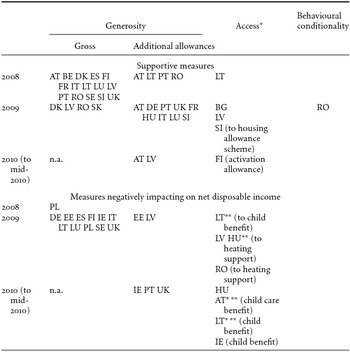
Many governments have used additional benefits and one-off payments to sustain household consumption and protect families’ living standards in the aftermath of the crisis (Immervoll and Llena-Nozal, Reference Immervoll and Llena-Nozal2011). To the extent that these additional benefits are not included in the means-test, measures impacting on these income components do affect the generosity of the minimum income package. Table 2 provides an overview of the countries that issued crisis measures impacting on the net disposable income of minimum income recipients. France and Slovenia both established a crisis premium for specific low income groups, whereas the Hungarian government introduced one-off emergency payments. Italy issued a social card system targeted at low income households with young children and urgent needs, entitling them to a budget that can be spent on the purchase of household goods. Luxembourg and Finland introduced more structural policy measures, in the sense that these were not introduced on a one-off basis and/or were targeted at a larger group of able-bodied minimum income recipients. In Luxembourg, the heating allowance was replaced by a substantially higher cost of living allowance. In Finland, the activation allowance was also raised for recipients of the Labour Market Subsidy, and its duration extended. However, these latter changes were not directly crisis-related.
Crisis measures implemented in 2008–mid-2010

Notes: Gross column represents countries where gross minimum income benefits increased (decreased) in 2008–09/2009–10 – including increases as of 1 January 2009/10 – more (less) than the average annual increase in the period 2004–08, and at least (–)1 percentage point in real terms. No information on gross benefit levels available for 2010–mid-2010. No gross benefits were available for Hungary and Bulgaria.
*Only mentioned where respondent notes actual change. However, sometimes parameters for access may be tied to gross benefits.
**Changes to the income threshold/means test for the particular benefit mentioned. Actual impact on minimum income recipients depends on specific situation and interaction with means test for minimum income protection.
Source: CSB-MIPI (Van Mechelen et al., Reference Van Mechelen, Marchal, Goedemé, Marx and Cantillon2011).
Another commonly used approach to contain the downturn's damaging effects on household income have been improvements in child cash benefits (OECD, 2011). For example, in 2008 the Austrian government decided to increase the universal child cash benefit by increasing the number of payments from twelve times per year to thirteen times. In 2009, the Austrian tax credit for families with children was raised. Similarly, Romania improved both its universal child cash benefits and means-tested child allowances in 2008. Comparable adjustments can be found in Latvia, Portugal, Germany and the United Kingdom (see also Gauthier, Reference Gauthier2010).
Measures negatively impacting on the generosity of minimum income recipient's rights were far less common. Estonia abolished a school allowance, whereas Latvia, Ireland and Portugal decreased (some of) their child benefits. The United Kingdom made indexation of minimum income benefits less generous in 2010, and skipped indexation altogether for some other benefits, including child allowances.
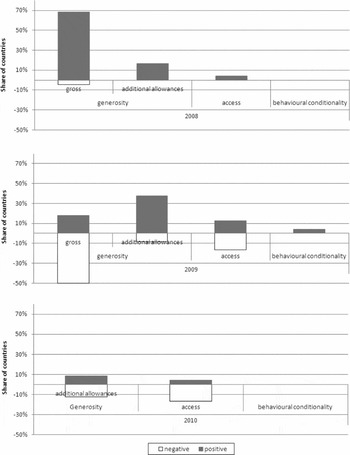
Consequently, supportive measures were far more common than generosity reducing measures, especially in the first crisis years. By 2010, (crisis) measures became relatively rare (see Figure 2). Only five countries issued crisis measures impacting on the net disposable income of benefits, of which three were negatively oriented. This seems to be in line with the relative absence of additional real increases in gross benefits in 2009–10.
Share of countries implementing expansionary and tightening crisis measures in three dimensions of social citizenship, 2008–mid-2010 Note: ‘Gross’ represents countries where gross minimum income benefits increased (decreased) in 2008–09/2009–10 – including increases as of 1 January 2009/10 – more (less) than the average annual increase in the period 2004–08, and at least (–)1 percentage point in real terms. No information on gross benefit levels available for 2010–mid-2010. No gross time series available for Bulgaria and Hungary. Hence, N = 22 for gross category instead of N = 24 for the other categories. See also footnotes to Table 2. Source: CSB-MIPI (Van Mechelen et al., Reference Van Mechelen, Marchal, Goedemé, Marx and Cantillon2011).

Access to benefits
Whereas the generosity of benefits was initially increased, Table 2 shows that rules determining access to benefits remained relatively unchanged during the first crisis years. In 2008, changes to means-tests, time-limits, nationality conditions, etc., were quite exceptional. In 2009, the number of countries that altered eligibility rules increased. Changes were often induced by adjustments to the means-test that resulted from changes in benefit levels. However, there is no uniform pattern across countries. While countries like Bulgaria and Slovenia expanded the coverage of their social safety net or housing allowance scheme, the reforms in Lithuania, Romania and Hungary were intended to restrict access to social assistance or other means-tested benefits. Latvia even combined expansionary and tightening measures; persons with mortgage liabilities became eligible for minimum income benefits, but at the same time a larger part of the child benefit became included in the means-test.
In 2010, quite a number of countries reduced access to minimum income protection, and especially to benefits for families with children (Table 2). Eligibility rules for child-related benefits became stricter in Austria, Ireland and Lithuania. While the generosity of cash child benefits generally improved during the early crisis period, the coverage of benefit schemes was subsequently scaled back. It is too early to draw final conclusions, but the data available seem to suggest that as the economic downturn persists, crisis response measures increasingly come under the grip of austerity packages (OECD, 2011).
Obligations: behavioural conditionality
Behavioural requirements do not directly impact on net income, but aim to regulate the behaviour of minimum income recipients through the use of sanctions tied to activity requirements. Often these activity requirements are coupled to additional support for investments in skills and human capital. This aspect of minimum income schemes has gained in importance over the last decade as governments have become more focused on activation (Weishaupt, Reference Weishaupt, Marx and Nelson2013; Eichhorst and Konle-Seidl, Reference Eichhorst and Konle-Seidl2008). Here we focus on legal changes in behavioural (activity) requirements.
The general absence of legal changes regarding behavioural requirements is striking. Only in Romania were a very small group of minimum income recipients (those caring for a disabled child aged sixteen to eighteen) exempted from labour force activation. Changes were generally only enacted by reforms prepared before the onset of the crisis. This was the case in France, the Netherlands, the United Kingdom, Hungary and the Czech Republic. In the latter two countries, more stringent activity requirements became explicitly tied to financial incentives. Hungary enacted a reform of the minimum income scheme; able-bodied persons of working age, who have no care responsibilities, are since 2009 eligible for a more generous ‘stand by’ allowance. This allowance is however conditional upon participation in an employment programme for a certain number of hours per week. Later on, it was stipulated that only one adult per household could receive this ‘stand by’ allowance. In the Czech Republic, after six months of benefit receipt, the minimum income benefit is decreased, unless one participates in employment programmes or voluntary work. Notable about these changes is that these were implemented despite the crisis.
On the other hand, a significant number of countries increased budgets for job search assistance and activation programmes in the initial stages of the crisis (such as Belgium, the Czech Republic, Denmark, Estonia, Finland, Latvia, Portugal, Sweden, Romania, the United Kingdom).Footnote 5 However, participation in activation programmes is only seldom a ‘right’. Often discretionary selection applies, and in many countries access to programmes for the unemployed remains difficult for minimum income recipients. Also, except in Denmark, the Netherlands and Finland, the number of places available is (much) smaller than the number of potential beneficiaries.
Discussion and conclusion
Just before the crisis arrived, unemployment levels were at the lowest level seen for a generation in many European countries. The belief that boosting employment, activation and social investment offered the way forward in bringing down poverty and strengthening social cohesion had become common currency. Minimum income schemes had suffered two decades of relative neglect in many countries.
This article has asked whether the crisis brought about any change. It seems plausible that it did. The crisis rendered the idea that people capable and willing to work ought to be able to generate an income in the labour market, with government support if necessary, patently untenable in many countries. It seems plausible to expect that the crisis brought a re-evaluation of the role of ‘passive’ minimum income schemes in ensuring social citizenship, especially in times of crisis. We have assessed here the impact of the crisis on the generosity, accessibility and conditionality of minimum income schemes during the first years of the crisis.
This article focused on the measures taken in the initial phase of the crisis, in the period 2008 to mid-2010. We find a general pattern of increases in gross minimum income benefits levels across the EU, especially in the years 2008 and 2009, before fiscal considerations took centre stage. In some countries, these increases countered a trend of gradual decline during the pre-crisis years. Yet the size of the increases does not point to marked breaks in long-term trends. In a substantial number of countries, we find (additional) measures to boost the net income packages of households reliant on social assistance or equivalent minimum income support. Most frequent are (targeted) hikes in child-related benefits. Some countries awarded one-off lump-sum benefits. Changes to eligibility conditions of minimum income schemes generally remained limited. Behavioural requirements imposed on minimum income recipients were neither tightened nor relaxed, but, in some countries, activation efforts aimed at minimum income recipients were intensified. Moreover, earlier prepared conditionality measures were introduced in a number of countries. If anything, it therefore seems that increased activation was only put ‘on hold’ in the first crisis years, in the sense that it was not perceived as a valuable crisis strategy.
Although supportive measures are the general pattern during the initial phase of the crisis, some retrenchment measures become evident later on in at least a number of countries (Figure 2). From 2010 onwards, most countries did not issue further expansionary measures. In some countries, indications for retrenchment appear in 2009 and 2010. Whereas the expansionary measures, mainly observed in the first crisis years, generally centred on increases in benefits, retrenchment measures were more often enacted through changes in access conditions. Examples include: skipping indexation, tightening the means-test, abolishment or decrease of additional benefits (for instance child benefit). Only one country, Ireland, actually cut minimum income benefits. This is broadly in line with the retrenchment literature where it is argued that retrenchment is often pursued through less visible, apparently technical changes. Countries that introduced retrenchment measures were mainly those where the crisis hit the hardest (Hay and Wincott, Reference Hay and Wincott2012).
In sum, there are no indications for decisive breaks in policy relating to minimum income protection during the first crisis years. Neither the size of the increases nor the choice of instruments (i.e., temporary one-off allowances) point to pathbreaking ruptures towards more adequate social safety nets. In the meantime, pressures for public spending cuts have mounted in most EU countries. Financial markets appear far from appeased and the outlook of some European countries remains uncertain at best. Various European governments have embarked on a policy of budget austerity or are being pressed to do so. Policy change in the direction of retrenchment seems not implausible and various countries have already started to prepare reforms of their social protection schemes. A close and continued monitoring of Europe's social safety nets is thus in order.
Acknowledgements
We would like to thank participants of the 9th ESPAnet conference in Valencia and the 2011 ‘Global economic crisis and the welfare state’ workshop in Bremen for their valuable comments to earlier versions of this paper. Also, the comments and suggestions of two anonymous reviewers are greatly appreciated.