



1. Introduction and main results
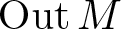
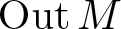
The outer automorphism group  $\operatorname{Out} M$ of a II1 factor M is the quotient of the group
 $\operatorname{Aut} M$ of all
 $*$-automorphisms of M by the normal subgroup
 $\operatorname{Inn} M$ of inner automorphisms, of the form
 $\operatorname{Ad} u$ with
 $u \in \mathcal{U}(M)$. In [Reference Ioana, Peterson and Popa3], answering a question of Connes from the 1970s, it was proven that there exist II1 factors M with trivial outer automorphism group. This provided at the same time the first complete computation of the outer automorphism group of any II1 factor.
A II1 factor M is called full if  $\operatorname{Inn} M$ is a closed subgroup of
 $\operatorname{Aut} M$. This is equivalent with M not having property Gamma in the sense of Murray and von Neumann. If M is full and has separable predual,
 $\operatorname{Out} M$ is a Polish group. It is a natural and by now well-studied question which Polish groups arise as the outer automorphism group of a full II1 factor with separable predual. The following families of Polish groups could be realized in this way: compact abelian groups in [Reference Ioana, Peterson and Popa3], countable discrete groups in [Reference Popa and Vaes5, Reference Vaes9], arbitrary compact groups in [Reference Falguières and Vaes2], and several families of non-locally compact groups in [Reference Popa and Vaes6], including all closed subgroups of the group of all permutations of a countably infinite set.
All this, however, left open the question if all locally compact second countable groups, in particular Lie groups, can be realized as  $\operatorname{Out} M$. We solve this problem here and the following is our main result.
Theorem A. Every locally compact second countable group G arises as the outer automorphism group  $\operatorname{Out} M$ of a full II1 factor M with separable predual.
Denote by  $(X,\mu)$ the standard non-atomic probability space. We consider the Polish group
 $\operatorname{Aut}(X,\mu)$ of all non-singular automorphisms of
 $(X,\mu)$, identifying two automorphisms that coincide almost everywhere. The measure preserving automorphisms form a closed subgroup
 $\operatorname{Aut}_{\text{mp}}(X,\mu)$. In [Reference Deprez1, theorem E], it was proven that for every countable subgroup
 $\Lambda \lt \operatorname{Aut}_{\text{mp}}(X,\mu)$, the centralizer
 $C(\Lambda)$ of Λ inside
 $\operatorname{Aut}_{\text{mp}}(X,\mu)$ is a Polish group that arises as the outer automorphism group
 $\operatorname{Out} M$ of a full II1 factor M with separable predual. A more direct proof of this result was given in [Reference Popa and Vaes6, proposition 8.5].
To prove theorem A, it thus suffices to realize every locally compact second countable group as a centralizer inside  $\operatorname{Aut}_{\text{mp}}(X,\mu)$. Note here that a subgroup
 $G \lt \operatorname{Aut}_{\text{mp}}(X,\mu)$ is of the form
 $C(\Lambda)$ for a subgroup
 $\Lambda \lt \operatorname{Aut}_{\text{mp}}(X,\mu)$ if and only if G equals its double centralizer
 $C(C(G))$.
Definition B. We say that a Polish group G is a centralizer group if there exists an ergodic probability measure preserving action  $\Lambda \curvearrowright (X,\mu)$ of a countable group Λ on a standard probability space
 $(X,\mu)$ such that G is isomorphic with the centralizer of Λ inside
 $\operatorname{Aut}_{\text{mp}}(X,\mu)$.
So as explained above, by [Reference Deprez1, Reference Popa and Vaes6] for every centralizer group G, there exists a full II1 factor M with separable predual such that  $G \cong \operatorname{Out} M$. Since every locally compact group G is the centralizer of G acting on itself (by transformations that are not probability measure preserving), theorem A is thus a consequence of the following result, which also shows that the class of centralizer groups is quite natural.
Theorem C. The following Polish groups are centralizer groups.
(i) The centralizer of any subgroup of the Polish group
 $\operatorname{Aut}_{\text{mp}}(X,\mu)$ of measure preserving automorphisms of a possibly infinite σ-finite standard measure space
$(X,\mu)$.
(ii) The centralizer of any subgroup of the Polish group
$\operatorname{Aut}(X,\mu)$ of non-singular automorphisms of a standard probability space
$(X,\mu)$.


To prove the first statement, we make use of Poisson suspensions, while we deduce the second statement from the first by using the Maharam extension. In §4 and 5, we prove a few permanence properties for the class of centralizer groups, we reprove that every closed subgroup of the group  $S_\infty$ of all permutations of a countably infinite set is a centralizer group (cf. [Reference Popa and Vaes6, corollary 8.2]) and that
 $\operatorname{Aut} K$ is a centralizer group for all compact second countable groups K.
Remark D. To summarize, we then get the following list of centralizer groups, which can all be realized as the outer automorphism group of a full II1 factors with separable predual.
(i) Locally compact second countable groups and their direct integrals (theorem A and proposition 4.2).
(ii) Closed subgroups of
$S_\infty$, the group of all permutations of a countably infinite set ([Reference Popa and Vaes6, corollary 8.2] and theorem 5.1).(iii) The automorphism group
$\operatorname{Aut} K$ of a compact second countable group K (proposition 5.3).(iv) The unitary group
$\mathcal{U}(N)$ of a von Neumann algebra N with separable predual ([Reference Popa and Vaes6, corollary 8.2]).(v) A direct product of a countable family of centralizer groups (proposition 4.1).


2. Preliminaries
We start by recalling the concept of Poisson suspensions and refer to [Reference Janvresse, Roy and De La Rue4] for details and further references. Let  $(Y,\eta)$ be a standard σ-finite measure space. A measure on Y of the form
 $\sum_{i \in I} \delta_{y_i}$, where
 $(y_i)_{i \in I}$ is a countable set of points in Y, is called a counting measure. Write
 $\overline{\mathbb{N}} = \mathbb{N} \cup \{0,+\infty\}$. The set X of all counting measures ν on Y has a unique standard Borel structure such that the maps
 \begin{equation*}N_A : X \to \overline{\mathbb{N}} : \nu \mapsto \nu(A)\end{equation*}
are Borel for every Borel set  $A \subset Y$. There is a unique probability measure µ on X such that for every Borel set
 $A \subset Y$ with
 $0 \lt \eta(A) \lt +\infty$, the random variable NA has a Poisson distribution with intensity
 $\eta(A)$, i.e.
 \begin{equation*}\mu\bigl(N_A^{-1}(\{k\})\bigr) = \exp(-\eta(A)) \, \frac{\eta(A)^k}{k!} \quad\text{for all}\ k \in \mathbb{N} \cup \{0\},\end{equation*}
and such that the random variables  $N_{A_1},\ldots,N_{A_n}$ are mutually independent for all disjoint Borel sets
 $A_i \subset Y$ with
 $0 \lt \eta(A_i) \lt +\infty$. Also note that
 $N_A + N_B = N_{A \cup B}$ when
 $A,B \subset Y$ are disjoint Borel sets.
There then is a unique isometric real linear map
 \begin{align}
\theta : L^{2}_{\mathbb{R}}(Y,\eta) \to L^{2}_{\mathbb{R}}(X,\mu) : \theta(1_A) = N_A - \eta(A) 1
\end{align}
for all Borel sets  $A \subset Y$ with
 $\eta(A) \lt +\infty$. One checks that
 \begin{equation}
E_\mu(\exp(it \theta(\xi))) = \exp\Bigl(\int_Y (\exp(i t \xi) - i t \xi - 1) \, d\eta \Bigr) \quad\text{for all}\ \xi \in L^{2}_{\mathbb{R}}(Y,\eta),
\end{equation}
where the right-hand side is well defined because  $|\exp(ir) - ir - 1| \leq r^2$ for all
 $r \in \mathbb{R}$.
Denote by  $L^{2}_{\mathbb{R}}(Y,\eta)^{\otimes_{\text{symm}}^{n}}$ the closed subspace of symmetric vectors in
 $L^{2}_{\mathbb{R}}(Y,\eta)^{\otimes^n}$. Consider the symmetric Fock space
 \begin{equation*}\mathcal{F}_{s}(L^{2}_{\mathbb{R}}(Y,\eta)) = \mathbb{R} 1 \oplus \bigoplus_{n=1}^{\infty} L^{2}_{\mathbb{R}}(Y,\eta)^{\otimes_{\text{symm}}^{n}}\end{equation*}
and define for every  $\xi \in L^{2}_{\mathbb{R}}(Y,\eta)$ the vector
 $\operatorname{Exp}(\xi) \in \mathcal{F}_s(L^{2}_{\mathbb{R}}(Y,\eta))$ by
 \begin{equation*}\operatorname{Exp}(\xi) = 1 \oplus \bigoplus_{n=1}^\infty \frac{1}{\sqrt{n!}} \xi^{\otimes n} \; .\end{equation*}
Note that  $\langle \operatorname{Exp}(\xi),\operatorname{Exp}(\zeta)\rangle = \exp(\langle \xi,\zeta\rangle)$.
Then  $\theta : L^{2}_{\mathbb{R}}(Y,\eta) \to L^{2}_{\mathbb{R}}(X,\mu)$ uniquely extends to an isometric, bijective, real linear map
 \begin{align}
\Theta: \mathcal{F}_s(L^{2}_{\mathbb{R}}(Y,\eta)) \to L^{2}_{\mathbb{R}}(X,\mu) : \Theta(\operatorname{Exp}(\exp(\xi) - 1)) = E_\mu(\exp(\theta(\xi)))^{-1} \, \exp(\theta(\xi))
\end{align}
for all simple functions  $\xi \in L^{2}_{\mathbb{R}}(Y,\eta)$, i.e. finite linear combinations of 1A with
 $A \subset Y$ Borel and
 $\eta(A) \lt +\infty$.
To every  $\alpha \in \operatorname{Aut}_{\text{mp}}(Y,\eta)$ corresponds the Poisson suspension
 $\widehat{\alpha} \in \operatorname{Aut}_{\text{mp}}(X,\mu)$ defined by
 $\widehat{\alpha}(\nu) = \alpha_*(\nu)$ for every counting measure ν on Y. Every measure preserving automorphism β of a σ-finite standard measure space
 $(Z,\zeta)$ also gives rise to the canonical orthogonal transformation Uβ of
 $L^{2}_{\mathbb{R}}(Z,\zeta)$. We then get that
 \begin{equation}
U_{\widehat{\alpha}} \circ \Theta = \Theta \circ \Bigl( \mathord{\text{id}} \oplus \bigoplus_{n=1}^\infty U_\alpha^{\otimes_{\text{symm}}^{n}}\Bigr) \quad\text{for all}\ \alpha \in \operatorname{Aut}_{\text{mp}}(Y,\eta).
\end{equation}
3. Centralizer groups, proof of theorems A and C
The following is the key technical lemma showing that in certain cases, the centralizer of a Poisson suspension equals the Poisson suspension of the centralizer.
Lemma 3.1. Let  $(Y,\eta)$ be a standard σ-finite measure space and
 $\Lambda \lt \operatorname{Aut}_{\text{mp}}(Y,\eta)$ a subgroup. Denote by
 $(X,\mu)$ the Poisson suspension of
 $(Y,\eta)$ and consider
 $\widehat{\Lambda} \lt \operatorname{Aut}_{\text{mp}}(X,\mu)$ given by
 $\widehat{\Lambda} = \{\widehat{\beta} \mid \beta \in \Lambda\}$. Assume that there exists a sequence
 $\beta_n \in \Lambda$ such that the orthogonal transformations
 $U_{\beta_n}$ of
 $L^{2}_{\mathbb{R}}(Y,\eta)$ satisfy
 $U_{\beta_n} \to \rho \cdot \mathord{\text{id}}$ weakly for some
 $0 \lt \rho \lt 1$.
Then  $\widehat{\Lambda} \lt \operatorname{Aut}_{\text{mp}}(X,\mu)$ is ergodic and the map
 $\alpha \mapsto \widehat{\alpha}$ is a bijection between the centralizer of Λ inside
 $\operatorname{Aut}_{\text{mp}}(Y,\eta)$ and the centralizer of
 $\widehat{\Lambda}$ inside
 $\operatorname{Aut}_{\text{mp}}(X,\mu)$.
Proof. Consider the symmetric Fock space  $\mathcal{F}_s(L^{2}_{\mathbb{R}}(Y,\eta))$ and the isometry
 $\Theta : \mathcal{F}_s(L^{2}_{\mathbb{R}}(Y,\eta)) \to L^{2}_{\mathbb{R}}(X,\mu)$ given by (2.3). By (2.4) and the assumption that
 $U_{\beta_n} \to \rho \cdot \mathord{\text{id}}$ weakly,
 \begin{equation*}\Theta^* \circ U_{\widehat{\beta_n}} \circ \Theta \to T := \mathord{\text{id}} \oplus \bigoplus_{n=1}^\infty \rho^n \cdot \mathord{\text{ id}} \quad\text{weakly.}\end{equation*}
So if  $\xi \in L^{2}_{\mathbb{R}}(X,\mu)$ is
 $\widehat{\Lambda}$-invariant, it follows that
 $\Theta^*(\xi) \in \mathbb{R} 1$ and thus
 $\xi \in \mathbb{R} 1$, proving the ergodicity of
 $\widehat{\Lambda} \lt \operatorname{Aut}_{\text{mp}}(X,\mu)$.
Take  $\varphi \in \operatorname{Aut}_{\text{mp}}(X,\mu)$ centralizing
 $\widehat{\Lambda}$. It follows that
 $\Theta^* \circ U_\varphi \circ \Theta$ commutes with T and thus globally preserves the eigenspace
 $L^{2}_{\mathbb{R}}(Y,\eta)$, so that Uφ globally preserves
 $\theta(L^{2}_{\mathbb{R}}(Y,\eta))$, with θ defined by (2.1). It follows from [Reference Roy7, proposition 4.4] that
 $\varphi = \widehat{\alpha}$ for a uniquely defined
 $\alpha \in \operatorname{Aut}_{\text{mp}}(Y,\eta)$. For completeness, we provide the following easy argument to obtain this result.
Define the orthogonal transformation U of  $L^{2}_{\mathbb{R}}(Y,\eta)$ such that
 $U_\varphi \circ \theta = \theta \circ U$. Take an arbitrary
 $\xi \in L^{2}_{\mathbb{R}}(Y,\eta)$. The characteristic function of the random variable
 $\theta(\xi)$ is given by (2.2). This is saying that
 $\theta(\xi)$ is infinitely divisible with Lévy measure ρξ given by
 $\rho_\xi(\mathcal{U}) = \eta(\xi^{-1}(\mathcal{U}))$ for all Borel sets
 $\mathcal{U} \subset \mathbb{R} \setminus \{0\}$. Since φ is measure preserving,
 $\theta(\xi)$ and
 $U_\varphi(\theta(\xi))$ have the same distribution and hence, the same Lévy measure. Since
 $U_\varphi(\theta(\xi)) = \theta(U(\xi))$, it follows that
 $\rho_\xi = \rho_{U(\xi)}$ for all
 $\xi \in L^{2}_{\mathbb{R}}(Y,\eta)$.
Since  $\xi \geq 0$ a.e. if and only if
 $\rho_\xi(-\infty,0) = 0$ and since
 $\xi \leq 1$ a.e. if and only if
 $\rho_\xi(1,+\infty) = 0$, we conclude that the orthogonal transformation
 $U \in \mathcal{O}(L^{2}_{\mathbb{R}}(Y,\eta))$ maps positive functions to positive functions and maps functions
 $0 \leq \xi \leq 1$ to functions
 $0 \leq U(\xi) \leq 1$. This is only possible if
 $U = V_\alpha$ for some
 $\alpha \in \operatorname{Aut}_{\text{mp}}(Y,\eta)$. So,
 $\varphi = \widehat{\alpha}$.
Since φ commutes with  $\widehat{\Lambda}$, we get that α commutes with Λ and the lemma is proven.
Lemma 3.2. Let Y be a standard Borel space and η an infinite, σ-finite, non-atomic Borel measure on Y. There exists a sequence  $\beta_n \in \operatorname{Aut}_{\text{mp}}(Y,\eta)$ such that the orthogonal transformations
 $U_{\beta_n}$ of
 $L^{2}_{\mathbb{R}}(Y,\eta)$ satisfy
 $U_{\beta_n} \to (1/2) \cdot \mathord{\text{id}}$ weakly.
Proof. Since all such  $(Y,\eta)$ are isomorphic, we may realize
 $(Y,\eta) = (X \times \mathbb{Z} , \mu \times \lambda)$ with
 $(X,\mu) = (\{0,1\}^{\mathbb{N}},\mu_{0}^{\mathbb{N}})$,
 $\mu_0(0) = \mu_0(1) = 1/2$, and λ the counting measure on
 $\mathbb{Z}$. We define
 $\beta_n \in \operatorname{Aut}_{\text{mp}}(Y,\eta)$ by
 \begin{equation*}\beta_n(x,k) = \begin{cases} (x,k+n) &\;\;\text{if}\ x_n = 0,\\
(x,k) &\;\;\text{if}\ x_n = 1.\end{cases}\end{equation*}
Take  $N \in \mathbb{N}$,
 $A_0,A_1 \in \{0,1\}^N$ and
 $B_0,B_1 \subset [-N,N] \cap \mathbb{Z}$. Write
 $C_i = A_i \times \{0,1\}^{ \gt N} \subset X$. When
 $n \gt 2N$, we have that
 \begin{equation*}\langle U_{\beta_n}(1_{C_0} \otimes 1_{B_0}) , 1_{C_1} \otimes 1_{B_1} \rangle = \frac{1}{2} \langle 1_{C_0} \otimes 1_{B_0} , 1_{C_1} \otimes 1_{B_1} \rangle \; .\end{equation*}
Since these vectors  $1_C \otimes 1_B$ are total in
 $L^{2}_{\mathbb{R}}(Y,\eta)$, it follows that
 $U_{\beta_n} \to (1/2) \cdot \mathord{\text{ id}}$ weakly.
Proof of theorem C
To prove (i), take a standard σ-finite measure space  $(Y_0,\eta_0)$ and a subgroup
 $\Lambda_0 \lt \operatorname{Aut}_{\text{ mp}}(Y_0,\eta_0)$. Denote by G the centralizer of Λ0 inside
 $\operatorname{Aut}_{\text{mp}}(Y_0,\eta_0)$. We have to prove that G is a centralizer group in the sense of definition B.
Take an arbitrary non-atomic, infinite, σ-finite standard measure space  $(Y_1,\eta_1)$. By lemma 3.2, take a sequence
 $\beta_n \in \operatorname{Aut}_{\text{mp}}(Y_1,\eta_1)$ such that
 $U_{\beta_n} \to (1/2) \cdot \mathord{\text{id}}$ weakly. Denote
 $(Y,\eta) = (Y_0 \times Y_1,\eta_0 \times \eta_1)$. Define
 $\Lambda_1 \lt \operatorname{Aut}_{\text{mp}}(Y,\eta)$ by
 $\Lambda_1 = \Lambda_0 \times \operatorname{Aut}_{\text{mp}}(Y_1,\eta_1)$.
The centralizer of Λ1 inside  $\operatorname{Aut}_{\text{mp}}(Y,\eta)$ equals
 $G \times \mathord{\text{id}}$. The sequence
 $\mathord{\text{id}} \times \beta_n \in \Lambda$ satisfies
 $U_{\mathord{\text{id}} \times \beta_n} \to (1/2) \cdot \mathord{\text{id}}$ weakly. Denote by
 $(X,\mu)$ the Poisson suspension of
 $(Y,\eta)$ and denote by
 $\widehat{\Lambda_1} \lt \operatorname{Aut}(X,\mu)$ the Poisson suspension Λ1. By lemma 3.1, the subgroup
 $\widehat{\Lambda_1} \lt \operatorname{Aut}_{\text{mp}}(X,\mu)$ is ergodic and its centralizer inside
 $\operatorname{Aut}_{\text{mp}}(X,\mu)$ is isomorphic with G.
Since  $\operatorname{Aut}_{\text{mp}}(X,\mu)$ is a Polish group, we can choose a countable subgroup Λ of
 $\operatorname{Aut}_{\text{ mp}}(X,\mu)$ whose closure equals the closure of
 $\widehat{\Lambda_1}$. Since the centralizer of Λ equals the centralizer of
 $\widehat{\Lambda_1}$, it follows that G is a centralizer group in the sense of definition B.
To prove (ii), take a standard probability space  $(Y_0,\eta_0)$ and a subgroup
 $\Lambda_0 \lt \operatorname{Aut}(Y_0,\eta_0)$ of non-singular transformations. Denote by G the centralizer of Λ0 inside
 $\operatorname{Aut}(Y_0,\eta_0)$. We have to prove that G is a centralizer group.
Denote by γ the measure on  $\mathbb{R}$ given by
 $d\gamma(t) = \exp(-t) \, dt$. Write
 $(Y_1,\eta_1) = (Y_0 \times \mathbb{R}, \eta_0 \times \gamma)$. For every
 $\beta \in \operatorname{Aut}(Y_0,\eta_0)$, denote its Maharam extension by
 \begin{equation*}\widetilde{\beta} \in \operatorname{Aut}_{\text{mp}}(Y_1,\eta_1) : \widetilde{\beta}(y,t) = \bigl(\beta(y),t + \log \frac{d(\beta^{-1}_*(\eta))}{d\eta}(y)\bigr) \; .\end{equation*}
For every  $s \in \mathbb{R}$, denote by λs the measure scaling automorphism
 $\lambda_s(y,t) = (y,t+s)$. Then
 \begin{equation*}\Psi : \operatorname{Aut}(Y_0,\eta_0) \to \operatorname{Aut}_{\text{mp}}(Y_1,\eta_1) : \Psi(\beta) = \widetilde{\beta}\end{equation*}
is a group homomorphism whose image is equal to
 \begin{equation*}\{\zeta \in \operatorname{Aut}_{\text{mp}}(Y_1,\eta_1) \mid \forall s \in \mathbb{R} : \zeta \circ \lambda_s = \lambda_s \circ \zeta \;\;\text{a.e.}\} \; .\end{equation*}
The image of Ψ is closed and Ψ is a homeomorphism between  $\operatorname{Aut}(Y_0,\eta_0)$ and the image of Ψ.
Then define  $(Y,\eta) = (Y_1 \times \mathbb{R} , \eta_1 \times \gamma) = (Y_0 \times \mathbb{R} \times \mathbb{R}, \eta_0 \times \gamma \times \gamma)$. For every
 $s \in \mathbb{R}$, define
 $\rho_s \in \operatorname{Aut}_{\text{mp}}(Y,\eta)$ by
 $\rho_s(y,t_1,t_2) = (y,t_1+s,t_2-s)$. Denote by
 $\Lambda \lt \operatorname{Aut}_{\text{mp}}(Y,\eta)$ the subgroup generated by
 $\widetilde{\beta} \times \mathord{\text{id}}$,
 $\beta \in \Lambda_0$, ρs,
 $s \in \mathbb{R}$, and
 $\mathord{\text{id}} \times \mathord{\text{id}} \times \operatorname{Aut}_{\text{ mp}}(\mathbb{R},\gamma)$. Denote by G 1 the centralizer of Λ inside
 $\operatorname{Aut}_{\text{mp}}(Y,\eta)$. Since we have already proven (i), it suffices to prove that
 $G \cong G_1$.
Take  $\varphi \in G_1$. Since φ commutes with
 $\mathord{\text{id}} \times \mathord{\text{id}} \times \operatorname{Aut}_{\text{ mp}}(\mathbb{R},\gamma)$, we get that
 $\varphi = \psi \times \mathord{\text{id}}$ for some
 $\psi \in \operatorname{Aut}_{\text{ mp}}(Y_1,\eta_1)$. Since φ commutes with all ρs, we get that ψ commutes with all λs. Since ψ is measure preserving, we get that
 $\psi = \widetilde{\alpha}$ for a unique
 $\alpha \in G$. So the map
 $\alpha \mapsto \Psi(\alpha) \times \mathord{\text{id}}$ implements the isomorphism
 $G \cong G_1$.
Proof of theorem A
Choose a probability measure µ that is equivalent with the Haar measure on G. View  $G \lt \operatorname{Aut}(G,\mu)$ by right translations. Then the centralizer of G equals the copy of G in
 $\operatorname{Aut}(G,\mu)$ by left translations. By theorem C(ii), the group G is a centralizer group. By [Reference Deprez1, theorem E] (see also [Reference Popa and Vaes6, proposition 8.5]), there exists a full II1 factor M with separable predual such that
 $\operatorname{Out} M \cong G$.
4. Permanence properties
When  $(G_i)_{i \in I}$ is a countable family of Polish groups, the product
 $\prod_{i \in I} G_i$ with the topology of pointwise convergence is again a Polish group. We start with the following elementary observation.
Proposition 4.1. If  $(G_i)_{i \in I}$ is a countable family of centralizer groups, the product
 $\prod_i G_i$ also is a centralizer group.
Proof. Choose standard probability spaces  $(X_i,\mu_i)$ and ergodic subgroups
 $\Lambda_i \lt \operatorname{Aut}_{\text{mp}}(X_i,\mu_i)$ whose centralizers are isomorphic with Gi for all
 $i \in I$. Define the standard probability
 $(X,\mu) = \prod_{i \in I} (X_i,\mu_i)$. For every
 $i \in I$, denote by
 $\Gamma_i \lt \operatorname{Aut}_{\text{mp}}(X,\mu)$ the group
 $\Lambda_i$ acting in the ith coordinate. Define
 $\Gamma \lt \operatorname{Aut}_{\text{mp}}(X,\mu)$ as the subgroup generated by all the
 $\Gamma_i$,
 $i \in I$. Since each
 $\Lambda_i \lt \operatorname{Aut}_{\text{mp}}(X_i,\mu_i)$ is ergodic, any element
 $\alpha \in \operatorname{Aut}_{\text{mp}}(X,\mu)$ that centralizes Γ must be of the form
 $\prod_i \alpha_i$ with
 $\alpha_i \in \operatorname{Aut}_{\text{mp}}(X_i,\mu_i)$. From this, the result follows immediately.
With some more care, we also have the following continuous variant of proposition 4.1.
Recall from [Reference Vaes and Wouters10, definition 7.3] (see also [Reference Sutherland8]) the concept of a measured field  $(G_x)_{x \in X}$ of Polish groups. In a nutshell, this means that
 $(X,\mu)$ is a standard probability space and that, after discarding from X a Borel set of measure zero, we are given a standard Borel structure on the disjoint union
 $G = \sqcup_{x \in X} G_x$ such that the following holds: the natural factor map
 $\pi : G \to X$ is Borel, there exists a dense sequence of Borel sections
 $\varphi_n : X \to G$ and, writing
 $G \times_\pi G = \{(g,h) \mid \pi(g) = \pi(h)\}$, the multiplication map
 $G \times_\pi G \to G$ and the inverse map G → G are Borel.
Given such a measured field  $(G_x)_{x \in X}$ over
 $(X,\mu)$, we consider the group
 $\mathcal{G}$ of all Borel sections
 $\psi : X \to G$, where we identify sections that are equal a.e. With pointwise multiplication and with the topology of convergence in measure, where
 $\psi_k \to \psi$ if and only if
 $\mu\bigl(\{x \in X \mid d(\psi_k(x),\psi(x)) \gt \varepsilon\}\bigr) \to 0$ for all ɛ > 0, we get that
 $\mathcal{G}$ is a Polish group.
Note that when X is a countable set and µ is an atomic probability measure that assigns a positive value to each atom, then  $\mathcal{G} = \prod_{i \in X} G_i$ as above. In that sense,
 $\mathcal{G}$ is a ‘direct integral’ version of the usual product of Polish groups.
Proposition 4.2. Let  $(X,\mu)$ be a standard probability space and let
 $(G_x)_{x \in X}$ be a measured field of second countable locally compact groups. As above, denote by
 $\mathcal{G}$ the Polish group of measurable sections of this field, identifying sections that are equal a.e. and using the topology of convergence in measure. Then
 $\mathcal{G}$ is a centralizer group.
Proof. We discard from X a Borel set of measure zero, so that  $G = \sqcup_{x \in X} G_x$ is equipped with a standard Borel structure satisfying the conditions explained above (see [Reference Vaes and Wouters10, definition 7.3]). Using [Reference Vaes and Wouters10, proposition 10.2], we may choose probability measures γx on Gx such that for every
 $x \in X$, γx is equivalent with the Haar measure of Gx and such that for every positive Borel function
 $F : G \to [0,+\infty)$, the map
 \begin{equation*}X \to [0,+\infty] : x \mapsto \int_{G_x} F \, d\gamma_x\end{equation*}
is Borel. We then denote by γ the probability measure on the Borel σ-algebra of G given by
 \begin{equation*}\gamma(\mathcal{U}) = \int_X \gamma_x(\mathcal{U} \cap G_x) \, d\mu(x) = \int_X \Bigl(\int_{G_x} 1_{\mathcal{U}} \, d\gamma_x \Bigr) \, d\mu(x) \quad\text{for every Borel set}\ \mathcal{U} \subset G.\end{equation*}
By construction,  $\pi_*(\gamma) = \mu$. For every Borel section
 $\varphi : X \to G$, define the Borel bijections
 \begin{equation*}\alpha_\varphi : G \to G : \alpha_\varphi(g) = \varphi(\pi(g)) g \quad\text{and}\quad \beta_\varphi : G \to G: \beta_\varphi(g) = g \varphi(\pi(g))^{-1} \; .\end{equation*}
Since every γx is equivalent with the Haar measure of Gx, it follows that all αφ and βφ are non-singular automorphisms of  $(G,\gamma)$. By construction,
 \begin{equation*}\alpha : \mathcal{G} \to \operatorname{Aut}(G,\gamma) : \varphi \mapsto \alpha_\varphi \quad\text{and}\quad \beta : \mathcal{G} \to \operatorname{Aut}(G,\gamma) : \varphi \mapsto \beta_\varphi\end{equation*}
are faithful continuous group homomorphisms.
Note that whenever G 0 is a locally compact second countable group and γ 0 is a probability measure on G 0 that is equivalent with the Haar measure of G, then the embedding  $G_0 \hookrightarrow \operatorname{Aut}(G_0,\gamma_0)$ given by left translation has a closed image and is a homeomorphism of G 0 onto this image. It follows that the same holds for
 $\alpha : \mathcal{G} \to \operatorname{Aut}(G,\gamma)$.
We claim that  $\Delta \in \operatorname{Aut}(G,\gamma)$ belongs to
 $\alpha(\mathcal{G})$ if and only if Δ commutes with
 $\beta(\mathcal{G})$ and satisfies
 $\pi(\Delta(g)) = \pi(g)$ for a.e.
 $g \in G$. One implication being obvious, assume that
 $\Delta \in \operatorname{Aut}(G,\gamma)$ commutes with
 $\beta(\mathcal{G})$ and satisfies
 $\pi(\Delta(g)) = \pi(g)$ for a.e.
 $g \in G$. Choose a dense sequence of Borel sections
 $\varphi_n : X \to G$. Take a conull Borel set
 $X_0 \subset X$ such that for every
 $x \in X_0$, the following holds:
 \begin{align*}
& \pi(\Delta(g)) = x \quad\text{for}\ \gamma_x-\text{a.e.}\ g \in G_x, \text{and}\\
& (\Delta \circ \beta_{\varphi_n})(g) = (\beta_{\varphi_n} \circ \Delta)(g) \quad\text{for all}\ n \in \mathbb{N}\ \text{and}\ \gamma_x-\text{a.e.}\ g \in G_x.
\end{align*}
So for every  $x \in X_0$, there is a unique
 $\varphi(x) \in G_x$ such that
 $\Delta(g) = \varphi(x) g$ for γx-a.e.
 $g \in G_x$. It follows that
 $\varphi \in \mathcal{G}$ and
 $\Delta = \alpha(\varphi)$. So the claim is proven.
Take any non-atomic standard probability space  $(Y_1,\eta_1)$. Choose an injective Borel map
 $\rho : X \to \operatorname{Aut}_{\text{ mp}}(Y_1,\eta_1)$. Write
 $(Y,\eta) = (G \times Y_1,\gamma \times \eta_1)$ and define
 $\delta \in \operatorname{Aut}_{\text{mp}}(Y,\eta)$ by
 $\delta(g,y) = (g,\rho(\pi(g))(y))$.
Define  $\Lambda \lt \operatorname{Aut}(Y,\eta)$ as the subgroup generated by
 $\Lambda_0 \times \operatorname{Aut}_{\text{mp}}(Y_1,\eta_1)$ and δ. We prove that the centralizer of Λ inside
 $\operatorname{Aut}(Y,\eta)$ is given by
 $\alpha(\mathcal{G}) \times \mathord{\text{id}}$. The proposition then follows from theorem C(ii).
Choose  $\Delta \in \operatorname{Aut}(Y,\eta)$ that commutes with Λ. Since Δ commutes with
 $\mathord{\text{id}} \times \operatorname{Aut}_{\text{mp}}(Y_1,\eta_1)$, we get that
 $\Delta = \Delta_0 \times \mathord{\text{id}}$ for some
 $\Delta_0 \in \operatorname{Aut}(G,\gamma)$. Since Δ commutes with δ and ρ is injective, it follows that
 $\pi \circ \Delta_0 = \pi$. Since Δ0 also commutes with Λ0, the result follows from the claim above.
Remark 4.3. It is plausible that for any measured field  $(G_x)_{x \in X}$ of Polish groups with the property that a.e. Gx is a centralizer group, also the Polish group
 $\mathcal{G}$ of measurable sections is a centralizer group. To prove such a result, one would need to make a measurable choice of
 $\Lambda_x \lt \operatorname{Aut}(Y_x,\eta_x)$ such that Gx is the centralizer of
 $\Lambda_x$ inside
 $\operatorname{Aut}(Y_x,\eta_x)$. While it sounds plausible that such a measurable choice always exists, we were unable to prove this.
5. Closed groups of permutations of a countable set
We denote by  $S_\infty$ the Polish group of all permutations of
 $\mathbb{N}$, equipped with the topology of pointwise convergence. The following result was already proven in [Reference Popa and Vaes6, corollary 8.2], but with the spectral methods of §3, we can give a considerably easier proof.
Theorem 5.1. Every closed subgroup of  $S_\infty$ is a centralizer group.
The main point in proving theorem 5.1 is the following lemma, which was obtained as [Reference Popa and Vaes6, lemma 8.6] and for which we give an easy spectral proof.
Lemma 5.2. Let  $(X_0,\mu_0)$ be a standard non-atomic probability space. Put
 $(X,\mu) = (X_0,\mu_0)^{\mathbb{N}}$. We view
 $S_\infty \lt \operatorname{Aut}(X,\mu)$ by permuting the indices and we view
 $\operatorname{Aut}_{\text{mp}}(X_0,\mu_0) \lt \operatorname{Aut}(X,\mu)$ as diagonal transformations.
In this way,  $S_\infty$ and
 $\operatorname{Aut}_{\text{mp}}(X_0,\mu_0)$ are ergodic subgroups of
 $\operatorname{Aut}(X,\mu)$ that are each other’s centralizer inside
 $\operatorname{Aut}(X,\mu)$.
Proof. For every  $\alpha \in \operatorname{Aut}_{\text{mp}}(X_0,\mu_0)$, we denote by
 $\varphi_\alpha \in \operatorname{Aut}_{\text{mp}}(X,\mu)$ the diagonal transformation
 $(\varphi_\alpha(x))_n = \alpha(x_n)$. When α is a mixing transformation, φα is mixing. So,
 $\operatorname{Aut}_{\text{mp}}(X_0,\mu_0)$ is an ergodic subgroup of
 $\operatorname{Aut}(X,\mu)$. Since
 $S_\infty \lt \operatorname{Aut}_{\text{mp}}(X,\mu)$ contains a Bernoulli shift, also
 $S_\infty \lt \operatorname{Aut}_{\text{mp}}(X,\mu)$ is an ergodic subgroup. To prove the lemma, it thus suffices to prove that
 $S_\infty$ and
 $\operatorname{Aut}_{\text{mp}}(X_0,\mu_0)$ are each other’s centralizer inside
 $\operatorname{Aut}_{\text{mp}}(X,\mu)$.
First assume that  $\varphi \in \operatorname{Aut}_{\text{mp}}(X,\mu)$ commutes with
 $S_\infty$. For every
 $k \in \mathbb{N}$, denote by
 $S_{\infty,k} \lt S_\infty$ the stabilizer of
 $k \in \mathbb{N}$. Since the action of
 $S_{\infty,k}$ on
 $(X_0,\mu_0)^{\mathbb{N} \setminus \{k\}}$ is ergodic and since φ commutes with all
 $S_{\infty,k}$, it follows that
 $\varphi = \prod_{k \in \mathbb{N}} \alpha_k$, where
 $\alpha_k \in \operatorname{Aut}_{\text{mp}}(X_0,\mu_0)$. Since φ commutes with
 $S_\infty$, it then follows that all αk are equal. So,
 $\varphi = \varphi_\alpha$ for some
 $\alpha \in \operatorname{Aut}_{\text{mp}}(X_0,\mu_0)$.
Conversely, assume that  $\psi \in \operatorname{Aut}_{\text{mp}}(X,\mu)$ commutes with all φα,
 $\alpha \in \operatorname{Aut}_{\text{mp}}(X_0,\mu_0)$. For every
 $\beta \in \operatorname{Aut}_{\text{mp}}(X,\mu)$, we denote by
 $U_\beta \in \mathcal{U}(L^2(X,\mu))$ the corresponding unitary operator. Below we prove that we may choose a sequence
 $\alpha_n \in \operatorname{Aut}_{\text{mp}}(X_0,\mu_0)$ such that
 \begin{equation}
U_{\alpha_n} \to P_{\mathbb{C} \cdot 1} + \frac{1}{2} P_{(\mathbb{C} \cdot 1)^\perp} \quad\text{weakly in}\ B(L^2(X_0,\mu_0)).
\end{equation}
Write  $\varphi_n = \varphi_{\alpha_n}$. We identity
 $L^2(X,\mu)$ with the infinite tensor product of the Hilbert spaces
 $L^2(X_0,\mu_0)$ w.r.t. the vector
 $1 \in L^2(X_0,\mu_0)$. For every finite subset
 $\mathcal{F} \subset \mathbb{N}$, we define the closed subspace
 $H_\mathcal{F} \subset L^2(X,\mu)$ by
 \begin{equation*}H_\mathcal{F} = \overline{\operatorname{span}} \Bigl( \bigotimes_{i \in \mathcal{F}} (L^2(X_0,\mu_0) \ominus \mathbb{C} 1) \Bigr) \subset L^2(X,\mu) \; .\end{equation*}
Note that  $H_\mathcal{F} \perp H_{\mathcal{F}'}$ when
 $\mathcal{F} \neq \mathcal{F}'$. For every
 $k \in \mathbb{N}$, we write
 \begin{equation*}L_k = \bigoplus_{\mathcal{F} : |\mathcal{F}|=k} H_\mathcal{F}\end{equation*}
with the convention that  $L_0 = \mathbb{C} 1$. It then follows from (5.1) that
 \begin{equation*}U_{\varphi_n} \to \sum_{k=0}^\infty 2^{-k} P_{L_k} \quad\text{weakly in}\ B(L^2(X,\mu)).\end{equation*}
Since ψ commutes with all φα, we get that Uψ commutes with all  $U_{\varphi_n}$ and hence also with its weak limit. It follows that
 $U_\psi(L_1) = L_1$.
Choose a Haar unitary  $v : X_0 \to \mathbb{T}$ that generates
 $L^\infty(X_0,\mu_0)$, meaning that
 $v : X_0 \to \mathbb{T}$ is a measure preserving isomorphism from
 $(X_0,\mu_0)$ onto the circle with the Lebesgue measure. Denote by
 $\pi_i : L^2(X_0,\mu_0) \to L^2(X,\mu)$ the embedding as functions only depending on the ith coordinate. Fix
 $i \in \mathbb{N}$. Define
 $w : X \to \mathbb{T}$ by
 $w(x) = v((\psi^{-1}(x))_i)$. So,
 $w = U_\psi(\pi_i(v))$ and because
 $U_\psi(L_1) = L_1$, we can uniquely write
 \begin{equation*}w = \sum_{j \in \mathbb{N}} \pi_j(v_j) \quad\text{with}\ v_j \in L^2(X_0,\mu_0) \ominus \mathbb{C} 1\ \text{and}\ L^2-\text{convergence.}\end{equation*}
Since  $w^2 = U_\psi(\pi_i(v^2)) \in L_1$, it follows that for all j ≠ k,
 $\pi_j(v_j) \pi_k(v_k) = 0$. Taking the
 $\|\,\cdot\,\|_2$-norm, we get that
 $\|v_j\|_2 \, \|v_k\|_2 = \|\pi_j(v_j) \pi_k(v_k)\|_2 = 0$ for all j ≠ k. We conclude that at most one of the vj is non-zero. So there is a unique
 $j \in \mathbb{N}$ and
 $v_j \in L^2(X_0,\mu_0) \ominus \mathbb{C} 1$ such that
 $U_\psi(\pi_i(v)) = w = \pi_j(v_j)$. Since v generates
 $L^\infty(X_0,\mu_0)$, we get that
 $U_\psi(\pi_i(L^\infty(X_0,\mu_0))) \subset \pi_j(L^\infty(X_0,\mu_0))$. Since a similar argument holds for ψ −1, we find a permutation
 $\sigma \in S_\infty$ and a family
 $\beta_i \in \operatorname{Aut}_{\text{mp}}(X_0,\mu_0)$ such that
 $U_\psi(\pi_i(v)) = \pi_{\sigma(i)}(U_{\beta_i}(v))$ for all
 $i \in \mathbb{N}$ and
 $v \in L^\infty(X_0,\mu_0)$.
Expressing that ψ commutes with all φα, it follows that every βi commutes with every  $\alpha \in \operatorname{Aut}_{\text{mp}}(X_0,\mu_0)$. So,
 $\beta_i = \mathord{\text{id}}$ and we have proven that
 $\psi = \sigma$.
We still need to construct  $\alpha_n \in \operatorname{Aut}_{\text{mp}}(X_0,\mu_0)$ satisfying (5.1). We may realize
 $(X_0,\mu_0)$ as
 $(X_1 \times X_2,\mu_1 \times \mu_2)$, where
 $(X_1,\mu_1) = (\{0,1\}^{\mathbb{Z}},\nu^{\mathbb{Z}})$,
 $\nu(0)=\nu(1)=1/2$ and
 $(X_2,\mu_2)$ is a non-atomic standard probability space. Choose a mixing
 $\gamma \in \operatorname{Aut}_{\text{mp}}(X_2,\mu_2)$. Then define
 $\alpha_n \in \operatorname{Aut}_{\text{mp}}(X_1 \times X_2,\mu_1 \times \mu_2)$ by
 \begin{equation*}
\alpha_n(x,y) = (x',y') \quad\text{with}\quad \begin{cases} (x',y') = (x,y)\ \text{if}\ x_n = 0,\\
x'_k = x_{2n-k}\ \text{for all}\ k \in \mathbb{Z}\ \text{and}\ y' = \gamma^n(y)\ \text{if}\ x_n=1.\end{cases}
\end{equation*}
One easily checks (5.1).
We now repeat part of the proof of [Reference Popa and Vaes6, proposition 8.11] to prove theorem 5.1 and use the opportunity to give a more self-contained argument.
Proof of theorem 5.1
Fix a closed subgroup  $G \lt S_\infty$. For every integer
 $n \geq 1$, denote by
 $I_{n,k} \subset \mathbb{N}^n$ an enumeration of the orbits of the diagonal action
 $G \curvearrowright \mathbb{N}^n$. Denote by λ the Lebesgue measure on the circle
 $\mathbb{T}$ and define
 \begin{equation*}(X,\mu) = (\mathbb{T},\lambda)^{\mathbb{N}} \times \prod_{n,k} (\mathbb{T},\lambda)^{I_{n,k}} \; .\end{equation*}
Define the subgroup  $\Lambda_0 \lt \operatorname{Aut}_{\text{mp}}(X,\mu)$ consisting of the diagonal transformations
 $\alpha^{\mathbb{N}} \times \mathord{\text{id}}$,
 $\alpha \in \operatorname{Aut}_{\text{mp}}(\mathbb{T},\lambda)$, acting in the first factor of
 $(X,\mu)$. Define
 $\Lambda_{n,k} \lt \operatorname{Aut}_{\text{mp}}(X,\mu)$ as the subgroup of all diagonal transformations
 $\alpha^{I_{n,k}}$, with
 $\alpha \in \operatorname{Aut}_{\text{mp}}(\mathbb{T},\lambda)$, that only act in the factor
 $(\mathbb{T},\lambda)^{I_{n,k}}$ and act as the identity elsewhere.
For every  $x \in X$, we denote by
 $x_0 \in \mathbb{T}^{\mathbb{N}}$ and
 $x_{n,k} \in \mathbb{T}^{I_{n,k}}$ its natural coordinates. For every
 $n,k$ and
 $1 \leq j \leq n$, define the transformation
 $\theta_{n,k,j} \in \operatorname{Aut}_{\text{mp}}(X,\mu)$ by
 \begin{align*}
\theta_{n,k,j}(x_0,(x_{n',k'})_{n',k'}) = (x_0,(y_{n',k'})_{n',k'}) \\
\text{with}\quad (y_{n',k'})_i = \begin{cases} (x_0)_{i_j} \cdot (x_{n,k})_i &\;\;\text{if}\ (n',k') = (n,k),\\
(x_{n',k'})_i &\;\;\text{if}\ (n',k') \neq (n,k).
\end{cases}
\end{align*}
Define  $\Lambda \lt \operatorname{Aut}_{\text{mp}}(X,\mu)$ as the subgroup generated by Λ0, all
 $\Lambda_{n,k}$ and all
 $\theta_{n,k,j}$. We prove the centralizer of Λ inside
 $\operatorname{Aut}_{\text{mp}}(X,\mu)$ is isomorphic with G.
Fix a  $\psi \in \operatorname{Aut}_{\text{mp}}(X,\mu)$ that commutes with Λ. Since ψ commutes with all Λ0 and
 $\Lambda_{n,k}$, by lemma 5.2, we find permutations σ 0 of
 $\mathbb{N}$ and
 $\sigma_{n,k}$ of
 $I_{n,k}$ such that
 $\psi = \sigma_0 \times \prod_{n,k} \sigma_{n,k}$. Expressing that ψ commutes with all
 $\theta_{n,k,j}$, we get that
 $(\sigma_{n,k}(i))_j = \sigma_0(i_j)$ for all
 $i \in I_{n,k}$ and
 $1 \leq j \leq n$. This means that σ 0 is a permutation of
 $\mathbb{N}$ with the property that the permutation
 $\sigma_0^n$ of
 $\mathbb{N}^n$ globally preserves all orbits of
 $G \curvearrowright \mathbb{N}^n$, for all
 $n \geq 1$, and that
 \begin{equation*}\psi = \sigma_0 \times \prod_{n,k} \sigma_0^n|_{I_{n,k}} \; .\end{equation*}
To conclude the proof of the theorem, it thus suffices to prove that such a permutation σ 0 must belong to G.
Take  $i_1,\ldots,i_n \in \mathbb{N}$. Since
 $\sigma_0^n$ globally preserves the orbits of
 $G \curvearrowright \mathbb{N}^n$, there exists a
 $g \in G$ such that
 $\sigma_0^n(i) = g \cdot i$. This means that
 $\sigma_0(i_j) = g \cdot i_j$ for all
 $j \in \{1,\ldots,n\}$. We have proven that σ 0 lies in the closure of G inside
 $S_\infty$. Since G is a closed subgroup, it follows that
 $\sigma_0 \in G$.
Lemma 5.2 also gives immediately the following result. Given a compact second countable group K, recall that the group  $\operatorname{Aut} K$ of automorphisms of K is a Polish group as a closed subgroup of the group of homeomorphisms of K.
Proposition 5.3. For every compact second countable group K, the automorphism group  $\operatorname{Aut} K$ is a centralizer group.
Proof. Denote by λ the Haar probability measure on K. Write  $(X,\mu) = (K,\lambda)^{\mathbb{N}}$. Denote by
 $\Lambda \lt \operatorname{Aut}_{\text{mp}}(X,\mu)$ the subgroup generated by
 $S_\infty$, acting by permuting the coordinates, and
 $\theta \in \operatorname{Aut}_{\text{mp}}(X,\mu)$ given by
 \begin{equation*}(\theta(x))_n = \begin{cases} x_1 x_2 &\;\;\text{if}\ n=1,\\
x_n &\;\;\text{if}\ n \neq 1.\end{cases}\end{equation*}
We prove that the centralizer of Λ inside  $\operatorname{Aut}_{\text{mp}}(X,\mu)$ is isomorphic with
 $\operatorname{Aut} K$. Take
 $\psi \in \operatorname{Aut}_{\text{mp}}(X,\mu)$ that commutes with Λ. For every
 $\alpha \in \operatorname{Aut}_{\text{mp}}(K,\lambda)$ denote by
 $\varphi_\alpha \in \operatorname{Aut}_{\text{mp}}(X,\mu)$ its diagonal product. Since ψ commutes with
 $S_\infty$ by lemma 5.2, we find
 $\alpha \in \operatorname{Aut}_{\text{mp}}(K,\lambda)$ such that
 $\psi = \varphi_\alpha$. Since ψ commutes with θ, we get that
 $\alpha(xy) = \alpha(x) \alpha(y)$ for a.e.
 $(x,y) \in K \times K$. By [Reference Zimmer11, theorems B.2 and B.3], there is a unique
 $\beta \in \operatorname{Aut} K$ such that
 $\alpha(x) = \beta(x)$ for a.e.
 $x \in K$. Since conversely every automorphism of K preserves λ, we have identified the centralizer of Λ with
 $\operatorname{Aut} K$.
Acknowledgements
Supported by FWO research projects G090420N and G016325N of the Research Foundation Flanders and by Methusalem grant METH/21/03—long-term structural funding of the Flemish Government.



