Introduction
Over the last decade, resilience, as a concept, has gained significant traction across the United States and around the world. Moving from the concept of resilience to implementing resilience actions often encompasses a mix of efforts that address the episodic disasters and disturbances and the everyday challenges that communities and decision-makers face. Fundamentally, community resilience is about finding ways to maintain and elevate the quality and protection of life of community members. As governments contend with increased risks associated with more frequent and impactful disasters, climate change, social inequity, urbanization and aging infrastructure, the questions about resilience take on greater urgency. Increasingly, communities and nations seek ways to become more resilient to their specific risks and challenges. Science, technology and data can undergird a community’s efforts to implement and achieve more efficient and effective risk reduction and resilience.
Over its 150 years, the US National Academies of Sciences, Engineering, and Medicine (National Academies) have striven to ensure that science is meaningful to society. The institution is best known for its blue-ribbon study panels that produce peer-reviewed consensus reports on the most vexing science-related policy issues of the day. Distinguished researchers, practitioners, and academicians are elected into the National Academy of Sciences, the National Academy of Engineering, or the National Academy of Medicine in recognition of their outstanding achievements. The National Academies, collectively, include these honorific institutions, as well as the operational arm that produces the studies, workshops, reports, and other advising activities.
The topic of disaster resilience emerged in the last decade or so, and the National Academies established a new program for this growing field. The Resilient America Program had the goal of demonstrating how the work of the National Academies could lead progress, shape narratives, and affect change in the realm of resilience. The Resilient America Roundtable (the Roundtable) is a part of that program. The Roundtable combines the foundational National Academies functions – consensus and convening activities – with novel approaches to bringing science to action by helping to translate and interpret data and information so that it is accessible, understandable, and useable by decision-makers and community stakeholders to inform their planning and implementation of resilience building activities.
In 2012, the National Academies released a report, Disaster Resilience: A National Imperative 1 that provided recommendations around critical issues of resilience and strategic steps for the United States to build disaster resilience. The report defines resilience as ‘the ability to prepare and plan for, absorb, recover from, or more successfully adapt to actual or potential adverse events’ (Ref. 1, p. 1). From this report the Resilient America Roundtable was formed with a core mission to (1) help decision-makers interpret key recommendations for useful application, and (Reference Szoenyi, Nash, Bürer, Keating, McQuistan and Campbell2) provide decision-makers with the intellectual heft of Academy members and other volunteers to take actions that build resilience.
Enhancing the resilience of the nation as a whole requires engaged and proactive local community efforts and commitment. To support communities in taking on their resilience challenges, the Roundtable launched a pilot community partnership program to work with four communities across the nation to implement recommendations from the 2012 report:
(1) Communicate, understand, and manage risk;
(2) Share data and information about hazards, best practices, communication, and policies that build resilience;
(3) Measure resilience;
(4) Build coalitions and partnerships across stakeholders in the public, private, NGO, and academic sectors.
Through the pilot community partnership program, Roundtable members and other Academy volunteers and experts work directly with local decision-makers. In this capacity, they provide expertise and technical assistance, and they help to identify resources that support each community’s priorities and needs for building resilience.
Working Together to Build Resilience – a New Approach
Through the community pilot program, the Roundtable helps local stakeholders identify key priorities of their community; tie those priorities to relevant risks; and identify actions that the community can take to build resilience to those risks. The pilot program entails intense work at the community level to help local leaders build a custom set of activities to fulfill those goals.
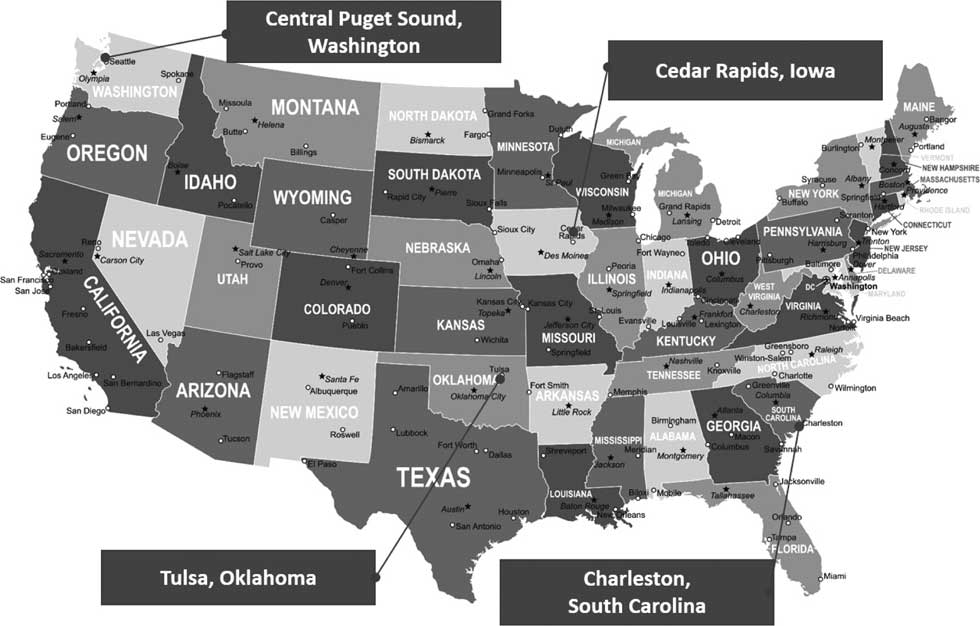
The Roundtable worked in four US communities to implement this work: Cedar Rapids, Iowa; Charleston, South Carolina; Central Puget Sound Region, Washington; and Tulsa, Oklahoma (see Figure 1). These community pilot partners were nominated based on a set of criteria established by the Roundtable membership. Pilot communities were selected from different regions in the United States (e.g. West, East, South, and/or Midwest) and represent communities that have a range of resilience-building capabilities and are at different stages in building resilience. Criteria that were considered in the selection process included the diversity of hazards, geographical location, demographics and population size of each community. In addition, a key criterion was that local decision-makers and key stakeholders are willing to partner with the Roundtable and commit to the partnership. Communities were chosen so that lessons learned had the potential to be shared with and applied to other communities in the nation.
The Roundtable is partnered with four communities through the pilot community partnership program: Cedar Rapids, Iowa; Charleston, South Carolina; Tulsa, Oklahoma; and Central Puget Sound, Washington. (Image by dikobraziy, 2015. Adapted by Charlene Milliken)

The first two pilot communities were named in September 2014. Charleston, South Carolina, experiences natural hazards that include coastal storms, hurricanes, riverine flooding, coastal surges, sea-level rise and earthquakes. Cedar Rapids, Iowa, experiences riverine and flash floods, extreme weather and tornados. The Central Puget Sound region of Washington State was added in 2015, and faces risks from volcanos, earthquakes, floods, landslides and sea level rise. And Tulsa, Oklahoma, became the Roundtable’s last community partner in 2016; Tulsa experiences floods, wildfire, tornados and seismicity.
In each community, issues and priorities for building resilience were identified through a community engagement process. Resilience priorities in Charleston, South Carolina and Cedar Rapids, Iowa centered on flooding. Both communities worked with the Roundtable to measure their baseline flood resilience; better understand and identify their flood resilience strengths, challenges, and priorities; identify and implement actions each community could take to build resilience to floods; and measure each community’s progress towards becoming more flood resilient. In Central Puget Sound, the Roundtable worked at a regional scale across four counties to better understand and address future climate impacts, taking into account social equity and transportation issues, in order to help local decision-makers identify and integrate actions to build climate resilience into current plans and efforts. In Tulsa, the community has a particular interest in its economic resilience so the Roundtable has focused its work on the impacts of economic disruptions to the community.
Measures of Community Disaster Resilience – the Heart of the Matter
A key element in building community resilience is for communities to measure their current resilience. By measuring their current level of resilience (i.e. baseline resilience), communities can identify areas for improvement, gauge progress toward reaching resilience goals and objectives, and determine how to prioritize, adjust or assess short- and long-term investments toward building resilience. While many reasons exist to undertake measurement work, communities continue to struggle with how to develop, access and implement resilience measures within the context of their specific risks and needs.
The Roundtable initiated an effort to measure flood resilience in two of its pilot communities, Charleston, South Carolina, and Cedar Rapids, Iowa, using a flood resilience measurement framework2 and online platform developed by Zurich Alliance, a private, public, and academic partnership. The data were collected across five different community capitals – human, social, natural, physical and financial – to assess each community’s resilience to flood. Roundtable members with expertise in the social sciences, resilience measures, floodplain management, and geography organized, planned, and designed an approach to implement this measurement framework in the community. Ultimately, the goals were to help the Cedar Rapids and Charleston communities to:
∙ Identify their flood resilience strengths, challenges, and priorities
∙ Identify actions or interventions they could take to build resilience to floods
∙ Implement actions or interventions to increase flood resilience in the community
∙ Measure their progress towards becoming more flood resilient
Zurich Alliance based the five capitals approach (Ref. 2, p. 4) on the Department for International Development’s Sustainable Livelihoods Framework, which identifies the capitals as representing a community’s assets. These capitals include:
(1) Human (e.g. education, health),
(2) Social (e.g. social networks),
(3) Physical (e.g. infrastructure, lifelines),
(4) Natural (e.g. natural resources, ecosystem services),
(5) Financial (e.g. diversity of income sources, financial institutions),
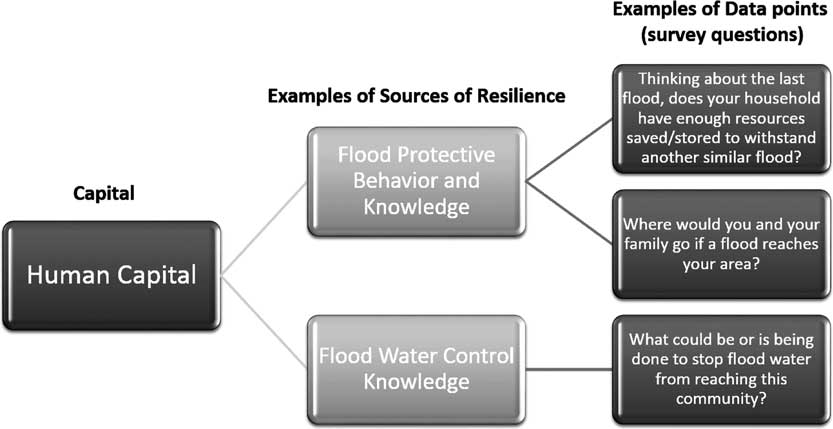
Each capital is made up of various sources (i.e. indicators) of resilience. Data were collected for each source of resilience in order to determine each community’s level of resilience for that source. The framework is broadly structured around three levels (see Figure 2):
(1) The five capitals that characterize a community.
(2) Sources of resilience for each capital.
(3) Data points for each source of resilience.
Flood resilience measurement framework structure using Human Capital as an example (created by Charlene Milliken with permission provided by Zurich Insurance Group).

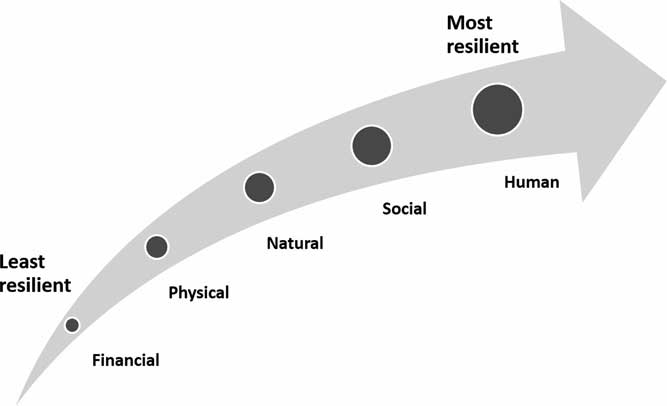
After the data collection was complete, each of the 88 sources of resilience was assessed by three to five community experts; the purpose was to identify areas where a community could take action to address a particular resilience gap or challenge. The assessment and grading of sources is not meant to compare one community against another; rather, it is a relative measure within each community. These ‘grades’ could be used by a community to better understand its baseline flood resilience and identify where investments and resources could be effectively applied to address their challenges. For example, in one pilot community, human capital was found to be most resilient and financial capital was identified as the least resilient (Figure 3).
Resilience of the five capitals in one of the Resilient America pilot communities, as identified by community stakeholders (created by Charlene Milliken).

Through this effort, Charleston and Cedar Rapids identified several common challenges. Both communities shared needs around developing robust regional approaches to flood risk and watershed management, maintaining community engagement and awareness about flood risks between flood events, and improving small business and nonprofit preparedness and continuity during disasters. In each community, critical information was discovered about how or whether individual members of the community understood their flood risks and the perception of local government’s efforts in addressing those risks. A common strength between these communities was their strong social networks among community members.
Once resilience priorities are established and actions to address those priorities are identified, the community is ultimately responsible to implement their efforts; the Roundtable supported the community’s implementation of a few interventions. The Roundtable also provided assistance for ongoing resilience activities. Actions could address short- or long-term needs and range from simple projects, such as designing and implementing a targeted communication strategy, to complex projects, such as major infrastructure enhancements. As an example, Cedar Rapids identified a need within their nonprofit community to develop disaster response strategies and business continuity planning. To address this gap, the Roundtable organized and hosted a disaster preparedness training event for nonprofits in the area. While the flood resilience measurement activity in the two pilot communities specifically focused on flooding, it has also been useful in understanding the communities’ resilience to a broader set of hazards and disruptions.
Lessons Learned for Communities
While some lessons are place-specific, risk and resilience issues cross political and geographical boundaries. With the pilot partners, the Roundtable worked intensively with four separate communities of differing geographical, political and demographic characteristics, and differing hazards, needs and priorities. In addition, the Roundtable had many opportunities for much broader interaction and learning from other communities in the nation and across the globe through its convening activities. Ultimately, what emerged is that communities share common challenges and needs in understanding, addressing and reducing risk, and building resilience, and they benefit from being able to exchange information and learn from one another’s experiences with taking on these challenges. The lessons learned apply to the unique circumstances of the Roundtable’s pilot communities, and they provide valuable insight for other communities around the nation and internationally. Some of the most salient lessons the Roundtable has learned from its pilot community work include:
∙ No single definition of resilience works for everyone. Communities define resilience based on their own goals, priorities and challenges. The Roundtable introduced to its pilot communities the definition of resilience from the National Academies’ 2012 report (‘the ability to prepare and plan for, absorb, recover from, or more successfully adapt to actual or potential adverse events’), but quickly learned that each community needed definitions that were specific to its community context and needs.
∙ Communities need to know their baseline resilience. To measure progress towards meeting resilience goals, communities need to understand what their starting point (baseline) and their desired end points are. That said, most communities do not understand current conditions and often feel they do not have the tools to measure resilience.
∙ Building resilience requires trust. Community support for resilience-building activities requires the trust of community members; in leadership and decision-makers, in its institutions and organizations, and in each other. The Roundtable had to work with communities over time – through multiple visits, meetings and activities – to build trust to overcome challenges, identify opportunities for consistent interaction and discussion for feedback, and tailor projects according to community needs.
∙ Relationships are important. Building resilience requires relationships and partnerships among key stakeholders of the community to identify priorities, implement the work, and engage with and conduct outreach to multiple stakeholders and individuals across the community. Relationships depend on trust – and both relationships and trust can take a long time to develop.
∙ Building resilience requires engaging stakeholders across diverse community sectors. Community engagement can be done in many ways. Different stakeholders can be engaged to align interests, identify common ground, connect with related work in the community, and leverage resources. Often, the Roundtable coordinated and facilitated discussions between community stakeholders that had never had an opportunity to connect as part of their work even though they shared a common focus on building resilience.
∙ Resilience needs to be mainstreamed into existing budgets, plans and operations. People are time-constrained and resource-constrained, so it is important to work within the capacity of a community’s resources and time, and build resilience into existing efforts.
∙ Communities struggle with how to effectively communicate risk. Understanding risk is consistently identified as one of the top needs and priorities at the community level. It is essential for decision-makers and officials to be able to communicate to individuals in the community what the risk is, who is at risk, and what is at risk. One observation from the Roundtable’s community pilot work is that resilience has to be built within the context of a set of resilience priorities or goals, the risks that affect those goals, a timeline, and a geographic boundary.
∙ Communities are concerned about their vulnerable populations and issues of social equity. All communities recognized the disparity between the resilience levels of those with economic or political empowerment and those without. It was a common understanding among all of the Roundtable’s pilot communities that the resilience of the communities depended on the resilience and wellness of their most disenfranchised residents.
∙ Local commitment and support may be the most important criterion for building resilience. This commitment can be seen via key decision-makers’ and stakeholders’ willingness to work together to build resilience over time. Becoming more resilient requires a culture shift and that shift starts at the local level. One observation was that sometimes even the most committed communities need a catalyst. The Roundtable served that role, but ultimately the community needs to continue working together and committing resources to the issues after the catalyzing event ends.
What Resilient America Has Learned
The innovative work of the National Academies through the Roundtable and its community pilot partnership program drew upon traditional National Academies convening activities to create a new paradigm for stakeholder engagement; these activities spurred communities to create new coalitions within their communities to operationalize and leverage resources for building resilience. Through its efforts, the Roundtable tested and applied approaches in real-time and with people who would implement these actions. As previously stated, communities gleaned many lessons. The National Academies, too, learned much about different ways to have greater impact in communities.
One common – and surprising – message among the four communities was about the importance of economic resilience as a necessary foundation for community resilience and disaster preparedness. The economic aspects of resilience are diverse and include factors such as insurance, mitigation, investments, local budgets, and supply chains. Fragility in any of these dimensions puts a community at risk. A loss of livelihood, tax base, or income can trigger a cascade of other risks and problems that can reverberate into the most fundamental functions of government or society.
The convening of stakeholders and the community engagement process are important acts of strengthening resilience. The process of hearing from and working with diverse stakeholders – including decision-makers, subject matter experts, individual community members, and others – was as important as the data and information gathered and assessed during the work. Over the course of the past four years, the Roundtable learned that successful community engagement requires devoting the time needed to cultivate relationships and build trust with and among community partners. Flexibility is required to be able to adapt to new, and sometimes unexpected, conditions that emerge within a community. For example, when new leaders are elected into office, they bring their own priorities and agendas. By engaging diverse community members, the Roundtable heard from stakeholders about the challenges they face in everyday operations and provided a platform for them to work together to address these resilience issues. By developing trust, building partnerships, and adapting to local priorities and strengths, the Roundtable was able to successfully bring science into decision making at the local level.
Every community recognizes the importance and value of good data and information, and seeks to create productive partnerships with those who can provide this information. However, every community also has its own unique set of priorities and limitations. Each community requires accessible and relevant information to support the important and time-sensitive decisions that must be made, often in conditions of an uncertain future, to meet their short- and long-term needs and to keep the community safe. Ultimately, Resilient America’s community pilot program, the partnerships that formed, and a new approach for engaging with communities, have resulted in a better understanding of ways to make science and research actionable to benefit society and impact communities in meaningful ways.
Note
The opinions expressed here are those of the authors and do not necessarily represent the positions of the National Academies of Sciences, Engineering, and Medicine.
About the Author
Sherrie Forrest is a senior program officer for the Program on Risk, Resilience and Extreme Events at the US National Academies of Sciences, Engineering, and Medicine. She leads the community pilot partnership program of the Resilient America Roundtable, a set of activities that employs science, analysis, and technology in combination with community engagement to build resilience to disasters. She joined the full-time staff in 2010 following a Christine Mirzayan Science & Technology Graduate Fellowship. She obtained her MS in biological oceanography from the Institute of Marine and Coastal Sciences at Rutgers University, and a BA in English from Pepperdine University.
Charlene Milliken is a program officer for the Resilient America Roundtable at the National Academies of Sciences, Engineering, and Medicine. Previously, she worked for seven years in the Department of Homeland Security’s (DHS) Science & Technology Directorate (S&T). Most recently, in the DHS S&T Office of University Programs that supports the Centers of Excellence Program. Charlene was a National Defense and Global Security S&T Fellow through the American Association for the Advancement of Science in 2007–2009. She received a BA degree in international relations from the University of Southern California, and a PhD in anthropology from the University of Pittsburgh. Her dissertation research investigated mortuary rituals and ancestor veneration of the ancient Wari civilization in Peru.