Mastitis, defined as an inflammation of the mammary gland, is one of the most expensive diseases in dairy farming, affecting the net earnings of milk producers all over the world (Fetrow, Reference Fetrow2000). In Argentine herds, the main causative agents are Staphylococcus (Staph.) aureus, Streptococcus (Str.) dysgalactiae and Streptococcus uberis (Acuña et al. Reference Acuña, Chertcoff, Martínez and Nimo2001; Calvinho & Tirante, Reference Calvinho and Tirante2005). These bacteria are very important, especially because they infect the udder shortly after drying off and before calving, when immunosuppression of cows increases the incidence of mastitis compared with the incidence during lactation (Sordillo, Reference Sordillo2005). The conventional methods of controlling mastitis are based upon adoption of preventive control strategies including diagnosis, segregation of the animals and the use of improved hygiene and therapeutic protocols. Even though these current management practices contribute to the decrease in the occurrence of the disease, the treatment for bovine mastitis relies heavily on the use of antibiotics.
During the last three decades, long-acting intramammary antibiotics have been used routinely for the treatment of existing infections and also for preventing new infections mainly at drying off (Calvinho et al. Reference Calvinho, Delgado, Vitulich, Occhi, Canavesio, Zurbriggen and Tarabla1991). However, while dry-cow antibiotic therapy has helped to reduce the incidence of mastitis, the emergence of antibiotic-resistant pathogens has been increasingly problematic (McDougall et al. Reference McDougall, Parker, Heuer and Compton2009).
In order to reduce antibiotic residues in dairy products and in agreement with global pressures to limit their use in dairy cattle, research has been focused on enhancing cows’ natural defence mechanisms through the development of innovative methods for the treatment and the prevention of bovine mastitis (Ryan et al. Reference Ryan, Flynn, Hill, Ross and Meaney1999; Meaney et al. Reference Meaney, Twomey, Flynn, Hill and Ross2001; Crispie et al. Reference Crispie, Alonso-Gómez, O'Loughlin, Klostermann, Flynn, Arkins, Meaney, Ross and Hill2008; McDougall et al. Reference McDougall, Parker, Heuer and Compton2009; Pellegrino et al. Reference Pellegrino, Giraudo, Raspanti, Odierno and Bogni2010).
The use of probiotic bacteria, live microorganisms that when administered in adequate amounts confer a beneficial effect to the host (FAO & WHO, 2008), has been widely studied as a novel approach to prevent infections in animals, especially in the gastrointestinal and vaginal tract (Otero & Nader-Macías, Reference Otero, Nader-Macías and Méndez-Vilas2007; Walsh et al. Reference Walsh, Gardiner, Hart, Lawlor, Daly and Lynch2008). Probiotics may exert their beneficial effects on the health of the host by different and several mechanisms: adhesion to epithelial cells, colonization, biofilm formation, production of biosurfactants, aggregation and co-aggregation, production of antagonistic metabolites (organic acids, hydrogen peroxide, bacteriocins), competition for nutrients, production of enzymes and/or immune system modulation. It is likely that microorganisms may exert their effects as a result of one or more of these mechanisms (Espeche et al. Reference Espeche, Otero, Sesma and Nader-Macias2009). In a previous study, Espeche et al. (Reference Espeche, Otero, Sesma and Nader-Macias2009) isolated several lactic acid bacteria (LAB) from bovine milk with the aim of studying their properties for the design of a probiotic product. Two of these strains, Lactobacillus perolens CRL 1724 and Lactobacillus plantarum CRL 1716 were selected for further studies to determine their beneficial properties against bovine mastitis.
The aim of the present study was to investigate the in-vitro capacity of Lactobacillus to adhere to bovine teat canal epithelial cells (BTCEC) and to inhibit and co-aggregate mastitis-causing pathogens (MCPs). The effect of Lb. perolens CRL 1724 after intramammary inoculation in lactating cows, through the determination of udder clinical signs, milk appearance, somatic cell counts (SCC) and recovery of Lb. perolens CRL 1724 in milk, was also evaluated.
Materials and Methods
Bacterial strain and culture conditions
Lactobacillus strains used in this study were isolated from milk of healthy Holstein cows from Tucumán, Argentina, and genetically identified by 16S rRNA gene sequencing as Lb. perolens CRL 1724 and Lb. plantarum CRL 1716. These strains were selected as potentially probiotic because of their high hydrophobicity index, moderate autoaggregation ability and ability to produce organic acid (Espeche et al. Reference Espeche, Otero, Sesma and Nader-Macias2009).
Lb. perolens CRL 1724 and Lb. plantarum CRL 1716, resistant to streptomycin, were grown in Man, Rogosa and Sharpe (MRS, Britania) broth at 37°C for 18 h, and stored in milk yeast extract (MYE) (10 g low-fat milk, 0·5 g yeast extract and 1 g glucose per 100 ml) with 12% glycerol at −20°C. Before performing additional studies, bacterial were subcultured three times, every 12–14 h at 37°C in MRS broth.
The following indicator bacteria were used to assess antagonistic activity and co-aggregation: Str. agalactiae ATCC27956, Str. dysgalactiae ATCC27957, Str. uberis 102, Str. uberis ATCC27958, Staph. hyicus 112249, Str. bovis ATCC27960, Enterococcus (Ec.) faecalis 19433, Ec. faecium 35667, Escherichia (Esch.) coli ATCC35218, Klebsiella (K.) pneumoniae ATCC10031 and Staph. epidermidis ATCC14990 provided by Dr Odierno (Universidad Nacional de Río Cuarto, Argentina). Staph. aureus RC108, Esch. coli 345 and Pseudomonas spp. 224 were isolated from milk of cows with bovine mastitis and identified in our laboratory. All these strains were cultivated on trypticase soy agar (TSA, Britania) at 37°C for 18 h and stored in trypticase soy broth (TSB, Britania) with 20% glycerol at −20°C.
Antimicrobial activity
Antimicrobial activity of Lactobacillus strains against MCPs in vitro was assayed by the streak line method (Hütt et al. Reference Hütt, Shchepetova, Lõivukene and Mikelsaar2006). The inhibitory effect was estimated as the width of the inhibition zone and ranked as high (>25 mm), intermediate (13–25 mm), low (1–12 mm) and no inhibition (0 mm). The assay was performed in duplicate.
Co-aggregation assay
To assess the interaction between Lactobacillus strains and MCPs, the method described by Reid et al. (Reference Reid, McGroarty, Gil Domingue, Chow, Bruce, Eisen and Costerton1990) was used. A suspension of Lactobacillus spp. adjusted to a concentration of 109 cfu/ml in 1m-phosphate-buffered saline (PBS) (pH 6·2) was mixed with 500 μl of 108 cfu/ml of each MCP and incubated at 37°C in an orbital shaker at 2 g for 4 h. Suspensions, in duplicate, were Gram-stained and observed under an optical microscope. Pure cultures were used as negative controls.
Adhesion to BTCEC
Adhesion of Lactobacillus strains to BTCEC was determined by the methodology described previously by Otero & Nader-Macías (Reference Otero, Nader-Macías and Méndez-Vilas2007) with modifications. Overnight cultures of Lactobacillus strains were centrifuged and the bacterial pellet was washed twice with saline solution (0·8% NaCl), once with Eagle's minimum essential media (MEM; Gibco; pH 7·0), and finally suspended in MEM to obtain a concentration of 107 cfu/ml.
To isolate BTCEC, cows' udders were obtained from an abattoir. At the laboratory, udders were washed with water and the teat orifice was disinfected with 70% ethanol. BTCEC were obtained by scraping the teat canal wall with a Medibrush XL (Medical Engineering Co.) and suspended immediately in 1 ml MEM (pH 7·0). The suspension was centrifuged for 10 min at 120 g and the pellet washed three times with 10 ml MEM and finally suspended in MEM at 105 cells/ml. Differential cell counts were carried out microscopically by using Wright stained smears. Cell viability was determined by the trypan blue exclusion method. The results were expressed as follows: (number of viable cells/number of total cells)×100. BTCEC were stored refrigerated until the adhesion assay. This assay was performed in triplicate to ensure the test reproducibility.
Equal volumes (500 μl) of BTCEC and lactobacilli suspensions were mixed and incubated under low agitation conditions at 37°C for 1 h. A tube with MEM was used as control. To remove non-adherent bacteria, tubes were centrifuged for 10 min at 120 g and the pellet was washed four times in 1 ml MEM. Bacterial binding to BTCEC were examined by optical microscopy (Gram stain) and results expressed as (1) percentage of adhesion: (number of BTCEC with bacteria adhered/total number of BTCEC)×100; and (2) adhesion index: (total number of bacteria attached to BTCEC/total number of cells with bacteria adhered). The application of the index allowed us to evaluate the efficiency of adhesion.
Scanning electron microscopy
Scanning electron microscopy was applied to illustrate the adhesion capabilities of Lb. perolens CRL 1724 to BTCEC and the bacterial aggregation. The adhesion assay was performed as previously described and the methodology utilized for scanning electron microscopy was described previously by Otero & Nader-Macías (Reference Otero, Nader-Macías and Méndez-Vilas2007) with slight modifications. Briefly, after adhesion assay pellets were fixed with 3·16% glutaraldehyde in 0·1 mol/l phosphate buffer (pH 7·4), incubated for 4 h at 4°C and homogenized. Fixed samples were centrifuged for 10 min at 300 g, washed twice with phosphate buffers (pH 7·2) and the pellet treated with 1% OsO4 buffer. The samples were dehydrated with increasing acetone-ethanol concentrations, critically point dried mounted and mineralized. Samples were examined in a Joel JSM35CF scanning electron microscope.
Intramammary inoculation of Lb. perolens CRL 1724
Five Holando-Argentino lactating cows were used for the assays. Cows were clinically healthy, free of milk major MCPs and with somatic cell counts (SCC) in individual quarters <200 000 cells/ml. Before intramammary inoculation, the animals were removed from the herd and maintained separately during the rest of the trial. The bacterial inoculum was prepared as follows: a culture of the strain (109 cfu/ml) incubated for 18 h at 37°C in MRS broth was centrifuged and the bacterial pellet was washed twice with saline solution (0·8% NaCl). Cells were suspended in 5 ml of saline solution to obtain a concentration of 109 cfu/ml. The concentrated preparation was serially diluted in saline solution to 103 cfu/ml and 106 cfu/ml. The inocula were fractionated and stored at 4°C until inoculation was performed (a period no longer than 2 h). All animals were inoculated after evening milking. Before inoculation, udders were cleaned with 70% ethanol and allowed to dry. Bacterial suspensions were infused directly into the teat via the streak canal to a depth of 17 mm using a syringe with a blunted smoothed tip to prevent injury to the teat.
Two cows were first used to determine the maximum bacterial concentration that did not produce udder inflammation. Three quarters of each cow were infused with 1 ml containing 103, 106 or 109 cfu of Lb. perolens CRL 1724. The remain quarter was used as control. To minimize animal handling and conform to animal welfare best practices, no infusion was made in the control quarter.
Another three lactating cows were used to evaluate the effect of intramammary inoculation through the determination of udder clinical signs, milk appearance, SCC and recovery of Lb. perolens CRL 1724 in milk. Three quarters of each cow were infused once on day 0 (D0), with 1 ml of the maximum bacterial concentration that did not produce udder inflammation selected as described in the former assay. One quarter was used as control.
Sampling and bacterial recovery
Before inoculation, foremilk samples were collected from each quarter according to the National Mastitis Council procedure (National Mastitis Council, 2004) immediately before milking. Milk samples were transported refrigerated (a period no longer than 2 h) to the laboratory and immediately 10 μl was plated onto blood-agar (TSA with 5% of sheep blood) and incubated at 37°C for 24 h. Bacteria were characterized by standard biochemical tests (Bergey & Holt, Reference Bergey and Holt1994). SCC were determined with a Somacount 300 (Bentley) according to the revised protocol of the 148A method C, fluoro-opto-electronic (International Dairy Federation Laboratory, 1995). Milk samples were collected 2 d before infusion (D2), immediately prior to infusion (D0) and post-infusion, as outlined below.
Serial dilutions of milk in saline solution were streaked on MRS agar plates in duplicate and incubated at 37°C for 24–48 h under microaerophilic conditions (5% CO2, 95% air) for Lactobacillus isolation. The isolated colonies were identified as Lb. perolens CRL 1724 by phenotypic tests (Gram stain, morphology, catalase activity, nitrate reduction, indole production) and by streptomycin resistance determination.
Clinical observations and animal care
Clinical signs were monitored throughout the experiment by a veterinarian, every 8 h during the first 24 h, and subsequently every time the cows were milked. General attitude and appetite were observed. The udders were palpated for soreness, swelling, hardness and heat and the appearance of milk was assessed visually for clots and changes in colour or composition every time the cows were milked. All animals involved in this investigation were cared for in accordance with The International Guiding Principles for Biomedical Research Involving Animals (1985).
Statistical analysis
Differences among Ln-SCCs and means of recovered Lb. perolens CRL 1724 were analysed using the software INFOSTAT (2004). Treatment and days of sampling were the initial variables included in the model for each analysis. Means were compared by analysis of variance (ANOVA). Differences were considered significant at P value <0·05.
Results
Antagonistic activity
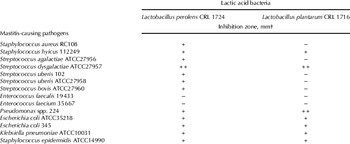
The antagonistic activity of Lactobacillus strains against 14 MCPs was evaluated through the growth inhibition values. Str. dysgalactiae ATCC27957, Pseudomonas spp.224, Esch. coli ATCC35218, Esch. coli 345, Str. epidermidis ATCC14990, Str. hyicus 112249 and K. pneumoniae ATCC10031 were inhibited by both Lactobacillus strains, albeit with different growth inhibition values (Table 1). Lb. perolens CRL 1724 was able to inhibit 12 of 14 MCPs (85·7%) in vitro, especially those considered to be major pathogens; whereas Lb. plantarum CRL 1716 was able to inhibit 7 of 14 MCPs (50%) in vitro. Ec. faecalis 19433 and Ec. faecium 35667 were not inhibited by either strain.
Antimicrobial activity of Lactobacillus perolens CRL 1724 and Lactobacillus plantarum CRL 1716 against 14 mastitis-causing pathogens (MCP)

† Interpretation of zone diameter of inhibition: −, no inhibition; +, 1–12 mm; ++, 13–25 mm; +++, >25 mm
Co-aggregation
Lb. perolens CRL 1724 showed co-aggregation with all of the MCPs assayed. A similar co-aggregation of MCPs was observed with Lb. plantarum CRL 1716 except that no co-aggregation was observed against Pseudomonas spp.224 and Esch. coli 345 (data not shown).
Adhesion capacity of lactobacilli
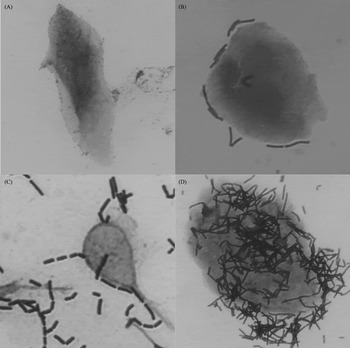
A high number of epithelial cells could be isolated from the bovine teat canal with the method set up in our laboratory, and no bacterial contaminants were observed after Gram staining. The two strains of lactobacilli were able to adhere to BTCEC. The percentages of adhesion and the adhesion index were different for the strains. Lb. perolens CRL 1724 showed a higher capability of adhesion (75% and 14·4 respectively) than Lb. plantarum CRL 1716 (37% and 7·4, respectively). Lb. perolens CRL 1724 aggregated to BTCEC as can be seen in Fig. 1. Figures 1B and 1C show different numbers of bacterial adherent to the surface of epithelial cells, showing an irregular pattern of distribution on the cell surface. Figure 1D demonstrate auto-aggregative pattern and adherence of lactobacilli as clusters on the cell surface.
Light photomicrographs showing Gram-stained Lactobacillus perolens CRL 1724 adherent to bovine teat canal epithelial cells. (A) Control. (B) and (C) Different numbers of bacterial adherent to the surface of epithelial cells, showing an irregular pattern of distribution on the cell surface. (D) Autoagreggative pattern and adherence of lactobacilli as clusters on the cell surface (1000×).

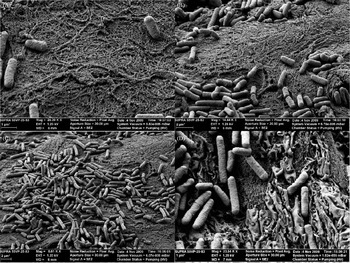
The microphotographs obtained by scanning microscopy illustrate the adhesion and aggregation of Lb. perolens CRL 1724 on the surface of BTCEC (Figs 2A, 2B and 2C) without producing morphological or ultrastructural modifications of the epithelial cells. Also the scanning electron microscopy shows Lb. perolens CRL 1724 aggregated and adhered on the surfaces of the eukaryotic cells but not on keratin (Fig. 2D).
Adhesion of Lactobacillus perolens CRL 1724 to epithelial cells isolated by teat canal wall scraping observed by scanning electron microscopy. (A), (B) and (C) Bacilli adherent to and aggregated on the surface of epithelial cells (26 390×, 14 440× and 8610×, respectively). (D) Bacilli adherent to and aggregated on the surface of epithelial cells and surrounded by keratin (23 540×).

Intramammary inoculation of Lb. perolens CRL 1724
To evaluate the in-vivo performance of Lb. perolens CRL 1724, the tolerance of udders to the inoculation of different concentrations of lactobacilli was first determined in two cows. Concentrations of 103 and 106 cfu/ml of lactobacilli were well tolerated by the animals. No clinical signs or teat damage were observed in the inoculated quarters and the udders presented a normal aspect. The appearance of the milk from these inoculated animals was normal, without clots, lumps, blood or any changes in the colour. After the inoculation of 109 cfu/ml, changes in the appearance of the milk (clots and lumps) were observed. These changes disappeared 48 h after inoculation.
SCC in milk samples from cows inoculated with 103 and 106 cfu/ml increased 2-fold with respect to the control quarters after 24 h of intramammary inoculation, decreasing to normal values (2×10⁵ cells/ml) after day 2 and remaining low until the end of the assay (data not shown). The greatest SCC (6×10⁶ cells/ml) was observed in milk samples inoculated with 109 cfu/ml on day 1 after inoculation. Lb. perolens CRL 1724 was recovered until the end of the assay and from all inoculated quarters. The highest bacterial recovery value (103 cfu/ml) was obtained 24 h after intramammary inoculations in the quarters inoculated with 109 cfu/ml. All quarters inoculated were negative for MCP isolation after the 7-d trial.
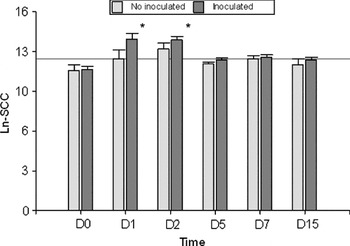
Taking into account the results obtained above, 106 cfu/ml of Lb. perolens CRL 1724 were inoculated into nine quarters of three lactating cows. There was a significant increase (P<0·05) in the SCC of all inoculated quarters 24 h after inoculation (Fig. 3). This increase was observed until 48 h post inoculation. After this, SCCs decreased to the control value (2×10⁵ cells/ml) at day 5. No significant differences were observed between the SCCs of inoculated and control (not inoculated) quarters during the trial. Lb. perolens CRL 1724 was recovered during the 15-d trial from 88·9%, 77·8% and 55·6% of the inoculated quarters on days 1, 2 and 7, respectively. At the end of the trial (D15), 22·2% of the inoculated quarters continued to shed the lactobacilli inoculated. Recovery of Lb. perolens CRL 1724 on day 1 showed a significant increase (P<0·05) with respect to the other days. No MCPs were isolated from milk during the trial.
Mean Ln-somatic cell counts (Ln-SCC) recovered after inoculation of lactating cows with 106 cfu/ml Lactobacillus perolens CRL 1724. Cut-line: 200 000 cells/ml. D, days. * P <0·05.

Discussion
During the last two decades, several studies of disease prevention by normal microbiota manipulation have been studied in domestic animals (gastrointestinal of pigs, chickens and turkeys). More relevant to these studies, Corynebacterium bovis has been used to colonize the teat canal for protection against mastitis. The mechanism of defence in this case is thought to be due to increased somatic cell count rather than to direct bacterial inhibition (Brooks & Barnum, Reference Brooks and Barnum1984).
The intramammary immune system's ability to eliminate infections naturally depends on a rapid and competent response to pathogens (Burvenich et al. Reference Burvenich, Paape, Hill, Guidry, Miller, Heyneman, Kremer and Brand1994) and the primary phagocytic cells of the bovine mammary gland, polymorphonuclear (PMN) and macrophages, comprise the first line of defence against invading bacteria (Crispie et al. Reference Crispie, Alonso-Gómez, O'Loughlin, Klostermann, Flynn, Arkins, Meaney, Ross and Hill2008). Indeed, impairment of the immune response is associated with increased susceptibility to mastitis infection (Burvenich et al. Reference Burvenich, Paape, Hill, Guidry, Miller, Heyneman, Kremer and Brand1994). In this sense, the use of a product capable of eliciting a rapid immune response can provide host protection against mastitis infection (Crispie et al. Reference Crispie, Alonso-Gómez, O'Loughlin, Klostermann, Flynn, Arkins, Meaney, Ross and Hill2008).
Among the parameters to take into account in designing a probiotic, the origin of the strains, based on the host specificity of the indigenous microbiota (Kotarsky & Savage, Reference Kotarsky and Savage1979), the capability to produce antagonistic substances, adhesion to host tissues and colonization to different sites of the host surfaces are the most important features to exert a beneficial effect (Nader-Macias et al. Reference Nader-Macias, Otero, Espeche and Maldonado2008; Espeche et al. Reference Espeche, Otero, Sesma and Nader-Macias2009).
In a previous report (Espeche et al. Reference Espeche, Otero, Sesma and Nader-Macias2009), 102 LAB strains were isolated from the teat canal and milk samples of healthy cows. The strains were selected according to high hydrophobicity index, moderate auto-aggregation and organic acid production. Two Lactobacillus strains were chosen to conduct further studies.
It is well known that Lactobacillus strains are able to inhibit pathogenic microorganisms by organic acids, hydrogen peroxide and bacteriocins (Chaimanee et al. Reference Chaimanee, Sakulsingharoj, Deejing, Seetakoses and Niamsup2009). In the present work Lb. perolens CRL 1724 was able to inhibit 85·7% of the MCP assayed, especially those considered major pathogens as Staph. aureus, Str. agalactiae, Str. dysgalactiae and Esch. coli. In addition, a co-aggregation effect of Lb. perolens CRL 1724 with all of them was observed. Lb. plantarum CRL 1716 showed a lower percentage of inhibition (50%) but a similar co-aggregation effect compared with Lb. perolens CRL 1724. Soleimani et al. (Reference Soleimani, Kermanshahi, Yakhchali and Sattari2010) showed that different strains of Lactobacillus are capable of co-aggregation with Staph. aureus strains causing bovine mastitis. Also Soleimani et al. (Reference Soleimani, Kermanshahi, Yakhchali and Sattari2010) suggest that the co-aggregation assay is a reliable method to evaluate the close interaction between lactobacilli and pathogenic bacteria and that many surface proteins are found in lactobacilli which are predicted to promote binding to environmental surfaces like other bacteria surface. Co-aggregation may be beneficial to Lactobacillus that produces antimicrobial compounds, as it would force the cells into closer contact (Reid & McGroarty, Reference Reid and McGroarty1988). Pascual et al. (Reference Pascual, Daniele, Ruiz, Giordano, Pájaro and Barberis2008) proposed that co-aggregation could be an important factor in maintaining health, because it produces an area around the pathogen where the concentration of antimicrobial substances produced by lactobacilli is increased.
Adhesion of lactobacilli to the epithelium is the first step in the formation of a barrier to prevent undesirable microbial colonization and has consequently been defined as an essential characteristic when selecting probiotic strains (Havenaar et al. Reference Havenaar, Brink, Huisin´t veld and Fuller1992; Reid et al. Reference Reid, Sander, Rex, Gibson, Mercenier, Rastall, Roberfroid, Rowland, Cherbut and Klaenhammer2003). In the present work, a percentage of adhesion and adhesion index of 75% and 14·4, respectively, demonstrated the high efficacy of adhesion of Lb. perolens CRL 1724 to BTCEC. Lower values were observed for Lb. plantarum CRL 1716 (37% and 7·4, respectively). The study of the inhibitory effect of lactobacilli against the mastitis pathogens using teat-canal cells should give relevant information. Future studies of co-inoculation (BAL/MCPs) will be conducted before performing in-vivo protection assays. Interestingly, a great pool of viable BTCEC was isolated with the method set up in our laboratory, and this allowed the development of an easy and rapid method to evaluate adherence in vitro. To our knowledge, this is the first report that demonstrated adhesion of lactobacilli to BTCEC. Similar results were obtained by Otero & Nader-Macías (Reference Otero, Nader-Macías and Méndez-Vilas2007) in epithelial cells from the bovine vagina.
Several studies have suggested that Lactobacillus adherence is mediated by proteins associated with the external protein S-layer (Wadström et al. Reference Wadström, Andersson, Sydow, Axelsson, Lindgren and Gullmar1987; Henriksson et al. Reference Henriksson, Szewzyk and Conway1991; Frece et al. Reference Frece, Kos, Svetec, Zgaga, Mrsa and Suskovic2005), while others have suggested a role for lipoteichoic acid and carbohydrate (Fuller, Reference Fuller1975); further studies need to be conducted to determine the chemical nature of the structures involved in adhesion to BTCEC. The adhesion of Lb. perolens CRL 1724 to BTCEC was confirmed by scanning electron microscopy. No evidence of morphological or structural modifications of BTCEC due to the adhesion of lactobacilli was observed through any of the scanning electron microscopy observations. The adherence of lactobacilli to epithelial cells, even after treatment employed to scanning electron microscopy preparations, suggests the adhesion efficacy of the strain to the epithelial cells.
Lb. perolens CRL 1724 was selected for udder inoculations because of its elevated percentage of inhibition and co-aggregation of MCPs and their major capability of adhesion to BTCEC. The tolerance of the udders to different concentration of Lb. perolens CRL 1724 was determined. The results showed that 103 and 106 cfu/ml were well tolerated by the udder, but 109 cfu/ml was not tolerated because of milk alterations and udder inflammation. A concentration of 106 cfu/ml was the dose selected for the intramammary inoculation assay because it was the highest lactobacilli concentration that did not produce long-term udder inflammation or alteration of milk.
The nine quarters inoculated with 106 cfu/ml showed that there were no adverse clinical signs in the udders, which remained free of clinical mastitis during the 15-d trial period. On the other hand, with the concentration used, there was a short-term significant increase in SCC 2 d post inoculation, returning to normal values at the end of the trial. The short-term significant increase observed in SCC is a normal reaction of the udder against inoculation and it cannot be due to any change or internal damage caused in the mammary glands by the lactobacilli inoculated. In this sense Crispie et al. (Reference Crispie, Alonso-Gómez, O'Loughlin, Klostermann, Flynn, Arkins, Meaney, Ross and Hill2008) concluded that the mechanism by which the live culture can provide host protection against mastitis infection may be associated with its ability to elicit a rapid immune response, inducing substantial recruitment of PMN, lymphocytes and localized production of acute phase proteins, which together can subsequently clear the gland of the infecting pathogen. Although no infusion was administered to the control quarter, nonetheless, these quarters exhibited a negligible increase in SCC (Crispie et al. Reference Crispie, Alonso-Gómez, O'Loughlin, Klostermann, Flynn, Arkins, Meaney, Ross and Hill2008). These increases were most likely due to cross-talk between quarters. Previous and repeated trials by our research team have shown that infusion of sterile water into the control quarter does not cause irritation or inflammation.
Several reports showed that the intramammary application of probiotic bacteria (Greene et al. Reference Greene, Gano, Smith, Hogan and Todhunter1991) or bacteriocin (Ryan et al. Reference Ryan, Flynn, Hill, Ross and Meaney1999) resulted in a short term increase in SCC. The results obtained in the present work are similar to those of Crispie et al. (Reference Crispie, Alonso-Gómez, O'Loughlin, Klostermann, Flynn, Arkins, Meaney, Ross and Hill2008), who observed an increase in the values of PMN leucocytes in the first 2 d after the inoculation of 109 cfu/ml of Lactococcus lactis, and a decrease on days 5 and 7 post inoculation. Interestingly, Lb. perolens CRL 1724 could be recovered during the 15 d of the assay. This indicates that the strain persisted in the udder, even though the inoculation was done in lactating cows, where milking favours the elimination of bacteria. Beecher et al. (Reference Beecher, Daly, Berry, Klostermann, Flynn and Meaney2009) recovered Lc. lactis for 2 d post inoculation.
Taking in account the high susceptibility of dairy cows to bovine mastitis during the dry period, the intramammary application of lactobacilli in cows during this period will also be the subject of a further study. The effect of the lactobacilli on milk also requires investigation, but it is fairly unlikely that bacteria would still be found after the dry period and calving. The results obtained will serve as the basis for further studies on the generation of non-antibiotic formulations for the prevention of mastitis in dairy cows.
Conclusions
The results obtained from this work demonstrate the in-vitro capacity of two Lactobacillus strains to adhere to BTCEC and to inhibit and co-aggregate MCPs. The in-vitro method of obtaining BTCEC, set up in the laboratory constitutes an easy and rapid method to evaluate adherence in vitro. In vivo, Lb. perolens CRL 1724 resulted in a short-term increase in SCC and was recovered from all quarters inoculated during the 15 d of the trial without producing clinical signs in the udder.
This work was supported by SECYT-UNRC, MINCYT Córdoba PID280, CONICET PIP 632 and ANPCYT PICT 543 grants. These are the results obtained from the project ‘Design of a probiotic product for bovine mastitis prevention’ signed between CONICET and UNRC Res. 2907. Ignacio Daniel Frola, María Carolina Espeche and Matías Santiago Pellegrino are recipients of a fellowship from Consejo Nacional de Investigaciones Científicas y Técnicas (CONICET). We thank Med. Vet. Laura Zapata for the collaboration in adherence assays. This work was previously presented at the XXVI World Buiatrics Conference in Santiago, Chile, 14–18 November 2010.