


%20--%3e%3c!DOCTYPE%20svg%20PUBLIC%20'-//W3C//DTD%20SVG%201.0//EN'%20'http://www.w3.org/TR/2001/REC-SVG-20010904/DTD/svg10.dtd'%3e%3csvg%20version='1.0'%20id='Layer_1'%20xmlns='http://www.w3.org/2000/svg'%20xmlns:xlink='http://www.w3.org/1999/xlink'%20x='0px'%20y='0px'%20width='64px'%20height='64px'%20viewBox='5.5%20-3.5%2064%2064'%20enable-background='new%205.5%20-3.5%2064%2064'%20xml:space='preserve'%3e%3cg%3e%3ccircle%20fill='%23FFFFFF'%20fill-opacity='0'%20cx='37.785'%20cy='28.501'%20r='28.836'/%3e%3cpath%20fill='%23595959'%20d='M37.441-3.5c8.951,0,16.572,3.125,22.857,9.372c3.008,3.009,5.295,6.448,6.857,10.314%20c1.561,3.867,2.344,7.971,2.344,12.314c0,4.381-0.773,8.486-2.314,12.313c-1.543,3.828-3.82,7.21-6.828,10.143%20c-3.123,3.085-6.666,5.448-10.629,7.086c-3.961,1.638-8.057,2.457-12.285,2.457s-8.276-0.808-12.143-2.429%20c-3.866-1.618-7.333-3.961-10.4-7.027c-3.067-3.066-5.4-6.524-7-10.372S5.5,32.767,5.5,28.5c0-4.229,0.809-8.295,2.428-12.2%20c1.619-3.905,3.972-7.4,7.057-10.486C21.08-0.394,28.565-3.5,37.441-3.5z%20M37.557,2.272c-7.314,0-13.467,2.553-18.458,7.657%20c-2.515,2.553-4.448,5.419-5.8,8.6c-1.354,3.181-2.029,6.505-2.029,9.972c0,3.429,0.675,6.734,2.029,9.913%20c1.353,3.183,3.285,6.021,5.8,8.516c2.514,2.496,5.351,4.399,8.515,5.715c3.161,1.314,6.476,1.971,9.943,1.971%20c3.428,0,6.75-0.665,9.973-1.999c3.219-1.335,6.121-3.257,8.713-5.771c4.99-4.876,7.484-10.99,7.484-18.344%20c0-3.543-0.648-6.895-1.943-10.057c-1.293-3.162-3.18-5.98-5.654-8.458C50.984,4.844,44.795,2.272,37.557,2.272z%20M37.156,23.187%20l-4.287,2.229c-0.458-0.951-1.019-1.619-1.685-2c-0.667-0.38-1.286-0.571-1.858-0.571c-2.856,0-4.286,1.885-4.286,5.657%20c0,1.714,0.362,3.084,1.085,4.113c0.724,1.029,1.791,1.544,3.201,1.544c1.867,0,3.181-0.915,3.944-2.743l3.942,2%20c-0.838,1.563-2,2.791-3.486,3.686c-1.484,0.896-3.123,1.343-4.914,1.343c-2.857,0-5.163-0.875-6.915-2.629%20c-1.752-1.752-2.628-4.19-2.628-7.313c0-3.048,0.886-5.466,2.657-7.257c1.771-1.79,4.009-2.686,6.715-2.686%20C32.604,18.558,35.441,20.101,37.156,23.187z%20M55.613,23.187l-4.229,2.229c-0.457-0.951-1.02-1.619-1.686-2%20c-0.668-0.38-1.307-0.571-1.914-0.571c-2.857,0-4.287,1.885-4.287,5.657c0,1.714,0.363,3.084,1.086,4.113%20c0.723,1.029,1.789,1.544,3.201,1.544c1.865,0,3.18-0.915,3.941-2.743l4,2c-0.875,1.563-2.057,2.791-3.541,3.686%20c-1.486,0.896-3.105,1.343-4.857,1.343c-2.896,0-5.209-0.875-6.941-2.629c-1.736-1.752-2.602-4.19-2.602-7.313%20c0-3.048,0.885-5.466,2.658-7.257c1.77-1.79,4.008-2.686,6.713-2.686C51.117,18.558,53.938,20.101,55.613,23.187z'/%3e%3c/g%3e%3c/svg%3e)
%20--%3e%3c!DOCTYPE%20svg%20PUBLIC%20'-//W3C//DTD%20SVG%201.0//EN'%20'http://www.w3.org/TR/2001/REC-SVG-20010904/DTD/svg10.dtd'%3e%3csvg%20version='1.0'%20id='Layer_1'%20xmlns='http://www.w3.org/2000/svg'%20xmlns:xlink='http://www.w3.org/1999/xlink'%20x='0px'%20y='0px'%20width='64px'%20height='64px'%20viewBox='5.5%20-3.5%2064%2064'%20enable-background='new%205.5%20-3.5%2064%2064'%20xml:space='preserve'%3e%3cg%3e%3ccircle%20fill='%23FFFFFF'%20fill-opacity='0'%20cx='37.637'%20cy='28.806'%20r='28.276'/%3e%3cg%3e%3cpath%20fill='%23595959'%20d='M37.443-3.5c8.988,0,16.57,3.085,22.742,9.257C66.393,11.967,69.5,19.548,69.5,28.5c0,8.991-3.049,16.476-9.145,22.456%20C53.879,57.319,46.242,60.5,37.443,60.5c-8.649,0-16.153-3.144-22.514-9.43C8.644,44.784,5.5,37.262,5.5,28.5%20c0-8.761,3.144-16.342,9.429-22.742C21.101-0.415,28.604-3.5,37.443-3.5z%20M37.557,2.272c-7.276,0-13.428,2.553-18.457,7.657%20c-5.22,5.334-7.829,11.525-7.829,18.572c0,7.086,2.59,13.22,7.77,18.398c5.181,5.182,11.352,7.771,18.514,7.771%20c7.123,0,13.334-2.607,18.629-7.828c5.029-4.838,7.543-10.952,7.543-18.343c0-7.276-2.553-13.465-7.656-18.571%20C50.967,4.824,44.795,2.272,37.557,2.272z%20M46.129,20.557v13.085h-3.656v15.542h-9.944V33.643h-3.656V20.557%20c0-0.572,0.2-1.057,0.599-1.457c0.401-0.399,0.887-0.6,1.457-0.6h13.144c0.533,0,1.01,0.2,1.428,0.6%20C45.918,19.5,46.129,19.986,46.129,20.557z%20M33.042,12.329c0-3.008,1.485-4.514,4.458-4.514s4.457,1.504,4.457,4.514%20c0,2.971-1.486,4.457-4.457,4.457S33.042,15.3,33.042,12.329z'/%3e%3c/g%3e%3c/g%3e%3c/svg%3e)
Background
Treatment of complicated Gram-positive infections conventionally requires four to six weeks of antibiotic therapy. Reference Delgado, Ajmone Marsan and De Waha1,Reference Schellong, Joean, Pletz, Hagel and Weis2 Prosthetic joint, vascular, valvular and cardiac device implantation is expanding in an aging population. Complete hardware removal is often unfeasible, and indefinite suppressive antibiotic therapy (SAT) is increasingly used instead. Reference Horne, Woolley and Lau3 Delivering these courses beyond hospital discharge depends on outpatient parenteral antimicrobial therapy (OPAT) through indwelling vascular access, or on partial oral step-down. The intravenous-to-oral (IV-PO) switch formally requires four simultaneous conditions: adequate source control, assured adherence, normal gastrointestinal absorption, and hemodynamic stability with clinical improvement on therapy. Reference Akhloufi, Hulscher, Melles, Prins, van der Sijs and Verbon4 In people who inject drugs, patients with substance use disorder, unstable housing, psychiatric comorbidity, gastrointestinal disease or retained hardware, one or more of these conditions is frequently unmet. Reference Akhloufi, Hulscher, Melles, Prins, van der Sijs and Verbon4 For this growing group neither OPAT nor oral step-down is reliable, and a treatment that delivers weeks of Gram-positive cover from one or two infusions has obvious appeal. Long-acting lipoglycopeptides (laLGPs) now occupy that space. This review sets out how they came to be used against pathogens that remain susceptible to first-line agents, why no narrow-spectrum long-acting alternative has been developed, and what would have to change for one to emerge. Throughout this review, narrow-spectrum refers specifically to narrow Gram-positive spectrum: activity confined to meticillin-susceptible staphylococci, penicillin-susceptible enterococci and streptococci.
The evidence for IV to PO antibiotic step-down therapy
Randomized evidence for IV-PO switch in Gram-positive infection rests on trials in three distinct clinical settings, and a much larger body of meta-analyses and real-world cohorts sits around them, pointing the same way with steadily increasing uncertainty. OVIVA (Oral vs IntraVenous Antibiotics) excluded Staphylococcus aureus bacteremia (SAB) and endocarditis by protocol and established non-inferiority of oral therapy for bone and joint infection, prosthetic joint infection included, independent of implant retention. Reference Scarborough, Li and Rombach5 POET (Partial Oral Treatment of Endocarditis) randomiszed clinically stable left-sided endocarditis due to streptococci, staphylococci or Enterococcus faecalis to oral completion without loss of efficacy, Reference Iversen, Ihlemann and Gill6 and its regimens are now embedded in the 2023 European Society of Cardiology guidelines. Reference Delgado, Ajmone Marsan and De Waha1 SABATO (Staphylococcus aureus Bacteremia Antibiotic Treatment Options) confined its noninferior oral switch to low-risk SAB, a population that excluded endocarditis, deep-seated foci and retained prosthetic material. Reference Kaasch, López-Cortés and Rodríguez-Baño7 A 2025 meta-analysis restricted to the S. aureus randomized trials of both bacteremia and endocarditis confirmed equivalence only for uncomplicated, already-stabilized disease. Reference Mourad, Nwafo, Skalla, Holland and Jenkins8 A much broader 2025 meta-analysis pooling 27 studies across Gram-positive bacteremia generally, almost entirely observational, found a mortality signal favoring oral switch but explicitly could not draw conclusions for enterococcal disease, where evidence remains too sparse. Reference Tan, Liang, Zhang, Liang, Bai and Cai9 Real-world cohorts extending beyond POET-defined eligibility have found no signal of harm, though clinicians still rarely switch meticillin-resistant or enterococcal disease. Reference Rallet, Pouy and Coutureau10 Two randomized trials addressing left-sided endocarditis completed follow-up in 2023 but remain unpublished. Reference Lemaignen, Bernard and Tattevin11
For vascular graft and cardiac device infection, no randomized trial has tested oral completion, and even observational cohorts are scarce compared with the bacteremia and endocarditis literature above. Guidance has nonetheless moved ahead of the trials, extrapolating from the broader IV-PO evidence base and from surgical source-control principles rather than from device-specific outcome data. A 2025 Delphi consensus from the European Society of Clinical Microbiology and Infectious Diseases and its Study Group for Implant-Associated Infections (ESCMID/ESGIAI) recommends an initial intravenous phase followed by oral completion in graft infection, including when prosthetic material is retained, Reference Kouijzer, Hernández-Meneses and Aarntzen12 and the American Heart Association 2024 statement endorses the same principle for device infection managed with chronic suppression. Reference Baddour, Esquer Garrigos and Rizwan Sohail13
The population that resists oral completion by any standard of evidence is defined less by organism than by source control: persistent or complicated bacteremia, meticillin-resistant disease, and infection with retained material that cannot be debrided or removed. It is this residual population for which a long-acting parenteral agent is most needed, and the only such agents currently available are the Reserve lipoglycopeptides.
Long-acting lipoglycopeptides as a consolidation option
laLGPs, dalbavancin and oritavancin, are semisynthetic derivatives of the glycopeptide class. A lipophilic side chain anchors the molecule in the bacterial membrane and confers high plasma protein binding, which together with slow elimination produces terminal half-lives of two to three weeks. Reference Malabarba and Goldstein14 Their activity is concentration-dependent, best predicted by the free-drug area under the curve to minimum inhibitory concentration ratio (fAUC/MIC). Reference Cojutti, Tedeschi and Gatti15 For dalbavancin this pharmacodynamic relationship has been translated into regimens for prolonged treatment: two 1,500 mg doses one week apart maintain suprainhibitory concentrations against S. aureus for about four to six weeks, with therapeutic drug monitoring (TDM) used to time any further dose. Reference Cojutti, Tedeschi and Gatti15,Reference Senneville, Cuervo and Gregoire16 A consolidation course of a few weeks can therefore be completed from one or two infusions, without daily administration or an indwelling catheter, which sets laLGPs apart from conventional OPAT. Where indefinite suppression is intended there is no fixed course, and dosing is repeated at intervals, preferably according to TDM results. TDM for antibiotics is not widely available, which limits how readily these dosing strategies translate across settings. Reference Williams, Cotta and Tabah17
For oritavancin, a population pharmacokinetic framework based on concentrations at 24 and 168 hours has recently been proposed to guide redosing from weekly to every-three-week intervals, though this awaits prospective validation. Reference Giuliano, D’Avolio and Angelini18
The intrinsic spectrum of both agents is broad. It spans meticillin-resistant staphylococci, viridans and pyogenic (beta-hemolytic) streptococci, and vancomycin-susceptible enterococci. Dalbavancin also covers vanB-mediated vancomycin-resistant enterococci (VRE), and oritavancin additionally covers vanA-mediated VRE.
The clinical evidence base has grown quickly, though it remains dominated by observational data. A systematic review and meta-analysis found laLGPs comparable to standard care for complicated Gram-positive infections. Reference Salvatore, Moore and Steuber19 A randomized trial supported a two-dose dalbavancin regimen for osteomyelitis. Reference Rappo, Puttagunta and Shevchenko20 For SAB, the DOTS (Dalbavancin as an Option for Treatment of S. aureus bacteremia) trial compared dalbavancin with standard therapy and did not demonstrate superiority on its primary end point, although outcomes were comparable. Reference Turner, Hamasaki and Doernberg21 Beyond these, the evidence for consolidation and suppressive use rests on single-arm cohorts, describing use in complicated bacteremia, endocarditis, prosthetic joint infection and osteomyelitis, with reduced length of stay and favorable cost-effectiveness for patients facing barriers to standard inpatient or OPAT-based care. Reference Rebold, Alosaimy and Pearson22–Reference Krsak, Scherger and Miller24 No randomized trial has yet tested laLGPs as SAT, and the dalbavancin substudy of the S. aureus Network Adaptive Platform trial is evaluating consolidation prospectively. Reference Tong, Mora and Bowen25 Across these cohorts, meticillin-susceptible S. aureus (MSSA), susceptible streptococci and enterococci together account for a substantial share of causative organisms. Reference Rebold, Alosaimy and Pearson22–Reference Krsak, Scherger and Miller24
Resistance to laLGPs on therapy is rare but real and concentrated in exactly the prolonged exposure this review discusses. A controlled study of patients on long-term dalbavancin for prosthetic joint infection found dalbavancin-resistant staphylococci in colonizing nasal and perineal flora significantly more often than in untreated controls, Reference Hugg, Stegger and Söderquist26 and case reports describe cross-resistance to vancomycin and daptomycin emerging after sequential glycopeptide exposure in device infection. Reference Stohs, Alexander and Fey27 In vitro pharmacodynamic modeling of oritavancin exposure selected reduced susceptibility but minimal cross-resistance with other agents and no β-lactam seesaw effect, suggesting the mechanism is agent-specific rather than shared across the class. Reference Werth, Zhang and Barreras Beltran28 This pattern has two implications for a future narrow-spectrum long-acting agent. First, resistance surveillance cannot be an afterthought given the prolonged, often indefinite exposure the indication implies. Second, a molecule engineered for rapid, high initial bacterial killing would limit the low-density persister populations from which resistance most readily emerges.
The AWaRe paradox
The World Health Organization (WHO) AWaRe framework classifies antibiotics as Access, Watch or Reserve to guide appropriate use. Reference Sharland, Cappello and Ombajo29 Access agents are first-line drugs for common infections, with a low propensity to select resistance. Watch agents carry a higher resistance potential and are prioritized targets for stewardship monitoring. Reserve agents are last-resort options to be protected. laLGPs are Reserve antibiotics. The paradox is that the infections for which they are increasingly used are, in a large share of cases, caused by organisms fully susceptible to Access agents. Reference Rebold, Alosaimy and Pearson22–Reference Krsak, Scherger and Miller24 Deploying a Reserve lipoglycopeptide against them is, at the level of the individual prescription, a rational response to a real barrier. At the population level it is a structural driver of Reserve consumption.
This substitution matters for a concrete policy target. The 2024 United Nations political declaration on antimicrobial resistance committed member states to ensuring that at least 70% of human antibiotic use falls within the Access group by 2030. Reference Medioli, Peiffer-Smadja and Catteau30 The substitution of Reserve laLGPs for Access-treatable infections works directly against this target, precisely in the population least able to receive first-line therapy by conventional routes. The effect is twofold. It erodes the Access target, and it accelerates selective pressure on agents held in reserve for genuinely resistant Gram-positive infections.
One nuance qualifies this picture. Clinicians are not overlooking a suitable Access agent when they choose a Reserve lipoglycopeptide. No agent combines a narrow Gram-positive spectrum with a prolonged dosing interval. Switching to a narrow-spectrum Access agent would preserve the spectrum but only at the cost of the prolonged interval. The realistic alternative becomes daily intravenous therapy or an indwelling catheter, the very burden laLGPs were adopted to avoid. The substitution reflects this constraint, not a preference for Reserve therapy.
Potential reasons for the nonexistent narrow-spectrum, long-acting antibiotic pipeline
The development gap has two roots. One lies in target biology, the other in pharmacokinetics.
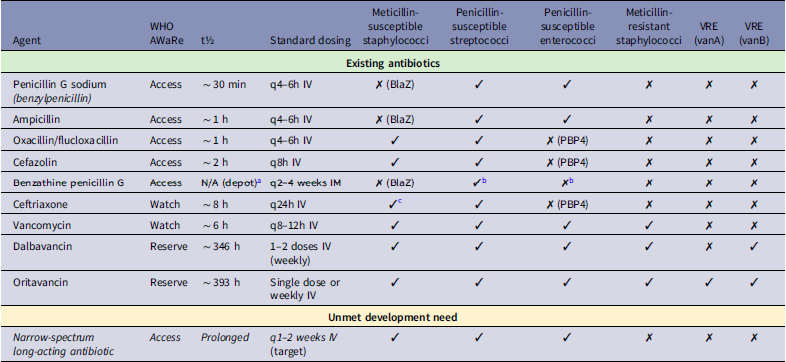
The spectrum problem. No narrow-spectrum β-lactam covers MSSA, streptococci and E. faecalis together. Antistaphylococcal penicillins and first-generation cephalosporins are inactive against E. faecalis because of the low affinity of penicillin-binding protein 4 (PBP4). Reference Moon, D’Andréa and Lee31 Penicillin G and ampicillin are hydrolyzed by staphylococcal BlaZ β-lactamase in most MSSA isolates. Only penicillin combined with a β-lactamase inhibitor and the carbapenems reach the full target spectrum, and they do so at the cost of broad Gram-negative and anaerobic coverage and a correspondingly larger ecological footprint. Non-β-lactam agents face the opposite constraint: Glycopeptides and lipoglycopeptides bind the peptidoglycan precursor Lipid II and the D-alanyl-D-alanine terminus, a target present in meticillin-susceptible and meticillin-resistant staphylococci alike, since it lies outside the penicillin-binding proteins that mediate meticillin resistance. Reference Cojutti, Tedeschi and Gatti15 Broad Gram-positive activity is therefore intrinsic to the class, not a by-product of the mechanism that could be engineered away while keeping the target: narrowing the spectrum would mean binding a different target altogether. Every clinically available agent thus sits in one of two zones: narrow Gram-positive spectrum with a short half-life, or broad spectrum with prolonged pharmacokinetics. The two have never coexisted in a single approved molecule (Table 1).
Gram-positive spectrum and dosing interval of clinically available antibiotics: the structural gap driving reserve lipoglycopeptide use for access-treatable pathogens

Table 1. Long description
A table with 12 rows and 8 columns comparing the spectrum and dosing intervals of various antibiotics. The columns are Agent, WHO AWaRe, t1/2, Standard dosing, Meticillin-susceptible staphylococci, Penicillin-susceptible streptococci, Penicillin-susceptible enterococci, and Meticillin-resistant staphylococci. The rows list different antibiotics and their properties. Row 1: Penicillin G sodium (benzylpenicillin), Access, ~30 min, q4-6h IV, X (BlaZ), ✓, ✓, X. Row 2: Ampicillin, Access, ~1 h, q4-6h IV, X (BlaZ), ✓, ✓, X. Row 3: Oxacillin/flucloxacillin, Access, ~1 h, q4-6h IV, ✓, ✓, X (PBP4), X. Row 4: Cefazolin, Access, ~2 h, q8h IV, ✓, ✓, X (PBP4), X. Row 5: Benzathine penicillin G, Access, N/A (depot), q2-4 weeks IM, X (BlaZ), ✓b, Xb, X. Row 6: Ceftriaxone, Watch, ~8 h, q24h IV, ✓c, ✓, X (PBP4), X. Row 7: Vancomycin, Watch, ~6 h, q8-12h IV, ✓, ✓, ✓, X. Row 8: Dalbavancin, Reserve, ~346 h, 1-2 doses IV (weekly), ✓, ✓, ✓, ✓. Row 9: Oritavancin, Reserve, ~393 h, Single dose or weekly IV, ✓, ✓, ✓, ✓. Row 10: Narrow-spectrum long-acting antibiotic, Access, Prolonged, q1-2 weeks IV (target), ✓, ✓, ✓, X.
Abbreviations: AWaRe, Access, Watch, Reserve; h, hour; IM, intramuscular; IV, intravenous; min, minute; N/A, not applicable; q, every (e.g. q8h, every 8 hours); t1/2, half-life; VRE, vancomycin-resistant enterococci; WHO, World Health Organization.
a Prolonged dosing interval achieved through slow dissolution from an IM depot, not through molecular pharmacokinetics.
b Resulting serum concentrations (∼.02–.15 µg/mL) remain above the MIC only for organisms with very low penicillin MIC (≤.03 µg/mL), adequate for rheumatic fever prophylaxis and pharyngeal group A streptococcal infections; they are insufficient for deep-seated Gram-positive infections.
c Ceftriaxone should be used with caution according to EUCAST guidance on cephalosporins for S. aureus infections.
WHO AWaRe classification is drawn from Sharland et al. (ref. 29).
Half-life, standard dosing, and spectrum data for penicillin G, ampicillin, oxacillin/flucloxacillin, cefazolin, benzathine penicillin G, ceftriaxone, and vancomycin are drawn from the Sanford Guide to Antimicrobial Therapy 2025 (Gilbert DN, Chambers HF, Saag MS, et al The Sanford Guide to Antimicrobial Therapy 2025. Antimicrobial Therapy, Inc; 2025); dalbavancin and oritavancin data are drawn from the pharmacokinetic sources cited in the text above.
The pharmacokinetic problem. β-Lactams are poorly suited to molecular half-life extension. They are small, hydrophilic, anionic molecules with a low volume of distribution, cleared largely unchanged by the kidney. Reference Smith, Zuccotto and Bates32 Their bactericidal activity depends on the time free, unbound drug remains above the MIC, because killing saturates once free concentration reaches a low multiple of the MIC and a higher peak adds little beyond that point. Reference Smith, Zuccotto and Bates32 This is precisely where the maneuvre behind multi-week lipoglycopeptide half-lives turns against a β-lactam. Extending elimination half-life through higher plasma protein binding lowers renal clearance, since only free drug is filtered, but it lowers the free fraction at every time point by the same stroke. A concentration- or AUC-driven killer with a long postantibiotic effect can absorb that trade-off, which is why the strategy works for the lipoglycopeptides. Reference Cojutti, Tedeschi and Gatti15,Reference Senneville, Cuervo and Gregoire16 A time-dependent killer cannot. Shrinking the free fraction works directly against the threshold the strategy is meant to sustain for longer, and compensating with a larger total dose runs into practical limits, since binding strong enough to reach multi-week half-lives tends to saturate within a deliverable dose range, making free-drug exposure disproportionate and unpredictable rather than reliably extended. The longest-acting systemic β-lactam in clinical use, ceftriaxone, shows the ceiling this leaves. Its comparatively high protein binding is part of why its eight-hour half-life is the longest in the class, and it still requires daily dosing. Reference Sharland, Cappello and Ombajo29 The only long-acting β-lactam in use, benzathine penicillin G, sidesteps the problem rather than solving it. Its two-to-four-week interval comes from slow dissolution out of an intramuscular depot, not altered molecular pharmacokinetics, and the low concentrations it sustains suffice only for organisms with very low penicillin MICs, adequate for rheumatic fever prophylaxis and pharyngeal group A streptococcal infection but not for deep-seated Gram-positive infection requiring sustained bactericidal exposure. Reference Neely, Kaplan, Blumer, Faix and Broderick33 Re-engineering the depot did not lift this ceiling. Reference Barr, Barber and Tait34
None of this makes half-life extension chemically unsolvable in general. It is solvable within pharmacodynamic classes where a reduced free fraction sustained for longer still accumulates sufficient exposure. Rezafungin demonstrates the point in a neighboring class. Replacing a labile hemiaminal linkage in the echinocandin scaffold, the core molecular structure shared by every member of the class, with a stable choline aminal ether confers metabolic stability without altering the target or the spectrum. Reference Krishnan, James and Polowy35 The resulting once-weekly antifungal, itself a concentration-dependent killer, was approved on the strength of a phase 3 non-inferiority trial. Reference Thompson, Soriano and Cornely36 A narrow-spectrum antibacterial scaffold has never been re-engineered this way, and for a time-dependent β-lactam the pharmacokinetic mismatch above means that simple protein-binding extension would not deliver it even if attempted.
Development pathways
Two development pathways are available. The first is pharmacokinetic re-engineering of an existing narrow-spectrum scaffold, as rezafungin illustrates for echinocandins. Applied to a β-lactam, this route meets both constraints already described: no single narrow β-lactam covers meticillin-susceptible staphylococci, penicillin-susceptible enterococci and streptococci together, and the time-dependent pharmacodynamics that make β-lactams effective are exactly what a protein-binding-based extension strategy undermines. The second route is a purpose-built scaffold, narrow by design rather than by inheritance, drawing if necessary, on chemistry other than a β-lactam to escape the pharmacokinetic problem. Selectivity is not the obstacle here. β-lactams discriminate meticillin-susceptible from meticillin-resistant staphylococci at the level of PBP affinity as a matter of course. What has never been attempted is a molecule designed from the outset for both a narrow target range and a dosing interval measured in weeks. Each attribute has been achieved on its own. The obstacle is not that chemistry has ruled the question out, but that nothing rewards asking it.
Aligning incentives with stewardship
The development gap reflects how antibacterial innovation is rewarded. The WHO 2023 pipeline analysis shows the share of the clinical pipeline active against Gram-negative bacteria rising from 38% to 56% between 2017 and 2023, with a corresponding contraction in Gram-positive investment. Reference Melchiorri, Rocke, Alm, Cameron and Gigante37 Push mechanisms, including CARB-X, the Global Antibiotic Research and Development Partnership, and the AMR Action Fund, fund early- and late-stage development directly rather than rewarding market entry, but they share the same blind spot as pull incentives: none earmarks funding for narrow-spectrum or off-patent reformulation work, and estimates put the additional annual investment these push mechanisms would need at US$250–400 million. Reference Piddock, Alimi and Anderson38 Every operational pull incentive reinforces this direction by tying reward to two attributes a narrow-spectrum long-acting antibiotic would lack: novel mechanism of action and activity against priority resistant pathogens. The DRIVE-AB (Driving Reinvestment in Research and Development and Responsible Antibiotic Use) market-entry reward, modeled at around US$1 billion per agent, was reserved for the most pressing resistant threats, a WHO priority pathogens list dominated by Gram-negative organisms though it also includes MRSA and VRE at lower priority tiers. Reference Årdal, Findlay and Savic39 In the United States, the Generating Antibiotic Incentives Now Act grants Qualified Infectious Disease Products five additional years of market exclusivity and priority regulatory review, but eligibility again tracks priority-pathogen activity rather than spectrum restriction. Reference Darrow and Kesselheim40 The United Kingdom subscription model, the first delinked scheme in routine use, values candidates through the STEDI framework, namely Spectrum, Transmission, Enablement, Diversity and Insurance, but treats activity against priority pathogens as the principal driver of reward. Reference Outterson and Rex41 The European Union has adopted a transferable exclusivity voucher, an instrument long judged a poorly targeted lever for antibiotic innovation because it rewards the holder’s commercial portfolio rather than any defined product profile. Reference Årdal, Baraldi and Busse42 In the form agreed by the Council and the Parliament in December 2025, the voucher grants twelve additional months of data protection that the holder may apply to any product in its portfolio, and it is available only for a priority antimicrobial, defined as one active against a multidrug-resistant organism. 43 A narrow-spectrum agent aimed at susceptible Access-treatable pathogens is excluded by that definition. A molecule whose value proposition is to spare a Reserve agent in an Access-treatable infection would therefore score at or near the bottom of every existing scheme. Even the priority-pathogen agents these schemes were built to reward have not met fair-share revenue targets across most of the G7, which leaves little prospect for one ranked below them. Reference Goh, McEnany, Freeman, Newton, Kesselheim and Outterson44
The contradiction is internal to the field’s own value framework. Two of the five STEDI elements are precisely those a narrow-spectrum long-acting agent would maximize: Spectrum, the benefit of avoiding broader therapy, and Diversity, the reduced selective pressure from using varied agents. A discrete choice experiment among Australian antimicrobial stewardship experts found that Spectrum carries a positive willingness-to-pay independent of other antimicrobial characteristics, direct empirical support for extending reward eligibility to narrow-spectrum agents on this basis. Reference Hillock, Chen, Merlin, Louise, Turnidge and Karnon45 Rewarding this niche would also serve antimicrobial stewardship directly: fewer Reserve prescriptions for Access-treatable infections translate into measurable reductions in Reserve consumption and selective pressure, the outcome stewardship programes already track. These values are endorsed on paper, yet no operational scheme rewards them in isolation. The two development routes are each foreclosed by a different facet of the same architecture. A novel narrow-spectrum scaffold directed at Access-treatable organisms forfeits the priority-pathogen weighting that dominates every framework. Pharmacokinetic re-engineering of an off-patent agent forfeits the novelty premium on which the same frameworks depend.
The architecture does more than overlook this niche. It produces the substitution it should prevent. Of the antibacterials approved between 2010 and 2020 and classified under AWaRe, all but one were placed in Reserve. Reference Outterson, Orubu, Rex, Årdal and Zaman46 Incentives reward Reserve novelty, the pipeline delivers Reserve agents, and in the absence of any narrow-spectrum long-acting alternative clinicians repurpose those agents against Access pathogens. The demand is real, but it exists only because no narrow-spectrum long-acting agent was ever developed. The one DRIVE-AB provision touching off-patent agents concerns generic supply continuity rather than reformulation, Reference Årdal, Findlay and Savic39 and the single scheme conceived specifically for narrow-spectrum development, a theoretical refunding model, remains unimplemented. Reference Böttcher and Gersbach47
Conclusion
This review opened with a paradox: Reserve lipoglycopeptides are increasingly used to treat infections that remain, in a large share of cases, fully treatable with Access agents. That substitution is not a failure of clinical judgment, since no Access agent offers the infrequent dosing these patients need. The failure lies further upstream, in an incentive architecture that rewards novelty and priority-pathogen activity but has never rewarded spectrum restriction, despite naming Spectrum and Diversity among its own values. Correcting this requires no new values, only their operationalization. Two changes would do it. Eligibility for delinked reward should extend to pharmacokinetic and pharmacodynamic optimization of off-patent Access agents. A re-engineered narrow-spectrum scaffold should be rewarded on that basis, not penalized for lacking novelty. Valuation frameworks should weight spectrum restriction and Reserve preservation explicitly. The technical premise is not speculative: narrow spectrum and prolonged half-life have each been achieved separately, and nothing in the chemistry rules out combining them. The clinical need, a growing population, is not in doubt. Without realignment, Reserve agents will continue to substitute for Access-treatable pathogens, eroding both the 70% Access target and the lipoglycopeptide class’s long-term durability. A narrow-spectrum long-acting antibiotic would be more than a marginal addition to the armamentarium: it would be the missing link that lets this population be treated without drawing on the Reserve group. The obstacle is not chemistry. It is an incentive architecture that has never been asked to value the thing stewardship most needs.
Data availability statement
No new data were generated or analyzed in support of this work.
Acknowledgments
None.
Author contribution
Conceptualization: G.M. and S.A.M.U. Writing original draft: G.M. and S.A.M.U. Writing review and editing: A.C., A.P. and M.L. All authors read and approved the final version of the manuscript.
Financial support
None.
Competing interests
The authors declare no conflicts of interest.

 Open access

