


Introduction
Auditory verbal hallucinations are a common and often distressing experience frequently but not always associated with a psychotic illness. It has been estimated that up to 70% of people diagnosed with schizophrenia will hear voices at some point (Landmark, Merksey, Cernovsky and Helmes, Reference Landmark, Merksey, Cernovsky and Helmes1990) for whom the experience is often felt to be intrusive, unwanted and uncontrollable (Nayani and David, Reference Nayani and David1996). In more recent years, evidence has emerged that psychotic symptoms also occur in the absence of a diagnosis (Johns and van Os, Reference Johns and van Os2001; Stip and Letourneau, Reference Stip and Letourneau2009): a recent systematic analysis of the prevalence of hearing voices in the general population (Beaven, Read and Cartwright, Reference Beaven, Read and Cartwright2011) suggested that about 10% of the general population hear voices at some point in their lives.
Increasing research has investigated the relationship that people have with their voices, how this may be linked with distress, and also may inform clinical intervention. Cognitive accounts (e.g. Birchwood and Chadwick, Reference Birchwood and Chadwick1997) have understood voice-linked distress in relation to beliefs about voices, rather than voice content, or topography, or the characteristics of a person's psychotic illness alone. Birchwood and Chadwick specifically hypothesized that core interpersonal schemata drive beliefs about voices’ omnipotence, malevolence and benevolence. These schemata derive from each person's unique interpersonal experiences. Consistent with this model, Birchwood, Meaden, Trower, Gilbert and Plaistow (Reference Birchwood, Meaden, Trower, Gilbert and Plaistow2000) reported that voice hearers were lower in social rank and subordinate to their voices, and that this relationship was mirrored in other social relationships. Birchwood et al. (Reference Birchwood, Gilbert, Gilbert, Trower, Meaden and Hay2004) found interpersonal schema concerning subordination to others to predict both depression and distress due to voices, and subordination to voices. Birchwood et al. suggested that it is powerlessness and inferiority in relationships in general that is linked with the perceived power of the voice. Similarly, Hayward (Reference Hayward2003) provided support for the idea that interpersonal relationships with voices are reflective of interpersonal relationships in general on the dimensions of voice intrusiveness, dominance and hearer dependence. Recent systematic reviews strongly suggest that voice related beliefs are central to voice related distress (Mawson, Cohen and Berry, Reference Mawson, Cohen and Berry2010; Paulik, Reference Paulik2011). Paulik additionally suggested that the existing cognitive model of voice hearing should be expanded to include interpersonal schemata as underpinning voice characteristics and content, beliefs about voices, and affective and behavioural responses to voices.
An alternative and complimentary way of conceptualizing the voice hearing experience is within Birtchnell's Relating Theory (Reference Birtchnell1996, Reference Birtchnell2002). Essentially interpersonal, Relating Theory describes how interpersonal relationships have two dimensions: power and proximity. Power involves the amount of influence that one has over another, while proximity describes the distance that is between two people, and hence the degree of intimacy. In an attempt to widen the focus of research on hearing voices, and to capture the complexity of the voice hearing experience, Vaughan and Fowler (Reference Vaughan and Fowler2004) considered the influence of these interpersonal dimensions on voice hearing. Adapting Birtchnell's (Reference Birtchnell1994) questionnaire (based on couple relationships), Vaughan and Fowler focused on the interpersonal relationships clinical voice hearers have with their voices. They found that voice upperness (the tendency of the voice to relate in a dominating and insulting way) and hearer distance (the tendency of an individual to react with suspicion and lack of communication with the voice) were associated with increased levels of distress, and were independent of beliefs about voices. However, there were a number of methodological problems with this study, including poor psychometric properties on several subscales of the developed measure, and small sample size. Sorrell, Hayward and Meddings (Reference Sorrell, Hayward and Meddings2010) aimed to replicate the results of Vaughan and Fowler using a more robust measure of interpersonal voice hearing: the Voice and You questionnaire (Hayward, Denney, Vaughan and Fowler, Reference Hayward, Denney, Vaughan and Fowler2008). In a sample of clinical and nonclinical voice hearers, significant correlations were observed between distress and voice dominance, voice intrusiveness, and hearer distance. In contrast to predictions, the associations were not independent of voice omnipotence and malevolence, leading to a suggestion that these beliefs possibly moderate or mediate distress in voice hearers (although this was not tested statistically). There has been some qualitative support for Relating Theory in the context of voice hearing through an interpretative phenomenological analysis (IPA) study. Chin, Hayward and Drinnan (Reference Chin, Hayward and Drinnan2009) found that where the concept of a relationship with a voice was accepted, the concepts of power and proximity were observable within participants’ responses. However, the concept of a relationship with a voice was simultaneously accepted and rejected by a number of voice hearers.
Most recently, Hayward, Berry, McCarthy-Jones, Strauss and Thomas (Reference Hayward, Berry, McCarthy-Jones, Strauss and Thomas2013) have suggested that a potentially fruitful direction is to seek the roots of beliefs about voices in developmental frameworks, such as attachment theory – an area increasingly being studied in psychosis and recently reviewed by Gumley, Taylor, Schwannauer and MacBeth (Reference Gumley, Taylor, Schwannauer and MacBeth2013). In a pioneer study, Dozier (Reference Dozier1990) reported higher levels of insecure attachment in people with a diagnosis of schizophrenia using the Adult Attachment Interview: however, this measure is time consuming, expensive and, in samples with psychosis, often muddied by psychotic symptoms (Berry, Wearden, Barrowclough and Liversidge, Reference Berry, Wearden, Barrowclough and Liversidge2006). As an alternative, based on Bartholomew's (Reference Bartholomew1990) model of attachment, the Psychosis Attachment Measure (PAM, Berry et al., Reference Berry, Wearden, Barrowclough and Liversidge2006) is a self-report questionnaire adapted and validated for use in samples of people with psychosis. Using this measure, Berry, Barrowclough and Wearden (Reference Berry, Barrowclough and Wearden2008) found that avoidant attachment was associated with positive symptoms, negative symptoms and paranoia, and that higher levels of attachment anxiety and avoidance were associated with interpersonal difficulties, whilst high levels of attachment avoidance were associated with poor engagement in therapeutic relationships. In a student sample, Berry et al. (Reference Berry, Wearden, Barrowclough and Liversidge2006) reported an association between attachment anxiety and hallucinations. However, another study of students (Pickering, Simpson and Bentall, Reference Pickering, Simpson and Bentall2008) found insecure attachment predicted paranoia but not hallucinations, once co-morbidity between paranoia and hallucinations was controlled for. Amongst voice hearers, Berry, Wearden, Barrowclough, Oakland and Bradley (Reference Berry, Wearden, Barrowclough, Oakland and Bradley2012) found significant associations between attachment anxiety, voice severity, and amount and intensity of voice distress. In contrast to previous research, no association was found between attachment avoidance and these voice dimensions. However, Berry et al. found associations between attachment avoidance and themes of criticism/rejection in voices and themes of threat.
Common to both the cognitive and interpersonal-relational approach is the suggestion that the relationship with a voice can be similar to relational patterns in general. Thus this study aims to substantiate the link between attachment avoidance/anxiety and the relationship people have with their voices. Unlike previous studies, we include voice-related measures from both the cognitive and relational approaches in combination with the clinically relevant variables of distress, depression and paranoia with the aim of clarifying relationships between several similar (but differently conceptualized) measures. Based on previous studies we made the following specific hypotheses:
1) Attachment avoidance will be significantly associated with hearer distance, voice dominance and increased distress.
2) Attachment anxiety will be significantly associated with voice intrusiveness, hearer dependence and increased distress.
As no study has combined the measures or sample used here, we reasoned that results would only be of clinical relevance if our predictors could combine to predict a clinically relevant effect: thus we took the approach of powering sufficient for a large effect size (f2 = 0.35; p < .05; 80% power) using three predictors. This led to a minimum required sample size of 36. In correlational terms, this estimated sample size provides statistical power (at 80%) for detecting a correlation of over 0.4 (medium to large) at p < .05.
We also aimed to study whether the relationship between attachment anxiety/avoidance and distress is mediated by voice related variables and paranoia. As the study is insufficiently powered to employ the classical approach using single multiple regressions, we have used an alternative bootstrapping approach while acknowledging this approach is tentative and would require replication in larger samples.
Method
Design
A correlational study was employed with a cross-sectional design using self-report measures.
Participants
Participants were adults aged 18 and above who reported hearing voices. There were no diagnostic criteria imposed on the study. A total of 44 people participated with a mean age of 39.6 (SD = 11.7). Thirty-four percent of the sample was male (n = 15) and 66% was female (n = 29). Ethnicity was as follows: White (72.7%, n = 32), Black (2.3%, n = 1), Mixed (6.8%, n = 3) and Other (18.2%, n = 8). As this study was conducted via on-line forums for voice-hearers, the majority of participants were recruited via on-line advertising via the London Hearing Voices Network and Intervoice (an international community for voice hearers).
Procedure
Potential participants were able to click on a link advertised in several on-line forums that took them to the study homepage. Participants gave informed consent and were given contact details of researchers, prior to completing measures. Following demographic questions participants completed the self-report questionnaires. Ethical approval was obtained through the University College London Ethics Committee.
Measures
Psychosis Attachment Measure (PAM; Berry et al., Reference Berry, Wearden, Barrowclough and Liversidge2006)
This 16-item self-report questionnaire has subscales for anxiety and avoidance with acceptable internal reliability (anxiety = 0.82, avoidance = 0.76) and concurrent validity with existing self-report measures of attachment (The Relationships Questionnaire; Bartholomew and Horowitz, Reference Bartholomew and Horowitz1991).
Beliefs About Voices Questionnaire – Revised (BAVQ-R; Chadwick, Lees and Birchwood, Reference Chadwick, Lees and Birchwood2000)
The BAVQ-R is a 35-item self-report questionnaire of a person's beliefs, emotions and behaviour in response to voices. It has five sub-scales, three of which focus on a person's beliefs about the dominant voice (omnipotence, malevolence and benevolence) as well as two scales that look at emotional and behavioural responses (resistance and engagement). Subscale alphas are all above 0.7, indicating good internal reliability, with correlations between malevolence and resistance, and benevolence and engagement suggesting construct validity.
Voice and You (VAY; Hayward et al., Reference Hayward, Denney, Vaughan and Fowler2008)
This 28-item self-report questionnaire assesses interpersonal aspects of the relationship with the dominant voice. There are four subscales comprising voice intrusiveness, voice dominance, hearer distance and hearer dependence. All subscales demonstrate acceptable internal reliability with alphas greater than 0.7. The VAY also has acceptable test-retest reliability on a 3-week retest. The VAY has reported concurrent validity with the BAVQ-R above.
Persecution and Deservedness Scale (PADS; Melo, Corcoran, Shyrane and Bentall, Reference Melo, Corcoran, Shyrane and Bentall2009)
This 10-item self-report questionnaire gives scores for both persecution and deservedness of persecution (once a certain level of persecution is recorded). The alpha level for the whole measure is reported to be 0.84 in addition to good concurrent validity.
Beck Depression Inventory II (BDI-II; Beck, Steer and Brown, Reference Beck, Steer and Brown1996)
This 21-item measure of severity of depression is very widely used in research and routine clinical practice, with widespread support of good psychometric properties.
Distress
As there are no validated self-report measures of distress in relation to voice hearing, distress in relation to the predominant voice was measured on a 5-point Likert scale from 0 (no distress) to 5 (extremely distressed).
Data analysis
Parametric tests were used in all analyses except where scales did not meet statistical criteria for normality. A series of mediation analyses (Baron and Kenny, Reference Baron and Kenny1986) were used to test whether the relationship between attachment (anxiety and avoidance) and distress were mediated by voice related variables (beliefs about voices and interpersonal processes) and paranoia. Indirect mediation effects were tested using the Bootstrapping method (Preacher and Hayes, Reference Preacher and Hayes2004) as this is preferable in small samples and does not make parametric assumptions.
Results
The average duration of voice hearing was 15.5 years (SD = 14.3); 73% of participants (n = 32) had had contact with mental health services while 27% (n = 12) had not; 86% of the sample (n = 38) stated that they had a diagnosed mental health difficulty, whilst 14% (n = 6) said they did not. Responses to diagnosis (an open question) were coded into five categories: Psychosis (48%, n = 21); Bipolar Affective Disorder (11%, n = 5); Personality Disorder (16%, n = 7); Mixed Diagnosis (9%, n = 4) and No Diagnosis (16%, n = 7). Of the participants 55% (n = 24) reported being prescribed medication in relation to voice hearing whilst 45% (n = 20) said they had not.
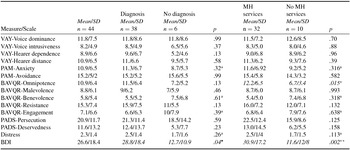
Table 1 gives descriptives for each measure's subscale for the entire sample, as well as separately for clinical voice hearers and non-clinical voice hearers. Clinical/nonclinical differences are reported and formally tested as defined both by presence of diagnosis and contact with mental health services. Presence of a diagnosis was associated with higher depression (t (42) = 2.058, p = .044). Those in contact with services reported greater depression (t(42) = 3.268, p = .002) and voice omnipotence (t(42) = 2.552, p = .015).
Descriptives and clinical/non-clinical group comparisons as defined by diagnosis and service use.

a = Mann Whitney U Test
*p < .05, **p < .01
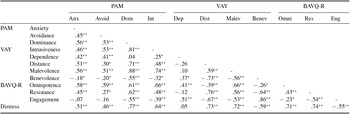
The first hypothesis stated that attachment avoidance would be associated with increased voice dominance, hearer distance and distress. Table 2 summarizes correlations between subscales of the PAM, VAY, BAVQ-R and voice related distress. As predicted, attachment avoidance was positively associated with voice dominance (r(42) = .532, p = .000), hearer distance (r(42) = .301, p = .047) and distress (r(42) = .496, p = .002). The second hypothesis posited that attachment anxiety would be positively associated with voice intrusiveness, hearer dependence, and distress. Again, as predicted, attachment anxiety was positively associated with voice intrusiveness (r(42) = .435, p = .002), hearer dependence (r(42) = .410, p = .005) and distress (r(42) = .538, p = .000). However, as can be seen from Table 2, both attachment anxiety and attachment avoidance were significantly correlated with all subscales of the VAY, and all but the benevolence and engagement subscales of the BAVQ-R, suggesting a strong lack of specificity in the observed results. A further caveat needs to be considered when interpreting these results. First, very substantial inter-correlations were found between subscales on the VAY. Notably, voice dominance and voice intrusiveness were highly correlated (r = .808, p = .000) as were voice dominance and hearer distance (r = .712, p = .000). Voice intrusiveness was also correlated moderately with hearer distance (r = .484, p = .001). Furthermore, there were moderate to large correlations between subscales of the VAY and BAVQ-R. Voice dominance was correlated with omnipotence and malevolence (r = .605, p = .000; r = .884, p = .000) as was voice intrusiveness (r = .659, p = .000; r = .737, p = .000).
Correlations between PAM, VAY, BAVQ-R and distress

*p < .05, **p < .01
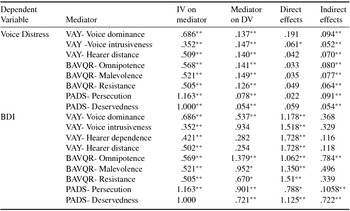
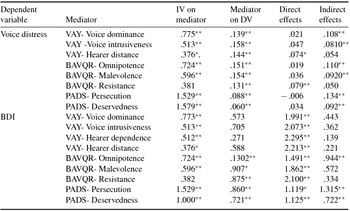
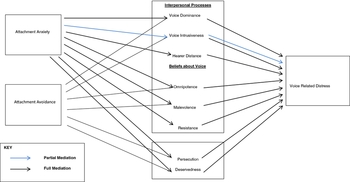
We ran a series of mediation analyses using bootstrapping to test for the effects of mediation between attachment avoidance/anxiety and voice related distress/depression where correlations were present. Table 3 shows several mediation analyses where attachment anxiety was the independent variable and voice distress or depression were the dependent variables. Table 4 shows similar analyses where attachment avoidance was the IV. Due to the number of analyses conducted, 99% confidence intervals were used for bootstrapping. Results based on 10,000 bootstrapped samples suggested that the indirect relationship between attachment avoidance and voice related distress through voice dominance was significant (IE lower 99% CI = .0411, upper 99% CI = .1984) at the p < .01 level. The relationship between attachment avoidance and voice related distress was fully mediated by voice dominance (IE lower 99% CI = .0411, upper 99% CI = .1984), voice intrusiveness (IE lower 99% CI = .0165, upper 99% CI = .1697), omnipotence (IE lower 99% CI = .0266, upper 99% CI = .1782), malevolence (IE lower 99% CI = .0240, upper 99% CI = .1816), persecution (IE lower 99% CI = .0567, upper 99% CI = .2439) and deservedness of persecution (IE lower 99% CI = .0216, upper 99% CI = .1821). Figure 1 represents the mediating relationships identified.
Mediation analyses for voice distress and depression with attachment anxiety as independent variable

*p < .05, **p < .01
Mediation analyses for voice distress and depression with attachment avoidance as independent variable

*p < .05, **p < .01
Proposed mediational relationships between attachment avoidance/anxiety and voice related distress

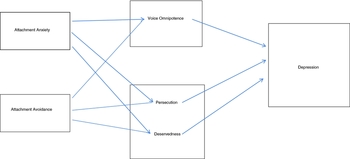
Figure 2 provides a graphic representation of the partial mediation relationships observed between attachment avoidance and anxiety and depression. As might be expected, there were fewer mediational relationships between attachment anxiety/avoidance and depression, although the relationship between attachment anxiety and depression was partially mediated by omnipotence (IE lower 99% CI = .0297, upper 99% CI = 1.6251), persecution (IE lower 99% CI = .4112, upper 99% CI = 1.8475) and deservedness of persecution (IE lower 99% CI = .1037, upper 99% CI = 1.3937). Similarly, attachment avoidance and depression was partially mediated by omnipotence (IE lower 99% CI = .1435, upper 99% CI = .2.3741), persecution (IE lower 99% CI = .4664, upper 99% CI = 2.3747) and deservedness of persecution (IE lower 99% CI = .0825, upper 99% CI = 1.3967).
Proposed partial mediational relationships between attachment avoidance/anxiety and depression

Discussion
Consistent with hypotheses, attachment avoidance was associated with voice dominance, hearer distance and voice related distress: attachment anxiety was associated with voice intrusiveness, hearer dependence and voice related distress. These were substantial relationships given the degree of error variance likely in self-report measures. Whilst some limited evidence of a relationship between attachment anxiety/avoidance and voice related distress mediated by voice variables was found, these should probably be viewed as preliminary results due to the limitations of multiple testing in a small sample.
These associations in the voice-hearer relationship are consistent with previous research in this area suggesting that more general processes in social relationships are linked to processes in the voice-hearer relationship (Birchwood et al., Reference Birchwood, Gilbert, Gilbert, Trower, Meaden and Hay2004; Hayward, Reference Hayward2003). They are also consistent with the predictions of cognitive models of voice hearing that view interpersonal schemata or beliefs about self and other as underlying the relationship with voices. Given the hypothesized link between interpersonal schemata and the voice relationship, the role of attachment anxiety and avoidance is a pertinent one. It has been argued that internal working models underlying attachment and core beliefs share similarities in that they guide attention, generate expectations and influence interpretation of new information (Platts, Tyson and Mason Reference Platts, Tyson and Mason2002). Attachment avoidance was associated here with voice dominance, hearer distance and distress. This is consistent with findings that attachment avoidance is associated with criticism in early relationships, negative beliefs about others and avoidance of relationships. That attachment anxiety was associated with voice intrusiveness, hearer dependence and distress is consistent with attachment anxiety being linked with intrusive caregiving, hyper-vigilance to rejection and overwhelming affect.
The mediation analyses in this study yielded some suggestive results: the relationship between attachment anxiety/avoidance and voice related distress as mediated by beliefs about voices is consistent with Birchwood et al.'s (Reference Birchwood, Gilbert, Gilbert, Trower, Meaden and Hay2004) suggestion that interpersonal schema of relevance to voice-related beliefs and distress come into existence through past trauma or attachment difficulties. We found some support for the suggestion that increased attachment avoidance/anxiety affects the relationship with the voice in a potentially negative way, which in turn may lead to increased distress. The present association between attachment avoidance and distress (mediated by voice related variables and paranoia) is in contrast to Berry et al. (Reference Berry, Wearden, Barrowclough, Oakland and Bradley2012) for reasons that remain unclear. The present study did not find evidence for an indirect effect of attachment avoidance on voice related distress mediated by distance from the voice or resistance, but rather evidence of a more direct effect of attachment avoidance on distress whilst controlling for these variables. The lack of an indirect effect and the more direct relationship between attachment avoidance and distress might be due to the relative inability of voice hearers to escape their voice. This may explain why attachment avoidance predicts voice related distress over and above an attempted distancing from the voice.
The link between attachment avoidance/anxiety and voice related distress was also found to be mediated by persecution and deservedness. This might be expected given Pickering et al.'s (Reference Pickering, Simpson and Bentall2008) finding that a link between attachment and hallucination proneness did not remain once paranoia had been controlled for. The relationship between attachment and paranoia has been considered by Trower and Chadwick (Reference Trower and Chadwick1995) who suggested a link between type of attachment (insecure – anxious or avoidant) and types of paranoia (poor me vs. bad me). However, this view has been challenged by Melo, Taylor and Bentall (Reference Melo, Taylor and Bentall2006) who provided evidence that the type of paranoia was not as fixed as suggested by Trower and Chadwick. Alternatively, it is possible that the finding that paranoia mediated this relationship may be linked with the presence of a delusional system incorporated in the experience of voice hearing, suggested by Birchwood et al. (Reference Birchwood, Gilbert, Gilbert, Trower, Meaden and Hay2004) to be associated with distress.
As might be expected, there were fewer mediated relationships in the current study between attachment anxiety/avoidance and depression than between attachment and voice related distress. However, the relationship with depression was mediated by beliefs about voice omnipotence and by persecution and deservedness of persecution. Beliefs about voice omnipotence as a mediator of this relationship might be expected given that the Birchwood et al. (Reference Birchwood, Gilbert, Gilbert, Trower, Meaden and Hay2004) model links depression and distress with interpersonal schema, and in light of beliefs about voice power being specifically related to depression (Birchwood and Chadwick, Reference Birchwood and Chadwick1997). Paranoia as a mediator of the relationship between attachment and depression may be accounted for by an association between paranoia and depression (Bentall, Corcoran, Howard, Blackwood and Kinderman, Reference Bentall, Corcoran, Howard, Blackwood and Kinderman2001).
Limitations
There was a distinct lack of specificity among the associations found in the present study between attachment and subscales of the VAY and BAVQ-R, limiting the specificity of conclusions. Both the sets of variables may lack specificity: attachment anxiety and attachment avoidance were significantly correlated and these self-report measures may not be as reliable in the present context. In addition, there are many substantial correlations between scales of the VAY and the BAVQ-R, suggesting considerable overlap in the constructs they purport to measure. Sorrell et al. (Reference Sorrell, Hayward and Meddings2010) argue that interpersonal processes as measured by the VAY and beliefs about voices as measured by the BAVQ-R may in fact be the same underlying constructs measured interpersonally and cognitively respectively. This would suggest that the separate analyses with voice dominance/intrusiveness and voice omnipotence/malevolence as mediators in the present study may have been testing a single underlying construct of negative relating to a voice. However, sample size prevented us empirically reducing the dimensions of these indices.
Given the nature of on-line recruitment, participants were limited to those who had access to a computer, which may have systemically excluded voice hearers with more chronic psychosis. The relatively small sample size does not allow full testing of the mediational relationships presented. Whilst bootstrapping is a non-parametric method for testing mediation and is acceptable for use in small sample sizes this is only with regard to testing simple mediational relationships. The mediational relationships presented in this study are likely to be more complex and involve multiple variables. Consequently, our results should be interpreted with caution.
Clinical implications
The current study provides further evidence that relational processes in the external world have relevance to the relationship with voices, and should therefore be considered in any therapy that aims to reduce distress with regard to voice hearing. Person-centred cognitive therapy is one such approach that has been applied to hearing voices (Chadwick, Reference Chadwick2006). The approach considers work on negative self-schemata and self-representation as key to developing a meta-cognitive perspective of self. In addition, Hayward, Overton, Doney and Denney (Reference Hayward, Overton, Doney and Denney2009) has provided some promising early results using Relating Therapy for voices, which considers interpersonal characteristics in the voice relationship. The current study provides additional support for these therapeutic approaches and suggests that attachment theory may complement and enhance these therapeutic approaches.



Comments
No Comments have been published for this article.