1. Introduction
Peridotite blocks constitute volumetrically minor but genetically important components of the surface of the Earth. Although several peridotite blocks have been dated as Archean mantle peridotites (e.g. Beyer et al. Reference Beyer, Brueckner, Griffin, O’Reilly and Graham2004; Brueckner et al. Reference Brueckner, Van Roermund and Perarson2004; van Roermund, Reference van Roermund2009; Xiong et al. Reference Xiong, Griffin, Zheng, O’Reilly and Pearson2015), these Archean records actually correspond to the time of melt-extraction of the mantle (Shirey & Walker, Reference Shirey and Walker1998). Most deep-seated mantle peridotites were exhumed to crustal level much later than the Archean Eon (Zhang et al. Reference Zhang, Van Roermund and Zhang2015). This perceived paucity in Archean exhumation records has been quoted as evidence against the existence of plate tectonics on Earth during the Archean Eon (e.g. Bédard, Reference Bédard2006, Reference Bédard2018; Condie & Kröner, Reference Condie, Kröner, Condie and Pease2008; Stern, Reference Stern2008; Condie, Reference Condie2016).
Nevertheless, recent studies in Archean terrains have provided increasing lines of evidence supporting that theory that mantle peridotites exhumed as a part of ophiolitic mélanges during Archean – early Proterozoic time, which can diagnostically indicate the existence of plate tectonics during Archean time (Kusky et al. Reference Kusky, Wang, Wang, Huang, Ning, Fu, Peng, Deng, Polat, Zhang and Shi2020). Not only emplaced to ophiolitic mélange belts, mantle peridotites can also be exhumed onto continental crust by deep-level ductile imbrication (Cuthbert et al. Reference Cuthbert, Harvey and Carswell1983; Cuthbert & Carswell, Reference Cuthbert, Carswell and Carswell1990; Medaris & Carswell, Reference Medaris, Carswell and Carswell1990). This crustal emplacement mechanism is common in Phanerozoic orogenic belts (Zhang et al. Reference Zhang, Van Roermund and Zhang2015). However, exhumation of mantle peridotites onto continent orogenic belt in an Archean subduction process has not yet been identified.
In this contribution, we present the mineral chemistry, whole-rock geochemical, Nd isotopic data and exhumation age constraints of two ultramafic blocks, namely, Songling and Majiayu peridotites, in the Eastern Block of the North China Craton (NCC). Our data suggest that a suite of mantle peridotites with melt-peridotite reaction signatures was exhumed in the Eastern Block during an arc–continent collision at the end of the Neoarchean Era. This peridotite suite, together with the reported subduction-related ophiolitic mélanges in the Central Orogenic Belt, may represent a subduction–collision tectonic cycle during Neoarchean time.
2. Geological background
2.a. North China Craton
The NCC is one of the Archean continental cratons on the Earth, and it has experienced multiple stages of deformation and metamorphism (Zhai & Windley, Reference Zhai and Windley1990; Kusky & Li, Reference Kusky and Li2003; Wan et al. Reference Wan, Liu, Song, Wu, Yang, Zhang and Geng2005; Kusky et al. Reference Kusky, Windley, Zhai, Zhai, Windley, Kusky and Meng2007, Reference Kusky, Polat, Windley, Burke, Dewey, Kidd, Maruyama, Wang, Deng, Wang, Wang, Fu, Li and Peng2016; Zhai & Santosh, Reference Zhai and Santosh2011; Zhao et al. Reference Zhao, Cawood, Li, Wilde, Sun, Zhang, He and Yin2012). The NCC is bordered by the Palaeozoic Central Asian Orogenic Belt to the north, the Qinling–Dabie orogenic belt to the south and the Sulu ultra-high-pressure belt in the east (Li et al. Reference Li, Xiao, Liou, Chen, Ge, Zhang, Sun, Cong, Zhang, Hart and Wang1993; Xiao et al. Reference Xiao, Windley, Hao and Zhai2003).
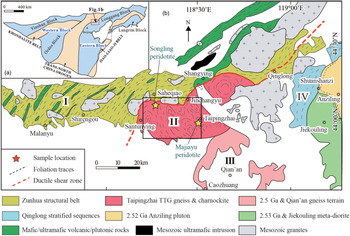
The tectonic divisions of the NCC are still controversial. Zhai & Santosh (Reference Zhai and Santosh2011) suggested that it had been cratonized by the amalgamation of several ancient micro-continental blocks along different greenstone belts (c. 2.6–2.75 Ga and 2.5 Ga); Li et al. (Reference Li, Kusky and Huang2002) advocated that the Western and Eastern blocks of the NCC collided at c. 2.5 Ga along the Central Orogenic Belt. However, more researchers accept the model that the Precambrian basement of the NCC can be divided into three parts, i.e. the Eastern Block, the Western Block and the intervening Central Orogenic Belt (or Trans North China Orogen in some literature; Fig. 1a) (Zhao et al. Reference Zhao, Sun, Wilde and Li2005, Reference Zhao, Cawood, Li, Wilde, Sun, Zhang, He and Yin2012; Zhao & Zhai, Reference Zhao and Zhai2013; Kusky et al. Reference Kusky, Polat, Windley, Burke, Dewey, Kidd, Maruyama, Wang, Deng, Wang, Wang, Fu, Li and Peng2016). The Western Block of the NCC has a continuous stable history since the Neoarchean Era (Zhao et al. Reference Zhao, Sun, Wilde and Li2005). On the contrary, the Eastern Block experienced complex and multi-stage deformation events, indicating that it has a prolonged history of collision, break-up and underplating since the Palaeoarchean Era (Liu et al. Reference Liu, Nutman, Compston, Wu and Shen1992; Kusky & Li, Reference Kusky and Li2003; Zheng et al. Reference Zheng, Griffin, O’Reilly, Lu, Wang, Zhang, Wang and Li2004). The Central Orogenic Belt extends nearly 1600 km from south to north, including several exposed Archean–Palaeoproterozoic basement massifs (Kusky et al. Reference Kusky, Windley, Zhai, Zhai, Windley, Kusky and Meng2007; Wang et al. Reference Wang, Zhou, Liu, Li and Yang2018; Lin et al. Reference Lin, Zhang, Li and Deng2020). Lithological types in the Central Orogenic Belt include tonalite–trondhjemite–granodiorite (TTG) gneiss, metamorphosed ultramafic–mafic rocks, granites and volcanosedimentary sequences with metamorphism grading from greenschist- to granulite-facies (Zhao et al. Reference Zhao, Wilde, Cawood and Lu1998; Kusky & Li, Reference Kusky and Li2003; Li & Kusky, Reference Li and Kusky2007; Kusky et al. Reference Kusky, Polat, Windley, Burke, Dewey, Kidd, Maruyama, Wang, Deng, Wang, Wang, Fu, Li and Peng2016).
(a) Tectonic subdivision of the North China Craton (NCC) (after Zhao et al. Reference Zhao, Wilde, Cawood and Sun2001, Reference Zhao, Sun, Wilde and Li2005) and (b) geological map of the Eastern Hebei terrane (modified after Kusky et al. Reference Kusky, Wang, Wang, Huang, Ning, Fu, Peng, Deng, Polat, Zhang and Shi2020). I: Saheqiao linear-structural belt; II: Taipingzhai ovate-structural domain; III: Qian’an gneiss dome; IV: Shuangshanzi supracrustal rock belt.

2.b. Regional lithotectonic units
The peridotites in this study are located to the SW of the Zunhua structural belt in the Eastern Block of the NCC (Fig. 1b). There are four lithotectonic units in Figure 1b: (I) the Zunhua structural belt; (II) the Taipingzhai ovate-structural domain; (III) the Qian’an gneiss dome; and (IV) the Shuangshanzi supracrustal rock belt (Kusky & Li, Reference Kusky and Li2003; Kusky et al. Reference Kusky, Wang, Dilek, Robinson, Peng and Huang2011, Reference Kusky, Polat, Windley, Burke, Dewey, Kidd, Maruyama, Wang, Deng, Wang, Wang, Fu, Li and Peng2016; Wang et al. Reference Wang, Kusky, Polat, Wang, Deng and Wang2013, Reference Wang, Li, Ning, Kusky, Wang, Polat and Deng2019 b; Deng et al. Reference Deng, Kusky, Polat, Wang, Wang and Wang2013, Reference Deng, Kusky, Polat, Wang, Wang, Li and Wang2016; Ning et al. Reference Ning, Kusky, Wang, Wang, Deng, Polat, Huang, Peng and Feng2020).
The allochthonous Zunhua Structural Belt extends as a NE-striking shearing belt in Malanyu, Saheqiao and Qinglong areas (Kusky et al. Reference Kusky, Polat, Windley, Burke, Dewey, Kidd, Maruyama, Wang, Deng, Wang, Wang, Fu, Li and Peng2016). It is characterized by highly deformed mafic–ultramafic volcanic and plutonic rocks, encased by and in tectonic contact relationships with metasedimentary gneiss (Wang et al. Reference Wang, Li, Ning, Kusky, Wang, Polat and Deng2019 b; Ning et al. Reference Ning, Kusky, Wang, Wang, Deng, Polat, Huang, Peng and Feng2020). The Dongwanzi ophiolite complex (Kusky et al. Reference Kusky, Li and Tucker2001) in this belt contains ultramafic interlayers and basalts formed at 2.50–2.56 Ga (Polat et al. Reference Polat, Herzberg, Münker, Rodgers, Kusky, Li, Fryer and Delancy2006; Zhang et al. Reference Zhang, Zhai, Zhang, Xiang, Dai, Wang and Pirajno2012). Palaeoarchaean (3.45 Ga) metamorphosed magnesium-rich volcanic rocks with mantle plume signatures occur in the Longwan area of this belt (Wang et al. Reference Wang, Song, Wei, Su and Dong2019 a).
The Taipingzhai ovate-structural domain is mainly composed of TTG gneisses and charnockites with several slivers of supracrustal rocks consisting of mafic and pelitic granulites and banded iron formations (BIFs) (Duan et al. Reference Duan, Wei and Rehman2017). The TTG gneisses and charnockites were emplaced at 2.50–2.58 Ga and metamorphosed at 2.48–2.53 Ga (Geng et al. Reference Geng, Liu and Yang2006; Nutman et al. Reference Nutman, Wan, Du, Friend, Dong, Xie, Wang, Sun and Liu2011; Yang et al. Reference Yang, Santosh and Tsunogae2016). The pelitic granulites have a deposition age of c. 2.5 Ga and a metamorphic age of c. 2.48 Ga, with an anticlockwise P-T path (Duan et al. Reference Duan, Wei and Rehman2017). Ultrahigh-temperature conditions were also recognized from mafic granulites (Yang & Wei, Reference Yang and Wei2017).
The Qian’an gneiss dome is composed of 2.55–2.50 Ga TTG gneisses and c. 2.49 Ga potassic granitic gneisses with a few large supracrustal blocks on its northern and southwestern margins (Nutman et al. Reference Nutman, Wan, Du, Friend, Dong, Xie, Wang, Sun and Liu2011). All the rocks in this dome have experienced amphibolite- to granulite-facies metamorphism. The Caozhuang supracrustal rocks in this region have a deposition age older than c. 3.5 Ga according to the age spectrum of detrital zircons (Liu et al. Reference Liu, Nutman, Compston, Wu and Shen1992; Nutman et al. Reference Nutman, Wan, Du, Friend, Dong, Xie, Wang, Sun and Liu2011).
The Neoarchean (c. 2.6–2.5 Ga) Shuangshanzi supracrustal belt comprises amphibolite, plagioclase gneiss, micaschist and sericite schist, metamorphosed at amphibolite- and greenschist-facies (Qi et al. Reference Qi, Hao, Zhang and Nie1999).
3. Field relationships
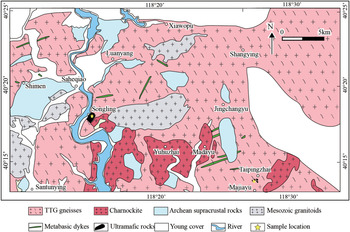
The peridotite block outcrops are located in the Taipingzhai ovate-structural domain (Fig. 1b). The Songling peridotite block is continuously exposed in an area of c. 1 km2, with massive fresh outcrops distributed along road cuts and quarries; the Majiayu peridotites are located to the south of the Taipingzhai County, as several outcrops of 100–200 m in length along the road cut (Fig. 2).
Geological map of the Taipingzhai ovate-structural domain, showing the occurrence of the Songling and Majiayu peridotites in Archean TTG gneiss and charnockites (modified after Wu et al. Reference Wu, Geng, Shen, Wan, Liu and Song1998).

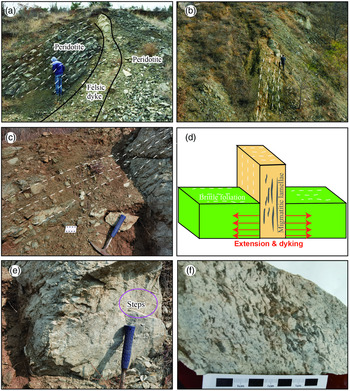
A trondhjemitic dyke intruded into the Songling peridotite (Fig. 3a). The exposed surface of the trondhjemitic dyke is 50 cm in width and almost 3 m in lateral extent (Fig. 3a, b). The dyke is in intrusive contact with the peridotite with a sharp and clear margin (Fig. 3c). Three phases of deformation can be identified in the Songling outcrop. The youngest deformation is represented by a pervasive NE-striking foliation, which is characterized by scaly cleavage and fault steps (Fig. 3e), suggesting a penetrative brittle deformation at shallow crustal level. An earlier ductile deformation phase is characterized by gneissosity and leucosome (i.e. migmatite partial melts; Sawyer, Reference Sawyer, Sawyer and Brown2008) enriched in quartz grains and/or feldspar aggregates, which is linearly oriented on hand specimen (Fig. 3e). The earliest deformation due to extension was perpendicular to the strike of the dyke and accommodated the intrusive trondhjemitic magma. The Majiayu peridotites located c. 25 km to the SE of the Songling peridotite (Fig. 2) have a brittle deformation similar to that of the Songling peridotite.
Field photographs: (a) relationship between the Songling peridotite and the trondhjemitic dyke; (b) aerial view of the Songling peridotite block showing the pervasive brittle foliation (indicated by white dashed lines) in the outcrop area; (c) brittle foliation (indicated by white dashed lines) of the Songling peridotite (left); (d) sketch model showing the three phases of deformation, including extension and dyking (red), migmatitic leucosome (grey) and brittle foliation (white dashed lines); (e) close view of a fault plane on the trondhjemitic dyke, showing the scaly cleavage and fault steps corresponding to the brittle deformation; also shown is the near-vertical gneissosity with migmatitic leucosome; and (f) close view of the gneissosity on a hand specimen; note the quartz-rich migmatitic leucosome.

4. Analytical methods
4.a. Mineral major- and trace-element chemistry analyses of peridotites
Analyses of minerals of five peridotite samples (two from Songling and three from Majiayu peridotites) and one trondhjemite sample (SL4) were conducted using JEOL JXA-8230 electron microprobe analysers (EMPA), equipped with four spectrometers (CH1–CH4), at Peking University. The PETJ crystal (CH1) has been used for K, Ca and Ti, the two TAP crystals (CH2, CH4) for Na, Si, Mg and Al, and the LIFH crystal (CH3) for Cr, Mn, Fe and Ni. For all elements, the Kα line was utilized. The acceleration voltage and the beam current were 15 kV with 10 nA, respectively. The beam was set to diameters of 2 μm. Counting times were 5 s and 20 s for Ca, Mg, Al and Fe, and 5 s and 10 s for all other elements, on background and peak. The SPI 53 minerals standard (US) was utilized for the quantitative analysis: sanidine was employed for K; diopside for Ca and Mg; rutile for Ti; jadeite for Na, Al and Si; chromium oxide for Cr; rhodonite for Mn; hematite for Fe; and nickel silicide for Ni. At the final calibration stage, the PRZ correction was performed.
In situ trace-element analyses of minerals were performed by a laser ablation inductively coupled plasma mass spectrometer (LA-ICP-MS) housed at the Key Laboratory of Orogenic Belts and Crustal Evolution, Peking University. The instrument configuration consisted of an Agilent 7500 ICP-MS instrument equipped with a 193 nm ArF Excimer laser. Ablation spot size was 60 μm or 90 μm in diameter with a repetition rate of 5 Hz and laser energy of 100 mJ. Helium was used as the cell gas. The acquisition times for the background and the ablation interval were 15–20 s and 45–60 s, respectively. International reference glass NIST610, NIST612 and NIST614 were used to estimate the precision and accuracy, and NIST610 was used as the standard to calculate element abundances. The calculation of trace-element concentrations was performed using GLITTER (version 4.4.2) (Griffin et al. Reference Griffin, Powell, Pearson, O’Reilly and Sylvester2008). For clinopyroxene and amphibole, analytical precisions were lower than 20% for Ti, Nb and U, and lower than 10% for other elements. For orthopyroxene, spinel and olivine, analytical precisions were lower than 10% for Sc, Ti, Co, Ni, Zn and Y, lower than 20% for rare earth elements (REEs), and lower than 30% for V, Cr, Sr, Zr, Nb, Hf, Th and U.
4.b. Whole-rock geochemical analysis of peridotites
Major-element analyses of bulk-rock samples, including two from the Songling peridotite and three from the Majiayu peridotite, were conducted by x-ray fluorescence spectrometry on fused glass disks using a Philips Avant (No.6735)+ XRF-1500 instrument at the Laboratory of Orogenic and Crustal Evolution, Ministry of Education, Peking University.
Trace-element analyses were conducted at the Key Laboratory of Orogenic Belts and Crustal Evolution, School of Earth and Space Sciences, Peking University. Sample digestion followed procedures described for basaltic rocks in appendix 2 of Tian et al. (Reference Tian, Campbell, Allen, Guan, Pan, Chen, Yu and Zhu2010). Trace-element concentrations were determined using a Perkin Elmer Sciex ElAN 6000 ICP-MS. The USGS standard BHVO-2 and Chinese National standard GSR-2 were chosen for element concentration calibration. Analytical uncertainties of REEs and other incompatible elements analyses are generally better than 5%.
4.c. Whole-rock Sm–Nd isotope analysis of peridotites
Chemical separation for Sm–Nd isotope analysis was conducted at the Key Laboratory of Orogenic Belts and Crustal Evolution, School of Earth and Space Sciences, Peking University, following procedures described in appendix 2 of Tian et al. (Reference Tian, Campbell, Allen, Guan, Pan, Chen, Yu and Zhu2010). Rock powders for Sm–Nd isotopic analysis were dissolved in a tightly sealed SAVILLEX™ 7 mL PFA vial after being spiked with 149Sm and 150Nd tracers prior to HF + HNO3 (with a ratio of 2:1) dissolution. REEs were separated on quartz columns with a 5 mL resin bed of Bio-Rad™ AG 50 W-X12, 200–400 mesh. Sm and Nd were separated using 1.7 mL of 2-ethylhexyl hydrogen 2-ethylhexyl phosphate (trade name P507 in China) impregnated Teflon™ powder as cation exchange medium. Procedural blank was monitored by Pb contents, which were below 50 pg in 100 blank samples analysed over a 2-year period. Isotopic ratios were measured using a Thermo-Finnigan TRITON thermal ionization mass spectrometer (TIMS) at the Isotope Laboratory of the Institute of Geology and Mineral Resources, China Geological Survey, Tianjin. 143Nd/144Nd ratios were corrected for mass fractionation by normalization to 143Nd/ 144Nd = 0.7219. Typical within-run precision (2σ) for Nd was estimated to be ±0.000015.
4.d. Zircon U–Pb geochronology, trace elements and in situ Hf–O isotope analysis of trondhjemitic dyke
Zircons were hand-picked from a trondhjemitic dyke sample SL4. They were cast into epoxy disk with reference zircons (Plešovice and Temora-2), ground and polished to expose the midsection of the grains. Cathodoluminescence (CL) imaging was conducted using a JEOL JSM6610A analytical scanning electron microscope (SEM) in the Research School of Earth Sciences (RSES), Australian National University (ANU), Canberra, equipped with a Robinson CL detector.
The ion probe instruments employed include SHRIMP-RG (reverse geometry) for U–Pb geochronology, SHRIMP SI (stable isotope) for O isotopes, laser ablation multicollector (LA-MC) ICP-MS for Hf isotopes, LA-ICP-MS for trace elements, all at RSES, ANU. The analytical procedures and data processing are summarized below.
Zircon U–Th–Pb isotope analytical procedures are similar to those described in Ireland & Williams (Reference Ireland and Williams2003). Data were reduced using the SQUID Excel Macro of Ludwig (Reference Ludwig2001 a) and the Isoplot/EX Excel Macro of Ludwig (Reference Ludwig2001 b). Oxygen isotope ratios (18O/16O) of zircons were determined using SHRIMP SI ion microprobe. Analytical conditions were similar to those outlined in detail by Fu et al. (Reference Fu, Bröcker, Ireland, Holden and Kinsley2015).
In situ Lu–Hf isotope and trace-element analyses of zircons were carried out (after ion microprobe 18O/16O analyses) using the 193 nm excimer laser-based HELEX ablation system coupled to both Neptune MC-ICP-MS (Eggins et al. Reference Eggins, Grun, McCulloch, Pike, Chappell, Kinsley, Mortimer, Shelley, Murray-Wallace, Spotle and Taylor2005) and Varian 820 quadrupole ICP-MS, similar to the split stream technique (e.g. Kylander-Clark et al. Reference Kylander-Clark, Hacker and Cottle2013). The laser spot size was 41 μm in diameter, and ablation time was up to 60 seconds. Data were reduced offline using the software package Iolite (Paton et al. Reference Paton, Woodhead, Hellstrom, Hergt, Greig and Maas2010, Reference Paton, Hellstrom, Paul, Woodhead and Hergt2011). The trace-element results were calibrated against synthetic glass (NIST 612) with Si as internal standard, while the Lu–Hf isotope results were estimated with the standard zircons 91500, FC-1, Monastery, Mud Tank, QGNG and Plešovice (Wiedenbeck et al. Reference Wiedenbeck, Alle, Corfu, Griffin, Meier, Oberli, Von Quadt, Roddick and Spiegel1995; Woodhead et al. Reference Woodhead, Hergt, Shelley, Eggins and Kemp2004; Woodhead & Hergt, Reference Woodhead and Hergt2005; Slama et al. Reference Slama, Kosler, Condon, Crowley, Gerdes, Hanchar, Horstwood, Morris, Nasdala, Norberg, Schaltegger, Schoene, Tubrett and Whitehouse2008).
5. Results
5.a. Petrography and mineral chemistry
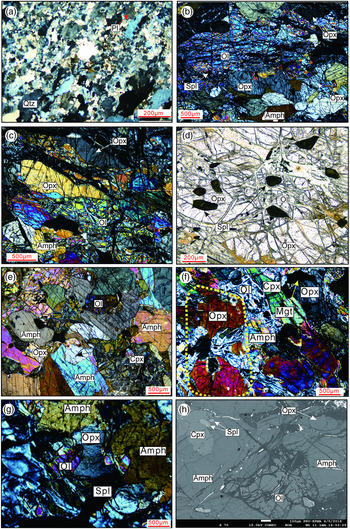
The trondhjemitic dyke cutting the Songling peridotite has a mineral assemblage containing 50% plagioclase, 40% quartz, < 5% K-feldspar, c. 5% biotite and minor tremolite (Mg-rich amphibole). Photomicrograph (Fig. 4a) shows that quartz–feldspar aggregates are strongly aligned to the foliation, which is similar to the ‘leucosome’, that is, syntectonic anatectic melts as defined by Sawyer (Reference Sawyer, Sawyer and Brown2008). Both Songling and Majiayu peridotites have mineral assemblage of Ol+Opx+Cpx+Amph+Spl, with pervasive serpentinization. Olivines from Songling peridotites show mosaic porphyroclastic texture (Fig. 4b), which have been partially or completely replaced by serpentine and talc (Fig. 4c, d). Orthopyroxenes have been partially replaced by serpentine, talc and bastite (Fig. 4c, d). Euhedral amphiboles of metamorphic origin are abundant, while primary clinopyroxenes are rare (Fig. 4e). Olivines and orthopyroxenes from Majiayu peridotites have also been serpentinized (Fig. 4f, g). The unserpentinized mode abundances of minerals within peridotites were estimated by area analyses of thin-sections and are listed in Table 1. These peridotites contain olivine (45–59%), orthopyroxene (25–34%), clinopyroxene (2–6%), amphibole (10–14%) and minor amounts of spinel (1–5%). If we take amphibole as a minor mineral, according to the International Union of Geological Sciences (IUGS) classification system for ultramafic rocks (Le Maitre, Reference Le Maitre1982), these peridotites are classified as spinel lherzolites and spinel harzburgites except one olivine websterite. However, it should be noted that the peridotites in this study had experienced hb-granulite-facies metamorphism and melt infiltration during exhumation (as discussed in Section 6.a). The mineral mode abundances reported in Table 1 actually reflect the mineral composition after the granulite-facies metamorphism. The original mineral composition before exhumation has to be recovered to restore the metamorphic amphibole to clinopyroxene on the basis of volatile-free chemistry. If the amphibole was recalled to clinopyroxene, the primary anhydrous mantle peridotites would have a clinopyroxene abundance of 12–20% and all the peridots would be classified as lherzolites.
Petrography photos of the peridotites and trondhjemitic dyke: (a) trondhjemite dyke sample SL-4; (b) mosaic porphyroclastic olivine, banded orthopyroxene, coarse spinel and amphibole of the Songling peridotite, SL-1, cross-polarized; (c) banded orthopyroxene of the Songling peridotite, SL-1, cross-polarized; (d) greenish-brown spinel, individual and coarse grain, SL-2, plane-polarized; (e) euhedral amphibole contacting with olivine or orthopyroxene, SL-1, cross-polarized; (f) large orthopyroxene intergrowth with magnetite and amphibole contacting with olivine and orthopyroxene, MJY-4a, cross-polarized; (g) euhedral amphibole contacting with olivine and orthopyroxene, MJY-5, cross-polarized; (h) olivine, orthopyroxene, clinopyroxene and spinel enclaved by overprinting amphibole, BSE image of MJY-1. Ol – olivine; Opx – orthopyroxene; Cpx – clinopyroxene; Amph – amphibole; Spl – spinel.

Mineral modes for thin-sections of the Songling and Majiayu peridotites.

a Note that the lithology is based on all minerals, not a volatile-free mineral composition.
Representative mineral major elements were analysed, and the results are listed in online Supplementary Tables S1–S6 (available at http://journals.cambridge.org/geo). Analysed data of EPMA standards are listed in online Supplementary Table S7. Program AX was used for the calculation of mineral formulae. In situ LA-ICP-MS trace-element analyses of olivine, orthopyroxene, clinopyroxene and amphibole are listed in online Supplementary Table S8. Analysed data of standard glasses are listed in online Supplementary Table S9.
5.a.1. Olivine
Olivine occurs in two domains in Songling peridotites: either as mosaic porphyroclastic grains (Ol-m) (Fig. 4b, c) or as relatively small grains enclaved by or in contact with amphibole grains (Ol-c) (Fig. 4e, f). Porphyroclastic olivines (Mg no. = molar Mg/(Mg + Fe2+) = 0.85–0.89) are small fragmented mosaic grains (0.1–0.5 mm), the rims of which are replaced by serpentine and magnetite. Such olivines have 0.23–0.49 wt% NiO and BDL–0.07 wt% CaO (BDL: below detection limit). Olivines enclaved by amphibole form inward curved edges. They have Mg numbers of 0.84–0.86, slightly lower than that of the porphyroclastic olivines.
Olivines from the Majiayu peridotites have Mg no. ranging from 0.82 to 0.84, 0.11–0.28 wt% NiO and BDL–0.05 wt% CaO.
5.a.2. Orthopyroxene
Similar to olivine, there are also two types of orthopyroxene in the Songling peridotites. The first type of orthopyroxene (Opx-d) shows strong deformation and forms elongated narrow bands of 1–2 mm in length (Fig. 4b, c). Such orthopyroxene (Mg no. = 0.85–0.90) has 0.04–0.14 wt% NiO (average, 0.09 wt%) and 2.01–3.04 wt% Al2O3 (average, 2.43 wt%). The remaining undeformed orthopyroxene (Opx-c) is enclaved completely or partially by amphibole (Fig. 4f, Mg no. = 0.84–0.86). The orthopyroxenes from the Majiayu peridotites have Mg no. ranging from 0.83 to 0.86. Their NiO content is up to 0.08 wt% and Al2O3 from 0.54 to 0.84 wt%.
5.a.3. Clinopyroxene
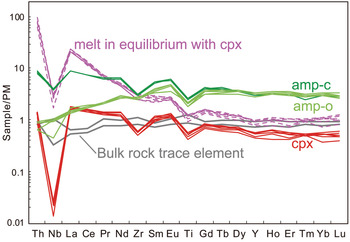
Clinopyroxene is very rare in the Songling peridotites. It occurs in two forms: enclosed in amphibole, or in contact with deformed olivine and orthopyroxene (Fig. 4f). Nevertheless, there is no remarkable compositional difference between these two types: Mg no. of the clinopyroxene ranges from 0.89 to 0.95, with Cr no. (Cr no. = molar Cr/(Cr+Al)) from 0 to 0.09. In the primitive mantle (PM) normalized trace-element diagram (Fig. 5), the clinopyroxenes are characterized by depleted medium REEs (MREEs) and heavy REEs (HREEs), as well as significant depletion of Nb, Zr and Ti.
Primitive-mantle-normalized trace-element patterns for bulk-rock Songling peridotite, amphibole, clinopyroxene and melt composition in equilibrium with clinopyroxene. The melt compositions are calculated based on the melt/cpx partition coefficients for REEs from Wood & Blundy (Reference Wood and Blundy1997) and for other elements from Hauri et al. (Reference Hauri, Wagner and Grove1994).

Clinopyroxenes from the Majiayu peridotite have Mg number ranging from 0.89 to 0.93. Their Cr numbers are below 0.06.
5.a.4. Spinel
Spinel in the Songling peridotites occurs in three domains: as individual grains outside the amphibole domain (Fig. 4d), fine-grained crystal enclaved by amphibole (Fig. 4f), or as exsolved rods or lamellae in amphibole. Spinel outside amphibole domain (Mg no. = 0.59–0.67) is green to light brown, and occurs as coarse grains in size (0.1–0.5 mm). Such coarse spinel grains have high Al2O3 = 49.92–55.92 wt%, low Cr no. = 0.05–0.13 with low TiO2 = BDL–0.07 wt%, and calculated Fe2+/(Fe2++Fe3+) is 0.75–0.85. Spinels from the Majiayu peridotite have Al2O3 from 58.55 to 59.44, Cr no. of 0.07 and TiO2 up to 0.16 wt%.
5.a.5. Amphibole
Amphibole is magnesio-hornblende according to Leake (Reference Leake, Woolley, Arps, Birch, Gilbert, Grice, Hawthorne, Kato, Kisch, Krivovichev, Linthout, Laird, Mandarino, Maresch, Nickel, Rock, Schumacher, Smith, Stephenson, Ungaretti, Whittaker and Guo1997). It occurs in two forms: either as euhedral grains (amp-c) contacting with olivine or orthopyroxene, 0.5–2.0 mm in size (Fig. 4c, e), or as coarse grains (amp-o) overprinting olivine + orthopyroxene + clinopyroxene + spinel (Fig. 4f). The small size of the former amphibole may be controlled by limited chemical supply from its surrounding region, while the latter texture suggests the reaction olivine + orthopyroxene + clinopyroxene + spinel (fine-grained) + fluid → secondary amphibole + spinel (exsolved rods or lamellae), which occurred in a wider area with abundant chemical elements for its growth. In the PM-normalized trace-element diagram (Fig. 5), the amphiboles are characterized by remarkably higher content of most trace elements when compared with the bulk peridotite compositions, except for Th and Nb in some amphiboles. The amphiboles contacting with olivine or orthopyroxene (amp-c) are enriched in Th and La and relatively depleted in Nb, whereas the amphiboles overprinting other minerals are all depleted in Th, Nd and light REEs (LREEs).
5.b. Major and trace elements
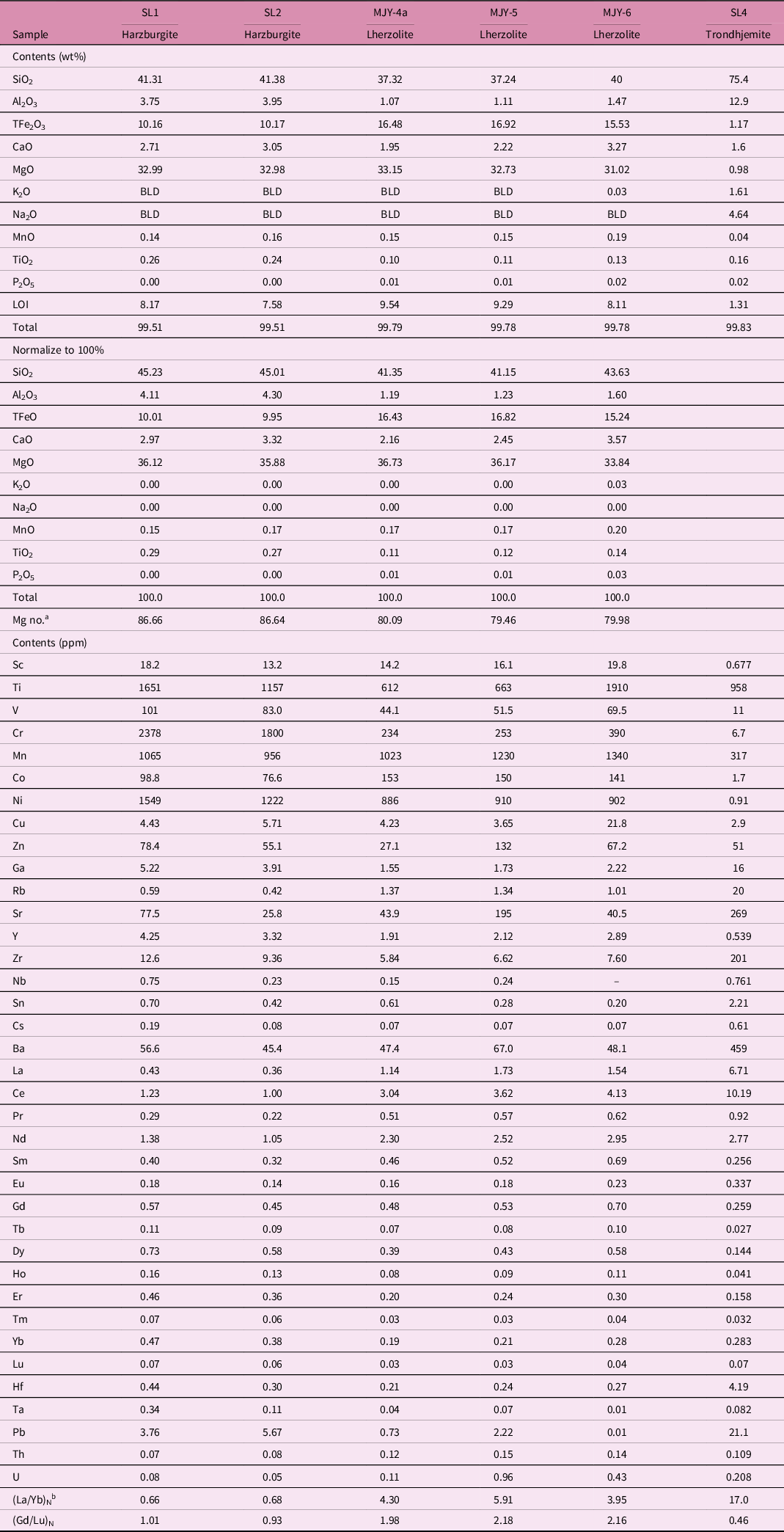
Bulk-rock major and trace elements for peridotites and trondhjemitic dyke are listed in Table 2. The analysed data describing two major-element standards, GSR-3 and GBW07101, together with the recommended values, are listed in online Supplementary Table S10. One trace-element standard BHVO-2 was analysed in different batches of ultramafic sample-included experiments as an unknown sample. The average analysed data and the recommended values are listed in online Supplementary Table S11.
Major and trace elements (wt%) for Songling and Majiayu peridotites. BLD – below the level of detection; LOI – loss on ignition.

a Mg no. = molar Mg/(Mg+Fe2+).
b Chondrite normalized (Sun & McDonough, Reference Sun, McDonough, Saunders and Norry1989).
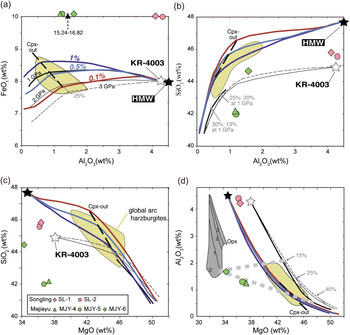
The peridotite samples are characterized by high loss-on-ignition (LOI) values from 7.58 to 9.54 wt%, due to pervasive serpentinization. By normalization after excluding volatiles, Songling peridotites are characterized by high SiO2 (45.01–45.23 wt%), Al2O3 (4.11–4.30 wt%) and CaO (2.97–3.32 wt%), slightly low MgO (35.88–36.12 wt%), and very high FeO contents (9.95–10.01 wt%) when compared with the model fertile mantle KR-4003 (Fig. 6). Majiayu peridotites show an extremely enriched FeO (15.24–16.82 wt%), significantly depleted SiO2 (41.15–43.63 wt%), and low MgO (33.84–36.73 wt%) and Al2O3 (1.19–1.60 wt%) contents relative to KR-4003 (Fig. 6). The trondhjemitic dyke has high SiO2 (75.4 wt%), low Al2O3 (12.9 wt%), low K2O (1.61 wt%) and high Na2O (4.64 wt%), similar to the quartz-rich trondhjemites from the Taipingzhai domain (Nutman et al. Reference Nutman, Wan, Du, Friend, Dong, Xie, Wang, Sun and Liu2011).
Major-element compositions of the peridotites from North Hebei with comparisons to experimentally determined melting trajectories of model fertile peridotite: (a) FeOt versus Al2O3; (b) SiO2 versus Al2O3; (c) SiO2 versus MgO; and (d) Al2O3 versus MgO. Model residue compositions formed by fractional melting of fertile peridotite KR-4003 (Herzberg, Reference Herzberg2004). Orthopyroxene compositions are from Herzberg & O’Hara (Reference Herzberg and O’Hara2002) for liquids in equilibrium with harzburgite at the pressures (GPa) indicated. The ‘modern arc peridotites’ field is modified from Polat et al. (Reference Polat, Herzberg, Münker, Rodgers, Kusky, Li, Fryer and Delancy2006). Co-variation plots of major-element oxides for the Songling (red) and Majiayu (green) peridotites in this study. Two model source compositions are shown: (i) KR-4003 fertile lherzolite (Herzberg, Reference Herzberg2004; white star); and (ii) hybrid mantle wedge (HMW; black star, thick coloured lines). Also shown are evolution trends for residues of (i) anhydrous batch melting of KR-4003 lherzolite (Herzberg, Reference Herzberg2004) at 1–3 GPa (thick solid black, thin solid black and dashed black lines); and (ii) modelled (pMELTS) hydrous batch melting of HMW at 1 GPa in solid heavy coloured lines (Bénard et al. Reference Bénard, Arculus, Nebel, Ionov and Mcalpine2017). Melting degree equilines for KR-4003 lherzolite are in grey and clinopyroxene-out boundaries for HMW melting are shown as bold black dashed lines. The yellow field encloses literature data for global arc harzburgites (Maury et al. Reference Maury, Defant and Joron1992; McInnes et al. Reference McInnes, Gregoire, Binns, Herzig and Hannington2001). Fertile mantle KR4003: 44.90 wt% SiO2, 4.26 wt% Al2O3, 3.45 wt% CaO, 8.02 wt% FeO, 37.30 wt% MgO (Walter, Reference Walter1998).

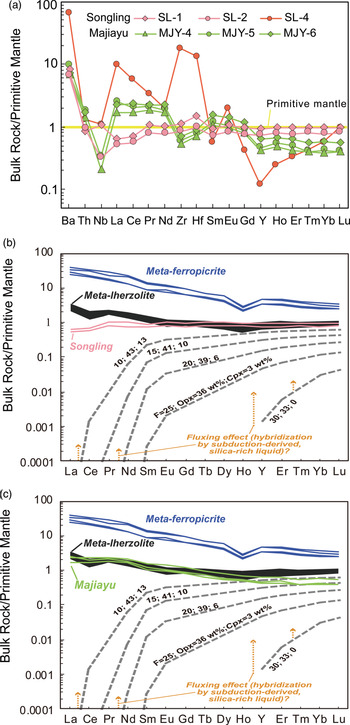
Trace elements of these peridotite samples are normalized to primitive mantle (PM) composition and plotted in Figure 7a. All samples are enriched in Ba and most are depleted in Nb. In addition, Zr and Hf from Majiayu peridotites are depleted relative to Nd and Sm. PM-normalized REE patterns for Songling peridotites are flat (Fig. 7b). HREE contents of the Songling peridotites are close to that of PM, while LREEs La and Ce are slightly depleted. Majiayu peridotites display fractionated REE patterns, characterized by enrichment in LREEs higher than PM and depleted HREEs lower than PM (Fig. 7c). The trondhjemitic dyke has (La/Yb)N value of 17.0 (Table 2) and low Yb abundance of 0.283 ppm.
Primitive-mantle-normalized trace-element and REE patterns of the peridotites in this study, the c. 3.5 Ga meta-lherzolite and meta-ferropicrite from Longwan and the results for dynamic flux-melting models. (a) PM-normalized trace-element patterns of Songling and Majiayu peridotites. Comparison between PM-normalized REE patterns of dynamic flux-melting model for a HMWreac source (dashed grey lines) from Bénard et al. (Reference Bénard, Müntener, Pilet, Arculus and Nebel2021) and the REE patterns of (b) Songling peridotites and (c) Majiayu peridotites. PM values are from Sun & McDonough (Reference Sun, McDonough, Saunders and Norry1989). The PM composition is depicted by the yellow line in (a) for comparison. The c. 3.5 Ga Longwan meta-lherzolite (black area) and meta-ferropicrite (solid blue lines) from Wang et al. (Reference Wang, Song, Wei, Su and Dong2019 a) are also shown for comparison.

5.c. Whole-rock Sm–Nd isotopes of peridotites
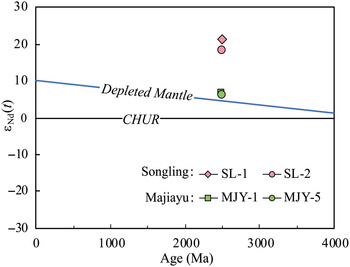
Bulk-rock Sm–Nd isotope data for Songling and Majiayu peridotites are listed in Table 3, and one Majiayu pyroxenite sample (MJY-1) was also analysed and listed. We use 2.5 Ga to calculate the initial ϵ Nd values of these peridotites (see discussion below in Section 6.b). The analysed present-day 143Nd/144Nd ratios of Songling peridotites and Majiayu ultramafic rocks are 0.513367–0.513374 and 0.511787–0.512743, respectively. Songling peridotites are characterized by extremely high ϵ Nd(t = 2.5 Ga) (+18.4 to +21.4) values, plotting above the depleted mantle evolution line (Fig. 8). Majiayu ultramafic rocks have normally positive ϵ Nd (+6.4 to +6.8) values, plotting close to the depleted mantle evolution line (Fig. 8).
Whole-rock Sm–Nd isotope data for Songling and Majiayu ultramafic rocks.

a The 2σ uncertainties correspond to last digits of 143Nd/144Nd ratios.
b Calculation parameters of Nd isotope: (143Nd/144Nd)0,CHUR = 0.512638; (147Sm/144Nd)0,CHUR = 0.1966; λ = 6.54×10⁻¹² a−1; Sm–Nd isotope calculation of CHUR using parameter from Goldstein et al. (Reference Goldstein, O’Nions and Hamilton1984).
c Error for ϵ Nd(t) is: σ ϵNd = ±(104×2σ)/[(143Nd/144Nd)CHUR,t ] = ±(104×2σ)/{(143Nd/144Nd)CHUR,now – [(147Sm/144Nd)CHUR,now×(e λt –1)]}.
ϵ Nd(t) versus age (Ma) diagrams for the Songling and Majiayu peridotites. Sm–Nd isotope calculation of depleted mantle using parameters from Goldstein et al. (Reference Goldstein, O’Nions and Hamilton1984). CHUR – chondritic uniform reservoir.

5.d. Zircon microstructure and U–Pb age of the trondhjemitic dyke
5.d.1. Microstructure of zircon
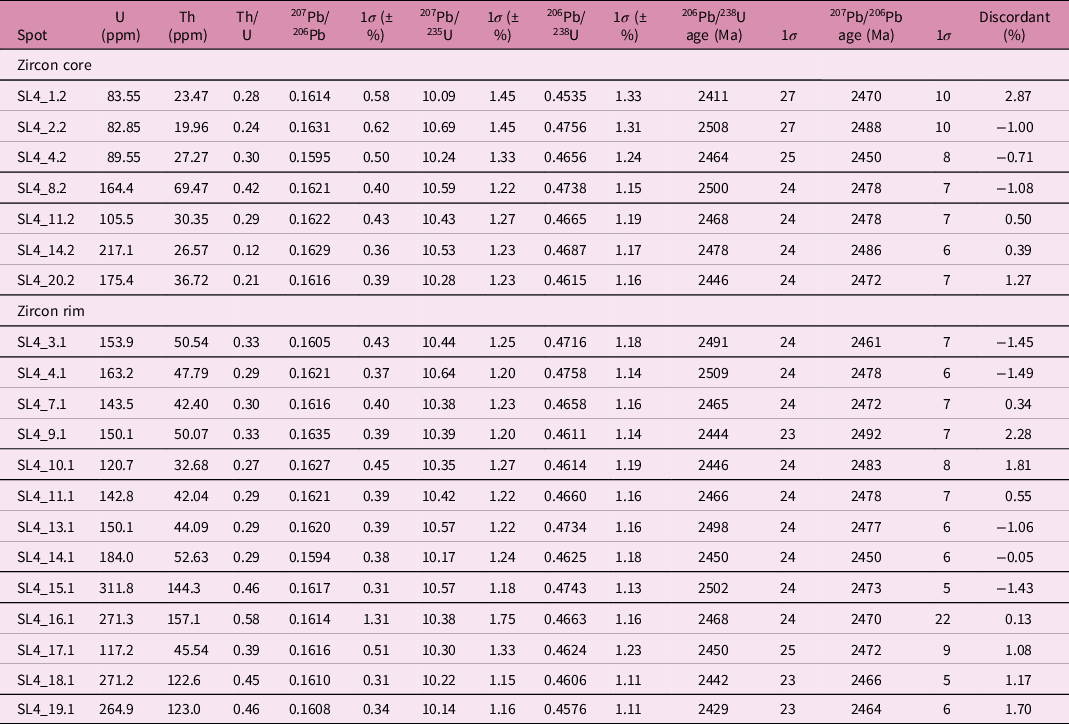
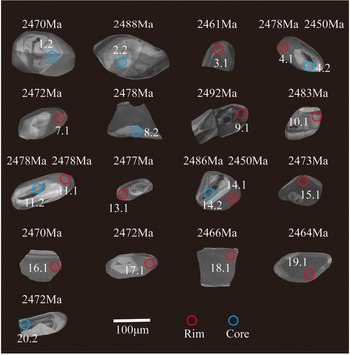
Zircon U–Pb geochronology was carried out on trondhjemitic dyke sample SL4, which intruded into the Songling peridotite (Fig. 3a–c). The zircon grains are euhedral and 100–200 μm in size. Core–rim structure is well developed in most zircon grains. Zircon cores are bright in CL images with oscillatory zoning. In seven analyses of cores, Th/U ratios range from 0.12 to 0.42 (Table 4) with an average of 0.27. Zircon rims are dark in CL images and have weak or no zoning (Fig. 9); their Th/U ratios range from 0.27 to 0.58 (Table 4) with an average of 0.36.
Zircon U–Pb data for SL4, Songling peridotite trondhjemitic dyke intrusion.

CL images of representative zircons of the felsic dyke that intruded the Songling peridotite. The blue and red circles represent analysed spots on zircon cores and rims, respectively.

5.d.2. U–Pb
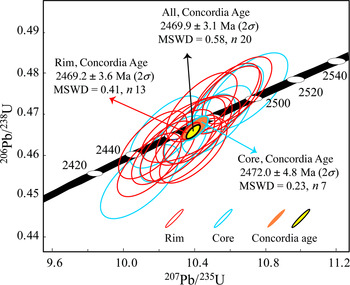
A total of 20 spots of 17 grains from sample SL4 are included in the concordia age calculation. Cores and rims of these zircon grains have concordia ages of 2472.0 ± 4.8 Ma (Fig. 10, 2σ errors, n = 7, mean squared weighted deviation (MSWD) = 0.23) and 2469.2 ± 3.6 Ma (2σ errors, n = 13, MSWD = 0.41), respectively. The zircon cores and rims have almost the same ages, indistinguishable high Th/U ratios, and essentially identical REE patterns for most analyses (Section 5.e). All the analysed spots yield a concordia age of 2469.9 ± 3.1 Ma (Fig. 10, 2σ errors, n = 20, MSWD = 0.58).
Concordia diagram of the zircon data of the felsic dyke that intruded the Songling peridotite. The blue and red circles represent ages of zircon cores and rims, respectively. The solid yellow circle represents the concordia age of all the analysed spots.

5.e. Zircon trace elements of trondhjemitic dyke
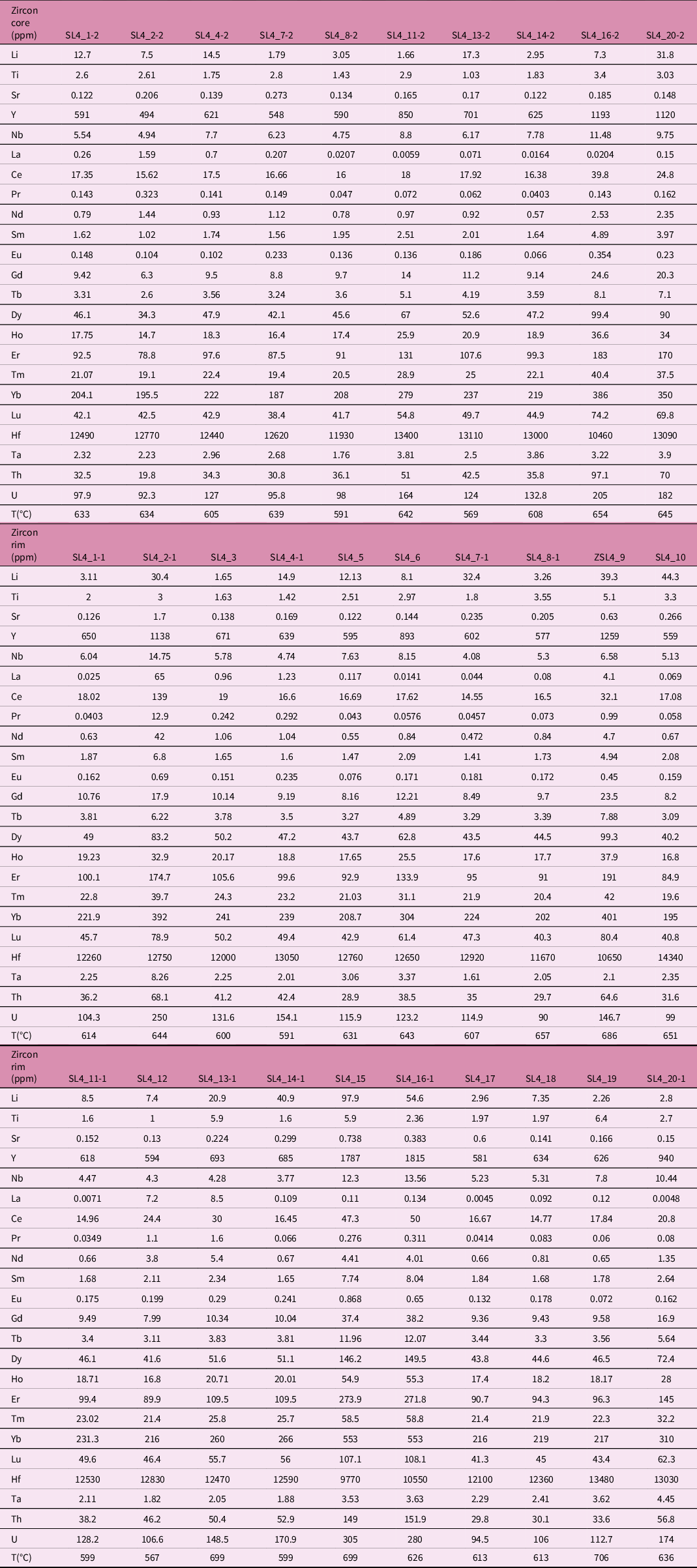
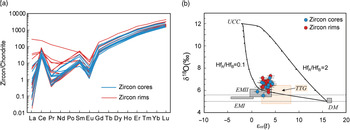
Trace element abundances analysed for different zircon domains in the trondhjemitic dyke are listed in Table 5. There is no significant difference between zircon cores and rims in REE patterns. Except for spot SL4_2-1, all the chondrite-normalized REE patterns are characterized by a steep positive slope with a significant positive Ce anomaly and a relatively steep negative Eu anomaly (Fig. 11a). Ti-in-zircon thermometer of Ferry & Watson (Reference Ferry and Watson2007) is applied to constrain the crystallization temperature of the zircons. Apparent temperatures for zircon cores and rims are 569–654 °C (average of 620 ± 17 °C) and 567–706 °C (average of 630 ± 18 °C), respectively. They are identical within error, with an overall weighted mean of 624 ± 12 °C. It should be noted that these temperatures are calculated by assuming the activities of SiO2 and TiO2 both to be 1.0 based on the presence of quartz and rutile in the rock; when rutile does not present, like the trondhjemite in this study, these temperatures only represent the minimal estimations of the actual temperature when the zircons crystallized.
Trace-element compositions for zircons from Songling peridotite felsic dyke intrusion.

(a) Chondrite-normalized REEs for zircon cores and rims from the Songling trondhjemitic dyke. Chondrite data are from Sun & McDonough (Reference Sun, McDonough, Saunders and Norry1989). (b) δ18O versus ϵ Hf(t) plots of the zircon data from the trondhjemitic dyke. Solid blue circles represent zircon cores and solid red circles represent zircon rims. The different O–Hf isotope reservoirs are also plotted for comparison. Oxygen isotope data of EM1, EMII, DM and UCC are from Eiler (Reference Eiler2001); Hf isotope data of different mantle reservoirs are from Salters & White (Reference Salters and White1998). Hf isotope data of Archean TTG from the North China Craton are from Liu et al. (Reference Liu, Guo, Lu and Diwu2009) (DM, +16 to +16.9; UCC, –2; Archean TTG, +2.0 to +8.3; EMI, –4.3 to +0.28; EMII, –0.42 to +4.17), and oxygen isotope data of global Archean TTG are from Bindeman et al. (Reference Bindeman, Eiler, Yogodzinski, Tatsumi, Stern, Grove, Portnyagin, Hoernle and Danyushevsky2005) (DM, +5 to +5.6; UCC, +12; Archean TTG, +4.8 to +6.4; EMI, +5.2 to +5.4; EMII, +5.4 to +6.1).

5.f. Zircon Hf–O isotopes of trondhjemitic dyke
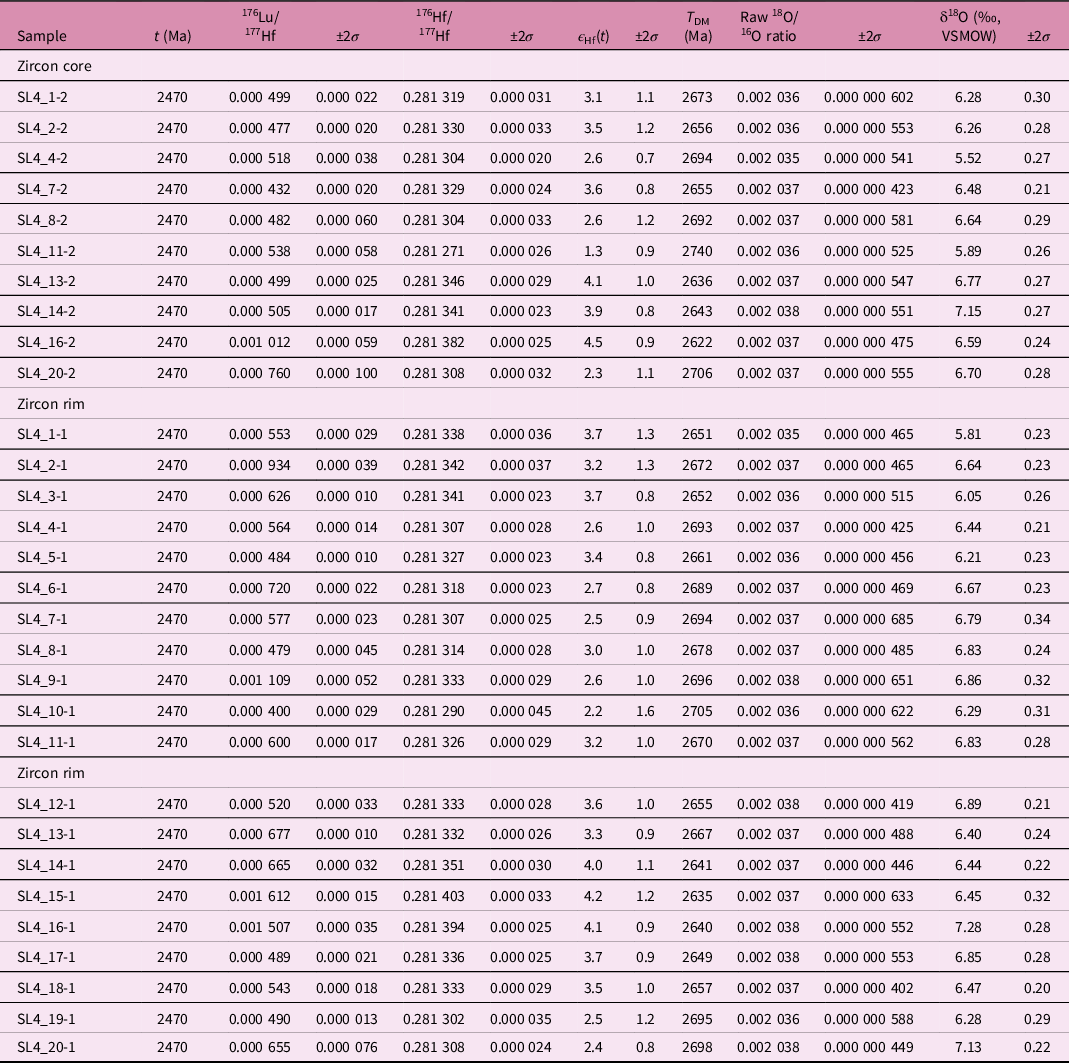
The Hf–O isotope analyses of zircons from trondhjemitic dyke are listed in Table 6. The Hf–O isotope for zircon cores and rims are uniform. Ten analyses for zircon cores yielded ϵ Hf(t = 2472 Ma) values of +1.2 to +4.4, with a weighted mean of +3.0 ± 0.7. A total of 20 analyses for zircon rims yielded ϵ Hf(t = 2469 Ma) values of +2.1 to +4.0, with a weighted mean of +3.0 ± 0.3. The δ18O values of zircon cores range from 5.52 ± 0.27‰ to 7.15 ± 0.27‰ with a weighted mean of 6.4 ± 0.26‰, and δ18O values of zircon rims range from 5.81 ± 0.23‰ to 6.86 ± 0.32‰ with a weighted mean of 6.6 ± 0.26‰, which are markedly higher than the mantle zircon (5.3 ± 0.3‰; Valley et al. Reference Valley, Lackey, Cavosie, Clechenko, Spicuzza, Basei, Bindeman, Ferreira, Sial and King2005).
Hf–O isotope analyses of zircons from Songling peridotite felsic dyke intrusion.

The δ18O plotted against ϵ Hf(t) values for these zircon spots, along with different Hf–O isotope reservoirs, are shown in Fig. 11b; the ϵ Hf of Archean TTG from the North China Craton (+2 to +8.3; Liu et al. Reference Liu, Guo, Lu and Diwu2009) and δ18O of global Archean TTG (+4.8 to +6.4; Bindeman et al. Reference Bindeman, Eiler, Yogodzinski, Tatsumi, Stern, Grove, Portnyagin, Hoernle and Danyushevsky2005) are also shown in Fig. 11b for comparison.
6. Discussion
6.a. Exhumation process of Songling peridotites
Based on structural analyses, petrography and mineral chemistry, we interpret the exhumation history of the Songling peridotites as a three-stage process as follows.
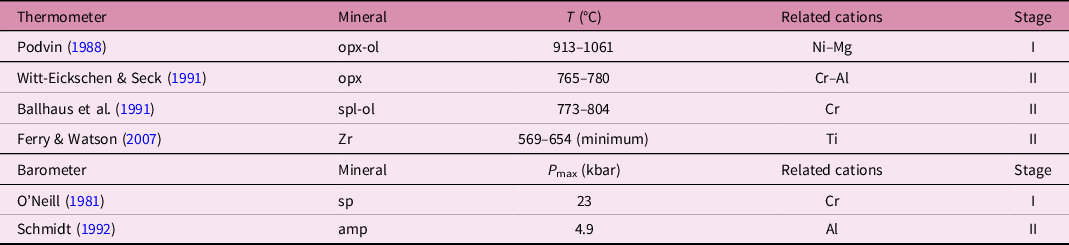
Stage I: sub-solidus cooling stage of the peridotites, which is characterized by mosaic porphyroclastic olivine (Ol-m) + banded orthopyroxene (Opx-d) + clinopyroxene + individual coarse spinel (Spl-i). The isolation between these minerals and the metamorphic amphiboles prevented re-equilibrium between the original peridotite mineral assemblage and the infiltration fluids, therefore the original pressure–temperature (P-T) conditions were able to be preserved after exhumation. The P-T conditions of this stage are estimated to be up to c. 23 kbar and up to 1061 °C, based on the Cr-geobarometer (O’Neill, Reference O’Neill1981) on individual coarse spinel (Spl-i), and the Ni-geothermometer (Podvin, Reference Podvin1988) on porphyroclastic olivine (Ol-m) and banded orthopyroxene (Opx-d), respectively (Table 7 and online Supplementary Table S12). This stage represents the original high P-T conditions of the peridotites.
Summary of pressure–temperature conditions estimated by geothermometers and geobarometers for the peridotites.

Stage II: high-temperature metasomatism stage to form extra orthopyroxene (Opx-c) + amphibole + exsolved spinel rods (Spl-s), with peridotite palimpsest mineral including enclaved olivine (Ol-c) + orthopyroxene (Opx-c) + clinopyroxene + spinel (Spl-s).
The undeformed olivine (Ol-c) + orthopyroxene (Opx-c) enclosed in amphibole yielded an Ni-geothermometer temperature of 740–764 °C (Table 7), which is lower than the temperature recorded by the mosaic porphyroclastic olivine (Ol-m) + banded orthopyroxene (Opx-d). The extra abundance of orthopyroxene both in mode analyses (up to 47%, Table 1) and norm calculation (up to 46%, Table 8) suggest that the undeformed orthopyroxene grew in a silica-rich metasomatism that occurred at this stage.
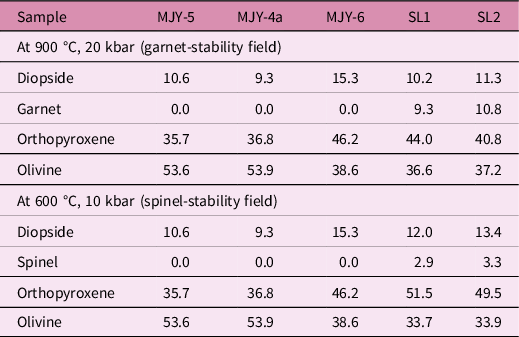
Modal mineral compositions of the Songling and Majiayu peridotites calculated by THERMOCALC.

The pressure of this stage is calculated by Al-in-hornblende barometer (Schmidt, Reference Schmidt1992) on the overprinting amphibole, which yielded a maximum pressure of 4.9 kbar for the Songling peridotites (online Supplementary Table S3). The amphiboles were observed in peridotites lacking plagioclase. In this case, the Al in hornblende barometer cannot be used because this barometer is calibrated for hornblende coexisting with plagioclase (Schmidt, Reference Schmidt1992). Nevertheless, the growth of undeformed orthopyroxene and amphibole implies the input of silica-rich melt, which may allow the Mg-rich amphibole to equilibrate with plagioclase phases in the metasomatism melt. The presence of trondhjemitic dyke in the Songling peridotites confirms this possibility.
We use three amphibole multi-component thermometers, including equations 5, 6 and 8 in Putirka (Reference Putirka2016), to calculate the temperatures of the amphiboles. The results are listed in online Supplementary Table S12 and summarized in Table 7. The weighted mean of the temperatures calculated by each method are 871 ± 21 °C, 845 ± 10 °C and 880 ± 18 °C by equations 5, 6 and 8, respectively, in Putirka (Reference Putirka2016). It is noted that the 871 ± 21 °C thermometer temperature is calculated by a pressure-independent thermometer (equation 5), which overlaps the other two results calculated by pressure-dependent thermometers (equations 6 and 8) within error. This also confirms that the pressure estimated by Schmidt (Reference Schmidt1992)’s Al-in-hornblende barometer was reliable.
The over 800 °C amphibole thermometer temperatures are actually within the temperature range of hornblende granulite-facies (hb-GR in Wei & Duan, Reference Wei, Duan, Zhang, Zhang, Schertl and Wei2019), suggesting that the peridotites were affected by the granulite-facies metamorphism commonly found in the Taipingzhai domain (Duan et al. Reference Duan, Wei and Rehman2017; Yang & Wei, Reference Yang and Wei2017). The undeformed olivine + orthopyroxene pairs recorded a temperature of 740–764 °C, which is lower than the amphibole thermometer temperatures (Table 7). This can be attributed to the lower closure temperature of the Ni partitioning between olivine and orthopyroxene when melt phase was present in the amphibole-bearing domain. The ‘Cr-Al-opx’ geothermometer (Witt-Eickschen & Seck, Reference Witt-Eickschen and Seck1991) yields a temperature of 765–780 °C for the banded orthopyroxene and 733–736 °C for the orthopyroxene contacted with amphibole, suggesting a progressive Cr mobilization during the metasomatism stage. The Cr in Spl-Ol thermometer (Ballhaus et al. Reference Ballhaus, Berry and Green1991) yields a temperature of 773–804 °C (Table 7), also suggesting Cr mobilization during this metasomatism stage.
The trondhjemitic magma was likely to intrude into the Songling peridotite at this stage because the migmatitic leucosome in the trondhjemitic dyke (Fig. 3e) required a metamorphic condition that can generate enough melt (Sawyer, Reference Sawyer, Sawyer and Brown2008). The leucosome occurring along the foliation of the trondhjemitic dyke occupies c. 10% of the total area, that is, c. 10% of melt proportion. Phase equilibrium simulation of an Archean trondhjemitic gneiss from the Taipinghzai domain suggested that 10 wt% melting of the trondhjemite would be achieved at 807 °C if the pressure is 7 kbar, and at 779 °C if the pressure is 4.9 kbar (Zhang et al. Reference Zhang, Wei and Duan2017). The temperature of the ductile deformation of the trondhjemitic dyke should therefore be in the temperature range close to hb-granulite or slightly below.
The pressure of 4.9 kbar recorded by the amphibole in Songling peridotites suggests that they have exhumed to upper crust level. This shallow emplacement also allowed the trondhjemitic dyke to assimilate upper continental crust materials, which can explain the high zircon δ18O data. As shown in Figure 11b, the analysed zircons have high δ18O up to +7.28‰, which is clearly different from the low δ18O values of Archean TTG (+4.8 to +6.4; Bindeman, et al. Reference Bindeman, Eiler, Yogodzinski, Tatsumi, Stern, Grove, Portnyagin, Hoernle and Danyushevsky2005). The assimilation-fractional crystallization (AFC) modelling curves in Fig. 11b suggest that these zircons may have crystallized from the magma that had assimilated some upper continental crust materials (δ18O up to 12‰; Eiler, Reference Eiler2001). We therefore conclude that the trondhjemitic dyke intruded into the Songling peridotites at this stage with an emplacement pressure no higher than 4.9 kbar. As shown in Figure 11a, the remarkable positive Eu anomaly indicates cumulation of plagioclase rather than amphibole, which is also consistent with the low crystallization pressure (Melekhova et al. Reference Melekhova, Blundy, Robertson and Humphreys2015). After emplacement, the trondhjemitic dyke experienced ductile deformation and partial melting, resulting in the gneissosity and sialic migmatitic leucosome.
Stage III: The retrograde massif continued exhumation to shallow-level crustal depth together with the trondhjemitic dyke intruded at 2.47 Ga. The peridotites and the trondhjemitic dyke experienced penetrative brittle foliation when the block and the dyke cooled down at shallow upper crustal level.
Based on analyses of metamorphic, metasomatism and deformation history, we conclude that the Songling peridotite started its exhumation from a mantle depth, with P-T conditions of c. 23 kbar and c. 1061 °C; the peridotite block then experienced granulite-facies retrograde metamorphism at crustal level and was intruded by the trondhjemitic dyke at this stage. When amphibole grew in these peridotites by high-temperature metasomatism, the trondhjemitic dyke also experienced ductile deformation at an upper crustal level. At the final stage of exhumation the peridotite block, together with the trondhjemitic dyke, experienced brittle deformation.
6.b. Exhumation age of the Songling peridotites constrained by the trondhjemitic dyke
There have been some exhumation age constraints for ultramafic blocks in the Zunhua structural belt. For example, Kusky et al. (Reference Kusky, Li and Tucker2001) reported an ophiolite complex with a late Archean age in the Dongwanzi area of the North China Craton. However, this Archean age has been hotly debated since some Phanerozoic zircon U–Pb ages were reported by Zhao et al. (Reference Zhao, Wilde, Li, Sun, Grant and Li2007). Recent approaches on the exhumation time of these blocks from the Zunhua belt have provided new lines of evidence supporting the Archean exhumation age (e.g. Wang et al. Reference Wang, Li, Ning, Kusky, Wang, Polat and Deng2019 b; Ning et al. Reference Ning, Kusky, Wang, Wang, Deng, Polat, Huang, Peng and Feng2020).
Field evidence (Fig. 3a–d) supports the theory that the trondhjemitic dyke intruded the peridotite block at a shallow crustal level. Zircon oxygen isotope data also support the theory that the trondhjemitic dyke emplaced at an upper crustal level. As shown in Figure 11b, the high δ18O zircons require that their parental magma experienced remarkable assimilation of an upper continental crust (UCC) end-member, not the depleted-mantle (DM) -like mantle peridotites. This means that the mantle lithosphere was exhumed to shallow crustal level earlier, otherwise upper crustal level assimilation cannot happen as blocked by the mantle peridotites. The age of the magmatic zircon cores (2469.9 ± 3.1 Ma) can therefore give a lower limit of the exhumation time of the Songling peridotite. If we take the exhumation time across the shallow mantle and the lower crust into account, the Songling block could have started its exhumation at the end of the Archean Eon.
An important feature of the zircons of the trondhjemitic dyke is their oscillatory zoning and partial modification of the zoning at the rim of some crystals. Oscillatory zoning of zircon forms when zircon crystallizes from melt, and is a primary magmatic structure (Vavra, Reference Vavra1990; Paterson et al. Reference Paterson, Stephens, Rogers, Williams, Hinton and Herd1992; Hanchar & Miller, Reference Hanchar and Miller1993), while zircon formed in metamorphic rocks does not display oscillatory zoning (Watson & Liang, Reference Watson and Liang1995; Hoskin & Black, Reference Hoskin and Black2000). Based on these criteria, the cores of zircons from the trondhjemitic dyke were magmatic and the rims were likely to form during metamorphic recrystallization. However, the concordia ages of the cores and the rims are identical (Fig. 10), as are the trace-element concentrations (Fig. 11a) and Hf–O isotopes (Fig. 11b). We suggest that the time of recrystallization at the rims was very close to the time of magma crystallization, that is, the trondhjemitic dyke and the Songling peridotites were rapidly exhumed to shallower depth soon after the intrusion of the former. This can explain how the gneissosity and migmatitic leucosome in the trondhjemitic dyke (Fig. 3d–f) were formed and why the trondhjemitic dyke did not completely react with the silica-undersaturated peridotite.
In addition, our zircon U–Pb age data can place a good constraint on the timing of the regional orogenic-type metamorphism. As explained above, the trondhjemitic dyke experienced migmatization under a metamorphic temperature at the hb-granulite range. The partial modification of oscillatory zoning at the rim of zircon crystals (Fig. 9) was also indicative of granulite-facies metamorphism, for example, metagranitoids from NE Australia (Hoskin & Black Reference Hoskin and Black2000) or granulite from the Ivrea Zone in Southern Alps (Vavra et al. Reference Vavra, Gebauer, Schmid and Compston1996). The age of the zircon rims therefore constrain the granulite-facies metamorphism of the Songling peridotites, which is c. 2.47 Ga. The metamorphic event at c. 2.47 Ga could be one of those reported from Eastern Hebei, for example, the amphibolite-facies metamorphic age of c. 2.49 Ga for the metamorphic overgrowth of zircons from the Caozhuang supracrustal rocks (Liu et al. Reference Liu, Wei, Kröner, Han and Duan2019), or the granulite-facies metamorphic age of c. 2.48 Ga for the metamorphic rim of zircon from metapelites in Taipingzhai (Duan et al. Reference Duan, Wei and Rehman2017). These ages are also coeval with the time of regional amphibolite/granulite-facies metamorphism revealed for the mafic granulites, TTG gneisses and charnockites (e.g. Zhao et al. Reference Zhao, Wilde, Cawood and Lu1998; Geng et al. Reference Geng, Liu and Yang2006; Nutman et al. Reference Nutman, Wan, Du, Friend, Dong, Xie, Wang, Sun and Liu2011; Yang et al. Reference Yang, Santosh and Tsunogae2016).
6.c. Metasomatism of peridotites
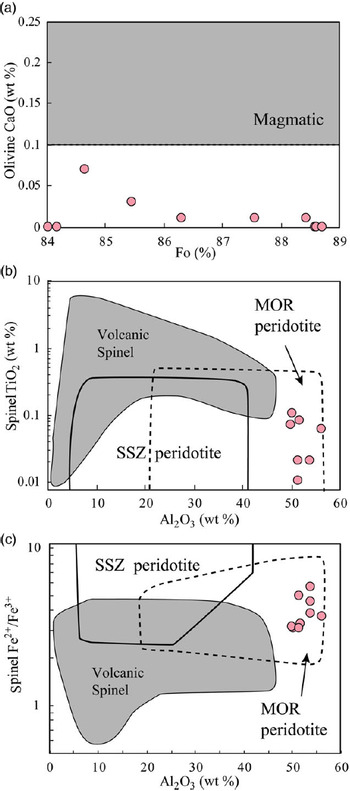
Mosaic porphyroclastic olivines with low CaO (BLD to 0.07 wt%) and high NiO (up to 0.49 wt%) in the Songling peridotite suggest that they were mantle residues after partial melting rather than cumulative crystals of magmatic origin (Fig. 12a; Thompson & Gibson, Reference Thompson and Gibson2000; Gao et al. Reference Gao, Rudnick, Xu, Yuan, Liu, Walker, Puchtel, Liu, Huang, Wang and Yang2008). The original coarse spinel grains in the peridotites with high Al2O3 and Fe2+/Fe3+and low TiO2 contents also suggest their mantle origin (Fig. 12b, c; Kamenetsky et al. Reference Kamenetsky, Crawford and Meffre2001).
(a) CaO versus Fo compositional relationship in olivine from Songling peridotites, Fo (forsterite) = 100×Mg/(Mg+Fe2+). High-CaO olivine (CaO > 0.1%) indicates a magmatic origin, whereas the low-CaO olivine (CaO < 0.1%) are mantle olivine (Thompson & Gibson, Reference Thompson and Gibson2000; Gao et al. Reference Gao, Rudnick, Xu, Yuan, Liu, Walker, Puchtel, Liu, Huang, Wang and Yang2008). (b) TiO2 versus Al2O3 in spinel. (c) Fe2+/Fe3+ versus Al2O3 in spinel from Songling peridotites. Continuous and dashed field are from supra-subduction zone and mid-ocean-ridge-basalt-type peridotites, respectively. The field of SSZ peridotite, MOR peridotite and volcanic peridotite follow Kamenetsky et al. (Reference Kamenetsky, Crawford and Meffre2001). SSZ – supra-subduction zone; MOR – mid-ocean ridge.

It should be noted that the mineral chemistry of the peridotite was subject to chemical equilibration with percolating melts (Ionov et al. Reference Ionov, Chazot, Chauvel, Merlet and Bodinier2006). The melts must migrate in the form of intergranular porous flow (Vernières et al. Reference Vernières, Godard and Bodinier1997). The country rock peridotites may therefore experience a different extent of rock–melt reaction along the distance at the metasomatism aureole, resulting in small-scale chemically heterogeneity (Bodinier et al. Reference Bodinier, Garrido, Chanefo, Bruguier and Gervilla2008). This small-scale heterogeneity can also be observed in the Songling and Majiayu peridotites. For example, some olivine grains have low-NiO content down to 0.23 wt%, which is even lower than that of olivine from fertile peridotite with a partial melting origin (0.25 wt% NiO; Herzberg Reference Herzberg2011).
All the amphibole grains record Al-in-hornblende pressure no higher than 4.9 kbar (online Supplementary Table S5). In this regard, we have ruled out the metamorphism-related mineral chemistry data when we make inferences about melting and metasomatism at mantle depth.
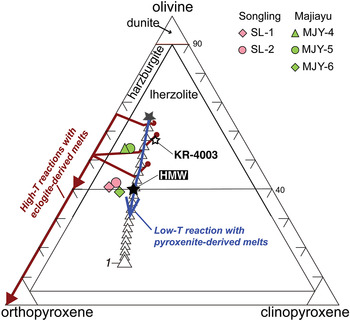
Partial melting will preferentially remove the clinopyroxene component from the residue mantle peridotite into a melt (Walter, Reference Walter2003), and therefore the mineral proportions of residue peridotites can be used to evaluate the degree of mantle melt depletion. Unfortunately, most of our peridotite samples have experienced alteration, and many primary minerals have been replaced by secondary minerals such as amphibole, serpentine, talc and bastite. This means that the original mineral compositions of the peridotites at mantle depth have to be estimated by modal mineral calculations from bulk-rock compositions rather than the mode composition listed in Table 1. We use the volatile-free major-element data to calculate the modal mineral composition of the peridotites by using the thermodynamic simulation software THERMOCALC version 3.33. The specified mineral activity models used in the calculation are as follows: (1) clinopyroxene from Green et al. (Reference Green, Hooland and Powell2007); (2) garnet from White et al. (Reference White, Powell and Holland2007); (3) orthopyroxene from Powell & Holland (Reference Powell and Holland1999); and (4) spinel from Powell & Holland (Reference Powell and Holland1998), and the olivine activity model uses an ideal mixing model. The modal mineral compositions calculated at the spinel and garnet stability depth are listed in Table 8 and are plotted in the olivine–orthopyroxene–clinopyroxene triangular diagram (Fig. 13). Different from the classification based on mineral modes estimated from thin-section (Table 1), all the peridotites are classified as lherzolite with excess orthopyroxene when compared with the fertile lherzolite KR-4003 (Herzberg, Reference Herzberg2004). The distinctive orthopyroxene enrichment of the Songling peridotites, as well as the Majiayu peridotites, is similar to that of the hybrid mantle wedge (HMW) (Fig. 13), which was proposed to represent the composition of the silica-rich mantle wedge source for arc magmas (Bénard et al. Reference Bénard, Arculus, Nebel, Ionov and Mcalpine2017). In the MgO–SiO2 and Al2O3–SiO2 diagrams (Fig. 6b, c), the Songling peridotite samples are also more silica-enriched than normal fertile lherzolite KR-4003 (Herzberg, Reference Herzberg2004) but share similar silica-excess features with HMW, which suggests the existence of a metasomatism process.
Olivine–orthopyroxene–clinopyroxene triangular plot for the Songling peridotites (red) and Majiayu peridotites (green). Also shown are the modal compositions of peridotite Bri2 impregnated by 0–100% of pyroxenite-derived melt (M5-40) at 1.5 GPa and 1250 °C (Lambart et al. Reference Lambart, Laporte, Provost and Schiano2012), and that of lherzolites impregnated by 0–100% of eclogite-derived melts at 2 GPa and 1375–1425 °C (Wang et al. Reference Wang, Lo Casciob, Yan and Xua2020). Model source compositions KR-4003 and HMW are as for Figure 6. The pyroxenite-derived melt metasomatism trend is highlighted with a light blue arrow, and the eclogite-derived metasomatism trends with brown arrows.

As shown in the PM-normalized REE diagram (Fig. 7b), the Songling peridotites are characterized by slight depletion in LREE and PM-like MREE and HREE abundances. However, these weak depletion and PM-like features (Fig. 7a, b) do not guarantee an ‘unmetasomatized fertile peridotites’ origin for the Songling peridotites. Further evidence suggests that the Songling peridotites may have experienced metasomatism before they obtained their current geochemical features. As shown in Figure 8, the Songling peridotites are characterized by extremely high ϵ Nd(t) values of +21.4 and +18.4, which are far above the depleted-mantle evolution curve. Formation of these highly radiogenic peridotites cannot be explained simply by absence of melt depletion process in the mantle region, but have to be explained by parent–daughter depletion due to an excess amount of garnet in the mantle peridotite mineral assemblage and long-lasting radiogenic decay (Witt-Eickschen & Kramm, Reference Witt-Eickschen and Kramm1997; Pearson et al. Reference Pearson, Canil, Shirey and Carlson2014).
The metasomatism process during the intrusion of the trondhjemitic dyke might be able to enhance the bulk-rock silica content and incompatible element abundance, resulting in the growth of amphibole and the extra amount of orthopyroxene. The migmatite feature of the trondhjemitic dyke also supports the theory that the dyke was emplaced at a temperature similar to the crystallization temperature of the amphibole. However, this episode of metasomatism was not able to generate the highly radiogenic ϵ Nd(t) values in the peridotites because there was not enough time for radiogenic cumulation of the daughter 143Nd. The Songling peridotites should therefore have experienced an earlier episode of mantle metasomatism, which was able to increase the bulk-rock f Sm/Nd by input of an extra amount of high-Sm/Nd-ratio garnets in the peridotite. In Figure 13, we plot the modal composition variation trend of peridotites impregnated by 0–100% of silica-rich pyroxenite-derived melt at 15 kbar and 1250 °C (Bri2 and M5-40; Lambart et al. Reference Lambart, Laporte, Provost and Schiano2012), and three compositional trends of lherzolites when they reacted with different eclogite-derived melts at 20 kbar and over 1375 °C (Wang et al. Reference Wang, Lo Casciob, Yan and Xua2020). The Songling and Majiayu peridotites are plotted between the two sets of compositional trends, suggesting they were the reaction products of peridotites with either pyroxenite-derived melts at a low temperature or eclogite-derived melts at a high temperature. The over 1000 °C equilibrium temperature recorded by Ni partitioning between Ol-m and Opx-d in Stage I is consistent with the cooling stage after this metasomatism.
A further constraint on the metasomatism reaction is the FeOt rich (> 10 wt%) feature of the Songling and Majiayu peridotites. When the peridotite reacted with pyroxenite-derived melt, no Fe-rich phases appear in the reaction zone (Lambart et al. Reference Lambart, Laporte, Provost and Schiano2012), while in the peridotite–eclogite reaction trends, garnet with FeO > 14 wt% was able to precipitate by the reaction (Wang et al. Reference Wang, Lo Casciob, Yan and Xua2020): lherzolite + melt1→ garnet + opx + melt2. This suggests that the Fe-rich composition of the peridotites in this study could be achieved by addition of Fe-rich garnet during reaction with eclogite-derived melts. Furthermore, the existence of garnet in this precursor peridotite would lead to a fast accumulation of daughter 143Nd, allowing extraordinarily high ϵ Nd values after a period of radiogenic decay.
It is not clear whether the Songling peridotites experienced melt depletion when they were exhumed from their original depth. However, the garnets have been completely replaced by low-pressure phases, possibly spinel + clinopyroxene + othorpyroxene ± magnetite, depending on the exhumation P-T path.
In summary, major- and trace-element and Nd isotope data suggest that the Songling peridotites were metasomatized by eclogite-derived melts long before their exhumation.
6.d. Nature of the Majiayu peridotites: metasomatized refractory mantle
The Majiayu peridotites have lower Mg no. and SiO2 but much higher FeOt (> 15 wt%) compared with the fertile mantle KR4003 (Fig. 6). When compared with the modelled mantle residue, the Majiayu peridotites experienced different melt extraction degrees and are more Al-rich than the 45% melt residue, which can be interpreted by the tie line between the residue and the orthopyroxene composition (Fig. 6d). When compared with the modelled REE curves at different partial melting degree (Fig. 7c), the lowest HREE abundance of the Majiayu peridotites corresponds to > 15% dynamic melting of primitive mantle (Bénard et al. Reference Bénard, Müntener, Pilet, Arculus and Nebel2021).
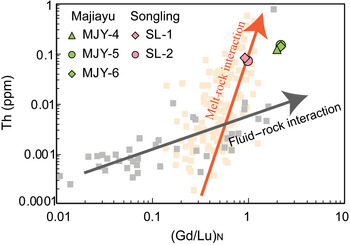
As well as this melt extraction feature, the Majiayu peridotites are characterized by metasomatic chemical signals. Their elevated LREE contents in Fig. 7c suggest an extensive reaction with metasomatic reagents. In the PM-normalized trace-element diagram (Fig. 7a), the Majiayu peridotites are characterized by enriched LREEs and depleted Nb, Zr and Hf, which is consistent with the involvement of subduction-related fluid/melt. The metasomatic agents can be further identified as melt by Th–(Gd/Lu)N (Fig. 14), in which the peridotite samples plot close to the trend of melt–rock interaction (Paulick et al. Reference Paulick, Bach, Godard, De Hoog, Suhr and Harvey2006).
Th versus (Gd/Lu)N diagram for the Songling and Majiayu peridotites, showing comparisons with deviating trends for melt–rock interaction and hydrothermal fluid–rock interaction. The orange squares are global abyssal peridotites compiled by Niu (Reference Niu2004). The grey squares are serpentinites that have experienced fluid–peridotite interaction from Paulick et al. (Reference Paulick, Bach, Godard, De Hoog, Suhr and Harvey2006). The rock–melt/fluid interaction trends are from Tian et al. (Reference Tian, Wang, Liu, Chu, Wang, Chen and Prichard2017). (Gd/Lu)N ratio was calculated using chondrite data from Sun & McDonough (Reference Sun, McDonough, Saunders and Norry1989).

An important difference between the Majiayu peridotites and other ‘normal’ peridotites is their extremely high FeOt (> 15 wt%). Crystallization of amphibole during exhumation in the crust level may transfer excess Fe from the infiltration melt to the peridotite. However, the amphiboles from the Majiayu peridotite only have FeO contents of 4.76–7.38 wt%, which are far below the bulk-rock FeOt. The crustal Fe-enrichment process was therefore unlikely to be the major mechanism to transform the Majiayu peridotites in terms of FeO abundance. A post-melting metasomatism process at mantle level may be the mechanism to elevate the bulk-rock FeO content. As shown in Figure 13, the Majiayu peridotites are plotted between the reaction trends of eclogite-derived melts and pyroxenite-derived melts with lherzolites. However, the extremely high FeOt of these peridotites (15.24–16.82 wt%) cannot achieved even through cumulation of Fe-rich garnet (c. 14 wt% FeO; Wang et al. Reference Wang, Lo Casciob, Yan and Xua2020) formed in the melt–peridotite reactions.
Polat et al. (Reference Polat, Fryera, Samsona, Weisener, Appel, Frei and Windley2012) suggested a hydrous supra-subduction zone mantle model to interpret the FeO-rich (up to 20 wt%) nature of hornblendite-bearing ultramafic complex. An open system reaction between hydrous melt and peridotite can be given as following: hydrous melt + olivine → orthopyroxene + magnetite, that is, 10(Mg1.5Fe0.5)SiO4 + 28H+ + O2 ↔ 4(Mg1.5Fe0.5)Si2O6 + Fe3O4 + 9Mg2+ + 2Si4+ + 14H2O.
In this way, Mg2+ and Si4+ will enter the hydrous melt, so that the Mg and Si contents in the peridotite sample are decrease, and the Fe content is relatively increased. This hydrous melt–peridotite reaction is also supported by the coexistence of orthopyroxene and magnetite in the Majiayu peridotites (Fig. 4f).
In summary, the major- and trace-element data suggest that the Majiayu peridotites were possibly a depleted-mantle peridotite that reacted with hydrous melt at a supra-subduction zone environment.
6.e. Tectonic implications of Songling and Majiayu peridotites
Based on the above discussion, we have several key findings for the peridotites occurring in the Taipingzhai TTG gneiss dome. (1) The Songling peridotites were metasomatized by eclogite-derived melts long before their exhumation, while the Majiayu peridotites were part of a depleted mantle that was metasomatized by hydrous melt in an open-system process. The former indicates a subduction zone was active long before 2.5 Ga, and the latter may indicate an active subduction zone at the north margin of the North China Craton. (2) Different from the ophiolitic mélanges observed in the Zunhua structural belt, the peridotite blocks in this study are distributed in the Taipingzhai TTG gneiss dome rather than a sedimentary matrix. The lithologies around the peridotites are TTG rocks, which should have resulted from crustal anatexis during the arc–continent collision during the late Archean Era. (3) Both the peridotites and the trondhjemitic dyke experienced granulite-facies metamorphism at c. 2.47 Ga, which is synchronous to the exhumation time of the peridotites.
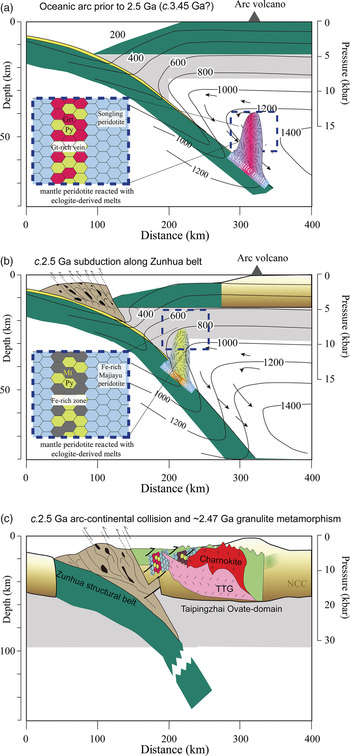
To summarize, we propose a tectonic evolution model (Fig. 15) to explain the genesis of the peridotite blocks. The Songling peridotites were part of an earlier mantle wedge in a former oceanic-arc system that experienced metasomatism by eclogite-derived melts (Fig. 15a); the Majiayu peridotites were part of the Neoarchean supra-subduction zone depleted mantle and were metasomatized by hydrous melts (Fig. 15a). They were finally exhumed by arc–continent collision related to the c. 2.5 Ga subduction process and c. 2.47 Ga granulite metamorphism along the north margin of the North China Craton (Fig. 15c).
Model illustrating the formation process of the Songling and Majiayu peridotites during the tectonic evolution of the north margin of the North China Craton and the Zunhua structural belt. Geodynamic model after Kusky et al. (Reference Kusky, Polat, Windley, Burke, Dewey, Kidd, Maruyama, Wang, Deng, Wang, Wang, Fu, Li and Peng2016) and Ning et al. (Reference Ning, Kusky, Wang, Wang, Deng, Polat, Huang, Peng and Feng2020). (a) Hypothetical subduction of oceanic crust a long time before 2.5 Ga (c. 3.45 Ga?), when the precursor of the Songling peridotites experienced metasomatism by eclogite-derived melts and resulted in Si, Fe-rich, high garnet content and high Sm/Nd ratio, allowing the highly radiogenic accumulation of the Songling peridotites before exhumation. (b) At a fore-arc position in the Zunhua subduction zone, a depleted-mantle peridotite reacted with hydrous melt and resulted in the Majiayu peridotites with extremely high FeO, elevated LREE and depleted Nb and Zr contents. (c) At c. 2.5 Ga, the Songling and Majiayu peridotites were exhumed to the Taipingzhai magmatic dome by arc–continent collision. During exhumation, the peridotite blocks experienced granulite-facies retrograde metamorphism and were intruded by the trondhjemitic dyke at 2.47 Ga.

7. Conclusions
(1) The Songling peridotites from Eastern Hebei started exhumation from a depth of c. 70 km (c. 23 kbar) and were intruded by a crustal-derived felsic dyke at c. 2.47 Ga.
(2) The Songling peridotites and the Majiayu peridotites are interpreted as mantle peridotites that experienced subduction-related metasomatism in different ways.
(3) These peridotite blocks were exhumed to the north margin of the North China Craton during arc–continent collision and granulite metamorphism during the end of the Archean Era.
Acknowledgements
We are grateful to Fanghua Zhang and Jie Dong of Peking University for their perceptive suggestions during the preparation of this manuscript. Three anonymous reviewers are thanked for enhancing the structural analyses of the Songling peridotites and for thoughtful comments on the mantle origin and metasomatism of the peridotites. This research was financially supported by the National Natural Science Foundation of China (grant nos 42030304, 41430207), Beijing Natural Science Foundation (grant no. 8194073), the Science Foundation of China University of Petroleum, Beijing (grant no. 2462017YJRC032), the Science Foundation of State Key Laboratory of Petroleum Resources and Prospecting, China University of Petroleum, Beijing (grant no. PRP/indep-4-1702) the and Opening Foundation of Key Laboratory of Mineral Resources Evaluation in Northeast Asia, Ministry of Natural Resources (DBY-KF-19-03).
Supplementary material
To view supplementary material for this article, please visit https://doi.org/10.1017/S0016756821000571