The relationship between herbivorous insects such as the Colorado potato beetle (Leptinotarsa decemlineata (Say); Coleoptera: Chrysomelidae) and the architecture of host and nonhost plants has not been the focus of many investigations. The indirect or secondary impact of plant structure on herbivores through its effect on parasites and predators has received the bulk of the attention (Kareiva and Sahakian Reference Kareiva and Sahakian1990; Grevstad and Klepetka Reference Grevstad and Klepetka1992; Frazer and McGregor Reference Frazer and McGregor1994) but the direct effect of plant structure on herbivores remains less studied (Hannunen Reference Hannunen2002; Mbungu and Boiteau Reference Mbungu and Boiteau2008; Simon et al. Reference Simon, Morel, Durand, Brevalle, Girard and Lauri2012). The agronomic and processing objectives of plant breeding have an impact on plant architecture that could have an impact on insect abundance (Hannunen and Ekbom Reference Hannunen and Ekbom2001; Hannunen Reference Hannunen2002; Simon et al. Reference Simon, Lauri, Brun, Defrance and Sauphanor2006; Lauri et al. Reference Lauri, Crété and Ferré2007; Simon et al. Reference Simon, Sauphanor and Lauri2007). The impact of plant architecture on herbivore dispersal within and between plants is probable (Hannunen Reference Hannunen2002; Simon et al. Reference Simon, Lauri, Brun, Defrance and Sauphanor2006; Lauri et al. Reference Lauri, Crété and Ferré2007; Simon et al. Reference Simon, Sauphanor and Lauri2007) but has received little attention. Longer distances between compound leaves and a decreased branching density within the plant have the potential to affect residency time. Potato plants have multiple primary stems each with secondary stems. It is not known how Colorado potato beetles use the architecture of the plant. Beetles coming down from a primary stem could explore the secondary stems or walk down to explore another primary stem or to walk off the plants onto the soil.
Predators invest foraging efforts in different parts of a plant in accordance with differences in the probability of prey encounter (Bond Reference Bond1983, Carter et al. Reference Carter, Sutherland and Dixon1984). Herbivores could invest their dispersal efforts in different parts of a plant in accordance with higher quality food (Hannunen and Ekbom Reference Hannunen and Ekbom2002) or in response to key orientation impulses (taxes). Colorado potato beetles, like many other beetles, have a tendency to move upwards on plants or along the fall line of sloped surfaces, especially as they emerge from the soil after pupation or after diapause (Grison and Ritter Reference Grison and Ritter1953; Pelletier and Caissie Reference Pelletier and Caissie2001). These behaviours are presumed to be the result of the strong phototactic response of the adult Colorado potato beetle (Grison Reference Grison1957) throughout most of its life cycle except when it prepares for overwintering and becomes strongly positively geotactic (Jander Reference Jander1963). A better understanding of the influence of plant architecture on the dispersal of insects between plants and on plants should help improve how we design pest control methods and strategies (Hannunen Reference Hannunen2005).
The general objective of this study was to determine if plant architecture modification could play a role in the management of the Colorado potato beetle. The immediate objectives were: (1) to determine if the dispersal pattern and residency time of adult Colorado potato beetles on the potato plant are affected by its architecture and (2) to establish if phototaxis is a determinant factor. This was achieved by observing and comparing, in a growth cabinet, the walking movement of individual adult potato beetles on plant models with different numbers of connections between artificial stem sections, branches, petioles, and leaf structures. The influence of phototaxis was assessed by exposing the models to positive and negative light intensity gradients. The use of plant models was useful in an initial investigation because it eliminated secondary factors associated with natural plants (Frazer and McGregor Reference Frazer and McGregor1994; Gingras et al. Reference Gingras, Dutilleul and Boivin2002; Hannunen and Ekbom Reference Hannunen and Ekbom2002).
Materials and methods
Insects
Tests were carried out using 14–28-day-old adult Colorado potato beetles reared on potato cultivar Shepody at the Potato Research Centre. All beetles tested were males to help standardise beetle size. In some tests, beetles were marked individually (Unruh and Chauvin Reference Unruh and Chauvin1993) to ensure that beetles could be recognised if they moved from one treatment to another. Beetles were kept in ventilated containers with access to food until time of release in all tests.
Dispersal pattern and residency
Experimental approach
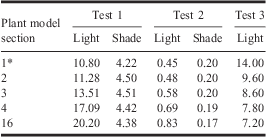
Tests were carried out in a growth cabinet (76 [depth] × 183 [length] × 91 [height] cm) lighted uniformly from above by fluorescent and incandescent light bulbs. Five plant models corresponding to the five treatments tested were randomly distributed on the floor of the cabinet 80 cm below eight fluorescent bulbs providing uniform lighting (13.84 klux or 94 795 W/cm2 at the center of the chamber; see also Table 1). The growth cabinet was set at 20°C, with a 16:8 light:dark light cycle and a 50% relative humidity. Each plant part was numbered to facilitate recording. The movement of each beetle was observed and recorded for up to 6 hours or until it walked off the plant. If a beetle fell off the model, the data for the given treatment were discarded. Preliminary trials established that the movement of the Colorado potato beetle on the five plant models could be observed at the same time by one observer. The number of replicates for each model varied because additional beetles were released whenever a beetle walked off a model early enough in the day to carry out an additional run. A small window in one of the doors of the growth cabinet allowed the observer to track the movement of the released beetles. Each beetle was released at the base of the primary stem and the time at which it entered (walked into) a different stem node, petiole, or leaf was recorded. Beetles were released sequentially on the different treatments.
Light intensity (klux) measured at different heights along the stem of the plant models used in growth cabinet tests.
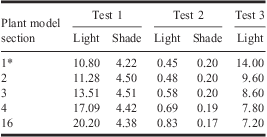
Tests 1 and 2 were lit from above and test 3 from below.
*Numbers 1, 2, 3, and 4 correspond to the consecutive sections of the main stem and 16 to a leaf model at the top of the stem.
Observations for given treatment stopped when the beetle walked off the plant and outside of a 7.5 cm radius area centered on the stem. If the beetle re-ascended the plant, observations continued. If the beetle walked beyond the base area, it was removed and was not reused for the tests.
Treatments
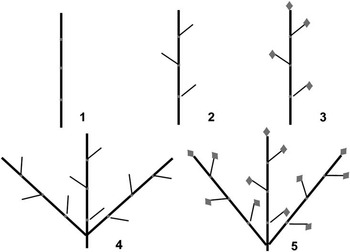
Plant models were made up of 45 cm high and 1.9 cm diameter polyvinyl chloride pipes (stems and branches) to which were attached water picks (petioles/tertiary branches) into which paper/potato leaves could be inserted. Leaves consisted of 8 × 8 cm pieces of green construction paper affixed to a wooden stir stick and inserted into the rubber septum of the water picks. The five models served as five different and increasing absolute numbers of one structural component. Treatment 1, the simplest plant model, consisted of a single vertical stem separated into four 11.25 cm sections by drilled holes (internodes) used for the insertion of petioles in other models (Fig. 1). Treatment 2 consisted of a straight stem (four equal internodes) with three water picks (petioles/tertiary branches). Treatment 3 (11 connections) was similar to treatment 2 but with leaves inserted in the water picks and at the top of the stem. For treatments 4 and 5, the single stem of models two and three were tripled by adding two lateral branches similar in structure to the main stem. The secondary stems were connected to the central stem ∼2.5 cm above the base of the plant and angled 30° to the central stem. Each secondary stem was similar to the central stem. Therefore, treatments 4 and 5 had three times the number of connections of models two and three, respectively. However, treatments 4 and 5 also had three times the size or scale of models two and three. Heterogeneity, another component of plant architecture, reflecting the relative abundance of the different kinds of structures (Bell et al. Reference Bell, Roberts and Smith1979; Gingras et al. Reference Gingras, Dutilleul and Boivin2002) varied between models. Heterogeneity was calculated using the Shannon–Wiener's index of biodiversity as in Gingras et al. (Reference Gingras, Dutilleul and Boivin2002). None of the leaves or branches touched or overlapped. Each model was anchored on a wooden base. Plastic components were lightly sanded to roughen the surfaces and ensure that locomotion would not be limited by male Colorado potato beetle tarsal pads sticking to the smooth plastic surfaces as reported by Pelletier and Smilowitz (Reference Pelletier and Smilowitz1987). Conversely, the sanding ensured that surfaces would not become coated with dust that could prevent the tarsal pads of walking Colorado potato beetle from adhering properly to the models (Boiteau et al. Reference Boiteau, Pelletier, Misener and Bernard1994).
Schematic representation of the five plant models corresponding to the treatments tested. The diamonds represent the leaves and the lines connecting them to the model represent the petioles. Connectivity is 4, 7, 11, 21, 33 and heterogeneity is 0, 1.76, 2.64, 1.76, and 2.64, in treatments 1, 2, 3, 4, 5, respectively. Treatments 4 and 5 are three times the size of treatments 1, 2, 3.

Analysis
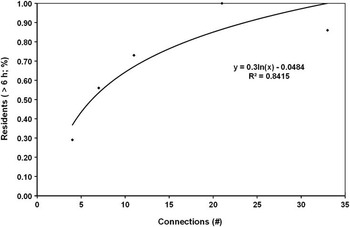
The percentage of beetles residing for at least 6 hours on each plant model was regressed against the absolute number of connections between parts in each model. A natural log transformation was applied to the data for the analysis. The distribution of transitions between model sections was compared for the different models using contingency tables. The analysis was carried out using VassarStats (http://www.vassarstats.net/). Total time spent on the different plant parts was compared graphically.
Impact of phototactic stimulus on dispersal pattern and residency
Experimental approach and treatments
The role of the phototaxis on the distribution of the beetles on the plant structures was studied in the same growth cabinet as above by simultaneous observation of the movement of adult Colorado potato beetles on two plant models each under different light intensity.
In the first test, a cardboard false ceiling was suspended on half of the chamber to create a darker zone. One plant model (Type 3, Fig. 1) was erected in the middle of each light and dark zone. Light intensity in the lighted side of the growth cabinet was more than three times that in the shaded side (Table 1). Also, light intensity increased with height in the lighted side and was more or less uniform in the shaded side. Light intensity was measured using a pyranometer coupled to a voltmeter (Li-Cor Biosciences, Lincoln, Nebraska, United States of America). The test was replicated 13 times. In the second test, the fluorescent lights were turned off leaving only the incandescent bulbs on the lighted side of the cabinet. Light intensity in the lighted side of the growth cabinet was two to four times that in the shaded side but  $$$\tfrac{{\rm{1}}}{{{\rm{10}}}}$$$ that in Test 1 (Table 1). The test was replicated 10 times. In the third test, the role of phototactic behaviour in the tendency for beetles to disperse to the uppermost sections of the plant models was challenged by quantifying the distribution of beetles exposed to the same fluorescent lighting as in test one but originating from the base rather than the top of the cabinet. The behaviour of beetles released from the base was compared with that of beetles released from the top of the plant model. The test was replicated 20 times. In all tests, the number of visits to the different sections of the model, under each treatment, and the distribution of transitions between model sections, under each treatment, were compared using contingency tables. The analysis was carried out using VassarStats (http://www.vassarstats.net/).
Results
Residency
Colorado potato beetles had a long residency period on plant models. Thirty-five of the 65 beetles released on the five plant models stayed on for the duration of the 6 hours observation period. The proportion of beetles remaining on a plant model for 6 hours after release was significantly (F 1,4 = 15.9331; P = 0.028) related to the absolute number of connections between the parts of the plant model (Fig. 2). Twenty-two of the 30 beetles that walked off within the 6-hour period of observation did so from the simplest model and early on, at 84 ± 21 minutes after release.
Proportion of adult Colorado potato beetles remaining on five plant models of increasing structural complexity (expressed as the absolute number of connections between parts) 6 hours after release (n = 65; 31, 9, 11, 7, 7, respectively).

Plant structure and beetle distribution
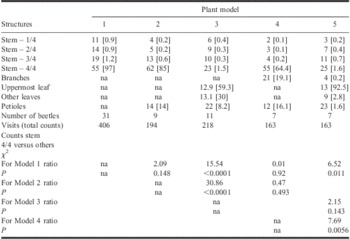
Counts on section four of the main stem represented 56%, 64%, and 58% of total visits on models one, two and four but only 23% and 25% on models three and five. The ratio of visits to the uppermost stem section and to the rest of the model was similar to that in model one for models two and four but significantly lower for models three and five (Table 2). The lower counts seem attributable to the presence of leaf-shaped structures, the only difference between models three, five and two, four. Adding visits on the top leaf to the visits on the top stem section, brought total counts on the uppermost section of models three and five up to 36% and 38%, respectively. These counts were similar to those on the other models indicating that beetles were most active in the uppermost section of all models over the course of the residency period of up to 6 hours. Branching was not a factor. The ratios of visits to the uppermost stem section and to the rest of the model for the branching models with and without leaves (five and four) were similar to those for single stem models with and without leaves (three and two) (Table 2).
Distribution of adult Colorado potato beetle visits on the four sections of the main stem, secondary branches, petioles, and leaves (as available) of five plant models of increasing architectural complexity.

Distribution of total time is shown between brackets.
The beetles spent an even greater proportion of their residency time at the top of the models. Of the 3703, 1796, 2402, 2301, and 1767 minutes spent on models one, two, three, four, and five, respectively, 97%, 85%, and 64% were spent on the last section of the main stem for models one, two and four and 62% and 94% on the last section and top leaf of models three and five. However, contrary to beetle activity, which was split almost 2:1 between the top section and the top leaf on models three and five, only 1.5% and 1.6% of the time was spent on the top section in contrast to 59% and 92%, respectively, on the top leaf. The increased retention on the leaf structures because of their uppermost position or shape left less time to disperse elsewhere on the models.
Impact of phototactic stimulus on beetle distribution
Test 1 – Positive light gradient and shade
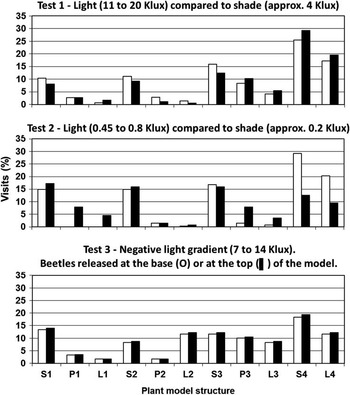
All beetles placed at the base of the models rapidly climbed the main stem for a total of 185 and 145 visits (df = 1; χ 2 = 2.2; P = 0.138) on shaded and lighted models, respectively. The uppermost section of the main stem received the most visits. Second most visited were the leaves, especially the leaf at the top of the stem (Fig. 3). The proportion of visits under light and shade was similar for the upper section of the stem (df = 1; χ 2 = 0.49; P = 0.484) and for the leaves (df = 1; χ 2 = 0.7; P = 0.403). Beetles spent 722 and 661 minutes on the plant models exposed to shade and light, respectively. Beetles exposed to shade and beetles fully exposed to light spent a similar proportion of their time on the terminal leaf (51% versus 45%) and on the last section of the main stem (38% versus 39%), respectively.
Impact of light gradients and shade on the proportion of visits to different structures of a potato plant model by 26, 20, and 40 adult Colorado potato beetles in tests 1, 2, and 3, respectively. All beetles were released at the base of the plant model except for one treatment released at the top of a negative light gradient (S = stem section; P = petiole; L = leaf; 1, 2, 3, and 4 correspond to the consecutive vertical sections of the model, from bottom to top).

Test 2 – Positive light gradient and deep shade
As in test 1, all beetles also climbed the models but for a smaller number of visits (56) on shaded than on lighted models (96) (df = 1; χ 2 = 5.36; P = 0.021). As in test 1, the uppermost section of the main stem and the leaves received the most visits in the lighted treatment but not under shade (Fig. 3). The proportion of visits under each treatment differed for the upper section of the stem (df = 1; χ 2 = 5.3; P = 0.021) but the proportion of visits to the leaves under shade did not differ significantly from that under light (df = 1; χ 2 = 0.05; P = 0.823). Beetles spent 273 and 259 minutes on the plant models exposed to shade and light, respectively. Beetles exposed to shade spent approximately half as much time on the terminal leaf (15%) and on the last section of the main stem (28%) than beetles fully exposed to lighting (31% and 47%, respectively).
Test 3 – Negative light gradient
Eighty percent of beetles placed near the base of the vertical stem model lit from below either walked away or climbed on to the bottom section of the stem and remained there. Beetles that climbed on the model spent more than 40% of their total time on the first quarter section of the stem and first petiole (Fig. 3). Beetles dispersed horizontally or remained stationary where light intensity was high. Beetles released at the top of the same model lit from below exhibited unusual behaviour. Forty percent of the beetles remained on the terminal leaf or the top  $$$\tfrac{{\rm{1}}}{{\rm{4}}}$$$ of the stem and 60% moved up and down the stem responding alternately to negative geotaxis or phototaxis. The proportion of visits to the different plant structures was similar to that by beetles released at the base of the model but substantially more time was spent on the last quarter section of the stem.
Overall, most beetles released at the top spent most of the 30 minutes observation period (28.8 ± 10.02 minutes) on the model, whereas beetles released at the base only spent an average of 9.4 ± 2.78 minutes on the model or at its base before moving away (df = 19; t = 6.796; P < 0.0001). Beetles on the flat surface at the base of the models remained stationary or were stimulated to move horizontally upon the intensely lit surface.
Discussion
In general, the absence of food encourages herbivorous insects such as Colorado potato beetle (e.g. Baker et al. Reference Baker, Ferro and Porter2001) to disperse, whereas the presence of host plants retains them and can serve as a sink such as in trap crops (Weber and Ferro Reference Weber and Ferro1994). The departure of most beetles from plant model one after an average  $$${\rm{1}}\tfrac{{\rm{1}}}{{\rm{2}}}$$$ hours met the general expectation. However, the retention of 76% of the beetles released on artificial plant models two, three, four, and five for at least 6 hours was unexpected and revealed that architectural complexity, and not only nutrition, played a role in determining retention on plant. It is difficult to pinpoint from the available data which structural component of plant architecture was responsible for beetle retention. There is a good correspondence between the increasing number of connections in the plant models presented and the increasing proportion of beetles staying on the models for the full 6 hours observation. A parallel change in the volume of the models could also have been a factor but this is less likely because the simple additions of petioles (Model two) or petioles and leaves (Model three) to the straight stem of model one actually added little to the volume while the proportion of individuals with long residency periods increased substantially.
An accurate mean residency time could only be calculated for beetles placed at the base of the simplest model. The residency period for the majority of the other beetles remained undetermined at the end of the observations making it impossible to calculate mean residency time on other plant models. Without these data, a complete analysis of the relationship between residency time and complexity, heterogeneity and scale of the plant models (Gingras et al. Reference Gingras, Dutilleul and Boivin2002) could not be completed. Nevertheless, the study has shown that plant architecture plays a role on the residency of potato beetles on plants but future research with longer periods of observation will be required to determine the relative roles of the different plant structure variables on residency time.
The distribution of beetle activity and beetle time among the different plant sections of each model failed to provide clear additional clues that could have helped understand the residency changes reported above. The dominant feature of adult Colorado potato beetle response to the different plant models was the rapid dispersal towards the upper section of each model (regardless of structure) and a concentration of their activity and time to the uppermost section or leaf. The data suggest that leaf shape structures reduced the level of activity and the time otherwise spent on the last stem section of the models (without leaves) but this may have mostly resulted from the uppermost position of some leaves on models three and five.
Beetles used in these tests had access to cut potato leaves until their release on a model and can be considered satiated. The large proportion of beetles tested that exhibited long residency periods of 6 hours or more on these structures without food could have been attributed to their satiety. However, beetles kept under the same conditions spent  $$$ \less {\rm{1}}\tfrac{{\rm{1}}}{{\rm{2}}}$$$ hours on the simple straight stem model one before walking off. Preliminary tests using potato compound leaves inserted in the water picks had produced long periods of inactivity and rest similar to those in tests using construction paper leaves. The potential link between food availability, satiety, and long residency time led us to abandon potato leaves for paper leaves. Results presented above have shown that the long residency periods observed are, at least partially, independent of food availability.
Knowing the strong and positive phototactic (negatively geotactic) response of the Colorado potato beetle outside of the diapause phase and its key role in the orientation of walking individuals (reviewed by Boiteau et al. Reference Boiteau, Alyokhin and Ferro2003; Otálora-Luna and Dickens Reference Otálora-Luna and Dickens2011), it was likely that the consistent return of beetles to the uppermost section of all plant models was in response to the light gradient. By manipulating the position of the light source, it was possible to demonstrate that phototaxis did control the distribution of the beetles on the plant models. Other tests showed that phototaxis could determine the dispersal and distribution of the adult potato beetles on plants under a range of light intensity conditions. It is likely that once a beetle reaches the canopy of a potato plant, much of its lateral movement is light driven. The retention of the phototaxis at lower light intensities, under shade, has been reported before. In fact, according to Jander (Reference Jander1963), insects exposed to low light intensity tend to be more positively phototactic. That the tendency for the beetles to disperse to the uppermost structures disappeared only at very low light intensity would be in agreement with the ability of the beetle to respond phototactically to light intensities as low as 10 lux according to Grison (Reference Grison1957). Conversely, it has been established that unlit areas with very low light intensities can, like physical barriers, stop or reorient the dispersal of the Colorado potato beetle (Boiteau Reference Boiteau2005).
It is difficult to extrapolate laboratory results to the field but it is likely that, based on structure alone, adult beetles will disperse more frequently between short simply structured emerging plants than on large multi-stemmed potato plants. Actual residency times on multi-stemmed potato plants remain to be determined and could be substantially longer than the 6 hours test depending on whether or not beetles tend to leave the plant after descending the first explored stem or tend to visit other stems on the same plant. The observation of such unexpectedly long residency periods even on artificial models providing no food suggests that further research for a better understanding of the factors controlling the Colorado potato beetle retention and dispersal within the host may be as important as a better understanding of dispersal between plants and fields to develop and improve ecological and cultural management tactics such as trap crops.
Acknowledgements
The authors wish to thank P. McCarthy for his contribution to an earlier version of the manuscript.