In the spring 1893, the following statement appeared in a theater review in one of the Parisian dailies: “Mais, dans ce diable de pays de Galicie, on n'est jamais tranquille et il faut toujours craindre pour le lendemain [But, in this hell of a land Galicia, it's never quiet, and one must always fear for tomorrow].”Footnote 1 These words were written in response to the first, and perhaps the only, opera produced in Western Europe about the Austrian province of Galicia.Footnote 2 The work's plot centered on a love triangle between a count, a gypsy girl, and a peasant, and was set against the historical backdrop of the Galician peasant uprising of 1846. The opera in question, Kassya, was the swan song of French composer Léo Delibes, written after a trip he took to Hungary and Austrian Galicia. The critic who penned the above words, Georges Street, certainly knew something about intrigue and conspiracy within the Austrian Empire. He was the grandson of Metternich's master spy, Georg Klindworth, and the son of Agnes Street-Klindworth, who gathered intelligence for her father about refugees of the 1848 upheavals living in Weimar.Footnote 3 Delibes's opera and Street's biography interconnect only circumstantially—the former composed the music to Kassya; the latter attended a performance and wrote a review—yet this coincidence suggests an interesting avenue for investigation regarding French contacts with East Central Europe.
The opera was created within the cultural milieu of Paris. Here, Delibes maintained close contact with exiled Poles who were living in France following defeats in the 1830–1831, 1848–1849, and 1863–1864 uprisings. His circle of Polish friends and acquaintances included, among others, the young composer Zygmunt Stojowski, the pianist Ignacy Jan Paderewski, the conductor Henryk Jarecki, the physician Grzegorz Ziembicki, and the socialite Maria Lemańska.Footnote 4 Many of the emigrés had strong ties to Galicia, and a number of them greatly influenced Delibes's composition. Potentially, Delibes had access to other opinions about the internal affairs of Austro-Hungary, including those expressed about the civil unrest in the province. French historians, politicians, and economists paid some attention to Galician matters following the massacres of 1846 and the Austro-Hungarian Compromise of 1867 and published pamphlets and tracts often focusing on the Polish and Ruthenian question of the province's population.Footnote 5 By far the most popular sources of information about this part of Europe were the translations of Leopold Sacher-Masoch's stories. His works enjoyed a large following in France. Nearly all of Sacher-Masoch's Galician tales were translated into French, and a number of the translations came out in several editions. One of these tales served as a basis for the libretto of Kassya.
This article will trace the history of the idea for, and the creation and reception of, Delibes's Galician opera Kassya, beginning with an information-gathering trip he took in 1885 to the Austro-Hungarian Empire and ending with the premiere of his completed work in 1893. My research reveals that the work's generally unfavorable reception was the result of four factors: first, the librettists' misinterpretation of Sacher-Masoch's world in their adaptation of his story “Frinko Balaban”; second, Delibes's (and later Jules Massenet's) inability to represent musically the complexity of Galician culture; third, the audiences' rejection of the opera's outmoded, non-Wagnerian style, particularly the overly episodic plot; and fourth, the critics' impressionistic reception of the work as a bagatelle of exoticism. The opera's creators, not surprisingly, ultimately got lost in the cacophony of trying to characterize the ethnographic variety of the disparate peoples of Galicia—Poles, Ruthenians, Jews, and Roma—rather than bringing forth in unison an idea of one land, a shared homeland, of these populations, and one with which the Parisian theater-going public could sympathize and understand.Footnote 6
French Delegation at the Hungarian National Exhibition (1885)
Delibes's first leg of his journey began in 1885, when the literary section of the Hungarian Academy invited him and another thirty-nine leading Parisian cultural figures and intellectuals to visit the national exhibition being held in Budapest. The group comprised a number of writers, artists, musicians, physicians, lawyers, scientists, and journalists.Footnote 7 Following their visit to Budapest, arrangements were made for them to embark on a whirlwind tour of the country, from the Carpathian Mountains to the Great Hungarian Plain. The invitation was issued for three reasons. Generally, the Hungarian Society of Writers and Artists wished to thank the French for the warm welcome and hospitality shown to them on the occasion of their visit to Paris in July 1883. Furthermore, they wished to show their gratitude for French charitable aid given to the city Szeged at the time of its great flood in 1879, during which the town was nearly wiped away. Finally, Hungary wished to show its guests the country's progress in modernization since the Ausgleich and success in technology and industry.Footnote 8 Though the stated aims of the invitation were to express gratitude, to advance international cooperation, and to celebrate Hungary's economic development, the motivation for the visit by the French delegation was overwhelmingly political. At the time, the French government, still some years away from negotiating an alliance with Russia, was considering establishing closer and direct ties with Hungary to help offset German hegemony.
On Saturday evening, at 7:35, on 8 August 1885, Delibes and the other French delegates of the International Literary and Artistic Association, led by the indefatigable Ferdinand de Lesseps and escorted by the Hungarian representative Attila de Szemere, boarded the Orient Express at Gare de l'Est in Paris to begin their voyage from the Boulevard de Strasbourg to the banks of the Danube River. The two-year old passenger train with its first-class compartments and parlors was the scene of great merriment as it rolled eastwards. Its occupants, with champagne glasses in hand, perhaps believed that they were Hugoesque diplomats setting the stage for the defeat of German imperialism and preparing for the future United States of Europe.Footnote 9 Gaily calling out and answering one another, the raised and raucous voices of the Frenchmen, along with cacophonous music by composers Delibes and Jules Massenet to words of a funny rhapsody improvised by Armand Gouzien, overpowered the sounds of the speeding train. The sight of the racing black train with its unsteady passengers resembled Mazepa's legendary wild horseback ride into the steppes of Ukraine: “Vues de la route, ces six voitures, dans leur élan vertigineux, avec ces ombres collées aux vitres, sous l'étincellement des flammes vacillantes, devaient donner l'illusion de quelque chevauchée fantastique [Seen from the road, these six train cars in their dizzying momentum, and with shadows fixed in the windows, under the gleam of flickering flames, must have given the illusion of a fantastic cavalry charge].”Footnote 10 Perhaps no one enjoyed himself more than Delibes, who, full of verve and humor, filled the dining car with the music “d'une symphonie abracadbrante [a fantastic symphony].”Footnote 11
However joyful the journey was, the train ride itself, and other moments during the delegates' visit to Hungary, was overshadowed by the specter of Chancellor Otto von Bismarck's Germany. As the train approached the Franco-German frontier at Avricourt early Sunday morning and passed through Strasbourg, the songs and revelry turned to silence. The group fell into contemplation during the painful passage across the former French lands of Lorraine and Alsace: “Tout le monde est éveillé pour donner une pensée et un regard à la vieille cité annexée [Everyone is awake to give some thought to and cast a glance at the annexed old city].” The landscape now under foreign rule appeared alien and deprived of its former beauty. Crossing the powerful, tumultuous, and legendary Rhine River drew journalist Georges Blavet to comment that it was nothing but “un fleuve sale et vilain, sans caractère [a dirty, ugly river, without character].”Footnote 12 Until the Orient Express crossed into Austria, the delegates felt uneasy, looking out the windows and observing how their train seemed to be under constant escort by a lance-bearing Prussian cavalry regiment, or Uhlans. The military display left them to wonder whether it was out of national pride or for a more hostile reason. It was with great relief that they escaped the watchful gaze, “envieuse et malveillante en Allemagne [resentful and malevolent in Germany],” and, upon passing through the Germano-Austrian frontier at Simbach, encountered a curiosity that was now “instantanément courtoise et sympathique [instantly courteous and friendly],” for in Austria “la France a tant d'amis instinctifs [France has so many instinctive friends].” At the first appearance of the Danube, the French travelers from the windows struck up Strauss's Blue Danube Waltz, then still a lyrical composition with satirical words by Josef Weyl (for Austria had lost its war with Prussia in 1866).Footnote 13
Music was a constant throughout the French delegation's tour of Budapest and the Hungarian countryside. Everywhere Delibes and the others traveled, they were accompanied by bands of Roma musicians playing seemingly nonstop the csárdás, a traditional Hungarian folk dance originating from the 1830s. Regardless of the leg of the journey, whether by wagon, boat, automobile, or cavalcade, the Roma followed and would lift the guests “en des regions inédites et quasiment extraterrestres [in unprecedented and almost extraterrestrial regions].”Footnote 14 Hungarian hospitality was like the folk dance, “une agitation continue, enivrante, qui vous enlace, vous soulève, vous rit, et vous emporte en un tourbillon [a continuous, exhilarating stirring, that hugs you, lifts you up, laughs at you, and carries you off in a whirlwind].”Footnote 15 Their hosts' generous spirit came across, whether the delegation was enjoying pantagruelian meals or engaging in bacchanalia—which included the tasting of fifty-year-old Tokay from the caves of Joseph Karl, the Archduke of Austria, or more soberly, surveying what type of oat was fed to the country's horses or the kind of coal used in its locomotives.
The csárdás is sometimes likened to a recruiting dance, and the Hungarian hosts appeared to be in full enlistment mode, by some estimates spending over 20,000 francs, courtesy of the Ministry of Commerce, to entertain the French delegation. And their French guests were willing conscripts. Political gestures abounded on both sides. On the part of the Hungarians, they made every effort to make the Frenchmen feel at home—“nous étions chez nous!”—among brothers and in a sister nation. Upon stepping off the train in Szob, just north of Budapest, the travelers were greeted by a young French woman who had been orphaned during the Franco-Prussian war and then adopted by a Hungarian family. This gesture had the appearance of the French welcoming the French. Throughout the trip, the French guests were transported in special trains by the administrators of the Hungarian railways and led by locomotives draped in garlands and flags in the colors of France and Hungary. Regardless of the time of day, the town, or the size of village they passed through, they were universally and enthusiastically greeted: “Soyez les bienvenus! Vive la France! Vive la chère France! Français, on vous salue, on vous aime!” The patriotic welcomes prompted dramatist Abraham Dreyfus to compare the Danube to the Seine, and the river's Margaret Island to Croissy Island. With musicians playing the Marseillaise and the Hungarian people speaking the French language as well as, or even better than, the French, Dreyfus wondered whether he and his compatriots had really left France and were not somehow disembarking at Rouen or Bordeaux.Footnote 16 Indeed, the Hungarian national exhibition and the events surrounding it were a world pageant of sorts, meant tactfully to convey dual allegiances to the Austrian Empire and the ethnic Hungarian nation, to assert the strength of the national market, and to ensure international credit. The kingdom's capital, Budapest, was marketed to Europeans as the “Paris of the East.”Footnote 17
The French delegation reciprocated by paying tribute to Hungary's revolutionary heroes and making overt displays to honor Hungarian patriotism. Lesseps, “lui [qui] réunit les Océans” [the man who brings together the oceans], at a luncheon in the Redoute-building in Pest, toasted the Hungarian hosts, promising that his next born—the twelfth by his second marriage—if a son, would be named Étienne (Stephen), after the patron saint of Hungary, and, if a daughter, would be named Giselle (Gizella), after the first queen consort of Hungary and spouse of Saint Stephen.Footnote 18 True to his word, Gisele de Lesseps was born on 12 December 1885. Other, perhaps lesser, physical manifestations of respect included paying homage to the Hungarian national poet Sándor Petőfi. The French delegates formed a procession to the statue erected in his honor in Budapest and laid there a wreath. This act was full of heavy significance. Petőfi had died at age 26 in 1849, in one of the battles of the Hungarian Revolution. Furthermore, as author of the Nemzeti dal (National Song), Petőfi is said to have inspired the revolution that grew into a full-out war for independence from the Austrian Empire. Later, when in Arad, the French delegation visited the martyrs' monument to pay its respect to the thirteen rebel generals who were executed there on 6 October 1849 by order of the Austrian general Julius Jacob von Haynau.
These manifest associations with shared revolutionary histories signaled a mutual challenge to the prevailing political order. France was looking for strategic allies to weaken Germany's stronghold over Central Europe and to end its diplomatic isolation. The 1882 Triple Alliance of Germany, Austria-Hungary, and Italy left France vulnerable. By visiting monuments related to Hungary's 1848 revolution, the French delegates stoked the fires of Hungary's recent insurrectionist history. Most likely, the visitors did not deliberately set out to undermine the Triple Alliance, but their actions certainly provoked a response from Germany. As for Hungary, the staging of its first national exhibition in Budapest, and its hosting of foreign delegations and journalists, was a source for civic and national pride. The imperial government in Vienna did not entirely approve, even though both Crown Prince Rudolf and his father, Francis Joseph I, jointly officiated at the exhibition's opening ceremony.
The French delegates learned during their visit that a German newspaper had reported that the goal of their voyage was to revolutionize Hungary. Responding to this news, writer Louis Ulbach countered: “C'est bien plutôt nous qui sommes révolutionnés de tout ce que nous voyons et surtout de cette sympathie sans bornes pour la France [Rather, it is we who are revolutionized by everything we see, and, especially, by this boundless sympathy for France].”Footnote 19 These words suggest that France was the true benefactor of goodwill; however, there was some truth to German concerns. Journalist Adolphe Badin suggested in his report that Hungary, thirty-six years after 1849, “est mûr pour la liberté [is ripe for liberty].”Footnote 20 Germany also saw the visit as a French provocation to stir up sympathy with regard to its lost territories of Alsace-Lorraine. Certainly remarks by Ulbach along the lines of Hungary providing France with its first revenge—“la revanche-préface,” against “les reptiles de Bismarck”—sought to needle Germany. German pressure was brought to bear on the governments of both France and Austria-Hungary to offset this diplomatic fiasco. A series of meetings between the French guests and government officials were either not organized or canceled. For example, Count Louis-Alexandre Foucher de Careil, French ambassador to Austria-Hungary, did not meet the train as it passed through Vienna; Prime Minister Kálmán Tisza left Hungary; Joseph Karl, archduke of Austria, excused himself from a luncheon organized on his estate on Margaret Island; and Count Alajos Károlyi, the Austrian ambassador to London, did not receive the French guests at his estate in Mezőhegyes.
Back home in Paris, at least one writer also considered the delegation's voyage to Hungary as gratuitous. Paul Forestier, an armchair traveler reading the daily reports about the delegate's activities and receptions, satirically mused that had he been a member of this group, then he would have assimilated himself quickly into Hungarian life. In two years' time, he would have fathered Hungarian children, taken on the name of “Forestierki,” and spent his free moments composing variations of the csárdás.
The joyful tempo of the csárdás, the artistry of the Roma musicians, and the respect of the Hungarian hosts did leave composers Delibes and Massenet in “eighteenth heaven.” Their hosts honored them with a concert at the Hungarian Royal Opera House at which they directed their own works. They received standing ovations and were crowned with garland wreaths for their efforts: Delibes conducted the orchestra for his ballet Coppelia, and Massenet for his Hérodiade. More importantly, opportunities abounded during their visit for Delibes's study of the rhythms of Hungarian folk music. Delibes spoke on the subject at a parting banquet in Budapest on the evening before the delegation's departure to the Carpathian Mountains. On another occasion, he was particularly moved by the performance of an old Roma violinist. He addressed the man, remarking on how singular and original his art was, and what a service this violinist rendered to the history of music by transmitting folk tradition. Delibes, most probably speaking for himself, concluded that the old musician had already influenced “sur la technique de quelques artistes chercheurs.”Footnote 21 He, as a composer and artist-researcher, had decided upon the completion of Lakmé to compose his next opera on an equally exotic subject, moving the setting from mid-nineteenth-century British India to Austrian Galicia.
Léo Delibes's Tour of Galicia
Following the triumphant festivities for the French visitors, which ended on 20 August, Delibes left his fellow companions, who returned to Paris, and set off for Austrian Galicia. His objective was to collect popular melodies for his next composition, in which the main characters were to be drawn from Galician society. For nearly three weeks, the composer traveled throughout the eastern borderlands of the Austrian Empire—all over Galicia and Bukovina, from Kraków to Kolomyia and beyond—noting down song after song, writing original studies, and collecting sketches of the landscape and peoples, all of which were to help with his next opera.
The Galician province that Delibes encountered was under the rule of Habsburg Emperor Francis Joseph. Its population of six million was multicultural, multilinguistic, multiconfessional, and largely agrarian. Among the inhabitants were Poles, Ruthenians, Germans, Armenians, Jews, Moldavians, Hungarians, Czechs, and Roma. Following the uprising of 1846, the Revolution of 1848, and greater Galician autonomy after 1867, Galician nationalists—particularly Poles, Ruthenians (Ukrainians), and Jews—were asserting their political, religious, and linguistic rights. Tensions grew between Polish and Ruthenian nationalists. Nonetheless, there were also members of the intelligentsia who advocated for a specifically Galician culture and a unified provincial community.Footnote 22 It could also be argued that other intellectuals, and certainly the peasantry, were indifferent to national concerns, and, as Tara Zahra writes, these individuals were more connected “to their local, regional, professional, familial, and religious communities than to any overarching national community.”Footnote 23 Was one a Galician, an Austrian, a Pole? Or rather a Roman, a Greek Catholic, or a Jew? Or a member of the gentry, a civil servant, or a peasant? Or simply “tutejsz,” someone “from here”? However, it is easy to argue indifference when one culture dominates another, as was the case in Galicia in the late nineteenth century, when by 1873 a devolution of power from Vienna to the Polish landowning class produced efforts to Polonize Yiddish-speaking Jews and the largely peasant Ruthenian population for the next two decades.Footnote 24
Ironically, this administrative change relied upon subsuming Polish national culture into a Galician identity—the national past into the provincial present—as the province was the lifeline to the preservation of the former and a counterweight to “the so-called nationalities problem that would embitter Habsburg politics for the next half-century.”Footnote 25 For Delibes, his Galician experience was guided and shaped by his Polish friends and colleagues, yet it did afford alternative perspectives on the music and culture of this province, from the peoples of the plains to those of the mountains. The multitude of these Galician encounters would ultimately disrupt the unity of his opera Kassya, which led to the criticism that the composer and the librettists had left nothing out of the composition and had created a vertiginous world full of: “Choeurs de paysans joyeux et de paysans furieux, de buveurs, de racolleurs, de bandits, de bohémiens, de seigneurs de la cour, etc. [Choruses of jolly peasants and angry farmers, drunkards, recruiting officers, bandits, gypsies, lords of the court, etc.].”Footnote 26
The Polish-language press paid particular attention to Delibes's movements during his trip through Eastern Galicia. The Kraków daily Czas announced on 13 August his imminent visit and its purpose. The composer Adam Münchheimer, who was then serving as director of the Grand Opera Theater in Warsaw, related to readers of the weekly Echo muzyczne, teatralne i artystyczne [Echo of Music, Theater and Art] that Delibes was writing an opera on Polish relations and that he had asked Münchheimer for help in locating sources. Although little is known about Delibes's daily itinerary during those two to three weeks, we know that he arrived in Lviv, the capital of Austrian Galicia, around 30–31 August, and departed for Kraków on 2 September. In Kraków, Delibes briefly met with Władysław Żeleński, who was a Polish composer and professor of the city's Music Society School (later, after 1888, a conservatory).Footnote 27 Delibes, during this stopover, may have been introduced to the fifteen-year-old Zygmunt Stojowski, who was at the time a student of Żeleński. Two years later, he would become one of Delibes's students in Paris (and one who endeared himself so much to Delibes and his wife that they offered to adopt him so that he could compete as a French national in the prestigious Prix de Rome competition).Footnote 28 Newspapers also reported that Delibes traveled to Kolomyia and Zakopane, towns located respectively in the foothills of the Carpathian and Tatra Mountains in present-day Ukraine and Poland, as well as to a number of Galician villages.Footnote 29
In L'viv, the author of Coppélia and Lakmé made arrangements to meet with Karol Mikuli, who at the time was serving as artistic director of the Galician Music Society and as director and professor of the L'viv Conservatory. Mikuli, a pianist and composer of Armenian descent, was born in Chernivtsi, the capital of the Bukovina region that was populated by Jews, Romanians, Germans, Ruthenians, and Poles, and in smaller numbers, Russians, Hungarians, and Armenians. His mother introduced him to music, and after a brief foray into medicine, Mikuli moved to Paris in 1841 (when Delibes was still just a young boy) to study under Chopin and remained there until 1847. There, among other musicians and writers, he met Franz Liszt, with whom he maintained a lifelong friendship. Mikuli returned to Chernivtsi in 1848 and traveled around Bukovina and Bessarabia searching out native talents and recording their folk songs, dances, and customs. In 1858, he settled permanently in L'viv and remained there until his death in 1897. Mikuli was actively engaged in conducting local orchestras and choruses; teaching piano, composition, and theory; composing piano and chamber works, popular songs, and folk music; and editing the works of Chopin.
For Delibes, Mikuli was an important connection to the folk music of the region, and he asked for his help in obtaining Polish and Ruthenian songs. After their meeting, the two attended a Polish-language performance of Offenbach's Contes d'Hoffmann at the Skarbek Theater. The nineteenth-century public in L'viv had a real taste for Parisian operettas, and one diarist noted that in the city theater the “daily bread consists of the plays by Offenbach and the cancan.”Footnote 30 Indeed, French culture and products prevailed in most spheres of life for Galician Polish elites, and they were a reminder of life in pre-partitioned Poland. Delibes, in a conversation with Mikuli, remarked after the performance how favorably impressed he was with the L'viv orchestra, the singer Elżbieta Skalska in the role of Giulietta, and the conductor Henryk Jarecki, whom the Frenchman remembered from Jarecki's visit to Paris in December 1882.
While visiting the Galician capital, which was the center of cultural and social life in the province, Delibes attended a private concert held at the residence of the Ziembicki family on one of the most exclusive streets in the city's central-western neighborhood.Footnote 31 He heard there Ruthenian and Polish folk music, including a kolomyika whose original themes made him laugh with joy, and a mazurka from which he could not keep himself from dancing. The French composer was known for his congenial disposition, and it was not unusual for him to participate exuberantly in musical entertainments, as he had done years earlier on a festive Friday evening by performing a polka solo at Jacques Offenbach's home to celebrate the “imminent end of the World.”Footnote 32
The Ziembicki home was that of Dr. Grzegorz Ziembicki, who was a professor of surgery at the University of L'viv and physician at the city's municipal hospital. Ziembicki had strong ties to France, and Delibes most likely first met him in Paris. In 1871, Ziembicki had been selected as an intern by the municipal hospital administration, one of the few, if not the only, Galician practitioners in France. While in Paris, he fulfilled his residency requirements at the dermatological, surgical, and syphilitic Hôpital St. Louis. Ziembicki completed his studies in 1875 with a specialization in urology, and then for two years served as a physician at the Polish School in Paris. He returned frequently to France in his capacity as a member of the Surgical and Anatomical Societies of Paris, and in 1895 to receive the highest decoration granted by the Legion of Honor, that of chevalier. At the 100th anniversary of the Internat in 1902, Ziembicki expressed his Franco-Polish patriotism by criticizing the expulsion of Slavic students from German universities and declaring that the foreign alumni of the hospital program were for France “vos colons scientifiques ... des sentinelles avancées,” ready to defend “l'idée française qui ... n'est que celle de la vraie liberté” [“your scientist-colonists… advanced sentinels,” who are ready to defend “the French idea ... which is only that of true freedom”].Footnote 33 Whereas France had exported scientific knowledge to Galicia, it was now the province's turn to export its musical traditions to France via Delibes. Decades later, another guest present at the salon concert hosted by the Ziembickis, Stanisław Niewiadomski, a Polish composer and music critic who was then manager of the Lviv opera, offered an account of the evening in the newspaper Rzeczpospolita. He described Delibes's wide-eyed delight upon hearing the playing of the kolomyika (a Ruthenian dance) and the composer's enthusiastic joining in the rhythmic dancing to the mazurka.Footnote 34
However, Niewiadomski disapproved of Delibes's music-gathering mission. He viewed the visit to L'viv as an attempt by a Westerner to appropriate material from the East for simple exotic effect. Yet Delibes, while traveling through Galicia, and particularly during his visits to L'viv and Kraków, would have been hard-pressed to hear any original music of the region imbued with Polish or Ruthenian attributes. The offerings in theaters, music societies, and private homes showed a marked preference for the musical culture of Austria, Germany, or France. These foreign cultures were regarded as superior to the local Galician one. Yet, despite the lack of fully developed original Polish or Ruthenian repertoires, provincial high society highly regarded Galician folk songs and folk music and considered them as the main repository of their “national” music culture. It was to this source of Galician cultural identity that Delibes was drawn, and the authenticity of which he wished to capture for his opera by collecting folk melodies from local musicians and music authorities alike.
Galician ethnographers had begun to study the province's musical culture in the early nineteenth century. Their efforts were among a number of other encyclopedic projects undertaken then, and with increasing frequency towards the end of the century, with “the assumption that Galicia was in and of itself a meaningful territorial unit and worthy of ethnographical/anthropological analysis.”Footnote 35 Zorian Dołęga-Chodakowski (pseudonym of Adam Czarnocki) in his book O Sławiańszczyźnie przed chrześcijaństwem [On Slavic Culture before Christianity] (1818) presented a research outline that proposed the collection of folk songs. Several years later, the almanac Pielgrzym Lwowski [The Lwow Pilgrim] published texts to a number of traditional Polish and Ruthenian folk songs, along with several illustrative notations of melodies. An article in the Lviv-annual Pąmietnik narodowy [National Journal] soon followed this publication. Its author wrote about the songs of the Polish and Ruthenian people: “Folk songs are the only source from which national poetry and national music grow out.” The idea of an ethnically diverse, but integral Galicia was emphasized by the author of Pieśni polskie i ruskie ludu galicyjskiego [Songs of the Polish and Ruthenian People in Galicia] (Lviv, 1833), who considered “popular” and “national” music one and the same, whether it originated from among the region's peasantry or nobility, from times past or the present. Oskar Kolberg's thirty-six volume encyclopedic works on songs and ethnography ensued. The compilation and popularization of the songs of the Galician folk had as its aim the creation of a shared culture and sense of a distinct identity. To aid in this nation-making project, music was written down and made accessible through the distribution of piano sheet music for the home.Footnote 36
Whereas original folk songs of Galicia were generally not known outside of the province, and did not circulate far from the borders of this Austrian kingdom, Delibes intended to bring this culture to the attention of the Western world by deliberately selecting these lands as the setting for his next opera and single-mindedly seeking out popular melodies, both Polish and Ruthenian. His fieldwork mirrored the ethnographic efforts outlined above, which sought to define Galicia as a provincial territory and a national homeland.
His final opera set him apart from being a simple armchair Orientalist, one who composes music meant to invoke distant lands, such as China, Japan, India, or Egypt, from the comfort of his study in Paris. Unlike many composers who imagined some mythic “East” and did not visit the lands about which they only fantasized (or, if they did, did not notate the music they heard), Delibes, during his impressionistic and fact-finding journey, traveled through the land, met the people, observed them and took notes, and verified his findings against the opinions of his Polish colleagues. The composer even went so far as to stay in Kolomyia, a town of only about 24,000 inhabitants, which “for someone used to Parisian comforts must have not been too tempting”; in other words, he did everything to immerse himself in the culture and to bring his frame of mind in line with the content of his opera.Footnote 37 The world took notice. The French newspaper Le Ménestrel announced Delibes's impending return to Paris on 13 September, and the Polish press reported that he had immediately set to work on his next opera, Kassya.Footnote 38
Galician Peasant Uprising of 1846: Léo Delibes's Kassya (1893)
The opera Kassya by Léo Delibes, composed to a libretto by Henri Meilhac and Philippe Gille and adapted from a Leopold Sacher-Masoch novella, made its premiere nearly eight years after the composer's voyage to Hungary and Galicia. The opera is set in Galicia during the peasant revolts of 1846. It was first staged at the Opéra-Comique in Paris on 24 March 1893. The work was presented posthumously and under another composer's orchestration, that of the composer's friend and former travel companion, Jules Massenet. Fifty-four-year-old Delibes died on 16 January 1891. He left a complete piano-vocal score to his final opera, but he had only finished orchestrating its first act.
Delibes's earlier and more notable works include the ballets Coppélia (25 May 1870) and Sylvia (14 June 1876) and the operas Le roi l'a dit (24 May 1873) and Lakmé (14 April 1883). Following his successes with the ballets Coppélia and Sylvia, Delibes was appointed professor of composition at the Conservatory in 1881, and in 1884, he became member of the French Institute, replacing the chair vacated by Victor Massé. Delibes's music, in the school of Gounod and Bizet, is considered charming and graceful, full of witty melodies and personality, and characterized by a lightness of touch and vivacity of spirit, yet lacking a strong musical identity. Notwithstanding these characteristics, Delibes is regarded as the father of modern ballet and significantly influenced such composers as Tchaikovsky, Alexander Glazunov, and Igor Stravinsky.Footnote 39
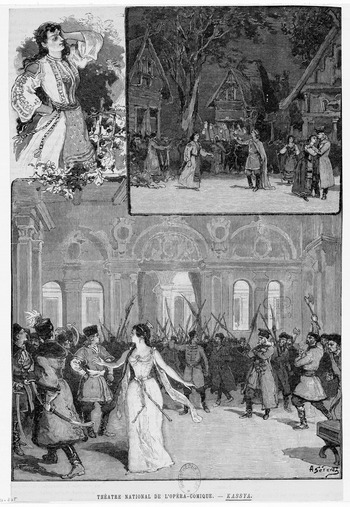
Théâtre national de l'opéra-comique. Kassya : (Opéra) : [estampe] / Tinayre sc [sig.]

Another one of Delibes's musical qualities was his talent for incorporating foreign elements into his compositions and imbuing them with innovative coloring, as in La Source set in Circassia and the Lakmé set in India in which “the British attempt to rule India is presented as neither heroic and admirable nor utterly vile but something in between: necessary or at least unavoidable, yet also obtuse and misguided.”Footnote 40 These works by Delibes were in the tradition of the “perfumed” opera, as had been popularized going back to the seventeenth-century,Footnote 41 and which proliferated particularly in the nineteenth century with such works as: Hector Berlioz's Les Troyens (1863), Georges Bizet's Les Pêcheurs de perles (1863) and Carmen (1875), Giacomo Meyerbeer's L'Africaine (1865), Giuseppe Verdi's Aida (1871), and Camille Saint-Saën's Samson et Dalila (1877), among many others.
When Delibes returned to Paris in September 1885 from the eastern periphery of the Austro-Hungarian Empire full of new impressions and exotic notations, he required a libretto into which he could pour all the motifs and strange harmonies that were playing in his head. His long-time collaborator Philippe Gille, who had written a number of libretti for Delibes, and associate Henri Meilhac, who had helped adapt Prosper Mérimée's Carmen for Georges Bizet, strove to find a story to suit their friend's inspiration.
The composer—though fully motivated after his journey along the Danube and Dniester rivers, and in possession of numerous picturesque motifs that he had collected—faced innumerable difficulties setting the libretto to music. His friends and collaborators, Meilhac and Gille, had been charged with finding a subject and setting that would suit Delibes's vision. Although Delibes's friend in Warsaw, Adam Münchheimer, suggested that the artists base their poem on folklore compiled by the Polish ethnographer and musicologist Oskar Kolberg, they fixed their choice for a libretto on one of Leopold Sacher-Masoch's stories. The story was entitled “Frinko Balaban” and had been translated into French by Thérèse Bentzon and published in the collection Legs de Caïn (1874). Delibes read and approved of Gille's and Meilhac's selection. Unfortunately, and unlike the fast, csárdas-like tempo of the Hungarian voyage, converting the tale to verse went slowly, and the librettists provided their friend the poem for Kassya scene by scene. Other obstacles ensued. A fire destroyed the Salle Favart, the home of the Opéra-Comique, in May 1887, and the newly appointed director after the blaze, Louis Paravey, was poorly disposed towards the work.
Delibes first sat down to compose the piano score to Kassya in February 1886. Not satisfied with his own sources, and looking for additional material, he turned to his Polish friends in Paris and abroad for assistance. In terms of published sources, he had at his disposal Stanisław Moniuszko's songs that had been translated into French in the series Échos de Pologne.Footnote 42 Thanks to Münchheimer, Delibes was able to obtain and consult the collection of Oskar Kolberg's Lud, a multivolume compilation of folklore (songs, tales, proverbs, riddles, and ethnographic documents) from areas in today's Belarus, Lithuania, Poland, and Ukraine. The pianist Ignacy Jan Paderewski also made suggestions. Paderewski had made his debut in Paris at the Salle Erard in March 1888 and was living in Paris in 1889. During that period, Paderewski supplied Delibes with some Polish folk themes. Paderewski even had an opportunity to hear Delibes play for him some of the ballet music from Kassya at the home of their mutual acquaintance, Zygmunt Stojowski. Stojowski, now a student of Delibes, recounted how Paderewski, though delighted in Delibes's use of harmonization, overall found the music banal. Delibes countered humorously that perhaps he meant that the music was “too Parisian,” or “too Delibian,” over which the two had a good laugh.Footnote 43
Although Delibes was able to poke fun at his “Parisian” style, he wanted Kassya to represent Galicia faithfully, particularly the region in which it was set, Pokutia, and, more specifically, the area around Kolomyia. The composer's reliance on Polish sources would suggest that, if anything, his music would be more Polish rather than “too French,” and thus not capture the diversity of Galician society portrayed in Sacher-Masoch's tale and Gille's and Meilhac's poem. We know, based on excerpts of his correspondence with Münchheimer published in 1889 in Echo muzyczne, teatralne i artystyczne, that Delibes greatly admired the music of Polish composers Stanisław Moniuszko, Józef Nowakowski, and Igancy Marceli Komorowski.Footnote 44 He appreciated their incorporation of Polish folk dances and song into their compositions, such as Moniuszko's use of these national elements in depicting socioeconomic and sociocultural relations in his operas, the use of the polonaise to depict the nobility, and the mazurka and krakowiak to represent the folk. Delibes's reliance on Polish sources and his Polish circle of friends, such as Münchheimer, Stojowski, and Paderewski, would suggest that he was not well acquainted with the ethnic diversity of Sacher-Masoch's Galician universe and that his encounters during the trip to Galicia in 1885 had been limited to the urban Polish elites. This was not the case.
Delibes had a fine appreciation of folk music and sensed the nuanced differences between the melodies of Polish gentry and folk versus those belonging to the Ruthenian peasantry. Additionally, he instinctively detected the subtleties of music between the eastern and western slopes of the Carpathians. Aside from relying on Polish sources, he researched original Ruthenian and Little Russian (Ukrainian) music. Delibes availed himself of two monumental collections that included extensive documentation of Ruthenian and Ukrainian songs: the aforementioned Lud by Oskar Kolberg (published in 36 volumes between 1857–1907 and containing 10,000 folk melodies and 12,500 song texts), which included four volumes (1882–1889) devoted to the folk culture of Pokutia (Pokucie), along with engravings by Tadeusz Rybkowski of the area's peoples and dwellings; and the work Piśni, dumki i szumki ruśkoho naroda na Podoli, Ukraini i w Małorossyj [Ruthenian Songs, Dumkas, and Shumkas in Podilia, Ukraine, and Little Russia] published by Antoni Kocipiński in Kyiv (1861).
Kolberg and Kocipiński spent much of their lives recording folk songs, the former gathering ethnographic material of Poles and national minorities living within borders that corresponded to a prepartitioned Poland, and the latter, with some overlap, in the regions of Podilia, Volhynia, and Little Russia (essentially Left-bank Ukraine). They were both romantic nationalists endeavoring to capture a disappearing folk heritage. Kolberg was more of a Polish patriot and conducted much of his work under the auspices of the Anthropological Commission of the Polish Academy of Sciences. Kocipiński gathered songs first while in the service of the Austrian army in Bukovina and later while working as a publisher in Kamianets-Podilskyi, Kyiv, Chişinău, and Zhytomyr. Kocipiński, during his years in Kyiv, became active in the city's Ukrainian movement and, as a minor composer, set music to poems by members of the Ukrainian school in Polish literature, such as Antoni Malczewski, Bohdan Zaleski, and Wincenty Pol. The first edition of his collection of more than one hundred Ruthenian (Ukrainian) songs, dumkas, and shumkas was published with the title page in the vernacular, and the second edition in Latin (i.e., Polish) script, so that it could reach a wider audience in Europe. This action was in direct opposition to the censorship circular of 1859 that prohibited the publication of Ukrainian-language books using the Latin alphabet in the Russian Empire. For his publishing activities and the hosting of weekly musical evenings devoted to aficionadas of Polish and Ukrainian songs, Kocipiński was under police surveillance, and his works were banned and confiscated by Kyiv authorities. When he died in 1866, Kocipiński left four hundred of the folk songs he had collected unpublished.
Today, Kocipiński's volume Piśni, dumki i szumki ruśkoho naroda na Podoli, Ukraini i w Małorossyj [Ruthenian Songs, Dumkas, and Shumkas in Podilia, Ukraine, and Little Russia] is a rarity, in both Cyrillic or Latin script, and it is a wonder the Delibes had a copy to consult. The work greatly influenced his writing of Kassya, and he studied its selections carefully, together with the notations he gathered during his travels through Galicia.
We see Delibes's methodological approach to composition and his concomitant determination to faithfully capture the character of the opera's subject in a series of questions he posed to Münchheimer in September 1886. He first asked about the folk music for kolomyiky, and whether their tempo (2/4 time) and scale modes (raised 6th to a minor 3rd, or a raised 4th to a major 3rd) were more characteristically Little Russian (Ukrainian) or Polish. Additionally, he wanted to know on which side of the Carpathians these dances were performed. As the action of Kassya takes places in the town of Kolomyia, from where this form originated, Delibes found it confusing that some of the passages he had recorded while in Galicia to depict the Polish nobility bore close resemblance to those that should have corresponded to the Ruthenian peasantry. The close proximity in which Ruthenian and Polish peasants lived in parts of rural Galicia would help explain the mixing of folk dance and music genres with which Delibes was grappling. He was resolute about getting the “local color” right and pressed on with his questions. Delibes asked about other songs in 2/4 time, such as the “Kozak,” and what people and area they represented. Wanting to avoid the improper use of original versus popular music, such as had unintentionally happened when Delibes used a Moniuszko melody for part of his ballet Coppélia, the Frenchman also inquired of his Polish friend whether the motifs he was citing were popular or attributed works.Footnote 45 Finally, Delibes wanted Münchheimer to let him know whether the musical notes he had jotted down for a dumka he heard sung in the area of Lviv was identifiable. Was it a folk song, or perhaps an excerpt from an opera or a work by a composer?Footnote 46 The dumka would be one of the pearls of the Kassya production in 1893.
For Delibes, composing the score to Kassya was a combination of stylistic experimentation and personal understanding. His musical exploration was not what Stanisław Niewiadomski had dismissed as simply “a gourmet looking for unknown morsels,” or a collector seeking ethnographic material for his museum; in other words, someone who had no regard for representing the region or culture in question, and for whom the Carpathians could easily have been the Caucasus.Footnote 47 Delibes sought to combine the qualities of French grand opera with the clear and melodic charms of the opéra-comique and with the picturesque, symphonic, or choral themes found in folk music.Footnote 48 The opera was also a labor of love. Everyone around him noted how taken he was with the subject—“Nous ne savons vraiment pas pourquoi Léo Delibes s'était si fortement épris du conte bizarre et noir de Sacher Masoch [We have no idea why Léo Delibes was so strongly enamored with the odd and dark tale by Sacher Masoch].” One can suppose that the music and setting held something intensely personal for him, and this may have been because of his close associations with Polish emigrés in Paris and nearby Clichy.
Delibes, whether experimenting stylistically or paying homage to his friendships, or for both reasons, moved forward deliberately on the score to Kassya. He continued to work on the piano-vocal music at an abnormally slow pace, not finishing it until 1 June 1890, a period of four years and six months during which the French press periodically and with anticipation reported on his progress. It would take him six more months to orchestrate the first act, and a third of the way through the second act, his pen stopped ironically at these fateful words: “Ma besogne s'achève [My work is ending].”Footnote 49 The evening before his death, Delibes visited with his friend Philippe Gille and played some of the motifs from Kassya to entertain Gille's son (and his godson), Victor. Feeling tired after dinner, he lay down for a time, returned home, and passed away the following morning.Footnote 50 At the funeral mass, Delibes's composer-friend Charles Grisart performed at the organ one of the interludes, “La Neige,” from the incomplete Kassya, a sad and profound piece that made a great impression.
The task of completing the orchestration to Kassya fell to two others. With authorization from Delibes's widow, Meilhac and Gille first turned to Ernest Guiraud to arrange the score. Guiraud was best known for writing the orchestral recitatives used for the posthumous versions of Bizet's Carmen and Offenbach's Contes d'Hoffmann. Although Guiraud devoted most of the year 1891 to completing the orchestration for Kassya, he soon gave up for two reasons. First, he wanted to focus on writing his own opera, Brunhilde. Second, he found what had been a project of affectionate devotion and a means of pious tribute to Delibes had been tainted by the machinations of the Heugel Publishing Company. They had turned the labor of love into a business arrangement.Footnote 51 Kassya and Brunhilde were both left unfinished because of Guiraud's death in Paris, also at age 54, on 6 May 1892. Jules Massenet, who had traveled with Delibes through Hungary and the Carpathian Mountains, and who had shared in the trip's visual and musical experiences, agreed to help realize Kassya.
Kassya opened at the Opéra-Comique on 24 March 1893, after some delay because of illness among the cast, and was performed eight times before closing on 18 April. Although reviewers were sympathetically disposed toward the posthumous production and Massenet's unenviable task of arranging the score, the opera left them generally disappointed with the poem, the orchestration, staging, or all of the above. There were, however, aspects that universally pleased the critics and that recalled Delibes at his best. They particularly praised his melodies that incorporated elements from Polish and Ruthenian folk music and the four Slavic folk dances in the ballet. It was these arrangements that allowed for Delibes's “personality,” his charm and light touch, tinged with exotic colorings, to emerge from behind Massenet's heavy-handed orchestration.
The Libretto
Delibes's choice to adapt a Leopold Sacher-Masoch novella for the stage was not so unusual. The Austro-Galician writer enjoyed particular popularity in France at the end of the nineteenth century. Beginning in 1872, with the publication of the story “Don Juan de Kolomea” in Revue des Deux Mondes, Sacher-Masoch gained a considerable readership in France. The first volume of the projected, but uncompleted, novella cycle Le Legs de Caïn was published by Hachette in 1874, a collection that included “Frinko Balaban” and was the source for Kassya.Footnote 52 Other editions followed. French readers were drawn to Sacher-Masoch's realistic descriptions of the Galician countryside and its peoples, whose character, passions, and feelings were drawn as if from nature. Those interested in the writer as a person found appealing his anti-German, pro-Slavic politics, especially after France's defeat in the war of 1870–1871. When the Austrian writer visited Paris in 1886–1887, Sacher-Masoch published an open letter in a French newspaper in support of Ruthenians in Galicia. He compared their fate in Galicia with that of the French in Alsace, thus stirring up the national traumas of the lost territories of Alsace and Lorraine after France's defeat in the Franco-Prussian War of 1870–1871.Footnote 53 One can suppose that Delibes, in the midst of composing the score to Kassya, had an opportunity to meet him, or, at least, to feel validation in his own creative work by the presence of Sacher-Masoch in France.
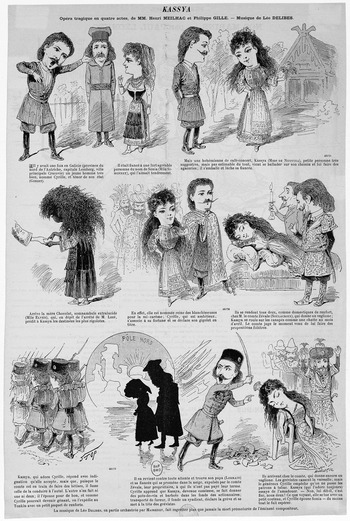
Kassya. Opéra tragique en quatre actes de MM. Henri Meilhac et Philippe Gille. Musique de Léo Delibes : [estampe] / Stop [sig.] ; Michelet sc. [sig.]

The poem Kassya departs significantly from the original novella. Sacher-Masoch's story opens with a long, six-page description of the Galician landscape by the author-narrator, who is traveling across its wintery, snow-covered plains by sleigh. Seeking refuge from a storm, the narrator and his driver come across an army outpost manned by Frinko Balaban and local peasants. Balaban offers his guests shelter and, in the course of the evening, is encouraged to tell the story of his love for Kassya.
The basic premise of his tale is a woman's betrayal of a man's love through egoism and pursuit of pleasure. Balaban loses his fiancée Catherine (or, in the diminutive, Kassya) to a Polish lord of an estate, to whom they are both subject. She leaves behind her peasant world and adopts the life of a libertine, going horseback riding, smoking cigars, and whipping the serfs. Meanwhile, Balaban enlists in the Austrian imperial army and lives a life of quiet renunciation. The experience is a formative one, as he helps the Ruthenian peasants organize against their Polish oppressors and travels throughout the Austrian Empire learning about and educating himself on civilization, law, and justice. He fights on behalf of the Austrian emperor during the Hungarian Revolution of 1848–1849, taking part in military campaigns in the Carpathian (Krapacks) Mountains, Košice, Tarcal, Kapolna, and Isaszeg. When Balaban returns home, he discovers that the count, to whom Kassya was married, has been imprisoned, and that she, in the meantime, has taken up an adulterous relationship with a neighbor. The soldier ends his days watching Kassya from a distance, in all her opulence, dressed in rich furs, the woman from whom he so easily received his first, and only, kiss. He muses, “N'a-t-elle pas ses krakouses et ses Cosaques? Les grands seigneurs lui baisent la main. Pourquoi ne serait-elle pas heureuse? [Doesn't she have her pseudo-Cracovians and Cossacks? The great lords kiss her hand. Why wouldn't she be happy?]”Footnote 54 With these closing words, Balaban does not blame Kassya for her infidelities but, rather, sees it as the inescapable fate of female nature within the political climate of the day. Kassya, because state power prevents her from behaving freely as a human being, resorts to exercising an alternative, unnatural form of power: domination over men. For Sacher-Masoch, it is those who are most frequently oppressed who accumulate “the cultural memory of how to oppress those who have been successful within the ruling hegemony.”Footnote 55 The only true happiness for either of the two former lovers lies in the escape from power relations and the full acceptance of death: a good premise for an opera, but one that was not followed.
It is easy to see why Delibes liked Philippe Gille's and Henri Meilhac's selection of “Frinko Balaban.” The meanderings of Balaban from his native Galicia, near the city of Kolomyia to the war front in Hungary, in many ways retrace, in reverse, the path of the composer's own journey in 1885 to Hungary, the Carpathian Mountains, and Galicia. And just as the trip offered many opportunities for Delibes and the other Frenchmen to honor the martyrs of the Spring of Nations, the chronological backdrop to “Frinko Balaban” suggests the imminent 1848–1849 revolution that began in France and then encompassed much of Europe. We can see, therefore, in the choice of “Frinko Balaban” several contextual layers that coincide with Delibes's own Austro-Hungarian and Austro-Galician experience.
Gille's and Meilhac's libretto for Kassya differed from the plot of “Frinko Balaban” in a number of ways. The most significant differences were the characterization of Kassya, the introduction of Sonia as another love interest for Balaban, who in the opera is renamed Cyrille, and the story's ending. The focus of Sacher-Masoch's novella was in the narration of the narrative (i.e., the telling of the story), with the story of Frinko Balaban's and Catherine's love serving as a pretext to reflect upon the nature of power politics within the Habsburg Empire. Gille and Meilhac changed Kassya from a Ruthenian peasant to a Bohemian gypsy, and transformed her character from a dominating libertine to a fickle yet virtuous heroine. Her sacrificial death at the opera's end allows the hero, Cyrille, to marry the sweet and patient village girl, Sonia. The libretto to Kassya may be summarized as follows:
Act 1. A public square of the village of Zevale. Cyrille puts down a group of local bandits, and, as it is the Feast of the Epiphany, the villagers honor him by designating him King of the celebration. Cyrille's father, Kostka, warns him that the bandits are under the protection of Count Zevale. Alone, Cyrille thinks of Kassya, and then encounters her and declares his love. Kassya spurs his devotion, and Sonia begins to suspect that Cyrille loves another. During the festivities, a fortune-teller reveals to Kassya that her future holds honor and wealth, and foretells to Sonia that hers will be one of happy, but humble, domesticity. Cyrille chooses Kassya as his queen for the night.
Act 2. A room in the castle of Count Zevale. Count Zevale plots to rid himself of his rival, Cyrille. Under the pretense of a party at his castle, he invites Cyrille to help with the decorations. Cyrille encounters Kassya there. She confesses that the Count has offered her to be mistress of the castle, but under pressure admits her love for Cyrille. Austrian soldiers arrive to take Cyrille among their ranks, as he has been enlisted by the Count. Kassya discovers the Count's treachery and asks for Cyrille to be released. The Count makes an offer of marriage, and he and his men raise a toast proclaiming victory.
Act 3. The edge of a forest, two years later. Kostka and Sonia eagerly await Cyrille's return. After a rejoicing reunion, Cyrille learns that the Count and Countess of Zevale have devastated the local peasants by imposing excessive taxes and have driven many from their homes. Sonia tells him that the Countess is Kassya. Cyrille vows to defend the village against the noblemen's tyranny. A group of vengeful peasants bearing scythes gathers, and the men elect Cyrille as their leader.
Act 4. A large hall of the castle of Zevale. The Count and Countess of Zevale and their noble guests have gathered for a party at the castle. They are entertained by Kassya, who sings a song (or dumka) about love, and a group of gypsy dancers perform traditional folk dances. After the entertainment is over, the noblemen encounter the peasants who have forced their way into the great hall. The insurgents want to execute the Count and Countess, but are stopped by Cyrille. With the support of Kostka and the village elders, mercy is granted, and the Count and his cohorts are to be exiled. Cyrille and Sonia plan to wed. Kassya throws herself at Cyrille, asks for his forgiveness, and affirms that she has always loved him. He begins to weaken, but Kostka helps bring him to his senses. Kassya realizes that all is lost, and mortally stabs herself with a dagger.
The above subject matter and setting were found by theater critics not to be lacking of interest and lyrical character, but the overall plot was deemed overcomplicated, overembellished, fragmented, and too episodic. The disjointedness of the libretto detracted from the narrative, which was weighed down by episodes “d'un exotisme trop ingénu [of an too ingenuous exoticism]” for the nerves of Parisian spectators.Footnote 56 One critic wondered what had compelled a composer with Delibes's talent for finesse and grace to compose a score out of such a “cobweb,” and another critic asked out of what “oriental jewelry” the fragments were decorated.Footnote 57 The general critique was directed at the opera's retrograde style, where the focus was on numerous interludes—“des végétations parasites”—rather than on the development of the characters and unity of action.Footnote 58 The opera was overwhelmed by choral pieces, such as the choruses of drinkers, Jewish merchants, Ruthenian peasant girls, Austrian recruiting officers, and Polish lords. The assessment of the verse did not fare better than the plot. Even the authors of the poem realized that there were problems with the lyrics. Philippe Gille was still reworking lines “de quelques ‘vers odieux’ [of some odious verse]” in mid 1892, as well as lines penned provisionally by Delibes himself.Footnote 59 Criticism also arose with regard to the plot's similarity with Carmen. Some detractors dismissed the opera as simply another, less interesting, less scenic version of Bizet's work. It was characterized as a “Carmen du Nord” devoid of color, relief, and grace: What drove Meilhac to recreate the plot of Carmen? Kassya resembles Carmen, Cyrille a mild Don José, and Sonia might have just as easily been named Micaëla.Footnote 60
The Music
Delibes, given the complexity of the action and surfeit of scenes in Kassya, wrote a quantity of arrangements incorporating the Polish, Ruthenian, Hungarian, and other motifs that he heard back in 1885. His final piano-vocal score included five acts and thirty pieces, nine of which were choruses and one a ballet. The reviewers initially criticized the opera, finding that it was less composed than juxtaposed. The faults lay mostly with Massenet's orchestration and the retrogradation of Delibes's score as compared to the musically revolutionary works pioneered by Richard Wagner twenty years earlier. Wagner's works were initially greatly resisted by the French because of their aversion for all things German, but the staging of La Walkyrie (sung in French) at the Palais Garnier in May 1893 marked a significant reversal in opinion. This opera was a critical and popular success. The contrast between Delibes's opera a month earlier, a few blocks away at the Opéra-Comique, and Wagner's triumph at the Opéra de Paris made the French composer's music seem all the more outmoded. Most commentators of Kassya did acknowledge that the work in Delibes's sole hands would have probably been different. He would have made changes to serve the artistic interests of the work. He would have kept the original dialogue in place of the recitatives, which weighed down the work, and also subtracted scenes during rehearsals. Reviewers did, however, praise certain aspects of his music.
Critics concurred on the beauty of a number of musical pieces. The two that most stood out for them were the dumka sung in the fourth act by the Romanian-born soprano, Margareta Iamandi-Nuovina, in the role of Kassya, and the “swallow” aria (l'Hirondelle) sung by soprano Cécile Simonnet in the role of Sonia during the third act. The dumka is a specifically Ukrainian form of folk music, dating from the Cossack period, and is associated with the mournful lyrico-epic works traditionally recited to the accompaniment of a bandura. In Kassya, the song takes the form of an elegy, with a cavalier refrain “C'est l'amour, un martyre, un sourire/Tour à tour, c'est l'amour! [It is love, a martyr, a smile/Alternatively, it is love!],” that one reviewer admired for being “brutal comme l'oubli [brutal as oblivion].”Footnote 61 The romance “Air de l'Hirondelle” was deemed exquisite and original with its fluid, elusive accompaniment, and the audience enthusiastically demanded an encore. The aria had been one of Delibes's first compositions for Kassya, undertaken when the opera was still just an idea while visiting Hungary. One of his travel companions, Émile Blavet, remembered Delibes sketching the song one evening in Budapest eight years earlier.
Critics praised other music in the first act, including: Cyrille's narrative “C'était là-bas sous les aulnaies” [It was there under the alders]; Kassya's entrance to the accompaniment of a melancholy flute; Cyrille's and Kassya's duet; and, above all, the fortune-teller's prediction, which was deemed to have been sung intelligently by the mezzo-soprano Suzanne Elven, and was considered one of the most striking and successful pieces of the opera. Singled out for commendation in the beginning of the second act were Kassya's Slavic song and prayer. The first act was considered the best of the four, and the beginning of the second revealed a few melodies of distinction and originality. As these were the parts orchestrated by Delibes, they were the most true to his original intentions. The third act drew admiration only for its symphonic prelude, La Neige, and the subsequent chorus, Choeur des Frileuses.
The ballet, however, was the chef d'oeuvre of the opera, which consisted of four instrumental numbers: an obertas, a Ruthenian dance (a kolomyika), shumka, and trepak. The names of these Polish, Ruthenian, and Cossack folk dances evoked “une saveur vraiment originale [a truly original flavor]” and brought the Galician world of Sacher-Masoch alive, with their penetrating local color, vibrancy, and instrumental grace. Nonetheless, some critics confused the origins of the music and identified the melodies as Czech, Hungarian, or, simply, from those “régions du Nord.” Polish critics, who knew that the opera was trying to capture Galician folk melodies, found either the plot contrived or the music unrecognizable. Their unenthusiastic appraisal, aside from pointing out the textual and musical flaws of the opera, may have also been a reaction to what they would have certainly understood as a negative, if not hostile, depiction of the Polish aristocracy. The Polish reviewers obliquely criticized Delibes for not having felt “the Slavic spirit” and for not having captured the “typical” folk character and temperament of Galician melodies.Footnote 62
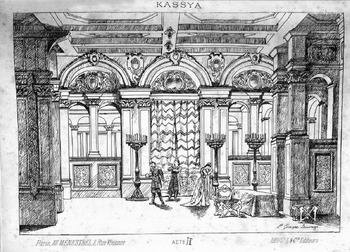
Lithographed frontispiece of a set design for Act II by A.A. Georges-Sauvage.

The music to the Ruthenian dance was oddly, yet effectively, composed for the clarinet and flute to the accompaniment of the mournful rhythmic ringing of the glockenspiel, while that of the shumka was set to the melancholy solo of a gypsy violinFootnote 63 – the latter folk dance surely inspired by the old Roma violinist Delibes had heard that one evening in Hungary back in 1885.
With the ballet, Delibes was in his element, and the Parisian press easily recognized the hand that had signed Coppélia and Sylvia. The music possessed the color and delicacy, and character and ingenuity, that had characterized his earlier works, and which had led composers such as Tchaikovsky to consider Delibes's ballets as far superior to “the monsters” the Russian composer had produced.Footnote 64 Following a performance of Kassya, one French journalist regretted that the entire opera had not been treated in pantomime. Another critic wished that Delibes had applied the motifs he had collected, “ces motifs à éperons” [these galloping motifs], toward creating a sequel to Coppélia rather than seeking “à l'aide de piments exotiques” [the help of exotic spice] to make the audience forget Lakmé.
The Staging
The director of the Opéra-Comique, Léon Carvalho, despite some hesitations regarding the production, took great care to stage Léo Delibes's posthumous work according to the composer's original wishes. The costumes were designed by Théophile Thomas, and the scenery was painted by Alfred Rubé, Philippe Chaperon, and Marcel Jambon, all based on reproductions and drawings from Galicia. The action of Kassya takes place in the village of Zevale in Galicia, presumably a fictitious place, but based on the events portrayed and scene descriptions, the village is located in the area of Pokutia, in the Carpathian foothills between the upper Prut and Cheremosh rivers. The depiction of Galicia on the stage of the Opéra-Comique was viewed favorably, especially in terms of the beautiful decor and original costumes. The exotic location of Kassya was new to French theater—“les pièces galiciennes sont rares [Galician plays are rare]”—and brought geographical variety to Parisian theatergoers who had had their fill of the grand spectacle of Au Dahomey at the Théâtre de la Porte St. Martin, a play featuring the French army's victory over the Dahomeans (Beninese) in the war of 1890.Footnote 65 The first scene depicted a Galician village square, in which “des coquettes petites maison [pretty little houses]” were set under the shade of lush trees. The second and fourth acts portrayed the great hall of Count Zevale's castle, and the third represented a wintry forested Galician landscape. The scenery for the village square and forest were thought particularly beautiful.
The Galician locale made possible the presentation of a multiclass and multinational society, and the opera included diversely costumed peasants, lords, merchants, soldiers, fortune-tellers, and musicians. Critics heard reports that those costumes for the opera's principals were ordered directly from Galicia. Some of the costumes were declared superb, such as the one worn by baritone Gabriel Soulacroix as Count de Zevale, who was dressed dripping in wealth, “littéralement ruisselant [literally dripping],” from head to toe, in his fur hat and boots. Tenor Etienne Gibert,Footnote 66 who performed the role of Cyrille, was outfitted modestly as a peasant, but in the third act donned a respectable military uniform.Footnote 67 The costumes for the supporting cast, however, were criticized for being “d'effroyables oripeaux [appalling rags]” that one would wear penitently during Lent, a sort of Lenten Array, rather than the traditionally colorful clothing worn by Galician peasants. This critic, Street, sardonically suggested that the Austro-Hungarian ambassador to France should raise a diplomatic incident over these costumes, for “On ne se moque pas à ce point du peuple galicien [We do not mock the Galician people on this point].”Footnote 68
The Politics
The opera, despite its revolutionary subject, had little in its plot or staging (or even costumes) to arouse the ire of Austria-Hungary or to provoke a formal protest by the Dual Monarchy's Ambassador to France, Ladislaus Graf von Hoyos-Sprinzenstein. Politically, there was also little in the work to agitate German or Russian diplomats, especially during this period of Franco-Russian rapprochement, when France was in the process of formalizing a military alliance with Tsar Alexander III. The rebellion depicted in Kassya was not some veiled allegory for a future war with Germany or, for that matter, any other state and only held coincidental parallels to the Bulgarian Crisis of 1885–1888. By means of Galicia as an imperial borderland, any metaphorical allusions to the regaining of the lost territories of Alsace and Lorraine by France were lost in the overly complicated plot. The actions taken by Cyrille and his fellow peasants, and the self-sacrifice of Kassya, essentially support the imperial and patriarchal status quo.
Sacher-Masoch held, as Ulrich Bach writes, “a distinctive utopian vision of a multi-cultural, property-free, communal Empire.”Footnote 69 In his “Frinko Balaban” and other novellas in the Legacy of Cain cycle, the author described ethnic and sexual tensions set against the backdrop of Galician provincial politics to explore and criticize institutional power that oppressed peasants, national minorities, and women. His identification with the dominating female characters of his stories, such as Kassya, was meant to show the degradation of a society under the autocratic rule of the nobility, or one at war. The oppression of one or another social class, race, or gender would lead inevitably to the same sadistic power relations, such as those revealed in “Frinko Balaban,” where the Polish landowners cavalierly and brutally mistreat their serfs, and in a reversal of roles, Kassya commands and exploits men's attentions. The Austrian writer held out hope for the development of an all-inclusive Austrian patriotism, by which loyalty to the state supplanted that to any single nation, so that “the various East European peoples could preserve an equality of political status under the umbrella of Habsburgs' rule.”Footnote 70
Delibes's Kassya took as an essential part of its plot the failed Polish aristocratic uprising of 1846 that, in turn, provoked a bloody peasant counter-rebellion. The peasantry received encouragement and support from the imperial government to strike down the uprising, which pitted self-conscious Poles against nationally indifferent ethnic Poles, the latter who were either Galician peasants, Polish-speaking Catholics, Masurians, imperial Austrians, or all the above.Footnote 71 The libretto, however, did not identify any of the peoples by nationality, and only those in the audience with knowledge of Galician ethnography or history would have understood the Polish-Ruthenian conflict within the original plot, the action of which invoked the 1848–1849 revolution. Spectators were not meant to sympathize with Kassya's demise, for Cyrille's destiny was to be married to the modest Sonia:
Kassya: Do you remember that gypsy fortuneteller, the one who read our futures, from your palm and mine? She promised me greatness. And I die a Countess! She promised you [Sonia] happiness ... Happiness! Fate has kept its promise!Footnote 72
Themes of national, religious or sexual freedom implicitly suggested in Sacher-Masoch's original work were absent in Gille's and Meilhac's poem. The overriding message was loyalty to the emperor in Vienna. The peasants' allegiance to the Austrian Empire can be seen, for example, in this exchange between Cyrille and Count Zevale's intendant, Kolenati:
Cyrille: He [Count Zevale] protects all our enemies, the miscreants of this land!
Kolenati: Ah! what big words! We can reach an agreement.
Cyrille: The Count fears the Emperor, and he wants to rely on us?
Kolenati: Maybe!
Cyrille: We recognize only the authority of the Emperor!
Kolenati: Ah! bah! Austria is far away, and your lord is nearby.Footnote 73
The principles most held up in the opera were those of benevolent rule, social equality, and justice, and not of national determination or insurrection.
With this in mind, let us return to Delibes's trip to Austria, Hungary, and Galicia and remind ourselves of the context that sparked the composition of Kassya. He and the other delegates' travels through these lands provided ample opportunities to honor the martyrs of the Spring of Nations. The visit was also a time to reflect on the commonalities between two isolated countries—France and Hungary—when continental politics were dominated by Germany, Austria, and Russia, and a time to consider the situation of national minorities living within the Habsburg Empire. For when France preached “l'indépendance des peuples et la liberté des hommes [independence of peoples and the liberty of man],” alongside Poland and Italy, it also thought of Hungary.Footnote 74 That said, of particular interest was the fate of the Poles, whose political elites by and large were based in France.
Delibes's Galician leg of the journey, undertaken because of personal ties to the province, led to a discovery of a different sort through his connections with members of the Great Emigration and the fieldwork he carried out. Galicia was neither a German, a Polish, nor a Ruthenian nation. Rather, just as an astute reader of Sacher-Masoch surmised, the Galicians were a people who: “vivent de leur vie propre, de la vie de leur temps et de leur pays. Paysans et seigneurs, juifs et belles dames, tous sont Galiciens […] servantes et laboureurs, fermiers et cabaretiers. Ce ne sont plus des abstractions, ce sont des créatures de chair [live their own lives, the lives of their time and their country. Peasants and lords, ladies and Jews, they are all Galicians [...] servants and laborers, farmers and innkeepers. They are no longer abstractions, they are creatures of the flesh].”Footnote 75
Despite this realization, did Delibes, in trying to document and localize the various melodies and songs that he collected, end up with an opera that failed to impart an all-encompassing representation of Galicia? For French audiences, the style of music in Kassya held too many different accents. By focusing on the particular, Delibes's opera was considered episodic, a series of curious and dissimilar juxtapositions. However, in the depiction of scenes of drinkers, serenades, the feast of Christmas with its procession of Jewish merchants and gypsies, recruitment forces, orgies of stately feasts, vivacious gypsy and peasant dances, agrarian revolts, and invasion of castles, Delibes did capture a sense of Galician culture in nonabsolute terms, even if not as masterfully as Sacher-Masoch did, in his own version of the kolomyika dance.
Conclusion
After its run from March–April 1893, Kassya was not staged in its entirety again. Though the initial critical reaction after the premiere on 24 March was generally negative, soon thereafter there were some regrets that the opera had not found a wider audience. Some critics held hope that it would receive renewed attention. Johannes Weber, a music columnist for Le Temps, reminded his readers that Bizet's Carmen did not triumph until after its tour abroad and return from Germany. True enough, reviewers of Carmen, after its premiere and performances in 1875 to early 1876, expressed disappointment with the music; some declared it dull and obscure, or too Wagnerian, and found the plot amoral. There was little public enthusiasm, and the opera played to half-empty houses. After re-orchestration and the addition of recitatives by Ernest Guiraud, Carmen won favor first at the Vienna Court Opera, and then achieved further success with performances in Brussels, London, New York, St. Petersburg, and Germany. In Weber's opinion, Kassya, too, would do well to travel. The leading music journal of the time, Le Ménestrel, agreed with this assessment and felt that the Delibes's score had fallen victim to special circumstances, and after returning from a run abroad, the opera could “astonish us” for having disregarded its real merit.
This opinion was shared by one of the contributors to the short-lived but influential British journal New Quarterly Musical Review, which published a detailed review of the dramatic, musical, and structural aspects of Kassya, with its main themes, motives, and harmonic treatments outlined by means of multiple musical examples. The anonymous author—in all likelihood one of three composers: the editor Granville Bantock or one of the two assistant editors, William Wallace or H. Orsmond Anderson—regretted that Delibes's opera had been shelved and forgotten so soon after its premiere, mostly thanks to a too-involved libretto and tangled plot. He offered the French composer his posthumous due and recognized the stylistic innovativeness and self-command that Delibes had applied to his final composition. The score was judged “ambitious” and “polished” and “more advanced” and “far removed” than the usual fare associated with Delibes's name. The reviewer stressed a couple of Delibes's achievements: first, that he had elevated the importance of musical accompaniment to equal that of the voice; and second, that he had contrived to make the orchestral voice interesting and “not a mere echo” of that of the singers. The review concluded with the statement that “the freedom with which the themes” in the opera Kassya were handled “makes one regret the composer's death at a time when he was producing his best.”Footnote 76
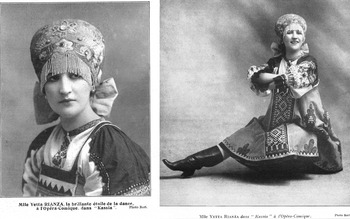
Yetta Rianza in the one-act ballet, Danses slaves (adapted from Kassya), at the Opéra-Comique, 1913. Source: Comœdia illustré, 20 February and 5 March 1913.

Despite Johannes Weber's recommendation, and the interest in the opera across the Channel, Kassya did not travel. Instead, individual pieces, such as the polonaise, Kassya's “chanson slave,” the interlude “La neige,” and the ballet music, were performed periodically at concerts and salons during the 1890s to the outbreak of World War I. In February 1913, Mme. Mariquita, one of the most respected and prolific choreographers in Paris and ballet mistress of the Opéra-Comique, arranged and produced a one-act ballet Danses slaves based on Delibes's dance music. The ballerinas included Yetta Rianza, Thérésina Negri, Darling, and Richaume, and the male role was performed by the celebrated Kyiv-born dancer Senka Malatzoff. The opportunity to hear once again Delibes's music on a grand stage was met with appreciation. The initiative was pronounced a perfect success, the music delicate and original: “Pauvre Kassya! Qui se doute aujourd'hui que c'est peut-être la plus charmante des oeuvres de Delibes, la plus abondante en idées neuves et en rythmes variés [Poor Kassya! Today, who knows whether this might be the most charming of Delibes's works, the one with the most innovative ideas and varied rhythms].”Footnote 77
I leave it to musicologists to debate the innovativeness of Delibes's score to Kassya and to what extent Massenet's orchestration kept to or deviated from the original music. The avenues of inquiry for this research are still many, such as comparisons of the various drafts of the libretto and the score, and the discovery of any extant correspondence between Delibes and his Galician colleagues and acquaintances. Historians can explore in what ways French politicians and publicists, at a time of strengthening ties with Russia and the growth of Pan-Slavism, influenced public understanding of Galicia and its Slavic population. What was certainly inventive on Delibes's part was to create a distinctive work of Galician character and to bring it before a mass French audience. These included numbers of people involved in the staging of the opera—composers, librettists, costume and set designers, theater directors, conductors, choreographers, singers, musicians, dancers, and so forth—as well as those on the other side of the stage—theater-goers and critics. Even if only for an evening or two, those involved in the creation, interpretation, and reception of Kassya took part in or were offered a tableau of nineteenth-century Galician life. And in France that was a very new idea.
Performance history of Kassya, opéra en quatre actes et cinq tableaux, the poem by Henri Meilhac and Philippe Gille (after Leopold von Sacher-Masoch), with music by Léo Delibes
-
Paris. Théâtre National de l'Opéra-Comique.
-
1893, March 24, 27, 29; April 6, 8, 13, 15, 18. Receipts: 24, 924 francs. Principal performers: Margareta Iamandi-Nuovina (Kassya), Etienne Gibert (Cyrille), Cécile Simonnet (Sonia), Gabriel Soulacroix (Le Comte de Zevale), Lorrain (Kostka).
-
Ballet
-
Paris. Théâtre National de l'Opéra-Comique. “Danses slaves.” (choreographed by Mme. Mariquita)
-
1913, February 1, 3, 8, 23, 24, 27. 28. Performers: Yetta Rianza, Darling, Thérésina Négri, Richaume, and Senka Malatzoff.
-
Concerts (selected)
-
Paris. Jardin zoologique d'acclimatation.
-
1894, 24 June, 19 August; 1895, 3 February. “Polonaise.” 1894, 15 July. “Mazurka.”
-
Pau. Casino.
-
1896, March. “La Neige,” “Polonaise,” and ballet music (under the direction of Edouard Brunel).
-
Lille. Palais-Rameau.
-
1896, May 31. “Polonaise” (under the direction of Oscar Petit).
-
London. Queen's Hall Promenade Concerts.
-
1897, January 9. “Polonaise” and ballet music (under the direction of Henry J. Wood).
-
Paris. Private concert at the home of Mme Léo Delibes.
-
1899, January. Fragments from Kassya (choruses sung by students of the Conservatory under the direction of André Wormser).
-
Derby (England).
-
1899, December 6. Ballet music (under the direction of Harold Henry).
-
Dieppe. Casino.
-
1900, August. “Thème slave et variations de Kassya” (under the direction of Adolphe Bourdeau, with Galand).
-
Monaco. Cercle des étrangers.
-
1913, July. “Polonaise” (under the direction of Louis Vialet).
Reviews of Kassya (Premiere on 24 March 1893)
-
Paris.
-
1893: Le Temps (24 Mar., 27 Mar. 1893); Le Figaro, Le Gaulois, Le Matin, Le Petit parisien (25 Mar.); L'Écho de Paris, Gil-Blas, L'Intransigeant, Le Jour, La Lanterne, Le Ménestrel (26 Mar.); Le Temps (27 Mar.); La Nouvelle revue (Mar.-Apr.); Journal des débats, Revue bleue (1 Apr.); Journal amusant (1 Apr., 8 Apr.); Les Annales politiques et littéraires, Le Monde artiste (2 Apr.); Revue du cercle militaire (9 Apr.); Le Correspondant (10 Apr.); La Revue hebdomadaire (Apr.); Revue d'art dramatique (Apr.-June); La Revue encyclopédique (15 Apr.); Les Annales du théâtre et de la musique (1893 (1894)).
-
London.
-
1893: The Morning Post (29 Mar.); The Era (1 Apr.).
-
1895: New Quarterly Music Review (Nov.)
-
Milan.
-
1893: Gazzetta musicale di Milano (26 Mar., 4 Apr.)
-
Stockholm.
-
1893: Svensk musiktidning (1 Apr.)
-
Warsaw.
-
1893: Echo muzyczne, teatralne i artystyczne (27 Mar. (8 Apr.)).
-
New York City.
-
1893: New York Times (25 Mar., 24 Apr.).
-
New Orleans.
-
1893: The Daily Picayune (16 Apr.)