Introduction
Grapholita molesta Busck, commonly known as oriental fruit moth, belongs to the Lepidoptera of Tortricidae, which is one of major pest species of stone and pome fruits mainly belonging to the Rosaceae family (van der Geest & Evenhuis, Reference van der Geest and Evenhuis1991). Its life cycle typically includes four developmental stages: egg, larva, pupa and moth, with larvae damaging the shoots and fruits of peach, apple, pear, plum, cherry, loquat and hawthorn worldwide (Kim et al., Reference Kim, Jung, Kim and Lee2011). In Taigu County, Shanxi Province, China, an outbreak of oriental fruit moths leaded to a rate of wormy peaches of up to 97.2% in 2008, causing almost total crop failure and severe economic loss (Zhao et al., Reference Zhao, Gao, Yang, Zhang, Wang and Ma2013a ). Thus, there is an urgent need to enhance the prevention and control against oriental fruit moths.
Monitoring pest populations is a basic and important daily work in pest prevention and control (Kim et al., Reference Kim, Jung, Kim and Lee2011). Presently, pest counting is primarily based on manual work, which, however, is labor-consuming, inefficient and lagged. Automatic monitoring methods based on automatic counting by digital image analysis can reduce labor-cost and improve measuring efficiency (Walton et al., Reference Walton, Daane and Pringle2004) (Taylor, Reference Taylor1977; Marotz et al., Reference Marotz, Lübbert and Eisenbeiss2001). Digital image-processing technology makes it possible to achieve real-time pest counting (Jianwei et al., Reference Zhang, Wang and Shen2006). Many researchers have applied computer image-processing technologies to insect counting. For instance, Mu has presented a method of searching connected components in binary images to count whiteflies (Mu, Reference Mu2003); Qiao used sticky traps in conjunction with an image-processing system to estimate density of Bemisia tabaci (Qiao et al., Reference Qiao, Lim, Ji, Chung, Kim, Uhm, Myung, Cho and Chon2008).
Currently, many pest forecasting methods have been presented based on periodic distance, accumulated temperature, phenology and effective accumulated temperature (Gao et al., Reference Gao, Lu, Sun and Kong2005), which, however, involve various variables and have poor operability and undesirable accuracy. Logistic mathematical models, especially the mathematical ecology of logistic model, have been widely applied to pest forecasting (Wickwire, Reference Wickwire1977). Some researchers have employed a logistic model in studying the population dynamics of brown planthoppers (Nilaparvata lugens) (You & Pang, Reference You and Pang1995). Additionally, Zhao has constructed a logistic growth and economic threshold model for pest monitoring by trapping with sex pheromone (Zhao et al., Reference Zhao, Rong, Zhao, Kong, Zhang and Ma2013b ). Thus, the logistic models have been proven to be a credible method to achieve automatic monitoring and forecasting of pests.
In this study, we attempted to establish a more accurate model for prediction of oriental fruit moths based on automatic counting of the trapped oriental fruit moths. First, sex pheromone traps were set to trap the oriental fruit moths in the peach orchard; then, a digital image-processing technology was employed to achieve automatic counting of the trapped oriental fruit moths; finally, a logistic regression model was established to forecast control threshold and key control period in the peach orchard.
Materials and methods
Monitoring of oriental fruit moths in peach orchard
Oriental fruit moths were consecutively monitored in a peach orchard in Wanghuizhuang Village, Taigu Country, Shanxi Province, China (E: 37°29′57.85″, N: 112°37′32.80″, H: 795 m) from 28 April to 19 September in 2009, from 21 April to 12 September in 2010, and 15 April to 15 September in 2011, respectively. Within each area of 667 m2, five traps (Geruibiyuan Technology CO., Ltd., Beijing, China, 18 × 25 cm2) were installed separately to form a ‘W’ shape, with three replicates and a distance of 15–25 m between replicates. Each triangular sex pheromone trap consisted of a sex pheromone core at the center and a replaceable sticky card, which was hung at 1.5 m high above the ground. The sex pheromone core (Institute of Zoology, Chinese Academy of Sciences, Beijing, China) was approximately 1–2 cm away from the sticky card, which contained 200 µg of G. molesta busck sex pheromone (Z)- and (E)-8-dodecen-1-yl acetate (Z:E = 95:5). The sticky card was replaced by a new one every 3 days. Oriental fruit moths trapped on the white sticky cards were photographed using a digital camera (NIKON D50) to collect full view images at 8:00 a.m. every day. Meanwhile, the trapped oriental fruit moths were also manually counted by the same investigator. Meanwhile, the numbers of top-breaking and wormy fruits were also recorded from 20 May to 21 June once every 3 days using the ‘W’ sampling method each year. As larvae of oriental fruit primarily damage the shoots and fruits of peaches (Kim et al., Reference You and Pang2011), their numbers were determined as the numbers of top-breaking and wormy fruits. Then, the total number could be estimated on the basis of the number of trees within each area of 667 m2. All experiments implemented in this study were performed in accordance with ethical standards and approved by the Ethics Committee of College of Agronomy, Shanxi Agricultural University.
Automatic counting based on digital image-processing method
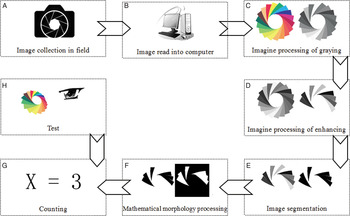
Full view images were collected for image analyses by the automated trap reading method using MATLAB R2010a software (fig. 1). First, all images of 3008 × 2000 pixels in JPEG format were numbered and imported into MATLAB software using the imread () function to generate image matrix I, which consists of true-color images containing both luminance information and color information. Each true-color image in m × n size was recognized as a matrix with a byte type of m × n × 3 image elements in the computer. Next, those true-color images were processed into grayscale images via converting pixel values into a range of 0–255 using rgb2gray () function. To reduce noise interference, histograms of the images was drawn using imhist () function, and the grayscale images were processed by smoothing and grayscale stretching using the following functions to enhance the contrast between objective and background, including imhist () function, graythresh () function, medfilt2 () function and imadjust () function (Xinwen & Zuorui, Reference Yu and Shen2001), Subsequently, to separate the background noise from moths, binarization of the grayscale images was performed to obtain binary images using im2bw () function. Afterwards, for image morphology processing, binary images were processed with erosion, expansion and segmentation as follows: Briefly, strel () function was applied to establish structuring elements of diamond as 5 × 5 and bwmorph () function was applied to perform opening and closing operations to remove background noise, respectively, together with imopen () and imclose () functions. Then, adjacent pest images were separated using the imerode () function and eye () function (Yan et al., Reference Yan, Chen, Zhang, Yuan, Cao and Zhou2011). Finally, pest number was automatically counted based on the external physical characteristic of oriental fruit moths using bwlabel () function.
Automatic counting by digital image-processing methods. (A) image collection; (B) image input; (C) graying of true-color image; (D) smoothing and gray stretching of the gray image; (E) image segmentation; (F), image morphology processing; (G) counting; (H) visual inspection.

Forecasting of oriental fruit moths based on the logistical model
To determinate the natural growth rate in the field, the number of adult oriental fruit moths caught by sex pheromone trapping was used for logistic fitting using Origin Pro 8 software. Finally, a logistic formula was established as follows: x(t) = N/(1 + Ce −rt ), where, x(t) is the increase in the number of adults; t represents time; N is the total number of adult pests in 30 days (the life cycle of the oriental fruit moths); r is the natural growth rate of oriental fruit moths; and C represents the pest growth rate under five traps, which can be calculated as follows: C = N − x 0/x 0 (x 0 is the number of trapped oriental fruit moths per day).
Forecasting of control threshold against oriental fruit moths
Furthermore, based on the assumption that the larvae of oriental fruit moths generally mature into adults within 18 days, the efficiency (Ec) of sex pheromone trapping can be measured by calculating the ratio of trapped adult oriental fruit moths to the adult oriental fruit moths speculated based on the investigated larvae. The life cycle of oriental fruit moths is 30 days, thus 30 days was used as the unit time for the counting of larvae, and then the pest number per day in the field was obtained. The accumulated increase of larvae in 30 days was calculated daily by the formula
 $L_T = \sum\limits_{i = 1}^{30} L $
(L, daily larvae increase; I, number of days; L
T
, the total number of oriental fruit moths in 30 days, which is the accumulation of larvae in 30 days). The daily trapping number x (t) was compared with L
T
to determine the trapping efficiency (E′), which was E′ = x(t)/L
T
. Because the trapping rate q was set as 1 in this model, the trapping efficiency (E′) equaled to trapping strength (E) of five sex pheromone traps. On the basis of the mathematical model established above, when the trapping and natural growth rates reached a balance point, the maximum sustainable trapping volume is considered as the control threshold. At this point, pest control can be most effective. The maximum sustainable trapping volume can be calculated as follows:
 $h_{\max} ^* = rN/4\left( {1 - E^*} \right)$
(
 $h_{\max} ^* $
is the maximum sustainable trapping volume; r, the natural growth rate of oriental fruit moths; N the total pests in the field; E* the trapping strength of the traps). The theoretical trapping strength can be calculated by the formula E* = r/(1 + r). The ratio of trapping strength E to theoretical trapping strength E* is used to determine whether prevention of oriental fruit moths is necessary.
Results
Automatic counting of oriental fruit moths
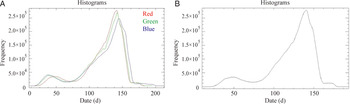
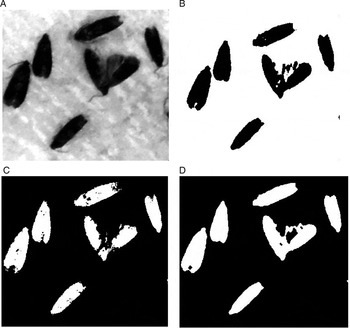
The true-color images were first processed into grayscale images, and then the range of gray values were determined. As shown in fig. 2, peak and valley values of the two peaks were determined as optimal thresholds. The image data were processed by median filtering algorithm to minimize noise interference from the target pests. Next, grayscale images were subject to binarization transformation based on their peak and valley values using the watershed transformation algorithm to extract the image data based on the morphological characteristics of oriental fruit moths (fig. 3A, B). Afterwards, a linear vector matrix of structural element was constructed. Poriform noise that was less than structural element was removed using an expansion algorithm to integrate the originally connected; the gaps at the image edge were filled to make the morphology of oriental fruit moths intact to reduce noise interference and improve recognition rate (fig. 3C, D).
Histogram of a gray image of an oriental fruit moth. (A) true-color image (RGB image); (B) gray image.

Image segmentation (A, B) and mathematical morphology processing of oriental fruit moth (C, D). (A) Gray image; (B) binary image; (C) anti-color binary image; (D) morphological processing results.

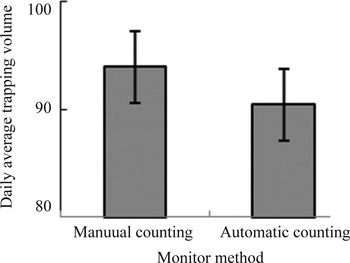
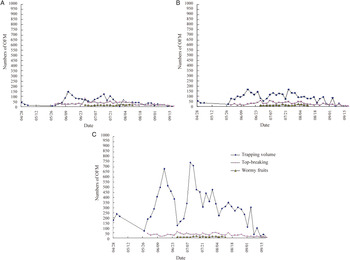
The daily average volume by automatic counting was compared with that by manual counting (fig. 4). And it can be found that the accuracy rate of automatic counting by MATLAB software reached 98.33%. A t-test further indicated that the consistency between automatic counting and manual counting reached up to 0.99 (P < 0.05), implying minor difference between them. Furthermore, the results of automatic monitoring showed that oriental fruit moths had four occurrence peaks each year: 23 April, the overwintering generation; 9–23 June, the first generation; 15–25 July, the second generation; 10 August–10 September, the overlapping occurrence period of the third and fourth generations. Overall, the dynamic of top-breaking was consistent with that of the occurrence of trapped adult oriental fruit moths, despite a time lag for the occurrence of top-breaking (fig. 5); meanwhile, a time lag of 15–18 days between adult occurrence peak and the larval damage peak was also observed (fig. 5).
Daily average trapping volume of automatic counting and manual counting.

Occurrence dynamics of oriental fruit moth. (A) 2009, (B) 2010, (C) 2011.

Forecasting of control threshold based on the logistic model
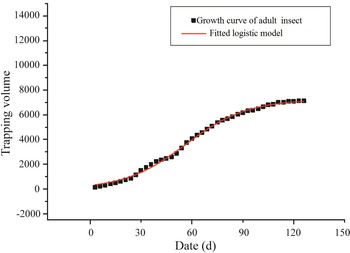
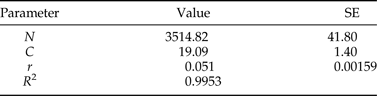
The number of increased adult moths during the growth period (30 days) and growth curve were consistent with the logistic model (fig. 6). Using Origin Pro 8 software, the number of adult oriental fruit moths caught by sex pheromone trapping was used for logistic curve fitting and subsequently a logistic model equation was generated, namely y = 3514.83/(1 + 19.09e −0.051x ) (R 2 = 0.9953). The parameters were shown in table 1, among which the growth rate (r) of the field populations of oriental fruit moths was 0.051 under the natural conditions. According to the equation E* = r/(1 + r), it can be concluded that theoretically, the sustainable trapping volume was reached at the trapping strength (E*) of 0.0485. Thus, when the actual trapping strength E was larger than E*, oriental fruit moths could be controlled below the control threshold (Zhao et al., Reference Zhao, Gao, Yang, Zhang, Wang and Ma2013a , Reference Zhao, Rong, Zhao, Kong, Zhang and Ma b ). The actual E value measured in the field was 0.0216, which was smaller than E*, suggesting that sex pheromone trapping of oriental fruit moths alone cannot control the oriental fruit moths under the control threshold effectively and thus other control measures are required. According to the model equation, the maximum sustainable trapping volume was 152.6 pests in 3 days when five traps were set within each area of 667 m2, indicating a control threshold of 10.17 oriental fruit moths per trap per day.
Fitted logistic model based on number of adult oriental fruit moths monitored by sex pheromone traps.

Parameters of fitting logistic model.

Forecasting of key control period based on the logistic model
One target for oriental fruit moths control is to keep the percentage of wormy fruits below 5% (Kim et al., Reference Kim, Jung, Kim and Lee2011). The dynamics data revealed that the percentage of wormy fruits reached 5% in the orchard from 9 to 12 July Therefore, it can be inferred that the larvae of the second-generation oriental fruit moths may be the main cause of economic loss in the peach orchard, and the first instar larvae caused a damage peak from 28 June to 1 July, implying this is a key period for the control of oriental fruit moths. As oriental fruit moths had four generations each year in the investigated area, continuous control of each generation is necessary in order to achieve an effective prevention. The key control period for prevention is when the average sustainable trapping volume of oriental fruit moths reaches 152.6 under five traps in 3 days. As the peak period of fruit damage will occur 15–18 days later, this period is considered as the key period for monitoring each generation of oriental fruit moths. Table 2 summarized the key periods of oriental fruit moth control for every adult generation monitored under sex pheromone trapping in 2012. At 25°C, the oriental fruit moths require 8–10 days from mating and spawning to hatching. Thus, when the average sustainable trapping volume was over 152.6 per five traps, there was a requirement to implement control measures for 5–7 days.
Maximum sustainable trapping volume and the date (2011).

Discussion
Pest forecasting is a prerequisite for the real-time and accurate monitoring of pest populations (Ke-qiang et al., Reference Si, Cao, Liu, Yang and Zhen2006; Wang et al., Reference Wang, Li and Pan2009). In this study, we first realized automatic counting of oriental fruit moths caught by sex pheromone trapping using MABLAB software, and then successfully established a logistic regression model to predict the control threshold and key control period. Furthermore, pest control indexes were developed to obtain a timely, accurate and effective forecast.
In the present study, we first used sex pheromone to trap oriental fruit moths, which is now widely used for the control of agricultural pests (Witzgall et al., Reference Witzgall, Kirsch and Cork2010). Sex pheromone can attract and trap specific pests specifically, thus avoiding the problems of pest classification and selection during image processing, accordingly simplifying the analysis process and increasing the measurement accuracy (Witzgall et al., Reference Witzgall, Kirsch and Cork2010). Next, we used digital image-processing technology to achieve automatic counting of oriental fruit moths caught by sex pheromone trapping. Image segmentation technique was used to extract the morphological characteristics of targets from the digital images. Usually, image segmentation can be performed by different methods including histogram method, optimal entropy thresholding method, minimum fuzzy entropy method and minimum error thresholding method (Yao et al., Reference Yao, Lü, Yang, Xue, Zheng and Tang2011). In this study, the optimal segmentation threshold was obtained by the median filtering algorithm. To extract morphological characteristics of oriental fruit moths, a series of algorithms can be employed, such as watershed transformation algorithm, corrosion and expansion algorithm, Gauss mixture model, simulated annealing algorithm, active contour algorithm and support vector machine algorithm (Beucher, Reference Beucher1992; Yaqiu et al., Reference Zhang, Wu and Wang2011). Herein, watershed transformation algorithm and corrosion and expansion algorithms were used to analyze images in order to collect accurate counting results. Weng has successfully separated locusts in extremely dense populations using the mathematical morphology method and watershed segmentation algorithm (Guirong, Reference Weng2008). Taken together, automatic counting was achieved here by using MABLAB software, which can save a lot of labor and time, thus improving the counting efficiency; furthermore, automatic counting is also proven to have a higher accuracy after comparing with manual counting.
Based on the automatic counting of oriental fruit moths in the field, a logistic model was established to predict the control threshold and key control periods against oriental fruit moths in the present study. The control threshold and key control periods against oriental fruit moths were predicted mainly based on the growth rate of adults. The dynamic of trapped adult oriental fruit moths based on the logistic prediction model was consistent with that based on the field investigation of larvae, suggesting a high credibility of the model.
The automatic counting and forecasting methods presented here allow researchers to conduct a long-term monitoring of agricultural pests in the field in a labor-saving, and more precise way, which were achieved by using certain digital image-processing software and establishing logistic regression model, respectively. More importantly, these methods have a potential for application to pest prevention and control in the agricultural management field. What's more, as the digital image-processing software used here can separate insects by their morphological characteristics, it may also be feasible to apply the digital image-processing method to the monitoring of smaller insects, such as scale insects, which cannot be easily recognized by visual inspection.
In the present study, the growth rate of oriental fruit moths was calculated based on the number of trapped adult oriental fruit moths in the field obtained by automatic counting, irrespective of environmental factors (e.g., temperature, light) or food condition. Actually, environmental factors such as temperature and rainfall, are significantly correlated with the oriental fruit moth population (Du et al., Reference Du, Guo, Zhang and Wu2009). Besides, the automatic counting and forecasting methods presented here also have other shortcomings. For example, the collection of photographs of oriental fruit moths on the white sticky cards is somewhat time-consuming; actually, we did not compare the cost and time between automatic counting and manual counting using experimental data. Additionally, the robustness of automatic counting and forecasting methods for large-scale monitoring of oriental fruit moths should be further validated. And we are planning to solve these problems in the coming future in order to improve the automatic counting and forecasting methods.
In conclusion, the automatic counting and forecasting methods can reduce labor and time costs, simply forecasting procedures, and improve maneuverability, thus complying with the requirements for standardization, networking, automation and visualization for pest forecasting. Our work provides a technical basis for automatic forecasting of oriental fruit moths, as well as other pest species, which has a potential for wide application to precision agriculture.
Acknowledgements
This study was supported by the special national nonprofit sector (agriculture) research (Grant no. 201103024), Shanxi province science and technology key project Foundation (20140311016-3), the National Science Foundation for Post-doctoral Scientists of China (Grant no. 125375), the Open Fund of the State Key Laboratory of Crop Stress Biology for Arid Areas (CSBAA2011-08), the Shanxi Agricultural University Innovation Fund (2010007, 2014YZ04), the Shanxi Province Science Foundation for Youths of China (Grant no. 2013021025-2), the Scientific Research Foundation of Shanxi Agricultural University (Grant no. 2013YJ11; 2013YJ45; 412564; 2012JY01; 2012JY04) and Plan to support young innovative talents of Shanxi Agricultural University (SXAU-BJRC-201201).
We wish to express our warm thanks to the undergraduates BaoLing Liu, YongMin Liu and Qintin Hao for their assistance in obtaining data from the field and to WeiDong Zhang and WengWeng Hu for their valuable added dimension to our research.