Implication
Due to their nutritive value and low environmental impact, there is an increasing interest on black soldier fly larvae meal (Hermetia illucens L.) as potential feed source in poultry diets. This study showed that insect meal from Hermetia illucens larvae can substitute conventional ingredients in the diet for broiler chickens, without any detrimental effects on meat quality parameters or heavy metal residues in the meat.
Introduction
Nowadays, insects are considered a novel and promising alternative dietary protein source for monogastric animals (Makkar et al., Reference Makkar, Tran, Heuzé and Ankers2014). Insects contain high quality and quantity of protein and are characterized by high feed to protein conversion rate (Makkar et al., Reference Makkar, Tran, Heuzé and Ankers2014). Furthermore, they can easily be reared on different secondary raw materials, thus allowing to reduce their disposal costs and promote reutilization of by-products (Makkar et al., Reference Makkar, Tran, Heuzé and Ankers2014; Boccazzi et al., Reference Boccazzi, Ottoboni, Martin, Comandatore, Vallone, Spraghers, Eechkout, Mereghetti, Pinotti and Epis2017; Meneguz et al., Reference Meneguz, Schiavone, Gai, Dama, Lussiana, Renna and Gasco2018; Ottoboni et al., Reference Ottoboni, Spranghers, Pinotti, Baldi, De Jaeghere and Eeckhout2018). Among the different insect species, black soldier fly (Hermetia illucens L., HI) larvae meal is already being used in developed countries as a feed for pets and exotic animals, including birds and fish. In relation to the nutritive profile, HI larvae contain large amounts of lipids, which show an extreme quantitative and qualitative variability, depending on the chemical composition of the rearing substrate (Spranghers et al., Reference Spranghers, Ottoboni, Klootwijk, Ovyn, Deboosere, De Meulenaer, Michielis, Eeckhout, De Clercq and De Smet2017; Meneguz et al., Reference Meneguz, Schiavone, Gai, Dama, Lussiana, Renna and Gasco2018). In addition, HI contains 58% to 72% saturated fatty acids (SFA) and 19% to 40% mono (MUFA) and polyunsaturated fatty acids (PUFA) of the total fat content (Makkar et al., Reference Makkar, Tran, Heuzé and Ankers2014). Moreover, the accumulation of toxic elements (i.e. heavy metals, mycotoxins and pesticides) is also one of the potential hazards associated with insect production (Belluco et al., Reference Belluco, Losasso, Maggioletti, Alonzi, Paoletti and Ricci2013); however, data regarding the chemical safety of reared insects are very scarce. Hermetia illucens has recently been tested as a feed ingredient in conventional poultry diets as a fat source in broiler chickens (Schiavone et al., Reference Schiavone, Dabbou, De Marco, Cullere, Biasato, Biasibetti, Capucchio, Bergagna, Dezzutto, Meneguz, Gai, Dalle Zotte and Gasco2017a and Reference Schiavone, Marzoni, Castillo, Nery and Romboli2018) and in laying hens and broiler quails as protein source (Cullere et al., Reference Cullere, Tasoniero, Giaccone, Acuti, Marangon and Dalle Zotte2016 and Reference Cullere, Tasoniero, Giaccone, Miotti-Scapin, Claeys, De Smet and Dalle Zotte2018; Maurer et al., Reference Maurer, Holinger, Amsler, Früh, Wohlfahrt, Stamer and Leiber2016), providing satisfactory results in terms of animal performance and gut morphology. In male broiler chickens, Dabbou et al. (Reference Dabbou, Gai, Biasato, Capucchio, Biasibetti, Dezzutto, Meneguz, Plachà, Gasco and Schiavone2018) demonstrated that increasing levels (50, 100 and 150 g/kg) of dietary HI meal inclusion may improve the live weight (LW) and dietary feed intake during the starter period. However, at the highest inclusion level, it may also negatively affect the feed conversion ratio and gut morphology. This suggests that low inclusion levels (50 or 100 g/kg) may be more suitable. However, no significant effects on the haematochemical and histological parameters were observed in relation to HI meal utilization. On the other hand, there is a lack of scientific information about the impact of the use of HI larvae meal on meat safety and quality traits. Hermetia illucens larvae meal utilization as protein source has recently been reported to not significantly affect meat quality parameters in broiler quails, with the only exception of a negative modulation of the fatty acid (FA) profile (Cullere et al., Reference Cullere, Tasoniero, Giaccone, Miotti-Scapin, Claeys, De Smet and Dalle Zotte2018). However, no studies are currently available on these aspects in broiler chickens.
Based on the above-mentioned paper and in order to provide reliable data on the potential use of insect meal in broiler chicken nutrition, the present research aims to evaluate the effects of dietary defatted HI larvae meal inclusion on the carcass traits and meat quality parameters, proximate composition, FA profile and heavy metals residues of broiler chicken breast meat.
Material and methods
Birds and diets
A detailed description of the experimental design is reported in Dabbou et al. (Reference Dabbou, Gai, Biasato, Capucchio, Biasibetti, Dezzutto, Meneguz, Plachà, Gasco and Schiavone2018). Briefly, 256 one-day-old male broiler chickens were reared from day 1 to day 35 and randomly allotted to four dietary treatments (eight pens/treatment and eight birds/pen). Four experimental diets were formulated to be isonitrogenous and isoenergetic during the three phase-feedings. The diets were formulated according to Sauvant et al. (Reference Sauvant, Perez and Tran2004) for all feedstuffs, except for HI larvae meal for which chemical composition as described by Schiavone et al. (Reference Schiavone, De Marco, Martínez, Dabbou, Renna, Madrid, Hernandez, Rotolo, Costa, Gai and Gasco2017b) was used. The diets were prepared including, as a feed basis, increasing levels of HI larvae meal (0, 50, 100 and 150 g/kg; HI0, HI5, HI10 and HI15, respectively). The inclusion of 50, 100 and 150 g HI meal per kg feed supply 16.56%, 33.01% and 49.63% of required crude protein. A partially defatted HI meal derived from larvae that were fed with vegetable by-products (cereals). The defatting process was performed using high pressure and without solvents.
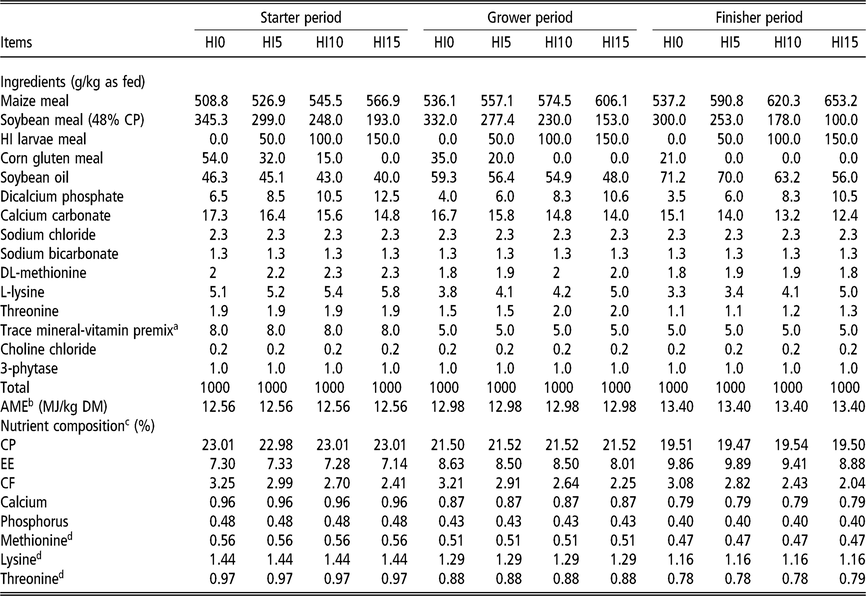
The ingredients and the chemical composition of the experimental diets are reported in Table 1.
Ingredients, apparent metabolizable energy and chemical composition of the experimental diets fed to broiler chickens

HI=Hermetia illucens; AME=apparent metabolizable energy; DM=dry matter; CP=crude protein; EE=ether extract; CF=crude fibre.
a Mineral-vitamin premix: vitamin A (retinyl acetate), 12500 IU; vitamin D3 (cholecalciferol), 3000 IU; vitamin E (DL-a-tocopheryl acetate), 60 IU; vitamin K (menadione sodium bisulphite), 1.02 mg; riboflavin, 2.0 mg; pantothenate, 8.0 mg; niacin, 6 mg; piridossin, 4 mg; folic acid, 0.5 mg; biotin, 0.10 mg; tiamin, 1.0 mg; vitamin B12, 20 mg; Mn, 120 mg; Zn, 80 mg; Fe, 52 mg; Cu, 15 mg; I, 1.5 mg; Se, 0.4 mg.
b Calculated according to Schiavone et al. (Reference Schiavone, De Marco, Martínez, Dabbou, Renna, Madrid, Hernandez, Rotolo, Costa, Gai and Gasco2017b) and Sauvant et al. (Reference Sauvant, Perez and Tran2004).
c Chemical analyses were carried out on three replicates of each feed sample.
d Digestible amino acid estimated according to Schiavone et al. (Reference Schiavone, De Marco, Martínez, Dabbou, Renna, Madrid, Hernandez, Rotolo, Costa, Gai and Gasco2017b) and Sauvant et al. (Reference Sauvant, Perez and Tran2004) for HI meal and other ingredients, respectively.
Fatty acid profile of the insect meal and experimental diets
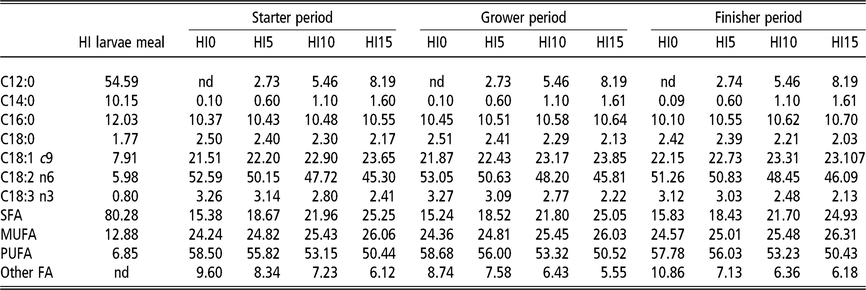
The FA composition of the HI larvae meal and experimental diets was assessed using the method described by Schiavone et al. (Reference Schiavone, Chiarini, Marzoni, Castillo, Tassone and Romboli2007). The fatty acid methyl esters were separated, identified and quantified on the basis of the chromatographic conditions reported by Renna et al. (Reference Renna, Gasmi-Boubaker, Lussiana, Battaglini, Belfayez and Fortina2014). The results were expressed as g/100g of total fatty acids (TFA) (Table 2).
Fatty acid profile of HI larvae meal and experimental diets of broiler chickens (g/100 g of total fatty acids)

HI=Hermetia illucens; nd=not detected; SFA=saturated fatty acid; MUFA=monounsaturated fatty acid; PUFA=polyunsaturated fatty acid; FA=fatty acids.
Slaughtering procedures
At 35 days of age, 16 animals (two birds per replicate pens) from each feeding group (chosen based on the average final LW in each pen) were individually identified with a shank ring and weighed. The chickens were slaughtered at a commercial abattoir. Plucked and eviscerated carcasses were obtained, and the head, neck, feet and abdominal fat were removed to obtain the chilled carcass. Then, the liver, heart, spleen, bursa of Fabricius, abdominal fat, thigh and breast weights were immediately recorded. The breast and thigh weights were expressed as percentages of the LW. Twenty-four hours after slaughtering, breasts were separated into right and left sides, individually vacuum sealed and refrigerated (4±1°C). Breast meat was divided into two parts and frozen at −20°C for further meat analyses.
Meat quality parameters
The meat quality parameters (pH, colour, drip loss, cooking loss and shear force) were assessed on the Pectoralis major muscles of the right breast (from the 16 slaughtered animals per each feeding group) following the harmonized methodologies for the assessment of poultry meat quality features described in Supplementary Material S1.
Chemical composition and fatty acid profile
The left breast meat of the 16 slaughtered animals per each feeding group was used to perform chemical analysis. The moisture and ashes were determined according to the Association of Official Analytical Chemists (AOAC, 1990) procedure. Proteins were determined using the standard Kjeldahl copper catalyst method (AOAC, 1990).Total lipids were measured using modification of the chloroform: methanol procedure described by Folch et al. (Reference Folch, Lees and Sloane Stanley1957). Fatty acids were then determined as reported in Supplementary Material S1. The results were expressed as g/100g of TFA. The health indexes were calculated as described in the Supplementary Material S1.
Heavy metals and arsenic
The analysis of heavy metals and arsenic were performed on HI larvae meal and four breast meat pools (one pool per feeding group, each of them composed by eight slaughtered animals (one bird per replicate pens)), as presented in Supplementary Material S1. The results were expressed as mg/kg 12% humidity.
Statistical analyses
The statistical analyses were performed using the IBM SPSS software package (IBM Corp. Released 2012. IBM SPSS Statistics for Windows, Version 21.0; IBM Corp, Armonk, NY, USA). The Shapiro–Wilk test was used to test the normality of the data distribution. Individual bird was used as the experimental unit to analyse the carcass characteristics, meat quality parameters and FA profile (n = 16 per treatment; two birds/pen). The carcass characteristics, meat quality parameters and FA profile data were tested by means of one-way ANOVA, with experimental diet (HI0, HI5, HI10 and HI15) as fixed effect, and according to the following model:
 $${Y_{{\rm{ij}}}} = {\mu _i} + \alpha + {\varepsilon _{{\rm{ij}}}}$$
where Y ij = the single observation; μ = overall mean; α = the effect of experimental diet (i = HI0 or HI inclusion level) and ε = residual error.
The effect of dietary HI meal inclusion was evaluated by means of polynomial contrasts (linear and quadratic responses). The results were expressed as the mean and standard error of the mean (SEM). Significance was considered at P<0.05.
Results
Carcass characteristics
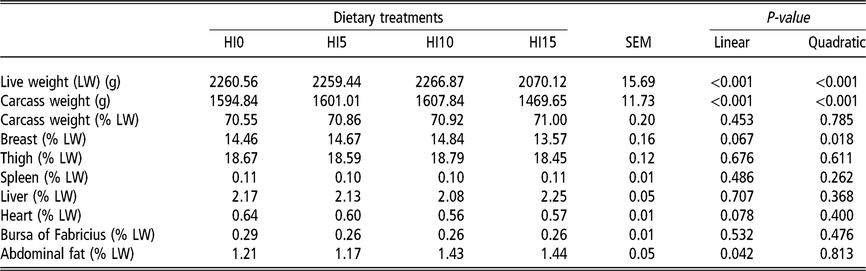
The carcass characteristics of the broilers fed the experimental diets are presented in Table 3. Linear and quadratic responses were observed for increasing HI meal levels in the live and carcass weights (P < 0.001), with a maximum for the HI10 group. The breast yield increased quadratically for increasing HI meal levels (P < 0.05), and the quadratic response increased to a maximum for the inclusion of 100 g/kg of HI meal. The abdominal fat yield showed a linear response to increasing HI meal levels (P < 0.05), with a maximum for the inclusion of 150 g/kg of HI meal. On the other hand, no significant effects related to HI meal utilization were observed for the other carcass traits.
Effect of the dietary HI larvae meal inclusion level on the carcass traits of broiler chickens (n=16 animals/group)

HI=Hermetia illucens; LW=live weight.
Meat quality parameters of the breast muscle
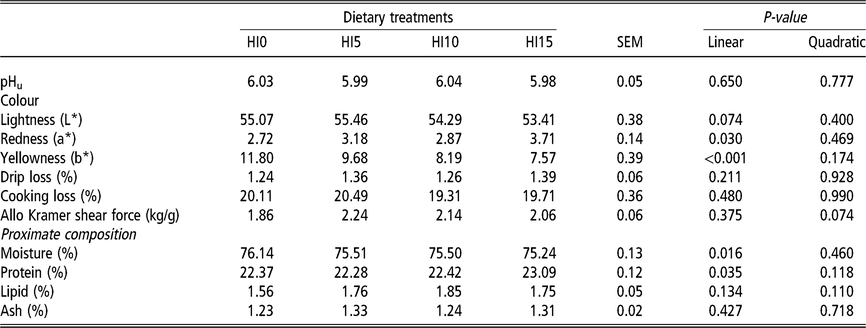
No significant differences were observed for the meat quality parameters, with the exception of the redness (a*) and yellowness (b*) colour traits (Table 4). The observed redness showed a linear response to increasing HI meal levels (P < 0.05), and the linear response increased to a maximum for the HI15 group. A linear decrease of yellowness was elicited for the HI meal as the level of HI increased with a minimum corresponding to the inclusion of 150 g/kg of HI meal.
Effect of the dietary HI larvae meal inclusion on the meat quality and chemical composition in breast meat of broiler chickens (n=16 animals/group)

HI=Hermetia illucens.
Chemical composition and fatty acid profile of the breast meat
As far as the chemical composition is concerned, the moisture content decreased linearly with increasing HI meal levels (P < 0.05), and the linear response decreased to a minimum for the inclusion of 150 g/kg of HI meal. A linear response was observed for the protein content, with a maximum for the HI15 group. No significant effect, related to HI meal utilization, was observed for the lipid and ash contents (Table 4).
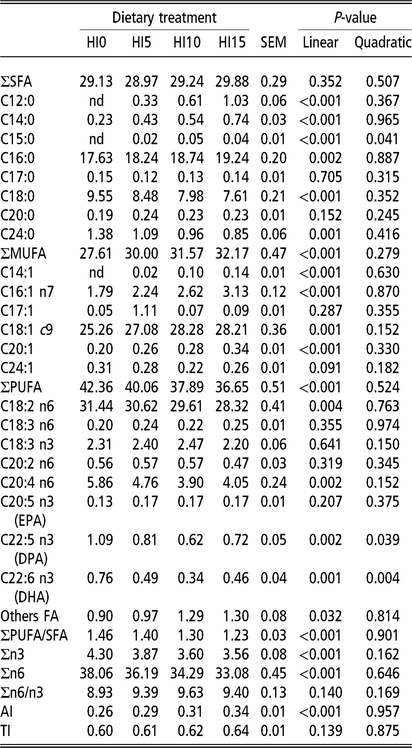
The effects of the experimental diets on the FA profile of breast meat are presented in Table 5. A linear increase was observed for C12, C14, C16, C14:1, C16:1 n7; C20:1 ΣMUFA and atherogenicity index, and the linear response increased to a maximum for the inclusion of 150 g/kg of HI meal. C15:0 and C18:1 c9 showed a linear response to increasing HI meal levels (P < 0.05), with a maximum for the inclusion of 100 g/kg of HI meal. A linear decrease was shown for C18:0, C24:0, C18:2 n6, C20:4 n6, ΣPUFA, Σn3, Σn6 and ΣPUFA/SFA. A linear and quadratic decrease was observed for C22:5 n3 and C22:6 n3 with a minimum for the HI10 group.
Effect of the dietary HI larvae meal inclusion on the fatty acid profile in breast meat of broiler chickens (g/100g of total fatty acids; n=16 animals/group)

HI=Hermetia illucens; nd=not detected; SFA=saturated fatty acids; MUFA=monounsaturated fatty acids; PUFA=polyunsaturated fatty acids; FA=fatty acids; AI=atherogenicity index; TI=thrombogenicity index.
Heavy metal and arsenic determination
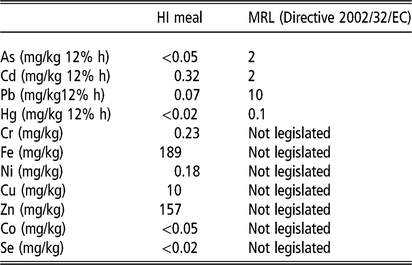
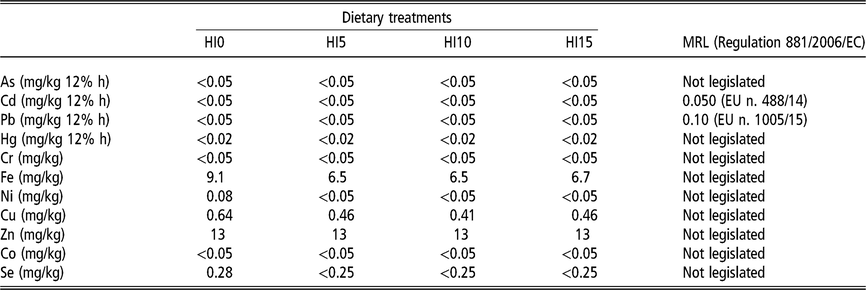
The concentrations of heavy metals and arsenic in the HI larvae meal and breast meat samples of the broiler chickens are summarized in Tables 6 and 7, respectively.
Heavy metals in HI larvae meal

HI=Hermetia illucens; MRL=Maximum Residue Limit; mg/kg 12% h=mg/kg 12% humidity.
Heavy metals in breast meat of broiler chickens (one pool per feeding group, eight birds/pool)

HI=Hermetia illucens; MRL=Maximum Residue Limit; mg/kg 12% h=mg/kg 12% humidity.
All the arsenic, cadmium, lead and mercury levels in the HI larvae meal were below the European Union (EU) limits reported for animal feeds (EC, 2002). The heavy metal and arsenic contents in the breast meat sample pools of the four dietary treatments were below the EU limits reported for chicken meat (EC, 2006).
Discussion
Hermetia illucens larvae meal has been recently proposed as emerging and innovative feed ingredient in poultry feeds (Cullere et al., Reference Cullere, Tasoniero, Giaccone, Acuti, Marangon and Dalle Zotte2016 and Reference Cullere, Tasoniero, Giaccone, Miotti-Scapin, Claeys, De Smet and Dalle Zotte2018; Loponte et al., Reference Loponte, Nizza, Bovera, De Riu, Fliegerova, Lombardi, Vassalotti, Mastellone, Nizza and Moniello2017; Altmann et al., Reference Altmann, Neumann, Velten, Liebert and Mörlein2018; Pieterse et al., Reference Pieterse, Pretorius, Hoffman and Drew2019) in order to improve the sustainability of poultry meat production. The defatting process results in insect meals with larger protein values and can reduce the risk of lipid oxidation, allowing for a longer shelf life of the product (Zheng et al., Reference Zheng, Hou, Li, Yang, Li and Yu2013). Our study investigated the effects of defatted HI larvae meal on carcass characteristics and meat quality of broiler chickens as well as the optimal level of inclusion.
The results of the relative carcass and organ yields showed a satisfactory effect of HI larvae meal inclusion on the carcass traits, a result that could be positive for commercial purposes. Positive linear and quadratic responses were observed up to 100 g/kg level of HI larvae meal for the parameters mentioned above, while HI15 group showed unfavourable results. The results observed in HI15 group are in agreement with our previous findings, which revealed a negative modulation of growth performance and gut morphology by insect meal utilization in HI15 birds (Dabbou et al., Reference Dabbou, Gai, Biasato, Capucchio, Biasibetti, Dezzutto, Meneguz, Plachà, Gasco and Schiavone2018). In fact, the authors observed the worst gut mucosal development (in terms of short villi, deep crypts and reduced villus height-to-crypt depth ratio) in HI15 group, which may explain the deterioration of the growth performance and consequently the carcass characteristics.
On the basis of the results of this research, the supplement of HI larvae meal up to 100 g/kg has been suggested to be suitable as a feed ingredient for broiler chicken diets.
The results obtained in this study are in agreement with those reported by Loponte et al. (Reference Loponte, Nizza, Bovera, De Riu, Fliegerova, Lombardi, Vassalotti, Mastellone, Nizza and Moniello2017). These authors reported greater carcass weights in Barbary partridges (Alectoris barbara) fed with HI and yellow mealworm (Tenebrio molitor L., TM) diets than control group as a partial replacement (25% or 50%) of soybean meal. However, our results are not consistent with the majority of studies about broiler chickens and quails, where all carcass traits were unaffected by dietary house-fly maggots (Musca domestica L., MD), TM and HI larvae meal inclusion (Bovera et al., Reference Bovera, Loponte, Marono, Piccolo, Parisi, Iaconisi, Gasco and Nizza2016; Cullere et al., Reference Cullere, Tasoniero, Giaccone, Acuti, Marangon and Dalle Zotte2016; Biasato et al., Reference Biasato, Gasco, De Marco, Renna, Rotolo, Dabbou, Capucchio, Biasibetti, Tarantola, Bianchi, Cavallarin, Gai, Pozzo, Dezzutto, Bergagna and Schiavone2017 and Reference Biasato, Gasco, De Marco, Renna, Rotolo, Dabbou, Capucchio, Biasibetti, Tarantola, Sterpone, Cavallarin, Gai, Pozzo, Bergagna, Dezzutto, Zoccarato and Schiavone2018; Pieterse et al., Reference Pieterse, Pretorius, Hoffman and Drew2019).
In the current study, the redness (a*) index of breast meat was higher in the HI15 group, while the HI5 and HI10 groups showed intermediate values in comparison with HI0 group. These results may be due to a possible accumulation of insect meal pigments in the intramuscular fat. On the other hand, the yellowness value (b*) decreased in a linear fashion (P < 0.001), unlike the overall responses of redness to dietary HI larvae meal for an increased HI larvae meal content in the diet. This finding may be attributed to the decreased content of corn gluten meal in HI diets (Table 1). The effects of dietary insect meal on meat colour are controversial. Cullere et al. (Reference Cullere, Tasoniero, Giaccone, Acuti, Marangon and Dalle Zotte2016) observed that redness (a*) in the breast meat of broiler quails was affected by increasing inclusion levels of HI larvae meal in diets, showing the highest (1.13) and lowest (0.46) values for 100 g/kg and 150 g/kg HI groups, respectively. On the contrary, Leiber et al. (Reference Leiber, Gelencsér, Stamer, Amsler, Wohlfahrt, Früh and Maurer2017), Altmann et al. (Reference Altmann, Neumann, Velten, Liebert and Mörlein2018) and Pieterse et al. (Reference Pieterse, Pretorius, Hoffman and Drew2019) did not find any significant effect of dietary HI meal on broiler meat colour. In regard to other insect meals, the use of MD larvae meal in broiler diets has been associated with a significant decrease in breast muscle lightness (L*) (Pieterse et al., Reference Pieterse, Erasmus, Uushona and Hoffman2014). Differently, Bovera et al. (Reference Bovera, Loponte, Marono, Piccolo, Parisi, Iaconisi, Gasco and Nizza2016) did not find any significant effect on the colour of raw and cooked meat, or on the skin of broiler chickens, also showing that the meat from broilers fed with TM meal could be accepted by consumers. However, the meat colour differences found in broiler chickens fed with HI larvae meal of the present study appear to be of little practical relevance and potentially incapable of affecting the consumers’ willingness to buy meat.
Orthogonal polynomial contrast test revealed that increasing the HI larvae meal of diets decreased the moisture content (linear effect, P<0.05), and increased protein, according to a notable linear trend, for increasing HI larvae meal inclusion levels. Even the effects of dietary insect meal on poultry meat proximate composition are conflicting. Cullere et al. (Reference Cullere, Tasoniero, Giaccone, Miotti-Scapin, Claeys, De Smet and Dalle Zotte2018), Pieterse et al. (Reference Pieterse, Pretorius, Hoffman and Drew2019) and Schiavone et al. (Reference Schiavone, Dabbou, De Marco, Cullere, Biasato, Biasibetti, Capucchio, Bergagna, Dezzutto, Meneguz, Gai, Dalle Zotte and Gasco2017a) reported no significant effects on meat chemical composition of broiler quails or chickens fed diets with HI meal and fat, respectively.
The FA composition of broiler meat basically depends on the dietary FA profile. Several factors (e.g. genotype, sex, age and slaughter weight) are also able to affect the FA composition of meat, the diet component being considered as a major effect in monogastric animals (Rymer and Givens, Reference Rymer and Givens2005; Schiavone et al., Reference Schiavone, Chiarini, Marzoni, Castillo, Tassone and Romboli2007 and Reference Schiavone, Cullere, De Marco, Meneguz, Biasato, Bergagna, Dezzutto, Gai, Dabbou, Gasco and Dalle Zotte2010). Consequently, as expected, the dietary inclusion of HI larvae meal influenced the FA profile of the broiler breast meat. The lauric and myristic acid contents increased with increasing levels of dietary inclusion of HI in the diet, and this increase was also noticed for C16:0. The total SFA remained constant, however C18:0 and C24:0 reduced linearly as the inclusion rate increased. These results are in agreement with those reported by Renna et al. (Reference Renna, Schiavone, Gai, Dabbou, Lussiana, Malfatto, Prearo, Capucchio, Biasato, Biasibetti, De Marco, Brugiapaglia, Zoccarato and Gasco2017) and Cullere et al. (Reference Cullere, Tasoniero, Giaccone, Miotti-Scapin, Claeys, De Smet and Dalle Zotte2018) for rainbow trout and broiler quail, respectively, fed defatted HI larvae meal. Avian FAs are typically monounsaturated due to an active hepatic delta-9 desaturase and an oleic (C18:1 c9) predominance (Klasing, Reference Klasing and Klasing2000). An increasing percentage of MUFA, mainly due to the higher content of C18:1 c9, was observed as a result of increasing inclusion levels of HI meal in the diets. On the contrary, PUFA significantly decreased with greater decreases in C18:2 n6. Hermetia illucens larvae meal was found to be relatively scarce in PUFA, which were represented almost entirely by C18:2 n6 and C18:3 n3. Such a composition lowered the contents of the n-6 and the n-3 PUFA fractions as the dietary HI larvae meal inclusion level increased. Despite these remarkable changes in the breast meat FAs, the Σ n-6/ Σ n-3 ratio remained unaffected. Breast meat lipids are mainly composed of triacylglycerol and phospholipids, the latter being rich in very long chain n-3 PUFA (Eicosapentaenoic acid (EPA; C20:5 n3) and Docosahexaenoic acid (DHA; C22:6 n3)), which are well known for their high biological efficiency in the organism and their beneficial effects on human health (Rymer and Givens, Reference Rymer and Givens2005). A significant decreased content was observed in HI groups for Docosapentaenoic acid (DPA; C22:5 n3) (on average −34.25%) and DHA (on average −43.42%). These results are in agreement with those reported by Cullere et al. (Reference Cullere, Tasoniero, Giaccone, Miotti-Scapin, Claeys, De Smet and Dalle Zotte2018), who found a significant reduction of DHA content in breast meat of Japanese quail fed increasing levels of HI meal. Renna et al. (Reference Renna, Schiavone, Gai, Dabbou, Lussiana, Malfatto, Prearo, Capucchio, Biasato, Biasibetti, De Marco, Brugiapaglia, Zoccarato and Gasco2017) also observed lower contents of EPA and DHA in the fillet muscles of trout fed 400 g/kg of HI than other groups, while DPA was reduced with the lowest inclusion level of HI meal. The present study indicates that the inclusion of a defatted HI larvae meal in broiler chicken diets leads to significant modifications of the breast meat FA profile, with higher MUFAs and lower PUFAs in HI groups than control group. In order to balance and overcome these potential negative effects related to HI larvae meal utilization, a modulation of the larva rearing substrate should be recommended to obtain an improved insect larvae FA profile and provide healthier meat for the modern consumer. Little information on the influence of insect meals on meat sensory profile and consumer health and acceptance has been provided till now. The dietary inclusion of insect meal may affect the sensory profile of meat as reported by Pieterse et al. (Reference Pieterse, Erasmus, Uushona and Hoffman2014), who found that the meat derived from chickens fed with a 10% MD larvae meal had a higher perception of metallic aroma and aftertaste but a higher sustained juiciness and a lower mealiness (dry sensation) in the mouth compared to the control group. Differently, Cullere et al. (Reference Cullere, Tasoniero, Giaccone, Miotti-Scapin, Claeys, De Smet and Dalle Zotte2018) reported unaffected meat sensory profile of quails fed HI larvae meal. Further research should be focused on the evaluation of the consumer acceptance and health, and meat processing in order to successfully include HI meal in commercial poultry diets.
In the current research, the concentrations of heavy metals and arsenic in both the HI larvae meal and in the breast meat of the birds remained below the EU limits suggested for feed materials (EC, 2002) and foodstuffs (EC, 2006). Hermetia illucens larvae have been reported to accumulate cadmium (Van der Fels-Klerx et al., Reference Van der Fels-Klerx, Camenzuli, van der Lee and Oonincx2016; Purschke et al., Reference Purschke, Scheibelberger, Axmann, Adler and Jäger2017; Biancarosa et al., Reference Biancarosa, Liland, Biemans, Araujo, Bruckner, Waagbø, Torstensen, Lock and Amlund2018), lead (Van der Fels-Klerx et al., Reference Van der Fels-Klerx, Camenzuli, van der Lee and Oonincx2016; Purschke et al., Reference Purschke, Scheibelberger, Axmann, Adler and Jäger2017; Biancarosa et al., Reference Biancarosa, Liland, Biemans, Araujo, Bruckner, Waagbø, Torstensen, Lock and Amlund2018), mercury (Biancarosa et al., Reference Biancarosa, Liland, Biemans, Araujo, Bruckner, Waagbø, Torstensen, Lock and Amlund2018) and arsenic (Van der Fels-Klerx et al., Reference Van der Fels-Klerx, Camenzuli, van der Lee and Oonincx2016; Biancarosa et al., Reference Biancarosa, Liland, Biemans, Araujo, Bruckner, Waagbø, Torstensen, Lock and Amlund2018) when reared on contaminated substrates. The results obtained in the present study suggest that the HI larvae were fed with a feeding media that did not contain heavy metals or arsenic levels that exceeded the maximum allowable limits. The cadmium and lead concentrations in the breast meat also remained below the EU limits, thus representing a relevant result in terms of food safety.
Conclusion
Overall, the present study has provided new data and knowledge on the potential use of a new sustainable feedstuff for broiler chickens. The main findings of the current research suggest that defatted HI larvae meal can be used to up to 100 g/kg level of inclusion in broiler chicken diets, without detrimental effects on carcass and meat quality parameters or heavy metal contents. Remarkable differences in the meat nutritional profile were found in relation to the FA composition, with an increase of MUFA content to the detriment of PUFA. Therefore, important efforts should be made to evaluate new substrates capable of improving the FA profile of larvae, thus potentially counteracting the negative effects on the nutritional value and perceived healthiness of the poultry meat. These substrates should also be evaluated from a safety point of view, as new evidence on their safety could be adopted to reduce the potential toxicity of the meal.
Acknowledgements
This research was supported by University of Torino (Italy) founding: SCHA_RILO_14_01 (2015 to 2017) and SCHA_RILO_16_02 (2016 to 2018).
A. Schiavone, 0000-0002-8011-6999, S. Dabbou, 0000-0002-3525-1614, M. Petracci, 0000-0002-5671-5676, M. Zampiga, 0000-0001-8074-7283, F. Sirri, 0000-0002-4640-7346, I. Biasato, 0000-0002-8855-4248, F. Gai, 0000-0003-1037-9483, L. Gasco, 0000-0002-1829-7936
Declaration of interest
The authors declare that there is no conflict of interest.
Ethics statement
The experimental protocol was designed according to the guidelines of the current European and Italian laws on the care and use of experimental animals (European directive 86 609/EEC, put into law in Italy with D.L.116/92) and approved by the Ethical Committee of the Department of Veterinary Science of the University of Turin (Italy).
Software and data repository resources
The data sets analysed in the current study are available from the corresponding author on reasonable request.
Supplementary material
To view the supplementary material for this article, please visit https://doi.org/10.1017/S1751731119000685