Introduction
Post-traumatic growth (PTG) is defined as positive, meaningful psychological changes that an individual can experience as a result of struggling with traumatic and stressful life events (Zoellner & Maercker, Reference Zoellner and Maercker2006). PTG includes developing an increased appreciation of life, greater sense of personal strength and self-understanding, renewed appreciation for intimate relationships, and positive spiritual changes (Tedeschi et al. Reference Tedeschi, Park and Calhoun1998). To date, however, the large body of studies documenting the negative sequelae of trauma vastly outnumbers the few studies that have examined PTG (Tedeschi & McNally, Reference Tedeschi and McNally2011). PTG has become an increasingly important topic, as scientific understanding of the effects of trauma has advanced beyond a focus on negative consequences to an emphasis on psychological well-being and growth (Seligman & Csikszentmihalyi, Reference Seligman and Csikszentmihalyi2000; Linley & Joseph, Reference Linley and Joseph2004; Wood & Tarrier, Reference Wood and Tarrier2010).
PTG has been reported among individuals who have experienced a broad range of traumas, including ex-prisoners of war (Sledge et al. Reference Sledge, Boydstun and Rabe1980; Feder et al. Reference Feder, Southwick, Goetz, Wang, Alonso, Smith, Buchholz, Waldeck, Ameli, Moore, Hain, Charney and Vythilingam2008), assault survivors (Kleim & Ehlers, Reference Kleim and Ehlers2009), college students (McCaslin et al. Reference McCaslin, de Zoysa, Butler, Hart, Marmar, Metzler and Koopman2009), war veterans (Pietrzak et al. Reference Pietrzak, Goldestein, Malley, Rivers, Johnson, Morgan and Southwick2010), refugees (Powell et al. Reference Powell, Rosner, Butollo, Tedeschi and Calhoun2003), and individuals with various medical conditions and injuries (Garnefski et al. Reference Garnefski, Kraiij, Schroevers and Somsen2008; McCaslin et al. Reference McCaslin, de Zoysa, Butler, Hart, Marmar, Metzler and Koopman2009). These studies have found that up to 50% of trauma survivors report at least a ‘moderate’ degree of PTG in one or more life domains. However, these studies used a range of measures to capture PTG (Zoellner & Maercker, Reference Zoellner and Maercker2006), only some of which have been validated, such as the Posttraumatic Growth Inventory-Short Form (PTGI-SF; Cann et al. Reference Cann, Calhoun, Tedeschi, Taku, Vishnevsky, Triplett and Danhauer2010).
Despite a growing body of research on PTG, the relationship between post-traumatic stress disorder (PTSD) symptoms and PTG remains unclear. One review found there was no systematic relationship between PTSD and PTG, with correlation coefficients ranging from r = –0.2 to r = 0.2 (Zoellner & Maercker, Reference Zoellner and Maercker2006). A more recent meta-analytic review reported that while there was a significant linear relationship between PTSD and PTG, there was a significantly stronger curvilinear relationship (Shakespeare-Finch & Lurie-Beck, Reference Shakespeare-Finch and Lurie-Beck2014). However, none of the studies included in the review was based on a large population-based sample of trauma survivors and none examined PTG in relation to specific PTSD symptom clusters, such as the five-factor model of PTSD symptoms (Elhai et al. Reference Elhai, Biehn, Armour, Klopper, Frueh and Palmieri2011; Wang et al. Reference Wang, Zhang, Shi, Zhou, Li, Zhang, Liu and Elhai2011; Pietrzak et al. Reference Pietrzak, Tsai, Harpaz-Rotem, Whealin and Southwick2012; Tsai et al. Reference Tsai, Whealin, Scott, Harpaz-Rotem and Pietrzak2012). Research using validated PTG measures in population-based samples with diverse trauma and clinical histories, and that examine specific PTSD symptom clusters may help clarify the nature of the association between PTSD and PTG.
In addition to PTSD, several sociodemographic and psychosocial factors have been linked to PTG. Factors associated negatively with PTG include older age at the time of trauma, depression, social constraint (i.e. blocking self-disclosure of intrusive thoughts) and disruptions in social activities (Cadell et al. Reference Cadell, Regehr and Hemsworth2003; Powell et al. Reference Powell, Rosner, Butollo, Tedeschi and Calhoun2003; Zoellner & Maercker, Reference Zoellner and Maercker2006; Jim & Jacobsen, Reference Jim and Jacobsen2008; Kimhi et al. Reference Kimhi, Eshel, Zysberg and Hantman2010). Factors associated positively with PTG include perceived social support, optimism, extraversion, spirituality, and effort/perseverance (Shaw et al. Reference Shaw, Joseph and Linley2005; Feder et al. Reference Feder, Southwick, Goetz, Wang, Alonso, Smith, Buchholz, Waldeck, Ameli, Moore, Hain, Charney and Vythilingam2008; McCaslin et al. Reference McCaslin, de Zoysa, Butler, Hart, Marmar, Metzler and Koopman2009; Prati & Pietrantoni, Reference Prati and Pietrantoni2009; Pietrzak et al. Reference Pietrzak, Goldestein, Malley, Rivers, Johnson, Morgan and Southwick2010). However, most of these studies have examined these selected constructs in isolation. Consequently, little is known about which factors, when considered in a multivariable context, are uniquely linked to PTG. Further, other protective psychosocial factors such as community integration, active life-style, and altruism, which are negatively related to psychopathology (Pietrzak & Cook, Reference Pietrzak and Cook2013), have not been evaluated in relation to PTG. An additional limitation of extant research on PTG is that most studies have recruited relatively small convenience samples of select trauma-exposed samples, such as war veterans (Pietrzak et al. Reference Pietrzak, Goldestein, Malley, Rivers, Johnson, Morgan and Southwick2010). Consequently, it remains to be determined whether results of these studies are generalizable to larger population-based samples of trauma survivors with more varied trauma histories.
To our knowledge, there has been no study of PTG and its correlates in any nationally representative sample. Veterans are an ideal group in which to study PTG given their relatively high rate of exposure to potentially traumatic events, their high proportional representation in the general US population, public concern for their health and well-being, and ongoing efforts to prepare soldiers for trauma in the military and to facilitate pathways for PTG after discharge (Tedeschi & McNally, Reference Tedeschi and McNally2011).
We had five aims in this study: (1) to evaluate the prevalence of PTG in a large, contemporary, nationally representative sample of US veterans; (2) to examine the relationship between PTSD symptoms and PTG; (3) to assess the functional significance of PTG; (4) to explore types of traumas that are independently related to PTG; and (5) to characterize how a comprehensive set of demographic, military, medical and psychosocial factors relate to PTG in this population. We hypothesized that PTG would be prevalent in about half of the sample and curvilinearly related to PTSD symptoms, that PTSD with PTG would be associated with better functioning than PTSD without PTG, and that psychosocial factors such as social connectedness and spirituality would be independently related to PTG.
Method
Sample
The National Health and Resilience in Veterans Study (NHRVS) is a nationally representative survey of 3157 US veterans conducted during October–December 2011. Participants completed a 60-min confidential web-based survey. The NHRVS sample was drawn from a research panel of more than 80 000 households maintained by GfK Knowledge Networks, Inc., a survey research firm that uses KnowledgePanel®, a probability-based, online survey panel of a nationally representative sample of US adults that covers approximately 98% of US households (details regarding the KnowledgePanel® sampling methodology may be found elsewhere; GfK Knowledge Networks, 2013). Of the 4750 veterans sampled for the NHRVS, 3408 (71.7%) completed a screening question to confirm their current or past active military status. Of these 3408 respondents, 3188 (93.5%) confirmed their current or past active military status and 3157 (92.6%) confirmed this status and completed the survey. Households were provided with access to the Internet and computer hardware if needed. To permit generalizability of study results to the entire population of US veterans, post-stratification weights were applied based on demographic distributions (i.e. age, gender, race/ethnicity, education, census region, and metropolitan area) from the most contemporaneous October 2010 Current Population Survey (United States Census Bureau, 2010). Although we utilized data from the full NHRVS sample in this study, analyses related to PTG were limited to the 2719 veterans who reported at least one potentially traumatic event and completed the PTGI-SF. All participants provided informed consent and the study was approved by the Human Subjects Subcommittee of the VA Connecticut Healthcare System.
Assessments
Trauma history and PTSD
The Trauma History Screen (THS; Carlson et al. Reference Carlson, Smith, Palmieri, Dalenberg, Ruzek, Kimerling, Burling and Spain2011) is a self-report measure that assesses the lifetime occurrence of 13 potentially traumatic events, including early life traumas such as physical or sexual assault during childhood; as well as traumas that more commonly occur in adulthood, such as motor vehicle accidents, military combat, and unexpected loss of a loved one. An additional event, life-threatening illness or injury, was added.
The PTSD Checklist – Specific Stressor Version (PCL-S; Weathers et al. Reference Weathers, Litz, Herman, Huska and Keane1993) is a 17-item screening instrument based on Diagnostic and Statistical Manual for Mental Disorders-fourth edition (DSM-IV; APA, 2000) criteria for PTSD. In the current study, we administered the PCL-S, which asked about lifetime and past-month symptoms related to respondents’ ‘worst’ stressful experience on the THS. Scores on the PCL-S range from 17 to 85. A positive screen for PTSD was operationalized as a total PCL-S score ⩾44 (Blanchard et al. Reference Blanchard, Jones-Alexander, Buckley and Forneris1996). Cronbach's α's on past-month and lifetime PCL-S items were both 0.95.
PTSD symptom clusters were based on a five-factor model of PTSD symptoms (Elhai et al. Reference Elhai, Biehn, Armour, Klopper, Frueh and Palmieri2011) that consists of re-experiencing (α = 0.90), avoidance (α = 0.71), emotional numbing (α = 0.85), dysphoric arousal (α = 0.80) and anxious arousal symptoms (α = 0.81). This five-factor model is increasingly being recognized as providing a better representation of PTSD symptom dimensions than the three-factor model of the DSM-IV and alternative four-factor models, which do not differentiate between dysphoric and anxious arousal symptoms (Wang et al. Reference Wang, Zhang, Shi, Zhou, Li, Zhang, Liu and Elhai2011; Pietrzak et al. Reference Pietrzak, Tsai, Harpaz-Rotem, Whealin and Southwick2012; Tsai et al. Reference Tsai, Whealin, Scott, Harpaz-Rotem and Pietrzak2012; Armour et al. Reference Armour, Carragher and Elhai2013).
PTG
The PTGI-SF (Cann et al. Reference Cann, Calhoun, Tedeschi, Taku, Vishnevsky, Triplett and Danhauer2010) is a 10-item validated instrument that assesses perceptions of positive psychological changes as a result of struggling with challenging life circumstances. Respondents were asked to refer to their self-nominated ‘worst’ stressful event assessed by the THS and rate items such as ‘I changed my priorities about what is important in life’ on a scale from 0 (‘I did not experience this change’) to 5 (‘I experienced this change to a very great degree’). Items are summed for a total score, which reflects overall perceptions of positive psychological changes related to a particular stressful life event. The PTGI-SF total score (α = 0.95) is comprised of scores reflecting five domains/subscales of PTG, including development of more intimate relationships (α = 0.84), recognition of new possibilities or paths for one's life (α = 0.85), greater sense of personal strength (α = 0.89), greater spiritual development (α = 0.92) and greater appreciation of life (α = 0.80).
Health-related functioning
The Short Form eight-item Health Survey (SF-8; QualityMetric, 2014) is a validated, abbreviated version of the SF-12 (Ware et al. Reference Ware, Kosinski, Tuner-Bowker and Gandek2002), one of the most widely used measures of health-related functioning. A sample item is: ‘How much bodily pain have you had during the past month?’. Standardized physical and mental component summary scores, which range from 0 to 100, are computed; a score of 50 represents the average level of functioning in the general population, with each 10-point interval representing one standard deviation. Higher scores reflect better functioning.
Other correlates
A broad range of medical, psychiatric, cognitive and psychosocial variables was assessed (see Table 1). Over 15 different validated measures were used, which have been described elsewhere (Pietrzak & Cook, Reference Pietrzak and Cook2013). A principal components factor analysis with varimax rotation was conducted to reduce the number of variables and group them into orthogonal factors. In all, eight factors were identified and labeled as physical health, mental health, substance abuse, protective psychosocial characteristics, social connectedness, altruism, spirituality, and active life-style. All item loadings on these factors were >0.40, yielding factors similar to a previous study of an older adult subset of the NHRVS sample (Pietrzak & Cook, Reference Pietrzak and Cook2013).
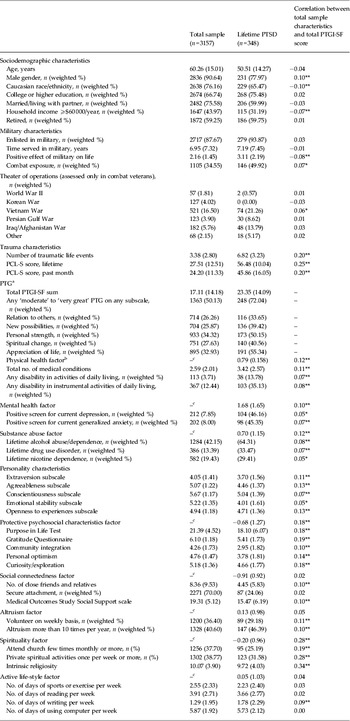
Sociodemographic, military, trauma, physical health, mental health, substance use, personality and other psychosocial characteristics of the sample

Data are given as weighted mean (standard error) unless otherwise indicated.
PTSD, Post-traumatic stress disorder; PTGI-SF, Posttraumatic Growth Inventory-Short Form; PCL-S, Posttraumatic Stress Checklist-Specific Version; PTG, post-traumatic growth.
a PTG was only assessed among veterans who reported a potentially traumatic event and responded to PTG items (n = 2719).
b Over 15 different validated measures were used to assess physical and mental health, substance abuse, personality characteristics, protective psychosocial characteristics, social connectedness, altruism, spirituality and life-style. These measures included the Patient Health Questionnaire-4 (Kroenke et al. Reference Kroenke, Spitzer, Williams and Löwe2009), Mini-International Neuropsychiatric Interview (Sheehan et al. Reference Sheehan, Lecrubier, Sheehan, Amorim, Janavs, Weiller, Hergueta, Baker and Dunbar1998), Medical Outcomes Study Social Support Scale (Sherbourne & Stewart, Reference Sherbourne and Stewart1991), Purpose in Life Test-Short Form (Schulenberg et al. Reference Schulenberg, Schnetzer and Buchanan2011), Duke University Religion Index (Koenig & Bussing, Reference Koenig and Bussing2010) and others. Other measures and details have been described in a previous report (Pietrzak & Cook, Reference Pietrzak and Cook2013).
c Because the factor analysis was conducted on the total sample, the factor scores for the total sample would all have a mean of 0.00 (standard deviation = 1.00).
* p < 0.01, ** p < 0.001.
Data analysis
First, descriptive statistics were computed for the total sample and the subsample of veterans who screened positive for PTSD. All analyses were based on the weighted sample, although raw counts were provided in descriptive statistics. Second, bivariate correlations were conducted between demographic, trauma-related, and health and psychosocial variables, and PTGI-SF scores to identify factors associated with PTG.
To evaluate the nature of the association between PTSD symptoms and PTG, hierarchical regressions were conducted testing the linear, quadratic and cubic effects of PCL-S scores on PTGI-SF scores, controlling for the number of lifetime potentially traumatic events. Lifetime PCL-S scores were standardized, and then squared and cubed to create quadratic and cubic growth terms, respectively. Then, in a hierarchical regression, standardized PCL-S scores and the number of potentially traumatic events were entered into the first step, the quadratic term in the second step, and the cubic term in the third step. Standardized β coefficients, total R 2 values and changes in R 2 in each additional step were calculated. Hierarchical regressions were also conducted on each of the factor scores of the five-factor PTSD model.
To assess the functional significance of PTG, the sample of veterans who reported at least one potentially traumatic event (n = 2719) was divided into four groups: no PTSD/no PTG, PTSD/no PTG, no PTSD/PTG and PTSD/PTG. PTSD was defined as lifetime PCL-S score ⩾44 and PTG was defined as endorsement of ‘moderate’ or greater growth (i.e. score ⩾3) on any of the PTGI-SF subscales. Multivariate analyses of covariance were then conducted to compare these groups with respect to SF-8 scores, controlling for sociodemographic, military history and health variables. Post-hoc group comparisons were conducted using Fisher's least significant difference test.
To explore possible associations between the nature of certain ‘worst’ potentially traumatic events and PTG, partial correlations were conducted that adjusted for lifetime PCL-S scores and number of potentially traumatic events. These partial correlations were also repeated after the ‘worst’ events were further categorized as assaultive (e.g. hit or kicked hard enough to injury as an adult) versus non-assaultive events (e.g. experiencing a natural disaster).
Finally, multiple regression analyses were conducted between relevant individual characteristics bivariately correlated with PTGI-SF total scores at the p < 0.01 level to examine factors independently linked to PTG. Collinearity diagnostics did not reveal any major multicollinearity problems, as tolerance values ranged from 0.23 to 0.93, which were above the standard threshold of 0.20 (O'Brien, Reference O'Brien2007). Post-hoc regression analyses were conducted to evaluate which of the five PTSD symptom clusters, and which component scales from other factors (e.g. protective psychosocial characteristics) were uniquely linked to PTG. To reduce the probability of type I error and taking into account the likelihood of the null hypothesis (Goodman, Reference Goodman2001), α was set at 0.01 for all analyses.
Results
Table 1 shows characteristics of the full sample of veterans, and those with a positive screen for PTSD. The rightmost column of the table shows the bivariate correlations between individual characteristics of veterans and their total PTGI-SF scores.
The mean number of potentially traumatic events in the full sample was 3.4 (s.d. = 2.8, range = 0–15), and 50.1% endorsed ‘moderate’ to ‘very great’ PTG on any of the PTGI-SF subscales (mean total PTGI-SF score = 17.1, s.d. = 14.2, range = 0–50), with the highest percentages observed for ‘personal strength’ and ‘appreciation for life’ subscales. Among veterans who screened positive for PTSD, 72.0% endorsed ‘moderate’ to ‘very great’ PTG on any of the PTGI-SF subscales (mean total PTGI-SF score = 23.4, s.d. = 14.1), with the highest percentages observed for the ‘relation to others’ and the ‘new possibilities’ subscales.
Bivariate correlations revealed that nearly all individual characteristics were significantly associated with total PTGI-SF scores, with the largest correlations between total PTGI-SF scores and number of traumas, lifetime and past-month PCL-S scores, dispositional gratitude, intrinsic religiosity, and engagement in private spiritual activities (r's = 0.18–0.34).
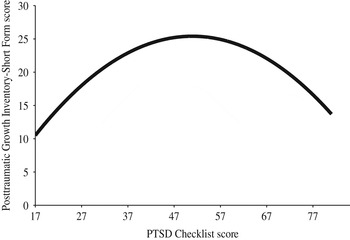
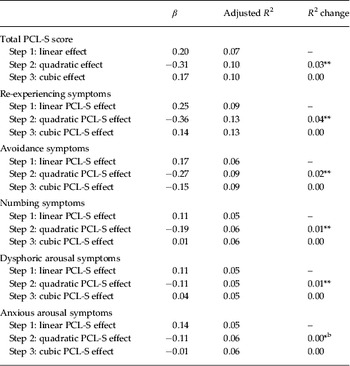
Hierarchical regressions revealed that a curvilinear association best described the association between lifetime PTSD symptoms and PTG (Table 2). Controlling for number of lifetime potentially traumatic events, the quadratic terms for the total PCL-S score and all five factors were significant in predicting PTGI-SF scores, above and beyond the linear PCL-S term. Together with the linear effect, the quadratic function of the total PCL-S score explained 10% of the variance in the PTGI-SF score, with the five factors explaining 5–13% of the variance. The cubic term was not significant for the total PCL-S score or any of the five factors. Fig. 1 shows a graph of the inverted U-shaped relationship between the total PCL-S and PTGI-SF scores.
Curvilinear relationship between post-traumatic growth and post-traumatic stress disorder (PTSD) symptom severity.

Hierarchical regressions of PTGI-SF scores regressed onto lifetime PCL-S scores a

PTGI-SF, Posttraumatic Growth Inventory-Short Form; PCL-S, Posttraumatic Stress Disorder Checklist-Specific Stressor Version.
a Controlling for the number of lifetime traumatic events.
b 0.004.
* p < 0.01, ** p < 0.001.
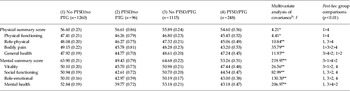
Table 3 shows results of analyses evaluating the functional significance of PTG among veterans who did and did not screen positive for lifetime PTSD. Controlling for differences in sociodemographic, military and physical disability characteristics, the PTSD/PTG group had higher SF-8 mental summary scores [Cohen's d = 0.48, 95% confidence interval (CI) = 0.23–0.71], mental health (d = 0.47, 95% CI = 0.23–0.71) and general health (d = 0.35, 95% CI = 0.11–0.59) subscale scores than the PTSD/no PTG group. The no PTSD/PTG group also had higher SF-8 mental summary (d = 0.11, 95% CI = 0.02–0.19) and vitality (d = 0.12, 95% CI = 0.04–0.21) subscale scores than the no PTSD/no PTG group.
Health-related functioning by lifetime PTSD and PTG status a

Data are given as adjusted mean (standard error).
PTSD, Post-traumatic stress disorder; PTG, post-traumatic growth.
a Health-related functioning was measured with the Short Form 8-item Health Survey. PTG was defined as ‘moderate’ or greater growth on any of the Posttraumatic Growth Inventory-Short Form subscales.
b One multivariate analysis of covariance was conducted on the summary scores and another on the eight subscales. Both analyses controlled for age, gender, race/ethnicity, marital status, income, enlistment in the military, combat exposure, any disability in activities of daily living, any disability in instrumental activities of daily living, and number of medical conditions.
* p < 0.05, ** p < 0.001.
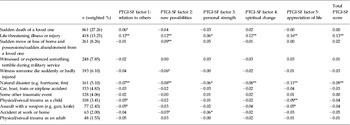
As shown in Table 4, the most frequent ‘worst’ traumatic event endorsed by participants was the ‘sudden death of a loved one’ and the most infrequent event was physical or sexual trauma as an adult. Partial correlations, controlling for number of lifetime traumatic events and lifetime total PCL-S scores, revealed that experiencing a life-threatening illness or injury was most strongly positively correlated with PTGI-SF scores (r's = 0.06–0.16), while experiencing a natural disaster was most strongly negatively correlated with PTGI scores (r's = –0.06 to −0.11). When these ‘worst’ events were categorized as either assaultive or non-assaultive events, assaultive events were found to be significantly negatively related to total PTGI-SF score (r = –0.06, p < 0.01), as well as the ‘relation to others’ and ‘appreciation of life’ subscales (both r's = –0.09, p < 0.001). None of the other correlations was significant (all r's < |0.05|, all p's > 0.02).
Partial correlations between ‘worst traumatic event’ and PTGI-SF scores a

PTGI-SF, Posttraumatic Growth Inventory-Short Form.
a Adjusted for number of lifetime traumatic events and lifetime Posttraumatic Stress Disorder Checklist-Specific Stressor scores.
* p < 0.01, ** p < 0.001.
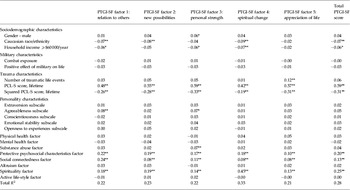
As shown in Table 5, multiple linear regression analyses conducted between significant individual characteristics and total and subscale PTGI-SF scores revealed that these characteristics explained over 25% of the variance in total PTGI-SF scores and 21–35% of the variance in the five PTGI-SF subscales. The largest associations were observed between total PTGI-SF and subscale scores, and lifetime PCL-S scores (β's = 0.42–0.59), protective psychosocial characteristics (β's = 0.10–0.22), spirituality (β's = 0.13–0.45) and social connectedness (β's = 0.08–0.24) factor scores. Post-hoc multiple regression analyses (see online Supplementary Table S1) revealed that PTSD-related re-experiencing symptoms (β's = 0.18–0.27), purpose in life (β's = 0.04–0.16), number of close friends and relatives (β's = 0.05–0.11) and intrinsic religiosity (β's = 0.09–0.31) were independently related to total PTGI-SF and subscale scores. Further post-hoc regression analyses revealed that of the five re-experiencing symptoms, ‘repeated, disturbing memories, thoughts, or images’ was most strongly related to PTG (β = 0.21, p < 0.001) followed by ‘having physical reactions (e.g. heart pounding, trouble breathing, or sweating)’ (β = 0.14, p < 0.001), ‘repeated, disturbing dreams’ (β = 0.12, p < 0.01), ‘very upset when something reminded you’ (β = 0.10, p < 0.01) and ‘acting or feeling as if your experience were happening again’ (β = 0.02, p = 0.64).
Standardized betas from multiple linear regressions of individual characteristics and the PTGI-SF scores

PTGI-SF, Posttraumatic Growth Inventory-Short Form; PCL-S, Posttraumatic Stress Disorder Checklist-Specific Stressor Version.
* p < 0.01, ** p < 0.001.
Discussion
To our knowledge, this is the first nationally representative study of PTG. We had five main findings. First, we found that half of all veterans reported at least ‘moderate’ PTG in relation to their ‘worst’ traumatic event, with nearly three-quarters of those who screened positive for PTSD reporting this level of PTG. Second, we found a curvilinear, inverted U-shaped relationship between PTSD symptoms and PTG, such that veterans who reported a moderate level of PTSD symptoms reported the greatest levels of PTG, a finding that aligns with results of previous studies (Shakespeare-Finch & Lurie-Beck, Reference Shakespeare-Finch and Lurie-Beck2014). Third, veterans who screened positive for PTSD and endorsed at least a moderate level of PTG reported better mental functioning and general health than veterans who screened positive for PTSD but did not endorse PTG. Fourth, the ‘worst’ traumatic event found to be most strongly associated with PTG was a life-threatening illness or injury. Fifth, we found that several psychosocial factors, namely social connectedness, intrinsic religiosity and purpose in life, were independently related to PTG. Collectively, these findings suggest that a significant proportion of US veterans may experience a ‘positive legacy’ of trauma (Tedeschi & Calhoun, Reference Tedeschi and Calhoun1996) that has functional significance, and that varies by trauma type and severity of PTSD symptoms.
Using a contemporary, five-factor model of PTSD symptoms (Elhai et al. Reference Elhai, Biehn, Armour, Klopper, Frueh and Palmieri2011), we found that each of the five PTSD symptom clusters evidenced a curvilinear relationship with PTG. This finding suggests that PTG is most likely to develop when PTSD symptoms reach a certain threshold, but not when PTSD symptoms are minimal or too severe.
Further, of the five PTSD symptom clusters, re-experiencing symptoms were most strongly related to PTG. This finding accords with prior work, which similarly found that intrusive trauma-related thoughts and ruminations are associated with greater PTG and benefit-finding (Helgeson et al. Reference Helgeson, Reynolds and Tomich2006; Cann et al. Reference Cann, Calhoun, Tedeschi, Triplett, Vishnevsky and Lindstrom2011; Stockton et al. Reference Stockton, Hunt and Joseph2011). PTG may result from reflection and cognitive processing of trauma, or it may represent a coping style. Importantly, however, re-experiencing symptoms may be maintained in part by a lack of fully processing the trauma (Ehlers et al. Reference Ehlers, Hackmann and Michael2004). Thus, even though re-experiencing symptoms are associated with negative emotional sequelae such as intrusive memories and nightmares, they may also provide greater opportunities for reflecting on trauma than other PTSD symptom clusters. Specifically, of the re-experiencing symptoms, repeated memories, thoughts, and images of trauma and having physiological reactions to them were most strongly related to PTG and may warrant increased attention in psychological treatments for symptomatic veterans.
A burgeoning body of literature has documented the healing aspects of writing about traumatic life experiences (King & Miner, Reference King and Miner2000; Pennebaker, Reference Pennebaker, Violanti, Paton and Dunning2000) and some evidence-based treatments for PTSD, such as cognitive processing therapy (Monson et al. Reference Monson, Schnurr, Resick, Friedman, Young-Xu and Stevens2006), encourage re-examination and processing of trauma-related thoughts. However, because of our cross-sectional study design and assessment of lifetime PTSD symptoms, it may be that PTG develops only after re-experiencing symptoms have subsided. Thus, more research is needed to understand the temporal course and mechanisms of how re-experiencing symptoms may help foster PTG, as this information can inform treatment approaches. Additional research on PTG in treatment-seeking veterans may also be informative in further understanding this association.
Veterans who screened positive for PTSD and reported at least moderate PTG had better mental functioning and general health than veterans who screened positive for PTSD but did not report PTG. These findings, which are the first of which we are aware to evaluate the functional significance of PTG in veterans, remained significant even after adjustment for sociodemographic characteristics, military history and health variables. While effect sizes were small to moderate, these results nevertheless suggest that the ability to experience positive psychological changes following trauma, such as a greater sense of personal strength and increased social connectedness, may help promote mental functioning and general health in veterans with PTSD. Taken together, these results suggest that veterans who experience PTG in the context of PTSD may be more functionally resilient than their counterparts who do not experience PTG. Facilitation of PTG in PTSD treatments may therefore help to improve mental functioning and general health, although formal studies are needed to evaluate this possibility, as well as the directional association between PTG and functioning in veterans with PTG.
Analyses evaluating the relationship between specific ‘worst’ traumas and PTG revealed that experiencing a life-threatening illness or injury was positively associated with PTG, while trauma from a natural disaster was negatively associated with PTG. These correlations were small, but are the first of which we are aware to examine specific types of traumas related to PTG in a population-based sample. One explanation for the positive association between experiencing a life-threatening illness or injury and PTG is that the nature of such an experience may serve as a ‘wake-up call’, alerting the survivor to the reality that life can be terminated in an instant. Such a ‘wake-up call’ might engender a greater appreciation for life and increased solicitation of support from friends and relatives, and stimulate a search for meaning and purpose. This finding is consistent with prior work describing PTG resulting from illness and injury (Garnefski et al. Reference Garnefski, Kraiij, Schroevers and Somsen2008; McCaslin et al. Reference McCaslin, de Zoysa, Butler, Hart, Marmar, Metzler and Koopman2009) and the psycho-oncology literature (Holland, Reference Holland1992; Greer, Reference Greer1994). Another explanation for this finding is that the THS assesses general trauma event categories. Thus, unique aspects of traumatic experiences, such as perceived threat (Bozo et al. Reference Bozo, Gündoğdu and Büyükaşik-Çolak2009), and resource loss (Zwiebach et al. Reference Zwiebach, Rhodes and Roemer2010), not simply exposure to a particular event in and of itself, may be drivers of PTG. Further research that assesses unique aspects of specific traumas will be useful in elucidating peri-traumatic experiences that may foster PTG.
Social connectedness, intrinsic religiosity and purpose in life were independently related to PTG. While the directionality of these associations could not be ascertained based on the cross-sectional design, these results nevertheless accord with those of a meta-analytic review that found that social support and support-seeking are moderately related to PTG (McMillen et al. Reference McMillen, Smith and Fisher1997). It is also well documented that social support buffers the effects of stress, provides a sense of community and contributes to overall well-being (Uchino, Reference Uchino2009). Thus, it is reasonable to suspect that social support can either directly or indirectly influence the development of PTG. For example, social support is known to facilitate active coping, which might include the search for meaning and purpose. This may be particularly applicable to individuals with serious medical illnesses, such as cancer and heart disease, as numerous studies have found that social support is predictive of PTG in these populations (Garnefski et al. Reference Garnefski, Kraiij, Schroevers and Somsen2008; McCaslin et al. Reference McCaslin, de Zoysa, Butler, Hart, Marmar, Metzler and Koopman2009).
Intrinsic religiosity and having a purpose in life may be two other major forces tied to PTG. Both were independently linked to PTG, suggesting that individuals with greater intrinsic religiosity and purpose in life may be better able to develop positive changes as a result of trauma or, conversely, that PTG may engender greater intrinsic religiosity and purpose in life following trauma. While longitudinal studies are needed to elucidate the causal relationships among these factors, prior work has similarly found that religion, spirituality and having a strong sense of purpose in life may be particularly relevant to trauma survivors who seek to build healthy narratives that integrate their trauma as meaningful experiences in their lives (Peres et al. Reference Peres, Moreira-Almeida, Nasello and Koenig2007). For example, numerous studies have found that religious coping has large effect size associations with PTG (Prati & Pietrantoni, Reference Prati and Pietrantoni2009); and religious faith can be a deep source of support for believers, and promotes mental and physical health (Marks, Reference Marks2005). These associations may also reflect, at least in part, overlap in assessment of intrinsic religiosity and purpose in life in relation to the PTGI-SF subscales of ‘spiritual change’ and ‘new possibilities’, respectively; the construct of PTG may thus, in essence, include a sense of purpose and spirituality. Nevertheless, these findings suggest that helping to promote religiosity and purpose in life in trauma survivors may help them make sense of, accept, and possibly grow from their traumatic experiences.
Methodological limitations of this study must be noted. First, the cross-sectional design precludes any conclusions regarding temporal associations between individual characteristics associated with PTG. This is an important consideration given that PTG is an ongoing process, and not a static outcome (Tedeschi & Calhoun, Reference Tedeschi and Calhoun2004). Second, study measures relied on retrospective report, which may be susceptible to various biases, and all assessments were self-report, some of which were single-item measures and short forms of existing measures. Third, PTSD symptoms were assessed using a lifetime version of the PCL, which to our knowledge has not been validated against clinician-administered PTSD assessment instruments; thus, additional research will be useful in evaluating cut-points on the PCL that are most strongly associated with PTG and greater functioning. Fourth, details regarding individual traumatic experiences and those specifically related to military service, which may be uniquely related to PTG, were not assessed. Fifth, the NHRVS sample was comprised predominantly of older male Caucasian veterans, so additional research is needed to evaluate the generalizability of study results to more diverse veteran samples, including younger, female and racial/ethnic minority veterans.
Despite these limitations, there were several strengths of the study, most notably that this is the first nationally representative study of PTG, that the sample was comprised of a mixed-trauma group that reported potentially traumatic events across the lifespan, and that a comprehensive range of demographic, medical, psychiatric and psychosocial factors were examined in relation to PTG.
In conclusion, results of this study suggest that half of all US veterans and nearly three-quarters of US veterans who screened positive for PTSD reported at least a moderate degree of PTG, with the most common aspects of PTG being appreciation of life and personal strength. Among veterans with PTSD, those with PTG reported better mental functioning and general health than those without PTG. Re-experiencing symptoms of PTSD were particularly strongly related to PTG and may thus promote increased personal reflection and growth from trauma. Greater social support, purpose in life and intrinsic religiosity were all independently associated with PTG, suggesting that clinical interventions designed to promote these factors may help foster psychological growth from trauma among symptomatic veterans, although longitudinal studies are needed to evaluate prospective interrelationships among these variables.
Supplementary material
For supplementary material accompanying this paper visit http://dx.doi.org/10.1017/S0033291714001202.
Acknowledgements
This work was supported in part by the United States Department of Veterans Affairs National Center for Posttraumatic Stress Disorder, the United States Department of Veterans Affairs, Office of Research and Development, and a private donation. The views presented here are those of the authors alone and do not represent the position of any federal agency or of the United States Government. None of the authors reports any conflicts of interest with this work.
This work received no specific grant from any funding agency, commercial or not-for-profit sectors.
Declaration of Interest
None.