1 INTRODUCTION
It has been observed that ‘Parisian French’ subsumes both a highly standardised prestige variety and a set of ‘culturally recognizable speech features’ associated with communities marked by ‘a high rate of unemployment, a concentration of ethnic minorities and low-quality housing stock’ (Armstrong and Jamin, Reference Armstrong, Jamin and Salhi2002: 119). Although popular media has been quick to portray such ‘speech features’ as a new variety of French, sociolinguists have argued that such practices more likely constitute evidence of ‘l'hétérogénéité constitutive du français, entrainant dans leur sillage des prises de conscience plus ou moins polarisées’Footnote 2 (Trimaille and Billiez, Reference Trimaille, Billiez, Molinari and Galazzi2007: 107). For ease of reference, this article will refer to such language practices collectively as a ‘Parisian urban youth vernacular’ (Pooley, Reference Pooley and Ayoun2007).
Sociolinguists and other observers have repeatedly attempted to identify the particular linguistic elements most emblematic of this Parisian urban youth vernacular. Popular media coverage has focused largely on lexical innovations (see Fagyal, Reference Fagyal2004), but commentators have also remarked on an accent purportedly characteristic of speakers of this youth vernacular. In an interview appearing in a 1995 Le Monde article, Christian Bachmann states that ‘le Français moyen se sent agressé par cette langue, dont les courbes intonatives spécifiques sonnent comme des engueulades’Footnote 3 (Genin, Reference Genin1995: 2).
To date, however, nothing beyond the pilot study documented in Stewart and Fagyal (Reference Stewart, Fagyal, Bertucci and Houdart-Merot2005) has focused on the speech perception of the Parisian youth vernacular. The present study aims to fill this void through a controlled testing of the prosodic variation hypothesised to distinguish the Parisian prestige norm from this Parisian urban youth vernacular. In order to characterise the divergence of prosodic patterns associated with these two Parisian Frenches, Section 2 presents relevant aspects of French intonational phonology and introduces evidence of the prosodic variation documented in the Parisian urban youth vernacular. Section 3 describes the methodology used in the current perception study. In Section 4, the results of this study are laid out and the effect of sociolinguistic experience, a measure of participants’ variable experience with non-standard French, regional varieties and foreign languages, is demonstrated. Finally, several conclusions pertaining to both intonational variation in Parisian French and the future testing of sociolinguistic experience are presented in Section 5.
2 BACKGROUND
2.1 French intonational phonology
In ‘General French’, ‘a non-regional accent without local characteristics, mostly spoken by educated people’, metrical stress is ‘regularly assigned to the final full [non-schwa] syllable’ (Post, Reference Post2000: 12; Di Cristo, Reference Di Cristo, Hirst and Di Cristo1998: 196). In larger chunks of speech, however, ‘the final full syllable of a word is realised with longer duration and higher intensity than non-final syllables only if it is the last full syllable of a phrase’ (Jun and Fougeron, Reference Jun and Fougeron2002: 147). In addition to the acoustic cues of increased duration and greater intensity, this phrase-final metrical stress is marked by a steep pitch rise.
Jun and Fougeron (Reference Jun, Fougeron and Botinis2000, Reference Jun and Fougeron2002) and Post (Reference Post2000) analyze this phrase-level stress using a model derived from the autosegmental-metrical framework (cf. Pierrehumbert, Reference Pierrehumbert1980). This model contains two major levels. The smaller unit is referred to as the ‘accentual phrase’ (AP) and contains, by default, a phrase-initial rise (/LHi/) and a phrase-final rise (/LH*/) (Jun and Fougeron, Reference Jun and Fougeron2002: 152).Footnote 4 APs are bound within the model's second unit: the intonational phrase (IP). In the last AP in an intonational phrase, the AP-final pitch accent is pre-empted by an IP-final boundary tone (L% or H%). IP-final syllables are significantly lengthened and optionally followed by a pause.
2.2 Expressivity in IP-final intonation contours
In addition to this ‘basic neutral unmarked intonation pattern’ (Hirst and Di Cristo, Reference Di Cristo, Hirst and Di Cristo1998: 18), speakers use a number of prosodic patterns to convey different pragmatic meanings. Classifications of these contours and their referential meanings are proposed in Delattre (Reference Delattre1966) and Di Cristo (Reference Di Cristo, Hirst and Di Cristo1998). Amongst IP-final declarative contours, Di Cristo (Reference Di Cristo, Hirst and Di Cristo1998) notes pitch movements marking finalité, continuation majeure, continuation mineure, implication and commandement. Continuation majeure and continuation mineure, prevalent in listing contexts, are described as phrase-final rises (L* H%). Di Cristo (Reference Di Cristo, Hirst and Di Cristo1998) describes the commandement contour as ‘rising-falling’, observing a ‘step down from the penultimate to the final syllable which is produced with static pitch’ (207–208). This description appears to indicate a phrase-final H* L% pitch movement, the H* pitch accent occuring on the penultimate syllable. However, Di Cristo (Reference Di Cristo, Hirst and Di Cristo1998) observes that ‘there is no specific imperative intonation pattern, but rather a modality of imperative enunciation including a number of pitch features which can apply to other types of utterance’ (208). Figure 1 illustrates schematically the difference between this intonation pattern and those of interrogative and exclamative utterances:
Schematic illustrations of / k ɛ l t  b / produced with interrogative, imperative and exclamative intonation patterns, respectively (taken from Di Cristo, Reference Di Cristo, Hirst and Di Cristo1998).

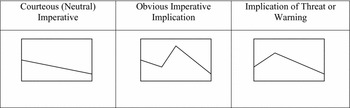
Léon (Reference Léon1974) presents a more thorough analysis of this ‘imperative modality’. Three socio-pragmatic meanings are described: (1) ‘énoncés impératifs ‘courtois’’(‘courteous imperative statements’) whose intonation largely mirrors that of declarative contexts, (2) an ‘implication impérative d’évidence’ (‘obvious imperative implication’) marked by sharp phrase-final turn in F0, and (3) an ‘implication de menace ou d'avertissement’ (‘threatening or warning implication’) identified with a phrase-final contour that rises very high before an abrupt fall (264–267). Léon (Reference Léon1974) notes that this contour mirrors an intonation pattern described in Fónagy and Magdics (Reference Fónagy and Magdics1963) as sawtooth in shape and is used to express anger in declaratives. Figure 2 recreates these three imperative contours.
Schematic illustrations of three imperative modalities identified in Léon (Reference Léon1974: 276).

2.3 Intonation contours in Parisian urban youth vernacular
Unfortunately, empirical studies on the Parisian urban youth vernacular's intonation curves which apparently sound like ‘engueulades’ (‘verbal slanging matches’) are relatively scarce. The existing studies on the subject, however, describe a prevalent intonation contour similar in form to Léon's (Reference Léon1974) contour expressing an ‘implication of threat or warning’, potentially explaining the threatening interpretation of a verbal argument (Figure 2). Conein and Gadet (Reference Conein, Gadet, Androutsopoulos and Scholz1998) analyze several recordings in an attempt to delimit potential linguistic markers of this vernacular. In reference to intonation, the authors cite two prosodic patterns with which they associate two different social meanings. The first pattern is termed ‘héréditaire (parigote ou faubourienne)’, or ‘hereditary (vernacular Parisian or suburban)’, and is said to be ‘caracterisée par les écarts mélodiques, les accents d'intensité, et une accentuation sur l'avant-dernière syllabe d'un groupe, longue et intense’Footnote 5 (109). These authors observe that ‘parmi les jeunes de banlieue, certains continuent à pratiquer ce schéma’Footnote 6 (109). The second prosodic pattern is said to be newer and is characterised by either penultimate stress or a particularly prominent phrase-final syllable (110). Listeners ‘qualifient généralement ce deuxième accent ‘d'accent beur’, bien qu'on l'entende chez toutes sortes de jeunes. . . et certains beurs ne l'ont pas’Footnote 7 (110).
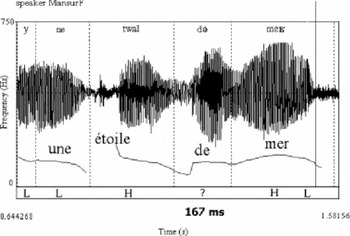
Fagyal (Reference Fagyal2003, 2005) presents a production study undertaken with recordings made during ethnographic fieldwork in La Courneuve, ‘among the poorest neighborhoods north of Paris’ (Fagyal, 2005: 91). Testing claims of the prosodic distinctiveness of the speech of French adolescents of North African descent, the author isolated the IP-final intonation contours produced by 12 collège pupils during a picture-naming task. Six of these students were French-Arabic or French-Berber bilinguals, the other six were monolingual speakers of French. In an analysis of the contours realised on five target words, Fagyal (2005) finds that her bilinguals’ productions did not appear to contain reliable lengthening of IP-penultimate syllables as compared to those of the monolingual speakers. Instead, the author recognises a preponderance of cases of early alignment of General French's phrase-final F0 rise (Section 2.1) in the bilinguals’ productions. In this pattern, the phrase-final rise appears to move towards the penultimate and anti-penultimate syllables, with a fall occurring on the final syllable. Fagyal (Reference Fagyal2003, 673–674) illustrates this ‘early alignment’ pattern with the fundamental frequency contour seen in Figure 3.
Waveform and fundamental frequency rendering of a production of une étoile de mer, depicting a phrase-final ‘rise-fall’ (adapted from Fagyal, Reference Fagyal2003: 673).

Finally, Lehka-Lemarchand (Reference Lehka-Lemarchand2007) presents both production and perception studies conducted in similar kinds of communities in Rouen. Although Rouen is located in a different dialect area from the Paris region, the author documents an urban youth vernacular similar to the Parisian vernacular described in Conein and Gadet (Reference Conein, Gadet, Androutsopoulos and Scholz1998) and analyzed in Fagyal (Reference Fagyal2003, 2005). Examining production data, Lehka-Lemarchand (Reference Lehka-Lemarchand2007) also notes that penultimate lengthening is not commonplace in prosodic phrases judged to exemplify the Rouennais urban youth vernacular. Prior to undertaking perceptual testing of the contour identified, the author notes that ‘l'une des caractéristiques saillantes de la configuration prosodique dégagée lors nos tests préliminaires [sic] est la réalisation de chutes abruptes de fréquence fondamentale (F 0), indiquant les frontières d'unités prosodiques’ Footnote 8 (92).
The intonational pattern analyzed in these three studies appears to vary slightly in form and socio-indexical meaning, in a manner reminiscent of Di Cristo's (Reference Di Cristo, Hirst and Di Cristo1998) ‘modality of imperative enunciation’ in which pitch features conveying imperative meaning ‘can [also] apply to other types of utterances’ (208). However, of the expressive intonation contours described in Section 2.2, the patterns described globally resemble the contour associated with imperative intent expressing ‘implication of threat or warning’ (Figure 2). Conein and Gadet (Reference Conein, Gadet, Androutsopoulos and Scholz1998), Fagyal (Reference Fagyal2003, 2005) and Lehka-Lemarchand (Reference Lehka-Lemarchand2007) make it clear, however, that certain speakers frequently use this contour in neutral declarative contexts, with no imperative intent whatsoever.
Although a discussion of the origin of this contour's use in neutral declarative contexts in the Parisian urban youth vernacular is outside the scope of this article, the possibility of influence of language contact between Parisian French, le français populaire and immigrant languages has been evoked elsewhere (see Fagyal, 2005). It is also conceivable that this modality has become a ‘marker’ (Labov, Reference Labov2001: 197) of the Parisian urban youth vernacular. That is, for listeners this contour type may be evocative of language practices associated with this urban vernacular, not imperative intent, particularly when combined with other, similarly connoted socio-phonetic markers. Such an analysis appears particularly fitting in light of Bachmann's observations of the high degree of salience associated with this prosodic pattern for naïve listeners, cited in Section 1 (Genin, Reference Genin1995). Speakers who use this modality may then possess a composite tonal inventory, combining contours found in General French, le français populaire and the Parisian urban vernacular, and style shift between the tonal inventories of each (see Fagyal and Stewart, in press).
The present study concentrates on how these prosodic cues alone or jointly evoke socio-indexical meaning for Parisian listeners. A perception study was carried out with participants who had previously evaluated the linguistic correctness of 21 towns in the Paris region in a language attitudes survey. The next section lays out the experimental methodology used, including a brief description of the study's stimuli and the resynthesization methods used to make them.
3 METHODOLOGY
3.1 Experimental task
Thirty-four Parisians who had previously participated in a survey on Parisian language attitudes were contacted and invited to take part in an online study on ‘Parisian French’. To access the study, participants clicked on a link provided in recruitment materials. Upon arriving at the page hosting the study, participants first read a text that contextualised the experimental task by asking participants to help Marie, a provincial school teacher trying to guess where her students might live based on their pronunciations of certain words. After reading through instructions explaining the experimental interface and being asked to put on headphones, participants were taken to the main experimental task.
In this perceptual mapping task, participants were asked to listen to a series of stimulus items and associate each stimulus with a city, represented by small green markers. After having selected a city for each stimulus item, participants indicated the level of certainty of their choice of city using a sliding bar. Participants then submitted that information, the next pronunciation of the stimulus word was loaded and participants continued to the next trial.
Respondents heard eight such stimuli varying in terms of penultimate and final syllable duration and F0 (Section 3.3) for each of five stimulus words (animaux ‘animals’, bagages ‘luggage’, bijoux ‘jewels’, image ‘image’ and légume ‘vegetable’) for a total of 40 stimuli. Stimuli were blocked by stimulus word; blocks and the stimuli within blocks were presented in a random order. Stimuli were inserted into a carrier sentence consisting of ‘Ça c'est’ (‘This is. . .’) and an appropriate definite or indefinite article, both taken from the same recording as the stimulus word.
3.2 Placement of stimuli as evaluations
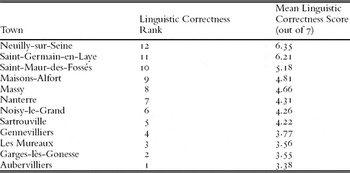
The 12 communes from which participants judged to stimuli to come represent a selection of the 21 towns in the Paris region evaluated in a previous language attitudes survey. This language attitudes survey asked participants to help a family moving to the Paris region by rating areas based on three evaluative criteria, one of which was linguistic correctness. This item asked about the degree to which the family's children could learn ‘good French’ in these towns (‘Dans cette commune les enfants apprendront à bien parler français.’) on a scale ranging from 1 (‘completely disagree’) to 7 (‘completely agree’). Ratings of the 21 towns’ linguistic correctness were subjected to non-metric multidimensional scaling and hierarchical agglomerative clustering analyses in R (R Development Core Team, 2005). Inspection of clustering diagrams and scaling displays indicated the existence of a group of towns with the most favorable linguistic correctness ratings (Neuilly, Saint-Germain-en-Laye, Saint-Maur-des-Fossés, Maisons-Alfort) and a group subject to highly negative language attitudes (Gennevilliers, Aubervilliers, Garges-lès-Gonesse, Les Mureaux). The former group includes some of the wealthiest areas in the 21 city sample; the latter four are amongst the poorest. Towns in this latter group appear to function as perceptual poles of non-standard Parisian French and are likely the same places singled out by Kuiper's (Reference Kuiper2005) respondents as being ‘home to many immigrants who “distorted the language”’ (Kuiper, Reference Kuiper2005: 44).
Four additional towns with intermediate linguistic correctness ratings were added to these 8 areas. In the preceding language attitudes survey, these four towns had mean linguistic correctness ratings closest to the midpoint (4) of the scale used (1–7). These towns were Sartrouville, Noisy-le-Grand, Massy and Nanterre. For the purposes of analyzing listener responses in the present study, all 12 areas have been assigned a rank based on their mean linguistic correctness score in the language attitudes survey. Table 1 shows the ranking of the 12 towns based on their mean linguistic correctness scores.
Twelve areas used in perceptual mapping task with rank and mean linguistic correctness scores taken from previous language attitudes survey.

In order to facilitate reference to this metric, this linguistic correctness ranking will be referred to as an ‘evaluation’.Footnote 9
3.3 Stimuli
For each stimulus word in the current study, two productions were located in recordings of male adolescents performing picture-naming tasks during fieldwork in a middle school in La Courneuve (Fagyal, Reference Fagyal2003, 2005). In the first production, target words were produced with an F0 rise beginning early in the penultimate syllable and culminating in a pitch peak on the final, the final syllable typically being marked by lengthening and increased intensity. This prosodic configuration mirrors the continuation majeure and continuation mineure outlined in Delattre (Reference Delattre1966), both in shape and pragmatic meaning. This production will be termed the ‘RISE’ production.
In the second production, penultimate syllables appeared to have longer durations and to be marked by shallower F0 rises than the penults in the RISE productions. In these productions, pitch peaks typically occurred around the end of the penultimate or the beginning of the final syllable and were followed by an F0 fall in the final syllable. Final syllables were frequently shorter in duration when compared with neighboring syllables, particularly the penult. The contour type seen in this second production was, then, much closer in form to the imperative intonation pattern discussed in Delattre (Reference Delattre1966), Léon (Reference Léon1974) and Di Cristo (1988) than any sort of continuation contour type. This second production type will be called the ‘RISE-FALL’ production.
Although RISE and RISE-FALL production types for each stimulus word were initially impressionistically determined, subsequent testing of the prosodic properties of the two groups revealed notable acoustic differences.Footnote 10 This testing targeted penultimate and final syllable duration, as a percentage of the overall duration of the stimulus word, and F0 contour shape. Penultimate and final syllable boundaries were marked using visual inspection of pitch tracks, spectrograms and waveforms and confirmed by listening to the speech files. Using Wilcoxon rank sum tests,Footnote 11 penultimate syllable durations in RISE productions (Median = 34.75%) were found to be significantly shorter than penultimate syllable durations in the RISE-FALL productions (Median = 43.94%), [W = .5, p < .05].Footnote 12 Stronger evidence of prosodic differentiation was found, however, in differing pitch peak alignment patterns between the two production types. Again, RISE-FALL productions appeared to have an intonation curve that peaked around the penultimate-final syllabic boundary whereas RISE productions’ pitch peak appeared to occur towards the end of the final syllable. RISE-FALL productions were, in fact, shown to have a pitch peak occurring at a point significantly earlier in the target word (Median = 59.78% of total utterance duration) than the RISE productions (Median = 84.63% of total utterance duration), [W = 24, p < .01]. Acoustic analysis then lends support to the hypothesis of systematic, significant differences between the two production types. Specifically, it would appear that, in comparison to the RISE productions, RISE-FALL productions contain (1) a pitch peak aligned earlier in the IP and (2) a reliably lengthened penultimate syllable. RISE and RISE-FALL productions for the stimulus word animaux are shown in Figure 4.
RISE and RISE-FALL production types of the stimulus word animaux.

3.3.1 Resynthesis procedures used to build stimuli
These 10 recordings, RISE and RISE-FALL productions of the five stimulus words (animaux, bagages, bijoux, image and légume), were then used to derive the stimuli used in the present study. Varying durational and intonational configurations were built into the RISE production of each of the five stimulus words. By building these conditions into only one production of each word, participants only heard one production per stimulus word and any potential confounding effect of segmental variation was neutralised. All resynthesis procedures were conducted in Praat (Boersma and Weenink, Reference Boersma and Weenink2011).
First, two durational conditions were resynthesised for each stimulus word's penultimate and final syllable: a base length and a lengthened condition. Resynthesis of syllabic duration was accomplished by segmenting all 10 recordings using PRAAT's TextGrid functionality and then submitting individual syllables to a PRAAT script that altered their duration using a linear interpolation algorithm. Stimuli were built with base (short) and lengthened (long) penultimate and final syllables for both the RISE and RISE-FALL production types.
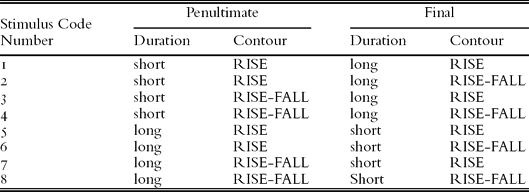
Next, another PRAAT script was used to transpose the RISE-FALL contour's penultimate and final syllable pitch movements onto the RISE production's short penultimate and long final syllables. This resynthesis procedure recalibrated the RISE-FALL production's pitch range to fit that of the RISE production. In this way, stimuli were built with the pitch range of the RISE production, but the penultimate and final syllable pitch movements of the RISE-FALL production. Stimuli were thus made with identical voice quality, but distinct phrase-final F0 contours and durations. In all, eight such stimuli, illustrated in Table 2, were built for each of the five stimulus words making a total of 40 stimuli.
Stimuli code numbers and corresponding durational and prosodic configurations.
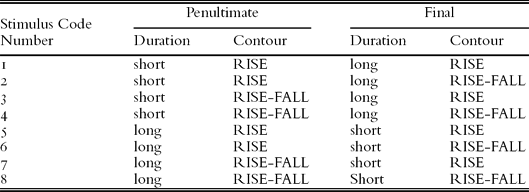
In order to facilitate future reference to individual stimuli, a code number will be assigned to each of the eight prosodic configurations. Table 2 displays the code number assigned to the prosodic configuration assigned to each stimulus.
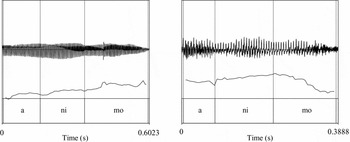
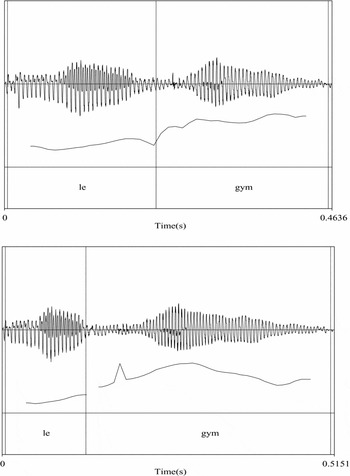
Figure 5 shows two of the resynthesised stimuli used in this study. The top waveform and pitch track display depict légume stimulus 7: long penultimate syllable bearing the RISE-FALL F0 contour and a short final syllable with the F0 contour of the RISE production. On the bottom is légume stimulus 4: short penultimate and long final and the RISE-FALL production's pitch movements on both the penultimate final syllables.
Two of the légume stimuli: long penultimate with RISE-FALL F0 contour and short final with RISE contour (top), short penultimate and long final with RISE-FALL pitch movements on both phrase-final syllables (bottom).

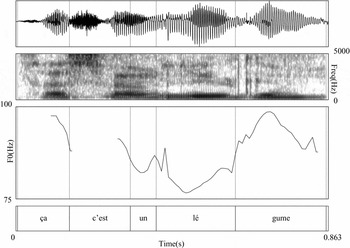
Finally, the blurring of formant transitions present in the original productions resulted in asynchronous pitch periods at syllable boundaries. These pitch periods were excised and replaced by their more synchronous neighboring periods. Although no formal test of the naturalness was carried out, the author and several colleagues listened to the stimuli several times and found them to sound fairly natural. Stimuli were converted from .wav to .mp3 files in order to be compatible with SoundManager2, the platform on which audio were presented on the website hosting the experimental task. Variable bit rate conversion was undertaken in dBPoweramp using the LAME encoder with the setting that provided the least costly compression (estimated bit rate = 240 kbps). A frequency manipulator was also set to ‘as source’, further ensuring a low degree of compression. Once converted, stimuli were impressionistically indistinguishable from the original .wav files. Figure 6 shows the final stimulus item with carrier sentence for légume stimulus 4, pictured in the bottom panel of Figure 5.
Waveform, spectrogram and pitch track of légume stimulus #4 after repair of formant transitions between syllables and .mp3 conversion.

3.3.2 Stimuli evaluation hypotheses
The varying phrase-final prosodic configurations seen in Table 2 demonstrate the variety of intonational configurations heard in the stimuli, presented with the aim of delimiting the prosodic characteristics of an intonational pattern likely to be associated with the Parisian urban youth vernacular. Although other linguistic features may have varied among the productions heard, clear patterns of stimulus evaluations across stimulus words would be a strong indication of the role of the prosodic configurations used.Footnote 13
Stimulus 1 mirrors the pattern cited in Delattre (Reference Delattre1966) as a continuation majeure/ mineure: a short penultimate and long final syllable with a phrase-final F0 rise. Stimulus 8 contains all of the prosodic traits documented as being indicative of the Parisian urban youth vernacular: a relatively long penultimate syllable bearing a shallow F0 rise and a shorter final syllable with a falling contour. This prosodic configuration is similar to the contour type noted by Léon (Reference Léon1974) as indicating ‘implication de menace ou d'avertissement’. Stimuli 1 and 8, the stimuli most similar to the original RISE and RISE-FALL production types, were then hypothesised to book-end evaluations, stimulus 1 receiving the highest scores and stimulus 8 the lowest.
Evaluations attributed to other stimuli would indicate the strength with which different prosodic configurations trigger the perception of the Parisian urban youth vernacular. Should the alignment of the phrase-final F0 rise be primarily responsible for cuing the intonation contour in question, stimuli with a penultimate RISE-FALL intonation (stimuli 3, 4, 7 and 8) would be evaluated differently from the others. If penultimate lengthening is a reliable cue to the intonation contour under examination, stimuli 1, 2, 3 and 4 would be evaluated more positively than stimuli 5, 6, 7 and 8. Because stimuli 5, 6, 7 and 8 also have a short final syllable, such a pattern would also indicate that the absence of phrase-final lengthening is an important part of this prosodic contour, as indicated in Lehka-Lemarchand (Reference Lehka-Lemarchand2007).
4 RESULTS
4.1 Stimuli evaluations
Results were collected using the MySQL database utility. For each stimulus word, three pieces of data were collected from each participant: an evaluation (see Section 3.2), a degree of certainty rating and the number of times participants played each stimulus. RM-ANOVAs performed on degree of certainty ratings and play counts revealed no significant effects of either factor and, thus, this section will only discuss stimuli evaluations. This section will first present the results of an analysis of patterns in stimuli evaluations before moving on to consider the role of participants’ sociolinguistic experience in these evaluation patterns.
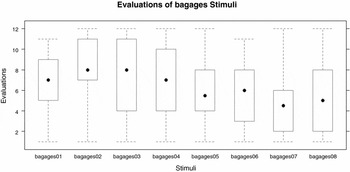
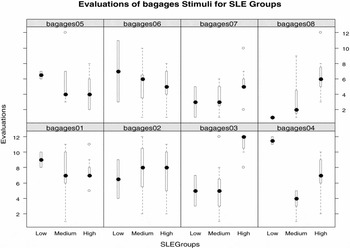
Figure 7 depicts evaluations for the bagages stimuli, which were typical of the evaluatory patterns of the majority of the stimulus words. More positive attitudes towards the stimuli are represented by evaluations with higher values.
Box plots of evaluations for the bagages stimuli.

In order to determine patterns in stimuli evaluations, these evaluations were submitted to Repeated Measures Analyses of Variance (RM-ANOVAs) for each word with stimulus item (1 vs. 2 vs. 3 vs. 4 vs. 5 vs. 6 vs. 7 vs. 8) as a within-subjects factor and subject as the error term. For all but one of the five stimulus words, the results indicated a significant main effect of stimulus item on evaluation: animaux [F(7, 175) = 2.0721, p <.05], bagages [F(7, 182) = 4.0546, p <.01], image [F(7, 147) = 2.0777, p <.05], légume [F(7, 154) = 2.2104, p < .05]. The stimulus word bijoux, however, showed no statistically significant main effect of stimulus on evaluation [F(7, 161) = 1.3911, p >.05]. No explanation was readily available for the absence of a main effect in evaluations of the bijoux stimuli. The rest of this section will concentrate on the other four stimulus words.
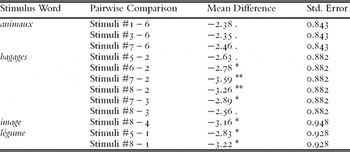
Considerable differences in stimuli evaluations can be seen in Figure 7, suggesting that certain intonation contours were subject to highly positive evaluations and others to much more negative ratings. In order to determine which particular stimuli were subject to significantly different evaluations, post hoc testing was undertaken on the mean evaluations of all stimuli, save those of bijoux. Tukey Honestly Significant Differences (Tukey HSD) tests were performed on stimuli evaluations. This test is used to find particular levels of a variable whose means are significantly different from another level, reporting the distinctive levels as pairs. In this case, the pairs would indicate stimuli whose evaluations show the greatest disparity. If particular stimuli consistently constitute the lower evaluation in such pairs, the prosodic configurations they contain would be likely to cue the perception of the Parisian urban youth vernacular. The results of the Tukey HSD tests are shown in Table 3. For the prosodic configurations contained in each of the stimuli, the reader is invited to consult Table 2.
Stimuli with significantly different mean evaluations as shown using Tukey HSD tests (p <.1 = ., p <.05 = *, p <.01 = **)

The three significant pairwise comparisons for the animaux stimuli appear to pattern differently from the pairwise comparisons highlighted for the bagages, image and légume stimuli. For the latter three stimulus words, the lower rated stimulus of the pairwise comparisons carries a lengthened penultimate and a short final, the higher rated stimuli having a short-long configuration. In the animaux pairwise comparisons, however, stimuli 1, 3 and 7 make up the lower rated stimuli with stimulus 6 receiving the higher rating. The lower rated stimuli (1, 3 and 7) have fairly dissimilar prosodic configurations: stimulus 1's phrase-final prosodic configuration closely resembles that of the continuation majeure or mineure, stimulus 3 has a short-long duration configuration but a RISE-FALL penultimate intonation and RISE final, stimulus 7 is identical to stimulus 8 except for a RISE intonation on the final. Stimulus 6, the higher rated stimulus in all three significant pairwise comparisons for the animaux stimuli, contains a long-short durational configuration and a RISE penultimate / RISE-FALL final. This pattern suggests that this word's eight stimuli were evaluated differently from the other stimulus words.
For bagages, image and légume, one of stimuli 5, 6, 7 and 8 constituted the more negatively evaluated pair of all significant pairwise comparisons. For all three, stimulus 8 had a mean evaluation that differentiated it from another, more positively evaluated stimulus. Stimulus 8 incorporated a long penultimate and short final syllable with a RISE-FALL intonation contour on both. This stimulus was hypothesised to receive the most negative evaluations and it did for three of the four stimulus words with significant main effects. For both animaux and bagages, stimulus 7, identical to stimulus 8 except for a final syllable RISE F0 contour, constituted the lower rated pair. Similarly, stimulus 5, with a short-long penultimate-to-final durational configuration its only resemblance to the RISE-FALL production type, was also the lower rated stimuli in two significant pairwise comparisons. The only commonality amongst these three lowest rated stimuli is a long penultimate syllable and a short final. In both the highest and lowest rated prosodic configurations, then, penultimate-to-final durational configuration appears to be a key cue to the presence or absence of the Parisian urban youth vernacular.
Overall, it would appear that the suite of prosodic characteristics in stimulus 8, long-short durational configuration and RISE-FALL intonation on both syllables, is the most negatively rated combination. Given the low linguistic correctness ratings of the towns it was consistently identified with, it is highly probable that its durational and intonation properties are the most effective trigger of the distinctive contour type associated with the Parisian urban youth vernacular.
4.2 Sociolinguistic experience and stimulus word evaluations
A final analysis was undertaken to determine if participants with varying levels of sociolinguistic experience (SLE) might evaluate stimuli differently. Clopper and Pisoni (Reference Clopper and Pisoni2004a, Reference Clopper and Pisonib; Reference Clopper and Pisoni2006) observed that individuals classify dialectal variation more accurately if they are more likely to have heard such variation, terming this the effect of ‘linguistic experience’. A test of the effect of ‘sociolinguistic experience’ posited that the more copious and diverse an individual's experience with different types of language practices, the less probable it is that he or she will negatively evaluate even highly stigmatised socio-phonetic variation. Conversely, participants with less sociolinguistic experience were hypothesised to consistently place instantiations of the Parisian urban youth vernacular in areas with low linguistic prestige.Footnote 14
In order to test this hypothesis, evaluations for the four stimulus words were submitted to a split plot repeated measures design, incorporating stimuli evaluations as a within-subjects factor and participants’ SLE as a between-subjects factor. SLE scores were grouped into ‘Low’, ‘Medium’ and ‘High’ levels using groupings indicated by a k-means clustering analysis. For the purposes of illustrating the patterns that obtained, the box plot in Figure 8 shows evaluations of all eight bagages stimuli grouped by participants’ SLE level (low, medium or high). Again, more positive attitudes towards stimuli are reflected by evaluations with a higher value. Of particular interest are evaluations of bagages stimuli #5, 6, 7 and 8, indicated in the previous section to be particularly poorly evaluated.
Box plots of stimuli evaluation for bagages stimuli with evaluations grouped by subjects’ level of sociolinguistic experience.

Of the stimuli designated by the Tukey HSD tests as being the more negatively evaluated member of statistically significant pairwise comparisons, the majority were evaluated more harshly by low SLE participants than by their high SLE counterparts. Figure 8 shows that this trend is not absolute. However, stimulus 8, the stimulus whose prosody most closely matched that of the RISE-FALL production type, had higher evaluations for high SLE participants than for low SLE participants for all four stimulus words. The split plot RM-ANOVAs indicated main effects of evaluations on SLE groupings significant at the α = .1 level for three of the four stimulus words: animaux [F(2, 16) = 1.9280, p = .167], bagages [F(2, 13) = 5.5874, p < .05], image [F(2, 10) = 3.5567, p = .06812] and légume [F(2, 11) = 5.0144, p < .05]. Evaluations and SLE levels for each of these three stimulus words were then submitted to post-hoc Tukey HSD testing to determine which levels of SLE might form statistically significant contrasts. Only one pairwise comparison, medium and high SLE for bagages, proved meaningful [Mean = 1.5357, SD = 0.6156, p < .05].
The small number of participants and stimulus items excludes firm conclusions on the role of sociolinguistic experience in the perception of socially stigmatised variation. However, this testing does suggest that individuals with a more diverse linguistic background are less likely to negatively evaluate a prosodic contour indicative of the Parisian French urban youth vernacular.
5 DISCUSSION
These results shed considerable light on the relevant acoustic details of intonation patterns in Parisian French which are associated with an urban youth vernacular. Statistical testing of the two production types from which the stimuli were synthesised indicated that RISE and RISE-FALL stimuli differed reliably in terms of pitch peak alignment and penultimate syllable duration (Section 3.3). The results presented in Section 4.1.1 showed that listeners pick up on these differences. Stimulus 8, containing all the phrase-final prosodic characteristics of the RISE-FALL productions, most frequently occurs as the lower rated stimulus in pairs indicated by the Tukey HSDs to have significantly different mean evaluations. Stimuli 5 and 7 were each the lower rated stimulus in statistically significant pairwise comparison on two occasions.
Taken together, these results indicate that penultimate prosodic prominence, either in duration or intonation, is vital to the identification of a contour type related to the Parisian urban youth vernacular. In more phonological terms, it may be that this penultimate prominence leads to the perception of a trochaic-type foot, a ‘strong-weak’ patternFootnote 15. According to these results, such a phrase-final accentual pattern appears to contrast perceptibly with General French's iambic (weak-strong) stress pattern. This interpretation would also go some way in explaining the unusual evaluations of the animaux stimuli, as disyllabic words are likely better exemplars of a trochaic foot, i.e. a phrase-final weak-strong-weak pattern is rare in metropolitan French (Jun and Fougeron, Reference Jun, Fougeron and Botinis2000: 216).
Although the methodology employed does not allow for conclusions as to why these stimuli were evaluated more negatively than others, it is possible that participants reacted to hearing a contour cuing the imperative modality in a sentence that, in lexical and syntactic terms, did not call for such a contour. Alternatively, this contour type may have become fossilised as a marker of le français populaire in general and the Parisian urban youth vernacular in particular.
Finally, listener's sociolinguistic background was shown to influence patterns of stimuli evaluation. It was hypothesised that individuals more experienced in dealing with linguistic diversity would express more tolerant attitudes towards even socially stigmatised language practices. Results gave a qualified confirmation of this hypothesis. RM-ANOVAs undertaken with evaluations and respondents’ SLE scores produced a significant main effect at α< .1 for three out of four stimulus words (see Section 4.1.2). For seven of the 10 stimuli forming the lower rated stimulus in significant pairwise comparisons, high SLE respondents rated stimuli used higher mean evaluations than those with low SLE. In this first testing of sociolinguistic experience, SLE was therefore seen to constrain socio-indexical evaluations of an intonation contour characteristic of the Parisian urban youth vernacular under examination.
6 CONCLUSIONS
This study offers an effective methodology for testing attitudes towards an accentual pattern associated with poorer communities with large ethnic minority populations in the Paris region. A prosodic contour type with a phrase-final strong-weak trochee-like pattern was associated with towns with low levels of linguistic prestige. Evaluations were obtained by presenting the experimental task as a perceptual mapping exercise, after which ‘placements’ were converted to evaluations using linguistic correctness ratings from a previous language attitudes survey. The specific acoustic properties of the contour type were demonstrated by speech resynthesis techniques used to produce stimuli with varying durational and intonational characteristics. Finally, different patterns of evaluation were shown to obtain for respondents with different types of language backgrounds. Participants with more copious and diverse experience with different language practices generally used overall higher mean evaluations than those with more limited sociolinguistic experience. The results speak to the utility of the methodology used to ‘focus more specifically on the exact linguistic elements that give rise to perception’ (Preston, Reference Preston and Preston1999: xxxviii). In the case of Parisian French, these results speak to the salience of prosodic variation in cuing the perception of a pronunciation pattern associated with poorer communities with large multi-ethnic populations.