Introduction
Carrot, Daucus carota var. sativus Hoffmann (Apiaceae), is an important crop in Canada with a farm gate value of CAD$129.3 million (Statistics Canada 2017). Carrot weevil, Listronotus oregonensis (LeConte) (Coleoptera: Curculionidae), is a serious pest of carrot that can be found in Canada from Nova Scotia to Manitoba (LeBlanc and Boivin Reference LeBlanc and Boivin1993). Adults overwinter near or in fields, emerging in the spring to seek food and oviposition sites. Carrot weevil feed not only on members of the Apiaceae but also weedy hosts such as Queen Anneʼs lace (Daucus carota Linnaeus) and parsnip (Pastinaca sativa Linnaeus) (Boivin Reference Boivin1999). Carrot weevil oviposition is reported to occur on the leaf petiole or in the crown of the plant during the fourth to seventh true-leaf stage (Boivin Reference Boivin1988), and this is followed by egg hatch and feeding by larvae that produces a continuous furrow around the carrot root when feeding (Joseph etal. Reference Joseph, Cutler and Blatt2018). When ready to pupate, the fourth instar leaves the carrot root and pupates in the soil. Reports of damage caused by this pest in North America include 90% yield loss in Iowa, United States of America (Harris Reference Harris1926), 50–90% loss in southern Illinois, United States of America (Chandler Reference Chandler1926), and 40% loss in Québec, Canada (Martel et al. Reference Martel, Svec and Harris1976; Boivin Reference Boivin1985). Currently, carrot weevil is reported as having widespread occurrence with moderate pest pressure in Ontario and Nova Scotia, Canada and high pest pressure in Québec (Pesticide Risk Reduction Program 2017). Carrot weevil typically has one generation in Canada (Stevenson Reference Stevenson1976; Boivin Reference Boivin1985), though a second generation can appear when conditions are appropriate (Boivin Reference Boivin1999).
Growers currently monitor carrot weevil populations in Nova Scotia using whole or sections of carrot as bait (carrot bait) in Boivin traps (wooden plate trap) (Ghidiu and VanVranken Reference Ghidiu and VanVranken1995). This method can require numerous traps to effectively cover larger acreages and can miss the start of emergence if an insufficient number of traps are used. Further, Boivin traps also attract click beetles (Agriotes sputator (Linnaeus); Coleoptera: Elateridae), which feed on the carrot bait and contribute frass to the trap. Despite this, the presence of click beetles was not found to deter carrot weevil entering the trap (Joseph et al. Reference Joseph, Cutler and Blatt2018). Current strategies to manage carrot weevil include crop rotation and pesticide application in early spring when a trap catch of 1.5 weevils/traps is recorded (Boivin Reference Boivin, Howard, Garland and Seaman1994).
Predicting key phenological events in the life history of an insect using degree-day (DD) models can complement and improve the use of monitoring tools or refine the timing of pesticides for control (Pruess Reference Pruess1983; Higley et al. Reference Higley, Pedigo and Ostlie1986, Purcell and Welter Reference Purcell and Welter1990). The DD7 model for L. oregonensis was developed in Québec, Canada, where carrot weevil adults were found to oviposit on carrot baits when 147 ± 9 DD7 have accumulated after 1 April (Boivin Reference Boivin1988) and no carrot weevil activity was observed before this date. However, this model was not designed to predict carrot weevil oviposition on carrot plants nor emergence of adults from overwintering. Predicting when carrot weevils will emerge from overwintering and move to traps allows growers to select an optimal spray timing to affect the majority of the population. Predicting oviposition on carrot plants is useful because it allows the grower to more accurately determine when to assess their crop for an estimate of damage. The combination of models provides growers the estimate potential damage and to manage L. oregonensis populations.
Degree-day models are often used to describe and predict insect phenology as they are simple and use the generally accepted most important factor affecting insect development, temperature (see Nietschke etal. Reference Nietschke, Magarey, Borchert, Calvin and Jones2007 and references therein). Prior to these models, insect development was modelled using data collected from the laboratory or field using both linear and nonlinear approaches to determine rate of development from one life stage to the next, or the length of time spent at a particular life stage (Hilbert and Logan Reference Hilbert and Logan1983; Briere and Pracros Reference Briere and Pracros1998; Briere etal. Reference Briere, Pracros, Le Roux and Pierre1999; Damos and Savopoulou-Soultani Reference Damos and Savopoulou-Soultani2012). The benefit of using rate of development models is their accuracy, while the benefit of a degree-day model is its simplicity. When comparing the phenology of a species between field sites or regions, specific life history events (e.g., onset of emergence, 50% emergence or peak flight) are used to evaluate previously developed degree-day models (Lee and Spence Reference Lee and Spence1987; Tauber etal. Reference Tauber, Tauber, Obrycki, Gollands and Wright1988a, Reference Tauber, Tauber, Obrycki, Gollands and Wright1988b). The drawback with trying to compare one-time events between sites is the inability to statistically compare single-point data.
The objective of this research was to use a nonlinear regression to develop and validate degree-day models to predict carrot weevil emergence and oviposition on carrot baits and plants using data collected from commercial carrot fields in Nova Scotia during 2015 and 2016.
Materials and methods
Study fields and weather data
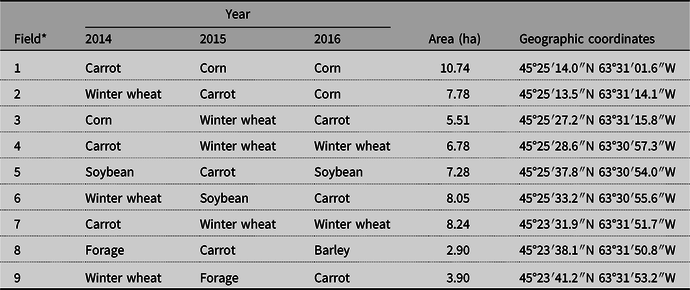
Carrot weevil emergence and oviposition were recorded during the growing seasons of 2015 and 2016 at six fields near Debert and three fields near Glenholme, Nova Scotia (Table 1). Each field had carrots (variety: Cupar) grown in rotation with corn (Zea mays Linnaeus; Poaceae), barley (Hordeum vulgare Linnaeus; Poaceae), winter wheat (Triticum aestivum Linnaeus; Poaceae), forage, or soybean (Glycine max (Linnaeus) Merrill; Fabaceae) (Table 1). Carrot weevil emergence and oviposition (on carrot baits) were monitored in each field during 2015 and 2016 using modified Boivin traps (Ghidiu and VanVranken Reference Ghidiu and VanVranken1995). Half hourly air temperature near each field was monitored using weather stations (WatchDog 1400, SpecWare, Woodville, Ohio, United States of America) attached to wooden stakes and placed approximately 0.5 m above the soil surface. Stations were located within 500 m of the carrot field being monitored (Table 1). Temperature data were used to calculate cumulative DD7 starting on 1 April using the following equation:
 $${\rm{DD}} = \sum \left( {{{\rm{T}}_{{1\over 2}{\rm{hour}}}} - {{\rm{T}}_{{\rm{base}}}}} \right) \Big /48$$
where  ${{\rm{T}}_{{1\over 2}{\rm{hour}}}}$ is the air temperature recorded every half hour and Tbase is the base air temperature where carrot weevil development will occur. The base air temperature of 7 °C was chosen as it is the base temperature for carrot plant development (Simonet and Davenport Reference Simonet and Davenport1981) and insects are often synchronised with the development of their hosts (Yukawa Reference Yukawa2000).
Fields located in Colchester County, Nova Scotia, Canada (year with carrot crop, area, and geographic coordinates) used to collect data on carrot weevil oviposition and emergence in 2015 and 2016.

* Weather station for fields 1–3 located at: 45°25′15.834″N 63°31′8.9508″W, for fields 4–6 located at: 45°25′31.6914″N 63°31′6.9414″W, and for fields 7–9 located at: 45°23′35.7246″N 63°31′58.224″W.
Carrot weevil emergence and oviposition on carrot bait and field carrots
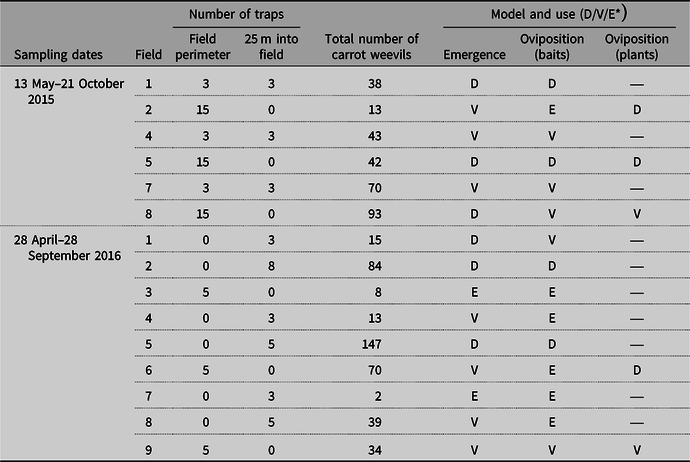
Carrot weevil emergence and oviposition on baits were monitored using modified Boivin traps spaced 50 m apart, in and around fields (Table 2). Six fields in 2015 and nine fields in 2016 were monitored for carrot weevil. Of the six fields in 2015, three were previously planted in carrot and had traps placed around the perimeter, as carrot weevils are reported to overwinter in adjacent hedgerows and walk into fields in search of their host (Stevenson Reference Stevenson1985). We also had traps placed 25 m into the field based on previous work showing that carrot weevil can overwinter in the field on leftover carrot. The remaining three fields were current year carrot fields and only had traps placed around the perimeter. Fields in 2016 were three current year carrot fields (traps placed around the perimeter) and six previous year carrot fields (traps placed 25 m into the field). Traps were baited with a store-bought, longitudinally cut carrot root section (approximately 25 cm long). Traps were checked twice per week from 13 May to 21 October 2015 and from 28 April to 8 September 2016. On each monitoring date, carrot weevils were removed by striking traps in a white plastic box. Carrot root sections were replaced in each trap, and carrot weevils were brought back to the laboratory and counted. Voucher specimens are deposited with the Agriculture and Agri-Food Canada, Kentville Research and Development Centre insect collection (Kentville, Nova Scotia, Canada). Carrot baits were taken back to the laboratory and dissected under the microscope where the number of oviposition punctures and eggs were counted.
Sampling dates, field, number of traps, and trap location, and total number of carrot weevils collected in fields used for carrot weevil model development and validation in Colchester County, Nova Scotia, Canada, in 2015 and 2016.
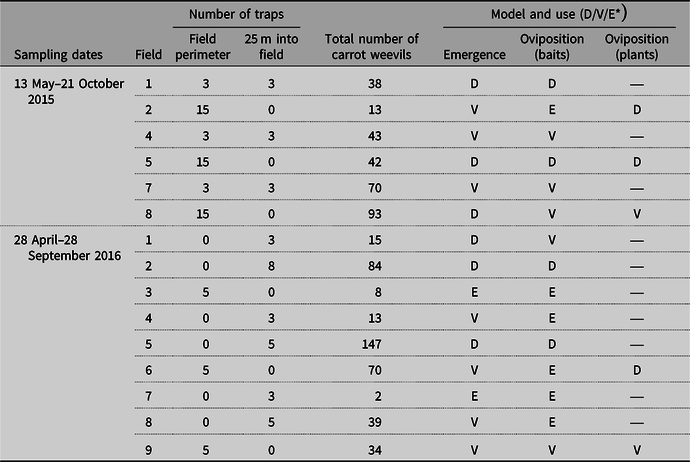
* D = used to develop the model, V = used to validate the model, E = excluded due to insufficient data, — denotes field not sampled.
Three fields in 2015 and two fields in 2016 were used to monitor oviposition on carrot plants. When carrot plants reached the second-true-leaf stage, 25 plants were randomly chosen from an area measuring 3 m in length within each of three rows, starting with the row where the trap was located and moving into the field and sampling the next two rows (for perimeter traps) or sampling the row on either side of the trap (for in-field traps) and inspected for oviposition punctures. Plants with oviposition marks on the leaf petioles were uprooted and taken back to the laboratory where eggs and/or larvae were counted. We used the descriptions reported by Whitcomb (Reference Whitcomb1965) and Martel et al. (Reference Martel, Svec and Harris1976) to identify the collected carrot weevil eggs.
Development of degree-day models
Data sets for model development were chosen randomly from the total list of fields where data were collected. As the same fields were monitored over two years, we use the term “field-year” to identify the specific field (and year) using the following convention: field followed by year (e.g., 1-2016). The model for carrot weevil emergence was developed using cumulative per cent emergence data from six field years (1-2015, 5-2015, 8-2015, 1-2016, 2-2016, 5-2016). Models for oviposition on carrot baits and carrot plants were developed using cumulative per cent oviposition data from four field years (1-2015, 5-2015, 2-2016, 5-2016) and three field years (2-2015, 5-2015, 6-2016), carrot bait and carrot plants, respectively (Table 2). For the analysis, some fields had to be excluded due to insufficient data caused by wildlife interference, e.g., deer (Odocoileus virginianus (Zimmermann); Artiodactyla: Cervidae) ate the carrot. For carrot weevil emergence, we excluded two fields (3-2016, 7-2016), and for oviposition on baits, we excluded six field years (2-2015, 3-2016, 4-2016, 6-2016, 7-2016, 8-2016).
Cumulative per cent carrot weevil emergence, oviposition on carrot baits, and oviposition on carrot plants were related individually to cumulative DD7 with a sigmoidal Hill equation of the form:
 $$Y = {{{\rm \theta }}_1}{x^{{{{\theta }}_{2\;}}}}/\left( {{{\theta }}_3^{{{{\theta }}_2}} + {{\rm{x}}^{{{{\theta }}_2}}}} \right)$$
where Y is the cumulative per cent emergence, oviposition on carrot baits, or oviposition on carrot plants, x is the cumulative DD7, θ1 is the theoretical maximum emergence or oviposition, θ2 is a shape parameter, and θ3 is the DD7 at 50% emergence or oviposition. Fitting of nonlinear equations and parameter estimation were done using the Gauss–Newton algorithm in PROC NLIN of SAS (SAS version 9.4, SAS Institute, Cary, North Carolina, United States of America).
Evaluating fit and validation of degree-day models
Goodness of fit for all models was assessed using the coefficient of determination (R 2), adjusted coefficient of determination (R 2Adj), and root-mean-square error (RMSE) (Archontoulis and Miguez Reference Archontoulis and Miguez2015) calculated as follows:
 $${R^2} = 1 - {{\sum {{\left( {{y_{obs}} - {y_{pred}}} \right)}^2}} \over {\sum {{({y_{obs}})}^2}}}$$
and
 $$R_{Adj}^2 = 1 - {{n\left( {1 - {R^2}} \right)}\over {\left( {n - p} \right)}}$$
and
 $$RMSE = \sqrt {(1/n)\sum \limits_{i = 1}^n {{\left( {{y_{obs}} - {y_{pred}}} \right)}^2}} $$
where yobs is the observed value, ypred is the predicted value, n is the number of observations, and p is the number of parameters in the regression equation (Bowley Reference Bowley2008). Goodness of model fit was based on low root-mean-square error values (root-mean-square error ranges from 0 to 100 with values closer to zero constituting a good fit) and R 2Adj values close to 1.
The model for cumulative per cent carrot weevil emergence was validated with emergence data from seven field years (2-2015, 4-2015, 7-2015, 4-2016, 6-2016, 8-2016, 9-2016). Models for oviposition on carrot baits and carrot plants were validated with oviposition data from five field years (4-2015, 7-2015, 8-2015, 1-2016, 9-2016) and two field years (8-2015, 9-2016), oviposition on carrot baits and carrot plants, respectively (Table 2). Emergence or oviposition data for each field used in the validation process were expressed as a cumulative percentage and plotted as a function of DD7. Emergence and oviposition predictions for each field were then calculated using the models and plotted against observed emergence and oviposition. R 2 and root-mean-square error were used to assess agreement between predicted and observed data.
Results
General trends in carrot weevil emergence and oviposition
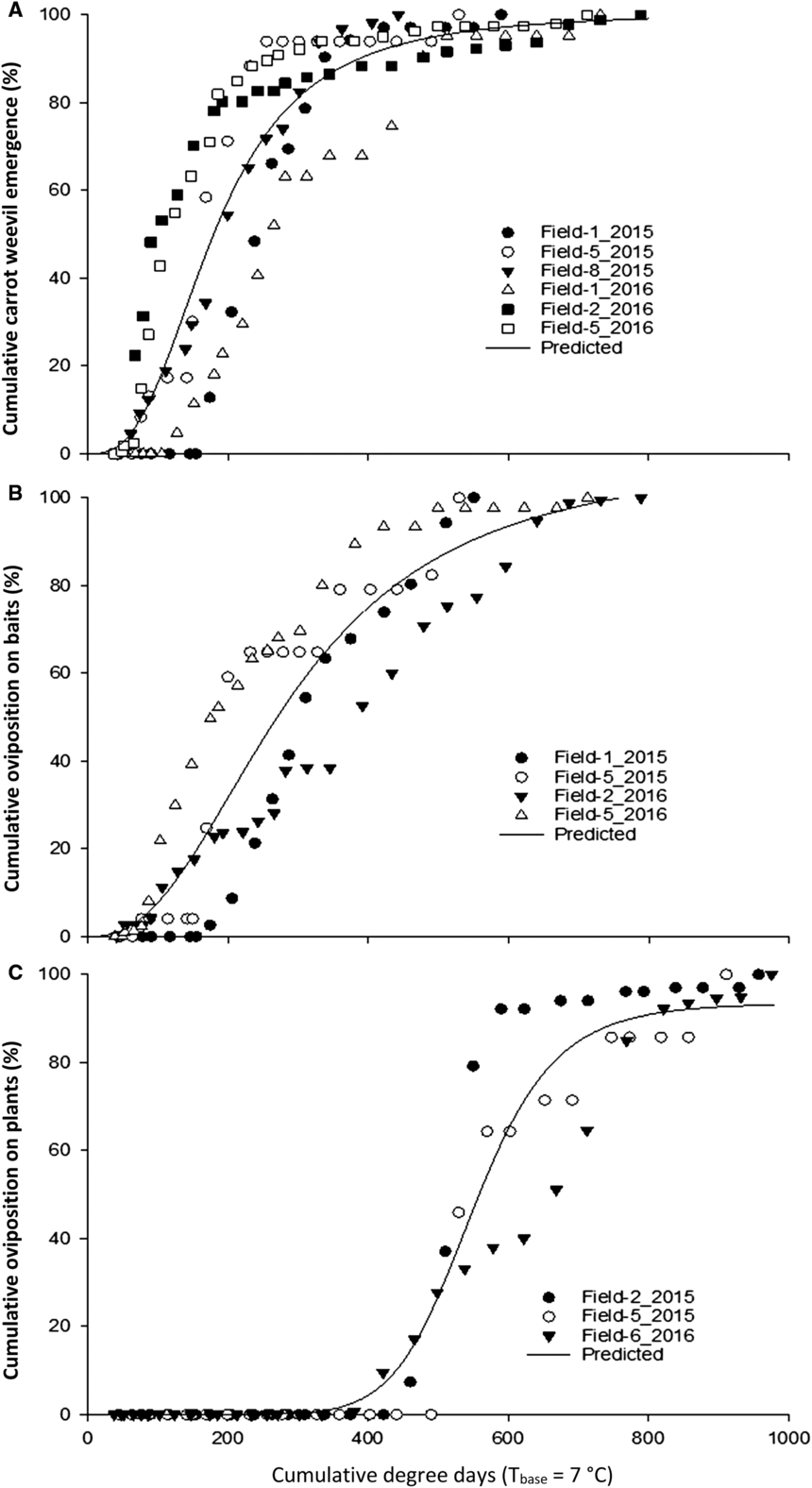
Carrot weevil emerged and moved into the traps between 44 and 174 DD7 (2–31 May, Fig. 1A). Emergence continued until 932 DD7 (2 August) with 90% of the carrot weevils emerged by 387 DD7 (23–28 June, Fig. 1A). Initial oviposition on carrot baits occurred between 49 and 310 DD7 (2–17 May) and continued until 789 DD7 (29 July–2 August, Figs. 1B, 2). Oviposition on carrot plants began later than on baits, starting at 379–529 DD7 (23 June–2 July) and continued until 988 DD7 (15 August, Figs. 1C, 3). All oviposition punctures on carrot plants were observed on the petiole with no eggs found on the crown. Oviposition on carrot plants started at the fourth true-leaf stage, but thereafter occurred frequently until the eleventh true-leaf stage (Table 3). In 2015, 77% of oviposition occurred between the fourth and eighth true-leaf stages, whereas in 2016, only 63% of oviposition occurred between these growth stages. The remaining 23% (in 2015) and 37% (in 2016) of eggs were laid on more mature carrot stages, as late as the eleventh true-leaf stage (Table 3). A total of 2403 eggs were laid: 2066 on carrot baits and 337 on carrot plants. Eighty-five per cent of the total number of eggs were laid on carrot baits with 55% of these laid before the first oviposition on carrot plants was observed at 342 DD7.
Per cent cumulative carrot weevil emergence (A), cumulative oviposition on baits (B), and oviposition on plants (C) in relation to cumulative degree days (DD7) calculated from air temperature (Tbase = 7 °C) at fields used for model development. The line represents the fitted sigmoidal Hill equation of the form  $Y = {{{\rm \theta }}_1}{{\rm{x}}^{{{{\theta }}_2}}}/({{\theta }}_3^{{{{\theta }}_2}} + {{\rm{x}}^{{{{\theta }}_2}}})$. Parameter estimates and goodness of fit statistics for the sigmoidal Hill equation are presented in Table 4.

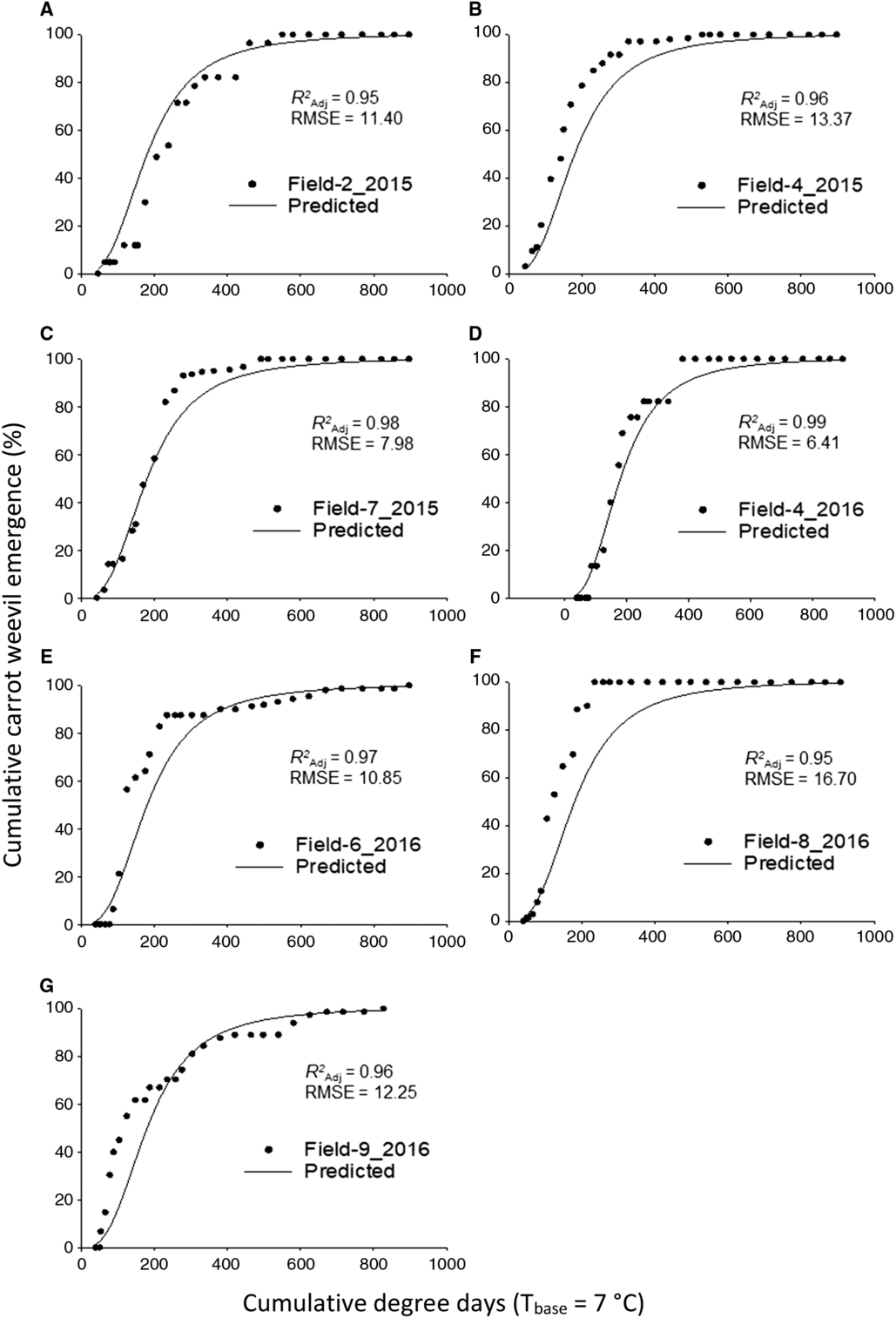
Observed and model-predicted cumulative per cent carrot weevil emergence in relation to cumulative degree days calculated from air temperature (Tbase = 7 °C). Panels A–G show the field-years used to test the model with R 2 and root-mean-square-error (RMSE) values for goodness of fit. Lines are the model predictions from the sigmoidal Hill equation of the form  $$Y = {{{\theta }}_1}{{\rm{x}}^{{{{\theta }}_2}}}/({{\theta }}_3^{{{{\theta }}_2}} + {{\rm{x}}^{{{{\theta }}_2}}})$$.

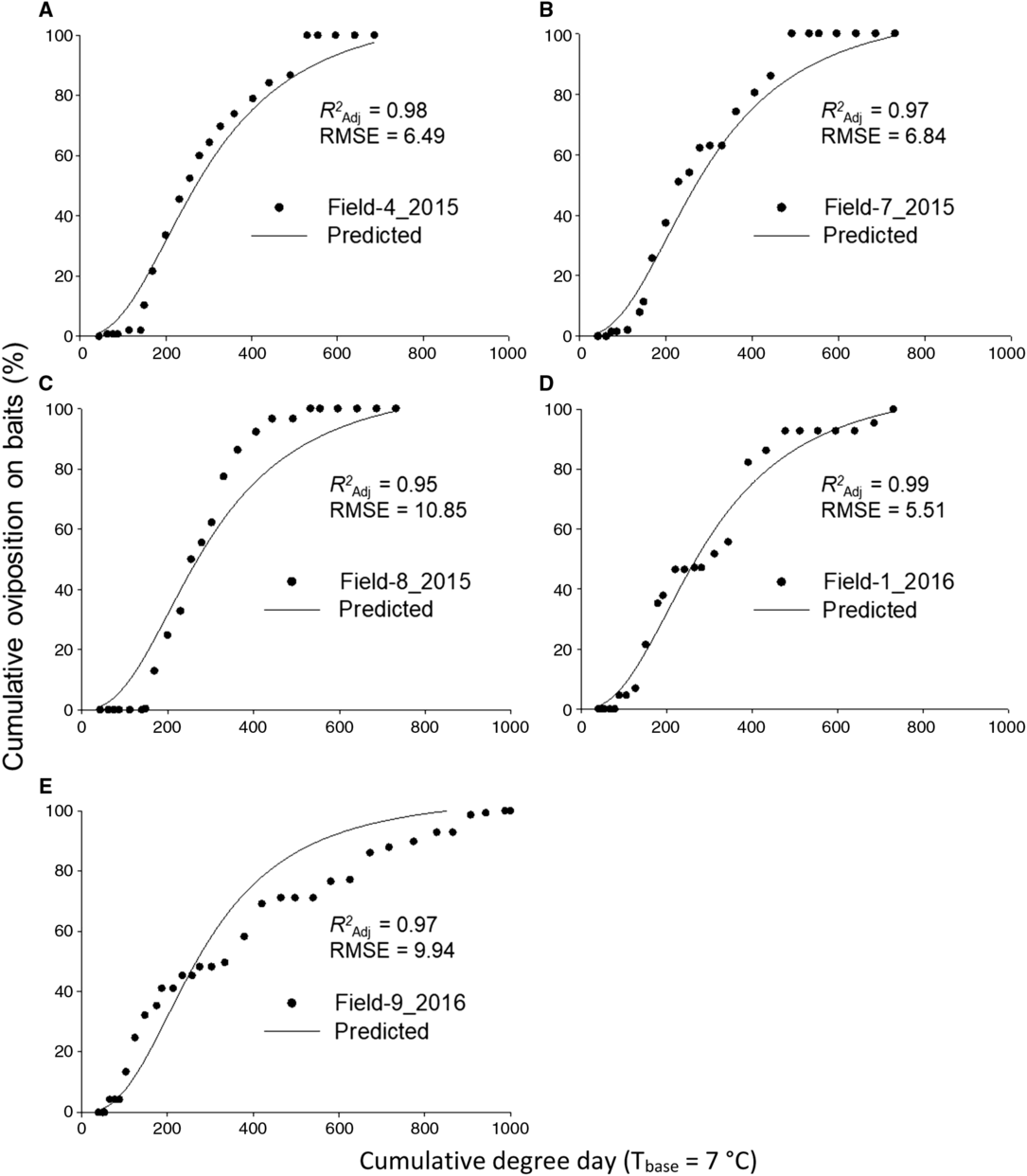
Observed and model-predicted cumulative per cent oviposition on bait carrots in relation to cumulative degree days calculated from air temperature (Tbase = 7 °C). Panels A–E show the field years used to test the model with R 2 and root-mean-square-error (RMSE) values for goodness of fit. Lines are the model predictions from the sigmoidal Hill equation of the form  $$Y = {{{\theta }}_1}{{\rm{x}}^{{{{\theta }}_2}}}/({{\theta }}_3^{{{{\theta }}_2}} + {{\rm{x}}^{{{{\theta }}_2}}})$$.

Mean number (percentage) of carrot weevil eggs found on carrot plants at different growth stages. Data taken from all six fields monitored in 2015 and all nine fields monitored in 2016.

* No eggs were observed on carrots before the fourth true-leaf stage.
Development of degree-day models
Plotting cumulative per cent carrot weevil emergence, oviposition on carrot baits, and oviposition on carrot plants as a function of DD7 allowed for standardisation of the data across fields better than using day of year (data not shown). The sigmoidal Hill equation to describe the relationship between per cent emergence and oviposition (both bait and plant) gave good fit with the field data (Fig. 1, Table 4). R 2 values were 0.95 or greater with oviposition on carrot plants having the best fit using this method (R 2 = 0.96, RMSE = 8.87). Developed model parameters predicted the onset of carrot weevil emergence, oviposition on carrot baits, and oviposition on carrot plants to occur at 35, 42, and 342 DD7, respectively. Emergence of 90% of the adults was predicted to occur at 333 DD7, with 50% predicted to occur by 187 DD7 and 10% predicted by 103 DD7. Oviposition (10%, 50%, and 90% of all eggs) on carrot baits was predicted to occur at 144, 262, and 470 DD7. On carrot plants, oviposition (10%, 50%, and 90% of all eggs) was predicted to occur at 440, 558, and 765 DD7, respectively.
Parameter estimates and goodness of fit statistics for the proposed sigmoidal Hill equation describing the relationship between cumulative growing degree days calculated from air temperature (Tbase = 7 °C) and cumulative per cent adult emergence, oviposition on bait carrots, and oviposition on carrot plants in Nova Scotia, Canada.*

* The sigmoidal Hill equation was of the form  ${\rm{Y}} = {{{\theta }}_{{1}}}{{\rm{x}}^{{\theta }}}^{{2}}/ ({{{\theta }}_{{3}}}^{{{\theta 2}}}+ {{\rm{x}}^{{\theta }}}^{{2}})$.
† Sigmoidal Hill model parameters: θ1 is the theoretical maximum emergence or oviposition, θ2 is a shape parameter, and θ3 is the degree day at 50% emergence or oviposition.
‡ Root-mean-square error.
§ Parentheses indicate standard error of parameter estimates.
Model validation
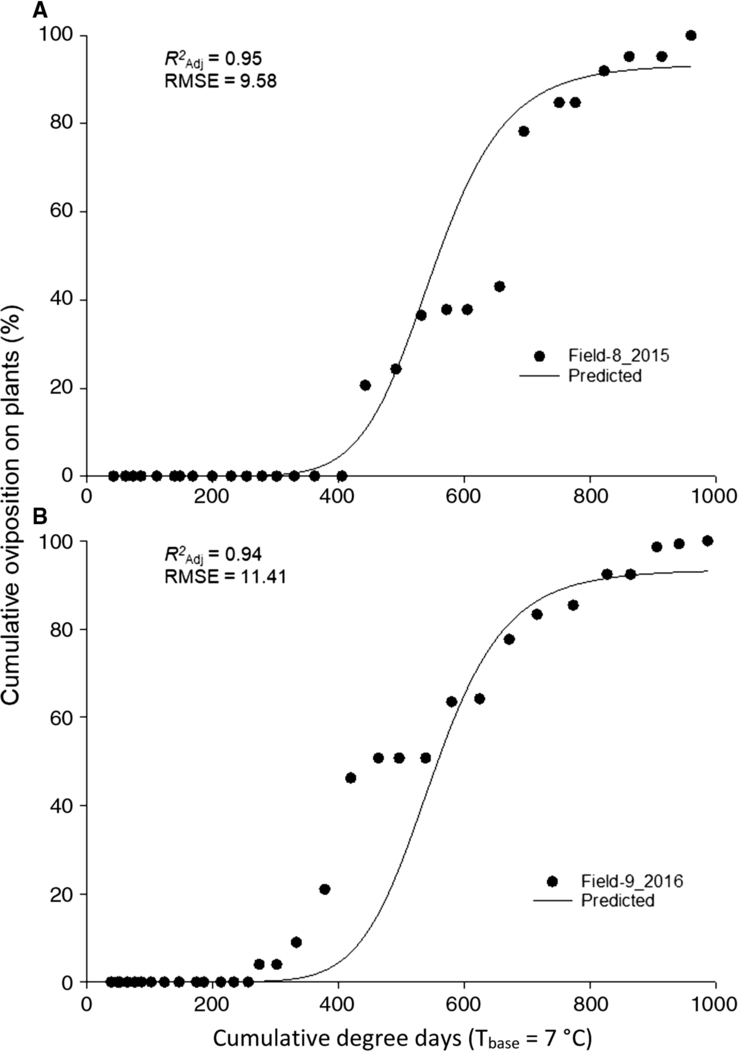
Field years used to validate the developed models predicted carrot weevil emergence, oviposition on carrot baits, and oviposition on carrot plants relatively well (Figs. 2–4). Fields used to validate the models generally had high R 2 (ranging from 0.94 to 0.99) and low root-mean-square error (ranging from 5.51 to 13.37), indicating a good fit with the developed models. Of the fields scoring lower R 2 and higher root-mean-square error values, these occurred for the oviposition on carrot plants, with 2016–9 (R 2 = 0.94, RMSE = 11.41) having oviposition occurring earlier than predicted and 2015–8 (R 2 = 0.95, RMSE = 9.58) having oviposition occurring later than predicted (Fig. 4A–B). These results are likely due to the low number of fields available to develop the model. For all of the seven fields used to validate adult emergence, the predictions of first emergence were accurate within 22 DD7. Model predictions for the initiation of oviposition on carrot baits were generally earlier than observed in all fields (Fig. 3A–E).
Observed and model-predicted cumulative per cent oviposition on carrot plants in relation to cumulative degree days calculated from air temperature (Tbase = 7 °C). Panels A and B show the field-years used to test the model with R 2 and root-mean-square-error (RMSE) values for goodness of fit. Lines are the model predictions from the calibrated sigmoidal Hill equation of the form  $$Y = {{{\theta }}_1}{{\rm{x}}^{{{{\theta }}_2}}}/({{\theta }}_3^{{{{\theta }}_2}} + {{\rm{x}}^{{{{\theta }}_2}}})$$.

Discussion
In this study, we used the DD7 model developed by Boivin (Reference Boivin1988), accumulating heat units after 1 April, and applied nonlinear methods to describe the emergence and oviposition patterns of carrot weevil in Nova Scotia. The pattern of oviposition differed between populations in Nova Scotia and Québec (using historical data). Oviposition in Nova Scotia, and historically in Québec, started on carrot plants at the fourth true-leaf stage. Nova Scotia had 70% of eggs laid on plants between the fourth and eighth true-leaf stage, while in Québec, Boivin (Reference Boivin1988) found 90% of eggs laid at these stages. Boivin (Reference Boivin1988) also reported oviposition before the fourth true-leaf stage, but this was less than 5%. Oviposition on carrot baits started at lower DD7 in Nova Scotia than historically observed in Québec, but reached 90% completion earlier in Québec than in Nova Scotia. This suggests that carrot weevil in Nova Scotia has an overall extended oviposition period relative to that observed in the 1980s for carrot weevil in Québec.
In laboratory studies, Simonet and Davenport (Reference Simonet and Davenport1981) reported a pre-oviposition period of 132 DD7 for carrot weevil females in Ohio, which is fairly close to the value reported in Québec in 1988. Oviposition sites on carrot baits at the same time that adults are first observed indicate that female carrot weevils emerge fecund. Variation between regions is likely due to population adaptation to local climatic conditions. Response to temperature can vary among insect populations of the same species. For example, Tauber etal. (Reference Tauber, Tauber, Obrycki, Gollands and Wright1988b) reported that two populations of Colorado potato beetle (Leptinotarsa decemlineata (Say); Coleoptera: Chrysomelidae) from New York, United States of America, also varied in their thermal requirement for oviposition, e.g., one population had a less intense diapause and required fewer degree days to initiate oviposition (135 degree days) than another population (213 degree days). We considered if earlier emergence of carrot weevil in Nova Scotia was related to temperature differences compared with Québec. Examination of the 10-year spring mean temperatures in Sainte-Clotilde, Québec (April: 6.7 °C; May: 14.2 °C) where Boivin conducted his studies shows it to be 3–4 °C warmer than Debert, Nova Scotia (April: 3.8 °C; May: 10.0 °C) (Environment Canada 2017). The lower DD7 requirement for adult emergence in spring suggests that Nova Scotia weevils may have adapted to cooler conditions and that possibly an even lower temperature threshold could be appropriate for this population.
A factor potentially affecting the data and contributing to the wide range of emergence DD7 values observed in this study could be proximity to a previous year carrot field. Carrot weevil is reported to walk between fields (Simonet and Davenport Reference Simonet and Davenport1981). We observed carrot weevils on leftover or volunteer carrots in fields that were planted with carrot the previous year. Current year crop in these fields could be wheat, soybean, or corn. This could explain a later arrival of carrot weevils in current year carrot fields, depending upon distance from previous year carrot fields, as these volunteer carrots could serve as a food source as well as a breeding site. Boivin (Reference Boivin1988) used experimental plots that were hand weeded with removal of leftover/volunteer carrots.
The nonlinear sigmoidal Hill equation described the emergence and oviposition patterns based on a degree-day model for carrot weevil reasonably well. Nonlinear models have been used to describe plant development (Ekeleme etal. Reference Ekeleme, Forcella, Archer, Chikoye and Okezie Akobundu2004; Dorado etal. Reference Dorado, Sousa, Calha, González-Andújar and Fernández-Quintanilla2008; White etal. Reference White, Boyd and Van Acker2012) but not combined with insect degree-day models to describe phenology patterns of insect activity. Use of such a nonlinear model allows for a statistical comparison of phenology patterns (e.g., emergence or oviposition) between fields or regions for an insect species. A model that quantifies the timing and duration of adult emergence and oviposition can also give useful information for an integrated pest management programme. Our oviposition models for both carrot baits and carrot plants provide a better understanding of when carrot weevil oviposition is occurring in the field. At present, growers typically apply pesticides to control their weevil populations at the fourth true-leaf stage and when trap captures reach a threshold average of 1.5 weevils/trap. Based upon the model developed here, growers could apply product earlier than the fourth true-leaf stage (generally observed to occur at 358 DD7 when first eggs are laid). Pree etal. (Reference Pree, Stevenson and Barszcz1996) also recommended pesticide application when carrots reached the second true-leaf stage to avoid oviposition. Adult weevils are moving around the fields and locating baited traps as early as 43 DD7. By 232 (± 23) DD7, 75% of the population is emerged and moving around the field. Product could be applied well ahead of their first oviposition opportunity and remove the majority of the population. To apply product based on trap captures, growers are likely only affecting 10% of the population. Should growers consider 75% an acceptable percentage of the population to target, the management window of opportunity would be approximately 126 DD7 (roughly 10–14 days depending upon temperature) before the fourth true-leaf stage is reached and oviposition on plants has begun.
As with all degree day models, individual year variation, as well as fields with microclimate effects (Page etal. Reference Page, Gallagher, Kemanian, Zhang and Fuerst2006), can introduce error into management recommendations. As carrot weevil adults overwinter in the soil, delay in soil warming may create discrepancy between air and soil temperatures, reducing accuracy of model predictions. Such discrepancy is often avoided by developing models for soil-dwelling organisms based on soil temperature (Myers etal. Reference Myers, Curran, VanGessel, Calvin, Mortensen and Majek2004); however, such models may be less useful for growers due to limited availability of yearly soil temperature data relative to air temperature data. There is also strong association between soil temperature at shallow depths and air temperature (Reimer and Shaykewich Reference Reimer and Shaykewich1980), likely lending sufficient accuracy to model predictions for practical purposes in most years. The rate of development of insect life stages can be influenced by temperature, often slowing at the lower and upper limits of development (Ludwig Reference Ludwig1928; Régnière etal. Reference Régnière, Powell, Bentz and Nealis2012). Temperatures near these limits during the spring could introduce error into the oviposition models as the air temperature could indicate accumulation in degree days, while the development of new eggs, and hence oviposition, could be delayed.
As carrot weevils do not appear to oviposit on carrot plants earlier than the fourth true-leaf stage, growers can determine the best time to manage their carrot weevil populations by using these models and cross referencing the recommendation with field observation of how rapidly their carrots are developing. Should a grower not use crop rotation as part of their management, these recommendations will likely not be accurate. Repeated plantings of carrot in a field will result in carrot weevil overwintering in the field with volunteer carrot, or leftover carrots postharvest, to sustain them until the crop has reached the appropriate growth stage. Volunteer carrots provide a food source and oviposition site for overwintering weevils within the field. Using the model to decide timing of spray could be challenging as these carrot weevils in the field emerge ready to oviposit, whereas the model is based upon carrot weevils having moved into the field seeking carrot. With carrot weevils present in the field, the window of opportunity for management becomes greatly reduced. By 81 ± 10 DD7, 10% of the carrot weevils have been captured in traps and by 148 ± 7 DD7, 10% of the oviposition on carrot baits has been observed. For growers to avoid increasing their carrot weevil population, product needs to be applied before oviposition occurs. At best, an application of product at approximately 130 DD7 will reach only 25% of emerged carrot weevil and increase the likelihood that a second application will be required. Crop rotation to manage carrot weevil populations by planting into new fields with no volunteer carrots can provide a grower with a larger management window of opportunity.
Growers can use our model to place their traps in the field earlier (to quantify their carrot weevil population) and to provide guidelines for management. Other options for control, such as bait stations, could be developed and use prior to seeding to reduce carrot weevil populations in new carrot fields or as a border between fields. Our DD7 models will guide growers in the timing of such control measures.
Acknowledgements
This study was supported by the Agriculture and Agri-Food Pest Management Centre (Project J-00035) and a Discovery Grant from the Natural Sciences and Engineering Research Council of Canada (grant RGPIN-2015-04639) to G.C.C.